KANTEI 4 – YAMASHIRO #28 – Nobukuni (信国) School 3

This time we continue with the Nobukuni smiths who were active around Ôei (応永, 1394-1428) and of which we can at least make out two individual names, Minamoto Saemon no Jô (源左衛門尉) and Minamoto Shikibu no Jô (源式部尉) Nobukuni. As mentioned in the previous chapter, everything points towards that these two were brothers and sons of the 2nd generation Nobukuni. Following Tsuneishi’s approach, there was a third son, Gyôbu no Jô (刑部尉), who seems to have been the first born son but who, according to Tsuneishi, only signed with “Nobukuni” and not with any honorary title or first name. This approach is insofar supported by the fact that there are no blades known which bear the title Gyôbu no Jô in the mei but several from that time, i.e. Ôei, whose niji-mei “Nobukuni” differs from that of Saemon and of Shikibu no Jô. Thus this Gyôbu no Jô might have been the official successor of the lineage, signed like his predecessors just in niji-mei, but was supported by his two brothers in keeping the Nobukuni workshop going. Incidentally, Saemon no Jô Nobukuni is also referred to as Genzaemon no Jô Nobukuni because the clan name Minamoto can also be read as Gen and “results” with the subsequent Saemon in another first name, Genzaemon. In other words, his mei of clan name plus first name was interpreted wrongly in some older sources, that is as a single first name, but this Genzaemon reading has become so widespread that it is also used as kind of a nickname for Minamoto Saemon no Jô Nobukuni.

In the following I would like to introduce some works of Minamoto Saemon no Jô and Shikibu no Jô Nobukuni which will be supplemented by Ôei-era Nobukuni works which do not match in terms of signature style with these two masters and who thus might be works of Gyôbu no Jô Nobukuni. But before I want to refer to the workmanship of the Ôei-Nobukuni smiths in general and what distinguishes them from similar works from other schools that were active at that time.

Typical for the Ôei-Nobukuni group in general is that it produced many horimono-laden sunnobi-tantô and hira-zukuri wakizashi with a nagasa of somewhere between 30 and 40 cm, some of which also being interpreted in more uncommon shapes like katakiriba-zukuri or unokubi-zukuri. In case of long swords, the sugata is a hint more stout than the rather elegant sugata with koshizori that was applied by Bizen smiths at that time. That is, the mihaba of Ôei-Nobukuni long swords is a little wider and the kasane is a little thicker than that of Ôei-Bizen blades. Ôei-Nobukuni works often show a hamon which is very similar to contemporary Ôei-Bizen koshi no hiraita interpretations with the difference that it is hardened in nie-deki or ko-nie-deki whereas the Ôei-Bizen hamon is in nioi-deki. A very prominent feature of Ôei-Nobukuni blades which is not seen on Ôei-Bizen blades is yahazu, i.e. dovetail-shaped gunome elements. Also some Ôei-Nobukuni blades may show ara-nie, a feature that is indeed also not associated with Ôei-Bizen. And due to the presence of nie, we see sunagashi, kinsuji and yubashiri, characteristics which are also usually don’t go with with Ôei-Bizen. In addition, the kaeri is usually more pronounced, wider, and runs back in a longer fashion than it is the case at Ôei-Bizen. Compared to “full blown” contemporary Sôshû, Ôei-Nobukuni blades are a little less nie-laden and although some tobiyaki and/or muneyaki might be present, there is usually no hitatsura (I say usually because there are very few Ôei-Nobukuni blades which do show a hitatsura or a strong tendency towards hitatsura). Also, Ôei-Nobukuni works in suguha or in shallow notare may show some Yamato elements like hotsure or kuichigai-ba. When it comes to the jigane, the Ôei-Nobukuni smiths also worked more Bizen-like in ko-itame mixed with mokume rather than in the typical Sôshû itame or ô-itame. However, there is usually masame or nagare which distinguishes their works from Ôei-Bizen and as the steel of Ôei-Nobukuni blades might tend to shirake a little, it differs from contemporary Fujishima blades which otherwise may look similar at first glance because Fujishima smiths too often hardened in a Bizen-style hamon. Also utsuri might be present but which appears more often at interpretations in suguha and that in a relatively weak manner and as bô-utsuri following the ha and not as midare-utsuri as seen at Ôei-Bizen.

*

Now let’s work out some individual characteristics among Ôei-Nobukuni works, starting with Minamoto Saemon no Jô Nobukuni. It is said that he signed in his early years with Nobumitsu (信光) and a blade signed that way which is dated Shitoku two (至徳, 1385) seems to be one of these early works of Saemon no Jô Nobukuni. When it comes to his main Nobukuni phase, we know dated blades from Ôei 9 to 34 (1402-1427) what seems a little odd at first glance because there is almost a 20-year gap between his Nobumitsu and his Nobukuni phase. Well, that gap might either explained by him not dating that often during those 20 years, by the fact that he was mostly working as a support to his older brorhter Gyôbu no Jô at that time, or by the fact that just no more blades from that time are extant. Most experts say that it was Saemon no Jô who hardened amongst all Ôei-Nobukuni masters the most flamboyant hamon, e.g. koshi no hiraita-midare, with the most prominent nie-hataraki. Accordingly, he and Osafune Morimitsu (盛光) are counted by some as the two greatest mastersmiths from the Ôei era. Also not to forget, he was an excellent horimono artist.

Picture 16 shows a very typical work of Saemon no Jô Nobukuni. It is an ubu tachi with a long nagasa of 80.3 cm, a normal mihaba, and a rather shallow sori for that length. It shows a somewhat standing-out itame-nagare with ji-nie and chikei and a gunome-midare in ko-nie-deki that is mixed with ko-notare, ashi, , sunagashi, and kinsuji. The nioiguchi is bright and please note that two gunome pair to yahazu-like elements in places. The bôshi is sugu with a little notare which tends to nie-kuzure. Both sides bear a bôhi which ends in marudome.
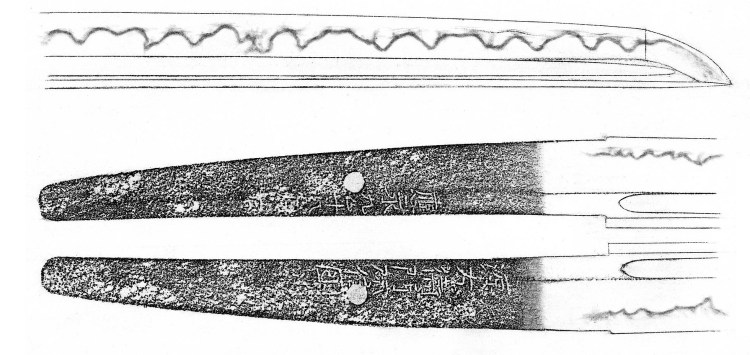
Picture 16: tachi, mei: “Minamoto Saemon no Jô Nobukuni” (源左衛門尉信国) – “Ôei kunen hachigatsu hi” (応永九年八月日, “a day in the eighth month of Ôei nine [1402]”), nagasa 80.3 cm, sori 1.8 cm, mihaba 2.8 cm, sakihaba 1.95 cm, shinogi-zukuri, iori-mune

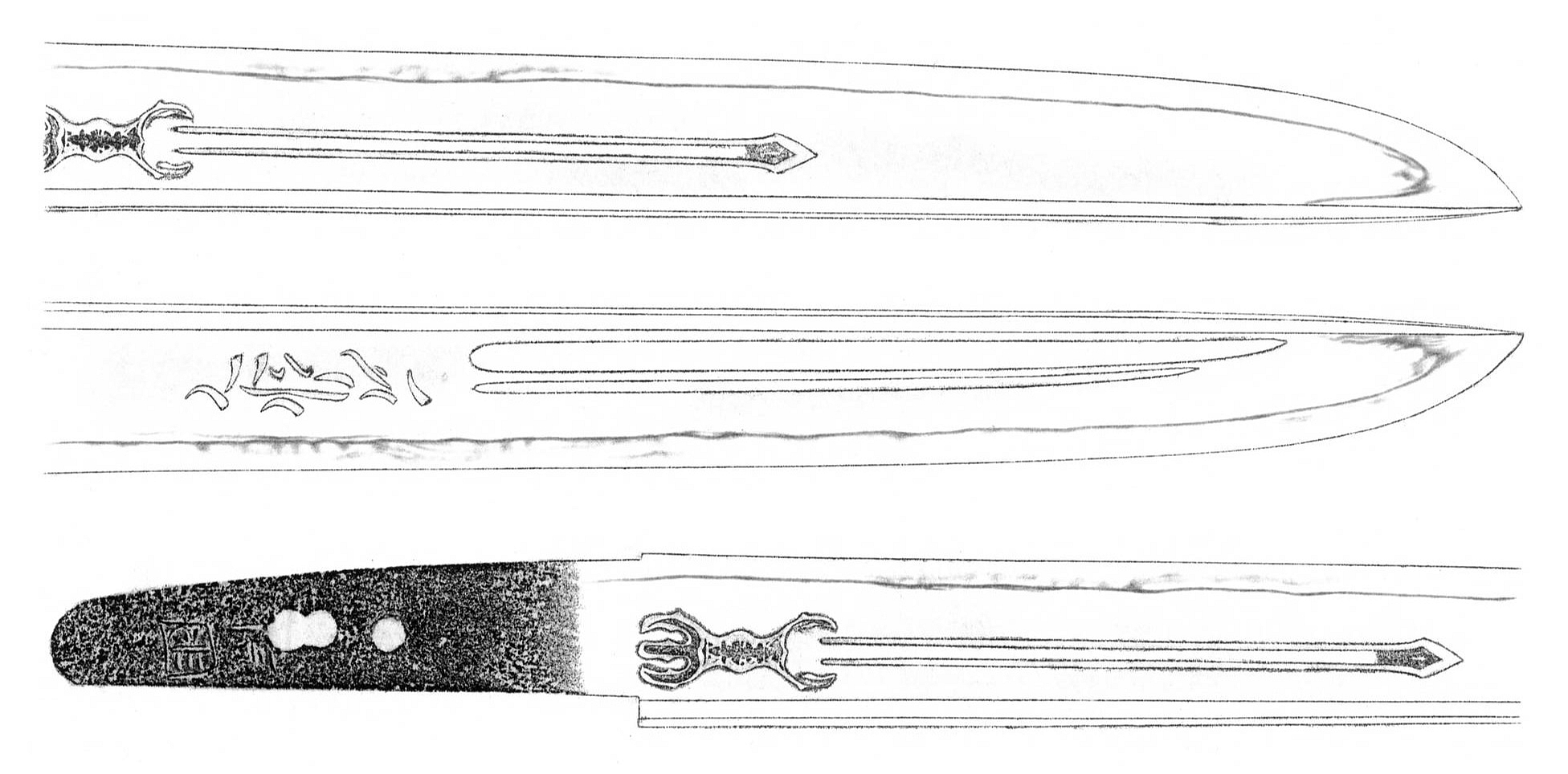
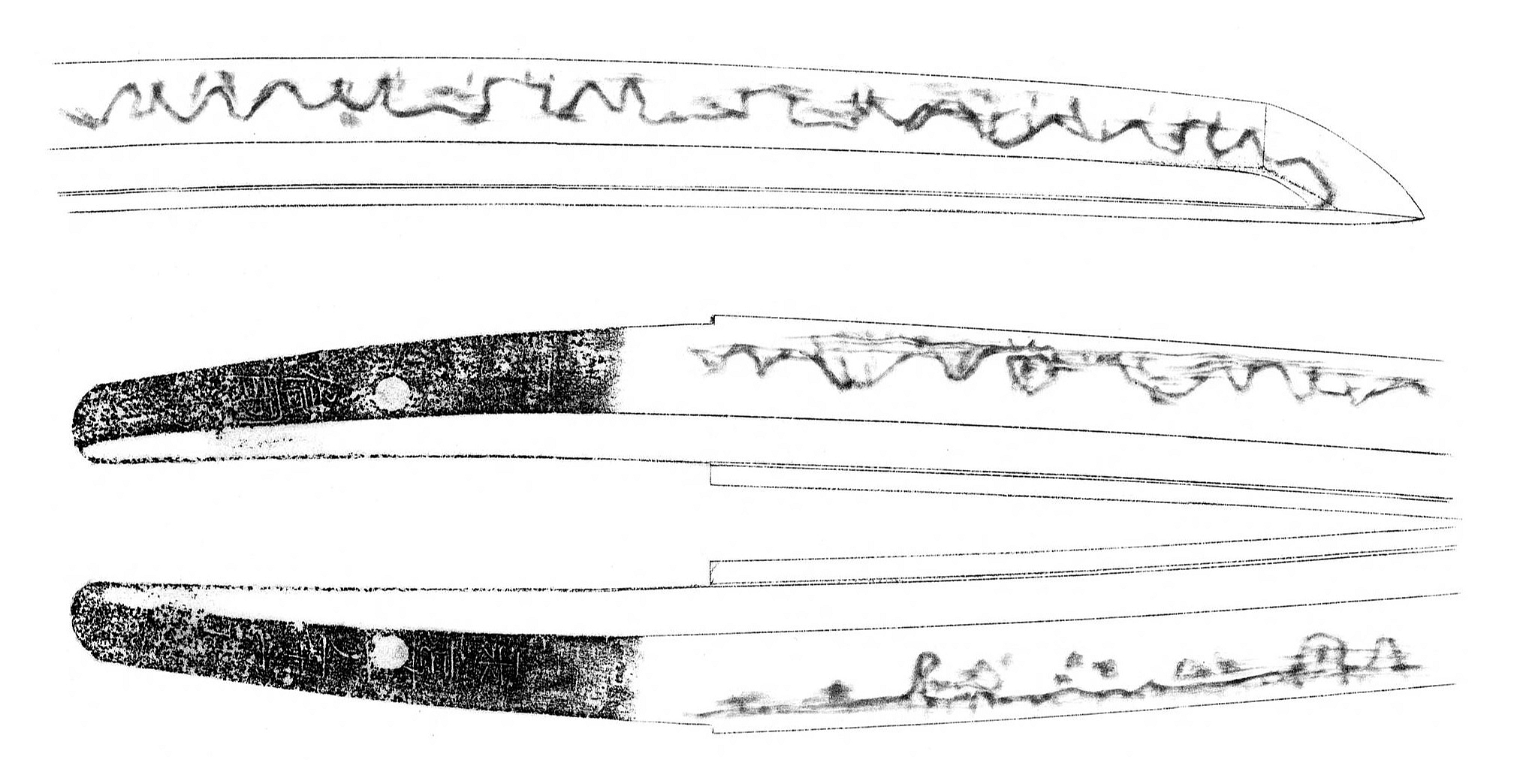
Another very typical work of Saemon no Jô is seen in picture 17. Please note that with Ôei, we have entered the time when shinogi-zukuri wakizashi started to become common. This is such a blade. It has a nagasa of 42.8 cm, a normal mihaba, tapers noticeably, has a thick kasane, and a shallow sori which tends to sakizori. The jigane is a rather standing-out itame that is mixed mokume, with nagare all over, and that shows ji-nie and fine chikei. The hamon is a nie-laden gunome-chô that is mixed with angular gunome, togariba, chôji, gunome that pair to yahazu, plenty of ashi and , kinsuji, sunagashi, and yubashiri-like tobiyaki along some yakigashira. The nioiguchi is wide and clear and the bôshi is midare-komi with hakikake and a ko-maru-kaeri on the omote, and a shallow notare-komi which runs out as yakitsume on the ura side. On the omote we see a bôhi with marudome with below a gyô no kurikara in a hitsu. The ura side bears a bôhi with kakudome with the relief of a bonji inside.
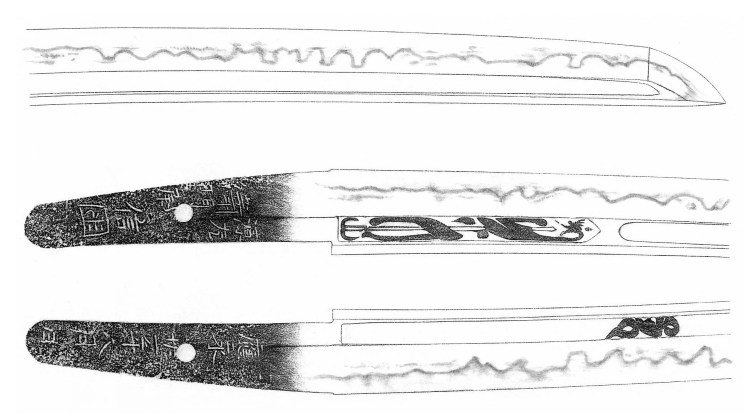
Picture 17: wakizashi, mei: “Minamoto Saemon no Jô Nobukuni” (源左衛門尉信国) – “Ôei nijûichinen hachigatsu hi” (応永廿一年八月日, “a day in the eighth month of Ôei 21 [1414]”), nagasa 42.8 cm, sori 0.8 cm, motohaba 2.7 cm, sakihaba 1.85 cm, shinogi-zukuri, iori-mune

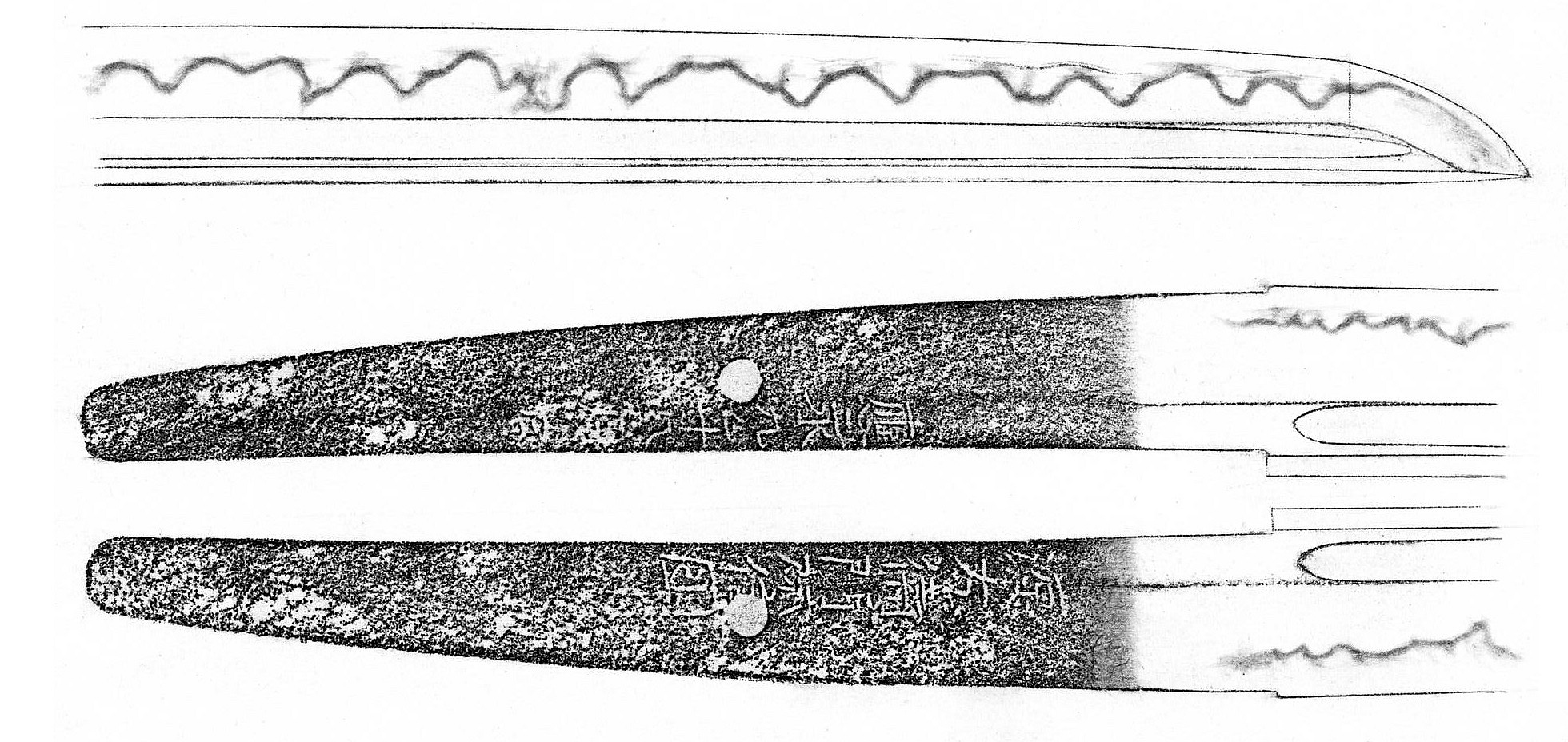
In picture 18 we see a sunnobi-tantô (or hira-zukuri ko-wakizashi) by Saemon no Jô. The proportions are still reminiscent of Nanbokuchô but everything is just a hint smaller, i.e. the nagasa is 31.8 cm and the mihaba is 2.9 cm. The jigane is a rather standing-out itame with ji-nie and the hamon is a ko-nie-laden mix of gunome, ko-notare, togariba, chôji, and some angular elements. Also ashi, , and sunagashi appear. The bôshi is midare-komi with a ko-maru-kaeri that features hakikake and that runs back in a long manner (not clearly shown in the oshigata). As for the horimono, the omote side bears a hi with kakudome with inside the characters of Hachiman-Daibosatsu and a rendai as relief, and the ura side bears a hi with kakudome with inside a bonji and a suken as relief. As mentioned earlier, the hamon might look like Ôei-Bizen at first glance but the nie, the bôshi, and the horimono speak for Ôei-Nobukuni.
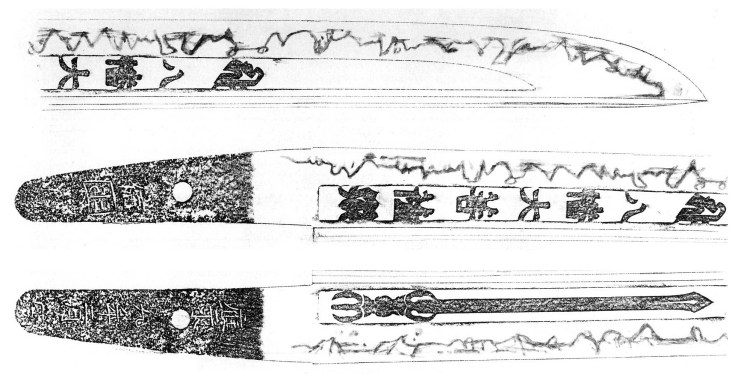
Picture 18: sunnobi-tantô, mei: “Nobukuni” (信国) – “Ôei kunen nigatsu hi” (応永九年二月日, “a day in the second month of Ôei nine [1402]”), nagasa 31.8 cm, sori 0.15 cm,  hira-zukuri, mitsu-mune

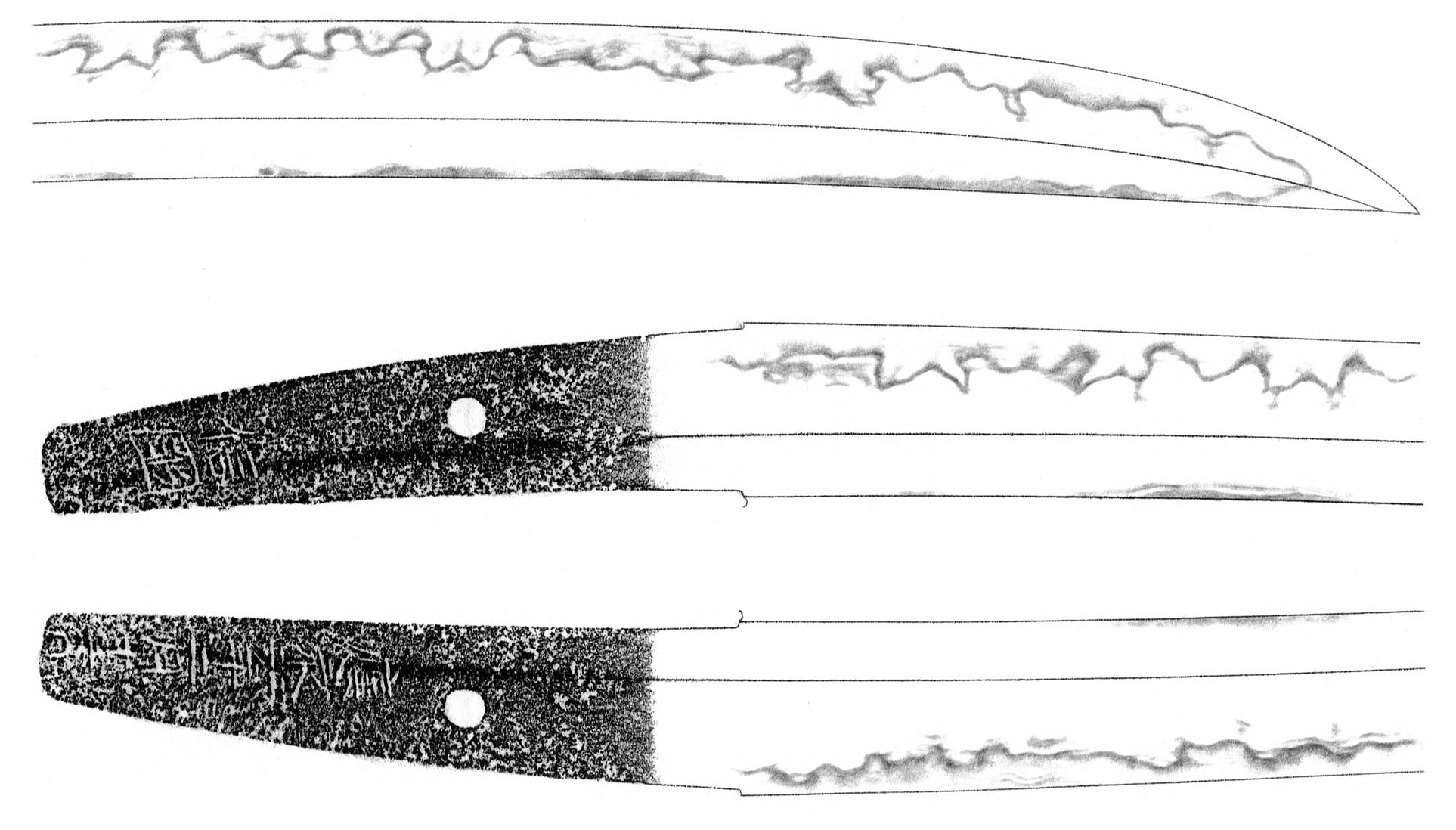
Picture 19 shows a tantô by Saemon no Jô which displays a quite classical deki and which shows a few of the Yamato elements that I have mentioned earlier. The blade is of a relatively elegant sugata but which has due to the pronounced fukura a somewhat wide feel. The jigane is a rather-standing out itame that is mixed with mokume and ô-itame in places and that features plenty of ji-nie and fine chikei. The hamon is a ko-nie-laden chû-suguha that is mixed at the base with some ko-gunome and that shows ko-ashi, , hotsure, kinsuji, a hint of kuichigai-ba, and a hint of nijûba. The nioiguchi is wide, bright and clear and the bôshi is sugu with a relatively wide and long running-back ko-maru-kaeri and shows some tendency towards nijûba too. On the omote side we see a sankozuka-ken and on the ura side a bonji with on top a katana-hi with soebi that end both in marudome. I think that this blade would be difficult at a kantei. It might look like Rai at first glance but then there are these few Yamato elements and the mixed-in mokume and ô-hada and the sugata with the thick kasane speaks for the transition between Nanbokuchô and early Muromachi. So I think with the advanced time and the not so classical horimono, the principle of exclusion might eventually lead towards Ôei-Nobukuni.
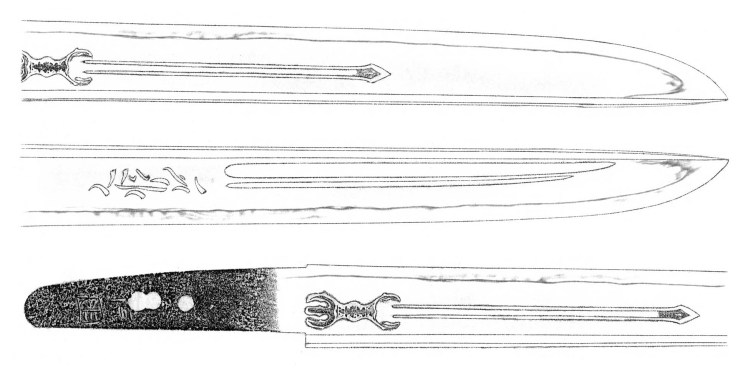
Picture 19: tantô, mei: “Nobukuni” (信国), nagasa 26.9 cm, uchizori, motohaba 2.5 cm, hira-zukuri, mitsu-mune

*

Now to Shikibu no Jô Nobukuni. He is said to have signed in early years with Nobusada (信貞) but this is doubted because a blade signed with “Nobukuni-ko Nobusada” (信国子信貞, “Nobusada, son of Nobukuni”) that is dated Ôei twelve (1405) postdates a blade signed “Shikibu no Jô Nobukuni” which is allegedly dated Ôei ten (1403). In short, it would be very odd if after receiving his honorary title and changing his name to Nobukuni he returned again to his earlier Nobusada mei. Anyway, I was not able to locate this Ôei ten blade and the earliest dated blade that I found for Shikibu no Jô is from Ôei 30 (1423). This date is followed by several extant works from the Ôei 30s (1423~1428) and then we have a blade dated Eikyô four (1432) and one where the mekugi-ana goes through the year but as it is a single kanji, it must be something between Einkyô one and nine, i.e. 1429-1437. This makes Shikibu no Jô the youngest of the Ôei-Nobukuni smiths and supports the tradition that he was the youngest brother of the second generation/s sons. Shikibu no Jô worked in the most Sôshû-esque deki of all Ôei-Nobukuni smiths, i.e. more nie, what is in particular true for his hira-zukuri wakizashi as also their shapes seem to connect more to mid-Nanbokuchô Sôshû than those of his older brother Saemon no Jô.

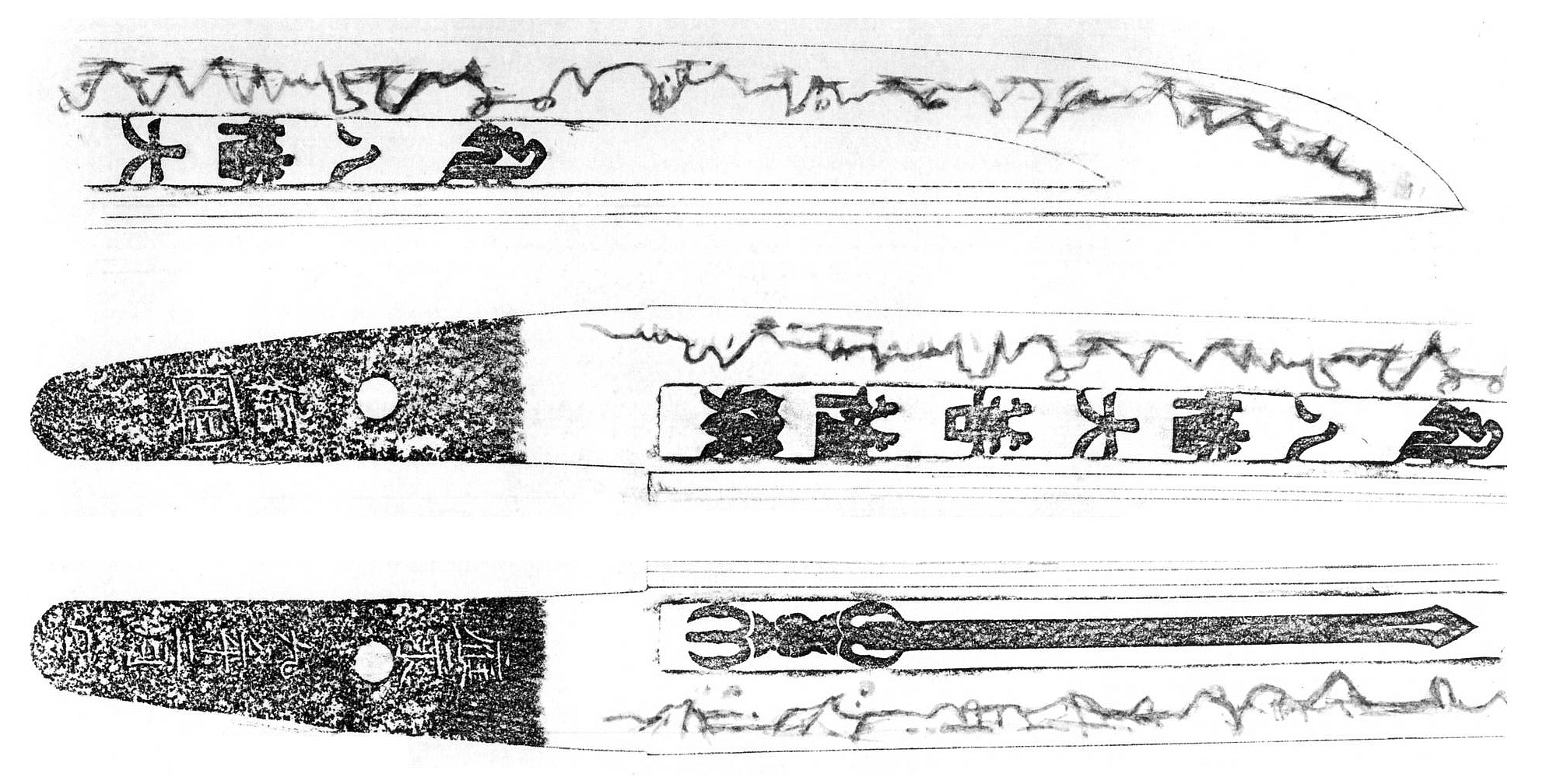
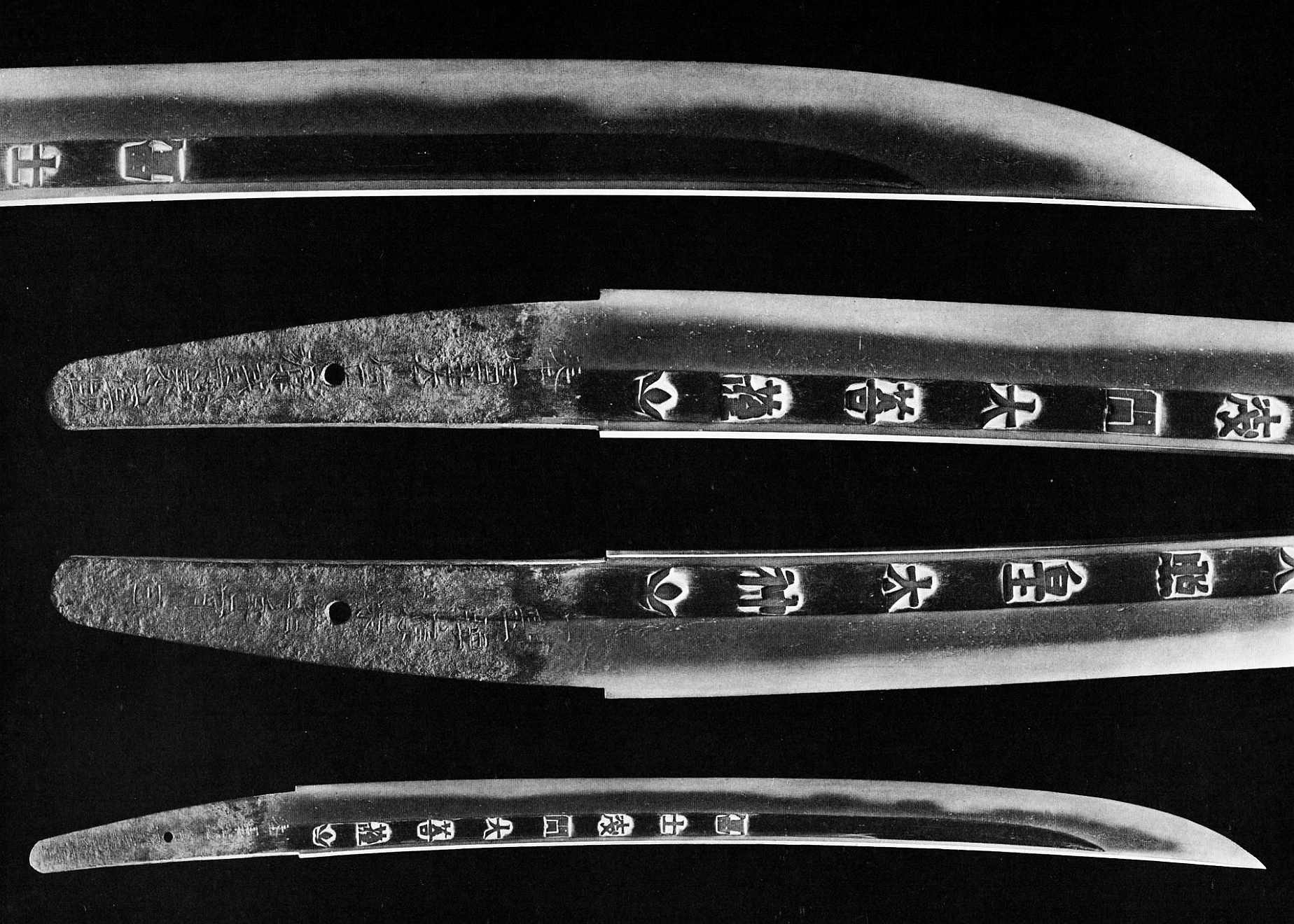
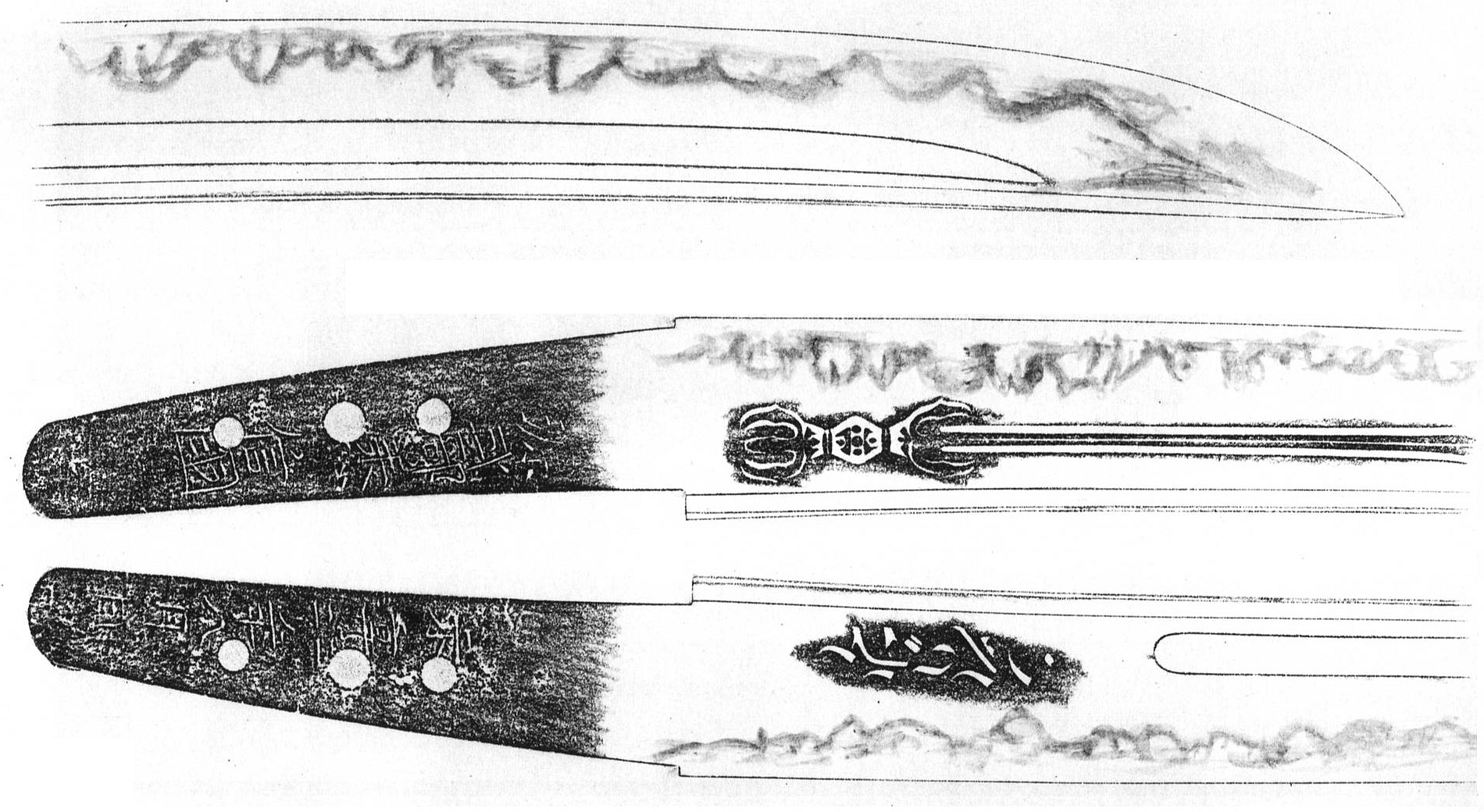
Picture 20 shows Shikibu no Jô’s most famous work, the jûyô-bunkazai wakizashi that is preserved in the Asama-jinja (浅間神社) and that thus also bears the nickname Asama-maru (浅間丸). It is a long and wide blade with magnificent horimono in the form of a very wide bôhi on both sides which bears as relief the characters of Fuji-Asama-Daibosatsu (富士浅間大菩薩) on the omote, and the characters Ise-Amaterasu-Susume-Ôkami (伊勢天照皇大神) on the ura side, both accompanied by a single rendai at the very base. The jigane is an itame mixed with ji-nie and chikei and the hamon is a nie-laden, gunome-based ô-midareba that is mixed with sunagashi. The bôshi is midare-komi and features a wide and long running-back kaeri.
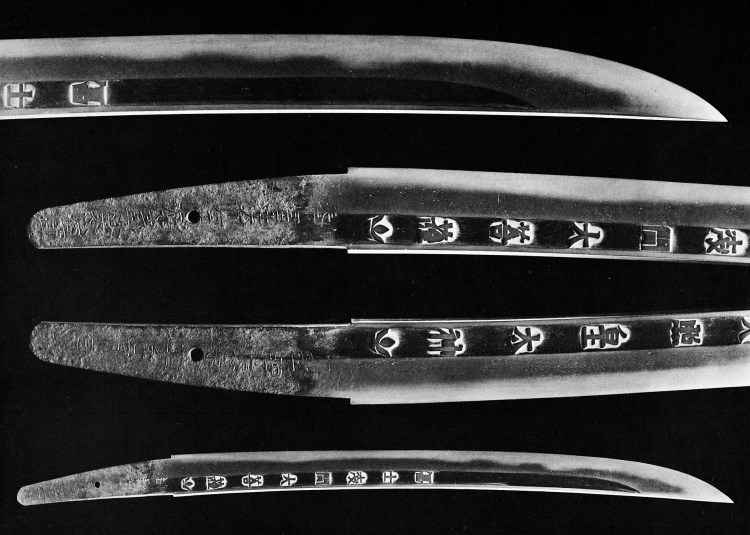
Picture 20: jûyô-bunkazai, wakizashi, mei: “Hô Fuji-hongû Minamoto Shikibu no Jô Nobukuni” (奉富士本宮源式部丞信国) – “Ichigo-hotokoshi Ôei sanjûyonen nigatsu hi” (一期一腰応永卅四年二月日, “My greatest masterwork, on a day in the second month of Ôei 34 [1427]”), nagasa 43.8 cm, sori 0.9 cm, motohaba 3.2 cm, hira-zukuri, mitsu-mune

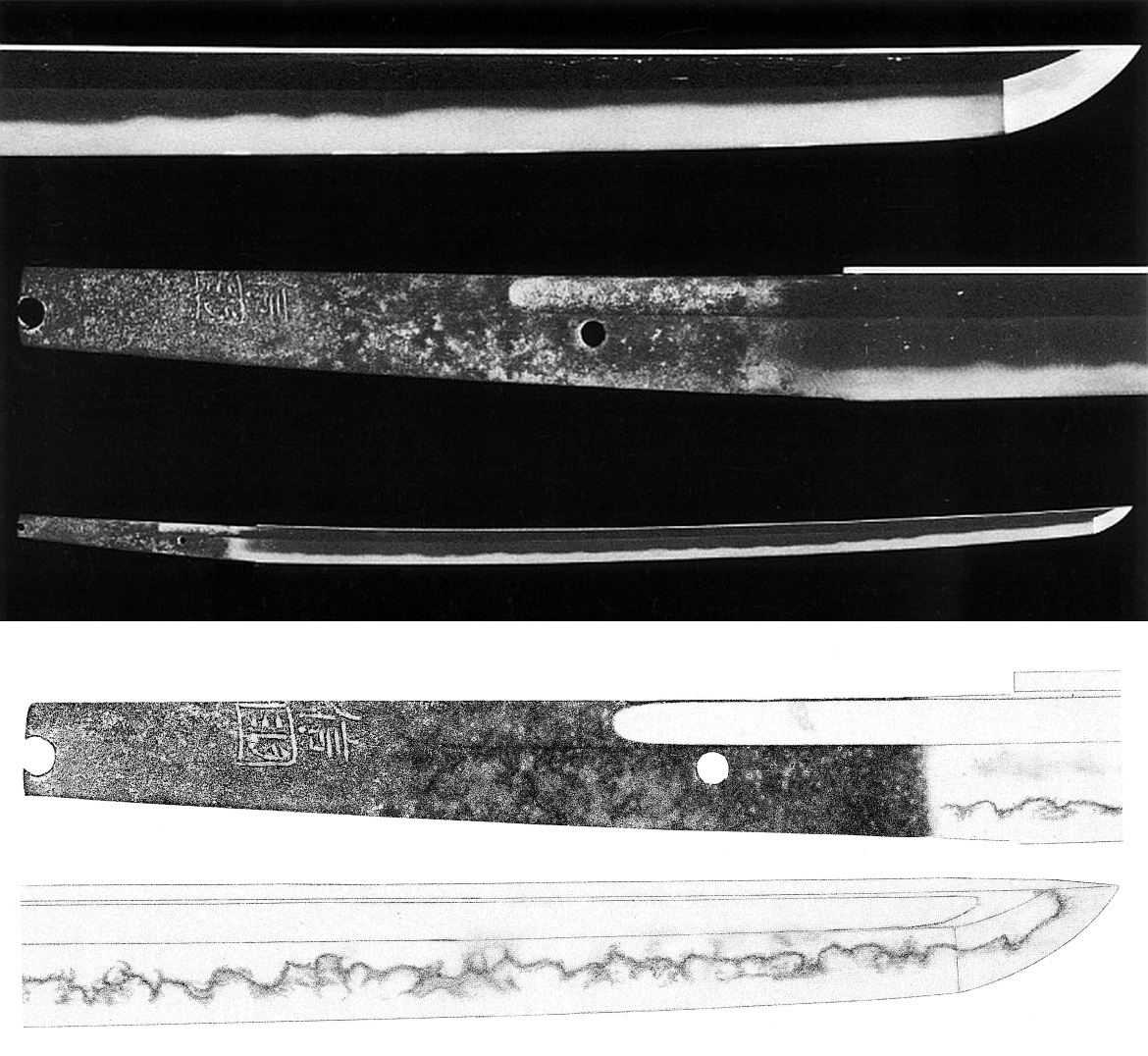
In picture 21 we see a jûyô-bunkazai tachi which was once (in 1924) designated so as a Nanbokuchô-era Nobukuni work. However, it has turned out to be a work of Shikibu no Jô Nobukuni and thus dates to the early Muromachi period, although the designation has not been withdrawn. The blade has been shortened to 71.6 cm, has a normal kasane (i.e. not thin as it would be typical for a Nanbokuchô blade), and has a quite shallow sori what makes it almost look like Kanbun-shintô at first glance, especially with the nakago in a shirasaya hilt for example. The jigane is a rather standing-out itame with ji-nie and the hamon is a gunome-midare in ko-nie-deki that is mixed with angular elements, togariba whose yakigashira seem to “fume” into the ji, ashi, , and sunagashi. Some gunome sections even tend to mimigata and we also see a hint of yahazu. The bôshi is midare-komi with a brief ko-maru-kaeri plus a little hakikake.
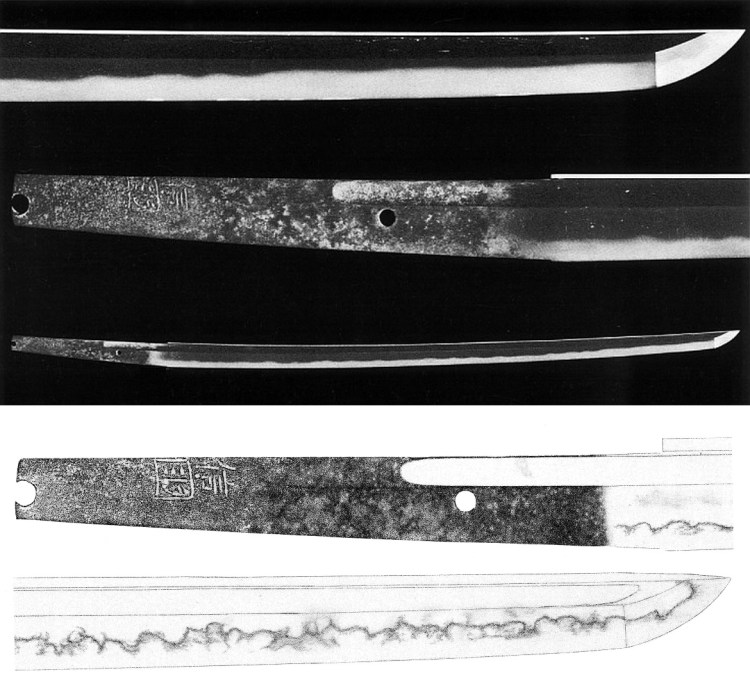
Picture 21: jûyô-bunkazai, tachi, mei: “Nobukuni” (信国), nagasa 71.6 cm, sori 0.9 cm, shinogi-zukuri, iori-mune

A shinogi-zukuri wakizashi by Shikibu no Jô can be seen in picture 22. Again, the interpretation of the hamon is close to Saemon no Jô in case of long swords and shinogi-zukuri wakizashi. The jigane is a dense itame with plenty of ji-nie and chikei and the hamon is a gunome-midare in nie-deki that is mixed with angular elements, yahazu, many sunagashi, ashi, , and some tobiyaki. The bôshi is a widely hardened midare-komi with a brief ko-maru-kaeri.
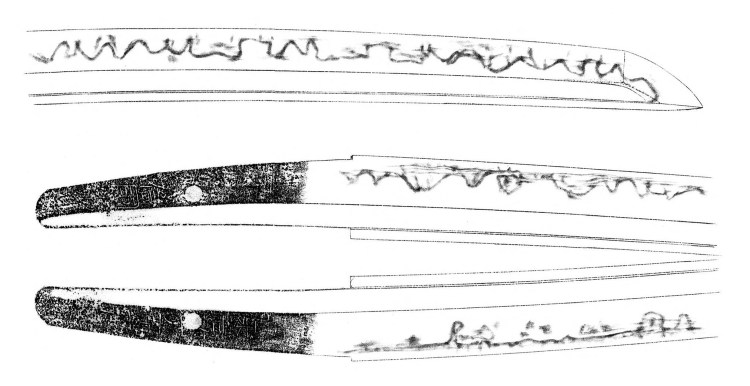
Picture 22: wakizashi, mei: “Nobukuni” (信国) – “Eikyô ?-nen rokugatsu hi” (永享〇年六月日, “a day in the sixth month of Eikyô ? [1429-1437]”), nagasa 52.4 cm, sori 1.6 cm, motohaba 2.75 cm, sakihaba 2.0 cm, shinogi-zukuri, iori-mune

Now to Shikibu no Jô’s tantô and hira-zukuri ko-wakizashi. An example is shown in picture 23. It is a wide and long blade with a noticeable sori and shows a jigane in itame-nagare with ji-nie and chikei. The hamon is a nie-laden gunome that is mixed with ko-gunome, ko-notare, ashi, , kinsuji and sunagashi and the bôshi is a widely hardened midare-komi with a pointed kaeri that features hakikake. On the omote side we see a katana-hi and below a sankozuka-ken and on the ura side a katana-hi with a bonji below.
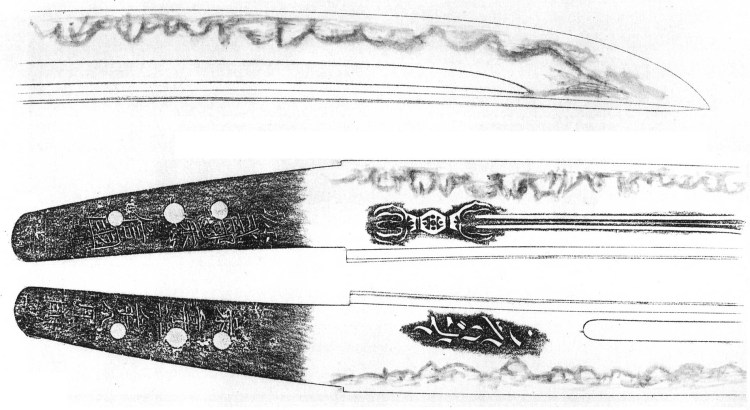
Picture 23: wakizashi, mei: “Minamoto Shikibu no Jô Nobukuni” (源式部丞信国) – “Eikyô yonen hachigatsu hi” (永享二二年八月日, “a day in the eighth month of Eikyô four [1432]”), nagasa 41.3 cm, sori 0.8 cm, motohaba 3.0 cm, hira-zukuri, mitsu-mune

*

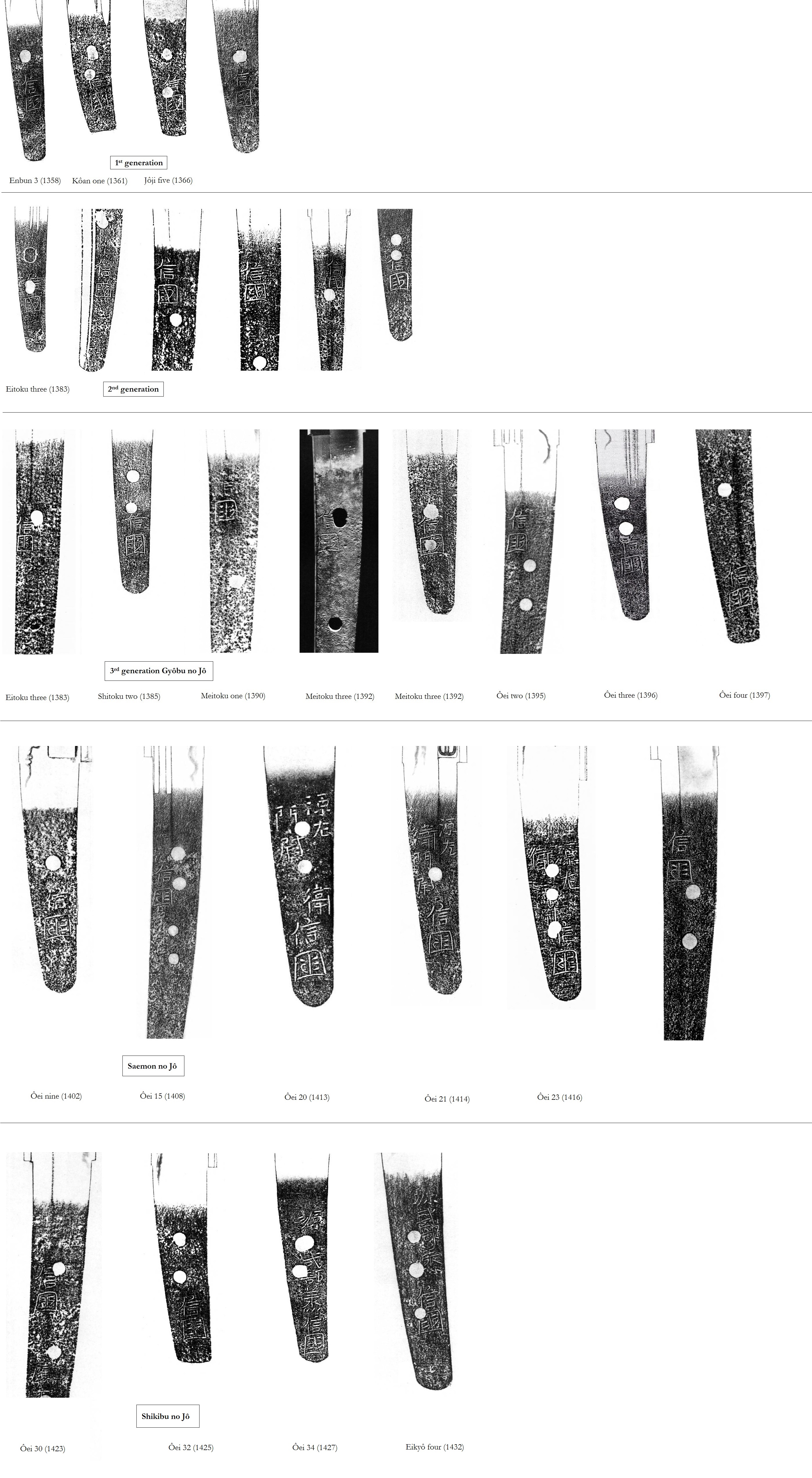
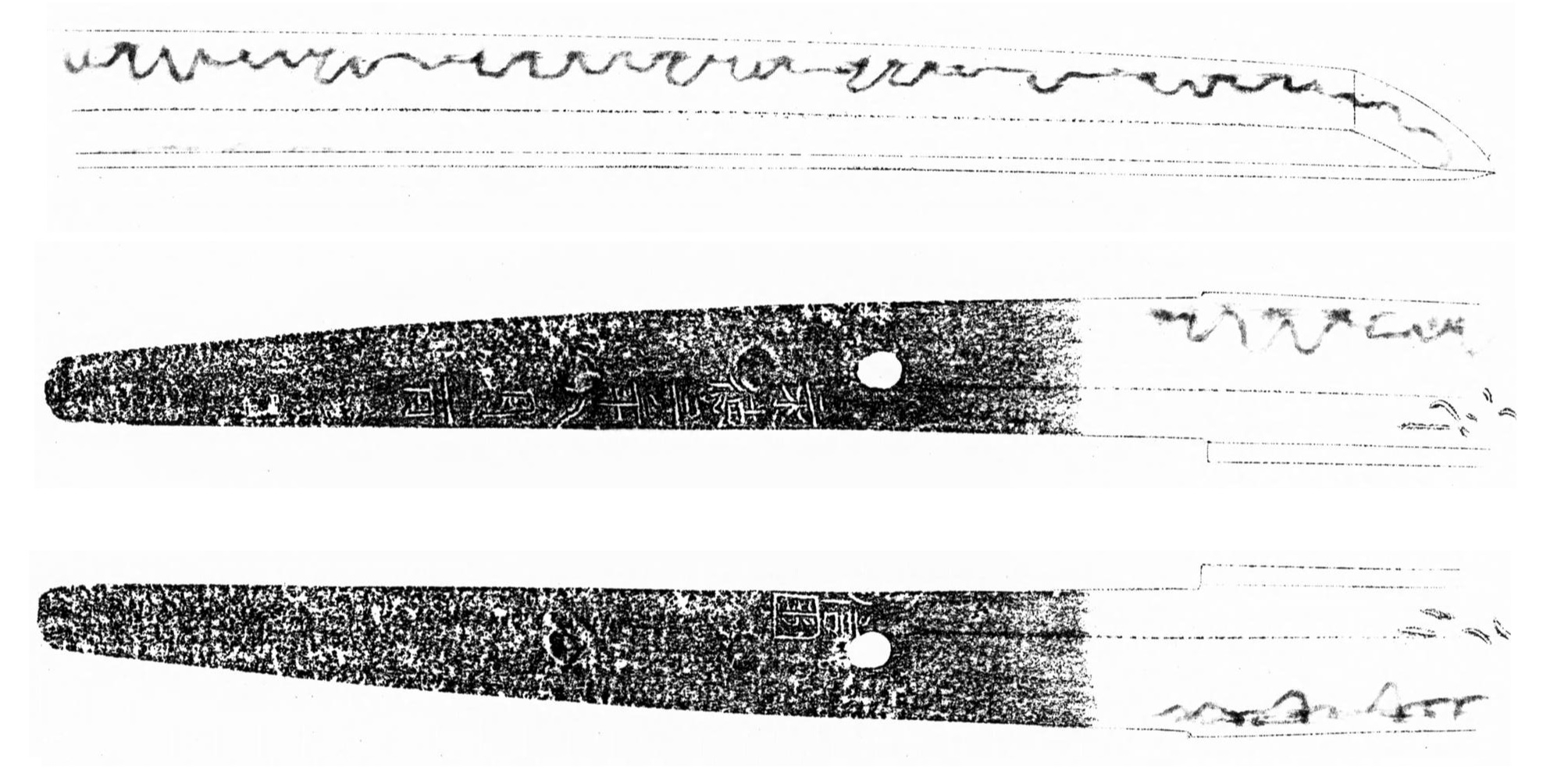
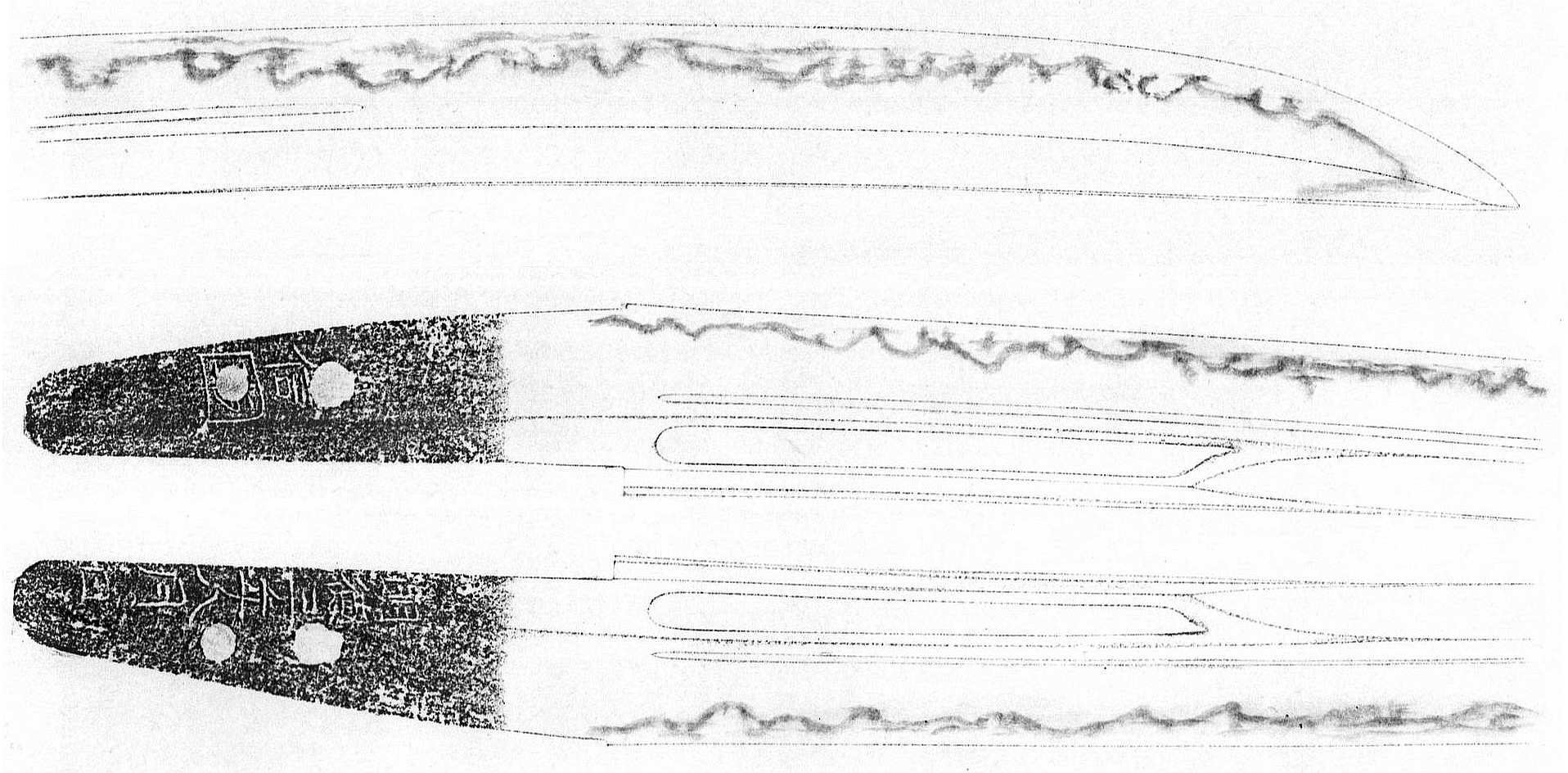
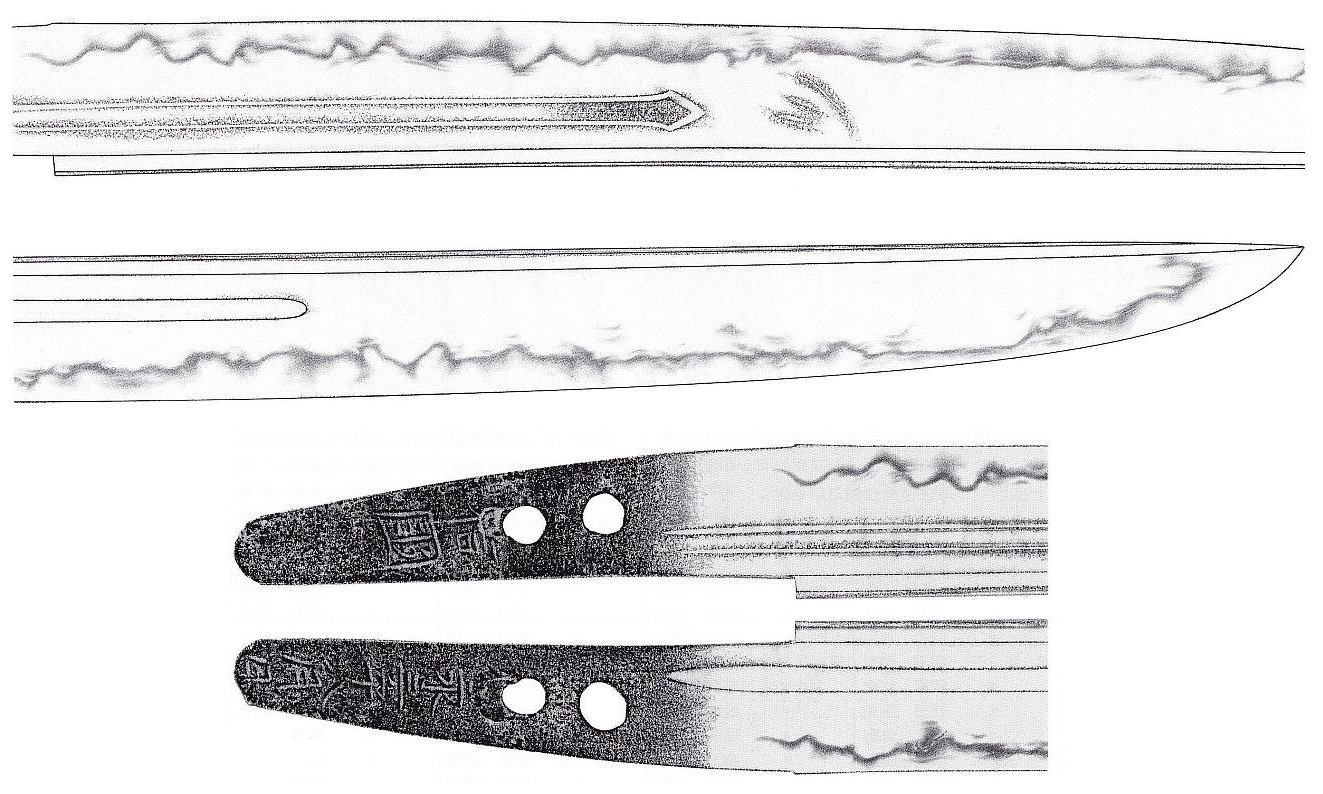
This brings us to the difficult case of trying to find out which Ôei-Nobukuni works go back to the hand of Gyôbu no Jô Nobukuni. To do so, I first want to introduce in picture 24 the different Nobukuni signature styles (click to see full-size pic). As you can see, the 1st generation signed the character for Nobu somewhat “squeezed” to left. Apart from that, his character for kuni is a little bit distorted, i.e. tilting a little bit to the top right. The 2nd generation did not squeeze the character for Nobu so much to the left, only a tiny little bit, and the one shown on the far right of my chart might be an edge case in term of signature style, although the work, which was introduced in picture 13 in the previous chapter, is attributed to the 2nd generation. Also he signed the left three internal strokes of the character for kuni in a more horizontal way than the 1st generation did. Saemon no Jô Nobukuni signed in a peculiar way, namely with the left and right inner parts of the character for kuni mirrored and with the central “dividing” stroke executed in a vertical manner. So his signatures are pretty easy to detect. Shikibu no Jô signed the left and right inner parts in the usual way and executed the central “dividing” stroke in a slightly diagonal manner but his works can be distinguished from the others in terms of slightly more advanced production time. So then there are signatures which significantly predate works of Shikibu no Jô and which do not match the mirrored signature of Saemon no Jô. These signatures, of which we know dates from Eitoku three (1382) to Ôei four (1397), are executed with the central “dividing” stroke in a very vertical manner and as they thus differ from works of the 2nd generation, of works of Saemon no Jô, and of works of Shikibu no Jô, both in terms of meiburi and production time, I attribute those for the time being to the 3rd generation, to Gyôbu no Jô Nobukuni.
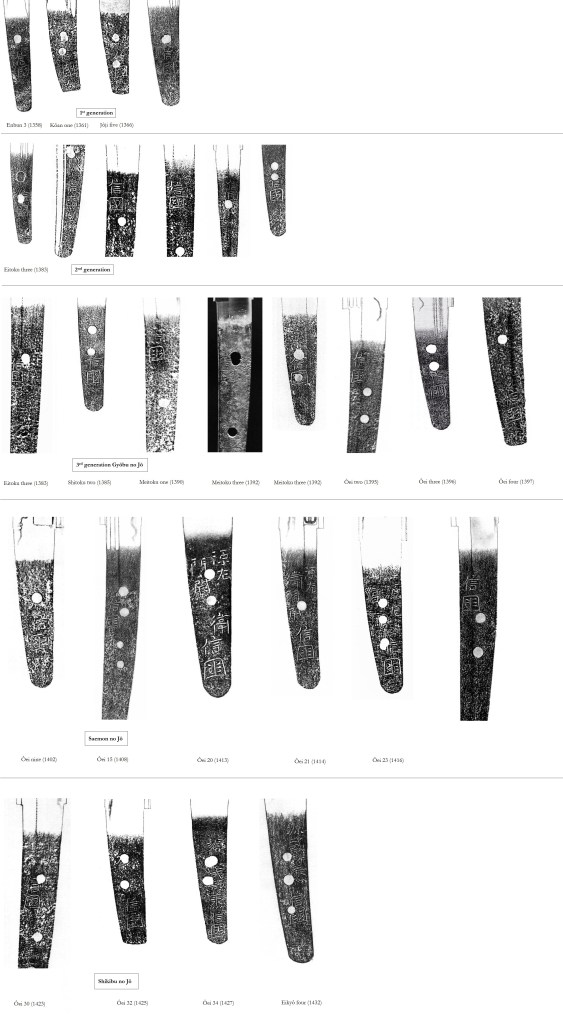
Picture 24: Nobuie mei comparison

That said, I have to go back to my previous Nobukuni chapter, in the way that maybe all but picture 13 might be actually works of the 3rd generation, i.e. of Gyôbu no Jô. This confusing grey zone before the arrival of individually signed Nobukuni blades, e.g. Saemon no Jô and Shikibu no Jô, is one reason for why it almost took me a full year to go on with the Nobuie chapter. In other words, most publications are kind of avoiding the issue of the succession of Nobukuni generations but I didn’t want to leave it like that, or rather I just didn’t want to brush off this issue, repeat everything that has already been written, and go on with the next chapter. So it took me a while to go again through all references, to study, compare and weigh off the about 150 Nobukuni blades I have in my references, and that is why I think the genealogy that I presented in the last chapter makes the most sense from point of view of my today’s knowledge.

Well, I still want to introduce some more works which are signed in the way that I regard uniquely between the 2nd generation and Saemon no Jô Nobukuni, starting with the blade shown in picture 25. It is a short and slender tachi dated Ôei three (1396) that tapers noticeably and that has a relatively deep sori which tends to sakizori. The jigane is a standing-out itame mixed with nagare that shows ji-nie and the hamon is a nie-laden gunome-midare that is mixed with togariba, some tobiyaki, and many sunagashi. The bôshi is sugu with a ko-maru-kaeri. The haki-omote side shows a bonji and then a koshibi with a suken as relief and the haki-ura side a bonji and a rendai. In terms of overall interpretation, I would place this blade in the vicinity of Eitoku three (1383) blade introduced in picture 9 in the previous chapter.
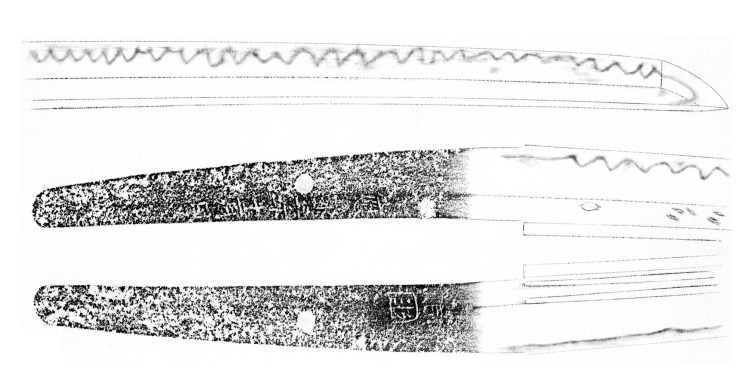
Picture 25: tachi, mei: “Nobukuni” (信国) – “Ôei sannen jûnigatsu hi” (応永三年十二月日, “a day in the twelfth month of Ôei three [1396]”), nagasa 66.3 cm, sori 2.1 cm, motohaba 2.7 cm, sakihaba 1.6 cm, shinogi-zukuri, iori-mune

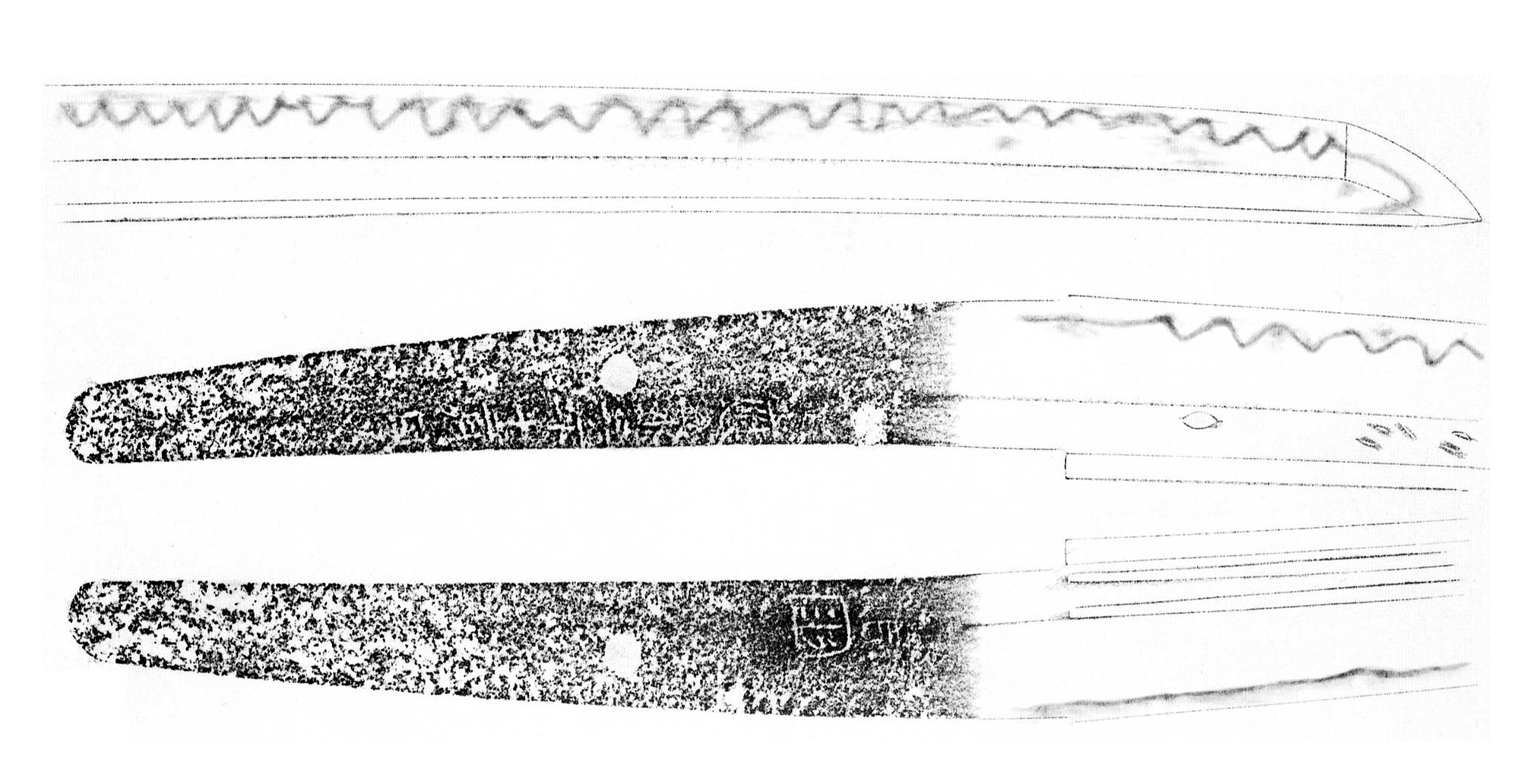
And last but not least, the blade shown in picture 26 kind of closes the “missing link” between the blade shown in picture 14 in the previous chapter and the Ôei-Nobukuni blades with prominent yahazu. It is a quite long shôbu-zukuri wakizashi with a jigane in a rather standing-out itame mixed with ô-itame and nagare, featuring plenty of ji-nie and much chikei. The hamon is a ko-nie-laden yahazu-ba mixed with gunome, ko-notare, chôji, togariba, angular elements, ashi, , kinsuji, sunagashi, yubashiri, and much muneyaki. The nioiguchi is bright and clear and the bôshi is midare-komi with a wide ko-maru-kaeri thar runs back in a long fashion and that connects with muneyaki.
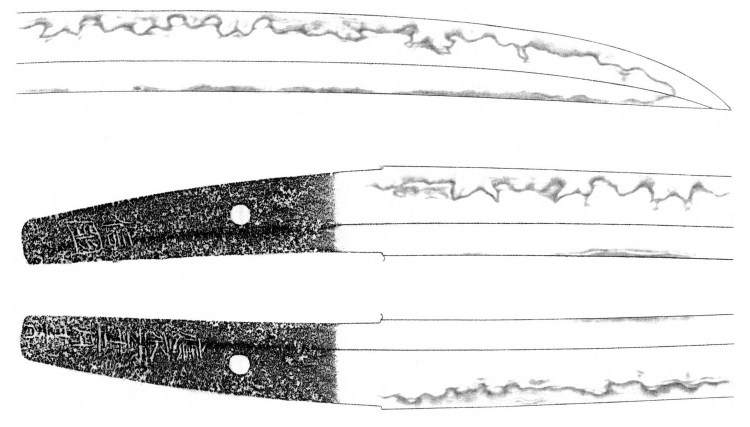
Picture 26: wakizashi, mei: “Nobukuni” (信国) – “Ôei yonen nigatsu jûrokunichi” (応永ニニ年二月十六日, “16th day of the sixth month of Ôei four [1397]”), nagasa 57.8 cm, sori 1.6 cm, motohaba 3.1 cm, shôbu-zukuri, maru-mune

This should do it for today and in the next part I want to conclude the Nobukuni chapter with introducing works of later generations Nobukuni and the alleged 6th generation of whom works with Chinese datings are extant.
 

GVSU Lecture Report

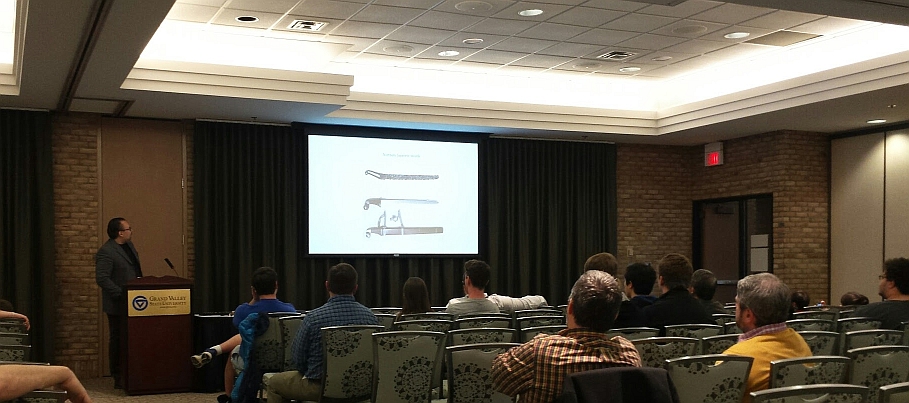
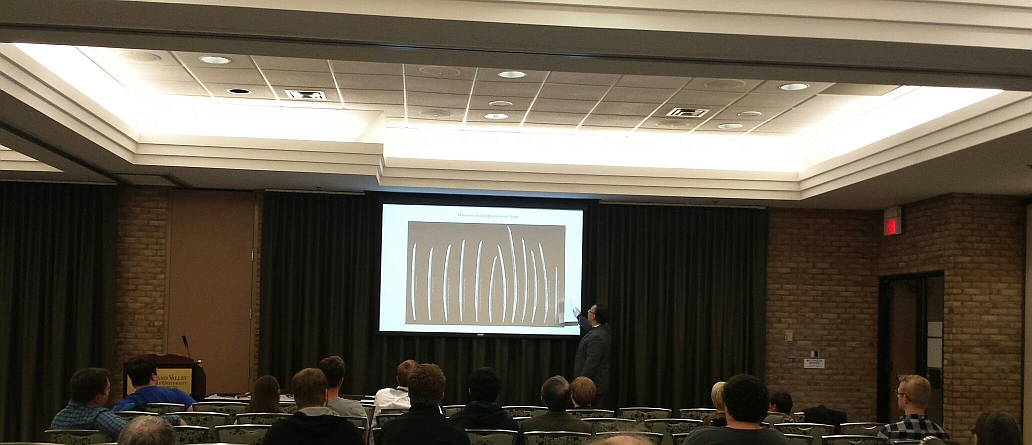
Just back from Grand Rapids I want to give you a brief report on the trip and lecture. The lecture was held on Wednesday, April 12, at Grand Valley State University’s L.V. Eberhard Center, starting at 5:30 pm, and it was a general overview of the history of the Japanese sword and how it is made, plus a brief introduction into the practice of cutting tests, tameshigiri. I will provide a transcript of the former part as PDF below.

Transcript-GVSU-Lecture-UnderstandingTheJapaneseSword

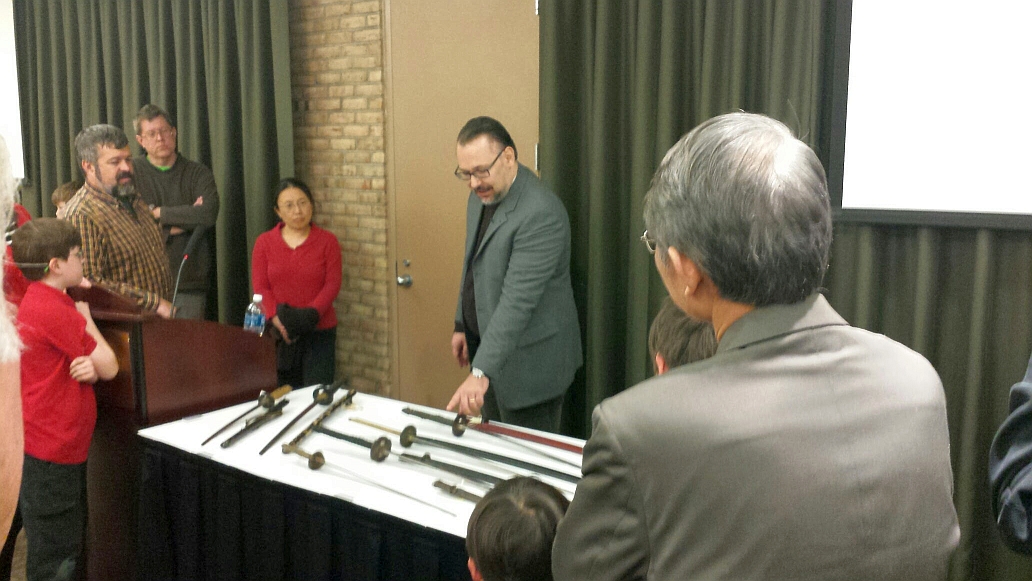
The lecture was concluded by me introducing several swords from the Grand Rapids City Archives and Research Center, accompanied by a very good Q&A session. The day prior to the lecture I was given the opportunity to go through the Japanese sword collection of the City Archives and I picked six representative swords for the lecture. The Grand Rapids City Archives and Research Center own about 25 Japanese swords, a Japanese armor, and a few Japanese helmets (e.g. a signed and very good Saotome Iechika [早乙女家親] and a Nobuie dated 1512 but which is probably gimei). The swords I picked were a signed Hizen Dewa Daijô Yukihiro (肥前出羽大掾行広) katana whose koshirae features a nice Nobuie-tsuba, an unsigned mounted Bizen Yoshii (吉井) School katana, a signed Kashû Kanewaka (加州兼若) wakizashi in kyû-guntô mounts, an unsigned mounted kotô naginata-naoshi katana, an unsigned Mino wakizashi with a typical sanbonsugi-hamon in a nice Higo-koshirae, and an unsigned shintô wakizashi that is also nicely mounted.

That said, I want to thank all attendees, the Japanese/Chinese students I met for lunch the day before the lecture, Mr. Alex Forist and Mr. Jared Yax from the Grand Rapids City Archives and Research Center for giving me the opportunity to go through their Japanese collection, and Prof. Meghan Cai from GVSU’s Chinese Faculty for initiating the lecture and for organizing the whole event. ありがとうございます!


Ah, and as Grand Rapids is Beer City USA, I also enjoyed the local craft beers of course 🙂

Easter eBook Super Sale III

Easter-Sale

I just started, like last year and the year before, an Easter eBook Super Sale where ALL of my eBooks are reduced by 50%! This offer will be valid for until the day after Easter Monday (4/18) so you have enough time to decide what you want. So fill up all your tablets (or PC´s) with all the important Nihonto and Tosogu reference material you need four your studies!

Once again, it goes directly via me (i.e. I’m not going to manually change all the prices on Lulu.com and then change them back when the sale is over). I provide a list of all my eBooks below, showing the regular and the reduced prices. I also linked them so that you can check what the description says but again, DO NOT buy over there at Lulu.com this time. Get in touch with me via “markus.sesko@gmail.com” and pay me directly, either by PayPal using the very same email address or by credit card, using the donate button at the very bottom of this page and I’m going to send you over the eBook. And anyway, if you gave a question, just drop me a mail.

So grab this chance to fill up your laptops/tablets/phones with all references you need.

Thank you for your attention!

Akasaka Tanko Roku ….. $8.90 – $4.50
Encyclopedia of Japanese Swords ….. $24.90 – $12.50
Geneaogies and Schools of Japanese Swordsmiths ….. $19.90$10
Genealogies of Japanese Toso Kinko Artists ….. $19,90$10
Identifying Japanese Cursive Script ….. $14.90$7.50
Identifying Japanese Seal Script ….. $14.90$7.50
Japan’s Most Important Sword Fittings ….. $14.90$7.50
Jukken ….. $14.90$7.50
Kano Natsuo I ….. $59.90$30
Kano Natsuo II ….. $59.90$30
Kantei Reference Book – Hamon & Boshi ….. $19.90$10
Koshirae – Japanese Sword Mountings ….. $19.90$10
Koshirae Taikan ….. $59.90$30
Koto Kantei Zenshu ….. $89.90$45
Koto Meikan ….. $39.90$20
Legends and Stories Around the Japanese Sword ….. $9.90 – $5
Legends and Stories Around the Japanese Sword 2 ….. $9.90 – $5
Masamune ….. $29.90$15
Masters of Keicho Shinto ….. $19.90$10
Nihon-koto-shi ….. $29.90$15
Nihon-shinto-shi ….. $29.90$15
Nihon-shinshinto-shi ….. $29.90$15
Shinshinto Meikan ….. $29.90$15
Shinto Meikan ….. $29.90$15
Shinto Shinshinto Kantei Zenshu ….. $89.90$45
Signatures of Japanese Sword Fittings Artists ….. $89.90$45
Soken Kinko Zufu ….. $9.90 – $5
Swordsmiths of Japan ….. $89.90$45
Tameshigiri ….. $29.90$15
The Honami Family ….. $19.90$10
The Japanese Toso Kinko Schools ….. $24.90$12.50

German Titles:

Die Honami Familie ….. $19.90$10
Geschichten rund ums japanische Schwert ….. $9.90 – $5
Geschichten rund ums japanische Schwert 2 ….. $9.90 – $5
Koto Kantei Zenshu ….. $89.90$45
Nihon-shinto-shi ….. $29.90$15
Nihon-shinshinto-shi ….. $29.90$15
Shinto Shinshinto Kantei Zenshu ….. $89.90$45

Theodor von Lerch

I have said this several times: Delving into the world of nihontô makes you aware of parts of Japanese history you probably wouldn’t have thought about, ever. Looking for something in particular in my files the other day, I came across a translation/research I did seven years ago.

So this is the background: I was approached by a friend of mine from Bavaria who knows someone who owns a Japanese sword in shirasaya that has an inscription, i.e. a sayagaki. Obviously I was asked to translate the sayagaki but I have to admit, it can’t provide any pics here because I got the inquiry via real physical photos and I never scanned or copied them before they were returned.

Anyway, I don’t remember if the blade was signed or attributed but it was a work of Sa Akikuni (左顕国), a student of master Sa Yasuyoshi (左安吉) who was active in the early years of the Ôei era (応永, 1394-1428) and who had moved from Chikuzen to Nagato province. So his name was noted in the sayagaki and was followed by the following inscrtiption:


呈墺国参県中佐レルヒ君
Tei ôkoku sanken chûsa Reruhi-kun.
Present to Lieutenant Colonal Lerch from Austria.


Now translating the brief dedication was not very difficult of couse but having a katakana transcription of a Western name that is just of three syllables made me doubt about finding anything on this person. However, I am from Austria too so I became ambitious about who he was. The age of the shirasaya and writing style of the sayagaki seemed to be Meiji, what would have been a match with my initial assumption that the person might have been one of the so-called oyatoi gaikokujin (御雇い外国人), a foreign government advisor in Meiji Japan. Next and always the first step, just google the name on Japanese Google, and well, just throwing in the katakana レルヒ already came back with a hit: Not a oyatoi gaikokujin but I was not that off. He was an official coming to Japan a little bit later than the oyatoi gaikokujin, Lieutenant Colonel Theodor Edler von Lerch (1869-1945), the guy who was the first to properly introduce the art of skiing to Japan, in 1911. Wow! So he was presented with a sword in Japan, obviously took it home, and it would be interesting to know how it ended up in Bavaria. 

I will provide some links for further reading on my fellow countryman below because I don’t want to rehash. I just thought it would be interesting to post this little anecote on my blog after stumbling upon this seven years old research of mine the other day.

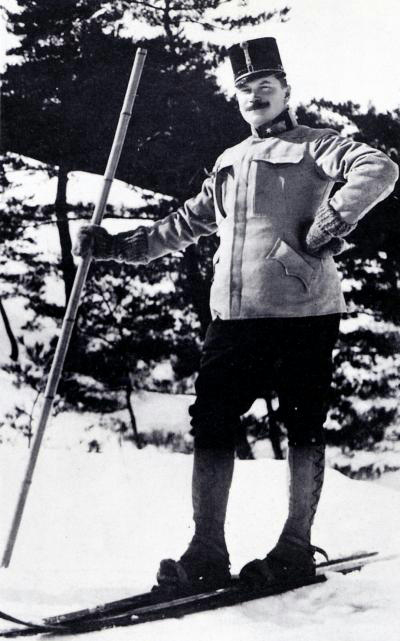
Picture 1: Theodor Edler von Lerch in 1911 in Jôetsu, Japan.

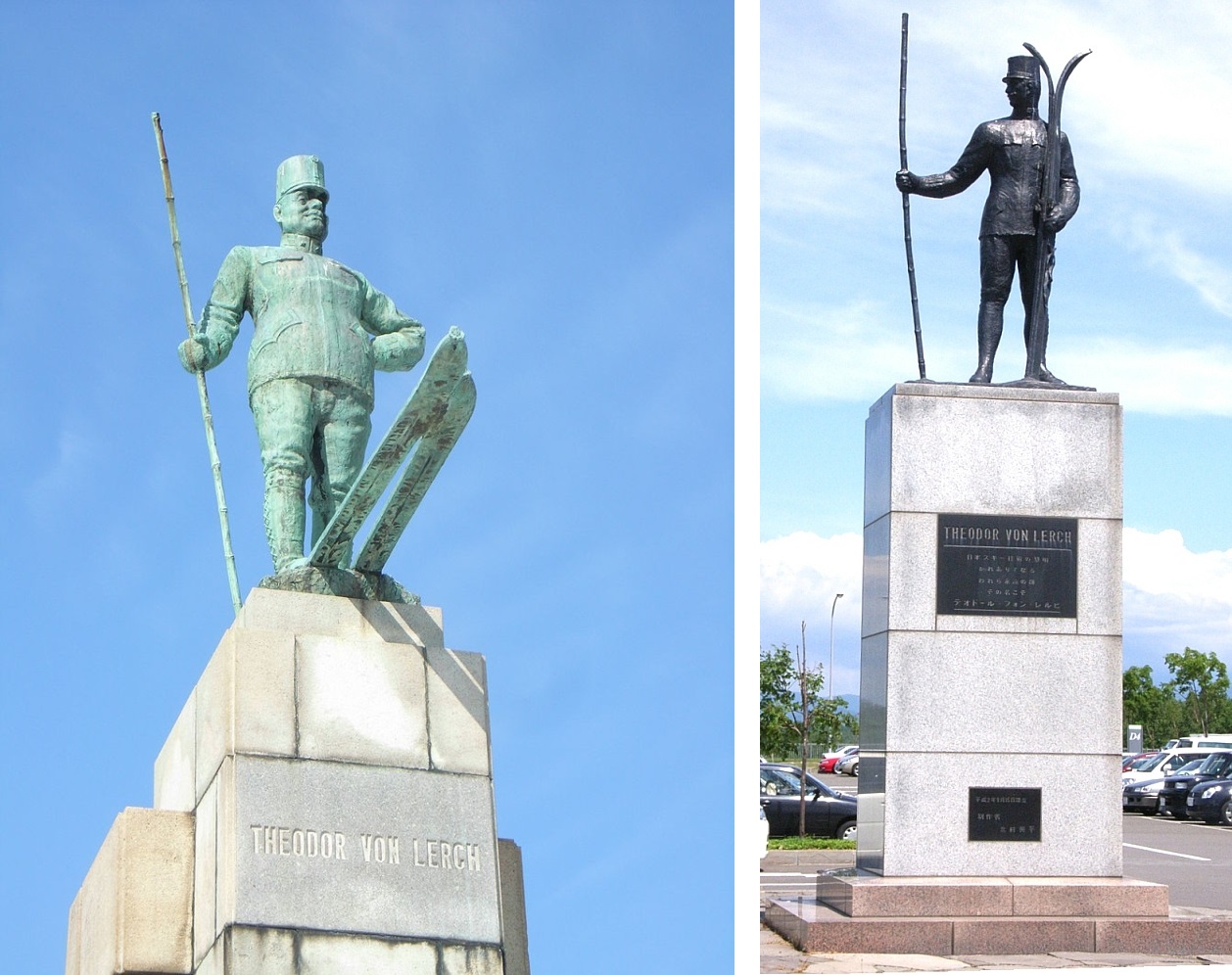
Picture 2: The two bronze statues of Lerch in Japan, one at the Kanayasan Ski Resort (left) and one at Asahikawa Airport (right).

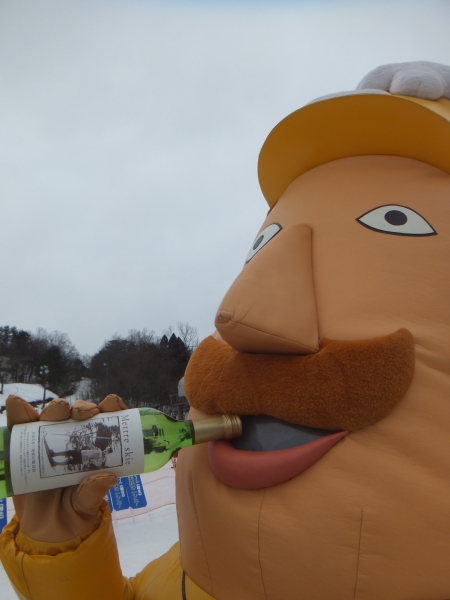
Picture 3: The local Lerch mascot at Kanayasan 😉


As mentioned, isn’t it fascinating what you come across by dealing with Japanese swords? That way, I had to dive into the world and history of Japanese barbershops, ramen noodles, sake brewing, weird delicacies served at a tea ceremony, the Portuguese entering the Indian Ocean, pirates, the entire Silk Road, the development of howitzers, the anatomy of skeletons of certain fish, and so much more. What a fruitful job and activity!


https://onehundredmountains.blogspot.com/2011/05/mettre-ski.html
http://www.outdoorjapan.com/magazine/story_details/224
http://www.city.joetsu.niigata.jp/soshiki/kyousei/english-lerch.html
http://www.bundesheer.at/truppendienst/ausgaben/artikel.php?id=892
https://de.wikipedia.org/wiki/Theodor_Edler_von_Lerch


KANTEI 4 – YAMASHIRO #27 – Nobukuni (信国) School 2

I know that by basically reverting to the old sources with my first chapter on the Nobukuni School, I didn’t make things easier but you have to be open for everything and not just regurgitate. So back to Nobuie and the difficult task of nailing down the immediate successor of the 1st generation, i.e. the one who studied with Sadamune, who was one of the first smiths to bring the Sôshû tradition to Kyôto, and who was the one who probably lived until the late 1370s or early 1380s. So if the 1st generation’s career did pass the zenith of the Nanbokuchô period, who followed him as 2nd generation? In my Swordsmiths of Japan, I already tried to do very same as here, that is, to find the balancing act between giving credit to the old traditions but following the most recent studies. That said, I introduced a 2nd generation but who might actually have been the 1st generation, or in other words, the first two generations in my Swordsmiths of Japan might have been the same smith.

This greyzone in counting the initial Nobukuni masters is very well reflected in the NBTHK jûyô papers which say – apart from explicitly stating 1st generation and Genzaemon and Shikibu to whom we will come later – also just for example “Nobukuni work from the Enbun-Jôji eras”, “Nobukuni work from the vicinity of the Kenmu-era 1st generation”, “Nobukuni work from the end of the Nanbokuchô period”, or “Nobukuni work from the Ôei era”. So in the following, I can’t help but so to speak keep this greyzone alive. That said, I will introduce works that chronologically follow those of the alleged 1st generation from my first Nobukuni chapter, works that are today – and because of this greyzone – just classified as “end of Nanbokuchô Nobukuni” and “Ôei-Nobukuni.” Those we can attribute to concrete masters like Minamoto Saemon, Shikibu, and Saburôzaemon Nobukuni will be introduced in the next chapter.

Now Tanobe follows the approach that I have forwarded in my first Nobukuni chapter, i.e. that the 1st generation was active to Eitoku (1381-1384). Satô Kanzan in turn sees the blades dated with this era, a tachi dated Eitoku three (1383) and a tantô dated Eitoku four (1384), as works of the 2nd generation. Well, Tanobe avoids tackling the succession of Nobukuni generations in his latest work, the Yamashiro Volume of the Nihontô Gokaden no Tabi series (published in 2015), so I will focus on the theories of Satô and Honma. As mentioned, Satô sees the Enbun and Jôji dated blades as works of the 1st generation, those around Eitoku as works of the 2nd generation (whom he sees being active until the beginning of the Muromachi era), and counts the smith who signed with Minamoto Saemon no Jô (源左衛門尉) and who was active around Ôei (1394-1428) as 3rd generation. Apart from that, he refers to Shikibu no Jô (式部丞) as being active a hint later than Minamoto Saemon and probably being the younger brother of the latter, although he does not explicitly introduce him as 4th generation. In short, and reading between the lines, Satô counts three Nobukuni main line generations and implies that by the time of the third master, i.e. the early Muromachi period, the lineage had already become a workshop with the name Nobukuni as trademark where several smiths worked (and signed with that name), being probably managed by the third generation Minamoto Saemon and his younger brother Shikibu no Jô. Honma just states that the Nobukuni who was active around Enbun and Jôji was the 1st generation, the one active around Ôei the 2nd, and the one active from Ôei to Eikyô (1429-1441) the 3rd generation. Interestingly, he sees Minamoto Saemon and Shikibu no Jô as younger brothers or students of the 2nd generation. This thing with Minamoto Saemon and Shikibu no Jô being both younger brothers of some Nobukuni kind of connects with Tsuneishi’s approach who introduces a Gyôbu no Jô (刑部丞) Nobukuni whom he lists as 3rd generation. That means, Tsuneishi sees Gyôbu no Jô as oldest, Minamoto Saemon as second oldest, and Shikibu no Jô as third oldest son of the late Nanbokuchô 2nd generation and states that it are only these three masters to whom we refer today as “Ôei-Nobukuni.”

So for the time being, I think of the genealogy of the Nobukuni School as seen in the link below:

Genealogy Nobukuni School

*

Now to some works which can be attributed to the immediate time after the 1st generation and before the Ôei-Nobukuni masters Minamoto Saemon and Shikibu no Jô. An interesting thing to observe at how the Nobukuni School went on is that it came from the Yamashiro tradition, that it next adopted the Sôshû tradition via Sadamune, and that it then shifted towards Bizen, although maintaining both Yamashiro and Sôshû characteristics, e.g. nie. That means, we can already see Bizen elements appearing towards the end of the Nanbokuchô period and with the Ôei era, works of the Ôei-Nobukuni smiths strongly resemble that of their Ôei-Bizen colleagues. That’s why Nobukuni works are often difficult to kantei.

I want to start with the aforementioned tachi which bears the date signature from Eitoku three. There is not much Sôshû and please note the pairs of gunome, an interpretation that is understood as the forerunner of the yahazu elements which are so typical for the Nobukuni School. The blade is of a small and slender sugata with not much sori and might be at the edge of being a kodachi. The jigane is a partially standing-out itame with plenty of ji-nie and the hamon is a nie-laden gunome-midare with a few sunagashi and some muneyaki. The bôshi is midare-komi with a prominently round kaeri and both sides feature a single bonji at the base.

Picture 9: jûyô, tachi, mei: “Nobukuni – Eitoku sannen hachigatsu tsuitachi” (信国・永徳三年八月一日, “first day of the eighth month Eitoku three [1383]”), nagasa 65.1 cm, sori 1.4 cm, motohaba 2.8 cm, shinogi-zukuri, iori-mune

The blade shown in picture 10 is dated with the third year of Meitoku (明徳, 1392), i.e. dates about a decate later than the previous one. The blade is of a magnificent and deeply curved sugata with an elongated chû-kissaki. It shows an itame that is partially mixed with masame-nagare and that features plenty of ji-nie and also chikei. The hamon is a nie-laden ko-notare that is mixed with gunome, ashi, sunagashi, kinsuji, and yubashiri and the bôshi is a notare-komi with hakikake and that almost runs out as yakitsume. The ura side bears the characters “Namu Hachiman Daibosatsu” and the ura side just a single bonji.

Picture 10: tokubetsu-jûyô, tachi, mei: “Nobukuni – Meitoku sannen mizunoe-saru jûichigatsu hi” (信国・明徳三年壬申十一月日, “a day in the eleventh month Meitoku three [1392], year of the monkey”), nagasa 71.0 cm, sori 2.6 cm, motohaba 3.1 cm, shinogi-zukuri, iori-mune

Now with picture 11 we arrive at what I have mentioned before, that is, the trend towards Bizen that happened with the Nobukuni School entering the Muromachi period. The blade is dated Ôei two (1395) and does therefore classify as Ôei-Nobukuni in the strict sense but it predates a little bit the earliest extant dated blade of Minamoto Saemon, which is from Ôei nine (1402). The blade is relatively short, has a normal mihaba, a thick kasane, tapers noticeably, and ends in a compact chû-kissaki. The jigane is a dense but overall somewhat standing-out ko-itame that is mixed with some mokume and that features plenty of ji-nie and fine chikei. The hamon is a gunome-chô in ko-nie-deki that tends to koshi no hiraita (i.e. wide bases) and that is mixed with yahazu, togariba, ko-gunome, ashi, , kinsuji, sunagashi, yubashiri, and tobiyaki. The nioiguchi is wide and bright and the bôshi is relatively widely hardened, showing a roundish kaeri and a hint of hakikake. On both sides we see a naga-bonji which is accompanied on the ura side by a koshi-bi with inside a suken as relief.

Picture 11: jûyô, tachi, mei: “Nobukuni – Ôei ninen hachigatsu hi” (信国・応永二年八月日), nagasa 68.3 cm, sori 2.45 cm, motohaba 2.9 cm, shinogi-zukuri, iori-mune

Let’s talk about tantô and wakizashi that the school produced around that time. First we must not overlook that although late in the Nanbokuchô period, the then Nobukuni head did still stick to the initial Yamashiro tradition of his school. A perfect example for that is the tantô shown in picture 12 which is dated Shitoku two (至徳, 1385). It is of a conservative shape but with a somewhat thicker kasane what rules out heyday Nanbokuchô. The jigane is a ko-itame that is mixed with ô-hada in places and that features plenty of fine ji-nie, chikei, and a nie-utsuri. The hamon is a chû-suguha in ko-nie-deki that has a rather tight and clear nioiguchi and that shows a few sunagashi, hotsure, and kinsuji. The bôshi has a classical ko-maru-kaeri and shows a hint more nie than the ha. On the omote side we see a bonji, a shiketsu, and a rendai, and on the ura side a sankozuka-ken. As you can learn from the description, and the oshigata of course, the tantô is classical Yamashiro but enriched with sophisticated horimono and that speaks for that time for the Nobukuni School.

Picture 12: jûyô, tantô, mei: “Nobukuni – Shitoku ninen hachigatsu hi” (信国・至徳二年八月日), nagasa 26.0 cm, muzori, motohaba 2.6 cm, hira-zukuri, mitsu-mune

In picture 13 we see another classical Yamashiro tantô by the 2nd generation Nobukuni, although this one is of a more slender mihaba. The jigane is a rather standing-out itame that is mixed with some nagare-masame and that features fine ji-nie and a linear nie-utsuri. The hamon is a chû-suguha in ko-nie-deki that tends a little to notare in places and that is mixed with hotsure, faint yubashiri, kinsuji, and sunagashi. The slightly undulating sugu-bôshi shows hakikake and a relatively long kaeri. On the omote side we see a suken and on the ura side gomabashi.

Picture 13: jûyô, tantô, mei: “Nobukuni” (信国), shu-mei: “Genroku jûyonen gokugetsu origami dai-kinsu roku-mei” (元禄十四年極月折紙代金子六枚, “[Hon’ami] origami from from the twelfth month of Genroku 14 [1701] evaluating the blade with six gold pieces”), nagasa 25.2 cm, muzori, motohaba 2.0 cm, hira-zukuri, mitsu-mune

Now picture 14 shows a more Bizen-style wakizashi. The blade is dated Meitoku three (明徳, 1392) and is interpreted in kanmuri-otoshi-zukuri with a prominent sori. The jigane is a dense but standing-out itame that is mixed with some ô-hada on the ura side and that displays ji-nie. The hamon is a nie-laden ko-notare that is mixed with gunome and sunagashi. The bôshi tends to sugu and features a ko-maru-kaeri with a wide turnback. Both sides show a naginata-hi with soebi.

Picture 14: jûyô, wakizashi, mei: “Nobukuni – Meitoku sannen hachigatsu hi” (信国・明徳三年八月日), nagasa 40.1 cm, sori 1.2 cm, motohaba 2.7 cm, kanmuri-otoshi-zukuri, mitsu-mune


Picture 15 shows a sunnobi-style tantô that is dated Ôei three (1396). It has a normal mihaba, as mentioned a sunnobi-sugata, and features a sakizori. The jigane is a densely forged itame that is mixed with mokume. Ji-nie and chikei appear and the hamon is a nie-laden gunome-chô that is mixed with yahazu, hotsure, yubashiri, ashi, , kinsuji, and sunagashi. The nioiguchi is tight and the bôshi has again a roundish kaeri with some hakikake. The omote side shows a bonji with below a suken and the ura side a koshi-bi.

Picture 15: tantô, mei: “Nobukuni – Ôei sannen hachigatsu hi” (信国・応永三年八月日), nagasa 28.3 cm, sori 0.2 cm, motohaba 2.4 cm, hira-zukuri, mitsu-mune

*

To recapitulate, certain Nobukuni works might be hard to kantei as they mix different traditions. So when you have a late Nanbokuchô Yamashiro blade that looks like Bizen but whose hardening is based on nie and which shows horimono (and yahazu), it is safe to go for Nobukuni. In the next chapter, we will talk about the aforementioned masters Minamoto Saemon an Shikibu no Jô and what attributes as Ôei-Nobukuni in general.

GENDAITO PROJECT HAS STARTED

1

Just back from my Europe trip (details on that will follow later), I launched my announced crowdfunding campaign for the GENDAITO PROJECT. Goal is $15,000 what is needed to make, maintain, update, and first of all feed the free online database with more than thousand entries for smiths and thousands of pictures. As seen on the indiegogo campaign site, there are perks, i.e. if you donate a certain amount to the project, you will get a goodie like eBooks and books of mine of choice, the finished Gendaito book, a good deal for my three-volume Japanese Swordsmiths set, and thanks to a donation of my dear friend Bobby, I have 5 nice little tsuba as giveaways too (as long as they last of course)!

I thank you all for your support and with the literally thousands of references I have received over the last two years, the GENDAITO PROJECT will become the greatest online reference/database on Gendaito and WWII smiths, provided that I can reach my goal! Again, thank you so much in advance!

https://www.indiegogo.com/projects/gendaito-project/x/16029957#/

Update: Indiegogo only accepts PayPal donations if the campaign is raising  funds in AUD. However, I would be happy to accept direct PayPal donations to “markus.sesko@gmail.com”, with all the options for perks as offered on indiegogo of course 🙂


campaign

GENDAITO PROJECT

1

UPDATE AND WHAT HAPPENED SO FAR:

I was asked relatively early on in my path of providing translations for and writing books on Japanese swords to produce something on gendaitô. I then always promised to do so but kept postponing such a project, on the one hand because I was so occupied with providing information on older swords, i.e. kotô, shintô, and shinshintô, and on the other hand because I did not yet have an idea about how to tackle this topic in the first place. Several relevant books had been published that deal with the post-Meiji sword world and the most important smiths of that era so I didn’t want to ruminate and write the same thing just with other words. Listening to inquiries I get on a regular basis on gendaitô however, it emerged that what was mostly needed was information on these smiths and references of their work. Thus I decided that when I am tackling the topic gendaitô, it should be more a database with CV’s of swordsmiths etc. rather than a history book.

In this sense, I started to collect gendaitô-related data and announced on several platforms, e.g. my website and the Nihonto Message Board, that I was looking for relevant references. This was in summer of 2014. Planned was a book that introduces in an alphabetical order as many as possible gendaitô smiths but then throughout 2015 and up to early 2016, I had received so much data that I started to think of a two-pronged approach. In other words, there is no way to fit all these gigabytes into a single physical book and I also didn’t want to have important references rot on my HD. Thus a comprehensive online database suggested itself which is easy to extend and which also allows corrections and amendments whenever new data comes in.

Long story short, there still will be a book (and an eBook) that lists all the gendaitô smiths I have in my records so far and what is known on each of them (as mentioned, as comprehensive as possible). There will be references in the form of oshigata and blade pictures and also portrait photos of some of the smiths will be provided. Parallel to that, I want to create the mentioned online database which should look something like seen here and here. For doing so, I need funds to cover the time necessary to feed the database over the coming months and to maintain it in the years to come. I thought that the database should be free and accessible for everyone who is looking for relevant information and that is why I decided to tackle this is a one-time crowdfunding instead of a pay to play or an individual subcription approach. And this is why I need your help to create the most comprehensive database on gendaitô smiths and to preserve information on them for future generations!

I am leaving for Europe this Thursday to work on a museum project and as soon as I get back, I will start an indiegogo.com crowdfunding for the Gendaito Project. There will be giveaways and perks for donations, for example eBooks and books of mine of choice, the finished Gendaito book, and even some tsuba for those who want to contribute a little more. So please stay tuned and share with your gendaitô friends that the campaigns is going to launch around March 1. Thank you!

UNDERSTANDING THE JAPANESE SWORD

Coming up later this year… Its based on the questions I receive on a daily basis translating sword stuff for now 12 years and doing it professionally and full time for almost 10 years. Aim is to give a basic guideline on the Japanese sword, not much technical talk, not going into great detail about kantei, schools, workmanships, and styles, just to provide an orientation guide for those brand new into the subject, to provide a solid basic knowledge from where to proceed (or not). Thus it will be an inexpensive paper-back, nothing fancy, just tips and stuff from my own experience.
.
How was the Japanese sword made and why was/is it made that way? What different sword forms do exist, how were they classified, and how do we classify them today? What are all these sword forms like tachi, uchigatana, sashizoe, koshigatana, chiisagatana, tantô, naginata, nagamaki, etc. and why did they emerge? Why are there “art swords,” or rather, what makes a sword an “art sword”? How were swords evaluated and appraised in the past and how is it done today? How and why were all these lists of swordsmiths (meikan) compiled? How do all the past and present swordsmith rankings work and why is there such a thing? How are swords certified/appraised today, i.e. what to do when you want to get papers for your sword and/or have your sword restored. How to recognize fake swords and practical tips for the online sword world. How to study swords hands on and how to get involved in clubs and associations? Tips for collecting or for starting a collection…
.
utjs_small

Outlook 2017

Well, 2016 passed quickly and this is gonna be an outlook for 2017. As for myself, 2016 was very busy and also what I would consider successful, although it felt like “bit off more than I could chew” over many months. As far as trips are concerned, I met some old friends and great folks in Florence in February, so in Orlando in June, and had a great meeting with sword friends in New York in November just recently. Talking about trips and meetings for the coming year, I will be in Berlin in February (therefore I can’t make it to Tampa, sorry) and maybe I can manage it to attend the Nihonto-Club meeting taking place around that time, what would be really great, followed by a lecture I give at a Michigan university in April and I will be at the Chicago Sword Show at the end of that month. I will also be in Orlando again and this time, I really want to make it to SF in August. Also Japan and the DTI are overdue after skipping a few years.

Before we continue, I want to point out that my friend Joachim from the Nihonto-Club Germany is going to have his entire collection available online with hi-res pics of the blades. The site is work-in-progress at the moment and an English version will be available down the road. The link is: 

http://www.nihonto-gallery.de/de/

Regarding translations and ongoing/upcoming projects, first of all, I want to have out the second Fukushi volume as soon as possible and finish the series by the end of the year (as mentioned in the announcements of the societies/clubs). I’m both happy and relieved when this epitome of a standard work on sword fittings is completed and I ask for your patience as this here is still a one-man-show (except of course for tireless Grey who is correcting my bad English).

As far as my own projects are concerned, I have mentioned before here on my site and on other occasions: The Gendaito Project is still going strong and I have received an abundance of references throughout the year. As this all is not gonna fit in any physical book, there will be a two-pronged approach: 1) A book, of course, but which will focus on an as comprehensive as possible list of gendaitô swordsmiths and their biographies. 2) Prior to publishing, I will start a crowdfunding because I don’t want to have all the references I received rot on my HD. That is, I want to create a freely accessible online database that contains on the one hand all the stuff from my book and on the other hand concrete references for all the smiths (i.e. oshigata, blade pics, etc). Also, this online database approach is easy to update. So whenever new references or new info comes in, I will update the corresponding entries accordingly. This all takes quite some time and a continuous effort and that’s why I need to have this crowdfunded but I will make an annoucement when I have a minute of peace and when everything is ready to go. That all is planned before the release of the book so if you are donating a small amount to the project, you will get some kind of goodie and from a certain amount on you will receive the book of course. You get the idea.

Last but not least, what I want to start in 2017, and what goes hand in hand with the ongoing Kantei series (i.e. I get constantly asked about when I will published the series in book form), is what I would consider as a “mini Taikan series.” That means, I want to publish specific books on certain artists and schools, both in terms of swords and sword fittings, and which will all have to same layout. In other words, I want to create something like a humble sword and sword fittings library where everyone can pick the specific school or artist he wants. So you can build up the entire library or just get the ones you need. That’s why I’m going to have this out as b/w paperbacks so that the venture is not going to become (again) some steep investment. Keeping it real and affordable so to speak. The library will not be tackled on chronologically. I will start with the more famous schools and smiths/artists and then fill in the gaps down the road.

I have some other stuff up my sleeves but the above mentioned points should do it for the time being. In this sense, I wish all my (sword) friends and readers a good start into a hopefully healthy and succcessful 2017! Looking very much foward to an exciting year in this world of Nihontô 🙂

kingashinnen

Kasuga-taisha sword findings polished

Wataru Hara-san just shared this Yomiuri Online article (link here) on FB and I thought I have to process this for my readers. In 1939, nine swords were discovered under the ceiling of the Kasuga-taisha treasure house during repair measures. Three of them were mounted as plain period kokushitsu no tachi (黒漆太刀). I don’t have any pictures of these swords but their koshirae probably looks something like shown below.

kokushitsutachi


Now the blades were all rusted, of course, but in course of last year’s shikinen-zôtai (式年造替), the rebuilding of the sanctuary that only takes place every 20 years, it was decided to have three of them polished, I guess the three most promising ones. The shikinen-zôtai was finished in November this year by the way. So the three blades were given to ningen-kokuhô polisher Hon’ami Kôshû (本阿弥光洲) and they obviously turned out great as the Yomiuri Online article is speaking of “kokuhô and jûyô-bunkazai level swords.” Two of the sword are mumei but attributed to Ko-Bizen and one is signed Kuniyoshi (国吉). It is a work of Enju Kuniyoshi. Not sure if there are more pics behind the Yomiuri Online premium paywall so I also have just the one seen in the link but as Hara-san pointed out on FB, the prominent ha-machi suggests that this blade is in an extraordinarily healthy condition! It measures impressive 106.8 cm in total. Will let you know if I read more about this blades in the future.