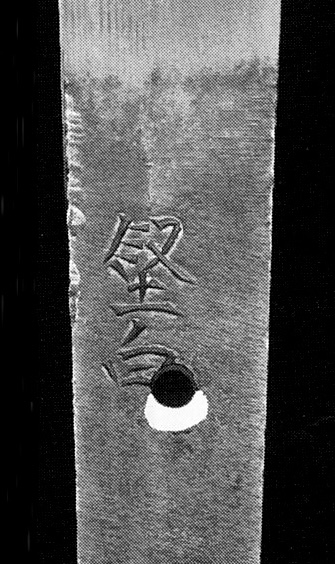
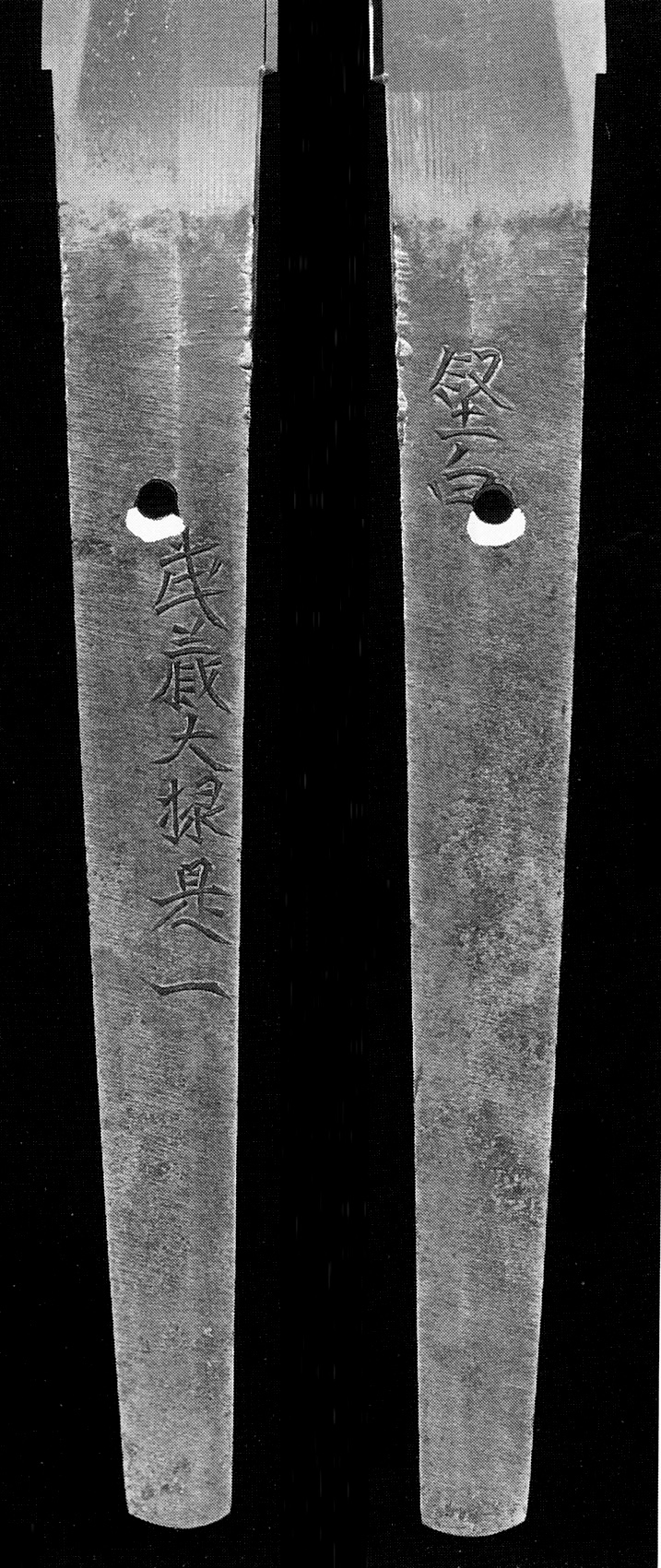
I know, the title sounds odd, but you will soon know why this brief write-up is named that way. The other day, I came across an image of the tang of a sword by Musashi Daijō Korekazu (武蔵大掾是一), that is, the first generation of this Ishidō (石堂) lineage, who was active around Manji (万治, 1658–1661) in Edo. Of interest, however, is the two-character inscription on the reverse of the tang: Kenpaku (堅白).
In literal terms, kenpaku means “hard white,” or “hard and white,” but what is its context, and why it is inscribed on a sword blade?
Now, said term goes back to what is referred to as The Argument on Hardness and Whiteness, Chinese Jiānbái Lùn (堅白論), and Japanese Kenpaku Ron. It was written by Gōngsūn Lóng (公孫龍 , c. 320 – 250 BC, Japanese: Kōson Ryū), a Chinese philosopher from the state of Zhào (趙), who is best known for a series of paradoxes, Jiānbái Lùn being one of them. According to Wikipedia, his “paradoxes seem to suggest a similarity to the discovery in Greek philosophy that pure logic may lead to apparently absurd conclusions.”
In short, Gōngsūn Lóng argues that a stone is both hard and white, but seeing it does not make one perceive its hardness, only its whiteness, whilst touching it does not convey its whiteness, but its hardness only.
Thus, in the sense of swords, the principle of kenpaku can be interpreted as one may recognize a blade as being of excellent workmanship simply by looking at it, but one cannot determine its cutting ability that way. Conversely, by actually using the blade, one can ascertain its cutting ability, but not the aesthetic qualities of its workmanship.
Well, there is of course a relationship between excellent workmanship and cutting ability, meaning an excellently made blade likely cuts well, but so can an unobtrusive blade, or such that looks of crude make at first glance.
That said, it is possible that Korekazu, whilst being confident in the cutting ability of his swords, wanted to convey precisely this idea: “This blade is certainly beautiful, but you cannot judge how well it will cut merely by looking at it. Does the term kenpaku ring a bell? Look it up!”