KANTEI 4 – YAMASHIRO #31 – Hasebe (長谷部) School 2

As promised last time, we are continuing with Hasebe Kunishige’s short swords. A characteristic feature of his (and his school’s) hira-zukuri ko-wakizashi (and partially also of the larger tantô) is that they show a noticeably thin kasane, i.e. thinner as it was already common during the mid-Nanbokuchô period. This peculiarity is more noticeable at shorter blades because of obvious pratical reasons: Long swords from heyday Nanbokuchô do indeed have a thinner kasane than their Kamakura predecessors but you just can’t make a tachi too thin. Another typical feature of Kunishige and Hasebe that is a hint more obvious on hira-zukuri ko-wakizashi and tantô than on long swords is the tendency towards nagare-masame towards the ha and towards the mune. Sometimes it is just a little nagare along the itame but relatively often you will see almost pure masame in these areas, i.e. ha and mune. So the whole tradition with Kunishige having Yamato roots might actually just be “reverse engineering” so to speak, i.e. having an emphasis on masame, what speaks for Yamato, and then finding in Yamato province a place, Hase, that has literally parts of his name in it. But in a scientific and an evidence-based world, it is of course not that easy. Well, nagare-masame is also found at Ryôkai and Nobukuni but in their case it mostly appears just along the ha and not towards the mune. Incidentally, the Yamato characteristics seen at Kunishige blades are in my opinion not as strong as the Yamashiro characteristics seen at early Nobukuni blades. In other words, and as mentioned in the corresponding chapters, early Nobukuni works do confirm that he had Yamashiro roots whereas just masame here an there is, for me, not enough to close the Hasebe case and accept that Kunishige came from Yamato.

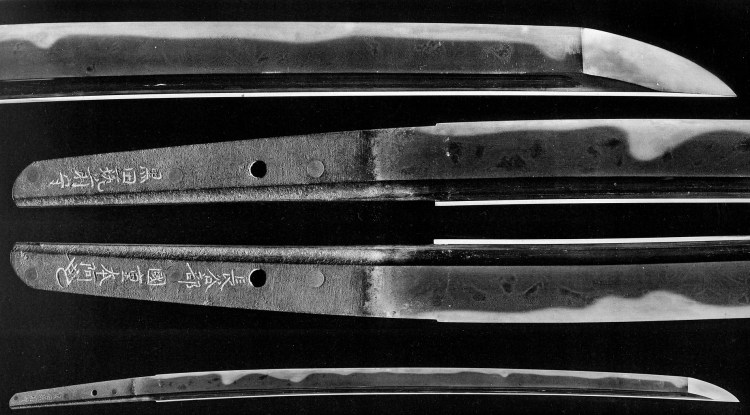
The first blade (picture 5) that I want to introduce is the blade that bears the earliest known date signature of Kunishige that is considered to be watertight, a hira-zukuri ko-wakizashi that is dated Bunna four (文和, 1355). The blade has a wide mihaba, a thin kasane, has a little sori, and is altogether of a typical sunnobi-sugata. The jigane is an overall standing-out itame that is mixed with masame towards the ha and towards the mune. In addition, also ji-nie and chikei appear. The hamon is a ko-nie-laden notare that is mixed with gunome, ashi, , kinsuji, sunagashi, tobiyaki, and muneyaki and that thus tends a little to hitatsura, although it is not a full and prominent hitatsura. The bôshi features a maru-kaeri with hakikake that runs back in a long fashion and connects with the muneyaki. As for the horimono, the omote side shows a suken and a bonji and the ura side a futasuji-hi which runs with kaki-nagashi into the tang. The tang is ubu, has a shallow kurijiri, kiri-yasurime, and three mekugi-ana. So, the kasane is a hint thinner than seen at contemporary heyday Nanbokuchô hira-zukuri ko-wakizashi, there is a tendency towards hitatsura, a long kaeri (although not added in the oshigata), and prominent masame and thus we have again all the characteristic features of the Hasebe School.
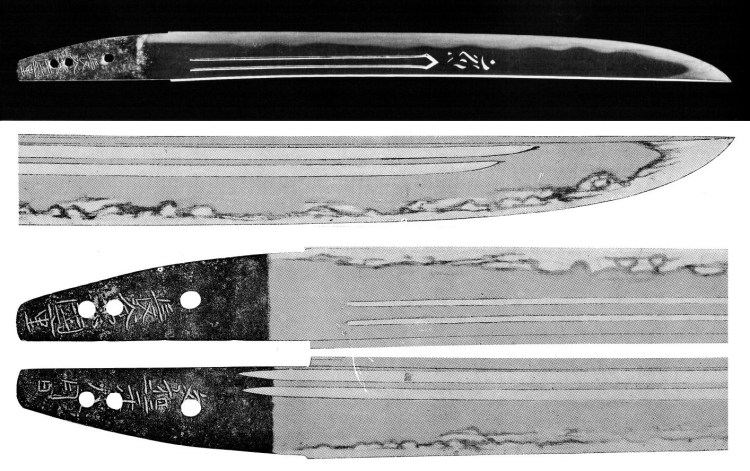
 

Picture 5: tokubetsu-jûyô, wakizashi, mei: “Hasebe Kunishige” (長谷部国重) – “Bunna yonen hachigatsu hi” (文和二二年八月日, “a day in the eighth month of Bunna four [1355]”), nagasa 34.2 cm, sori 0.4 cm, motohaba 2.9 cm, hira-zukuri, mitsu-mune

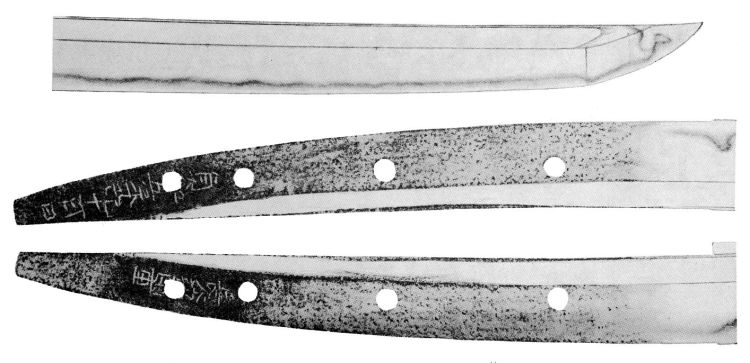
The next blade (see picture 6) that I want to introduce was made a few years after the one shown in picture 5. It is a tantô that is dated with the Enbun era but unfortunately, the mekugi-ana goes through the year so the date can be anything between 1356 and 1361. This blade is a little bit smaller, measuring 29.0 cm in nagasa, but still features in relation to that nagasa a wide mihaba. The jigane is an itame that tends to masame-nagare along the ha and there is plenty of ji-nie. The hamon is a nie-laden ko-notare that is mixed with some ko-gunome, angular elements, much sunagashi all over, and tobiyaki, i.e. the hamon again appears altogether as hitatsura. The bôshi features a ko-maru-kaeri that runs back in a continuous manner as muneyaki. So please take a look at the hamon, bôshi, and muneyaki: We have here an interpretation that is very typical for the Hasebe School, namely a more or less uniformly wide hamon (i.e. no gradual widening towards the bôshi etc.) that is so to speak “mirrored” in a small way in the muneyaki. Or in other words, imagine two more or less parallel hardenings which “enclose” a hitatsura in between them. Kunishige and the other Hasebe smiths of course also hardened different hamon which increase in width, sometimes even prominently towards the bôshi, but from my experience, if you have a heyday Nanbokuchô hira-zukuri ko-wakizashi or sunnobi-tantô in hitatsura that has this almost what I call a “tuning fork” like hamon/muneyaki combination, there is a good chance that it is a Hasebe work. That said, there are quite similar interpretations by contemporary Sôshû masters like Hiromitsu and Akihiro but usually we see a hint more ups and downs along their hamon, and in particular dango-chôji in case of Hiromitsu. Also, there would not be that prominent masame-nagare and their blades would show a little thicker kasane.
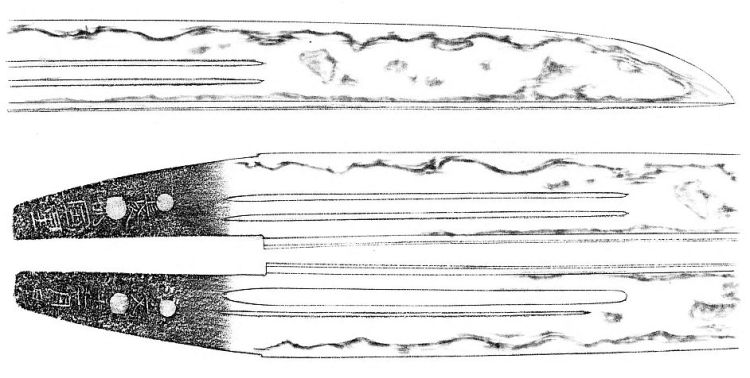
 

Picture 6: jûyô, tantô, mei: “Hasebe Kunishige” (長谷部国重) – “Enbun ?-nen nigatsu hi” (延文〇年二月日), nagasa 29.0 cm, only a little sori, motohaba 2.8 cm, hira-zukuri, mitsu-mune

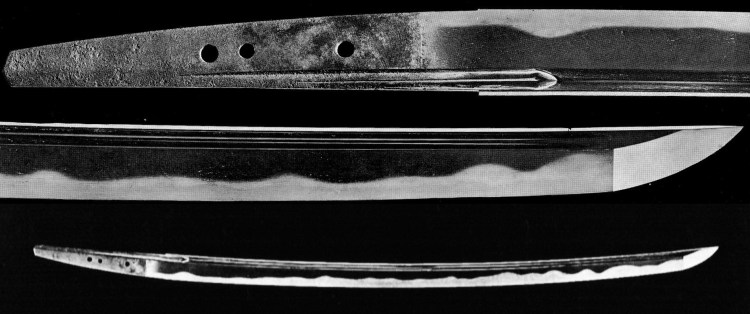
In picture 7 I want to introduce another example, this time with the picture shown vertically, so I hope you understand what I meant with the “tuning fork” comparison, even if the muneyaki part doesn’t go all the way down here. It is another hira-zukuri ko-wakizashi and shows a somewhat standing-out itame that tends to nagare in places and that is mixed with mokume, some jifu, plenty of ji-nie, and chikei. The hamon is a ko-nie-laden notare that is mixed with gunome, a little bit chôji, many ashi, fine sunagashi and kinsuji, and with some tobiyaki at the base and along the upper half of the blade. The nioiguchi is bright.
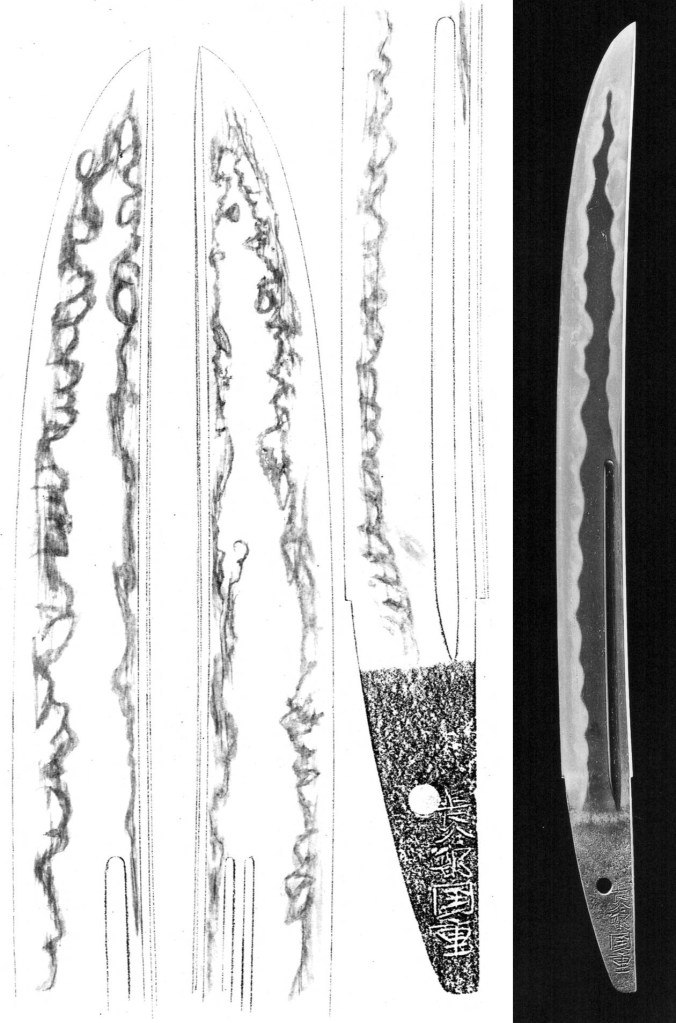
 

Picture 7: tokubetsu-jûyô, wakizashi, mei: “Hasebe Kunishige” (長谷部国重), nagasa 36.9 cm, sori 0.5 cm, motohaba 3.5 cm, hira-zukuri, mitsu-mune


Picture 8 shows a tantô with a moderate nagasa for mid-Nanbokuchô but which appears with the relatively narrow mihaba nevertheless in sunnobi-style. The jigane is a standing-out itame that is mixed with masame towards the mune and that features ji-nie and chikei. The hamon is a nie-laden gunome-chôji that is mixed with ko-notare, tobiyaki, yubashiri, sunagashi, and kinsuji and with the muneyaki, we arrive again at a full-blown hitatsura. Please note the different bôshi: It has a pointed kaeri on the ura but a typically roundish “Hasebe kaeri” on the omote side.
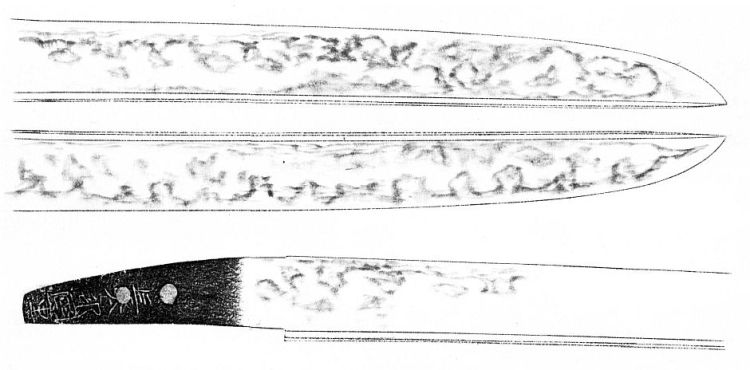


Picture 8: jûyô, tantô, mei: “Hasebe Kunishige” (長谷部国重), nagasa 27.0 cm, sori 0.2 cm, motohaba 2.4 cm, hira-zukuri, mitsu-mune


The last blade (see picture 9) that I want to introduce for Kunishige should demonstrate another side of his repertoire, although interpretations like that are rather rare for him. It is a sunnobi-style tantô with a dense ko-itame that only tends on the ura side towards nagare-masame, and this only very little. In additiom, there is plenty of ji-nie and chikei. Such a relatively fine ko-itame is usually rather associated with Hasebe Kuninobu tachi than Hasebe Kunishige short swords. The hamon starts a a low and calm notare-chô which then turns into a wide chôji that is mixed with tobiyaki, yubashiri, muneyaki, fine kinsuji, and sunagashi. Thus the ha only appears in the upper section as hitatsura. Incidentally, the nioiguchi is wide and bright and the bôshi has a ko-maru-kaeri with a small shimaba on the omote side.
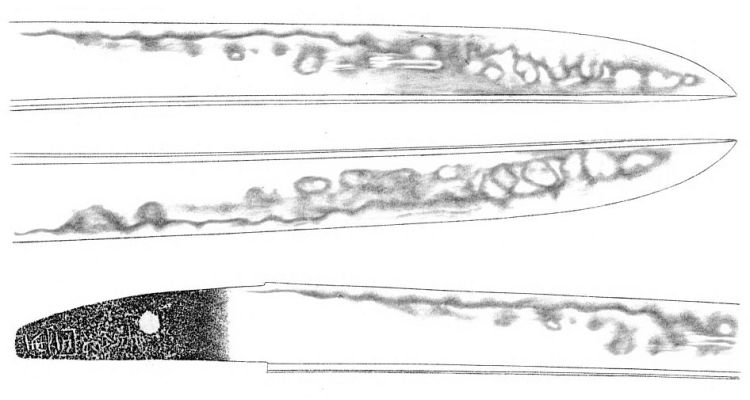
 

Picture 9: jûyô, tantô, mei: “Hasebe Kunishige” (長谷部国重), nagasa 27.9 cm, sori 0.3 cm, motohaba 2.8 cm, hira-zukuri, mitsu-mune

*

Next part will deal with Hasebe Kuninobu after which we will conclude the Hasebe chapter wit Kunihira and the genealogy of the school.
Shrine gifts to the Shôgun

This time I want to talk about a special custom, and that is the traditional sword gift that the Tanzan-jinja (談山神社) made to each new shôgun. Before we start, the Tanzan-jinja was mostly referred to by its mountain name, Tônomine (多武峯), in feudal times, just to point that out if you come across conflicting data when doing research or reading about that custom in another context. Anyway, the Tanzan-jinja, or Tônomine respectively, is located close to present-day Sakurai (桜井), Nara Prefecture. It is about 15 miles (25 km) to the south of Nara station (linear distance), or 38 miles (62 km) to the south of Kyôto (again, linear distance).

There exists a seven-volume record titled Kyôto Oyakusho-muki Taigai Oboegaki (京都御役所向大概覚書), a collection of official memoranda and reports fro the office of the Kyôto magistrate, the Kyôto machi-bugyô (京都町奉行), which was compiled in Kyôhô two (享保, 1717). Therein we read that from the 18th year of Keichô (慶長, 1613) onwards, the Tanzan-jinja (Tônomine) presented at every shogunal succession one sword from its possessions to the new shôgun. Practice was this that the Kyôto magistrate office required the Tanzan-jinja to bring in advance a few dozen swords so that they in turn can call the head of the Hon’ami family to come in and pick the one that is most suitable for the present.

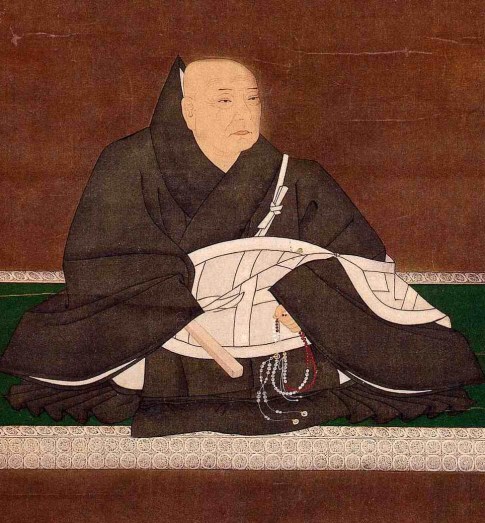
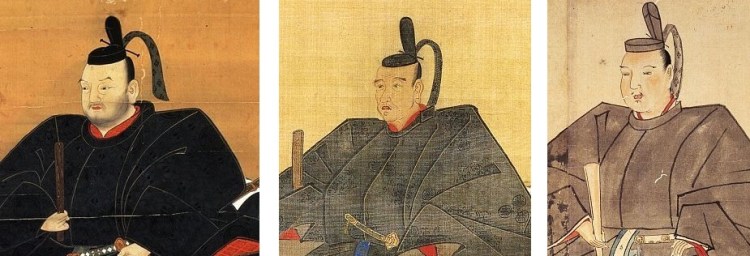
Picture 1, from left to right: Ietsuna, Tsunayoshi, Ienobu

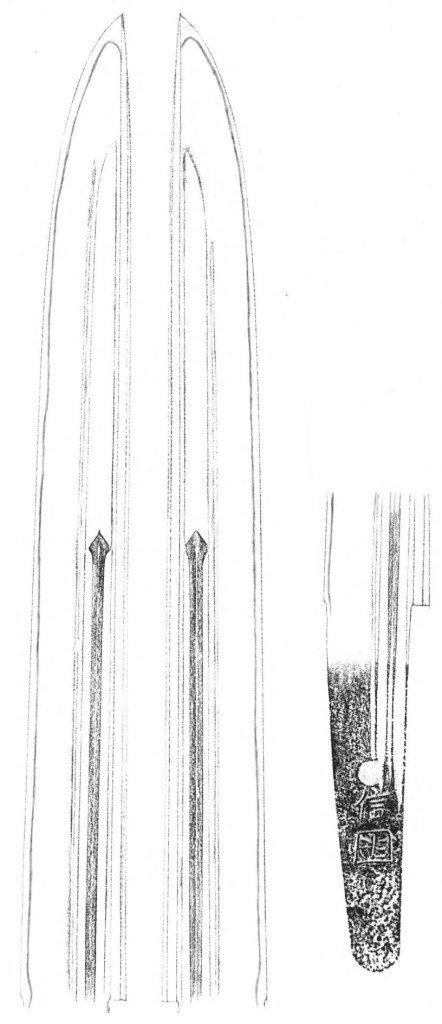
In order to not just provide dry text here, I want to introduce a sword that was presented by the shrine on one such occasion, namely a Nobukuni (信国) tantô (see picture 2) that was given to the 5th Tokugawa shôgun Tsunayoshi (徳川綱吉, 1646-1709) when he took over from Ietsuna (徳川家綱, 1641-1680) in the fifth month of Enpô eight (延宝, 1680). By the way, Kôjô (本阿弥光常, 1643-1710) was the head of the Hon’ami family at that time but we don’t know who exactly was in charge of picking the sword.

Picture 1: jûyô, tantô, mei: “Nobukuni” (信国), nagasa 26.1 cm, uchizori, hira-zukuri, mitsu-mune

The second shrine gift that I want to introduce here is from the sixth year of Hôei (宝永, 1709) and concerns the succession of Tokugawa Ienobu (徳川家宣, 1662-1712) taking over from Tsunayoshi and becoming the 6th Tokugawa shôgun. In preparation to his 1709 succession, the astonishing amount of 58 swords were brought from the Tanzan-jinja to the place of the Kyôto magistrate and for this time, we know who from the Hon’ami family was chosen to pick the gift sword, Hon’ami Kôzan (本阿弥光山, 1634-1714). That is, it was maybe not the head of the family who was proceeding to Kyoto to meet with the official.

Incidentally, we also know that Kôzan was in charge for picking the Tanzan-jinja sword gift for the very next succession, which took place in Shôtoku three (正徳, 1713), the year before he died. So from the Kyôto Oyakusho-muki Taigai Oboegaki record we know that Kôzan had to judge the condition of the polish and had to arrange a polish (togi-age, 研上ケ), the making of a new shirasaya, a wooden habaki (yes, wooden, that’s what the record says), and a new sword bag (katana-bukuro, 刀袋) if necessary. What he picked was an unsigned wakizashi attributed to Bizen Osafune Sadamitsu (備前長船貞光), measuring ~ 42 cm in nagasa

That kind of speaks volumes for the then, i.e. mid-Edo “treasure” swords of the shrine, i.e. a signed Nobukuni is pretty good, don’t get me wrong, but an unsigned and therefore probably ô-suriage blade of a minor Bizen smith? For the auguration of the new shôgun? I want to do more research in the future to see if also other shrines were making similar gifts, what seems likely, at least for ther larger shrines, and maybe these shrine presents were more seen as nice gestures, unlike gifts from daimyô where all the context of family bond and alliances comes into play. But be that as it may, it tells us how many swords these shrines were storing at any time throughout the Edo period, i.e. if they picked 58 for “a closer consideration”.

In this sense, there is hope that there are still treasure swords going to be discovered  in some shrines in the future, as for example pointed out here. Also, I just finished translating an article for the Western members of the NKBKHK which deals with an armor that was probably worn by the famous warlord Katô Kiyomasa (加藤清正, 1562-1611) and that had been stored away more or less unnoticedly in a simple bucket in a shrine in deep Nagano Prefecture for about 400 years!


Kantei Series Challenges

In view of the shortly published second part of the Hasebe chapter of my Kantei series, I just wanted to share a certain difficulty that I face on a regular basis when doing research for this series. I will skip the greater context and details of workmanship here because they will be addressed in the upcoming chapter.

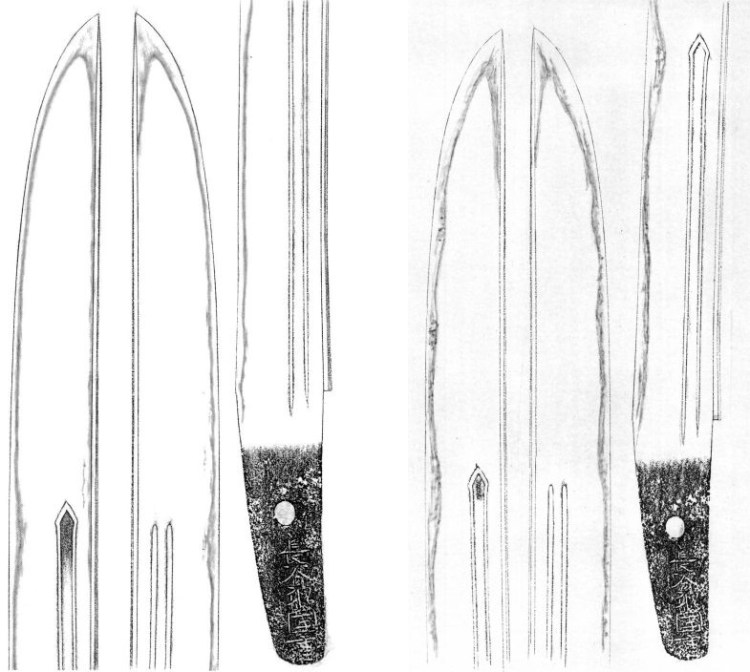
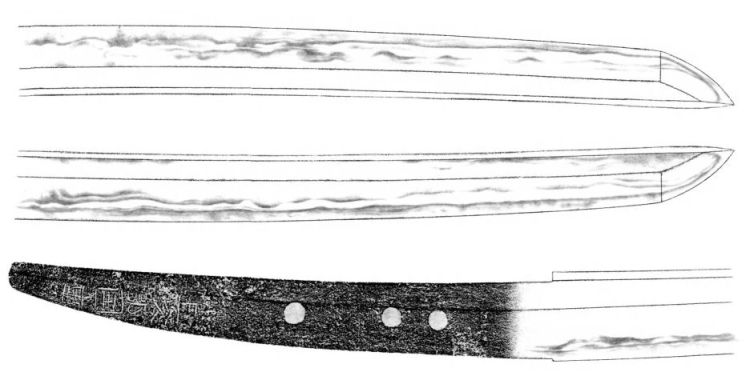
So the difficulty I am talking about is significantly differing oshigata and/or blade descriptions. The blade in question is a hira-zukuri ko-wakizashi by Hasebe Kunishige (長谷部国重) which was also introduced by Tanobe sensei in his Me no Me article series. Therein he uses it to point out that certain rare interpretations by Kunishige bear a resemblance to contemporary Nobukuni (信国) works, in concrete terms through a typically wide Enbun-Jôji-sugata and a hardening in suguha. Tanobe also explains that the standing-out ô-itame with nagare-masame towards the ha and mune and the large, roundish, and long running-back kaeri (which connects with muneyaki that continue to about the mid-blade section) eventually identify the blade as a Hasebe work. So that’s all fine, case almost closed, but I wanted to find out more on that blade, in particular to see if there are more of this kind in order to work out similarities/differences between the Hasebe and Nokubuni schools.

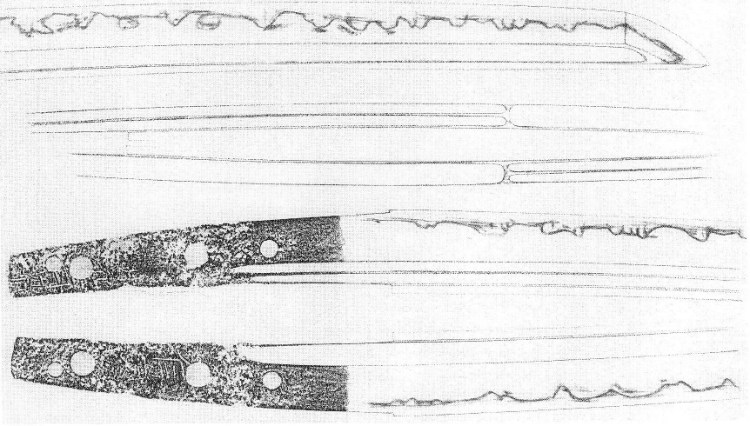
As Tanobe mentioned that the blade in question is jûyô, I was able to find it in the records (it passed in 1967) and what do I see, a significantly different oshigata (see picture 1). No more a relatively pure suguha as seen on the oshigata used by Tanobe sensei. Also no strikingly roundish bôshi and neither a drawing nor a mention of the long muneyaki. In the jûyô oshigata we see a hamon in shallow notare (or with good faith a suguha-chô that is mixed with notare at best) that even shows a hint of ko-chôji or ko-midare in places. Also, the bôshi features a relatively pointed kaeri, or at least that is what the “artistic rendering” of hataraki within the bôshi suggests. Apart from that, check out the significant difference in thickness of the ha along the monouchi and fukura. There is the same notare protrusion on the omote side, close to the tip of the suken shown on both oshigata, but then Tanobe’s version shows quite a thin suguha whereas the jûyô version shows a wide ko-notare/sugha-chô that features ups and downs. And on the ura side, the ha protrusion of the mid-blade section comes at the end of the gomabashi in the Tanobe version whereas on the jûyô oshigata, that protrusion starts after the gomabashi horimono. And also please notice how much wider the ha on this side is along the fukura

OshigataComparison

Picture 1: Tanobe oshigata left, jûyô oshigata right.

It is very interesting to see how two experts can “read” a blade differently. Anyway, I just wanted to give you a quick look “behind the scenes” of my Kantei series and stress that picking references can be a sensitive task. So on one hand, I don’t want to work through the same old blades over and over again that are found in every book but on the other hand, I also don’t want to introduce one oddity after the other. Aim is to provide a good balance between very typical works and a few more rare interpretations which help to understand the variety of workmanships of certain smiths or schools in some cases. That should do it for today and I will be back with part 2 of the Hasebe chapter shortly.

Similar reads:

The Musashi-Masamune – One blade, four oshigata
Another different oshigata
Kiyomaro oshigata comparison

KANTEI 4 – YAMASHIRO #30 – Hasebe (長谷部) School 1

Now we arrive at Yamashiro’s Hasebe School which is, lo and behold, actually Sôshû. Also, we are facing here kind of the same issues as we faced with the Nobukuni School. In regards to the former aspect, the Hasebe School does not qualify as member of the Yamashiro tradition in the strict sense of the word because its workmanship is, as mentioned, pure Sôshû. However, all traditional sources introduce the school as part of the Yamashiro tradition due to it being later located in Kyôto, and I don’t want to break with these conventions in my kantei series. In other words, and as my regular readers may know, I am questioning old publications quite frequently but at the same time, I still want to stick to traditional approaches as much as possible in order to maintain “backwards compatibility.” Long story short, I am introducing the Hasebe School in the Yamashiro chapter, the place you will also find it in traditional original Japanese sources in case you want do more research. I have dealt with the origins of the Hasebe School a while ago in this article. So basically there is the theory that the name of the school, and therefore the school itself, has its origins in Yamato province but there is also the approach to link the origins of the Hasebe School to Shintôgo Kunimitsu who bore the family name Hasebe. That said, I would like that you also read Darcy’s excellent write-up on this context here.

When it comes to the mentioned similar Nobukuni School issue, it is that of the counting of generations of the school founder, Hasebe Kunishige (長谷部国重). This means, like at the Nobukuni School, there are views which basically assume that the ancestor and first generation emerged in the mid-Nanbokuchô period whereas some of the older sources see him as student of Masamune and therefore place him in the early Nanbokuchô period. But let’s start and address these issues as we proceed.

The records are in agreement that the Hasebe School was founded by Kunishige. This Kunishige now either came from the Senju’in (or Taima) School, i.e. having Yamato roots, or was the son of (or otherwise related to) Shintôgo Kunimitsu. The former approach suggests that he followed the then trend of smiths being either invited to Kamakura or that he tried his luck at this new hotspot of sword making whereas the latter approach suggests that Kunishige was born into a newly created but now thriving sword making tradition. Either way, he must have been in touch with Masamune and with Masamune’s colleagues and this local context is good enough for me to understand why later sources count him as one of the famous Ten Students of Masamune. Just for your info, the Kotô Mei Zukushi says that the 1st generation Hasebe Kunishige was the son of Senju’in Shigenobu (千手院重信), that his first name was Chôbei (長兵衛),  that he was born in Bun’ei seven (文永, 1270), and that he died in Jôwa three (貞和, 1347) at the age of 78. It also says that he worked in Kyôto from the Ryakuô era (暦応, 1338-1342) onwards. The last statement makes insofar very much sense because with the fall of the Kamakura bakufu in 1333, we see kind of a “Kamakura exodus” with most of the then of Sôshû masters leaving the area, i.e. Gô Yoshihiro and Norishige going to Etchû, Rai Kunitsugu and Hasebe Kunishige to Kyôto, Sadamune to Takagi in Ômi province, Kaneuji and Kinjû to Mino, Chôgi to Bizen, and Sa going down to Kyûshû. I don’t want to digress too much but just so much for the historical background: After Kamakura fell, it was tried to have the shôgun in Kyôto and a deputy shôgun in Kamakura but that never worked out because the deputy shôgun tried to become shôgun what made Kamakura and the region was basically unstable. So only a few masters still remained on site to equip the local military elite, for example Hiromitsu and Akihiro.

Back to Kunishige. When we take a look at his entire body of work we learn that he focused on the production of hira-zukuri ko-wakizashi and tantô respectively (or all long swords were either used up or shortened later). Tachi are rare, what is in particular true for signed specimen. To my knowledge, there are only three zaimei tachi known, one is dated Jôwa five (貞和, 1349) and its authenticity is debated since pre-WWII times, one has an orikaeshi-mei, and one is ubu and displays a signature style which differs somewhat from that seen on his ko-wakizashi and tantô, although it is mentioned that in fact of the otherwise matching workmanship of the blade itself, the differences in the mei might well lie within the realm of changes of a smith’s signature style over time.

So before we introduce some of Kunishige’s works, let’s address the elephant in the room, the question about the succession/counting of generations. In the meikan, we usually find find three generations, the 1st being active around Kenmu (建武, 1334-1338), the 2nd around Enbun (延文, 1356-1361), and the 3rd generation, Rokurôzaemon (六郎左衛門), around Ôei (応永, 1394-1428). The Nihontô Koza also introduces three generations Kunishige, with Honma sensei adding that the workmanship of the first two is hard to distinguish and basically has to be tackled via the quality factor, what is the traditional approach we see so often, i.e. “looks definitely like smith A but the quality is a little inferior so let’s say it is a work of a second generation A.” This scenario sometimes works but sometimes there is nothing really substantial to base it on. Incidentally, in his Nihon Kotô Shi, Honma states that he agrees with the tradition that the 1st generation was already active around Kenmu. Tsuneishi and Uchida both follow the three generations theory too (with Rokurôzaemon the 3rd being active around Ôei) whereas Tanobe sensei dismisses the approach that the 1st generation was active that early (or rather counts the Kenmu and Enbun Kunishige as one smith) and counts Rokurôzaemon as 2nd generation (as Fujishiro sensei does).

My take on this is as follows. I accept that some mid to later Nanbokuchô smiths with a Sôshû-influenced workmanship have never trained with Masamune or have never been to Kamakura but I have troubles with accepting that certain smiths, especially like Hasebe Kunishige whose workmanship is so close to what was done by the first generation Sôshû smiths, so to speak locally popped up out of the blue two or three decades after initial masters like Masamune had been active. Also, the travelling of medieval smiths is often doubted but when for example Aoe smiths were able to make it the 150 miles (as the crow flies) from Bitchû to Kyôto to work for Gotoba, nothing speaks for smiths doing the 215 miles trip from Kyôto to Kamakura (again, as the crow flies). Let’s take a look at the dated blades we know from Kunishige. The earliest is the Jôwa five one mentioned above but as this mei is doubted, Bunna four (文和, 1355) becomes the earliest one. Then it continues with Enbun two (延文, 1357), three (1368), five (1360), Jôji two (貞治, 1363) and four (1365), and Ôan one (応安, 1368) as the youngest. And then we have two oshigata of Rokurôzaemon blades which are dated Ôei 24 (応永, 1417) and Shôchô one (正長, 1428). So when the Kotô Mei Zukushi is correct with the 1st generation being born in 1270 and having died in 1347, all these dated blades before Rokurôzaemon go back to the 2nd generation. The Kotô Mei Zukushi also says that the 2nd generation Kunishige was born in Shôwa two (正和, 1313) and died in Ôan four (応安, 1371) at the age of 60, what does not add up, and states that the 3rd generation was born in Enbun one (延文, 1356) and died in Ôei eight (応永, 1401) at the age of 46 what seems to be incorrect as there are blades known as mentioned above which bear much later dates

Not saying that the Kotô Mei Zukushi is correct with all its dates of course (for reasons mentioned in one of the previous chapters) but everything would fall in line if this source is quasi off by one generation. That is, what if it was the 1st generation who was born in 1313? He would have been in his late 20s or early 30s when studying with Masamune, and in his 20s in the Kenmu era. And he would have been just 55 years old when the youngest known dated Kunishige blade was made in 1368. The fact that the vast majority of dated Kunishige blades is from about that time, or a little earlier, could be explained by the assumption that his school only really took off after the Hasebe smiths got settled in Kyôto. The problem that remains is that it seems that when the 1st generation assumedly died in 1371, there are then no dated blades known from the 2nd generation. This in turn could be explained by the fact that when he was reaching his artistic maturity (being born in 1356), it was already the late Nanbokuchô period and so maybe the demand for Hasebe blades had decreased. Or he was weak/sickly and hardly worke himself as he assumedly died at the young age of 46. And the 3rd generation then left Kyôto and tried his luck somewhere else (more on this later).

Enough speculation and as I was already writing quite a bit, I will only introduce a few long swords by Kunishige and will leave his hira-zukuri ko-wakizashi and tantô as well as the characteristic features of his and Hasebe workmanship for the next part. Let’s start with what is undoubtedly Kunishige’s most famous work, the kokuhô meibutsu Heshikiri-Hasebe (圧し切長谷部) (see picture 1). For info on the historical background of the blade and its nickname please see my other site here. The Heshikiri-Hasebe has a wide mihaba, a shallow sori, a thin kasane, and ends in an ô-kissaki, i.e. everything is classical heyday Nanbokuchô. The kitae is a dense, excellently forged ko-itame with fine ji-nie and the steel has that beautiful “wet” look. The hamon is a notare-midareba in ko-nie-deki that is mixed with ashi and that tends with its tobiyaki and yubashiri to hitatsura. The bôshi is relatively widely hardened and runs back in an ô-maru-kaeri.


Picture 1: kokuhô Heshikiri-Hasebe, nagasa 64.8 cm, sori 0.9 cm, motohaba 3.0 cm, sakihaba 2.5 cm, shinogi-zukuri, iori-mune


Picture 2 shows the tachi with the questionable mei/date. It has relatively unobtrusive sugata, i.e. not heyday Nanbokuchô, what would corroborate its date, and ends in an elongated chûj-kissaki. Don’t be mislead by the four mekugi-ana and the low signature, the blade is considered to be ubu. That is, we have here already one of the typical characteristics of the Hasebe School, namely signing the blades sometimes at the very bottom of the tang. As you can see in the oshigata, the hamon is a rather calm suguha with some midare towards the base and the kaeri of the bôshi encloses a shimaba, a feature that is often seen at Sôshû blades, e.g. at Masamune.


Picture 2: tachi, mei: “Hasebe Kunishige” (長谷部国重) – “Jôwa gonen tsuchinoto-ushi jûgatsu hi” (貞和五年己丑十月日, “a day in the tenth month of Jôwa five [1349], year of the ox”), nagasa 71.2 cm, shinogi-zukuri, iori-mune


In picture 3 we see a katana that is designated as a jûyô-bunkazai and that is attributed to Hasebe Kunishige via Den. It is ô-suriage, has a wide mihaba, a thin kasane, a shallow sori, an elongated chû-kissaki, and, what is another feature relatively often seen on Hasebe blades, a maru-mune. The kitae is an itame that tends to nagare and that shows ji-nie and the hamon is a notare that is mixed with gunome, ashi, connected , and that tends along the upper half of the blade to hitatsura. The bôshi is midare-komi and shows hakikake.


Picture 3: jûyô-bunkazai, katana, mumei: Den Hasebe Kunishige (伝長谷部国重), nagasa 70.6 cm, sori 1.36 cm, shinogi-zukuri, maru-mune


And last for today the aforementioned tachi that is ubu and signed but whose signature differs a little bit from that seen on Kunishige’s hira-zukuri ko-wakizashi and tantô. The blade is rather slender, has a deep sori, and ends in a ko-kissaki. So in terms of shape, this should be either a very early work of Kunishige (what would explain the different signature) or a later work that was made for court use. The kitae is an itame that is mixed with mokume and that features plenty of ji-nie and chikei. The steel has a “wet” look and is very clear. The hamon is a ko-nie-laden ko-notare-chô that is mixed with gunome, many ashi, kinsuji, sunagashi, hotsure, yubashiri, and muneyaki and tends to a so to speak layer-based (i.e. not a tobiyaki and/or togari-based) hitatsura. The bôshi is sugu with a ko-maru-kaeri and shows hakikake that tend to a little bit to nie-kuzure.


Picture 4: jûyô, tachi, mei: “Hasebe Kunishige” (長谷部国重), nagasa 67.7 cm, sori 2.6 cm, motohaba 2.7 cm, sakihaba 1.75 cm, shinogi-zukuri, iori-mune


*

Hôki no Kami Masayoshi’s (probably) last blade

From the very end of the kotô era onwards, we start to get more reliable information on the biographical data of swordsmiths, for example the dates of birth and death and what year honorary titles were received etc. This “tendency” does not only go back to the obvious fact that more data is extant the later, i.e. younger we find ourselves in history but also to the relatively massive bureaucratic apparatus the Tokugawa bakufu brought along. In addition, shintô and shinshintô smiths, or at least the renowned masters, signed in greater detail than their kotô colleagues, generally speaking. In this article, I want to introduce such an example.

So when we look into the meikan, we often read things like: “Smith X died in the fifth year of D and we know dated blades from B to C,” at least when it comes to the more well-known shintô and shinshintô masters as mentioned. Or we read for example: “There exists a blade dated C that is signed with the supplement ‘made at the age of Y’ what calculates his year of birth as A.” This all gives us a pretty decent idea of when the smith worked but also tells us about what were his early years, when did he have his zenith, and which blades can be regarded as late works. The blade that I want to introduce goes “a step further” in what it states about when it was made and under which circumstances so to speak. But first of all, let me introduce the very smith we are dealing with.

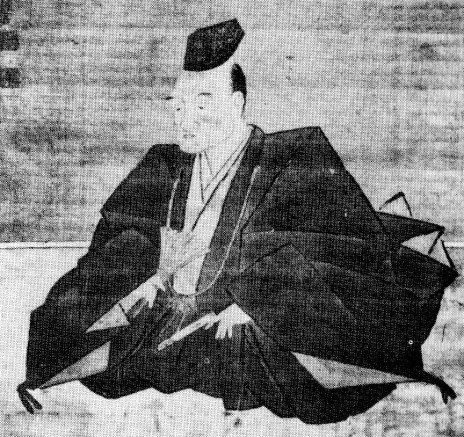
Picture 1: Portrait of Hôki no Kami Masayoshi

It is Hôki no Kami Masayoshi (伯耆守正幸, see picture above), the 3rd generation of Satsuma’s Masayoshi (正良) lineage. Masayoshi was born in Kyôhô 18 (享保, 1733) as son of the 2nd generation Masayoshi, whom he succeeded under that name, but when he received his honorary title “Hôki no Kami” in Kansei one (寛政, 1789), he changed the yoshi character of the hereditary name from (良) to (幸). Masayoshi was in his mid 50s when he received that title and reaching the age of 70, he started to add his age to his mei. Apart from that, he signed with the supplement “Satsuma-kankō” (薩摩官工, about “official smith of the Satsuma fief”), which is already found on blades from his earlier Masayoshi (正良)-phase.


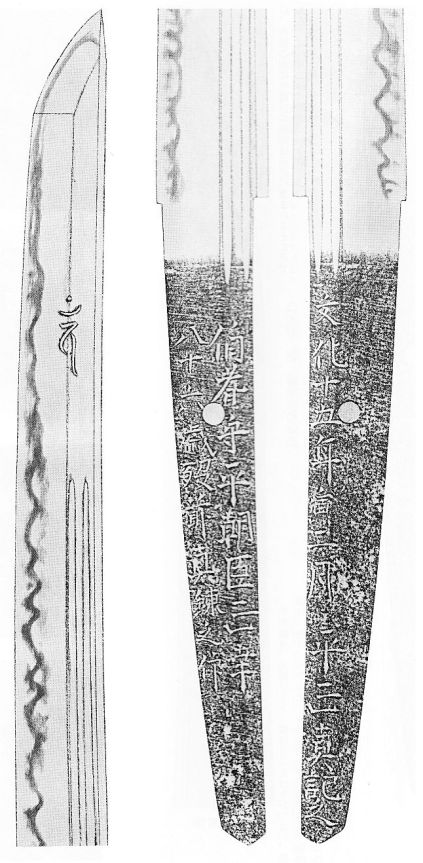
Picture 2: katana, nagasa 70.1 cm, sori 1.8 cm, shinogi-zukuri, iori-mune


Now the blade shown above is very special because it is signed the following way:

omote:

“Hôki no Kami Taira Ason Masayoshi” (伯耆守平朝臣正幸)
“Hachijûroku-sai botsuzen shinren no saku” (八十六歳没前真錬之作, “carefully made before his death at the age of 86”)

ura:

“Bunka jûgonen tora nigatsu” (文化十五年寅二月, “second month of Bunka 15 [1818], year of the tiger”)
Taira Masazane kore o shirusu” (平正真記之, “recorded by Taira Masazane”)


In short, Masazane, one of Masayoshi’s students, recorded on the tang that Masayoshi carefully made that blade before his death and when the master was already 86 years old. We know that Masayoshi died on the 22nd day of the fourth month of that year. At first glance, this would mean that the blade was made two months before his death but here we have to weigh in a custom of swordsmiths to date blades by default with the second or the eighth month of a year unless it is a special date signature where the exact day and month the blade was made is recorded. Masayoshi followed this custom as the vast majority of his dated blades either show the second or the eighth month in the mei, in particular the second month. That said, the blade in question could have been theoretically made anytime between the first day of the first month and the 22nd day of the fourth month of Bunka 15 (= Bunsei 1), the day that Masayoshi died. Well, Masazane’s supplement is quite a rarity and therefore I tend to think that this was maybe the very last, or one of the last few blades, that Masayoshi made. In other words, it was something special that compelled Masazane to add that info to the mei.

When it comes to Masayoshi’s latest works for comparison, we know a kogatana signed with the supplement “made at the age of 82,” a katana dated Bunka twelve (1815) and signed with the supplement “made at the age of 83,” a katana dated Bunka 13 (1816), and a katana dated Bunka 14 (1817), all of them papered. So far I was unable to find another example that was made in the same year as the one introduced here, in Bunka 15 (= Bunsei 1), the year of his death.

Now when author and expert Fukanobu Yasumasa (深江泰正) introduced this blade back in Token Bijutsu #240 (January 1977), he interpreted the mei in the literal way, i.e. that Masayoshi pesonally made this blade before his death and that Masazane recorded that fact after the master had passed away. However, he also notes that the yasurime are katte-sagari, the tyical file marks of his students, whereas Masayoshi himself finished his tangs in katte-agari yasurime with kiri at the beginning (or just with kiri-yasurime). Thus Fukanobu sensei forwards the possibility that the tang was indeed finished and signed by Masazane but that the blade was probably completely made by master Masayoshi, maybe even down to the horimono.


Well, I think I respectfully disagree with this theory. To understand why, I recommend you watch the excellent recent BBC documentary Handmade in Japan linked above that shows kind of a similar case. It portrays the Komiya (小宮) family of swordsmiths and shows how nearly eighty-eight years old grandfather Komiya is overseeing his two sons and his grandson making swords. Grandfather Komiya says himself in the documentary: “I’m unable to do it anymore because of my age,” what is understandable when you take into consideration the physically hard work it requires to forge-fold the steel bundle and to forge out the blade. Even if Masayoshi was super fit at the age of 86, I have my doubts that he did the whole forging work. Maybe he did the yakiire himself, that’s quite possible. Also taking into consideration the fact that master Masayoshi trained more than 40 students, that several of them were allowed to do daimei for him (and the best of them also to do full daisaku-daimei), and that the finish of the tang speaks for a student’s work, I am thinking of the following “cause of events,” although of course this is all nothing more than pure speculation:

The local forge in Satsuma must have been quite a bustling place and as master Masayoshi was famous throughout the country, the order situation was surely pretty good. When Masayoshi got really old, let’s say 80+, he was basically doing the same thing as grandfather Komiya does in the BBC documentary, and that is talking to customers, to the administration of his fief, and walking around in the forge giving orders and tips. As the sword production was probably still in full swing in early 1818, some students were busy making daisaku-daimei works for the master, Masazane being one of them. Then Masayoshi passed away towards the end of the fourth month and I think that the sword introduced here was the very daisaku-daimei blade that Masazane was working on at that time. So after the funeral and everything, Masazane maybe feld obliged to commemorate that context on the blade, implying that it was the last sword Masayoshi “made” before he died. However, it is absolutely possible that a few other blades that were just finished or in production at the time of Masayoshi’s death were signed this way by the students who were making them as daisaku-daimei and that maybe this is the only one that is extant today (or has been discovered yet).

Anyway, it is a very interesting and rare inscription and I literally came across that blade the day before I watched the BBC documentary for the first time. So I thought I have to share this with you.

On the eve of another famous historical Japanese incident

About three years ago, I wrote a humble article here on sword-related “things” happening on the eve of on of Japan’s most famous historical events. Well, this time, we find ourselves a little earlier than the 47 rônin but the incident is of similar historic significance. But before we continue, let me introduce the sword that was the catalyst for this article.

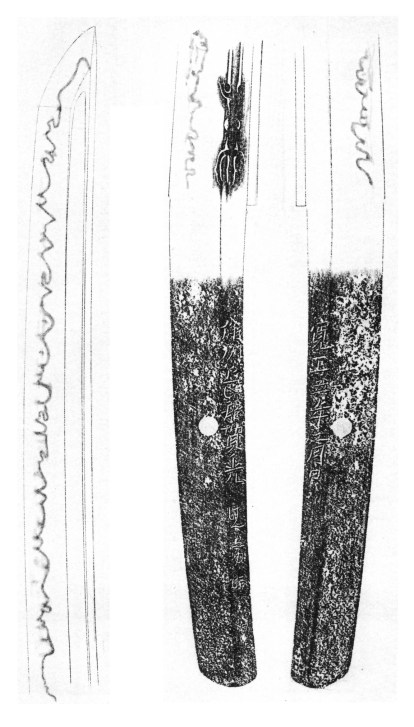
The above picture shows a katana by Osafune Yoshimitsu (賀光) which was made in Kanshô five (寛正, 1464) for a certain “Monk Kenju”. The full signature is “Bishû Osafune Yoshimitsu – Kenju-bô – Kanshô gonen nigatsu hi” (備州長船賀光・けん志ゆ坊・寛正五年二月日, “on a day in the second month of Kanshô five”). Please note that the name of the monk (, 坊) is noted in an “archaic” manner, i.e. as “Ke-n-shi-yu” but which reads Kenju. Now who was this Kenju? None other than the famous Buddhist priest Rennyo (蓮如, 1415-1499) (see picture below). So let me explain in the following the context of Rennyo’s Kenju name, the things happening before and around this sword was made, and why it is therefore an important historic piece.


Now Rennyo was born in Ôei 22 (応永, 1415) as eldest son of the later 7th abbot of the Hongan-ji, Zonnyo (存如, 1396-1457), and this is kind of where Rennyo’s later problems already started: His mother namely wasn’t Zennyo’s wife, she was his grandmother’s  maid. Five years later, in Ôei 27 (1420), Zennyo eventually married, not the maid but Nyo’en (如円, ?-1460) from the Ebina (海老名) family. With this marriage, Rennyo’s biological mother had to leave the Hongan-ji and he never saw her again. It is said that most of his later “motivation” goes back to the trauma Rennyo had suffered being separated from his mother at the age of six (counting in Japanese years).

When Rennyo was 17 years old, that is in Eikyô three (永享, 1431), he became a yûshi (猶子) of Provisional Middle Councillor (gonchûnagon, 権中納言) Hirohashi Kanenobu (広橋兼郷, 1401-1446). Yûshi means literally “another child considered as one’s own”. It is similar to an adopted child (yôshi, 養子) but does not come with the legal obligations a yôshi does. The yûshi approach was mostly used for giving one’s child in the care of an influental person to develop good connections for its later career, and not to aim at a possible succession as head of that family. After becoming Kanenobu’s yûshi, Rennyo, then still bearing his youth name Hoteimaru (布袋丸), became a monk at the Shôren’in (青蓮院) in Kyôto whereupon he took the name Kenju (兼寿), the very name that is noted on the sword.

In Eikyô eight (1436), Rennyo’s grandfather Gyônyo (巧如, 1376-1440), the 6th abbot of the Hongan-ji, abdicated and his father Zonnyo became the 7th abbot. When Zonnyo died in Chôroku one (長禄, 1457), Rennyo’s step mother tried get her own son that she had with Zonnyo, Ôgen (応玄, 1433-1503), to become the 8th abbot but it was decided in favor of Rennyo. Well, probably because Rennyo was still the first born son of Zonnyo and already well-versed in all Buddhist things, being 42 years old whereas his step brother Ôgen was only 24 (or 25 if you count in the Japanese way). As abbot, Rennyo immediately started to expand the influence of the Hongan-ji in the Kinai provinces around Kyôto what was much to the displeasure of the Enryaku-ji, the head temple of the Tendai School located on Mt. Hiei. Funds and protection were mostly provided by artisan-class followers of Rennyo from congregations in Ômi province but Rennyo was refusing to pay obligatory funds to the Enryaku-ji which he was supposed to pay on behalf of the Shôren’in as the Enryaku-ji was then the head temple of Kyôto’s Shôren’in.

So issues began to build up and Rennyo must have known that some of them were probably ending in physical violence. Therefore he approached the Osafune master smith Yoshimitsu to forge him a sword for self-defense. And he turned out to be right: In the first month of Kanshô six (1465), i.e. the year after the sword was made, the Enryaku-ji declared Rennyo a butteki (仏敵), an “Enemy of Buddha,” and sent out warrior monks who destroyed Rennyo’s then base, the Ôtani-Hongan-ji (大谷本願寺) in Kyôto. Warrior monks were sent out again three months later and others followed and these “activities” of the Enryaku-ji went down in history as “Kanshô Presecutions” (Kanshô no hônan, 寛正の法難). Sometimes Rennyo was able to bribe the monk warriors due to the wealth of the congregations he had convered in the area, other times he was only able to flee at the last minute and due to timely assistance from a cooper who saw the attackers coming, leadinf Rennyo out through the back of the temple. In short, Rennyo was very well in need of a sword! This context and the notation of Rennyo’s Kenju name makes the very blade an important historical piece as mentioned and it is today designated as an Important Cultural Property of Ôsaka Prefecture (the blade is preserved in the Ôsaka City Museum).

After the attacks of 1465, Rennyo tried to gain more support from local followers but the Enryaku-ji with its ties to the court and the bakufu was too strong and a kind of a peace deal with the temple was made in the third month of Ônin one (応仁, 1467) that required Rennyo to retire from the post of abbot of the Hongan-ji. Also, the Ônin War broke out that month, significantly weakening the bakufu, and so Rennyo was realizing that he will not have any government support or outside forces to protect his congregations from the Enryaku-ji. So he left Kyôto and lived a nomadic life, eventually rebuilding the Hongan-ji in northern Echizen province, gaining many many followers, and returning to Kyôto in Bunmei seven (文明, 1475) with such a following that Mt. Hiei could no longer prose a credible threat to him and his Jôdo Shinshû School (quoting from Wikipedia).

I hope this was another interesting short excursion into Japanese history with a concrete sword as a starting point and I will continue to do so whenever I come across similar historically important objects that are related to the sword world.

KANTEI 4 – YAMASHIRO #29 – Nobukuni (信国) School 4

With this article, we are concluding the chapter on the Nobukuni School. Just to repeat, when it comes to traditional clasifications of works by this school, for example by the NBTHK, we are facing the following parameters:

  • Work of the 1st generation
  • Mid-Nanbokuchô work in the vicinity of 1st generation
  • Nobukuni work not later than late or end of Nanbokuchô
  • Nobukuni work from the transition between Nanbokuchô and Muromachi
  • Ôei-Nobukuni
  • Direct attributions to Saemon no Jô or Shikibu no Jô
  • Early Muromachi
  • Later generations Nobukuni

So far we have dealt with all of these classifications, except for the last two, which I am going to tackle in the following.

Now I have stated this already in my second chapter on the Ryôkai School: By the end of the Nanbokuchô period, the old-established Yamashiro schools were all fading and Sôshû had taken over significantly, even in the old imperial capital. There is the theory that everything Kyôto-based started to disappear with the Ônin War, which lasted from 1467 to 1477, and this is certainly true for that time because the war destroyed much of Kyôto and in particular the power of the office of shôgun. So it was surely not a good time for craftsmen like swordsmith who were depending on a steady supply of raw materials (e.g. there was no steel production in the capital itself). However, we already see a so to speak “Kyôto exodus” way before that time, for example with the Ryôkai School whose descendants moved down to Kyûshû where they founded the Tsukushi-Ryôkai group. We are able to date back their works to the 1440s. Also the Rai School had been well scattered into the four winds way before the outbreak of the Ônin War (Nakajima, Echizen, Higo/Enju). So that war can’t be the reason for why many swordsmiths left the capital in the early to mid 1400s but lets save these reasons for another time.

According to tradition, it was the second son of the 3rd generation Nobukuni who was hired in Eikyô twelve (永享, 1440) to work for the Ajimu (安心院) family that ruled the manor of the same name in Buzen province which was located just a little bit to the southeast of Usa (宇佐). Again we are facing here the “oddity” of the Nobukuni (and of the Ryôkai) School that their smiths were allegedly signing with several different names. So the second son of the 3rd generation is said to have signed with Nobukuni Yoshiie (信国吉家) and he might actually be the same person who signed with Nobukuni Yoshihisa (信国吉久), the 4th generation of the lineage. As you can see, the name of the school has turned into a family and brand name by then just like the later shintô-era Chikuzen-Nobukuni smiths all had their individual names but signed with the prefix Nobukuni. Anyway, in my article on Japanese Sword Trade With Ming China, I have introduced a Nobukuni blade that is dated with a Chinese nengô, namely “ninth month Chénghùa two” (成化二年九月), what corresponds to the seventh year of Kanshô (寛正, 1466). I will introduce this blade again here, in picture 27.


Picture 27: tachi, mei: “Nobukuni” (信国), date see text above, nagasa 67.9 cm, sori 2.4 cm, shinogi-zukuri, iori-mune


The blade is suriage and has a relatively elegant sugata with a deep sori. The kitae is a dense ko-itame with ji-nie and the hamon is a gunome in ko-nie-deki that is mixed with angular gunome and with hint of yahazu. The nioiguchi is rather tight and clear and the bôshi is sugu with a ko-maru-kaeri. The haki-omote side shows a bôhi that is followed by a futasuji-hi and on the haki-ura side we see the opposite, i.e. a futasuji-hi that is followed by a bôhi.

Nobukuni Yoshisada (信国吉貞, ?-1640), the ancestor of the aforementioned shintô-era Chikuzen-Nobukuni School, still worked initially for the same Ajimu family, until they got defeated by the Ôtomo (大友) but Yoshisada’s career thereafter will be discussed in the corresponding shintô chapter. He counted himself as 12th generation Nobukuni and when we take all this into account, i.e. a continuous employment by Buzen’s Ajimu family and the 6th generation making swords with Chinese dates, I tend to think that the whole main line had moved down to Kyûshû with the 4th generation. That is, it would seem odd if the 4th and 5th generations worked on Kyûshû, the 6th generation back in Kyôto, and the 7th to 12th generation again down in Buzen. Well, maybe some of them were able to proceed to the capital once in a while.

Be that as it may, there were also Nobukuni smiths who stayed in Kyôto, what is proven by extant signatures like “Heianjô-jû Nobukuni” (平安城住信国) that date to the early to mid 1400s. It is assumed that one of the Nobukuni smiths signing that way was the son of Shikibu no Jô. When it comes to kantei points for later generations Nobukuni, well, it is difficult to name unique features. Basically it can be said that the characteristics of the school in hardening a nie or rather ko-nie-based Bizen-like koshi no hiraita gunome/midare with remnants of yahazu and the strong tendency of adding horimono can still be seen in early to mid-Muromachi period Nobukuni works but, as seen in other schools, the quality declined. Also the quantity declined and although some meikan list a few Kyôto-based Nobukuni smiths for the late Muromachi period, I would personally not go for Nobukuni at a Bizen-esque blade of that time. Early to mid-Muromachi yes, but not late Muromachi or end of Muromachi.

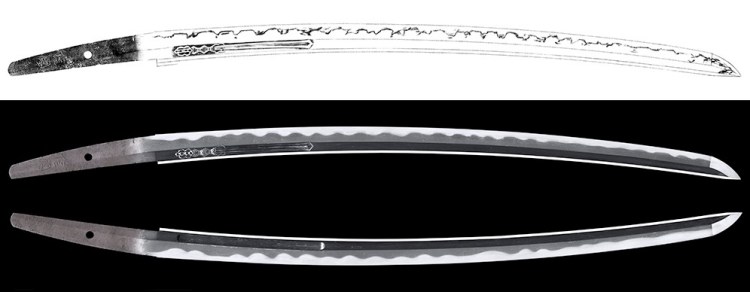
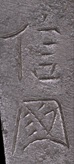
Picture 28 shows an uchigatana signed “Nobukuni” which is papered to “early Muromachi period Nobukuni” but whose signature (see picture 29) does not match any of the masters we have dealt with in the last part. The blade is short and classifies with its nagasa of 57.7 cm today as a wakizashi but I still think that it was made as an uchigatana which was worn as long side sword to a tachi and/or as main sword outside of the battlefield. Its kitae is a ko-itame that is mixed with masame-nagare and that features ji-nie. The hamon is a gunome in ko-nie-deki that has tendencies to koshi no hiraita and that is mixed with ko-midare, a few yahazu-like elements, some tobiyaki, ashi, and . The bôshi is midare-komi with a rather pointed and wide kaeri. On the omote side we see a suken and on the ura side a koshi-bi.


Picture 28: uchigatana, mei: “Nobukuni” (信国), nagasa 57.7 cm, sori 1.8 cm, shinogi-zukuri, iori-mune

Picture 29: Signature of the above blade

Last part that I want to introduce here is shown in picture 30. It is attributed to “later generation Nobukuni.” It has a nagasa of 49.0 cm and as we are here somewhat later in the Muromachi period, I think this one was indeed made as a wakizashi. It shows a kitae in itame that is mixed with mokume and that features ji-nie. The hamon is a ko-gunome-midare in ko-nie-deki that is mixed with kinsuji and sunagashi, The bôshi features much hakikake and thus tends to kaen. The blade shows a sô no kurikara on the omote and gomabashi on the ura side.


Picture 30: wakizashi, mei: “Nobukuni” (信国), nagasa 49.0 cm, sori 1.2 cm, shinogi-zukuri, iori-mune

*

With this article we end the chapter on the Nobukuni School, the Tsukushi-Nobukuni (筑紫信国) branch that prospered later on in Buzen province and all the other offshoots like the Yamamura (山村) group of Echigo province will be dealt with in the corresponding chapters, and next time we will continue with the Hasebe School.


Tosogu Classroom Sale

At the end of last year, members of the JSS/US, NBTHK/AB, and NBTHK/EB were able to buy the first volume of our joint 5 volume Tosogu Classroom project at the actual cost of producing the books. The translation was paid by the three above mentioned parties as a benefit to their members.

The first volume is now also available for non-members for the price of $60.00 (+ shipping, ~$4 US, ~$6 EU). For the time being, the book can only be ordered from me directly and public sales on Lulu and Amazon will not be released until the end of the year.

The first four volumes of the Tosogu Classroom set are hardbound with a dust jacket (US only), 8.5″x11″, will cost $60.00 each, and contain more than 500 pages of text with hundreds of black and white pictures. The fifth (complementary) volume is hardbound too, has the same format, will be approximately 350 pages but with illustrations being in color, it will cost $120.00. Volume 1 includes an introduction into fittings, materials, design, surface treatment, carving, inlay, coloring, early tsuba (both iron and kinkô), and the beginning discussion of artists and schools who worked in iron, going into great detail on the artists and work they produced (please find the table of contents of volume 1 below). Volume 2 will be the second volume on iron and volumes 3 and 4 will cover the kinkô artists. Considering the number of pages and pictures each volume will contain, either individual volumes or the complete set of five will be a valuable addition to your library.

Please get in touch with me via “markus.sesko@gmail.com” if you want to order the first volume, or if you have any question.


Volume 1 Contents

Character Conundrum

In this article I am going to tell a little bit from my everyday challenges as “sword translator.” To start with, I have to say that when it comes to kanji or grammatical puzzles that I can’t solve (or that I am not really 100% happy with with my attempt at explanation), these things stick and are saved in that certain part of my brain that is still working pretty well. When it comes to swords, tsuba, or sword fittings, there is chance that I totally forget everything within some months or so because it is just too much, so you can pretty much embarrass me if you show me or ask me about a certain blade some time down the road and I totally forgot that I have ever laid my eyes on that piece.

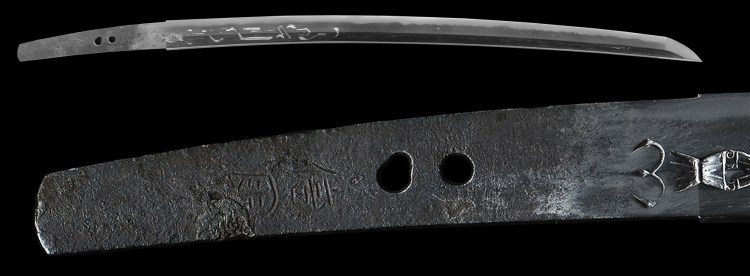
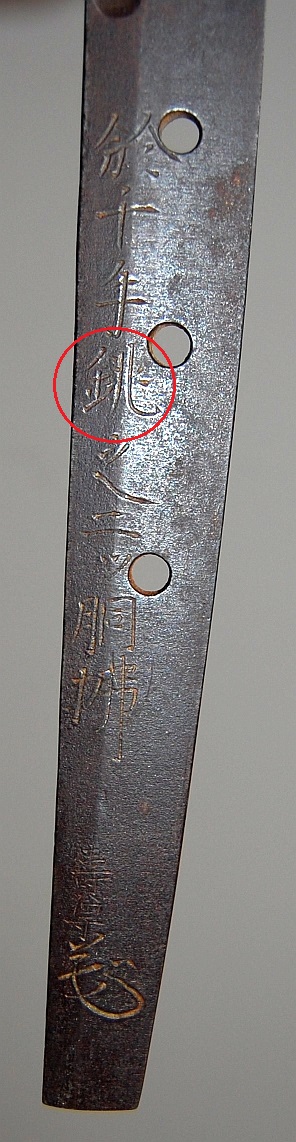
Anyway, let’s get back to topic. A little over a month ago I was approached about a cutting test inscription that contained a wording, or rather a certain character, that is relatively uncommon in tameshi-mei but which I had seen before. The mei in question can be seen in picture 1 and is found on a blade signed niji-mei “Masashige” (正重), either Sengo Masashige or Shitahara Masashige, with the style of the signature rather pointing towards the latter. The tameshi-mei in question reads (於千手銚之貮ッ胴拂・壽尊) and everything but the one character is clear, i.e. “cut by [a certain] Toshitaka (壽尊) + kaô through (拂) two bodies (貮ッ胴) at (於) Senju (千住),” Senju being the place in Edo where most of the cutting tests took place. So only “problem” here is the character (銚).

Picture 1

From the syntax of the tameshi-mei, i.e. the position where the character in question (銚) is found, it is obvious that it either means that Toshitaka “tested” this blade cutting at Senju through two bodies, or that Toshitaka “cut” with this blade at Senju through two bodies. So either kore o tamesu or kore o kiru respetively. As mentioned in my book on Tameshigiri, the term “tested” has been noted in earlier times with different characters,  e.g. with (様), (試), (験), or (驗). In short, there is a chance that the character in question should just read tameshi/tamesu, that is: “Senju ni oite kore o tamesu futatsu-dô harai – Toshitaka + kaô.”

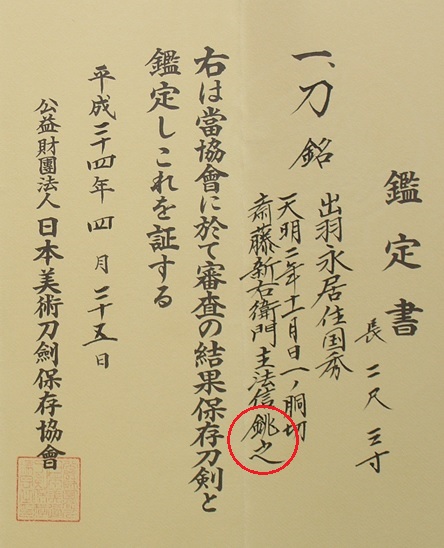
Well, I could have just left it as it was, end of story, but I don’t like the “should” part in my last sentence and so I kept going, trying to see if I can find more, and this article is so to speak a chronology of the investigation into that conundrum. First of all, I instantly remembered that I have dealt with this character once before, and that was translating a hozon paper for a katana by the Dewa shinshintô smith Nagai Kunihide (永居国秀), and that was back in 2013. This blade too bears a tameshi-mei but as I was only working with the paper (see picture 2), I was not aware about the subtleties in syntax and thought that I was facing here a name, Nabeyuki (銚之) (more on the readings of this character in a little), because it was mentioned in one go with the name of the guy who performed the cutting test, a certain Saitô Shin’emon (斎藤新右衛門) by the way.

Picture 2

So having the same kanji and phrase (銚之) on a blade that bears a cutting test inscription too raised some red flags and I immediately had the hunch that it was not a name that I was facing translating the hozon paper four years ago. No sooner said than done, I started to dig into my references. Where else does this kanji or rather phrase appear? As I have a pretty decently organized archive, I made some finds right away, three to be precise, which I will introduce in the following.

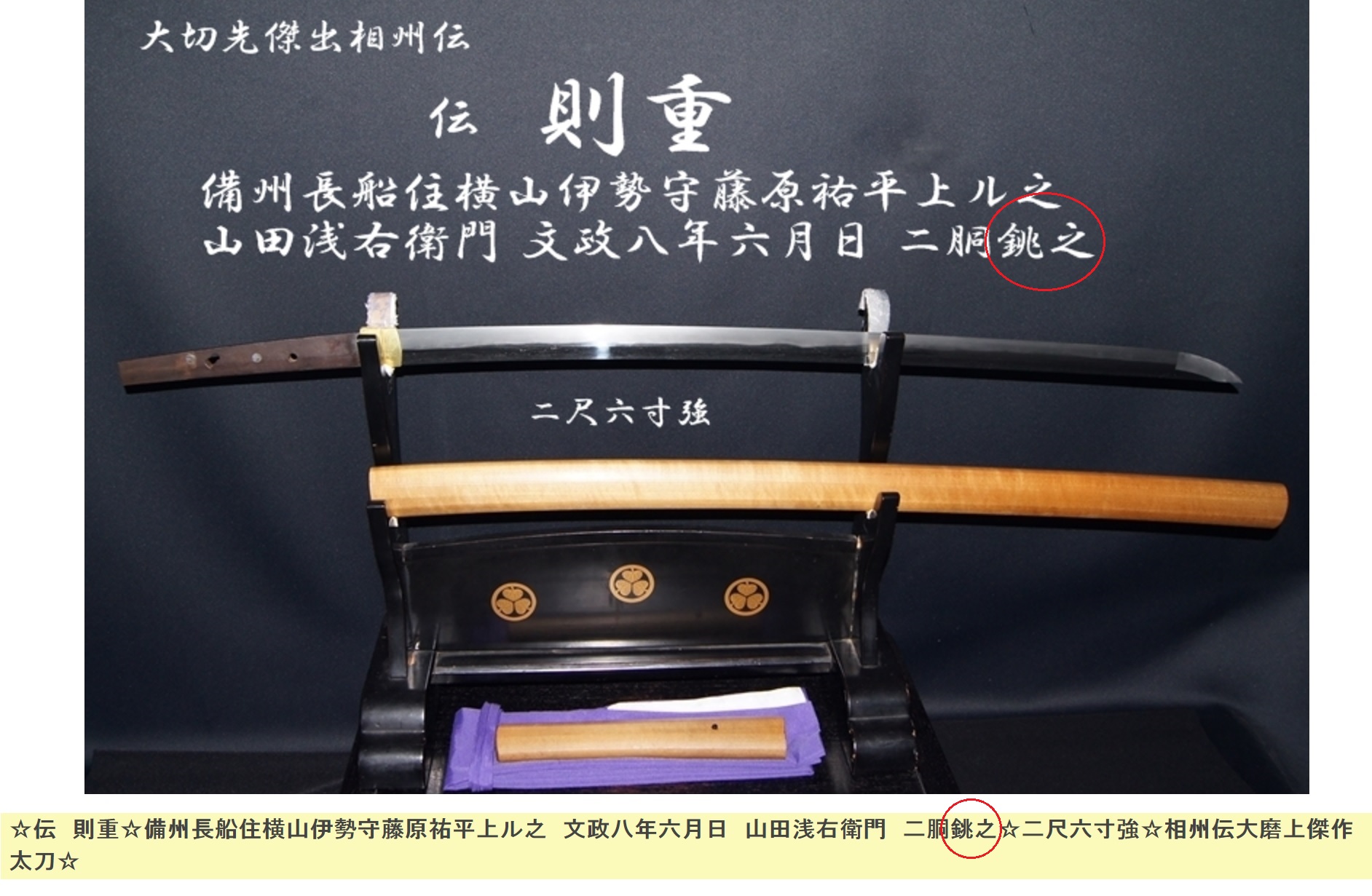
Lo and behold, they are all related to cutting tests. So in hindsight, we are obviously not talking about a name as I had interpreted the mei just on the basis of the hozon paper. First example, shown in picture 3, is a Norishige (則重) blade that was shortened by Yokoyama Bizen Sukehira (横山祐平) and tested by Yamada Asa’emon (山田浅右衛門) in Bunsei eight (文政, 1825). The syntax of the mei (二ッ胴銚之) suggests that in this case the kanji is used in the way of “cut,” i.e. “cut through two bodies.” Now “problem” with this blade is that when I saved it, from the winners-auction.jp website, the detailed pictures already did not load anymore so just the quotation of the mei has to be taken with a grain of salt, also because I am generally very cautious when it comes to auctions like that.

Picture 3

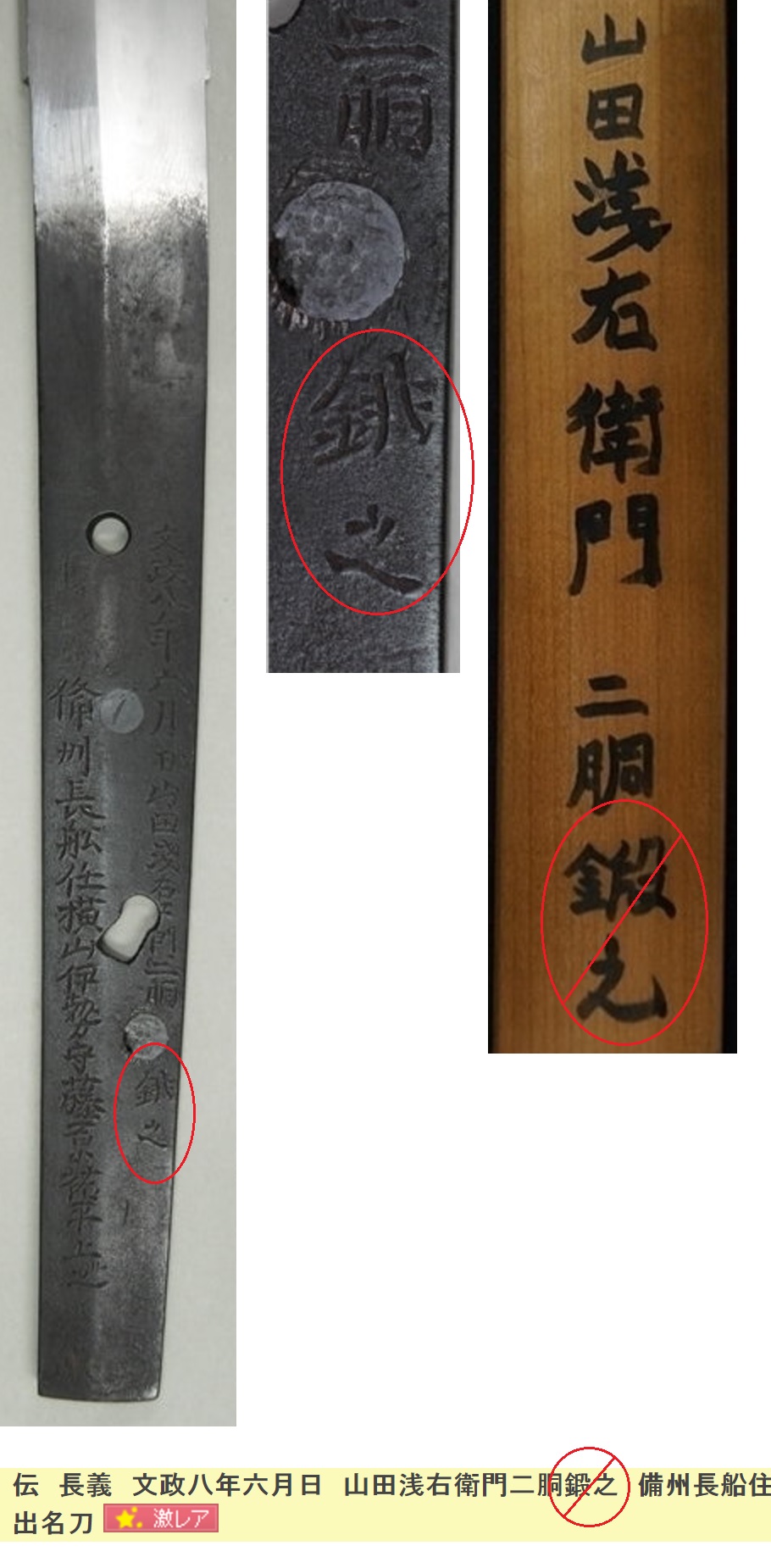
The same applies to the auctioned blade shown in picture 4. Here we have another famous smith, Chôgi (長義), whose blade was again shortened in Bunsei eight by the same Yokoyama Sukenaga, and again Yamada Asa’emon cut with it through two bodies, what a coincidence (same seller BTW, *cough, cough*). In this case however, the character in question was wrongly interpreted in the listing as being the character for “forged” (鍛), and the (clumsily written) sayagaki did so too.

Picture 4

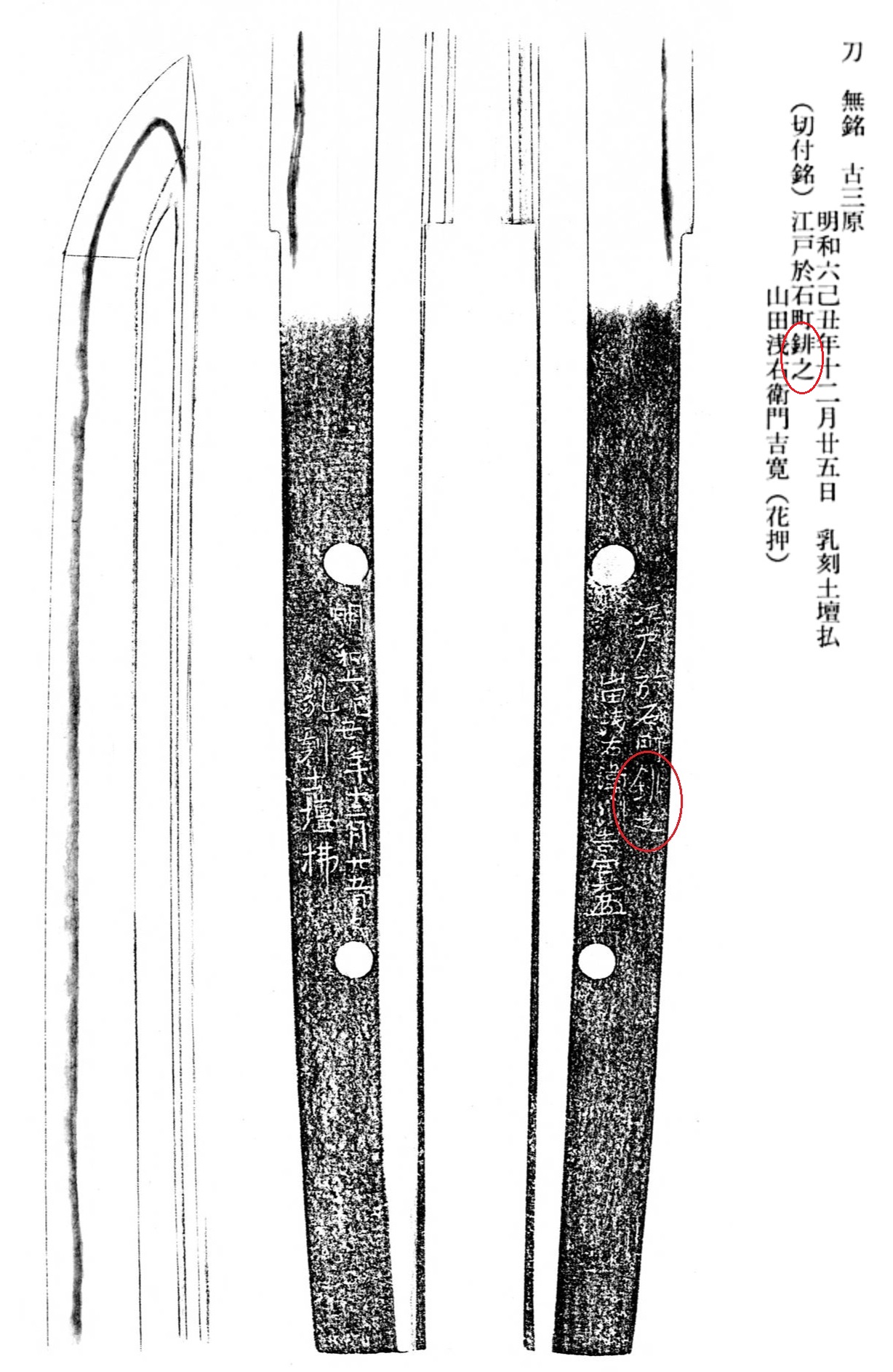
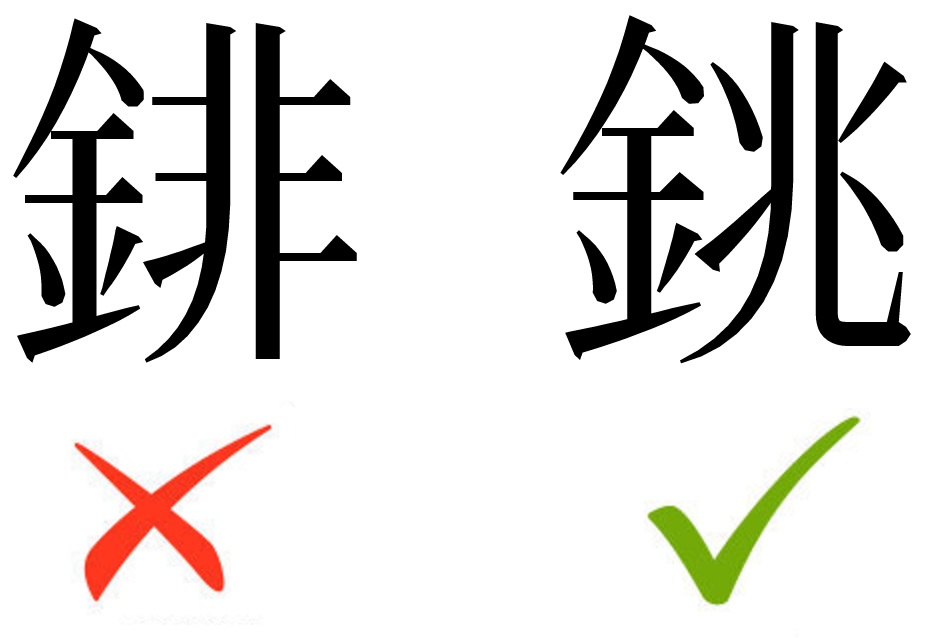
But I also have a watertight reference, and that is a Ko-Mihara blade that passed jûyô with which Yamada Asa’emon Yoshihiro (山田浅右衛門吉寛, 1738-1770), the 4th generation Yamada, cut through a body with the chiwari cut (see picture 5). The syntax of the cutting test inscription of this blade, (江戸於石町銚之), suggests that the character in question is read in this case as tamesu,. “Tested,” namely “tested in Kokumachi in Edo.” But before I continue with going into etymological considerations and my thoughts on this matter, I want to point out that the 1981 jûyô paper quotes the character in question as (䤵).  I think it is actually still (銚) (see picture 6) because of the two lateral horizontal strokes on the nakago, instead of three, and the upward sweep of the right vertical “hook” of the radical (儿). In short, I think that the right part of this character is (兆) and not (非).

Picture 5

Picture 6

So what is it now, “cut” or “tested”? First I tended 70:30 towards “tested,” tamesu/tameshi, because of the syntax of the blade introduced in picture 1 and the two wathertight, i.e. papered blades introduced in pictures 2 and 5. The character (銚) itself reads chô/jô/yô in its Sino-Japanese reading or nabe in its Japanese reading. It is the kanji for a certain small pot or sake bottle with handles. But it can also read suki and in this context, the character stands for “spade/plow.” Now no kanji dictionary lists this character as meaning “cut” or “test” (although some also say it can mean hoko, “spear” though) but I think that here we have to go to the etymological origins of this characters, which is “using a metal, metal tool/implement (金) to bisect (兆) something,” for example soil in the aforementiond meaning of “spade/plow.” Does that ring some bells, “metal used to bisect something”? Sounds pretty much like the definition of a sword to me.

That said, I have seen other instances where characters were used in the sense of their pictographic meaning and not necessarily for what they usually mean. So the cutting tests introduced above surely don’t mean “sake bottled through two bodies” and for the time being, and to conclude this article, I am now leaning 70:30 towards interpreting the character as “cut” rather than as “tested.” So I hope that brief tour into things like that, some of my daily tasks, was kind of interesting and if any of my native Japanese readers has further insight into this matter, please don’t hesitate to comment below. It would be very much appreciated. Of course, also please feel free to comment if you are not a native Japanese reader 🙂


Important update to services offered

Due to an overwhelming amount of inquiries that I now receive on a daily basis, I have to change a certain service/assistance that I offer.

Please don’t get me wrong, I am – honestly – very grateful to be approached by so many sword lovers every day now, asking about a specific translation of a mei, sayagaki, hakogaki etc. or about my opinion on the one or other piece. This is all fine and my basic translation fees can be found in the TRANSLATION SERVICE/PRICES menu at the very top of my page, or will be discussed along in your inquiry.

But now we have to talk about signature assessments, i.e. in the sense of signatures being possibly shôshin (authentic) or gimei (forgeries). I receive inquiries about this matter probably once or twice every single day and there is a lot of responsibility in answering such inquiries. People in touch with me can reassure you that I always try my best to answer, as good and as detailed as I can, any question about signatures, or in other words, I usually don’t blunty reply “its gimei” or “I don’t know”, i.e. I always try to explain why I think, for example along the execution of certain parts of a character etc., that a mei might be shôshin or gimei. And so far, I did not even charge for that service

But this has to change, not because I am greedy or mean, but because I just can’t take away time from my other (paid) projects to do such sensitive stuff any more for free. That said, I will charge from now on $150 for any inquiry about the authenticity of a a signature. Not for the reading per se, that will be free forever (unless it is a very long and very complex mei), but for the inquiry about if a signature might be shôshin or gimei.

Now there is of course some “lead time” before I charge that amount. That is, when you approach me about possible authentication of a mei, I will tell you in advance about how many shôshin references I am able to compare your mei with and we can take it from there. For example, maybe I only have a single or just a couple of reference mei for a certain smith, or none at all, and in this case I would not charge anything of course and would just give you my personal opinion as I did so far. But in case you approach me and I am able to tell you that I can compare your mei with let’s say 20, 50, or even 100 shôshin-mei, e.g. from NBTHK/NTHK papers or from publications, that will be the point when I have to charge $150 because as mentioned, comparing a mei to a considerable number of references is not only a very time consuming but also a very sensitive task (just think about people planning to submit papers on that basis). So for this fee, I will not only tell you the actual number of authenticated mei I am be able to compare your signature with but also provide you with a detailed sheet on the points where the mei in question matches, or does not match with the references. Naturally, I do not provide any guaranee for authenticity, also of course because I don’t have the blade in hand to compare workmanship and/or quality with the mei in questiion, but if I can tell you in advance that I am able to compare your signature with for example 20, 50, or even 100 authentic mei as mentioned, that should be a pretty decent factor for you to make up your mind on where to go from there (i.e. papers). Of course you will receive a pictorial reference where I point out the aspects of where the mei in question differs, or not.

So that’s gonna be about the new fee for signature comparisons and if you have a signed blade you want to know more about, just let me know and as mentioned and we can take it from there. Thank you very much for your attention.