Nidai Oku Motohira

Over the years, I have seen several inscriptions on sword tangs that refer to the use of a special supplements/raw materials used for making the blade. Most well-known supplement is of course nanban-tetsu (南蛮鉄) but others I have come across are for example old temple nails, old ship nails, old temple bells, and steel from the battleship Mikasa (三笠) as pointed out here by Arnold, just to name a few. I don’t want to go into detail about the availability/shortage of raw materials or the various reasons for incorporating other steels to make a sword. This time I want to introduce two swords with a very interesting inscription about the supplement that was used but first I want to start with the smith.

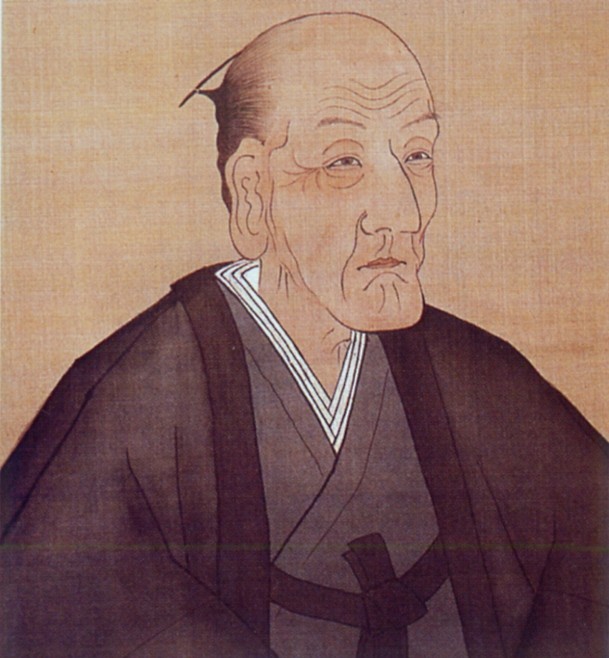
We are talking about the 2nd generation Oku Motohira (奥元平, 1833-1905). Motohira was born into a lineage of swordsmiths that worked for the Satsuma fief since the 1640s and if you start counting from their ancestor, Tadakiyo (忠清), then Motohira II was the 7th generation of that lineage. Now his grandfather, Oku Motohira I (1744-1826), was the most famous master of the Oku family of swordsmiths and when his son Motohiro (元寛), i.e. Motohira II’s father, died young and unexpectedly in Tenpô 14 (天保, 1843), the then only ten years old Motohira II was nominally declared head of the family. He was trained by the 2nd generation Motoyasu (元安, 1793-?) who was the son of his grandfather’s younger brother Motoyasu I. Well, there are many unclear points when it comes to the career of the 2nd generation Motohira. Swords of him are rare and dated ones are even more rare, but I know of at least two blades dated Keiô three (慶応, 1867) and one from Meiji 30 (明治, 1897) which will be introduced in this article. He signed in his early years with Motomitsu (元光) but I haven’t come across a blade signed that way yet, neither one that bears his Ju’an (寿安) under which he entered priesthood in his late years. Anyway, he was 34 years old in Keiô three and thus it is safe to assume that he already had been active at least 15 or so years at that time, assuming that he started his profession in his late teens, i.e. somewhere shortly after 1850. In Meiji 30 he was 64 years old and he died eight years later, in Meiji 38 (1905) at the age of 73. When it comes to his employers, Motohira II has actively experienced the rule of the last three Satsuma daimyô who were Shimazu Narioki (島津斉興, 1791-1859) who ruled from 1809 to 1851, Shimazu Nariakira (島津斉彬, 1809-1858) who ruled from 1851 to 1858, and Shimazu Tadayoshi (島津忠義, 1840-1897) who ruled from 1858 to 1871. He also witnessed the career of Tadayoshi’s son Prince Shimazu Tadashige (島津忠重, 1886-1968) who became a rear admiral in the Imperial Japanese Navy and also that much of the ruling/upper class of his fief dominated the new Meiji government.

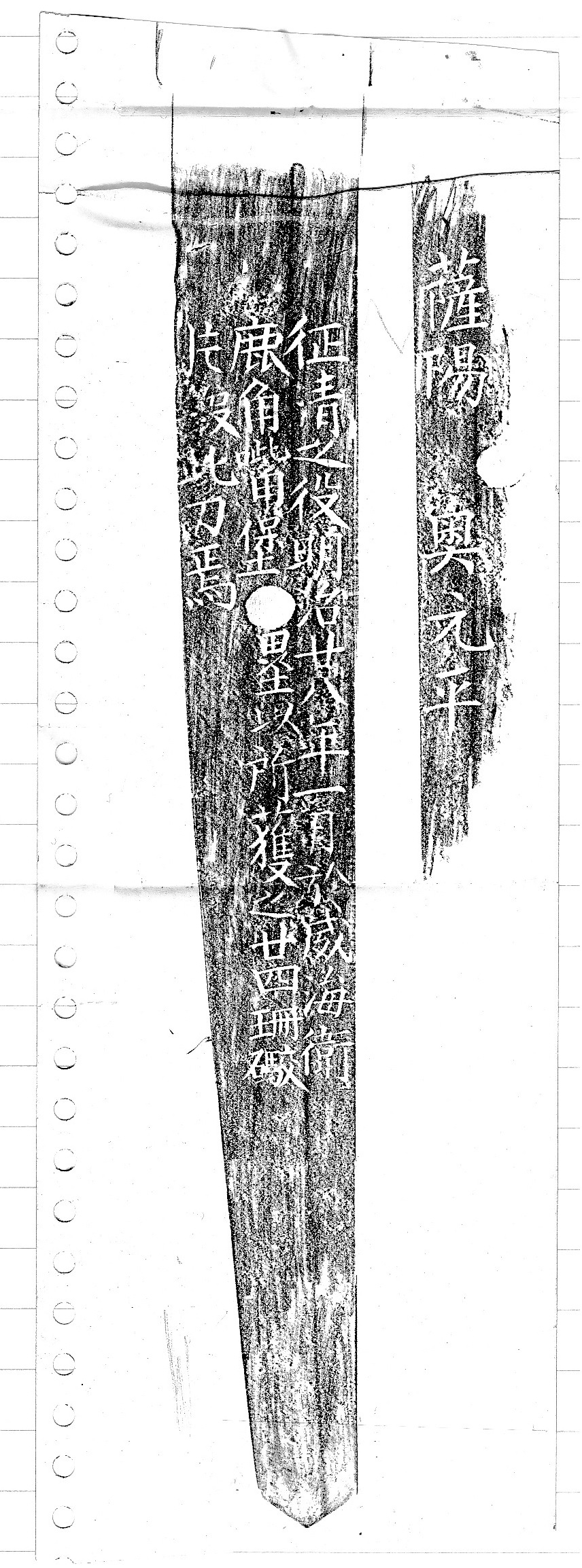
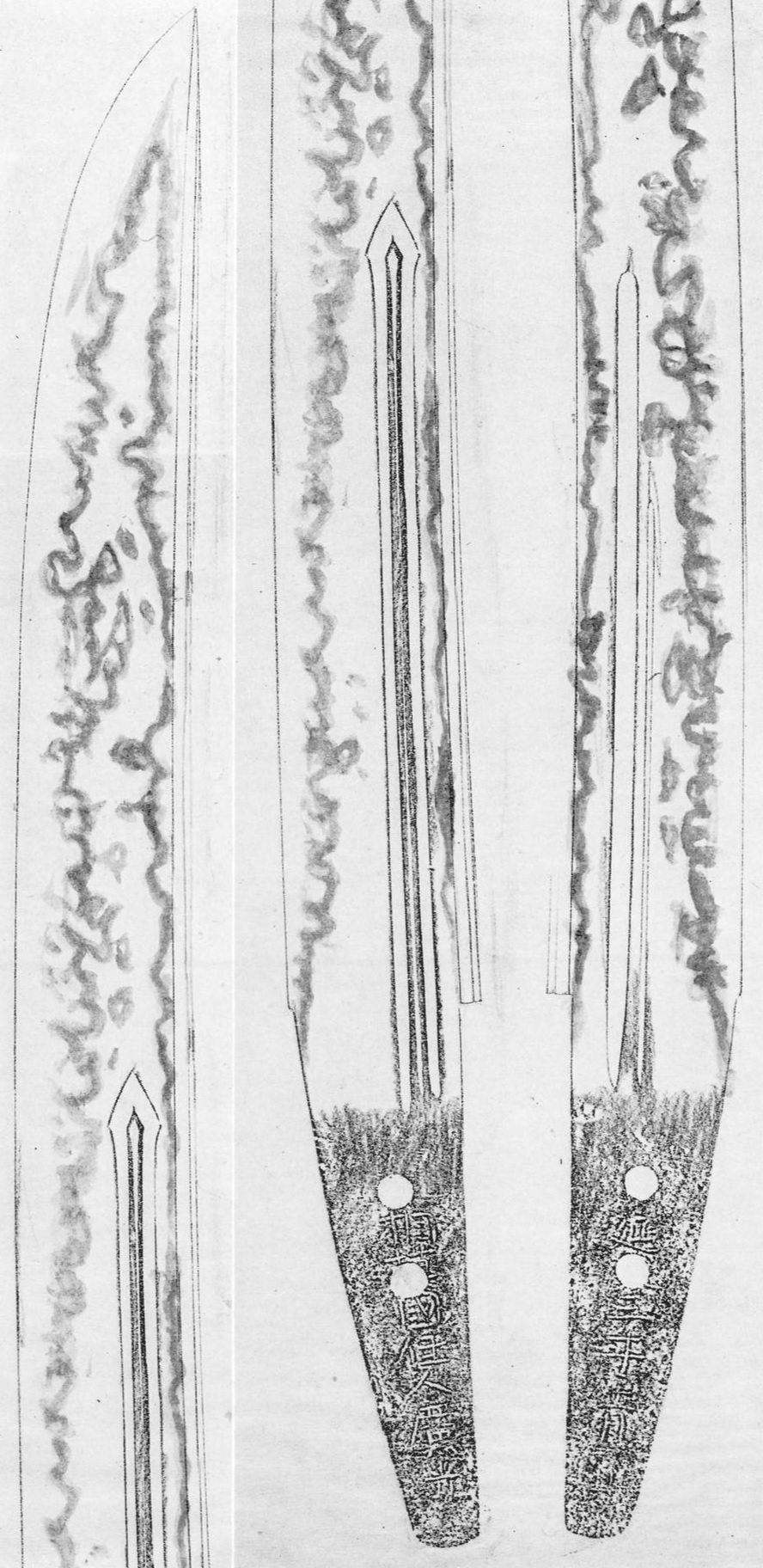
Anyway, now to the sword, or rather the swords, and why I wrote this post because the supplement that was used to make them is quite interesting. The first one (see picture 1, blade pictures courtesy of e-sword.jp) is signed the following way:

Satsuyô Oku Motohira (薩陽奥元平)
Seishin no yaku Meiji nijûhachinen ichigatsu Ikaie ni oite Kakakushi-hôrui ni eta nijûyon-senchi tsutsu no hen o motte kono katana o kitaru en (征清之役明治廿八年一月於威海衛鹿角嘴堡塁以所獲之廿四珊礮片鍛此刀焉) – “This blade was made by using a fragment of a 24 cm howitzer that was obtained from the Fort Lujiazui Battery of the Battle of Weihaiwei during the Sino-Japanese War of 1895.”

motohira1a

Picture 1: katana, Oku Motohira II, nagasa 63.6 cm, sori 0.9 cm

And the second blade (see picture 2) is signed the very same way, except from that we have here an actual date when it was made, which was the fifth month of Meiji 30 (1897), when Motohira was 65 years old, and also we have here a reference to where it was made (the otherwise identical signature omitted):

Meiji sanjûnen gogatsu Iso Shûsei-jo ni oite (明治卅年五月於磯集成所, “fifth month of 1897 at the Shûsei place in Iso”)

motohira2a

Picture 2: katana, Oku Motohira II, nagasa 70.7 cm, sori 1.4 cm

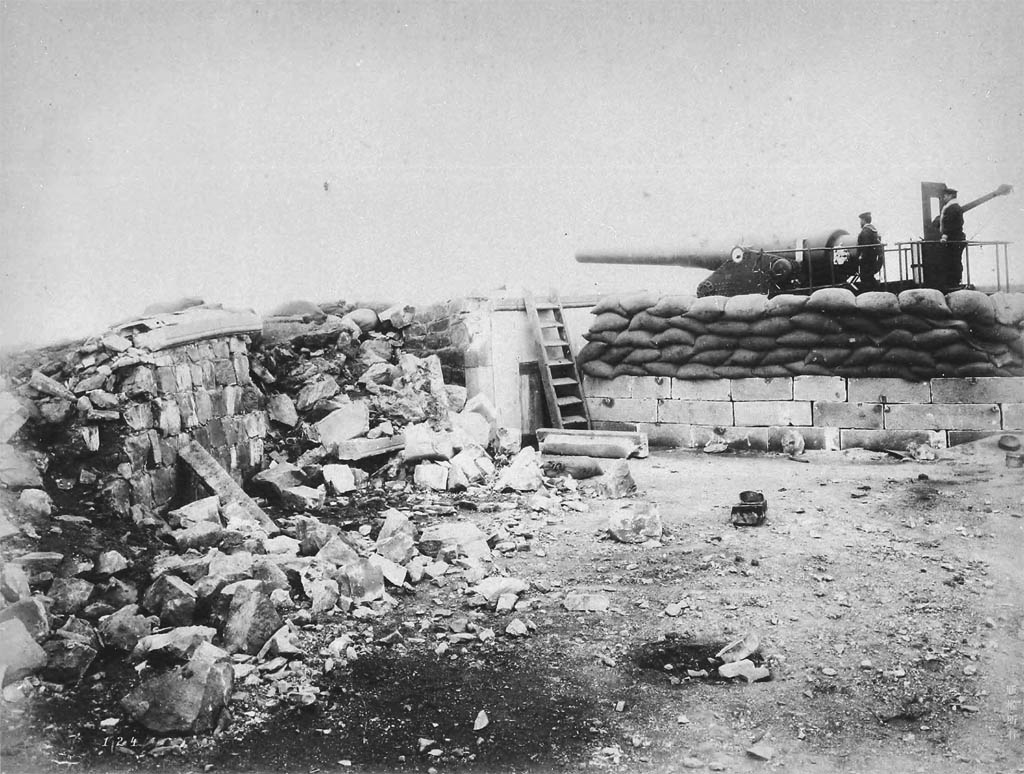
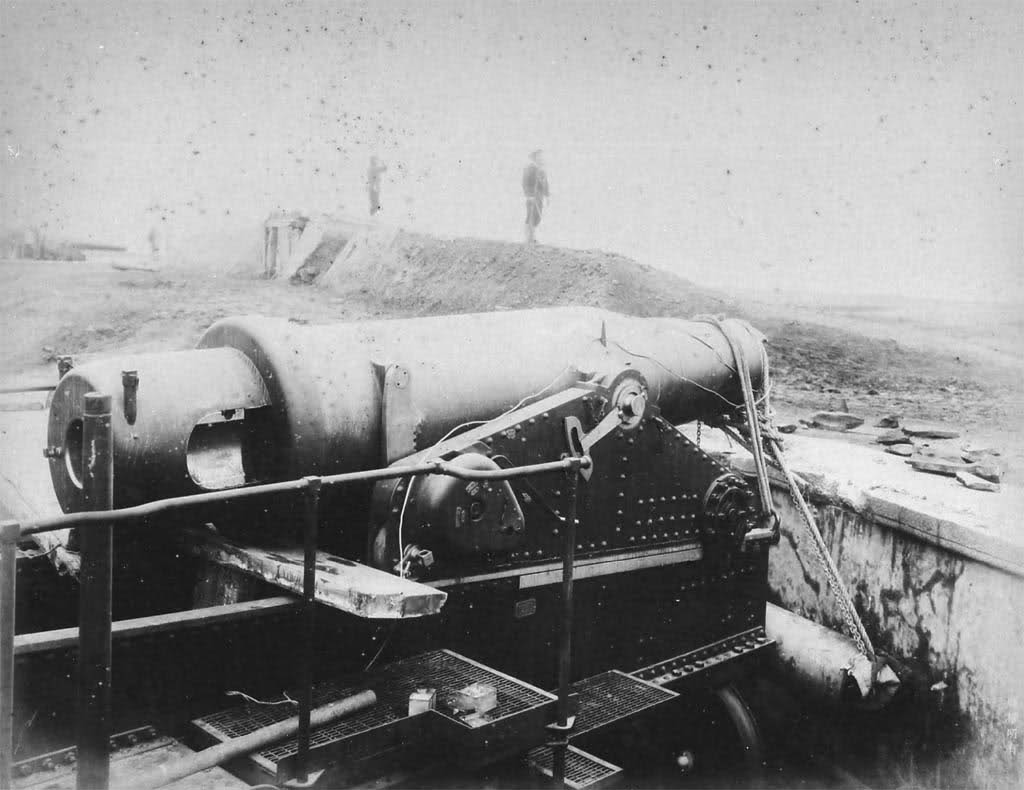
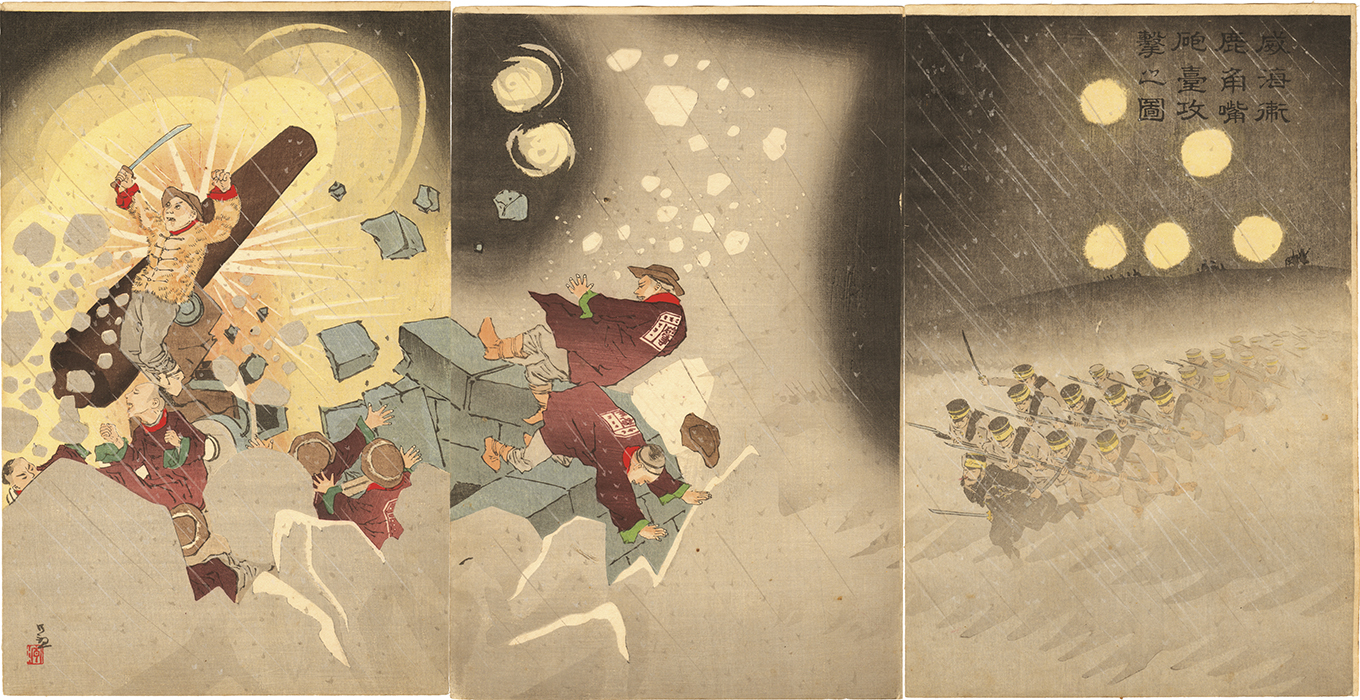
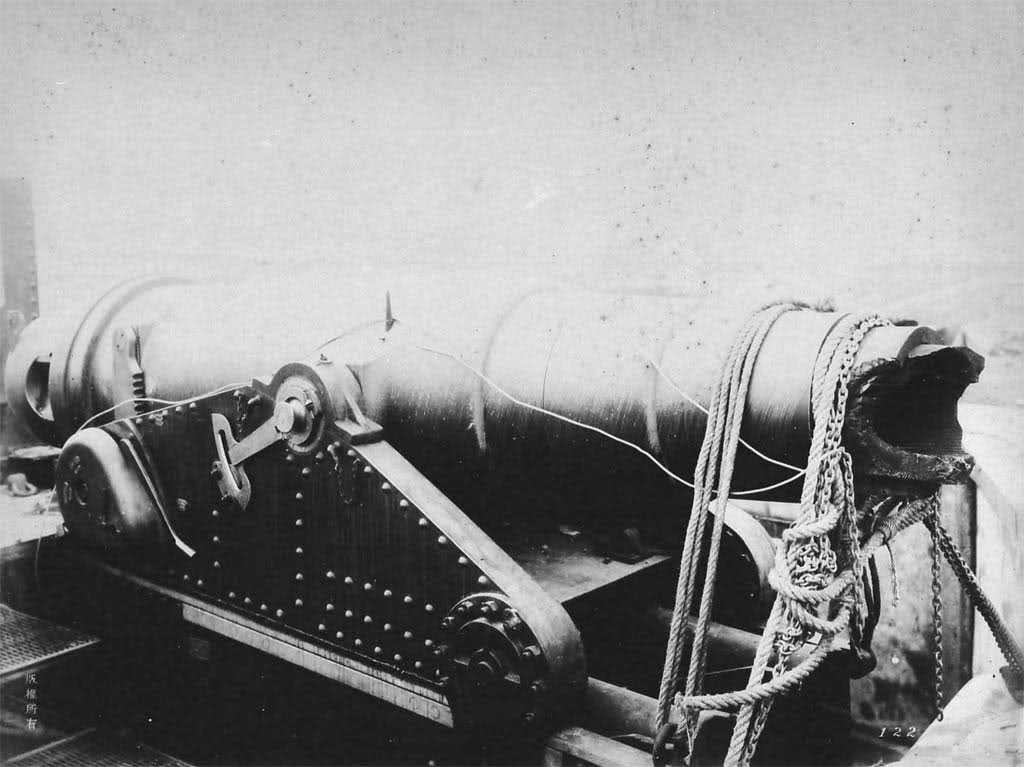
The Battle of Weihaiwei is dealt with in detail in Wikipedia so I am not goint to ruminate it here. Interesting is that we have actual artistic reference to and photographic evidence of what is stated on the two nakago. As mentioned in the Wikipedia article, the Chinese troops were defending their fortifications for about nine hours before abandoning them largely intact. However, several of these forts were seriously devastated as historic photographs show. The Fort Lujiazui Battery (in period Western publications often quoted as Lukeutsuy) was equipped with four 24 cm Krupp coastal howitzers of which one was indeed damaged (see picture 3). An intact one from the Lujiazui Battery can be seen in picture 4. So basically the whole barrel was blown off at the one and had later been tied with ropes and chains to the howitzer (see picture 5), probably in order to repair or recycle it. So far the historic facts. But there is also an artistic rendering of this incident where the whole howitzer is blewn from its firing platform, “effectfully” also blowing away the whole Chinese operating staff (see picture 6). Well, we can book this as artistic freedom.
motohira3

Picture 3

motohira4

Picture 4

motohira5

Picture 5

motohira6

Picture 6: 1895 print by Kobayashi Kiyochika (小林清親, 1847-1915) titled “Attack on the Lujiazui Battery at Weihaiwei” (威海衛鹿角嘴砲臺攻撃之圖)

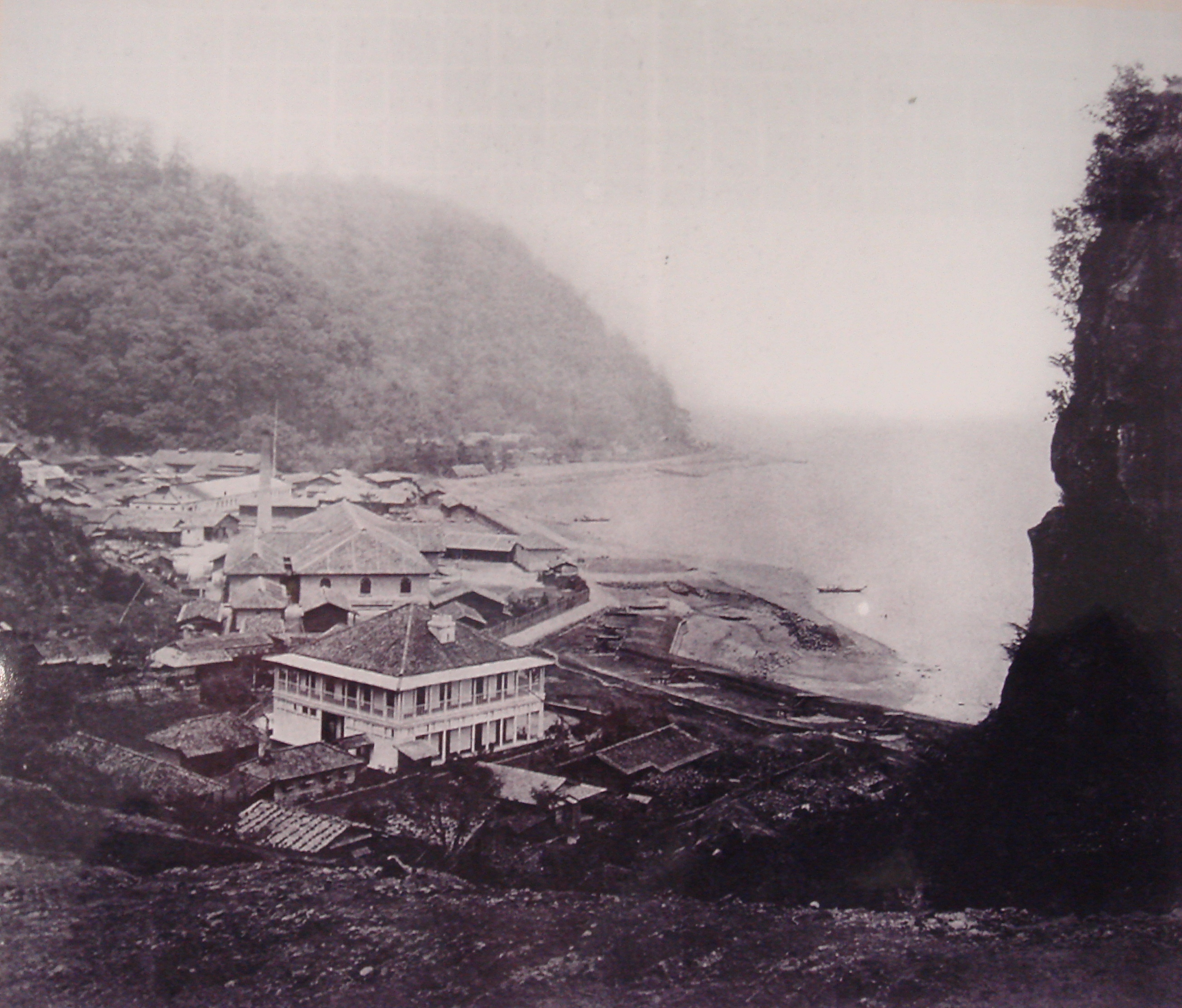
Now back to the making of the sword. I am not sure if the entire broken-off barrel was taken and/or if some of these howitzers were disassembled and transported to Japan. But here maybe the supplement of the second blade comes into play. It mentions that the sword was made at the Shûsei place and refers to the Shûseikan (集成館) (see picture 7), an industrial complext that was initiated by Shimazu Nariakira in Iso, on the outskirts of Kagoshima. It was the first western-style industrial enterprise in Japan with factories that produced machines, textiles and other products and, lo and behold, steel for ship building and casting cannons.
motohira7

Picture 7: The Shûseikan

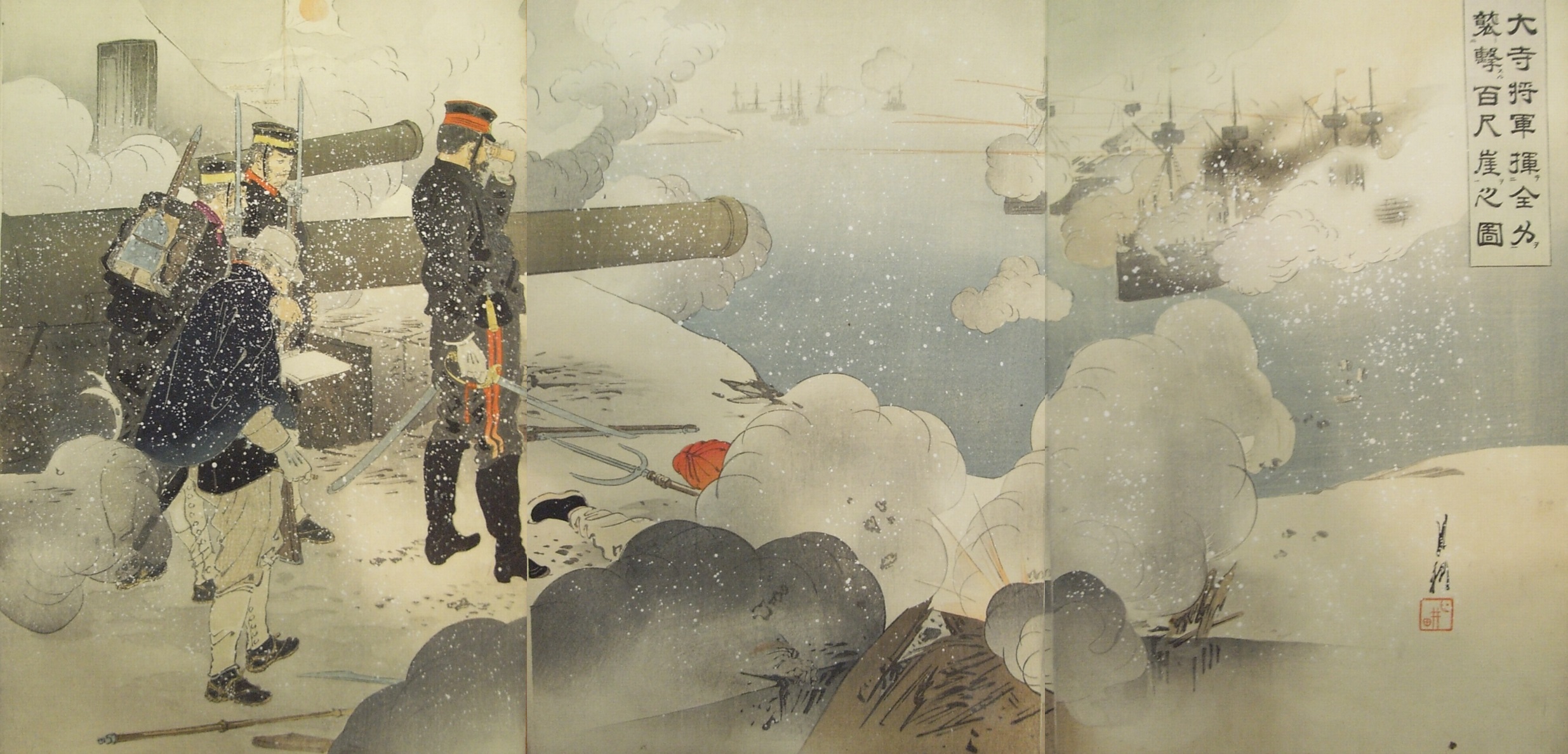
There are now several possible scenarios about how these two blades (maybe there are even more out there?) came into existence. One could be that indeed the damaged howitzer was transported to the Shûseikan in order to be repaired or to salvage it. Maybe it was then decided to commemorate this successful attack on the Lujiazui Battery, and/or the win of the First Sino-Japanese War, by having a local smith, Oku Motohira II, make swords out of what was left of the barrel. Or maybe the idea with the swords came right on the spot when the battery was conquered to use that barrel and make some commemorative swords out of it, maybe for the actual commanding officers of the attack? Maybe some of these officers were from Satsuma, or maybe one was a friend of Oku Motohira II. The former is quite possible as we know that one famous Satsuma man, Major General Ôdera Yasuzumi (大寺安純, 1846-1895) (see picture 8) died at Weihaiwei when leading his infantry regiment against the land fortifications guarding the naval base. His position was hit by an artillery shell fired by the defenders. He was the only Japanese general killed in combat during that war and the highest ranking casualty on the Japanese side.
Exif_JPEG_PICTURE

Picture 8: Print by Ogata Gekkô (尾形月耕, 1859-1920) titled “Major General Ôdera Attacking With All His’ Power From the Baichi Cliff” (大寺将軍揮全力襲撃百尺崖之圖)

Very interesting pieces of history these two Motohira blades! If I am in the area, i.e. Kagoshima, I want to do some more research in this direction at the Shôko Shûseikan Museum into which the Shûseikan main building has been turned in 1923.


Update: Dec 22 2016.

I have received a rubbing of another blade by Oku Motohira II that he made by incorporating a fragment of that howitzer. The mei is identical to the blade seen in picture 1, with the difference that the inscription is distributed over three and not two colums. So now we have three of these blades. Very interesting!
motohira9

Another Signature Removal

Some months ago I was talking about the pitfals of removing signatures in this post. I have pretty much pointed out why it is important to check, double-check, and triple-check before even thinking about having a mei removed so this time I want to introduce a different, recent and documented example of why signatures were removed, and thanks Darcy for bringing that very issue to my attention.

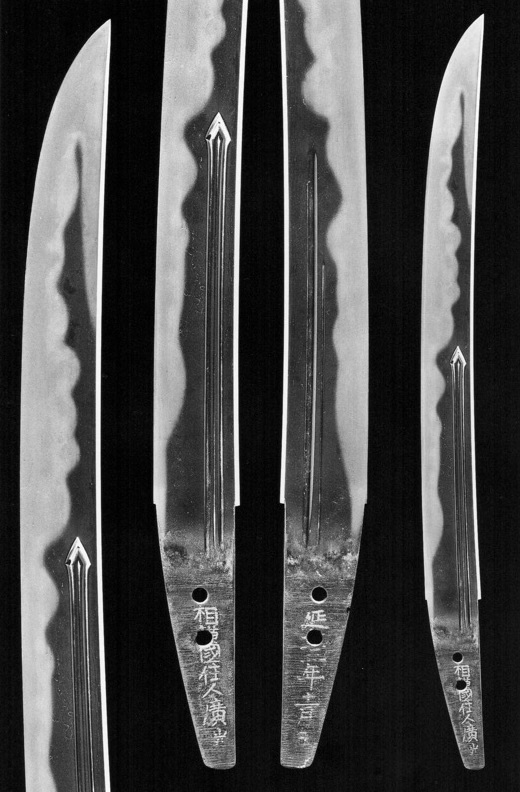
It is about a sunnobi-tantô by the famous Sôshû master Hiromitsu (広光). Today, there are roughly 20 dated works of this smiths extant that have been authentificated. Now one of these works, a tantô signed “Sagami no Kuni-jûnin Hiromitsu” (相模国住人広光) and dated “Enbun sannen jûchigatsu hi” (延文三年十一月日, “a day in the eleventh month Enbun three [1358]”) was designatged as a jûyô-bijutsuhin on December 18 1935 (see picture 1). Back then, it was owned by Count Sakai Tadatae (酒井忠克, 1883-1939), the grandson of the last Sakai daimyô of the Obama fief of Wakasa province.

hiromitsu1

Picture 1: jûyô-bijutsuhin, sunnobi-tantô, original mei, nagasa 31.95 cm, sori 0.55 cm, hira-zukuri, mitsu-mune

So far, so good. 26 years later, in November 1961, this very sunnobi-tantô was stolen in Niigata City and for some reason, probably someone panicking, realizing how high the recognition factor of a fully signed and dated Hiromitsu is (let alone that it is a jûyô-bijutsuhin), had the complete mei removed. I mean, unlike the above linked Enju blade, this is not a case where someone doubted the authenticity of a mei and had it removed because he was going for papers. No, this mei was removed because someone didn’t want to be connected to the theft. “Fortunately,” the jûyô-bijutsuhin designation included recording the blade and so, although we don’t know when and by whom, the original signature was “preserved” via a shu-mei. The shu-mei was quite carefully done, i.e. following the very interpretation of the original mei. So we have now one of those cases where we find ourselves in the “greyzone” of things happening in the past but still knowing why a certain shu-mei was done (and having records of the original mei as oshigata as seen in picture 1), but imagine 50 more years down the road. Who knows then about all that context and, provided the blade is still extant, many people will then say: “Well, its just a shu-mei. You can put anything on a tang like that…”

Anyway, the blade is now designated as a tokubetsu-jûyô (in 2008, it got jûyô the year before, with the shu-mei already on, so the shu-mei must have been added some time in between) and luckily, that context of the theft is recorded in the jûyô-tôken nado zufu explanation.

hiromitsu2

Picture 2: tokubetsu-jûyô, sunnobi-tantô, shu-mei

New eBook Super Sale


ebooksale-dti1

As promised, I have started another -50% off eBook Super Sale, ony difference this time, it goes directly via me (i.e. I’m not going to manually change all the prices on Lulu.com and then change them back when the sale is over). I provide a list of all my eBooks below, showing the regular and the reduced prices. I also linked them so that you can check what the description says but again, DO NOT buy over there at Lulu.com this time. Get in touch with me via “markus.sesko@gmail.com” and pay me directly, either by PayPal using the very same email address or by credit card, using the donate button at the very bottom of this page and I’m going to send you over the eBook. And anyway, if you gave a question, just drop me a mail.

So grab this chance to fill up your tablets/phones with all references you need, especially if you are going to attend the DTI. Got a lot of feedback that its super handy being able to look up artists or backgrounds on the spot. In this sense, the eBook Super Sale will be up a little longer this time, until Nov 6, and the next one might not come until next summer.

Thank you for your attention!

Akasaka Tanko Roku ….. $8.90 – $4.50
Encyclopedia of Japanese Swords ….. $24.90 – $12.50
Geneaogies and Schools of Japanese Swordsmiths ….. $19.90$10
Genealogies of Japanese Toso Kinko Artists ….. $19,90$10
Identifying Japanese Cursive Script ….. $14.90$7.50
Identifying Japanese Seal Script ….. $14.90$7.50
Japan’s Most Important Sword Fittings ….. $14.90$7.50
Jukken ….. $14.90$7.50
Kano Natsuo I ….. $59.90$30
Kano Natsuo II ….. $59.90$30
Kantei Reference Book – Hamon & Boshi ….. $19.90$10
Koshirae – Japanese Sword Mountings ….. $19.90$10
Koshirae Taikan ….. $59.90$30
Koto Kantei Zenshu ….. $89.90$45
Koto Meikan ….. $39.90$20
Legends and Stories Around the Japanese Sword ….. $9.90 – $5
Legends and Stories Around the Japanese Sword 2 ….. $9.90 – $5
Masamune ….. $29.90$15
Masters of Keicho Shinto ….. $19.90$10
Nihon-koto-shi ….. $29.90$15
Nihon-shinto-shi ….. $29.90$15
Nihon-shinshinto-shi ….. $29.90$15
Shinshinto Meikan ….. $29.90$15
Shinto Meikan ….. $29.90$15
Shinto Shinshinto Kantei Zenshu ….. $89.90$45
Signatures of Japanese Sword Fittings Artists ….. $89.90$45
Soken Kinko Zufu ….. $9.90 – $5
Swordsmiths of Japan ….. $89.90$45
Tameshigiri ….. $29.90$15
The Honami Family ….. $19.90$10
The Japanese Toso Kinko Schools ….. $24.90$12.50

German Titles:

Die Honami Familie ….. $19.90$10
Geschichten rund ums japanische Schwert ….. $9.90 – $5
Geschichten rund ums japanische Schwert 2 ….. $9.90 – $5
Koto Kantei Zenshu ….. $89.90$45
Nihon-shinto-shi ….. $29.90$15
Nihon-shinshinto-shi ….. $29.90$15
Shinto Shinshinto Kantei Zenshu ….. $89.90$45


Lulu Discount

As mentioned on FB, there will be another eBook Super Sale with 50% off pretty soon and in view of the upcoming DTI. So if you want to charge your tablets and phones to have some on-the-spot referencewhen shopping for swords or sword fittings over there, please stay tuned. In the meanwhile, Lulu.com has a great discount going on until October 24. All print books are 30% off and that is usually as good as it gets, using the code OCTHIRTY (all caps).

http://www.lulu.com/spotlight/nihontobooks

luluoct24

Banzuke (番付)

I know, the two articles a week have become quite rare lately on my site as I still try to catch up on things big time. So in order to avoid posts slackening completely, I want to briefly introduce an interesting item that I came across the other day in course of an ongoing translation.

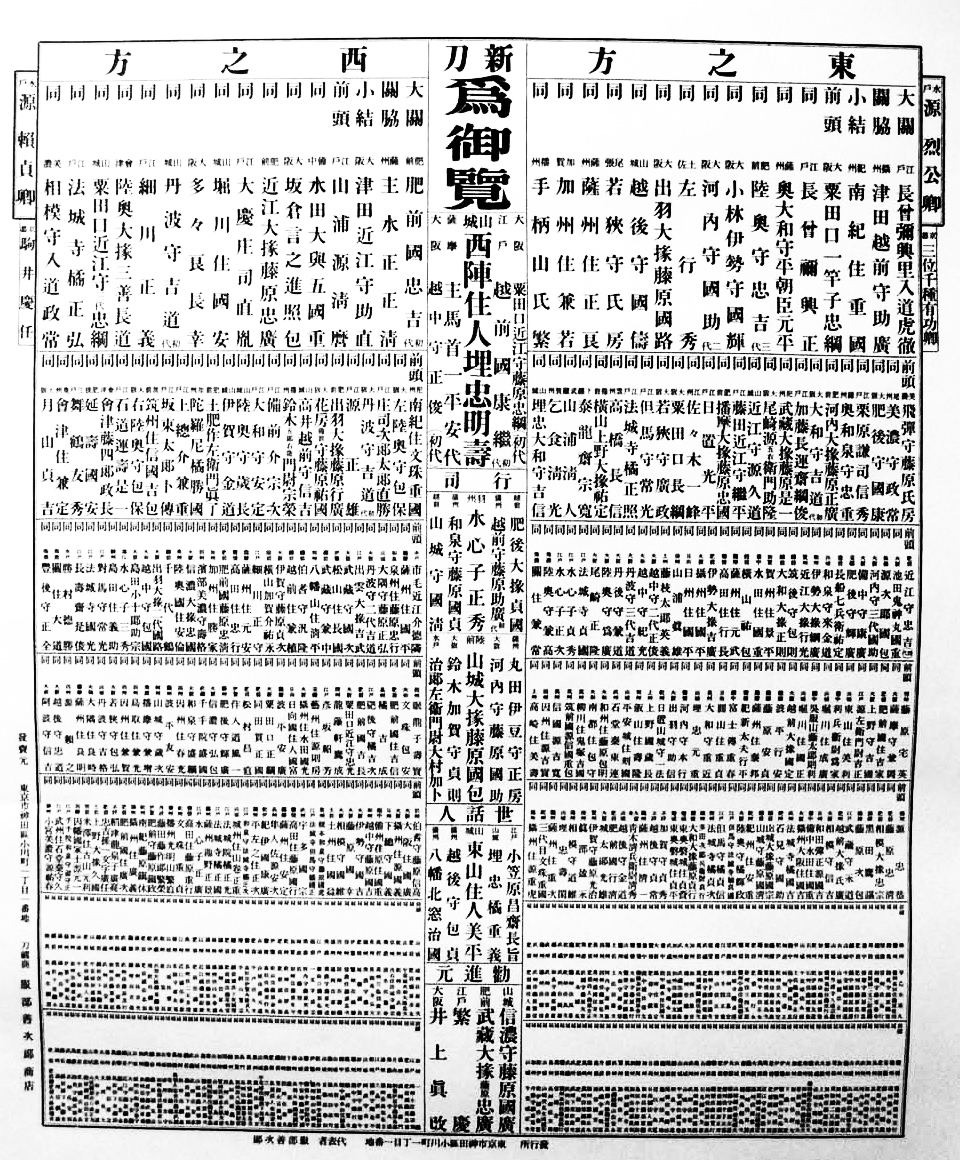
Some of you might be familiar with the banzuke (番付, lit. “ranking list”), the posters or flyers published before each sumô tournament that list the rankings of the participating wresters. As mentioned in the Wikipedia entry here, this kind of banzuke document can be traced back to the 1700s. Entering the 1800s, banzuke started to find its way into other fields, almost everything, as we know banzuke rankings for Onsen hot springs, famous poets  and song writers from the past, plants, gardens, craftsmen, famous swordsmen, and scenic views for example, and from the Meiji era onwards also for millionaires (or the richest people of each province/prefecture) which kind of became the Japanese Forbes list after WWII.

Now I have seen some banzuke on swordsmiths but the one I want to introduce here is the first on tsuba makers that I recall coming across. But before we continue, I briefly want to explain how these banzuke “work,” or rather how they are structured. Usually, the sheet contains the name and date of the tournament followed by a list of referees and promoters/sponsors. This information forms the mid section and the wrestlers are divided into East, which is printed on the right, and West, which is printed on the left. The top row with the largest characters always marks the highest ranking wrestlers, starting in descending order from right to left for each division. It starts thus with the Ôzeki (大関), the current champion, who is followed by the ranks of Sekiwake (関脇), Komusubi (小結), and Maegashira (前頭). After the first Maegashira or first row of Maegashira, the rest of the wrestlers of that rank are only marked by the character (同), which just means “ibid.” or “the same.” As for swords (see picture below), there are banzuke that list kotô smiths on the right and shintô/shinshintô smiths on the left side, or vice versa, or specific kotô, shintô/shinshintô, or even WWII era gendaitô banzuke where the East and West division is kept by just following the then provinces (or prefectures), e.g. everything east from Kyôto on the right side and everything west on the left side (which was not always strictly followed).

banzuke1

So what should one make of such a swordsmith banzuke? Well, first of all, they seem to appear at a time when sword publications had been widely available for a certain time. Ranking was very much a thing in Edo period Japan and so the already well-known banzuke format perfectly fitted the need of a sword collector or enthusiast for a simple and easy to understand list in a handy format, i.e. a folded or rolled up poster (or just a larger sheet of paper). These swordsmith banzuke were exactly seen as what they were, that is a useful guidance for one who is not that deep into swords to get a basic overview of where the skill of a smith of interest is placed within the sword cosmos. That said, they were not understood as set in stone and legally binding rankings on the basis of which you can start a lawsuit against a dealer, e.g. if you wanted an Ôzeki ranked smith and he sold you a Maegashira.

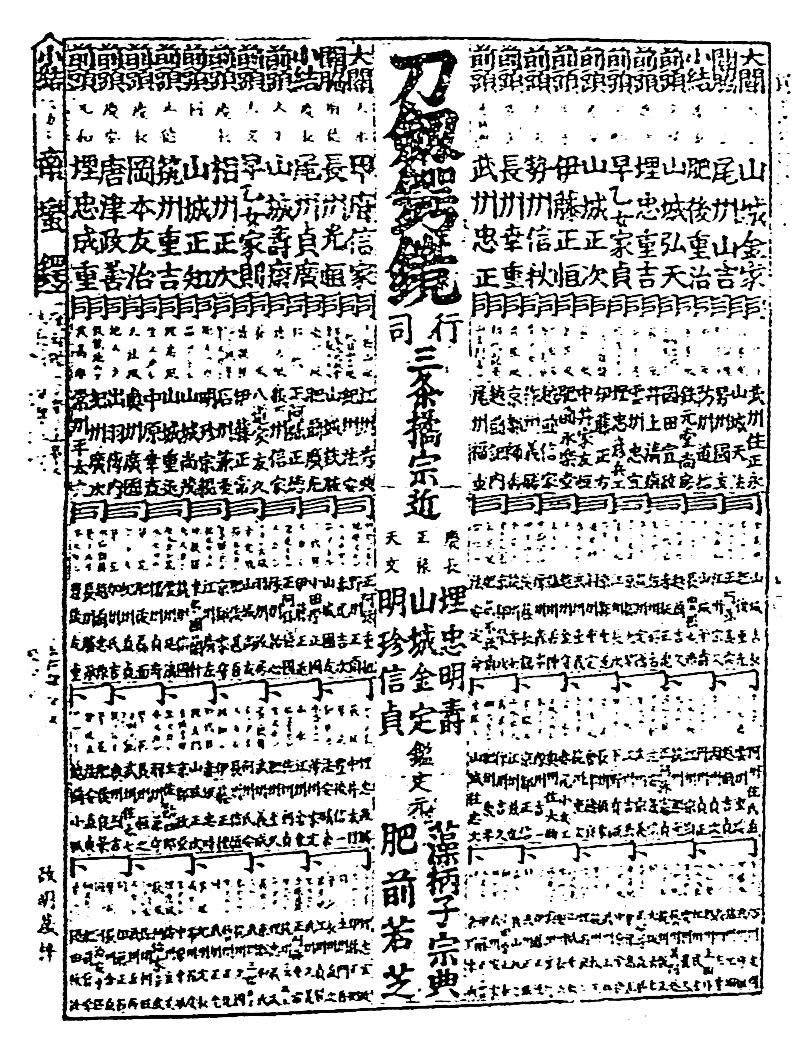
And this brings us to the tsuba makers banzuke that I was talking about (see picture below). It is titled Tôken Tsuba Kagami (刀剣鍔鏡) and was compiled by Noda Takaaki (野田敬明, 1759-1825) some time during the Bunsei era (文政, 1818-1830). Noda was an expert of sword fittings and wrote amongst others the Edo Kinkô Meifu (江都金工名譜, 1810) and Kinkô Kantei Hiketsu (金工鑑定秘訣, 1820). The mid section has to be taken with a grain of salt, i.e. Sanjô Tachibana Munechika (三条橘宗近), Umetada Myôju (埋忠明寿), Yamashiro Kanesada (山城金定), and Myôchin Nobusada (明珍信貞) are quoted as “referees” (gyôji, 行司) for this “tournament.” Below of that referee section we find two names, Sôheishi Sôten (藻柄子宗典) and Hizen Jakushi (肥前若芝). This is interesting as they are listed as kantei-moto (鑑定元), hinting at the term kanjin-moto (勧進元, promoter/sponsor) that is found on sumô banzuke. The term kantei-moto implies to me that Sôten and Jakushi works, which were produced in very large numbers and thus found in every corner of Japan, were used by Noda as basis (moto) for his judgement (kantei) of the ranking.

To conclude, I want to quote the important top section (also because the lower parts of the banzuke are illegible anyway on the picture. This gives you a good overview of which tsuba makers were regarded as best at that time, i.e. the early 1800s. The two undisputed grandmasters (Ôzeki) were Kaneie (金家), listed on the right, and Nobuie (信家), listed on the left. Please note that Nobuie is quoted as “Kôfu Nobuie” (甲府信家), i.e. back then it was still assumed that it was the Myôchin armorer based in Kai province who made the tsuba. The two Sekiwake were Bishû Yamakichi (尾州山吉), i.e. Yamakichibei on the right, and Chôshû Mitsutsune (長州光恒) on the left, the founder of the Nakai family. The right side Komusubi is Higo Shigeharu (肥後重治), i.e. Matashichi (又七), and the one on the left side is Bishû Sadahiro (尾州貞広). Please note that we find Bishû, i.e. Owari artists on the left and right side, so this list doesn’t seem to be divided into an East and West division. Also please note that at the very left another Komusubi rank was added, that is Nanban-tsuba (南蛮鐔). So Nanban-tsuba must have been pretty highly regarded back then. The top section Maegashira are listed below:

Right: Yamashiro Kôten (山城弘天), Umetada Shigeyoshi (埋忠重吉), Saotome Iesada (早乙女家貞), Yamashiro Masatsugu (山城正次), Itô Masatsune (伊藤正恒), Seishû Nobuaki (勢州信秋), Chôshû Yukishige (長州幸重), and Bushû (Akasaka) Tadamasa (武州忠正).

Left: Yamashiro (Umetada) Jusai (山城寿斎), Saotome Ienori (早乙女家則), Sôshû Masatsugu (相州正次), Yamashiro Masatomo (山城正知), Chikushû Shigeyoshi (筑州重吉), Okamoto Tomoharu (岡本友治), Karatsu Masayoshi (唐津政善), and Umetada Narishige (埋忠成重).

It is also interesting to learn that two Saotome artists are found within the top ranks. Anyway, it becomes clear that this banzuke focuses on tankô (鐔工), i.e. tsuba craftsmen, and does not include kinkô (金工) but I’m pretty sure that Noda also made a kinkô banzuke in parallel. So if someone comes across the kinkô twin to this banzuke, please let me know.

banzuke2

Sword News

sakaitadahisa1

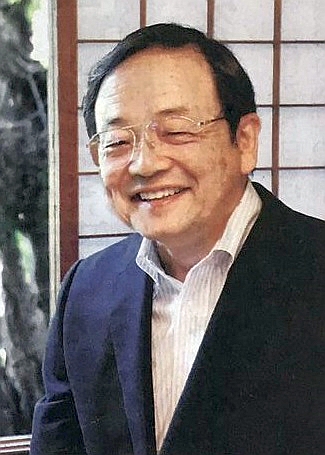
I just want to inform those who haven’t heard yet, the NBTHK has a new president. At the end of July, Sakai Tadatsugu (酒井忠次, 1946- ) took over the post from Ôno who had been in charge since 2012.  To provide a little background, Mr. Sakai is the 11th generation of the Sakai family, the former daimyô of the Shônai fief of Dewa province. Apart from acting as trustee of the local Honma Museum of Art, of which Dr. Honma Junji was the first president by the way, Sakai san runs (with his son Tadayori [酒井忠順, 1974- ] as director) the private Chidô Museum of Tsuruoka, Yamagata Prefecture, which was founded by his grandfather Count Tadayoshi (酒井忠良, 1888-1962).

I had the honor to meet Mr. Sakai at one of Mr. Kurokawa’s DTI after parties, I think it was in 2008. I had a brief chat with him as I had visited his museum I think six years earlier, knowing that it owns two kokuhô swords, a Nobufusa (信房) tachi and a Sanemitsu (真光) tachi (which I have introduced a while ago here). Oh, and if you are in Japan in fall and can manage it to visit Yamagata, the two swords are on display from October 1 to 30 (see here), plus the jûyô-bunkazai meibutsu Shinano-Tôshirô (信濃藤四郎).

That should do it for today’s news and I will report back asap with some more articles.

Honma Junji’s “Kun” in “Kunzan”

This is just a very brief post but I thought that it might be of interest. As most of you know, Dr. Honma Junji (本間順治, 1904-1991) used the  Kunzan (薫山), which means literally “fragrant mountain.” Kind of odd meaning, isn’t it. But background is the following: Dr. Honma had a certain habit when examining swords, namely making sniffing noises all the time he focused on the blade. Now sniffing is kunkun (クンクン) in Japanese, an onomatopoeic expression, and one day one of his colleagues at the board for the protection of cultural assets (for which he worked from 1950 to 1960) gave him the nickname Kun-san (クンさん), which means “Mr. Sniff.” So Dr. Honma took this nickname and made Kunzan out of it, or that is at least what he told Mrs. Watanabe from the Sano Museum about the origins of his  🙂

HonmaJunji

Tobari Tomihisa (戸張富久)

A while ago, the late Edo period kinkô artist Tobari Tomihisa landed on my desk, that is in the form of a research request. So I was once again going through all the relevant sources and I captured the gist of his career in my 2012 published The Japanese toso-kinko Schools. Now I want to first forward what we know about this artist from the mentioned relevant sources and second, based on my recent research, to provide you with some possible scenarios that could explain what was really going on. So please sit back and follow me on another journey into the fascinating world of Japanese sword fittings from a broader, cultural point of view (as we did it here, here, and here).

The foundation of what we know on Tobari Tomihisa is the entry in the Kinkô Tanki (金工鐔寄) which was published in Tenpô ten (天保, 1839), i.e. only 14 years after Tomihisa’s death. I want to cite the whole entry as it contains information we will come back to later (the square brackets are my comments):

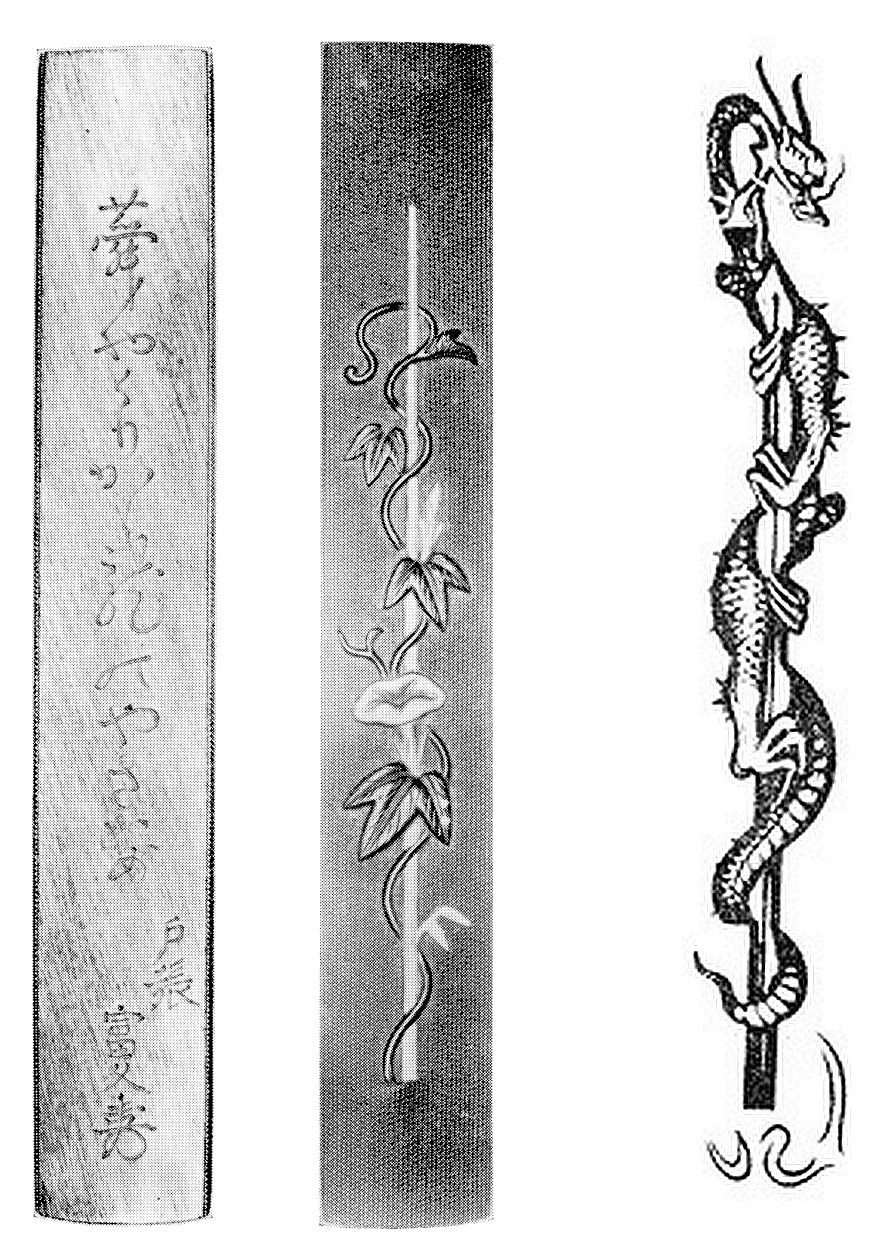
Student of the Gotô family, skilled, Kisôji (喜惣次), for some reason, he broke up with the Gotô and lived henceforth in Zôshigaya (雑司ヶ谷), later on however, he returned to Kyôbashi (京橋) [where the Gotô family lived], did the preparatory work for dragons and shishi lions [for the Gotô family] but also designed his own pieces, for example a kozuka that shows a morning glory winding around a bamboo pole that bears the haikuAsagao ya – kurikara-ryû no – yasasugata” (蕣やくりから龍のやさ姿, “The morning gory, of the graceful figure of a kurikara-ryû winding around a sword”) on the back side.

Before we continue, I want to introduce one of these morning glory kozuka. There are several going round, so he must have made a bunch of them and as even the Kinkô Tanki mentions this very interpretation, it must have been much celebrated amongst his customers. Side note: Tomihisa’s works are all top-notch, i.e. he was truly highly skilled. To the right of the kozuka, a kurikara-ryû engraving as we know if from swords, i.e. what came to Tomihisa’s mind when he looked at morning glories. On the other hand, a kurikara-ryû was an in-house kozuka motif of the Gotô School and maybe Tomihisa got his inspiration from preparing such pieces for the Gotô and thought to himself one day, let’s convert that into a morning glory.

Tobari1

Anyway, the Kinkô Tanki does not mention his concrete master but it was the 13th Gotô generation Enjô (後藤延乗, 1721-1784), also named Mitsutaka (光孝). Now we know that Tomihisa died in Bunsei eight (文政, 1825), that is a considerable time after his master had passed away. We don’t know when he was born though but here is where my theories start, also incorporating the fact that we know of a very limited number of dated works, i.e. from Bunka six (文化, 1809), Bunka eight (1811), and Bunsei four (1821). When we assume that he lived to the age of 70 we arrive somewhere around Hôreki five (宝暦, 1755) for his year of birth. This would mean he was about 30 years old when his master Gotô Enjô died. And when we assume that he died at the age of 60, he was born somewhere around Meiwa two (明和, 1765) and was about 20 when Enjô died.

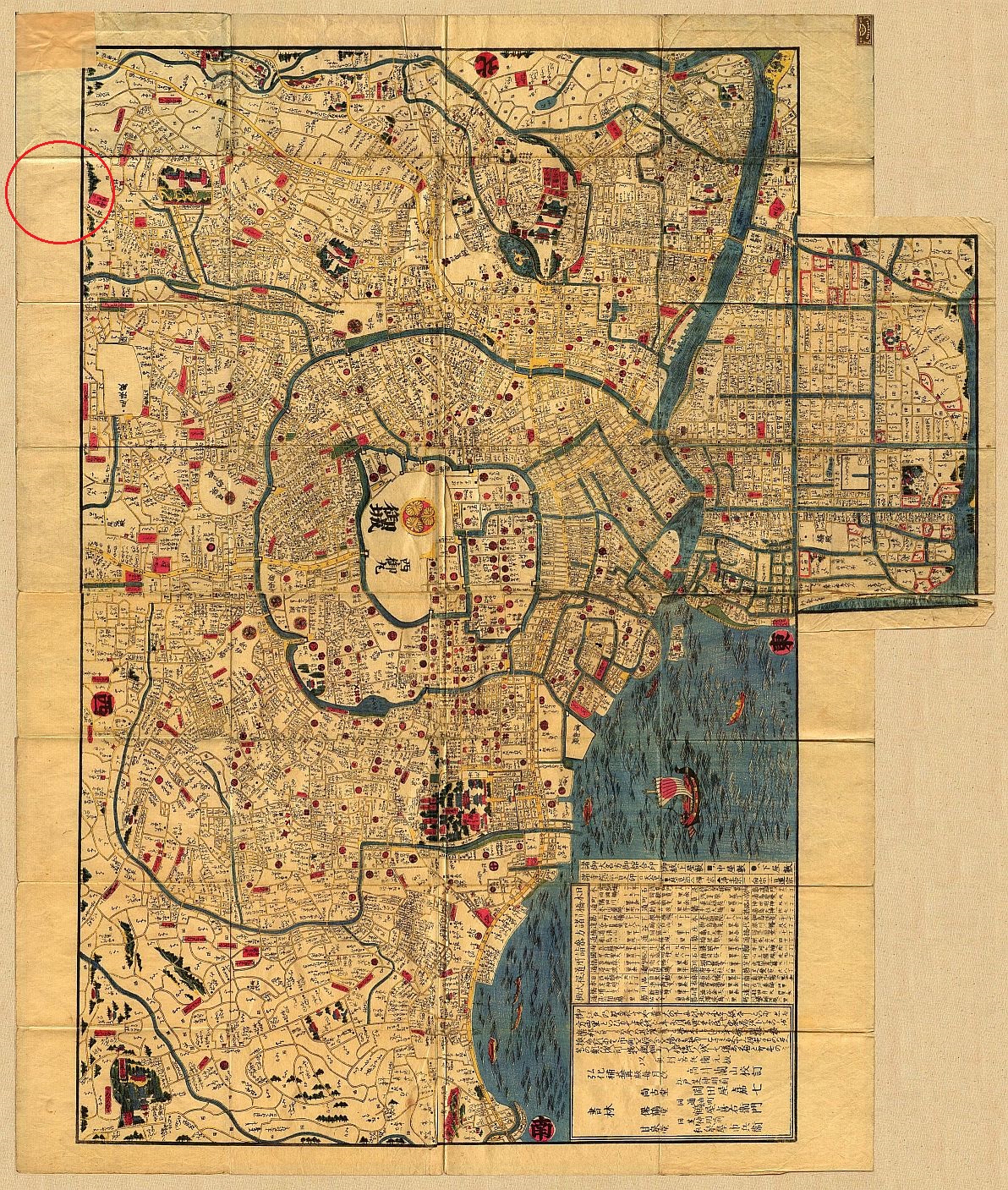
Taking another lead from the relevant sources, that is that Tomihisa also ran a soba noodle restaurant, our journey continues. Digging into that soba matter I learned that Tomihisa did not just open a noodle restaurant because he “felt like to,” no, I found out that he was actually the fourth generation of a successful soba business that was located, get this, in Zôshigaya. From here, we have to take a detour to Edo period soba culture as it is in my opinion essential for the understanding of the whole career of Tomihisa. It is thought that soba noodles were introduced around the beginning of the Edo period and the first real soba shop or restaurant was opened, in Edo, during the Kanbun era (寛文, 1661-1673). Later on, Edo had everything from small and ultra-portable soba stands to large-scale restaurants that offered seating for many dozens of customers. Zôshigaya was a little special. The area started as a small village of the same name located about 3.5 miles to the northwest of downtown Edo. There was some much frequented temple and falconry grounds of the bakufu out there and after the Great Fire of Meireki had destroyed much of Edo in 1657, several bushi decided to rebuild their residences in the suburbs. As a result, the village of Zôshigaya gradually developed into an Edo outskirt and by the mid-1800s, it was officially acknowledged as a district (machi/chô, 町) of Edo. But it was still quite rural and woody and it even hardly made it onto the much later, the famous Kôka era (弘化, 1844-1848) map of Edo that is shown below (the circle marks Zôshigaya).

Tobari2

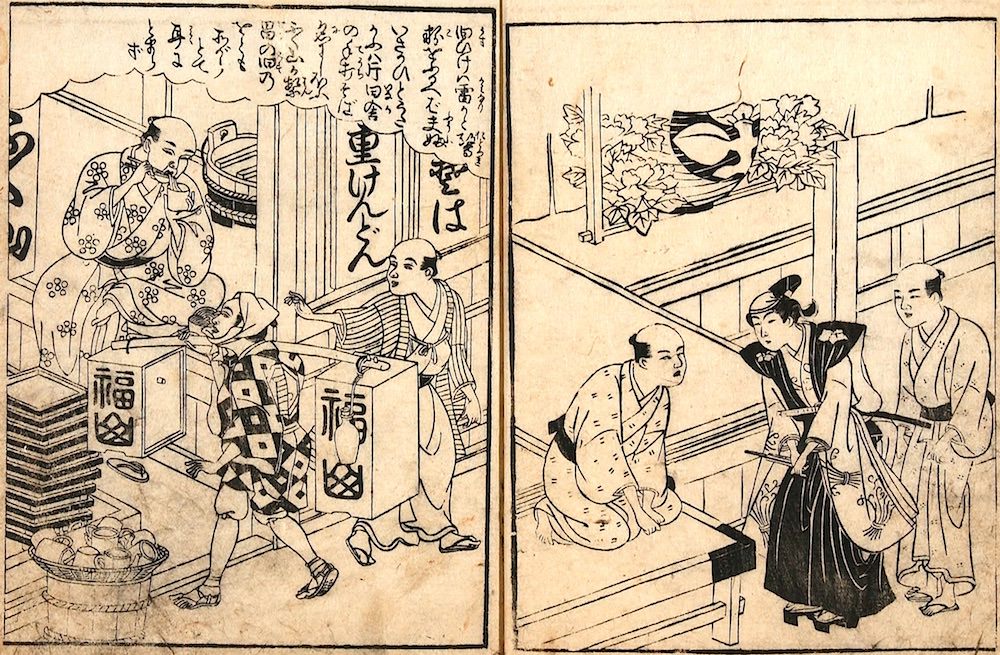
Now we know how refined high Edo culture was and how sophisticated many of the higher-ranking bushi were. Like today, cuisine played an important role of daily life and it is no wonder that soon the Edo dandy’s were sharing “insider’s tips.” By the mid-1700s, Zôshigaya was home to several soba shops and as it was a woody area as mentioned, the term Yabu soba or Yabu no soba (藪蕎麦) was coined for their noodles which means “thicket soba” or “soba in the thicket.” And the dandy’s appreciated yabu soba as bring “real rural original” soba as it should be, not like the fast food they offer around downtown Edo. So this local Zôshigaya soba restaurants were quite popular. Below a print of a downtown Edo soba and udon shop as seen in the Ehon Sakaegusa (絵本三家栄種) from 1771.

Tobari3

The soba shop run by Tomihisa in fourth generation went by the name Kisôji (喜惣次), spelled as the entry in the Kinkô Tanki. Interesting is that Tobari Tomohisa signed his kinkô works with the characters (喜三治) for Kisôji and there is also a receipt for a menuki order extant which he signed that way. But such “misspelling” of names was actually pretty common and for the time being, I think that the one here (i.e. the use of the character [惣] for [三]) goes back to a humorous poem that the famous poet and fiction writer Ôta Nanpo (大田南畝, 1749-1823) once dedicated to Tobari Tomihisa, who was his friend and drinking buddy. This poem goes:

Miwataseba mugi no aoba ni yabu no soba, kori mo koko e Kisôji.
見渡せば麦の青葉に藪の蕎麦、狐狸もここへ喜惣治
If you look over you see the soba place in the thicket of fresh wheat, it is Kisôjis’, where even foxes and racoons stop by.

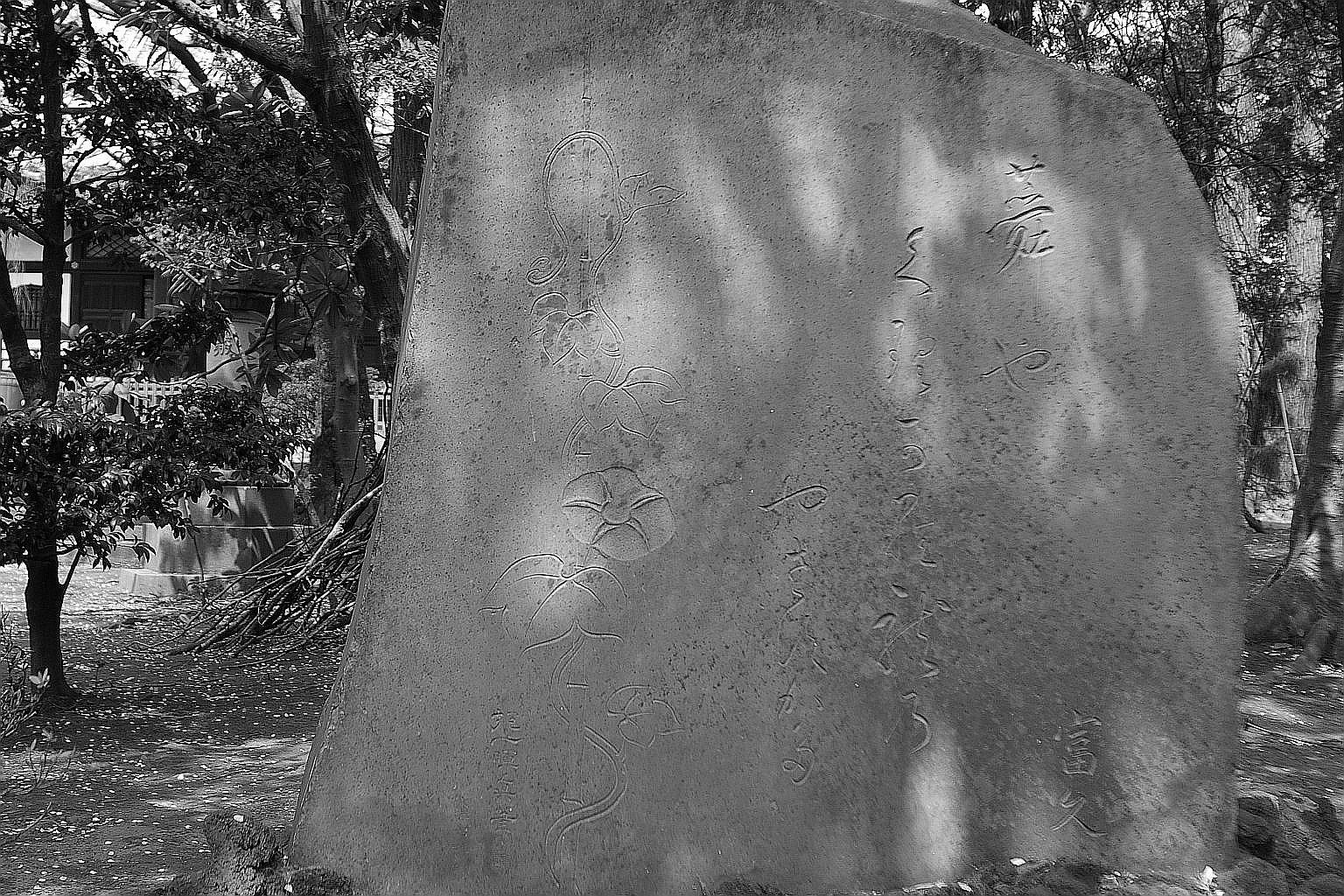
And this brings us back to Tomihisa’s career. Renowned soba restaurants like that, or insider’s tips, were places with an endless coming and going of people from all walks of life, from the common servant to the high-ranking bakufu official. We know that Tomihisa became later a relatively well-known figure in the cultural circles of Edo, making acquaintance with several daimyô, and writing poetry himself under the pen names Shôseisai (松盛斎), Kôsôken (貢僧軒), and Senri (仙里), and some suggest that “Tomihisa” was actually one of his , what would mean that it should be read “Fuku.” He also became a friend of the famous Rinpa School painter Sakai Hôitsu (酒井抱一, 1761-1829). Incidentally, there is a memorial stone within the grounds of the Zôshigaya Hômyôji (法明) that bears the aforementioned asagao poem of Tomihisa, his name, and a morning glory as once painted by Hôitsu (see picture below). Now with that information, i.e. that the depiction of the morning glory on the memorial stone goes back to Hôitsu, and seeing striking similarities in interpretation, it is very likely that the morning glory on Tomihisa’s famous kozuka bases on a drawing or sketch that he received from his painter friend.

Tobari4

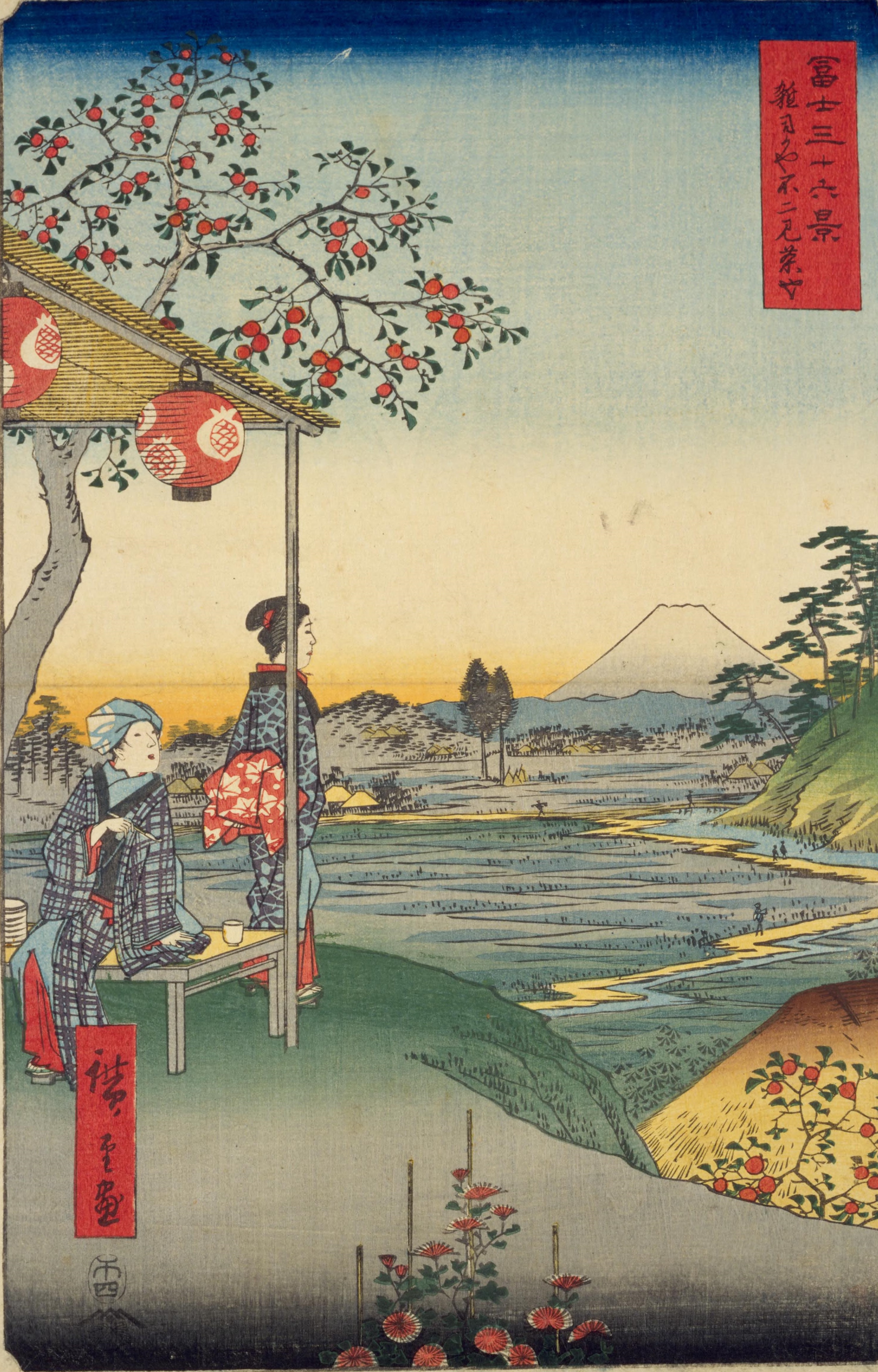
Below I want to present two ukiyoe prints by Utagawa Hiroshige (歌川広重, 1797-1858) where he features Zôshigaya. On the one hand as a reference, i.e. to show you the atmosphere of the then Zôshigaya neighborhood, but on the other also because the bottom one that has a view of Mt. Fuji shows at the very bottom, lo and behold, morning glories! So these flowers were around where Tomihisa ran his soba restaurant. With this in mind, I think that he was kind of inspired by them, maybe they reminded him of his time as an apprentice with the Gotô family (more on this in a little), i.e. preparing and handling kozuka with kurikara-ryû motifs, and so he combined all that, that is his inspiration, the fact that he was involved in the kinkô craft, and his poetry, asked then his friend Hôitsu for a sketch for a morning glory on a pole, and turned all that into a nice little kozuka series. But you have to understand, asking Hôitsu for a sketch does not mean that Tomihisa was incapable of drawing one himself. No, such collaborations were very common and a vehicle to honor all involved artists and craftsmen.

Tobari5

Tobari6

Finding out all this, I will reconstruct Tomihisa’s career for the time being as follows: He was born into a family that run a successful soba place in Zôshigaya. I guess they have been well off, able to support their son’s passion for sword fittings and arranging an apprenticeship with the renowned Gotô family. But when his master Enjô died in 1784, Tomihisa was either around 20 or 30 by that time, he decided to return to Zôshigaya to take over his family business in fourth generation. Therefore I think there was no real “break” with the Gotô family, as for example Kuwahara Yôjirô (桑原羊次郎) suggests in his 1941 published Nihon Sôken Kinkô Shi (日本装剣金工史). Tomihisa just went back to his initial family business from where he was also able to cultivate and intensify his contacts with persons from culture, business, and government. 

Maybe somewhat later in his life he decided to once more focus on his passion of making fine sword fittings and so he returned to Kyôbashi. I guess that the Gotô gave him permission to work from their workshop as Tomihisa’s son, Yoshihisa (喜久), studied with the Gotô family too. However, we know that Yoshihisa later opened his own kinkô workshop in the Suidô-chô (水道町) neighborhood which is about halfway between Zôshigaya and downtown Edo. Also we know that the Kisôji soba shop went out of business at the end of the Bunsei era (文政, 1828-1830), what basically means to me shortly after Tomihisa died. Thus we might assume that facing the end of his career, Tomihisa shifted more towards the kinkô profession and had his son continue that rather than the soba family business (we know dated works of Yoshihisa from 1828 and 1841, so he surely did not give up the craft after only a few years when his father passed away). But many scenarios are possible, for example the one that other soba local restaurants gained “supremacy,” pushing the Tobari family out of business. Or maybe Tomihisa was just tired of running such a bustling place and wanted to focus on the quiet and solitary fields of poetry and craftsmanship.

Again, a highly interesting topic. You do some research on a single kinkô artist and all of a sudden you find yourself in the middle of Edo period soba noodle culture and history. Heck, I even ordered an issue of a monthly soba magazine (yes, there is something like a Soba Monthly) that featured a brief article on the then local Zôshigaya soba places. 🙂

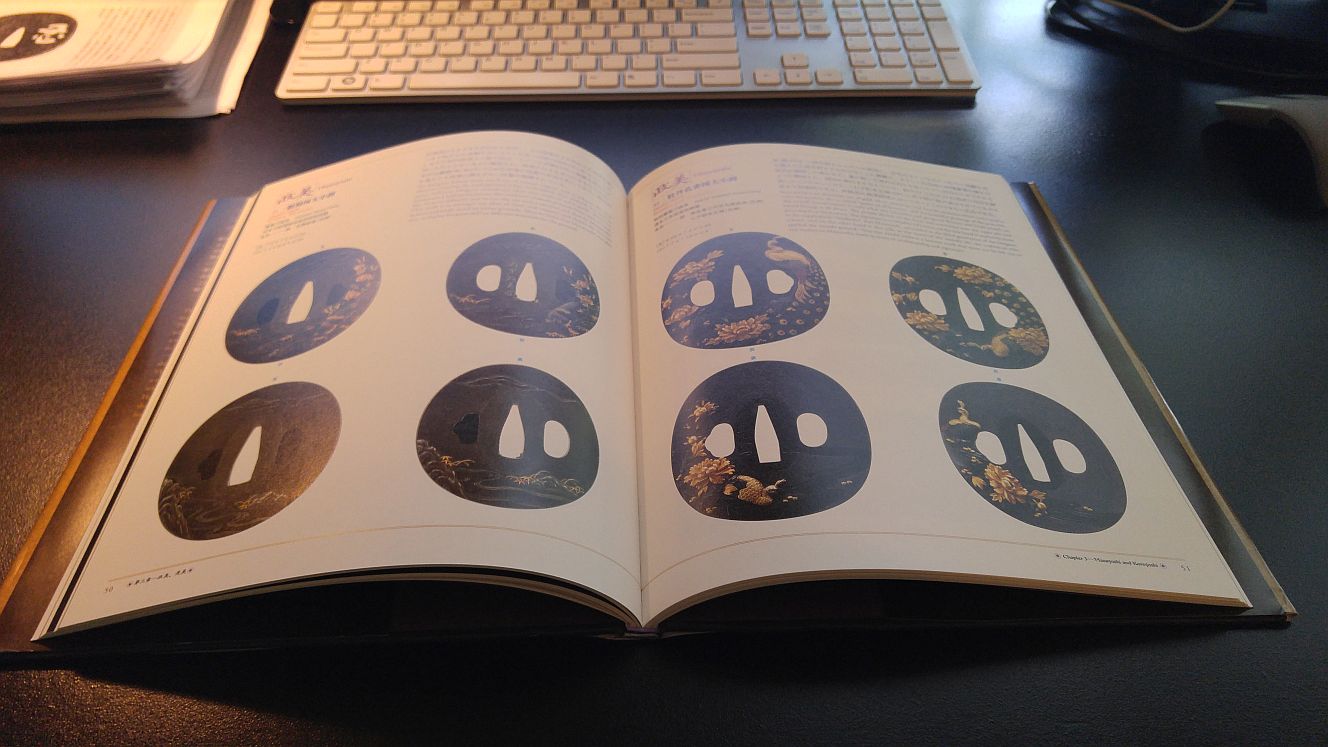
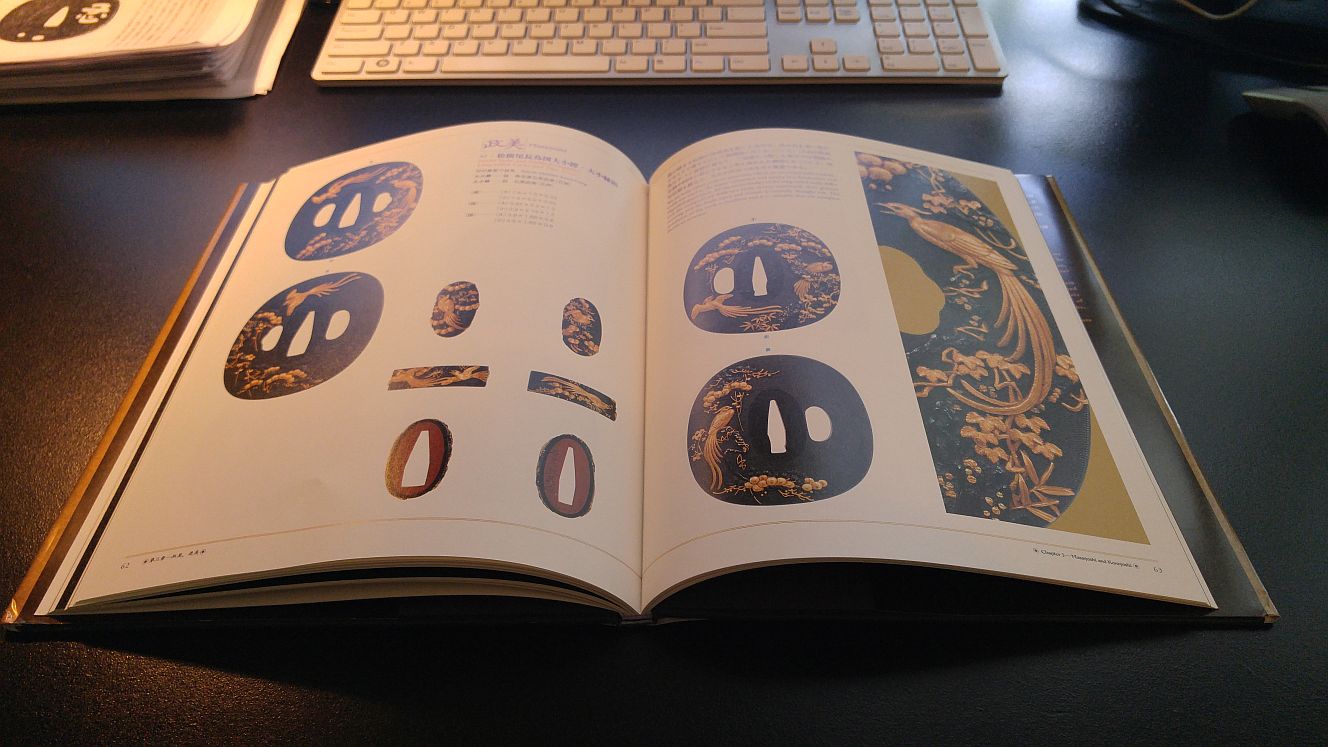
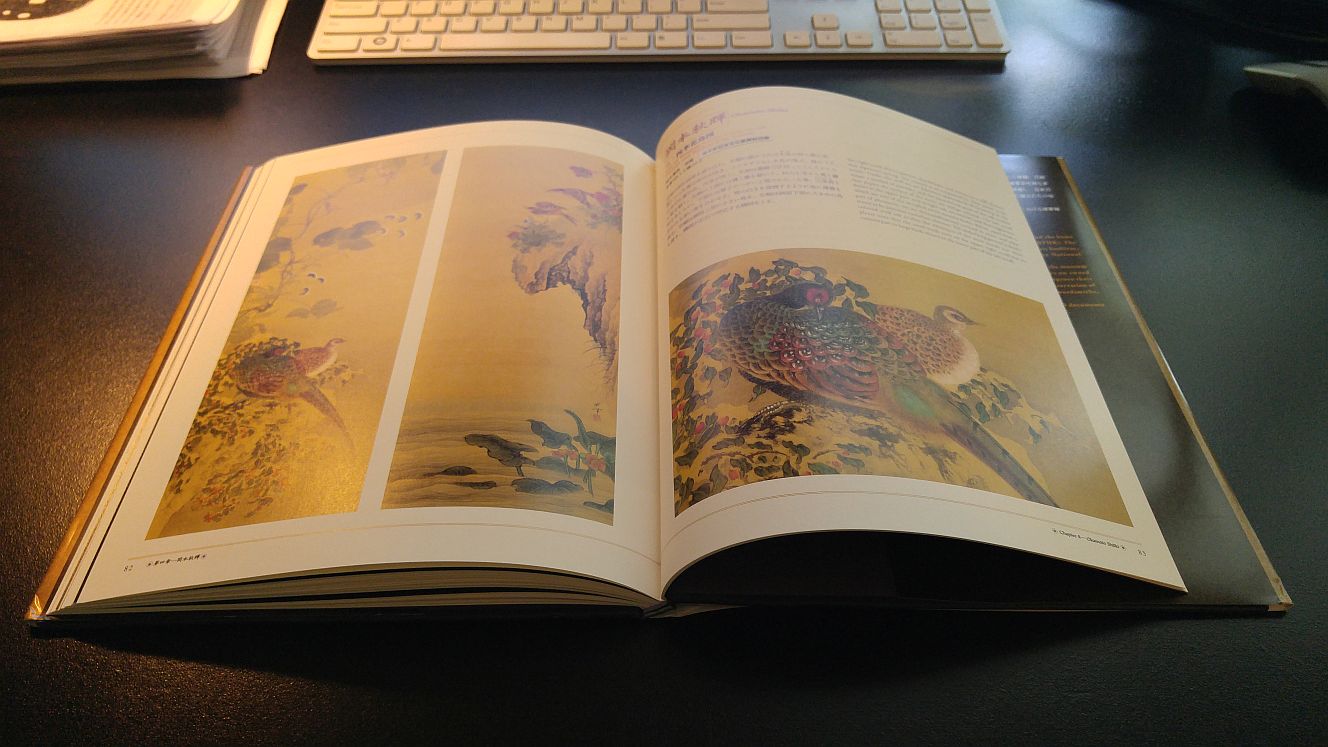
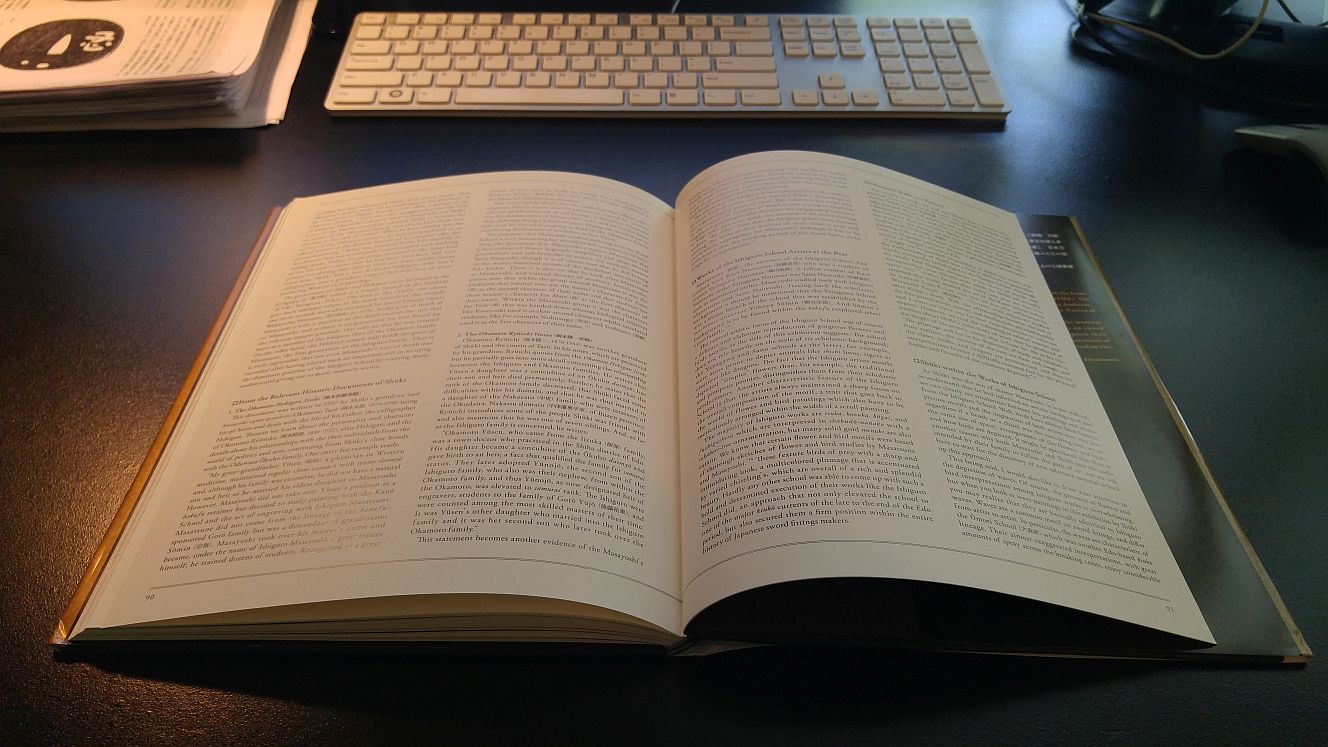
Ishiguro Exhibition Catalog

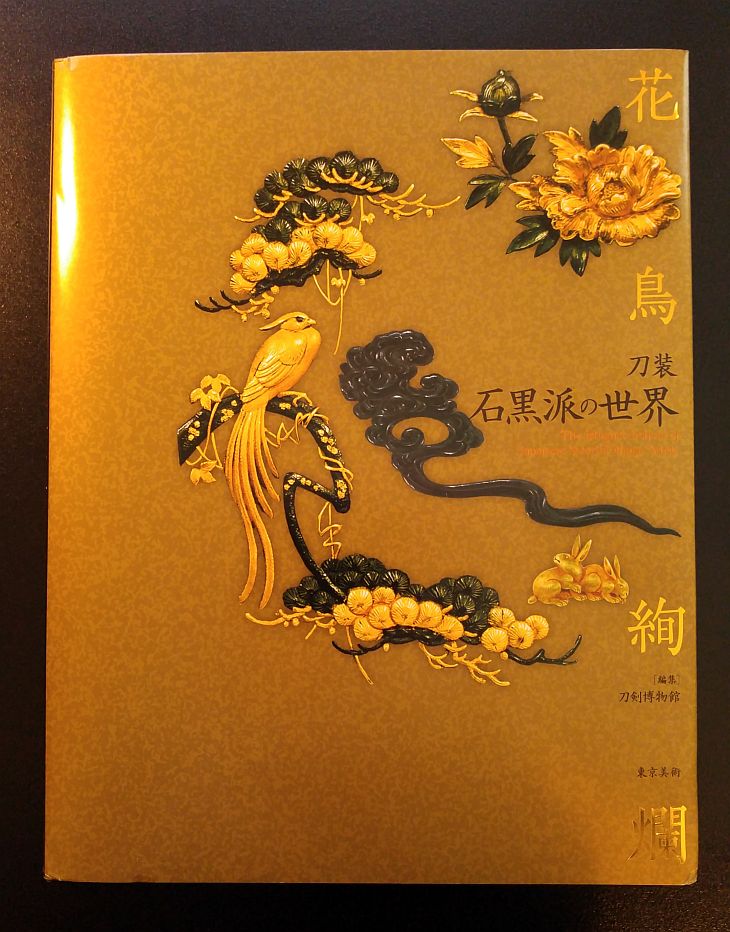
Let me introduce the hot-off-the-press catalog to the currently running Ishiguro exhibition that I had the honor of translating for the NBTHK. The exhibition started two weeks ago but will be up until October 30. So if you are in Tokyo at that time, I would highly suggest to visit the NBTHK (aka The Sword Museum).

The catalog turned out really nice! High quality hardcover in about letter format with great pictures of the fittings, also featuring some stunning close-ups. The catalog is basically divided into four chapters: 1. Masatsune, Masatsune II, and Koretsune, 2. Masaaki, 3. Masayoshi and Koreyoshi, and 4. Okamoto Shûki. Okamoto Shûki was the son of Ishiguro Masayoshi but became a painter. Kubo Yasuko, the senior curator at the NBTHK, dedicted Shûki a detailed chapter in the catalog. The catalog has 95 pages and can be ordered from amazon.co.jp for just 2,500 Yen here.

Ishiguro1

Ishiguro2

Ishiguro3

Ishiguro4

Ishiguro5

Ishiguro6

Note: I just got the catalog the other day and browsing through the pages, I learned that it was messed again with the text that I had delivered, and that multiple times. I had my translation proofread, of course, and I understand very well that passages are subject to change at the last minute but the passages that I found that do not correspond to the text that I forwarded to the NBTHK rather seem to contain arbitrary changes (for example sometimes just certain words were deleted what makes the sentence(s) in question odd, at best, or straightforward wrong in the worst case). I mean, not a big issue taking into consideration the quality of the catalog as a whole but it kind of bugs me because its also about my very own humble reputation as a translator. Anyway, I still highly recommend the catalog but wanted to have that out. Well, this time its at least not as bad as with the last catalog (please read here), but still… 😉

Samurai Stubbornness

A few weeks ago, I was translating material for my friend Jan Petterson whom I met at our armor symposium in Florence. To provide you with some context, Jan is going to write a book about the matchlock history of Yonezawa during the Momoyama and Edo period and visited the very site earlier this year. There he had the chance to get in touch with the local groups and experts and if you want to learn about his awesome trip (with Jan himself actively participating in the annual teppô events), I would highly recommend to register with The Samurai Armour Forum and check out the thread labeled “The viking raid of 2016!” Great read!

Now as Jan is writing his book, I am not going into too much detail here but in one of the relevant source texts, I came across a kind of funny story that I want to share with my readers (Jan is in the loop). To provide some background, the Uesugi (上杉), the daimyô of the Yonezawa fief (米沢藩), were early adopters of the teppô as one of their famous ancestors, Uesugi Kenshin (上杉謙信, 1530-1578), was among the then powerful Sengoku daimyô who recognized the powerful potential of this new weapon. Uesugi Kagekatsu (上杉景勝, 1556-1623), Kenshin’s successor, was actually the first of the family to enter Yonezawa and he too focused very much on having firearms incorporated into his army, much supported by his retainer and confidant Naoe Kanetsugu (直江兼続, 1559-1620). So they hired gunsmiths and shooting instructors and all that stuff and had teppô drills pushed and production sites established on their lands. Kanetsugu by the way compiled a 15-article teppô practice curriculum, the so-called Teppô Keiko Sadame (鉄砲稽古定), which interestingly pretty much grasps all the relevant gun safety issues in effect today.

About a decade after the Ôsaka campaigns of 1614/15 and when everything had calmed down, Kagekatsu’s successor Uesugi Sadakatsu (上杉定勝, 1604-1645) was facing his share to rule of the fief and introduced an event called teppô-jôran (鉄砲上覧) which was an biennial demonstration of all matchlock, hand cannon, and cannon using troops that was witnessed by the daimyô. The teppô-jôran was of course a big thing for the local bushi and a great honor and practice motivation for all participating units. But as more and more importance was attached to that event over the years, an honorable demonstration of skill turned into a dispute between two units about who makes the start. As some of you might know, who is first has ever been a very important issue among samurai armies, i.e. those guys who were leading a vanguard and be the first into battle were usually the ones who entered the history books. So this dispute has to be seen in this context.

Now the fight was between the two units of the o-umamawari-gumi (御馬廻組) and the gojûki-gumi (五十騎組), the former going back to the 100 mounted warriors that were once chosen by Uesugi Kenshin to form his (banner-bearing) elite guard, and the latter to the mounted hatamoto group of 50 which was carefully selected by Uesugi Kagekatsu from his highest ranking and most bemedaled retainers. In short, both units were standing relatively high within the Yonezawa army hierarchy and belonged to the so-called san-tegumi (三手組), a military organizational group within the retainer structure of Yonezawa with the Yoita-gumi (与板組, an infantry unit) being the third party.

Stumbling block for the whole “who comes first at the teppô inspection” dispute was the Kan’ei four (1627) inspection when the gojûki-gumi was about to make the start depite the fact that the o-umamawari-gumi‘s name was on top of the (written) san-tegumi list. So that record was taken literally. The gojûki-gumi however pointed out that it had been in the vanguard at the Ôsaka Winter Campaign and so it was eventually decided in favor of this unit making the start and that the two groups start from now on alternatingly. Well, things heated up again when it came to who performs first at a teppô-jôran after a hatsu-nyûbu (初入部). A hatsu-nyûbu was when the Yonezawa daimyô visited his fief for the first time, i.e. having been raised and living in the Edo mansion of the fief until the succession. So performing first at the first teppô inspection of a newly inaugurated daimyô was even a greater honor for these units. The hatsu-nyûbu thing came up when the sixth Yonezawa daimyô Uesugi Munenori (上杉宗憲, 1714-1734) entered Yonezawa in Kyôhô eleven (1726) and when it was decided that the o-umamawari-gumi should make the start at the first teppô inspection after a hatsu-nyûbu. The gojûki-gumi protested as they had that honor at the last and second last first inspection after a new lord had been appointed. In short, the agreement on the alternating performance was jeopardized by making the first event after a hatsu-nyûbu so special.

UesugiYozan

The dispute flared up again when Uesugi Harunori (上杉治憲, 1751-1822), aka Yôzan (鷹山) (see picture above), entered Yonezawa in Meiwa six (1769) and the gojûki-gumi made the start. Now the o-umamawari-gumi emphasized that it had been settled since Munenori that they have that honor at the very first event following a hatsu-nyûbu regardless of whose turn it would be following the alternating order. Yôzan addressed the commanders of each unit and brought all parties to the table but no one gave in and things were escalating, with friends and relatives not wanting to sit next to each other up to having daughters divorced.

This whole situation troubled Yôzan very much and he tried again to bring the two units together, also including the Yoita-gumi this time. When they were discussing things Yôzan forwarded that competition is in the nature of a bushi but that they were all still retainers at the end of the day and that they thus have to bear in mind the welfare of the fief as top priority. So more energy should be put into daily teppô practice and a major and long lasting dispute like this has the potential to destroy a fief. With the Yoita-gumi mediating, Yôzan was waiting for a response from the two parties. But when the o-umamawari-gumi was objecting many points of the written reply the gojûki-gumi had submitted, Yôzan’s patience was wearing thin and he had the head of the o-umamawari-gumi removed from his post and the head of the supposedly mediating Yôita-gumi placed under house arrest. After that, both parties were requested to submit another written reply and as this time the one from the gojûki-gumi was nothing more than a stubborn copy of their first reply, the fief’s elder recommended Yôzan that nothing will help but to abolish the whole official teppô inspection. Well, Yôzan wanted to give that issue a last try because him not being able to ressolve this issue would on the one hand worsen the discipline of the entire teppô practice, but would be on the other hand always something that will be associated with his name and function as a daimyô for generations to come. So he openly informed the two parties about these considerations. This was effective, both heads resigned and telling their members about their daimyô’s words, the bushi were deeply impressed but also ashamed that it came so far, replying that from now on, the gojûki-gumi should have the honor of making the start and the o-umamawari-gumi will perform second without further hassle. Yôzan expressed his gratitude to the o-umamawari-gumi and put into effect that the gojûki-gumi will henceforth be the unit that opens the official teppô inspection.

So this whole story tells you that the teppô-jôran was not just seen as a blown up circus event. The units were taking that performance very seriously, even after 150 years of peace. And it also tells you that once achieved merits were resonating strongly within hereditary samurai units. By the way, Jan informed me that the present-day teppô-tai that go back to these two units are still bitter rivals and that they never perform at the same event 🙂

Homepage of the Yonezawa Han Koshiki Hôjutsu Hozon Kai (米沢藩古式砲術保存会) click here.

Videos of the annual event an be found here.