I am currently researching to which extent remote artists were aware of trends and fashions happening in the old capital of Kyōto, and the new capital of Edo. We are talking about the Edo period of course. Communication between people involved in the production of Japanese arms and armor of prior periods is extremely limited.
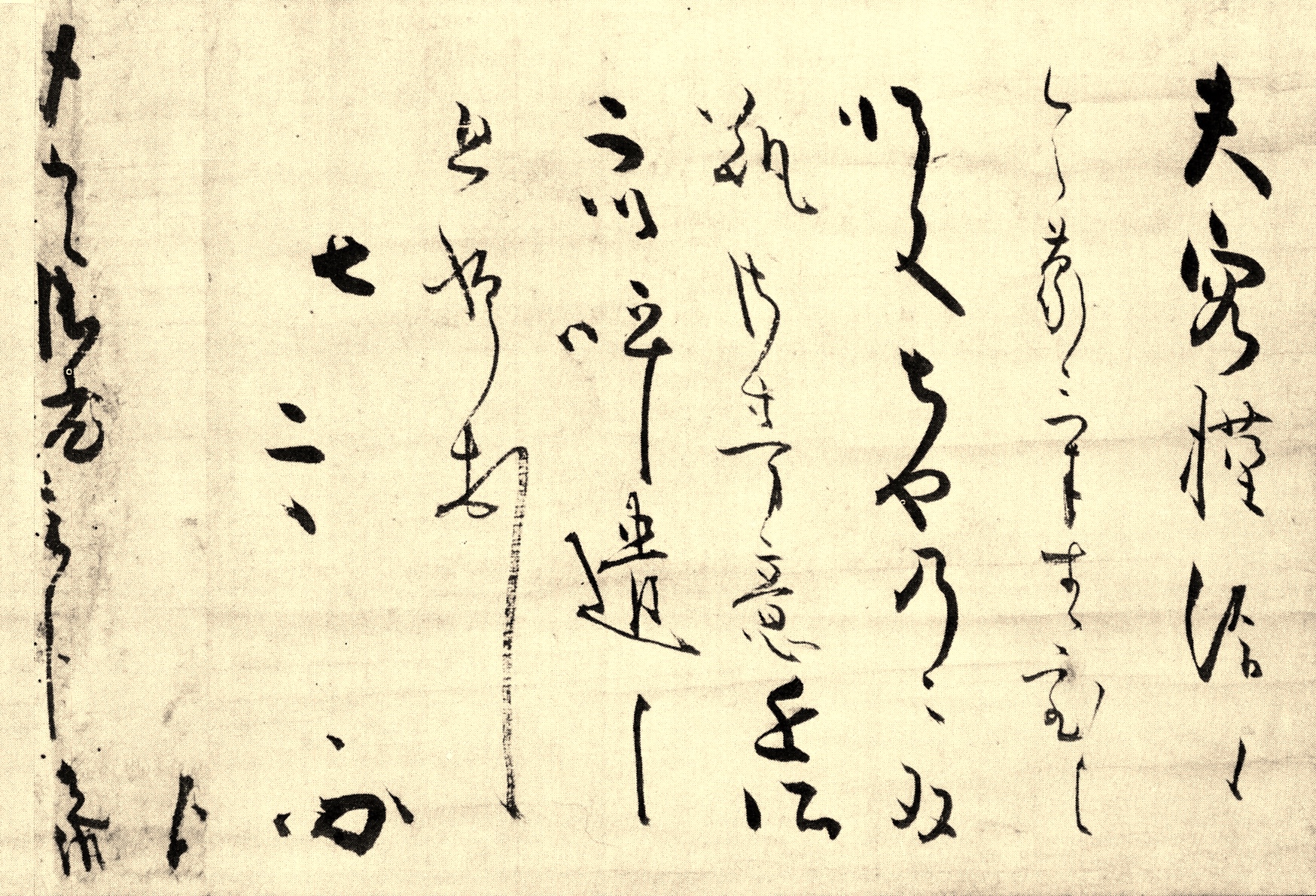
So, in this sense, I would like to introduce a letter sent by Hon’ami Kōsa (本阿弥光瑳, 1578–1637), the third generation of the Kōji (光二) lineage of the renowned Hon’ami family of sword appraisers and polishers, to his father-in-law, Hon’ami Kōtoku (本阿弥光徳, 1556–1619), who was the ninth generation of the Hon’ami mainline. Kōsa was married to Kōtoku’s daughter Myōzan (妙山). The letter is completely unrelated to swords, but wanted to share it anyway for those interested.
Incidentally, Kōsa was from the Kataoka (片岡) family, which was closely tied to the Hon’ami family, and this also explains the very frank and brief letter as formalities were omitted for the most part. And what is also interesting is that the calligraphic style is close to that of of the late years of Kōtoku’s cousin, the famous artist Hon’ami Kōetsu (本阿弥光悦, 1558–1637). So, it is all connected, as always…
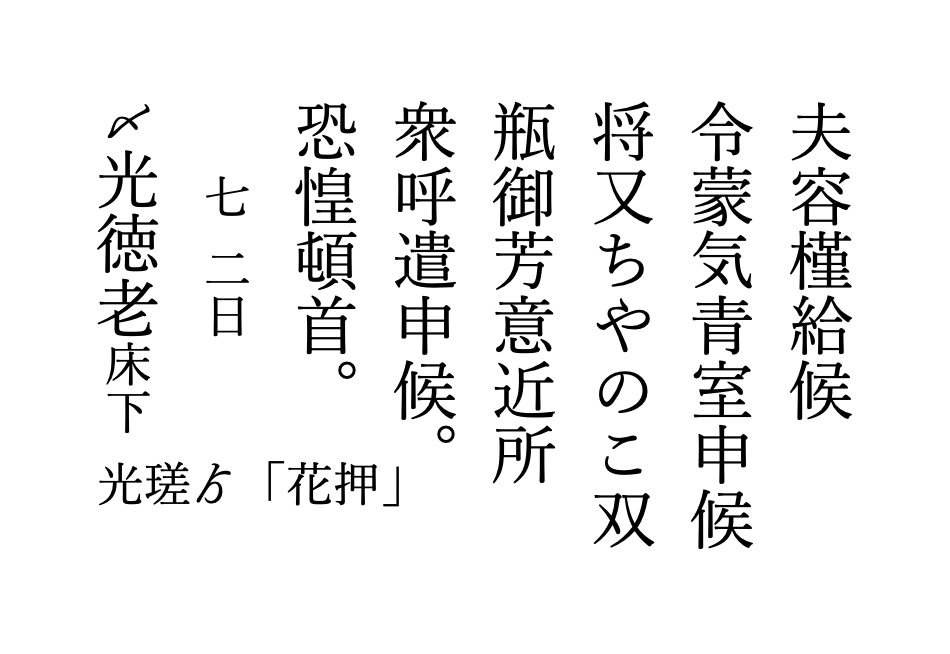
Fuyō-asagao tamawari-sōrō. Rei ni mōki seishitsu mōshi-sōrō. Hatamata cha no ko sō- bin go-hōi kinjo- shū yobi ni yarimōshi-sōrō. Kyōko-tonshu. Shichi futsuka (Fu) Kōtoku-rō shōka Kōsa yori + kaō
“I have gratefully received your hibiscus, which lifted my spirits, and the two containers with tea confections, those I even proudly showed to my neighbors. With best regards, Second day of the seventh (month) (Sealed) to the venerable old Kōtoku, from Kōsa + monogram”
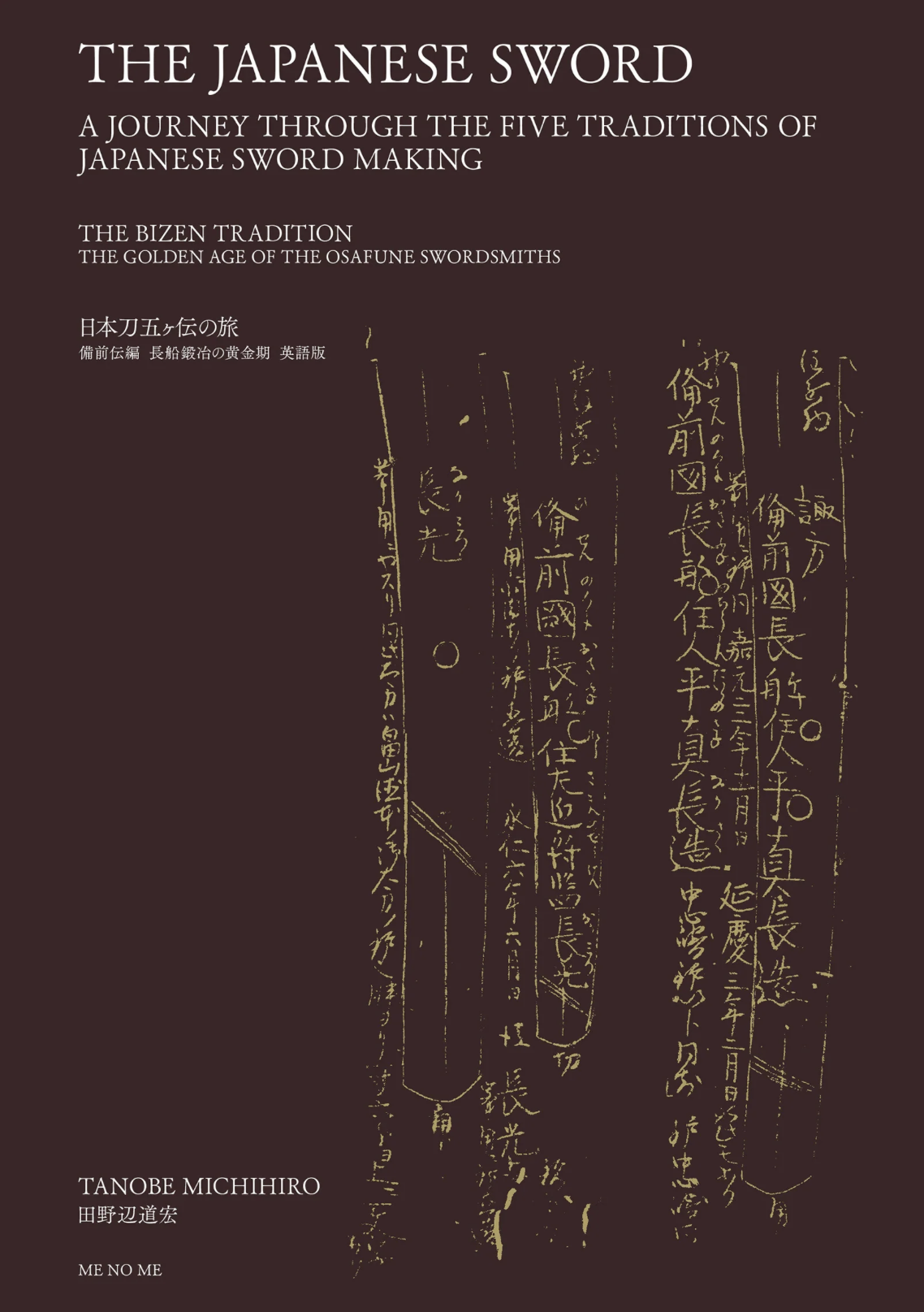
I have posted this on other channels and wanted to let you know that I just got word from the publisher Me no Me that the next installment of Tanobe Sensei’s Gokaden series, translated by yours truly, is out:
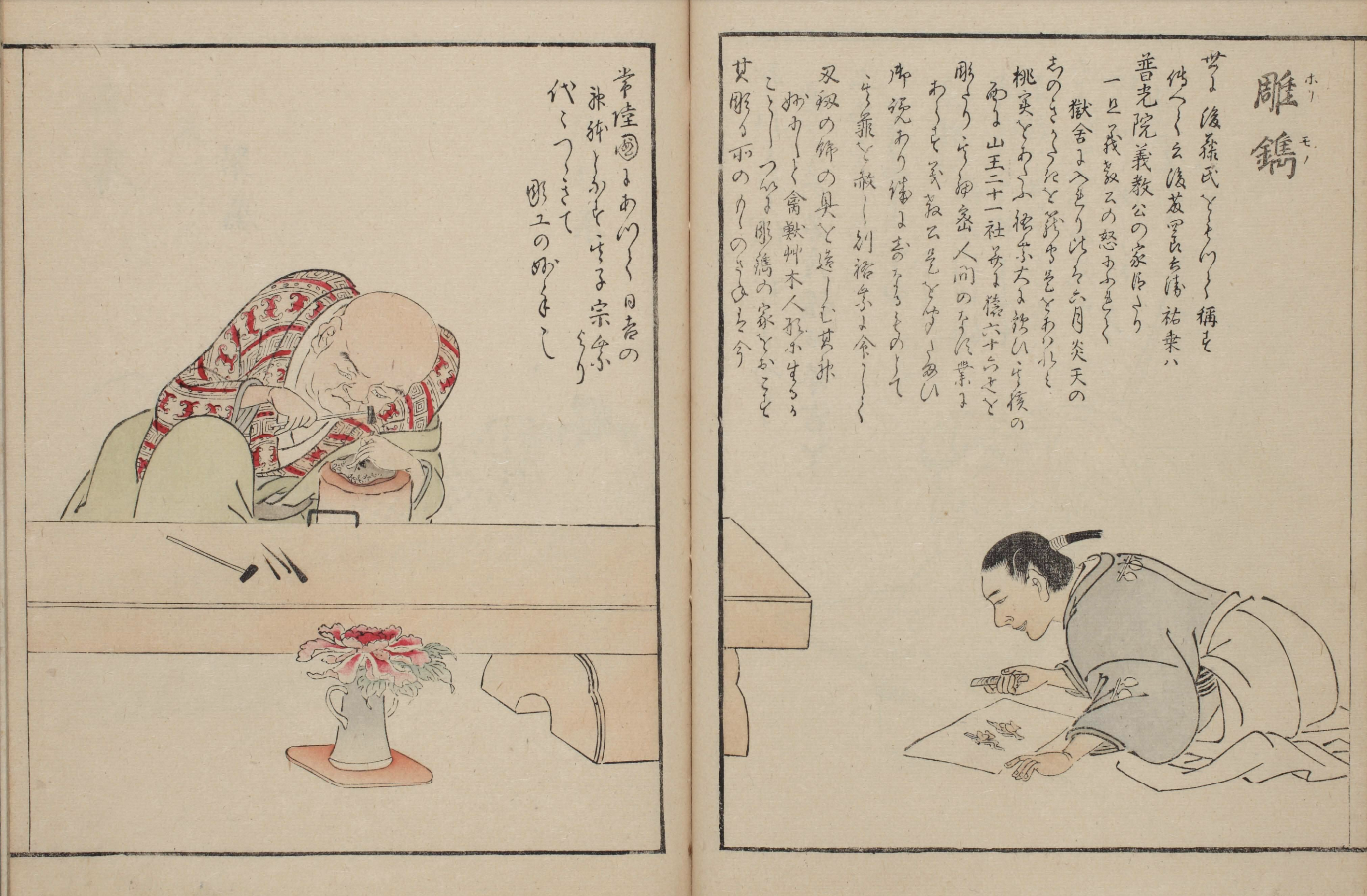
From the Saiga Shokunin Burui (彩画職人部類), Illustrated Compendium of Artisans, a two-volume work published in its first edition in Meiwa seven (明和, 1770) featuring illustrations by painter Tachibana Minkō (橘岷江). Translation of text below.
“The Gotō family is renowned throughout the country. According to tradition, Gotō Shirōbei Yūjō was a retainer of Lord Yoshinori (the sixth Ashikaga Shōgun), known by his posthumous Buddhist name Fukō’in. On one occasion, Yūjō incurred Lord Yoshinori’s displeasure and was imprisoned.
It was the sixth month, and the oppressive summer heat was almost unbearable. Taking pity on him as he languished in confinement, someone gave him a peach. Yūjō was greatly delighted and carved upon the surface of its pit the twenty-one Sannō Shrines, together with sixty-six monkeys. The carving was so extraordinarily intricate that it seemed beyond the capabilities of human hands.
When Lord Yoshinori heard of this, he summoned the object for inspection. Astonished by its truly remarkable workmanship, he pardoned Yūjō and immediately ordered him to produce decorative fittings for swords.
Yūjō’s craftsmanship was so exquisite that the birds, beasts, plants, trees, and human figures he carved appeared almost alive. Thus, he eventually established a hereditary lineage of metalwork engravers.
The peach pit that he carved is now said to be preserved in Hitachi Province, where it serves as a sacred representation of the deity Hiyoshi. Beginning with his son Sōjō, successive generations of the family continued the tradition, each becoming a master of the engraver’s art.”
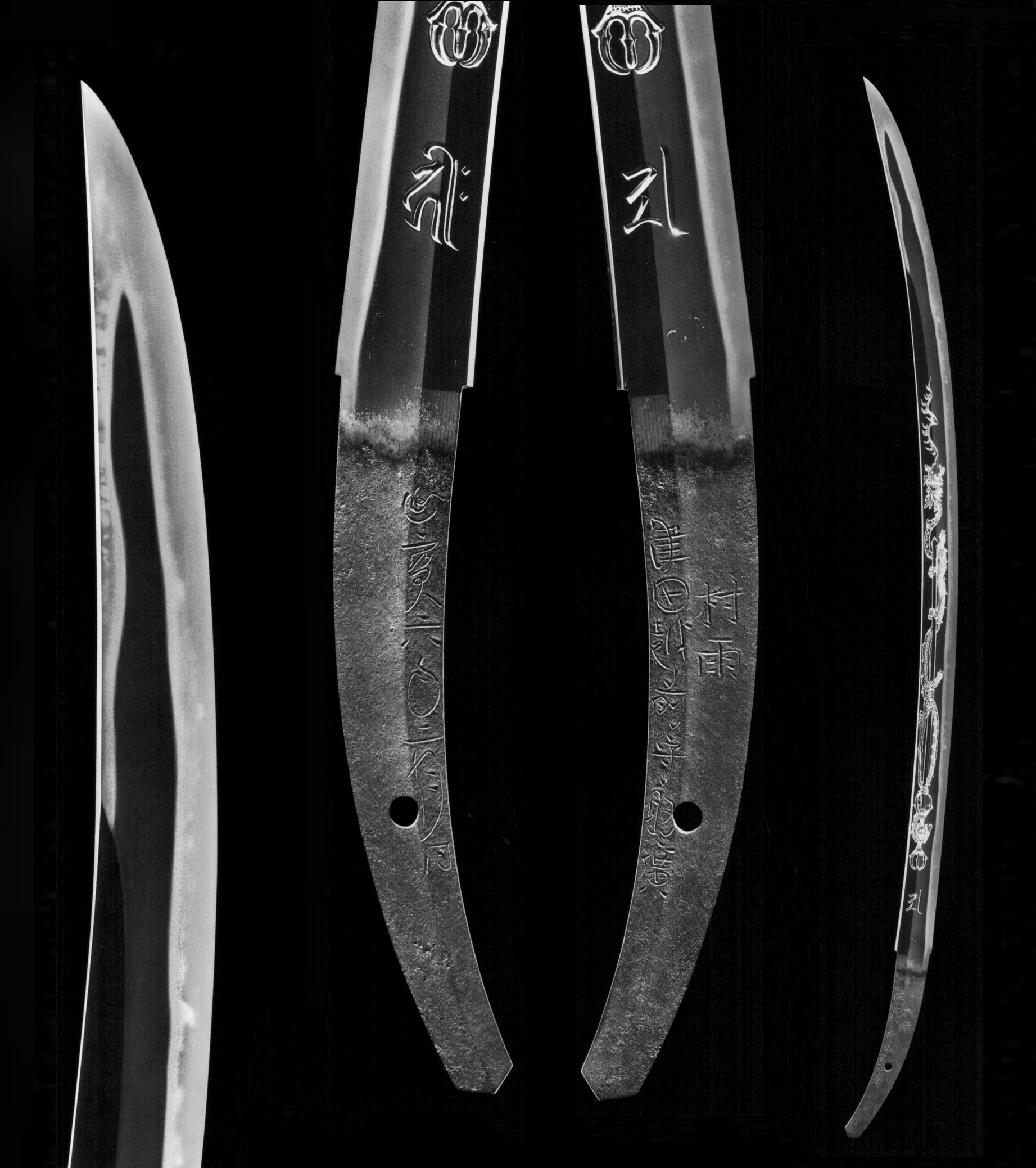
Much has been written about this famous blade by Tsuda Sukehiro (津田助広, 1637–1682), arguably one of his greatest masterworks, just not by yours truly, which I want to change with this article.
Before we go into details, just a few things out of the way. The blade, a katana, is ranked Tokubetsu-Jūyō Tōken by the NBTHK, which makes it only one of six works of Sukehiro that passed TokuJu. Above of that only come the government designations, of which there are eight Jūyō-Bijutsuhin and a single Jūyō-Bunkazai. Thus, we are talking here of an elite group of 15 blades.
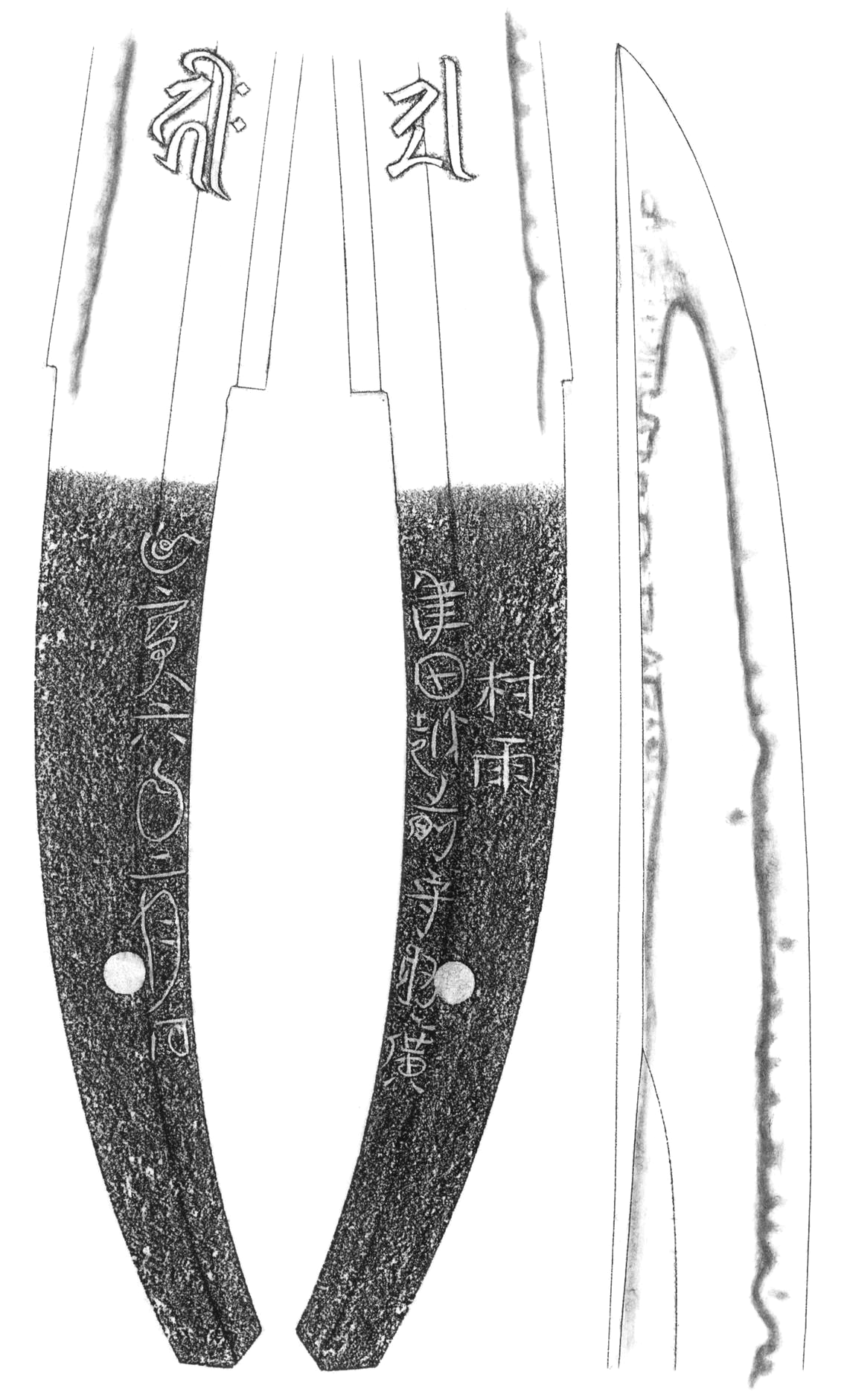
The blade is of a very rare shape, not only for Sukehiro, but for Japanese swords in general, meaning it is of an unokubi-zukuri, but with an astonishingly long nagasa of 83.0 cm (32 11/16 in.) and a prominently wide mihaba of 4.2 cm (1 5/8 in.). What also catches the eye is its strongly curved nakago, which is of a pronounced furisode shape typically seen with early tachi, but more on this later.
The katana is signed and dated the following: “Murasame, Tsuda Echizen no Kami Sukehiro – Enpō rokunen nigatsu hi” (村雨、津田越前守助広・延宝六年二月日) – “Passing Shower, Tsuda Echizen no Kami Sukehiro, on a day of the second month Enpō six (1678).” This date identifies the blade as having been made when the smith was 41 years old and in the prime of his life.
So, let’s address the elephant in the room, the name of the blade, Murasame (村雨). The literal meaning of this term is “village rain,” but it has its etymological origins either in the homophonous term murasame (群雨・叢雨), “clustered rain,” or murasame (斑雨), “scattered rain, rain in patches” It describes a sudden, heavy rain shower that falls unevenly or in patches and that quickly subsides, in Japanese poetry often associated with cold rain showers occurring in fall. Unlike the prolonged rainfall of the rainy season or thunderstorms, murasame refers to rain that begins almost unnoticed and ceases after a short time.
The Heki (日置流) School of archery uses the term murasame as a metaphor for the ideal hanare (離れ, release) in advanced archery. That is, one cannot predict when such a shower will begin or even recognize precisely when it has stopped. Only afterward, upon noticing that the ground and vegetation are wet, does one realize that rain has fallen. Similarly, the ideal release occurs naturally and without conscious effort, like a sudden shower that begins and ends unexpectedly.
This context is also mentioned by Fukunaga Suiken (福永酔剣), Nihontō Daihyakka Jiten (日本刀大百科事典) Vol. 5, p. 176, but he explains it different, referencing the Nihon Budō Zenshū (日本武道全集) from 1966–1967 as his source. He writes: “When a sudden shower falls upon the morning dew resting on the tips of leaves, the droplets roll off instantly, or alternatively, when the wind accompanying such a shower sweeps through vegetation, the grasses and trees suddenly part. Applied to a sword, the name implies that a single stroke would cause an opponent’s head to fall cleanly from the shoulders, or the body to be instantly severed in two. Thus, certain blades were named Murasame in praise of their exceptional cutting ability.” More on such namings can be found here.
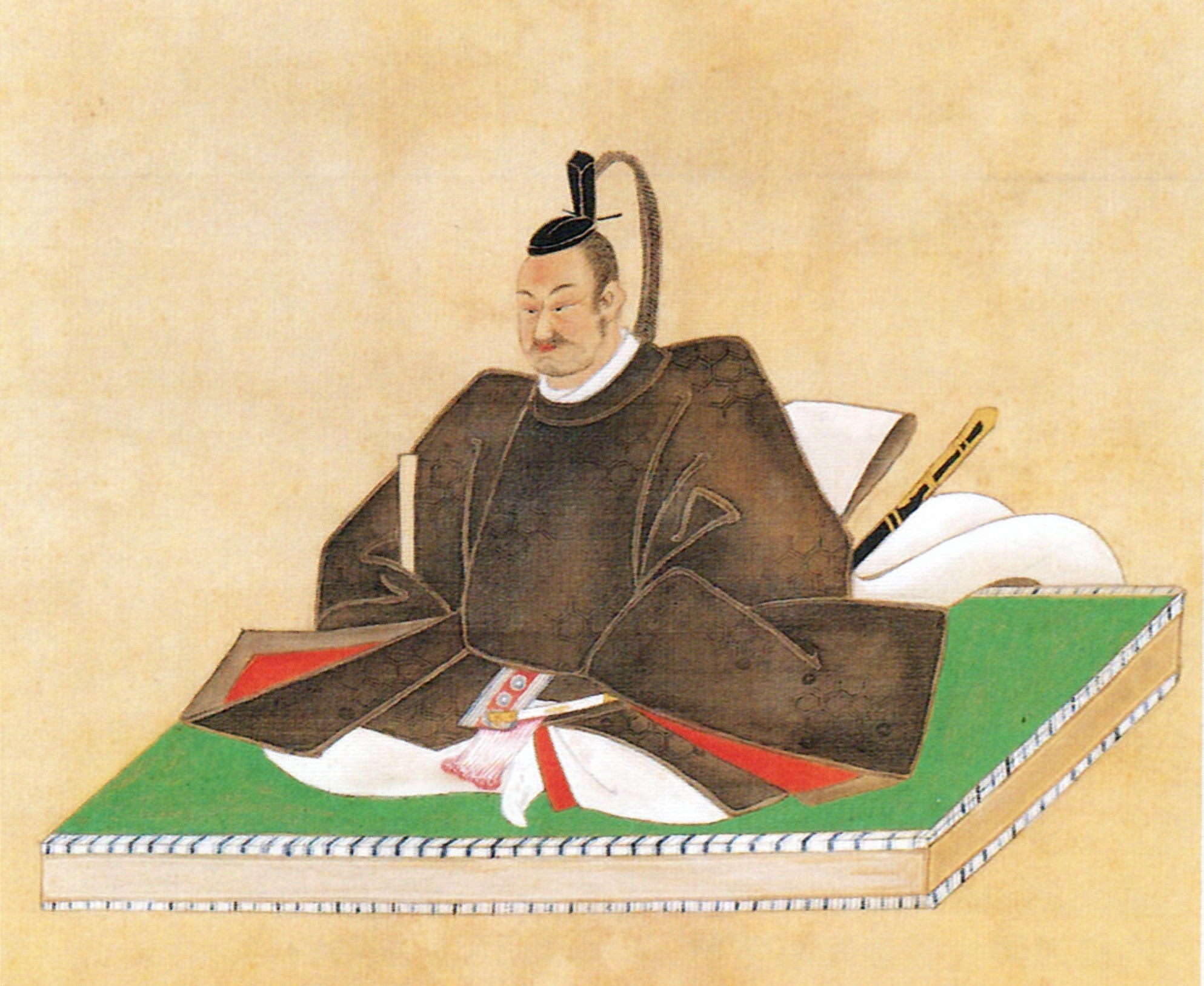
The actual reason behind this very name, however, appears to be a different one, which is pointed out in the description to the Tokubetsu-Jūyō Tōken ranking. “This blade was made at the behest of Aoyama Munetoshi (青山宗俊, 1604–1674) (see image below), then Ōsaka-jō dai (大坂城) [A title of the Shōgunate that identifies an official responsible for holding and defending Osaka Castle and for the administration of the city of Osaka.]. Named Murasame, it was handed down through successive generations of the Aoyama family. According to tradition, the family kept the sword carefully concealed, bringing it out only on occasions when prayers for rain (amagoi, 雨乞い) were offered. This account seems plausible in light of the fact that a prolonged drought affected the Tōkai, Nankai, and Saikai regions from spring through summer of Enpō 6 (1678), precisely the period in which the sword was made. Furthermore, Sanskrit characters are engraved near the base of the blade on both sides. That on the omote side represents Daiitoku Myōō (大威徳明王, Yamāntaka), while that on the ura represent Marishiten (摩利支天 , Mārīcī). These inscriptions further suggest that the Murasame was forged with prayers for abundant harvests and rainfall in mind.”
So, this hope for more murasame showers seems the more plausible reason for the name rather then just referring to a sword that cuts very well. Incidentally, the mounting for the blade is contemporary to the blade and also dates from the early Edo period. As it is adorned with chrysanthemum crests, it is possible that it is indeed the original koshirae as a chrysanthemum with leaves was one of the family crests of the Aoyama. For more pictures, see the blog post of Nakamura Keisuke San (Katana Case Shi) here. The style of the mounting is what is referred to as a sō-fukurin hyōgō-gusari tachi-koshirae (総覆輪兵庫鎖太刀拵), and such koshirae represent an style often used with early tachi with furisode-nakago.
Incidentally, the elaborate horimono in the form of a kurikara dragon spitting flames are thought to have been engraved by the local Ōsaka specialist Nagasaka Yūhōken (長坂遊鵬軒), about whom I have written here (wow, 12 years ago already, time flies…).
The sword remained within the Aoyama family until fairly recently and was offered for sale at the Dai Tōken Ichi (大刀剣市) in 2017 by Shingendō (真玄堂) (even made it onto the cover of the catalog). There, or thereafter, it found its way into a private collection in Taiwan and was featured just last year in the special exhibition Ethereal Steel: The Art and Spirit of the Japanese Sword (鐵華刃韵—日本刀之美) held by the NBTHK Taiwan Branch in Taipei (also see Nakamura San’s blog post again).
What a fascinating sword, and I hope this write-up was interesting.