Rare mentions of forging techniques in sword signatures

   When I was working at my Index of Japanese Swordsmiths, I frequently came across different kinds of mentioning certain forging techniques in a signature. First the easy ones. For example a wakizashi with the mei „Teruyoshi saku – shitagitae Hidekane“ (英義作・下鍛英兼), which means „Made by (Fujieda Tarô) Teruyoshi, foundation forging by Hidekane (who was Teruyoshi´s student but is mostly quoted with the reading „Hidekane“).“ Another example. There is a katana extant by Miyoshi Nagamichi (三善長道) whose mei on the ura side starts with „agegitae“ (上鍛), which means „final or finish forging.“ This practice was by no means uncommon, i.e. a master having his students forging the shitagitae, rare is only the explicite mentioning on the tang. So we can assume that such inscriptions honestly marked less expensive blades coming out of the forge where the buyer was now sure that the master at least gave the finishing touches. (Note: More details about shitagitae and agegitae can be found in Kapp and Yoshihara´s standard work The Craft of the Japanese Sword.)

   Another rather frequently found term on sword tangs is „shin no kitae“ (真の鍛) or „shin jûgo-mai kôbuse tsukuru“ (真十五枚甲伏造). The former is seen for example occasionally on blades of Kotetsu (虎徹) and the latter on works of Ômura Kaboku (大村加卜), his student Bokuden (卜伝), Suishinshi Masahide (水心子正秀), the 2nd generation Shitahara Toshinaga (下原利長), Hamabe Toshinori (浜部寿格), or Musashi Tarô Yasukuni (武蔵太郎安国). Usually shin no kitae is translated as „carefully forged“. As this process takes a great deal of time and effort, the translation is not off but there is more than just „carefully forged“. The famous sword tester Yamano Ka´emon (山野加右衛門) wrote namely in his rare script „Tetsutan-shû“ (鉄鍛集) that for shin no kitae, high-quality steel from Izuha (出羽) of Iwami province is used and mixed with a small amount (5 monme ~ 19 g) of old iron from anchors and the like. This mix of iron pieces is piled up in the usual way of a loose block (mizubeshi, 水減し) and then forged and folded crosswise. Note: Like Shiso (宍粟) in Harima province, Izuha was known since oldest times as production site of high-quality iron or steel respectively.

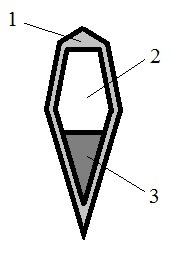
   Well, the term shin jûgo-mai kôbuse tsukuru has nothing to do with shin no kitae. The one who started to apply this technique was the aforementioned Kaboku. In his publication „Kentô-hihô“ (剣刀秘宝) he explains that he used three different kinds of steel for this forging technique, namely two kinds of core steel, shin-jitetsu (心地鉄, lit. „basic core steel“) and shin-hatetsu (心刃鉄, lit. „cutting-edge core steel“), and one kind of skin steel which he called tsurabuse-uwatetsu (面伏上鉄, lit. „bent over surface steel“). First he prepared the soft shin-jitetsu like the well-known shingane (core steel). Then he made the shin-hatetsu of high-quality steel from Izuha and/or Shisô which is still soft but a bit harder than the shin-jitetsu. The shin-jitetsu is put atop of the shin-hatetsu and both steels are forged together. As a final step, the hard tsurabuse-uwatetsu is completely wrapped around this package (see picture 1). Thus we have here still a kind of kôbuse, the famous U-shape, but where the shingane consists of two kinds of steel of different hardness and the kawagane covers also the later back of the blade. The jûgô-mai is explained by the fact that the shin-jitetsu is folded fifteen times to make it considerably soft. That means „shin jûgo-mai“ is here an abbreviation of „15-times folded shingane“. It is now assumed that this forging technique was developed by Kaboku either to achive the most durable sword or to rediscover old and forgotten kotô forging techniques. I would tend to the former approach because unlike forging methods like hon-sanmai-awase or shihô-zume, a kôbuse or Kaboku´s version of a kôbuse does not necessarily have that big effect on the later appearance of the finished sword (i.e. the way the jigane interacts with the habuchi and yakiba for example). In turn, the later shinshintô master Suishinshi Masahide who had a strong theoretical approach to swords, was inspired by Bokuden´s publications and so it is no wonder that he too experimented with the shin jûgo-mai technique.

  kaboku

Picture 1: Cross-section of a shin jûgo-mai kôbuse blade of Kaboku. 1. tsurabuse-uwatetsu, 2. shin-jitetsu, 3. shin-hatetsu

     A slightly different shin jûgo-mai technique was applied by the shinshintô smith Sasaki Ichiryûsai Sadatoshi (佐々木一流斎貞俊). He signed namely with the supplement „shin jûgo-mai futo-hirafuse“ (真十五枚太平伏). Hira-fuse referred in contrast to kôbuse to the forging technique of makuri-gitae (捲り鍛え), where the shingane is layed atop of the kawagane and then folded together so that the kawagane encloses the shingane in the known U-shape. In short, Sadatoshi used 15-times folded shingane for his hira-fuse/makuri-gitae technique. Somehow unclear is the term „futo“ (太) which means „thick“. So either a thick layer of shingane was used or „futo-hira-fuse“ was back then one single term to express a makuri-gitae.

   Most of the other forging techniques like maru-gitae, muku-gitae, makuri-gitae, hon-sanmai-awase-gitae or shihô-zume-gitae are described and depicted elsewhere. I did not want to hash and rehash all the stuff published but focus on the few lesser known forging techniques in this very first article.

Nihon-shinto-shi

Nihon-shinto-shi

Als Nachfolgewerk Dr. Honmas „Nihon-koto-shi“ konzipiert versucht der Autor der Lücke „shinto“ Rechnung zu tragen und, dem Leser eine gesammelte Geschichte der shinto-Schwertperiode näherzubringen. Mit dem Übergang zur friedlichen Edo-Zeit erlebte das japanische Schwert viele einschneidende Veränderungen. Hier werden nun die historischen und schulischen Faktoren des shinto schlüssig und umfassend dargelegt. Der Leser soll ein Bild von den sich verändernden Schmiedetraditionen und von den Aktivitäten der verschiedenen Schulen der einzelnen Provinzen bekommen. Als Konsequenz der veränderten politischen Rahmenbedingungen der Edo-Zeit ergibt sich auch für die Geschichte der shinto-Schwertperiode ein etwas anderer Ansatz, als das im koto der Fall ist. Mit dem Wegfall der traditionellen gokaden bietet sich nämlich mehr eine geographische denn schulische Aufarbeitung an, wobei den Anfang die großen Schmiedezentren Kyoto, Osaka und Edo machen. Danach werden sämtliche Provinzen im Kontext zueinander abgehandelt.

Lulu.com

ISBN 9781300602392, Paperback, 7.44 wide x 9.68 tall, 444 pages

69,90 €

Nihon-kotô-shi

Nihon-koto-shi

Die Geschichte der kotô-Schwertperiode

von Honma Junji

Das “Nihon-kotô-shi” wurde von Dr. Honma Junji das erste Mal 1958 veröffentlicht. Seit dieser Zeit gilt es als Standardwerk, das in kompletter Weise die Geschichte der kotô-Schwertperiode beschreibt. Es beinhaltet eine historische und handwerkliche Betrachtung der meisten aller kotô-Schulen, unterstützt durch 372 s/w-Bilder, oshigata oder Illustrationen.

Books on Demand
Hardcover, 30,3 x 21,4 x 2,2 cm, 280 Seiten

150 €

Tôban-shôkan-kôketsu

Toban-shokan

Diese Publikation ist eine Übersetzung Matsumiya Kanzans (1686-1780) Erläuterungen zum Thema tsuba, gefolgt von seinen Illustrationen der einzelnen Stücke nebst Kommentaren. Im Anschluß findet sich ein einleitender Text, eine Biographie Kanzans, sowie eine Erläuterung zu Matsumiyas Kommentaren
Books on Demand

ISBN 978-3-8423-2783-2, Paperback, 29,4 x 21 x 1,4 cm, 184 Seiten

54,90 €

Shinto & Shinshinto-kantei

Kantei-shinto

An unavoidable difficulty with books that deal with Japanese swords in general is that the workmanship of a smith has to be reduced to its most important characteristics which can be seen on the majority of his works. It is here that this work comes into play, with the motive to provide more concretely described reference examples. Unique is that – depending on the blade – former participant’s kantei bids are also addressed. This means that one’s own approach and attempt at attributing a blade may also be comprehended. With the 169 introduced shinto and shinshinto blades from altogether 13 provinces, this volume constitutes an extensive reference work. The order starts for shinto with Kyoto, Edo and Settsu, and for shinshinto with Edo.

Lulu.com

ISBN 9781300555711, Paperback, 8.26 wide x 11.69 tall, 416 pages

98.00 $ / 75,21 €

Koto-kantei

Kantei-koto

An unavoidable difficulty with books that deal with Japanese swords in general is that the workmanship of a smith has to be reduced to its most important characteristics which can be seen on the majority of his works. It is here that this work comes into play, with the motive to provide more concretely described reference examples. Unique is that – depending on the blade – former participant’s kantei bids are also addressed. This means that one’s own approach and attempt at attributing a blade may also be comprehended. With the 189 introduced kotô blades from altogether 19 provinces (including the five gokaden) this volume constitutes an extensive reference work. The order starts in the classical way, namely with the gokaden Yamato, Yamashiro, Bizen, Sôshû and Mino.

Lulu.com

ISBN 9781300552581, Paperback, 8.26 wide x 11.69 tall, 464 pages

98.00 $ / 75,93 €

Koshirae – Japanese Sword Mountings

Koshirae-e

With this publication I try to systematically and comprehensively process the subject of „Japanese sword mountings“. It was not my goal to depict as many extant interpretations of sword mountings as possible but to deal with their different styles. With this publication the reader will be informed in which way the Japanese swords were mounted over time, the origins of the various styles, what changes they underwent and it will also serve as a reference material to classify extant specimen. In this sense the descriptions were embedded in an explanation of their historical context rather then listing them simply by their interpretation or in alphabetical order. As the main focus lies on „koshirae“, explanations on the sword fittings – the tosogu – were omitted because their descriptions can be easily found elsewhere. Also, the military mountings – the gunto-koshirae – were left out because there are excellent publications available which deal with them in great detail.

Lulu.com

ISBN 9781300333241, Paperback, 6.63 wide x 10.25 tall, 202 pages

49.15 $ / 40,54 €


The Japanese toso-kinko Schools

Lexikon-tosokinko-e

This book deals systematically, for the first time in English, with all the Japanese tôsô-kinkô schools and sorted by their production sites such as Kyôto, Edo, Mito, Higo and the like. Comprehensive cross references are given for the origins of the individual schools and the master-student relationship(s) of the individual artists, supported by genealogies for the larger schools. In addition, a detailed introduction of the historical context of the Japanese tôsô-kinkô, the manufacturers of sword fittings, is given at the beginning. Also added is an extensive index containing all the names, first names and pseudonyms of the artists introduced in this publication.

Lulu Inc.

ISBN 9781291024982, Paperback, 22,86 x 15,24 cm, 430 pages

40,90 € / 50,32 $ / 31,66 £

Swords from the Nihonto-Club Germany

Nihonto-club-e

This catalogue records a selection of the blades from the Nihonto-Club Germany. But it is not just an illustrated list but offers sound and considerable informations to each blade, its characteristics, and its maker and/or school.

Listed are 40 blades of which twelve bear the status juyo-token. The sequence is as usual, speak Koto-gokaden, Koto blades of other provinces, Sue-Koto, Keicho-Shinto, Shinto, Shinshinto, and Gendaito.

Books on Demand

ISBN 978-3-8423-4724-3, Paperback, 29,5 x 20,8 x 1 cm, 104 pages

49,90 € / 36,65 £