Gendaito Project

GendaitoProjectLogo1

The Tameshigiri book is almost finished. Writing is done and the last chapters are now proof read and then comes final formatting. I mentioned earlier and on the NMB that I am going to write a book on Gendaito in fall. Start of the project will be fall this year after I return from the US early October. I already gratefully received support in the form of books but I have to get some more so that I am able to cover the subject thoroughly. What I now need is further references in the form of blade/oshigata pictures. For that, I have created a separate email address, “gendaitoproject@gmail.com“. Everyone who has data to support this project is cordially invited to send me pictures and texts. I guess everybody knows what kind of pics are expected from such a publication, i.e. tangs in top view with either a white or black background and the like. Please understand that I will not reply individually to each mail. This email address is used to gather reference material and I will report back when there are questions. Thus I say hereby thank you very much for all data you are able to provide! Also please note that the copyright has to be ensured. That means if you have the copyright, you agree to pass it on to me with sending me the pictures. All data will only be used and published in course of the Gendaito Project. As this is still a one-man-show here and I might have to postpone other projects, I would also greatly welcome any financial support to make this project happen “smoothly.” That means I am not going to use kickstarter or any other crowdfunding because I am going to tackle the project anyway. It is just for keeping it on a steady course and not to have it largely interrupted by other projects as everybody knows, bills are not going to wait until this book is finished 😉 So everyone who wants to support the Gendaito Project, please use the “donate” button on the very bottom of this blog. I thank you a lot in advance and all those who do this in a “larger scale” will receive a signed copy of the book when finished of course. As indicated, this publication should be as complete as possible so we are talking here about a price in the upper two-digits or lower three-digits range for the finished book. Thank you for your attention!


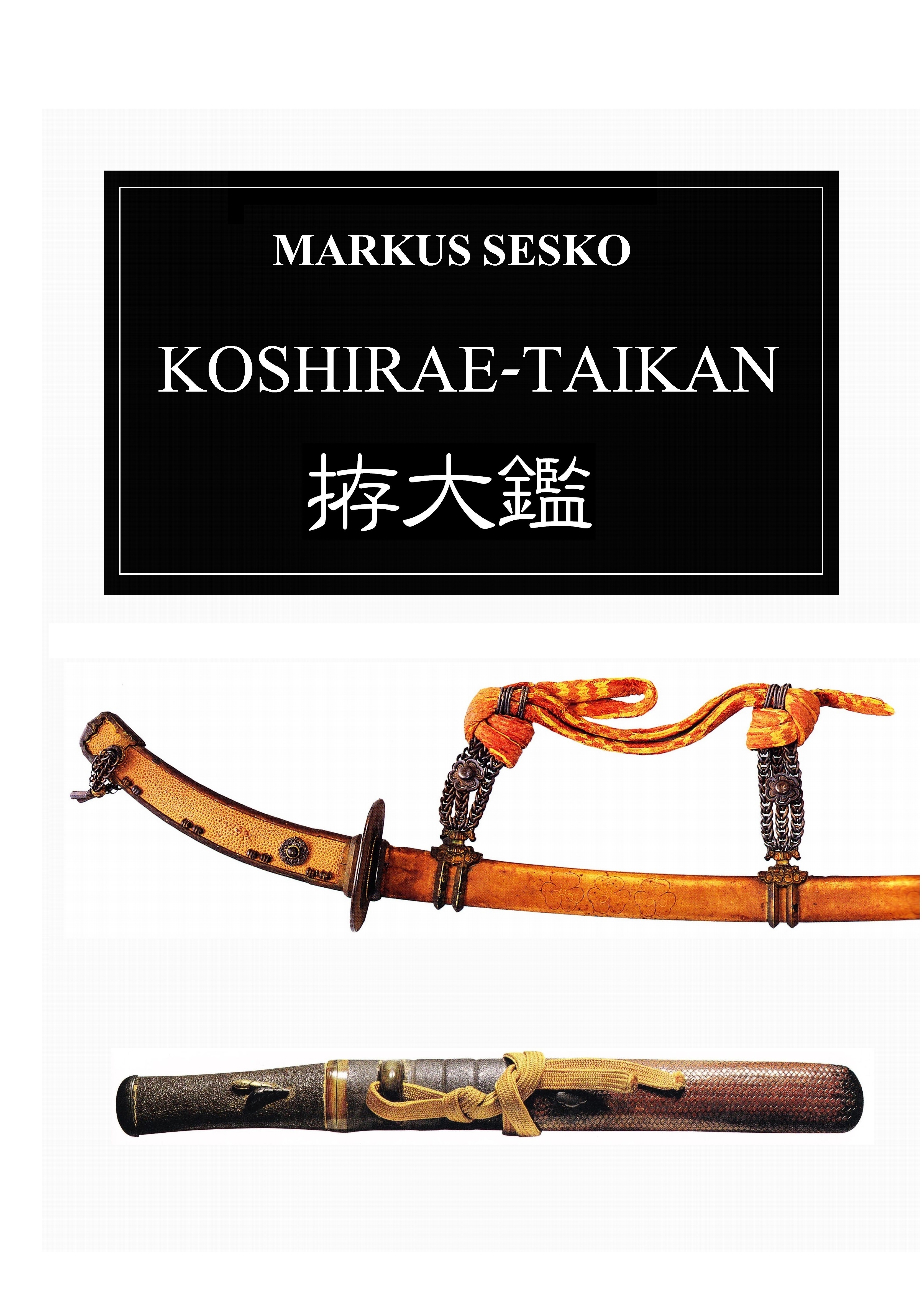
KOSHIRAE-TAIKAN

As announced on the Nihonto Message Board and before I am away from all my books in the end of July, I compiled upon enquiry a enlarged color hardcover 8.25″ x 10.75″ format version of my previously published book Koshirae – Japanese Sword Mountings. The initial book had 202 black and white pages, as 6.6″ x 10.25″ paperback. Shifted to the new format, it would come up to about 140 pages. So the new version is with its 402 pages actually about twice as extensive. The extension concerns not only many color versions of the old pics and a plus of many full-color koshirae pics, the book now also contains a section on koshirae seen on paintings and portraits and the full! koshirae section (84 plates) of the famous 18th century illustrated standard work Shûko-jûshu. And because it feels now comprehensive and substantial enough, I named the publication KOSHIRAE-TAIKAN. The price is 169 USD for the hardcover, and 79 USD for the eBook.

Please understand that as far as the price is concerned, about 100 USD makes just the color and hardcover printing. Another factor for the price is that the expected copies sold will be in the lower double-digit range.

The printed hardcover copy  is only available over me, that means please contact me via mail (markus.sesko@gmail.com) if you want to order the KOSHIRAE-TAIKAN. In other words, upon transfer (PayPal or wire, what you prefer), I will have a copy print and shipped to you at Lulu.com. That´s the easiest way. For the eBook, please also contact me. I will then give you a direct link where you can order your copy as usual.

CoverTaikan3

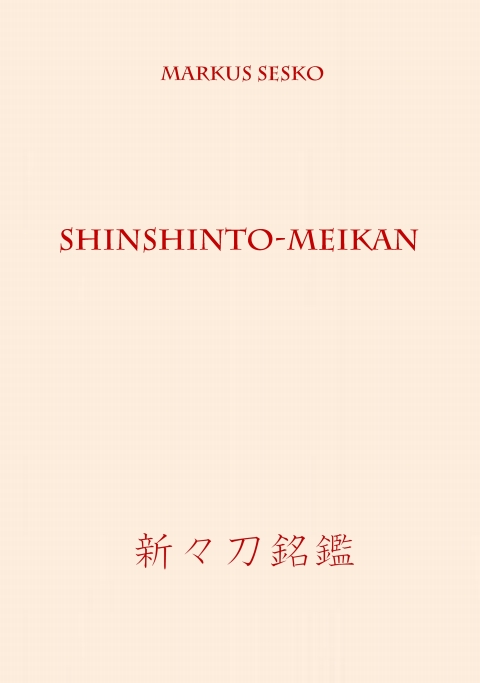
SHINSHINTO-MEIKAN

Last but not least the SHINSHINTO-MEIKAN , arranged to a 242 pages hardcover book in the format 8.25″ wide x 10.75″ tall. It is a classic meikan format book with pictures of about 640 tangs of about 250 shinto smiths. A list of all featured smiths can be found as PDF below (the “double-entries” refer to different smiths/generations with the same name).

The price is 49.90 USD for the hardcover copy and 24.90 USD for the eBook.

Please order via these links:

Hardcover copy

eBook

SHINSHINTO-MEIKAN-Contents

SHINSHINTO-MEIKAN-Cover

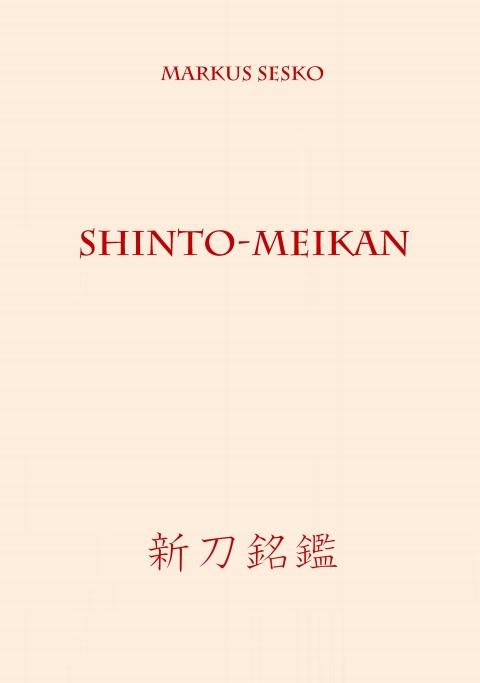
SHINTO-MEIKAN

Now the SHINTO-MEIKAN follows, arranged to a 456 pages hardcover book in the format 8.25″ wide x 10.75″ tall. It is a classic meikan format book with pictures of about 1,300 tangs of about 640 shinto smiths. A list of all featured smiths can be found as PDF below (the “double-entries” refer to different smiths/generations with the same name).

The price is 79.90 USD for the hardcover copy and 34.90 USD for the eBook. A SHINSHINTO-MEIKAN will follow soon.

Please order via these links:

Hardcover copy

eBook

SHINTO-MEIKAN-Contents

SHINTO-MEIKAN-Cover

KOTO-MEIKAN

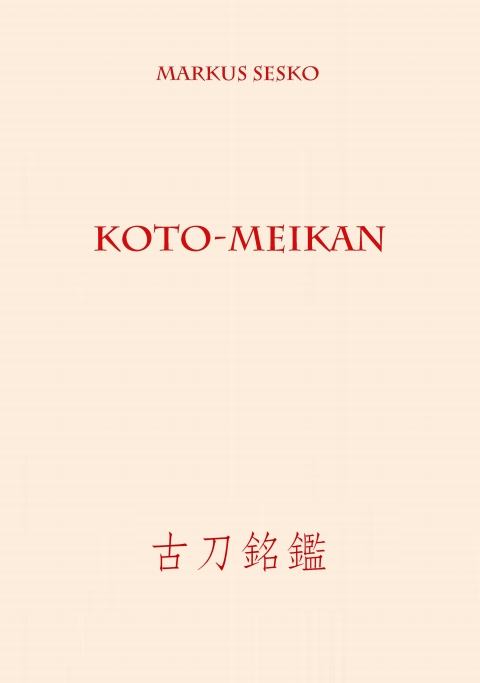
As announced on the NMB along this discussion, I make available step by step my signature archive. First the koto blades, which I arranged to a 696 pages hardcover book in the format 8.25″ wide x 10.75″ tall (thus the same format as I used for my Signatures of Japanese Sword Fittings Artists). It is a classic meikan format book with pictures of about 2,000 tangs of about 900 koto smiths. A list of all featured smiths can be found as PDF below (the “double-entries” refer to different smiths/generations with the same name). I hope this serves as a reference and also of interest should be the eBook so that one can compare signatures on the spot when going to buy swords. Just like at the previously published Signatures of Japanese Sword Fittings Artists, one can also check a signature to find out if a blade is a promising candidate for papers. The design was kept simple as I don´t like fancy covers, or in other words, a meikan is a meikan and stands for itself.

The price is 89.90 USD for the hardcover copy and 39.90 USD for the eBook. A SHINTO-MEIKAN will follow soon.

Please order via these links:

Hardcover copy

eBook

KOTO-MEIKAN-Contents

KOTO-MEIKAN-Cover

Identifying Japanese Seal Script

This is for all trying to identify seals on paintings or elsewhere.

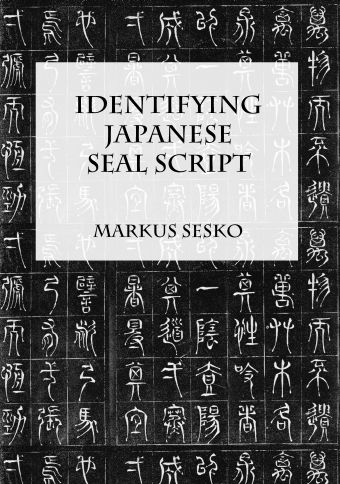
The purpose of this publication is to provide a basic guide and reference for identifying Japanese seal script. The most effective way of identifying a seal script is by its radical, a graphical component under which the character is traditionally listed in a dictionary. The radicals used here are the Japanese version of the 214 Chinese Kangxi radicals.The first thing to do is to identify the radical under which the character is most likely to have been indexed.To begin with, this dictionary offers a RADICAL SECTION. If you think you found a match with the supposed radical for the seal character in question, then go to the page which lists the characters grouped under that radical. This dictionary contains approximately 4,000 characters. As mentioned, the purpose of this publication is to provide a basic guide and reference. It is not meant as a comprehensive seal script dictionary offering different interpretations of each seal character.

6 wide x 9 tall, 362 b/w pages, price $ 39.90 / 32,24 € (for the paperback)

As at the previous publication Identifying Japanese Cursive Script, there is a paperback, a hardcover, and an eBook version available.

Please click at Preview under the cover at any of the links provided above to see some sample pages of the book.

CoverSealSmall

Tameshigiri update

Dear readers,

Let me give you a short update on the tameshigiri project. First of all, I would like to thank you all for your great feedback! Based on this feedback, it seems that this publication was long overdue and much sought after. My particular thanks go to those who provide(d) me with reference material on cutting tests! This is the first time so far that I get references before the book is published and I am very happy about that because the publication should become a standard work and contain as much information on the subject as possible.

As for the progress, the historical part is finished now. It offers, as the name suggests, the historical background of the practice of sword tests, may it be for testing a sword blade or the cutting ability of a swordsman. This is followed by a detailed description on the shaping of systematic tameshigiri which contains information on the early systematic sword testers and their genealogy. This chapter is so to speak the prelude to the famous Yamano family of sword testers.

The next section deals with Edo-period criminal punishment, i.e. it explains when tameshigiri were performed and what was exactly the context of cutting tests, decapitation, and criminal punishment. The section also explains how the judicial system of the Edo period worked and narrates the course of events from being arrested to being beheaded.

This section is followed by a description of tameshigiri during mid-Edo times, accompanied by an introduction of the Yamada Aasaemon family which held the o-tameshi-goyô monopoly (sword testers to the bakufu). The section comes with a genealogy and an overview of the publications of the Yamada family like the famous Kaihô-kenjaku and its list of wazamono.

The next big chapter is on the testing of swords itself, i.e. testing on living persons, dead bodies, and solid targets. This chapter introduces via pictures and descriptions all the cuts (on multiple torsos for example) and preparations (of the dotan, the blade, and the like) necessary for performing valid and repeatable cutting tests.

Next will be an overview on the practice of tameshi-mei (setsudan-mei). And the end of the book will consist of a list of known sword testers accompanied by pictures and oshigata of their meshi-mei, followed by the wazamono list, sword nicknames with reference to the cutting ability of swords (like seen here), and things like that.

As I am asked about a pre-order option, I would like to use this opportunity to gratefully accomodate that wish. That means everyone who wants to place a pre-order can transfer/paypal me the amount for the book + shipping (the about 300+ pages harcover book will be 59.90 USD / 45 € and shipping flat rate 10 USD / 8 € to everywhere in the world). The plus for those pre-ordering is that they receive in return a signed copy (as soon as I have them here). The expected date for publishing will be end of June. For more details please get in touch with me via “markus.sesko[at]gmail.com”.

In this sense, once again thank you all for the feedback! Much appreciated.

On a probably fake kinzôgan tameshi-mei

Whilst working on my next publication on tameshigiri, I stumbled over an interesting gold-inlayed test result of a cutting test which requires caution. After finishing the chapter on the famous Yamano family (山野) of sword testers whose succession was Ka´emon Nagahisa (加右衛門永久), Kanjûrô Hisahide (勘十郎久英), and Kichizaemon Hisatoyo (吉左衛門久豊), I also tried to find some more members of the Yamano family and found a certain Kantarô Nagatsugu (勘太郎永継) on a wakizashi of Kotetsu. This Nagatsugu does neither appear in any of the publications on tameshigiri nor have I found his name inlayed on any other sword tang so far but the blade got jûyô in 2004. And looking for Yamano Kantarô Nagatsugu, I learned that my blogger-colleague Itô Sanpei had addressed the very same wakizashi back in 2006. His article can be found here.

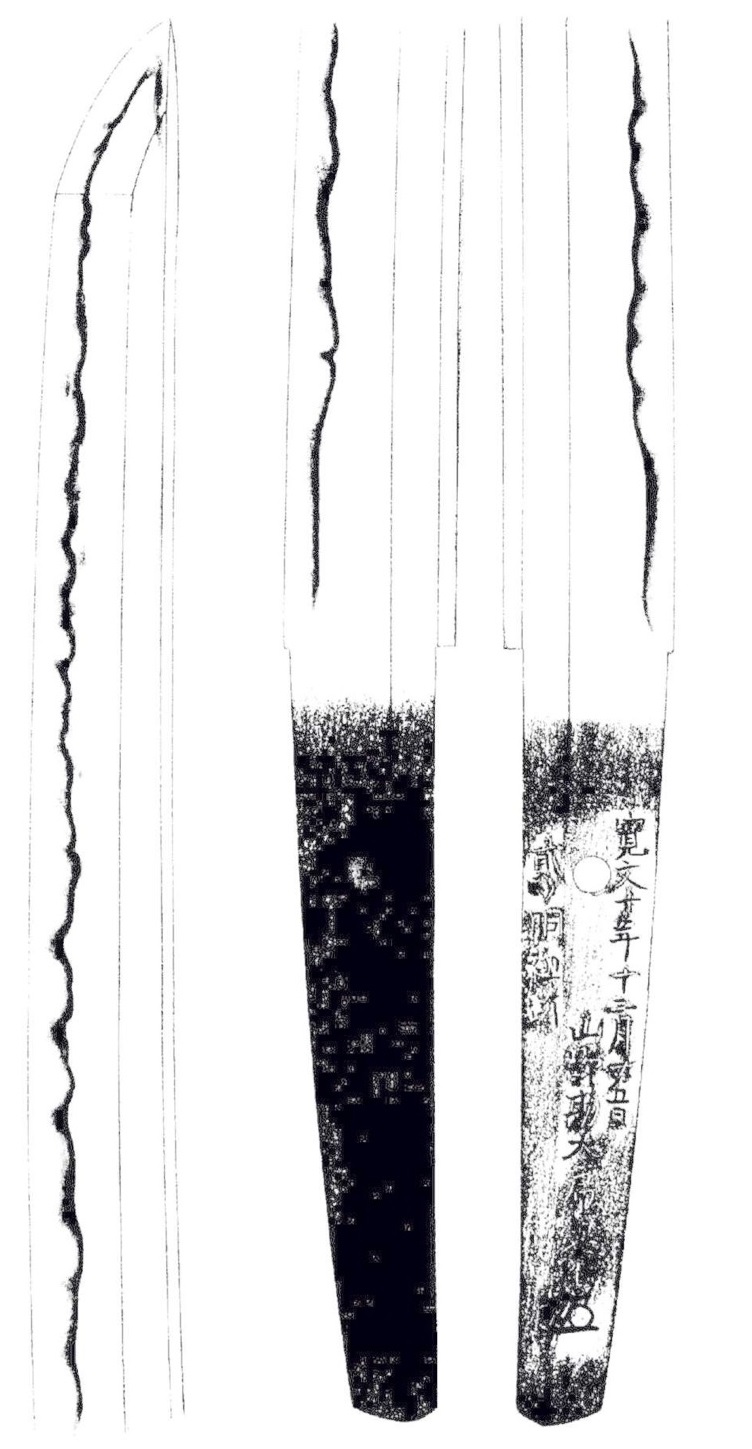
Itô found out that there is a wakizashi depicted in the Kotetsu-taikan (虎徹大鑑) whose tameshi-mei reads: “Kanbun gonen jûnigatsu nijûgonichi – futatsu-dô setsudan – Yamano Kantarô Nagatsugu + kaô” (寛文五年十二月二十五日・貳ツ胴截断・山野勘太郎永継, “Yamano Kantarô Nagatsugu cut through two bodies on the 25th day of the twelfth month Kanbun five [1665]”). In Itô´s blog, the picture on the far left is the one from the Kotetsu-taikan. Itô was now informed that the date of the tameshi-mei was later altered from Kanbun five to Kanbun ten (1670) and that we are facing the very same wakizashi. However, the jûyô paper does quote the mei as “Kanbun jûnen jûnigatsu nijûgonichi…” but does not mention any possibility of an alteration. Incidentally, the very same wakizashi was also introduced in Aitô magazine (愛刀) No. 355 (December 2005) and Itô presents the oshigata of the nakago on the far right on his blog. By the way, the picture in the middle is from the jûyô-zufu which I will show in addition below.

 Tameshimei1

The Kotetsu-taikan says that on the basis of the signature syntax and style, the wakizashi in question can be dated to Kanbun twelve (1672) and adds that according to the Kajihei-oshigata (鍛冶平押形), the kinzôgan-mei was added later by the famous forger Kajihei. Well, if the mei dates the blade to Kanbun twelve, why did Kajihei add a tameshi-mei from Kanbun five (1665)? I.e. a blade tested about seven years before it was even made?! This might be explained by that back in Kajihei´s times, studies on Kotetsu were still in their infancy. That means Kajihei just assumed that the blade was made around Kanbun five. The Kajihei-oshigata in turn does not depict an oshigata of the nakago but just a drawn copy with the mei written with the brush. This might explain the minor differences in the tameshi-mei and its kaô. Also the measurements of the Kotetsu-taikan entry and the jûyô-zufu differ a little but one does not have to worry about such small divergencies as they are quite common and go either back to imprecise measurings or to conversions from the Japanese shaku to the Western cm measurements. So these minor differences in measurements are no reason to say that these are not the same blades. Itô´s friend who pointed out to him the whole issue is convinced that it is the same wakizashi and Itô is of the same opinion although he remarks that he had never seen the blade in person. Reasons for him thinking that it is the same blade but with an altered tameshi-mei are on the one hand that the date matches entirely except for the year and that this is the one and only blade known bearing a tameshi-mei of Yamano Kantarô Nagatsugu who does not appear in any records as mentioned and who might therefore be a creation of Kajihei. Incidentally, for the approach that Nagatsugu was a creation of Kajihei speaks also the fact that the Yamano family inherited the character for “hisa”.

But against the view that we are facing the same wakizashi speaks the different year of the tameshi-mei. So even if Kajihei added later a supposed cutting test by Yamano Nagatsugu, why should he alter the date from Kanbun five to Kanbun ten later? Also possible is that another person altered the year when the improving studies on Kotetsu revealed that the mei of the smith can not match the date of the cutting test. Well, the Kotetsu-taikan was published for the first time in 1955 and a revised version was published in 1974. So maybe by the time shortly before the Kotetsu-taikan was published, new studies on Kotetsu made it possible to narrow down the mei of the smith to at least around Kanbun twn plus minus two years. In other words, it is also possible that Kajihei´s tameshi-mei was altered in the early fifties of last century. But why, and this question is also asked by Itô, the shinsa team did not check the Kotetsu-taikan in 2004? Everybody knows that the name Kotetsu causes the alarm bells to ring. And by checking the Kotetsu-taikan, the tameshi-mei in question would have given rise to suspicion (i.e. almost identical date and very rare name of cutting tester). So maybe the Kotetsu-taikan was just not consulted, maybe because the shinsa teams has other references or worksheets. Also possible is that the shinsa team found out all that and just did not mention it explicitly in the jûyô paper as the mei of the smith is authentic anyway. From my experience in translating numerous jûyô papers over the last years I know that it is rather the rule than the exception that a cutting test or the name of a former owner of the blade (added via kiritsuke-mei) is not addressed in the jûyô paper at all. But this is no wonder because the shinsa standards of the NBTHK do not address tameshi-mei or kiritsuke-mei at all. But I don´t know if the knowledge that the tameshi-mei was altered in the last century would have changed the outcome of the jûyô-shinsa. Of course the tameshi-mei does not change anything for the blade or the authenticity of the mei of the smith and maybe this was the approach of the shinsa team. But maybe it was anyway thought that the alteration of the year goes back to Meiji times and is so quasi a “historic forgery” which can be negleted in the same way the tameshi-mei itself is neglected (for jûyô considerations concerning the authenticity of the blade and mei of the smith). Itô suggests the NBTHK should withdraw the jûyô paper and change the description accordingly as this would contribute much to the credibility of the organization. I know that such sophisticated considerations can not be applied at hozon or tokubetsu-hozon level and that the shinsa standards in neglecting tameshi-mei or kiritsuke-mei work very well for papers of this category. But jûyô is in my opinion a different story and adding some additional information, or at least adding everything that was found out during the shinsa, would be a great thing.

Support for next project

Now it´s official, I started to write my next publication, working title Tameshigiri – The History of Japanese Sword Testing. This is going to be an extensive source of information on everything historic tameshigiri related, i.e. from the history of sword testing in general, on the sword testers, the criminal punishment during the Edo period, the use of executed felons as medium for sword tests, over the actual cutting tests themselves to the inlay of test results on sword tangs via a setsudan/saidan-mei. But the publication will be in size and price somewhere between my Legends and Stories around the Japanese Sword and the Nihon-shinto or Nihon-shinshinto-shi, so not as expensive as for example the recently published Natsuo and Kantei-zenshu volumes or the Signatures of Japanese Sword Fittings Artist. But as I have two other projects running at the moment (one of them private), I would be very grateful for a little support to finish the Tameshigiri project smoothly (please see donate link at the bottom of this blog). Well, I am not going to start any crowdfunding as there are other very worthy projects out there to support, see here for example, and as mine is IMHO to small for that anyway but as mentioned, any support will be received with sincere gratitude. Thanks a lot for your attention!