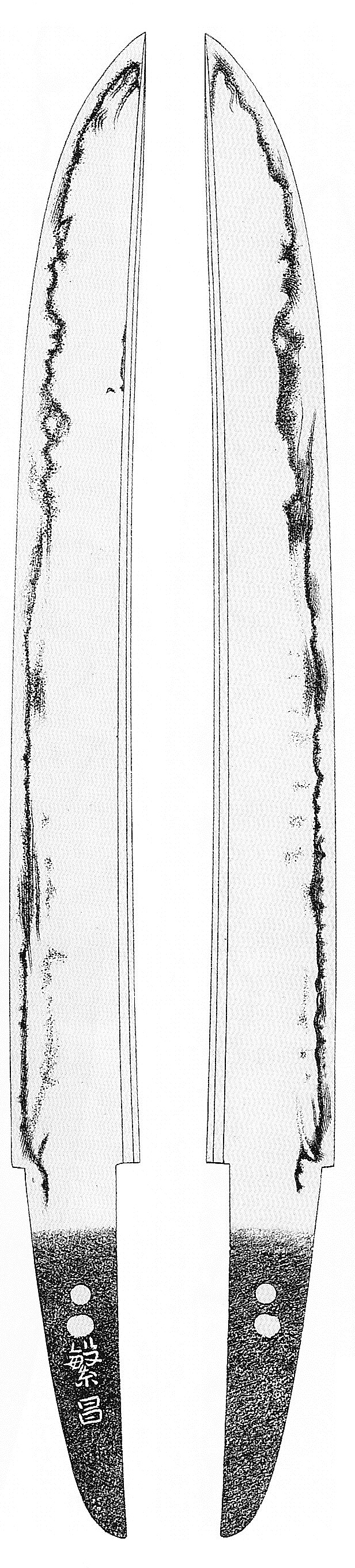
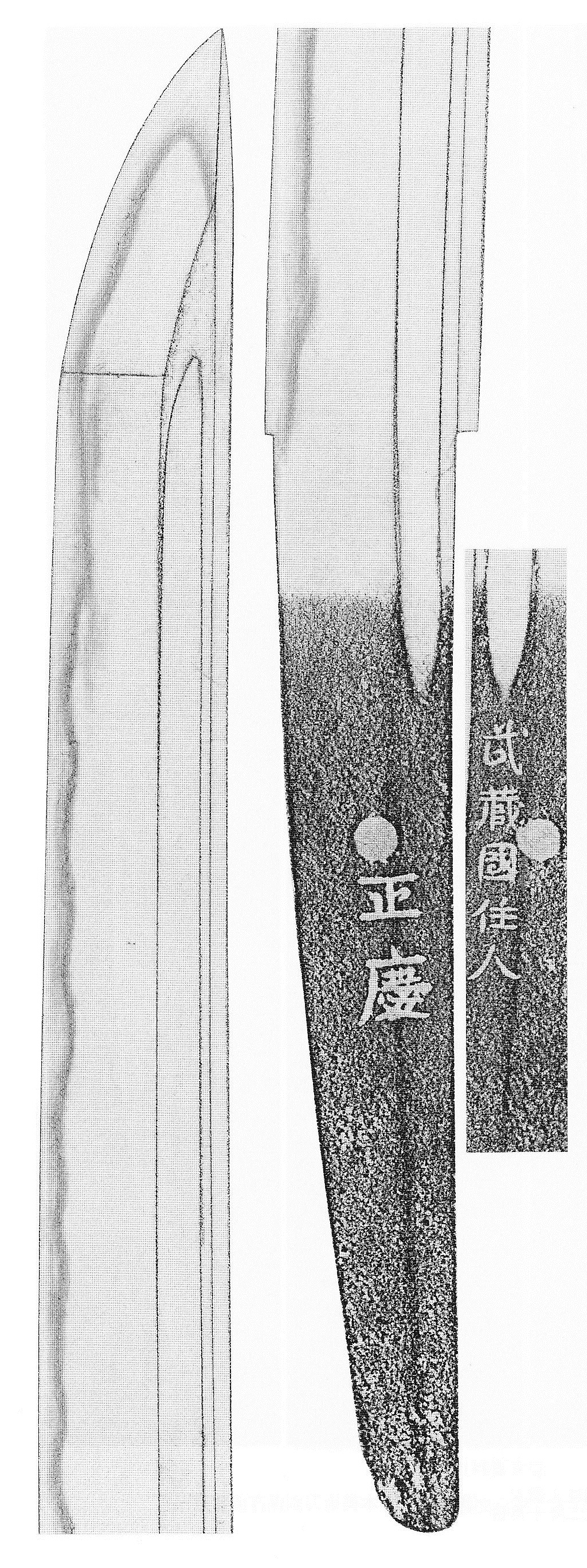
On a probably fake kinzôgan tameshi-mei

Whilst working on my next publication on tameshigiri, I stumbled over an interesting gold-inlayed test result of a cutting test which requires caution. After finishing the chapter on the famous Yamano family (山野) of sword testers whose succession was Ka´emon Nagahisa (加右衛門永久), Kanjûrô Hisahide (勘十郎久英), and Kichizaemon Hisatoyo (吉左衛門久豊), I also tried to find some more members of the Yamano family and found a certain Kantarô Nagatsugu (勘太郎永継) on a wakizashi of Kotetsu. This Nagatsugu does neither appear in any of the publications on tameshigiri nor have I found his name inlayed on any other sword tang so far but the blade got jûyô in 2004. And looking for Yamano Kantarô Nagatsugu, I learned that my blogger-colleague Itô Sanpei had addressed the very same wakizashi back in 2006. His article can be found here.

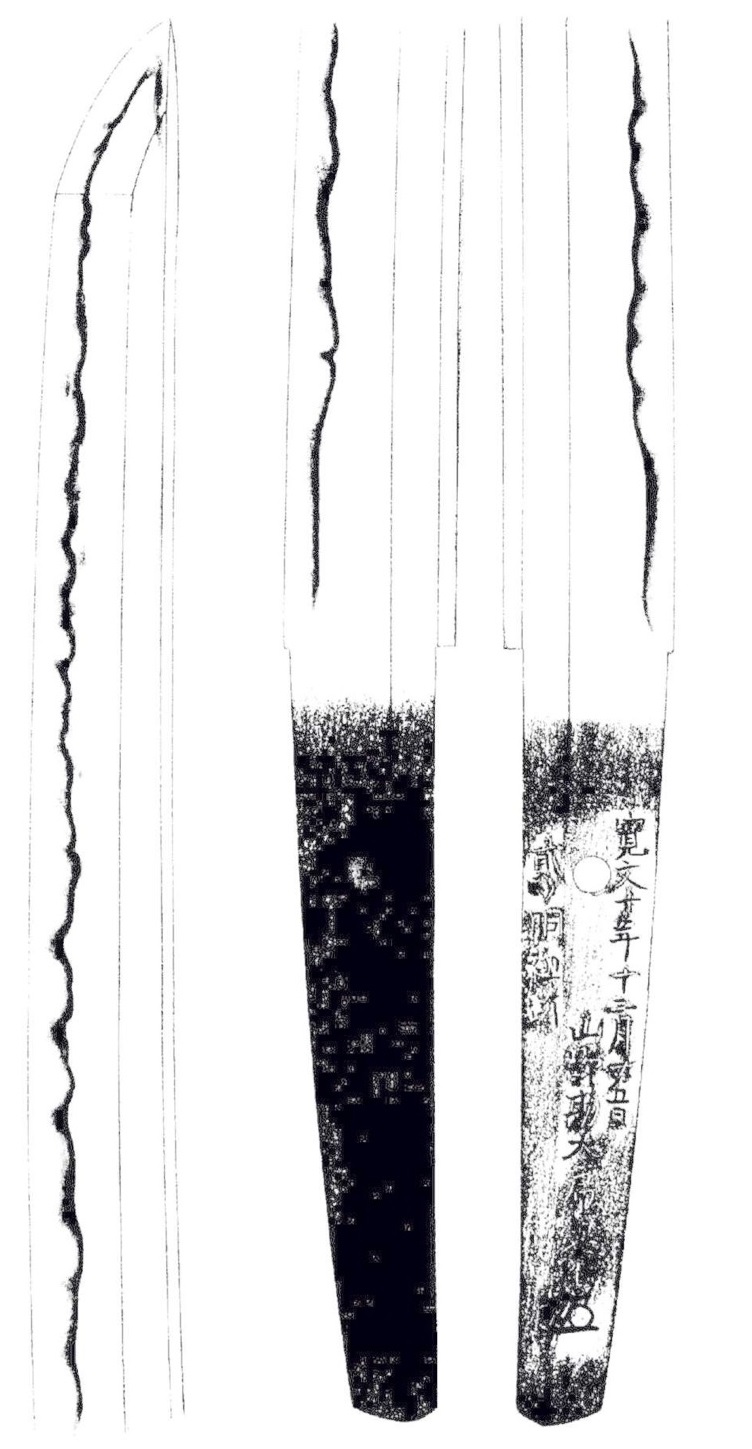
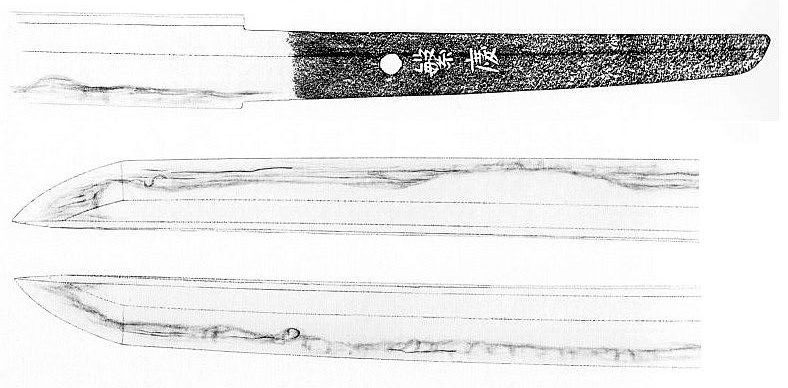
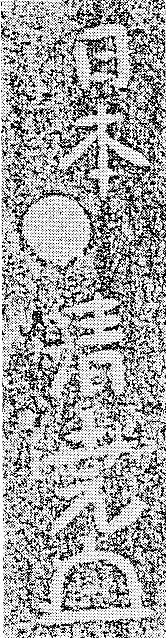
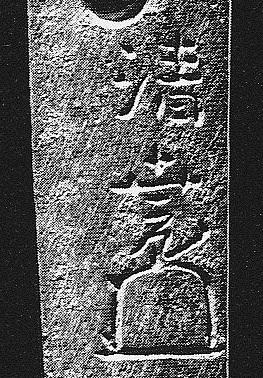
Itô found out that there is a wakizashi depicted in the Kotetsu-taikan (虎徹大鑑) whose tameshi-mei reads: “Kanbun gonen jûnigatsu nijûgonichi – futatsu-dô setsudan – Yamano Kantarô Nagatsugu + kaô” (寛文五年十二月二十五日・貳ツ胴截断・山野勘太郎永継, “Yamano Kantarô Nagatsugu cut through two bodies on the 25th day of the twelfth month Kanbun five [1665]”). In Itô´s blog, the picture on the far left is the one from the Kotetsu-taikan. Itô was now informed that the date of the tameshi-mei was later altered from Kanbun five to Kanbun ten (1670) and that we are facing the very same wakizashi. However, the jûyô paper does quote the mei as “Kanbun jûnen jûnigatsu nijûgonichi…” but does not mention any possibility of an alteration. Incidentally, the very same wakizashi was also introduced in Aitô magazine (愛刀) No. 355 (December 2005) and Itô presents the oshigata of the nakago on the far right on his blog. By the way, the picture in the middle is from the jûyô-zufu which I will show in addition below.

 Tameshimei1

The Kotetsu-taikan says that on the basis of the signature syntax and style, the wakizashi in question can be dated to Kanbun twelve (1672) and adds that according to the Kajihei-oshigata (鍛冶平押形), the kinzôgan-mei was added later by the famous forger Kajihei. Well, if the mei dates the blade to Kanbun twelve, why did Kajihei add a tameshi-mei from Kanbun five (1665)? I.e. a blade tested about seven years before it was even made?! This might be explained by that back in Kajihei´s times, studies on Kotetsu were still in their infancy. That means Kajihei just assumed that the blade was made around Kanbun five. The Kajihei-oshigata in turn does not depict an oshigata of the nakago but just a drawn copy with the mei written with the brush. This might explain the minor differences in the tameshi-mei and its kaô. Also the measurements of the Kotetsu-taikan entry and the jûyô-zufu differ a little but one does not have to worry about such small divergencies as they are quite common and go either back to imprecise measurings or to conversions from the Japanese shaku to the Western cm measurements. So these minor differences in measurements are no reason to say that these are not the same blades. Itô´s friend who pointed out to him the whole issue is convinced that it is the same wakizashi and Itô is of the same opinion although he remarks that he had never seen the blade in person. Reasons for him thinking that it is the same blade but with an altered tameshi-mei are on the one hand that the date matches entirely except for the year and that this is the one and only blade known bearing a tameshi-mei of Yamano Kantarô Nagatsugu who does not appear in any records as mentioned and who might therefore be a creation of Kajihei. Incidentally, for the approach that Nagatsugu was a creation of Kajihei speaks also the fact that the Yamano family inherited the character for “hisa”.

But against the view that we are facing the same wakizashi speaks the different year of the tameshi-mei. So even if Kajihei added later a supposed cutting test by Yamano Nagatsugu, why should he alter the date from Kanbun five to Kanbun ten later? Also possible is that another person altered the year when the improving studies on Kotetsu revealed that the mei of the smith can not match the date of the cutting test. Well, the Kotetsu-taikan was published for the first time in 1955 and a revised version was published in 1974. So maybe by the time shortly before the Kotetsu-taikan was published, new studies on Kotetsu made it possible to narrow down the mei of the smith to at least around Kanbun twn plus minus two years. In other words, it is also possible that Kajihei´s tameshi-mei was altered in the early fifties of last century. But why, and this question is also asked by Itô, the shinsa team did not check the Kotetsu-taikan in 2004? Everybody knows that the name Kotetsu causes the alarm bells to ring. And by checking the Kotetsu-taikan, the tameshi-mei in question would have given rise to suspicion (i.e. almost identical date and very rare name of cutting tester). So maybe the Kotetsu-taikan was just not consulted, maybe because the shinsa teams has other references or worksheets. Also possible is that the shinsa team found out all that and just did not mention it explicitly in the jûyô paper as the mei of the smith is authentic anyway. From my experience in translating numerous jûyô papers over the last years I know that it is rather the rule than the exception that a cutting test or the name of a former owner of the blade (added via kiritsuke-mei) is not addressed in the jûyô paper at all. But this is no wonder because the shinsa standards of the NBTHK do not address tameshi-mei or kiritsuke-mei at all. But I don´t know if the knowledge that the tameshi-mei was altered in the last century would have changed the outcome of the jûyô-shinsa. Of course the tameshi-mei does not change anything for the blade or the authenticity of the mei of the smith and maybe this was the approach of the shinsa team. But maybe it was anyway thought that the alteration of the year goes back to Meiji times and is so quasi a “historic forgery” which can be negleted in the same way the tameshi-mei itself is neglected (for jûyô considerations concerning the authenticity of the blade and mei of the smith). Itô suggests the NBTHK should withdraw the jûyô paper and change the description accordingly as this would contribute much to the credibility of the organization. I know that such sophisticated considerations can not be applied at hozon or tokubetsu-hozon level and that the shinsa standards in neglecting tameshi-mei or kiritsuke-mei work very well for papers of this category. But jûyô is in my opinion a different story and adding some additional information, or at least adding everything that was found out during the shinsa, would be a great thing.

Support for next project

Now it´s official, I started to write my next publication, working title Tameshigiri – The History of Japanese Sword Testing. This is going to be an extensive source of information on everything historic tameshigiri related, i.e. from the history of sword testing in general, on the sword testers, the criminal punishment during the Edo period, the use of executed felons as medium for sword tests, over the actual cutting tests themselves to the inlay of test results on sword tangs via a setsudan/saidan-mei. But the publication will be in size and price somewhere between my Legends and Stories around the Japanese Sword and the Nihon-shinto or Nihon-shinshinto-shi, so not as expensive as for example the recently published Natsuo and Kantei-zenshu volumes or the Signatures of Japanese Sword Fittings Artist. But as I have two other projects running at the moment (one of them private), I would be very grateful for a little support to finish the Tameshigiri project smoothly (please see donate link at the bottom of this blog). Well, I am not going to start any crowdfunding as there are other very worthy projects out there to support, see here for example, and as mine is IMHO to small for that anyway but as mentioned, any support will be received with sincere gratitude. Thanks a lot for your attention!


A rare motif on a rare work

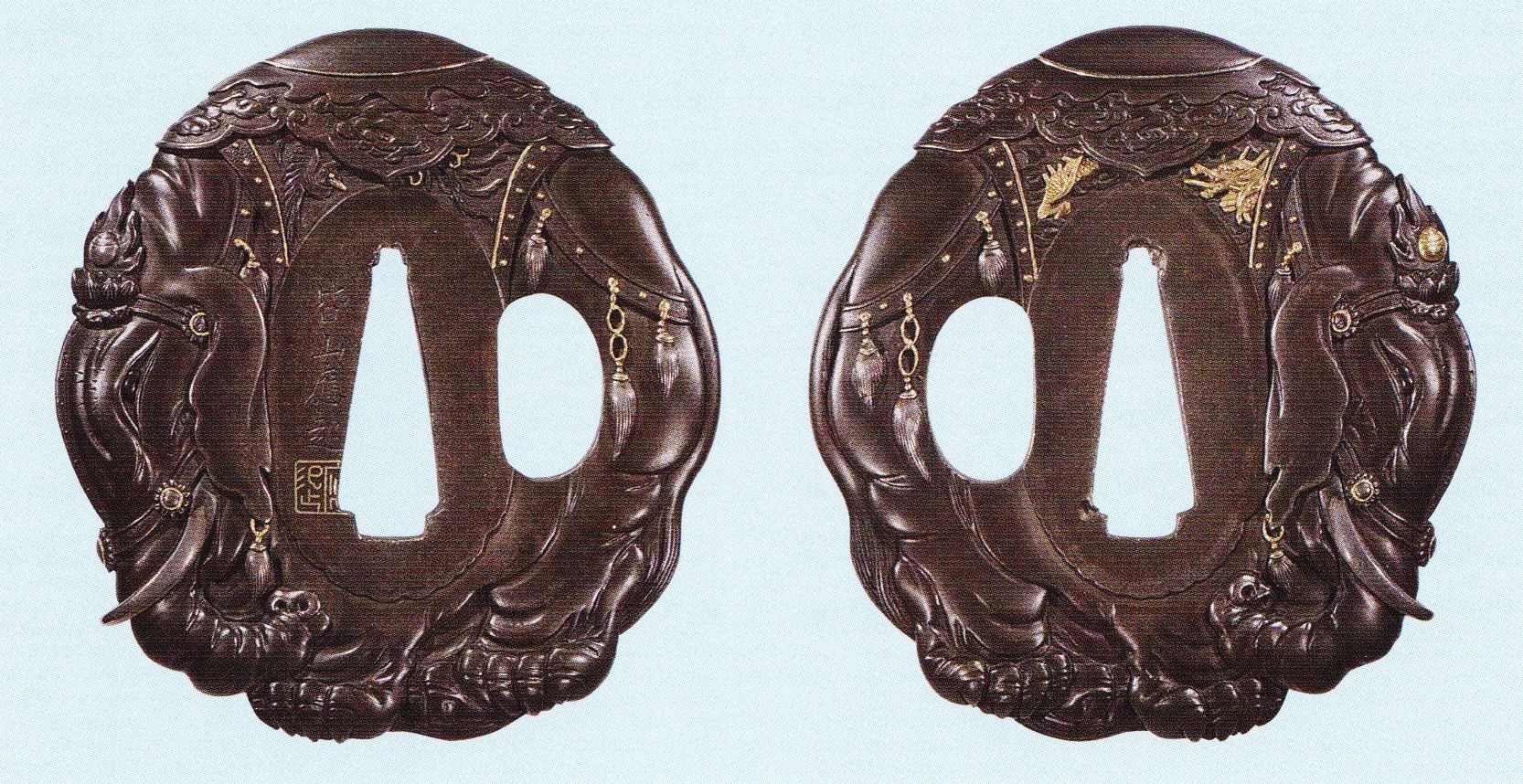
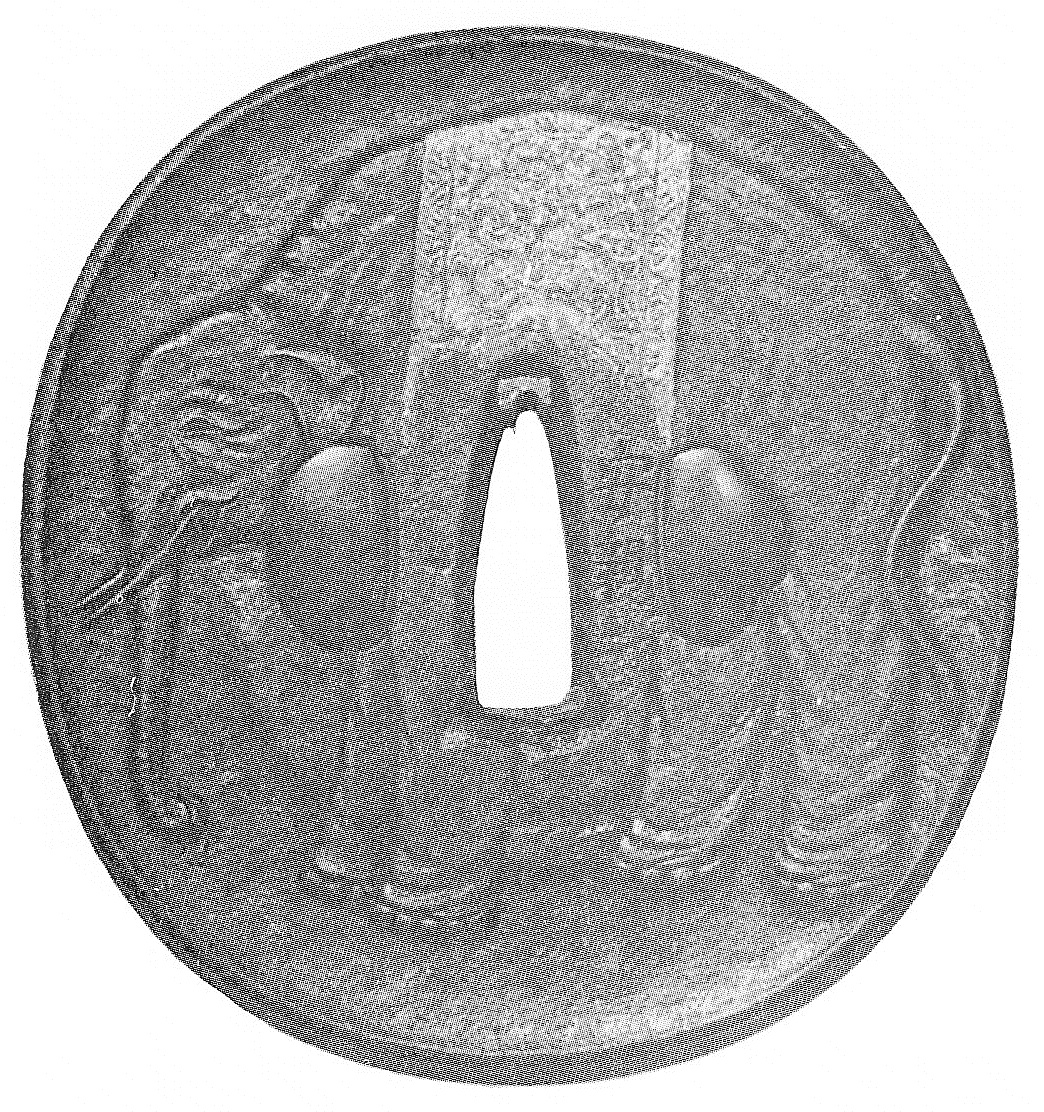
Back from my short Easter break, I want to start with the description of a fine tsuba which was on display at the this years January NBTHK-EB meeting in Bonn, Germany. The special aspect of this tsuba is on the one hand and apart from the excellent workmanship, that it shows a very rare motif for sword fittings, namely an elephant, and on the other hand that works of this artist are in general very rare. Thus, and although I repeat myself, this tsuba might best be described as true rarity. Before I go into detail on the motif, I want to introduce the artist, Minayama Ôki (皆山応起). His civilian name was Minayama Naoichi (皆山直市) and he was an outstanding student of Ôtsuki Mitsuoki (大月光興, 1766-1834). He runned a shop or studio called Hishi´ya (菱屋) which was located at the intersection Nijô (二条) and Ogawa (小川) (present-day Nishidaikoku-chô, 西大黒町). During his studies with Mitsuoki, to whom he was also a preparer, he used the characters (応興) for Ôki and it has to be mentioned that he signed the first character (応) in the old and unsimplified variant (應). And his kaô seems to be composed of a simplified variant of this character for “Ô”. Another thing to mention is that he used not only the common radical (比) for the top part of the character “Mina” (皆) but sometimes also the, for that caracter otherwise unused, radical (此). Unfortunately, his date of birth and death are unknown but we know that he also used the pseudonyms Chikuhô (竹鳳) and Reibokudô (麗墨堂) and the name Mitsuhisa (光久). Anyway, taking into consideration his master´s active period, we can assume that Ôki was basically active from around Bunsei (文政, 1818-1830) into bakumatsu times.

 Oki1

Picture 1: tsuba signed “Minayama Ôki” + seal “Ôki”.

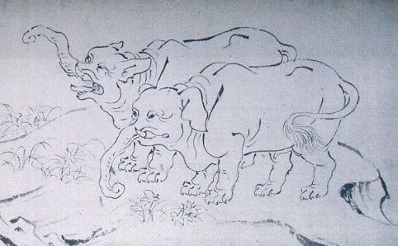
And now we come to the motif. The elephant was rather early known in Japan although not as living animal but in the context of Buddhism. In Buddhism, Maya (摩耶), the mother of Siddharta Gautama and the later Buddha, dreamed of a white elephant holding a white lotus flower in its trunk, appeared and went round her three times, entering her womb through her right side. Finally the elephant disappeared and Maya awoke, knowing she had been delivered an important message, as the elephant is a symbol of greatness in India. According to Buddhist tradition, the Buddha-to-be was residing as a Bodhisattva in the so-called Tuṣita heaven, and decided to take the shape of a white elephant to be reborn on Earth for the last time. Apart from that, the Bodhisattva Fugen (普賢菩薩, Sanskrit Samantabhadra) is usually depicted riding on an elephant of which some believe it refers to the same elephant Maya that appeared in Maya´s dream. One of the first written mentions of an elephant in Japanese texts dates back to the second year of Eikan (永観, 984) and is found in the Sanbô-ekotoba (三宝絵詞), a collection of Buddhist tales compiled by Minamoto no Tamenori (源為憲, ?-1011). So here again we have a Buddhist context in which the elephant appears. But at the latest by the 12th century some Japanese must had known how an elephant looks like because we can find a pretty realistic depiction in the famous Chôjû-jinbutsu-giga (鳥獣人物戯画) scroll (see picture 2).

 Oki2

Picture 2: Two elephants as seen in the Chôjû-jinbutsu-giga.

Incidentally, the elephant, (象), was also called kisa (岐佐) in early times. The character in turn is said to be based on the actual appearance of an elephant and is known in hieroglyphic form from archaic characters of early China where the animal once existed. The first recorded appearance of a living elephant in Japan dates back to the 15th year of Ôei (応永, 1408). It arrived from Southeast Asia in Obama (小浜) in Wakasa province, namely on orders of a not specified Southeast Asian emperor via a ship that came from Arabia and meant as a gift to the then shôgun Ashikaga Yoshimochi (足利義持, 1386-1428). The animal is mentioned in the record of the presents as: “One Indian elephant, two pairs of peacocks, and two pairs of parrots.” The ship landed at Obama on the 22nd day of the sixth month and the elephant about a month later in Kyôto. Three years later, i.e. in Ôei 18 (1411), Yoshimochi decided to send the elephant as gift-in-return to King Taejong (太宗, 1367-1422) of the Joseon Dynasty of Korea from whom he had received before a complete Sutra collection. In chronicles on Taejon we read that this gift-in-return was also the first chance for Koreans to see a living elephant and that the king took good care of the animal. It got 4 to 5 to (72~90 l) of beans every day but when it trampled to death some people who came to see it, the elephant was isolated until its death.

The second arrival of a living elephant in Japan was in Tenshô three (天正, 1575), namely at Usuki (臼杵) in Bugo province via a Ming ship and as present for Ôtomo Sôrin (大友宗麟, 1530-1587), the local daimyô. In Keichô two (慶長, 1597), the Spanish governor-general of Luzon of the Phillipines, Don Luis de Navarrete Fajardo, presented an elephant to Toyotomi Hideyoshi. This elephant had a name, Don Pedro, and was trained to trumpet on command. It is recorded that Hideyoshi had a great joy with the animal and fed it melons and peaches. And from the Cochinchina region of present-day Vietnam, an elephant was presented in Keichô 7 (1602) together with a tiger and a peacock to Tokugawa Ieyasu.

A famous arrival of two elephants, a male and a female one and the first time general public was able to see elephants, took place in the sixth month of Kyôhô 13 (享保, 1728), meant as present by Quang-nam (広南, present-day central Vietnam) to the then shôgun Tokugawa Yoshimune (徳川吉宗, 1684-1751). Well, the female elephant died only three months after their arrival in Nagasaki. The “Elephant Chronicle” (Zôshi, 象志) published for the first time in Kyôhô 14 (1729) says that they fed it too much pastries what caused a tumor on its tongue and that everything was done to cure it and present it to the shôgun. Anyway, the Japanese did not have strong enough ships back then to safely transport the male to Edo, or at least they did not dare to put it on one of the existing ships, so they decided to walk! with it overland to the capital making 16~20 km a day. The transport crew had a great responsibility to bring the surviving animal to the shôgun so even pointy stones and pebbles on the roads were removed and straw mats were laid, bridges were reinforced, it was ensured that no dogs and cats were around to scare the elephant, and buckets were prepared at certain distances to give it water. The Zôshi also says that large crowds were gathering along the road where the elephant was walking. On the way they stopped in Kyôto so that emperor Nakamikado (中御門天皇) can see the fascinating animal. A funny side note, it required a court rank to meet the emperor and so the male elephant was given the lower fourth court rank. After showing the elephant to Yoshimune in Edo Castle it was brought to the Hama-goten (浜御殿), the residence of the shôgun at the mouth of the Sumida River. But the feed and maintenance costs of the elephant were too high for the bakufu and so they sold it in the fourth month Kanpô one (寛保, 1741) to a farmer from the village of Nakano (中野村, present-day Nakano ward of Tôkyô) named Gensuke (源助). However, the animal died in the twelfth month of the following year of illness. Parts of the tusks of this elephant are still preserved in Nakano´s Hôsenji (宝仙寺). Well, the elephant was of course a big attraction for the Edo people at that time and it was described as “animal with a long nose, slow walk, and charming eyes.”

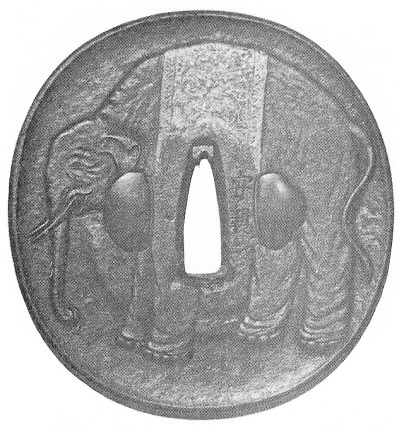
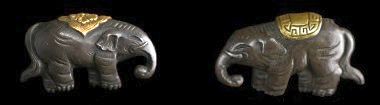
After the death of Yoshimune, no more large animal gifts were received in Japan but another male elephant arrived in Japan in Bunka ten (文化, 1813) in Nagasaki. When the British had occupied Dutch possessions in East Asia at that time and were now in the position to trade with Japan, they tried to impress the shôgn with this elephant but the present was declined. So three months after its arrival, the elephant was again put on a ship and left Japan. So the Kyôhô 13 (1728) elephant gift was as mentioned actually the one and only chance for the general Japanese public to see such an animal. The first to apply an elephant as motif on a sword fitting (see picture 3) was Yasuchika (安親, 1670-1744) who was in Edo at that time and so it is safe to assume that he had seen it with his own eyes. He must have been quite impressed as he also made a pair of elephant menuki (see picture 4).
 Oki3

Picture 3: Yasuchika´s iron elephant tsuba (jûyô-bunkazai).
 Oki4

Picture 4: Yasuchika´s elephant menuki.

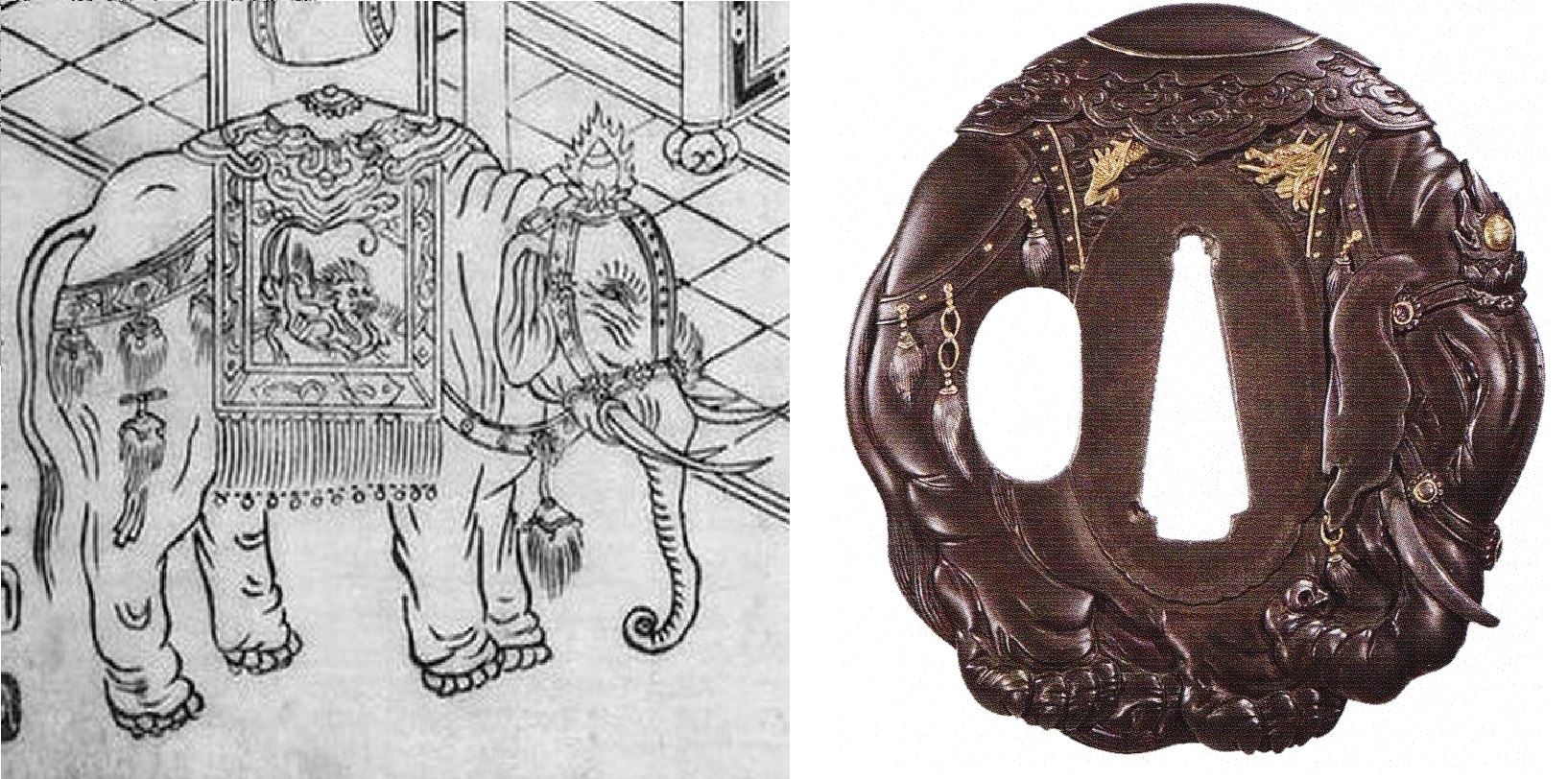
Our artist, Minayama Ôki, approached the elephant in a different way as Yasuchika. His interpretation pays attention to detail and shows all the gear with which the animal was equipped. Also the tsuba is done in katachibori-gata, i.e. the motif itself forms its outline what in turn is a measure to give a feeling of the large size and majestic appearance of the animal, although represented by such a rather small piece like a tsuba. Well, Ôki was of course not alive when the Kyôhô elephant walked through the streets of Edo so he had to rely on depictions. Looking for Edo-period elephant depictions I think I was able to find his inspiration. It is a depiction by Nakamura Heigo (中村平五, 1671-1741) presented in the Zô no mitsuki (象のみつき, “Elephants as Tributes”) published in Kyôhô 14 (1729) showing an elephant in front of the Gate of Supreme Harmony (太和門), back then called Fengtianmen (奉天門), the second major gate encountered when entering the Forbidden City from the south. It shows the very same gear and the same flaming gem as headgear. For example also the three brushtip-like ornaments dangling from the rear leather gear are identical. Ôki also copied the dragon, the symbol of the Chinese emperor, as seen on the cloth covering the back of the elephant.

Oki5

Picture 5: Elephant from the Zô no mitsuki.

 Oki6

Picture 6: Detail of the elephant as seen in the Zô no mitsuki and to the right Ôki´s interpretation.

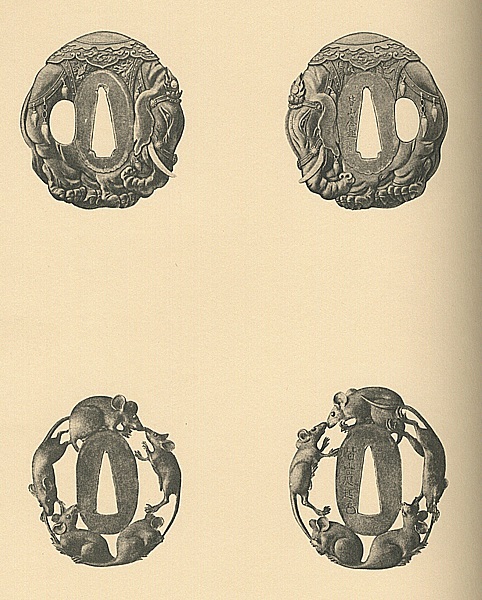
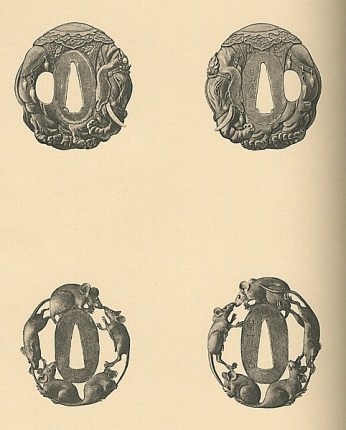
And last but not least I want to mention that this elephant tsuba by Minayama Ôki was considered worth by Mitsumura Toshimo to make it in his fancy tôsôgu two-volume set Tagane no hana (鏨廼花, lit. “Flowers of the Chisel”) published in 1904. Picture 7 shows the corresponding page of this book. More details on Mitsumura can be found here and here. At this point also a big thank you to the owner of the tsuba for giving us the opportunity to study the piece hands-on at our NBTHK-EB meeting!
 Oki7

Picture 7: The page in question of the Tagane no hana.
Signatures of Japanese Sword Fittings Artists

It turned out that the formatting did not take that much time and so I was able to finish my just previously announced latest publication Signatures of Japanese Sword Fittings Artists.

My motivation for compiling this work was purely a service-oriented one. Over the years I have constantly received inquiries for authenticating signatures on sword fittings, or for advice as to whether a work/signature looks promising enough to be submitted to shinsa, a procedure which we all know needs some background work and takes time and money. Dealing with such inquiries is quite a sensitive task. First of all, you don´t have the item in hand. That means you have to decide on the basis of pictures alone if a signature and quality of a work justifies further research, providing that the pictures you receive are of decent enough quality. If so, you have to compare the signature with your reference, and for this I have compiled over the years a humble database of roughly 5,000 pictures of mei. As this was for my use only, and as I am fortunately able to read Japanese, I just labelled the pictures accordingly, i.e. I did not make any list with the names of the artists or translations of the signatures and the like. With this database as a reference I have so far been able to offer some signature comparisons which have been of much help in making some basic judgements. So, if a signature matches in syntax and the characteristic style is very close to an authentic signature from my database, then sending the piece to Japan for shinsa becomes a possibility. Or, if the inquiry was not about obtaining papers, the inquirer can be reassured that chances are now higher that his item is authentic.

The greatest problem in compiling this publication was due to the quality of the pictures. Although over the years I have always scanned the pictures with the highest possible resolution and with a decent scanner, the main problem remaining was the often bad initial quality. In many cases signatures had been photographed and catalogued only once and then it was decades ago. After some test prints I had to immediately dismiss about a fifth of the pictures in my archive. Apart from that there are some pictures whose quality is really no better than those dismissed but for which I decided that they should remain in the publication. This concerns first and foremost signatures of artists of which hardly any signed works are known. On the other hand I also kept pictures where one is at least able to see the basic style, position, and arrangement; information which might also help sometimes in “judging” a signature.

As for the structure of the book, the information provided for each artist is kept as simple as possible. That means, for reasons of space, all the necessary data is given which allows one to recognize an artist on which detailed information can then be found elsewhere in a next step. I also attached importance to quoting the signature shown, as if I had simply illustrated the pictures this publication would have been a “half-hearted” approach and would not have been that useful in the end. However, and again for reasons of space, only the basic and essential information of lengthy signatures is quoted. Specifically this means that dated signatures are just quoted as “dated 1858” for example, and sometimes the names of places and the like are omitted. In addition, and for the sake of searchability and recognisability, I also attached importance in quoting each name and with both the simplified and the un-simplified characters. Apart from that this publication should be self-explanatory. A list of all the characters from the names used by the featured artists is provided at the end. In this sense I hope that this work will serve the collector, dealer, and sword fittings enthusiast as a source of reference.

The 680-pages hardcover book (format US Letter) is available here:

http://www.lulu.com/shop/markus-sesko/signatures-of-japanese-sword-fittings-artists/hardcover/product-21586801.html

And the eBook version, ideal for an on-site signature comparison when purchasing signed sword fittings when having it on the tablet, is available here:

http://www.lulu.com/shop/markus-sesko/e-signatures-of-japanese-sword-fittings-artists/ebook/product-21586815.html

Thank you for your attention and once again Happy Easter to everyone!

SignaturesCoverSmall

On vacation

Dear readers,

I am leaving for an Easter vacation on Sunday and will be back on Tuesday, April 29th. Until then, this blog will rest but I will be back after the holiday with renewed vigor. Also the previously announced project, the publication of mei tôsôgu signature archive under the title Signatures of Japanese Sword Fittings Artists, should be finished soon. I can already see the light at the end of the tunnel what means in concrete terms about 600 pages and 4,200 signature pictures. In this sense I wish you all Happy Easter and as a little Easter present, I have discounted the two hardcover Zenshu volumes of my Kantei books reduced by 50 %, and the two Kano Natsuo books by 20 %! So please take a look at the link below:

http://www.lulu.com/spotlight/nihontobooks

Hankei and his school

At our last NBTHK-EB meeting in Nuremberg in March, our topic was utsushi in the widest sense. One of the blade presented was a jûyô-katana by Hankei (繁慶) (picture 1) and in our discussion on how the term “utsushi” can be defined, it was addressed that Hankei had his very own approach to the Sôshû tradition. At his time, we are talking about the Keichô-shintô era, a focus was again on the great Sôshû masters and katana-size Nanbokuchô-style blades was quasi the ultimate goal, i.e. a wide blade with an elongated kissaki and a shallow sori which emulates an ô-suriage tachi of the heyday of the Nanbokuchô era. Hankei, his civilian name was Noda Zenshirô (野田善四郎), originally came from Mikawa province which was also the home province of Tokugawa Ieyasu. It is assumed that he first moved to Sunpu (駿府) to work there as a gunsmith, the profession he had inherited from his father. Ieyasu had established a gunsmith center in Hachiôji (八王子) in Tenshô 18 (天正, 1590) what was Hankei´s second station. There he learned from the gunsmith Agari Sôhachirô (胝惣八郎) who also came from Mikawa and who already worked for Ieyasu at that time. With his studies under Agari, Hankei signed with the name Kiyotaka (清堯). By the way, there are teppô with the mei Kiyotaka extant which bear date signatures from Keichô 15 to 20 (慶長, 1610-1615). Those made exclusively for the Tokugawa family are signed “Nihon Kiyotaka + kaô” (日本清堯) (picture 2) and it is very interesting that there are even swords extant with the very same signature and kaô (although extremely rare) (picture 3).

 Hankei1

Picture 1: katana, mei “Hankei”, nagasa 69.6 cm, sori 1.35 cm

Hankei2

Picture 2: jûyô-bunkazai hinawajû, mei “Nihon Kiyotaka + kaô”, overall length 148.5 cm, dated eleventh month Keichô 16 (1611)

 Hankei3

Picture 3: “Nihon Kiyotaka” mei on a sword blade

 Hankei4

Hankei4a

Picture 4: katana signed “Kiyotaka + kaô” and detail of the mei

So Ieyasu eventually retired to Sunpu in Suruga province in the seventh month Keichô twelve (1607) and as we know, he invited his most trusted swordsmith to accompany him, the 1st generation Yasutsugu (康継) and Nanki Shigekuni (南紀重国). But also Kiyotaka/Hankei accompanied Ieyasu to Sunpu and most experts agree that it was this meeting of his great talent with the specially invided bakufu-employed swordsmiths that brought the decision that he should better switch from gunsmith to swordsmith. Also it is safe to assume that Kiyotaka/Hankei learned the necessary techniques on the spot from the two aforementioned smiths and as he was already a renowned gunsmith and used to work with steel, changing jobs did not take him that long. When we namely assume that he went to Hachiôji at the age of 25, he was around 50 at the time in Sunpu. Well, Ieyasu died shortly later in Genna two (元和, 1616) and Kiyotaka/Hankei returned again to Hachiôji, i.e. to Edo. The name change to “Hankei” took place after his moving to Edo and it is generally assumed that this happened between the fifth year of Genna (1620) and the first year of Kan´ei (寛永, 1624). So when we again take our assumption that he arrived at Hachiôji about the age of 25 as a basis, he was in his late fifties or about to turn sixty at the time he changed his name. “Hankei” by the way is a very auspicious name and means literally about “prospering/flourishing joy.”

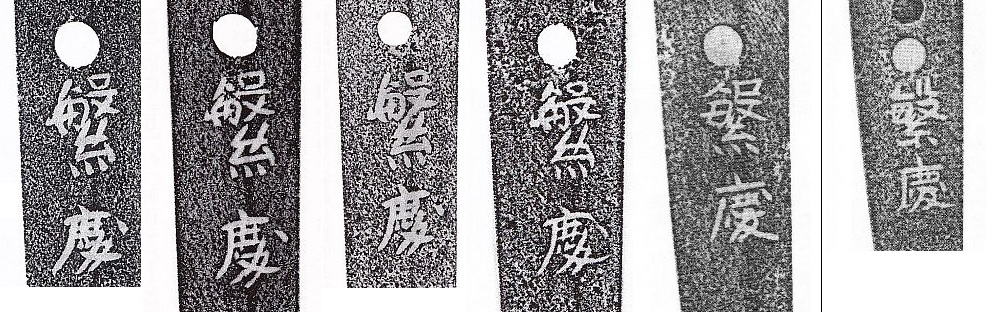
So Hankei shared about the same fate as Kotetsu although forty or so years earlier. Also Kotetsu had his origins in a different but kind of related craft, namely the craft of armor making, and he took changed his profession around the age of 50. However, I assume that Kotetsu had slightly different reasons for becoming a swordsmith. At his time, the demand for newly made armour had drastically dropped. As mentioned in an earlier article, Sekigahara happened 40 years earlier, Ôsaka had fallen more than 30 years ago, and the last great armed conflict – the Shimabara Rebellion from 1637 to 1638 – was at its tenth anniversary. Hankei in turn worked still in a sphere that we define today as Momoyama Culture. In other words, ten or fifteen years after Sekigahara nobody knew that the new bakufu would bring a longstanding peace. And with all the relocations of daimyô and the reorganization of the hierarchic feudal structure, wait and see was the order of the day. That means there was no drastic drop in the demand for firearms that would have forced Kiyotaka/Hankei to look for a new job. But we can agree that both smiths, Kotetsu and Hankei, were highly talented and great personalities as otherwise they would have disappeared from the scene and/or their swords would have been classed into the “also ran” category, i.e. as well-eant swords made by a former armorer or gunsmith respectively. But back to the Momoyama Culture. I have already mentioned that the then fashion in swords inspired Hankei to his style. It is namely very interesting to see that Hankei did not just copy the great Sôshû masters as faithful as possible (of course there are als such works) but took what he understood as Norishige style, who is assumed as being his greatest inspiration, and interpreted this style in a way which can only be described as very strong in character. He made blades with an acute mitsu-mune and a rough itame mixed with masame and hada-ware which appears with plenty of ji-nie and thick chikei as so-called hijiki-hada (鹿尾菜肌・羊栖菜肌・ひじき肌) what has to be undertood as reminiscence of Norishige´s also very peculiar matsukawa-hada. His hamon is usually based on a hiro-suguha or notare, is hardened in nie-deki, and is mixed with gunome-ashi. The nie are thick but not that sparkling. Many sunagashi occur which makes the hamon look partially like as if it is entirely composed of sunagashi. The habuchi is unclear, that means it is often hard on Hankei blades to define an exact line between the ha and the ji. This is for example the case at the ura side´s monouchi of the blade shown in picture 1, and at the kantei at Nuremberg, this area reminded me kind of a sudareba at a glance. Also very typical for Hankei are his characteristic tang with the deeply notched machi and the so-called yagen-jiri, and the thickly chiselled signature. We don´t know when Hankei died but it is assumed that he lived at least to about mid Kan´ei (1635~40). As for his signature, we distinguish roughly between two categories, namely the so-called ro-mata (ロ又) from the height of his career, the the so-called ru-mata (ル又) signatures from his later years. The names refer to the interpretation of the right part (攵) of the upper radical (敏) which can be chiselled like the katakana syllable ro (ロ) plus the character mata (又) below, or like the katakana syllable ru (ル) plus the character mata below (see picture 5).

 Hankei5

Picture 5, signature comparison: ro-mata left, ru-mata right

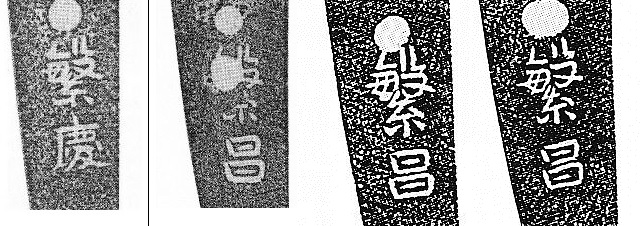
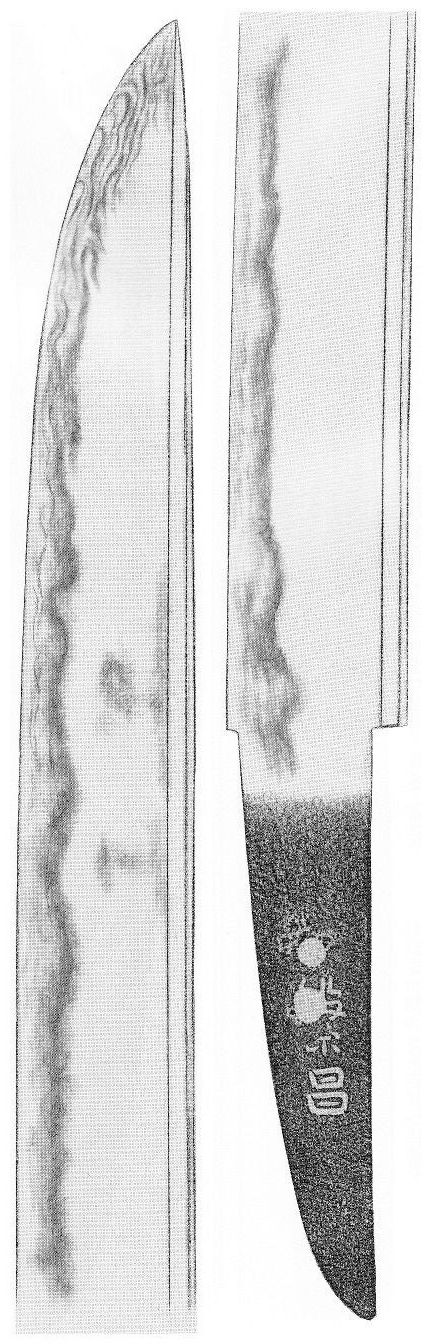
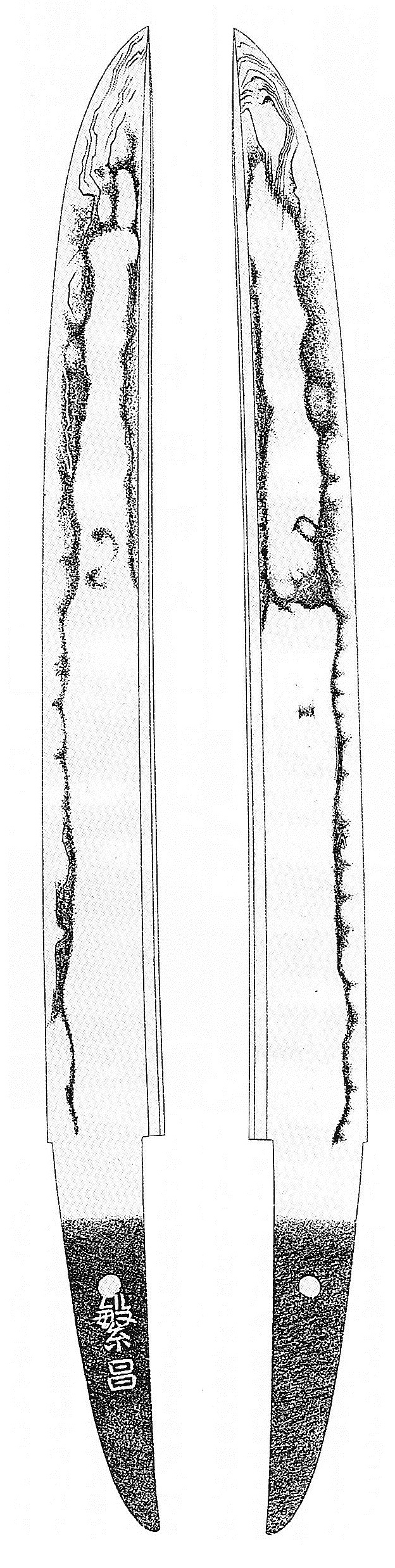
Now to Hankei´s students and here too, we have some similarities to Kotetsu. Apart from Kotetsu´s adopted son Okimasa (興正) namely, there are only very few works from both schools extant, what concerns for example Kotetsu´s direct students Okihisa (興久) and Okinao (興直), and Hankei´s direct students Hanjô (繁昌) and Masayoshi (正慶). Thus it is assumed that the personality of the great master was so overwhelming that none of the students had the time and chance or was “brave enough” to work on his own and produce fine blades in larger numbers. But also other factors play a role here. As for Hankei, he was a bakufu-employed swordsmith so after his death, there were maybe some reasons for the Tokugawa to not continue the employment with any of the students what meant practically the end for the school. As for Kotetsu, his students were facing different times and so maybe the decreasing demand for swords did not allow them to continue their school into post Jôkyô and Genroku times who knows. In this sense I would like to use the opportunity to introduce some of the rare Hankei-student works and thus the article´s title “Hankei and his school.” First Hanjô (繁昌) as his blades are closest to Hankei. We know that he came originally fromAnzai (安西) in Suruga province and went to Edo where he entered an apprenticeship with Hankei. As I have pointed out that Hankei had returned to Edo after Ieyasu´s death, it is safe to assume that also Hanjô arrived at Edo after the second year of Genna (1616). Interesting is that Hanjô signed his character for “Han” in the ru-mata manner, that means he continued the signature style of the late Hankei and so the theory was forwarded that Hanjô was actually a late signature of Hankei. But this approach is no longer followed as we can see some slight differences in workmanship, for example that Hanjô did not stick so much to Norishige but more on the great early Sôshû masters in general. However, followers of the one person-theory explain this by stating that Hankei maybe moved away from Norishige again towards the end of his career. Also we must bear in mind that in some sources (Tôkô-taikan, p. 512) we read that some of Hanjô´s works are superior to Hankei and that his interpretations are a bit more calm with lesser hada-ware and hijiki-hada, all indicators for the more mature workmanship of an artist. Anyway, the workmanship of Hankei and Hanjô is as mentioned pretty close and I haven´t handled any Hanjô work yet. But what you can learn from oshigata and descriptions is that Hanjô added a pronounced yakikomi at the hamachi.

Hankei6

Picture 6, signature comparison: ru-mata Hankei left, Hanjô right

Hankei7

Picture 7: tantô, mei “Hanjô”, nagasa 28.2 cm, only very little sori, hira-zukuri, mitsu-mune

Hankei8 

Picture 8: tantô, mei “Hanjô”, nagasa 29.7 cm, sori 0.1 cm, motohaba 2.86 cm (measured with the mune), hira-zukuri, mitsu-mune

 Hankei9

Picture 9: sunnobi-tantô, mei “Hanjô”, nagasa 33.1 cm, sori 0.4 cm, motohaba 3.42 cm, hira-zukuri, mitsu-mune

Another Hankei-student we know is Masayoshi (正慶). He is listed as “Masayoshi” but with the Sino-Japanese reading of Hankei´s and Hanjô´s names in mind, his characters might read as “Shôkei.” It is said that Masayoshi came like Hanjô from Anzai in Suruga province. The blade introduced in picture 9 does have plentiful of ji-nie and many thick chikei but the hijiki-hada is not that prominent as at Hankei. The hamon bases on a shallow and early Sôshû-inspired notare and with the sugata and the elongated kissaki, we see again the typical Nanbokuchô or rather Keichô-shintô style. But please note that Masayoshi´s wakizashi comes with an iori-mune instead of a mitsu-mitsu.

Hankei10

Picture 10: wakizashi, mei “Musashi no Kuni-jûnin – Masayoshi”, nagasa 48.2 cm, sori 0.9 cm, shinogi-zukuri, iori-mune

The horimono-shi Nagasaka Yûhôken

Whilst working Shintô & shinshintô-kantei volume, I came across a wakizashi by Tsuda Echizen no Kami Sukehiro (津田越前守助広) (No. 254.641, detail of the horimono shown in picture 1) with a kurikara horimono on the omote side of which is assumed that it was not cut by Sukehiro himself but by the horimono-shi Nagasaka Yûhôken (長坂遊鵬軒). This assumption inspired me to do some research on Yûhôken as the reasons for this assumption were not explained any further. Soon in turned out that this was one of the cases where not much info is available. As stated in Haynes (H 12357), I was at least able to find out that Yûhôken carved horimono on Ôsaka-shintô blades.

 Nagasaka

Picture 1: kurukara detail from the blade of Tsuda Echizen no Kami Sukehiro

Nagasaka5

Picture 2: mei “Awataguchi Ikkanshi Tadatsuna Nyûdô – Shôtoku gonen nigatsu kichijitsu – horimono Ikkanshi nanajûyon-sai kore o horu – Yûhôken nanajûsan-sai kore o horu” (粟田口一竿子忠綱入道・正徳五年二月吉日・彫物一竿子七十四歳彫之・遊鵬軒七十三歳彫之).

The major reference for Yûhôken´s active period is a blade by Awataguchi Ikkanshi Tadatsuna (粟田口一竿子忠綱) dated Shôtoku five (正徳, 1715) which states in its mei that Tadatsuna was 74 years old at that time and Yûhôken who engraved the horimono 73 (picture 2). From the differences in signature style and from the syntax it seems that both Ikkanshi Tadatsuna and Yûhôken engraved the horimono at a later point in time to the blade, otherwise Tadatsuna would have recorded his engraving as hori-dôsaku in my opinion. Maybe the owner of the blade or maybe his son or grandson approached Tadatsuna and Yûhôken again years later to add fine horimono to the family heirloom. My theory on the later horimono is based on the fact that we know dated blades from Ikkanshi Tadatsuna to Kyôhô twelve (1727). So if he was already 74 in Shôtoku five (1715), he must had been 86 in Kyôhô twelve. Well, possible but rather unlikely, unless the last known dated blade is a daisaku. However, the blade in question tells us that Ikkanshi Tadatsuna and Nagasaka Yûhôken were of the same age.

Nagasaka1

Picture 3: wakizashi by Tsuda Sukenao

Now to another blade of an Ôsaka-shintô master with a horimono of Yûhôken. It is a wakizashi from Tsuda Sukenao which is shown in picture 3 and which is signed the following way: “Tsuda Ômi no Kami Sukenao – Jôkyô yonnen hachigatsu – horimono Nagasaka Yûhôken saku – Genroku rokunen yongatsu jûsannichi hitotsu-dô Nagasaka Bunzô setsudan” (津田近江守助直・貞享二二年八月・彫物長坂遊鵬軒作・元禄六年四月十三日一胴長坂分蔵切落), “Tsuda Ômi no Kami Sukenao in the eighth month of the fourth month of Jôkyô (1687), horimono by Nagasaka Yûhôken – Nagasaka Bunzô cut with the blade through one body on the 13th day of the fourth month Genroku six (1693)”. Details of the horimono can be seen in picture 4. The interpretation of the kurikara is pretty detailed and unique. Take a look for example at the roundish, wide open eyes, the thickish toes which remind more of paws than claws, and the way the body of the dragon winds in a very vivid way around the sword. Usually the windings of the dragon go in a more uniform way around the ken. Also the lines of the hatahoko are very fluid and represent the fluttering of the standard in the wind pretty good.

Nagasaka2

Picture 4: horimono detail from the blade of Sukenao

Another very rare horimono interpretation of Nagasaka Yûhôken can be found in a blade of the Ôsaka-shintô smith Ise no Kami Kuniteru (伊勢守国輝) (picture 5), very rare because it shows a dragon winding around a bamboo and not around a sword! I haven´t seen any other blade with such a horimono yet. Yûhôken states in his signature that he engraved the horimono when he was 70 years old. So we learn that he was well booked in his late years and surely highly respected as great horimono master amongst the local clientel. Speaking of local clientel, we have to become aware of the then differences in Japan´s “metropolises.” I have already mentioned several times that it took some decades after Sekigahara until Edo got off the ground, at least in terms of art and craftsmanship. As we know, the New Sword, the shintô, was born in Kyôto, but rather soon some of the great early shintô masters felt drawn to Ôsaka.Back then, Edo´s produced very little everyday goods so Ôsakaserved first and foremost as a trans-shipment centre for goods collected and produced in Kyôto and shipped to the new capital. With the introduced sankin-kôtai system, soon a constant stream of goods was necessary to entertain the individual fief residences and this forced the establishment of ware and treasure houses. Quite quickly Ôsakabecame the new trade, economy and banking centre of the country. The first highlight of this new style of the Ôsaka-shintô was achieved around Kanbun (寛文, 1661-1673) whereas we can see a noticeable difference in fashion trends. On the one side Edo with the simple and reserved, practically-oriented workmanship, and on the other side the nouveau rich clientele of Ôsaka with their weakness for luxury and ostentation. And this difference in trends is not only reflected in the workmanship but also in the supplements to blades. The Ôsaka merchant-based clientele was tending towards a fine finish with elaborate horimono whereat the mostly warrior-based Edo clientele was much after the results of cuttings tests as we know them in large numbers on blades of Yamato no Kami Yasusada (大和守安定), Izumi no Kami Kaneshige (和泉守兼重), Kazusa no Suke Kaneshige (上総介兼重), or Kotetsu (虎徹). Of course there were also horimono engraved on Edo-shintô blades like by the Shitahara school or cutting tests performed with Ôsaka-shintô blades but the basic trend is obvious.

Kuniteru

Picture 5: katana by Ise no Kami Kuniteru

Nagasaka4

Picture 6: imono detail from the blade of Kuniteru

Nagasaka9

Picture 5: signature comparison of Nagasaka Yûhôken

All in all I think the luxury of Ôsaka during the Genroku years is best seen in the blades of Ikkanshi Tadatsuna. His predecessor, the 1st generation Tadatsuna, had died in Enpô four (延宝, 1676) and was thus not prone to engraving horimono but Ikkanshi reacted to the demand of his days and proudly mentioned on the tang of his swords via hori-dôsaku (彫同作) and horimono-dôsaku (彫物同作) that he did the horimono himself. And it is this emphasis on horimono what I mean with “luxury of Ôsaka during the Genroku years.” The somewhat earlier Ôsaka-shintô smiths like Kunisada (国貞), his son Inoue Shinkai (井上真改), father and son Kunisuke (国助), and the two generations Sukehiro (助広) placed namely more emphasis on the fineness of the steel and the interplay of nie and nioi rather than on engravings and other “knicknacks.” They all were active when the Ôsaka nouveau rich was still on the rise. But at the time of Ikkanshi Tadatsuna, this top class was already established and thus there was probably a striving for more to express their wealth. I.e. a fine jigane and a perfectly tempered hamon was no longer enough. Elaborate horimono and fancy koshirae were now sought after. But it has always been that way: Sometimes a super sports car is not enough, it needs a super sports car with diamonds all over…

Announcement

Tired of working with loose indexes and/or translations to meikan when checking a signature on a sword fitting? Tired of troublesome looking for signature examples in more or less limited references to compare them with a signature you have? You want to get a feel for a signature when thinking of submitting a kodôgu to shinsa? That means does the mei in question look promising at all? Found a signature but not sure who´s the guy? If you answered “yes” to any of those questions, then my next publication might be right for you. After consultation with several collectors for whom I was comparing signatures to sort out items for shinsa, I decided to publish my own humble kodôgu signature archive gathered over the years. It consists of about 5,000 pictures of signatures from about 3,000 artists. I am now in the process of bringing all the data to a proper format. There will also be an eBook version of course, so you can bring the archive on your tablet to sword shows and dealers and compare signatures on the spot. I will keep you informed on the progress of the project.  Thanks for your attention.


The whale as motif on sword fittings

The earliest records of whaling, i.e. active whaling and not the consumption of stranded whales, go back to the Nara-period Man´yôshû (万葉集) which refers to it as isana-tori (いさなとり). Tori comes from toru (取る・捕る) and means “to catch” and isana (いさな・勇魚) is an old word for whale which means literally “brave fish.” But today it is thought that large-scale whaling was not carried out before the 12th century. At that time, whales were mostly caught by driving them into smaller bays which were closed with nets and killing them with hand thrown harpoons or longer lances. The Kujira-ki (鯨記), a work on whaling written in the first year of Meiwa (明和, 1764), says that greater whales were caught by harpooning for the first time in the last decades of the 16th century in Mikawa province by groups of 6 to 8 boats. Apart from that there are records extant that Miyoshi Yoshioki (三好義興, 1542-1563) fixed shôgun Ashikaga Yoshiteru (足利義輝, 1536-1565) a whale dish in his residence in Eiroku four (永禄, 1561). And it is said that the Tosa sengoku-daimyô Chôsokabe Motochika (長宗我部元親, 1539-1599) presented Hideyoshi with a caught whale in Tenshô 19 (天正, 1591). According to records, the organized group whaling system, the kujira-gumi (鯨組), was established by a certain Wada Chûbei Yoritomo (和田忠兵衛頼元, 1555-1628) in the eleventh year of Keichô (慶長, 1606) in Taiji (太地) on the Kii peninsula. Yes, it is the same Taiji which is in the news since some years for its annual dolphine drive hunt. Yoritomo installed whale spotting stations along the shore which launched boats to catch the whales with harpoons and lances. First successes with the new Wada whaling enterprise had Yoritomo´s eldest son Kin´emon Yoriteru (金右衛門頼照), and Yoriteru´s second son Kaku´emon Yoriharu (角右衛門頼治, 1623-1699), who took later the family name Taiji (太地), promoted the increased use of nets. He suggested that instead of harpooning whales in open waters, a lot of smaller boats should drive the whale to shallows where another group of whalers hard prepared nets to hold back the whale and make him tired whilst the others harpoon it.

 Whale1

Picture 1: Inshore whaling in Taiji.

In the Edo period, whaling was put under direct control of the fiefs, that means the aforementioned kujira-gumi were not bakufu controlled. The whalers held kind a special position as they were paid by their fiefs via an annual salary just like samurai. Incidentally, one whale earned the whalers a profit of about 4 ryô what corresponds to about the annual income of an average lower ranking retainer of one of the fiefs. From Takano Chôei´s (高野長英, 1804-1850) letters to Phillip Franz von Siebold we know that about 300 whales were caught per year. But experts calculate the number of caught whales from Kyôhô (享保, 1716-1736) to the bakumatsu era as about 20.000. By the way, the Geishi (鯨志), the first book just on whaling published in Hôreki ten (宝暦, 1760) by Katoriya Ji´emon (楫取屋治右衛門), classifies whales as fish.

 whale2

Picture 2: The Geishi.

Now to the sword fittings with whale motif. Well, let me say right away that whale motifs are surprisingly scarce although the animal itself is quite majestic and a lot of things were made out of it over so many centuries. Also I haven´t seen or heard of any sword fitting with whale motif from before the Edo period and it seems that the adoption of this animal started rather with wale-related puplications in the mid-Edo period like the aforementioned Geishi. In other words, it was in my opinion more the diffusion of knowledge on whaling that made sword fittings artists think of adapting this motif. Also painters were not so much into whales, apart from the more scientific depictions in relevant publications on fish and animals. Famous for example is Itô Jakuchû´s (伊藤若冲, 1716-1800) whale and elephant screen of which the detail of the whale is shown below.

whale3

Picture 3: Detail from Itô Jakuchû´s whale and elephant screen, dated 1795.

And the most famous whale motif is probably found on a tsuba of Iwamoto Konkan (岩本昆寛). Konkan made much use of empty space, on both sides of the tsuba, which represents on one hand the vast expanse of the ocean and on the other the vast expanse of the sky. The whale has surfaced to breath; the upper part of his large body is visible between the waves. For the whale, a large black shakudô inlay was used. The interpretation of the eye (please note that the whale has almond eyes) gives it a gentle appearance but the silver sawtooth-like teeth are a bit frightening. The sukidashibori and kebori waves are excellently done and give a good feeling of perspective and the cloud bank is truly interpreted in the typical way of Konkan. We have here motion and silence and boldness and elaborate detail combined as is usual for the Konkan school, as if it would be the easiest thing in the world. Konkan was born in the first year of Enkyô (延享, 1744) and died in Kyôwa one (享和, 1801), that means he was 16 years old when the Geishi was published. Please complare Konkan´s interpretation with an early whale painting by an unknown artist.

whale5

Picture 4: jûyô-tsuba, signed “Iwamoto Konkan” + kaô

whale4

The kozuka shown below is a work of the 14th Gotô generation Keijô (後藤桂乗, 1750-1804) and attributed so by his successor Shinjô (真乗) alias Mitsuyoshi (光美). It is of pure silver and worked in sukidashi-takabori. The whale is of shakudô-zôgan and there are some gold iroe accentuations. Also Keijô´s whale is almond eyed and was truly active at the same time as Konkan.

whale6

Picture 5: kozuka, signed “Keijô saku – Mitsuyoshi + kaô” (桂乗作・光美)

Another whale motif can be found on a futatokoromono of Yoshioka Inaba no Suke Terutsugu (吉岡因幡介照次, 1761-1849) consisting of a wari-kôgai and a kozuka (please click on the small preview picture below to see it a Hajime Zenzai´s highly recommendable blog). Interesting here is that a whaling scenery is depicted as we see a harpooner on the back of the kozuka. The whale os of shakudô and shows a real large almond eye highlighted in gold. And that detail of a whale put to an extreme on a kozuka can be found at another blog entry of Hajime san (please click on the small preview picture below). And a tsuba with whale motif can be found here.

whale7

whale8

whale9

Picture 6: kozuka with whale motif in shakudô-nanako with motif in suemon-zôgan

So all of these are mid to late Edo period works and I would be very pleased if someone could provide me with any pre-Edo sword fitting with whale motif to round off this article.

On the eve of one of Japan´s most famous historical incidents

We all know the story of the infamous  forty-seven rônin and a lot has been written on this topic and so I don´t want to rehash that here. Everything started when Asano Naganori (浅野長矩,  1667-1701), the daimyô of the Akô fief (赤穂藩) of Harima province, attacked and wounded the court official Kira Yoshinaka (吉良義央, 1641-1703) in Edo Castle on the 14th day of the third month Genroku 14 (元禄, 1701). After Naganori was compelled to commit seppuku, his retainers became masterless rônin but planned over two years a revenge which went down in history.

 KanzakiNoriyasu1

Picture 1: Kanzaki Yogorô Noriyasu

This time I want to introduce a tantô ordered by one of the forty-seven rônin only two years before Naganori assaulted Yoshinaga. The rônin in question is Kanzaki Yogorô Noriyasu (神崎与五郎則休, 1666-1703) who was born in Tsuyama as son of Kanzaki Mitsunori (神崎光則, ?-1717) who was a retainer of the Mori family (森), the daimyô of the Tsuyama fief (津山藩) of Mimasaka province. It is not entirely clear how it came that the Kanzaki left Tsuyama and ended up in Akô but what we know is that at the latest by Genroku six (1693), Noriyasu became a reatiner of the Asano, the daimyô of the Akô fief. His annual salary was 5 ryô plus a stipend to support three persons. This was pretty low but as mentioned, his family was not in a hereditary lord-vassal relationship and so he was treated as shinzan (新参, “novice”, “new into service”). But he was known for his refined taste and poetry and was counted with Ôtaka Tadao (大高忠雄, 1672-1703), another one of the forty-seven rônin, and Kaya no Shigezane (萱野重実, 1675-1702) as one of the Three Famous Poets (sanbagarasu, 三羽烏) of the Asano retainers. Apart from that he became a student of the famous Confucian philosopher Ogyû Sorai (荻生徂徠, 1666-1728). So he eventually managed it to get the post of kachi-metsuke (徒目付), a post responsible among others for taking care that everything goes smooth when the daimyô visits Edo Castle during his sankin-kôtai turn and also doing night watch in the castle. This post earned him additional 5 koku.

So this post eventually allowed him to place an order for a fine blade at the local Akô smith Munesada (宗貞). Picture 2 shows the blade in question, as mentioned a tantô, measuring 29.0 cm in nagasa and showing a sori of 0.45 cm. It bears the following signature: “Banshû Akô-jû Munesada – Kanzaki Noriyasu no motome ni ôjite kore o saku – Genroku jûninen nigatsu hi” (播州赤穂住宗貞・神崎則休需應之作・元禄十二年二月日, “made by Munesada from Akô in Harima province on orders of Kanzaki Noriyasu on a day in the second month Genroku twelve [1699]”).  So the blade was ordered when everything went just fine in Akô and Noriyasu had enough money at the side to commission Munesada with such a work. And Munesada was no nobody. He had studied under the famous master Tsuda Echizen no Kami Sukehiro (津田越前守助広) in Ôsaka. The blade comes in its original chiisagatana-koshirae with a black-lacquered, diagonally ribbed saya, a red-lacquered hilt wrapping on red-lacquered wrinkled shibokawa, and an unsigned iron tsuba in tatemaru-gata showing a matsubishi lozenge design in brass and silver zôgan. But this tantô was not used by Noriyasu at the vendetta in Genroku 15 (1703). At that time records say he wore a katana by Hiromitsu (広光) measuring 2 shaku 5 sun (~ 75.5 cm) and a mumei wakizashi measuring 1 shaku 8 sun (~ 54.5 cm).

KanzakiNoriyasu2

Picture 2: hira-zukuri tantô made by Munesada for Kanzaki Noriyasu

And while we are on the subject, I want to introduce a tsuba which was supposedly worn by Ôishi Yoshio (大石良雄, 1659-1703), the karô elder of Asano Naganori and the later leader of the forty-seven rônin. It bears the inscription “Ôishi Yoshio kore o mochi” (大石良雄持之, “owned by Ôishi Yoshio”) which was added later via a kiritsuke-mei. It has an uncommon mokkô-gata shape and shows four sukashi framed by gold nunome-zôgan elements in the form of two facing tomoe. Two tomoe were namely the family crest of the Ôishi. The tsuba is attributed to the early Harima branch of the Umetada school (埋忠). But not less interesting is the hakogaki of its tsuba box. It was namely written by the famous swordsman Yamaoka Tesshû (山岡鉄舟, 1836-1888) and goes: “Ôishi Yoshio shoyô tsuba ari aieru kore Koteda-kimi ni teisuru – Tesshû-koji” (大石良雄所用鍔有相得之呈籠手田君・鉄舟居士, “Acquired this tsuba from the possessions of Ôishi Yoshio and present it to Mr. Koteda – the [Buddhist] layperson Tesshû”). The name Koteda refers to the polititian Koteda Yasusada (籠手田安定, 1840-1899) who was one of the best fencing students of Tesshû.

KanzakiNoriyasu3

Picture 3: Ôishi Yoshio

 KanzakiNoriyasu4

Picture 4: tsuba of Yoshio and its hakogaki

 KanzakiNoriyasu5

Picture 5: Yamaoka Tesshû (left), Koteda Yasusada (right)