A very special tsuba by and for Natsuo

This time I want to introduce a Natsuo tsuba which is not “just” a great masterwork like they all are but which is oustanding as it marks a very important stage in his career.
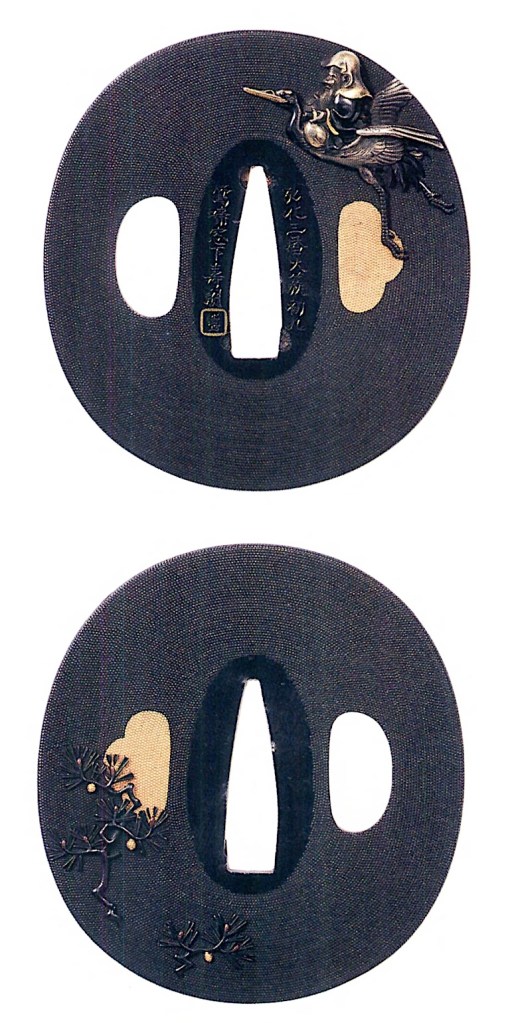
The above shown tsuba has the motif of the God of Luck Jurōjin (寿老人) riding a crane on the omote and young pines on the ura side. It is of shakudō, has a nanako ground, and makes much use of empty space. Jurōjin on his crane is interpreted in a quite three-dimesional manner, jutting out in a relatively prominent from the ground plate. Jurōjin is regarded as auspicious, as is the crane, as are young pines. So just from the motif of motif elements alone we have triple auspiciousness so to speak. Highly elegant is also how Natsuo plugged the one hitsu-ana with gold as part of the design and has the nanako and parts of the motif running over it. That is, to emphasize the optical or rather perceived fact that Jurōjin is indeed flying on a crane, a reference point is required. Now you can just add for example treetops to create a sense for height, i.e. flying, but often the perception of flying high in the sky was achieved via the sun or the moon in the background. But instead of merely adding a flush hira-zōgan of the sun or lunar disc, Natsuo so to speak made use of the common practice of plugging hitsu-ana and turned that into the sun so to speak, what is in my opinion a highly elegant approach as stated above.

So far, so good, very nice tsuba you will all agree on, but why is it sp special? Well, for this, we first have to take a look at the signsture, which reads: “Kōka san no toshi taisō shokyū – Ōtei-sōka Toshiaki + gold seal ” (弘化三暦大簇初九・鶯蹄窓下寿良), “humbly made by Toshiaki on the ninth day of the first lunar month, spring, of Kōka three (1846)”. First of all, the ninth day of the first lunar month is an auspicious day as it is the birthday of the Jade Emperor who is also revered in Buddhism, what adds quasi a fourth layer of auspiciousness to the tsuba (i.e. Jurōjin, a crane, and young pines being the other three).

The more advanced kodōgu enthusiasts, and readers of my book(s) on Natsuo may know, Toshiaki (寿良) was the early name with which Natsuo signed. Now let me introduce his career up to the time this tsuba was made so that we get some background for its importance. Natsu was born on the 14th day of the fourth month of Bunsei eleven (文政, 1828). In Tenpō ten (天保, 1839), he started an apprenticeship with the kinkō artist Okumura Shōhachi (奥村庄八). Okumura was a Gotō-trained guy and so he learned from him first and foremost the proper application of nanako, the making of menuki, gilding and silvering via techniques like kingise, ginsise, iroe or okigane, and the production of ground plates for kozuka. Training under Okamoto was not enough because after just about one year of learning, it was in Tenpō eleven (1840), he left his workshop and entered an apprenticeship with Ikeda Takatoshi (池田孝寿) from the Ōtsuki school (大月). The Ōtsuki school was a renowned lineage of kinkō artists founded in the mid-18th century in Kyōto. The school followed initially the classical style of the Gotō school but then became famous when its fourth master Mitsuoki (光興, 1766-1834) started to study painting under contemporary masters like Ganku (岸駒, 1749/1756-1838) and Nagazawa Rosetsu (長沢蘆雪, 1754-1799) from the Maruyama school (円山). This means that later in his career Mitsuoki applied more and more novel motifs and tried fresh interpretations strongly inspired by his training as a painter.

Takatoshi’s father Ikeda Kyūbei (池田久兵衛), who signed with Okitaka (興孝) and later with Takaoki (孝興), was a student of Mitsuoki but it is said that also Takatoshi studied directly with the fourth Ōtsuki master. Natsuo later said that under Takatoshi he spent two whole years, among other things of course, practicing katakiribori basics following copper plates designs given to him by his master. This practice helped him a lot and so his master decided it was time to grant him the character for Toshi from his own name whereupon Natsuo took the craftsman name Toshiaki (寿朗). He was 15 years old at the time.

While practising kinkō he also studied classical Chinese in the morning under Tanimori Shigematsu (谷森重松), and in the evening painting under Nakajima Raishō (中島来章, 1796-1871) from the Maruyama-Shijō school (円山四条). His master Raishō even suggested that Natsuo should become a painter but he stayed with the kinkō art which mas more to his liking. Well, as Natsuo was born rather weak, his adoptive mother Miyo (みよ・美代) was initially against his wish to become a kinkō craftsman. Instead she made him learn to play the shamisen but Natsuo later told his students that he stopped that very early because it was absolutely not his thing.

After five years of training under Takatoshi, the master realized the great progress his promising student had made and entrusted him for the first time with works for customers for which he could refine his takabori and kebori techniques, the first of them being menuki in the form of flying cranes, a fuchigashira set with a turtle motif, a kozuka with kebori of bamboo, and a tsuba showing young pines.

And now we arrive at where the tsuba introduced here was made. In Kōka two (弘化, 1845), i.e. when he was 17 years old (or 18 according to the Japanese way of counting years), Natsuo decided that his craft was advanced enough to leave his master Takatoshi, and just one year later he took the risk to open up his own business in the old cultural capital Kyōto. In other words, the tsuba in question was made by Natsuo when he was just 18 years old (or 19 according to the Japanese way of counting years) and most likely the piece with which he celebrated his going into business for himself. It is now possible that he was comissioned with it by an affluent client, so to speak as form of support to get his business started, and we know that often clients left the motif of the work to the artist. That is, maybe Natsuo’s very first client told him he is going to pay him good money for a nice tsuba, as support for his craft, and that it just should depict something auspicious, maybe something with the upcoming New Year in mind. Or, Natsuo came up with everything for himself and thus placed so much auspiciousness into it, i.e. as a relatively safe bet to find a paying customer as auspicious motifs of course never go out of fashion.

Be that as it may, after leaving his master Toshitaka, Natsuo was basically an autodidact. In Kaei two (嘉永, 1849), when he was 21/22 years old, he gave up the craftsman’s name Toshiaki in favour of Natsuo. His student Okabe Kakuya (岡部覚弥) later quoted Natso upon describing the times of his name change: “When I was twenty-two or twenty-three I experienced a first sense of maturity when carving kozuka with the motif of a tiger carrying his cubs over the river and fuchigashira showing hares and waves, as these pieces were so much praised by everyone who saw them.”

However, when he was twenty-five he had the feeling that Kyōto might not be the best place to unfold his talent as “so many people wore ceremonial court dresses and were just into fabrics and patterns.” So, he made plans to try his luck in Edo, the capital and the center of the bushi class. On the second day of the tenth month of Ansei one (安政, 1854) he borrowed 20 gold pieces from his adoptive mother and left Kyōto with his friend Chūshichi (忠七) and took with him a tsuba with the motif of the Oath of the Peach Garden into which he had put his entire heart and sold, to use as a demonstration piece to show his abilities in Edo. The rest of his career is described in detail in my book on Natsuo here.
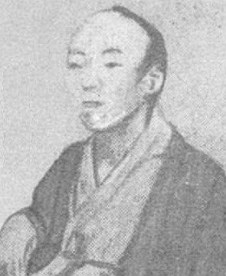
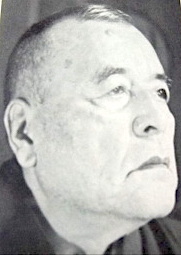
Above is a picture of the young Natsuo. I do not know how old Natsuo was at the time it was taken but I assume it is pretty close to when the tsuba introduced here was made. So in conclusion I want to say that this tsuba would surely make a very very nice cornerstone of every Natsuo collection. I do not know who the owner of the tsuba is but he must be very proud of owning this, in my opinion very special by and for Natsuo.

Old sayagaki inventory

This is going to be a very brief post. Background is, I was asked about a certain sayagaki which I explained to my client but which I thought might be interesting for some of my readers.

Now as most of you know, a sayagaki is just something someone wrote on a plain shirasaya storage “mounting”, i.e. it can be anything from just barely mentioning what blade that storage mounting holds to an elaborate expert comment/praise of the blade in question. In other words, a sayagaki may add value, or at least additional info to the sword, but does not have to.

The initial purpose of doing a sayagaki was obviously of inventory reasons. That is, you write down what blade is stored therein and add a few notes so that you don’t have to draw it and take the hilt off all the time. In other words, the first sayagaki just mentioned something like “Masamune, shortened, unsigned, length X, written by X” or “Go Yoshihiro, shortened, unsigned, comes with a Hon’ami X evaluation to X gold coins, received by Tokugawa X on the X date on the occasion of X.”

As mentioned, most of you already know that. What I would like to explain a little bit in this post is the practice of adding an inventory number to a sword in shirasaya. Beginning with the Tokugawa family, every daimyō family had a more or less extensive sword collection that was usually stored away in some kind of kura (蔵・倉・庫), a special storehouse with thick earthenware walls that could withstand a fire for some time, usually located within the principal castle of each fief. In charge of managing that storage facility was the local koshimono-kata (腰物方), or koshimono-bugyō (腰物奉行) in case of the bakufu, i.e. a retainer who was responsible for keeping track of all the swords owned by the fief or the administration/lord of the fief in particular. So for example, when an important occasion was approaching, the daimyō called his koshimono-kata and told him to pick a proper gift sword for the wedding/inauguration/succession etc. person X.

Sayagaki1

Picture 1:

Sayagaki2

Picture 2:

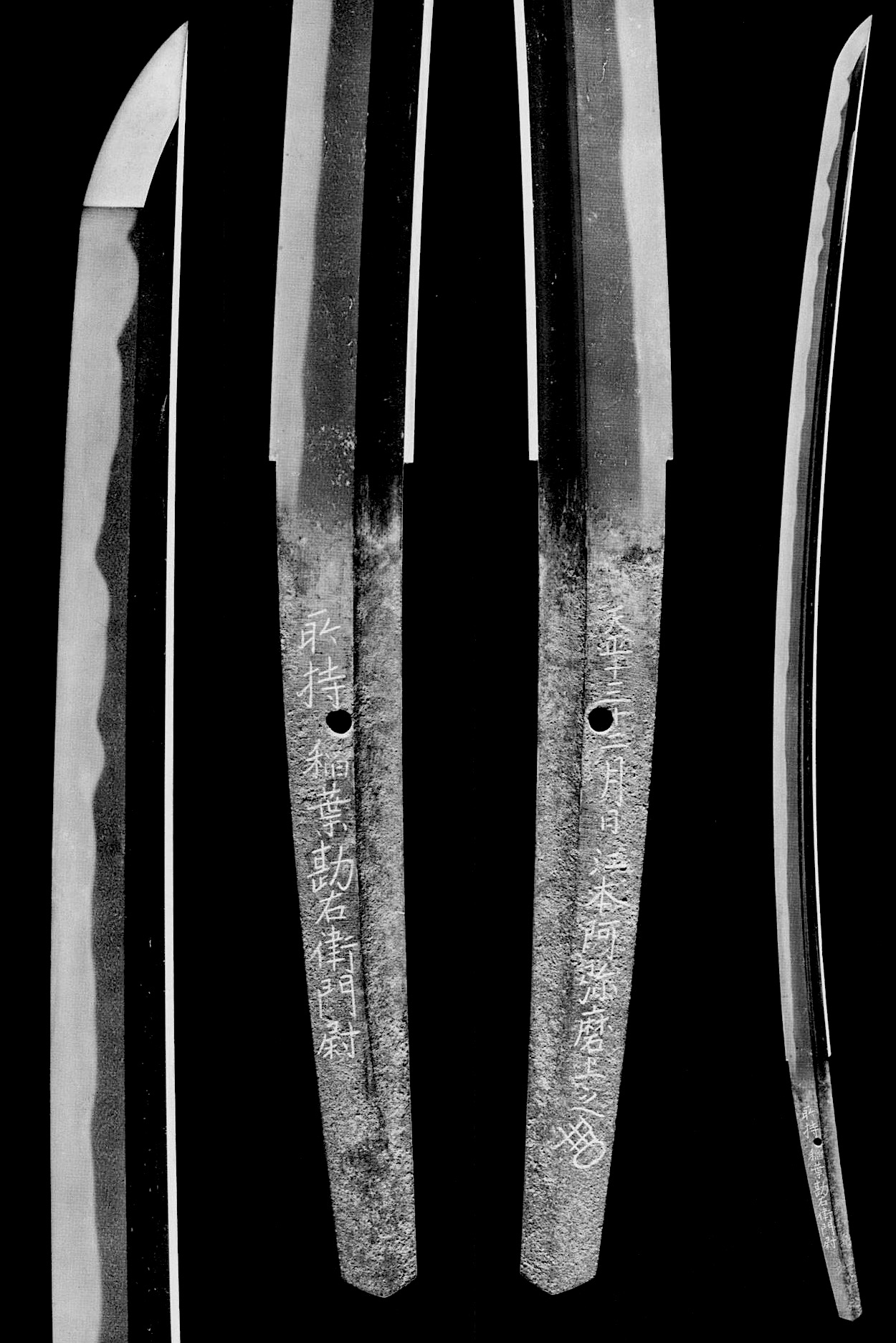
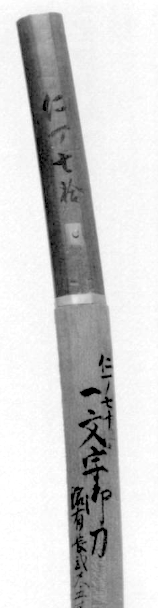
And this brings us back to the actual topic of this post. In concrete term, I was asked about the sayagaki shown in pictures 1 and 2. The sword in question is an Ichimonji (一文字) from the possession of the Owari-Tokugawa family and both the hilt and the top part of the shirasaya mention the following:

Jin ichi no nanajū (仁一ノ七拾)

Note: The inscription on the hilt uses the old (拾) character for ten whereas the saya uses (十).

So, there is obviously a number here, “1-70” but which is preceded by the character (仁), jin, which means “benevolence.” So, and that was the question from my client, what has that sword, number, or sayagaki to do with “benevolence”?

Actually, not much and there is a relatively easy explanation. Benevolence, jin, was the highest ranking of the Five Confucian Virtues, which were:

jin (仁) – Benevolence
gi (義) – Righteousness
rei (礼) – Proper rite
chi (智) – Knowledge
shin (信) – Integrity

This system was of course known by everyone and as it was so omnipresent, it served as way of ranking, like ABCDE, with A being jin and the highest rank of that hierarchy. In other words, Jin ichi no nanajū means “Sword 1-79 from the highest category of our swords.”

Also, I have seen shirasaya inventory sayagaki that use the four directions of the compass – kita (北, north), minami (南, south) nishi (西, west), higashi (東, east) – which either refer to a certain section within a single kura storehouse or to a different storehouse within a fief.

So, “lection” for today: If you have like jin or gi or rei on a period sayagaki, this does not mean that the sword is benevolent, righteous, or of proper rite respectively. No, these Five Confucian Virtues were merely used as a ranking system of 1 to 5. I have written about a kind of similar topic here.

Oh, and for those who are curious about the sword in that shirasaya, it is the tokubetsu-jūyō Yoshioka-Ichimonji shown below 😉

Sayagaki3

Raikirimaru (雷切丸) – The Thunder Cutter

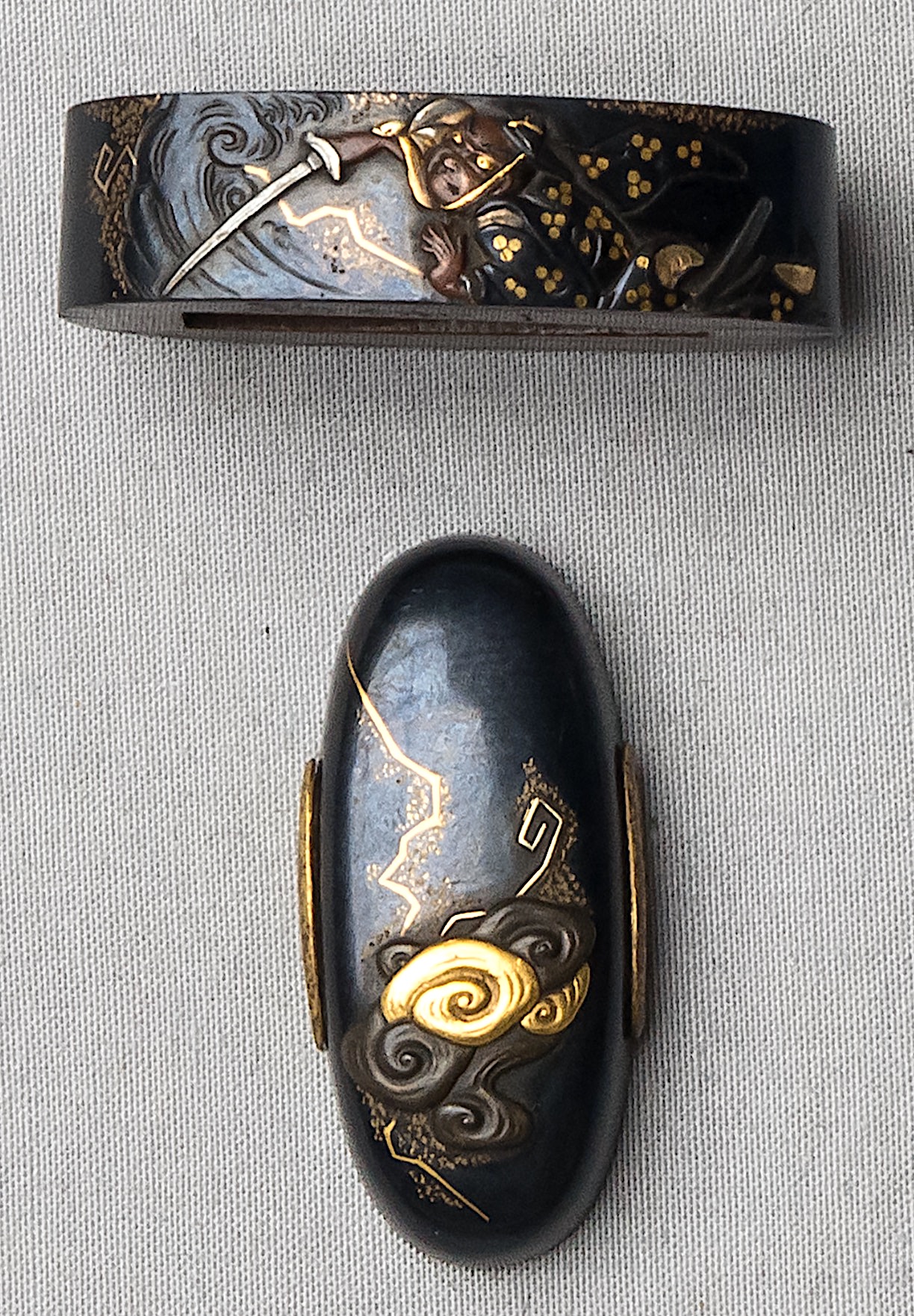
Whilst doing cataloging work for the Samurai Art Museum, Berlin, I came across a fuchigashira set by Gotō Ichijō (後藤一乗, 1791-1876) whose motif I had troubles with identifying. Now as you can see in picture 1 below, the set shows, embedded into thunder clouds and lightning, a fiercly looking guy wielding a sword, and although I am not yet 100% sure, I had the hunch that it might represents the story which I am going to share with you now. Or in other words, I might later find out that the fuchigashira set actually depicts something else, what is quite possible, but that hunch of mine about what it might show is a pretext for introducing that very story here.

Raikiri-Fuchigashira

Picture 1: fuchigashira set, mei: Ichijō + kaō (一乗「花押」)


Ok, let’s start. There exists a famous sword which is nicknamed Raikirimaru (雷切丸), lit. “The Thunder Cutter,” or short just Raikiri (雷切) (Note: Maru is a suffix that represents something valuable/beloved but it is hard to translate 1:1. So, the maru suffix often just represents the determiner “the”, i.e. Raikiri meaning “Thunder Cutter” vs. Raikirimaru meaning “The Thunder Cutter”.)

The year is Tenbun 17 (天文, 1548), a very hot fifth day of the sixth month, and the 35-years-old Tachibana Dōsetsu (立花道雪, 1513-1585) is taking a nap under large tree near his hown town of Fujikita (藤北) in Bungo province. (Note: That is according to the early Edo period Ōtomo Kōhai Ki (大友興廃記). The 20th century Yanagawa Shiga (柳川史話) says the incident took place on the fifth day of the sixth month of Tenbun six (1537) when Dōsetsu was 25 years old.) Suddenly, a storm came up and a big thunder woke up Dōsetsu, a thunder which was immediately followed by a lightning that struck the tree. But Dōsetsu swiftly jumped out from under that tree, drew his cherished sword Chidori (千鳥), “Plover” (named after its plover menuki), and cut the God of Thunder that came down on him in that lightning. So he survived but the lightning did struck him, although records vary on how much he got affected, that is, from “his legs constantly hurt throughout his life afterwards” over “his left leg was crippled” to “half (the left) of his body was paralyzed henceforth” is possible.

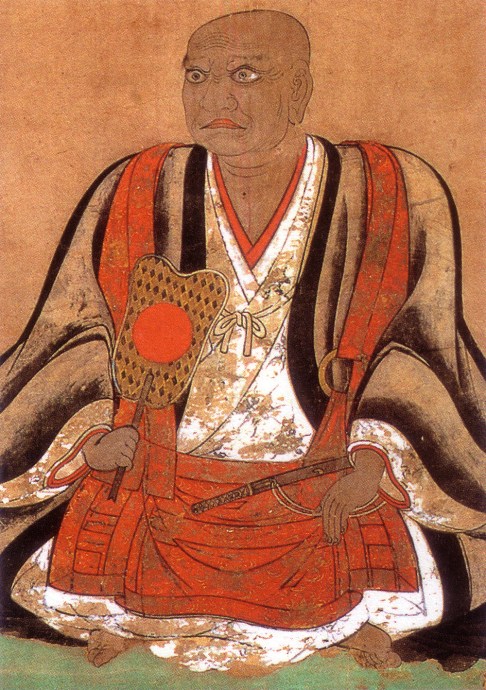
Raikiri-Dosetsu

Picture 2: Tachibana Dōsetsu (also named Bekki Akitsura, 戸次鑑連). Note how the face with the fierce eyes just looks like the depiction on the fuchigashira.


Historic records mention that in his later years, retainers had to carry around Dōsetsu in a palanquin from which he gave orders wielding a long Bizen Katsumitsu (備前勝光) tachi with a nagasa of 82 cm in the one, and a teppō in the other hand, plus having a 3 ft long staff dangling from a cord attached to one of his hands which he used too to give orders. Now there is the tradition that Dōsetsu went like that, i.e. with the palanquin, into battle after the lightning hit him but when we look at other period records, we learn that he distinguished himself in consecutive battles (taking place in the years 1562, 1567, 1568, and 1569). None of these period records mention a palanquin and it is stated that in the 1567 Battle of Yasumimatsu (休松の戦い), he killed seven men with his sword and in the 1568 Battle of Tatarahama (多々良浜の戦い), he was riding right into the enemy lines from wherein he fought furiously. So, it is pretty unlikely that he did all that from a palanquin and it appears that he was doing pretty ok with what he suffered from that lightning stroke (it is said that throughout his life, he participated in 37 battles!) and that it only started to bother him in later years. In short, I think that people saw the old and then half-paralyzed Dōsetsu fiercely commanding his men from the palanquin and the legend was created that he had always been that way since he was struck by a lightning as a young man.

So far Dōsetsu but what about the sword? It is still extant and preserved in the Tachibana Museum (立花家資料館) in Yanagawa, Fukuoka Prefecture. Well, this is the blade which was handed down as Raikirimaru because there is some discrepancy in measurements. The today extant blade has a nagasa of 1 shaku 9 sun 3 bu (58.5 cm), i.e. it was shortened at one point to become a compact uchigatana, or an ō-wakizashi if you will. The Tachibana family records however (Onkoshimono Yurai Oboe, 御腰物由来覚) mention the blade as measuring 1 shaku 6 sun 7.5 bu (50.7 cm) in nagasa. There is nothing wrong with period records not matching the present-day length of a sword as there is always the chance that it has been shortened since but this doesn’t work the other way around, that is, the blade can’t magically get longer and grow again 8 cm. A possibility is of course that the person who compiled the Onkoshimono Yurai Oboe just made a mistake and got the nagasa wrong.

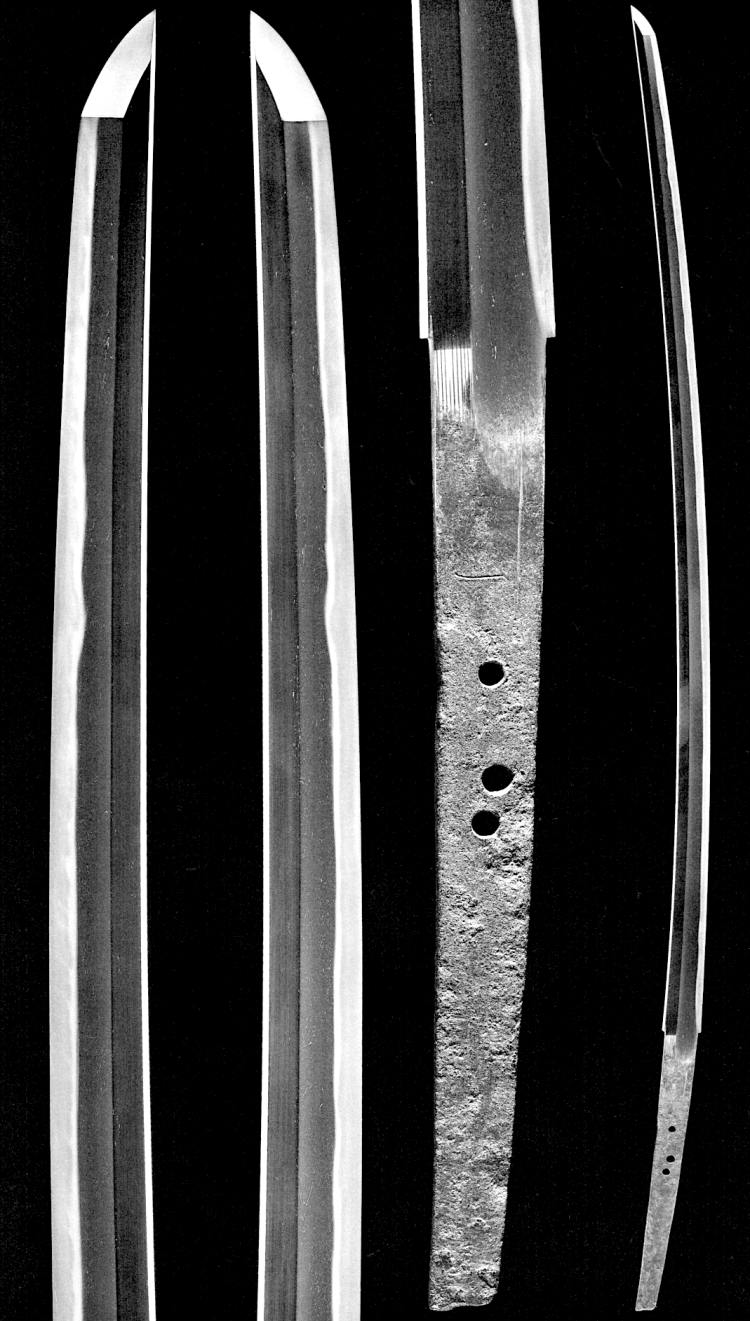
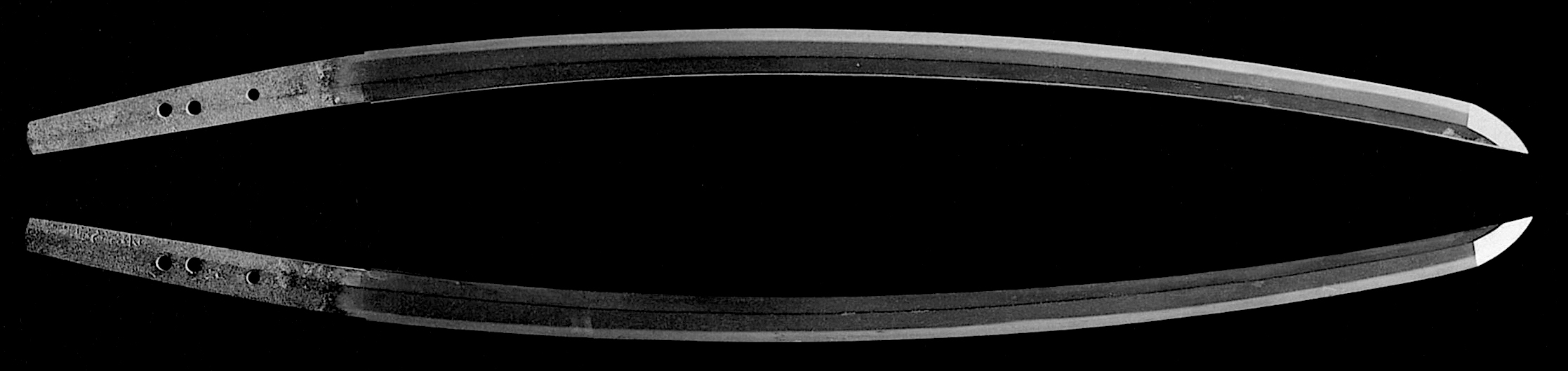
Raikiri-BladePicture 3: The Raikirimaru, nagasa 58.5 cm, sori 2.4 cm, shinogi-zukuri, iori-mune

Back to Dōsetsu. When he died in Tenshō 13 (天正, 1587), the sword came into the possession of his adopted son and successor Tachibana Muneshige (立花宗茂, 1567-1643) who became the first Tachibana daimyō of the Yanagawa fief (柳川藩) of Chikugo province, the fief the family then ruled until the abolition of the feudal system. The ura side of the tang bears towards the nakago-jiri the kinzōgan-mei “Tachibana Hida no Kami shoji” (立花飛騨守所持), “owned by Tachibana Hida no Kami.” Hide no Kami was the honorary title of Muneshige but it is unclear if he himself had it added or if it was done later. Also unclear is if it was Dōsetsu who changed the nickname of the sword from Chidori to Raikirimaru or if one of his successors decided to better stick to that legend with the lightning and that the sword shall henceforth be referred to as Thunder Cutter. Even the Onkoshimono Yurai Oboe admits that is unclear from when on the nickname Raikiri was in use. As you can see, we are again facing one of these difficult cases where we have to work from one contradicting period source to the next and where we have little rock solid facts.

Be that as it may, Muneshige bequathed the sword to his successor Tachibana Tadashige (立花忠茂, 1612-1675) who gave it to his sixth son Tachibana Shigetoki (立花茂辰, 1656-1678). Shigetoki died only three years after his father and at the young age of 23 and so it was decided to give the sword to Yashima Iwami Yukikazu (矢嶋石見行和) who was Shigetoki’s younger brother, but an illegitimate child of Tadashige. However, Yukiazu promised that the sword will be treasured within his lineage and the Yashima were anyway closely related to the Tachibana main line. So the sword was still quasi in family possession.

Fast forward about one hundred years, the then head of the Yashima family, Yashima Suō (矢嶋周防), gave the Raikirimaru back to the Tachibana main line, that is, he presented it in Hōreki nine (宝暦, 1759) to the seventh Yanagawa daimyō Tachibana Akinao (立花鑑通, 1730-1798) on the occassion of Akinao was proceeding to Edo. By then, the Raikirimaru was appraised (by whomever) as Mihara (三原) work but as Akinao was going to Edo, plans were made to submit it to the Hon’ami family. For whatever reason, the blade was not submitted to the Hon’ami main line but to Kōho (本阿弥光葆, ?-1788) who was the 5th generation of the Hon’ami Kōtatsu lineage and who appraised it as a Sōshū work. As a return gift, Yashima Suō was given a chiisagatana by master shintō smith Yamato no Kami Yasusada (大和守安定).

Raikiri-Blade1Picture 4: Color photo of the Raikirimaru.

Then some time during the early Shōwa era, Hon’ami Kōson (本阿弥光遜, 1879-1955), whom I just dedicated an article recently here, was examining the swords in the Tachibana collection and in his 1942 published Tōken Kantei Hiwa (刀剣鑑定秘話), he noted the following on the Raikirimaru:

“I was respectfully examining the Tachibana treasure sword Chidori, which has been renamed to Raikirimaru. The blade measures just around 2 shaku and it appears that at one point, it had suffered some fire damage. However, it is in a very old polish so I am not really able to tell much about its workmanship/quality, but it looks quite promising.”

To wrap things up, I want to briefly address the workmanship of the blade. As you can see in picture 3 and 4, it features quite a deep sori and ends in a chū-kissaki, what suggests that it was once of a pretty magnificent tachi-sugata, probably end of Kamakura. The jigane is a ko-itame that is mixed with nagare and the hamon is a nie-laden suguha with a wide nioiguchi but the jiba is overall relatively calm and does not feature much prominent hataraki like chikei and kinsuji. So, although this is just a remote diagnosis without ever seeing the sword, I can both understand the Mihara and the Sōshū approach, the latter more like referring to early Sōshū like Shintōgo Kunimitsu (新藤五国光) or Yukimitsu (行光). The nakago is ō-suriage as mentioned, has katte-sagari yasurime, three mekugi-ana, and of the kinzōgan-mei, the gold has come off of the last three characters.

So, when I have the chance to travel to Fukuoka, I surely want to visit the Tachibana Museum and I then want to inquite beforehead if it is possible to see the Raikirimaru (not sure if it is on permanent display but hands-on study would be perfect of course).


On vacation

Ok, we are leaving for Italy tomorrow May 8 and I will be back in office on May 23. I will be able to reply to emails of course but I would kindly ask you to wait until the 23rd or 24th to send me translation/research work (a quick NBTHK or NTHK paper is always possible of course 😉 ). Thank you!

Also, as 2018 is a BIG anniversary year for me (20 years of studying Japanese, 10 years of running my business, and 5 years of running this blog), some changes will come in the weeks and months after our trip. That is, I will do a little rebranding and restructuring of my services, mostly shifting my focus to one side and downsizing at the other. But I will explain in more detail when the time has come and everything is ready (still have to wrap my head around the one or other issue).

In this sense, I am looking forward to some great Italian food and wine and will enjoy la dolce vita for the next couple of weeks!

Hon’ami Kōson (本阿弥光遜)

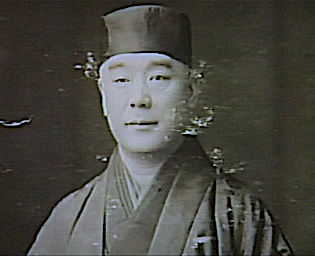
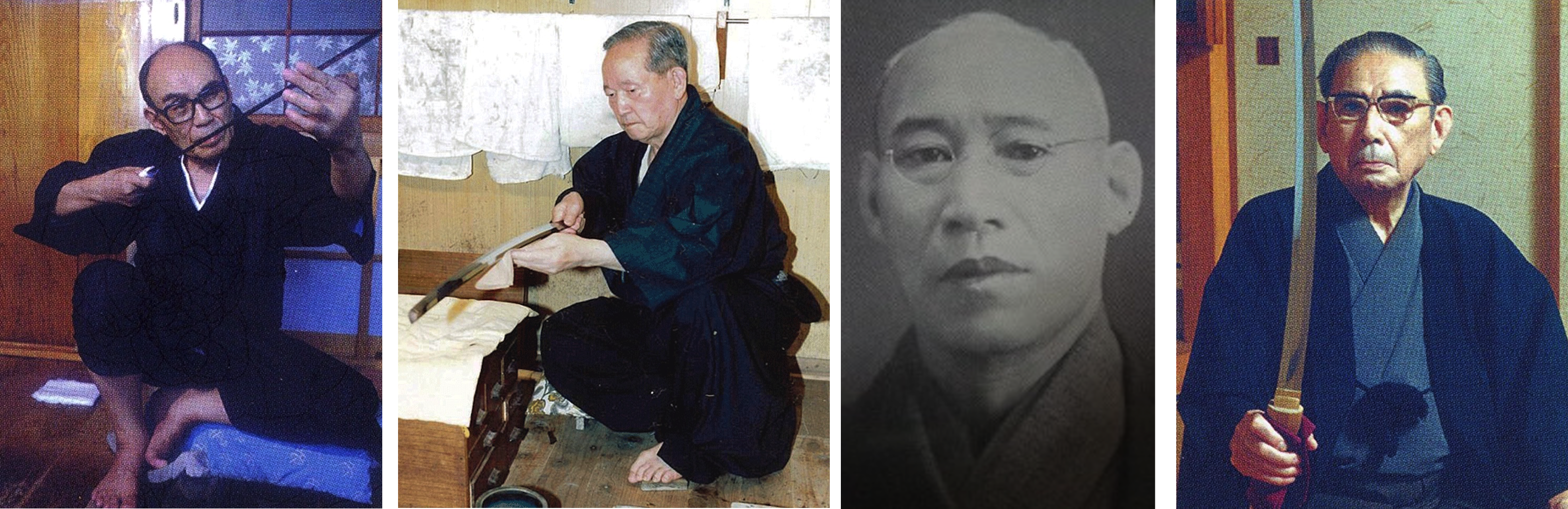
Time for another portrait of an important figure in the sword world, Hon’ami Kōson (本阿弥光遜). Kōson was born on April 29 of Meiji twelve (明治, 1879) as Kawaguchi Teikichi (川口定吉), son of Kawaguchi Magotarō (川口孫太郎), in Maebashi (前橋), Gunma Prefecture. Before the Meiji restoration and the abolishment of the feudal system, his father had been a sword polisher of the Maebashi fief of the same name, located what was then Kōzuke province and ruled by the Matsudaira (松平) family. It is said that Magotarō, who also went by the name Kinmei (欽明, also read Yoshiaki), later became a physician, or that he was a physician for the fief who polished swords at the side. When Teikichi was twelve years old, i.e. in 1890, his father moved to Tōkyō and Teikichi entered an apprenticeship as sword polisher with Hon’ami Ringa (本阿弥琳雅, 1859-1927). This is how his remarkable career started.

Hon’ami Ringa

Ringa was the 16th generation of the Kō’i (光意) lineage of the Honami which had branched off from the 7th Hon’ami main line generation in the Momoyama era. Ringa had been adopted into the Hon’ami family as had been basically all his Kō’i predecessors since the 5th generation of that lineage. I assume that Ringa was recognizing Kōson’s great talent because he managed it to get him married to a daughter of a relative of Hon’ami Mitsuyoshi/Kōga’s (本阿弥光賀, ?-1887) widow. Mitsuyoshi/Kōga was from the Kōmi (光味) lineage of the Hon’ami and as he was working (from Edo) for the Mito-Tokugawa, he is referred to as Mito-Hon’ami (水戸本阿弥). Henceforth, I will refer to Mitsuyoshi/Kōga just as Mitsuyoshi in order to avoid confusion with the earlier Hon’ami master Kōga of the same name from the early 1700s.

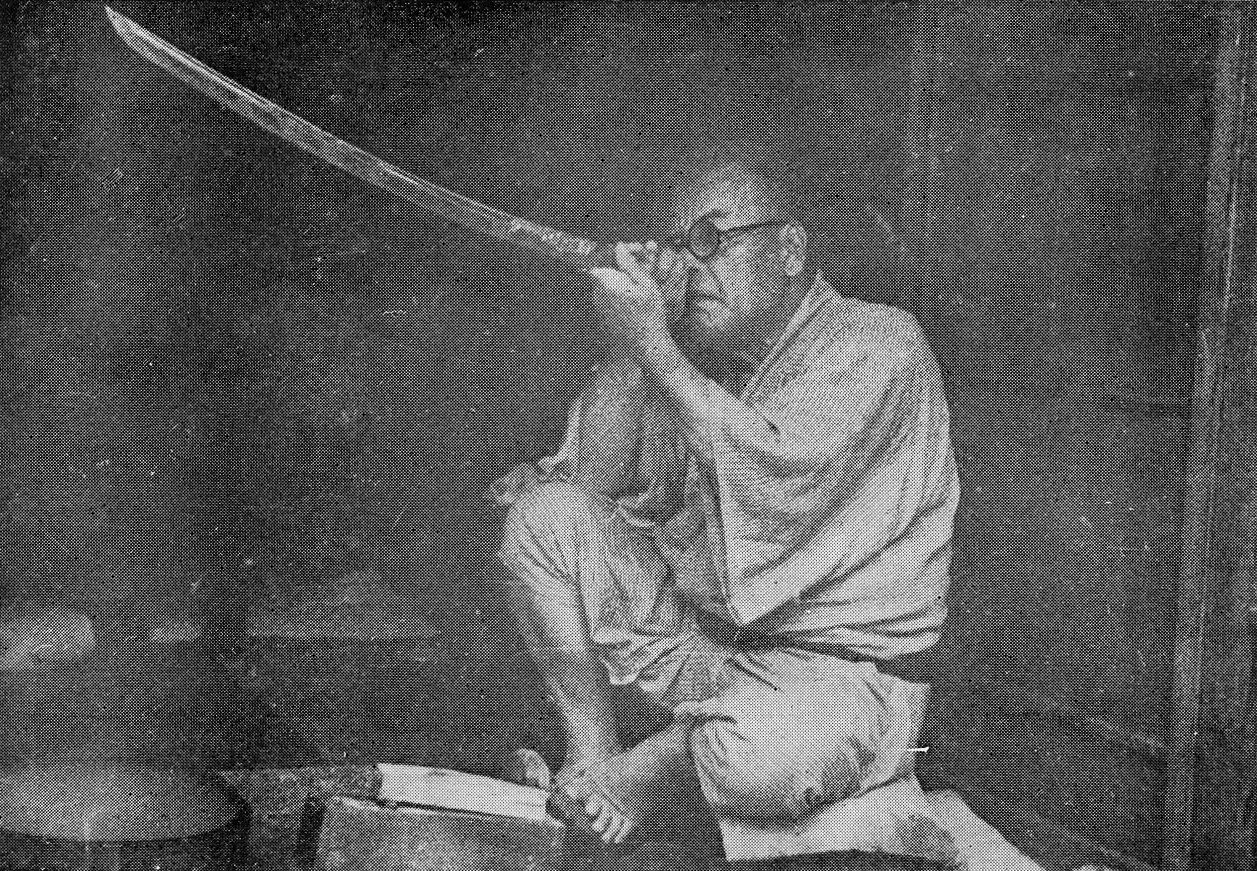
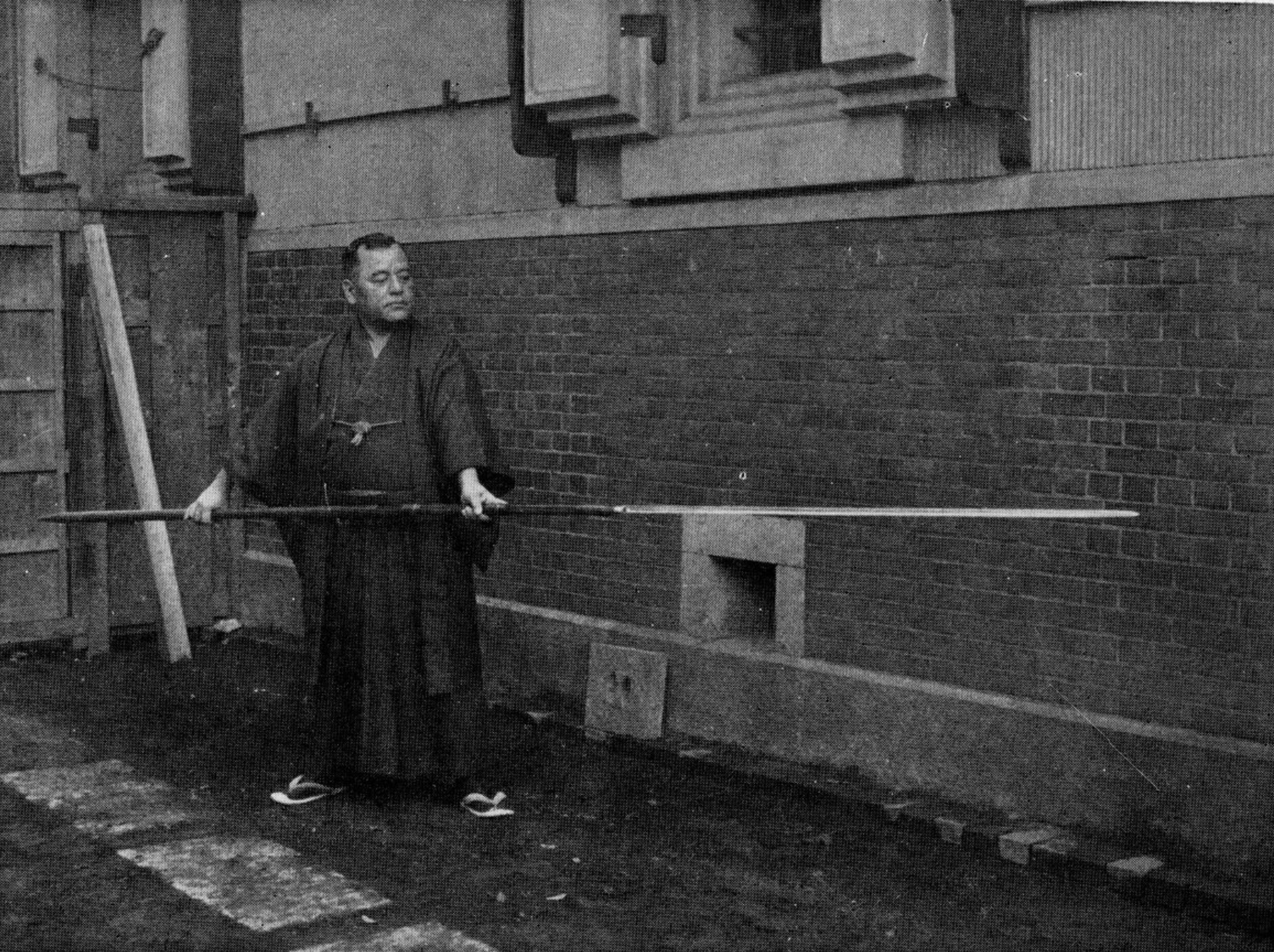
Kōson polishing the famous sword Yamabushi-Kunihiro (山伏国広).

Now at the of time of Teikichi’s adoption into the Kōmi-Hon’ami family, taking the name Kōson, sword-related craftsmen were struggling since the abolishment of the samurai class and the 1876 ban on wearing swords in public. Mitsuyoshi for example had also worked as an architect and gardener. His widow, who had been a geisha before Mitsuyoshi married her, and his adopted daughter both committed suicide later by jumping one after another into the Sumida River. One of the then polishing students of the Hon’ami Kōmi lineage who was supposed to marry Mitsuyoshi’s adoptive daughter, Wada Shūsen (和田秋詮, ?-1929), behaved erratically after his master’s death and was kicked out of the workshop. Of course also his marriage arrangement was cancelled but that didn’t stop Wada touring the country as official Hon’ami sword appraiser under his master’s name Hon’ami Mitsuyoshi. However, it didn’t go so well for Wada as he died later, in July of 1929, at a sword meeting from a stroke.

Just another anecdote of those “crazy” times. The previous head of the Kōmi lineage, Hon’ami Tadataka (本阿弥忠敬, ?-1897), worked very hard to live up to the famous Hon’ami name and was quite often approached by sword collectors, for example asking him to authenticate their blades, but as a member of a Hon’ami side line, he was not allowed to issue Hon’ami appraisals. What he did was buying the official Hon’ami copper seal that was stamped on the back of origami from an impoverished member of the main line, who was working as a farmer at that time, and went ahead and just issued Hon’ami origami on his own. Well, Tadataka was a heavy drinker and also died from a stroke.

Among all that stuff going on, there was also a momentum for the Hon’ami. For example, Tadataka’s successor Tenrai (本阿弥天籟, ?-1938) was one of the first to grasp the changing times and the idea to make some of the family secrets public. In 1904 for example, he published the Japanese style-bound ten-volume work Kokon Tōken Kantei Hiketsu (古今刀剣鑑定秘訣), a treatise on the workmanship of kotō and shintō blades. The whole project was quite risky because of the relatively small number of potential buyers, but it was a matter of great personal concern to Tenrai because he tried to bring in fresh air to the then sword world. Besides that, he was a passionate drawer of oshigata, not only of masterworks and meibutsu but also of ordinary “everyday” blades. To the side of his oshigata he wrote comments in the style of the Hon’ami family, the way it had been practiced for centuries. So it was both something new and something traditional.

Kōson posing with the famous yari Otegine (御手杵).

I might digress but I just wanted to give you an idea of the times Kōson found himself becoming an independent swoerd polisher in Meiji 40 (1907). Three years earlier the Russo-Japanese War had broken out and it was one of the first incidents that brought the actual “use” of Japanese swords back on the table. So things improved a little for people in the sword craft. Kōson worked very hard to make the Japanese sword more accessible to the general public. Just a couple of decades ago namely, a commoner was not supposed to know anything about swords or even be interested in them. It was a “samurai thing” so to speak. But Kōson published a magazine called Nihontō Kenkyu (刀剣研究, “Sword Studies”), and among others in 1914 and 1924 the books Nihontō (日本刀, “The Japanese Sword”) and Tōken Kantei Kōwa (刀剣鑑定講話, “Lectures on Sword Appraisal”) respectively. He even founded a sword club, the Nihontō Kenkyū Kai (日本刀研究会). Also, as some of you might know, it was Kōson who introduced the system of the gokaden.

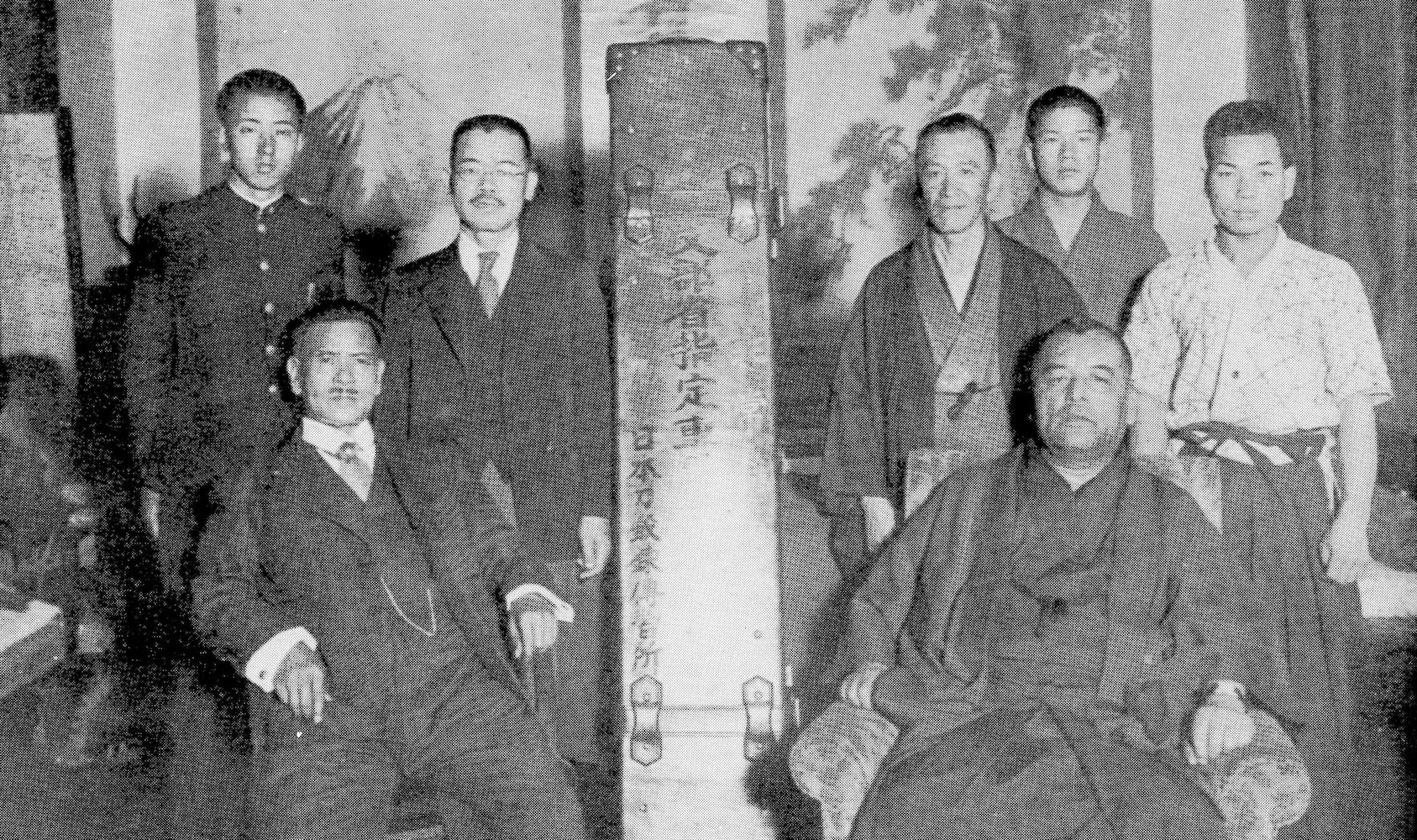
Kōson (sitting to the right) and Kurihara Akihide (栗原昭秀) (sitting to the left) preparing in May 1937 a sword exhibition in Manschuria.

So from about 1910 onwards, it was Kōson and Tenrai who were the go-to-guys for everything Hon’ami, i.e. polishing and appraisal-related as it was them who were able to continue the traditional Hon’ami business. The main namely line wasn’t quite able to make it. For example, their 19th head Kōchū (本阿弥光仲, ?-1869) was a dandy and had to pawn the official copper seal that had been granted to the family for their appraisals by Hideyoshi, plus some calligraphies by his ancestor Kōtoku (本阿弥光徳, 1556-1619) and eventually even his house. After he had died, it was his successor Tadamichi (忠道) who sold Mitsuyoshi the Hon’ami copper seal because as you know, the Hon’ami worked for the Tokugawa and when the Shogunte was abolished, they all ended up without a job. The situation improved a little bit when Tadamichi was employed, together with other Hon´ami members, by the Imperial Household Agency (Kunai-shō, 宮内省) for the newly founded section for swords. However, the sword section was shortly closed afterwards in the fourth year of Meiji (1871). When he realised that the situation was helpless , he “fled” from his debts and became a farmer as mentioned. Well, he returned later to Tōkyō when everything had “cooled down” where he henceforth ran a ryokan hotel and dealt with antiques. His successor Michitarō (道太郎, ?-1895), the last head of the Hon’ami main line, ended up as a shoe maker…

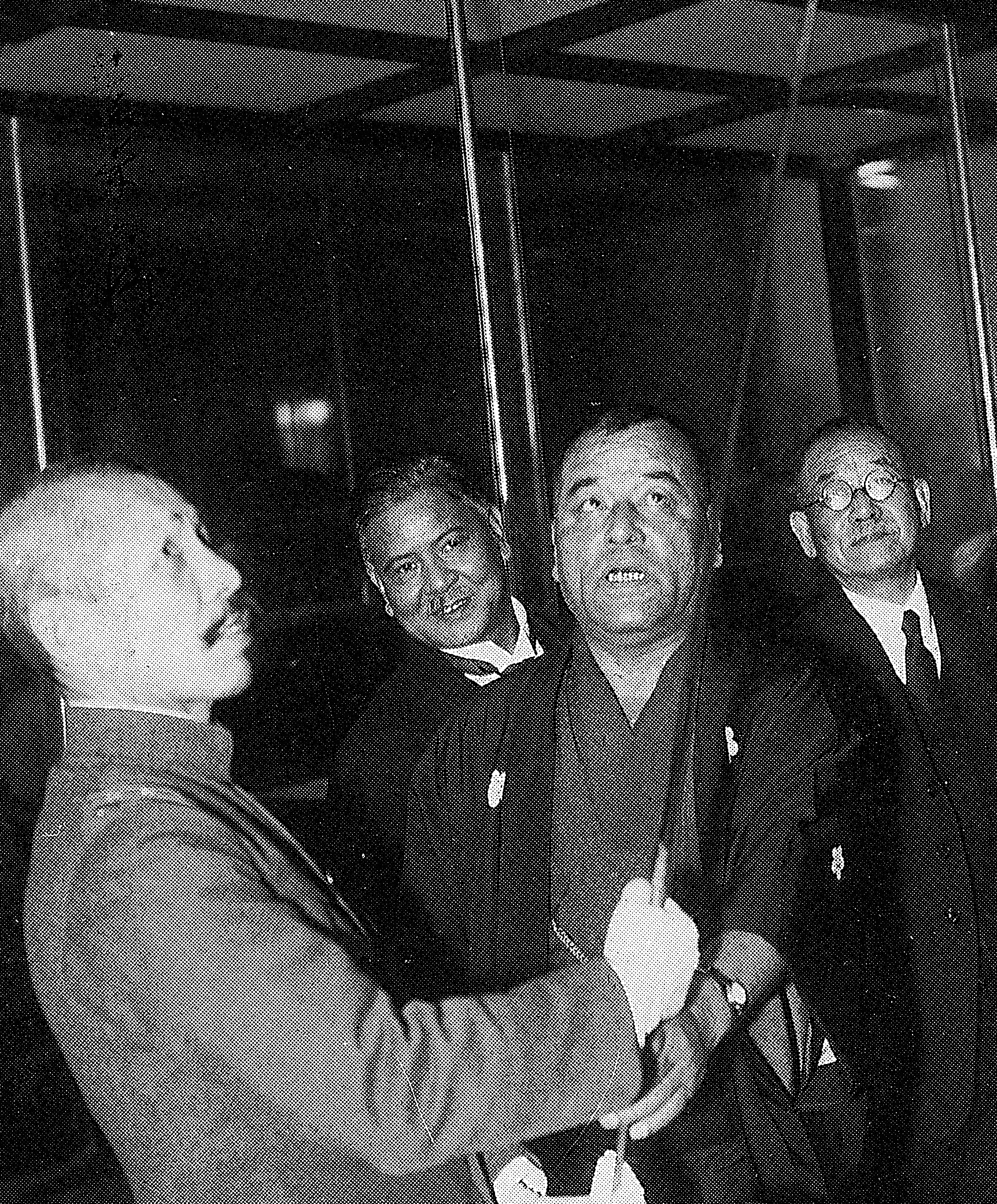
Kōson watching Prime Minister Saitō Makoto (斎藤実, 1858-1936) examining a kabuto.

As shown in the picture above and below, Kōson was very active before and during WWII. In 1936, he put all the oshigata he had taken so far from former daimyō and high-ranking collections and combined them to a neat set of twelve scrolls, each measuring 15 m when rolled out. In 1942, he published his Nihontō Taikan (日本刀大観, “Broad Overview of the Japanese Sword”). After the war, he became an advisor and trustee and a shinsa member of the newly founded NBTHK. With his 70th birthday in 1948. he took on the pen name Kaishi’an Sōho (芥子庵宗甫).

Kōson showing an ōdachi made by Kurihara Akihide to Minister of War Araki Sadao (荒木貞夫, 1877-1966).

The last project he was working on was the Nihontō no Okite to Tokuchō (日本刀の掟と特徴, “Guidelines and Characteristic Features of Japanese Swords). He was already 77 years old at that time and fighting with lung cancer, from which he died just one month after the publication of the book, on July 26, 1955. Kōson’s legacy was not only to contribute greatly to the post-WWII sword momentum, he also trained three great polishers and experts, his immediate successor Hon’ami Mitsuhiro/Kōhaku (本阿弥光博, 1918-1979),  ningen-kokuhō Ono Kōkei (小野光敬, 1913-1994), and ningen-kokuhō Nagayama Kōkan (永山光幹, 1920-2010).

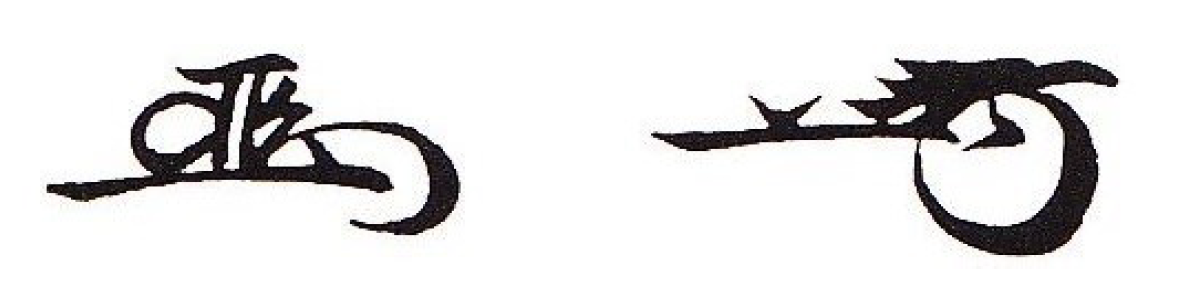
Kōson’s two kaō.

Last but not least and for the sake of completeness, I want to mention the other Hon’ami lineage that went strong after the decline of the main line, and that is the most important Hon’ami group today. I am talking about Ringa’s successor Nisshū (本阿弥日洲, 1908-1996). Nisshū was the son of Ringa’s polishing student Hirai Chiba (平井千葉). He later became ningen-kokuhō, as did his son Hon’ami Kōshū (本阿弥光洲, 1939- ).

From left to right: Ono Kōkei, Nagayama Kōkan, Hirai Chiba, Hon’ami Nisshū.

Tenshō-suriage and Keichō-suriage

Ok, I am leaving for the Chicago Sword Show tomorrow morning and am looking forward to see you guys there. So this is just gonna be a very short post but I thought it might nevertheless be of interest. A client asked me yesterday to explain the differences between a so-called Tenshō-suriage (天正磨上げ) and a Keichō-suriage (慶長磨上げ) as these terms are actually not explained in my Encyclopedia of Japanese Swords.

Before I deal with these kinds of suriage, a very brief historic outline of what we are talking about. By the end of the Muromachi period, a what I call a “civilian samurai uniform” started to emerge because now, shugo-daimyō and their higher-ranking vassals were no longer just protecting someone else’s land, they were ruling and administering it. As you don’t do this daily duty in full armor of course, the sword became the visible symbol of rank and authorative power. This was when these shugo-daimyō (the forerunners of the later daimyō) and their higher-ranking vassals needed a sword form, that could be easily thrusted through the sash of the new daily worn “uniform” and that did not have to be complicatedly suspended with cords like the tachi. For a more detail info on the changes in warrior dress code please look here. Again, we are talking about the upper ranks here, not what an average retainer had to his disposal.

Now Oda Nobunaga (織田信長, 1534-1582) came into power and he had, among others, a preference for Nanbokuchō-period Sōshū masterworks. If it was him who started it all of if there was already a momentum of reviving those works is a topic for another time but we know that his preference was continued by his “successor” Toyotomi Hideyoshi (豊臣秀吉, 1537-1598) and then basically by the entire upper warrior class. As Nanbokuchō-period Sōshū (and other, e.g. Sōden-Bizen) blades were long, wide, and heavy, Nobunaga and his peers had them shorted so that they can wear them with their civilian uniform. This was the start of the trend we are talking about here.

To be clear, Japanese swords have been shortened all the time. It was not like that the people at Oda Nobunaga’s time suddenly realized: “Hey, there is a nick or a crack at the base, but instead of throwing out the blade and have a complete new one made, let’s just cut off the end of the blade to the extent where the issue is and work the remaining part below of that into a new tang.” No, suriage and ō-suriage are as old as sword making is because steel was expensive and it is way easier and cheaper to shorten an otherwise completely functional blade and re-use it as a, well, shorter sword than have a new one made from scratch.

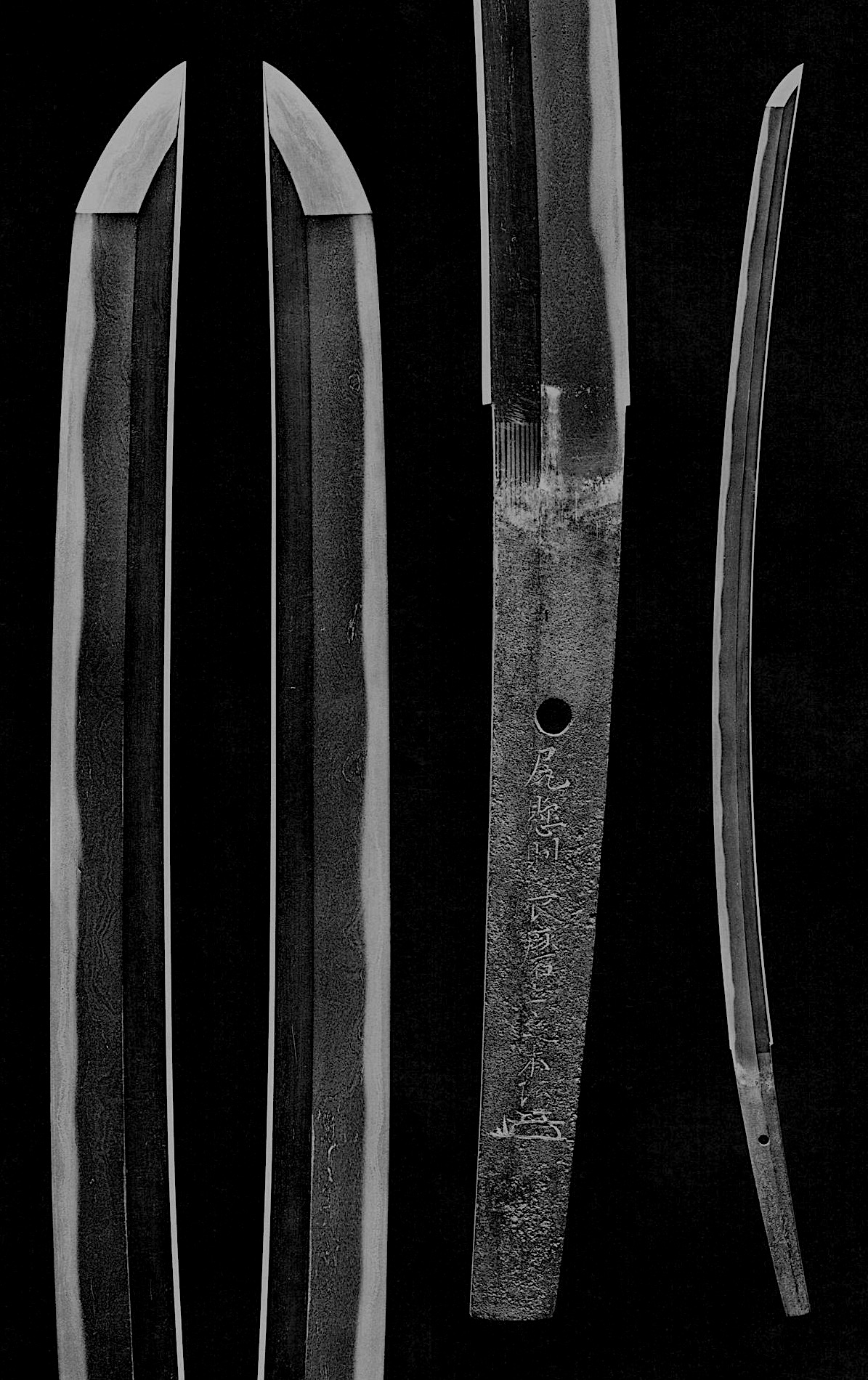
Back to the difference between Tenshō-suriage and Keichō-suriage, which are by the way sometimes also just referred to as Tenshō-age and Keichō-age. Before I address the possible reasons for the differences, I want to outline them. As you can see in the shortened blade in picture 1, which comes under the category of a Tenshō-suriage, the tang tapers noticeably and the newly formed end is neatly shaped into a kengyō-jiri.

Picture 1: Tenshō-suriage

At the blade in picture 2, the tang does not taper that much (in the very case, the difference is actually not that obvious) and the newly formed end is just a straight kirijiri. So in short, the differences are: A Tenshō-suriage tapers more noticeably and has a more or less elaborately finished nakago-jiri whereas a Keichō-suriage does not taper much and ends in a straightly cut off kirijiri. There are no period set in stone rules that define a Tenshō and a Keichō-suriage, that is, these are relatively recent terms which were introduced to refer to certain kinds of ō-suriage tang finishes and I described them according to what I have been told (or more like overheard) in Japan. In other words, this post is not a very scientific treatise but states the issue as how I understand it and as how I explained it to my client who asked me this question.

Picture 2. Keichō-suriage

Now some thoughts about the reasons for these two different tang finishes of shortened blades. First of all, at the time Nobunaga came along, the highest circles were kind of looking down on shortened blades, in particular when it comes to presenting someone a fine sword. At the same time, it can be assumed that many of the extra long and wide Nanbokuchō blades with a nagasa of way more than 80 cm had already by shortened by then. But Nobunaga liked Sōshū and I think that he ordered his finest craftsmen to turn some of these Nanbokuchō works into blades that can be comfortably been worn as uchigatana/katana. This was so to speak stage one of this development, which took place during the Tenshō era (1573-1592), and the craftsmen shaped the newly created tang of a shortened sword into how a tang would have been initially finished by a swordsmith. Hence the taper and the sophisticated jiri. Or in other words, they were breaking new grounds and everyone was testing out the waters to see what was accepted and what not. So, you shorten a blade and make it look like as “original” as possible.

Jump to the Keichō era (1596-1615). Nobunaga and Hideyoshi had died (well, the latter not at the beginning but relatively quickly into Keichō era) but Nanbokuchō blades, in particular those of the Sōshū and Sōden-Bizen masters, were still very much first choice. Now by then, roughly twenty to thirty years after that entire trend had started, I guess that a shift had taken place. That is, by now, shortened blades have become socially acceptable so to speak. With that, there was no more need to “hold back” and do the balancing act of having a blade clearly shortened but make it look like as original as possible, in terms of tang finish. So, shortening a blade and leave it look like a shortened blade has always looked like (i.e. just the end cut off and filed the tang into a shape that can be fit into a new hilt) was no longer a taboo.

This is my take on this issue because even in Keichō times, we are talking about very fine blades. By way of explanation, it is like as if you are a master mechanic running the greatest workshop in the country (i.e. Hon’ami-Umetada collaboration): You just don’t have to cut corners when working on a Maybach or a Bugatti, that is, you have all the time and means in the world and don’t have to cut off a nakago in a straight kirjiri because you drown in work and just can’t shape it into a neat kenyō-jiri. Therefore, I rather think a shift in conception has taken place by the Keichō era and that this is the reason why shortened tangs were now finished differently than twenty to thirty years earlier and why we now refer to those different finishes as Tenshō-suriage and Keichō-suriage.

I hope you can follow my train of thoughts and I will be back shortly with the next chapter of the Kantei series.


Easter eBook Super Sale IV

Easter-Sale

I just started, like last three years before, an Easter eBook Super Sale where ALL of my eBooks are reduced by 50%! This offer will be valid for until April 6 so you have enough time to decide what you want. So fill up all your tablets (or PC´s) with all the important Nihonto and Tosogu reference material you need four your studies!

Once again, it goes directly via me (i.e. I’m not going to manually change all the prices on Lulu.com and then change them back when the sale is over). I provide a list of all my eBooks below, showing the regular and the reduced prices. I also linked them so that you can check what the description says but again, DO NOT buy over there at Lulu.com this time. Get in touch with me via “markus.sesko@gmail.com” and pay me directly, either by PayPal using the very same email address, by check, or by credit card using the donate button at the very bottom of this page, and I’m going to send you over the eBook. And anyway, if you gave a question, just drop me a mail.

So grab this chance to fill up your laptops/tablets/phones with all references you need.

Thank you for your attention!

Akasaka Tanko Roku ….. $8.90 – $4.50
Encyclopedia of Japanese Swords ….. $24.90 – $12.50
Geneaogies and Schools of Japanese Swordsmiths ….. $19.90$10
Genealogies of Japanese Toso Kinko Artists ….. $19,90$10
Identifying Japanese Cursive Script ….. $14.90$7.50
Identifying Japanese Seal Script ….. $14.90$7.50
Japan’s Most Important Sword Fittings ….. $14.90$7.50
Jukken ….. $14.90$7.50
Kano Natsuo I ….. $59.90$30
Kano Natsuo II ….. $59.90$30
Kantei Reference Book – Hamon & Boshi ….. $19.90$10
Koshirae – Japanese Sword Mountings ….. $19.90$10
Koshirae Taikan ….. $59.90$30
Koto Kantei Zenshu ….. $89.90$45
Koto Meikan ….. $39.90$20
Legends and Stories Around the Japanese Sword ….. $9.90 – $5
Legends and Stories Around the Japanese Sword 2 ….. $9.90 – $5
Masamune ….. $29.90$15
Masters of Keicho Shinto ….. $19.90$10
Nihon-koto-shi ….. $29.90$15
Nihon-shinto-shi ….. $29.90$15
Nihon-shinshinto-shi ….. $29.90$15
Shinshinto Meikan ….. $29.90$15
Shinto Meikan ….. $29.90$15
Shinto Shinshinto Kantei Zenshu ….. $89.90$45
Signatures of Japanese Sword Fittings Artists ….. $89.90$45
Soken Kinko Zufu ….. $9.90 – $5
Swordsmiths of Japan ….. $89.90$45
Tameshigiri ….. $29.90$15
The Honami Family ….. $19.90$10
The Japanese Toso Kinko Schools ….. $24.90$12.50

German Titles:

Die Honami Familie ….. $19.90$10
Geschichten rund ums japanische Schwert ….. $9.90 – $5
Geschichten rund ums japanische Schwert 2 ….. $9.90 – $5
Koto Kantei Zenshu ….. $89.90$45
Nihon-shinto-shi ….. $29.90$15
Nihon-shinshinto-shi ….. $29.90$15
Shinto Shinshinto Kantei Zenshu ….. $89.90$45

Thoughts on the Gokaden

In the very same source I addressed here, I found another very interesting entry, an entry that kind of predicts the well-known concept of the so-called gokaden (五箇伝), the “Five Traditions”.

At the beginning of the Yamashiro part of my Kantei series I have stated that it is generally assumed that the system of the gokaden (五ヶ伝・五箇伝), lit. “The Five Traditions,” was introduced by Hon´ami Kōson (本阿弥光遜, 1879-1955). “His” five traditions were:

  • Yamashiro tradition (Yamashiro-den, 山城伝)
  • Yamato tradition (Yamato-den, 大和伝)
  • Bizen tradition (Bizen-den, 備前伝)
  • Sōshū tradition (Sōshū-den, 相州伝)
  • Mino tradition (Mino-den, 美濃伝)

Before his time, swords, in particular kotō swords, were mostly classified according to their production site, that is the province they were made in. For example, blades made in Bizen were called Bizen-mono (備前物), and such made in Yamato were called Yamato-mono (大和物). But this classification via mono (物, lit. “thing” or rather “work” in this context) and the province a blade was made in is inflexible and does not make clear any stylistic connections. That is, you can’t see at a glance that for example an Enju blade is, via the Yamashiro tradition, actually stylistically connected to the Kyōto-based Rai school when it is just listed as Kyūshū-mono. So Kōson’s approach via den (traditions) makes sense but the interesting find I made recently shows that he did not come up with that gokaden system out of the blue.


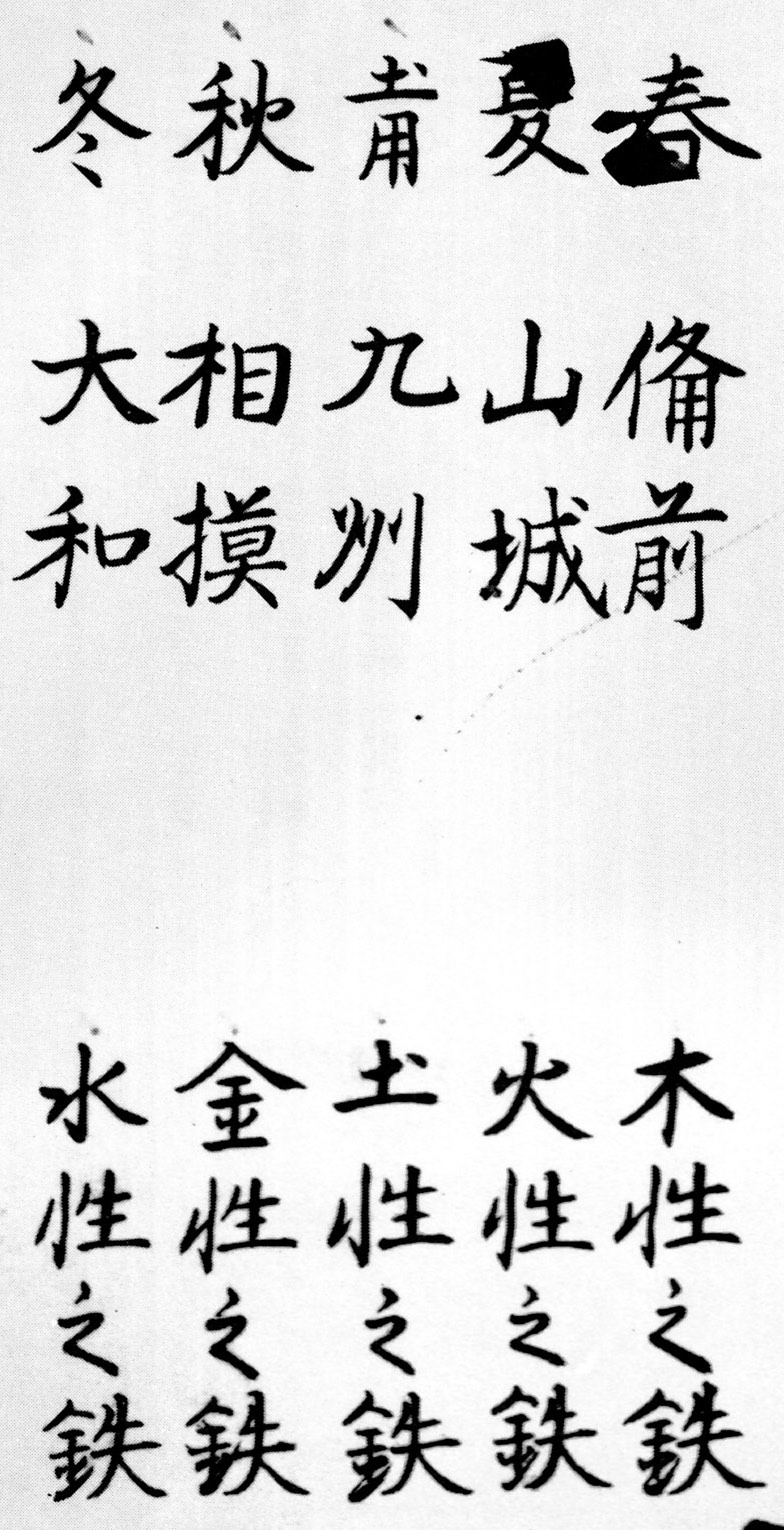
So the section in question is basically about the basics of kantei and it is written in a somewhat esoteric manner. Lets begin with the overview that caught my attention. As seen above, we are provided with five basic classifications, very similar to Kōson’s gokaden. These classifications are:

Spring: Bizen – steel like wood
Summer: Yamashiro – steel like fire
Late Summer: Kyūshū – steel like earth
Fall: Sagami – steel like metal
Winter: Yamato – steel like water

As you probably realize right away, we are dealing here with the concept of the Five Elements or Five Phases (五行, Chinese Wǔ Xíng, Japanese gogyō). Before the mid-Edo period, this concept was very much in use in Japan and, to keep it simple here, it was only given up because of the nationalistic push applied by the Tokugawa bakufu. The book in question was written in the early Edo period and so it still follows the Five Elements approach that was prevailing in earlier periods. It is interesting to see that Mino is not in that list, although by the time the book was written, it had been a major sword production site for more than one hundred years. This suggests that earlier wisdom was copied here which had not yet adopted the Mino tradition into its curriculum (although Mino is still introduced, as part of the Sōshū tradition, see below).

Now the supplement of “steel like wood” for example does not have any direct meaning, neither does “spring” for Bizen province, and it seems that the Five Elements system was applied to swords as a memory aid so to speak. Like an easy to remember way of summing up the five major sword production sites by the manageable number of five which was anyway used by everyone because to the Five Elements concept. But there is more. This list of five is then expanded on the following pages of the book and each province/region is listed with its major schools. Although there are some associations which are hard to follow in terms of workmanship, this expansion of the list of five is actually doing what Kōson was doing later, and that is listing schools and/or smiths in each group which are stylistically connected. The first section is expanded as:

Spring: Bizen – Wood
jōsaku Ichimonji (一文字)
jōsaku Osafune Mitsutada (長船光忠)
jōsaku Hatakeda Moriie (畠田守家)
Ukai Unji (鵜飼雲次)
chūsaku Yoshioka-Ichimonji Sukemitsu (吉岡一文字助光)
gesaku Yoshii Naganori (吉井永則)
gege-saku Kozori Yoshikage (小反吉景)
chūsaku Tajima Hōjōji Kunimitsu (但馬法成寺国光)
chūsaku Bitchū Aoe Moritsugu (備中守次)
chūsaku Bingo Mihara Masaie (備後三原正家)
gesaku Suō Niō Kiyotsuna (周防二王清綱)
jōsaku Hōki Ōhara Sanemori (伯耆大原真守)

As you can see, there is already a qualitative classification via the jōsaku, chūsaku etc. system and for some reason, this school of knowledge thought that Niō Kiyotsuna and Ōhara Sanemori somehow belonged to Bizen. For the sake of completeness, I want to quote the remaining four expansions in the following, and associations have to be taken with a grain of salt.

Summer: Yamashiro – Fire
jōsaku Sanjō Munechika (三条宗近)
chū-no-chū Rai Kuniyoshi (来国吉)
jōsaku Raitarō Kuniyuki (来太郎国行)
jōsaku Rai Kunitoshi (来国俊)
jōsaku Niji-Kunitoshi (二字国俊)
chū-no-ge Ryōkai (了戒)
jōsaku Chūdō-Rai Mitsukane (中堂来光包)
betsujō Awataguchi Tōmanosuke Norikune (粟田口藤馬之丞則国)
gesaku Settsu Nakajima-Rai Kuninaga (摂津中島来国長)
gesaku Rai Tomokuni (来倫国)
gesaku Rai Kuninao (来国直)
chūsaku Higo Kikuji Enju Kunimura (肥後菊地延寿国村)
gesaku Heianjō Mitsunaga (平安城光長)
gesaku Inaba Kokaji Kagenaga (因幡小鍛冶景長)
gesaku Nobukuni 3rd generation (信国三代)

Late Summer: Kyūshū – Earth
betsujō Bungo Kishindayū Yukihira (豊後紀信太夫行平)
jōsaku Ki no Masatsune (紀正恒)
chūsaku Sō Sadahide (僧定秀)
gesaku Jitsu’a (実阿)
gege-saku Satsuma Naminohira Yukiyasu (薩摩浪平行安)
chū-no-ge Chikugo Miike Motozane (筑後三池元真)
gesaku Ōshū Mōgusa Takeyasu (奥州舞草雄安)
gesaku Chikuzen Kongōbyōe Moritaka (筑前金剛兵衛盛高)
gesaku Bungo Takada Tomoyuki (豊後高田友行)
jōsaku Etchū no Kuni Matsukura-jū Yoshihiro (越中国松倉住義弘)
jōsaku Etchū ni Kuni Gofukuyama Norishige (越中国御服山則重)

Fall: Sagami – Metal
jōsaku Bizen Saburō Kunimune (備前三郎国宗)
jōsaku Shintōgo Kunimitsu (新藤五国光)
jōsaku Kamakura-Rai Kunitsugu (鎌倉来国次)
jōsaku Tōroku Sakon Kunitsuna (藤六左近国綱)
jōsaku Tōsaburō Yukimitsu (藤三郎行光)
mujō Gorō Nyūdō Masamune (五郎入道正宗)
betsujō Hikoshirō Sadamune (彦四郎貞宗)
chūsaku Kurōjirō Hiromitsu (九郎次郎広光)
chūsaku Akihiro (秋広)
chū-no-jō Tōgenji Sukezane (藤源次助真)
gesaku Kyō Hasebe Kunishige (京長谷部国重)
jōsaku Mino no Kuni Kaneuji (美濃国兼氏)
gesaku Mino no Kuni Kinjū (美濃国金重)
Chikuzen no Kuni Sa (筑前国左)
chūsaku Bizen no Kuni Chōgi (備前国長義)
jōsaku Bizen no Kuni Kanemitsu (備前国兼光)
chūsaku Bizen no Kuni Motoshige (備前国元重)
gesaku Iwami no Kuni Izuha-jū Naotsuna (石見国出羽住直綱)
gesaku Owari Yamada-Seki Kunitsugu (尾州山田関国次) (via Mino)
gesaku Hachiya-jū Daruma (蜂谷住達磨) (via Mino)
gesaku Etchū Uda Kunimitsu (越中宇多国光)
gesaku Kaga Fujishima Tomoshige (加賀藤島友重)
gesaku Izumo Dōei Naganori (出雲道永永則)
gesaku Awa Kaifu Yasuyoshi (阿波海部泰吉)
gesaku Echizen Chiyozuru Kuniyasu (越前千代鶴国安)

Winter: Yamato – Water
chūsaku Senju’in Shigehiro (千手院重弘)
betsu Taima Kuniyuki (当麻国行)
jōsaku Tegai Kanenaga (手掻包永)
chūsaku Shikkake Norinaga (尻懸則長)
chūsaku Hoshō Gorō (保昌五郎)
gesaku Suruga Shimada Yoshisuke (駿河島田義助)
gesaku Mikawa Heianjō Nagayoshi (三河平安城長吉)
gesaku Ise Kuwana Muramasa (伊勢桑名村正)
gesaku Wakasa Fuyuhiro (若狭冬広)


So it appears to me, as indicated, that the Five Elements approach was nothing more than a vehicle to learn by heart and remember these smiths and their qualitative evaluation. Imagine you are the son of a high-ranking samurai who is sent to learn kantei with a Hon’ami or a Takeya sensei of that time and after a while the teacher would ask you: “What are the smiths for fall and what evaluation do they have?” or “What are the earth steel smiths?” You probably got beaten with a bokutō if you don’t remember correctly 😉

Next in the book follow the major kantei points, distributed into the “Five Elements of Shape” (gotai, 五体) and the “Ten Characteristics” (jūsei, 十性). The Five Elements of Shape are: tsukurikomi, kissaki, mune, shinogi, and overall shape. And the Ten Characteristics are: bōshi, kaeri, nie, nioi, course of hamon, hada, color of the steel (which is again divided into five colors: blue, red, yellow, white, and black), shine, ji, and kitae.

In conclusion I want to say that I am of the opinion that although this all sounds esoteric at first glance, we should not pay too much attention to that, or rather don’t go down that rabbit hole too deeply. Like here, I get more the impression that the concept of splitting up information into five bullet points was an easy way to make such lists as everyone know the Five Elements concept. It is very interesting to see some pre-Kōson gokaden system and that is why I thought I should share this with my readers.


*

Challenges of translating period Japanese sword texts

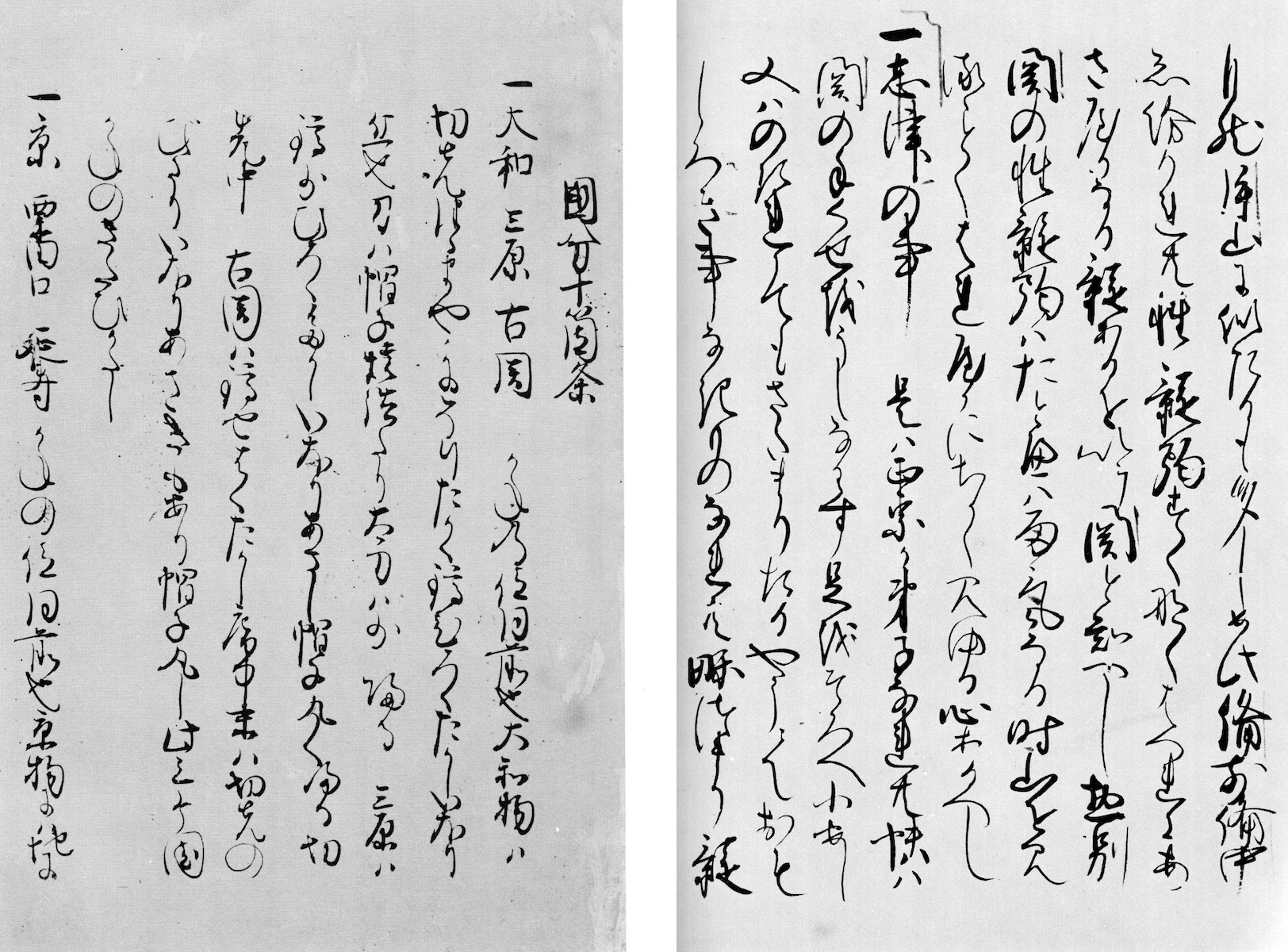
A few weeks ago, one of my dear clients sent me a gift, a thick and old book on Japanese swords, basically with the words: “I got this one but it makes more sense in your hands than in my library. Maybe you can get some valuable information out of it and share them with all of us.” Thank you very much Mr. D.! Now browsing through the book now and then over the last weeks, I found some highly interesting information but first of all, I realized again how tough it actually is to translate period Japanese sword texts. In this article, I want to give you an understanding of my daily struggles and walk with you through the different layers of challenges that I and others are facing doing this kind of stuff. Before we continue, I want to state that I will introduce the title of the book, its contents, and more details about it in the future but suffice it to say, it bases on period sword literature from the Momoyama to early Edo period that goes partially back to the Takeya (竹屋) system of sword knowledge (for some basic info on the Takeya family, see this article here).


Now the very first challenge is of course being actually able to read/decipher the characters of a text like the two above. For this, you need to know how a Japanese/Chinese character, a kanji is written, i.e. the stroke order and how strokes merge and/or are omitted when writing them in semi-cursive or cursive (grass) script. The former, knowing how a kanji is written, is relatively easy to learn but the latter, being able to grasp the semi-cursive and cursive script, takes some years. This is basically the same challenge as it is with handwritten period Western texts from let’s say the 1700 or 1800s. You just have to learn it. Short anecdote: Some years ago I visited an exhibition in Japan that focused on the early Meiji period and there were letters on display written by some Germans working in Japan at that time which I could not read (I am Austrian as most of you know, so German is my mother tongue). But I was able to read the handwritten letters of their Japanese employers…

If you are able to handle challenge one, the reading/deciphering of the kanji, challenge two comes into play which is making a sense out of what you got. For this you have to understand the Japanese writing system, which you probably do when being able to master challenge one, but for those who don’t, I will explain. The Japanese writing system uses Chinese characters, the kanji, and combines them with a pair of syllabaries, hiragana and katakana. In short, a Japanese sentence usually contains a mixture of kanji and hiragana/katakana, the former representing a certain term and the latter supporting the meaning of that term, having grammatical funtions, and representing particles, just to keep it simple here. To quote Wikipedia in this respect: “Because of this mixture of scripts, in addition to a large inventory of kanji characters, the Japanese writing system is often considered to be the most complicated in use anywhere in the world.”

But wait, there is more. Kanji can also be kana syllables. Yes, you read that correctly. We are talking here about so-called man’yōgana (万葉仮名), a writing system that employs kanji to represent phonetical syllables in the Japanese language. This approach was by the way the origin of the hiragana and katakana alphabet, that is, Chinese characters used to represent a certain phonetical Japanese syllable were written in more and more cursive ways and ended so up as the simple hiragana and katakana we all know today. Just to give you an example, the picture below demonstrates how the character bi/mi (美), which means “beauty”, became via its cursive style of writing the hiragana syllable mi. In other words, if this character appeares somewhere in a period Japanese text and doesn’t make any sense at all in that context, it might just be there substitutional for the sylable mi. So for example if you come across the characters (黒美) in a period Japanese text, they most likely don’t mean “black beauty” because the second kanji is just there for its reading mi. That is, the word is kuromi (黒み), which means “black tinge”, “blackishness”, etc.

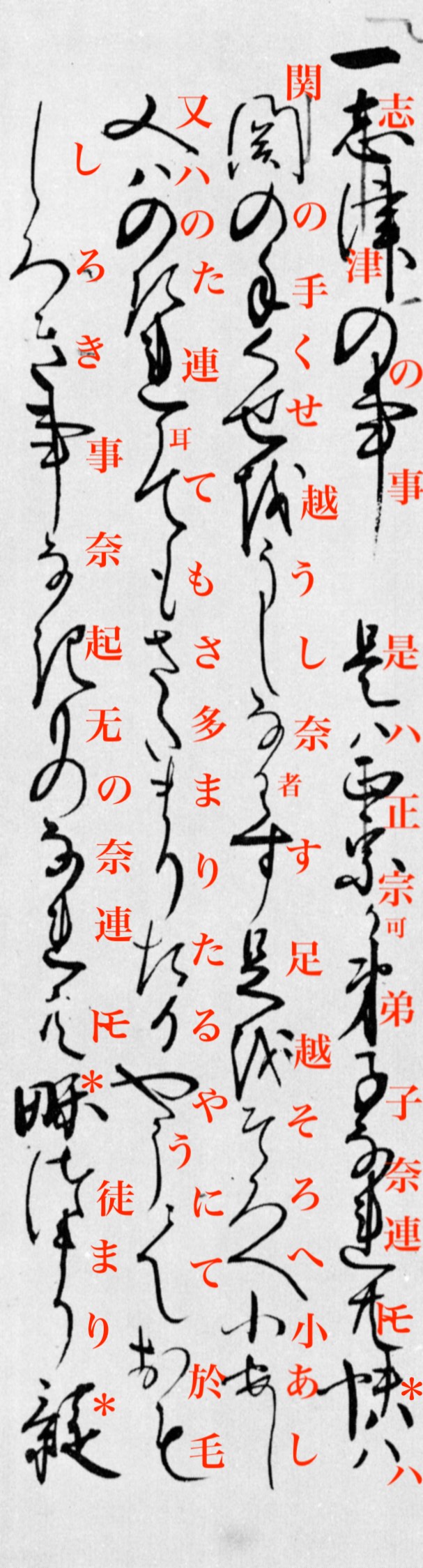
This brings us back to the first picture, the example I am using in this article, and I want to focus on the left four lines of the text on the right. So, if you truly master challenges one and two, you might be able to read/decipher these four lines as follows:


一 志津の事 是ハ正宗可弟子奈連トモ「ヤキバ」ハ
関の手くせ越うし奈者す足越そろへ小あし
又ハのた連耳てもさ多まりたるやうにて於毛
しろき事奈起无の奈連トモ「千ハ田」徒まり「景龴𤴓」

Shizu no koto – Kore wa Masamune ga deshi naredomo yakiba wa
Seki no tekuse o ushinawazu, ashi o soroe, ko-ashi
mata wa notare ni temo, sadamaritaru yō ni te omo
shiroki koto naki mono naredomo, jihada tsumari nie


I want to pick out one word to demonstrate what we just did, the third word in line two, ushinawazu. This word means “is not lost” and would today be written as (失わず), or just with hiragana syllables as (うしなわず). In the period text in question, the syllables na and wa have been replaced with the kanji (奈) and (者) which also read na and wa respectively. Apart from that, you also have to know when a syllable is voiced as those little voicing marks, the dakuten, are usually omitted in period texts. For example here, the last syllable zu is written with the hiragana syllable su (す) and you have to fill in the blank and “make” it into a zu (ず).

If you are still following, this is already pretty difficult so far and to bring that all together smoothly, i.e. being able to recognize, understand, and translate such a text, it takes many many years of studying.

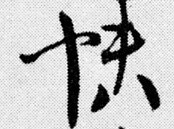
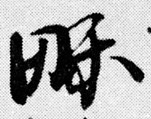
But that is still not all. I picked this text because it contains another nasty little challenge, and that is, it contains so to speak “made up fantasy characters.” Yes, you read that correctly again. The example features three of them which I had to put into Japanese quotation marks 「 」 (and mark them with an asterisk in the picture) because as they are made up as mentioned, they are obviously not available as computer-typeable kanji.


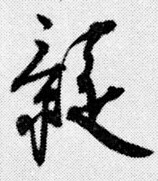
The first one is shown in the picture above. First you would assume some character with the heart radical (忄) to the left, maybe this one (怽). But this character is very uncommon and not in use in the Japanese language. Well, it is used in Chinese but its meaning “a troubled/confused heart” doesn’t really make any sense in this context. Next thing to assume would be that it was used for its phonetical reading, which is or in Chinese but mi or mo don’t make sense either at this place in the sentence. To cut it short: The “character” in question actually consists of the three katakana syllables ya (ヤ) to the left, ki (キ) on top right, and ha/ba (ハ) written around ki. You get it? The term we are looking for is yakiba!

So, making up a character from syllables was totally a possibility back then, even if there exists a just kanji combination for yakiba – (焼刃) – which is not that difficult to remember at all. That is, if you are able to write a book on swords that contains hundreds of other difficult characters, it is not about that you can’t remember the kanji for yakiba and have to make them up. We are just dealing here with customs that were handed down within schools of sword knowledge and we find made up characters like that all the way back in the oldest, pardon, second oldest extant sword document, the Kanchi’in Bon Mei Zukushi.


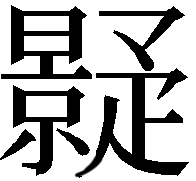
Back to the second of them (see picture above). Here you see the character (田) to the left and something like (禾) to the right but again, this combination doesn’t exists as a kanji. This time we are facing the combination chi/ji (千) on the left, ha/ba (ハ) written around that at the bottom, and ta/da (田) on the left, at least we had this initially correct… And with filling in the blank and adding the voicing marks in your head, you arrive at the term jihada!


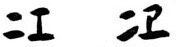
The last one (see picture above) is even more tricky. In this case, the left part of the character is kei (景) which means “scenery” but the part on the right doesn’t even exist as a character by itself. Here you just have to come across some explanation (like I did with the book in question) one day because without that, I guess it is impossible to figure out that the kanji you see above stands for nie, which is usually written with the character (沸). Another way to write nie in this sense of made up characters is combining the two katakana syllables ni (ニ) and e (エ), or ni (ニ) and we (ヱ) (see picture below). On a normal day, you would think of reading e (江) here, as in Edo (江戸), or as the abbreviated character for Gō Yoshihiro’s (郷義弘) (江). Big head scratcher again if you are not aware of the existence of made up characters and how they work.


*

In conclusion I would like to say that if you want to translate period Japanese sword texts, you have to go very deep into the matter of the language, the subject of the sword, and the historical background. But if you do, it is totally worth it because in my opinion, getting a better and better understanding of the subtleties in another language is the best way to develop a decent understanding of the way of thinking and of the mindsets of the people who wrote these texts in the past. Also with translating poems and understanding their sometimes obvious, sometimes highly sophisticated allusions via not only the language itself but the deliberate use of certain characters, you get a grasp of the entire whole of the nihontō that just learning features in the steel can’t deliver. But this is something you really have to invest time and energy in, and probably need a teacher, so nothing you can just tackle at the side. The icing on the cake after many years of blade studies if you will. I am now studying Japanese for exactly 20 years and translate for about 15 (first as a hobby and 10 years now full time as my job), and it still feels as if I just have pushed open a door, a significant door maybe which makes you aware that the doors you have opened so far were nothing compared to what is still out there…

*

Volume 2 – Tosogu Classroom

Update on the project:

Volume 2 has just been completed and I am placing orders for members who have prepaid as we speak. That said, if you are going volume by volume, you can get in touch with me at your convenience to order Volume 2. Members of the three associations who organized this project – which are the JSS/US, NTBHK/AB and NBTHK/EB – can order Volume 2 for just the cost of printing and shipping, which is $44 within the US and Canada. If you are not a member, the price is $64 per copy. Slightly different prices apply for outside of the US so please get in touch with me to talk about details. As you can see in the preview below, Volume 2 is with almost 700 pages quite substantial. It is the second volume that deals with artist who worked in iron. Volume 3 and 4, which should follow in the coming months, will deal with the kinkō guys and Volume 5 is the color volume.

Thank you for your attention.

Volume 2 Contents