Tosogu Classroom Volume 3

Dear Readers,

After a too long gap, which is all on me and not on anyone else involved with this project, I am happy to announce that Volume 3 of the series is finished! Yes, this is not a drill; I repeat, this is not a drill! In the next few days, I am tweaking the cover layout to match the first two volumes and check my proof copy upon arrival. After that, Volume 3 is good to go!

That said, for those who pre-ordered the set, please get in touch with me via markus.sesko@gmail.com in case your address has changed the last few years. I will also reach out directly, but if you get in touch with me in case you moved, this would save me some time and is very much appreciated!

Below, I am attaching the table of content of Volume 3. I think I have mentioned this before, but most of Volumes 4 and 5 is already translated and “just” needs proofreading/editing and layout, etc.

I sincerely thank you all for your patience!

TosoguClassroom-Volume3-Contents

Ten years in writing about Japanese swords…

Earlier this year, I passed the milestone of writing ten years about Japanese swords and related subjects here on this site. In order to preserve things for posterity, if ever something happens to me or this domain, I put together all articles (sans the Kantei series, which will be published separately) in two volumes, one for swords-related, and one for sword fittings and armor-related articles. The former counts almost 700 pages, and the latter 270 pages, containing roughly 130 and 50 articles, respectively. All articles were carefully edited, mostly in terms of English grammar and typos, and to standardize all punctuation and ortography.

I am now offering both for those who want to have all articles in a collective and form that can be read offline and that saves you from navigating through this website, etc. May also make a nice gift 😉 Reflecting the printing costs for hardcover and color, the books will arrive at $120 and $90 for the sword-related and for the sword fittings and armor-related volume, respectively. A searchable digital version is available as well, which would arrive at $80 and $40.

If you are interested in acquiring a copy, or have any question about them, please reach out to markus.sesko@gmail.com. As always, thank you very much for your attention, and for being so faithful readers here for over a decade!

Content-Swords

Content-FittingsEtc
 

HONMA’S APPRAISAL DIARY VOLUME 4

Well, we have arrived at Volume 4 of Honma’s Appraisal Diary. This volume, which covers the year 1975, introduces on ca. 380 pages 275 blades, meaning we have now arrived at a total of about 1,580 pages of text and 1,222 featured blades in this series. The price is yet again $99, which includes shipping.

If you would like to order a copy, and/or have any questions, please reach out via markus.sesko@gmail.com


As a reference, below are the links to the previous volumes:

 
Index to Volume 4 below:
 

Juyo Quantities – Ebb and Flow

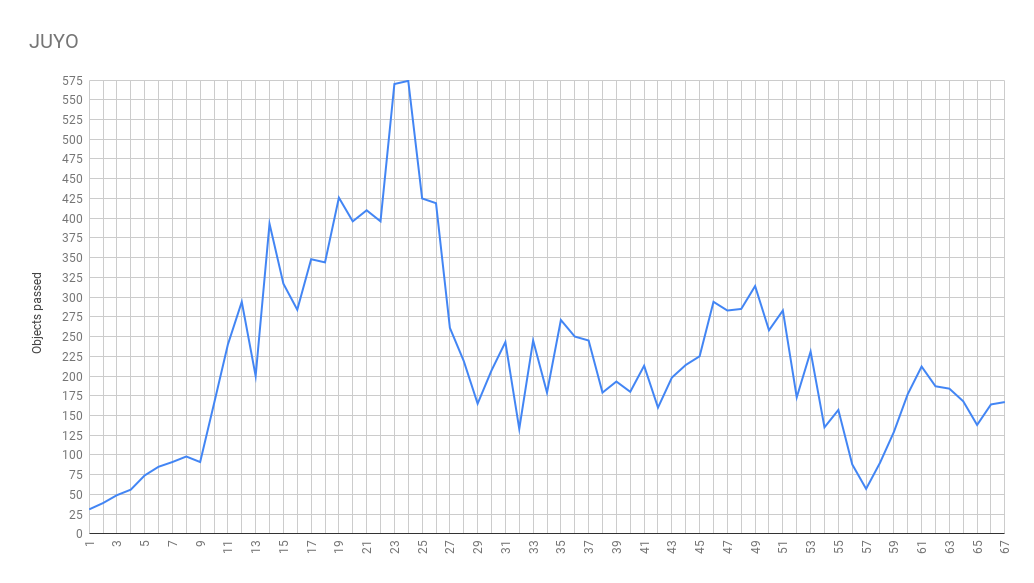
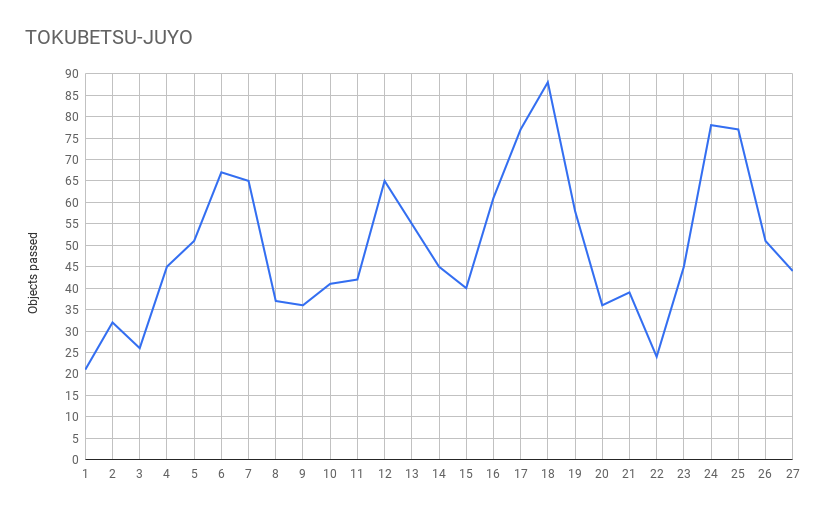
I was looking at some quantities of objects passing in specific NBTHK Jūyō and Tokubetsu-Jūyō Shinsa and so I thought it might be interesting for the one and other to see the ebb and flow of numbers over the years. That is, the numbers of objects that pass increases to a certain point and than the corrective kicks in, if you will, and subsequent Shinsa become once again tighter.

As for the years, the current Jūyō system started in 1958, and the first Tokubetsu-Jūyō Shinsa was held in 1971, just so that you get a better idea of the x axis of the two charts below.


Tiger & Dragon Tadakuni

Quick post. Wanted to share something I came across a while ago whilst looking up a blade in Satō Kanzan’s Shintō Oshigata. The book features a blade by Hizen Tadakuni (肥前忠国), which shows a hardening pattern in the form of the Kanji characters for “tiger” (虎) and “dragon” (龍), plus the shape of a dragon as well. Just thought you might find this interesting, as I did.


Honma’s Appraisal Diary Volume 3

Continuing from the previous post, we have now reached Volume 3 of Honma Junji’s Appraisal Diary.Volume 3 covers the year 1974 and introduces in about 350 pages roughly 255 blades. Total for Volume 3 is $99, which includes shipping.

With Volume 3, we have arrived at about 1,200 pages of text and almost 1,000 blades! Please let me know if you have any questions.

Honma’s Appraisal Diary

For the advanced Kantei participants, and for those who just love to read about all sorts of sword stuff, I am offering the first five years of Honma ‘Kunzan’ Junji’s Appraisal Diary (Kantō Hibi Shō), which was published in the Tōken Bijutsu magazine of the NBTHK between 1969 and 1983. The translations provide a very valuable insight into the mind of one of the greatest sword scholars of the 20th century, and unlike in “official” blade descriptions, Honma is occasionally quite frank about period attributions and what he thinks about a certain blade.

In about 480 (letter format, paperback) pages, Volume 1, which covers the years from 1969 to 1971, introduces roughly 400 blades, of which many are accompanied by oshigata drawings. Price for Volume 1 arrives at $129.00, which includes shipping.

Volume 2, which covers the years 1972 and 1973, introduces in about 370 pages roughy 300 blades and arrives at $99.00, again, with shipping included.

If you are interested in acquiring a copy or both, please reach out to me via markus.sesko@gmail.com. Thank you!

Reading another kozuka motif

Whilst I was looking for somthing else, I came across a note in my database that said: “43.120.151 – Check signature.” The background for this entry is one of the first projects I tackled after joining The Met in 2018, which was to decipher and translate all the signatures seen on sword fittings and put that into a database. To give you an idea about the scope of this venture: Of about 3,500 sword fittings in the collection of The Met, about 2,500 are signed.

So, the object in question, which has the accession number 43.120.151, is a humble kozuka that bears an inscription and a difficult to decipher signature. The piece itself is of shibuichi and depicts a tree and two eldery men in low relief, whose walking sticks are highlighted via gold iroe. Thus, my first thought was, the motif is probably a reference to some famous Chinese subject, like Taoist immortals or hermits, etc. In any case, I was more interested in the inscription as I always see them as a challenge and good opportunity to learn something.

Luckily, the inscription is not interpreted in crusive script and is therefore relatively easily to decipher as:

桑樜影斜春社散
家々扶得醉人歸

Sōsha-kage o namame ni shite shunsha san-su,
kaka suijin o tasuke-ete kaeru.

I will deliver the translation shortly, but I want to walk you through the “solving process” so to speak. Just googling this inscription, which has been revealed as being a poem, yields fairly many results, and after some research, I was able to find what I think was the very inspiration for this kozuka. That is, a double-page in the Waka Meiga En (和漢名画苑, lit. “A Garden of Celebrated Japanese and Chinese Paintings”) that was published by Ōoka Shunboku (大岡春卜, 1680–1763) in Kan’en three (寛延, 1750). Fortunately, The Met is also in the possession of a copy Shunboku’s six-volume publication, so you can find some information on this publication here.

The aforementioned double-page is titled: Gan Ki hitsu (顔輝筆, “Painting by Yán Huī [early 14th century]”) and Yotte Kika Zu (酔歸家圖, “Drunks Going Home”). This title is then followed by the very poem we see on the kozuka, and the double-page can be seen below.

As you can see, we have some adults and the eldery with walking sticks depicted, plus trees and some kind of pathway between foothills of mountains which are referenced on the kozuka as well. And now we come to the translation of the poem, that is, what is this motif all about?

“When the shadows of the mulberry trees lengthen and the Spring Festival breaks up, all families return and support those who are drunk.”

So, the double-page and the kozuka depict just that, i.e., ordinary people returning to the village after having enjoyed a festive day somewhere outside, with some of them overdoing it with the sake and now need help to make it back home safely. I can imagine this evening scene very well😇

But, it wouldn’t be fun without a little mystery, right? The mystery in this case being the actual signature of the piece. For the sake of completeness, the copper seal at the very top right of the kozuka reads “Kyōto seal” (京印). Now, the mei (some shots that show the mei and inscription a little better are shown below) starts with Shiryū (紫龍), which is one of the many art names () of Ōtsuki Mitsuoki (大月光興, 1766–1834), and the last two characters are dōjin (道人). The character in between is a bit difficult to read, but I think it is Mitsu (光). That is, it does not appear as (堂) to me, which Mitsuoki used as suffix for the previously mentioned art name in the form of Shiryūdō (紫龍堂), and it does not appear to be Kyoku (髷) either, which Mitsuoki used as a prefix for dōjin to create yet another art name, Kyoku-dōjin (髷道人). In short, the signature could either be “Shiryūdō-dōjin” (紫龍堂道人), or “Shiryū Kyoku-dōjin” (紫龍髷道人), but as mentioned, I don’t think that this is the case. We know that Mitsuoki very often abbreviated his family name Ōtsuki (大月) to just as Tsuki (月). So, there is the remote possibility that he abbreviated his name Mitsuoki to just as Mitsu here, although I have to admit, I have never seen any other work of his signed this way, i.e., “Shiryū Mitsu dōjin” (紫龍光道人)…

Lastly, I would like to mention that the kozuka came to The Met as part of the large collection of sword fittings the brothers Herman A. E. and Paul C. Jaehne gifted to the museum in 1943. Some of their records and notes are still with certain pieces, and the kozuka introduced here comes with the cryptic description: “Unsigned? After the old painting by Masayuki, by Horyusai Mitsukyo.”

Oda-Samonji (織田左文字)

This time, I would like to introduce a meibutsu (名物, renowned sword with a nickname) that has been rehardened (saiha, 再刃), and that sword is the Oda-Samonji (織田左文字).

The Kyōhō Meibutsu Chō (享保名物帳) introduces the sword as follows (notes in square brackets added by me for reasons of clarification):

Oda-Samonji, suriage, 2 shaku 2 sun 4 bu (~ 67.9 cm), value 100 gold coins, [in the possession of] Lord Ii Kamon no Kami [Naomasa] (井伊掃部頭, 1561–1602).
Owned by Lord Nobunaga (信長, 1534–1582) who gave it to his second son Nobukatsu (信雄, 1558–1630). Afterwards, through whichever transmission, owned by Lord Kamon no Kami. Appraised in Keichō four (慶長, 1599).

The Oda-Samonji.


Right away, we have here the origins for the nickname of the blade, i.e., the blade is called Oda-Samonji because it was once owned by Oda Nobunaga. Prior owners are unknown. Journalist and sword scholar Takase Ukō (高瀬羽皐, 1853–1924) writes in his 1919 publication Shōchū Tōken Meibutsu Chō (詳註刀剣名物帳,), which is an annotated version of the Kyōhō Meibutsu Chō, that he was unable to find any reference to how the sword came into the possession of Ii Naomasa. In Volume 1 of his Nihontō Daihyakka Jiten (日本刀大百科辞典, 1993), Fukunaga Suiken (福永酔剣) speculates that the blade may have come into the possession of Naomasa as a reward for defeating Nobukatsu’s retainer Maeda Yojūrō (前田与十郎) after Maeda had switched sides and supported Hideyoshi in 1584.

Takase Ukō (高瀬羽皐, 1853–1924).


So, be that as it may, the sword remained henceforth in the possession of the Ii family, who were the Daimyō of the Hikone fief (彦根藩) in Ōmi province. It is unclear if an origami was issued at the time of the Keichō four appraisal. The current origami that exists for the blade goes back to Hon’ami Kō’on (本阿弥光温, 1603–1667) and was issued in Keian four (慶安, 1651). It remains with the attribution to the early to mid-14th century smith Samonji (左文字) and with the evaluation of 100 gold coins.

Towards the end of the Edo period, when Ii Naoaki (井伊直亮, 1794–1850), the twelfth head of the Ii family after Naomasa, was in possession of the sword, he had a new koshirae made for it. The copper tsuba (see picture below) features the characters “Oda-Sa” (お多左) as sukashi design, which is based on a calligraphy of said characters written by Ii Naoaki himself. This fact is recorded on the tsuba via the inscription: Tō no Chūjō Naoaki kore o sho-shita + kaō (藤中将直亮書之「花押」, “Written by Tō no Chūjō [a title] Naoaki + monogram”).

Oda-Sa tsuba (privately owned).


Ii Naoaki (井伊直亮, 1794–1850).


Then in 1923 unfortunately, the blade was damaged in the devastating fire that followed the Great Kantō earthquake as the Ii main residence in Tōkyō was one of the countless buildings that did not survive. At some later point, the blade was rehardened, but it is unclear when this took place and who carried it out. The blade is now in the possession of the Hikone Castle Museum by the way, which houses the huge collection of the former Ii Daimyō family.


Page from the Imamura Oshigata.


Imamura ‘Chōga’ Nagayoshi (今村長賀, 1837–1910).


We do have, however, an oshigata of the blade that was made before the fire damage and rehardening (see picture above, right). It is featured in Volume 2 of the posthumously published oshigata collection of sword expert Imamura ‘Chōga’ Nagayoshi (今村長賀, 1837–1910) titled Imamura Oshigata (今村押形・古刀第二巻, 1927). Therein, Imamura refers to the blade as being in the possession of “Count Ii.” There were two heads of the Ii family bearing that title, Ii Naonori (井伊直憲, 1848–1902), the son of Naoaki’s successor Naosuke (井伊直弼, 1815–1860), and Naonori’s son Naotada (井伊直忠, 1881–1947). The oshigata is not dated and Imamura passed away in 1910, so it is possible that he had studied the blade either when it was with Naonori or with Naotada. Interestingly, Imamura also made a rubbing of the tsuba (see picture above, left). Incidentally, Naotada was the head of the Ii main line when the Great Kantō earthquake took place. Naotada was known for being a connoisseur of Japanese art, in particular of the Nō drama. It is therefore conceivable that it was him who commissioned the rehardening of that family heirloom sword.


Ii Naonori (井伊直憲, 1848–1902) (left), Ii Naotada (井伊直忠, 1881–1947) (right).


Coming back to the pre-saiha oshigata. Takase writes in said publication that he remembers Imamura mentioning that the omote side shows a midare with saka-ashi that resembles the style of Bizen Motoshige (元重) and that the ura side is truly interpreted in the typical style of Samonji. Fukushi states the same and adds that the hamon on the ura side (which was originally the omote side when the blade was still a tachi) is a large-dimensioned midareba and that the bōshi of the ura side is pointed and interpreted in kaen style. Fukushi also quotes from the Meibutsu Hikae (名物扣), a Hon’ami internal draft for the later Kyōhō Meibutsu Chō if you will, in which it is stated that there are traces of a soebi, that there is a kizu (flaw) above of the hamon at about 1.2 cm below of the kissaki on the omote side, and that there is also a ha-kobore (chip) in the monouchi area. I can not detect these soebi traces and that kizu on the photograph shown above, which is from the Sano Museum catalog to its 2009 special exhibition Reborn (p. 45). Also, I can not see any chipping in the monouchi in this photograph, but we can assume that any minor chip has been polished out since the Meibutsu Hikae was compiled in the early 18th century, and that the traces of the soebi disappeared that way as well.

Interestingly, Watanabe Taeko (渡邊妙子), the director of the Sano Museum, writes in the exhibition catalog entry to this blade that on the basis of the hamon seen in Imamura’s oshigata, it appears that the blade is a work of Samonji’s son Yasuyoshi (安吉). I would agree in terms of sugata and the bōshi, but in my humble opinion, I am associating a relatively narrow ko-notare-based hamon with Yasuyoshi that is mixed with a more or less pronounced amount of gunome and togariba, or connected sections of such. I do not recollect coming across a long sword by Yasuyoshi that has such a wide and clearly slanting midareba. In any case, Watanabe further writes that in its current condition, the blade displays a faintly visible itame that makes the jigane tend to muji, that the hamon is a nie-based connected gunome, and that nie activities are also extending into the ji.


Juxtaposing the photo of the blade with Imamura’s oshigata (see above), it appears that the latter may not have been consulted for the rehardening job as I see a greater tendency to gunome in the new hamon. However, it is difficult to tell from this photo alone, so this is just an impression and the new hamon may actually do slant more than it looks. That said, the Oda-Samonji is an interesting case of a named blade that was handed down within the same family for 300+ years, and it was so much treasured that even a Daimyō took it on himself to provide the calligraphy for the tsuba design of a koshirae project that he had initiated.

Not your usual hataraki

This will be a brief post. Background: I came across a blade with interesting activities above the hamon.

We all know that by the shintō era, swordsmiths became increasingly concerned with the appearance of the hamon. In a nutshell, we see a shift from the aesthetics that result from form follows function towards seeing the surface of a blade as a canvas that can be adorned with a hamon at will. Accordingly, we see hamon that deliberately try to evoke pictures of plunging or surging waves, cloud banks, a mountain range, etc., and then with the shinshintō era truly picturesque hardening patterns, e.g., kikusui (chrysanthemum floating on water) and Fuji-mi Saigyō (poet Saigyō looking at Mt. Fuji) emerged.

The sword in question is a work by the second generation Tango no Kami Kanemichi (丹後守兼道) from the Mishina (三品) School. Kanemichi, real name Mishina Kiheiji (三品喜平次), was the son and heir of the first generation Tango no Kami Kanemichi (丹後守兼道 , 1603–1672). His father was the second son of the Kyōto-based master Tanba no Kami Yoshimichi (丹波守吉道) and had relocated to Ōsaka during the Kan’ei era (寛永, 1624–1644).

We are dealing with a wakizashi with a nice Genroku-shintō-sugata (deeper curve than seen with the preceding Kanbun-shintō-sugata) that displays a calm and gently undulating notare in ko-nie-deki. Striking, and that is the point of this post, are the five prominent tobiyaki in the upper section of the blade. Smaller tobiyaki over notare billows can represent spray, or a single larger one the sun or the moon, but five such big ones? And they are clearly no mistake as they appear on the ura side as well (also five).

So, what are they? As we are dealing with five circular tobiyaki, one might think of the gosei (五星). Gosei are the planets Mercury, Venus, Mars, Jupiter, and Saturn, which were regarded as major planets and which are visible to the naked eye. These planets are the basis for the conceptual scheme of the Five Phases or Five Elements (gogyō, 五行), i.e., fire, water, wood, metal, and earth/soil and are thus very important for astronomy, the calendar, the horoscope, and much more.

More likely, however, the tobiyaki represent the upper part of the asterism of the Big Dipper. There was a blade with very similar features for sale at the Samurai Museum Shop (link), although here, we have seven tobiyaki and thus all the starts of the Big Dipper represented. Interestingly, this blade is also the work of a Mishina School smith, Echizen no Kami Minamoto Rai Nobuyoshi (越前守源来信吉). The website also elaborates a bit on the religious meaning of the Big Dipper and you can find more and very detailed information on Mark Schumacher’s outstanding website here.

It is likely that the owner of the sword was involved in some of these beliefs, but I am too busy right now to speculate about how exactly swords can be linked to Big Dipper worship, apart from the fact that Myōken (妙見), the Buddhist deification of the North Star and/or the Big Dipper, is often depicted with holding a sword over his head (see picture below). My aim with this very brief post was to make readers aware of that when seeing a shintō or later blade with an unusual hamon and/or hataraki, one should assume that it was not done at random.