Brief update: Over the last few months, several readers approached me who were informed by others about my revised 3-volume set Swordsmiths of Japan (see here) but couldn’t find it on Amazon. Well, the set is not available there because Lulu does not offer a distribution of this kind of format and layout (i.e. hardcover and 8.25″ x 10.75″) on Amazon. Only smaller hardcovers make it over there. Of course I was referring to Lulu where the set is perfectly find and orderable but then I was told “Amazon or it did not happen” 😉 So I add a poll to this post to see if there are more who want a somewhat cheaper paperback version to be orderable from Amazon. Depending on the feedback, I will provide a new, additional edition or not. Thanks for your time!
Category Archives: Uncategorized
Book Review – Nihon no Bi: Nihonto
Finally received my copy of Gakken’s latest sword publication Nihon no Bi: Nihonto (The Japanese Sword) the other day (thanks to Jason). To tell you right away, I really really appreciate the approach of this book as it is the first in this category (of books coming from Japan) that comes fully bilingual. That means it is not, as so often, a sword book in Japanese with just an English index and here and there some half-hearted English captions, no, it is as mentioned truly bilingual. Or almost, as the descriptions of the tsuba and kodôgu were not translated. But not a big deal and I am aware of the fact that sometimes concessions have to be made to layout and to extent of a publication and that the focus was clearly on swords. Also Paul Martin did a great job with the translations and I am very glad the he did this as he is an expert himself and knows his stuff, i.e. we are luckily not dealing with “outsider” translations that leave ambiguities. This becomes the more evident in the extensive 40+ pages terminology section at the end of the book. So if you grab a copy, you not only have depictions and explanations of the great swords (with which I will deal in the following), you also get a detailed and comprehensive sword glossary that works as a fine reference by itself.
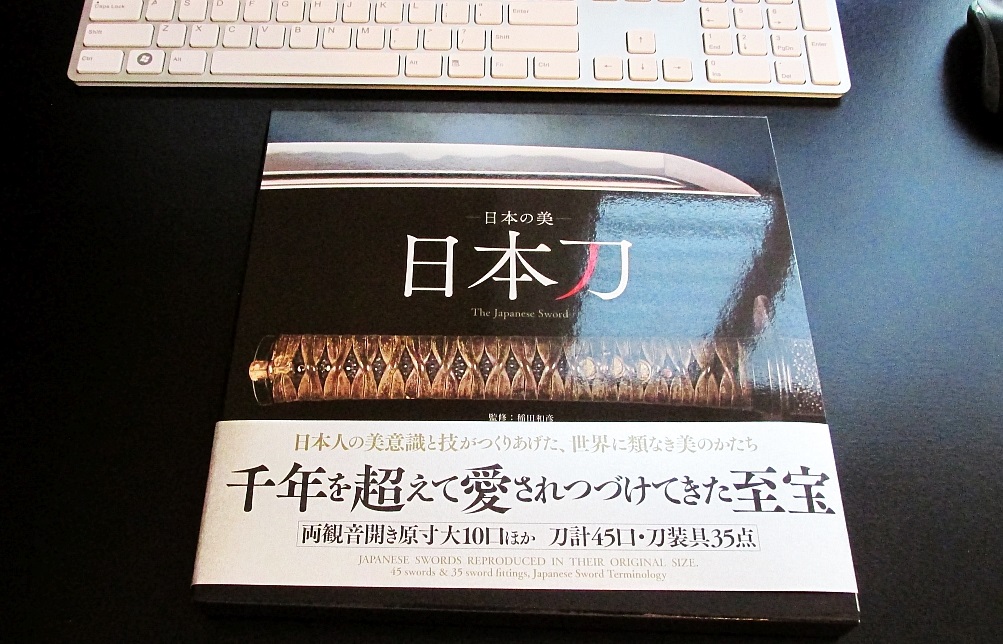
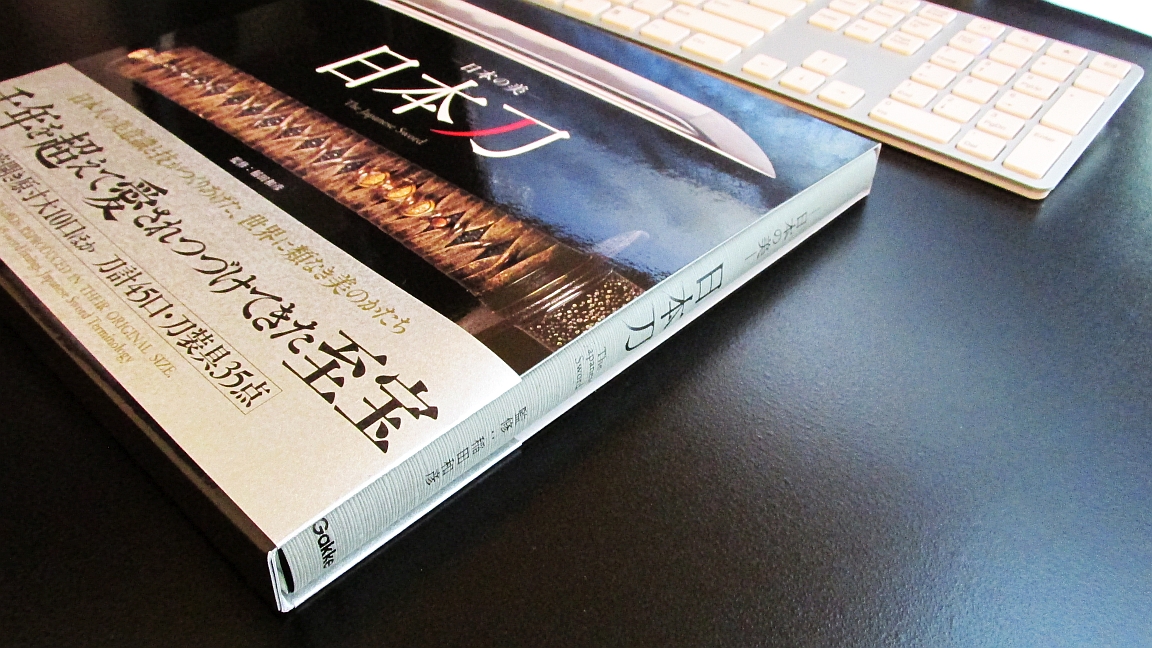
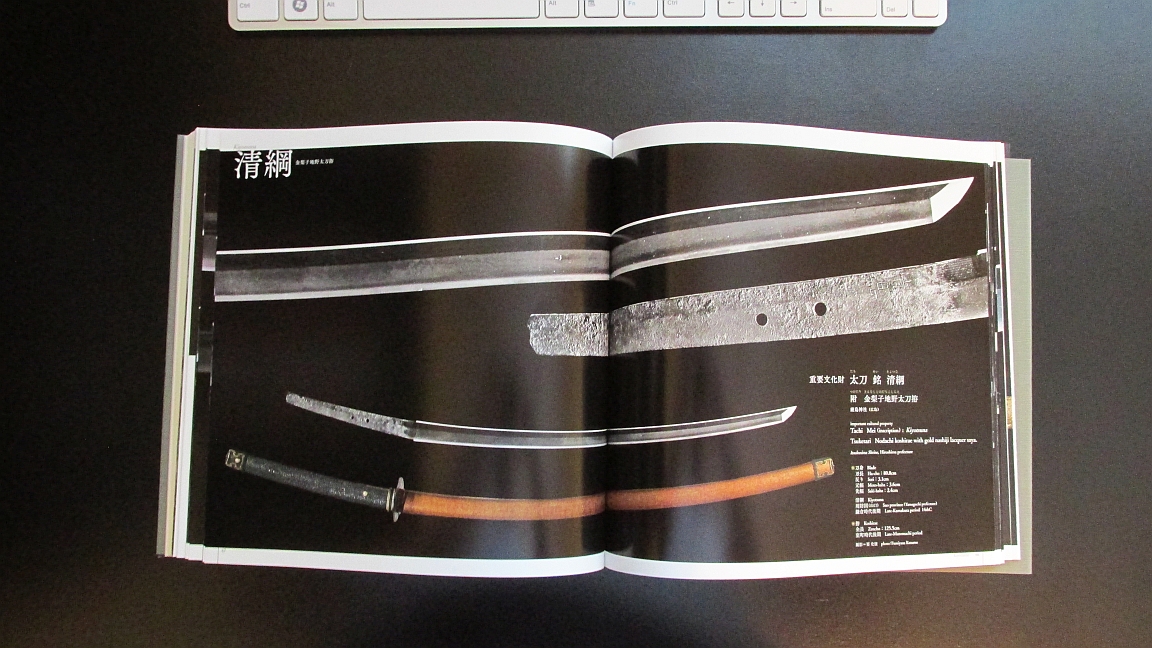
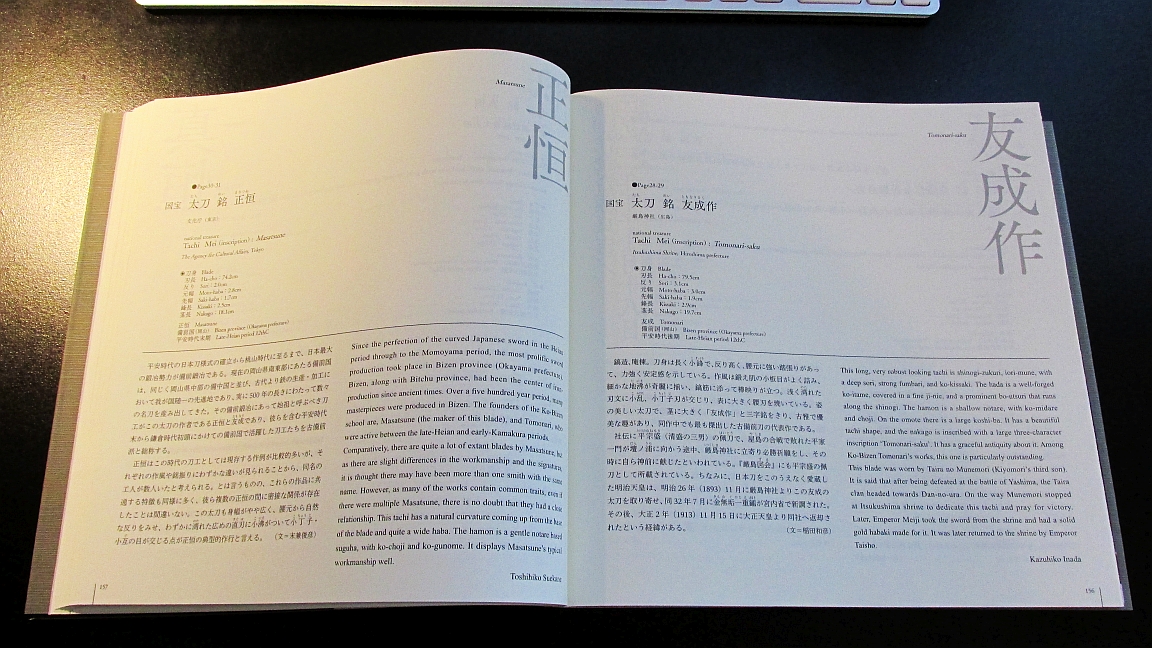
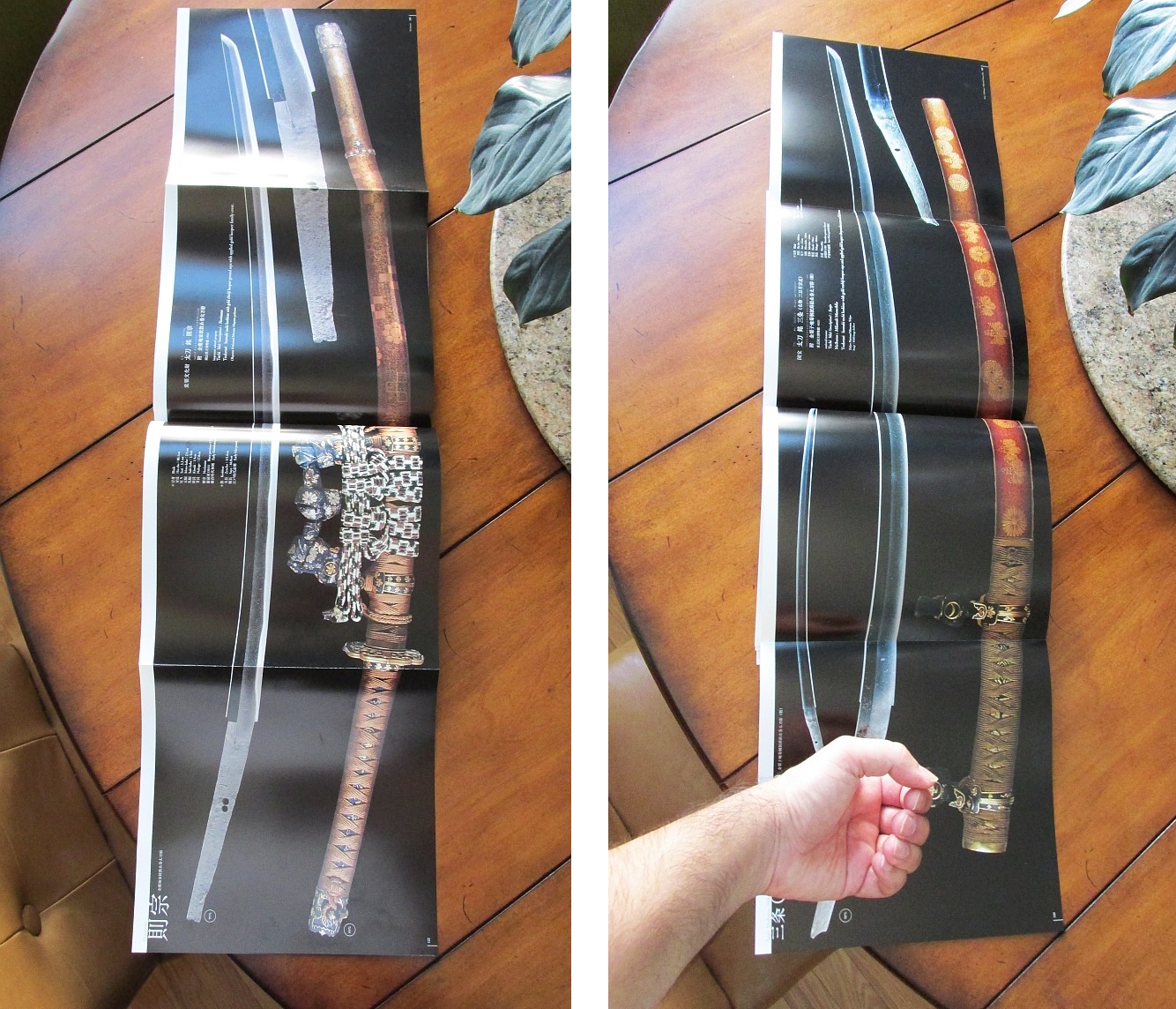
Now to the book itself, which is four-sectioned (or at least that is how I see it, your mileage may vary). First section introduces about 30 renowned blades in color and with certain parts in full size. Depending on the sword, also its mounting is depicted in color. This section is concluded by several fine koshirae with excellent details of their highlights and masterly tsuba and fittings. As most of them are also blown up to 200~300% (135~185% when it comes to tsuba), you can really appreciate subtle details in workmanship. The second section are the pullout pages which present 1:1 color pictures of about a dozen of renowned swords and their mountings. And this section is great as it gives newbies and others who don’t have access to handle and study superior Japanese swords in person a good feel of the excellence and what makes the fascination of these superior and so much more than edged weapons. Thus one tip: Some of the swords might look at a glance delicate and fragile for beginners when you open the book but when you pull out the pages fully and place them vertically on a (preferrably empty) table or on the floor and approach them just as you would pick them up at a sword appreciation (kantei) session, you will realize how magnificent and breathtaing they actually are! The third section provides the explanation of the blades introduced in sections 1 and 2 and comes in an appealing layout as each one page is reserved for one blade and due to the bilingual approach with the Japanese text and Paul’s translation right next to each other, this also provides a great exercise for those who are about to dig deeper into the subject of translating nihontô-related texts. And section four is the aforementioned terminology part.
My conclusion: This book should be found in every nihontô library as it also excellently serves as a teaser if someone interested asks you to tell him or her more about this fascinating subject and you can show him or her, via catchy pictures, what this is all about. The only small downer is that you can’t easily order it outside of Japan for example from amazon.com. But it is relative easy to create an account on amazon.co.jp (no, your amazon.com account won’t work for that and you need to register with a different email address) and order it from them. Five of five stars.
KANTEI 4 – YAMASHIRO #10 – Awataguchi (粟田口) School 5
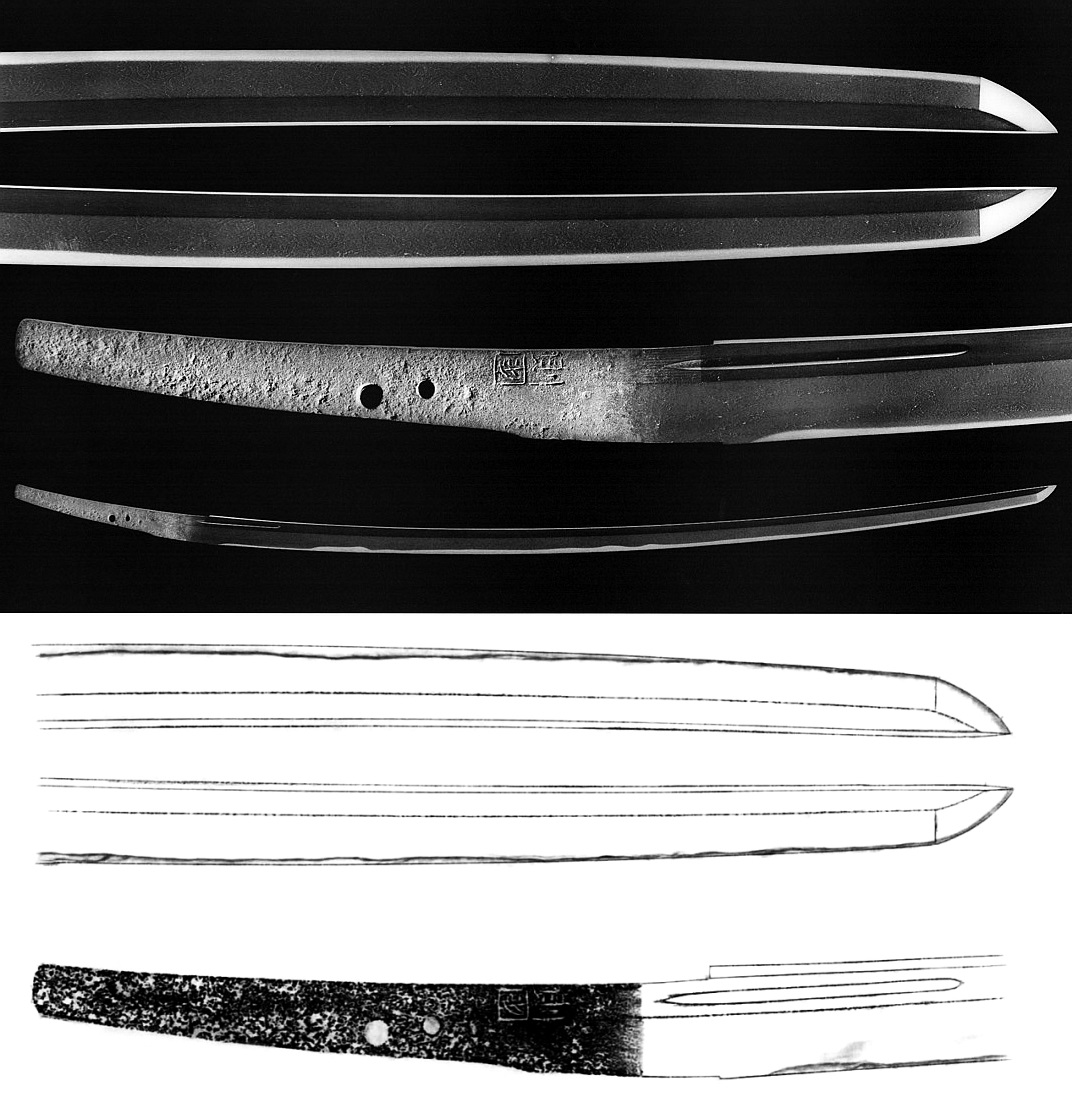
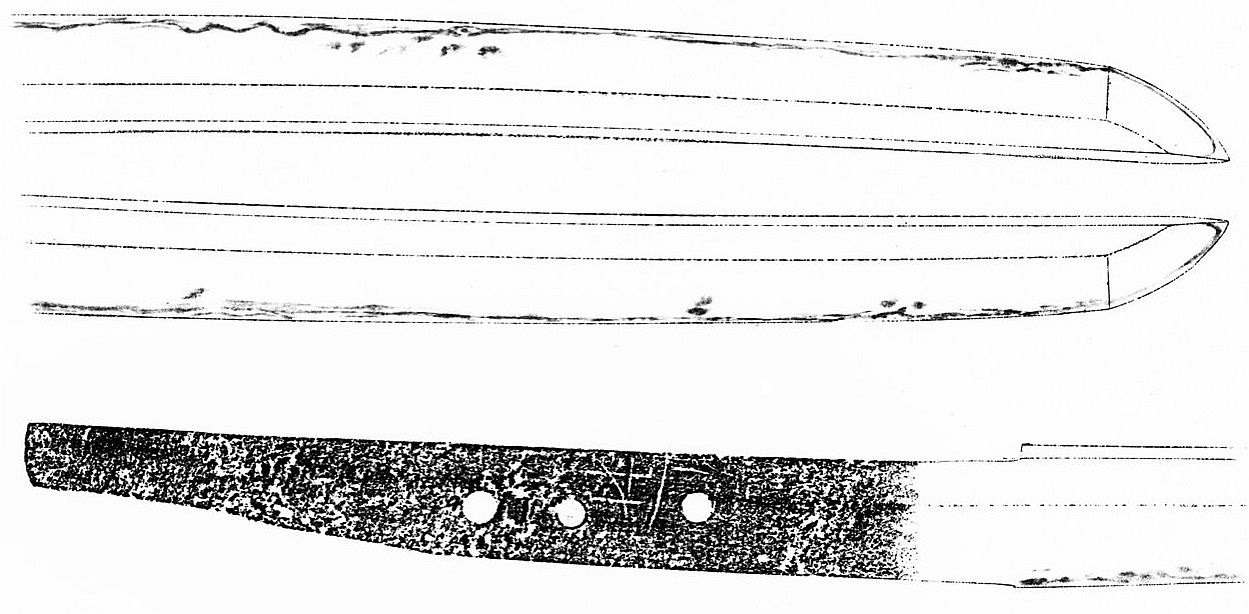
We continue with the Awataguchi main line which was succeeded after Kunitomo by his son Norikuni (則国). The Kotô Meizukushi Taizen says that he was born in Jô´an four (承安, 1174) and that he died in Ryakunin one (暦仁, 1238) at the age of 65. Traditionally he is dated around Jôkyû (承久, 1219-1222) although some put him around Katei (嘉禎, 1235-1238), that means with Norikuni, we are slowly approaching mid-Kamakura. His first name was Tômanosuke (藤馬允) and like his uncle Kunitsuna (国綱) and his cousin Kagekuni (景国), he was part of the Oki-goban-kaji group. It seems that Norikuni has focused more on the production of tantô, or at least he is the early Awataguchi master of whom the most tantô are extant. But we are lacking a sound quantitative evidence base to say for sure what his main focus was and if the increased tantô production started with him or if the tantô production increased at all at a certain point in time or if there are just no such blades of the earlier smiths extant. To my knowledge, there are four signed Norikuni tachi going round, the most representative one being the kokuhô that was once a heirloom of the Ikeda (池田) family, the daimyô of the Tottori fief (鳥取藩) of Inaba province (see picture 1). This blade keeps despite of the suriage some of its originally deep koshizori, features a ko-kissaki, and is overall quite elegant and of a very harmonious tachi-sugata. The kitae is a very dense ko-itame with fine ji-nie and chikei and appears as nashiji-hada and the hamon is a ko-nie-laden hoso-suguha-chô with a little shallow notare sections that is mixed with ko-midare, ashi, yô and frequent kinsuji. The bôshi is sugu and shows a ko-maru-kaeri with kinsuji. In general we can say that Norikuni’s interpretations are a hint more nie-emphasized than that of his successors Kuniyoshi and Yoshimitsu. The tang is as mentioned suriage but its original katte-sagari yasurime can still be made out. The niji-mei is preserved at the very tip of the tang.
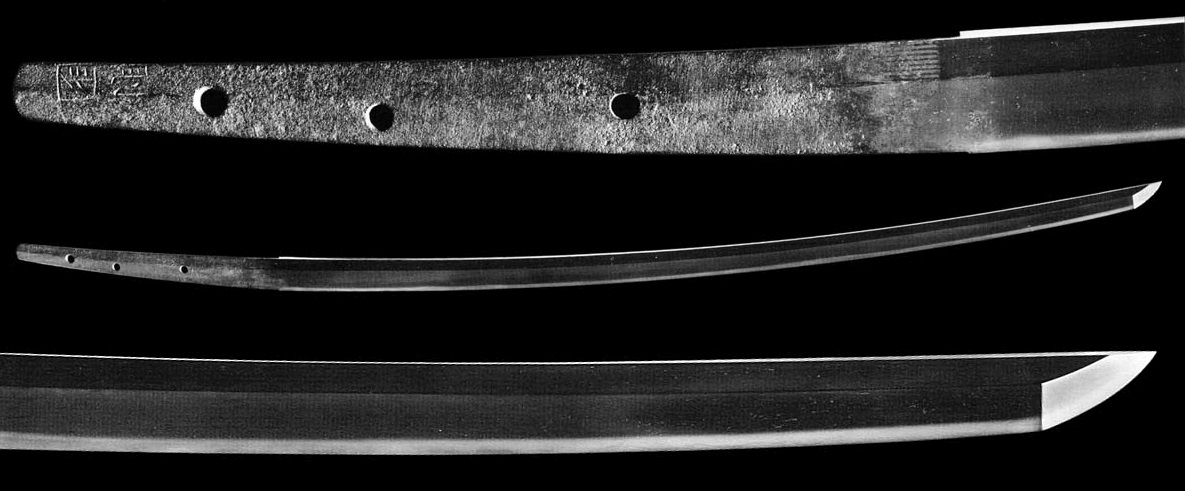
Picture 1: tachi, kokuhô, mei “Norikuni” (則国), nagasa 74.7 cm, sori 2.1 cm, shinogi-zukuri, iori-mune, please click here to see get some close-ups of the blade
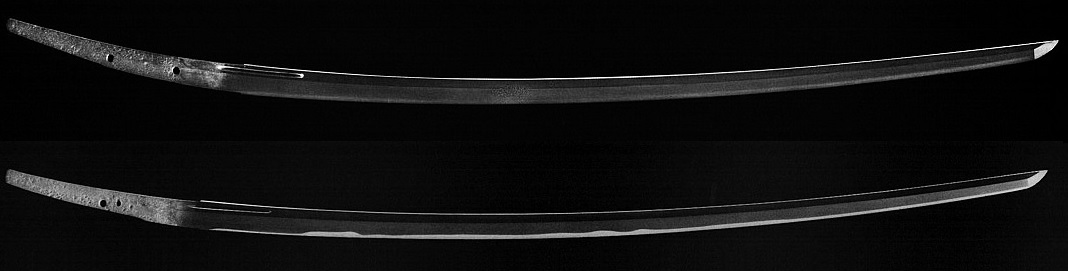
Following the kokuhô, there are two tachi of Norikuni that bear the status of jûyô-bunkazai which I want to introduce in the following. One of them (see picture 2) is owned by the Atsuta-jingû but preserved in the Tôkyô National Museum. It is also slender and elegant and almost ubu, that means it retains its deep koshizori and also its funbari. The kitae is a dense ko-itame in nashiji with ji-nie and a faint nie-utsuri. The hamon is a suguha-chô in ko-nie-deki that is mixed with ko-chôji, ko-midare, ko-ashi, and kinsuji and the bôshi is notare-komi with a somewhat pointed ko-maru-kaeri.
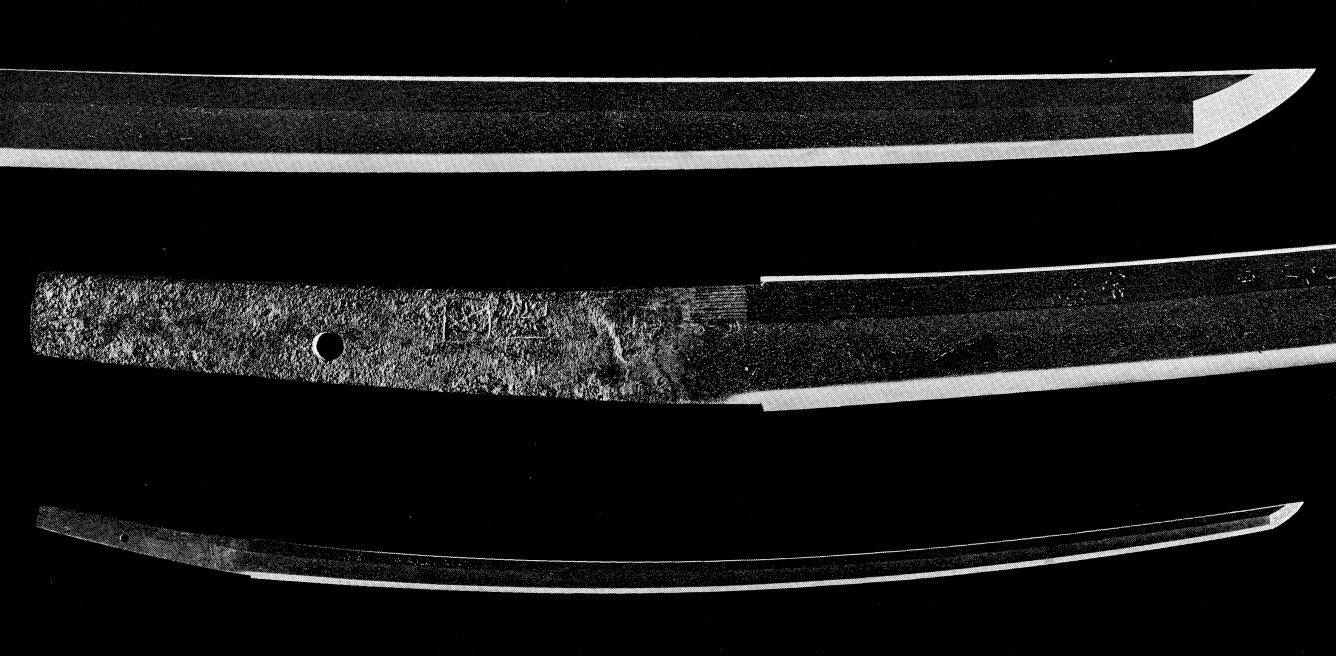
Picture 2: tachi, jûyô-bunkazai, mei “Norikuni” (則国), nagasa 72.1 cm, sori 2.7 cm, shinogi-zukuri, iori-mune
The other jûyô-bunkazai (see picture 3) is preserved in the Konda-Hachimangû (誉田八幡宮, Ôsaka Prefecture). This tachi is with a nagasa of 81.1 cm rather long and has a wide and noticeably tapering mihaba (from 3.2 cm motohaba to 1.7 cm sakihaba), a koshizori, a thick kasane, plenty of niku, and a ko-kissaki. The kitae stands a little more out than at the aforementioned two blades and shows some masame towards the ha but is overall forged as itame with chikei and plenty of ji-nie. The hamon is a suguha in ko-nie-deki with a somewhat subdued nioiguchi that is mixed with ko-midare and many ko-ashi and that starts with a hint of yaki-otoshi. The bôshi is sugu with a wide ko-maru-kaeri and the tang is ubu and shows a shallow kurijiri. In addition, the name of the donator to the shrine is inlayed in gold in a carved out recess on the tang and the whole kinzôgan-mei reads “Ôhashi Nyûdô Shikibu Kyô Hô’in Ryûkei” (大橋入道式部卿法印竜慶, the donator) on the one, and “Kenjô Konda-Hachimangû moshi sejin kore o obau kami no bachi o ukubeki nari” (献上誉田八幡宮世人若奪之可受神罰也, “offered to the Konda-Hachimangû and if stolen, the stealer should receive divine punishment”) on the other side. Incidentally, Ôhashi Ryôkei (1582-1645) was a renowned calligrapher and tea master of the early Edo period. He served Hideyoshi and Ieyasu and the blade had been a family heirloom since the Muromachi period. The jûyô-bunkazai designation mentions that the tachi was handed down under the nickname Karigiri (鐘截, lit “temple bell cutter”) within the Ôhashi family.

Picture 3: tachi, jûyô-bunkazai, mei “Norikuni” (則国), nagasa 81.1 cm, sori 2.6 cm, shinogi-zukuri, iori-mune
Picture 4 shows a signed tokubetsu-jûyô tachi that is ubu too, slender, and highly elegant. It shows a deep koshizori with funbari and a ko-kissaki and the kitae is an itame mixed with mokume that features plenty of ji-nie, chikei, and a faint nie-utsuri. The hamon is a hoso-suguha-chô in ko-nie-deki that is mixed with ko-midare, ko-chôji, ko-gunome, ashi, hotsure, uchinike, nijûba, and fine kinsuji. The bôshi is sugu and runs out as yakitsume. Please note that this blade too shows a brief yaki-otoshi and a thin and short koshibi just like the one on blade 2 by his father Kunitomo in the first Awataguchi chapter. And in direct comparison (see picture 5) the similarities become even more obvious (e.g. also the kijimono-style finish of the tang). By the way, this tachi of Norikuni had been a heirloom of the Kitabatake family since Kitabatake Akiie (北畠顕家, 1318-1338) had received it as a present from Emperor Godaigo.
Picture 4: tachi, tokubetsu-jûyô, mei “Norikuni” (則国), nagasa 77.7 cm, sori 2.3 cm, shinogi-zukuri, iori-mune
Picture 5: Comparison Kunitomo top, Norikuni bottom.
Now to Norikuni’s tantô. A representative piece is the signed tokubetsu-jûyô (see picture 6) that ws once a heirloom of the Kuroda (黒田) family, the daimô of the Fukuoka fief (福岡藩) of Chikuzen province. The blade has normal proportions, i.e. mihaba and nagasa are neither wide nor sunnobi respectively, and an uchizori. The kitae is a dense ko-itame mixed with mokume and nagare and we see plenty of ji-nie and fine chikei. The hamon is a nie-laden suguha-chô to slightly undulating notare that is mixed with a conspicuous amount of ko-gunome, ko-ashi, and some nie-suji. The nioiguchi is rather wide and the bôshi is notare-komi with brief ko-maru-kaeri. Both sides show gomabashi which are close together and arranged more towards the mune, a feature that is typical for all Awataguchi horimono on tantô. And we find another Awataguchi featuere at Norikuni, namely that in many cases the smiths of this school added the exact same kind of horimono on each side whereas for their Rai colleagues engraved for example a suken on the omote and gomabashi on the ura side. But there are also exceptions to this “rule” as seen at a tokubetsu-jûyô mumei tantô attributed to Norikuni that shows a suken on the omote and a shôbu-hi on the ura side.
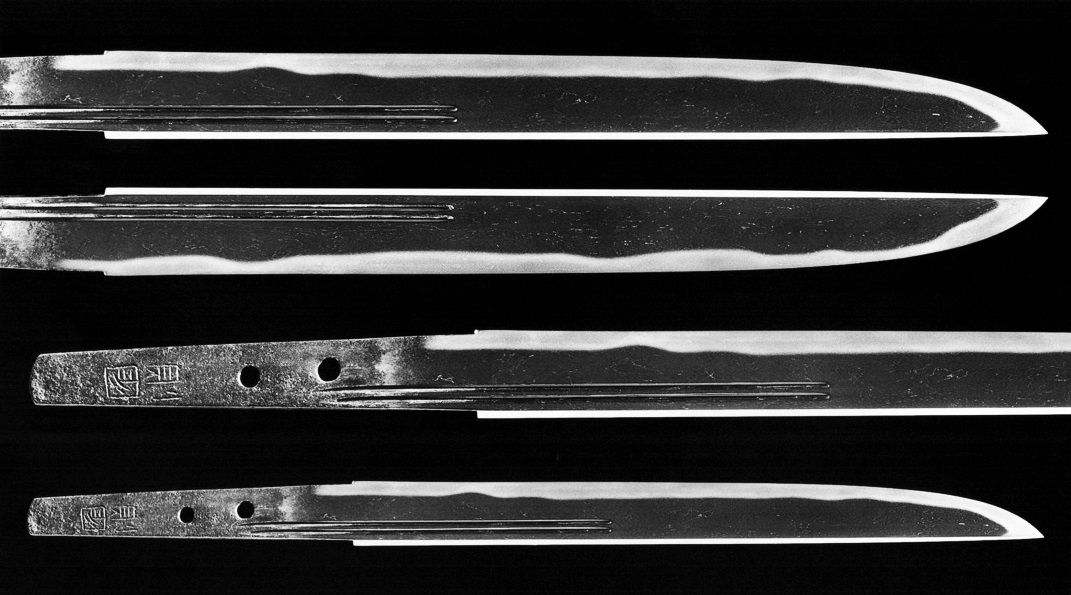
Picture 6: tantô, tokubetsu-jûyô, mei “Norikuni” (則国), nagasa 24.2 cm, uchizori, hira-zukuri, mitsu-mune (with wide top surface)
Last but not least it should not go unmentioned that again, we are facing slightly different signature styles but which are thought to go back to the different stages in the career of a single smith. There are somewhat larger and somewhat smaller mei and by trend we can say that he signed his tachi with a thinner chisel than his tantô which show a relative thickly chiselled signature. There was a ken of Norikuni discovered in recent years during repair works at a hall belonging to the Yokawa (横川) temple unit of the Enryaku-ji on Mt. Hiei that was hidden in a Buddhist statue. The ken (see link here) is now designated as cultural property of Takamatsu City, Kagawa Prefecture, as it is preserved in the local history museum and it shows the same thick mei as seen on tantô. Also interesting to note is that his character for “Kuni” is very similar to that of his son Kuniyoshi (see picture below). Both signed the left inner part of the box radical as three more or less horizontal and parallel strokes, met underneath by a pronounced arc that starts to the top right of the separating central stroke.
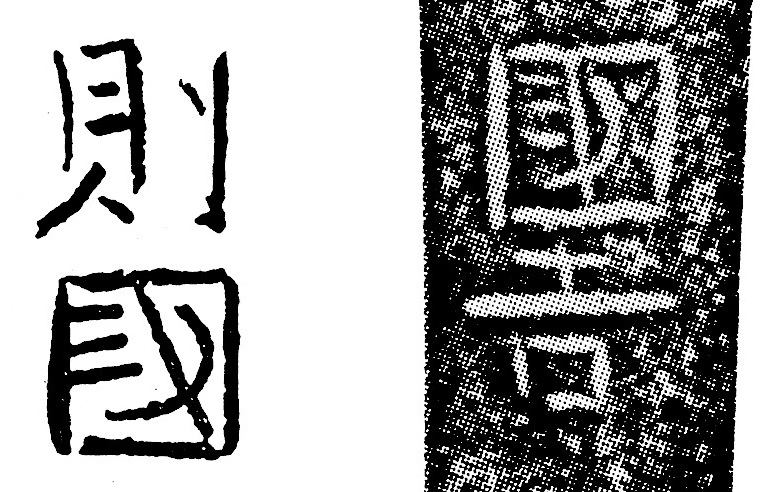
Norikuni mei left, Kuniyoshi mei right.
On vacation…
With this post I leave for a short vacation and will be back in office on Oct 19th. Thank you all for your loyalty as blog stats are pretty impressive (for me personal and also from the point of view that this is a nihontô blog in particular) by now keeping an average of about 6,000~8000 views per month. Top ten readers come from (from top to bottom): USA, Germany, UK, France, Japan, Netherlands, Italy, Australia, Poland, and Canada. You want more stats? Most search terms that lead to my site are “markus sesko” followed by “kotegiri masamune”, “honshu masamune”, “kuji kiri”, “higo koshirae”, “masamune hamon”, “hamon masamune, “a real masamune sword hamon”, and “masamune oshigata.” So I guess Masamune is still pretty omnipresent 🙂 After my return we will continue with the Awataguchi School and of course with other interesting articles. So stay tuned and see you all towards the end of October.
New Site!
With an upcoming crowdfunding project in mind and finishing certain things before our first vacation since one and a half years (separate note will follow), I decided to create a separate site where I make available for free all stories that were published in my two books Legends and Stories Around the Japanese Sword and Legends and Stories Around the Japanese Sword 2, so to speak as a present to the Nihontô community and to generate more interest in the fascinating subject of the Japanese Sword. You can find the page as shown below and via a link at the blogroll at the very bottom of this site.
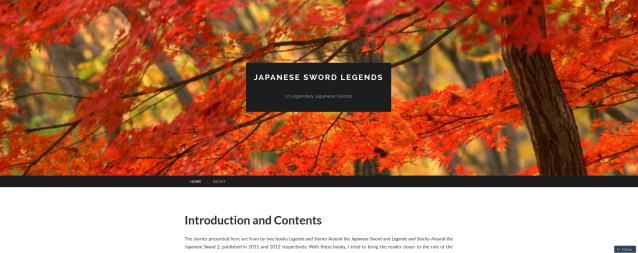
The site will be updated from time to time with additional legends and stories and I will make a short announcement on any substantial update on this site too. So please spread the word and have fun!
Copies, homages, and reinterpretations
Just a couple of weeks ago I was following a discussion on NMB but couldn’t find the time to participate, and when I was finishing the reformatting of the Keichô-shintô project the other day, this thread and the discussions we had on the topic of utsushimono at two of our NBTHK-EB meetings (in 2009 and in 2014) came back to my mind. So before I continue with the kantei series, I would take the liberty of forwarding my two cents on this topic.
When talking about copies of blades, the term utsushimono (写し物) comes into play which means, well, “copy” but which can be used in a pretty broad sense. And that is the crux of the matter because when the term utsuhimono – or short utsushi (写し), e.g. as a suffix – is dropped, we need to differentiate. First of all, there is the “true copy,” that means a work that copies as faithfully as possible a concrete blade. For example the meibutsu Koryû-Kagemitsu (小竜景光) made by the Bizen smith Kagemitsu in the second year of Genkô (元享, 1322). Several smiths made copies of this blade, some of them on their own initiative but most because of being asked to do so by a customer. In my Tameshigiri book I introduced two Koryû-Kagemitsu-utsushi by the shinshintô smith Koyama Munetsugu (固山宗次). Interesting in this case is that Munetsugu made first, i.e. in Kôka four (弘化, 1847), a “reconstructed copy” of how the blade must have looked like initially (see picture 1 left). The Koryû-Kagemitsu has been shortened, although it still measures magnificent 80.6 cm in nagasa (see picture 1 center). Considerably later, i.e. in Bunkyû two (文久, 1862), Munetsugu made a 1:1 copy of the then condition of the meibutsu, and interesting this time, he also copied the signature of the original 1:1 and signed himself on the back of the tang (see picture 1 right). Please note that this does not come under the category of gimei as the smith added his name at least somewhere on the tang. But even if Munetsugu had not added his name on the back of the tang we would not see this blade as gimei. Meibutsu blades of the calibre of a Koryû-Kagemitsu can be compared to the Mona Lisa. So even if you make a perfect copy of the Mona Lisa, everybody knows that the original hangs in the Louvre and it is next to impossible to trick anyone buying it as original. Of course there were also schemes around meibutsu but they almost always evolved around a famous blade that was long believed to be lost but suddenly popped up somewhere, for sale of course. Details on the backgrounds of why and for whom Munetsugu made these copies can be found in my Tameshigiri book but it should be mentioned here that Munetsugu must have had the original in hand as the copy is indeed pretty close, that means much closer as you can make one just on the basis of oshigata drawings and plain measurements.

Picture 1: The Koryû-Kagemitsu and its two Koyama Munetsugu utsushi
I was already briefly talking about utsushimono in this post and like in the case above, the Fudô-Kuniyuki-utsushi of Nobukuni Shigekane (信国重包) can be considered as a “true copy.” That means even if the original meibutsu had to be retempered about 70 years before Shigekane got to work with it, his approach was still the attempt to copy as faithfully as possible a concrete blade. This brings us to the first “grey area.” Namely even supposing the Fudô-Kuniyuki had been missing at the time of Shigekane and all he had was good enough oshigata and descriptions, the result would still be considered as utsushimono as he copied, or tried to copy a concrete blade, although no longer existing. So the term utsushimono applies here too but it might not be paraphrased as “true copy.” In other words, the farther away the oshigata and descriptions from the original, the more we are entering the realms of a mere homage and eventually end up at a “free interpretation” of the Fudô-Kuniyuki if for example all that Shigekane had to work with was the order to “make me something like the famous but lost Rai blade” and the brief description that it had a this and that horimono and that it measured 1 shaku 9 sun 9 bu in nagasa. But of course also a smith (or his client) can specifically decide to make more like an homage, even if the original is still extant and could act as a model. An example for that are some of Echizen Yasutsugu’s (越前康継) copies of the meibutsu that were damaged by fire when Ôsaka Castle fell in 1615 and which he was ordered to retemper. So Yasutsugu made some “true copies” of these blades whilst he had the chance to study them hands on – or at least what was left of them in terms of steel, shape, and engravings – but he sometimes also copied just the sugata and horimono and added his own hamon. That means he did not even try to recreate the kind of hamon that the blades once might have shown. Again, they are still referred to as as utsushimono. By the way, I was talking about one of Yasutsugu’s “true copies” here.
Then there is the next category of “copies,” namely utsushi not of concrete blades but of styles of a smith or school. For example, if Koyama Munetsugu had made a blade that tries to reproduce the style of Kagemitsu, we would speak of a Kagemitsu-utsushi. Remember, the copy of the Koryû-Kagemitsu is not a Kagemitsu-utsushi but a Koryû-Kagemitsu-utushi. Many many blades were made over the centuries that try to copy the style of a certain school or master. I want to leave out the cultural backround but just one remark, it is common in East Asia for a craftsman to measure his own skill with that of a great master by trying to copy his works over and over again, not seldom over decades. Its just a learning and maturing process (artistically and spiritually) – learning through imitation – and does not mean that one uncreative. But lets get back to the topic. So if a smith tries for example to recreate a blade that is interpreted just like Osafune Kanemitsu (長船兼光) would have made a blade, it is referred to as Kanemitsu-utsushi, and if he tries to recreate a blade in the style of the Aoe School, it is referred to as Aoe-utsushi. And as borders between true copies and homages are fluid, there are other terms than utsushi or utsushimono which might nail the subtle differences better. For example nerau (狙う), “to aim at,” and narau (倣う・傚う), “to emulate, to imitate.” Incidentally, the term for learning, narau, has the same etymological origins (not going into detail on the sophisticated etymological differences of the characters for narau here). A little weaker form of saying “to aim at, to emulate, to imitate” is omowaseru (思わせる) which translates as “gives the impression of,” “has the appearance of” or “sth. reminds of sth.” For instance, a free interpretation that reminds of the style of Kanemitsu or of the Aoe School might be described as “Kanemitsu o omowaseru (兼光を思わせる)” or “Aoe-mono o omowaseru (青江物を思わせる)” respectively. It now depends on the writer, i.e. we see texts where such a free interpretation is still referred to as utsushi, but also such where it is stated that A tried to emulate B, that C aimed at D, and that a certain work reminds of X. So what its gonna be also depends on the context. Some smiths are known for focusing on concrete utsushi, for example Taikei Naotane (大慶直胤) who often copied or aimed at famous Osafune masters like Kanemitsu and Kagemitsu, whereas others rather reinterpreted certain things, for example Hankei (繁慶) and his working with the Sôshû tradition.
That brings us back to the different approaches of the smiths and it must be mentioned at this point that an utsushi is not considered as a forgery. Also forgeries try to reproduce a certain style, or even a concrete blade, as faithfully as possible, but they then “claim” to be a work of that school or smith or to be that very blade. In short, different intention. Or in other words, it doesn’t have to be by a great master or a very close copy but if the buyer/owner knows that the blade was made as copy of or as an homage to a certain school or smith, everything is fine. Like indicated above, it was very common to approach a smith and order a blade with the requirement it should be in the style of Kanemitsu or of the Rai School for example. Did myself so about ten years ago when I commissioned master Matsuba Kunimasa (松葉國正) with making me a naginata-naoshi style wakizashi that bases, freely, on a certain Ko-Aoe blade. What about the historic aspect? It is safe to assume that copies and forgeries coexisted from earliest times onwards. That means, learning through imitation was there what creates copies/imitations and making money from selling someone something cheap as something more valueable is is as human as it gets. So swords are of course no exception. It is hard to say for pre-Nanbokuchô smiths but one of the earliest examples of copying/imitating/recreating – isolated from the works left from the mere learning-through-imitation process – is the Ôei-Bizen group. When the turmoils of the Nanbokuchô period were over the Ashikaga family reinstalled the post of shôgun back in Kyôto and the upper warrior class was again trying to catch up with the cultural world of the aristocracy, after having tried something new and different, something more martial and bold in Kamakura. This is very well reflected in the sword fashions when the Bizen tradition, which was predominating during Kamakura times, was given up in the Nanbokuchô era in favor of the wild Sôshû tradition, which was given up again with the relocation of the bakufu to Kyôto in favor of the Bizen tradition. That means we see a significant backwards orientation at Ôei-Bizen as the group made blades in reminiscence of their great Kamakura predecessors. Another example for early utsushi are the numerous Rai or Yamashiro copies of the Sue-Seki smiths. My theory on the success of these copies is as follows: By that time, i.e. later Muromachi, sword forging in Yamashiro, that means Kyôto, was with entering the 1500s virtually non-existing and it is assumed that one reason for that was the massive “urban exodus” of the local smiths with the outbreak of the Ônin War. But unlike the changing fashions for long swords, classical koshigatana were always in demand. The koshigatana market had been predominated by the Yamashiro smiths as they equipped the warrior elite from the start with their fine daggers. Thus the peak of highest-quality tantô production is in the Kamakura period. The larger hira-zukuri ko-wakizashi that became increasingly in use with the Nanbokuchô period were a hint more utilitarian than the koshigatana, or at least more utilitarian than the “status symbol koshigatana” that were worn with formal costumes. So by the late Muromachi period, there were no Yamashiro masters at whom one could place an order for a classical koshigatana, i.e. a medium-sized tantô with harmonious proportions, a fine hada, and an elegant sugaha hamon. And thus warriors were approaching the then Seki masters who made them classical and high-quality koshigatana but which were much more affordable than looking for the real thing, i.e. trying to buy an Awataguchi or Rai original which always had been expensive. The Momoyama era experienced a “rediscovery” of the great early Sôshû masters and details on that like the upper warrior classes “need” for owning certain masters and the effect on then sword fashion can be found in my recent Masters of Keicho-Shinto and my Masamune book. But this much is to say: Sôshû was the order of the day and virtually every master or aspiring master was making Sôshû copies or a stab at the Sôshû tradition at that time.
And then came the shintô era of sword making which brought a lot of changes. The continuous peace, urbanization, accumulation of wealth for a higher number of individuals, and the conservative formation of an upper bourgeoisie had the effect that swordsmiths saw themselves more than ever as artists rather than as craftsmen. As a result, faithfully imitating certain predecessing masters or styles was no longer enough. Kotô blades are pretty much form follows function coupled with a special sense of aesthetics, i.e. simply put, the aesthetics of nativeness or natural simplicity. The great Ôsaka-shintô, Edo-shintô and early Hizen masters (just to name a few) developed with their strong creative power certain concepts, that means they started to separated the individual aesthetics of a blade like the sugata, jigane, hamon, and bôshi, just to rearrange them according to their overall idea of a sword blade. And utsushimono were no exception. Still “true copies” were made but we see more and more idealized reinterpretations of certain styles. In other words, these shintô masters reflected what constituted for example the Yamashiro tradition or for which the Yamashiro tradition was recognized for and banned these very elements onto canvas, in their case onto a sword blade. To stay with the example Yamashiro, the Yamashiro tradition is first of all famous for a densely forged, uniform jigane and a highly elegant suguha or suguha-chô. Accordingly, the great shintô masters focused on these elements and highlighted them at their own discretion. This changed again with shinshintô times as the shinshintô masters so to speak had to – after almost a decade of lean spell and a decrease in demand for swords and a decline craftsmanship – “reinvent” the whole wheel and were first of all aiming again at the kotô models. Rephrased, they first had to “learn” again through imitation before they were able to go over to free reinterpretations (which are by the way hardly seen in shinshintô anyway). Using the example of car makers and the Jaguar E-Type, the shinshintô masters were making as faithful as possible Jaguar E-Type retros whilst the shintô masters took everything for what that icon of a car stands for and created something new that might only remind of the original at a glance, or that can only be recognized as being Jaguar E-Type inspired when you have a decent undertanding of classic cars. But if the master was a great master, you can see what his inspiration was, how he skillfully highlighted certain elements, and how he really conveyed the aesthetics of the E-Type, oh pardon me, the Yamashiro tradition. But if a master was not that good, you might get what he was aiming at but the result is in the worst case a “Yamashiro grotesque.” Just like the thin line between an outstanding and a “too much” concept car.
Perfect timing, Aoi Art just put an interesting piece on sale. Link here (and picture below). It is a copy of a copy, that means Kasama Ikkansai Shigetsugu (笠間一貫斎繁継, 1886-1965) copied a blade by Taikei Naotane (大慶直胤, 1778-1857) which the latter had modelled, rather freely if you compare it to the three originals introduced in my Masamune book, on one of the Hôchô-Masamune. Like Koyama Munetsugu, Shigetsugu also copied the signature “Mo Hôchô-Masamune Naotane + kaô” (模包丁正宗直胤) of Naotane’s copy (or rather homage). Shigetsugu himself signed on the ura side, interestingly with “Ikkansai kore o tsukuru” (一貫斎造之), i.e. just with his gô and omitting his smith name (blade got papered to Shigetsugu by the way, so it is none of the other numerous Ikkansai smiths).

Leaving aside the art aspect, making a convincing and “true copy,” for example making a Koryû-Kagemitsu-utsushi, requires quite a high level of skill. Imagine how perfectly you have to master the craft to know how to arrange, fold, and forge your initial steel bundle and harden the blade to get in the end the exact same kinsuji at the exact same spot as on the original. You can do a lot with tsuchioki but in general, there are no tricks or shortcuts. That means you can’t “draw” a kinsuji onto a blade. It is just amazing how some smiths did this!
Gendaito Project Update 2

Just want to add a few thoughts on the upcoming Gendaito book but first of all, a big THANK YOU to all who provided me with material via the separate gendaitoproject@gmail.com address, facebook, the NMB, and everywhere else. Please understand that I will wait with replying and asking specific questions until the actual writing job starts. As mentioned earlier, I have gathered about 1,100 smiths and aim is to record and publish once and for all as many smiths as possible. I have also mentioned that there are quite many where no pictures or oshigata are available but which will be published too, or course, and this most likely collected and in a separate section. Apart from that, I am facing certain page limits, 800 pages to be precise, but it doesn’t make much sense to approach this limit anyway as I have learned that anything that big is prone to fall apart or get “wobbly.” The “sound barrier” is somewhere around 600~650 pages, which is within easy reach at more than 1,000 smiths. And I am not going to make it two volumes. As picture quality is also an issue, this will definitely not be a coffee-table book with details of hamon or jigane and an ouvre of each smiths works (much as I would like).
To sum it up: This book will not be a “Jack of all trades, master of none.” Top priority is as indicated recording the CV’s of as many smiths as possible, accompanied by pictures/oshigata of signatures so that the book also work as a reference for mei comparisons. To leave the focus on the smiths, I also don’t want to toss off a half-hearted chapter on the history of gendaitô, but what I want to do is to follow up something like a Nihon Gendaitô Shi, so to speak continuing my Nihon Shinto Shi and Nihon Shinshinto Shi, that contains all that information like production sites, programs, contests, etc.
That should do it for tonight and thanks for your attention.
Gendaito Project Update
I just want to give you another short update on my upcoming Gendaito book. As some of you already know via direct correspondence with me, I had to rethink and postpone the project due to an unexpected “setback” when it comes to references. This of course does not apply do those who already and unhesitantly shared their information with me and who offered me further support when the project is entering the final and crucial phase of writing. But I have collected enough so far and kind of started to sort out data a while ago. After finishing my revised Swordsmiths of Japan and taking the info on the gendai guys therein as a basis, I arrived at about 1,100 smiths for the upcoming book. Of course I will not have pictures and reference blades/oshigata for all of them. Also I had to sort out whom to include and whom not and came to the following conclusion: Included will only be smiths whose career (or major part of the career) started after the ban on wearing swords (1876) as there were just too many shinshintô smiths active who were still making swords in the early years of the Meiji era and who I don’t want to include as they really don’t classify as gendaitô smiths. Also I will not include smiths whose career only started after WWII. But there might be some exceptions to these limits. Apart from that, I was experimenting with the layout and came to the conslusion that the book has to be two-part, that means it will consist of a large picture reference part and a part with basic info on those smiths of whom I don’t have any blade pictures of. Both parts will be structured alphabetically and aim of the second part is, as good as possible, not to leave any smith out. So the two pictures below are a very first attempt to see how this all might look like in the end. So to all of the gendaitô collectors out there, there is still enough time to give me feedback and forward me material as the crucial writing phase will not be started for a while. Also please note that in case you send me files, descriptions and further info to “gendaitoproject@gmail.com” (and I would appreciate that everything is going there and not to my regular address), everything is gathered there fore the time being and I will only reply later on to say thank you (and if there are further questions). Oh, and if anybody wants to financially support the preparative work on this project in the form of a small donation, what would be very very much appreciated, there is a humble button at the very end of this site for this 😉 Thank you all for your attention!
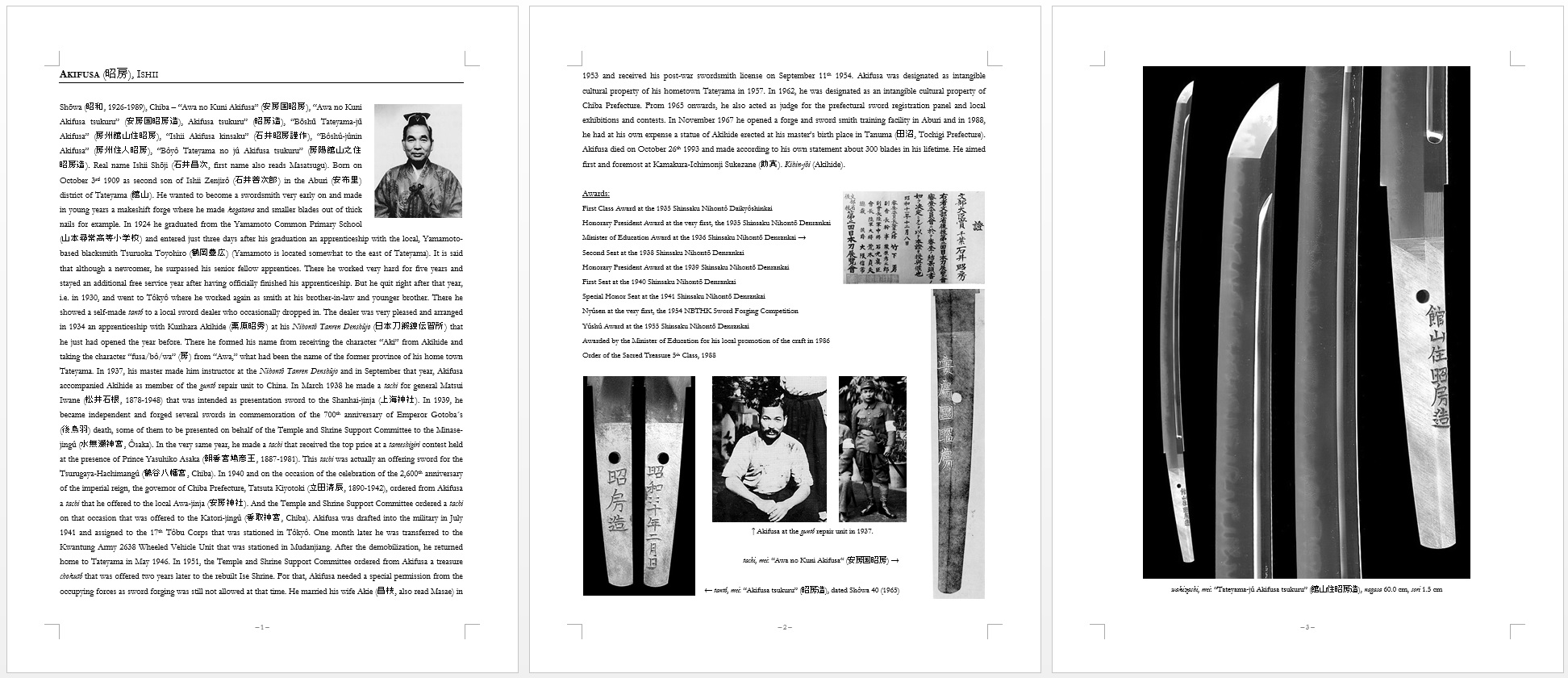
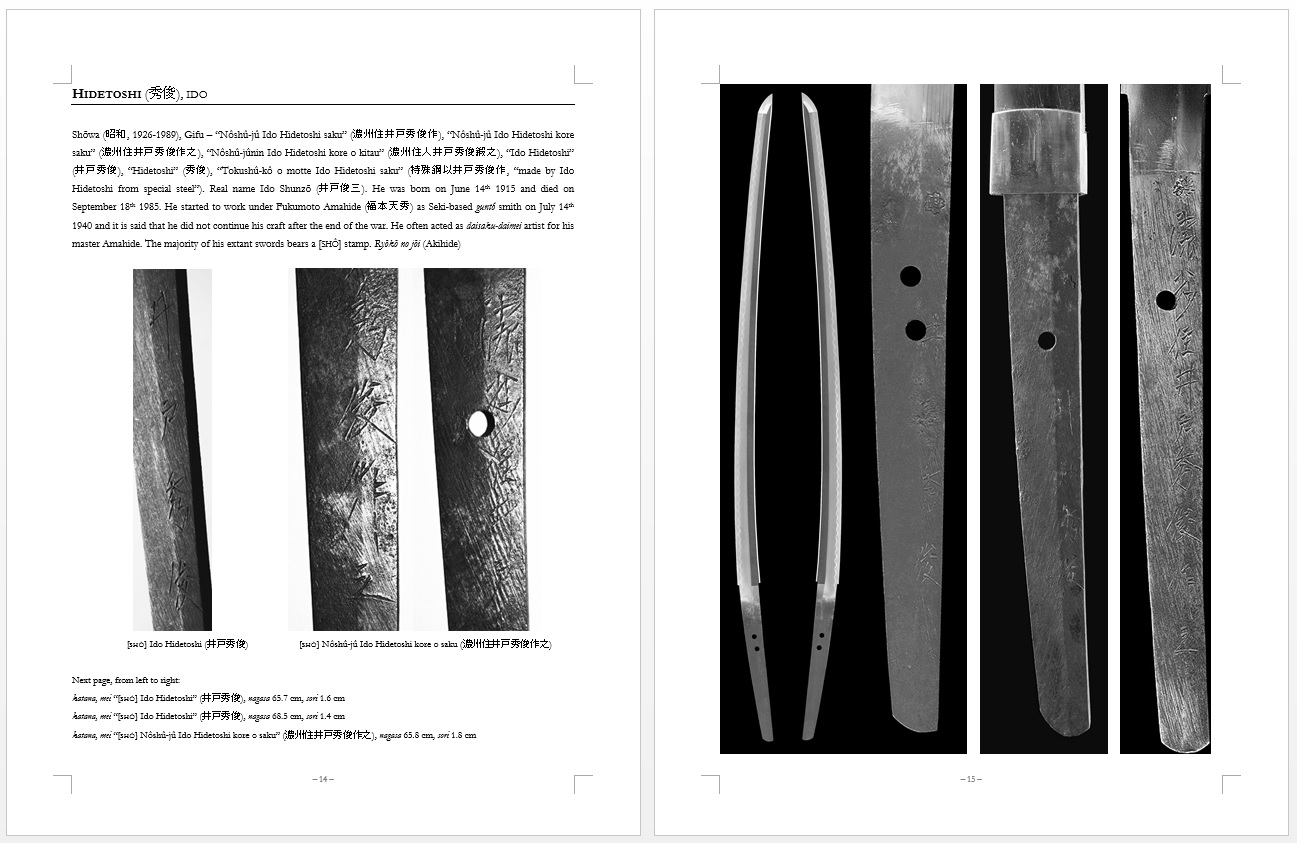
The wakizashi
Inspired by an article that appeared in the Tôken Bijutsu about a year ago and on which I will elaborate in the second part of this post, I was once again reflecting on the entire topic of the wakizashi (脇指・脇差). Well, due to the nature of the article, I was first focusing on mere blade lengths and restrictions but as my thoughts were spreading wider and wider, I thought it might be a good idea to write all that down in order to provide a general overview of this sword type. I guess when the term wakizashi is dropped, most of us automatically think of the shorter twin brother of the katana that represents one half of the famous daishô (大小) sword pair. Also many know that the wakizashi emerged sometime during the Muromachi period and that later on, it was so to speak the “maximum” of a sword a civil person was allowed to carry. This is all correct, so nothing has to be set straight right away, but the matter is of course much more complex. First of all, some etymological explanations. In earlier times, especially before entering the mid to later Muromachi period, the term katana (刀) was not referring to the katana as we know it today but to a short, dagger-sized and single-edged blade, or to a dagger in general if you want, and was mostly used as suffix (also with the Sino-Japanese reading tô) in a compound term. For example, in historic sources we find terms like koshigatana (腰刀), uchigatana (打刀), tsubagatana (鐔刀), futokorogatana (懐刀), chiisagatana (小サ刀), wakigatana (脇刀), kogatana (小刀), or shôtô (小刀). From the context we often get a pretty good idea about what kind of sword or dagger was meant but many entries are ambiguous, e.g. when a later edition of a work quotes the very same paragraph with a different term than the initial one. The matter is further complicated by the fact that some terms were just used interchangably and that there were no universal dictionaries that defined terms and made their use mandatory, at least not until rather recent times. The first real scientific approaches that tried to put all that together, i.e. doing etymoligical studies and comparative researches of the sources, do not date before the mid-Edo period. So we are entirely relying to context interpretations of the original sources on the one hand, and on the more or less accurate views and interpretations of Edo period experts on the other hand. And with experts I mean that the Edo period scholars who wrote down their definitions were usually not sword but military historians and experts on the warrior class. Also important to note is that when reading their texts, we learn that by the mid-Edo period, that means at a time when the country had seen no larger battle for at least over a century, a great deal of sword and armor knowledge of the past had already been lost as some of them openly admit that they are merely guessing on what certain elements and features were for or how and by whom certain sword forms were worn and used. But we are not entirely groping in the dark, that means due to many many studies we have today a quite decent overview of what was going on in terms of swords for each era.
Actually, it is all not that complicated if you leave aside the Japanese terms for the time being and think in general sword/weapon terms. The pre-Edo period warrior, i.e. we are talking about the times before the big regulations came into play with the Tokugawa-bakufu, had (when it comes to swords) basically the following options: Long sword, shorter side, companion or ersatz sword, and dagger. It was now up to the rank, wealth, social status, field of application of his military unit, occasion, and other factors for what sword or what combination of swords a warrior was going. Over time, different terms came into use to refer to different interpretations and to different fields of application but basically they were all just talking about the one or other of these basic three sword types or sword combinations. All that we have to do is to find out what time, what clientele or wearer (aristocracy, bushi, or civilan class), and what occasion (e.g. battle, ceremony, civil service, private life) we are facing to break down the different terms. So there were approaches to classify these three sword types according to length, or to blade length to be precise, what resulted in the umbrella terms daitô (大刀) for the long sword, shôtô (小刀) for the shorter side, companion or ersatz sword, and tantô (短刀) for the dagger. Others tackled this need for proper naming from the point of view of use and introduced the term honzashi (also pronounced honsashi) (本差) for the the main, the longer sword, and the terms wakizashi (脇指・脇差), wakigatana (脇刀), wakimono (脇物), or sashizoe (差添), for the companion or ersatz sword. Incidentally, it is assumed that the terms wakizashi and wakigatana were actually shorter forms of the term wakizashi no katana (脇差の刀), for example noted that way in the late 14th century epic Taiheiki (太平記) wherein we read that “[when the tip of Fuchibe’s sword broke,] he threw it away and drew his companion sword” (sono katana o nagesute, wakizashi no katana o nuite, その刀を投げ捨て、脇差の刀を抜いて). And as the text is referring to the person in question wearing the other sword in a pocket at his chest, we learn that the ersatz sword was in this case a dagger and not a wakizashi-length companion sword. So as mentioned, we are talking about (more or less neutral) umbrella terms and terms like honzashi or wakizashi do not make clear without context to what kind of sword they are referring to, only that it was either the main or the side/companion/ersatz sword.

Picture 1: Higher ranking samurai wearing an ô-yoroi.
Back to the sword form wakizashi. Companion swords were worn early on to the main sword when going into battle. The main sword had, as far as battles are concerned, always been the tachi (and later on to a certain extent also the uchigatana) and the companion sword was by default a dagger. Please note that I stick to the Japanese way of addressing and also refer to daggers as “swords” in the first place. Well, some bushi opted for longer companion/ersatz swords, occasionally even to go with rather than instead of the initial companion dagger, and it is assumed that the origins of this trend have to be found within the turmoils of the Sengoku era. With all that had happened after things were escalating in Kyôto during the Ônin War, warriors of all ranks were eager not to be caught off guard at any time and have an “as full as possible” ersatz sword in case something happened with the main sword. Let me demonstrate that on the basis of some illustrations as a picture is worth a thousand words. In picture 1 we see the so to speak default armament of a mid to higher ranking mounted warrior throughout all periods. The armor and armor parts changed of course over time so please don’t pay too much attention to details of the armor shown. As you can see, the warrior is wearing a tachi suspended from the belt via two hangers and a companion sword, in this case a koshigatana-style dagger, that is thrusted through the belt. The bow was the main weapon, the tachi was for for attacking and defending at closer ranges (and of course for possible duels), and the dagger was an allpurpose “tool” and used as last resort in hand-to-hand combat and when the tachi was, for whatever reason, not available or applicable.

Picture 2: Warriors wearing companion swords that are conspicuously longer than daggers.

Picture 3: Uchigatana in aikuchi-style mounting intended to be worn thrusted edge-up through the belt as companion sword to the tachi.
Picture 2 now shows about how the Muromachi-period trend of wearing longer side swords had looked like. These swords were pretty much what we understand today of early wakizashi but please note that back then, the term wakizashi was a more neutral one as for example also an uchigatana mounted with a 70 cm long blade could have come under the category of side/companion/ersatz sword. To avoid confusion, it has become custom to refer to these longer swords by their other term sashizoe instead of wakizashi but strictly speaking, something like seen in picture 2 would come, when worn with the tachi, under the category of a wakizashi as it was not the main sword. Well, it is unclear when the term wakizashi became synonymous for companion swords that were in terms of length somewhere in between the main, i.e. the long sword and the dagger but reading between the lines of historic documents and analyzing their context, it seems that this “shift” in meaning took place sometime between the Momoyama and the early Edo period. Probably this was connected to the development of the “civilian samurai uniform” consisting of a kataginu/hakama ensemble and a pair of swords thrusted edge-up through the belt that took place at that very time (please see here for additional information). It was namely then when a quasi more standardized side sword started to form, or in other words, with entering the Edo period and the establishment of the daishô, it was no longer ambiguous to what kind of sword the term “side/companion word” was referring to and so the neutral term wakizashi slowly became the synonym for the smaller companion sword of the sword pair. And with that we are right at where for the first time nationwide sophisticated sword laws were issued.
So with the establishment of the Tokugawa-bakufu, the Tokugawa government regulated now very strictly all swords, i.e. how long a sword had to be, who was allowed to wear what kind of sword, and when certain swords had to be worn by whom. The honzashi of the samurai, i.e. the katana, was limited to a blade length of 2 shaku 8 sun (~ 84.8 cm) and the wakizashi to 1 shaku 8 sun (~ 54.5 cm). However, these measurements were slightly adjusted later. In the eighth year of Kanbun (寛文, 1668), the Tokugawa-bakufu issued the so-called mutô-rei (無刀令) with which it prohibited all persons not belonging to the samurai class to wear swords with a blade length over that of a ko-wakizashi (小脇指). Therefore a ko-wakizashi blade was determined to measure maximally 1 shaku 5 sun (~ 45.5 cm). Later this law was relaxed and so travellers of the partial dangerous Tôkaidô – the then main road between Kyôto and Edo – were allowed to wear swords with a nagasa up to 1 shaku 8 sun (so to speak a wakizashi instead of a ko-wakizashi) for their self-defence. So basically the Tokugawa government was saying that as a civilian, you were legally maximally allowed to carry the side/companion sword of a samurai. Everything between a wakizashi and a honzashi, i.e. a sword with a blade length of 54.5 to 60.6 cm, was classified as ô-wakizashi (大脇指). Please note that these measurements varied over time. For example, we also find law texts wherein a ko-wakizashi is defined as measuring maximally 1 shaku 3 sun (~ 39.4 cm) instead of the aforementioned 1 shaku 5 sun (~ 45.5 cm). Also please note that for wakizashi that measured in between a ko-wakizashi and an ô-wakizashi, also the more specific term of chû-wakizashi (中脇指) existed.
But although these laws sound quite strict, the transition between ko-wakizashi, chû-wakizashi, and ô-wakizashi were fluid and even if the eyes were surely on the bushi who were walking through the streets of Edo during their sankin-kôtai stay, there was no official “sword police” going through the rural fiefs making all samurai unsheath their swords and measure the nagasa of their mounted blade. So basically it was like no plaintiff, no judge and when there was no sword incident caused by a civilian that had to be officially investigated, it can be assumed that no one would take notice if you wore a chû-wakizashi instead of a ko-wakizashi on one particular day. When I say “sword incident caused by a civilian,” I am also referring to the fact that civilians were not only allowed to arm themselves with wakizashi because of robbers and similar risks but also to defend themselves against members of the samurai class who were going to make (unjustified) use of their right of kirisute-gomen (切捨御免), their right to strike with sword anyone of a lower class who compromised their honor. Parallel to the rigid hierarchic social class structure that was eventually cemented in the Edo period, underground organizations and outlaws were emerging in not to be underestimated numbers. There were for example gamblers (bakuto, 博徒) and peddlers (tekiya, 的屋) whose partially strict internal codes made them the predecessors of the modern yakuza. “Heroic” members of these groups who defended the “poor” townsmen against unlawful and arbitrary acts of local samurai were romantized as kyôkaku (侠客), lit. “men of chivalry.” Of couse these kyôkaku did not follow the law and as they actually saw themselves as “Robin Hoods,” they were wearing longer than allowed (often handachi-style mounted) wakizashi (see picture 4), which were not named ô-wakizashi but naga-wakizashi (長脇指・長脇差) in this context. In addition and in order to restore local peace, the bakufu had sometimes no other choice than granting the heads of these “organizations” certain rights so that they were at least able to keep other underground groups in check, and one of these rights was actually the permission to carry a naga-wakizashi instead of a ko-wakizashi. As you can see, the bakufu sometimes rather preferred to turn a blind eye to certain things as long as they were no longer bothered with it. Incidentally, these kyôkaku were thus also referred to as naga-wakizashi, i.e. about “those with the long wakizashi.” As these naga-wakizashi were from their outward appearance pretty much identical to a katana, also terms like ipponzashi (一本差) and ippongatana (一本刀) came in use to refer to the kyôkaku. These terms have to be understood as allusion to the term nihonzashi (二本差), lit. “the two sworders” or “the two-sword-wearers,” which was another name for a member of the samurai class.
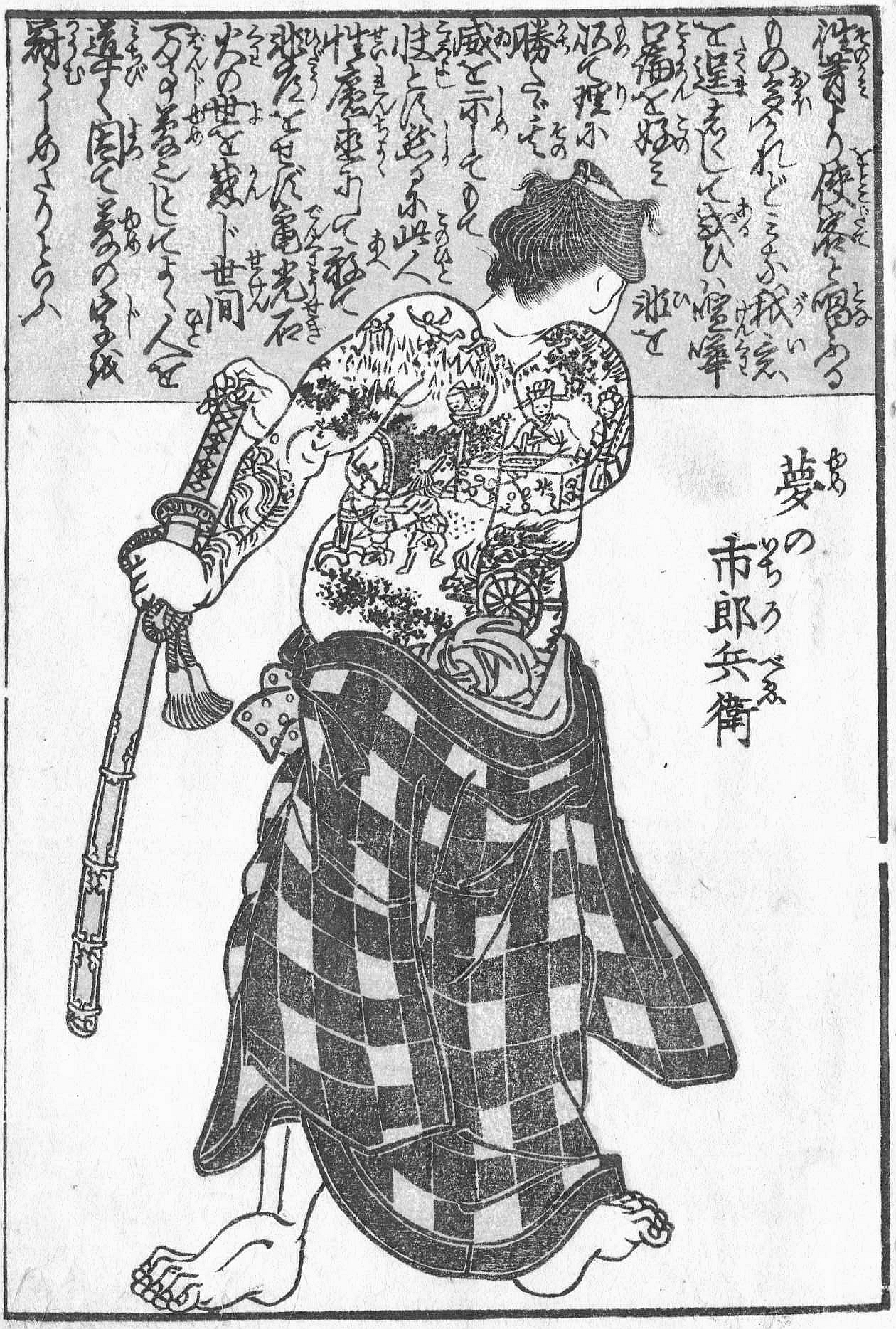
Picture 4: Tattooed kyôkaku with a handachi-style mounted naga-wakizashi.
*
But naga-wakizashi were not only worn by outlaws. They could also have been the choice for a samurai who preferred to wear, for whatever reason, a longer sword pair. And with this we arrive at part two of this post. Sometimes it is hard to tell if a shinogi-zukuri blade, or a shinogi-zukuri shintô or shinshintô blade in particular, that measures slightly less or slightly over 2 shaku was intended as katana or as wakizashi. As mentioned earlier, transitions were fluid and the historic sword order I am introducing next is an important reference as it does not leave any doubt about what we are facing. It is a sword order placed by the Saga fief to two of their smiths, the 2nd generation Kawachi no Kami Masahiro (正広, 1627-1699) and the 4th generation Tadayoshi (忠吉, 1669-1747), who are addressed as Hashimoto Kawachi (橋本河内) and Hashimoto Shinzaburô (橋本新三郎) respectively, and reads:
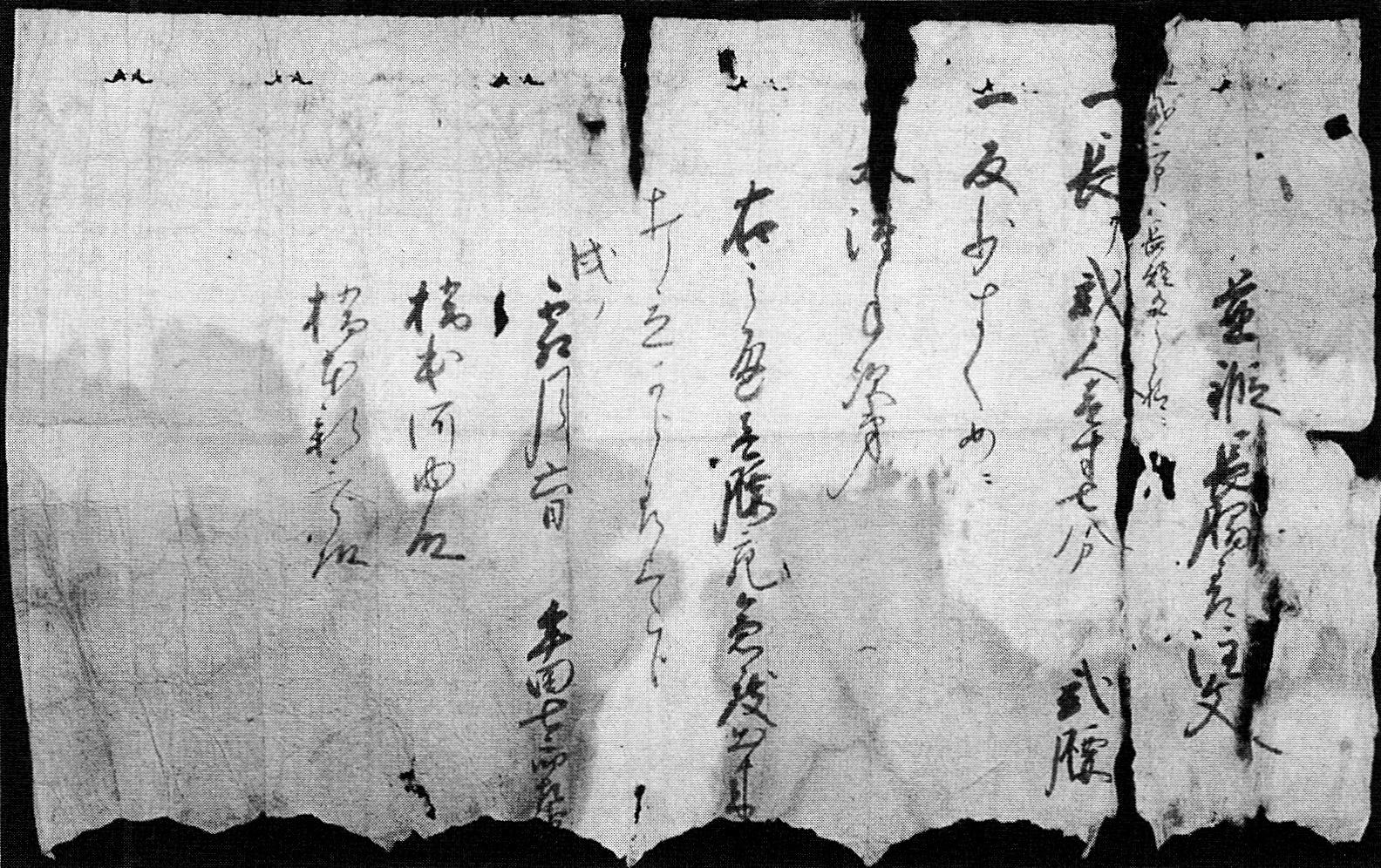
Picture 5: Extant sword order from the archives of the Masahiro lineage (preserved in the Saga Prefecture Library (佐賀県立図書館).
並鍛長脇差注文
一 長サ 弐尺壱寸七分 弐腰
一 反  少しすくめニ
一 刃  得手次第
右之通壱腰宛急度出来
打立可被差上候 以上
戌ノ
霜月六日 牟田七郎左衛門
橋本河内殿
橋本新三郎殿
Namigitae naga-wakizashi chûmon
• nagasa 2 shaku 1 sun 7 bu – futakoshi
• sori sukoshi sukume ni
• ha ete shidai
Migi no tôri hitokoshi ate kitto deki
uchitate sashiagarubeshi-sôrô, ijô.
inu no
shimotsuki muika Muta Shichirôzaemon
Hashimoto Kawachi dono
Hashimoto Shinzaburô dono
Order for ordinary forging quality naga-wakizashi:
• two blades with a nagasa of 65.7 cm
• sori rather on the shallow side
• ha(mon) dependent upon the forte of the smith
Please make each sword according to these points.
Year of the dog (Genroku seven, 1694)
Sixth day of the eleventh month, Muta Shichirôzaemon (probably an official of the Saga fief)
to Mr. Hashimoto Kawachi
to Mr. Hashimoto Shinzaburô
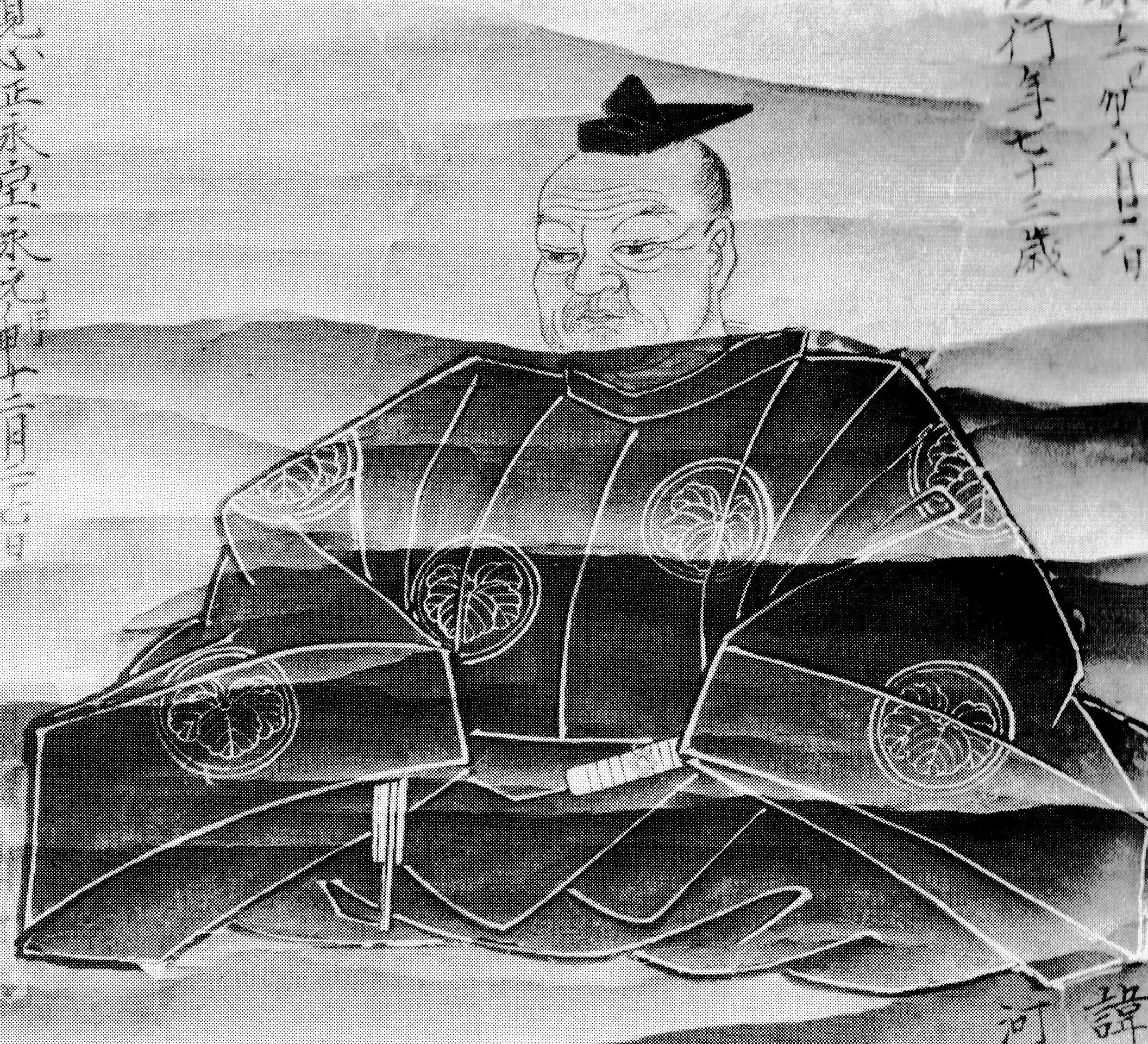 Picture 6: 2nd generation Hizen Masahiro.
Hizen mainline swords in particular are very good for distinguishing between short katana and oversized wakizashi as their tangs were strictly finished according to the intended use. This means, blades that were intended as long swords or honzashi, in short as katana, were signed in tachi-mei, i.e. on the side of the tang that faces towards the wearer when wearing the mounted sword thrusted edge-up through the belt. Apart from that, the tangs of honzashi were finished with a somewhat roundish nakago-mune. Wakizashi in turn were signed in katana-mei and finished with a flat nakago-mune. So if you find a Hizen-tô with a nagasa of about 2 shaku and you are not sure if it is a katana or a wakizashi, check for these two features and they tell you exactly what the sword initially was.
As for the wakizashi-sized blades in general, there are certain rules of the thumb that can be applied to find out what the sword initially was. If you have a shinogi-zukuri shôtô that is obviously longer than dagger (e.g. sunnobi-tantô) size and shorter than katana size and that dates from the early to the late Muromachi period, you can assume that it was worn as wakizashi or sashizoe just like shown in picture 2. And the longer the blade, the more likely it is that they were mounted with a tsuba. If the blade is shorter and in hira-zukuri, it was probably worn as koshigatana like shown in picture 1. Please note that there were also longer, for example 45~50 cm measuring shôtô in hira-zukuri worn as wakizashi/sashizoe. Now with the approaching the Momoyama era, chances are increasing that a shinogi-zukuri shôtô was worn as wakizashi to the civilian samurai uniform. If you have a later Muromachi blade but that predates the Momoyama era and that measures somewhere around or slighty lesser than 2 shaku and comes with a relative short nakago, you are most likely facing a katateuchi. Katateuchi were intended for single-handed use, thrusted edge-up through the belt, and often worn as wakizashi/sashizoe to the honzashi, the tachi. So these blades too were worn just like shown in picture 2, although with the difference that katateuchi were by default mounted with a tsuba. Entering the Edo period, it is, as indicated, sometimes hard or even impossible to tell if a blade that measures somewhere around 2 shaku was ordered by a member of the samurai class to be his hon or his wakizashi. Many factors like personal preferences, body height, fencing style and so on come into play that might have influenced his choice of wearing an over or an undersized daishô pair. Also it is very difficult to tell in concrete numbers how strong the “impact” of kyôkaku and other outlaws were on the output of around 2 shaku measuring blades but the fact that the term naga-wakizashi was synonymously in use to refer to these guys suggests that there must had been a considerable number of such blades made for them.

Picture 7: Wearing the kodachi.
And then there is another category of swords that must be addressed when talking about side swords, and that is the kodachi (小太刀), the lit. “small tachi.” A theory says that the kodachi was born from the necessity that aristocrats wanted longer blades than koshigatana to wear in coaches (kuruma, 車) for their self-defence, i.e. after having handed over the main sword, the tachi, to the sword bearer. Therefore also the terms kuruma-gatana (車刀) and kuruma-dachi (車太刀) were in existence for shorter swords which were no daggers. Kodachi blades measure somewhere between 1 shaku 7 sun (51.5 cm) and 2 shaku (60.6 cm) and what distinguished them from contemporary uchigatana was that they were interpreted in shinogi-zukuri and basically maintained the proportions of a tachi. Uchigatana in turn were made prior to Muromachi times in hira-zukuri and were usually rather wide. Well, some speculate that kodachi were smaller tachi of the younger sons of the aristocracy or higher-ranking bushi (or especially for their genpuku ceremony) whilst others even assume that they were worn by women. The former approach and the approach that kodachi were alternative swords of higher-ranking persons is supported by the fact that many of the extant and unaltered kodachi were made by great master smiths, although it is of course quite possible that all the others, i.e. the ones that were not cherished as treasures, were just lost over time. Interesting is that also the term hakizoe-kodachi (佩き添え小太刀) existed what means that some kodachi were worn – edge down suspended from the belt as the prefix haki (佩き) implies – worn as side/companion/ersatz sword to a honzashi. Problem again is here the very limited evidence base, and that is especially true for kodachi-koshirae. But it is most likely that the kodachi was worn as seen in picture 7, i.e. with a simple hanger-system to formal and semi-formal outfits. One of the major references in this respect is the signed kodachi by Rai Kunitoshi (来国俊) that was once offered with its koshirae to the Futarasan-jinja (二荒山神社, Tochigi Prefecture). As experts assume that the mounting is original to the blade, the sword as a whole, i.e. not only the blade, was designated as kokuhô. The koshirae is interpreted in hirumaki style (蛭巻), that means hilt and saya were spirally wrapped with leather which was lacquered black. The fittings are of yamagane and the fukurin of the tsuba, the seppa, and the kabutogane were gilded. The area between the two ashi hangers bears a red-lacquer inscription which reads: “Kishin-tatematsuru Kaneko Genchû + kaô” (奉寄進金子玄忠). So it is assumed that this Genchû was the one who offered the sword to the shrine and that he was one of the ancestors of the Kaneko Tôdayû (金子頭太夫) family which later held one of the shrine offices. Very interesting historical piece but way too unique to draw conclusions on the appearance of kodachi in general.

Picture 7: kokuhô, kodachi, mei: “Rai Kunitoshi” (来国俊), nagasa 54.4 cm, sori 1.67 cm, motohaba 2.3 cm, sakihaba 1.4 cm, shinogi-zukuri, iori-mune, very dense and fine ko-itame with ji-nie, suguha in ko-nie-deki with a rather tight nioiguchi, ko-ashi, sunagashi, and kinsuji.
Picture 8: kokuhô, kuro-urushi hirumaki tachi-koshirae (黒漆蛭巻太刀拵), overall length 88.8 cm
*
I hope I was able to give you a decent insight into the vast world of the side sword, the wakizashi, and I should be back in a little with the next part of the Kantei series.
KANTEI 4 – YAMASHIRO #3 – Sanjô (三条) School 3
With this chapter, I would like to close on the Sanjô School. Apart from Munechika and a few blades of (one) Yoshiie that are most likely Sanjô works, there are really not that many blades extant from this school. One Sanjô smith by whom at least a handful of works are known is Chikamura (近村) who is traditionally listed as son of Munechika. Well, some sources say he was the son of Yoshiie and the grandson of Munechika and in terms of workmanship, his blades come indeed pretty close to those of Gojô Kanenaga (兼永) who was the son of Munechika’s son Arikuni (有国) and Munechika’s grandson accordingly. In terms of sugata, Chikamura’s blades show an elegant and conspicuously curved tachi-sugata that is typical for early Yamashiro works but they are not that slender as those of Munechika. So we have here again a certain gap that speaks more for the grandson than for the son approach. The probably most famous blade of Chikamura is the one that was once preserved in the Tanzan-jinja (談山神社, Nara) and that went into the possession of the Imperial family before it was transferred into the Tôkyô National Museum where it is preserved today (picture 1). It shows a somewhat standing-out itame with ji-nie and a ko-midare in ko-nie-deki that is mixed with many ko-ashi and yô, kinsuji, and nijûba along the monouchi. The nioiguchi is rather subdued and hajimi appear in places but it has to be mentioned that the blade is a little tired. The bôshi is sugu with a ko-maru-kaeri and shows some nijûba too. The tang is ubu, tapers to a shallow kurijiri, shows kiri-yasurime, and bears over the mekugi-ana a large and finely chiselled niji-mei that is positioned more towards the nakago-mune.

Picture 1: tachi, mei “Chikamura” (近村), nagasa 78.1 cm, sori 2.7 cm, shinogi-zukuri, iori-mune
In picture 2, that shows another signed Chikamura tachi, you can seen some remnants of the “multi-layered” aproach of Munechika but not that “extreme” as it is the case at the Sanjô founder. On the other hand, Chikamura’s blades have in general a more ancient feel than those of Yoshiie and if I had to decide whether Chikamura or Yoshiie was the son of Munechika, I would go for Chikamura for the time being. The blade seen in picture 2 shows an itame with plenty of ji-nie and chikei. The hamon is nie-laden ko-midare that is mixed with kinsuji, yubashiri and plenty of sunagashi. The bôshi is a narrow sugu with a ko-maru-kaeri. The tang is a little machi-okuri, has a shallow kurijiri, katte-sagari yasurime, and bears just like the former gyobutsu a large and fine, ancient looking niji-mei that was chiselled above the initial mekugi-ana and towards the nakago-mune.
Picture 2: tachi, mei “Chikamura” (近村), nagasa 68.8 cm, sori 2.4 cm, shinogi-zukuri, iori-mune
When we are talking about Chikamura, the famous mei has to be mentioned that gave birth to some controversial theories in the Meiji era. The original signature was “Chikamura tatematsuru” (近村上), “offered/presented by Chikamura” (i.e. either to a high-ranking client or to a religious facility), but someone later added the character for “Mune” atop of it to allude to Munechika and to create the mei (宗近村上). This mei was then interpreted by some as “Munechika Murakami,” i.e. the character “mura” (村) from Chikamura and the character “tatematsuru” (上) which also reads “kami” were interpreted as the family name Murakami and the theory was forwarded that this must had been Munechika’s family name. But comparative studies have shown that, as mentioned, the character for “Mune” was a later add-on as another blade of Chikamura was discovered that was signed “Chikamura tatematsuru” (see picture 3). Incidentally, this kind of mei is not that uncommon. For example, there are also offering/presentation blades with the prefix or suffix tatematsuru extant by Rai Kunimitsu and Fukuoka-Ichimonji Sukeyoshi (助吉).

Picture 3: The enlarged Chikamura mei right and the other “Chikamura tatematsuru” mei left.
Well, when it comes to Chikamura and to several of the other Sanjô smiths – first of all Yoshiie as mentioned in the last chapter – we are facing one interesting similaritiy, namely that were homonymous early Bizen smiths active for many of them. For example, there was a Ko-Bizen Chikamura who worked, depending on source, around Genkyû (元久, 1204-1206) or Bunryaku (文暦, 1234-1235). The same goes for Munetoshi (宗利), Muneyasu (宗安), Munenori (宗則), Sanenori (真則), and Sanetoshi (真利). And then there were the two smiths who had a certain relation to Kawachi province, Arikuni (有国) and Arinari (有成), who are listed as students or sons of Munechika. So some say that Arinari came originally from the northern Ôshû Môgusa group and that he went to Kyôto to study with Munechika before he eventually settled in Kawachi. And Arikuni was either a student who moved later to Kawachi where he studied with Arinari or that there were two Arikuni, a Sanjô smith who never left Kyôto and a Kawachi smith who belonged to the school of Arinari and who was not directly connected to Munechika. Another interesting coincidence is that several of the early northern Ôshû smihs are listed as having moved down to Bizen where they acted as co-founders of the Ko-Bizen group. For example, Arinari’s initial master Arimasa (有正) was, according to tradition, also the master (or even father) of the famous Ko-Bizen Masatsune (正恒). This suggests that either (a) these northern Môgusa smiths were much more predominant than we think of them today and spread to all provinces where they greatly contributed to the establishment of the most renowned schools (e.g. Sanjô, Ko-Bizen), or (b) that at least some of the early Yamashiro smiths moved later to Bizen province, (c) that all these identical smith names are just a big coincidence, or (d) that some of these homonymous smiths were later “invented” by chroniclers to establish certain connections or fill genealogic gaps.

Picture 4: tachi, mumei, Ishikirimaru, attributed to Kawachi/Sanjô Arinari, nagasa 76.1 cm, sori 2.5 cm, preserved in the Ishikiritsurugiya-jinja (石切剣箭神社, Ôsaka)
Anyway, as far as all the other recorded Sanjô smiths are concerned, there are as mentiond in the beginning next to zero works of them extant. One of the several swords nicknamed Ishikirimaru (石切丸) is attributed to Arinari (see picture 4). So there is not much to add from a kantei point of view, except for the fact that it is anyway extremely unlikely to come across one of these earliest Yamashiro blades in the wild (and outside of Japan). For an overview of the Sanjô School and also in view to the upcoming chapter that deals with the Gojô School, I add their common genealogy below.
 Markus Sesko