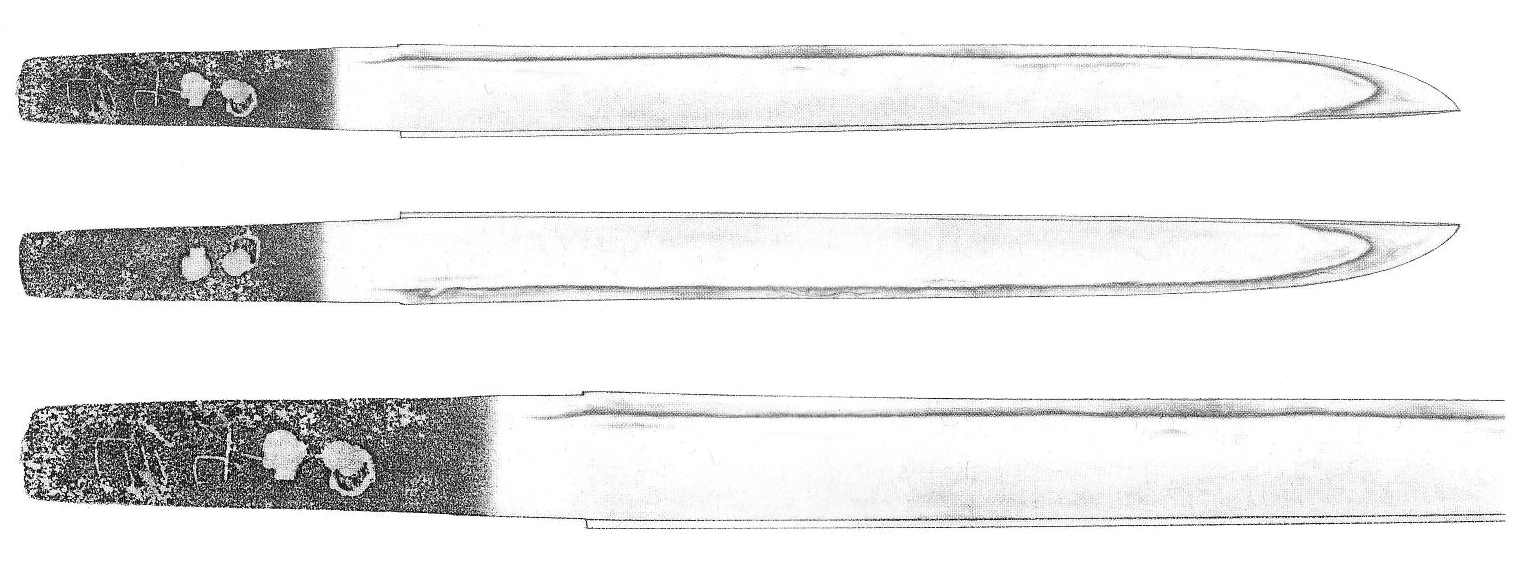
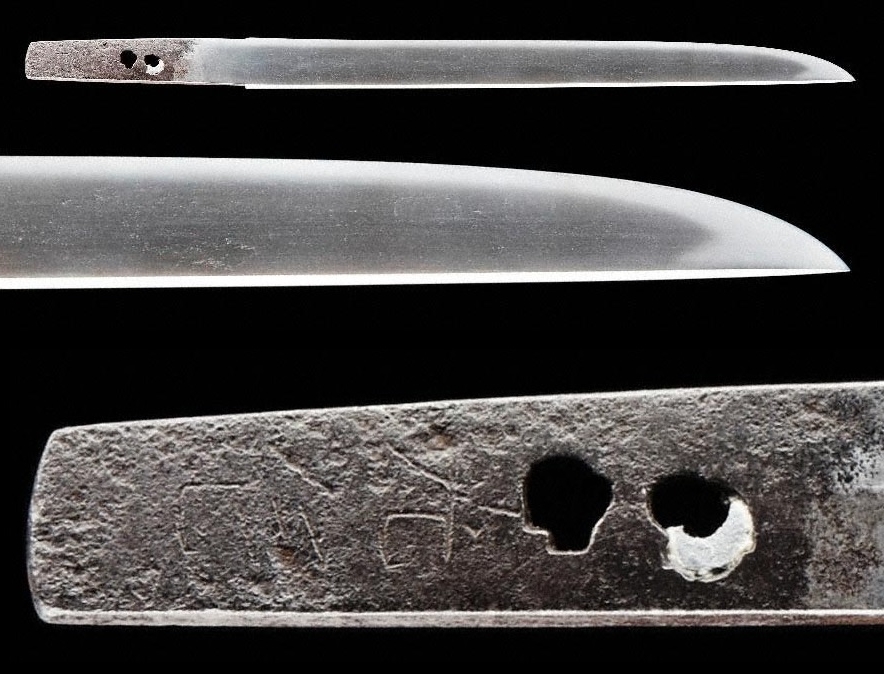
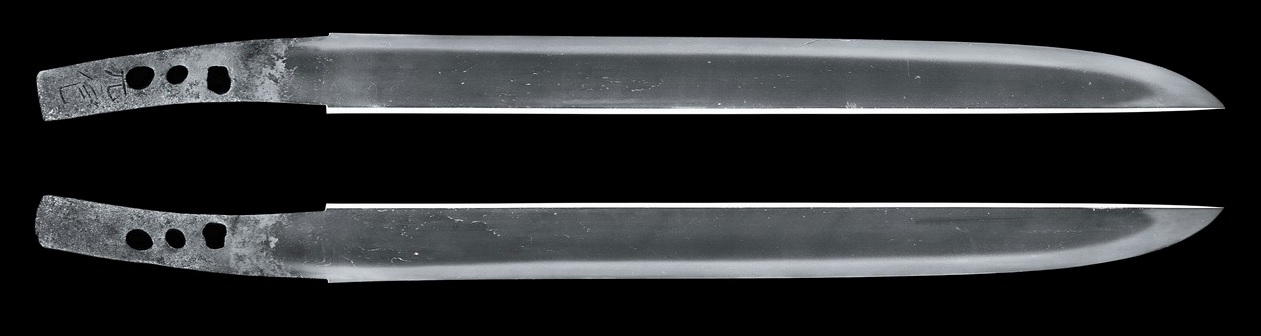
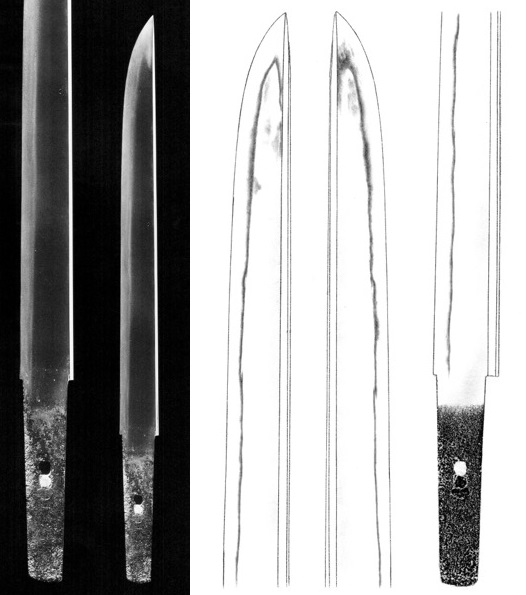
KANTEI 4 – YAMASHIRO #26 – Nobukuni (信国) School 1

The Ryôkai offshoot of Nobukuni was one of the schools that firmly established the Sôshû tradition within Kyôto, i.e. Yamashiro, but there is this decade-long discussion about its ancestor. Basic problem is that the earliest extant Nobukuni blades do not directly link to the alleged scholastic backgrounds and that the historic sources are either contradicting or so broadly defined that so to speak anything could be possible (for example that several Ryôkai smiths also signed with Nobukuni at a certain point in their career). The most common tradition says that the 1st generation Nobukuni was one of the “Three Great Students of Sadamune” (Sadamune-santetsu, 貞宗三哲) and that he was active around Kenmu (建武, 1334-1338) in Kyôto, at the instersection Gojôbômon (五条坊門) and Horikawa (堀川). This background is found in the Nôami Hon Meizukushi (能阿弥本銘尽) which was written in 1483, i.e. about a century after the first Nobukuni smiths had been active. This source also does not refer to his other scholastic background, the Ryôkai School, which is found for the first time in the Genki Gannen Tôken Mekiki Sho (元亀元年刀剣目利書) from 1570. This source sees the 1st generation Nobukuni as son of Ryô Nobuhisa and grandson of Ryô Hisanobu. The Kokon Mei Zukushi in turn whose data goes back to 1611 says that the tradition with Nobukuni being the son of Nobuhisa is incorrect and that he was actually the son of Ryô Kunihisa, i.e. Hisanobu’s brother and Nobuhisa’s uncle. And the Kotô Meizukushi Taizen lists him as direct student of Ryôkai whilst the Nihontô Koza says “either the son of Ryôkai or of Ryô Hisanobu.” And then Nobukuni Yoshisada (信国吉貞, ?-1640), the founder of the shintô era Chikuzen-Nobukuni School, stated in his genealogic claims from 1602 that his ancestor became during the Gen’ô era (元応, 1319-1320) a late student of Ryôkai and worked henceforth for several decades under the name of Nobukuni along Kyôto’s Gojôbômon. As indicated above, the statement of the Kotô Meizukushi Taizen that Ryô Hisanobu signed from the Jôwa era (貞和, 1345-1350) onwards with Nobukuni and that his son Nobuhisa did so too from the age of 43 onwards does not make things easier.

So how about the facts? The earliest extant date signature is from Enbun three (延文, 1358), followed by dates from Kôan one (康安, 1361), Jôji five (貞治, 1366), Ôan ? (応安, 1368-1375, the part with the year is illegible), and Eitoku three (永徳, 1383) as very last one that possibly attributes to the 1st generation. All these dates mean heyday Nanbokuchô and support at first glance the widespread assumption that there is too much a gap between the 1st generation Nobukuni and his alleged masters Ryô Hisanobu (or Ryôkai himself) and Sadamune. But only at first glance because I think that actually it all might go together. Just as a sidenote before we continue: I stated at the very beginning of this Kantei series that I will omit for the most part the biographical data of the smiths and that I am not going too much into historic detail, with the disclaimer that unless it is necessary for the understanding of what I am trying to communicate. Well, I broke that “promise” pretty quickly after we started because I realized that I don’t want to use a cookie-cutter approach and just throw in things like “sugata XY, kitae XY, hamon XY, bôshi XY…” What I want to provide is something comprehensible, replicable, something that allows you to follow my trains of thought rather than makes you feel urged to start from scratch by yourself. In other words, I do speculate quite often but I always try to provide an understandable foundation for my speculations. But let’s return to the topic.

Now the dismissal of the early Nobukuni always goes like “records say that the 1st generation was active around Kenmu (建武, 1334-1338) but there are no Nobukuni blades extant that can be dated back that far,” concluding from there that the 1st generation was active much later. But for me actually nothing speaks against the assumption that the 1st generation Nobukuni studied around 1320 with the Ryôkai School when master Ryôkai was in his latest years (as the Chikuzen-Nobukuni genealogy says), that he learned from Sôshû Sadamune much later, and that he enjoyed a long life and was still alive in the early 1380s. Sadamune was active from the very end of the Kamakura period, i.e. around Karyaku (嘉暦, 1326-1329) and Gentoku (元徳, 1329-1331), until about the Nanbokuchô-period Jôwa era (貞和, 1345-1350). Even when we dismiss the 1320 date and assume that Nobukuni emerged somewhat later from the Ryôkai School, we are still in the picture, i.e. him being active in Kenmu and being either the son of Ryô Hisanobu or Kunihisa. And another statement from the Kokon Mei Zukushi which says that Nobukuni started forging swords when Sadamune was of an old age and active around Enbun (延文, 1356-1361) does only dismiss the approach that he directly learned from master Ryôkai but fits in smoothly into everything else. Thus for the time being I think that there was indeed a Nobukuni who was active in the Kenmu era, that this nengô is maybe just placed too early and does not refer to his main active period, that he learned the Sôshû tradition of sword forging from Sadamune, and that he was still active when the Nanbokuchô period had passed its zenith.

*

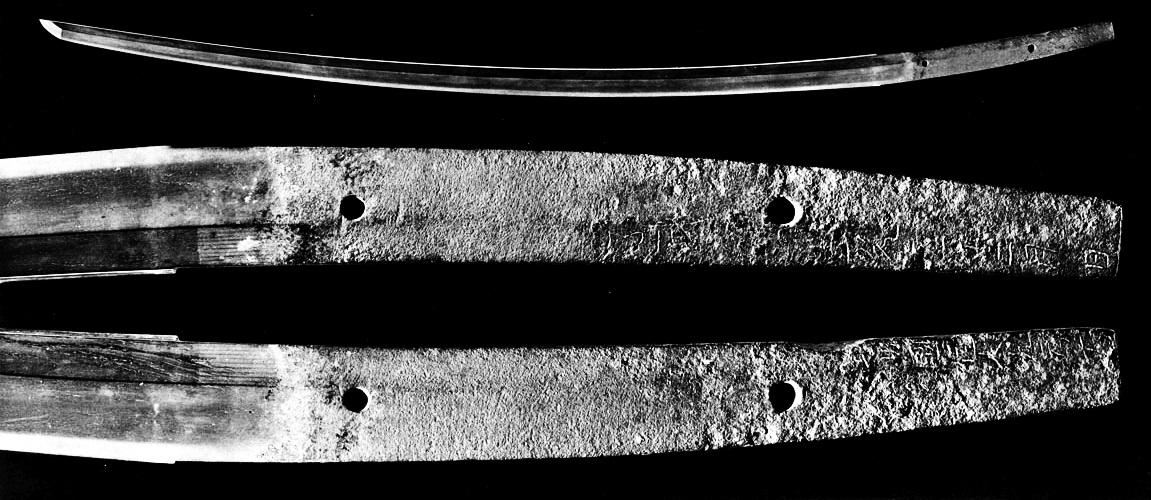
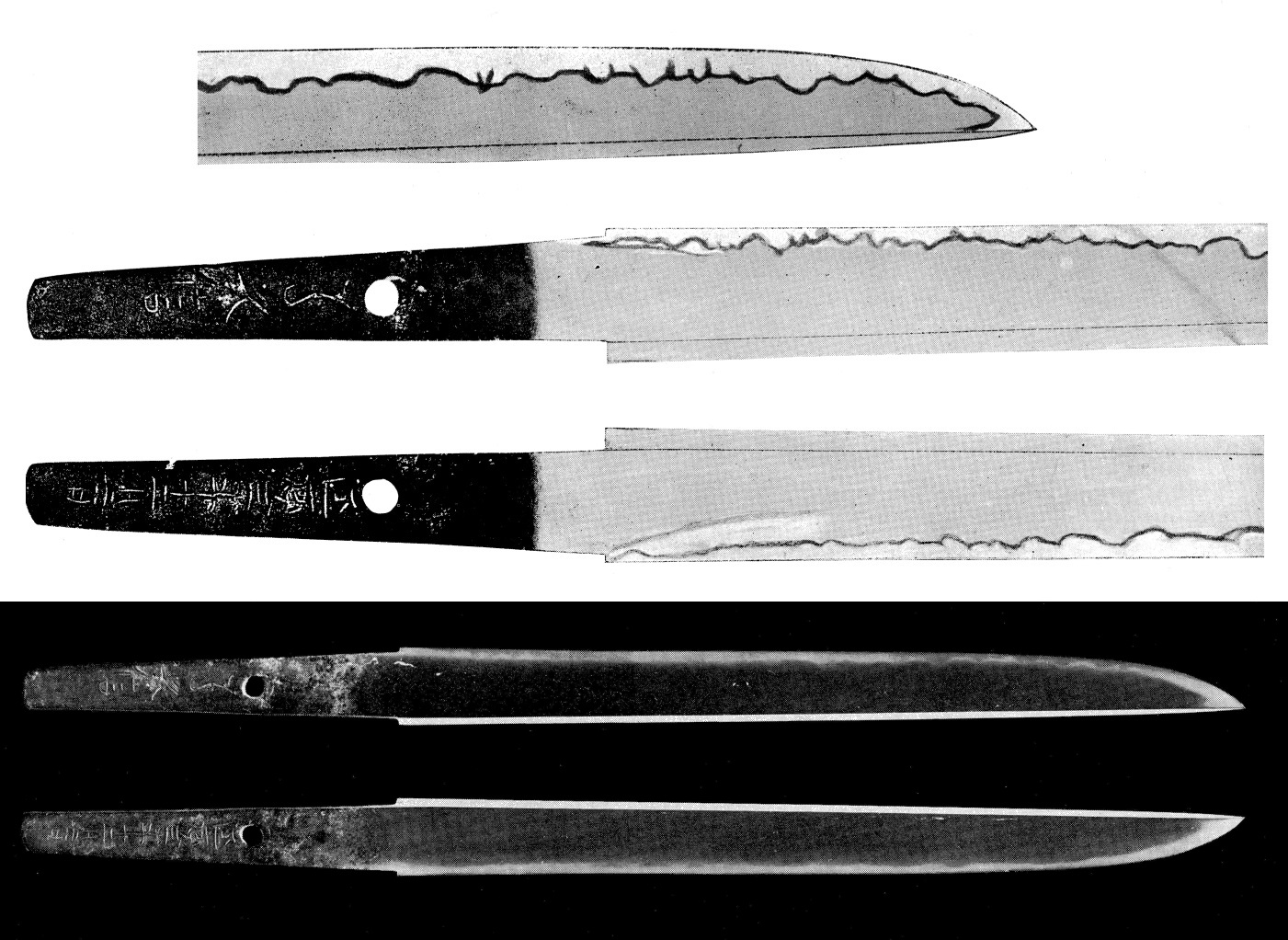
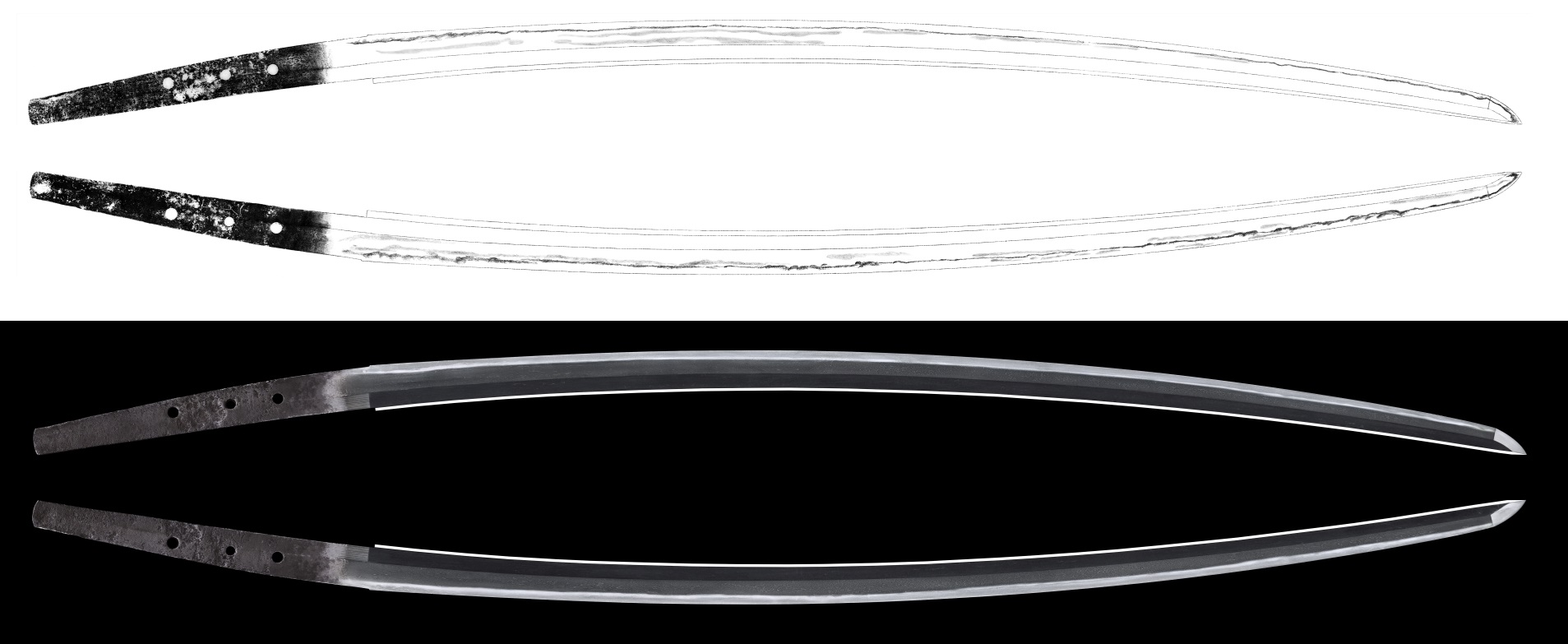
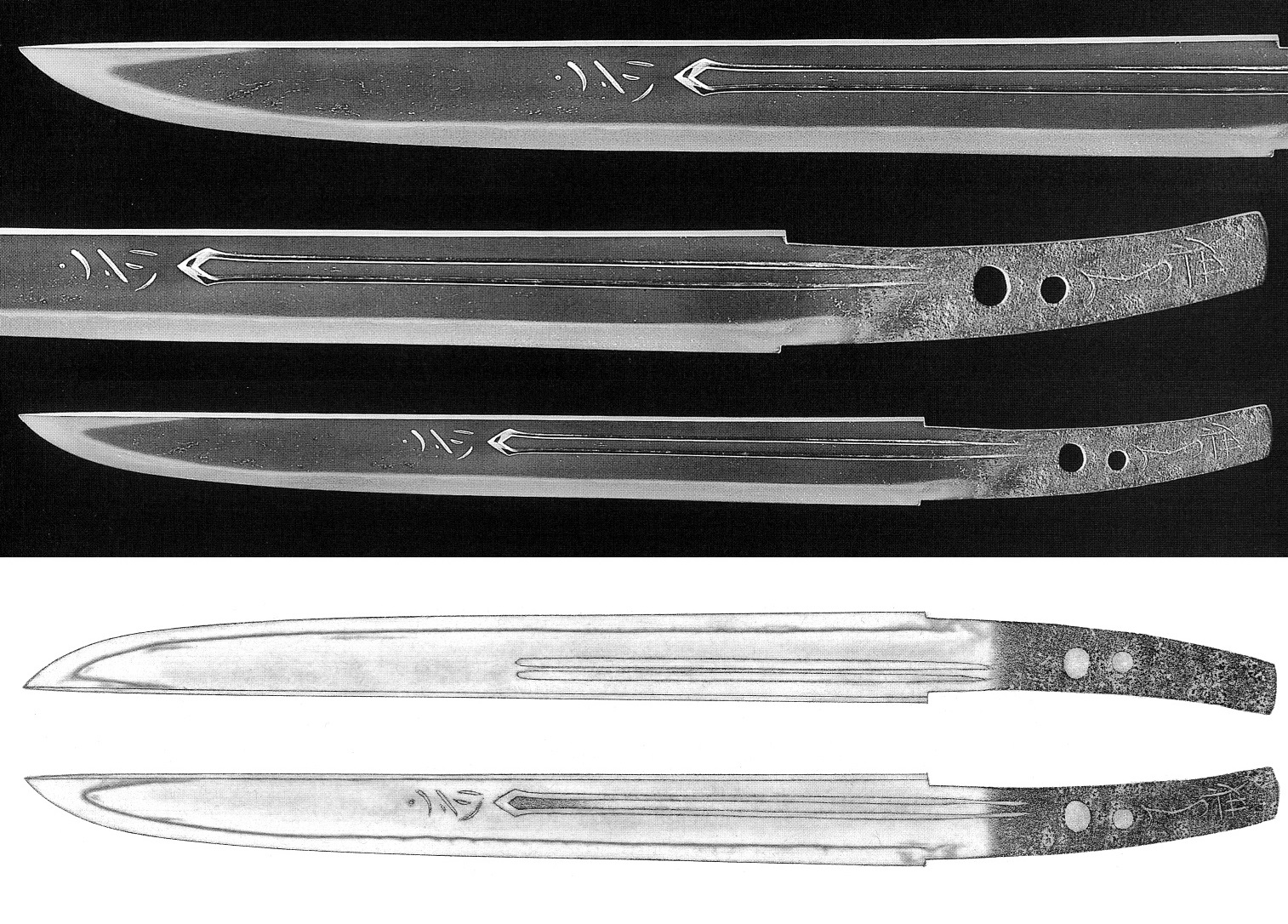
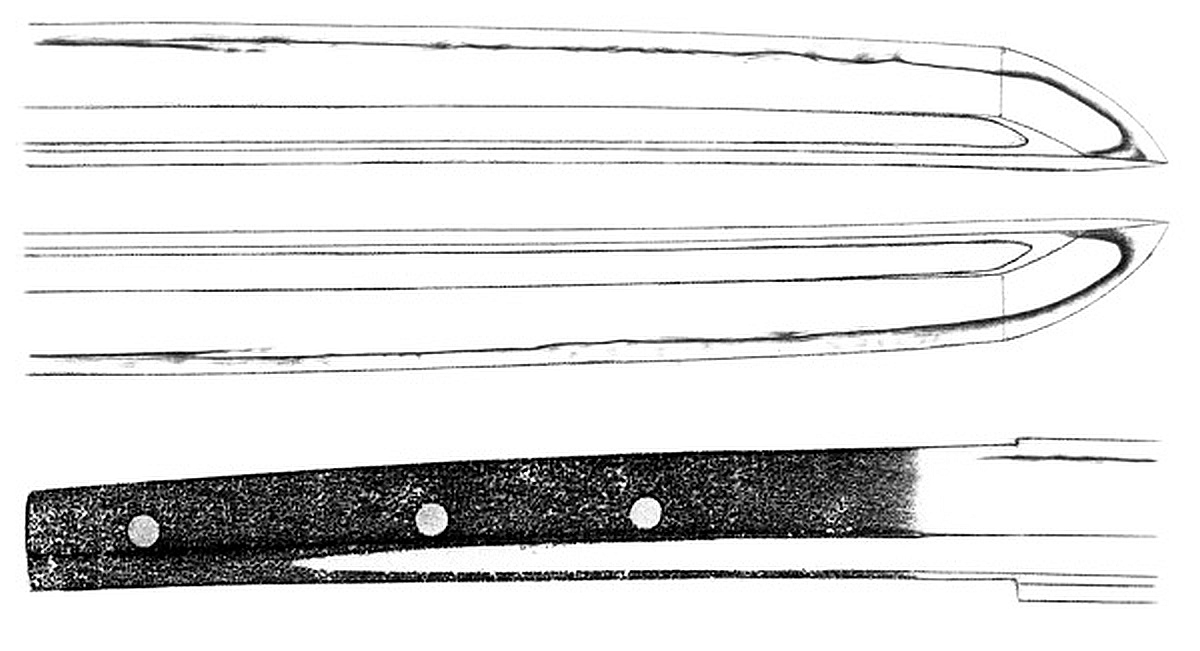
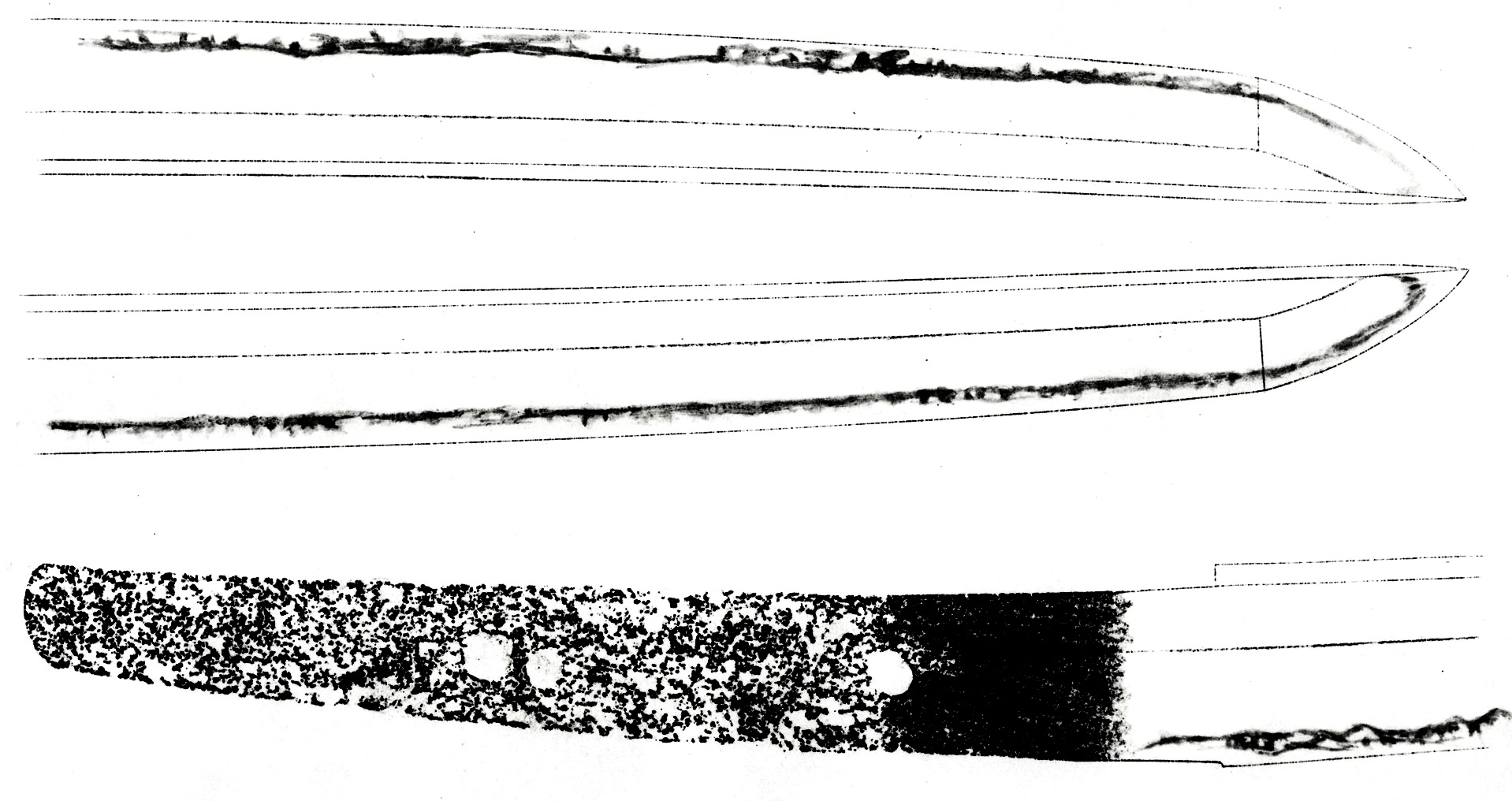
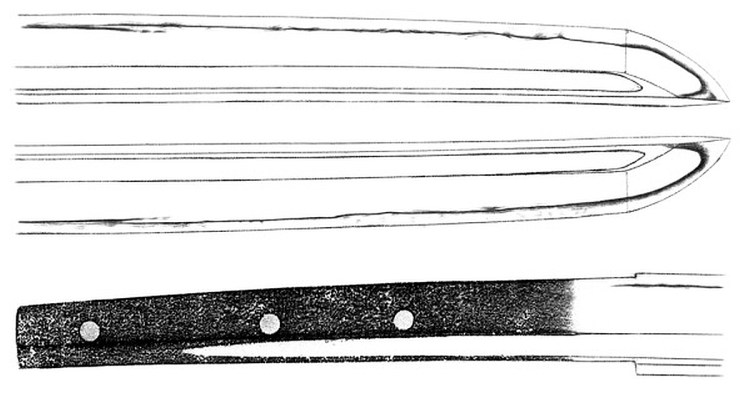
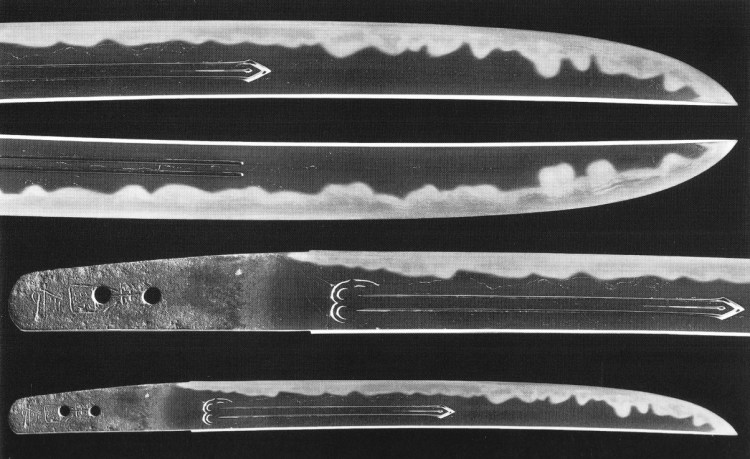
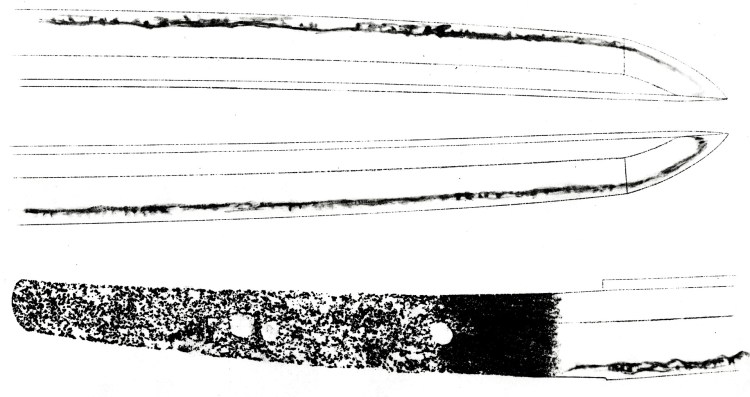
But let me underline all that, i.e. my above mentioned approach, on the basis of concrete works. Picture 1 shows the earliest dated work known by Nobukuni. It is a tantô that is designated as jûyô-bijutsuhin, signed in niji-mei “Nobukuni,” and dated “Enbun sannen jûnigatsu hi” (延文三年十二月日, “a day in the twelfth month Enbun three [1358]”). It has a nagasa of 27.5 cm, is in hira-zukuri, has a rather wide mihaba and a sunnobi-sugata, features a relative thin kasane, and a hint of a sori. So the sugata is typical for pre-heyday Nanbokuchô, i.e. pre-Enbun-Jôji. The jigane is a rather standing-out itame with some masame-nagare towards the ha and shows plenty of ji-nie and chikei. The hamon is a classical Yamashiro-like chû-suguha in ko-nie-deki that comes with a rather tight nioiguchi, starts with a yakikomi over the machi, shows only little hataraki like ko-ashi, and that ends in a sugu-bôshi with a relative wide and long running-back ko-maru-kaeri. The blade was once a heirloom of the Shimazu (島津) family, the daimyô of the Satsuma fief, and speaks truly for Yamashiro Rai at first instance and with the nagare-masame along the ha for Ryôkai at second glance.

Nobukuni1

Picture 1: jûyô-bijutsuhin, tantô, mei “Nobukuni” (信国), date see text above, hira-zukuri, mitsu-mune, nagasa 27.5 cm, a hint of a sori

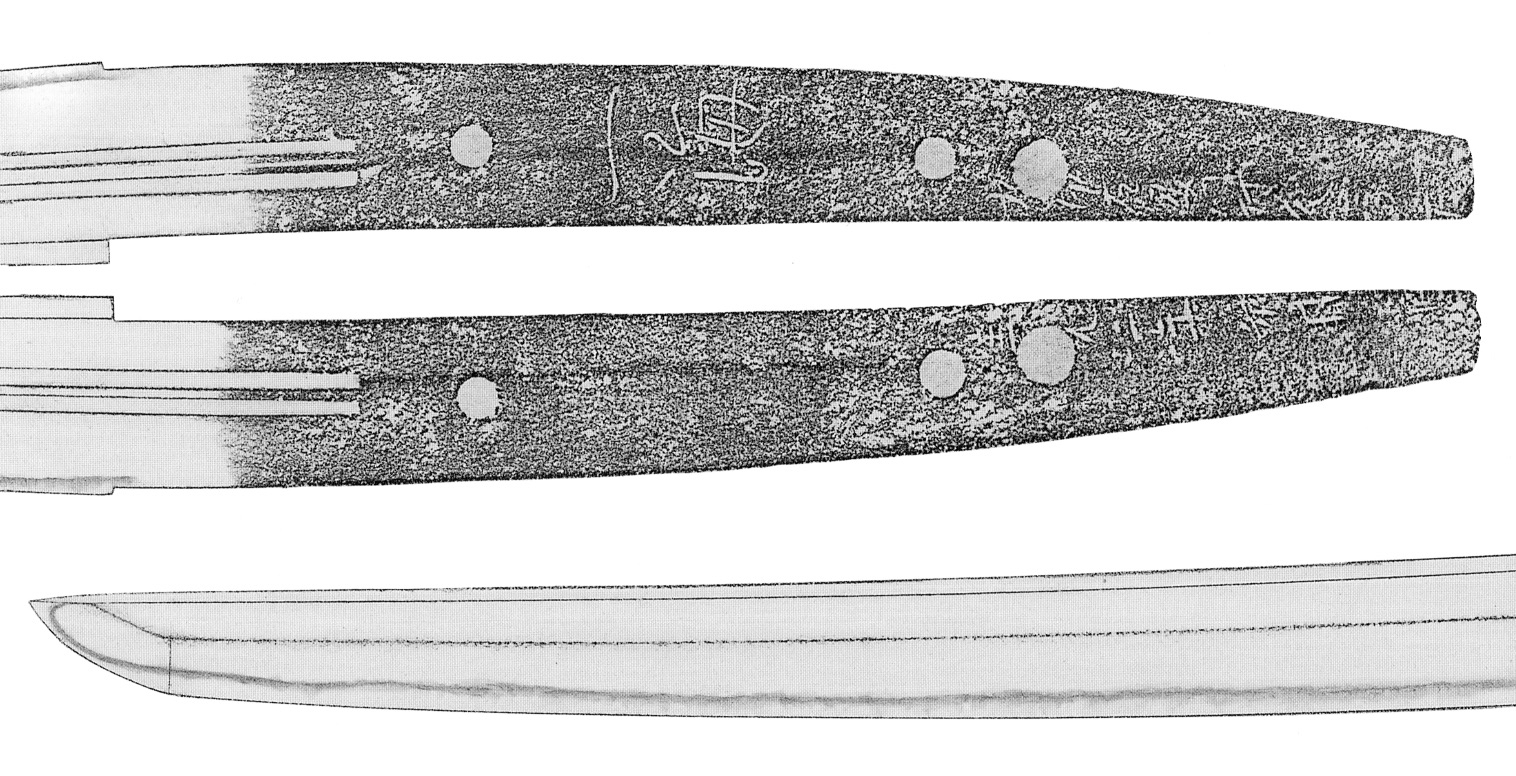
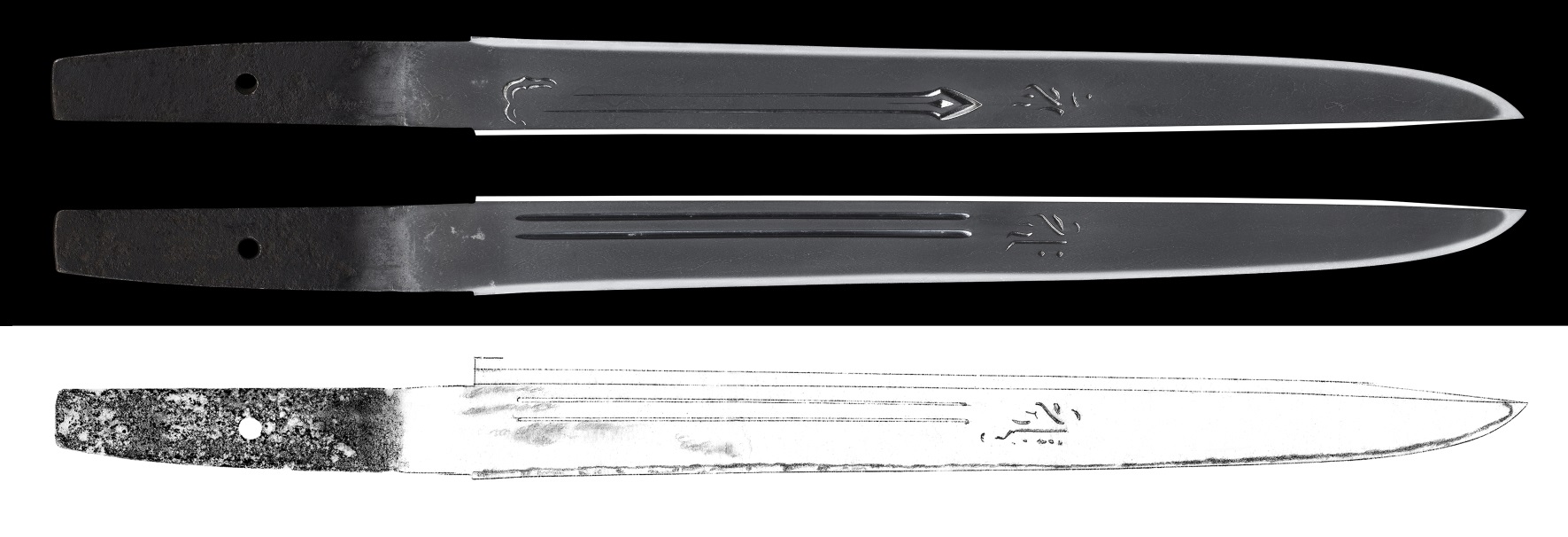
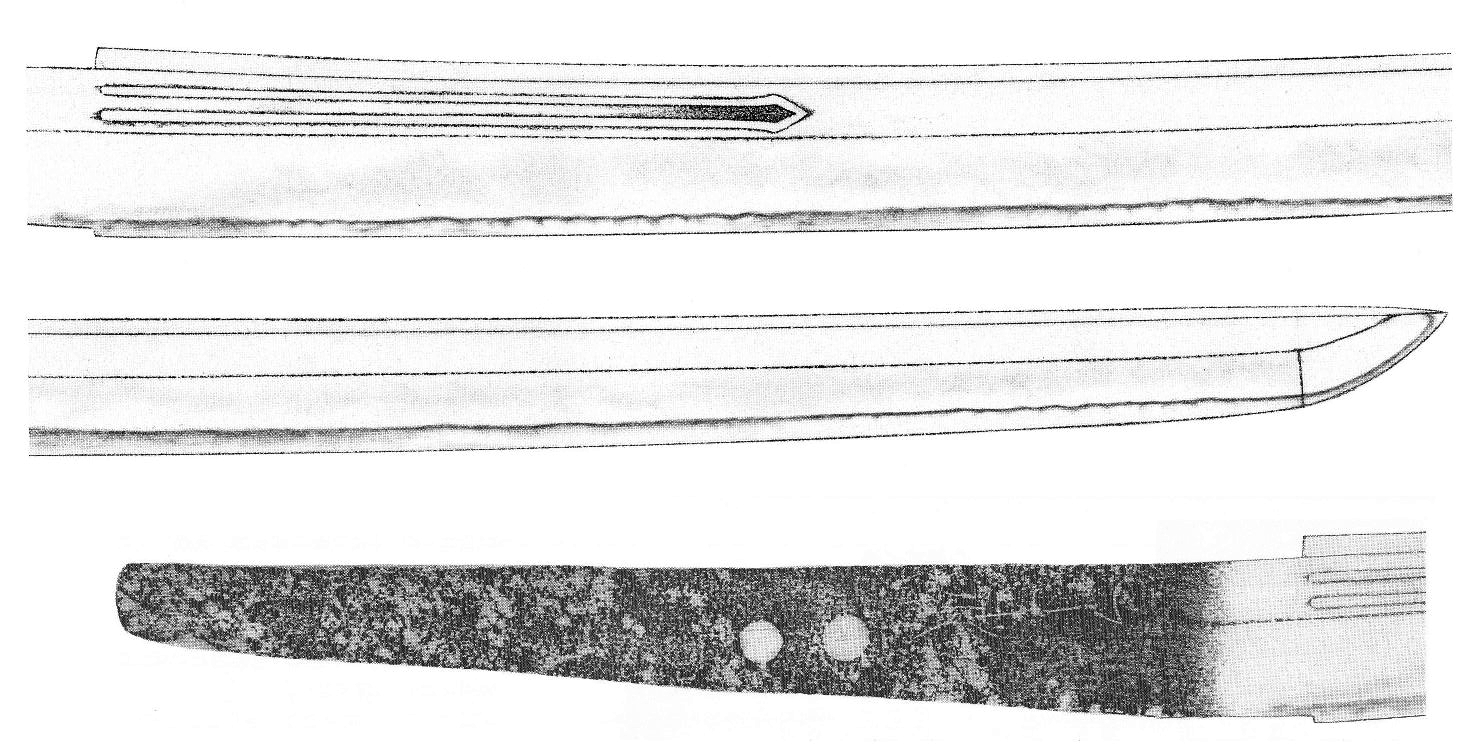
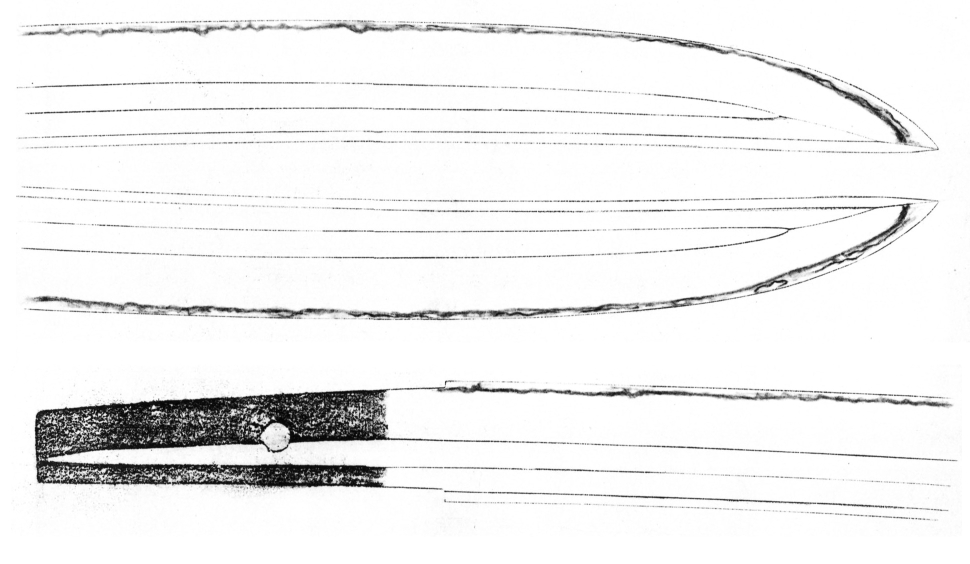
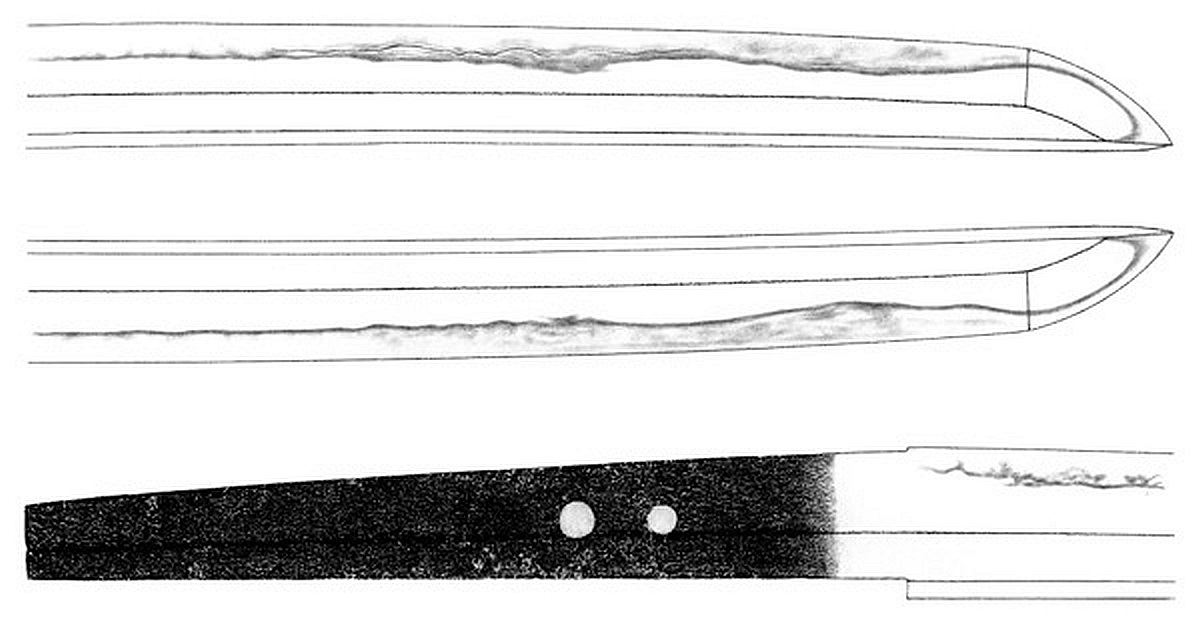
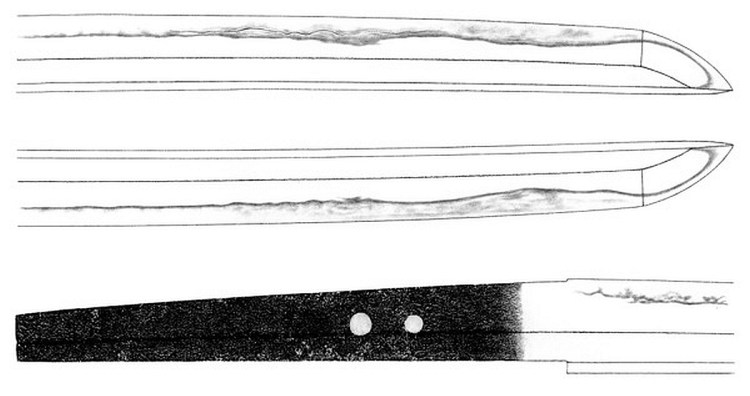
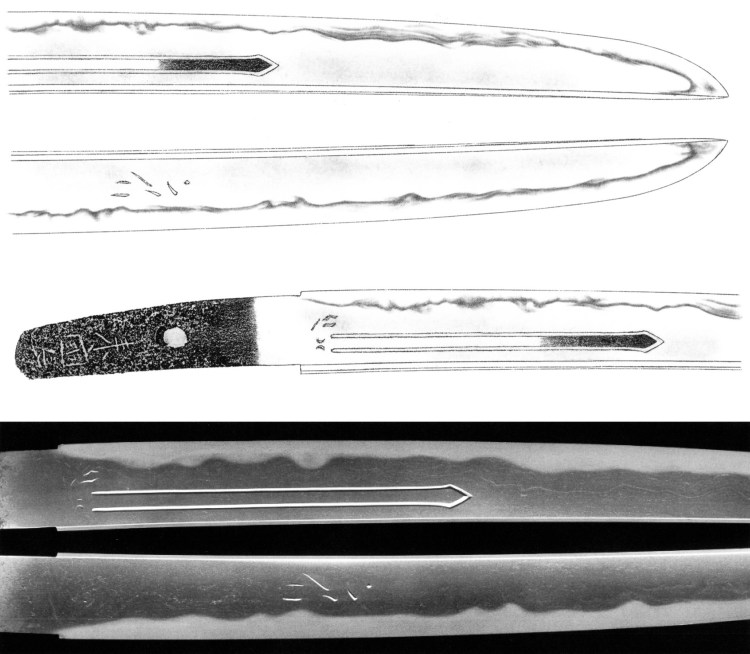
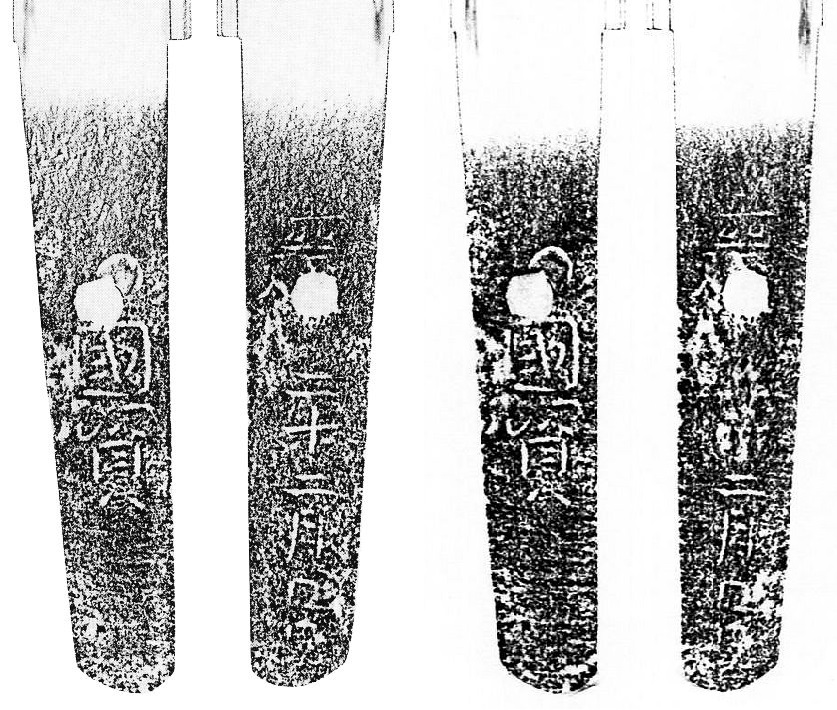
Next in picture 2 I want to introduce the blade with the second eldest known date signature. It is a sunnobi-tantô or hira-zukuri ko-wakizashi with a nagasa of 31.2 cm, a wide mihaba, a noticeable sori, and a thin kasane. The jigane is a rather standing-out itame with masame towards the ha, plenty of ji-nie, and chikei. The hamon is a hoso-suguha in ko-nie-deki that shows some hotsure along the monouchi and the bôshi is sugu with a smallish ko-maru-kaeri that features some hakikake. On the omote side we see a katana-hi with a soebi and on the ura side just a katana-hi. Please note that the tang is judged as ubu, although with the tip cut off, i.e. the hi are supposed to run like that into the nakago. Again, this blade is clearly more Ryôkai than Sôshû.

Nobukuni2

Picture 2: jûyô, tantô, mei “Nobukuni” (信国) – “Kôan gannen ni…” (康安元年二…, “second [month] Kôan one [1361]”), nagasa 31.2 cm, sori 0.2 cm, motohaba 2.9 cm, hira-zukuri, mitsu-mune

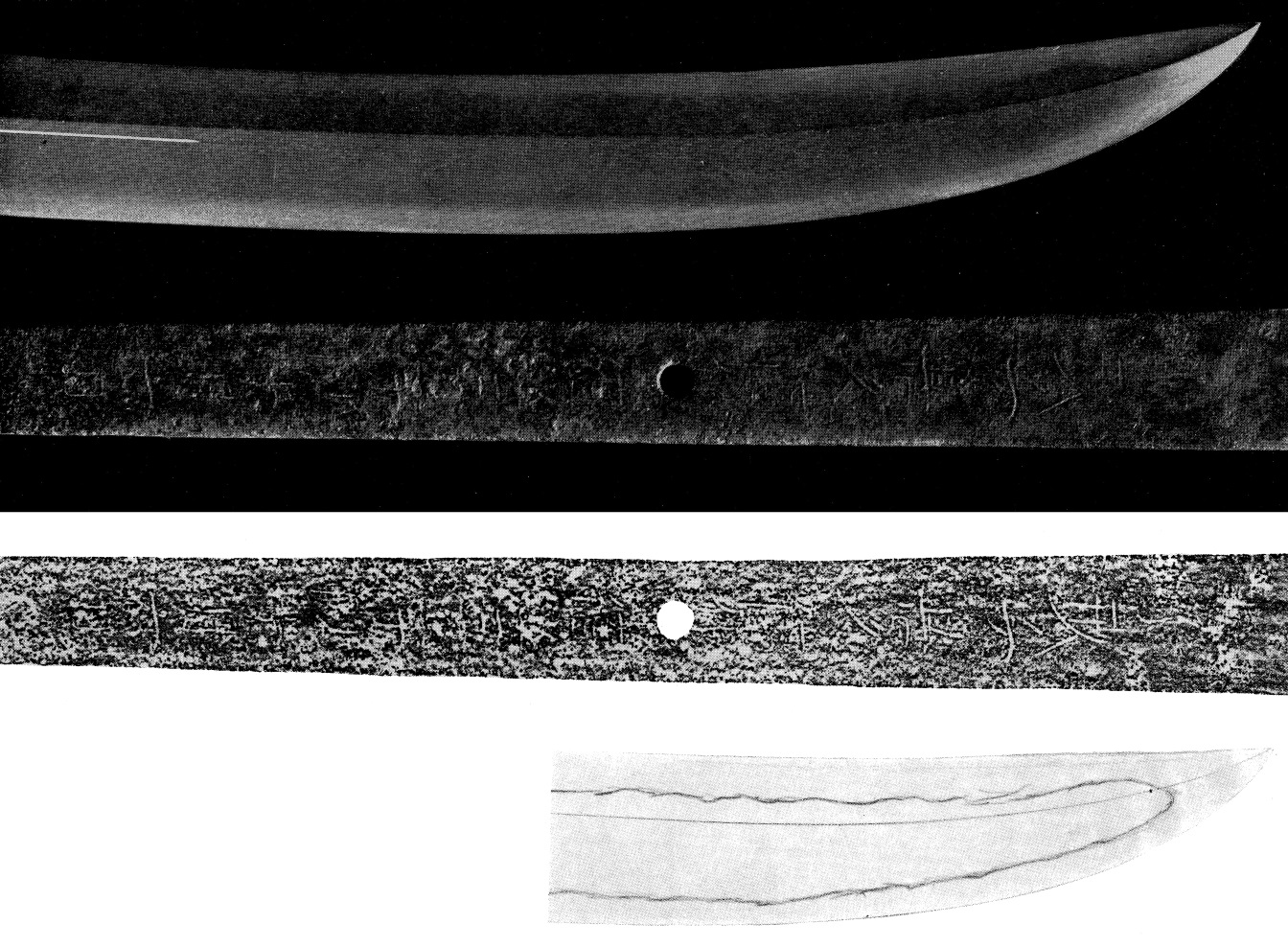
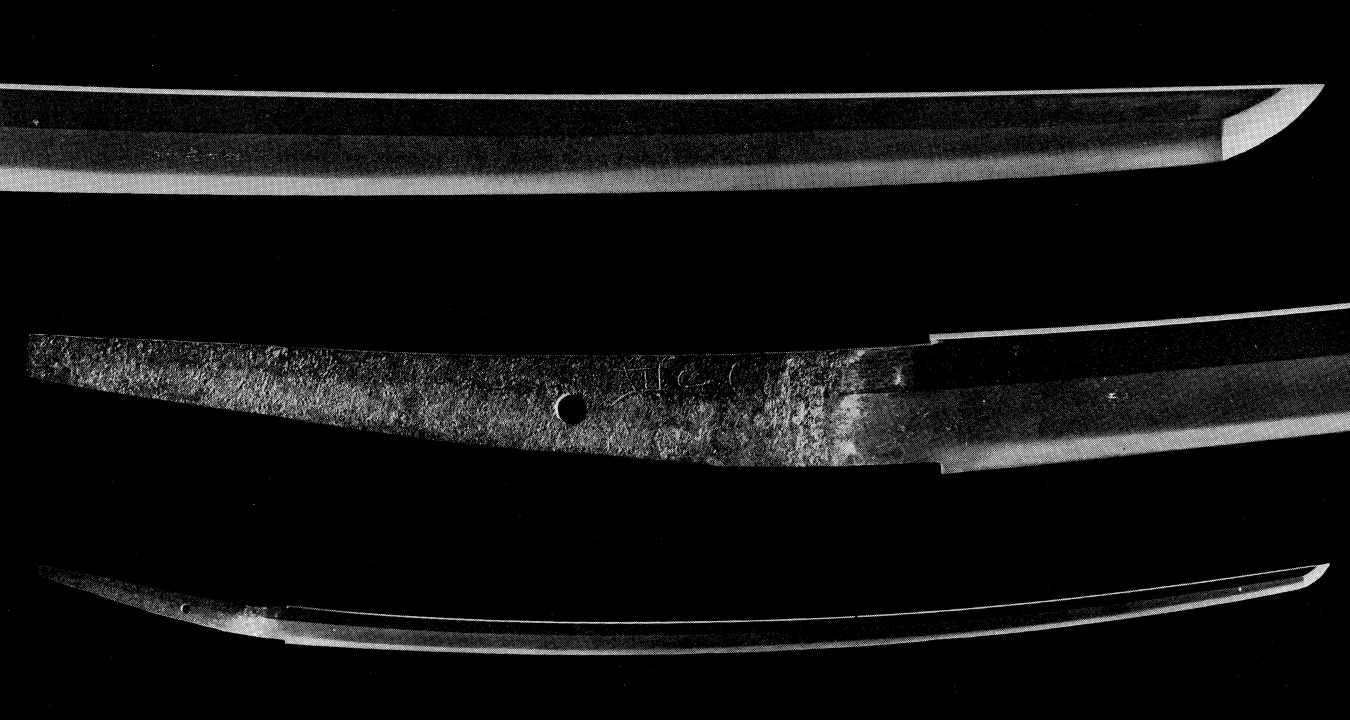
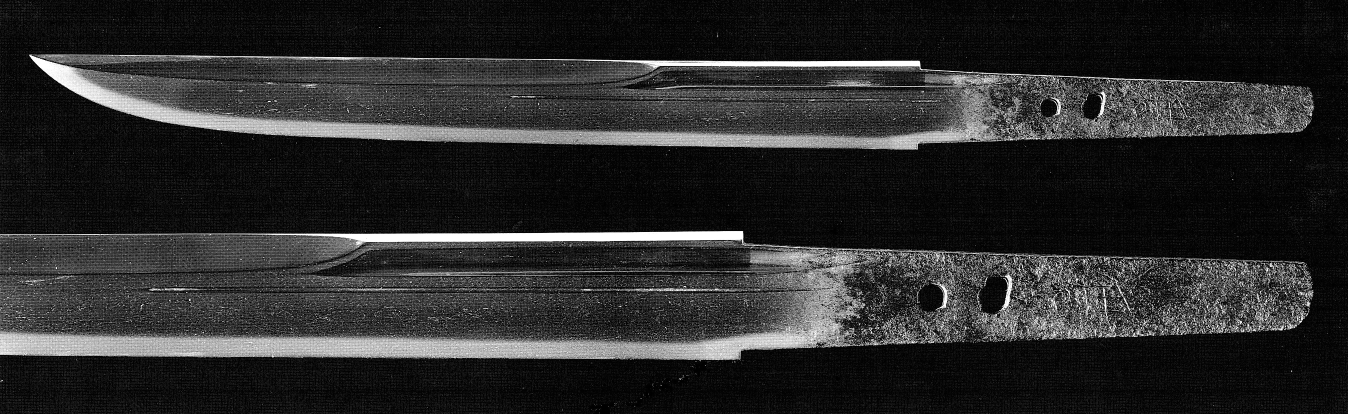
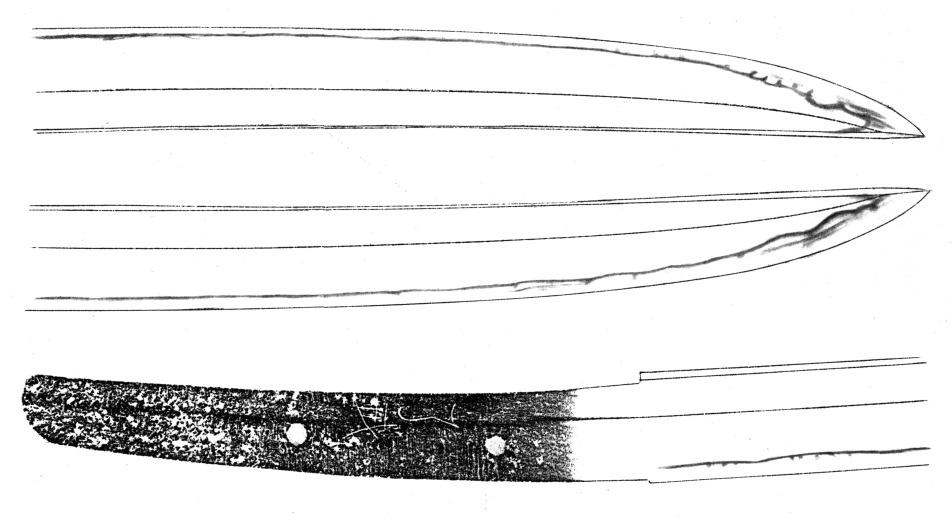
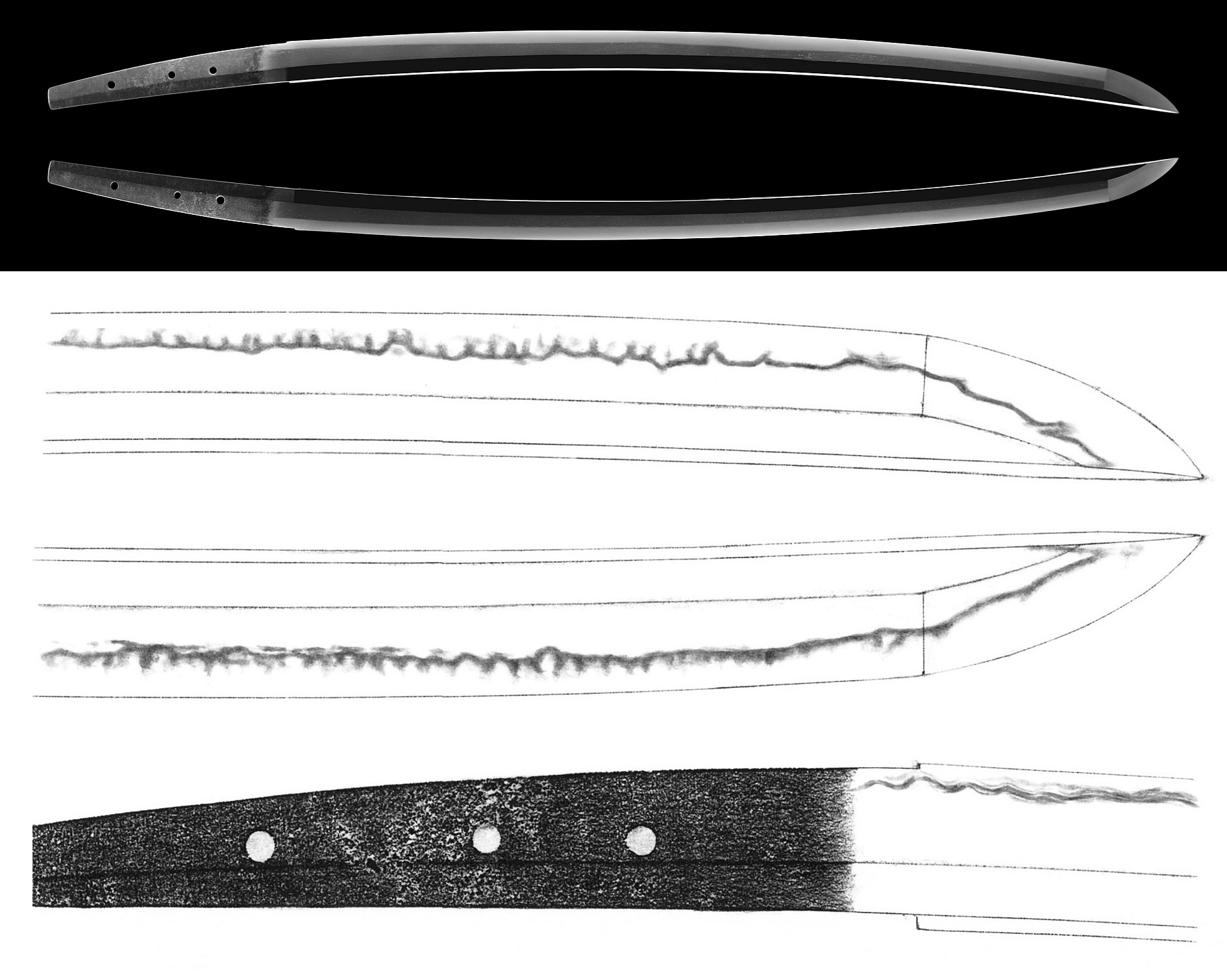
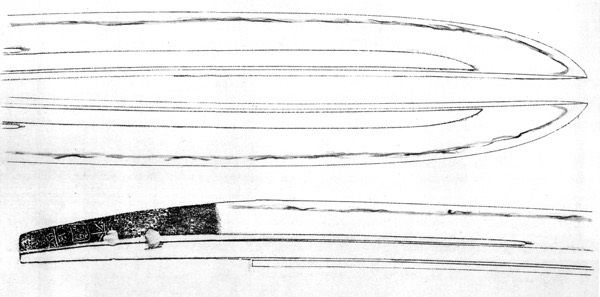
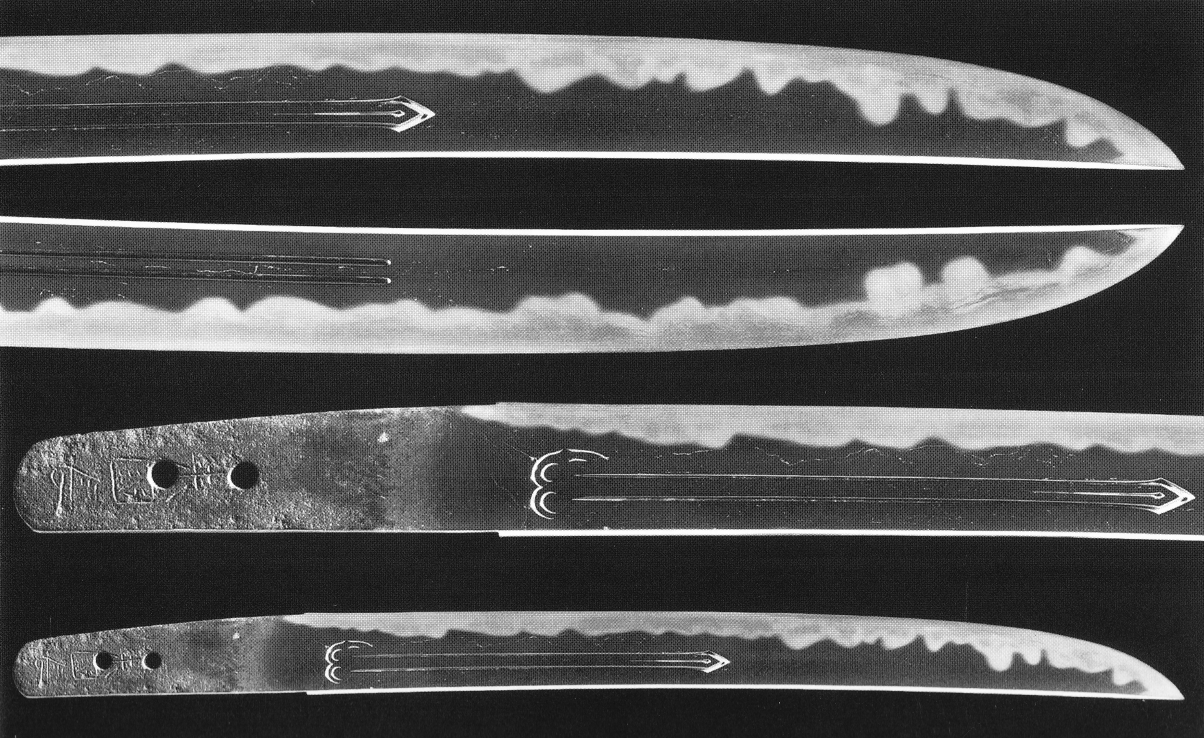
After that, i.e. some time in the mid 1360s, Nobukuni finally started to apply the techniques of the Sôshû tradition which he had learned from Sadamune. The next known dated work namely (see picture 3), a jûyô-bunkazai tantô, shows a finely forged itame but which comes with an abundance of ji-nie and a ko-notare hamon in ko-nie-deki with a wide nioiguchi that is mixed with ashi and yubashiri. The bôshi is midare-komi and features a wide but rather pointed kaeri.

Nobukuni3

Picture 3: jûyô-bunkazai, tantô, mei “Nobukuni” (信国) – “Jôji gonen jûgatsu” (貞治五年十月, “tenth month of Jôji five [1366]”), nagasa 27.9 cm, sori 0.1 cm, hira-zukuri, mitsu-mune

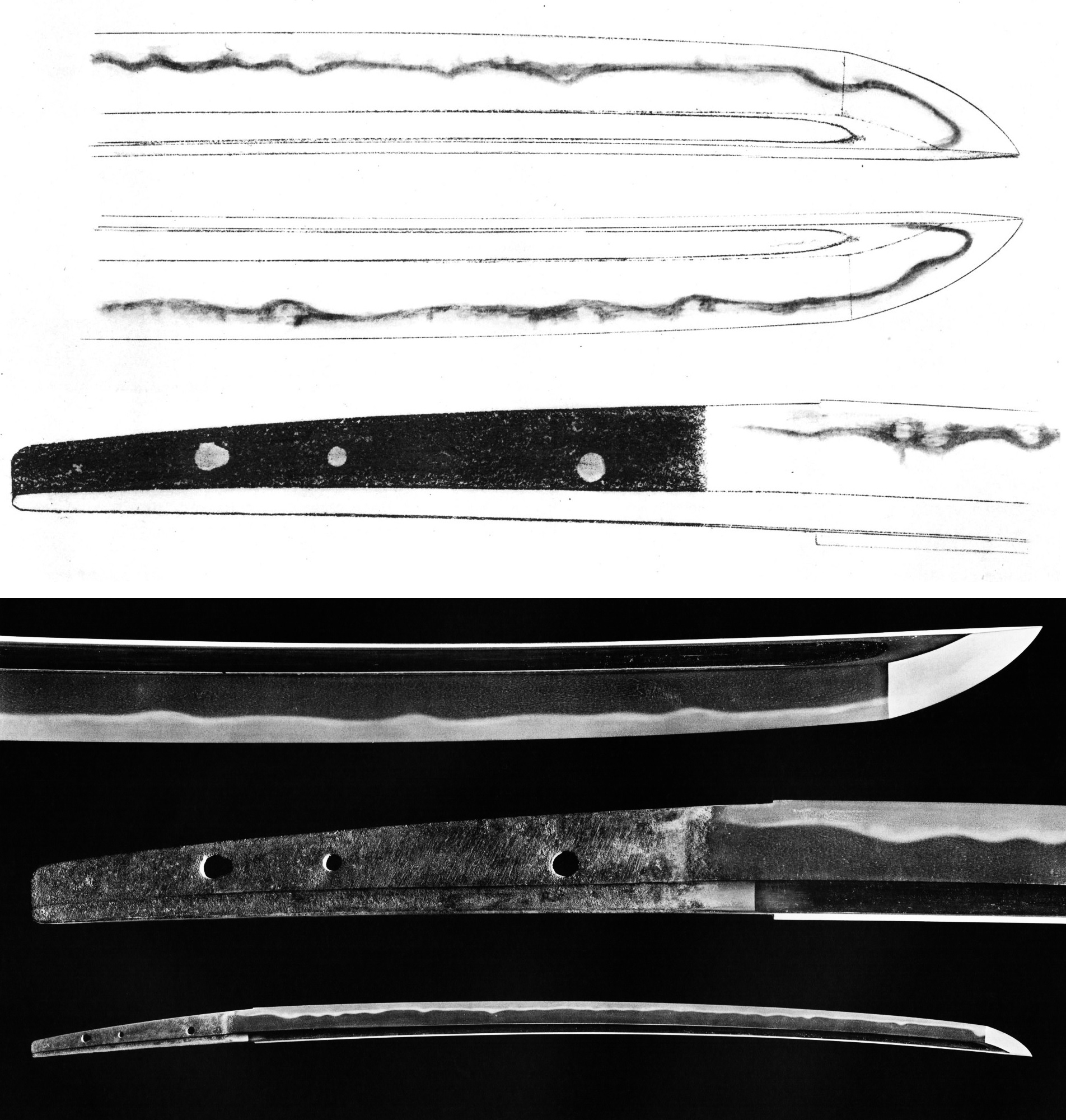
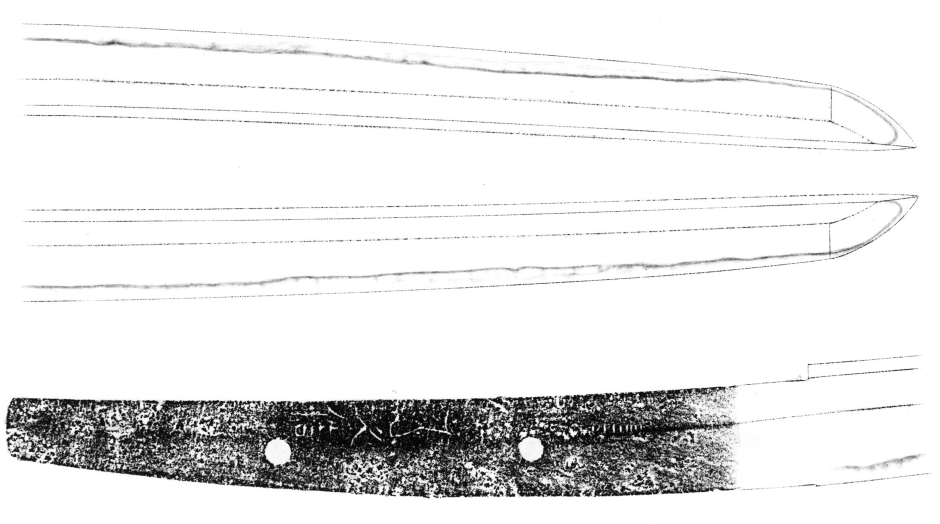
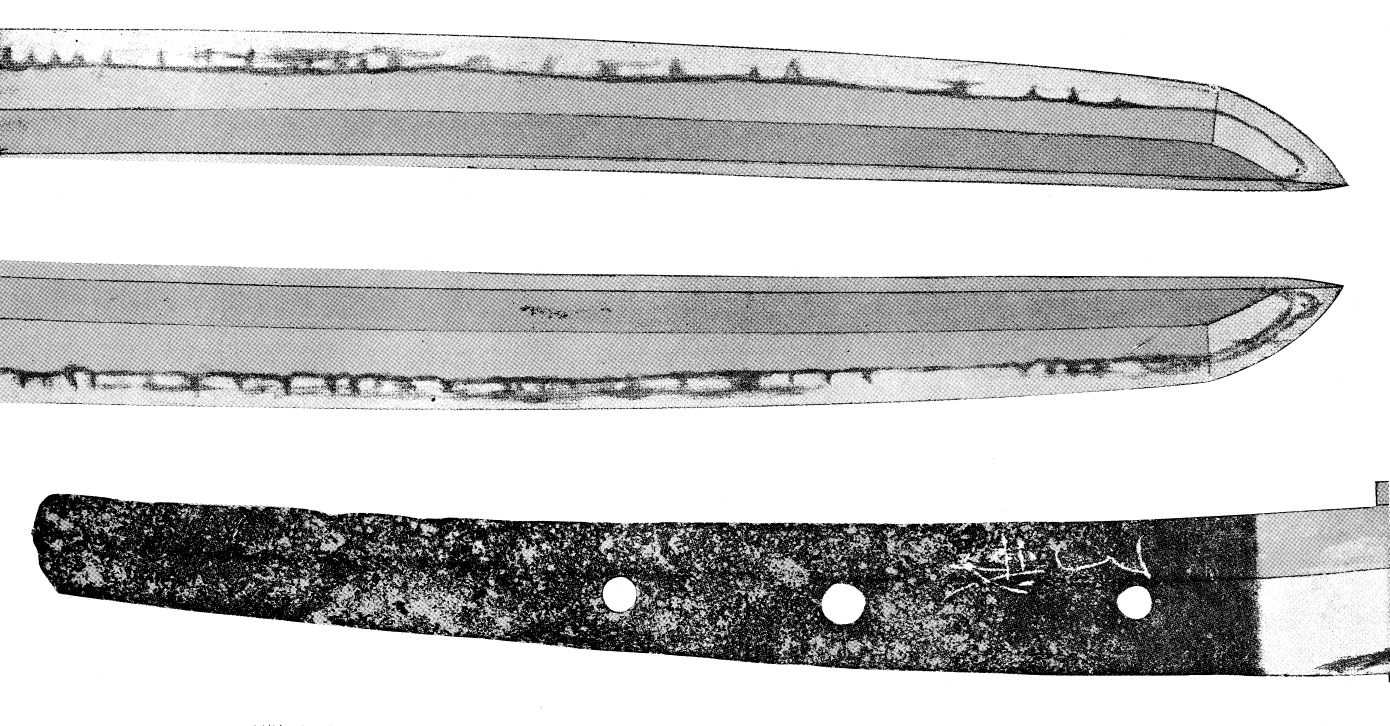
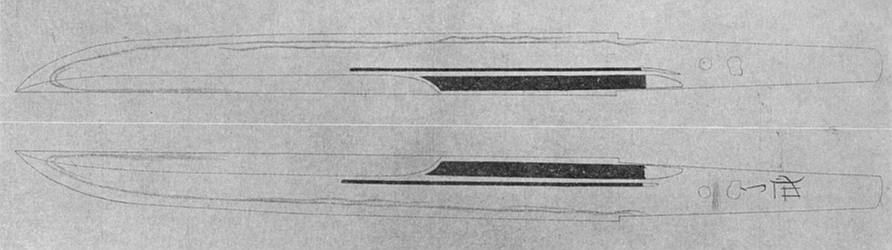
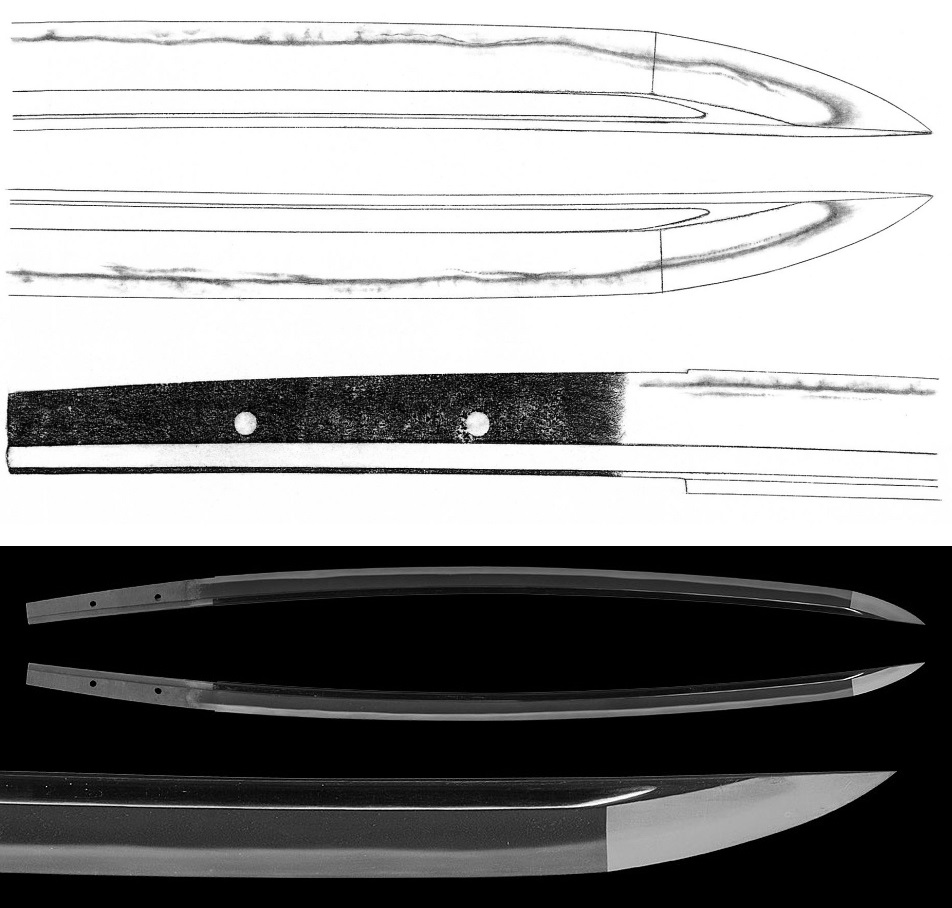
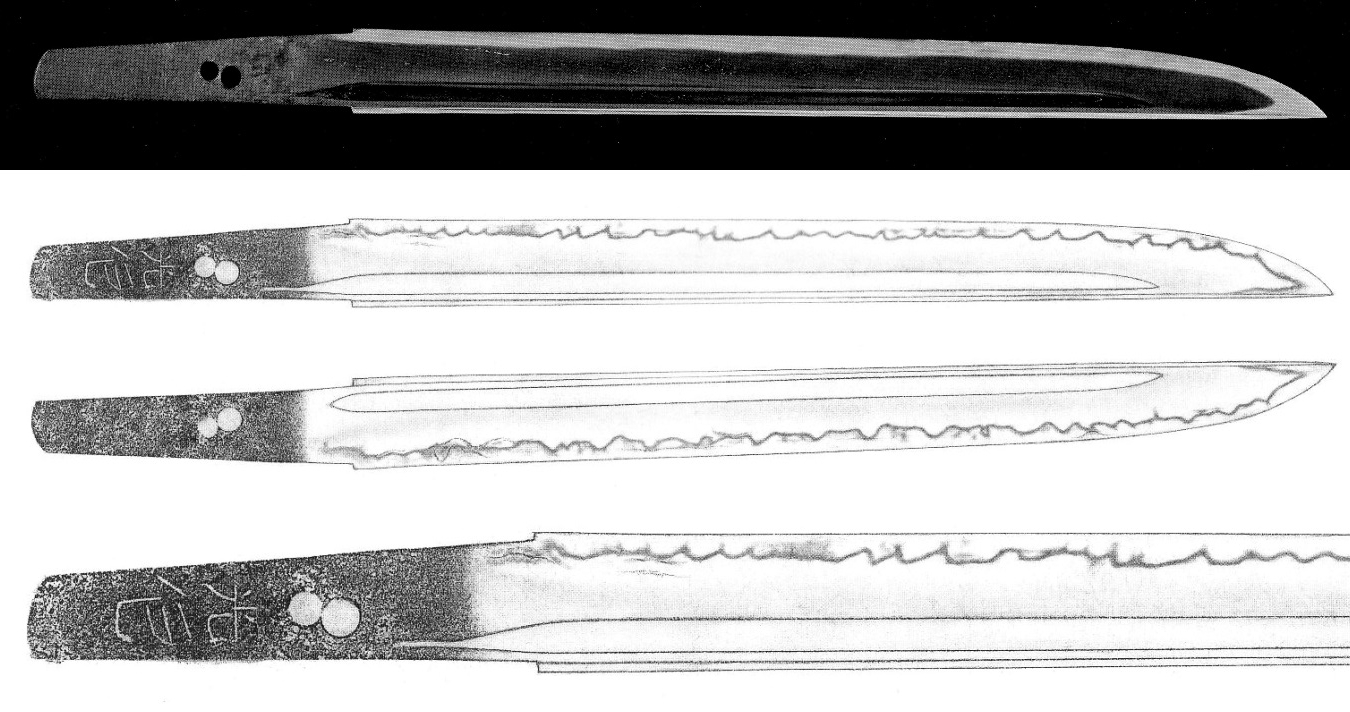
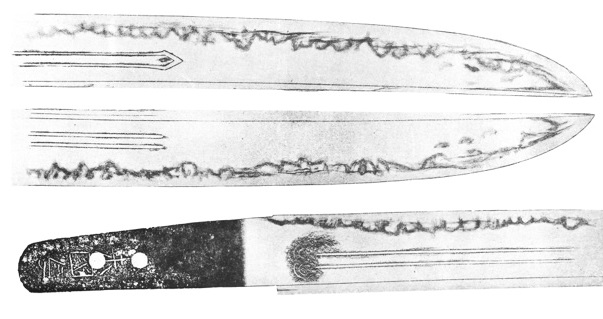
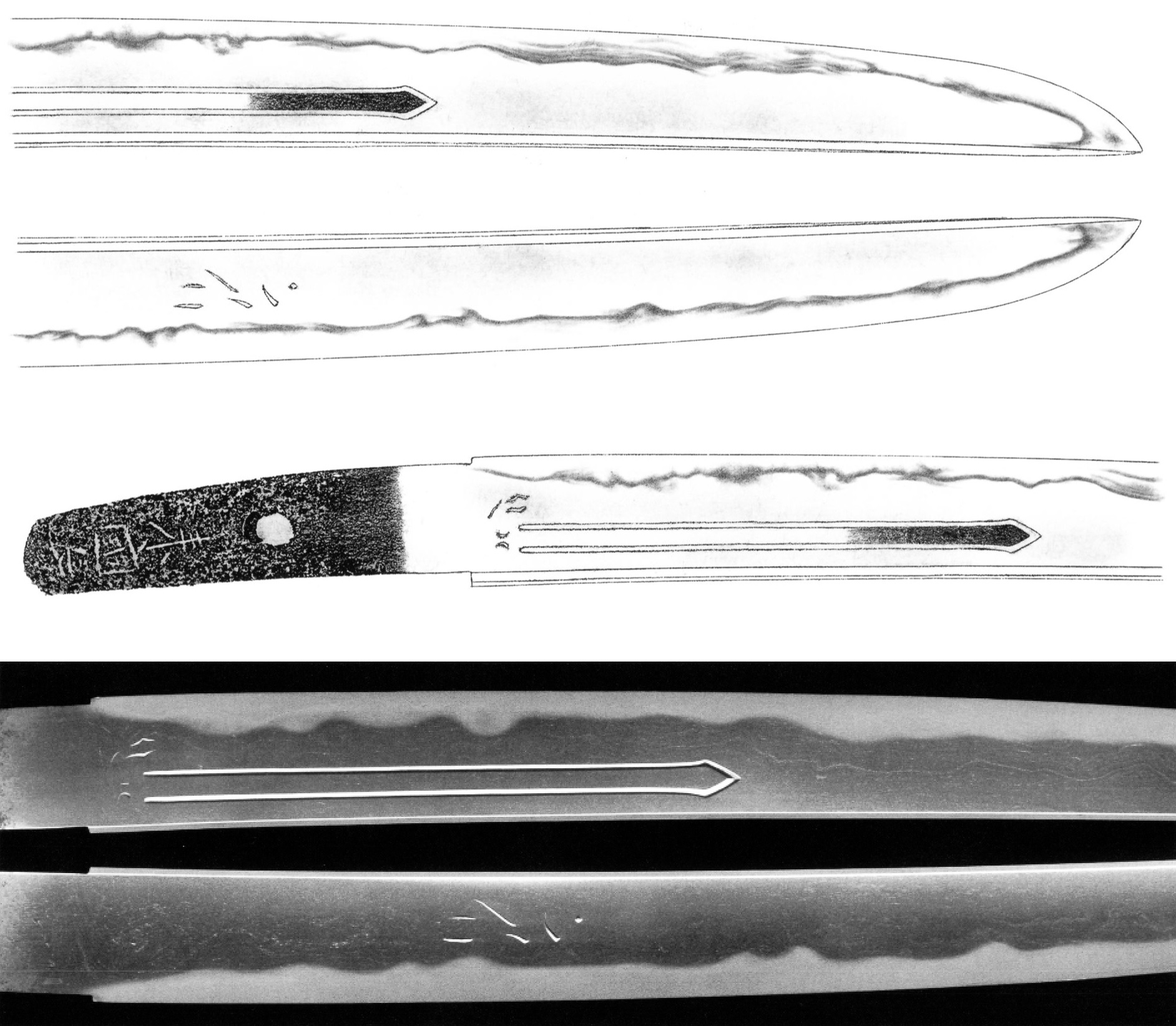
And then he went so to speak “full” Sôshû, as seen in the jûyô-bunkazai introduced in picture 4 which is regarded by many as the best work of Nobukuni. It is a wide hira-zukuri ko-wakizashi with a relative deep sori and shows a dense but overall rather standing-out itame that is mixed with a little ô-hada in places and that features plenty of ji-nie, chikei, and jifu, and Tanobe even mentions a nie-utsuri that appears towards the mune. The hamon is a quite nie-laden notare that is mixed with gunome, ko-midare, much sunagashi, some ara-nie, and a few kinsuji and the tobiyaki and yubashiri that appear along the yakigashira anticipate in certain areas a hamon interpretation that is often found on Nobukuni blades, and that is yahazu. In other words, the longer areas of yubashiri and tobiyaki that float in Sôshû-style over the gunome or ko-midare merge later with the ha and form gunome or ko-midare that fork into dove-tail shaped elements. The bôshi of the jûyô-bunkazai runs back in a long manner and shows hakikake and ara-nie. On the omote side we see a futasuji-hi and on the ura side a katana-hi with inside a suken as relief and a short soebi at the base. With this we have another approach that should become a characteristic feature of the Nobukuni School, and that is the trend to horimono. Incidentally, this masterwork was once a present of the Bizen Okayama daimyô Ikeda Tsunamasa (池田綱政, 1638-1714) to the Tokugawa family on the occasion of the birth of Tokugawa Ienobu’s (徳川家宣, 1662-1712) son Iechiyo (家千代, who died at the age of only two months). From that time on, the blade was a heirloom of the Tokugawa main line.

Nobukuni4

Picture 4: jûyô-bunkazai, tantô, mei “Nobukuni” (信国), nagasa 36.6 cm, sori 0.6 cm, motohaba 3.2 cm, hira-zukuri, mitsu-mune

A very good example of the aforementioned trend towards elaborate horimono is the jûyô-bunkazai hira-zukuri ko-wakizashi that is shown in picture 5. It is basically of the typical 1st generation Nobukuni interpretation of the Sôshû tradition, i.e. dense ko-itame with chikei and plenty of ji-nie in combination with a ko-notare-based hamon in ko-nie-deki that is mixed with ko-gunome, ko-midare, and sunagashi and a bôshi with a rather wide kaeri that features hakikake. The blade is shortened and bears a kinpun-mei attribution to Nobukuni on the omote and a no longer legible kinpun inscription on the ura side. As for the horimono, we see a ceremonial hat, a bonji, a rendai, kuwagata and a suken with elaborate sankozuka hilt on the omote, and a katana-hi with inside bonji and a suken as relief on the ura side.

Nobukuni5

Picture 5: jûyô-bunkazai, kinpun-mei “Nobukuni” (信国), nagasa 38.1 cm, sori 0.6 cm, motohaba 3.4 cm, hira-zukuri, mitsu-mune

 *

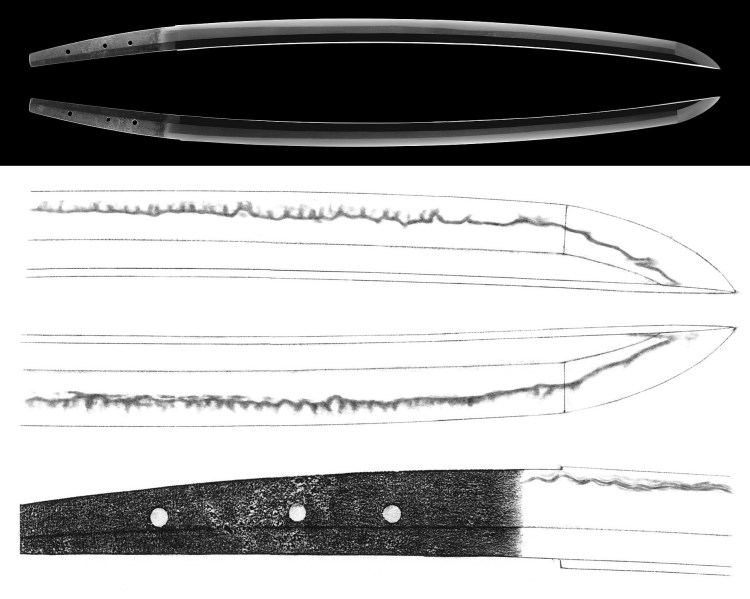
 When we take a look at the entire body of work of Nobukuni, and not only of the 1st generation but of the entire school, we learn that they placed a firm focus on shorter blades, i.e. sunnobi-tantô and hira-zukuri ko-wakizashi. Long swords are rare, and this is all the more true when we go back to the early Nobukuni smiths who had their main active periods before Ôei (応永, 1394-1428). So looking at these very rare Nanbokuchô-era tachi reveals that unlike short blades, it seems as if the 1st generation Nobukuni no longer used his Ryôkai-based Yamashiro style for them, i.e. they are all pretty much soshuesque, at least as far as the hamon is concerned. Picture 6 shows a tokubetsu-jûyô tachi that is ô-suriage and that comes in the typical heyday Nanbokuchô sugata which is a wide mihaba, a relative shallow sori, a thin kasane, and an elongated chû-kissaki. The kitae is an itame mixed with masame that shows ji-nie and chikei and the hamon is a nie-laden shallow notare that is mixed with gunome, ashi, kinsuji, and sunagashi. The nioiguchi is wide, bright, and clear and the bôshi runs on the omote side with a yakikomi over the yokote into a suguha and appears on the ura side as notare-komi, both running back with a ko-maru-kaeri.

Nobukuni6

Picture 6: tokubetsu-jûyô, katana, mumei, attributed to Nobukuni, nagasa 69.7 cm, sori 1.5 cm, motohaba 3.1 cm, shinogi-zukuri, iori-mune

A more flamboyant long sword of the 1st generation can be seen in picture 7. The blade is ubu, has a tachi-sugata with a toriizori, a relative thick kasane, and a chû-kissaki and shows a kitae in itame that tends to nagare on the omote side and that shows much chikei and plenty of ji-nie. The hamon is a ko-nie-laden ko-notare that is mixed with gunome, ko-gunome, ashi, connected , sunagashi, kinsuji, and some gunome that are about to turn into yahazu (but not yet fully). The bôshi is midare-komi with a brief ko-maru-kaeri. So from the overal sugata and the interpretation of the ha we can place this blade to the latest active period of the 1st generation and it connects very well to the works of his immediate successors.

Nobukuni7

Picture 7: tokubetsu-jûyô, tachi, mei “Nobukuni” (信国), nagasa 67.9 cm, sori 2.6 cm, motohaba 3.0 cm, shinogi-zukuri, iori-mune

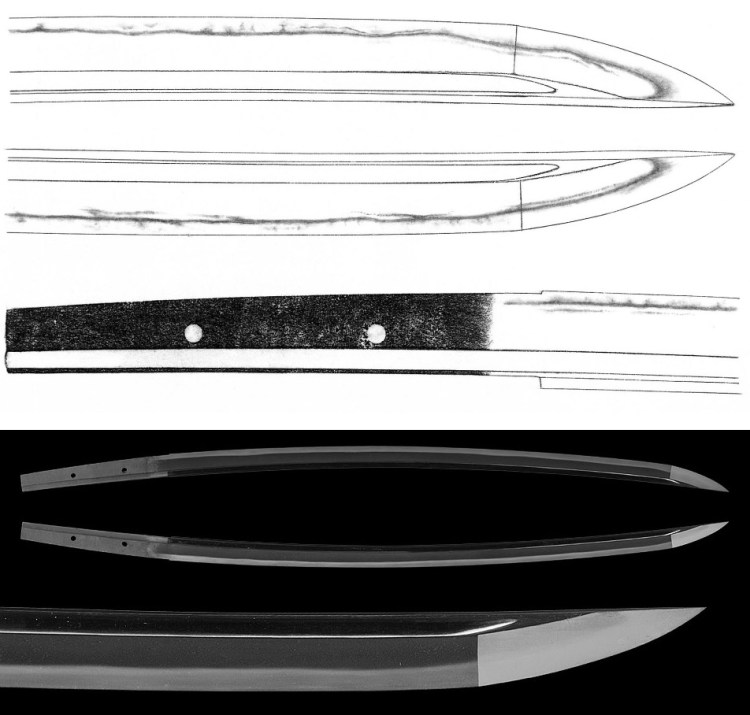
The last blade that I want to introduce for today is more Sadamune-like in terms of its sugata and ha (see picture 8). It is an ô-suriage tachi with a relative wide mihaba, a shallow sori, and a very much elongated chû-kissaki that might already come under the category of an ô-kissaki. The jigane is a rather standing-out itame but which tends very much to nagare-masame and that shows ji-nie. The hamon is a nie-laden shallow ko-notare that is mixed with gunome, kinsuji, and sunagashi and the bôshi is sugu-chô to midare-komi that features a pointed and late starting kaeri with hakikake. On both sides we can see towards the bottom of the tang the remnants of the suken relief in the bôhi.

Nobukuni8a

Nobukuni8b

Picture 8: jûyô, wakizashi, mumei, attributed to Nobukuni, nagasa 54.5 cm, sori 1.4 cm, motohaba 3.0 cm, shinogi-zukuri, iori-mune


*


I have saved the discussion about the succession of generations or rather the counting of generations for the next part as it would have been too confusing to pack all that into this first chapter. Also horimono and the distinguishing features of Nobukuni signatures will be addressed next time so please stay tuned.

Brief Update

Dear Readers, I want to give you a brief update what is going on at the moment and what is partially propagated via Facebook and the Nihonto Message Board. First of all, we have a green light with the Nobuie project, the translation of a 40+ article series Itô Mitsuru san (the author of the three Higo books) published starting over 15 years ago in the Tôwa Magazine. I really (and I mean really) appreciate the fact that we have more than 60 participants in this project and I hope that we are able to maintain this “momentum” for other upcoming projects. As indicated, I have already started with working on the project and I will be provided with further (color) pictures from Itô’s collection of Nobuie tsuba. These pics are not featured in the original series but should show you our effort to make this project as comprehensive as possible (by adding more pictures for your reference). And I would like to take this opportunity to congratulate my friend Eckhard Kremers, the initiator of the whole Nobuie project, for being elected new president of the European Branch of the NBTHK.

Apart from that, I would like to inform you that I was just commissioned by the NBTHK with translating the catalog to the upcoming special exhibition on the Ishiguro School that will be held from July 27 to October 30th at the Sword Museum. A great honor of course for me and everyone who is into Edo kinkô and machibori should watch out not no miss this one as the Ishiguro School is so to speak as good as it gets in this respect.

In this sense, June will be pretty tight for me and I honestly thank you in advance for your understanding if certain things might take longer as usual. Well, I know that I have been quite slow lately but this is because I still work wholeheartedly on other projects too, like Fukushi and my very own Gendaito one. Also my Kantei series will be continued as I am writing the first chapter on the Nobuie School these days. And on top of that, I will be in Orlando next month and I look very much forward to meet my friends and all of you who make it to the show!

An interesting gassaku

In the last Tôken Bijutsu, the May issue of 2016, Imoto Yûki (井本悠紀) introduces a gassaku, a joint work between Mishina Kaneyuki (三品金行) and the 11th generation Aizu-Kanesada (会津兼定), which is insofar very interesting as one side of the blade shows a kitae in itame mixed with mokume whilst the other side is in pure masame. Now some might wonder how to forge a blade so that one side has a completely different forging structure than the other one. But if you remember all the different blade constructions, it is actually pretty simple and I like to take this brief article of Imoto as an opportunity to elaborate a little on that and on the context of this gassaku.

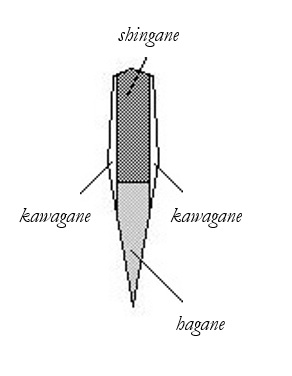
Now first about the forging. We know several blades of Kanesada where he explicitly states on the tang that they are forged in hon-sanmai (本三枚), although he uses the term shin-sanmai (真三枚). For example, a katana that he made in Ansei four (安政, 1857) at the age of 20 which is featured in Toyama Noboru’s book on Kanesada that I had the honor to translate a couple of years ago (and which can be purchased here). And Imoto introduces a mei of Kanesada bearing that supplement which is dated Meiji 35 (明治, 1902) and which also comes with the information that he made it at the age of 66. As most of you know, the forging technique of hon-sanmai uses three different steels, two outer layers of kawagane, a shingane core, and an additional hagane at the cutting edge (see picture below). Usually the smith forges the two outer kawagane layers identically but from this gassaku we learn that one smith, Kaneyuki, forged the one layer whilst the other, Kanesada, forged the other one, by each of them sticking to their traditional technique (well, Kanesada also often worked in other kitae but masame was one of his trademarks). And the blade is also signed that way, i.e. Kaneyuki signing on the omote, the side which is in itame-mokume, and Kanesada on the ura, which is the one in masame. So either one of the two, and I assume it was Kaneyuki, took all the prepared steels, bundled them up (the process called tsukuri-komi [造り込み] or kumi-awase [組み合わせ]), and forged this bundle into a blade. The blade itself by the way is a hira-zukuri wakizashi with a nagasa of 39.4 cm, a sori of 0.7 cm, showing a nie-deki hamon where gunome sections are connected with notare and suguha-chô and which is mixed with togariba and plenty of kinsuji and sunagashi.

hon-sanmai

And as mentioned above, I want to elaborate on the context of this joint work a little. I have already stated in this article that Kanesada proceeded to Kyôto in the seventh month of Bunkyû three (文久, 1863) where he received five months later the honorary title Izumi no Kami (和泉守). The Mishina family was, as we know, so to speak in charge of handling the awarding of honorary titles with the court, expressed through their own special honorary title of Nihon Kaji Sôshô (日本鍛冶宗匠・日本鍛冶惣匠). Now we know from records that Kanesada worked in the tenth month of that year in the residence of Kaneyuki and it is assumed that such a stay belonged to the procedure of receiving a honorary title. In other words, the Mishina family probably wanted to see live the talent of the smith before forwarding any suggestions to the Imperial household. Usually, these stays are always described as “someone refining his craft in Kyôto” but most of the smiths doing so were already fully trained masters at the height of their career. This just as a side note.

Now Kaneyuki had studied with the 10th generation Iga no Kami Kinmichi (伊賀守金道) whom he later succeeded, under the name of Kinmichi, as 11th generation of that lineage. He himself had received his honorary title of Ômi no Kami (近江守) on the 20th day of the tenth month Bunkyû three (1863), i.e. at the very time Kanesada was staying in his house. Now we don’t know exactly when he succeeded as 11th generation Kinmichi (Fukunaga Suiken assumes it took place before Keiô two [慶応, 1866]) but what we do know is that the gassaku wakizashi is already signed with the additional honorary title Nihon Kaji Sôshô, which he had received from Kinmichi two months earlier, in the eighth month of Bunkyû three (1863). Also we know that Kanesada returned to Aizu in the second month of Keiô one (1865) what allows us to narrow down the production time of the undated gassaku wakizashi between the twelfth month of Bunkyû three (1863), the time Kanesada had received the title Izumi no Kami and by which the blade is signed, and the second month of Keiô one (1865) when Kanesada left Kyôto.

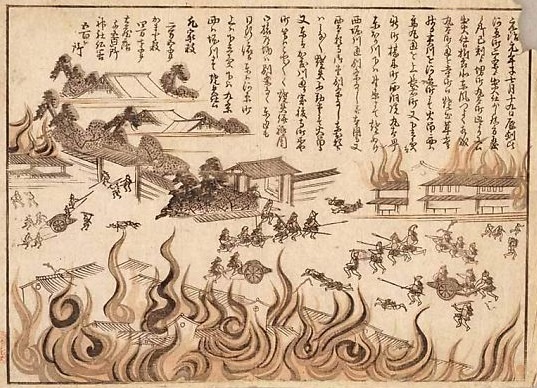
Last but not least I want to introduce another interesting anecdote in this context. In my above linked article on the last of the Kanesada, I mentioned that Kanesada witnessed the so-called “Hamaguri Gate Rebellion” (Hamaguri-gomon no hen, 蛤御門の変) which took place in 1864 and where royalists rebelled against the Tokugawa at the Hamaguri Gate of the Imperial Palace. Now in the course of this incident, the residence of the Mishina family caught fire and was seriously damaged (as were large parts of Kyôto, see picture below). After the rebellion was over, the Mishina family sent out letters to all their former students, who had scattered all over the country in the meanwhile by the way, not asking for but (by their choice of words) rather demanding a contribution to the reconstruction of their forge 😉

HamaguriFire

KANTEI 4 – YAMASHIRO #25 – Ryôkai (了戒) School 2

Ryôkai was succeeded by his son Hisanobu (久信) who is – due to the fact that he often signed just with the prefix “Ryô” – mostly referred to as Ryô Hisanobu (了久信). The Kotô Meizukushi Taizen says that he was born in Kagen one (嘉元, 1303) and died in Ôan seven (応安, 1374) at the age of 73. Again, we have here dates which don’t add up and apart from that, the source also mixes up Hisanobu with Nobuhisa (信久). That is, it lists Nobuhisa as son of Ryôkai and Hisanobu as his successor whereas all other sources state it the other way round, i.e. Nobuhisa being the son of Hisanobu. Hisanobu being the son of Ryôkai is also proven by dated and signed works which will be addressed in the following. First, there is a pretty famous tachi extant (see picture 1) which is signed kakikudashi-style “Ryôkai Kagen sannen sangatsu hi” (了戒  嘉元三年三月日, “Ryôkai, on a day of the third month Kagen three [1305]”) on the haki-omote, and “Yamashiro no Kuni-jûnin Kurôza…” (山城国住人九郎左…) (rest cut off) on the haki-ura side. This mei was for a long time interpreted as showing Ryôkai’s first name, being Kurôzaemon or Kurôzaemon no Jô but in more recent years another tachi has been found (see picture 2) which is signed “Kurôzaemon no Jô Hisanobu saku – Kagen ninen uzuki hi” (九郎左衛門尉久信作・嘉元二年卯月日, “on a day of the fourth month Kagen two [1304]”). So Kurôzaemon no Jô was obviously the first name of his son Hisanobu and not of master Ryôkai and the Kagen three tachi is thus obviously a gassaku. Incidentally, the Kagen two tachi by Hisanobu bears somewhat apart from the actual mei and interpreted in a completely different way the name “Ikkai” (一海). Some speculate that this was the nyûdô-gô of Hisanobu but the NBTHK says that it is a kiritsuke-mei, i.e. added later. Well, and “final proof” for Hisanobu being the one of Ryôkai delivers a naginata (see picture 3) which is signed “Ryôkai shisoku Hisanobu – Tokuji sannen tsuchinoe-saru jûgatsu muika” (了戒子息久信・徳治三年戊申十月六日, “Hisanobu, son of Ryôkai, on the sixth day of the tenth month Tokuji three [1308], year of the monkey”).

Now let me introduce all these blades, beginning with the gassaku which is designated as a jûyô-bunkazai, owned by the Atsuta-jingû, but preserved in the Tôkyô National Museum. It must have had a magnificently long nagasa because it measures 82.6 cm in its shortened condition. It has a deep sori that tends to koshizori, maintains a little funbari, tapers noticeably, and ends in a ko-kissaki. The jigane is a ko-itame that is mixed with masame-nagare and fine ji-nie as well as a shirake-utsuri appear. The hamon is an overall rather subdued suguha to hoso-suguha in ko-nie-deki that is mixed with ko-midare, some ko-chôji, ko-ashi, and that features a rather tight nioiguchi, and the bôshi is a thin sugu to midare-komi with a ko-maru-kaeri.

RyoHisanobu1

Picture 1: jûyô-bunkazai, tachi, mei see text above, nagasa 82.6 cm, sori 3.0 cm, motohaba 3.0 cm, sakihaba 1.6 cm, shinogi-zukuri, iori-mune

The Hisanobu tachi with the Ikkai supplement is shown in picture 2. This blade too is with a nagasa of 84.0 cm pretty long. It has a wide mihaba that tapers noticeably, a deep koshizori with funbari, and end in a ko-kissaki. The jigane is a ko-itame that is mixed with a conspicuous amount of masame and features fine ji-nie and a shirake-utsuri. The hamon is a suguha-chô in ko-nie-deki that is mixed with some ko-gunome, ko-midare, ko-chôji and ko-ashi and has a subdued nioiguchi. The bôshi is sugu with a ko-maru-kaeri and tends to a little bit to a sansaku-bôshi. The omote side bears a bonji with below a suken, and the ura side a bonji with below gomabashi, both of them running as kaki-nagashi into the tang.

RyoHisanobu2

Picture 2: jûyô, tachi, mei see text above, nagasa 84.0 cm, sori 2.8 cm, motohaba 2.95 cm, sakihaba 1.6 cm, shinogi-zukuri, iori-mune

RyoHisanobu3

Picture 3: The naginata which explicitly states that Hisanobu was the son of Ryôkai. It is owned by the Tokugawa Museum, has a nagasa of 42.8 cm, and is interpreted in the typical Ryôkai style.

Another signed tachi of Ryô Hisanobu is introduced in picture 4. It has a long nagasa too, tapers noticeably, but the kissaki tends to chû. Its jigane is a standing-out itame that is all over mixed with nagare-masame and that features ji-nie and a shirake-utsuri. The hamon is a chû-suguha in ko-nie-deki that is mixed with ko-gunome, hotsure, ashi, , and sunagashi and appears subdued in places. The bôshi is sugu with a ko-mar-kaeri.

RyoHisanobu4

Picture 4: jûyô, tachi, mei “Ryô Hisanobu” (了久信), nagasa 83.7 cm, sori 2.6 cm, motohaba 3.1 cm, sakihaba 1.6 cm, shinogi-zukuri, iori-mune

An interesting blade is shown in picture 5 (click on the pic to get to the website), interesting insofar as that it is very similar to the shôbu-zukuri tachi of Ryôkai shown in picture 8 of the previous chapter. Hisanobu’s blade is ubu but unsigned, has a nagasa of 67.3 cm, a high shinogi, and shows a ko-itame that is mixed with much nagare-masame and some ô-hada in places, even formingsome mokume swirls here and there. This time a faint nie-utsuri appears and the hamon is a subdued hoso-suguha with ko-ashi, and the bôshi is sugu too and runs out as yakitsume.

RyoHisanobu5

Picture 5: tachi, mumei, attributed to Ryô Hisanobu, nagasa 67.3 cm, sori 2.5 cm, motohaba 2.94 cm, shôbi-zukuri, iori-mune

*

Now let’s talk about Hisanobu’s tantô. An often quoted work is the tantô shown in picture 6 that is dated Enkyô three (延慶, 1310). It is a so to speak standard hira-zukuri tantô for that time, showing moderate to smallish dimensions, an uchizori, and a jigane in dense ko-itame that tends to nagare along the mune and that displays a midare-utsuri. This midare-utsuri is in my opinion linked to the interpretation in midareba. I mean, we see a ko-notare-based ko-gunome in nioi-deki that is mixed with ashi and that features a mizukage, thus quite a flamboyant interpretation for the Ryôkai group. The bôshi is midare-komi too and runs back in a ko-maru-kaeri. So when we bear in mind that the latest known date signature of Rôkai is from the previous year and take into consideration that not that many works of Hisanobu are extant, we can speculate that he might have mostly worked for his father. This is also supported by the fact that we are facing a pretty inconsistent signature style of the characters for Ryôkai, I am hinting at daisaku-daimei, and this might go hand in hand with the tradition that Hisanobu signed himself with “Ryôkai” one or two years after his father had died, so at least according to the Goto Tebiki Shô (如手引抄). Well this work was published in the Kan´ei era (寛永, 1624-1644), more than 300 years after Hisanobu’s active period. Incidentally, the known date signatures of Ryô Hisanobu, which are pretty rare, span just from Kagen (嘉元, 1303-1306) to Enkyô (延慶, 1308-1311).

RyoHisanobu6

Picture 6: tantô, mei “Ryô Hisanobu” (了久信) – “Enkyô sannen jûnigatsu muika” (延慶三年十二月六日, “sixth day of the twelfth month Enkyô three [1310]”), nagasa 23.9 cm, uchizori, hira-zukuri, iori-mune, preserved in the Tôkyô National Museum

But the majority of Hisanobu’s tantô is in suguha, like for example the blade shown in picture 7. It is with a nagasa of 26.2 cm of standard length has no sori. The motohaba is with 2.42 not really on the narrow side for a tantô but when you take a look at the width of the tang, the condition of the ha-machi, and the thinness of the ha, I think that this blade has lost some substance. It shows a finely forged ko-itame that is mixed with ko-mokume and nagare and features ji-nie, a shirake-utsuri, and even a few chikei. The hamon is a hoso-sugha in ko-nie-deki that is mixed with sunagashi and fine kinsuji and the bôshi is sugu with a ko-maru-kaeri.

RyoHIsanobu7Picture 7: tantô, mumei, attributed to Ryô Hisanobu, nagasa 26.2 cm, muzori, hira-zukuri, mitsu-mune

*

Genealogy of the Ryokai School

Now Ryô Hisanobu was succeeded by his son Nobuhisa (信久) who lived, according to the Kotô Meizukushi Taizen, from Bunna one (文和, 1352) to Ôei 26 (応永, 1419). He signed in the syntax of his father, i.e. with “Ryô Nobuhisa” (了信久) and worked allegedly also in the same style, although I have never come across any of his works. Well, Tsuneishi goes pretty much into detail but the problem is, he just addresses a “3rd generation Ryôkai” and does not say if he means Nobuhisa or not. Apart from that, most other sources don’t count an exact succession of generations of the Ryôkai lineage or just say that Ryôkai was the 1st generation and Ryô Hisanobu the 2nd, period. Tsuneishi introduces even more generations, i.e. a 4th generation who was active around Jôji (貞治, 1362-1368) and a 5th generation who was active around Ôei (応永, 1394-1428). For a better overview, I have compiled a genealogy of the Ryôkai School that is provided above. So Tsuneishi describes the 3rd generation as working basically in the style of his father and grandfather, hardening a hoso-suguha but which shows less nie and that comes close the a pure nioi-deki. He further states that his nioiguchi is not tight and dull (he uses “dim, blurred”), that most extant works show a “tired yakiba,” a weak and roughish hada, much masame towards the mune, and a shirake-utsuri. His tantô are smaller dimensioned and show a hoso-suguha that is mixed with ko-gunome-midare which is more “busy” than the ha of the 1st and 2nd generation. And he concludes that the 3rd generation also does not match the quality of his two predecessors.

Anyway, the old-established Yamashiro schools were all fading by the end of the Nanbokuchô period. The Awataguchi School had “long” been gone. The Rai School had just “disappeared” or had scattered to the four winds (Nakajima, Echizen, Higo) and its remaining smiths were outshined by masters, for example from the Hasebe and the Nobukuni School, who adjusted their work very much to the new Sôshû tradition. The Ryôkai School shared the same fate. Their own offspring Nobukuni overshadowed all other Ryôkai students and the son of Hisanobu’s student Yoshisada (能定), i.e. the 2nd generation Yoshisada, moved eventually down to Kyûshû where he became the ancestor of the so-called Tsukushi-Ryôkai group.

KANTEI 4 – YAMASHIRO #24 – Ryôkai (了戒) School 1

According to tradition, Ryôkai (了戒) was a very early son of grand master Rai Kunitoshi (来国俊), born when Kunitoshi was only 17 years old. He entered priesthood at an early age of 16, taking the very name Ryôkai, but returned later to secular life to forge swords, allegedly not only with his father but also learning from Ayanokôji Sadatoshi (綾小路定利). As always, there are several traditions and theories going round. One says that he was actually a Nara smith who came to Kyôto to study with Kunitoshi. Another one suggests that he started a normal career as a swordsmith and entered priesthood only later in life, whilst sources who follow the approach that Niji Kunitoshi and Rai Kunitoshi were different smiths say that Ryôkai was the son of the former and thus the brother of Rai Kunitoshi. Well, when we take a look at the extant date signatures of Ryôkai, which start from Shôô three (正応, 1290), followed by date signatures from Einin (永仁, 1293-1299) and Kagen (嘉元, 1303-1306) to Enkyô two (延慶, 1309) as the latest, we learn that he was active at about the same time when Kunitoshi signed in sanji-mei. We know that Kunitoshi was born in 1240. So when we follow the tradition that Ryôkai was born when Kunitoshi was 17 years old, we arrive at Kôgen two (康元, 1256) as year of birth for Ryôkai (or at Shôka one [正嘉, 1257] if we follow the Western way of counting years). This date (Kôgen two) is also forwarded by the Kotô Meizukushi Taizen by the way, what means that not all of its data is far-fetched. This in turn means that he was 34 when he made the earliest extant dated blade from Shôô three (1290) what sounds very plausible. The Kotô Meizukushi Taizen also says that Ryôkai died in Shôkyô four at the age of 72 but the Shôkyô era (正慶, 1332-1334) only lasted for two years, and apart from that, if you count 72 from Kôgen two (1256), you arrive at 1328 (or 1327 according to the Japanese way), what in turn would correspond to Karyaku three. Taking into consideration that Ryôkai’s known date signatures end noticeably before those of Kunitoshi (of whom we know date signature up to 1321), I tend to think that he might have died before his father and indeed in the Karyaku era (嘉暦, 1326-1329). Or in other words, the Kotô Meizukushi Taizen might be right about his age at death but not about the year he died in.

Before we come to the workmanship of Ryôkai, I want to elaborate on his standing in the sword world, or on his ranking if you want. There are 5 blades of him that made it jûyô-bunkazai (3 tachi, 1 tantô), no kokuhô, about 90 jûyô, and 2 that passed tokubetsu-jûyô. In comparison, Rai Kunitoshi has 4 kokuhô, 17 jûyô-bunkazai, more than 200 jûyô, and about 30 tokubetsu-jûyô. But we have to bear in mind that (due to the fact that Kunitoshi was the grand master of a bustling workshop) there are in total more blades of Rai Kunitoshi extant than of Ryôkai, so these numbers are relative. An interesting aspect of Ryôkai’s ranking is gained by looking into contemporary records. For example, the Chûshin Mono (注進物), a report on sharp swords from the entire country compiled on request of the bakufu in Shôwa two (正和, 1313) which contains the name of 60 smiths, does list Ryôkai but not his father Rai Kunitoshi. Well, the emphasis of such early works remains to be seen as for example, the Chûshin Mono lists for Yamashiro also Sanjô Kokaji Munechika, Awataguchi Kuniyoshi, Awataguchi Hisakuni, Ayanokôji Sadatoshi, and kiku-gyosaku, and therefore I tend to interpret sources like that as mere guidelines for what kind of swords are “appropriate” to be owned by (and presented to) the contemporary high-society rather than referring to their effective sharpness. But just due to the fact of being on this list, you can get an idea of how high Ryôkai’s blades were regarded these days.

*

Now to the workmanship of Ryôkai. In general, it can be said that the sugata and jiba of his works, and that means both tachi and tantô, are pretty close to Rai Kunitoshi. However, many of his tachi are more on the slender side, showing a noticeable taper, a deep sori, and a smallish kissaki, and it is assumed that it is this trend towards a more classical elegance might be the reason for why some assumed he studied with Ayanokôji Sadatoshi. But at Sadatoshi’s slender tachi, the koshizori is more pronounced and straightens more out towards the tip. Apart from that, some of Ryôkai’s tachi show a somewhat higher shinogi (and partially also a higher iori-mune) what in turn might have been the reason for assuming a Yamato origin. This is further substantiated by the fact that Ryôkai’s jigane is basically the Rai-typical ko-itame but which tends to a certain extent to nagare and might even show masame here and there. In addition, we usually see shirake or a shirake-utsuri on his blades and not the nie-utsuri from Rai main line. Also his hamon is a hint more narrow and subdued and has a lesser emphasis on nie than that of Rai Kunitoshi. So we have here again the junction where you were following the Rai Kunitoshi road but then come across nagare-masame and shirake and have to fork to one of the Rai sidelines like Ryôkai or Enju. And then the hamon and bôshi should tell you, in the ideal case, if you took the right exit. But of course, sometimes it can be very had to tell if a blade is a Rai Kunitoshi, an early Rai Kunimitsu, or a Ryôkai.

One of his most representative works is the signed tachi that is preserved in the Tôkyô National Museum but which does not hold any status (see picture 1). It is ubu and in this case, the sori tends more to koshizori, also running into a pretty curved kijimomo-style nakago. We see funbari and a ko-kissaki and the kitae is a dense ko-itame that features masame, shirake, and some jifu. The hamon is a suguha in ko-nie-deki that is mixed with ko-midare, ko-chôji, and ko-ashi and the nioiguchi is rather subdued. The bôshi is a midare-komi with a ko-maru-kaeri.

Ryokai1

Picture 1: tachi, mei “Ryôkai” (了戒), nagasa 79.98 cm, sori 2.7 cm, shinogi-zukuri, iori-mune

Also very representative is the jûyô tachi that is shown in picture 2. It is ubu too and preserves like the previous blade its long nagasa of 80.3 cm. It tapers, shows funbari and its jigane is an itame that is mixed with masame-nagare and that shows ji-nie and shirake. The hamon is a chû-suguha in ko-nie-deki which tends a little to shallow notare and that is mixed with ko-midare, , some kinsuji, and many ko-ashi. The nioiguchi is rather tight and subdued and the bôshi is a slightly undulating sugu with a ko-maru-kaeri whereas the ura side features hakikake. Thus with the rather wide ha with its abundance of hataraki and the quality of the jiba place this work pretty close to Rai Kunitoshi. By the way, this blade was one of those that were submitted to (and passed) the very first jûyô-shinsa in 1958. It was once a heirloom of the Hisamatsu-Matsudaira (久松松平) family, the daimyô of the Iyo-Matsuyama (伊予松山藩) fief.

Ryokai2

Picture 2: jûyô, tachi, mei “Ryôkai” (了戒), nagasa 80.3 cm, sori 3.0 cm, motohaba 3.0 cm, sakihaba 1.65 cm, shinogi-zukuri, iori-mune

Another signed tachi of Ryôkai that is almost ubu is shown in picture 3. The blade was shortened to 71.0 cm but keeps its rather deep sori (which tends again somewhat to koshizori). We still see a hint of funbari, a noticeable taper, and a ko-kissaki. The jigane is an itame with a conspicuous amount of masame and features ji-nie and a shirake-utsuri. The hamon is a gentle suguha in ko-nie-deki with a little shallow notare and is mixed with ko-gunome and some faint nijûba in places. The bôshi is sugu to notare-komi with a ko-maru-kaeri.

Ryokai3

Picture 3: jûyô, tachi, mei “Ryôkai” (了戒), nagasa 71.0 cm, sori 2.3 cm, motohaba 2.7 cm, sakihaba 1.4 cm, shinogi-zukuri, iori-mune

The tachi in picture 4 is one of Ryôkai’s highly classical, calm, and unobtrusive interpretations. It is ubu and signed, slender, has a rather deep koshizori, tapers noticeably, shows funbari, a high shinogi, and a ko-kissaki. The kitae is a densely forged but also somewhat standing-out ko-itame that is mixed with nagare-masame, some ô-hada, and jifu. In addition, ji-nie and a shirake-utsuri appear. The hamon is a suguha in ko-nie-deki that is mixed with a little ko-gunome, ko-midare, ko-ashi, , and some fine kinsuji and sunagashi. The nioiguchi and the entire ha are more subdued. The bôshi is a narrow sugu with a brief ko-maru-kaeri. On the omote side we see a suken at the base and there are several tachi of Ryôkai known that bear such a short suken or koshibi at the base.

Ryokai4

Picture 4: jûyô, tachi, mei “Ryôkai” (了戒), nagasa 75.65 cm, sori 2.8 cm, motohaba 2.85 cm, sakihaba 1.5 cm, shinogi-zukuri, iori-mune

*

Now we come to his tantô, the most famous of course the meibutsu Akita-Ryôkai (秋田了戒) which is designated as a jûyô-bunkazai (and was even holding the status of kokuhô for a while, i.e. until many designations were reassessed by the Agency for Cultural Affairs after WWII). The name of the meibutsu goes back to the fact that it was once work by Akita Sanesue (秋田実季, 1576-1660) who held the title of Akita Jônosuke (秋田城之介). Later it became an heirloom of the Kaga Maeda family. There are several tantô extant by Ryôkai which are interpreted in kanmuri-otoshi-zukuri. The jigane is an itame that is mixed with masame and that shows ji-nie and some shirake-utsuri. The hamon is a suguha in ko-nie-deki with a tight nioiguchi and nijûba and the bôshi is rather pointed and features a rather wide and long running-back kaeri, also with nijûba.

Ryokai5

Ryokai5a

Picture 5: jûyô-bunkazai, tantô, mei “Ryôkai” (了戒), nagasa 27.2 cm, muzori

An outstanding tantô of him can be seen in picture 6. It is tokubetsu-jûyô and is with the moderate dimensions, the uchizori, and the curved furisode-nakago quite classical. The jigane is a dense ko-itame with fine ji-nie and a shirake-utsuri and the hamon is a chû-suguha in ko-nie-deki with some ko-ashi, , and nijûba in places that features a tight nioiguchi. The bôshi is sugu with a rather wide ko-maru-kaeri. On the omote side we see a suken with on top of it a bonji and on the ura side gomabashi, both running with kaki-nagashi into the tang. The tang is ubu by the way, so the second mekugi-ana and the kaki-nagashi of the horimono do not speak for a suriage in this case. There is no nagare-masame or “weakness” in the jigane and so this tantô comes pretty close to Rai Kunitoshi.

 Ryokai6

Picture 6: tokubetsu-jûyô, tantô, mei “Ryôkai” (了戒), nagasa 24.9 cm, very little uchizori, motohaba 2.35 cm, hira-zukuri, mitsu-mune

As it will be addressed in the next chapter, the Ryôkai lineage also made some naginata and a shortened one, a naginata-naoshi wakizashi, can be seen in picture 7. It is relative wide and bears on both sides a central shinogi-hi, i.e. a groove that runs along the shinogi. The jigane is a dense ko-itame with some nagare and ji-nie and the hamon is a hoso-suguha in ko-nie-deki that is mixed with ko-gunome, kinsuji, and sunagashi. The bôshi runs out as yakitsume and taking into consideration the overall course of the ha, we learn that this was once a shizuka style naginata (more on that interpretation here).
Ryokai7Picture 7: jûyô, naginata-naoshi wakizashi, mumei, attributed to Ryôkai, nagasa 40.6 cm, sori 0.9 cm, motohaba 2.9 cm, iori-mune

But Ryôkai also made some more uncommon blade shapes, like for example the one in shôbu-zukuri seen in picture 8. Well, the blade has a nagasa of 68.2 cm and is classified, due to the position of the mei, as tachi but it might well be one of these longer uchigatana that come mostly in hira-zukuri that were made by some of the great Kamakura masters for a higher ranking clientele (like the Nakigitsune-Kuniyoshi, see here). The blade has a relative deep sori and shows a dense itame that is mixed with nagare in places and with ô-hada along the upper half of the omote side. In addition, ji-nie and a shirake-utsuri appear. The hamon is a suguha in ko-nie-dei that is mixed with some ko-ashi and fine sunagashi and kinsuji and that shows some ko-gunome along the monouchi. The bôshi is formed out of these ko-gunome elements and runs back with a short ko-maru-kaeri and some hakikake.

Ryokai8Picture 8: jûyô, tachi, mei “Ryôkai” (了戒), nagasa 68.2 cm, sori 1.8 cm, motohaba 2.7 cm, shôbu-zukuri, iori-mune

KANTEI 4 – YAMASHIRO #23 – Rai (来) School 9

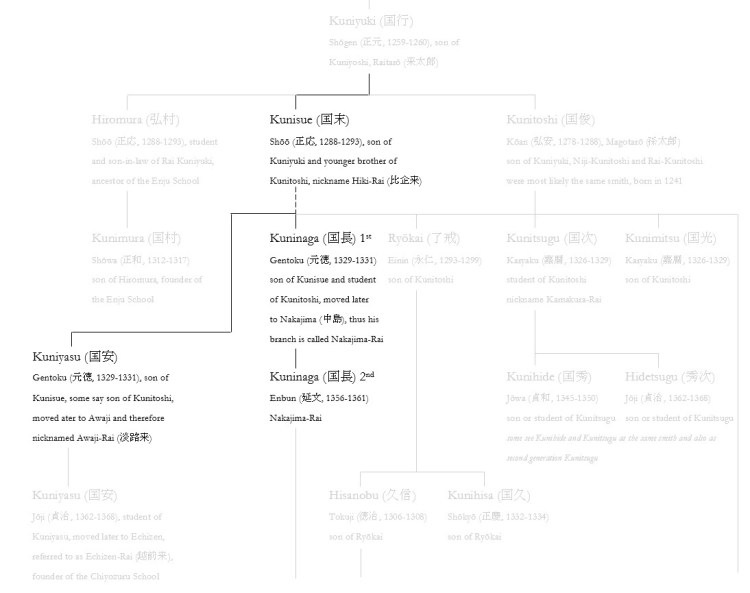
In this chapter I will introduce the last relevant Rai smiths, starting with Kunisue (国末) who was allegedly the third son of grand master Rai Kunitoshi, so at least according to the oldest extant sword publication, the Kanchi’in Bon Meizukushi, whose core data was compiled whilst all these masters were still alive. The source also says that he died in his thirties. However, the Kotô Meizukushi Taizen says that he was not the son but the younger brother of Kunitoshi, that he was born in the Kenchô (建長, 1249) and died in the Shôchû era (正中, 1324-1326) at the age of 76. Interesting is that the Kanchi’in Bon Meizukushi lists Kunisue at another point, namely in a Rai genealogy, as younger brother of Kunitoshi (like the Kotô Meizukushi Taizen does). So the source is not consistent in this regard. Anyway, there is only one signed blade of Rai Kunisue extant, what would support the approach that he died young, but there is another tradition, namely the one that he later moved to the Hikigayatsu (比企谷) neighborhood of Kamakura, and this in turn would speak in my opinion rather for that he lived longer. Due to this alleged Kamakura connection, which is by the way found in both of the above mentioned sources, Kunisue is also referred to as Hiki-Rai (比企来). As indicated, there are virtually no blades of him extant, i.e. not a single one that bears a designation by the Agency for Cultural Affairs, nor any one that is jûyô or tokubetsu-jûyô. The mentioned signed blade is designated as a jûyô-bijutsuhin and shown in picture 1. It has a suriage-nagasa of 72.9 cm and the original length is estimated with around 79 cm. It is rather slender, tapers noticeably, has a relative thick kasane, a deep sori, and a ko-kissaki. The kitae is a dense and excellently forged ko-itame that is mixed with mokume and some jifu in places. In addition, ji-nie, chikei, and a jifu-utsuri appears. The hamon is a chû-suguha that tends a little to shallow notare. It is mixed with ko-ashi, saka-ashi, and “soft” looking and the hardening is in nioi-deki with only a hint of fine ko-nie. The bôshi is sugu with a short ko-maru-kaeri. Both sides bear a bôhi with ryô-chiri that runs on the omote side as kaki-tôshi through, and on the ura side as kaki-nagashi into the tang. We also see traces of a tsurebi in the kissaki. The tang is suriage as mentioned, shows katte-sagari yasurime, and bears on the hira-ji a rather small sanji-mei.

RaiKunisue

Picture 1: jûyô-bijutsuhin, tachi, mei “Rai Kunisue” (来国末), nagasa 72.9 cm, sori 1.98 cm, motohaba 2.8 cm, sakihaba 1.75 cm, kasane 0.8 cm, shinogi-zukuri, iori-mune

Now the jigane speaks because of the densely forged ko-itame and the clarity of the steel basically for Rai but we also see a considerable amount of mokume as well as jifu that tends to jifu-utsuri in places, what results with the saka-ashi in a slightly Aoe or Un feel. Honma places the mei on the basis of its smaller size in the vicinity of Rai Kunimitsu and also sees him rather as a contemporary of the latter than of Kunitoshi. He also says that judging from this blade, Kunisue was surely a very skilled smith but does not reach the quality level of the top Rai Kunimitsu works. He further states that the hada stands more out and the jigane is stronger than at Kunitoshi and Kunimitsu. Incidentally, the blade was once a heirloom of the Sakai (酒井) family, the daimyô of the Shônai fief of Dewa province. It was later owned by Honma sensei’s younger brother, Honma Yûsuke (本間祐介). Incidentally, the smiths of the Rai School we are dealing with today are highlighted below.
NakajimaRai

*

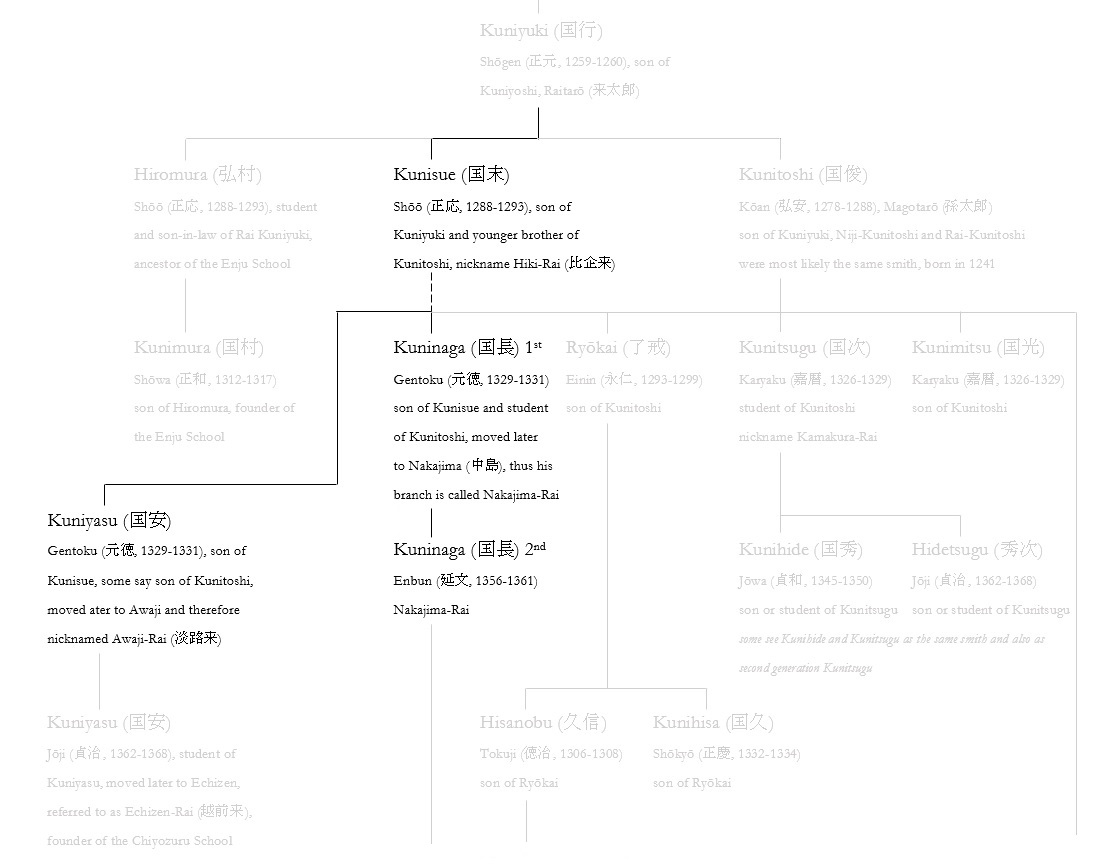
Via Kunisue we arrive at an offshoot of the school, and that is the so-called Nakajima-Rai (中島来) branch which was founded by Kunisue’s son Kuninaga (国長). Please note that Kuninaga and his successor are both also referred to as Nakajima-Rai. So when you hear the term Nakajima-Rai, it almost always means first and second generation Rai Kuninaga and only in certain cases it is about the branch in general or about other smiths from that branch. Now Kuninaga was trained by Kunitoshi and turned out to be a great master himself, leaving us today two jûyô-bunkazai and about 100 jûyô (of which one made it tokubetsu-jûyô, counting both works that bear attributions to Rai Kuninaga and to Nakajima-Rai). These blades comprise all categories, i.e. tachi/katana, hira-zukuri ko-wakizashi, and tantô, and even a naginata-naoshi is among them. Thus we have quite an impressive body of work to deal with. To my knowledge, there are no dated blades of Kuninaga extant but he is traditionally placed around Gentoku (元徳, 1329-1331), with his successor of the same name somewhere between Shôhei (正平, 1346-1370) and Ôan (応安, 1368-1375). The Kotô Meizukushi Taizen however sees Kuninaga as son of Kunisue’s son-in-law Kuniyasu (国安, who will be introduced later) and states that he was 24 years old in the Enbun era. But this would rule out that he had studied with Kunitoshi and would place him much later than stated by all the other sources. So I stick to the above mentioned approach that he was the son of Kunisue, a student of Kunitoshi, and active from the very end of the Kamakura to the early Nanbokuchô period (and not that his career just started in mid-Nanbokuchô). Anyway, Kuninaga moved at some point (the Nihontô Kôza says during the Gentoku era) to Nakajima in Settsu province, thus the nickname Nakajima-Rai. Disclaimer: I will deal with the smiths who emerged from all these local offshoots in corresponding chapters, i.e. Settsu, Echizen and so on).

When we take a look at the above mentioned body of work as a whole, we learn first that signed blades are very rare, and second that we have on the one hand a few more classical blades, and on the other hand noticeable more that are either quite magnificent or come with an ô-kissaki that clearly speak for heyday Nanbokuchô. Accordingly, a shift in generations is obvious, although we can’t say for sure when exactly it took place, and it seems as if the second generation was more productive. It is said that smaller, more angular signatures are that of the first and larger, more roundish signatures that of the second generation. The differentiation of the meiburi seems to match with the differences in sugata and production time. Please note that in the case of Kuninaga, the NBTHK treats the generations equally in terms of quality. In other words, they do not, as it is sometimes the case, attribute the best works to the first and the somewhat inferior ones to the second generation but orientate themselves merely on the sugata and the interpretation of the jiba (and meiburi of course in those rare cases where a signature is present). In this sense, it should be mentioned that the one and only tokubetsu-jûyô of Kuninaga is a work of the second generation and if you have a blade that is attributed to the Nidai, it means just that it was made by the (worthy) successor and doesn’t imply at all that it is inferior in quality. As for the attribution criteria to Rai Kuninaga, the Hon’ami family used to handle it that way that mumei blades which are close to Rai Kunimitsu in interpretation but are somewhat inferior in quality get an attribution to Rai Kuninaga or ti Nakajima-Rai. And the NBTHK seems to follow this approach. Simply speaking, it means that if you have a Hon’ami origami or a NBTHK attribution of an unsigned blade to Rai Kuninaga or to Nakajima-Rai, it means that it is in their eyes a very good Rai work from the close vicinity of Kunimitsu but insufficient to pass as such. There is room for discussion of course but that’s the general approach. Next I introduce, in chronological order, some works of the two generations Rai Kuninaga as I want to talk about “attribution labels” like that separately.

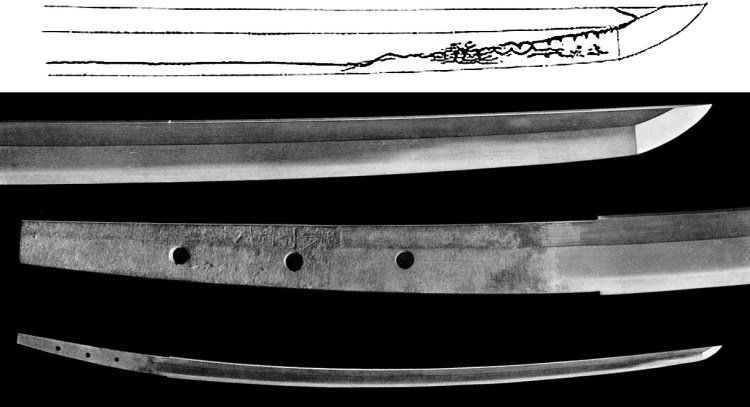
The blade shown in picture 2 is one of the two jûyô-bunkazai. It is attributed to the first generation, bears a smallish mei, and its sugata with the elongated chû-kissaki speaks clearly for a blade that was made before the heyday of the Nanbokuchô period. In short, we can date it somewhere from the very end of the Kamakura to the early Nanbokuchô period. The kitae is a ko-itame with some masame, plenty of ji-nie, and the steel is clear. The hamon is a chû-suguha in ko-nie-deki that is mixed with many ko-ashi, some uchinoke and kuichigai-ba, and that widens at the monouchi where it tends a little to kuzure and from where it runs into an (almost) ichimaibôshi. So by just looking at the oshigata, one might be even reminded of Gô Yoshihiro at first glance with this wide and wild monouchi and the widely hardened bôshi. The tang is suriage and shows katte-sagari yasurime. This tachi is considered as the greatest masterwork of Rai Kuninaga and as being equal in terms of quality to his contemporary Rai Kunimitsu. It was once worn by Takeda Shingen (武田信玄, 1521-1573) and was later offered by one his his local successors, Yanagisawa Yoshiyasu (柳沢吉保, 1659-1714), daimyô of the Kôfu fief of Kai province, to the Enri-ji (恵林寺, Yamanashi Prefecture) which still owns it today.
RaiKuninaga2

Picture 2: jûyô-bunkazai, tachi, mei “Rai Kuninaga” (来国長), nagasa 79.3 cm, sori 2.5 cm, motohaba 2.9 cm, sakihaba 1.7 cm, shinogi-zukuri, iori-mune

The next blade (picture 3) is ô-suriage mumei and attributed to Rai Kuninaga and because of its pre-heyday Nanbokuchô sugata (i.e. chû-kissaki and noticeable taper), I tend to attribute it to the first generation for the time being, although it is already rather wide, has a shallow sori for its length, and was once pretty long. The jigane is a standing-out ko-itame that is mixed with mokume, nagare-masame, and jifu. In addition, plenty of ji-nie, chikei, and a nie-utsuri appear. The hamon is a nie-laden chû-suguha-chô that is mixed with ko-gunome, ko-chôji, many ashi and , and towards the top and bottom also with nijûba and long kuichigai-ba. The nioiguchi is rather tight and is bright and clear. The bôshi is sugu with a relative wide ko-maru-kaeri and shows some hakikake at the very tip.
RaiKuninaga3

Picture 3: jûyô, tachi, mumei, attributed to Rai Kuninaga, nagasa 76.5 cm, sori 1.8 cm, motohaba 3.2 cm, sakihaba 2.4 cm, shinogi-zukuri, iori-mune

Picture 4 shows another blade that is probably a work of the first generation. It is ô-suriage, has a normal mihaba, a relative deep sori for its length, and a chû-kissaki. The jigane is a very dense and beautifully forged ko-itame with plenty of ji-nie and the hamon is a ko-nie-laden hiro-suguha-chô that is mixed with ko-chôji, ko-gunome, many ashi and , and some kinsuji and sunagashi. The nioiguchi is bright and clear and the bôshi is sugu with a ko-maru-kaeri. Again, we see an increase in midare and hataraki along the monouchi, but not as strong as seen in the blade from picture 2 of course, and also the ha drops again before the yokote and turns into a pretty calm bôshi.
RaiKuninaga4

Picture 4: jûyô, tachi, mumei, attributed to Rai Kuninaga, nagasa 69.7 cm, sori 1.7 cm, motohaba 2.9 cm, sakihaba 2.1 cm, shinogi-zukuri, iori-mune

Tantô and hira-zukuri ko-wakizashi of the first generation are very rare, this means, the majority of Rai Kuninaga works from that category are attributed to the second generation. The hira-zukuri ko-wakizashi shown in picture 5 is, based on the small and thinly chiselled signature, attributed to the Shodai. The blade is relative wide and also shows some sori what would speak for Nanbokuchô at a glance (please compare it to the similar Kunizane hira-zukuri ko-wakizashi introduced in picture 2 here). But it has to be mentioned that such a sugata is sometimes also seen in the Kamakura period and it still remains to be clarified if the heyday Nanbokuchô danbira are more related to growing koshigatana or to shrinking uchigatana (i.e. blades like the Nakigitsune-Kuniyoshi introduced here). Anyway, the blade in question shows a rather standing-out itame that is mixed with some masame. Ji-nie appears and the hamon is a suguha-chô that is mixed with some ko-gunome, hotsure, kinsuji, and sunagashi. The nioiguchi tends to be tight and the ha is clear and the bôshi is sugu with a ko-maru-kaeri. Both sides bear a soebi-accompanied katana-hi that runs with kaki-tôshi through the tang, although the initial end of the grooves might be grasped at the nakago-jiri.
RaiKuninaga5

Picture 5: jûyô, wakizashi, mei “Rai Kuninaga” (来国長), nagasa 38.3 cm, sori 0.6 cm, motohaba 2.7 cm, hira-zukuri, mitsu-mune

Now let’s go over to the second generation and I want to start with the blade that I have mentioned before, that is the only tokubetsu-jûyô of Rai Kuninaga. This hira-zukuri ko-wakizashi has an obvious sunnobi-sugata, is wide, has some sori, and a thin kasane, so no discussion that this is not heyday Nanbokuchô. The kitae is an itame that is mixed with some nagare and apart from that, jinie, chikei, and a nie-utsuri appear. The hamon is pretty flamboyant for a Rai work and appears as a nie-laden gunome that is mixed with chôj, ko-notare, ashi, , sunagashi, kinsuji, and along the upper half also with yubashiri and tobiyaki what almost results in a kind of hitatsura approach from the monouchi upwards. The bôshi continues from there and appears as a midare-komi with a rather pointed kaeri on omote side and some hakikake. The omote side shows a suken, and the ura side gomabashi, both with a tsume at the base. The blade is, as mentioned, with the abundance of hataraki and the strong jigane truly flamboyant for Rai and reflects the advanced times, times when with the emergence of the Sôshû tradition such and similar, more “ambituous” interpretations began to dominate. Incidentally, the blade was once a heirloom of the Hisamatsu (久松) family, the daimyô of the Iyo-Matsuyama fief on Shikoku.
RaiKuninaga6aRaiKuninaga6b

Picture 6: tokubetsu-jûyô, wakizashi, mei “Rai Kuninaga” (来国長), nagasa 33.0 cm, sori 0.35 cm, motohaba 3.0 cm, kasane 0.55 cm, hira-zukuri, mitsu-mune

Another characteristic feature of the Nidai Kuninaga is that his hira-zukuri ko-wakizashi often show similarities to blades by the Hasebe School of his contemporary Nobukuni (信国), who was from the Rai offshoot Ryôkai. One such Nobukuni-kind-of interpretation is shown in picture 7. It is a signed tantô with a nagasa of 28.9 cm, a thin kasane, and some sori and shows a somewhat standing-out and altogether rather largely structured itame that is mixed with nagare all over. In addition, plenty of ji-nie, chikei, and a faint nie-utsuri appear. The hamon is a ko-nie-laden ko-notare that is mixed with gunome, ko-ashi, kinsuji, and sunagashi and the bôshi has a ko-maru-kaeri with hakikake. As horimono we see a suken with tsume base on the omote, and a bonji on the ura side. So the standing-out hada and the conspicuous trend to nagare as well as the slight approach to yahazu (see the one hamon protrusion on the ura side above of the bonji) make one think of Nobukuni at a glance.
RaiKuninaga7

Picture 7: jûyô, tantô, mei “Rai Kuninaga” (来国長), nagasa 28.9 cm, sori 0.2 cm, motohaba 2.6 cm, hira-zukuri, mitsu-mune

As for the Nidai’s long swords, they follow as mentioned the then heyday Nanbokuchô trends, i.e. are wide, magnificent, don’t taper that much, have a shallow sori, and end in an ô-kissaki, although there are also many that feature “just” an elongated chû-kissaki. Picture 8 shows such a blade, once a tachi, later greatly shortened to a katana. The kitae is a dense ko-itame with plenty of ji-nie and is mixed with nagare-masame. The hamon is a ko-nie-laden hiro-suguha-chô that is mixed with many and densely arranged ko-chôji, ko-gunome, ashi, , some yubashiri along the yakigashira, and sunagashi. The nioiguchi is wide, bright, and clear and the bôshi is widely hardened and runs out as yakitsume with hakikake on the omote, and shows pointed kaeri on the ura side.
RaiKuninaga8

Picture 8: jûyô, katana, mumei, attributed to Rai Kuninaga, nagasa 69.3 cm, sori 2.0 cm, motohaba 3.2 cm, sakihaba 2.6 cm, shinogi-zukuri, iori-mune

The last blade that I want to introduce for the second generation has a really large ô-kissaki and that shows again features that can be considered as characteristic for Rai Kuninaga, and that are njûba and kuichiga-ba (or in this very case just slight approaches to kuichigai-ba). So with the aforementioned proximity to Rai Kunimitsu in mind, we might say that he often followed the basic style of Kunimitsu which was introduced here in Picture 5c. So when it comes to long swords, we learn that in quantitative terms Kuninaga mostly followed style 5c. Well, the blade shown in picture 9 is wide, does not taper much, and concludes as mentioned with a pretty large kissaki. At first glance, the rather thick kasane and deep sori might sound, on the paper, uncommon for a heyday Nanbokuchô blade but we have to take into consideration that it is very likely that this blade was once quite long. The kitae is a dense ko-itame that is mixed with some nagare here and there and that shows ji-nie and fine chikei. The hamon is a ko-nie-laden suguha-chô with a little notare and is mixed with a hint of ko-gunome, many ashi, uchinoke, nijûba, fine sunagashi, and kinsuji, hataraki that also continue into the slightly undulating sugu-bôshi which runs back with a ko-maru-kaeri with some hakikake.
RaiKuninaga9

Picture 9: jûyô, katana, mumei, attributed to Rai Kuninaga, nagasa 68.9 cm, sori 1.9 cm, kasane 0.77 cm, motohaba 2.9 cm, sakihaba 2.35 cm, shinogi-zukuri, iori-mune

*

I will end this chapter with Rai Kuniyasu (来国安) who is seen as son of Kunisue, son-in-law of Kunisue, grandson of Kunisue, son of Kunitoshi, or as son-in-law of Kunitoshi. But there might be some merger here with his student of the same name who moved later to Echizen province where he founded the Echizen-Rai offshoot. So although mostly listed as student, it is possible that Echizen-Rai Kuniyasu was actually the son of Rai Kuniyasu and as a consequence the grandson of Kunisue. Anyway, most meikan date him around Gentoku (元徳, 1329-1331) and the Kotô Meizukushi Taizen says Kenmu (建武, 1334-1338), what would match with his alleged direct connection to Kunisue and/or Kunitoshi and with the interpretation of his blades, which are typical for the very end of the Kamakura and the beginning of the Nanbokuchô period. Now extant blades of Rai Kuniyasu are very rare and most that are labelled as Rai Kuniyasu are works of his son/student Echizen-Rai Kuniyasu. Well, we know that Rai Kuniyasu left, together with his homonymous son/student, Kyôto and settled in Awaji (淡路) in Settsu province. Because of that, he is also referred to as Awaji-Rai (淡路来). Just as a sidenote, Awaji is located in present-day Ôsaka and just about 1 mile to the northeast of Nakajima. As a sidenote, there exists a connection between this Awaji manor and Echizen, the province to which his son/student moved later but I want to address this in a separate article.

A blade that is attributed to Rai Kuniyasu, i.e. not to Echizen-Rai Kuniyasu, is seen in picture 10. It is suriage but maintains its sanji-mei “Rai Kuniyasu” of which the last character is almost illegible. The blade is elegant, has a relative deep sori, and a chû-kissaki. The kitae is a dense ko-itame with ji-nie and the hamon is a nie-laden and relative narrow suguha-chô that is mixed with ko-chôji, ko-gunome, ashi, , sunagashi, and kinsuji. The nioiguchi is wide and the bôshi is sugu with a ko-maru-kaeri and shows a few hakikake. The hamon is interpreted in a way where all hataraki are found within the ha or adjacent to the habuchi, this means, there is no “layered” approach with nijûba or uchinoke.
RaiKuniyasu

Picture 10: jûyô, tachi, mei “Rai Kuniyasu” (来国安), nagasa 70.7 cm, sori 1.9 cm, motohaba 3.0 cm, sakihaba 1.85 cm, shinogi-zukuri, iori-mune

*

That should do it for Rai and in the next chapter we continue with Ryôkai whose Rai offshoot I treat, in view of the Nobukuni group that emerged from it, as a school of its own. In other words, the next chapter will not be “Rai (来) School 10” but “Ryôkai (了戒) School 1.”

Uncommon kanji for sword terms

Looking something up the other day in the Kokon Mei Zukushi (古今銘尽), I also browsed through its fifth volume again, the one which introduces workmanships of different smiths. Doing so I remembered how the uncommon way many terms are written therein gave me quite a headache when I worked through this publication for the very first time. So in this sense, I thought that it might be of interest, for the kanji nerds out there so to speak, to present them here. The “list” is not very extensive and don’t worry, you don’t have to memorize them as they are no longer in use. Most of them are phonetic substitutes, whilst there are also some semantic substitutes. I point out the former via (PS) and the latter via (SS). Also, I am not talking about the use of old and unsimplified characters, an issue that I have addresses a while ago here. I am talking about the use of odd or rather very uncommon characters and/or substitutions. So in the brief list below, I will also add some explanations and as mentioned, this humble post is more for the kanji cracks.

bôhi (謀樋) – [棒樋] (PS): (謀) reads but means “plan, strategy”

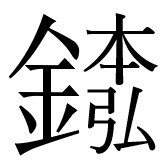
funbari (釒本弘) – [踏張り] – This kanji (see pic below) is not found in any character set. It is composed of the metal radical left, and to the right of the character (本) on top of (弘). Thus the composition is kind of literal, i.e. “wide/broad” (弘) at the “base” (本), with the metal radical as its “sword-related classifier.”
Funbari

gomabashi (護摩梯) – [護摩箸] (PS): (梯) reads hashi/bashi but means “ladder, stairs”
hada (膚) – [肌] (SS): actually means “skin/texture/grain” too but came out of use to refer to the jihada of a sword

jifu (地苻) – [地斑] (PS): (苻) reads fu but refers to a “kudzu-like plant”

kaeri (歸) – [返り] (PS): use of old variant of (帰)

kenuki (鑷) – [毛抜] – The opening in the tang of a kenukigata-tachi, i.e. (鑷) has the same meaning of “tweezers” but came out of use to refer to the kenukigata opening/interpretation.

kiriha/kiriba (刎齒) – [切刃] (PS): (刎) reads kiri but means “decapitate,” so still semantically related to kiri/kiru (切, “cut”). And (齒) reads ha but means “tooth.”

machi (関) – [区] (SS): (関) does not read machi but means what the machi are supposed to be, i.e. “barriers” between blade and tang

mune (𫒒) – [棟] (PS): (𫒒) reads mune and has to be taken literally, i.e. as “metal (金) hill (丘).” For example, the literal meaning of this term was also quoted with the charactes (刀背), i.e. “sword (刀) back (背)” whereas the two characters (刀背) were then again read as mune.

sujikai (直違) – [筋違] – Interesting case as we have here a coming together of several substitutes. First of all, the term sujikai originally referred to braces, i.e. slanting beams giving extra support between horizontal and/or vertical members of a timber frame, forming a X when mounted. Thus this term was initially written with suji (筋, “sinew, tendon,” or also something long and linear) and kai (交い, “alternate, cross”), referring to the X shape of the braces. But then this writing of the term (筋交い) was replaced by (筋違い), which reads suji-jikai in the strict sense, i.e. suji (筋) and chigai (違い, voiced jikai). Therefore we find this term, or the yasurime in question, sometimes quoted as suji-jikai. But even if replaced by (筋違い), the initial reading of sujikai of the characters (筋交い) was kept. In short, (筋違い) should also read sujikai but suji-jikai is not wrong of course. Back to the Kokon Mei Zukushi. Therein the term was so to speak “re-split-up” from suji-kai to su-jikai and the su (which should actually be suji [筋] and not just su) was replaced by the homophonic (直).

togariba (鋒刃) – [尖り刃] (PS): (鋒) reads togari, or rather tokari, but means “lance, pike, tip of sword.” So this is kind of literal too, i.e. something pointy (togaru, 尖る) like a tip or lance

yakiba (㓵) – [焼刃] – The etymological meaning of (㓵) is “sword” or “double-edged sword” but it also had the meaning of “edge of knife,” so that’s why it was used to represent the term yakiba.

yasuri (鈩) – [鑢] – This substitute is insofar interesting as it is the (simplified) variant (itaiji, 異体字) of the character (鑪) (note the different radical on the bottom left, i.e. 心 and 皿). In other words, (盧) gets replaced by (戸) and (慮) either by (呂) or (虑). So the character for yasuri (鑢) should actually be replaced by (鋁) and not by (鈩).

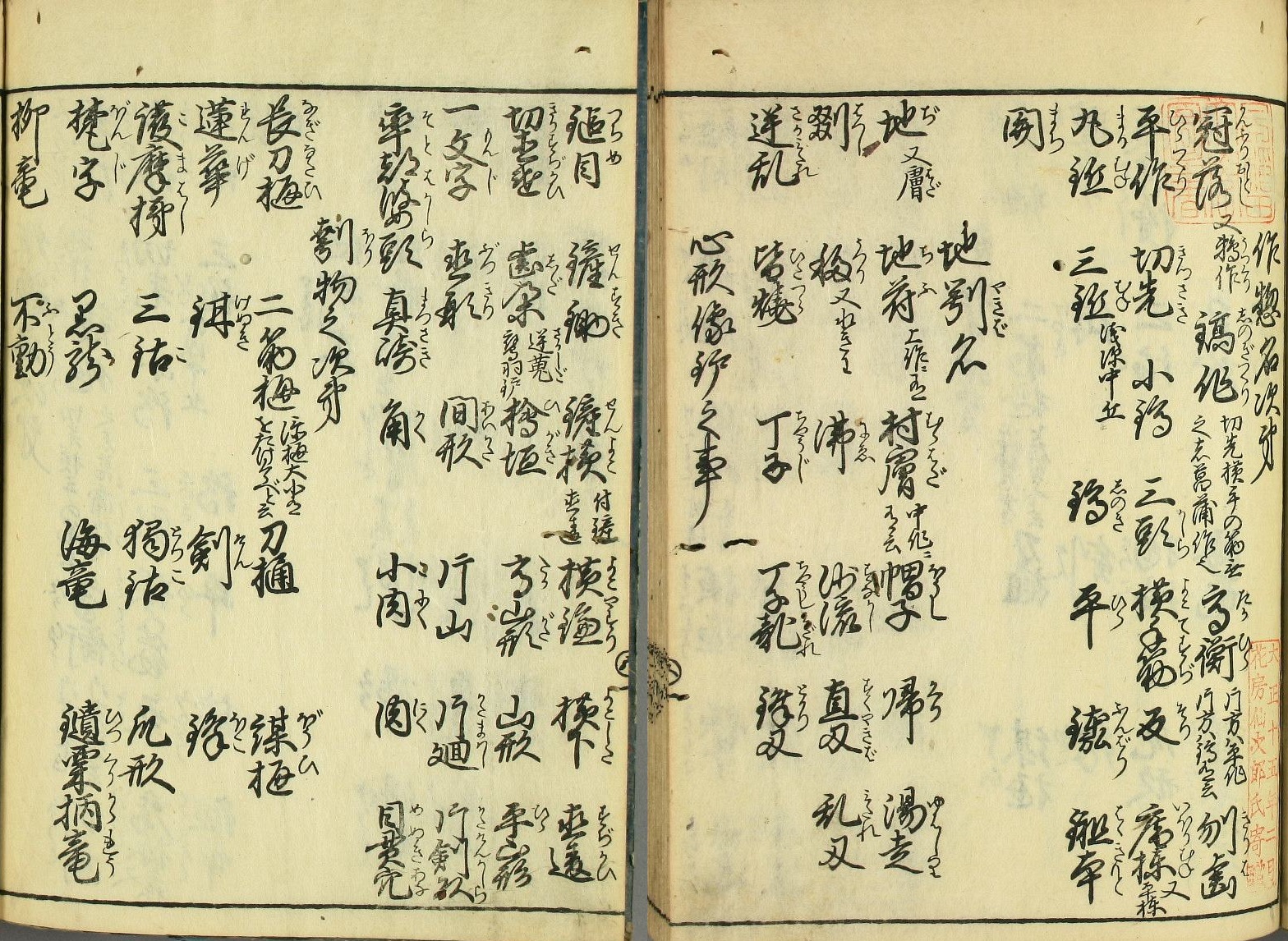
And below the two introductory pages in question of volume 5, just in case you want to do some deciphering yourself.

KokonTerms

KANTEI 4 – YAMASHIRO #22 – Rai (来) School 8

Today, I am talking about Mitsukane (光包) before we deal next with the Nakama-Rai branch. I did not want to “pack” Mitsukane into the previous chapter because he was a pretty outstanding master and because there is, compared to for example Kunihide and Kunitsugu, a relative good body of work of him extant. In short, he deserves a separate chapter for himself. What you will immediately notice when you deal with Mitsukane is first, that there are no long swords known by him and second, that he never signed with the prefix “Rai.” The first distinctive feature has already been pointed out in Muromachi-period sword publications. Some now assume that he actually did some in his early years but that on a very small scale whilst others assume that he did not make any tachi at all. Well, there were allegedly some very few unsigned tachi attributed to him going round in feudal times but nothing really tangible from today’s perspective. And the second distinctive feature goes back to the fact that he was not an indigenous Rai smith. According to tradition, he left the forge of the Osafune master Nagamitsu (長光) to proceed to Kyôto where he studied under Rai Kunitoshi whereupon he left the capital again later to open up his own forge in Ômi province. Now the old publications, for example the Kotô Meizukushi Taizen, give us some cornerstones for this tradition, namely that Mitsukane was born in Kôan one (弘安, 1278), that he studied around Tokuji (徳治, 1306-1308) under Nagamitsu, that he became a student of Rai Kunitoshi at the age of 29, and that he died in Jôwa five (貞和, 1349) at the age of 72. Now the given age of 29 would correspond to Tokuji two (1307) and this in turn would mean that he entered the forge of Kunitoshi immediately after having studied with Nagamitsu. But other sources, e.g. the Kokon Mei Zukushi, say that he arrived in Kyôto around Bunpô (文保, 1317-1319) and this could mean that the given age of 29 is a typo and he that was actually 39 when he studied with master Kunitoshi (what would then correspond to Bunpô one, 1317).

So lets unravel this handed down career of Mitsukane step by step. It is said that he was the fourth son of Nagamitsu, thus being named Heishirô (平四朗, i.e. -shirô as suffix for the fourth son). Some say that he was the son of a mistress of Nagamitsu but maybe both is true, i.e. that he was his fourth son but born out of wedlock. When we now follow this tradition that he was Nagamitsu’s son and take Kôan one (1278) as his year of birth, his entire apprenticeship would have roughly correlated to the Einin era (永仁, 1293-1299). In this light, the tradition that he studied with Nagamitsu around Tokuji (1306-1308) sounds a little odd as he was already approaching his 30th birthday at that time. So if the Tokuji approach is true, then Mitsukane was probably not the son of Nagamitsu but a student who entered the Osafune forge at an advanced age. Or his alleged year of birth is not true and he was born a decade or so later. Anyway, his most famous work, the meibutsu Midare-Mitsukane (乱れ光包), seems to go back to this Osafune milieu. The blade is shown in picture 1 and got its nickname from the interpretation in midareba. It is a wide sunnobi-style hira-zukuri tantô with uchizori and a rather thick kasane that shows a dense ko-itame with chikei and plenty of fine ji-nie that tends somewhat to nagare and that shows shirake along the mune. The hamon is a slanting, katauchi-style gunome in ko-nie-deki with a wide nioiguchi and is mixed with ashi and kinsuji. The bôshi is midare to notare-komi and shows a rather pointed ko-maru-kaeri that runs back in a long fashion. Both sides bear a katana-hi that runs with kaki-nagashi into the tang. The tang is ubu, has a ha-agari kurijiri, katte-sagari yasurime, and shows centrally under the mekugi-ana Mitsukane’s large and finely chiseled, peculiar niji-mei.

RaiMitsukane1

Picture 1: jûyô-bunkazai, tantô, mei “Mitsukane” (光包), nagasa 29.2 cm, uchizori, kasane 0.7 cm, motohaba 2.5 cm, hira-zukuri, iori-mune, owned by the NBTHK

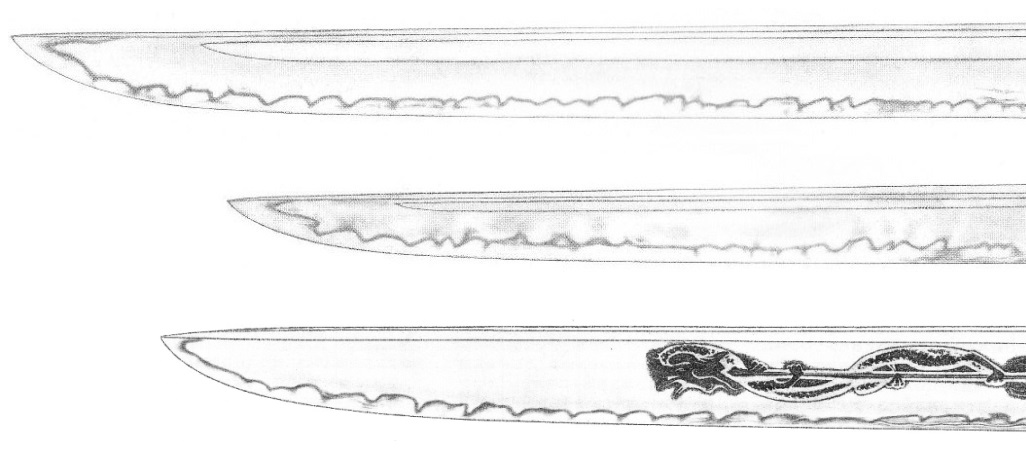
The interpretation of the midareba that tends noticeably to kataochi-gunome is so much similar to that of Nagamitsu and (some earlier blades) of his successor Kagemitsu (景光) (see picture 2) that the tradition of Mitsukane having studied at the Osafune School shall be deemed safe. Also the noticeable thickness of this tantô is a feature that is also seen at several Nagamitsu tantô. Interesting is that Tanobe describes the Midare-Mitsukane as showing also a nie-utsuri, an element that I haven’t read in any other descriptions of the very meibutsu. This would distinguish him from Nagamitsu as the Osafune master usually either applied a or a midare-utsuri and is probably feeding into the (more uncommon) approach that Mitsukane’s career happened the other way round, i.e. coming from the Rai School and studying later in life down in Bizen under Nagamitsu. Another factor that would support this approach is that on the one hand, Bizen-style blades of Mitsukane are regarded as his wakauchi (若打), i.e. his early works, but the meibutsu Midare-Mitsukane is a great masterwork of the calibre we would expect from an advanced master. Well, maybe Mitsukane was just a very talented smith and able to produce early on such great masterworks and what also speaks against the “other way round” approach is that if he was a Rai smith who decided to study with Osafune Nagamitsu later in his career, he would have signed with “Rai,” and probably not given up to do so.

RaiMitsukane2

Picture 2: Comparison of the Midare-Mitsukane (top) with works of Nagamitsu (center) and Kanemitsu (bottom).

Mitsukane eventually arrived in Kyôto and studied with Rai Kunitoshi. As mentioned in one of the previous chapters, we know that Kunitoshi was born in Ninji one (1240) and lived at least until Genkô one (1321). So when the studies of Mitsukane have taken place around Tokuji (1306-1308) or Bunpo (1317-1319), depending on tradition, then he was learning from an about 67 or 77 years old master respectively. Both ages might look advanced at a glance but we have to bear in mind that Mitsukane was alreay a fully trained swordsmith when he entered the Rai forge and we can assume that Kunitoshi was rather acting as a grand master, giving him some coaching and being supported so by his no less skilled sons Kunimitsu and Kunitsugu. In short, Mitsukane didn’t have to learn from scratch how to prepare the charcoal for example and was basically “just” introduced on the spot to the Rai School’s technical approach of sword forging.

A prime example of his later Rai interpretations is shown in picture 3. It is a jûyô-bunkazai tantô that was once handed down within the Date (伊達) family, the daimyô of the Sendai fief. It is with a nagasa of 26.4 cm about jôsun, i.e. of standard length, shows a hint of an uchizori, and is rather slender. Different from Kunitoshi is that the kasane is somewhat thicker than we would expect from a tantô of the Rai grand master. The kitae is a very dense ko-itame with fine ji-nie, some chikei, and a nie-utsuri, and the lower half of the blade shows some mixed-in larger hada structures, but we don’t see Rai-hada. The hamon is a ko-nie-laden and thin suguha that has a rather tight nioiguchi and that is mixed with some fine kinsuji and a little bit of hotsure along the monouchi of the ura side. The bôshi is quite prominent as it is widely hardened and a little taore, i.e. “falling/leaning” towards the ha on the omote side. So the bôshi too is different from that of Rai Kunitoshi.

RaiMitsukane3a

RaiMitsukane3b

Picture 3: jûyô-bunkazai, tantô, mei “Mitsukane” (光包), nagasa 26.4 cm, a hint of uchizori, hira-zukuri, mitsu-mune, preserved in the Fukuyama Museum of Art, Hiroshima

Another jûyô-bunkazai of Mitsukane in Rai style is shown in picture 4. This blade is with a nagasa of 24.5 cm a little shorter and comes with a curved furisode-nakago. It shows a rather dense itame with a nie-utsuri and a suguha in ko-nie-deki, a deki which reminds of Kunitoshi at first sight but the again somewhat thicker kasane and the widely hardened bôshi with the long kaeri show the typical stylistic approach of Mitsukane. The blade was once a heirloom of the Echizen-Matsudaira (越前松平) family.

RaiMitsukane4

Picture 4: jûyô-bunkazai, tantô, mei “Mitsukane” (光包), nagasa 24.5 cm, uchizori, hira-zukuri, mitsu-mune, preserved in the Tôkyô National Museum

Well, after his study visit of Kyôto he travelled a little bit farther north-east and settled in Tozu (戸津) in neighboring Ômi province and took with this the name of Tozu Sasuke (戸津佐助). A popular tradition says that he had then retreated to the Konpon-Chûdô (根本中堂) named main hall of the Enryaku-ji (延暦寺) on Mt. Hiei (比叡山) to forge swords for a while there, what earned him later the nickname Chûdô-Rai (中堂来). Now some see this Tozu referring to the Totsu Shrine (戸津神社) which is located on the southeastern lakeside of Lake Biwa. But it was found out that also a neighborhood of present-day Sakamoto (坂本) was named Tozu and Sakamoto is right where you arrive at when coming down from Mt. Hiei going east, i.e. down to Lake Biwa. However, this tradition of him establishing a forge on Mt. Hiei, what is with transporting all the raw materials up there rather cumbersome and laborious, is today dismissed by some scholars who forward that Chûdô actually refers to the Chûdô-ji (中堂寺) and its surrounding district, a neighborhood which is just located in the heart of Kyôto. But on the other hand, his later name Tozu Sasuke and the fact that his son and some of his students moved to the southern Biwa lakeside village of Awazu (粟津) does suggest a strong connection to Ômi province. Incidentally, this branch of his that moved down to Awazu is referred to as Awazu-Rai (粟津来).

Before I introduce a last work of Mitsukane, let me address some kantei points for him. As mentioned, his tantô show a somewhat thicker kasane than Rai Kunitoshi. Also his jigane is a little stronger and does not show Rai-hada and of course the widely hardened bôshi is different too. In addition, Mitsukane’s kaeri often emphasizes the nie and there are by trend a little more hataraki within the ha as at Kunitoshi. It is often said that Mitsukane’s suguha is generally wider than that of Kunitoshi but if you take a look at his entire body of works, you learn that this view needs to be rethought as more than half of his tantô actually shows a pretty narrow suguha. Some even place Mitsukane’s tantô more in the vicinity of Awataguchi Yoshimitsu but the sugata differs insofar as the blades of Mitsukane feel a little more stretched, i.e. more sunnobi for their width, and are just not as harmonious in overall shape as are Yoshimitsu’s tantô (of that kind). Well, Yoshimitsu is regarded by many experts as greatest tantô smith of all times so his daggers have of course an overwhelming presence and dignity that is not seen to that extent in the tantô of Mitsukane.

Now last but not least the meibutsu Kuwayama-Mitsukane (桑山光包). Also I want to mention at this point that 5 works of Mitsukane bear designations by the Agency of Cultural Affairs (all tantô and all jûyô-bunkazai). 7 tantô passed jûyô of which 3 made it tokubetsu-jûyô later. The Kuwayama-Mitsukane is one of these 3 tokuju and was once owned by Kuwayama Iga no Kami Motoharu (桑山伊賀守元晴, 1563-1620) who presented it later to shôgun Tokugawa Iemitsu (徳川家光, 1604-1651), who in turn gave it to Maeda Toshitsune (前田利常, 1594-1658) after whom it was handed down within the Kaga Maeda family (which sold it after WWII). By the way, the Kyôhô Meibutsu Chô says that Motoharu once bought this tantô for 1,500 kan from a person from Ôtsu (大津) in Ômi province, a town that is also located at Lake Biwa. The tantô , shown in picture 5, is pretty similar in interpretation to the jûyô-bunkazai tantô introduced in picture 3. It has a nagasa of 27.1 cm, shows a hint of uchizori, a thick kasane, and tends to sunnobi. The kitae is a very dense ko-itame with plenty of ji-nie and a nie-utsuri appears along the mune. The hamon is a ko-nie-laden suguha with a wide, bright and clear nioiguchi that is mixed with kuichigai-ba and along the fukura with yubashiri. The bôshi is again relative widely hardened but is due to the this time rather wide suguha not as prominent. It shows a pointed ko-maru-kaeri which meets the yubashiri to form some kind of muneyaki approach, but just in the tip.

RaiMitsukane5

Picture 5: tokubetsu-jûyô, meibutsu Kuwayama-Mitsukane, mumei, nagasa 27.1 cm, a hint of uchizori, hira-zukuri, mitsu-mune

Book review: Analysis of the Iai Katana

Today I want to review a recently published book, written by PhD Jon Andresen from American Art Swords. Title of the book is Analysis of the Iai Katana, published by Jon’s Androzo Publishing, and available via amazon. In his book, Jon approaches the katana, as mentioned in the blurp, analytically and his academic scientific background is very much reflected in this approach. Jon is also an iaidôka, a rokudan renshi to be specific, and thus he tackles the analysis of swords, and that is of iaitô and shinken as well, truly from the modern iaidô practitioner’s point of view.

The book is basically divided into three parts, i.e. bokutô, iaitô, and shinken. In the first part, Jon thoroughly analyses all aspects of the bokutô, with a main focus on the woods used, from traditional to modern Japanese sources to non-Japanese equivalents. And with thorough, I mean thorough, as this (I am speaking of ~ 50 pages) is the most comprehensive study on bokutô I have come across to this day. The second part is comparatively brief and addresses all basic and relevant points you have to know about iaitô whereas the third part on shinken is the main part of the book and comprises ~ 120 pages. In these 120 pages, Jon analyses and puts into relation measurements, weight, and bôhi grooves by using a dataset of 1,695 long swords from all periods. Through this analysis, you can see certain trends and relations of nagasa, kasane, weight, and presence or absence of bôhi, just to name a few factors, whereas the weight makes an important part of this analysis because as Jon says in the preface, to predict the weight of blades based on their nagasa was originally a major goal of this work.

This means, and borrowing from the preface, it was to be for the benefit of iaidô students who generally care about what swords weigh when information of the weight is usually omitted in descriptions on sites that sell swords. The book is rounded off by guidelines and tips on maintenance (and that applies to bokutô, iaitô, and shinken) and therefore I would recommend this publication to the serious iaidô aspirant who wants to get as much information as possible to make up his mind on the purchase of an as perfect as possible iaitô or shinken (in addition to what your sensei is recommending of course). In other words, studying Jon’s book gives you useful tips, and makes you aware of maybe never thought off aspects that you have to bear in mind when shopping for a sword that should fit you well and for a long time on your journey along the Way of Drawing the Sword. As indicated, the book places a firm focus and does not pretend to be anything else, thus do not expect to find in it any discussions on swordsmiths schools, workmanships, swords as collectibles, or iaidô techniques/kata and things like that . I just wanted to underline that because, from my personal experience as an author in this field, people often expect a “Swiss Army knife” approach.

AnalysisOfTheIaiKatana

Fujiwara ligature

Working on the German translation of parts of the current Tôken Bijutsu magazine I saw that Satô Kazunori (佐藤一典) points out a “habit” in the 24th part of his article series on Sendai swordsmiths that I would briefly like to introduce. The habit in question is a certain ligature, gôji (合字) in Japanese, that combines the characters Fuji (藤) and wara (原) to a single character that represents, obviously, the clan name Fujiwara. Now I don’t want to deal with the specific swordsmith, who is the Nidai Sôryûshi Tamateru (雙龍子玉英, 1820-1889) by the way, but suffice it to say that I first came across this habit years ago via his master Taikei Naotane (大慶直胤, 1778-1857). Naotane started rather early on in his career, i.e. around Bunsei (文政, 1818-1830) to drop the wara and sign the reference to the clan name Fujiwara just with Fuji (see my Shinshinto-Meikan, p. 135f). Later, i.e. around Tenpô (天保, 1830-1844), he signed Fujiwara as everyone else with two characters but changed towards the end of his career, i.e. around Kôka (弘化, 1844-1848) and Kaei (嘉永, 1848-1854) to the gôji ligature variant. So Tamateru obviously adopted this habit from his master.

Goji1

Picture 1, from left to right: Naotane signing just with Fuji (dated Bunsei four, 1821), with Fujiwara (dated Tenpô eleven, 1840), and with the gôji (dated Kaei four, 1851)

When I say “came across via Naotane” above, I mean that I once wrongly read this gôji just as Fuji, i.e. I thought that he later returned to the habit of dropping the wara character again but was pointed out that he did add it by so to speak squeezing it into the the lower Fuji part (滕), that is squeezing it between the radicas (月) and (𣳾). So if you see a mei like the one in picture 1 right, you correctly read it (in this very case) as “Mino no Suke Fujiwara Naotane” and not “Mino no Suke Fuji Naotane.”

Goji2

Picture 2: Naotane’s Fujiwara gôji (left) and how Tamateru signed it (right).

Explicit ligature was and is rather rare in Japan because when you combine two characters, you just get a new character and this is not regarded as ligature in the strict sense. However, there were some, but they mostly used for decorative or “underlining/emphasizing” purposes on temple inscriptions or talimans. Apart from that, and what we see sometimes today, Western units were adopted and made into gôji, for example (糎) for centimeter, Japanese senchi or senchimêtoru, composed from the characters (米) and (厘), and (粍) for millimeter, Japanese miri or mirimêtoru, composed from the characters (米) and (毛). In our field, you can come across such units gôji via certain papers, for example those issued by the Nihon Tôsôgu Kenkyû Kai and the Jûhô Tôken Kenkyû Kai (see picture below).

Goji3

Picture 3: Details from a NTK and a JTK paper.