Hashitomi (半蔀)

With this post I want to start a little series on easy to miss hidden symbolisms on sword fittings. The series will be continued on an irregular basis, depending on when I come across such a hidden symbolism or an ambiguous motif worth being introduced and described in detail. The series surely is not meant to be smart aleck even if I will point out “wrongly“ papered fittings or descriptions from time to time. Well, I put the term wrongly in quotation marks as a description of a motif according to what you see is of course not wrong, even if the artist meant something different, hidden. But more on that later. Aim is on the one hand to provide a little reference for those who own sword fittings with an unclear and/or ambiguous motif, and on the other hand to sensitize collectors for hidden symbolisms. And with hidden I mean really hidden, i.e. in this series I will refrain from introducing widely known hidden symbolisms like cherry blossoms on running water referring to the Yoshinogawa subject and the like.

Our first easy to miss hidden symbolism is a motif called hashitomi (半蔀). Hashitomi is the title of a Nô play which is said to go back to Naitô Tôzaemon (内藤藤左衛門). It is a complex reference to the Yûgao chapter (夕顔) of the Genji-monogatari in which Genji has a short and sad romance with an lady of the same name Yûgao. Yûgao had once been the mistress of a noble officer but whose wife was against this affair and so she had gone into seclusion with their her and the nobleman´s daughter but where she was suddenly possessed by an evil spirit and died. Genji was informed about that background only after their affair. Now in the Nô play Hashitomi, a monk living in the Unri´in temple (雲林院) in Kyôto´s Kitayama is praying to console the spirits of flowers offered to Buddha every day. At the evening of that day, a mysterious lady appears and offers a single but magnificent white flower, a moonflower, yûgao in Japanese. The monk is curious but the lady does not tell him her name, only vaguely where she lived in Kyôto. When the monk learns later from a villager about the story of Genji and Yûgao, he decides to visits the area described by the lady and finds a lonely and old-style house with open shutters (hashitomi, 半蔀) on which yûgao bloom. And indeed, the lady appears again, but tells the monk now the whole sad story and her deep love to Genji and begs him to pray to console her soul. And whilst she returns behind one of the shutters, the temple bells ring and the monks wakes up and realizes it had all just been a dream.

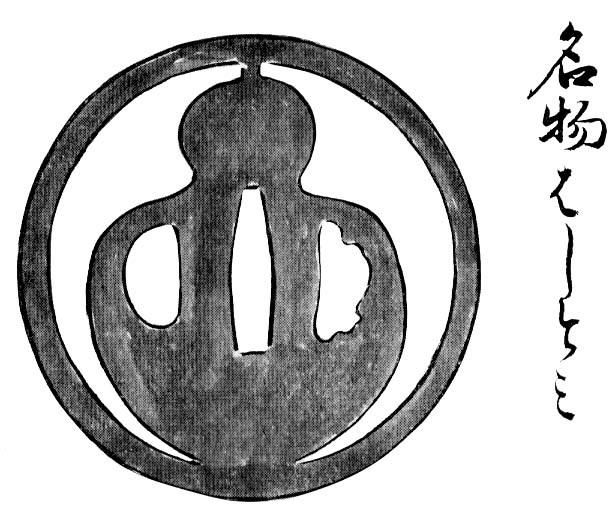
 HashitomiToban

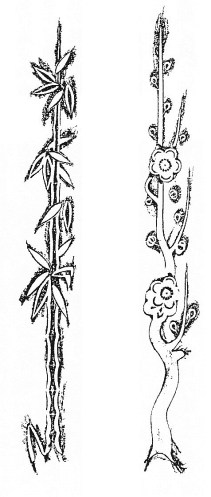
Picture 1: Drawing from the Tôban-shôkan-kôketsu

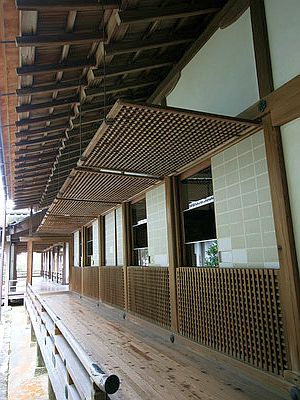
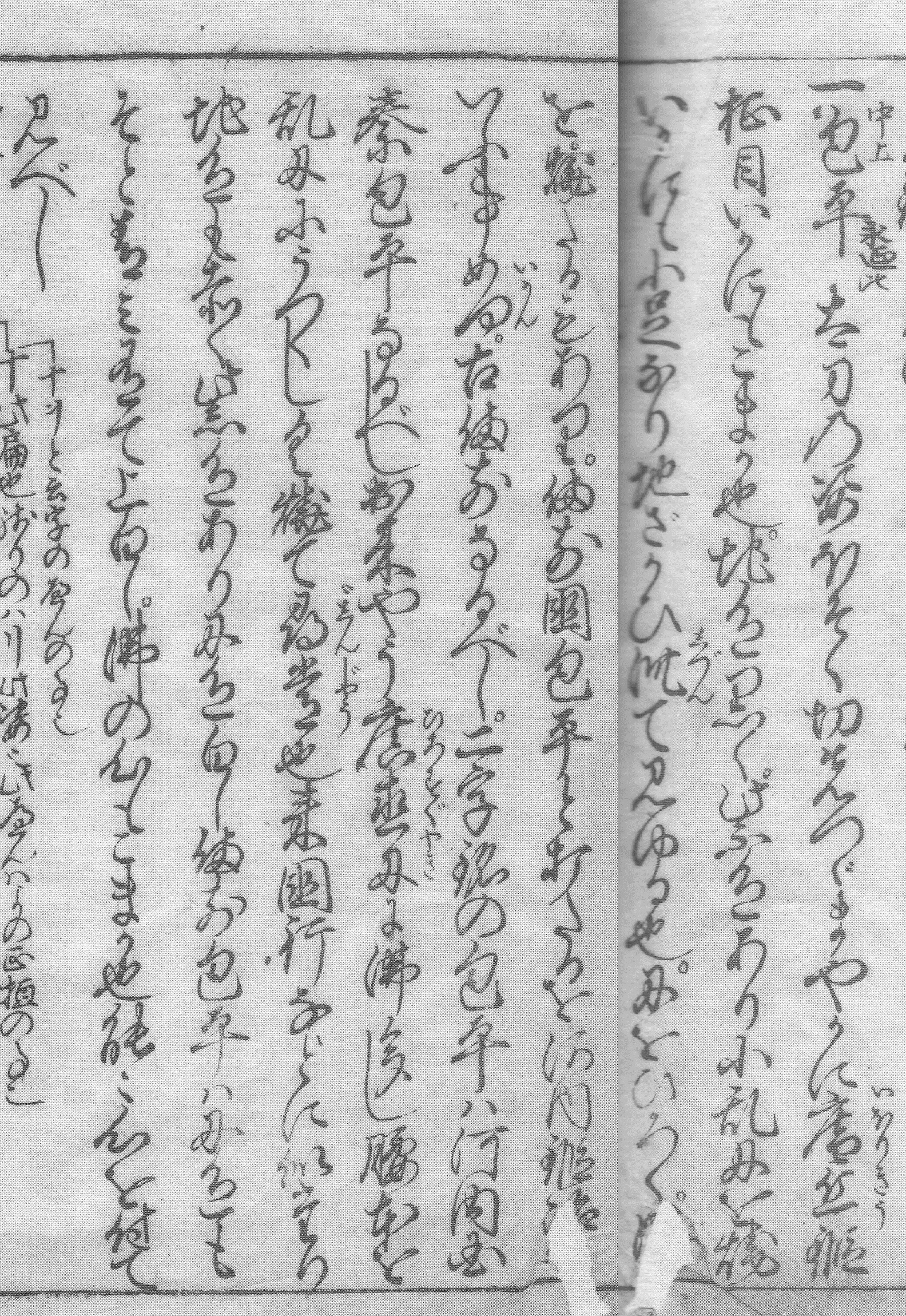
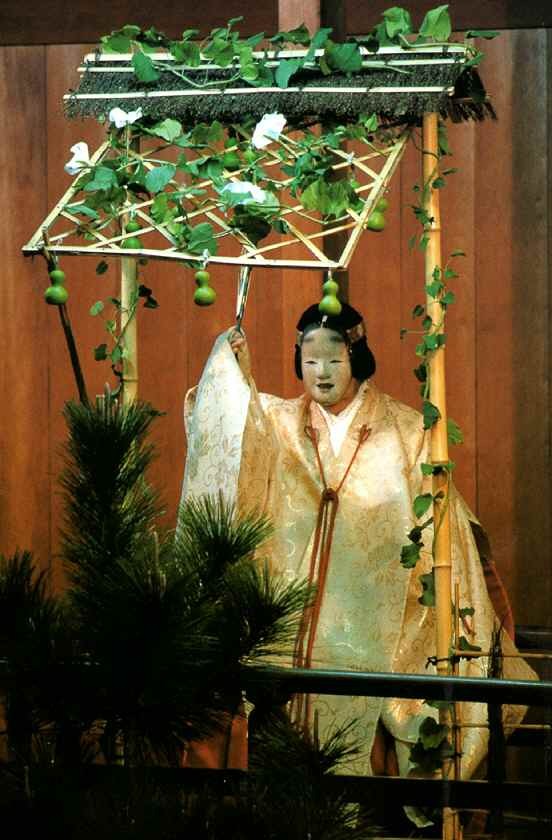
So far the Nô play and now to the hidden symbolism in sword fittings, in our particular case found on sukashi-tsuba which depict centrally a large gourd which takes almost the entire ji. The reference to the Nô play Hashitomi goes namely back to Matsumiya Kanzan´s (松宮観山, 1686-1780) publication Tôban-shôkan-kôketsu (刀盤賞鑒口訣). About in the middle of the book we find a drawing of such a gourd sukashi-tsuba (see picture 1) with the brief description “meibutsu Hashitomi” (名物者しと三), “celebrated Hashitomi [tsuba].” So Matsumiya Kanzan has incorporated a tsuba which was famous at his time under the name Hashitomi. But now why the reference to the Nô play and the tragic love story of Genji and Lady Yûgao? Because the moonflower yûgao is a calabash flower and was often growing as ornamental plant on the aforementioned hashitomi shutters. Picture 2 shows such a stylized/hinted shutter as used in the Nô play Hashitomi and picture 3 the actual shutters. Note that in the case of the shutters themselves, usually the pronunciation hajitomi is used.

 HashitomiGrille

Picture 2: stylized hashitomi

HashitomiHajitomi

Picture 3: hajitomi/hashitomi


But we must bear in mind that not every tsuba with a gourd motif is automatically a hidden reference to the Hashitomi subject. This term is namely in the strict sense only used for tsuba interpreted in the manner of the one depicted in the Tôban-shôkan-kôketsu, i.e. in the manner of the celebrated meibutsu whose whereabouts are unknown. So in conclusion it can be said that a sukashi motif of a central large gourd in sukashi should be referred to as “Allusion to Hashitomi” (Hashitomi rusu-moyô no zu tsuba, 半蔀留守模様の図鐔) Or maybe even more accurate would be a description like “Allusion to the meibutsu Hashitomi” (meibutsu Hashitomi rusu-moyô no zu tsuba, 名物半蔀留守模様の図鐔). But of course it´s really not that bad if the hidden meaning is missed as even the NBTHK papers such tsuba as hisago sukashi-tsuba (瓢透鐔, “gourd/calabash sukashi-tsuba”) as seen here. As mentioned at the beginning, “gourd sukashi” is perfectly correct and fine to describe the motif of such tsuba but it is a nice plus to transport all the hidden symbolism with the naming.

A reference to Kotetsu´s scholastic background

I dealt with Kotetsu´s career in detail in my Legends and Stories around the Japanese Sword 2 and also presented at the end of this chapter what we know or what is speculated about his scholastic background. Now I wan´t to introduce a blade from his very early years as a swordsmith which can be seen as a strong indication that he was trained by an Echizen-based master. But first and to get familiar with the great Kotetsu, let me quote the essential parts from my aforementioned publication.

Let us begin with the facts or the historic records respectively. The works Ômi-ochiboshi-shû (淡海落穂集), Ômi-kojin-dan (淡海 故事談) and Kobayashi Zui´ô hikki (小林随翁筆記) write that Kotetsu was born in Nagasone (長曽祢) in the vicinity of the castle town Sawayama (佐和山), in Ômi province. This transmission is also followed by the Hikohan narabi Kingô-ôko kikigaki (彦藩並近郷往古聞書) but which goes somewhat more into detail. Therein we read: “According to a transmission, Kotetsu lived until recent years in Nagasone but came originally from the Northern provinces. The time is around the Kanbun era (寛文, 1661-1673).” Interesting is the wording “until recent years” which implies that this work was written not too long after Kotetsu´s death in Enpô six (延宝, 1678). Unfortunately, all those mentioned records are undated. Some sword-related documents were published shortly after Kotetsu’s death. The Arami-mei-zukushi (新身銘尽),for example, was published in the sixth year of Kyôhô (享保, 1721), i.e. 43 years after his death. Therein we find the information: “According to transmission he once lived in Echizen but originally came from the village of Nagasone in Ômi province. Later he moved to Edo.” The author of the Arami-mei-zukushi, which deals exclusively with shintô blades, was Kanda Hakuryûshi Katsuhisa (神田白龍子勝久, 1680-1760). Katsuhisa was a renowned and busy scholar and chronicler who compiled several 20, 30 and 40 volume publications. He was a friend of the 8th Tokugawa-shôgun Yoshimune, he visited several fiefs for his studies, and talked to many swordsmiths. So it can be safely assumed that his entry in the Arami-mei-zukushi represented the then knowledge on Kotetsu. Kamada Natae (鎌田魚妙) also follows up in his standard work Shintô-bengi (新刀弁疑) from the sixth year of An´ei (安永, 1777) the approach that Kotetsu came originally from Nagasone.

The other, often quoted, approach that Kotetsu came originally from Echizen goes back to extant signatures with the prefix “Hongoku Echizen-jûnin” (本国越前住人). Sword books, like the Honchô-shintô-ichiran (本朝新刀一覧) from the fourth year of Bunsei (文政, 1821) and the Tôken-jitsuyô-ron (刀剣実用論) from Bunsei seven (1824), interpret this prefix wrongly. They confuse namely the term hongoku (本国, “home country/province”) with shōkoku (生国, “country/ province of birth”). In short, hongoku does not necessarily mean that a person was also born in this country but simply that he or she lived or had lived there for a longer period of time. The question is now why Kotetsu signed explicitely with the supplement “Hongoku Echizen,” i.e. “home country/province Echizen”? The most obvious reason would be that Kotetsu considered Echizen as his home country because he had left Nagasone at a very young age. But there might also be another reason. After the Battle of Sekigahara, Ieyasu had entrusted Echizen province to his second son, Yûki Hideyasu (結城秀康, 1574-1607), who made the local Kitanoshô Castle (北ノ庄城) his stronghold and who reverted to the former family name “Matsudaira.” Kitanoshô became Fukui Castle, which also served as a name giver for the surrounding fief. So Fukui was, because of its direct connection with the family of the shôgun, a high ranking fief and smiths like Yasutsugu (康継) were proud to mention in their signatures their relationship with it or their patronage by this Tokugawa branch. And “Echizen” became, for example “Echizen Yasutsugu” (越前康継), an inseparable pseudonym of this master.

The Ômi-kojin-dan writes about the family name “Nagasone”: “The Kotetsu family lived in Nagasone since the time of his great-grandfather and up to Kotetsu all of them used the name of this village ´Nagasone´ as their family name.” The next question which arises is when and why the move to Echizen province took place. A theory says that Kotetsu´s father had supported the troops of Ishida Mitsunari who also came from Ômi. And when he saw that Ishida was going to be defeated at Sekigahara, he fled Nagasone and moved to Echizen to escape eventual punishment by the Tokugawa. Many contemporary swordsmiths shared the same fate. Others assume that Kotetsu´s father had chosen Echizen or rather Kitanoshô Castle because it was, back then, controlled by the Mitsunari-ally Aoki Kazunori (青木一矩, 1541-1600). This means that as he was previously employed by Mitsunari then it would have been easier for him to find a new job with a “sympathiser” of his former lord than trying his luck somewhere else in a hurry. At the same time we can also observe how other Nagasone craftsmen who had made armours, armour parts, swords, tsuba, stirrups (abumi, 鐙) and bridle (kutsuwa, 轡) scattered into the four directions. A metal worker, who signed “Nagasone Masanori Nyûdô Shôsa” (長曽祢当則 入道承佐), for example, made in Kaga´s Daishôji fief (大聖寺藩) tsuba and the swordsmith Nagasone Kawachi no Kami Nagahiro (長曽祢河内守長広) worked in Ôsaka.
 Kotetsu1

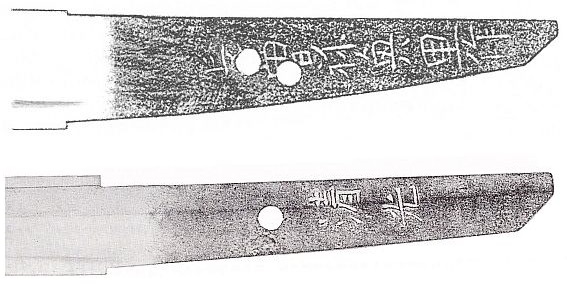
Picture 1: wakizashi with the mei “Nagasone Okisato saku” (top) and “Kiyomitsu” (bottom)

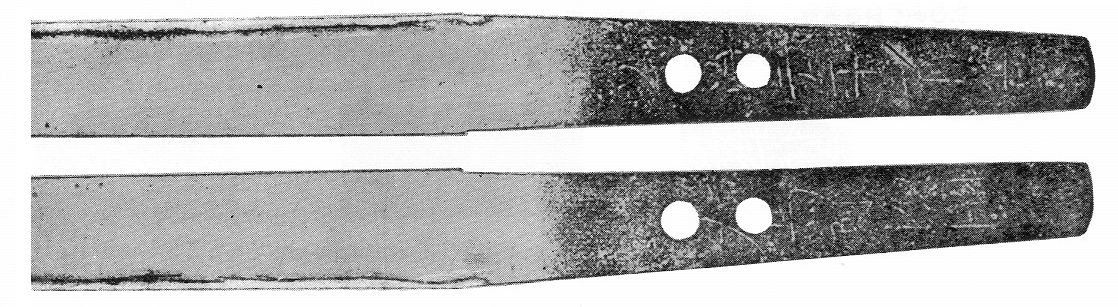
Let us return to Kotetsu´s career as a swordsmith. As mentioned in the first volume of the Legends and Stories around the Japanese Sword, the commonly accepted theory says that around the age of 50 he went to Edo to change his profession from that of an armourer to a swordsmith. When we examine all extant blades by Kotetsu we learn that the earliest specimen, i.e. those which are signed with “Okisato” (奥里), have a great deal in common with the tang finish of works by the Kaga smiths like Kiyomitsu (清光) and Yukimitsu (行光). Picture 1 demonstrates this and the peculiar so-called “Kashû-nakago” (加州茎). This gives the impression that he had gained experience as a swordsmith before he moved to Edo and that he maybe was trained by his Kaga relative, the aforementioned Masanori. Well, the exact reasons for Kotetsu´s change of profession are unknown but there exists roughly three approaches. One says that when he faced his 50th birthday, the demand for newly made armour had drastically dropped. Sekigahara happened 40 years earlier, Ôsaka had fallen more than 30 years ago, and the last great armed conflict – the Shimabara Rebellion from 1637 to 1638 – was at its tenth anniversary. That means there was a generation of active armourers who produced items more or less for parades and celebrations for high-ranking samurai, daimyô and the family of the shôgun or repaired extant pieces. The second approach is that Kotetsu was just looking for a new challenge. And there exists a story which gives another reason for his change of profession.

This story says that he had killed a man from Echizen and was on the run. It is said that the man was a samurai from the Fukui fief who had ordered a sword from Kotetsu. When smith and customer met in the forge to talk about the finishing touches, the samurai examined the amost finished blade and complained: “Do you think I can kill anybody with a piece like this? I don´t like it and it isn´t what I expected!” Kotetsu took back the blade and grumbled: “We will see if my blade can kill anybody …” whilst cutting deeply into the left shoulder of the man. It is said that Kotetsu threw away the bloody blade and hastily abandoned the forge whilst the man died on the ground. He fled to Edo and found a safe shelter with the befriended Inaba family (稲葉). The Inaba eventually arranged for Kotetsu to be able to live and work in the vicinity of the Kan´ei-ji (寛永寺) in Edo´s Ueno district (上野). Whether from remorse or as a disguise, the smith shaved his hair and entered priesthood under the name “Kotetsu.” It is unknown if, or to what extent, this story is true but there exist some blades which do show a local connection. Picture 2 shows a katana which is signed “Jû Tôeizan Shinobigaoka no hotori Nagasone Okisato saku” (住東叡山忍岡辺長曽祢興里作, “made by Nagasone Okisato in the vicinity of Shinobigaoka at the Tôeizan”). “Tôeizan” is another name for the Kan´ei-ji. But the catch is that these blades are dated Kanbun eleven (寛文, 1671) and Enpō two and five (延宝, 1675 and 1677), that means they go back to his late artistic period. The Arami-mei-zukushi mentions “at the Honjo-Warigesui canals” as his place of residence. The Shintô-mondô (新刀問答), published by Wakabayashi Tôsui (若林東水) in Kansei eleven (1799), goes further into detail and writes: “[…] lived at the Honjo-Warigesui canals, later in the vicinity of the Ueno pond Shinobazu no Ike (不忍池) and also in Yushima (湯島).” This means that the story is nice but is probably just an urban legend.
 Kotetsu2

Picture 2: katana, mei “Jû Tôeizan Shinobigaoka no hotori Nagasone Okisato saku – Enpô ninen rokugatsu kichijônichi” (住東叡山忍岡辺長曽祢興里作・延宝二年六月吉祥日, “made by Nagasone Okisato on a lucky day in the sixth month of Enpô two in the vicinity of the Shinobigaoka at the Tôeizan”)

The third approach is about a helmet test which is better known in the sword world. One day Kotetsu, the armourer, competed against the Kaga swordsmith Chôbei Kiyomitsu (長兵衛清光), whose blades were famous for cutting through helmets. The whole competition ended in an official showdown with the presence of lord Maeda Toshitsune. After everything was arranged, Kotetsu stepped forward and put his newly made helmet onto a wooden pedestal. Now it was Kiyomitsu´s turn. Specially for the test he had forged a robust katana measuring 2 shaku 5 sun (~ 75,7 cm) which he brought into the overhead position. As he was at exhaling and cutting down, Kotetsu yelled: “Stop! The helmet is not in its perfect position!” Quickly he approached the pedestal and changed the position of the helmet only marginally. But the intended interruption made an impact. Kiyomitsu´s concentration on the cut was disturbed and so he was “only” able to cut  1 sun (~ 3 cm) into the upper area of the helmet bowl. The swordsmith was perplexed, markedly paler, and feared that his face was lost, even his lord rewarded both of them. Back home in his forge Kotetsu said to his adopted son Okimasa and to his two students Okihisa (興久) and Okinao (興直): “Without this interruption, Kiyomitsu would surely have cut through my helmet. This was a shabby and cowardly action on my behalf! From this day on I will retire as an armourer and devote my future life to the craft of sword forging…” It is said that he left Kanazawa, heading to Edo that very same night. As confirmed later, Kiyomitsu also left Kaga that the same night. This was found out when Okimasa fell in love with a prostitute from Edo´s redlight district Yoshiwara (吉原). This prostitute was namely Kiyomitsu´s daughter who had been sold by her father because the latter was no longer able to work because of fear of failure. Now it was Kotetsu´s turn. He tried everything to make up for his failure and so he went to his then customer, the Ikeda family (池田) from Bizen province, and asked for the unusual high advance payment of 300 ryô. When he informed Mitsumasa (池田光政, 1609-1682), the head of the Ikeda, about the reason of his demand, it is said that the lord was so moved that he granted him the advance. With this money Kotetsu was able to ransom Kiyomitsu´s daughter and marry her to his adopted son Okimasa. As so often, there are several versions of this story going round. In one of them, the competing smith was a certain Shima Hyôe Masatsugu (志摩兵衛正次) but such a name is not found in the records of swordsmiths. Others say it was not Kaga Kiyomitsu but either the 1st generation Darani Katsukuni (陀羅尼勝国) or the 3rd generation Kaga Kanemaki (兼巻).

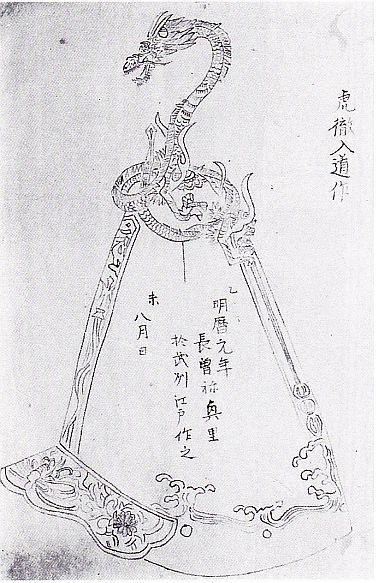
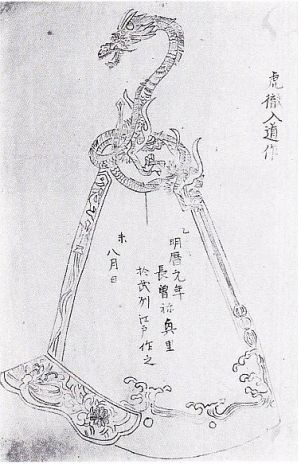
The assumption that Kotetsu changed profession at the age of 50 in Edo goes back to a signature on one of his blades. This mei reads: “Hongoku Echizen-jûnin, hanbyaku ni shitatte Bushû Edo ni kyojū-su, kaji no kôsei o tsukusu nomi” (本国越前住人至半百居住武州之江戸 鍛冶之工精尽爾) which translates as: “After 50 years in my home country Echizen I devote now myself to the craft of sword forging in Edo, Musashi.” Unfortunately, the blade – it is a wakizashi with a nagasa of 45,7 cm and a horimono of the Deva guardians (Niô, 仁王) on both sides – is not dated. But on the basis of comparative studies of other (dated) signatures – especially the interpretations of “Kotetsu” and “Okisato” – we are able to pin down the production date around the second and third year of Kanbun (寛文, 1662~63). If we take the aforementioned first year of Keichō (1596) as his year of birth, we come up with Shôhô three (正保, 1646) for his 50th birthday. The earliest extant blade by Kotetsu with a date – another wakizashi – is from the second year of Meireki (明暦, 1656). That means now that it took him either eight or nine years until he had finally become a swordsmith in Edo, or that the year Keichô one is not correct for his year of birth. Many experts assume that, as an armourer, he only needed one or two years to start up a new career as a swordsmith. This assumption is also backed by a drawing of a helmet by Kotetsu found in Matsumiya Kanzan´s (松宮観山, 1686-1780) Meikô-zukan zokushû (名甲図鑑続編, see picture 3). According to Kanzan, the helmet bears the following signature: “Meireki-gannen kinoto-mi hachigatsu-hi – Nagasone Okisato – Bushû Edo ni oite kore o saku” (明暦元年乙未八月日・ 長曽祢奥里 ・於武州江戸作之, “made by Nagasone Kotetsu in Edo in Musashi province on a day of the eighth month of Meireki one [1655], year of the sheep”). To summarise we can now say that Kotetsu still made helmets in Edo, in Meireki one, but two years later at the latest he also made swords. Thus, when he left Echizen in 1655 at the age of 50 – i.e. around the time he made the above mentioned helmet – then his year of birth can be calculated as Keichô ten (1605).
 Kotetsu3

Picture 3: Drawing from the Meikô-zukan zokushû.

Anyway, all the extant sources and reference pieces do not allow us more precise statements. But it is highly unlikely that it took him, as fully trained armourer, nine or ten years to forge decent sword blades. On the other hand, the obituary record of the Tôkyô´s Myôkanji (妙観寺) where Kotetsu is buried, which lists Keichō one (1596) as his year of birth, is a circumstancial evidence we can´t brush aside that easily. Maybe the answer lies somewhere in the middle. It is namely possible that he arrived in Edo in the mid 1640´s but continued to work there as an armourer. This is namely backed up by an exact copy of an armour by Kotetsu of which the signature was also copied 1:1. This copy was made by the Edo katchū-shi Asai Katsushige (浅井勝重) and the choice of characters for his name allows us to date the original piece to the first year of Kanbun (1661). That means for at least five years Kotetsu still occasionally made armours while he was already working as a swordsmith.

The next big question is who was his master to become a swordsmith? Let me say straight off: This question too is not entirely solved. Suishinshi Masahide (水心子正秀) assumed that it was the 5th generation Ise no Daijô Tsunahiro (伊勢大掾綱広, 1616-1683) who also worked in Edo´s Shitaya district (下谷) for a certain time. But, from the point of view of workmanship, we can´t see any connections between the two smiths. The commonly accepted theory is that Kotetsu´s master was the 1st generation Izumi no Kami Kaneshige (和泉守兼重) who worked in Edo for the Tôdô family (藤堂). Some also say it was Kaneshige´s son, the 2nd gen. Kazusa no Suke Kaneshige (上総介兼重), but this does not match for chronological reasons because the latter smith was active somewhat later than Kotetsu. The 1st gen. Kaneshige came originally from Echizen too and his workmanship is quite similar to Kotetsu´s. However, after Kotetsu gained some fame because of the sharpness of his blades, he was employed by the Nukada fief of Hitachi province. Extant records say he worked for this fief from the third year of Manji (万治, 1660) to the second year of Kanbun (1662). After that he was hired by Inaba Masayasu (稲葉正休, 1640-1684), a hatamoto and the daimyô of Mino´s Aono fief (青野藩). He worked for him until Kanbun ten (1670). Masayasu´s uncle Inaba Masafusa (稲葉正房) was, by the way, a retainer of the Fukui fief, so it is possible that this employment was arranged via this connection. But it has to be mentioned that Kotetsu always worked from the Edo residences of his employers.

According to transmission, Kotetsu died on the 24th day of the sixth month of Enpô six (延宝, 1678), and if Keichō one is correct as his year of birth then he enjoyed a very long life of 82 years. The cause of his death is unclear but some speculate that his exaggregated ambition to forge whenever possible was the result of a psychosis and that he eventually commited suicide by drowning himself in a well in Hirokôji (広小路), in Edo´s Ueno district. But it is possible that the story with the well is a confusion with the swordsmith Inoue Shinkai (井上真改) because, according to transmission, the latter fell completely drunk into a well and died at the young age of 53 in Tenna two (天和, 1682).
 Kotetsu4

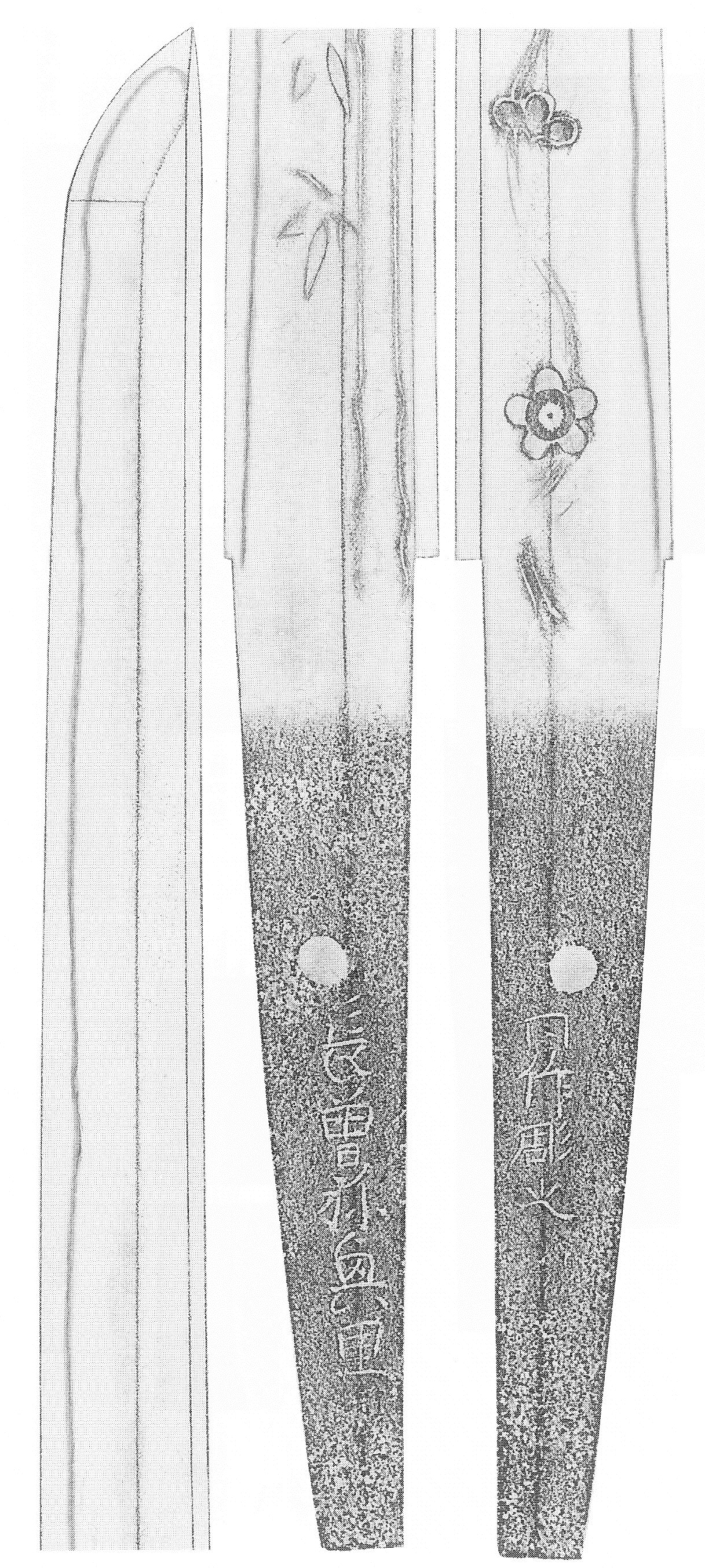
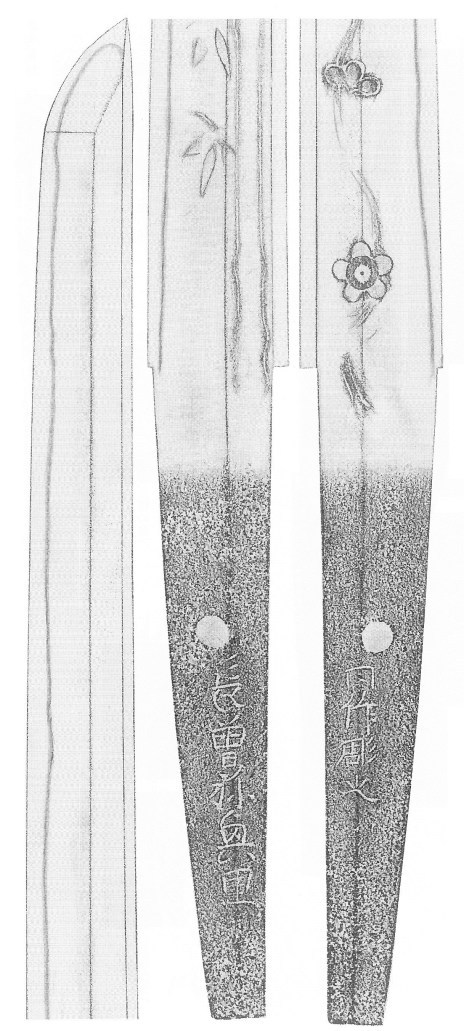
Picture 4: wakizashi, mei “Nagasone Okisato – dôsaku kore o horu”

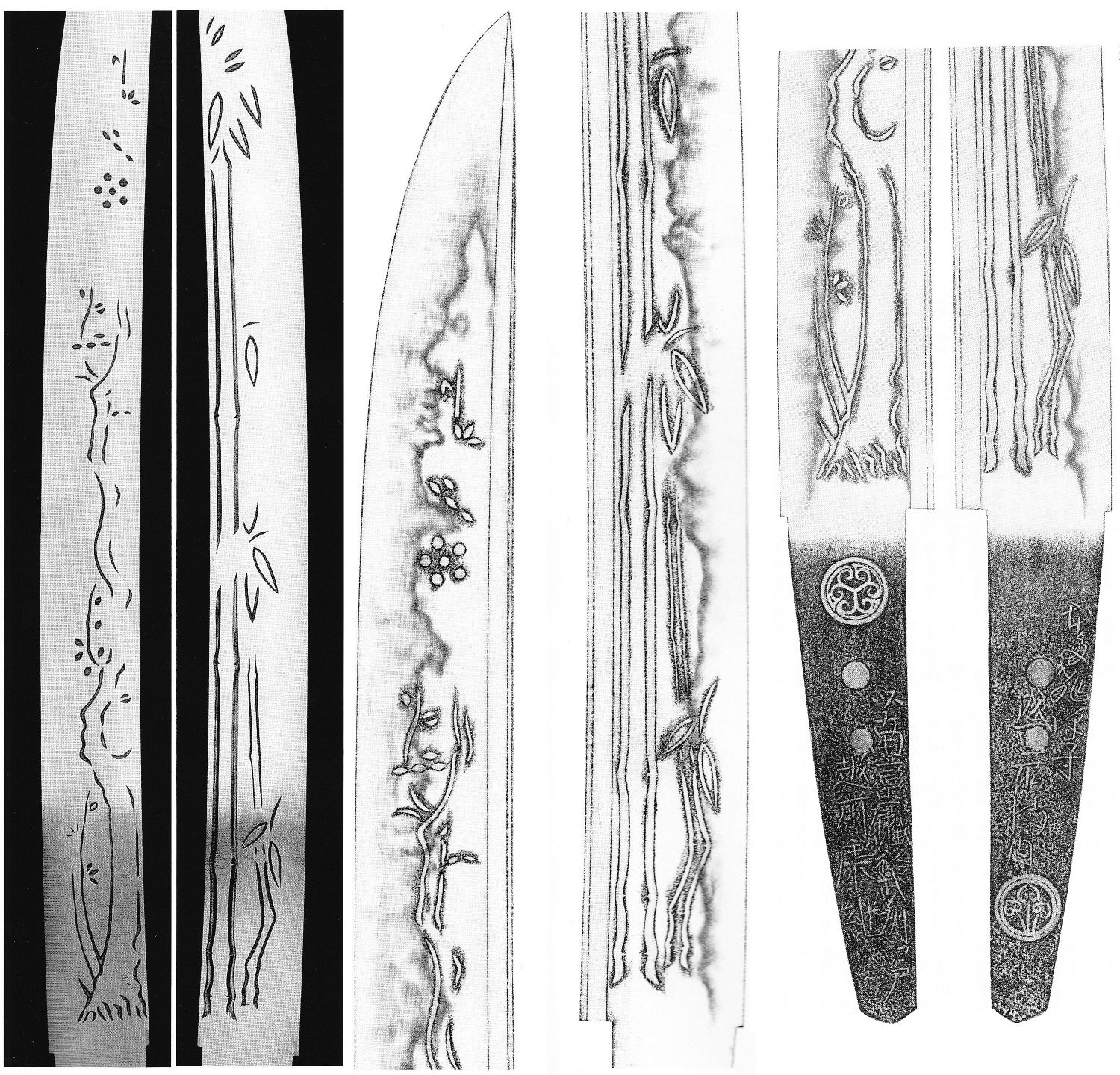
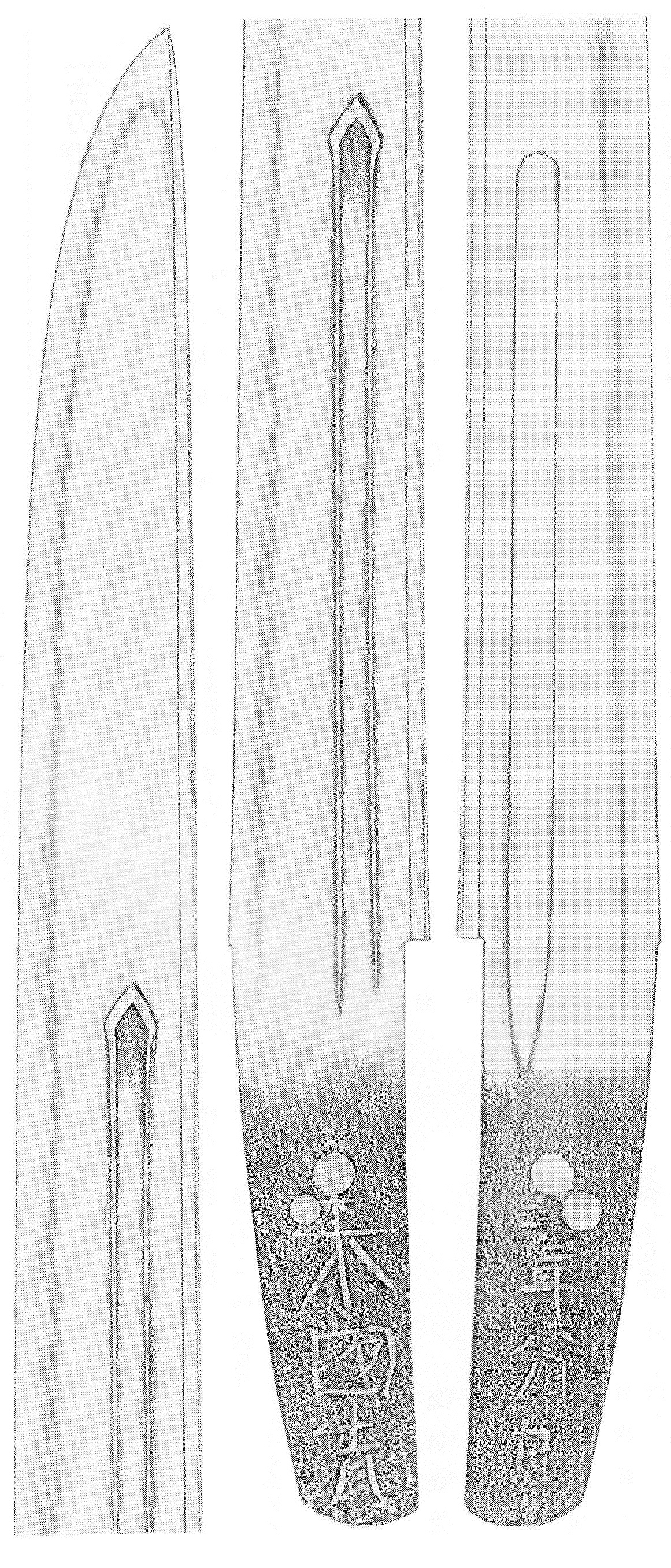
So far the outline of Kotetsu´s career and a brief reference to his possible masters. In terms of interpretation of the jiba, the most obvious similarities can be seen with Izumi no Kami Kaneshige, and early tang finishes suggest a connection to Kaga smiths, but there are many indications pointing towards Fukui, i.e. the capital of Echizen province. And as mentioned at the beginning of this article, I want to present another one, a strong indication that he was trained by an Echizen-based master. This indication is the wakizashi shown in picture 4. It has a nagasa of 55.1 cm and a shallow sori of 0,6 cm, is in shinogi-zukuri with an iori-mune, has a noticeable taper, and a chû-kissaki. It is signed “Nagasone Okisato – dôsaku kore o horu” (長曽祢興里・同作彫之) and from the signature style it can be dated to the Meireki era (明暦, 1655-1658) which means although undated, we have here one of the earliest extant sword blades of Kotetsu. Interesting is on the one hand the very clear jigane and bright habuchi, a feature so typical for him, but far more interesting are on the other hand the horimono. We see on the omote side an engraving of a bamboo and on the ura side of a plum tree. This peculiar combination goes back to Echizen Yasutsugu, or rather to his copy (see picture 5) of the meibutsu Baichiku-Sadamune (梅竹貞宗, lit. “Plum and Bamboo Sadamune”) which was once presented by Tokugawa Ieyasu to Nagasaka Charikurô Nobumasa (長坂茶利九郎信政, ?-1572).
 Kotetsu5

Picture 5: tokubetsu-jûyô, wakizashi, mei “[Aoi-mon] Echizen Yasutsugu” (越前康継) – “Nanban-tetsu o motte Bushû Edo ni oite” (以南蛮鉄於武州江戸, “[forged] in Edo by using nanban-tetsu”) – “Honda Hida no Kami Narishige shoji-nai” (本多飛騨守成重所持内, “owned by Honda Hida no Kami Narishige [1572-1647]”), nagasa 38.6 cm, sori 0.5 cm
 Kotetsu6

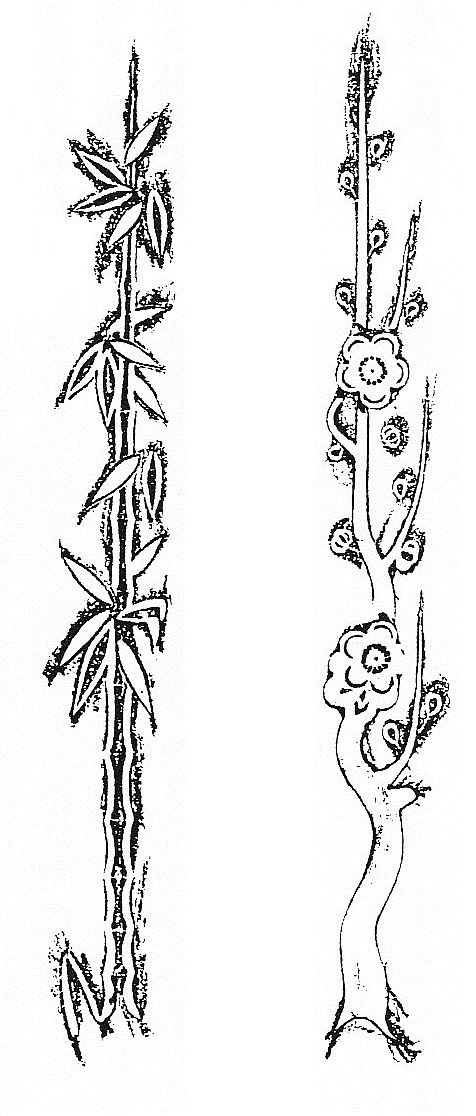
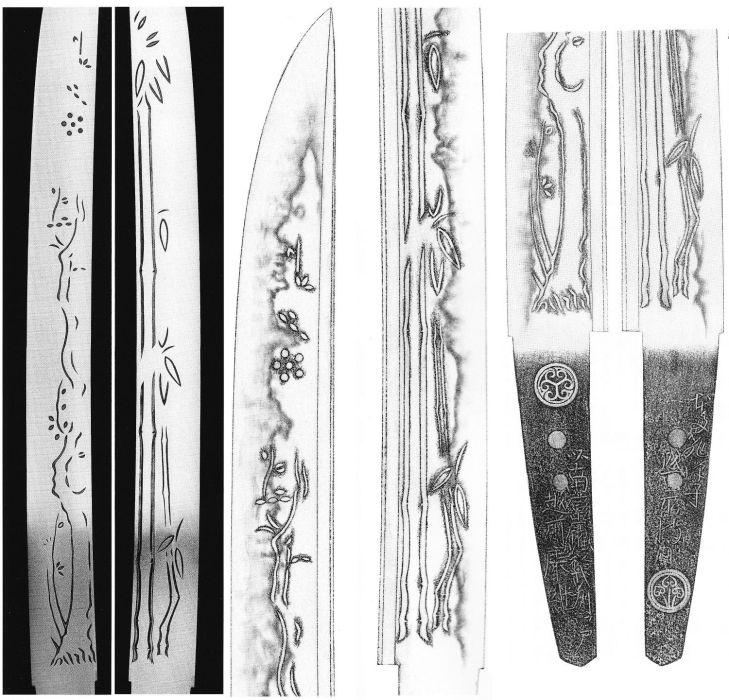
Picture 6: Well-known baichiku horimono on an Echizen-mono.

Later on, this utsushimono of master Yasutsugu served his successors and several local, i.e. Echizen-based smiths as model for own but successively more and more similar interpretations of the baichiku horimono sujet with more emphasis on the plum blossoms (see picture 6) which in turn became over time a trademark of Echizen-mono. So in my opinion it is not a coincidence that we find a horimono sujet famous for Echizen blades on a very early blade of Kotetsu It is namely rather unlikely for me that if trained solely by Kaneshige, he added such a horimono just to remind of his Echizen roots and without any scholastic connections to local Echizen smiths. Again, it are mostly such individual pieces which allow us over years and decades to draw bit by bit a clearer picture of the careers of certain smiths.
The Tsunahiro Connection of Suishinshi Masahide

In my Nihon-shinshinto-shi published least year I also addressed Suishinshi Masahide´s (水心子正秀) acquisition of the Sôshû tradition from the 10th generation Tsunahiro (綱広). And I also mentioned an extant blade from the eighth month of Kansei three (寛政, 1791) which is signed with the supplement “Kamakura-jûnin Masamune-masson Minamoto Tsunahiro Sôden no kitae” (鎌倉住人正宗末孫源綱広相伝鍛之, “forged in the Sôshû tradition of the Masamune-descendant Tsunahiro from Kamakura”). But there exists even an earlier blade, or to be more precise a blade from the year before, which demonstrates the relationship of Masahide and Tsunahiro. And starting with this blade, I want to go into greater detail of the Tsunahiro connection of Suishinshi Masahide. So let me introduce the blade in question. It is a katana with a nagasa of 70.3 cm and a sori of 1.3 cm. It is in shinogi-zukuri with an iori-mune, shows an ô-itame with plentiful of ji-nie and chikei, and narrow notare-chô along the lower half which turns into a wide and heavily nie-loaden suguha-based mix of ko-notare and gunome with many yubashiri and sunagashi which make the upper half even appearing as kind of sudareba. Also the bôshi is widely tempered, tends almost to ichimai, but shows some roundish kaeri with nie-kuzure. Interesting of course is also the signature which reads on the omote: “Gorô Nyûdô Masamune masson Minamoto Tsunahiro chakuden o motte Masahide kore o saku” (以五郎入道正宗末孫源綱広嫡伝正秀作之, “made by Masahide in the tradition of Gorô Nyûdô Masamune which had been inherited to Minamoto Tsunahiro”). The ura side is dated “Kansei ninen nigatsu hi” (寛政二年二月日, “a day of the second month Kansei two [1790]”) and bears two more names: “Enshû Yokosuka-shin Mitsuhide” (遠州横須賀臣三秀, “Mitsuhide, retainer from Yokosuka of Tôtômi province”), and “Tsunahiro-chaku Ôgitani-jûnin Yamamura Tadasaburô” (綱広嫡扇谷住人山村直三郎, “Yamamura Tadasaburô, heir of Tsunahiro and resident of Ôgitani [in Kamakura]”).

 Masahide1

Picture 1: gassaku of Suishinshi Masahide and two of his students

Before we continue, let me introduce the basics of Masahide´s career until he met Tsunahiro (for a detailed biography please refer to my Nihon-shinshinto-shi). Hide was born under the name “Suzuki Saburô” (鈴木三郎)  in the third year of Kan´en (寛延, 1750) in Dewa province and worked there as a village blacksmith. It is said that he had learnt the craft of forging from a certain Yoshizawa Sanjirô (吉沢三次郎) from a village close to his. But Masahide had decided early for himself to become a swordsmith and his first station in this goal was Sendai where he became a student of a later generation Kunikane (国包). His smith name was “Takuei” (宅英) at that time. After this initial training he moved to Hachiôji (八王子), in Musashi province, where he learnt from the local Shitahara master Musashimaru Yoshiteru (武蔵丸吉英) who was in turn a student of Musashi Tarô Yasukuni (武蔵太郎安国). With this master-student relationship he changed his name to “Terukuni” (英国) and was hired by the Akimoto family (秋元), the daimyô of the Yamagata fief (山形藩), in the third year of An´ei (安永, 1774) whereupon he changed his name again, namely from “Terukuni” to “Masahide”, and his entire civilian name to “Kawabe Gihachirô” (川部儀八郎). With his employment at the Yamagata fief he was able in terms of money to travel further and further, to take lessons in the Bizen tradition at the Ishidô school (石堂) and as mentioned in the Sôshû tradition under the 10th generation Tsunahiro.

 Masahide2

Picture 2: seishi of Masahide addressed to Yamamura Uhei

The start of master-student relationship to Tsunahiro can be narrowed down to the first year of Kansei (寛政, 1789) because there is a written oath (seishi, 誓詞) extant (picture 2) within the Yamamura family (i.e. the family of the Tsunahiro lineage) which is dated third day tenth month Kansei one and which contains Masahide´s will to learn the Sôshû tradition from Yamamura Uhei (山村宇兵衛), i.e. from the 10th generation Tsunahiro. So Masahide was already 39 years old when he visited the forge of Tsunahiro. That means he was already a fully trained smith by then working for the Akimoto family for about 15 years so his turning up at the forge of Tsunahiro has to be understood as a refinement of his craft. When we take a look at the aforementioned blade, we see at a glance that he had mastered the Sôshû tradition within a year because it is truly interpreted in the magnificently “relaxed” but daring style of the great Sôshû masters. And on the basis of the quality of the work and the production time it is safe to assume that Tsunahiro had initiated Masahide to all family secrets just as if he was his son and heir. Interesting are also the other two names appearing on the tang, Mitsuhide and Yamamura Tadasaburô. The 10th generation Tsunahiro died the very next year, i.e. in Kansei three (1791), and both Mitsuhide and Tsunahiro´s heir Tadasaburô appear later on the list of Masahide´s students. So it is likely that Masahide took care of Tsunahiro´s son and some of his students after the death of the master. Incidentally, Mitsuhide changed his name later to “Kuniyasu” (国安).

 Masahide3

Picture 3: gassaku-katana of Masahide and the 11th generation Tsunahiro

Eight years after this joint work, Masahide worked once again with Tadasaburô on a blade. The latter had already succeeded as 11th generation Tsunahiro. The blade in question (picture 3) is dated “Kansei jûnen nigatsu hi” (寛政十年二月日, “a day of the second month Kansei ten [1798]”) and is signed “Suishinshi Masahide + kaô” on the ura, and “Tôdaijô no kenkô Minamoto Tsunahiro” (東大城之剣工源綱広) on the omote side. The katana has a nagasa of 72.7 cm and a sori of 1.8 cm. It is in shinogi-zukuri with a mitsu-mune and shows a standing-out itame mixed with mokume, thick chikei, and plentiful of ji-nie. The hamon is based on a heavily nie-loaden shallow notare-chô mixed with ô-gunome along the monouchi and apart from that with nie-kuzure, hotsure, kinsuji, sunagashi, yubashiri, tobiyaki, and muneyaki. The bôshi is a rather narrow and slightly undulating sugu-bôshi. So we can see at a glance a straightforward Sôshû-deki.  Interesting is also the prefix of Tsunahiro´s signature. “Tôdaijô no kenkô” means literally “Swordsmiths from the Great Castle in the East”. The castle refers of course to Edo Castle and from the syntax experts assume that this unique term refers to a bakufu employment. Well, the Tsunahiro lineage does not appear in the bakufu records of employed swordsmiths like Yasutsugu (康継), Korekazu (是一), or Hôjôji Kunimasa (法城寺国正) but the aforementioned present-day Yamamura family is also in the possession of records which proof that their predecessors made during the bakumatsu era swords on orders of the koshimono-bugyô (腰物奉行), the bakufu magistrate responsible for everything sword-related. These documents also show that the family had an Edo-mansion granted by the bakufu so everything points towards an official employment by the Tokugawa shogunate even if the contemporary official records lack their name. So the blade in question is also an important reference for the bakumatsu-era employment conditions of the Tsunahiro lineage. Anyway, it was a great honor for a smith to receive orders by the bakufu and so with some imagination it is possible that the following took place.

After acting as head of the school and family for eight years, the 11th generation Tsunahiro had finally made himself a name in Edo and was thus informed about the bakufu´s intention to employ him. To celebrate this recognition, he visited once again his former master Suishinshi Masahide who also took care of him after his fathers death to make a special blade which reminds of their connection. And Masahide of course agreed to that because he also owed a lot to the Yamamura family as Tadasaburô Tsunahiro´s father introduced him to the Sôshû tradition, an act which helped him a lot in his professional development of the fukkotô movement. Please note that unlike the Kansei two blade, Masahiro switched here to the ura side of the nakago to place his signature. This shows his respect towards Tsunahiro as being the leading artist of this “project.” And again it is interesting to see what vivid picture of a certain phase of a swordsmith´s career we can draw just on the basis of two swords and their signatures.

Cutting ability nicknames of swords

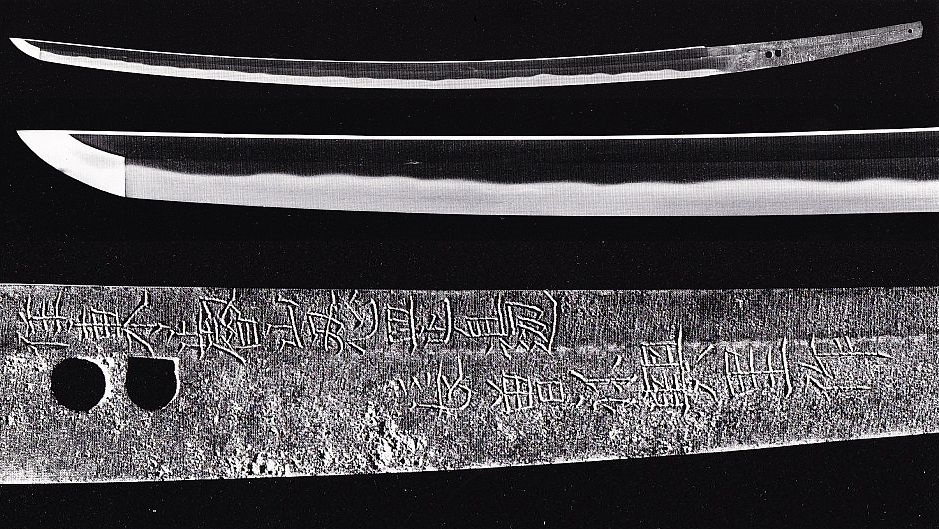
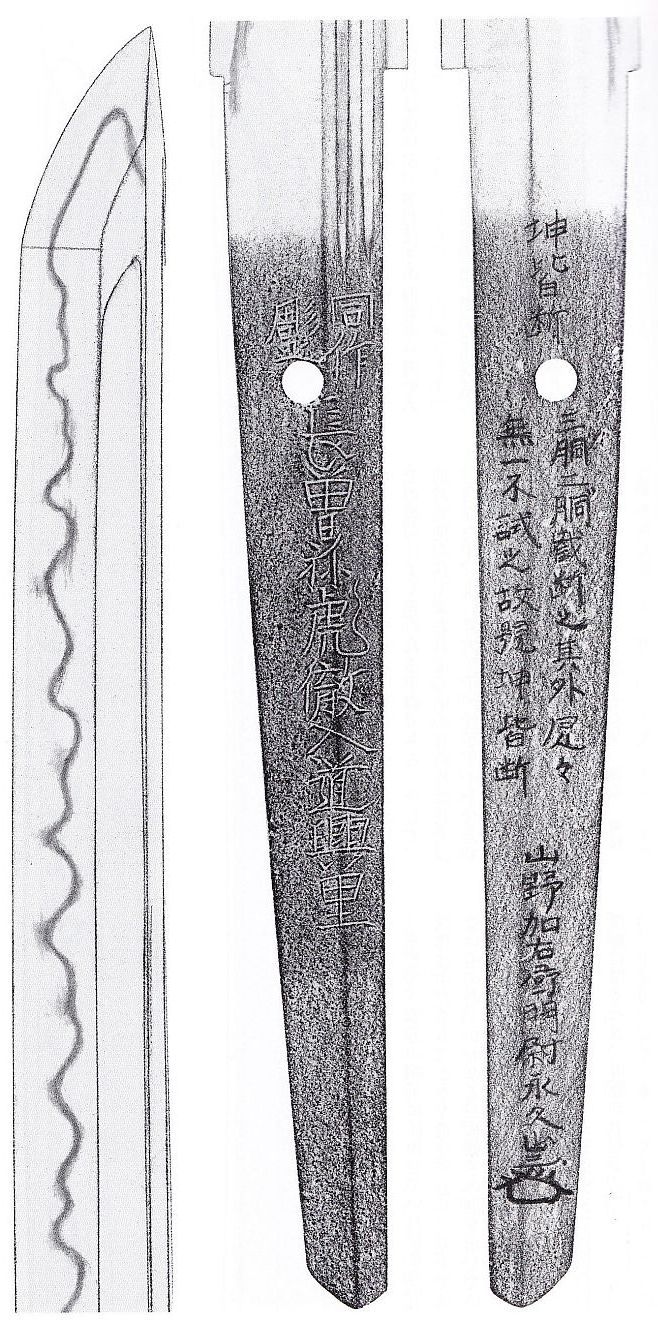
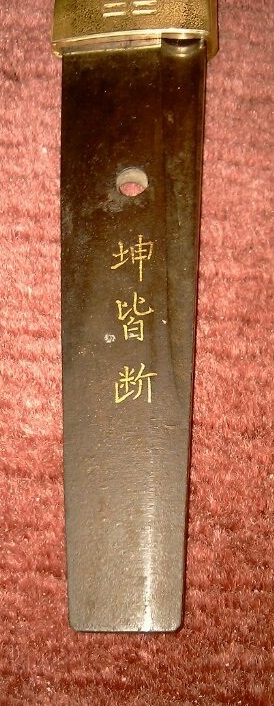
By a recent inquiry of a collector I came across a blade´s nickname that had given me a little headache a time ago in another context. This other context was a blade by Kotetsu (虎徹) I introduced in my Kantei volumes (No 237.621, Shinto & Shinshintô-kantei pages 124-125; Shintô & Shinshintô-kantei zenshû pages 198-199) (see picture 1). The mei of the blade reads: “Dôsaku horu kore (同作彫之) – Nagasone Kotetsu Nyûdô Okisato” (長曽祢虎徹入道興里), and the kinzôgan-mei: “Konkaidan (坤皆断) mitsu-dô, futatsu-dô setsudan no sono hoka shosho muichifu tameshi no yue gô Konkaidan” (三ツ胴二ツ胴截断之其外処々無一不試之故号坤皆断, “because of the cutting test where the blade cutted through two, three bodies and also because it never failed, it shall be named ´Konkaidan´”) – “Yamano Ka´emon no Jô Nagahisa + kaô” (山野加右衛門尉永久).

 KotetsuKonkaidan

Picture 1: katana by Kotetsu, nagasa 71.2 cm, sori 1.2 cm

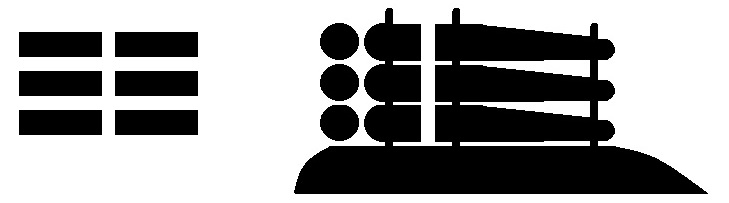
Konkaidan is, as mentioned in my Kantei volumes, a term from the divination system of the I-Ching, and after sending an inquiry to Japan, I was told that the konkaidan trigram also stands for the Dainichi-nyorai (大日如来), the Vairocana Buddha. Well, I was not that satisfied with that because of the lack of connection. A reference to the Vairocana Buddha alone would have been ok for me but the wording of the tameshi-mei “because of the cutting test … it shall be named ´Konkaidan´” made me doubt as if there is a better explanation. Now the Kantei volumes had to come to an end but this inscription preyed upon my mind. And some months later, it fell like scales from my eyes when browing through my Kantei volumes on the search for a certain blade by Kotetsu´s successor Okimasa (興正). The nickname of the blade has not so much to do with the Vairocana Buddha and the konkaidan trigram, or to be more precise the kon trigram (坤), has to be taken “literally” as a symbol. As seen in picture 2 it is composed of three broken lines which just look like three severed bodies positioned atop of each other for a cutting test! So the nickname of the blade Konkaidan translates roughly as “cut through three bodies like the kon trigram.”

 dotanbarai

Picture 2: The kon trigram and three bodies positioned at the dotanbarai.

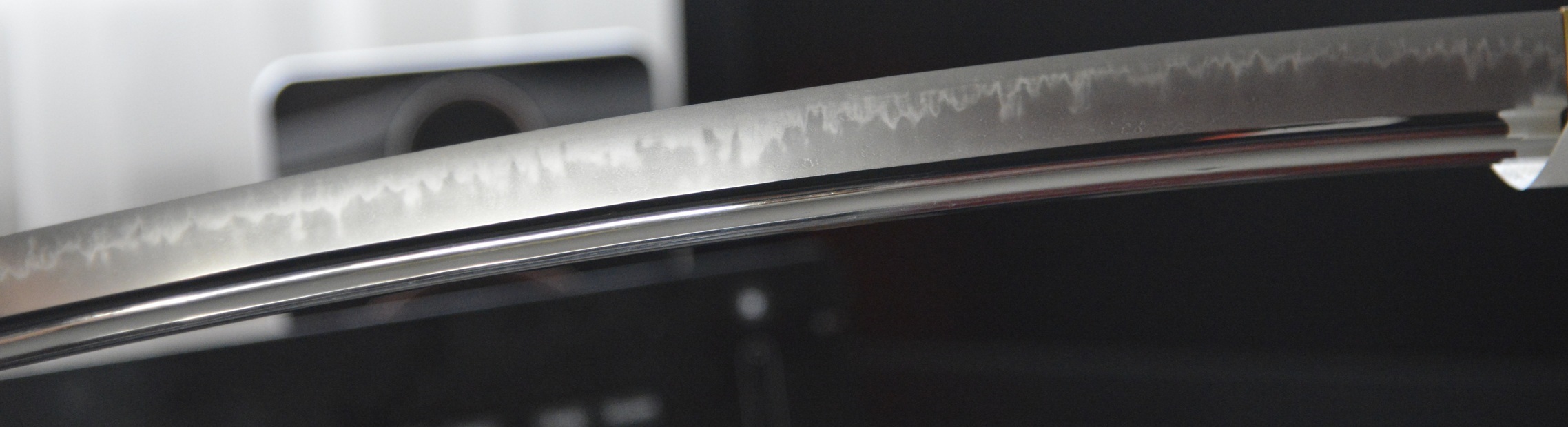
The second blade I addressed was shortened to a wakizashi. It shows a flamboyant Bizen-style hamon with utsuri and has old tokubetsu-kichô papers to Heki Mitsuhira (日置光平), although the midare-komi bôshi and the workmanship in general made me and the owner of the blade also think that it might be a work of Tatara Nagayuki (多々良長幸). Anyway, the shortened nakago was inlayed with the nickname Konkaidan and interesting is, that this wakizashi comes with a habaki onto which the kon trigram is engraved (partly visible in picture 3).

 Konkaidan2

Picture 3: The nakago of the supposed Mitsuhira wakizashi with the kinzôgan-mei “Konkaidan”

 Konkaidan3

Konkaidan4

Picture 4: Flamboyant hamon of the supposed Mitsuhira wakizashi, nagasa 54.0 cm, sori 2.0 cm

So much for the supplements to the kinzôgan-mei “Konkaidan.” Now I want to introduce some more nicknames of swords which go more or less back to their cutting abilities, namely such nicknames which do not necessarily refer to the cutting ability of a single special blade but which are more “general” and thus might also be found inlayed on more than one blade.

Asaarashi (朝嵐): Asaarashi means literally “morning storm” and refers to strong storms in the morning which make it impossible for fresh snow to remain on mountain peaks. But it can also refer to a heavy storm which makes you slip and fall from a wintery mountain, so we have here basically the same allusion as the nickname → Sasanoyuki.

Daiyagawa (大谷川) Taki no mizu (滝之水)

Funabashi (船橋) → Tanahashi (棚橋)

Fusenaikyô (無布施経・布施無経): This term means literally “no offering at Sutra reading” and refers to the practice that monks usually received offerings (fuse, 布施) when paying a visit and reading Sutras. But sometimes the parishioners did not give any offerings and in such a case the monks so to speak showed up without their kesa robe, almost in the sense of “no money, no honey.” In sword terms, fusenaikyô just means to perform a kesa-kiri (袈裟斬り), i.e. a cut diagonally over the chest following theoretically the seam of a monks kesa robe. So, a saying among monks developed from this context, which was: “Take off your kesa when going to read Sutras with no offerings” (fusenai-kyô ni kesa-otosu, 布施ない経に袈裟落す), and with this context, the nickname in the context of swords could also mean: “Here, I take the kesa off for you with my sword!” For example, there is supposedly a blade by the Kan´ei-era (寛永, 1624-1644) Owari smith Ujikumo (氏雲), and one by the Osafune Sanenaga (真長) bearing the nickname Fusenaikyô.

Gibôshi-fusetsu no todomarazu (擬法珠風雪不溜): “Snow does not accumulate on a gibôshi.” A gibôshi is the onion-shaped ornament on a bridges handrail and so this nickname refers to a blade so sharp that it cuts through an object as easily as a snow slides from such a gibôshi.

Hachimonji (八文字): This nickname goes back to a legend which says that Satake Yoshishige (佐竹義重, 1547-1612) cut with his Chôgi blade (長義) in the tenth year of Eiroku (永禄, 1567) in a battle a mounted enemy into halves. Because the blow went through the helmet down to the saddle, both body halves slided down to the left and right of the horse. This “sliding” resembled the character (monji, 文字) for “eight” (hachi, 八) and this is why the blade got its nickname “Hachimonji.”

HachimonjiChogi

Picture 5: The meibutsu Hachimonji-Chôgi, nagasa 78.5 cm, sori 2.1 cm

Hatchô-Nenbutsu-dango-zashi (八丁念仏団子刺し): There is the legend about Suzuki Magoichi (鈴木孫一, 1534-1589) who cut with his sword at a monk but who kept reciting the nenbutsu and walked away from the scene as if nothing happened. Magoichi was so perplexed and wondered about the sharpness of his sword so that he stabbed angrily on the ground several times. After he had calmed down he looked down at his sword which had skewered stones (sashi/zashi, 刺し) like dumplings (dango, 団子). Then he followed the tracks of the monk and found him dead, cut intwo two halves, at a distance of eight chô (hatchô, 八丁 ~ 870 m). Thus he nicknamed his blade by Bizen Yukiie (行家) Hatchô-Nenbutsu-dango-zashi, about “if you cut somebody with this blade, the person doesn´t notice it because of the sharpness and can still make eight chô, and apart from that, you can skewer stones with it like dumplings.”

Jigokuzue (地獄杖): This term means literally “hell cane.” It is found for example as kinzôgan-mei on a Bungo-Takada blade and stands for the sword in general, i.e. the sword being a “cane” which sends you to hell.

Kagotsurube (籠釣瓶): This term is found on quite many blades. It means “woven bamboo basket (kago, 籠) as sinking bucket (tsuruba, 釣瓶).” A woven bamboo basket can´t hold water of course and as easy the water leaks out from such a basket, as easy cuts a blade with that nickname. An about identical nickname is Kotsurube (古釣瓶), i.e. a lit. “old basket” which can´t hold water. It is found as kinzôgan-mei on a wakizashi by Osafune Motoshige (元重) which was once a heirloom of the Tsuyama-Matsudaira family (津山松平).

KanesadaKagotsurube

Picture 6: katana by No-Sada with the kinzôgan-mei “Gô Kagotsurube” (号笭釣瓶), nagasa 66.8 cm, sori 1.7 cm. Please note that a different character for “Kago” was used for this inscription.

Kokesa (古袈裟): This name has basically two meanings. One alludes again to the kesa cut and the other one goes back to the symbolism of a very old kesa robe, i.e. a ko-kesa, which tears by itself and without any further force, quasi cutting through something so easily as if doesn´t need any extra force to do so. There is a blade by the Sue-Seki smith Kanemine (兼峯) which bears the ginzôgan-mei “Kokesa” (古けさ). A similar nickname is → Yaregoromo.

Kotsurube (古釣瓶) Kagotsurube (籠釣瓶)

Kusarinawa (腐り縄・クサリナワ): Kusarinawa means literally “rotten straw rope.” This nickname is found as kinzôgan-mei and in katakana syllables on an Aoe blade and refers like → Kokesa to an easily tearing rope, i.e. in the figurative sense to a very sharp blade which cuts through things easily.

Matsukaze (松風): This nickname is used for a sword which cuts through things as if nothing had happened, just making the sound of the wind soughing through pine trees. The kinzôgan-mei “Matsukaze” is for example found on a blade of the Sue-kotô Sakakura-Seki smith Masatoshi (酒倉正利).

Michishiba no tsuyu (道芝の露) Sasanoyuki (笹雪・篠雪)

Odoributsu (踊仏): Literally “dancing Buddha”, this term alludes to Buddha or a monk starting to dance and taking off the kesa from the shoulder. So again we have here a reference to the kesa cut. This nickname is found for example on a katana by Etchû no Kami Masatoshi (越中守正俊).

Oni-Hôchô (鬼包丁): A wakizashi in kata-shinogi-zukuri – a shape where one side is in shinogi-zukuri and the other one in hira-zukuri – by Hata Mitsuyo (秦光代) with a nagasa of 42,4 cm was the favourite sword of the famous Shinkage-ryû (新陰流) swordsman Yagyû Ren´ya Yoshikane (柳生連也厳包, 1625-1694). When Ren´ya was surprised one night by an assassin, he drew this short sword and killed his opponent with one single blow. Due to this incident, the blade received the nickname “Oni-Hôchô” (鬼包丁), lit “devil´s kitchen knife.” The peculiar shape was copied later by other smiths too whereas the nickname “Oni-Hôchô” was kept for such blades.

OniHocho

Picture7: Oni-Hôchô-style blade attributed to Hata Mitsuyo, nagasa 62.2 cm, sori 0.7 cm

Sasanoyuki (笹雪・篠雪): Literally “snow on a bamboo leaf,” this term alludes to no force needed to cut with such a blade just like snow slips from a bamboo leaf without further ado when too heavy. A similar nickname is Michishiba no tsuyu (道芝の露). It alludes to the dew (tsuyu, 道露) on roadside grass (michishiba, 道芝) which also slips from the leaves without any further ado. This rather uncommon name was used for a blade of Kimura Shigenari (木村重成, 1593-1615) who fought an all-out battle at the Siege of Ôsaka but was caught and beheaded. And the same allusion is used by the nickname Take no ha no arare (竹葉霰・竹の葉のあられ), lit. “hail slipping from bamboo leaves.”

Sotto-hasamibako (ソット挟箱): This nickname is found for example as inscription on a blade by Kanefusa (兼房). It refers to a certain storage box (hasamibako, 挟箱) for spare clothes worn by a servant via a stick over the shoulder. At this certain form of such a box, clothes were pinched between two bamboo sticks and carried over the shoulder to let them dry. But they sometimes fell down, silently and unnoticed (sotto, ソット) as the weight did not much decrease and not making any noise when hitting the ground. So a sword nicknamed that way is so sharp that the enemy doesn´t even notice that he had been hit.

Take no ha no arare (竹葉霰・竹の葉のあられ) → Sasanoyuki (笹雪・篠雪)

Taki no mizu (滝之水): Nickname for a blade which is so sharp that a severed body part falls off like the water (mizu, 水) of a waterfall (taki, 滝). A blade by the Kan´ei-era (寛永, 1624-1644) Owari smith Bungo no Kami Masamitsu (豊後守正全) is named that way. A nickname with the same meaning is Daiyagawa (大谷川). It refers to Kegon Falls (華厳滝) along the Daiyagawa in the Nikkô National Park.

Tanahashi (棚橋): A tanahashi is a bridge without any railing, i.e. a bridge from which one can fall from easily. The Yamano family used this term to mark a very sharp blade, for example found as kinzôgan-mei on a blade of Yamato no Kami Yasusada (大和守安定). A similar term is Funabashi (船橋), a “bridge” made out of aligned boats. Crossing a river via aligned and moving boats without any railings is of course dangerous and one can slip easily. The nickname Funabashi is for example found on a blade by Tanba no Kami Yoshimichi (丹波守吉道).

Tôrinuke (通抜): This term means as verb torinukeru (通り抜ける) “to cut through, to go through,” i.e. it refers to a sharp sword which cuts through things easily.

Unomi (鵜呑): A sword which cuts through things as easy and fast as a cormorand (u, 鵜) swallows (nomi, 呑) fish. A blade by Hachiya Kanesada (蜂屋兼貞) for example bears this nickname.

Yaregoromo (弊衣・破衣): The term means “worn out clothes”, i.e. so worn out and thin that they tear easily. It is said that Tokugawa Mitsukuni (徳川光圀, 1628-1701) nicknamed his blade by Onizuka Yoshikuni (鬼塚吉国) that way when punishing a dissolute priest with it. That means the sharp blade cut so easily through the poor monk like worn out clothes tear apart. Another nickname with the same meaning is Yareginu (破絹), lit. “worn out silk.” It is found on a blade by Harima no Kami Teruhiro (播磨守輝広).

Yume no aida (夢の間): This term means “as in a dream” or “like dreaming.” It is found for example on a blade by Suishinshi Masahide (水心子正秀) which with a wakige (脇下) test cut through the armpits went through the body as if nothing had happened, i.e. just like everything was a dream.

On the Kaimoto Smiths

In the course of my research on the more unknown schools, I want to introduce this time the Kaimoto smiths (甲斐本) of Bungo province. First of all, let´s address the name of the group. It goes back to an area of the same name in Nakao (中尾). Nakao in turn is located about 3 km to the southwest of the city of Bungo-Ôno (豊後大野市) and about 30 km to the south of the city of Ôita (大分市) and at the limits of the village of Nakao, there are still the graves of the Kaimoto smiths extant. The i in “Kaimoto” is usually not pronounced, i.e. with kay like in okay but with a longer “a” and not stressing the “y”. Older topographies transcribe the area also as “Kehinomoto” (ケヒノモト) and write the name with the characters (賀井本), or (賀井ノ本) respectively when the particle no was noted too.

 Kaimoto1

Picture 1: The red dot marks Nakao/Kaimoto (© 2014, Google, ZENRIN)

We don´t know exactly when smiths started to forge swords in the Kaimoto neighborhood but it is assumed that this was at the latest in the Sengoku period. The earliest written reference we have today is on a document with a joint signature of five magistrates (bugyô, 奉行) of the Ôtomo family (大友) from Eiroku five (永禄, 1562). From this document we learn that the Ôtomo provided the Kaimoto smiths from within Bungo´s Mie district (三重郷) with charcoal and iron and paid them a salary of 50 koku. Also we have genealogic informations on the group or rather family compiled by the 6th Kaimoto-generation Yukihisa (行久). Therein he states that the ancestor of the family was a certain Magoshirô Yukinaga (孫四郎行長) and the actual founder of the school his successor Matazaemon Yukinaga (又左衛門行長). Yukihisa states that the Kaimoto smiths were employed like the Takada smiths (高田) by the Ôtomo family and that they received initially a salary of 50 koku what matches with the bugyô document. But further he writes that when their lord Ôtomo Yoshishige (大友義鎮, 1530-1587), aka Sôrin (宗麟), retired and moved to Usuki Castle (臼杵城) in Tenshô four (1576), the salary was reduced to 10 koku. This is insofar interesting as it shows that the Kaimoto smiths played a more important role for the earlier Ôtomo campaigns, e.g. against the Kikuchi (菊池), Ryûzôji (龍造寺), and Môri (毛利) and until about the time Yoshishige was appointed shugo governor of Buzen and Chikuzen province and Kyûshû-tandai (九州探題) in Eiroku two (1559), compared to the later fightings against the Shimazu family (島津) and their fighting for Hideyoshi in the course of his Kyûshû Campaign in Tenshô 15 (1587). It surely also played a role that Yoshishige´s son Yoshimune (大友義統, 1558-1610) was accused by Hideyoshi in Bunroku two (文禄, 1593) of deserting under enemy fire in Korea and lost so all Bungo domains, a measure which basically sounded the bell for the end of the Ôtomo family.

After Yoshimune was removed by Hideyoshi, the lands of Usuki, i.e. where Kaimoto was located, were given to his retainer Ôta Kazuyoshi (太田一吉, ?-1617). But Ôta sided with Ishida Mitsunari at Sekigahara and so his lands were again confiscated and transferred by Ieyasu to Inaba Sadamichi (稲葉貞通, 1546-1603) as he changed sides in favor of the Eastern Army during the battle. And the Inaba family held the Usuki fief (臼杵藩) until the abolition of the feudal system. Back to the Kaimoto smiths. We know from fief records from Keian four (慶安, 1651) that the Kaimoto smith Matazaemon (又左衛門) received still the salary of 10 koku and that the family was treated like with the same social status as that of a village head, whatever that means. It is assumed that this entry refers to the same sixth Kaimoto-generation Yukihisa who made the aforementioned copy of the families genealogy. So if this is correct than the meikan must be corrected because they date Yukihisa around Tenshô (天正, 1573-1592). Then we find an entry from Kyôhô eleven (享保, 1726) which states that the Kaimoto smith Sôzaemon (惣左衛門) is “doing a good job”, lit. “saiku mo yoroshiku tsukamatsuri-sôrô” (細工も宜く仕り候). But Kyôhô eleven seems too late for Kaimoto Toyoyuki (豊行) who was the one who bore the first name “Sôzaemon.” From another document we learn that the family was granted the status of o-memie (御目見), i.e. qualified to meet with the shôgun, in Hôreki nine (宝暦, 1759) what meant usually samurai status. But then for Kansei eleven (寛政, 1799) we read that the Kaimoto smith Ka´emon (嘉右衛門) couldn´t cope with the fief´s demands in him as a craftsman – lit. “shokubun-fushussei” (職分不出精) – and that so the status of o-memie was again withdrewn. After that time, i.e. entering the late Edo period, we loose track of the Kaimoto smiths. However, a document from the Usuki fief from Bunsei three (文政, 1820) in which several local merchants ask their government for the permission to have a bridge erected on their own costs mentions the name “Kaimoto Gensuke” (甲斐源助) as being as tea dealer (chaya, 茶屋) one of the petitioners.
A nice wakizashi of Toyoyuki with some utsuri can be seen here.

 Kaimoto2

Picture 2: wakizashi, mei: “Toyoyuki” (豊行).

 Kaimoto3

Picture 3: Signature comparison of the two Toyoyuki wakizashi.

So that was basically the history of the Kaimoto smiths and as a reference, I want to present a genealogy which bases largely on the information provided by Yukihisa but which was enlarged by other available data. But it must be mentioned that there is some confusion with the Bungo smiths, especially around the transition from kotô to shintô. For example there are several smiths from the Kaimoto and Takada group using the same name and in the meikan some shinshintô smiths pop up which are supposedly sons or students of the early shintô smiths. Also a question raises the naginata of the supposed 7th Kaimoto-generation Yukiie which is dated Kan´ei two (寛永, 1625) and which is today an important cultural object of Ôita City. To be more precise, when the 2nd Kaimoto-generation Yukinaga died in Jôô one (承応, 1652) as a transmission says, that how can the 7th generation be active at about the same time or even a bit earlier? The information provided by Ôita City says further that Yukiie, the maker of the naginata, was the son of Yukihisa what matches with the genealogy, but also that he was the younger brother of a Yukinaga.
 KaimotoGenealogy

Apart from that, Yamada Masato (山田正任) presents in his 1974 publication Zusetsu Bungo-tô (図説豊後刀, p. 414) a blade signed “Bungo no Kuni Mie-jû Fujiwara Yukinaga” (豊後国三重住藤原行長) dated Keichô 13 (慶長, 1608). So one of the Yukinaga did not only sign with “Kaimoto-jû” but also with “Mie-jû”, i.e. with the district or larger area instead of the local neighborhood. Well, the naginata of Yukinaga which is signed with “Kaimoto” (without “jû”) and which is dated Keichô 16 (1611) presented by Yamada on page 349 seems to go back to a different Yukinaga, at least this is what the noticeable differences in signature style, in particular in the characters for “Yuki” (行), suggest (see pictures 4 and 5).

 Kaimoto4

Picture 4, signature comparison: Yukinaga naginata from 1611 left, Yukinaga katana from 1608 right.

 Kaimoto5

Picture 5: Line-up of the differing characters in question.

My conclusion is that the Kaimoto genealogy provided by Yukihisa is sound as long as it is “enjoyed” by itself. As soon as we add data from outside, like for example extant date signatures and the genealogies of the Takada smiths, problems occur. I think that the Kaimoto smiths were surely working for the Ôtomo in late Muromachi times and that they were still pretty active in the Keichô era, i.e. right after Sekigahara. But with the establishment of the han system, the shifting of all major industries to the castle towns, and the general decreasing demand for swords, there was probably no longer much to do for a family of swordsmiths deep inside rural Bungo province. On the other hand, the chronicles of the Usuki fief still refer much later to certain Kaimoto smiths, so there must had been something going on. But maybe by then the Kaimoto smiths were already working from the fief´s capital, the coastal town of Usuki of the same name.

A kozuka full of references

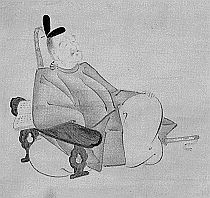
Let me introduce a kozuka of the great Tsuchiya Yasuchika (土屋安親) which does not look so spectacular at a glance. First the technical terms. It is of suaka and with shibuichi and shakudô hira-zôgan and measures 10 cm in length. It is signed via a kinzôgan seal which reads “Tô´u” (東雨), so we learn that we are facing a work from his later years. The kozuka depicts or rather represents a famous tea scoop container (chashaku-zutsu, 茶杓筒) made by Kobori Enshû (小堀遠州, 1579-1647).

 enshushokado1

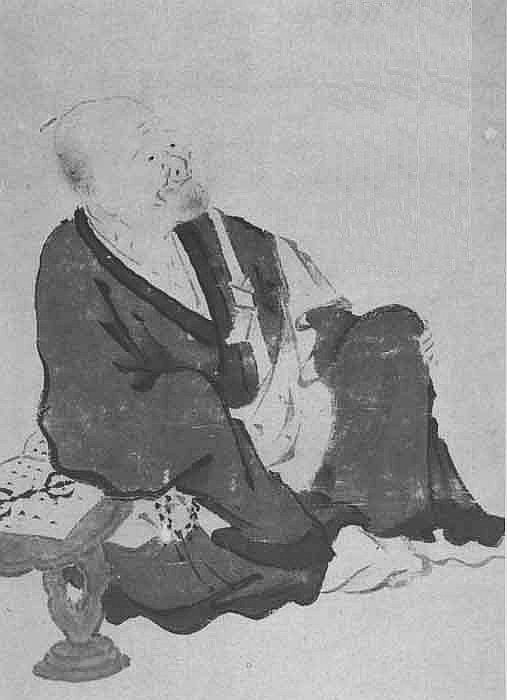
Picture 1: Kobori Enshû (left), Shôkadô Shôjô (right)

You may already be familiar with Kobori Enshû, the famous aristocratic tea master and “allround artist” who developed his own style of the tea ceremony and who taught among others the third Tokugawa-shôgun Iemitsu (徳川家光, 1623-1651) the ways of the sadô (茶道). One day, Enshû received a gift of Shôkadô Shôjô (松花堂昭乗, 1584-1639) in the form of a hanging scroll. The Buddhist monk Shôjô was a master of the tea ceremony too who became also famous as calligrapher as one of the “Three Brushes of the Kan´ei Era” (Kan´ei-sanpitsu, 寛永三筆). As a return gift, Enshû presented him a self-made tea scoop container with the nickname aogoke (青苔, “green moss,” sometimes also quoted as seitai). This nickname is a reference to the 78th chapter of the Ise-monogatari (伊勢物語) in which the court noble Fujiwara no Tsuneyuki (藤原常行, 836-875) is on his way back from a memorial service and stops at Prince Saneyasu´s (人康親王, 831-782) residence in Yamashina (山科) to the north of Kyôto. The prince entertained Tsuneyuki and so he gave him as a gift a beautiful rock from Chisato Beach (千里の浜) of Kii province which was once intended to be a present for Tsuneyuki´s father but did not arrive in time for the festivities. But although beautiful, just a rock would not be adequate as a present for a prince and so Tsuneyuki scaped away the green moss from the surface until characters in the form of a poem remained. The Ise-monogatari speaks of “scraped away the green moss from the rock until … the words stood out like the raised design of a makie lacquerware.” The poem goes:

あかねども岩にぞかふる色見えぬ心をみせむよしのなければ
Akane domo iwa ni zo kafuru iro mienu kokoro o misemu yoshi no nakareba.
“Inadequate though it be, this rock must represent those feelings that 
by their nature have no color to arrest the eye and thus cannot be made 
visible.”

So this receiving and returning of gifts must had reminded Enshû of Tsuneyuki and the prince and when he made the tea scoop container for Shôjô he added an inscription which is an allusion to the above mentioned poem:

伊勢物語尓ハあをきこけ越き佐三てとありたけをき佐みてお可しくあかねとも竹尓曽可ふる色三えぬ
古々ろをみせむよしのなければ
Ise-monogatari ni wa aoki-koke o kizamite to ari, take o kizamite 
okashiku, akane domo take ni zo kafuru iro mienu kokoro o misemu yoshi 
no nakareba.
“The Ise-monogatari tells of an inscription in the form of green moss 
of which I was thinking carving this bamboo. Inadequate though it be, 
this bamboo must represent those feelings that by their nature have no 
color to arrest the eye and thus cannot be made visible.”

YasuchikaKozuka

Picture 2: chashaku-zutsu kozuka of Yasuchika, in´mei “Tô´u” (東雨)

Yasuchika now took Enshû´s tea scoop container and turned it – with a certain artistic freedom – into a kozuka. He also added Enshû´s inscriptions via a shakudô hira-zôgan on the back and front and also copied the worm damage of the front. The inscription on the front reads: “Takimotobô, chashaku, Sôhoshi” (瀧本坊・茶杓・宗甫子). The Takimotobô was the temple of which Shôkadô Shôjô was the chief priest and “Sôhoshi” (mostly without “-shi”) was a pseudonym of Kobori Enshû. Please note that the original tea spoon container of Enshû seems to bear a slightly inscription, namely “Takimoto onbô” (瀧本御坊, “monk Takimoto”). The chashaku-zutsu is owned by the Hatakeyama Memorial Museum of Fine Art and a picture can be seen here. Yasuchika´s adaption is very tasteful and has the typical more calm and introverted approach of his later years. There is no other kozuka of him known representing a tea spoon container and so it is possible that it was made on request and/or it was maybe a return gift for somebody?

 YasuchikaKozuka1

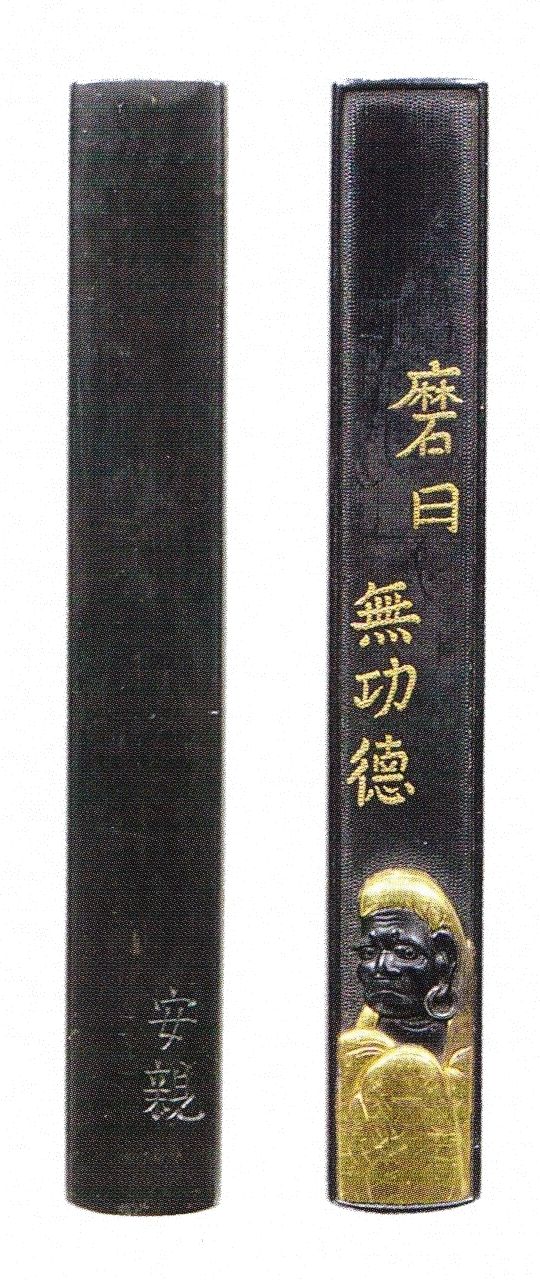
Picture 3: Bodhidharma kozuka of Yasuchika, mei: “Yasuchika” (安親)

As comparison, I would like to introduce a kozuka from Yasuchika´s earlier years. It is of shakudô with a nanako ground and depicts the Bodhidharma in his form as great teacher. The inscription reads: “Ma iwaku – mu-kudoku” (磨曰・無功徳), “Daruma said: No merits.” This line refers to an encounter of the Chinese Emperor Wû of Líang (梁武帝, 464-549), who was a fervent patron of Buddhism, with Bodhidharma whom he didn´t know yet: Emperor Wû asks Bodhidharma how much karmic merit he has yet earned by doing so much for Buddhism and Bodhidharma replied: “No merits. Good deeds done with wordly intent bring good karma, but no merit.” Upon this Emperor Wû asks: “So what is the highest meaning of noble truth of Buddhist wisdom?” And Bodhidharma replies again: “There is no noble truth, there is only emptiness.” Then Emperor Wû wonders and asks: “Then, who is standing before me?”, and Bodhidharma finally replies: “I don´t know.” This kozuka takes the viewer into the position of Emperor Wû, being confronted with the enlightened teacher Bodhidharma, whose at a glance incomprehensible answers make one to rethink his approach so far. And with quoting explicitly the line “No merits”, the kozuka reminds the viewer of doing good things but in an unselfish manner.

On the Rai school´s character “Rai”

Between two sword club meetings with main focus on the Rai school,  I thought I do some research to provide some background on the origins of the school as I am unfortunately unable to provide some Rai blades for appreciation. We known that the Rai school originated in Kyôto, Yamashiro province, somewhere in the mid-Kamakura period, and that in terms of workmanship it is probably linked to the Awataguchi school. These are the facts we have about the school´s origins, now to the theories. Most old relevant sources quote Kuniyoshi (国吉) as founder of the Rai school and the Kanchin´in-bon mei-zukushi (観智院本銘尽) from Ôei 30 (応永, 1423), the oldest extant sword document, states that Kuniyoshi was a Korean smith who had immigrated, or who had came to Japan, and sees the origins of the school´s name in the term raigoku (来国). Raigoku means namely literally “came to [our] country” and so the first character was adopted as name of the school and the second character, koku/goku or in its Japanese reading kuni, was adopted as tôri-ji (通字), as distinctive character used in the names of all people belonging to a single clan or school. So raigoku extended by another character became “Rai Kuni-X”, e.g. “Rai Kuniyoshi” (来国吉). This theory, i.e. that Kuniyoshi was from Korea and had immigrated to Japan where he founded the Rai school, is also found amongst Fukunaga Suiken´s (福永酔剣) seven theories on the Rai school´s character “Rai” forwarded in his publication Nihontô-daihyakka-jiten (日本刀大百科事典). Two more of these seven theories are pretty similar, namely one says that the Rai school´s ancestor – no concrete name is mentioned, just “ancestor” – came from Korea, and one says that Kuniyoshi´s ancestor was from Táng China (唐, 618-907). So these two theories too go with the assumption that the school´s use of the character “Rai” goes back to an earlier immigration. Another, similar theory from the seven says that Kuniyoshi´s supposed son Kuniyuki (国行) was a copper craftsmen from another country (no specification here) who came to Japan, and because his skills were of use for the country, he was granted with the family name “Rai” by the court. This practice was pretty common and we can confirm from historic sources that several Korean immigrants were naturalized by the court and received family names.

Another theory of the seven says that “Rai” (来) was an abbreviation of the Korean family name “Rae.” This name is written with the left-hand radical (阝) and the old variant of “Rai” (來), but as this character is not available in modern charset, I have to quote it as (阝來). Reading of this theory, I immediately remembered a tantô which had been a confusing jigsaw piece in explaining the origins of the Rai school for now half a century. The tantô in question (see picture 1) was once owned by Mr. Asabuki (朝吹). It is dated “Bunji ninen nigatsu ?-nichi” (文治二年二月?日, “? day of second month Bunji two [1186]”) and its signature is mostly quoted as “Rai Sama no Jô Minamoto Kuniyori” (徠左馬尉源国頼). Already Dr. Honma writes in his Nihon-kotô-shi that it is possible that the Rai connection of this tantô goes back to an erroneous transcription of the character “Chin/Jin” (陳). So according to Honma, “Chin/Jin” (陳) became “Rai” (徠). But with Fukunaga´s forwarding of the theory with the Korean family name “Rae” in mind, maybe the tantô is not signed with “Chin/Jin” but with “Rae” (阝來)? So the chronicler was just wrong with the left radical, i.e. (彳) compared to (阝), instead of getting the entire character wrong, i.e. (徠) compared to (陳). The problem is that the first character of the signature is hardly legible. But who was this Kuniyori? His name does not appear in the old sword documents and it seems that he slipped into the meikan just towards the beginning of the Edo period. The Kokon-mei-zukushi (古今名尽) quotes him as ancestor of the Awataguchi school but says that he was not a swordsmith and that he lived in Yamato province. He is followed in the genealogy in question by his son Kuniie (国家) who in turn is listed with the comment “he was the first who carried out the profession of a swordsmith” and that he was a descendant from Yamato´s Kôfukuji (興福寺), although it doesn´t say in which context this “descent” has to be understood. Anyway, the aforementioned tantô shows typical Awataguchi characteristics, i.e. a nashiji-hada, beautiful ji-nie, a nie-loaden chû-suguha, and an ô-maru-bôshi. And because of this typical Awataguchi deki, the inscription was brushed aside as not showing the characteri “Rai” (徠) but “Chin/Jin” (陳). But with the Korean family name “Rae” (阝來) as a possibility, we might come back to a direct Awataguchi-Rai connection. However, Kuniyoshi and his son Kuniyuki (国行), who are today considered as actual founders of the Rai school, were active about 70 or 80 years later than this tantô was made. Honma also mentions another Kuniyori tantô dated Gennin one (元仁, 1224) but he is doubtful of the authenticity of the signature. I haven´t seen any oshigata or pictures of this tantô yet and he also doesn´t go into detail regarding its workmanship. Incidentally, the Kokon-mei-zukushi says in another context that the Awataguchi-ancestor Kuniyori was active around Kôji (康治, 1142-1144). So all these speculations might lead – with a little phantasy – to a new theory, namely that maybe both the Awataguchi and the Rai school had their origins in Korea or in a smith whose ancestors had immigrated from Korea?

KuniyoriTanto

Picture 1: tantô, mei “Rai? Sama no Jô Minamoto Kuniyori – Bunji ninen nigatsu ?-nichi” (徠左馬尉源国頼・文治二年二月?日)

Let us now turn to the fifth theory on how the Rai school came to the character “Rai.” This theory, which goes according to Fukunaga back to the Honchô-kaji-bikô (本朝鍛冶考, 1796) and Kokon-kaji-bikô (古今鍛冶備考, 1830), sees the etymological origins of “Rai” in context with the swordsmiths school in the Yamato period. At the time of the Yamato state, people were basically divided into three social groups, the uji (氏, clans or kin groups), be (部, occupational groups), and yatsuko (奴, servants or slaves). That means each be group was responsible for a specialized task and named that way and this name turned later into a clan, and even later into a real family name. And the theory now quotes the be group of the Kumebe (来目部・久米部) as possible origin of the character “Rai.” The Kumebe were professional warriors under the command of the powerful Ôtomo (大伴) and when it was later “time” to use the be name or parts of the be name as family name, “Kumebe” (来目部) was abbreviated to “Ku” (来), i.e. “Rai.” For example the clan name “Ôtomo” was later abbreviated to “Tomo” (伴) and so on. And as the Kumebe were professional warriors, it is safe to assume that they had certain swordsmiths working for them, and so the theory is not too far-fetched. However, we are speaking of Yamato and maybe Nara times, so a lot of time passed until the emergence of the Rai school of swordsmiths.
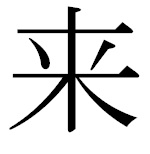
And the seventh and last theory has nothing to do with any immigration and also does not base on etymological assumptions. It says that when Rai Kunitoshi (来国俊), Kuniyuki´s supposed son and Kuniyoshi´s supposed grandson, climbed Mt. Hiei (比叡山) northeast of Kyôto and looked down on Lake Biwa, the sailing ships heading towards him reminded him one day of the character “Rai” and this was when he decided to sign with this character. This theory matches at least with the extant works because no blade predating Kunitoshi is signed with the prefix “Rai.” Also true is that the character for “Rai” really looks like a sailing ship in front view with its bow and fully blown sail (see picture below). But Kunitoshi was and is not the only one noticing this similarity and so this theory is probably nothing more than a nice anecdote.

 RaiChar

And since we are on the subject, I want to introduce a blade of a meikan-more Rai smith, i.e. of a Rai smith whois not found in the meikan records, namely of Rai Kunikiyo (来国清). It is dated Meitoku four (明徳, 1393) and dates thus to the very end of the Nanbokuchô period. One year later the Ôei era (応永, 1394-1428) started, what means in historic terms Muromachi period. So this is probably one of the latest dated Rai works known and comes from a time when the school gave up its predominance and left the field to its offshoots like Ryôkai, Nobukuni, Enju, or Chiyozuru. Nothing to do with the main topic I know but I thought he blade is nevertheless of interest.

 RaiKunikiyo

Picture 2: tantô, mei: “Rai Kunikiyo – Meitoku yonnen hachigatsu-hi” (来国清・明徳二二年八月日, “on a day of the eighth month Meitoku four [1393]”), nagasa 26.3 cm, only a hint of a sori, hira-zukuri, mitsu-mune, relative wide mihaba, thin kasane, dense ko-itame mixed with some ô-hada, ji-nie, a little bit of utsuri, chû-suguha which is a bit wider and mixed with hotsure on the ura side, rather wide nioiguchi in ko-nie-deki and with sunagashi, sugu-bôshi with a ko-maru-kaeri

Tsuba with the “bird of prey catching a monkey” motif

Last year, Iiyama Yoshimasa (飯山嘉昌) forwarded in a brief article (Tôken-Bijutsu 677, June 2013) the theory that the famous “bird of prey catching a monkey” (môkin-hoen no zu, 猛禽捕猿図鐔) tsuba of Shimizu Jingo (志水甚吾) (picture 1) depicts actually an eagle rescuing a monkey rather than catching him. When the June magazine arrived last year, I just skimmed through the text as I was quite busy at that time and I even forgot to reply to an inquiry from a fellow enthusiast who asked me if the article is on the eagle motif in general or on Jingo´s eagle interpretation in particular. Now just a few days ago, I stumbled by chance over Itô Sanpei´s (伊藤三平) comment on Iiyama´s article in his highly interesting blog which made me curious and so I reread the article. And as it is really exciting to get a complete new view on a well-known motif, I thought I better share Iiyama´s find with my readers.

 Jingo

Picture 1: môkin-hoen no zu tsuba, attributed to Shimizu Jingo

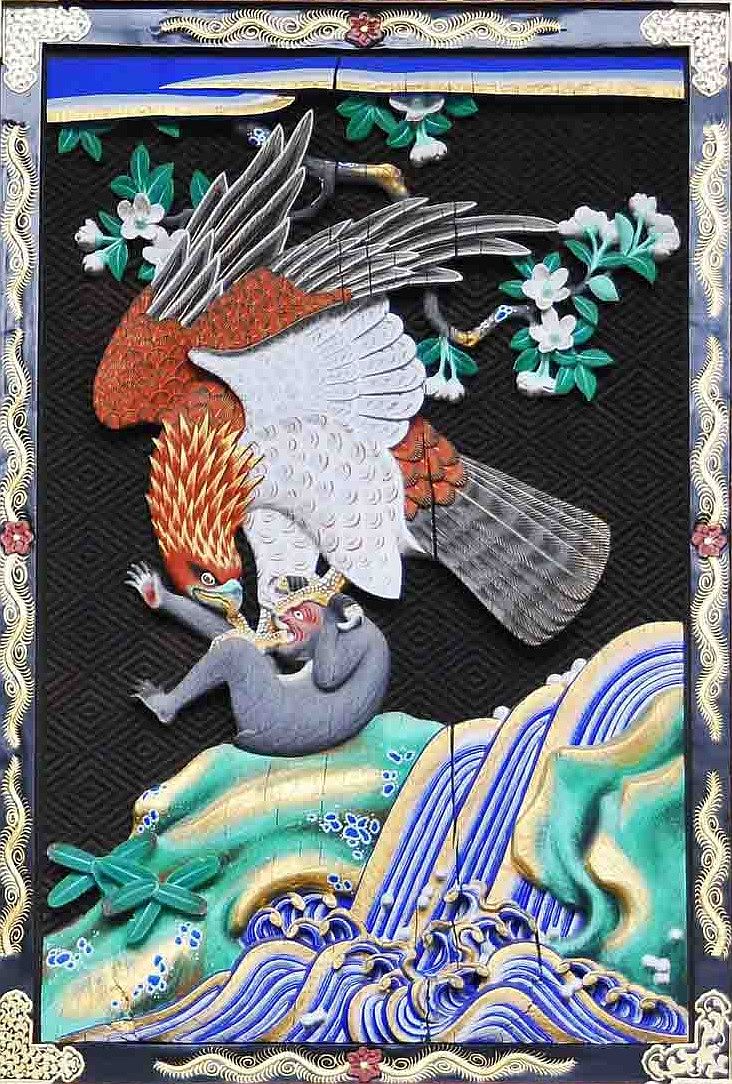
 Apart from the discussion that this tsuba is actually a work of Nishigaki Kanshirô (西垣勘四郎) – the present owner, the Tôkyô National Museum labels it as work of Jingo, Itô Mitsuru (伊藤満), the author of the excellent Higo books says it’s a work of Kanshirô – all publications quote the tsuba´s motif as mentioned above, i.e. “bird of prey catching a monkey.” Iiyama now saw in an art show on TV a report on the Kangi´in´s (歓喜院) Shôtendô (聖天堂) which was designated as kokuhô in July 2012. The temple is located in Menuma (妻沼) in Kumagaya (熊谷市) in Saitama Prefecture and the Shôten Hall holds a panelling into which the motif “eagle and a monkey” (washi to saru, 鷲と猿) is carved (picture 2). The carvings are attributed to the semi-legendary early Edo-period sculptor and carpenter Hidari Jingorô (左甚五郎). Striking is the similarity of this carving to the motif of the tsuba and now things get interesting. The Shôten Hall´s carving is namely described as follows: “Motif of an eagle rescuing a monkey who fell from a tree into a raging stream … The monkey stands for the hard to control human earthly/carnal desires and the eagle for Shôten (聖天) – also called Kangiten (歓喜天), the patron saint of the temple and Shôten Hall – who rescues us from these desires.” Shôten is generally considered to be the Japanese Buddhist form of the Hindu elephant-headed god Ganesha, but is also identified with the Shôkannon-Bosatsu (聖観音菩薩), the Bodhisattva Avalokiteśvara who embodies the compassion of all Buddhas.

 jingo1

Picture 2: carving of the Shôten Hall

And when we now take a closer look at the tsuba, we see it as Iiyama and Itô write in a different light, namely that we are not facing a like so often described “fierce and determined eagle standing for the austere bushi of the Sengoku period,” but a calm eagle with a closed beak, without any claws, grasping the more grateful than scared monkey right at the shoulders, who is about to drop him off gently onto the ground. Compared to the carving, at which the artist created in the context of the temple an allusion to the deity Shôten, the new interpretation of the tsuba´s motif makes pretty much sense. And so Iiyama suggests that the motif should be renamed to “ôtori saru o sukuu” (鷲救猿), i.e. “eagle rescuing a monkey.”

Kanehira and the problem with the early smiths

Whilst doing some research on the meibutsu Ô-Kanehira (大包平), more on this later, I was once again confronted with the datings of early smiths. Many of the famous early smiths and school founders were frequently dated in pre-Edo period sword documents to eras like Ei´en (永延, 987-989). But going back that far is problematic because the transition from the 10th to the 11th century AD marks just the forming of the fully developed nihontô as we know it today. And by “fully developed” we speak of a single-edged blade in shinogi-zukuri with a deliberately added sori (i.e. not a sori which is caused by hardening). So late Heian would probably be better to date extant blades of the early smiths concerned. Experts assume that these early datings are mostly simply based on hearsay or on any early nengô which sounded appropriate for the author. These early datings would not be such a big deal if not later authors dealt with them in different ways. For example, a Muromachi-period author who was going to compile a meikan record had extant and dated blades and more recent records of sons, grandsons or students of famous smiths which did not comply at all with the early datings of earlier publications. So he had basicall three different options: Correcting the supposed nengô arbitrarily to a nengô more suitable with extant works and more recent records, keeping the old era and causing a gap of 200 or more years between an ancestor and his sons or students, or filling the gap with invented descendants and students. Well, from a historical point of view, all three approaches are problematic and maybe the best solution would have been the second approach with additional comments like “handed-down date is no longer tenable because …” The worst is of course the third approach and the first approach can cause significant problems too when namely later chroniclers were facing the old and initial records and the already corrected data of some predecessors. This resulted namely often in double-listings.
Another common practice of chroniclers was to justify very early nengô by claiming that the smith in question made swords for a certain high-ranking person or emperor of his time or that a person from then high-society wore a blade by this smith. And this brings us to Kanehira because my aforementioned research was about finding out who owned the Ô-Kanehira before the Momoyama-era Ikeda family (池田). For further details on the Ikeda and their relation to the meibutsu, please see Satô, The Japanese Sword p. 94ff. Well, Satô already points out that the previous history of the Ô-Kanehira is uncertain and so this article (with reference to Mamiya Kôji´s article published in Tôken-Bijutsu 483, April 1997) should serve mere as demonstration of how difficult and confusing cross-checking historic sword refereces can be. We know today that most pre-Edo period sword publications are more or less transcriptions of earlier documents whereat each copy was usually enlarged with comments. So it takes a chronological approach and we have to start with the earliest extant sword publication which is the Kanchi´in-bon mei-zukushi (観智院本銘尽) from Ôei 30 (応永, 1423). Therein we read:

 Kanehira1

Picture 1: The entry of the Kanchi´in-bon mei-zukushi.

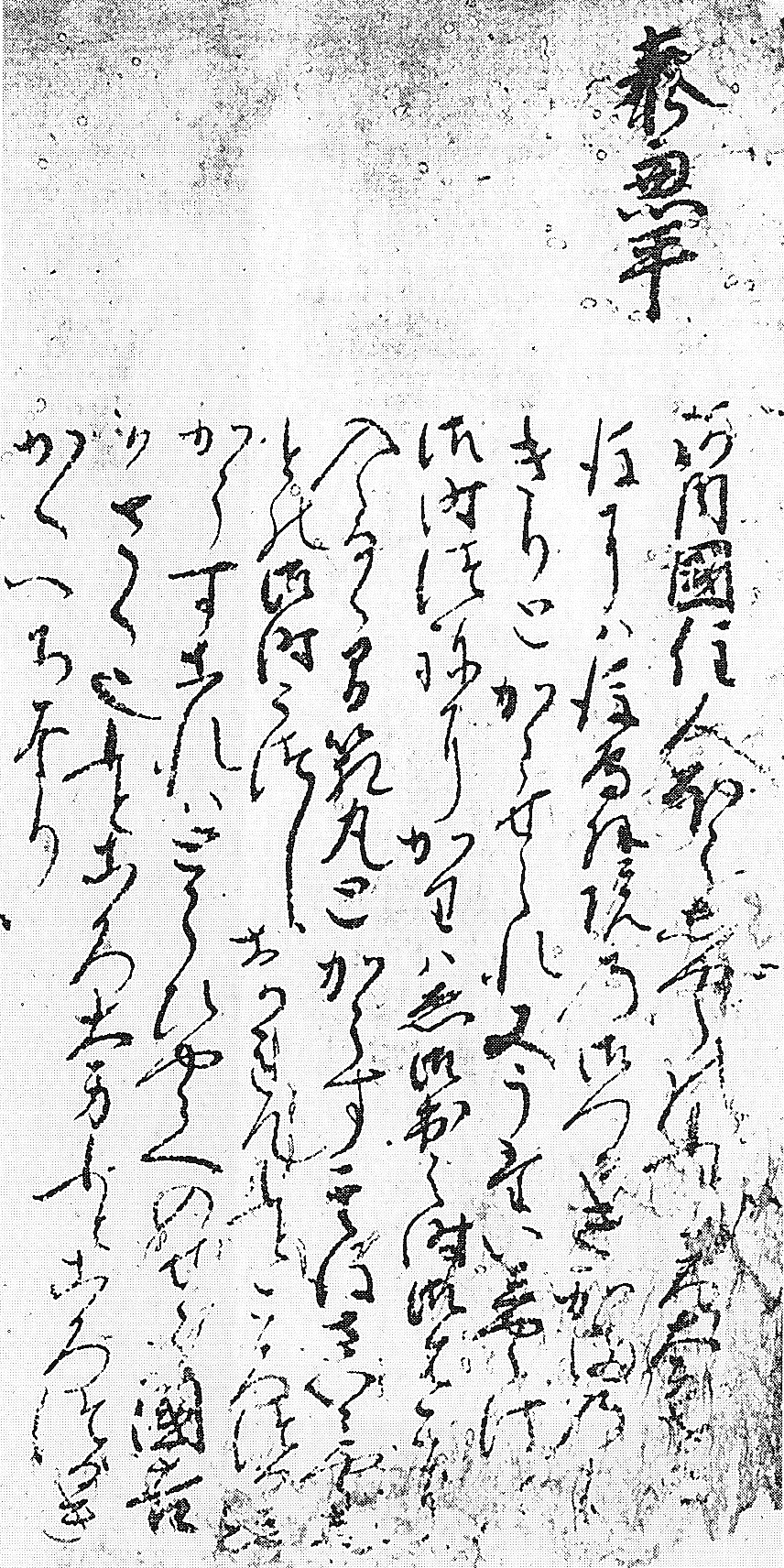
泰兼平

河内國住人、ほうしやうのふところ太刀を作、
後には後鳥羽院の御つるぎかまのは
きりとがうせられ、又うたいしやうけの
御時つねにかりはゑ御出之時、御箱に
入るる間、箱丸とがうす、其後、さいみやうじ
どのの御時うつしおかれ、ふところのつるぎど
がうす、ころれはとうひょうえのぜぶ國吉
がさく也、ふところ太刀、ふところつるぎ
かくへちなり。

Immediately noticeable is that the Kanchi´in-bon mei-zukushi quotes Kanehira (包平) with the characters (兼平) and that it uses the character (泰) for “Hata” (秦) (more on this Hata later). Then it reads that he was a resident of Kawachi province and that he made the futokoro-tachi (ふところ太刀) of Hôshô (ほうしやう). Futokoro-tachi means in this context “beloved sword” and must not be confused with the small and hidden futokorogatana (懐刀). And “Hôshô” is the Sino-Japanese reading of the characters for “Yasumasa” (保昌) and refers to the mid Heian noble and poet Fujiwara no Yasumasa (藤原保昌, 958-1036). Then we read that this beloved sword of Hôshô or Yasumasa respectively came eventually in the possession of the abdicated emperor Gotoba (後鳥羽院, 1183-1198), although it is possible that actually the abdicated emperor Toba (鳥羽院, 1103-1156) was meant, who nicknamed it “Kama no ha-kiri” (釜歯切). Kama no ha is a pot with an extra wide rim so it seems that the sword cut through such a thing. Then we learn that the sword was owned by the Udaishô family (うたいしやうけ). “Udaishô” or “Udaishôgun” (右大将軍) was another name of Minamoto no Yoritomo (源頼朝, 1147-1199). Each time Yoritomo was spending time on his hunting grounds, he put the sword in a special box (hako, 箱) and stored it away and so it got the nickname “Hakomaru” (箱丸). Later the sword was owned by lord Saimyôji (さいみやうじ), i.e. Hôjô Tokiyori (北条時頼, 1227-1263) who ordered the smith Tôhyôe no Jô Kuniyoshi (とうひょうえのぜぶ國吉) to make copy of the sword. “Saimyôji” (最明寺) is the posthumous Buddhist name of Tokiyori and with the smith, Awataguchi Kuniyoshi is meant. So the original was still called futokoro-tachi and the copy futokoro-tsurugi (ふところつるぎ).

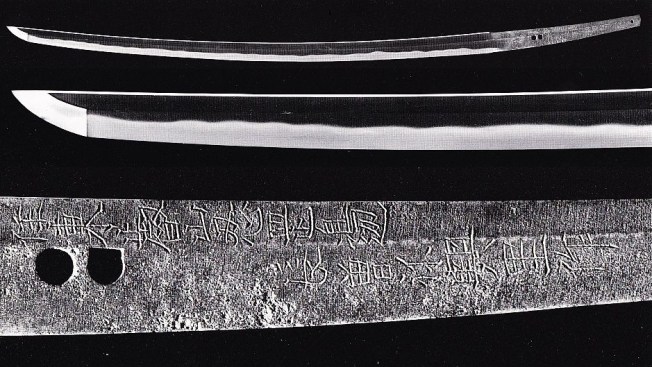
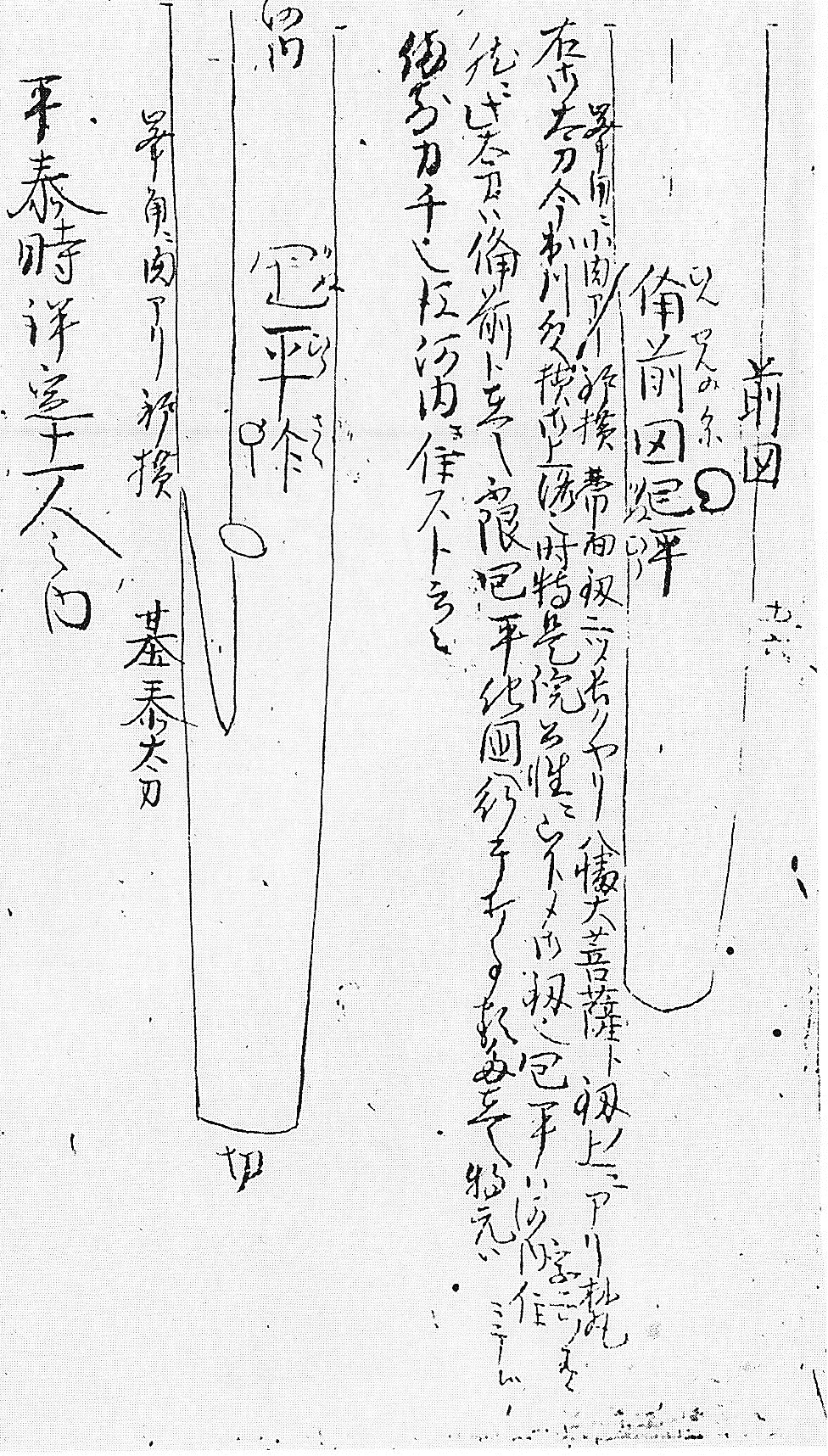
Now lets tackle the next reference, the Ôseki-shô (往昔抄) from Eishô 16 (永正, 1519). The entry therein is insofar precious because it comes with a drawing of a nakago which is signed “Buzen no Kuni Kanehira” (備前国包平). Please note that the character for “Kuni” is not just abbreviated in this drawing because Kanehira actually signed that way, seen in the picture to the right which is the mei of the Ô-Kanehira. So the Ôseki-shô writes next to the tang:

 Kanehira2O-Kanehira-nakago

Picture 2, left: The entry of the Ôseki-shô; right: mei of the meibutsu Ô-Kanehira

峯角ニ小肉アリ、鈩横、帯面剣二ツ長クヤリ、八幡大菩薩ト剣ノ上ニアリ梵字二ツ有
右御太刀今出川殿様御上洛之時、持是院公性ニ下サレシ御剣也、包平ハ河内住ニテ候
然ルニ此太刀ハ備前と在之不限包平ニ他国ヘ行テ打ツ事類多在之物、根元ハ
備前カチ也、後河内ニ住スト云々
 

The blade has a kaku-mune with ko-niku, kiri-yasurime, shows two long (su)ken on the haki-omote and bonji over the characters of Hachiman-Daibosatsu and another (su)ken on the ura side. When lord Jizei´in (持是院), i.e. Saitô Myôjun (斎藤妙純, ?-1497), proceeded to Kyôto, he was presented with this sword by the noble Imadegawa family (今出川). Then it is stated that Kanehira lived in Kawachi province but that this tachi was made when he was in Bizen and that the smith worked also in other regions. And finally it is written that Kanehira was originally a Bizen smith and that he moved later in his career to Kawachi.

 Kanehira3

Picture 3: The entry of the Genki-gannen tôken-mekiki-sho.

Our next source is the Genki-gannen tôken-mekiki-sho (元亀元年刀劔目利書) from the first year of Genki (元亀, 1570). This source tells us the following:

秦包平、同御宇、永延以来
河内国住人或備前住秦ノ字ヲハ不打ト云柄
身サキ細也切ヤスリ峯モハ方モメンヲトル柄身先
少丸シ銘太刀ハ目貫穴ヨリ上ニ打刀ハ下ニ打
保昌懐太刀造之後ニ鳥羽院之御剣釜歯
ト号、其右将相伝之常ニ狩場ヘ出御之時
被入御簾之間之号ニ簾丸又最明寺殿被写
置作者藤兵衛國吉也、是太刀ヲハ懐剣ト号
セラル、包平作懐太刀也、國吉作ヲハ懐剣と号ス

Hata Kanehira, active during the reign of emperor Ichijô (一条天皇, 980-1011, r. 986-1011) and from Ei´en onwards. Note that the entry states dô-gyo´u (同御宇), lit. “same reign”, which refers to the previous entry. Then we read that he was a resident of Kawachi and of Bizen but that he did not sign with “Hata” when in Bizen province. His tangs taper from both the mune and ha side, show kiri-yasurime, and a somewhat roundish nakago-jiri. Tachi are signed above the mekugi-ana and katana below of the mekugi-ana, whereat katana refers here probably to koshigatana or similar smaller sized blades. One blade was the beloved sword of Fujiwara no Yasumasa with came then in the possession of the abdicated emperor Toba who nicknamed it “Kama no ha”. Then the same legend with Minamoto no Yoritomo follows but with the difference that the sword was stored away behind a bamboo screen (misu) and was thus caled “Misu-maru” (簾丸). And later on, Hôjô Tokiyori had Awataguchi Kuniyoshi make a copy of the sword which was called futokoro-ken and the original of Kanehira futokoro-tachi. So without a few exceptions, the Genki-gannen tôken-mekiki-sho follows faithfully the Kanchi´in-bon mei-zukushi.

 And last I want to introduce the data of the Kokon-mei-zukushi (古今銘尽) published in Manji four (万治, 1661). This work first separates Ko-Bizen Kanehira and Kawachi Kanehira strictly in its genealogy section but only to address later on both smiths again in one the the same entry. So in the first volume which deals basically with genealogies we find Kanehira in the Ko-Bizen genealogy in an individual entry next to Nobufusa (信房). In this entry he is listed with the nengô Jôhô (承保, 1074-1077), Jôryaku (承暦, 1077-1081), Eihô (永保, 1081-1084), Ôtoku (応徳, 1084-1087), Kanji (寛治, 1087-1094), and Kahô (嘉保, 1094-1096). And the other Kanehira is introduced several pages earlier along the Kawachi section but just with the comment yoko-yasuri (i.e. kiri-yasurime) and his successors being Arikuni (有國), who was originally from Yamato province, Arinari (有成), and Aritsuna (有綱) (see picture 4).

 Kanehira4

Picture 4: The genealogic entries from the first volume of the Kokon-mei-zukushi. Left the Ko-Bizen entry, right the Kawachi entry.

In volume 2 both Kanehira appear side by side in the section about smiths of the same name working in different provinces and not being the same persons. Then later in volume 2 we find some details on the Kanehira from Kawachi province. The entry in question reads:

秦包平 一条院の御宇河内國後に備前に住す永延の比より慶長
八年迄六百十五年

Hata Kanehira, active during the reign of emperor Ichijô, lived in Kawachi province but moved later to Bizen, from around Ei´en onwards which is about 615 years in Keichô eight (慶長, 1603) [i.e. when the data for the Kokon-mei-zukushi was copiled before it was pubished about sixty years later.]

So according to this entry, we are talking about the same smith who started in Kawachi but moved later in his career to Bizen province. An entry in volume 4 deals with the workmanship of Kanehira and in this entry, both smiths are again separated, but read it for yourself:

 Kanehira5

Picture 5: The entry of the fourth volume of the Kokon-mei-zukushi.

一、包平 永延比 太刀の姿ほそく切先つゞまやかに庵丘鍛
柾目いかにもこまか也。地色黒く。紫色あり。小乱刄を焼
いかにま小足なり。地ざかひ沈て見ゆる也。刄をひろく、沸
を焼たるもあり。備前國包平と打たるを河内鍛冶と
いふ事如何。古備前なるべし。二字銘の包平は河内國
秦包平なるべし。出来やう廣直刄に沸多し。腰本を
乱刄にうつくしく焼て尋常也。来國行などに似たり。
地色も赤く紫色あり。刄色白し、備前包平は刄色も
そと青み有て上白し。沸の心もこまか也。能々心を付て
見べし

“Kanehira: Around Ei´en. His tachi-sugata is slender, tapers, and shiows an iori-mune. The kitae is a fine masame and the steel is blackish bit also purple. He tempered a ko-midareba with ko-ashi and the nioiguchi is rather subdued. The ha is white and shows nie. He signed with “Bizen no Kuni Kanehira” but it is also said that he was a Kawachi smith, but works signed that way are from the Ko-Bizen smith. All niji-mei must be attributed to Hata Kanehira from Kawachi province. He tempered a hiro-suguha with plentiful of nie and usually a midareba at the base. This interpretation is similar to Rai Kuniyuki. The steel is reddish and purple and the ha is white but the ha of Bizen Kanehira is more blueish white. The nie are also finer and he [Bizen Kanehira] has to be regarded as superior.”

What is my conclusion? Well, this is a case where not just one odd document forwards a different theory and all others are in unison about the origins of a certain smith. Here we have too many ambiguous entries on the basis of which we just can´t rule out one approach or the other. That means everything is possible, i.e. that Kanehira moved from Bizen to Hata in Kawachi province, that he originated in Kawachi and moved to Bizen and gave up there signing with “Hata,” or that we are facing two completely different smiths. Also I can´t say for sure of the Ô-Kanehira was the futokoro-tachi owned by Fujiwara no Yasumasa as it is suggested by some experts. But the Tôkyô National Museum which owns the blade today dates it to the late Heian period and says 12th century. So not middle Heian and close to Yasumasa. I hope though that I was able to illustrate how hard it can be to rely on old references and that sometimes like here you have to stop at a certain point because you can´t squeeze out more information from them. And now imagine how much work it was to compile my Index of Japanese Swordsmiths where I tried for the first time to bring in line all this data by keeping at the same time as much original content as possible. Sometimes it needed just a keyhole surgery, but sometimes three patients were lying side by side with their bodies opened and you just don´t know which organ to transplant where.

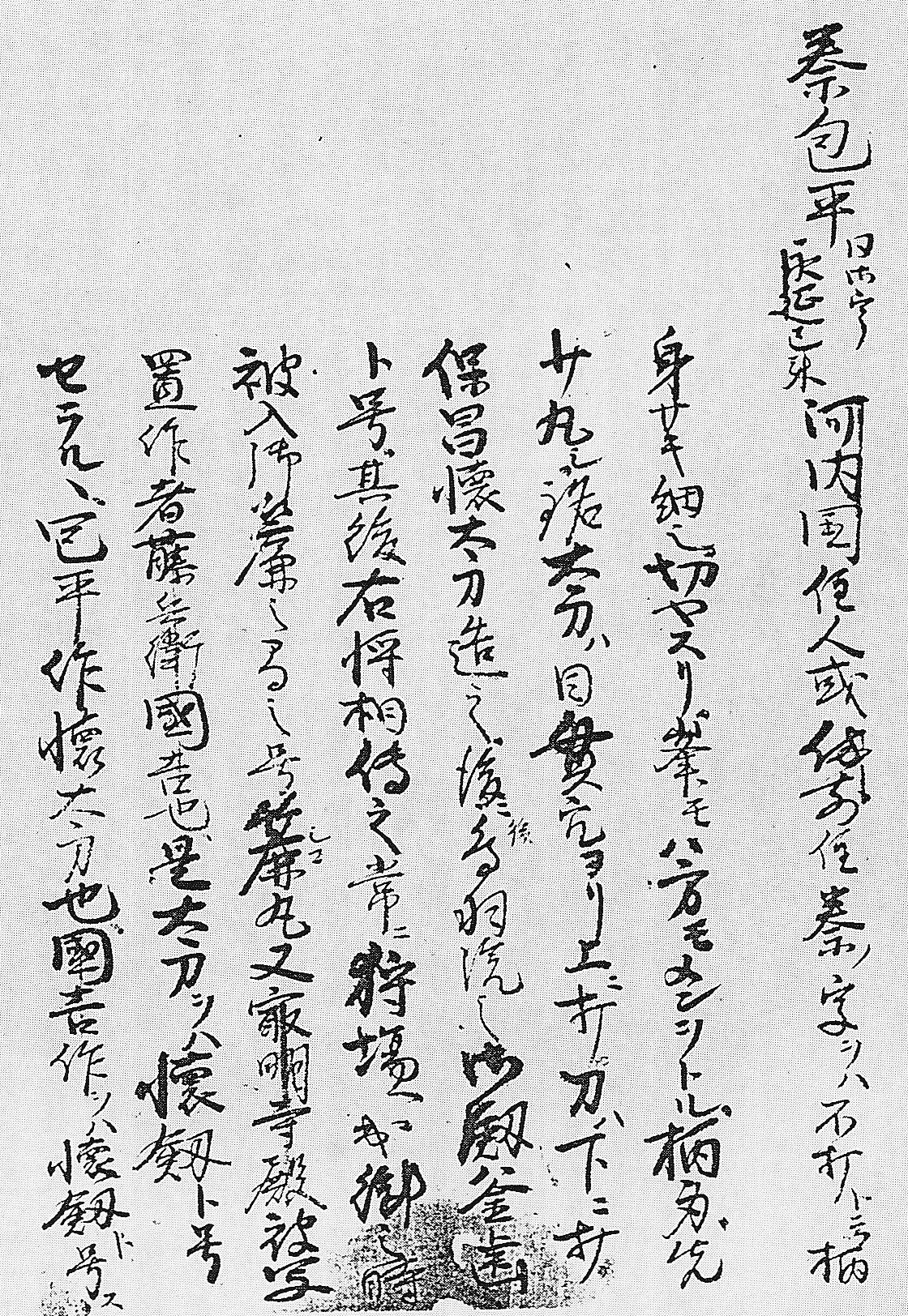
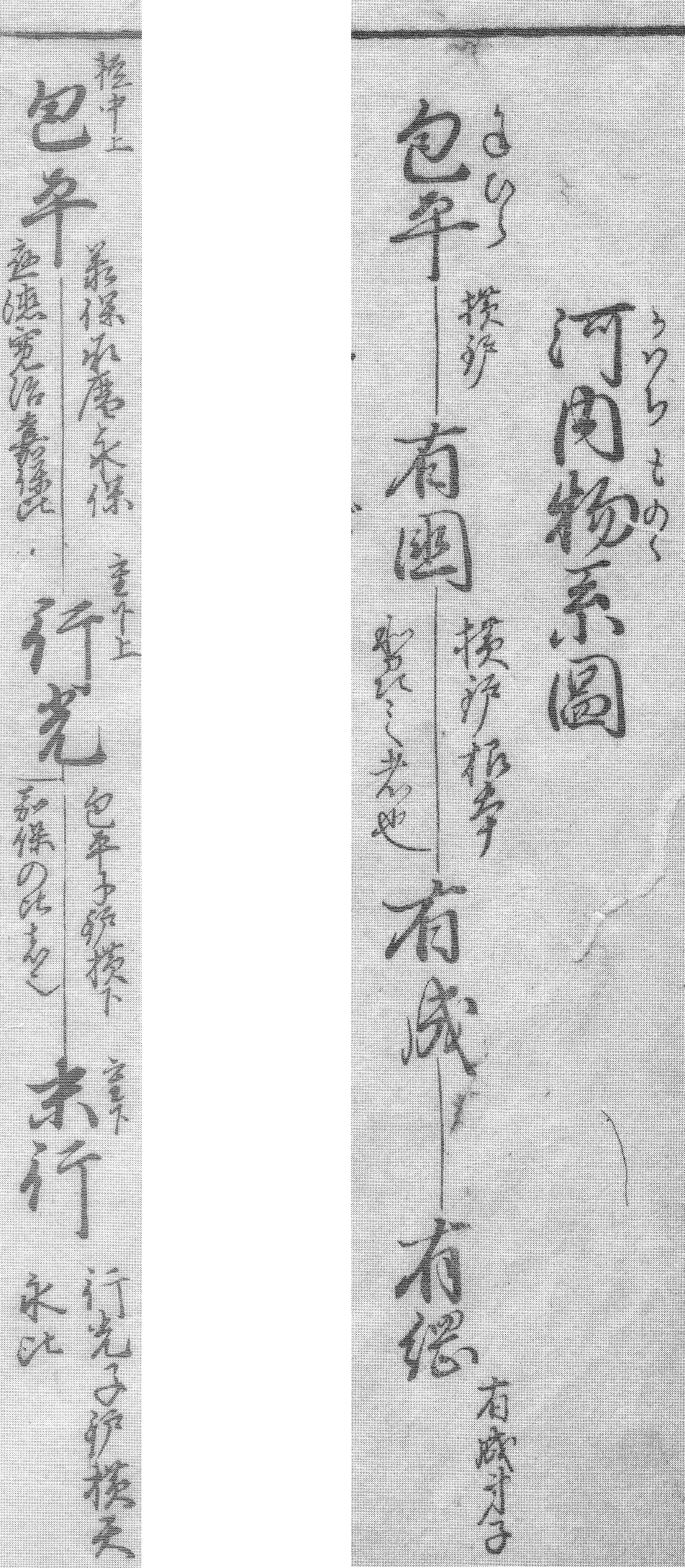
 Kanehira6-O-Kanehira

Picture 6: tachi, kokuhô, mei “Bizen no Kuni Kanehira saku”, meibutsu Ô-Kanehira, nagasa 89,2 cm, sori 3.5 cm, motohaba 3.7 cm. Please note that this blade has a thin kasane and weighs despite its length just 1.35 kg (usually tachi with such a nagasa weighs around 2 kg).

On the origins of Akasaka-tsuba

Well, Akasaka-tsuba need no introduction as they are so predominant when it comes to iron sukashi-tsuba, and most of you are probably also aware of the theories on their origins. So I want to touch these origins rather briefly as the main topic of this article is the Akasaka area itself. My aim is to give the reader as good as possible an idea of how the area where the Akasaka-tsuba artists worked looked like in the Edo period, thus the many images.

Akasaka was and still is a district of Edo or Tôkyô respectively, located in north of present-day Minato-ku and to the southwest of the Chiyoda-ku (see picture 1), but let´s go very back to where everything began. From local histories we learn that the area in question was cultivated for the first time in Eiroku ten (永禄, 1567) and a village called Hitotsugi (人継村, later written with the characters [一ツ木村]) was founded there but the whole region around the fishing-village Edo was rather unsettled. Ieyasu had made Edo Castle his stronghold after being offered eight Kantô provinces by Hideyoshi in 1590 and started to largely rebuid the castle three years later. Things were finally pushed after he won Sekigahara and decided to establish the Tokugawa-bakufu in Edo but the castle should be completed until 1636 and the time of his grandson Iemitsu. Back then, we are largely talking about the late Genna (元和, 1615-1624) and subsequent Kan´ei era (寛永, 1624-1644), town houses and warrior residences and a little later the houses of merchants and craftsmen mushroomed there and Akasaka turned gradually into an urban district. This initial urban Akasaka district is referred to as “Moto-Akasaka” (元赤坂) and forms still today a Tôkyô district of the same name. Incidentally, the name “Akasaka” appears for the first time in Meireki three (明暦, 1657). But even though Edo was gradually blossoming, the early Tokugawa-bakufu was struggling with a problem, namely that the new capital was so to speak too bushi-weighted. The art world was hesitant going there and cultured people from the old capital Kyôto called the Edo-residents “eastern barbarians” (azama-ebisu, 東夷) and the activities in the new capital were regarded with suspicion. And when the bakufu had stabilized and Edo had taken shape around Keian (慶安, 1648-1652) to Kanbun (寛文, 1661-1673), the lack of influental persons from art and culture who refused to leave Kyôto was still not solved. So the Tokugawa government responded by forced displacements and “offers” which came close to blackmail. For example, the Gotô main line first refused to go to Edo but was eventually “convinced” in Kanbun two (1662), and in the 1675 chronicle Enpeki-kenki (遠碧軒記) we read: “Once, no one from the Gotô family went to Edo, because they had for this duty their clerk Shôzaburô (庄三郎).” Anyway, the bakufu agenda of turning Edo into the new political and cultural capital of the country succeeded around early Genroku (元禄, 1688-1704).

 AkasakaMap1

Picture 1: Present-day Akasaka district in the very center of the map (© 2014 Google, ZENRIN)

 AkasakaMap2

Picture 2: Present-day Akasaka district as seen via © Google Earth.

Now to the district itself. The area to the south of Moto-Akasaka was called Akasaka-Tamachi (赤坂田町), or just Tamachi district. Its eastern boundary was the sotobori (外堀), the outer moat of Edo Castle. By the way, the present-day Sotobori-dôri follows basically this outer moat and that is also where it has its name from. To the north there was as mentioned the Moto-Akasaka district and the outer Akasaka-gomon Gate (赤坂御門), also known as Akasaka-mitsuke (赤坂見附). The bridge to the Akasaka-gomon Gate was actually a dike and interrupted the moat, and its southern continuation was also used as reservoir (tameike, 溜池). Leaving the castle grounds via the Akasaka-gomon Gate (see picture 5) and turning left, i.e. south, one passed successively the first, second, third, fourth, and fifth Akasaka-Tamachi district. Right opposite to third and fourth district was the Hie-jinja (日枝神社). By Ieyasu´s definition of the outer moat, the Hie-jinja was now on the grounds of Edo Castle but his son Hidetada had moved the castle´s limits back a bit so the people could worship there.

“Akasaka” means literally “Red Slope.” Leaving Edo Castle via the Akasaka-gomon Gate and turning right, i.e. heading north to the Yotsuya district, one had to negotiate a slope to the east of which the Edo residences of the Kishû Tokugawa family were located. Because of this, the slope got the name “Kinokunizaka” (紀伊国坂, lit. “Kii Province Slope”). Today there are basically three explanations for its second name “Akasaka.” One says that madder  grew on top of the hill of which red dye was made. The hill itself was called Akaneyama (赤根山). This name means literally “Red Root Hill” but has its etymoligical roots in the Madder (akane, 茜). And so the slope to the Akaneyama was called “Akasaka,” “Red Slope.” The other explanation is that the name goes back to the red dyed silk hung up along the slope by local dyers. And the third explanation is based on the fact that the Kinokunizaka consisted to a large extent of red soil.

AkasakaMap3

Picture 3: 1. Kinokunizaka, 2. Akasaka-gomon Gate, 3. Hie-jinja, 4. tamaike reservoir. Please note that the initial name of the area or village respectively, i.e. Hitotsugi, was still used for the district two districts west of the second Tamachi district. The third Akasaka-Tamachi district where the Akasaka school was located is marked in red.

 AkasakaMap4

Pictuere 4: The same places as they look today. The red line marks (to its right) the Akasaka-Tamachi districts (© Google Earth).

 AkasakaMap5

Picture 5: Leaving Edo Castle via the Akasaka-gomon Gate. The houses to the very left belog to the first and second Akasaka-Tamachi district. Picture predates Meiji 14 (1881).

 AkasakaMap6

Picture 6: View up to the Akasaka-gomon from an early Meiji-era photo.

Now let us take a look on the area as seen on ukiyoe, namely from Utagawa Hiroshige´s (歌川広重, 1797-1858) series One Hundred Famous Views of Edo (Meisho Edo Hyakkei, 名所江戸百景). Picture 7 shows a woodblock print titled “The Paulownia Garden at Akasaka” (Akasaka kiribatake, 坂桐畑) and we see Paulownia trees, the tamaike, and on the opposite shore the Hie-jinja. So Hiroshige was actually standing right in the third or fourth Akasaka-Tamachi district, the district where the Akasaka tsuba workshop was located, when making sketches for this woodblock print. Picture 8 is titled “Kinokuni Hill and Distant View of Akasaka and the Tameike Pond” (Kinokunizaka Akasaka Tameike enkei, 紀ノ国坂赤坂溜池遠景) and we have here basically the same view as in picture 5. Picture 9 is by the second generation Hiroshige (1829-1869). It is titled “View of the Paulownia Trees at Akasaka on a Rainy Evening” (Akasaka kiribatake uchû yûkei, 赤坂桐畑雨中夕けい) and is not always included in the One Hundred Famous Views of Edo. There is the theory that it was a replacement print for “The Paulownia Garden at Akasaka”. Here the view is north towards the Akasaka-gomon Gate but seen from the very same spot as at the first generation. It is nice to see that the Municipal Garden Office of Tôkyô had Paulownia trees planted along the Sotobori-dôri so that the original Edo-period view was kept “as good as possible” (see picture 10).

 Akasaka7

Picture 7: Akasaka kiribatake (1856)

Akasaka8

Picture 8: Kinokunizaka Akasaka Tameike enkei (1857)

 Akasaka9

Picture 9: Akasaka kiribatake uchû yûkei (1859)

Akasaka10

Picture 10: South view along the Sotobori-dôri. The red dot marks the entry to the Hie-jinja (© Google)

But let me come back to the Akasaka school. In Bunsei seven (1824), the bakufu appointed the scholar Hayashi Jussai (林述斎, 1768-1841) as head of the project of the topography of Musashi province and the urban era (machikata, 町方) of Edo. With this project, all present historical reference materials were examined and consolidated. It contains among others the position and orientation of the city, its history of origins, its dimensions and area, the number of taxable households, the guardrooms, sewers, bridges, drains, the landowners, and so-called “old-established families” (kyûka, 旧家). This very detailed information is of paramount importance for studies on feudal Edo, and the original is preserved in the National Diet Library (Kokuritsu-kokkai toshokan, 国立国会図書館). The third district of Akasaka-Tamachi was tackled in the seventh month of Bunsei ten (1827) and the compiled document bears the signatures and stamps of each local myôshu (名主, taxable landowner). And from this document we learn that at the time of its compilation, the tsuba craftsmen Hikojûrô (= the 8th generation Tadatoki, 忠時) was living there, i.e. in the third Akasaka-Tamachi district, and that his family was old-established. Further we learn that the Akasaka-Tamachi districts were developed southwards, that means the first district right outside of the Akasaka-gomon Gate was, as the name already suggests, the first Akasaka-Tamachi district.There were 72 houses in the third district: 3 belonged to landowners, 8 to houseowners (Hikojûrô Tadatoki was one of them), 27 were rented, and 34 were rented as shops. Another house owner and kyûka was for example the dyer (kon´ya, 紺屋) Seizaemon (清左衛門), who moved there from Kaga province during the Manji era (万治, 1658-61) taking over a vacant dyer´s trade. At the time of the compilation of the document, the Seizaemon family was able to look back to eight successive generations just like the Akasaka family. By the way, the info on the Akasaka family reads as follows: “The former background of his [Hikojûrô´s] ancestor Shôzaemon (庄左衛門) is unknown but from around Kan´ei, first-class sukashi-tsuba were made from there, the Akasaka district, which are signed ´Akasaka Shôzaemon Tadamasa´ (赤坂庄左衛門忠正). This Shôzaemon died in the third year of Meireki (1657), year of the rooster, from illness. The second generation succeeded the name and signed in the very same way. The hird generation was called ´Shôzaemon Masatora´ (庄左衛門正虎), the fourth generation ´Hikojûrô Tadamune  (彦十郎忠宗), and the fifth generation ´Hikojûrô Tadatoki´ (彦十郎忠時). From the fifth generation onwards, the fourth generation´s first name ´Hikojûrô´ became the hereditary first name of the family which carried out the profession of tsuba craftsmen uninterruptedly from their ancestor to the present eighth generation. Tsuba which are called ´Akasaka-tsuba´ since earliest times and those which are signed ´Bushû-jû Akasaka Tadatoki´ or ´Akasaka Hikojûrô Tadatoki´ are their works.

To conclude, I want to go back again to the very beginning of the Akasaka school and the developments of early Edo. When talking about the origins of Akasaka-tsuba, one name appears inevitably: Kariganeya Hikobei (雁金屋彦兵衛). The reason why I bring him into play right at this point is the aforementioned founding of Edo. Kariganeya Hikobei was supposedly from Kyôto, and we have several indications that he was running an antique shop. It is said that he moved to Edo and started from new in the Akasaka district where he employed tsuba artists to make for him iron sukashi-tsuba on the basis of his sketches. The most obvious theory, which is forwarded in several documents, is that the first Akasaka generations were these tsuba artists but we don´t know for sure if this Kariganeya Hikobei was a real historic person or just a later fabrication by “Akasaka-affine” persons to draw a connection to Kyôto, the old cultural capital.

Let me introduce a sketch (or maybe it is an actual oshigata) of a sukashi-tsuba published in Yamane Yûzô´s (山根有三, 1919-2001) Konishi-ke kyûzô – Kôrin-kankei-shiryô to sono kenkyû (小西家旧蔵・光琳関係資料とその研究, “Studies on Kôrin-related Reference Materials from the Heirloom of the Konishi Family”) (see picture 11). Incidentally, Yamane was an art historian who specialized in the painters Hasegawa Tôhaku (長谷川等伯, 1539-1610), Tawaraya Sôtatsu (俵屋宗達), Ogata Kôrin (尾形光琳, 1658-1716), and the Rinpa school. The tsuba in question (see picture 1 in the following) was labelled as “after a sketch of Kôrin” and because it appears in the Konishi documents right next to sketches and patterns by Ogata Kôrin, we have here a strong circumstancial evidence for the theory that the roots of Akasaka-tsuba were in Kyôto. The painter Kôrin was the second son of the wealthy Kyôto draper Ogata Sôken (尾形宗謙) whose trade was namely called “Kariganeya” (雁金屋), had also the same name as Kariganeya Hikobei. The then high artistocracy of Kyôto was their customer, for example Yodogimi (淀君, 1567-1615), Hideyoshi´s concubine, or Tôfuku-mon´in (東福門院, 1607-1678), Tokugawa Hidetada´s daughter and wife of Emperor Go-Mizunoo (後水尾天皇, 1607-1678). But also the flourishing Kariganeya business run by the Ogata family was unable to follow the agenda of the bakufu and closed its gates in Kyôto in Genroku ten (1697) and moved to Edo.

 Akasaka11

Picture 11: Sketch labelled “after a sketch of Kôrin.”

So maybe Hikobei was a young and ambitious member of the Ogata family or employee at the Kariganeya who shared the – probably volitional – fate of Gotô Shirôbei to be one of the first to check things out in the new capital. There in Edo he worked as a representative of the business and was responsible for acquiring local clients and forwarding their orders to Kyôto. As there was a kind of gold-rush mood in young Edo, it is not hard to imagine that Hikobei was looking for something at the side, and as he was mostly surrounded by bushi back then, tsuba were the obvious option. So maybe he either asked likeminded and “adventurous” Kyôto-based tsuba artists to join his business idea, or hired local tsuba artists which had moved there earlier.

So I hope I was able to give you a basic idea of how the neighborhood looked like where the Akasaka masters worked throughout the Edo period. And when you take again a look at picture 5, this is about what the 9th and last Akasaka generation Tadatoki was seeing on a walk. From the extant data we can namely calculate that he was in his early or mid 80s when the Tokugawa-bakufu ended in 1868.