Encyclopedia of Japanese Swords

The announced publication is out now!

This completely new encyclopedic reference for the Japanese sword contains about 2,500 entries, many of them illustrated by photos and drawings. The Encyclopedia of Japanese Swords is an A-Z general encyclopedia covering each and every part of the sword: the blade, the mountings, the fittings, and all their different interpretations. Further, this encyclopedia also explains the literal or etymological meaning of each Japanese term and provides an even deeper insight into the subject.

552 pages, b/w (eBook in color), format 6 x 9″

Please note that it comes this time in three forms, the suitable edition for everyone.

The 79.90 USD hardcover version is available here.

The less expensive 49.90 USD paperback version is available here.

And the 29.90 USD eBook version is available here.

Hope the Encyclopedia of Japanese Swords serves as my other books as a useful reference for you all!


EncyclopediaCover-small


Coming up soon…

Some might remember that we discussed a while ago on the NMB future projects of mine. I had been asked in the past to compile and publish a new encyclopedia where you can find all sword, sword fittings, and sword mounting terms but then I was reminded that such a thing already exists, namely in the form of Kotoken Kajihara’s Nihonto Swords of Japan A Visual Glossary, which even has an English translation. So I put this aside. But then I was contacted by many NMB members, blog readers, and collectors to pursue this project as Kajihara’s book is really hard to get and nothing for a small wallet (saw it the other day for about 600 USD).

Well, as in the past, your wish is my command and I worked parallel to my other ongoing projects on a completely new Encyclopedia of Japanese Swords which should be finished soon. It will contain as mentioned all terms around the nihonto, which are at the moment around 2,100, presented with tons of pictures on approx. 500+ pages. The book will be in the same format as my Tameshigiri book, i.e. 6 x 9″ and hardcover, and of course also available as eBook. Pricing will follow the aim of the book which is to provide a standard reference work, so definitely in the two-digit range and somewhere around the Tameshigiri book. I will keep you updated.

EncyclopediaCover-small

Ryukyuan swords and Japan’s foreign trade loophole

This time I would like to introduce some special swords called “Ryûkyûan swords” (Ryûkyû-tô, 琉球刀; from now on quoted without macrons except for terms in Japanese) which are usually left out in the relevant sources, mostly because of the fact that they are such an absolute rarity. But why are Ryukyuan sword so rare? Reason number one lies not that far back: It was the destruction and confiscation of all weapons by the American troops during the attacks on the Ryukyu island in the last year of the Pacific War. And reason number two is the disarmament of local Ryukyuan warriors and a weapons ban which took place several times in history. To understand the special circumstances around Ryukyuan swords and Japan’s foreign trade loophole mentioned in the headline, we have to go back to the 14th century, but before that, it takes a short excursion into geography. The Ryukyu Islands are a chain of islands that stretch southwest from Kyushu to Taiwan. They basically consists of six larger islands or archipelagos, namely from north to south of Ôsumi (大隅), Tokara (吐喝喇), Amami (奄美), Okinawa (沖縄), Miyako (宮古), and Yaeyama (八重山).

Ryukyu1

Picture 1: The Ryûkyû Islands.

The Ryukyu Kingdom (Ryûkyû-ôkoku, 琉球王国) had its origins on the largest of the Ryukyu Islands, Okinawa, which consisted until the 14th century subsequently of smaller feudal domains and three major kingdoms – Hokuzan (北山), Chûzan (中山), and Nanzan (南山) – which were unified by the king of Chûzan, Shô Hashi (尚巴志, 1371-1439), in 1429. Incidentally, the oldest evidence of human existence on the Ryukyu Islands is from Stone Age and written reports on Ryukyuan inhabitants go back to the 7th century AD, but as we are focusing on the Ryukyu Kingdom, I want to leave out the early history of the islands. Before the unification, Shô Hashi had been the king of Chûzan and had strengthened the connections to Ming China to which Chûzan was tributary. Japan had used Okinawa and Amami as bases during some of the 8th century missions to Tang-China but we know that the islands had continuous contact with both Japan and China over the subsequent centuries. However, Shô Hashi’s policy marked a noticeable shift towards China. Another main policy of him was to expand trade, not only with Ming China but with other Asian countries as well. The strong bonds with China become especially evident when the Ryukyu court send emissaries to the Ming court and not to the Ashikaga-bakufu to ask for the investiture of Shô Hashi’s son after Hashi’s death.

Ryukyu2

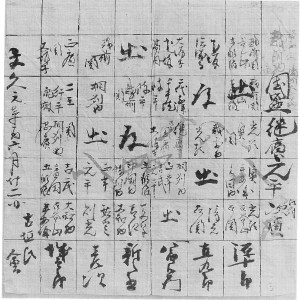
Picture 2: Page from the Rekidai Hôan.

Before Shô Hashi’s regency, Ming China had sent three imperial diplomatic missions to Chûzan, i.e. to Okinawa, namely in 1372, 1404, and 1415. Twelve more followed until the end of the 16th century. So the tributary relationship to China was the motor of the Ryukyu Kingdom being now a key player in maritine trade with Southeast and East Asia. The Rekidai Hôan (歴代宝案), an official compilation of diplomatic documents of the Ryukyu Kingdom covering the period from 1424 to 1867, contains records of communications and trade between Ryukyu and ten different trading partners. The ten countries were China, Korea, Siam, Malacca, Palembang, Java, Sumatra, Pattani, and Jakarta. I have written here about the Japanese sword trade with Ming China so the questions are: Did the Ryukyu Kingdom just act as transshipment point for Japanese swords, i.e. was Ryukyu just another way via which the same Japanese swords were exported to Ming China? Or were there special, peculiar swords exported from Ryukyu and by the Ryukyu Kingdom itself? One indication of the assumption that the Chinese distinguished between Japanese swords and Ryukyuan swords is that there are both Nihontô no uta (日本刀歌), Odes to the Japanese Sword, and Ryûkyû-tô no uta (琉球刀歌), Odes to the Ryukyuan Sword, extant from Chinese poets. For example, two known Odes to the Ryukyuan Sword go back to the Ming Chinese painter and poet Xú Wèi (徐渭, 1521-1593), and one to the Qing Chinese painter and poet Zhāng Wèntáo (張問陶, 1764-1814). However, from the late Ming to the early Qing Dynasty, i.e. in the mid-17th century, China experienced a boom in such sword odes and in several cases, the term Ryûkyû-tô was used synonymously with Nihontô. Therefore and because of the pretty identical content of both odes, some experts assume that the differentiation was just made on the basis of from where the swords were imported. Anyway, there are both Ryûkyû-tô no uta and Nihontô no uta extant from Xú Wèi and Zhāng Wèntáo. Indications for the assumption that Ryukyuan swords were special and not just forwarded from Japan are found in the Rekidai Hôan. At this point I have to point out that with “special,” the sword mountings are meant, because experts agree that the blades of Ryukyuan swords were solely made by Japanese smiths. So in the Rekidai Hôan we read very often of swords with gilded scabbards or with scabbard and/or hilts with mother-of-pearl (raden, 螺鈿) ornamentation. Mother-of-pearl and the inlay of seashells is a very characteristic feature of Ryukyuan lacquerware. On the basis of these descriptions and the very few extant Ryûkyû-tô it seems that the blades and certain sword fittings like tsuba, fuchi, kojiri, and maybe even kozuka and kôgai if present, were imported from Japan, and local craftsmen added the hilt, scabbard, menuki, and kashira; to add on the ond hand the special “Ryukyuan touch,” and to comply on the other hand with the taste of the Chinese and Southeast Asian customers. Some assume that the Ryukyu Kingdom was the “contact point” for Chinese and Southeast Asian customers to order, in addition to Japanese swords, also customized swords which met more their taste and needs. There is namely no indigeneous Japanese production line known making directly on the ground “Chinese-style” swords ready for dispatch. Another possibility is that not sword blades and parts were ordered from Japan but that just a certain amount of the swords forwarded in the course of the trading with China and Southeast Asia were taken apart and remodelled by local Ryukyuan craftsmen. Or the Ryukyuan foreign trade office ordered, upon receiving custom orders from China, some more swords from Japan and those were locally remodelled and resold profitably.

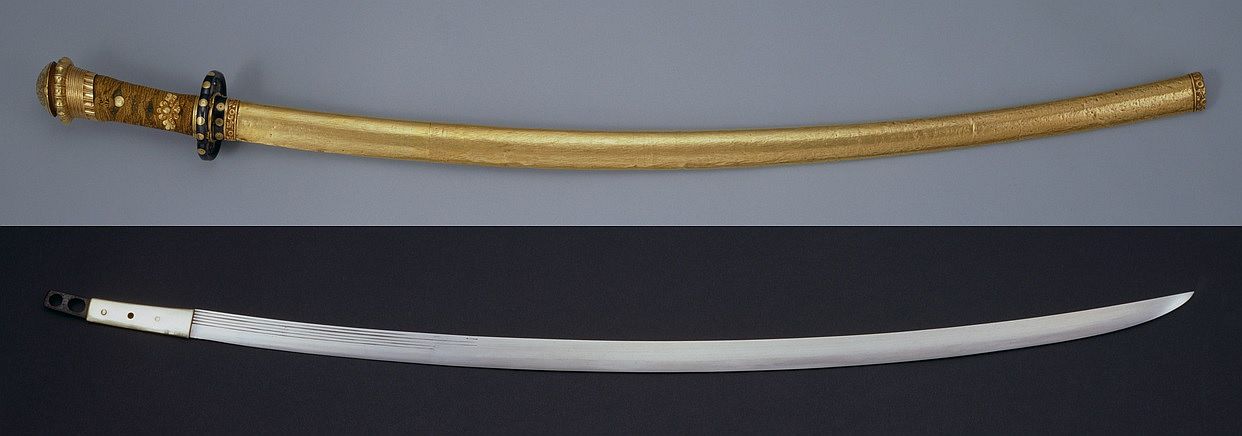
Before we continue I want to introduce the three most famous extant Ryukyuan swords to give you a better idea of what we are talking about. These three swords come from the artefacts of the Ryukyuan royal Shô family which are together designated as kokuhô. Sword number one (picture 3) is named Chiyoganemaru (千代金丸). According to tradition, the sword was once a hereditary treasure sword of the kings of Hokuzan and the last Hokuzan king Han’anchi (攀安知, ?-1416) committed seppuku with it when being defeated by Shô Hashi. To be more precise, Han’anchi got angry about not being able to defend his castle and so he cut at one of the castle’s sacred stones and as the sword possessed spiritual powers which should protect the king, it did not cut his belly and so he threw it into the near Shigema River (志慶間川) from which it was washed down, into the sea, and ashore of Iheya Island (伊平屋島) which is located to the north of Okinawa. The people of Iheya then presented it to the new king Shô Hashi. From that time on it formed, with the two swords described in the following, the treasure sword triumvirate of the Shô Dynasty until Shô Hiroshi (尚裕, 1918-1996), the great-grandson of the last king of the Ryukyuan Kingdom, presented it shortly before his death to the Okinawan city of Naha. The blade of the Chiyoganemaru is mumei and has a nagasa of 71.3 cm. It is in hira-zukuri, rather slender, and shows a pronounced sakizori. The jigane is an itame-nagare, the hamon a hiro-suguha-chô mixed with ko-gunome, ashi, and , and the bôshi is sugu with a rather pointed kaeri. Both sides show five narrow and parallel hi at the base. It is assumed that the nakago was altered for single-handed use and to add a Ryukyu-style koshirae and it is equipped with a riveted metal collar, an installment which is completely atypical for a nihontô. The blade is dated to the early Muromachi period which would support the tradition but no “official” attribution to a certain smith or school was done so far, at least not to my knowledge. The koshirae measures overall 92.1 cm and is dated somewhat later, namely to the Momoyama or early Edo period. Tsuba, koiguchi, and kojiri are thought to be of Japanese production but saya, menuki and the kabutsuchi no tachi-like pommel of local Ryukyuan manufacture. The tsuba is of shakudô, in mokkô-gata, shows each four inome and flower-shaped sukashi along the rim, and in between gilded chrysanthemums with kebori accentuations. The rim is highly raised and bears on the left side the kebori inscription “Tekanemaru/Teganemaru” (てかね丸). The exact meaning of this inscription is unknown but the Omoro Sôshi (おもろさうし), a compilation of ancient poems of songs from Okinawa and the Amami islands, contains a song titled Teganemaru no uta (てがねまる/手金丸の歌) from which we learn that the Teganemaru was a hereditary treasure sword whose other nickname was Tsukushi-jara (筑紫だら), a name in Okinawan dialect which means literally “large wakizashi from Tsukushi,” i.e. from Japan. So from this point of view, it seems that the name Teganemaru actually referred to the Chiganemaru, the sword which is described next. So either the tsuba had been switched, or the inscription was added later and the responsible craftsman just mixed up the nicknames of the two swords (which is quite possible as the names Chiyoganemaru and Chiganemaru sound pretty similar). Anyway, the uncommon pommel of the Chiyoganemaru is made of pure gold and shows carvings of chrysanthemums and the characters “Taisei” or “Ôyo” (大世) which are thought to refer to Shô Taikyû (尚泰久, 1415-1460), Shô Hashi’s fifth successor, whose posthumous divine name is Ôyo no nushi (大世主). Incidentally, there are records which suggest that the Chiyoganemaru was worn at each investiture ceremony of a Ryukyuan king. For detailed, zoomable pictures of the Chiyoganemru, click here.

Ryukyu3

Picture 3: The Chiyoganemaru.


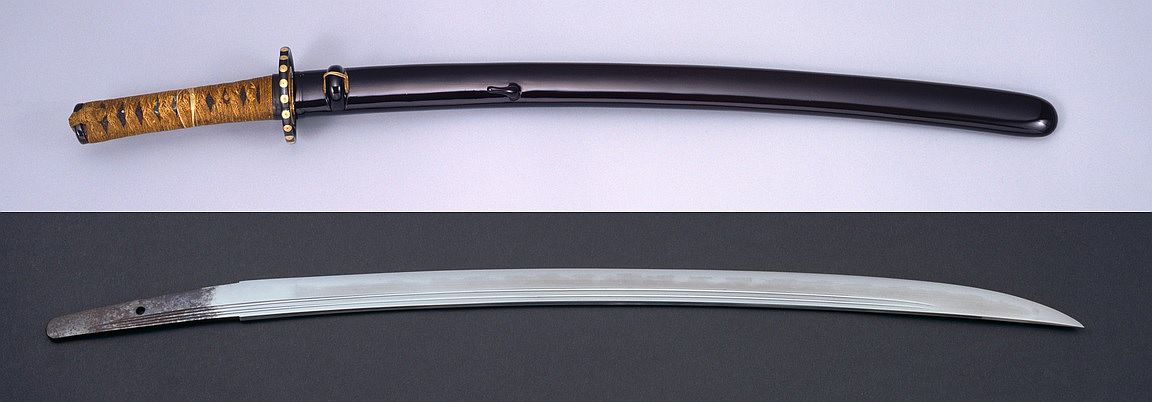
Sword number two is the Chiganemaru (治金丸). According to tradition, the chieftain Nakasone Toyomiya (仲宗根豊見親) of Miyako Island presented the sword and sacred beads in 1522 to the Ryukyuan king Shô Shin (尚真, 1465-1527) to congratulate him for subjugating the Yaeyama archipelago. Incidentally, a stele in Okinagwa’s Shuri Castle (首里城), the former royal palace of the Ryukyu Kingdom, was erected in 1543 in commemoration of this sword gift. The Chiganemaru is a wakizashi with a black-lacquer saya and both blade and koshirae, which measures 73.6 cm in overall length and which is about contemporary to those of the Chiyoganemaru, are thought to be of Japanese manufacture. However, the kozuka and hilt-wrapping seem to be of local origin. The tsuba is identically interpreted as the one of the Chiyoganemaru. Also identical are the two ô-seppa which, in both cases, might be made by a Ryukyuan craftsman. The blade has a nagasa of 53.8 cm and coms in hira-zukuri with sakizori. The jigane is itame, the hamon is a koshi no hiraita-gunome in nie-deki with togariba, and the bôshi is midare-komi with a maru-kaeri on the omote, and a pointed kaeri on the ura side. On both sides we find a futasuji-hi which runs with kaki-nagashi into the tang. The blade is mumei but thought to be a work of Ôei-Nobukuni (応永信国). So both koshirae are as mentioned later works and with the following tradition found in the Kyûyô (球陽), the authorized history of the Ryukyu Kingdom compiled in the mid-18th century, we can do some speculations on them. The Kyûyô states that king Shô Shin ordered Ahagon Jikki (阿波根実基), who is said to be the ancestor of Okinawan martial arts, to bring the Chiganemaru to Kyôto to have it repolished there. But when Jikki came to pick the finished blade up, the polisher gave him a counterfeit which Jikki unsuspectingly brought home to Ryukyu. But the fraud was discovered and Shô Shin ordered Ahagon Jikki once more to proceed to Kyôto to find the original treasure sword. It took him three years until he found and return it to Okinawa and because of this long stay, he changed his family name to Kyô-Ahagon (京阿波根). So it is possible that the Chiganemaru was newly mounted on this occasion and maybe the king himself or an official responsible for the royal swords ordered a local craftsman to equip the Chiyoganemaru with an identical tsuba. This would mean that one tsuba is of Japanese, and the other one of Ryukyan origin. Or Ahagon had the rediscovered Chiganemaru newly mounted on his own expense to remedy his fault of bringing back the wrong sword. Or his compensation was to present the king with a new and identical tsuba for the Chiyoganemaru which he paid for himself. Well, this is pure speculation but maybe the aforementioned inscription “Tekanemaru/Teganemaru” on the Chiyogane’s tsuba has something to do with this incident. Incidentally, the characters (手金, read as tekin) mean literally “deposit.” However, if both koshirae were made later, i.e. in the 17th century (experts’ opinions differ in this respect), than none of these speculations are true and the Chiganemaru was sent to Japan once more later. For detailed, zoomable pictures of the Chiganemru, click here.

Ryukyu4

Picture 4: The Chiganemaru.

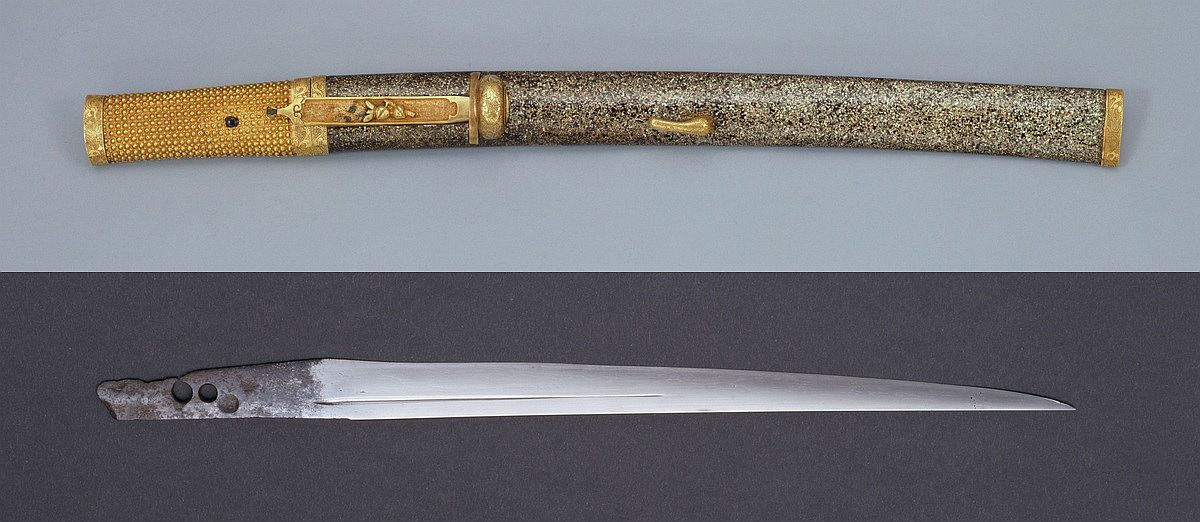
Sword number three is a koshigatana named Chatannakiri (北谷菜切). A legend says that the blade was once a kitchen knife of a farm woman from the Okinawan village of Chatan (北谷). One day when she was cooking, the knife autonomously cut off the head of her baby. The case was investigated and the woman charged but an official made a test and left the knife in the vicinity of a goat which head it cut off too. Upon this, the woman was released but the knife confiscated and forged into a dagger which was nicknamed “Chatannakiri,” lit. “vegetable cutter/knife from Chatan.” Another legend says that it came in the possession of the Shô in exchange for a paddy field in Chatan. Anyway, the koshirae is thought to be of local Ryukyu manufacture and is roughly dated like the other two to the 16th to 17th century. It measures 46.5 cm in length, has a saya covered with inlaid mother-of-pearl which features small square-shaped pieces of great turban shell, and a hilt with a golden uchidashi-same cover, that means the mounting is quite loud. It comes with a gilded kozuka and kôgai which are of noticeable inferior craftsmanship than for example contemporary Gotô works. The kozuka bears on the back the seal script character for ten (天, “heaven” or “imperial”) and the symbol for weight (fundô, 分銅). And the kôgai bears the same seal script character and a drum-shaped symbol. It is assumed that the character for ten is a mark to identify them as personal items of the Ryukyu King. The blade has a nagasa of 23.0 cm, is in hira-zukuri with a mitsu-mune and with a little sori. It lost much material (it remains to be seen if consciously altered or just often used) and shows thus only a hoso-suguha and lacks a bôshi. The jigane is itame which tends all over to nagare and the ura side shows a thin koshi-bi. Although not appraised, the blade is dated to the early Muromachi period. For detailed, zoomable pictures of the Chatannakiri, click here.

Ryukyu5

Picture 5: The Chatannakiri.


Back to the sword trade. When we stay in the Muromachi period and check the entries of the Rekidai Hôan, we are far from the numbers of swords exported by the Japanese. The record from the 1425 trade with Ming China lists only 71 swords, and in the 1434 record we find 166 swords. In comparison, the Chinese court had by then limited the Japanese sword import to 3.000 tachi. And very interesting is that in most of the annual Ryukyuan trading reports we read of polishing stones being exported. For example, the 1428 report mentions “five different polishing stones” (wûyàng mó dao shí, 五様磨刀石) in the amount of altogether about 2.3 tons! The 1434 trade record mentions 3.8 tons of polishing stones so we can assume that everything was exported what was necessary from foundation to finishing polish. In other words, some Chinese customers or units were not only eager to resharpen their swords but also to bring back to a certain degree the beauty of the Japanese swords which was extolled in the aforementioned odes. As for the prices of these Ryukyuan swords, we learn from the 1434 trade record that the costs for one “royal ceremonial sword” (gûndao or Japanese kontô, 袞刀) of Ryukyuan manufacture was at that mission in average a little over 28 kan (貫). In comparison, the Japanese trade record from the 1432 mission states that the costs for one tachi were about 0.8~1 kan. So my conclusion is that the Ryukyuan sword trade with China was partly a very exclusive one.

But what about the Ryukyuan ruling class itself? The Ryukyu Kingdom was composed of a complex caste system which was largely subdivided into royalty (ôji, 王子), scholar-officials (shizoku, 士族), and commoners (heimin, 平民). Enforcing law and providing military defense to the kingdom was put in the hands of the scholar-officials class which was subdivided into four ranks. The second highest shizoku rank, pechin (親雲上), was the one closest to the Japanese bushi class and by the 19th century, even the term samure was introduced to put the class literally on par with their Japanese counterpart. However, the scholar-official class was as the name suggests not a warrior-official class like in Japan. Depending on the historical phase of Ryukyu, the shizoku underwent somtimes more and sometimes less an official martial arts training. Also we know that the kingdom equipped all members of the royalty with swords and bestowed swords to shizoku when they served in the government ministry. That means it was not like Japan where each and every member of the ruling warrior class was equipped by default with a sword regardless of where he served and what his function was. So the Ryukyuan government model was more close to China and their scholars than to Japan. There are many questions remaining on how the fourteenth, fifteenth, and sixteenth century Ryukyuan ruling class was equipped but it seems that the majority of swords was imported from Japan and locally remodelled to a sword form similar to the Chiyoganemaru, i.e. sword intended for single-handed use with a short handle. And with these considerations, we are right back at the time when the Ryukyu Kingdom got again more connected with Japan.

I have explained that the Ryukyu Kingdom was tributary to Ming China. When Hideyoshi asked king Shô Nei (尚寧, 1564-1620) to support his plans to conquer Korea, he refused, and he also refused later to formally submit to the newly founded Tokugawa-bakufu when being asked by the Shimazu, the lords of the Satsuma fief which was closest to Ryukyu. Thus the shogunate ordered the Shimazu in 1609 to invade the Ryukyus and the kingdom surrendered without armed resistance. As a result, the northern Amami archipelago was annexed by the Satsuma, the fief established suzerainty over the islands ruled so far by the Ryukyu Kingdom, and the kingdom was now officially a tributary vassal of the Satsuma fief, not the bakufu. But only seven years later, the initially strong Satsuma control was withdrawn and Shô Nei was given a great degree of autonomy. By the way, the Shimazu disarmed the Ryukyuan pechin and prohibited them of carrying of weapons but relaxed the prohibition a few years later so that pechin were able to travel with their personal swords to the smiths and polishers in Satsuma for maintenance and repair and the Ryukyuan royalty was still allowed to bestow swords upon their members. Thus it is assumed that swords were not confiscated but, except for ceremonies, wearing them in public was banned. Well, commoners were from now on no longer allowed to own swords. There was a simple reason for why the Satsuma control was withdrawn, namely profit. Ming China had prohibited trade with Japan in 1567 but the Tokugawa-bakufu realized that it was now again able to continue to maintain trade relations with China via the loophole Ryukyu Kingdom which was still tributarily connected to the Ming Dynasty. China namely would not make a formal trade agreement unless a country was a tributary state, which Japan wasn’t at that time. And eleven years after the Qing Dynasty had replaced the Ming Dynasty in 1644, the Tokugawa-bakufu of course also formally approved the tribute relations between the Ryukyu Kingdom and Qing China. So when Japan had cut off trade relations with Europe except for the Dutch, Ryukyu became (apart from Nagasaki) the only connection with the outside world.

But with this situation, there was now always the danger that Chinese officials found out about how much control Japan in general and the Satsuma fief in particular had over the Ryukyu Kingdom, with the consequence that Qing cut off relations with Ryukyu as well. Thus Japan tried everything to make Ryukyu look as independent and autonomous as possible as China continuously sent in average about every twenty years an envoy to the Ryukyuan court to confirm investitures and tribunal connections (there were 22 such missions from 1404 to 1866). By the way, it has to be mentioned that it took the court several years to prepare to receive a Chinese missions as the envoys generally stayed for four to eight months. Often the money had to be borrowed from Satsuma to cover the enormous expenses of accomodating and entertaining the ambassadors and their entourage. To keep up appearances, Japanese were prohibited from visiting Ryukyu without shogunal permission, and the Ryukyuans were forbidden from adopting Japanese names, clothes, or customs. They were even forbidden from divulging their knowledge of the Japanese language during their occasional trips to Edo as part of Satsuma’s sankin-kôtai attendance. Apart from that, the Satsuma officials relocated temporarily from their residences or suspicious Chinese officials were taken to a different village to be shown that there were no Japanese. On the other hand, the Shimazu did not only profit from the trade loophole. A “side effect” of the attempt to make Ryukyu look as exotic and non-Japanese as possible allowed the clan to brag that they are ruling the one and only fief of Japan to which another kingdom is tributary! Not to mention the exotic goods they received first and long before anyone else via the Ryukyuan trade ships. In this sense I hope I was able to provide an interesting insight into a topic which is, as mentioned at the beginning, often left-out when it comes to the history of nihontô.

Ryukyu6

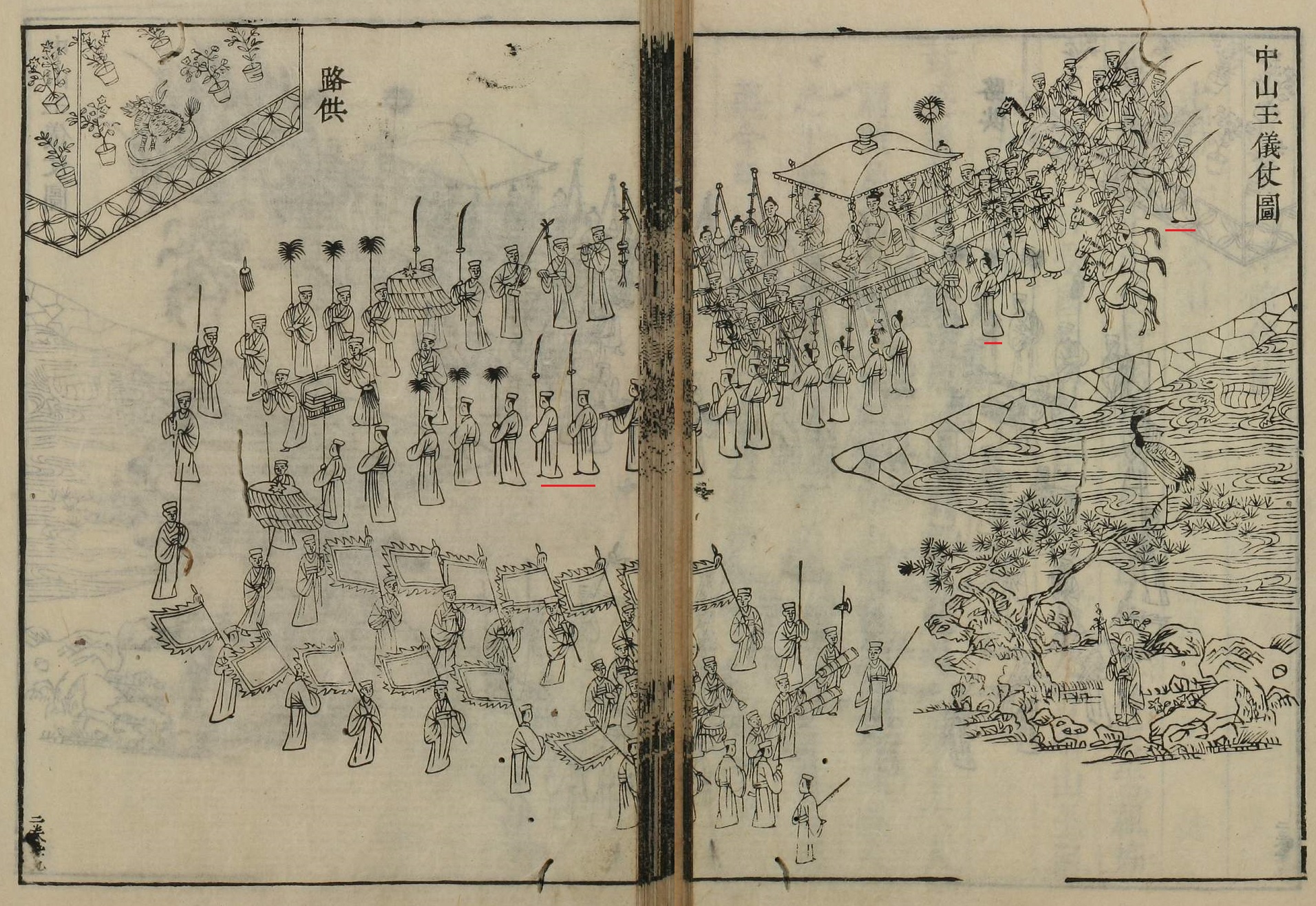
Picture 6: Depiction of the entourage of the Rykyuan King as seen in the Zhongshan Chúanxìn Lù (中山伝信録), the six-volume account of Ryukyuan history, politics, topography, language, and customs written by a Chinese official based on his journey to Ryukyu in 1719. On this depiction we see (highlighted in red) that at least in parades and official royal ceremonies, swords were worn. For example some wearing what seems Chinese-style naginta and some wearing drawn long swords leaning on their shoulders. And interesting is that the servant highlighted in red who stands next to the litter seems to hold the Chiyoganemaru sword.

About kakikudashi-mei

When I was compiling my recently published KOTO-MEIKAN, I had to go through my entire sword archive, or at least through the folders which contain the koto blades. In this sense, I came once again across the rare signature form where all information – e.g. name of the smith, place of residence, and date – is chiselled onto the same side of the tang. This signature form is called kakikudashi-mei (書下し銘) and in most of the cases all information is presented in one line, i.e. name of smith and date below or vice versa, and in some cases the smith left a little space between his name and the date. So whilst preparing the files for the book, I asked myself what prompted a smith to sign this way and I checked the relevant literature but did not find any explanation. But what I was able to find is an article by Yokota Takao (横田孝雄) in Tôken-Bijutsu #536 on the subject. Well, right away in his introductory words Yokota writes that he too was unable to find any explanations so I was kind of relieved that there is no commonly accepted and well-known theory which I just overlooked. The interesting thing about Yokota’s article is that he provides a quantitative overview of kakikudashi-mei, sorted chronologically and according to production site. So with his research – he presents 84 examples of koto-era kakikudashi-mei which can be considered as pretty representative as I doubt that that many more can be found which would throw over quantitative observations – we have at least a decent starting point.

On the basis of the 84 koto-era kakikudashi-mei he found, the following table can be created:

Province Heian Kamakura Nanbokuchô Muromachi Total
Bitchû 4 18 22
Bizen 13 4 17
Yamato 6 8 2 16
Yamashiro 12 12
Chikuzen 2 2 4
Ôshû 2 2
Etchû 2 2
Suô 2 2
Bingo 1 1
Ômi 1 1
Tosa 1 1
Hizen 1 1
Higo 1 1
Satsuma 1 1
Sagami 1 1
Total 1 43 38 2 84

According to the table, the majority of all kakikudashi-mei is found on Bitchû swords, i.e. on swords from the Aoe school, followed by Bizen, Yamato, and Yamashiro. That means we can see first of all an obvious concentration on the Kinai area and on the two koto-era Kibi-area sword centers Bizen and Bitchû. Also we learn right away that kakikudashi-mei were basically in use during the Kamakura and Nanbokuchô eras. There is no gradual increase from the Heian to the Kamakura and no gradual decrease from the Nanbokuchô to the Muromachi period. So the phenomenon kakikudashi-mei seemed to have popped up in Kamakura times and disappeared again, rather abruptly, when the empire was unified again by Ashikaga Yoshimitsu (足利義満, 1358-1408), or in other words with the transition to the Muromachi period. We learn further that Yamashiro and Bizen smiths were the first to sign with a kakikudashi-mei, that the Aoe smiths used this signature variant mainly in the Nanbokuchô era, and that in Yamato blades were signed on just one side about uniformly throughout the Kamakura and Nanbokuchô era. But it must be mentioned that in Yamato, kakikudashi-mei are mostly found on tantô and ken, what is uncommon, because the vast majority of all other schools and smiths applied such a signature to long swords and naginata only.

Next, let us take a look at the kakikudashi-mei by smiths outside of Bitchû, Bizen, Yamashiro, and Yamato. The four from Chikuzen are all found on blades by Jitsu’a (実阿). Accoding to tradition, Jitsu’a was the son of Sairen (西蓮) and the last of the Chikuzen masters who worked in the traditional and classical Ko-Kyûshû style which has as we know much in common with the Yamato tradition. The two Ôshû kakikudashi-mei are found on Hôju (宝寿) blades and these smiths also had a certain connection to Yamato. The two from Etchû go back to Norishige (則重) who has no Yamato connections. The two Suô blades are from Kiyotsuna (清綱) and Kiyohisa (清久), both Ko-Niô smiths, a school which also is stylistically connected to the Yamato tradition. The one from Bingo goes back to Kokubunji Sukekuni (国分寺助国). The Kokubunji temple where Sukekuni worked had strong bonds to the Tôdaiji in Nara, Yamato province. The kakikudashi-mei from Ômi is found on a tachi by Akimitsu (顕光) and one theory about his supposed master Kanro Toshinaga (甘呂俊長) says that Toshinaga was related to a certain Taima Toshinaga (当麻俊長). This Taima Toshinaga is not found in the meikan records but Toshinaga’s blades do show Yamato characteristics. The Tosa blade is from Tosa Yoshimitsu (吉光) and his roots are said to go back to Yamato too (to be more precise either in the Senju’in or in the Tegai school). As for Hizen, the kakikudashi-mei is from a blade by the 1st generation Suesada (末貞) whose master Norisue (則末) came according to tradition from the Naminohira school which, again, has certain connections to the Yamato tradition. The Higo blade is from Enju Kunitoki (延寿国時) and the scholastic roots of the Enju school are said to be found in both the Rai and the Senju’in school. The example from Sagtsuma is the only one from Heian times, i.e. from Heiji one (平治, 1159), found on a blade by Ko-Naminohira Yukimasa (行正) and the oldest extant date signature on a nihontô at all. As mentioned, the Ko-Naminohira school had connections to the Yamato tradition. And last but not least the blade from Sagami, found on a blade by Mitsufusa (光房) who is said to have been a student of Sôhû Yukimitsu (行光). The kakikudashi-mei of Mitsufusa is from Kôan three (弘安, 1280) and is the oldest known date signature on a Sôshû work. So except for Norishige and Mitsufusa, we can draw to all above mentioned smiths some Yamato connections and Enju Kunitoki might have inherited the kakikudashi-mei “habit” either from his Yamato or his Yamashiro roots, if we assume that this signature form has something to do with scholastic tradition.

When it comes to the mei itself, we learn that the majority of those Yamato smiths who applied kakikudashi-mei did so by starting with the date and chiselling their name at the bottom. The Yamashiro smiths usually started with the name and had the date follow, except for Ryôkai (了戒) who also did it the “Yamato way.” The same applies to Bizen whose smiths usually also started their mei with the name and place of residence if present. Exceptions here are Yoshioka-Ichimonji Sukeyoshi (助吉), Tsunemitsu (恒光), and Nakahara Kunimune (中原国宗) who also signed in Yamato-manner with the name last. Except for one naginata by Naotsugu (直次), all Aoe smiths started with the name and place of residence. Jitsu’a, Suesada, Enju Kunitoki, Tosa Yoshimitsu, Suô Kiyotsuna, Kokubunji Sukekuni, Norishige, Hôju, and Kanro Akimitsu signed their kakikudashi-mei in the Yamato way. Only Niô Kiyohisa, Naminohira Yukimasa, and Sôshû Mitsufusa did it the other way with the name last. Please bear in mind that these observations base only on the 84 blades collected by Yokota. Another peculiarity is that eight of the 18 Nanbokuchô-era Aoe blades with kakikudashi-ei are from the relative short Jôwa era (貞和, 1345-1350) which lasted only six years.

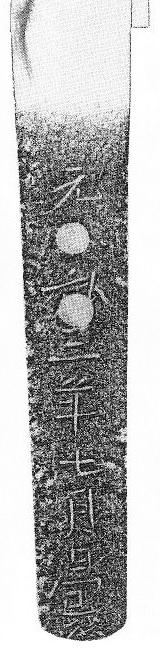
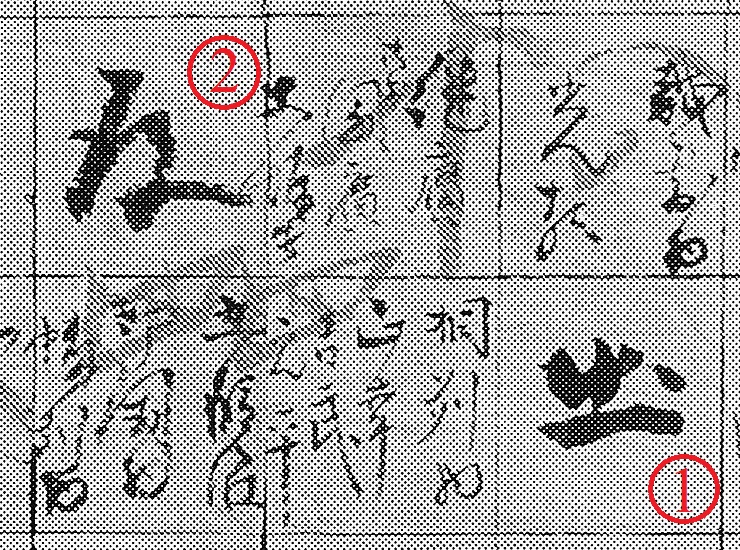
 kakikudashiRai                                            kakikudashiYamato

Picture 1 (left), kakikudashi-mei of Rai Kunitoshi, dated Genkô one (元亨, 1321)

Picture 2 (right), kakikudashi-mei of Tegai Kanetsugu, dated Genkô three (元弘, 1333)

My very own conclusion is that it is obvious that kakikudashi-mei were mostly in fashion among the Kamakura-era Rai and the mid-Nanbokuchô Aoe school. For Bizen, we can’t see any specific acculumation at a certain school or smith but for Yamato, a kakikudashi-mei was most common for the Tegai school. Also quite obvious for me is the Yamato connection of the “rural” smiths who signed occasionally in kakikudashi-mei although this connection might be rather weak in places where the Yamato roots were lying too far back. In other words, it is hard for me to imagine that for example Kanro Akimitsu suddenly reminded himself of his master Toshinaga’s (supposed) Yamato roots and decided to sign some blades in kakikudashi-mei just because some earlier Yamato smiths did. So there might had been another reason. As for Aoe, I can imagine that the custom of signing tachi in kakikudashi-mei during the Nanbokuchô era might be connected to another custom, namely that their Kamakura-era Ko-Aoe predecessors signed their tachi in katana-mei, i.e. with the signature on the inside of the tang, facing the wearer’s body when the sword is suspended from the belt edge down. So maybe it was now “decided” to better leave blank the side facing the wearer where their predecessors used to sign? When it comes to Yamato, I have mentioned that a great number of their kakikudashi-mei is found on tantô and ken and with their temple connection it is conceivable that leaving one side of the tang completely blank and signing also the date on the other side, even if space is limited at a tantô-nakago, might have had some religious reason in the beginning. As for the Rai school, their kakikudashi-mei focus around Rai Kunitoshi (来国俊), the latter half of his active period, and his sons/students from that time (i.e. Kunimitsu and Ryôkai). Back to the reason why to sign all information on just one side of the tang. As we talking, except for the Yamato smiths, basically of Kamakura and Nanbokuchô period tachi, maybe certain smiths thought that it was kind of repectful to leave the side of the tang empty which faces the wearer? And as we are talking here of master swords – the majority of the 84 examples collected by Yokota are by very high ranking smiths and classified as jûyô, tokubetsu-jûyô, jûyô-bijutsuhin, jûyô-bunkazai, and even kokuhô – the custom of kakikudashi-mei might go back to considerations of leaving one side of the tang blank so that the owner or his successors can record their glorious merits they achieved with the swords. On the other hand, no blade signed in kakikudashi-mei is known where the other side of the tang bears acually any description. Interesting, but maybe this has nothing to say at all, the oldest date signature of the Ko-Naminohira Yukimasa blade comes in kakikudashi-mei and its ura side actually bears an inscription, namely the name “Kuniyasu” (国安), which is thought to be the name of the owner of the sword. So maybe it started all with leaving one side of special blades empty so that the name of the owner can be perpetuated on the other side? Anyway, we might never get an answer to this question unless an old official, maybe local administrative documents are discovered in which swordsmiths are required or encouraged to sign in kakikudashi-mei. If anyone has another interesting theory, I would love to hear it. So please don’t hesitate to use the comment function. 😉

The sword polisher Takeya Rian and the Twenty-six Martyrs of Nagasaki

My 2010 published book Genealogies and Schools of Japanese Swordsmiths starts with a brief introduction to the history of Japanese sword literature. Therein I mentioned a certain Takeya Sôzaemon no Jô Rian (竹屋惣左衛門尉理安) who published during the Tenshô era (天正, 1573-1592) the sword book Shinkan Hiden Shô (新刊秘伝抄). Incidentally, his name “Rian” is sometimes also quoted with the characters (理庵). It is said that Takeya’s family descended from the famous early Muromachi-period sword appraiser Utsunomiya Mikawa Nyûdô (宇都宮三河入道) and that they changed their family name from “Utsunomiya” to “Takeya” after settling in the Takeya-machi (竹屋町) district of the same name of Kiyosu (清洲) in Owari province. An Edo-period genealogy of the Takeya even claims that the family goes back to the noble Takeya family of the same name, being the descendants of Ôsumi no Suke Nobutoshi (大隈介信俊) who was, according to this genealogy, the youngest brother of the court noble Takeya Kanetoshi (竹屋兼俊, ?-1447). But no such Nobutoshi is found in the official genealogies of the aristocratic Takeya family so this genealogy is obviously a fake. Well, Nobutoshi did exist but he was “just” a local Owari sword polisher and appraiser who was later employed by the Tokugawa-bakufu as sword polisher. Back to Rian. Not much is known about his life and so I try with this article to shed some light on the circumstances of the Takeya family of sword polishers at his time. One of the most important references is in this context the genealogy of the Owari-Takeya family found in the document titled Meikyô (銘鏡, also read as Mei Kagami) from the archives of the NBTHK. Therein we find the following information:

1st generation Takeya Chûzaemon Unsetsu (竹屋忠左衛門雲節): Lived in Kiyosu’s Takeya-machi and worked as a stipended sword polisher for Oda Nobunaga. Also did service on campaigns on several occasions.

2nd generation Takeya Roku’emon Dôya (竹屋六右衛門道也): Also worked as sword polisher for Oda Nobunaga.

3rd generation Takeya Genzaemon Fushi’ in (竹屋源左衛門ふし印): Adopted son of Roku’ emon. Formerly called Kasuya Gonnosuke (粕谷権之助). Came originally from Harima province.

4th generation Takeya Kyû’emon Dôi (竹屋九右衛門道意): Son-in-law of Genzaemon who was adopted as successor of the family. Came originally from Mino province and from the Mitsuma family (三間, also read as Mima). Died in Genroku 16 (元禄, 1703) at the age of 78.

5th generation Takeya Kyû’emon Jôgen (竹屋九右衛門浄玄): Adopted son of Kyû’emon Dôi. Came originally from Mino province and died in Kyôhô twelve (享保, 1727) at the age of 7?.

6th generation Takeya Kyû’emon Dôyu (竹屋九右衛門道由)

7th generation Takeya Kyû’emon Dôju (竹屋九右衛門道寿)

8th generation Takeya Kyû’emon Dôya (竹屋九右衛門道屋)

9th generation Takeya Kyû’emon Dôgen (竹屋九右衛門道玄)

As the 1st generation Takeya Unsetsu is listed as living in Kiyosu and working for Nobunaga, we can narow his active period down to the time from when Nobunaga entered Kiyosu, which was in Kôji one (弘治, 1555), to his death in Tenshô ten (天正, 1582). And when also the 2nd generation Dôya was directly hired by Nobunaga, he was probably active from Tenshô (天正, 1573-1592) to Keichô (慶長, 1596-1615). And as Takeya Rian published his Shinkan Hiden Shô as mentioned during the Tenshô era, he was a contemporary of Unsetsu and Dôya. Some assume that Rian was actually the first generation of the Owari-Takeya family and Unsetsu the second but when we take a look at these dates, this approach seems rather unlikely. However, we can’t dismiss for now another theory, namely that Rian and Unsetsu were the same person. There was also an Edo branch of the Takeya family which was founded by Takeya Jinsa (竹屋尋佐) who was active around Keichô and who did not come from the Owari-Takeya family. A document of the Takeya Mikinosuke Kôki (竹屋造酒之助光輝), the second son of the 7th Edo-Takeya generation Sekô (施光), also preserved by the NBTHK, claims namely that also the Edo-Takeya family goes directy back to Utsunomiya Mikawa Nyûdô. By the way, if the names of the Edo-Takeya heads were not but formal civilian names, their reading would be “Hirosuke” for Jinsa, “Mitsuteru” for Kôki, and either “Toshimitsu,” “Nobumitsu,” “Harumitsu,” “Masumitsu,” or “Mochimitsu” for Sekô.

So far so good. The Takeya were obviously in the possession of the documents and the knowledge of Utsunomiya Mikawa Nyûdô, had the honor to work as sword polishers directly for Oda Nobunaga, and were one of the togi-sanke (研ぎ三家), the “Three Famous Families of Sword Polishers.” The others were the Hon’ami and the Kiya (木屋), and all three were later working for the Tokugawa-bakufu. And we know from several accounts that not only the Hon’ami but also the Takeya and Kiya and other polisher families also appraised swords at the side. But not commonly known is the fact that the late Muromachi and Momoyama-era Takeya family was closely linked to Christianity in Japan. A group of Christians, all Franciscan missionaries, was executed by crucifixion in Nagasaki in Keichô two (1597) on orders of Toyotomi Hideyoshi. The group went down in history as the Twenty-six Martyrs of Japan (Nihon Nijûroku Seijin, 日本二十六聖人) and one of them was a certain St. Cosmas Takeya who is quoted in some sources as St. Cosme Takeya. The Japanese rendering of his name is Sei Kosume Takeya (聖コスメ竹屋). In contemporary records we read that this Takeya came from a noted family of Owari province and was a swordsmith. He was baptized by a Jesuit and became later a interpreter and catechist for the Franciscans and eventually preached in Ôsaka where he was arrested and brought down to Nagasaki to be crucified. Experts assume that “swordsmith” goes back to a wrong transcription. The entry in question reads tôken-shi (刀剣師) but as the term tôken-shi is quite odd for referring to a swordsmith, it is very likely that actually tôken-togishi (刀剣研師), i.e. “sword polisher” was meant. According to records of the Catholic Curch, Cosmas Takeya was beatified in 1627 by Pope Urban VIII and canonized by Pope Pius IX in 1862. In an annual report of Keichô two which refers to the crucifixion we find a very interesting entry: “He [Cosmas Takeya] was the brother of Takeya Leon (in Japanese Takeya Rean, タケヤ・レアン), a major figure in Christinanity in Owari province, who had died in the previous year [Keichô one, 1596].” From another record we know that this Takeya Leon fell ill in Sakai in the seventh month of Keichô one and died after receiving the remote sacrament from the Jesuit Missionary Gnecchi Soldi Organtino who preached at that time in Kyôto.

The family name “Takeya” appears already in an earlier Jesuit report from Tenshô 15 (1587). In this report in turn we read that Takeya Leon had been baptized before Tenshô ten (1582) in the castle town of Azuchi. Furhter we read that he was a swordsmith (here the same applies as mentioned before) but had moved to Kyôto and left his house in Kiyosu to Catholic priests. In Kyôto he had built a new house where he accomodated Evangelists and Catholic priests and allowed them to celebrated the Mass. There he acted as preacher under the name Takeya Cosme/Cosmas. So according to this report, Takeya Leon and Takeya Cosmas were one and the same person. But this does not match with the record that Leon was Cosma’s brother and died one year before the latter was crucified in Nagasaki. Anyway, it is likely that the name “Takeya Leon,” or in Japanese “Takeya Rean,” refers to Takeya Rian as the Christian name Leon was often also transcribed as “Riyan” and “Rian,” using the very same characters (理安). Also the reference to the Takeya as a sword polishers is striking.

But that’s not enough. We find two more, different historical records on Takeya Cosme/Cosmas and Rian. The first says that Cosme/Cosmas was a Korean who had came to Japan at the age of eleven and had been baptized in Nagasaki where he later lived. There he accomodated a Dominican friar and was therefore arrested and burned to death in Genna five (元和, 1619). His wife Ines and his twelve-year-old son Francisco died a martyrs’ death in Genna eight (1622). The other record tells of a Takeya Gonshichi (竹屋権七) who was the son of a Korean prisoner of war from one of Hideyoshi’s Korean campaigns who had become naturalized and got the Japanese family name “Takeya.” Gonshichi was arrested for accomodating a missionary and arrested and executed in Genna nine (1623). He died as martyr and his Christian name was “Rian” (理安). The connection to the Korean campaigns is insofar interesting as it opens the perspective that one or more members of the Takeya family went there as “field” sword polishers.

As mentioned, the Muromachi and Momoyama-era Takeya family was closely linked to Christianity. As we know, Christianity was banned after the Shimabara Rebellion and this would be an explanation why we don’t find Takeya Rian or Cosme/Cosmas in the Edo-period Takeya genealogies. Back then it was surely not a good thing to point out in an official genealogy that certain ancestors of the family were influental Christians. Well, this is pure speculation but the Takeyas’ connection to Christianity could also be an explanation for the fact that they did not play that an important role as sword polishers and appraisers as the Hon’ami did later throughout the Edo period. So maybe their sword polishing and knowledge of swords was held in high regard, they were as mentioned actually employed by the bakufu, but were rather “recommended” to stay in the background.

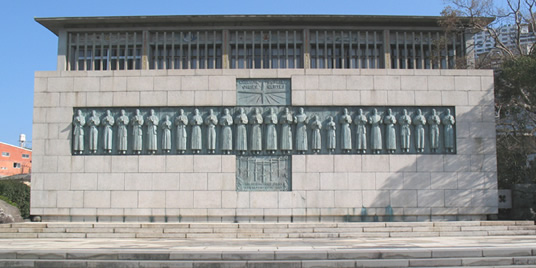
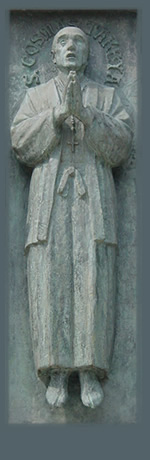
The picture below shows the monument built in 1962 in Nagasaki to commemorate the 100th anniversary of the canonization of the Christians executed there in 1597. And below detail of St. Cosmas Takeya.

Takeyapic1

Takeyapic2Takeyapic3

Tameshigiri Preorder Update

Dear preorderers of my Tameshigiri book, I want to inform you that one half of the signed copies will be shipped later today and the other half tomorrow. I thank you all for your patience but I had to change plans as I am in the US now and Lulu.com shipping is unusually slow to Austria and the books didn’t make it in time there so I had to ship them all to my place here in NC. My sincerest gratitude to all preorderers and supporters of my work and I hope you enjoy the book!

Late Edo period nyûsatsu-kantei

One opportunity to refine your skills in judging a Japanese sword in a playful or competitive manner is nyûsatsu-kantei (入札鑑定), lit. “bidding kantei,” where you submit your answers to a designated judge who acts as head of the session. According to your bid, the judge gives you a certain and today standardized response by which you should be able to narrow down your bid and nail down the smith in the ideal case. A detailed list of these replies can be found for example at the end of Kokan Nagayama’s standard work The Connoisseur’s Book of Japanese Swords. Well, we don’t know exactly when nyûsatsu-kantei were held for the first time. Fukunaga Suiken says in his Nihontô Kantei Hikkei (日本刀鑑定必携, 1985) that they were quite in fashion during the Edo period and suggested by the Hon’ami family as good kantei practice. Hon’ami Mitsuhiro (本阿弥光博) writes in his Nihontô Kantei Hô (日本刀鑑定法, 1973) that evidence of nyûsatsu-kantei goes at least back to the bakumatsu era, although he states at the same time that the practice is definitely older. And Satô Kanzan wrote in his Nihontô Kikô (日本刀紀行, 1976) that nyûsatsu-kantei has a long tradition which even predates the Edo period. Anyway, references are limited but alone on the basis of the large number of relevant publications like simple kantei guides, meikan, and mei-zukushi released in the late Edo period we can conclude that nyûsatsu-kantei were popular all over Japan at that time.

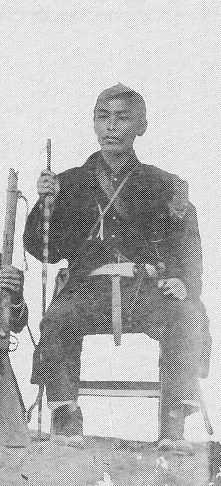
This time I want to introduce one of the rare extant written records of late Edo period nyûsatsu-kantei. We are talking about several documents found among the records of the Furugaki family (古垣). The Furugaki were retainers of the Miyakonojô branch (都城) of the Shimazu family (formerly Hongô family, 北郷) who ruled the Miyakonojô territory of the same name which was located in Hyûga province and which was one of the semi-autonomous sub-territories of the large Satsuma fief. Incidentally, the Miyakonojô-Shimazu were pretty well off as their lands were nominated with an annual income of 36,000 koku. The kantei documents in question go back to a certain member of the Furugaki family, to Furugaki Genjûrô Toshiaki (古垣源十郎俊彰, 1839-1877), who belonged initially to the cavalry corps of the Miyakonojô-Shimazu holding the fifth of ten of the local samurai rank. Toshiaki was trained in the Tenshin-ryû (天真流) of swordsmanship (which he later mastered) and became in Ansei two (安政, 1855), aged 17, a page of the then Miyakonojô lord Shimazu Hisanaga (島津久静, 1832-1862). Later he was promoted to the rank of bettô (別当), serving at the machi-bugyô office, and after that he was able to get the post of bugashira (武頭) which means that he was the head of the various local samurai kumi units. When he became an escort of Hisanaga’s successor Hisahiro (島津久寛, 1859-1884), he was able to often visit the capital Kagoshima where he refined his fencing and riding skills. He participated in the Anlo-Satsuma War which took place in 1863 and fought in the course of the Boshin War at several places in the northern Ôshû region, that means on the opposite end of Japan. When the Satsuma Rebellion broke out in 1877, Toshiaki was appointed second lieutenant of the government troops and fouht thus against the army of Saigô Takamori. During this campaign, a bullet pierced his chest and killed him. This was on the 16th day of the sixth month Meiji ten (1877). He was only 39 years old.
 nyupic1

Picture 1: Furugaki Genjûrô Toshiaki.

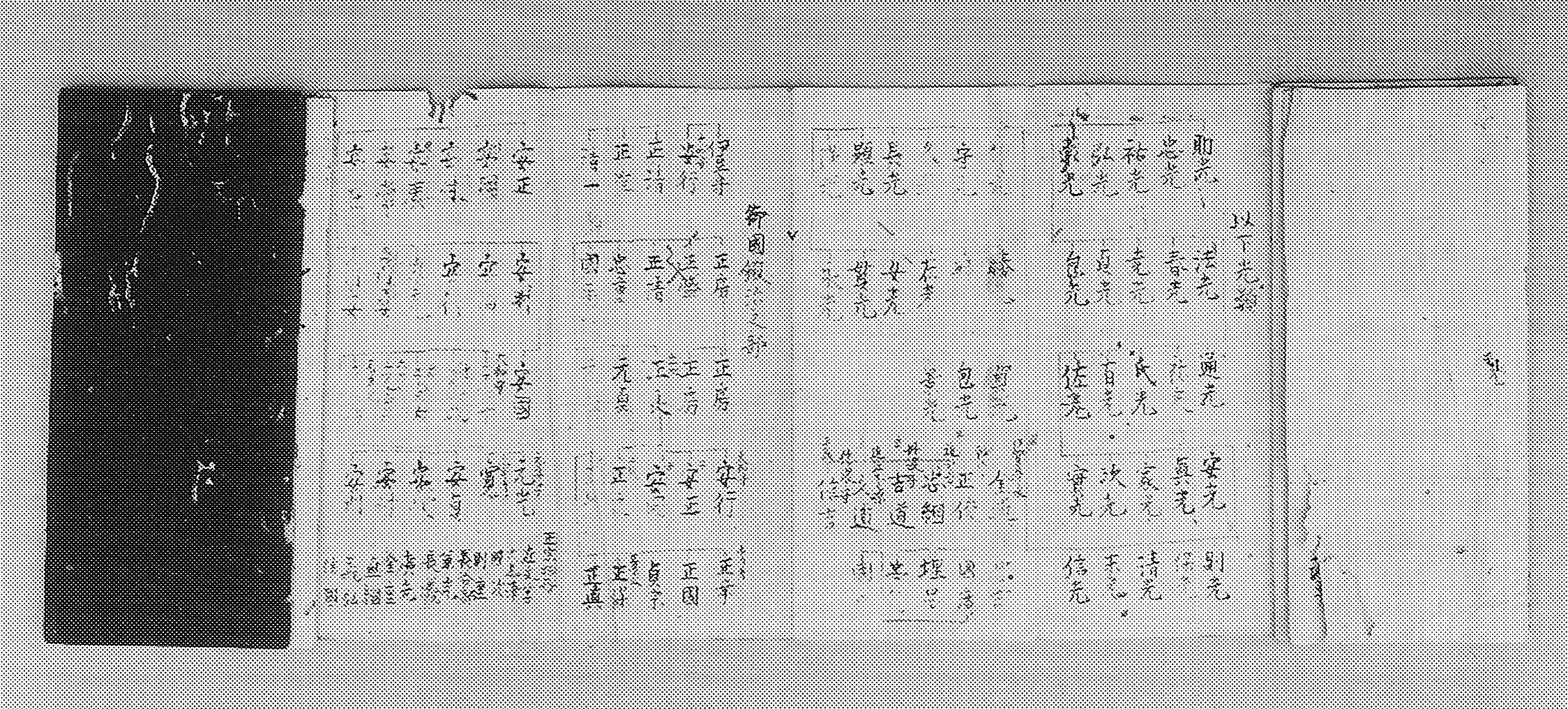
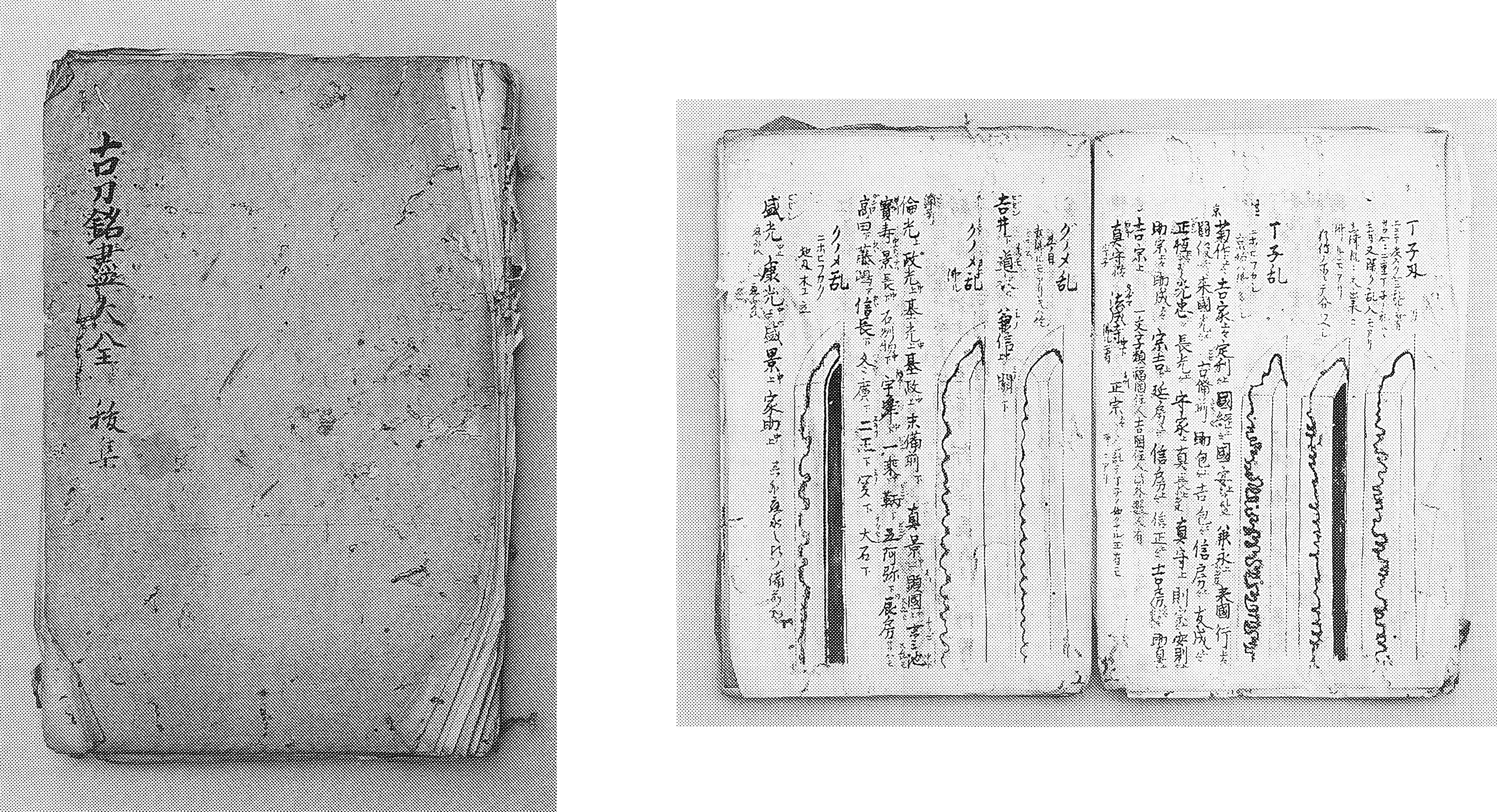
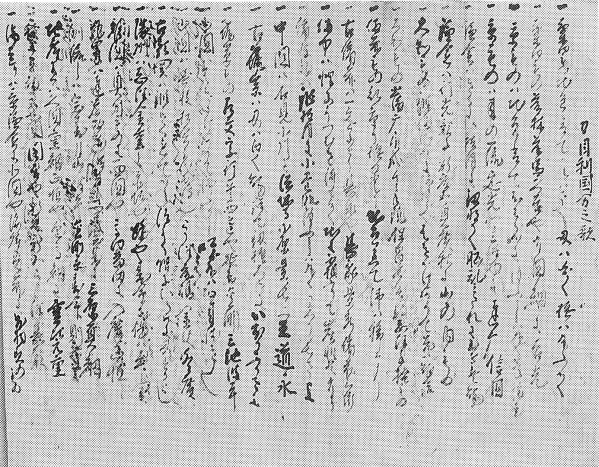
So far the resume of Furugaki Toshiaki’s short but eventful life. As for the kantei-related documents extant from his possessions, we are talking about five writings, namely two nyûsatsu-kantei lists titled Tôken Nyûsatsu Kantei Ichiranhyô (刀剣入札鑑定一覧表), notes to the kantei sessions titled Katana Mekiki Ichijô Oboetome (刀目利一条覚留), a dôzen list titled Tôken Nyûsatsu Kantei Dôzen Chô (刀剣入札鑑定同然帳), an abbreviated version of the sword publication Kotô Mei Zukushi Taizen titled Kotô Mei Zukushi Taizen Nukishô (古刀銘尽大全抜集), and a mnemonic song on kantei titled Katana Mekiki Kuniwake no Uta (刀目利国分之歌). The latter consists of 29 verses on how to memorize the characteristic of different provinces and was written down by a member of the Ano family (阿野) from southern Satsuma province.
 nyupic2

Picture 2: The Katana Mekiki Kuniwake no Uta.
nyupic3a nyupic3b

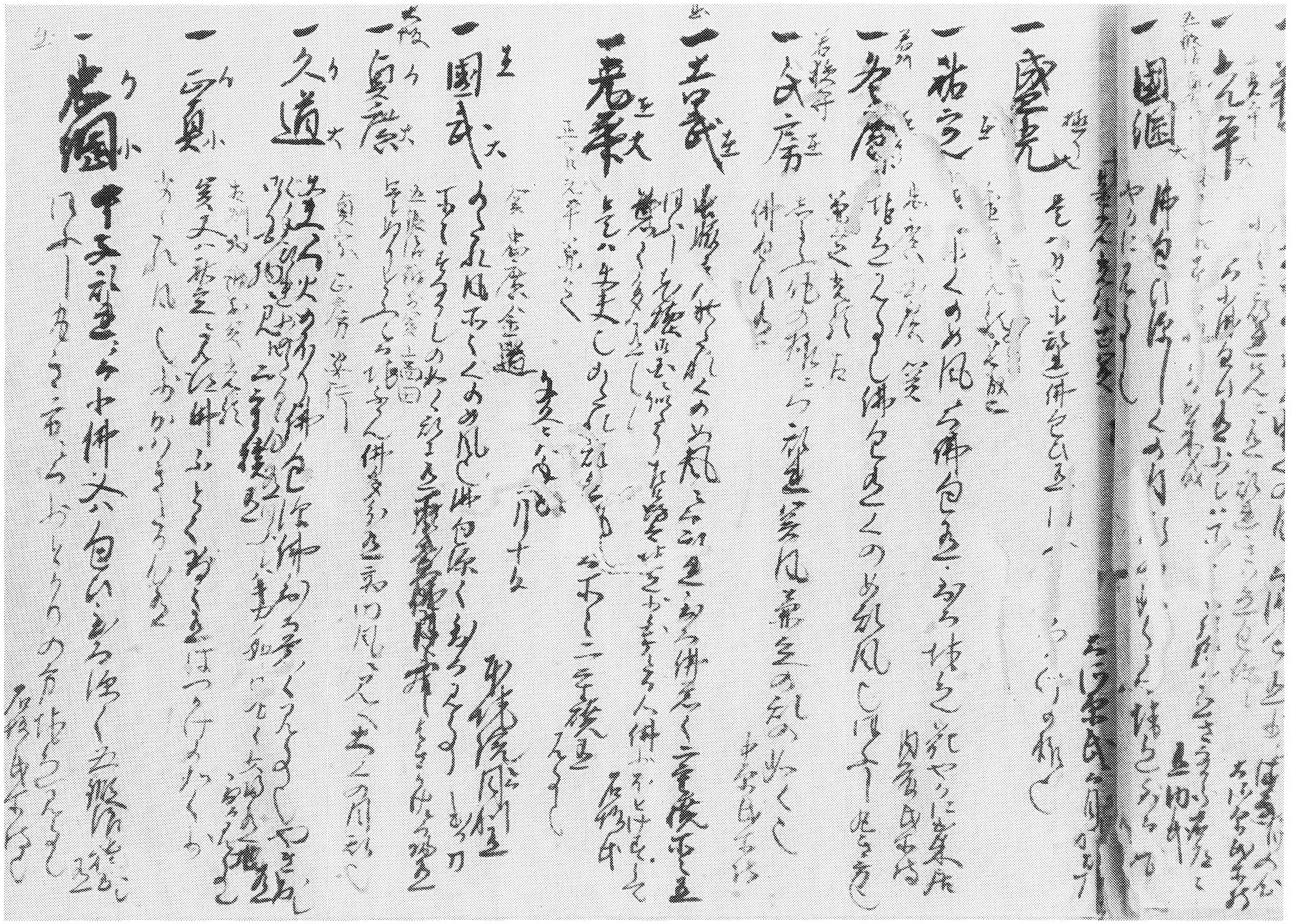
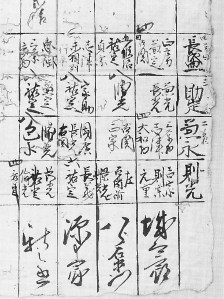
Picture 3: The two extant Tôken Nyûsatsu Kantei Ichiranhyô lists (click to enlarge).

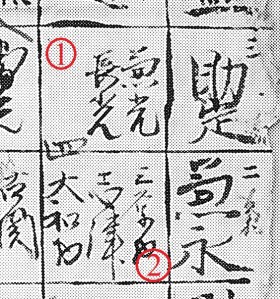
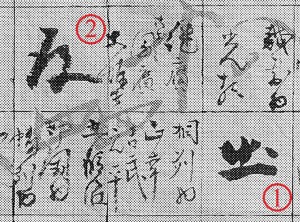
We learn from the kantei notes that the first mentioned lists are two out of nine nyûsatsu-kantei sessions. One list is dated with the 22nd day of the sixth month Bunkyû one (文久, 1861) and shows the inscrpition “Furugaki-shi kai” (古垣氏会) which means “meeting at Furugakis’.” It is assumed that these lists were kept by the person who held the kantei session at his house, i.e. in our case by Furugaki Toshiaki. As mentioned, the one sheet is undated but we find in Toshiaki’s kantei notes a matching entry for the names of the smiths which is dated Man’en one (万延, 1860). And as the second sheet was preserved with the first one, it is safe to assume that this kantei session was also held at Furugakis’. Also we learn from the kantei notes that judges at the two sessions in questions were a certain Iguro (伊黒) and a certain Ôkawara (大河原). The third name we find in the documents pointing out a judge at a kantei is Yamada (山田). So these three “guys” were replying on a rotating basis to the participants of the nine nyûsatsu-kantei sessions. Incidentally, Iguro must had been a kind of teacher or mentor to Toshiaki as we read in the “imprint” to his handwritten abbreviated version of tghe Kotô Mei Zukushi Taizen that the original was a loan from Iguro. Well, we don’t find given names to any of these three judges so we can’t say for sure who they were but at least we find all three family names in the list of retainers of the Miyakonojô-Shimazu family. But back to the actual lists. When you take a look at the boxes (see picture 4) you will find one to four names of swordsmiths which shows us that there were rounds at the nyûsatsu-kantei. The boxes at the bottom of each column show the names of the bidders, that means at the session held in Man’ en one there were four blades and four participants and at the session held in Bunkyû one there were five blades and six participants. The first column to the very right shows what blades were presented for the kantei. To give you a feel for how close the participants were, I want to paraphrase the two kantei lists in the following:
 nyupic4

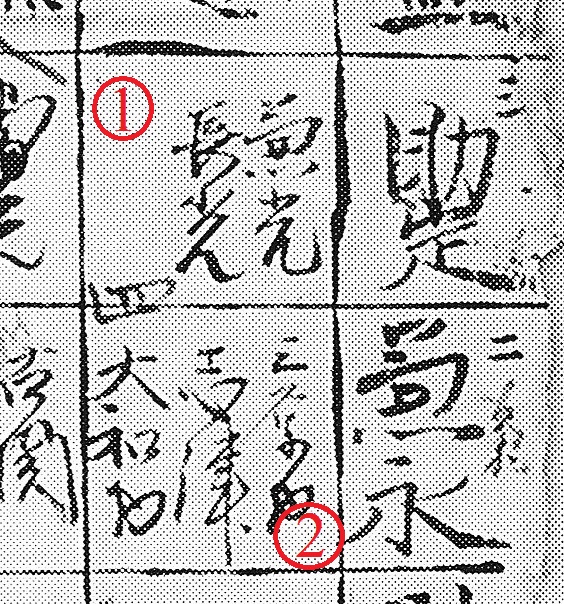
Picture 4: Detail of one of the lists. Box 1 contains the names Kanemitsu (兼光) and Nagamitsu (長光) and box 2 the names Mihara-mono (三原物), Shizu (志津), and Yamato-mono (大和物).

Session from Man’en one (1860):

1st kantei blade: Norimitsu (則光). Jôzaburô (城三郎) bade subsequently on Yoshiie (吉家), Norimune (則宗), and Motoshige (元重). Hachirô’emon (八郎右衛門) bade on Sa (左), Ko-Bizen (古備前), Kagemitsu (景光), and Norimitsu, i.e. got eventually an atari. Genjûrô (i.e. Furugaki Toshiaki) bade on Chôgi (長義) and on Sukesada (祐定). And Shinnosuke (新之丞) bade on Nagamitsu, on Sukesada but which was crossed-out and changed to Tomomitsu (倫光), and to Sukesada again.

2nd kantei blade: Tegai Kanenaga (包永) [written on the list with the wrong characters 兼永]. Jôzaburô bade on Mihara-mono, Shizu, and on Yamato-mono. Hachirô’emon bade on Ko-Seki (古関) and on Masaie (正家). Genjûrô bade on Kunihiro (国広), Nagamitsu, and Ko-Seki. And Shinnosuke bade on Katsumitsu (勝光) and on Kanenaga which was atari. Please note that in the box of the bids, Shinnojôs bid on Kanenaga is noted with the correct characters for the smith.

3rd kantei blade: Sukesada (祐定) [written on the list with the wrong characters 助定]. Jôsaburô bade on Kanemitsu and Nagamitsu. Hachirô’emon on Katsumitsu. Genjûrô on Iesuke (家助) and atari on Sukesada. And Shinnosuke bade on Kanesada (兼定) and atari on Sukesada. Please note that here too, the atari bids of Genjûrô and Shinnosuke were noted with the correct characters for the smith.

4th kantei blade: Takada Nagamori (高田長盛). Jôsaburô bade on Masafusa (正房), Kanesada (兼定), Ko-Seki, and finally on Takada. Hachirô’emon bade on Gokaji (五鍛冶, what refers to the five Kyôto-based smiths Tanba no Kami Yoshimichi, Ômi no Kami Hisamichi, Ikkanshi Tadatsuna, Iga no Kami Rai Kinmichi, and Shinano no Kami Nobuyoshi), on Sukesada, and on Sadamune (貞宗). Genjûrô bade on Shizu, Sue-Sôshû, and on Yukihira (行平). And Shinnosuke bade on Tadatsuna (忠綱), Mihara, and on Kyô-mono.
nyupic5

Picture 5: Detail of one of the lists. Box 1 shows the character da(su) and box 2 the character son(jiru).

Session from Bunkyû one (1861):

1st kantei blade: Kôshû (Ômi) Tsuguhiro (江州次弘). Genjûrô bade on “Mitsu/Kô-rui” (光類), Ko-Tamiyama (古谷山), and Ko-Seki. “Mitsu/Kô-rui” means “one of the Mitsu” and in Genjûrô’s dôzen list we find a corresponding entry which lists under the title “Mitsu/Kôrui” about 40 smiths like for example Sukemitsu (祐光), Norimitsu (則光), Katsumitsu (勝光), and Kiyomitsu (清光). No Ôei-Bizen or Kozori name like Morimitsu (盛光), Yasumitsu (康光), Moromitsu (師光), Shigemitsu (重光), or Toshimitsu (利光) appears in this list and so it refers to Sue-Bizen only. And the term “Ko-Taniyama” refers to the production site of the Naminohira school of the same name, i.e. Taniyama. Thus this entry is equivalent to “Ko-Naminohira.” The next participant Naokurô (直九郎) bade on Kiyomitsu and on Ko-Seki. Hachirô’emon did not bid on this one as he was the owner of the blade, marked with da(su) (出) which can be translated as “submitter” (see picture 5). Shinnosuke bade on Ichimonji, Aoe, and Yamato-mono. Hikoji (彦次) on Sukesada (祐定) and Norimitsu (則光), and Jôsaburô on Yamato-mono, Ko-Taniya, and on Heianjô (平安城). It is not sure which Tsuguhiro was submitted because there is no such smith using these characgters found working in kotô-times in Ômi province. There were Tsuguhiro (次弘) working in Bizen, Bitchû, and Iwami and it is also possible that this entry actually refers to a Tsuguhiro who wrote his name with the characters (次広), although no such smith is found for Ômi province either. But in Genjûrô’s kantei notes he had pointed out that the blade lacks nie, has a thick kasane, is of high quality, and shows a ko-midare which is similar to Biyen-mono. So his bid on “Mitsu/Kô-rui” is understandable.

2nd kantei blade: Motohira (元平). Genjûrô bade on the Oku school (奥), which should actually be atari, but continued bidding on Heianjô and on Mizuta-mono (水田物). Naokurô did not bid this time because he was the owner of the blade. Hachirô’emon bade on Sôshû-mono, Masayoshi (正幸), Yoshitake (吉武), and finally atari on Motohira. Shinnosuke bade on Gokaji, on o-kuni-mono (御国物, local Satsuma-shintô or shinshintô smiths), and on Banshû-mono (播州物, Harima-province work). Hikoji bade on Masayoshi (正幸) and atari on Motohira. And Jôsaburô bade on Yoshitake (吉武), Hirokuni (広国), and on Gokaji.

3rd kantei blade: Tsuguhiro (継広). Genjûrô bade again on Mitsu/Kô-rui, on the Oku school, and on Seki. Naokurô bade on Echizen-mono and on Mitsu/Kô-rui. Hachirô’emon bade atari on Tsughiro but continued to bid, for whatever reason, to o-kuni-mono, Kunihiro (国広), and on Ôsaka-uchi (大坂打, i.e. an Ôsaka-made blade). Shinnosuke did not participate as he already knew the blade, marked with the character son(jiru) (存) in the corresponding box. Also Hikoji did not bid as he was the owner and Jôsaburô bade on Seki, Sôshû-mono, and on Masahiro (正広).

4th kantei blade: Bizen Ômiya Kunimori (大宮国盛). Genjûrô bade on Echizen-mono, Taniyama, and Gokaji. Naokurô did not bid as he already knew the blade. Hachirô’emon bade on 2nd generation Shizu, on Senju’in, and on Naminohira. Shinnosuke bade on Naminohira, Echizen, and on Seki. Hikoji bade only once and on Sôshû-mono. And Jôsaburô bade on Niô (二王), Yukihira (行平), and on Kotetsu.

5th kantei blade: unsigned Echizen-mono. Genjûrô bade on Echizen-Seki, Taniyama, and Gokaji. Naokurô bade on Shimosaka (下坂) and on Hôjôji (法城寺). Hachirô’emon bade on Ôsaka-uchi, Shimosaka, and Takada. Shinnosuke did not bid as he was the owner of the blade. Hikoji bade on Echizen-Seki. And Jôsaburô bade on Masahiro (正広), Seki, and on Ôsaka-uchi.

Also interesting to observe on these two lists are the numerical remarks in red ink. For example we find the character for “ten” (, 十) written over Hachirô’emon’s first-bid atari on Tsuguhiro at the Bunkyû one nyûsatsu-kantei session. So an atari at the first bid counted ten points. The number eight (hachi, 八) is found over Genjûrô’s Oku bid on Motohira and on Hikoji’s second atari bid on Motohira. That means a dôzen at the first bid and an atari at the second bid counted both eight points. Four points were given for example to Shinnosuke when he bade at the second round on o-kuni-mono for Motohira. Also four points were given to Hachirô’emon when he got atari for Motohira at the fourth round and to Jôsaburô for his Yamato-mono bid after the third round for the Kanenaga blade. However, what we don’t know is why some kept bidding even after receiving atari and why on three occasions four rounds were allowed when the maximum number of bids is in all other cases three. Maybe if you were close with your last bid you got a final chance but as all these three cases are only seen at Hachirô’emon, it is also possible that he was a beginner and got thus by default four bids. Another questionable point is why the character da(su) was written over Genjûrô’s bid box for the Ômiya Kunimori blade. If it was his blade, why did he bid three times not even close to atari? So maybe this da(su) must had been some kind of mistake. Or the blade was signed “Kunimori” and Genjûrô did not know which Kunimori and submitted it therefore to see the opinion of the other participants or of the judge. Anyway, Shinnosuke was the winner of the Man’en one nyûsatsu-kantei session. His final score of 20 points (弐拾) is written on top of his column. Well, the Bunkyû one session did not show any winner. Maybe because it was thought that this session was kind of unbalanced as it consisted largely of submitters and of participants who already knew the certain blades.

Let us go over to Genjûrô Toshiaki’s Katana Mekiki Ichijô Oboetome notes. We find therein 53 blades and it is interesting to see that most emphasis was laid on the hamon and bôshi. That means measurements, sugata, nakago finish, and hataraki are not addressed at all. Also the jihada is hardly mentioned, just four times we read masame-hada and matsukawa-hada. But we find for example several times the entries nuritô (ぬりとふ) and jiiro-migoto (地色見事, lit. “steel color magnificent”). It is assumed that, written with the kanji (塗砥), the first term refers to a simple Edo-period way of finishing, namely by applying hazuya over both ha and ji after the blade was polished to the uchigumori step. Incidentally, hazuya is usually used for the ha only. So at nurito (which means literally “greased/greasy/smeared/blurred polish”) not too much attention was paid to the appearance of the blade, but we learn that also such pieces were submitted to nyûsatsu-kantei, causing problems for the participants in properly judging the blade in question. What Toshiaki also noted in his Katana Mekiki Ichijô Oboetome was, on 29 occasions, the name of the owner of the blade and which ones he owned himself and submitted to one of the nine nyûsatsu-kantei sessions (eleven pieces). So he practically provided at least one blade per session and sometimes even two. Some of the 29 recorded names appear in the retainer list of the Miyakonojô-Shimazu family and were rather high-ranking samurai. This shows us how much Furugaki Toshiaki was trusted to loan him precious blades for his kantei sessions. When it comes to the balance of the sessions, we arrive at an about 50:50 ratio of kotô to shintô, although the majority of the kotô blades are Muromachi and only a handful dates back to Kamakura or Nanbokuchô times. For example and apart from the aforementioned Tegai Kanenaga and Ômiya Kunimori, we find in Toshiaki’s kantei notes for Kamakura and Nanbokuchô a Senju’in katana, an Akihiro tantô, a Hiromitsu wakizashi, a Sa wakizashi (mumei, attributed), a Sadamune katana (mumei, attributed), and a Shizu katana (also mumei and attributed). As for shintô, we find names like Dewa no Daijô Kunimichi, Ikkanshi Tadatsuna, Ômi no Kami Hisamichi, or Hizen Yukihiro, but no blades of local smiths like Izu no Kami Masafusa, Mondo no Shô Masakiyo, or Ippei Yasuyo. Instead we find relative many blades of smiths from the Oku school, like Tadashige (忠重), Tadakane (忠金), Kunihira (国平), and the aforementioned Motohira. Also no local Naminohira blades are found, neither for kotô nor for shintô, even if some of the participants were bidding on them on several occasions. Maybe the famous award winning smiths Mondo no Shô Masakiyo and Ippei Yasuyo were just too high-priced for local samurai. And except for the few Kamakura and Nanbokuchô-era smiths, there are hardly any big names found in Toshiaki’s notes what tells us apart from the borrowed blades about the average quality of rural late Edo period nyûsatsu-kantei sessions. In other words, there were just no large numbers of “daimyô quality” blades available but it was obviously tried hard to display the best of what was going round among middle and lower-ranking samurai.
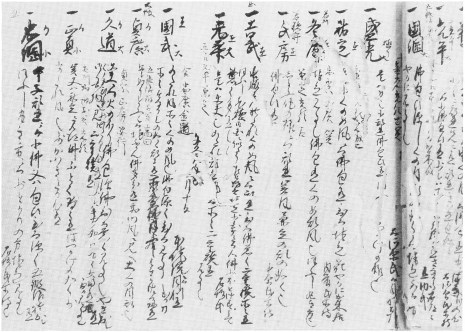
 nyupic6

Picture 6: Example page from the Katana Mekiki Ichijô Oboetome.
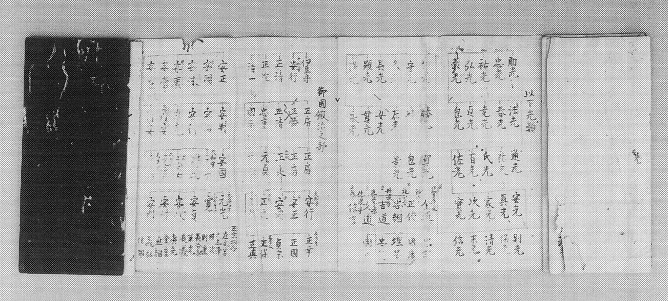
 nyupic7

Picture 7: The Tôken Nyûsatsu Kantei Dôzen Chô.

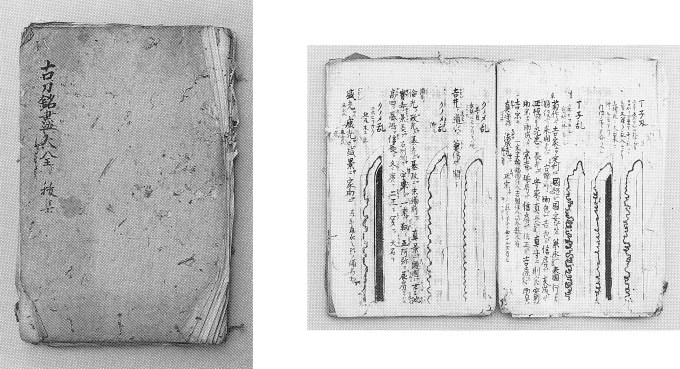
Toshiaki’s dôzen list is dated Ansei three (安政, 1856), that means he copied or compiled the list for his own use when he was just 18 years old. The way it is bound and folded shows us that it was designed for single-handed use. So we can assume that Toshiaki used it as a quick reference browsing through it with the left hand whilst holding the sword in the right. It does not only contain a simple dôzen list but also presents smiths sorted according to certain features like “shallow hi,” “thick kasane,” “unokubi-zukuri interpretation,” “high shinogi,” or “koshiba or midareba from the center of the blade upwards,” and it is easy to understand how much effort Toshiaki put into this document to make it an as useful as possible reference. As for the abbreviated copy of the Kotô Mei Zukushi Taizen Nukishô, we learn that he basically copied volumes 1 and 4 of the Kotô Mei Zukushi Taizen which contain the chapters “Basics of Sword Judgement,” “Step-by-step How to Judge a Sword,” “Differentiation of kotô and shintô,” “Superior Smiths from all Provinces”, and “Average and Inferior Smiths.” He diligently copied the pictures and paid much attention to the accurate reproduction of the hamon and bôshi.
nyupic8

Picture 8: Cover and sample page of Toshiaki’s Kotô Mei Zukushi Taizen Nukishô.


In conclusion it can be said that although the data seems to be quite limited at a glance, i.e. just a few sheets and booklets written by a rural lower-ranking Satsuma-samurai, it gives us nevertheless quite an insight into late Edo period kantei sessions. We learned that blades were borrowed from higher-ranking, mostly local samurai, that it was tried that each session was balanced and that at least a minimum of high-quality blades was presented, that points were awarded and a winner was selected, that some of the participants made minute notes of the kantei blades, and that the sessions were held at irregular intervals but several times a year (in Toshiaki’s kantei notes we find the dates fall Man’en one, and first month, fourth, sixth month, and seventh month of Bunkyû one) and at different locations with different persons acting as judge. So apart from the private aspect of holding the meetings in the house of the organizer, these nyûsatsu-kantei sessions were held pretty much the same way as we do it today. So if you are attending a meeting of one of the sword associations or local sword clubs and listen to the discussions about how to get grasp of high-quality blades and who can bring what for the next kantei, bear in mind that it had always been that way and that also Edo-period samurai put on their pants/hakama one leg at a time.
Sword-related Japanese Sayings 2

After basically just announcements and book presentations over the last weeks and months, I would like to expand my entry from January this year which was on sword-related Japanese sayings. As mentioned in the first article, some of these sayings might not be that common at all. Anyway, here we go:

aikuchi ni tsuba o utta yô (七首に鐔を打ったよう) – Literally “like mounting a tsuba to an aikuchi.” As an aikuchi comes without a tsuba, this saying is used when something does not match. Variants are kogatana ni tsuba (小刀に鐔, about “like a tsuba on a kogatana”) and kogatana ni kin-tsuba o utta yô (小刀に金鐔を打ったよう, lit. “like mounting a golden tsuba to a kogatana”).

akunin wa katana no tameshi-mono (悪人は刀の試し物) – This saying means about “this bad guy would make a fine test object for my sword” and is rather self-explanatory.

bushi wa katana, hyakushô wa kuwa (武士は刀、百姓は鍬) – Literally “the bushi has the sword and the farmer has the hoe” It means that everyone has a main thing or field where he or she focusses on and/or is good at. The saying might also be used like the English “Cobbler, stick to your last.”

chônin no katana-konomi (町人の刀好み) – This phease means literally “the sword love of the merchant” and is generally applied to something which is unworthy of or ill-matched.

dojô-shiru ni kin-tsuba (泥鰌汁に金鍔) – Literally “loach soup and golden tsuba,” a phrase which points out a very bad match. Please note that the term kin-tsuba is not used literally in this phrase. It refers to a bean paste-filled dessert which has the shape of a tsuba.

dosu no katana de dosu no kobu(どすの刀でどすの首) – This saying means “to give tit for tat” or also “to beat the enemy with his own weapons.”

emi no uchi no katana (笑みの中の刀) – Literally “sword behind a smile.” Variants of this saying are shôchû ni tô ari (笑中に刀あり), shôchû ni yaiba o togu (笑中に刃を研ぐ, lit. “sharpening the blade whilst smiling”), and shôri ni tô o kakushi deichû ni hari ari (笑裸に刀を隠し泥中に針あり, “a sword hidden in the smile and a fish hook hidden in the mud”) and they apply to a person who seems calm and friendly on the outside but who is actually mean on the inside or following evil plans. An English equivalent is probably “wolf in sheep´s clothing.” Please note that the character (中) of the first variant is read as uchi and not chû or naka. It is sometimes also replaced by (内).

entô-ikkatsu (鉛刀一割) – Literally “Splitting something with a lead sword.” A saying which has the same meaning as the English “even a blind hen sometimes finds a grain of corn.” But the saying is also used in the context of something difficult which worked at the first try.

ese-zamurai no katana ijiri (似非侍の刀いじり) – Literally “Only the false samurai is meddling with the sword.” The proverb means that it is mostly cowards who threaten people or act wildly and brandish their weapons.

funabata ni kizami o tsukete katana o tazuneru (船端に刻みをつけて刀を尋ねる) – Literally “looking for a sword where you made a mark at the broadside of a ship.” It means if you loose your sword whilst on a ship, it doesn´t make much sense to mark the spot where you lost it on the ship itself as it moves. A variant is funa ni kizamite ken o motomu (船に刻みて剣を求む) and these sayings are applied when someone tries to preserve some old tradition without recognizing that times have changed too significantly for preserving this tradition.

goke-zaya de saya-nari ga suru (後家鞘で鞘鳴りがする) – Literally “the widow scabbard makes noise.” The phrase refers to the fact that a leftover saya, so-to-speak a “widow saya,” will never fit exactly when used for another blade and thus the sword makes a grinding noise (saya-nari, 鞘鳴り) when drawn. The saying goke-zaya de saya-nari ga suru means if there is constantly some fighting within a group of people or a family.

hiroki ie wa saya-nari (広き家は鞘鳴り) – Literally “even a spacious house can cause scabbard noises.” This phrase refers as mentioned above to the grinding noise a sword makes when drawn from a unmatching saya. It is used when people get a too big house, e.g. when it doesn´t go hand in hand with their status or money or how they live.

jaken no yaiba (邪見の刃) – This phrase means that someone eventually got hurt because of someone´s wrong or evil thoughts.

katana, aruji o erabu (刀、主を選ぶ) – This saying means literally “the one with the sword is the head/master” or “the sword makes the head/master” and means that it actually does matter who is chosen for a certain task or post.

katana ni kakete (刀に懸けて) – Literally “depending on one´s sword.” This phrase means doing something by force.

katana no ha watari (刀の刃渡り) – This phrase goes back to certain fakir-like performances by Buddhist ascets who walked barefootedly over sword blades. It means doing something very dangerous similar to the English phrase “balancing on a razor edge” or “to walk a tightrope.” A variant is katana no ha o ayumu(刀の刃を歩む) which means literally “to walk on a sword blade” too.

katana no kizu wa naoseru ga kotoba no kizu wa naosenai(刀の傷は治せるが言葉の傷は治せない) – “A sword wound can be healed but a wound caused by words not.” This saying is also rather self-explanatory and means that physical injuries might heal fast but mental wounds might never heal.

katana no sabi (刀の錆) – This phrase means literally “the rust of the sword.” As blood causes rust, it is a metaphor for killing someone or being killed but was and is also used in a derogatory manner for someone who isn´t even worth making your sword dirty, like “he/she isn´t worth it.” Variants of the latter context of katana no sabi are katana-yogoshi (刀汚し) and katana no kegare (刀の汚がれ) which mean, expressed very rudely, “you ain´t worth shit.”

katana no sabi wa katana yori izuru (刀の錆は刀より出ずる) – Literally “The rust of the sword comes from the sword itself.” The saying means “being born evil.”

katana-ore ya-tsukiru made (刀折れ矢尽きるまで) – Literally “until your sword breaks and you run out of arrows.” It means to fight until you run out of “weapons” or rather “arguments,” i.e. to be at your wit´s end. It also means to face a complete loss.

katana o urite kôshi o kau (刀を売りで子牛を買う) – Literally “selling your sword and buying a calf.” A variant is ken o uri ushi o kau (剣を売り牛を買う) which means literally “selling your sword and buying a cow.” The saying means to put away arms and live peacefully from now on.

katana-torumi mo kuwa-torumi mo (刀取る身も鍬取る身も) – This saying means literally “wearing the sword and using the hoe” and means being equally a white-collar and a blue-collar worker.

katana wa nukazaru ni ri ari (刀は抜かざるに利あり) – Literally “Advantage/benefit without drawing the sword.” The proverb means solve something by avoiding unnecessary force. It also means that something turns out fine because you left “your sword in the scabbard,” i.e. because you were patient and have not jumped the gun. A variant of this saying´s latter context is nukanu-tachi no kômyô (抜かぬ太刀の高名) which means literally “the fame of the undrawn sword.”

kojiri ga tsumari (鐺が詰まる) – Literally “the kojiri is blocked” and used to express if one is in a tight corner, in deep water, in a fix and so on.

kojiri o toru (鐺を取る) – Literally “to grasp the kojiri,” this phrase means to put an end to something.

kojiri-togame (鐺咎め) – Literally “blame the kojiri.” The phrase goes back to that in feudal times, hitting someone´s saya in passing ended usually in a duel or an argument. Kojiri-togame means now “to make a mountain of a molehill.” A variant with the very same meaning is kojiri o hirou (鐺を拾う) which means lit. “to find the kojiri (of another person).”

komo o kaburu ka kin-tsuba sasu ka(薦を被るか金鍔差すが) – Literally “wearing a reed mat or a golden tsuba” and equivalent to the English “to win the mare or use the halter.”

kotoba ni saya ga aru (言葉に鞘がある) – Literally “words have a scabbard” and with the meaning “to be evasive, to be not entirely truthful, to not be frank.”

Masamune mo yaki-otsureba kugi no ne (正宗も焼き落つれば釘の値) – This saying means literally “even a Masamune is not more than a nail after lossing its tempering” and is applied to someone who is no longer as strong or powerful as he used to be.

Masamune no katana de daikon-kiru (正宗の刀で大根切る) – Literally “cutting white radish with a Masamune sword.” The saying means “doing something the wrong way.” A variant is Masamune de takigi o waru (正宗で薪を割る) which means literally “to chop wood with a Masamune.”

Masamune no katana mo tsukaite shidai (正宗の刀も使い手次第) – Literally “Even a Masamune sword needs a master swordsman.” This proverb is applied to someone who is not able to show his true value regardless of what means and resources he has.

me no saya o hazusu (目の鞘を外す) – Literally “removing the scabbard from your eyes.” This phrase means “to watch carefully” or “to take good care.”

namari no katana de hito o kitta yô ni (鉛の刀で人を切ったよう) – Literally “like killing someone with a sword of lead.” The phrase means something is too soft for a certain task and bends and is used like “this will probably not achieve much” or “this wouldn´t be of much benefit.”

onoga katana de onoga kubi (己が刀で己が首) – Literally “Taking your head with your own sword.” It means to get into trouble, because of wrong decisions for example. A variant is waga katana de waga kubi kiru (我が刀で我が首切る).

Satsuma no saya-wari (薩摩の鞘割り) – Literally “the scabbard breaking of Satsuma.” The saying applies to an irreversible decision. It goes back to the fact that drawing a sword was a decisive thing for a Satsuma-samurai. And some even broke in half their saya after drawing their sword to underline for the opponent and/or bystanders that from now on there was no way back for him, even if the matter ends in seppuku.

saya-hashiru (鞘走る) – This term had the meaning of a sword gliding out of its scabbard and is now used as “jump to conclusions” or “the tongue works faster than the mind.” Sometimes also used in the long variant saya-hashiri yori kuchi-bashiri (鞘走りより口走り, lit. “words faster than a sword gliding out of its scabbard”).

saya o toru (鞘を取る) – Literally “taking the saya.” This phrase means “to charge a fee” or “to receive a commission.”

saya wa naku tomo mi wa hikaru (鞘は無くとも身は光) – Literally “the blade shines without its scabbard,” meaning about the same as “it is the inner values that are important,” or if you want the opposite of “a fair face may hide a foul heart.”

tsuba-giwa (鍔際) – Literally “edge of the tsuba” with the meaning of a “critical moment.” It goes back to the moment when an opponent´s blade hits one´s tsuba. Please note that this term is usually written with the characters shown and not with the character (鐔) for tsuba.

tsuba o waru (鐔を割る) – Literally “splitting/breaking tsuba”, a phrase for a very intense fight.

yoki-takumi to iedomo katana no ayamari naki ni arazu (良き工といえども刀の誤りなきにあらず) – Literally “even a skilled craftsman is not immune to making a sword with flaws,” this saying means “even a great person makes mistakes.”

yumi wa fukuro ni tachi wa saya (弓は袋に太刀は鞘) – Literally “the bow is in its bag and the sword in its scabbard.” This saying refers to restored peace after times of turmoils.

Tameshigiri – The History and Development of Japanese Sword Testing

It´s done, the Tameshigiri book is out now!

As stated in the preface of several of my other publications, I am always trying to fill gaps and some of the blank spots in the area of non-Japanese sword-related publications. The legendary sharpness of Japanese swords is widely known, and through the activities of various martial arts practitioner’s information on tameshigiri has also become more accessible in the recent years. But, for a large part, this information focusses on modern cutting tests and only briefly discusses the historical aspect. As far as sword collectors and enthusiasts are concerned, the subject of tameshigiri has been approached by several experts in the past, but here too information is rather limited. Because this status-quo of information, being only available on certain aspects of sword or cutting tests, had prevailed virtually unchanged for decades, several misunderstandings of tameshigiri had become firmly anchored in the minds of both martial artists and collectors.

This publication systematically processes this subject for the first time to provide an, as complete as possible, overview of the historical aspect of tameshigiri. Not only are the developments from mere sword tests to systematic cutting tests under repeatable conditions are addressed, it also explains the sword testers, the various cuts and set-ups for cuts, and the practice of recording cutting test results on sword tangs for example. It is rounded-off by a reference section which provides examples of tameshi-mei from more than forty different sword testers.

To conclude, I would like to express my sincere thanks to all those who have provided me with a wealth of reference material. This was an incredible experience because I received support from all parts of the world which confirmed my belief that this book was long overdue. Without your support this project would probably have remained on my to-do list as I did not want to publish an incomplete book on this subject which again would have left more questions than answers.

In this sense I hope that Tameshigiri – The History and Development of Japanese Sword Testing meets the high expectations of such a publication and serves this and future generations of nihontō enthusiasts and martial artists likewise as a valuable reference.

Hardcover copy. 6″ x 9″, 378 pages (b/w) for 69.90 USD is available here.

And the eBook for 29.90 here.

TameshigiriCover

You will have noticed that the pre-order option was for a slightly lower price. That was because I first estimated to just scratch the 300 pages mark but after incorporating more reference material and adding several chapters, the publication arrived at 378 pages. But please, none of the pre-orderers have to pay the extra 10 USD. See this as little discount for supporting the project with your pre-order. I will ship the signed books as soon as my author´s copies arrive here and I will post a little note here when done. Please note that I know from experience that Lulu´s shipment to Austria is rather slow so this might take a while.

PS: I would be most grateful if the book is ordered directly via Lulu.com because Amazon (where it should appear in a few days) deducts almost 3/4ths of the royalties per sold copy! Thank you very much.