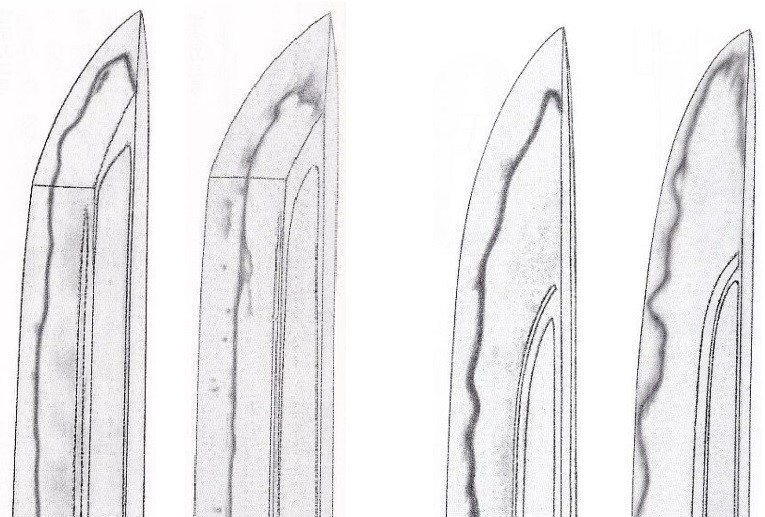
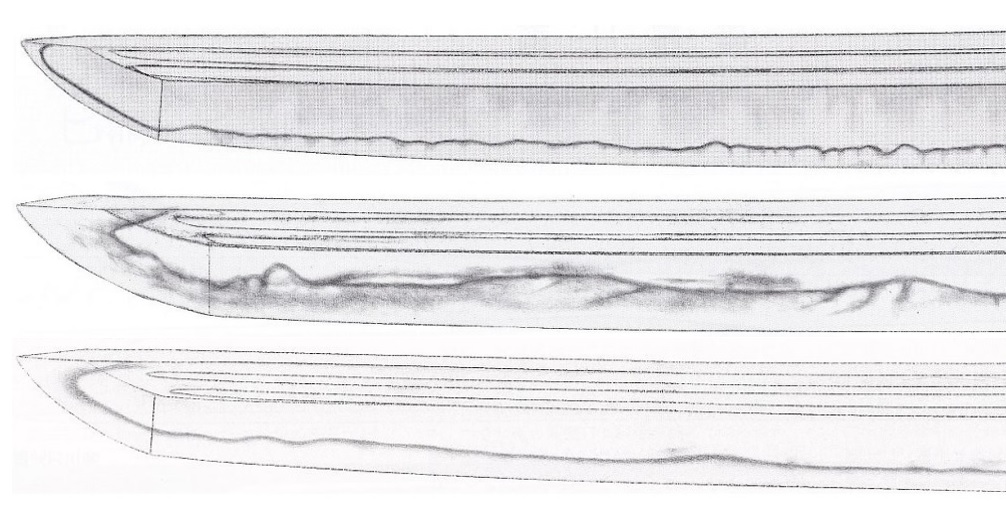
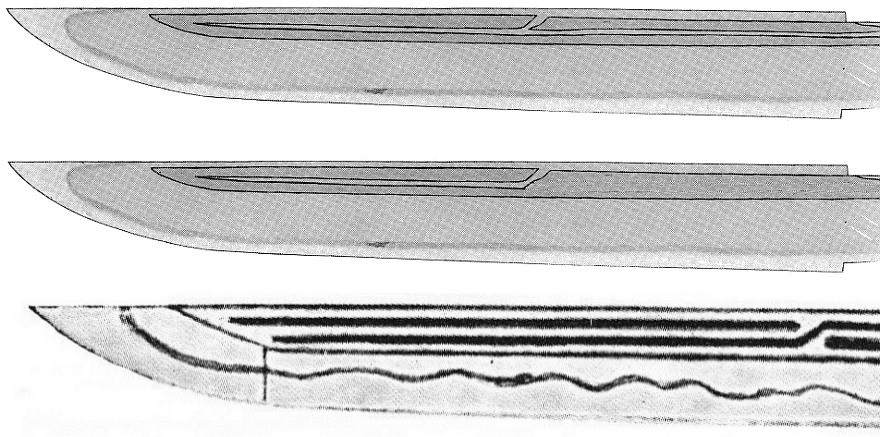
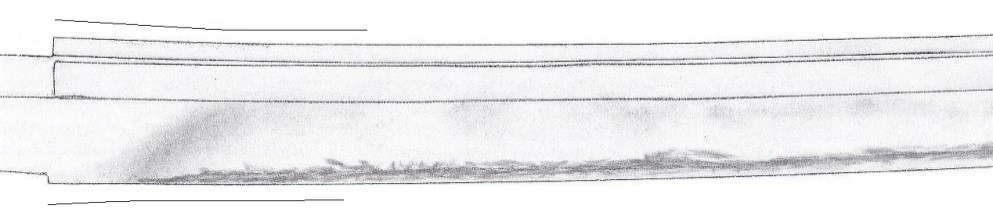
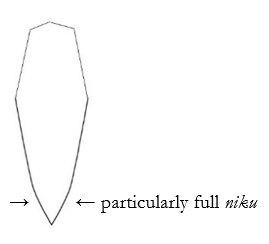
KANTEI 1 – SUGATA #5

A few weeks ago, we have ended the basics when it comes to the sugata of a Japanese sword, that means the names and characteristics of the different elements of a blade. Now and over the next few chapters, I want to introduce on a chronological basis the differences in blade shapes, or in other words, doing the actual sugata-kantei.

*

1.8 Heian period (794-1184)

The Japanese sword got its curvature somewhere around the mid-Heian period, i.e. around the 9th and 10th century BC. As these earliest nihontô are an utmost rarity and virtually to impossible to handle and find on the market, they shall be ruled out for our considerations on sugata. So we start with the earliest “tangible” time what is the late Heian period, i.e. the 11th and 12th centuries. It goes without saying that even from those times it is very rare to study and purchase blades in their original condition as most of them either hold a status like kokuhô or jûyô-bunkazai and are thus only accessible in Japan and at special occasions, or were shortened and/or are polished down. What makes now a typical late Heian-period sugata? Blades from that time are slender, taper noticeably, have a deep koshizori, funbari, and a ko-kissaki, an interpretation which makes them look highly elegant, noble, or graceful, depending on what term you want to use to classify such a shape. In Japanese you will find terms and formulations like yasashii (優しい), yûbi (優美), yûga (優雅), kôshô (高尚), koten-teki (古典的), or hinkaku ga takai (品格が高い) to refer to a classic late-Heian period sugata. Another Japanese term which might be found in preferrably older publications is in no tachi (陰の太刀). It means “slender tachi,” or “unobtrusive tachi” if you want, but has to be understood as the opposite of the yô no tachi (陽の太刀), the “magnificent” or “powerful tachi,” as here the yin and yang (Japanese in and ) terminology was used to distinguish between two fundamentally different tachi shapes. In late-Heian times, the classical tachi was the weapon of higher-ranking bushi and was thus wielded from horseback. Accordingly, unshortened blades from that time have a somewhat longer nagasa of about 80 to 85 cm. Again, I don’t want to go too much into historic details in this series on kantei so please forgive me for the lack of differentation here and there.

Let us stay with the sori for a while. I have mentioned that blades from that time show mostly a koshizori, that means the center of the curvature is towards the base, often right at the area of the habaki. But not only that, we can also observe that the curvature continues into the tang, i.e. also the nakago curves gently. An additional way to describe a koshizori which is relative often found in Japanese sources and which had been mentioned above is to say that the sori “bends down” towards the tip, saki ni itte fusaru (先に行って伏さる) or saki ni itte utsumuku (先に行って俯く). This just means that the sori does not increase again as it would be the case at a toriizori but runs out gently from the deepest curvature, the base, towards the tip.

Representative schools and smiths for a classic late-Heian period sugata are: Early Kyô-mono like the Sanjô (三条) school (Munechika [宗近], Yoshiie [吉家], Arikuni [有国], Arinari [有成]), Gojô (五条) school (Kanenaga [兼永], Kuninaga [国永]), or Awataguchi (粟田口) school (Kuniie [国家], Kunitomo [国友]); for Yamato the early Senju´in (千手院) school (Yukinobu [行信], Yukiyoshi [行吉]); the Ko-Bizen (古備前) school (Tomonari [友成], Masatsune [正恒], Takahira [高平], Kanehira [包平], Sukenari [介成], Sukehira [助平]); the Ko-Aoe (古青江) school (Yasutsugu [安次], Moritsugu [守次], Masatsune [正恒]); the Ko-Hôki (古伯耆) school (Yasutsuna [安綱], Ôhara Sanemori [大原真守], Moritsuna [守綱]); early northern Ôshû-mono like the Môgusa (舞草) school (Yasufusa [安房], Takeyasu [雄安], Morifusa [森房], Arimasa [有正]); the Ko-Kyûshû smiths like Sô Sadahide (僧定秀), , Chôen (長円), Ryôsai (良西); and the Ko-Naminohira (古波平) school (Masakuni [正国], Yukiyasu [行安], Yukimasa [行正]).

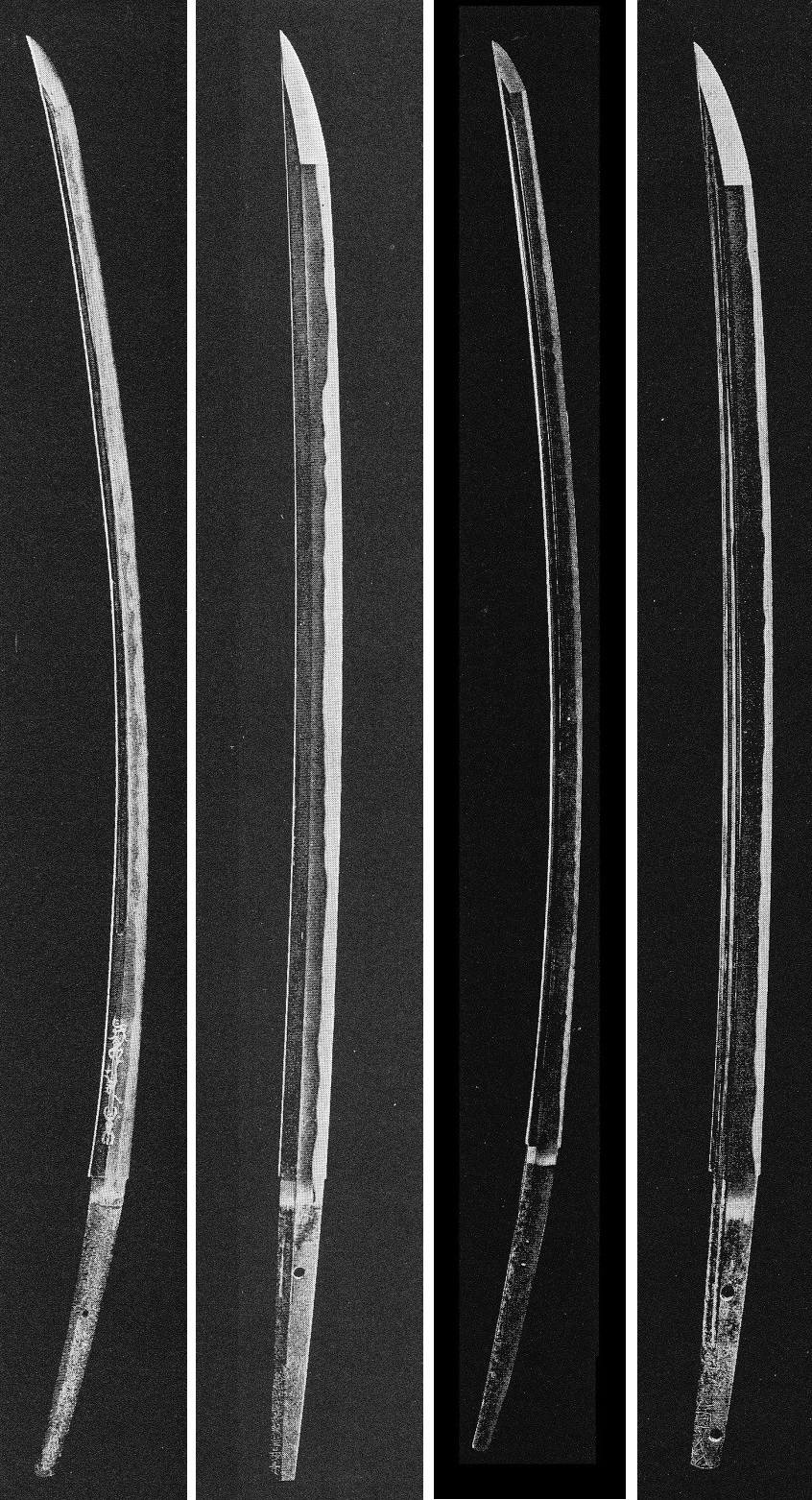
But it has to be mentioned that even if all these smiths are dated to the late or end of Heian period, we can see certain differences when it comes to their sugata. In other words, not all of these smiths focused solely on slender classic late-Heian period tachi shapes. For example Ko-Hôki Yasutsuna was known for making somewhat more robust and wider blades. And an extreme example is the Kyûshû Chikugo smith Miike “Tenta” Mitsuyo (三池典太光世) who made noticeably stout tachi for his time. These differences in shape might go back to the different production sites and the different clientel but what must not be forgotten is that we hardly have any reliable dates when it comes to such early smiths. For example, old sword documents date Sanjô Munechika traditionally around Ei´en (永延, 987-989) but more recent and comparative studies suggest that he was rather active at least a century later. The same applies to Yasutsuna who is listed as being active around Daidō (大同, 806-810) or Kōnin (弘仁, 810-824), eras when the Japanese sword was still in its uncurved chokutô phase. Or Miike Tenta Mitsuyo who is listed, depending on the source, around Kōhei (康平, 1058-1065), Jōhō (承保, 1074-1077), or Heiji (平治, 1159-1160).

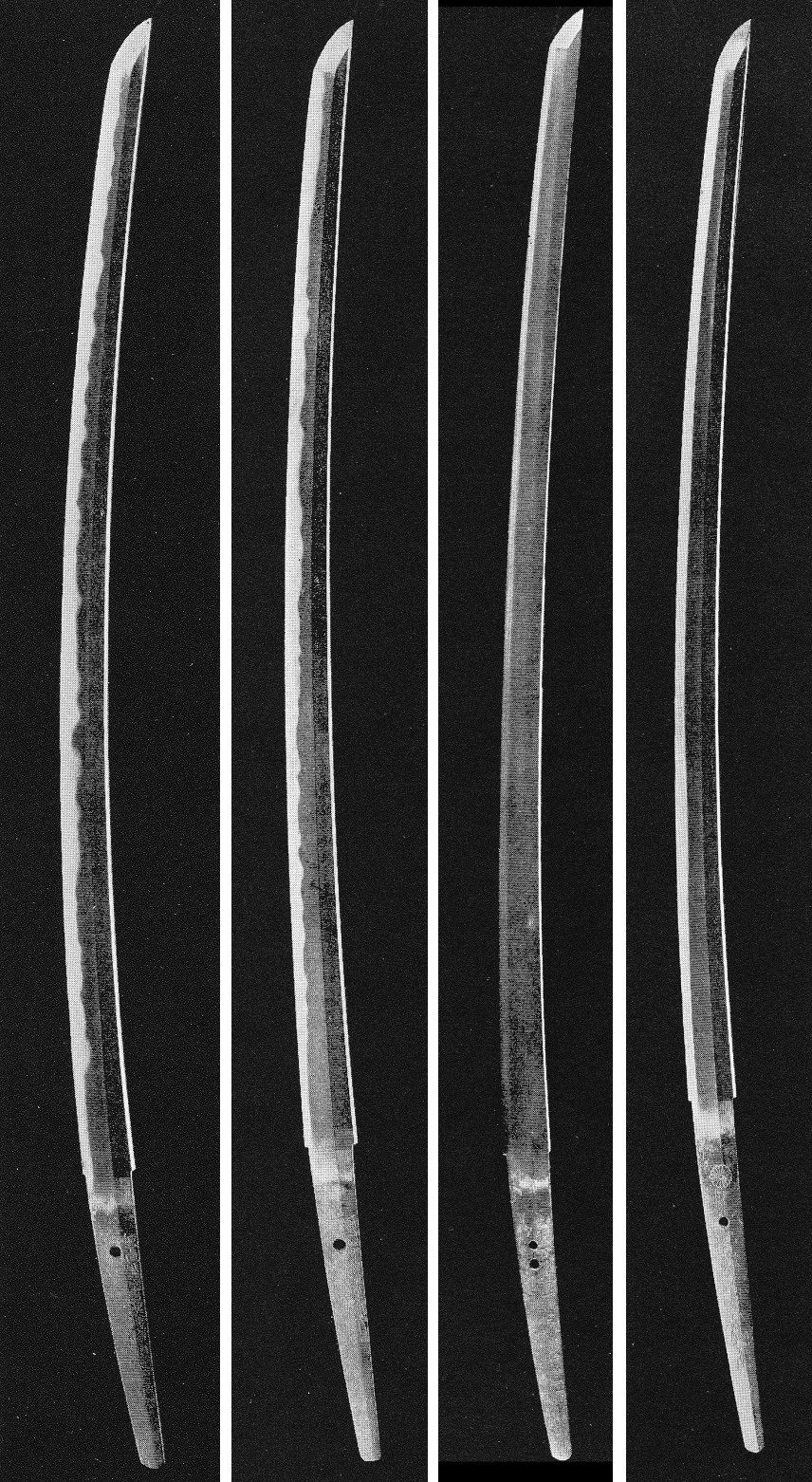
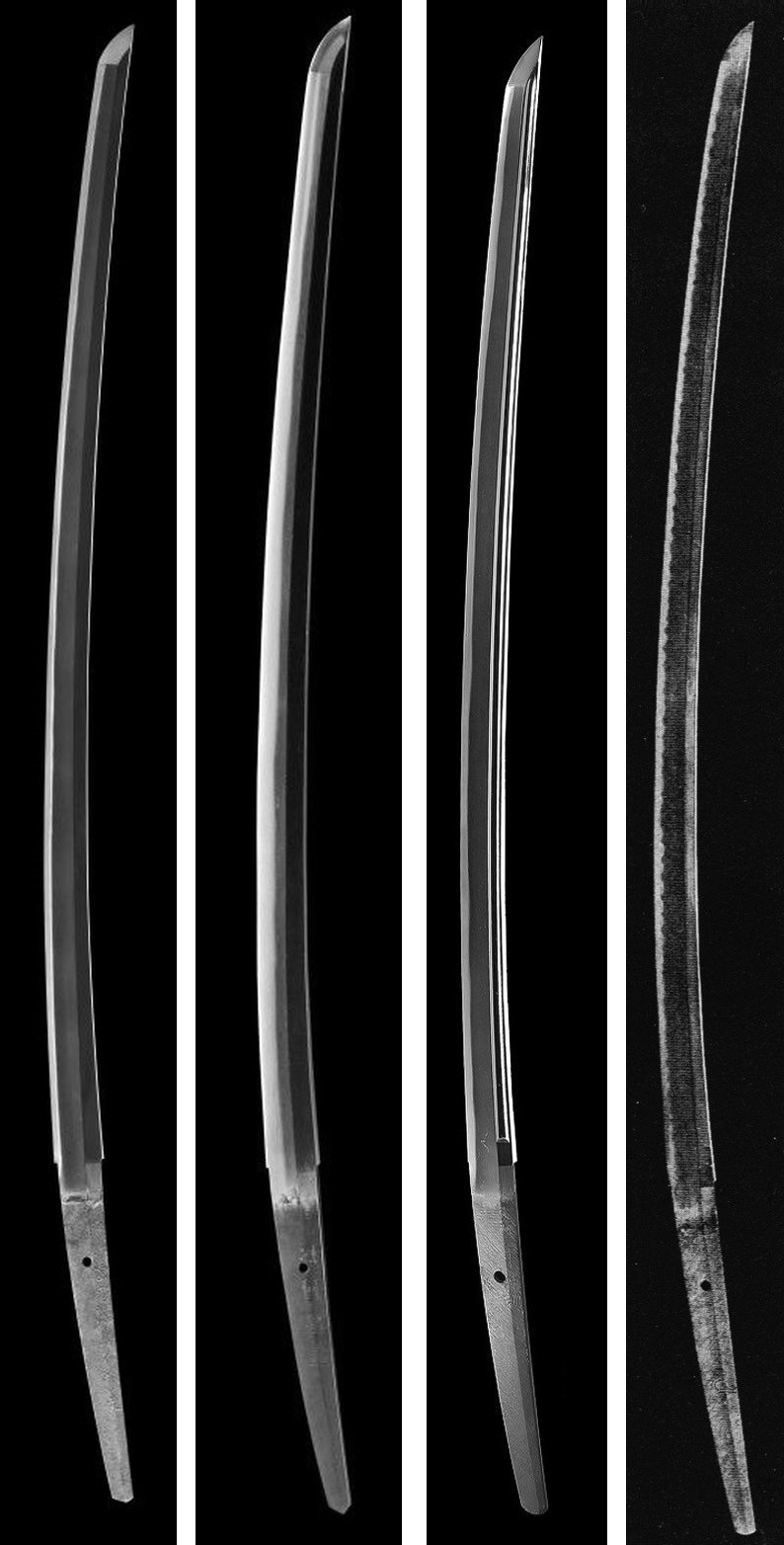
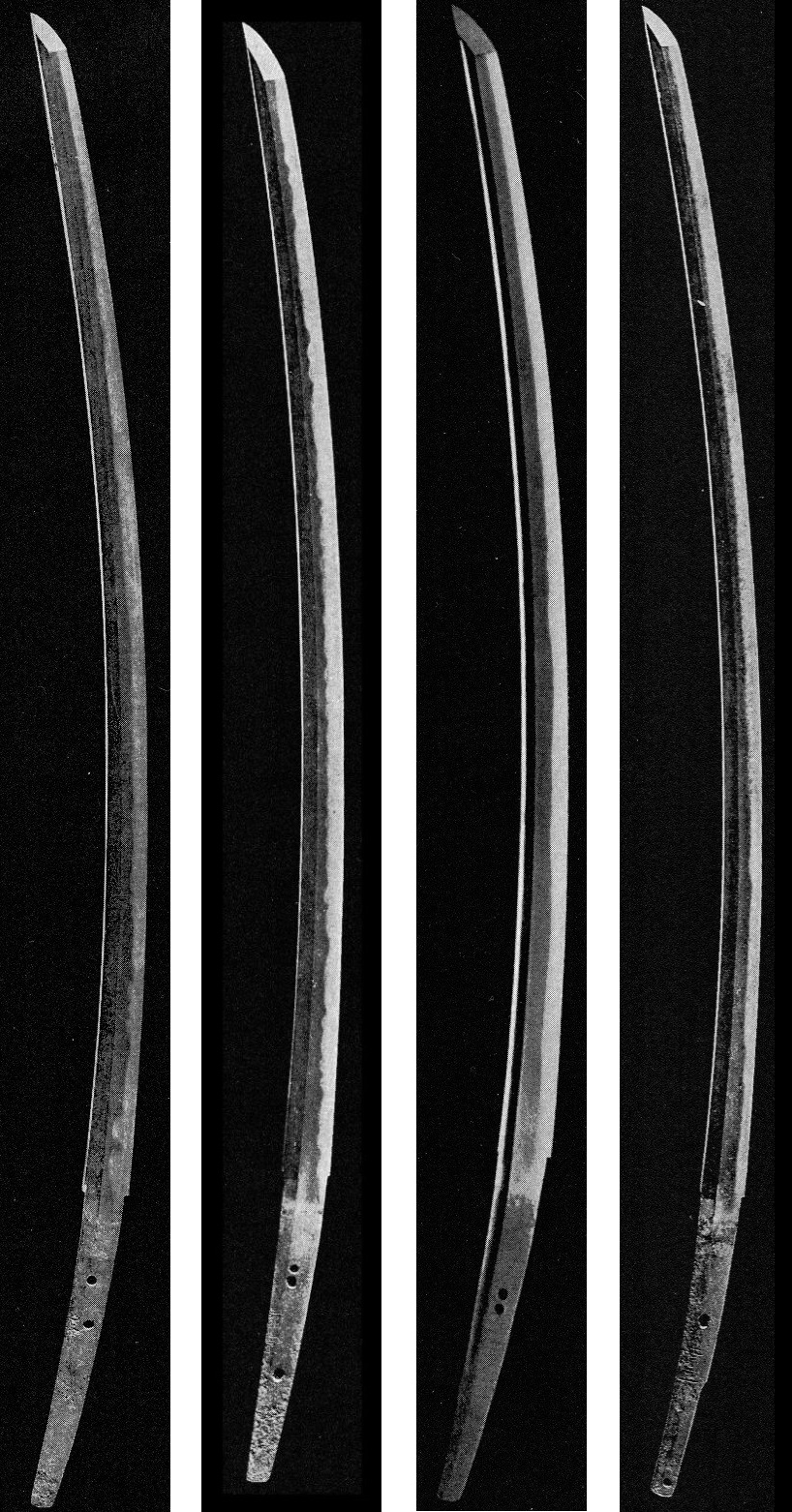
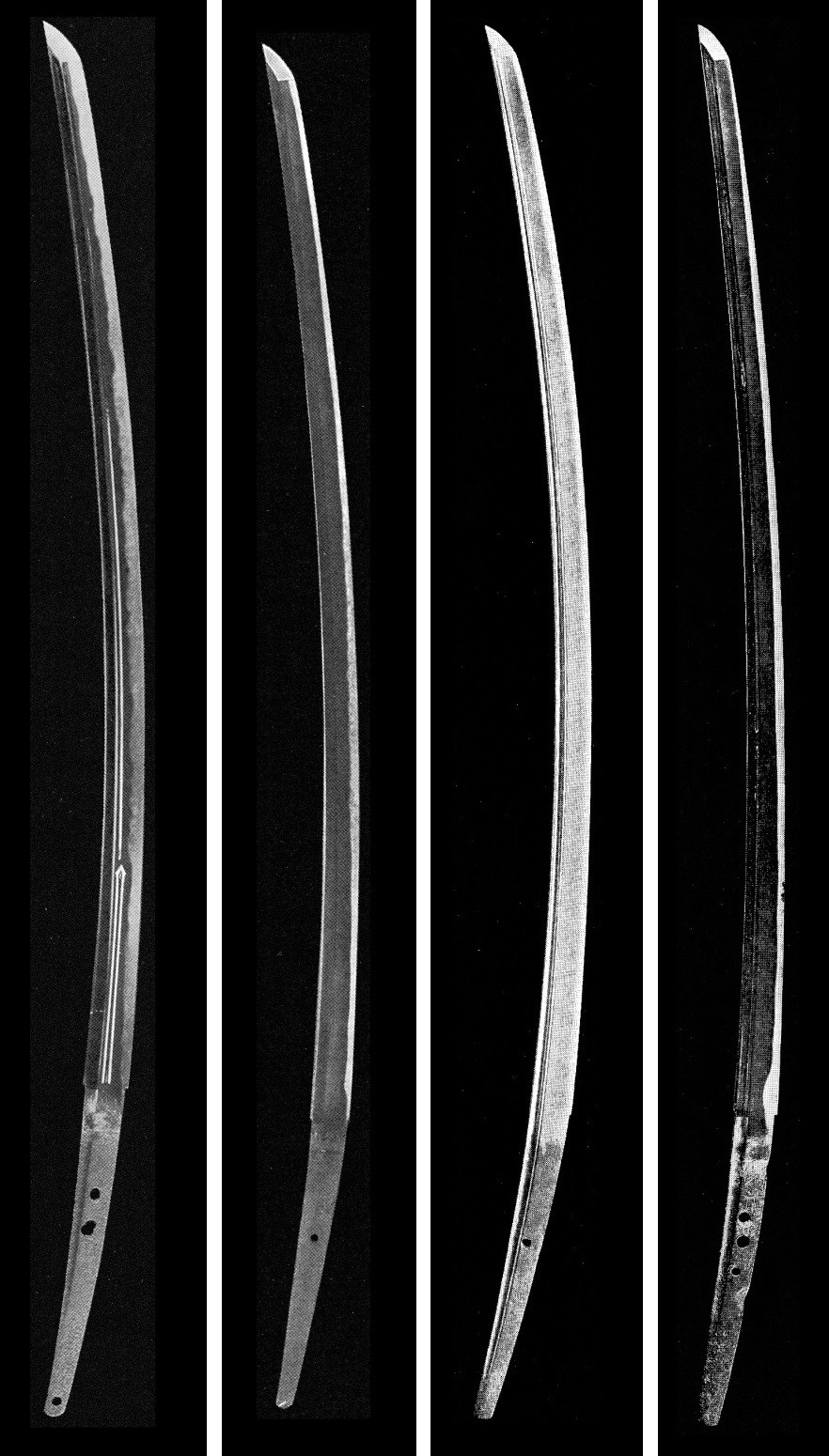
In the following I would like to introduce pictures of blades from that time. Please take your time and internalize their elegance and gracefulness and also take a look at the nagasa. Although chances to handle blades like these in their original condition are as mentioned very rare, you will recognize them when holding a noticeable long but slender, elegantly curved blade with quite a smallish kissaki in hand. That means, with such a blade you know that you might be in the realm of the late Heian period or that you are facing a later work that tries to reproduce such a very classical sword. And in the latter case, i.e. when just the sugata suggests late Heian but everything else shintô or shinshintô for example, you might be able narrow down the kantei via remembering who was known in this or that time for making copies of very classical blades. But I will point out such “peculiarities” in the chapters on the schools and smiths.

Heian1

Picture 1: late-Heian period tachi (from left to right):
meibutsu Mikazuki-Munechika (三日月宗近), mei “Sanjô” (三条), nagasa 80.0 cm, sori 2.7 cm
meibutsu Tsurumaru-Kuninaga (鶴丸国永), mei “Kuninaga” (国永), nagasa 78.8 cm, sori 2.7 cm
jûyô-bunkazai, mei “Aritsuna” (有綱), Ko-Hôki, nagasa 83.4 cm, sori 3.2 cm
jûyô-bunkazai, mei “Yukiyasu” (行安), Ko-Naminohira, nagasa 73.9 cm, sori 2.7 cm

Heian2

Picture 2: late-Heian period tachi (from left to right):
kokuho, mei “Tomonari saku” (友成作), nagasa 80.0 cm, sori 2.9 cm
kokuhô, mei “Sanetsune” (真恒), Ko-Bizen, nagasa 89.7 cm, sori 3.7 cm
meibutsu Dôjigiri-Yasutsuna (童子切安綱), mei “Yasutsuna” (安綱), nagasa 80.0 cm, sori 2.7 cm
kokuhô, mei “Sanemori tsukuru” (真守造), Ko-Hôki, nagasa 76.7 cm, sori 1.9 cm

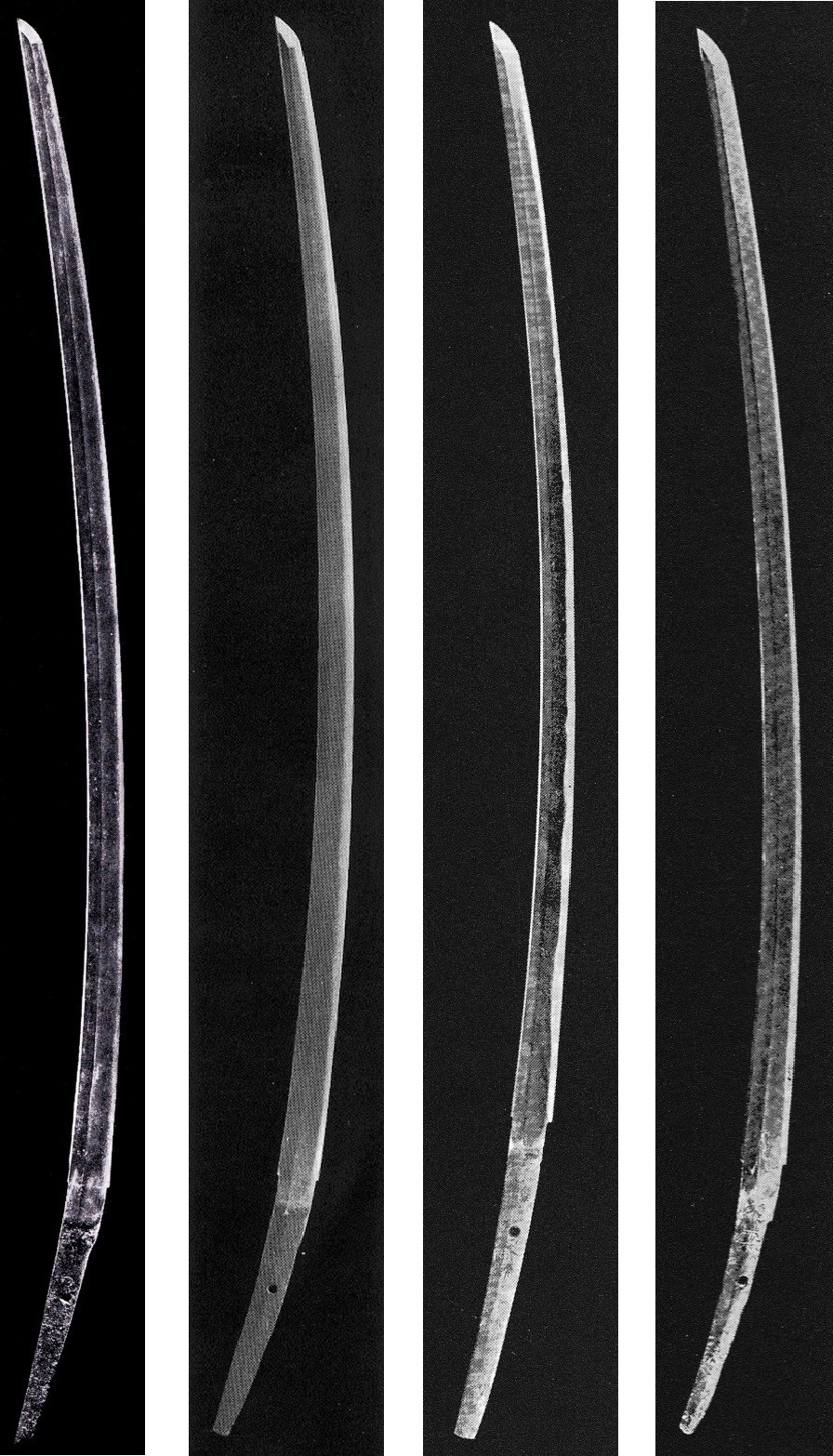
Heian3

Picture 3: atypical late-Heian period tachi (from left to right):
meibutsu Ô-Kanehira (大包平), mei “Bizen no Kuni Kanehira saku” (備前国包平作), nagasa 89.2 cm, sori 3.4 cm
meibutsu Ôtenta-Mitsuyo (大典太光世), mei “Mitsuyo saku” (光世作), nagasa 66.1 cm, sori 2.7 cm
meibutsu Sohaya no tsurugi (ソハヤノツルキ), meiMyōjun-denji sohaya no tsurugi - utsusu-nari” (妙純傅持ソハヤノツルキ・ウツスナリ), attributed to Miike Tenta Mitsuyo, nagasa 67.9 cm, sori 2.4 cm

*

1.9 Early Kamakura period (1185-1232)

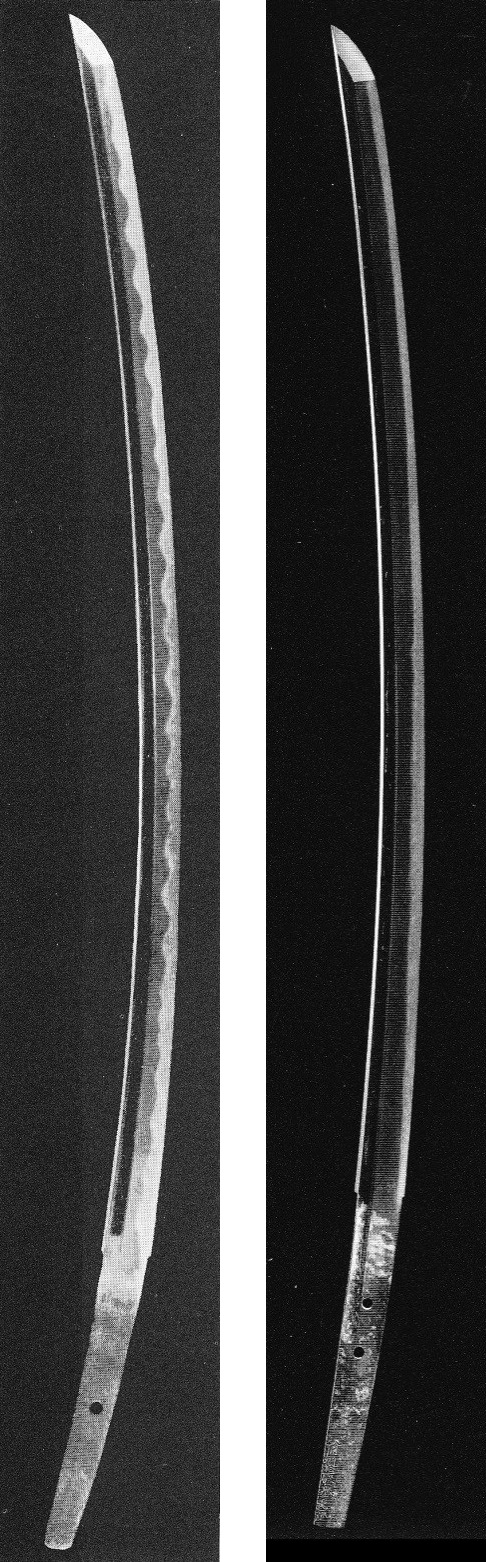
The general sugata did not change drastically or suddenly with the transition from the Heian to the Kamakura period but what we can observe is a slight increase in width and kissaki size and a little lesser tapering. The pronounced koshizori remains and the changes in shape reflect about the changes in time: The warrior class had just gained supremacy but the aristocracy was still strong, to put it in a nutshell. So these early Kamakura shapes are often described with wordings like “elegant but strong,” in Japanese yûbi de chikarazuyoi (優美で力強い) or yûsô (優壮), but often they are still referred to as “classic” (koten-teki, 古典的).

Representative schools and smiths for a classic early Kamakura period sugata are: Kyô-mono like the Awataguchi (粟田口) school (Kunitomo [国友], Hisakuni [久国], Kuniyasu [国安], Kunikiyo [国清]); the Ko-Ichimonji (古一文字) as connecting link from the Ko-Bizen to the Fukuoka and other Ichimonji schools (Norimune [則宗], Sukemune [助宗], Nobufusa [延房], Muneyoshi [宗吉], Nobukane [信包], Narimune [成宗], Sukeshige [助茂]); the Ko-Aoe (古青江) school (Sadatsugu [貞次], Suketsugu [助次], Tsunetsugu [恒次], Masatsune [正恒], Yasutsugu [康次], Nobutsugu [延次]); subsequent Ko-Kyûshû and Ko-Naminohira smiths like Bungo Yukihira (豊後行平).

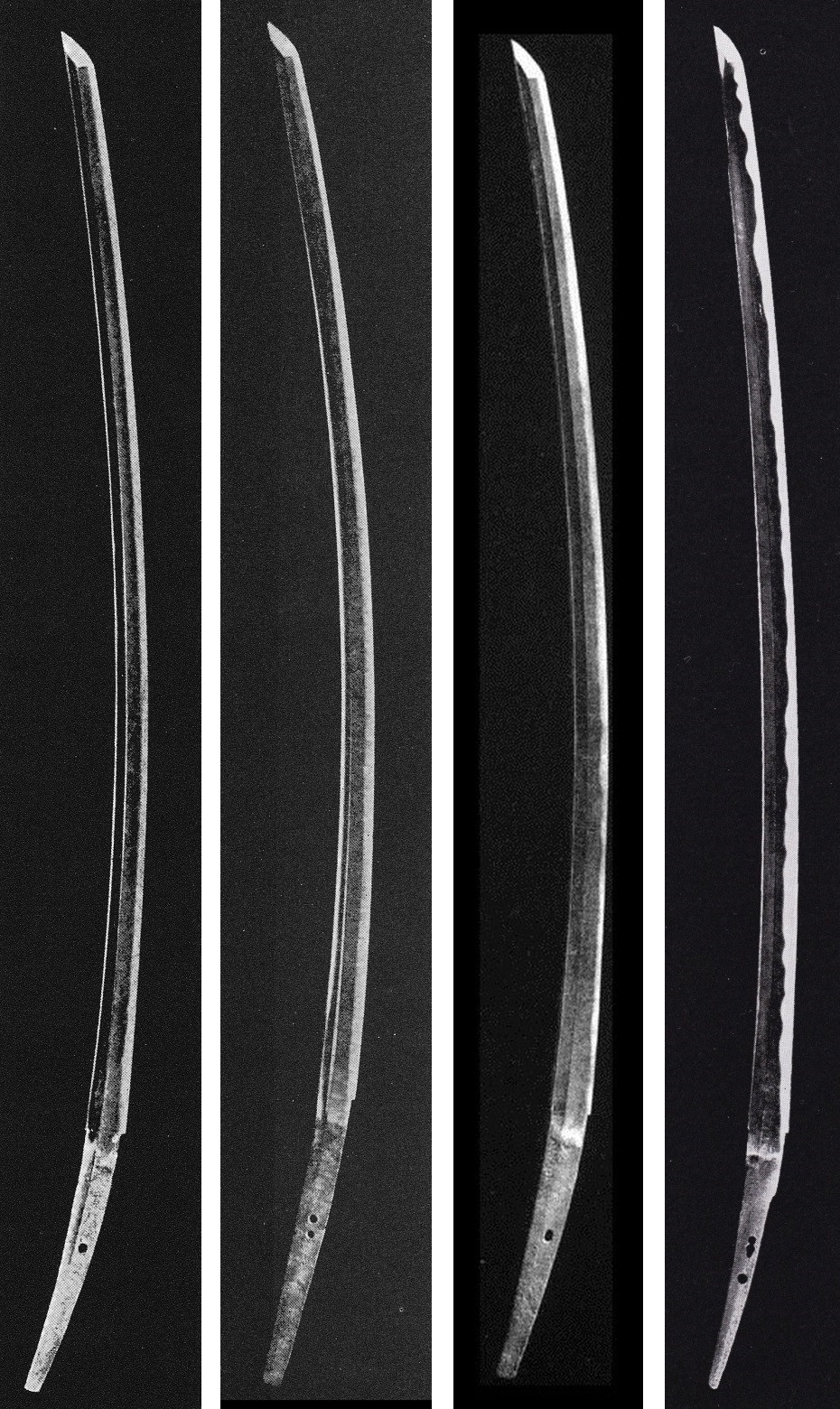
KamakuraEarly

Picture 4: early Kamakura period tachi (from left to right):
meibutsu Kitsunegasaki (狐ケ崎), mei “Tametsugu” (為次), Ko-Aoe, nagasa 78.8 cm, sori 3.3 cm
kokuhô, mei “Bungo no Kuni Yukihira saku” (豊後国行平作), nagasa 80.1 cm, sori 2.8 cm
jûyô-bunkazai, mei “Kiyotsuna” (清綱), Ko-Niô, nagasa 79.7 cm, sori 2.3 cm
jûyô-bunkazai, mei “Hôju” (宝寿・寶壽), nagasa 74.8 cm, sori 3.7 cm

*

1.10 Mid-Kamakura period (1232-1288)

The increase in length and width continuously proceeded in the mid-Kamakura period and tachi became now noticeably more magnificent than their early-Kamakura or late-Heian predecessors. The mihaba gets wider, the tapering decreases, the sori shifts more from a koshizori to a toriizori, we can see plenty of hira-niku – and a variant of that, the hamaguriba – and the kissaki appears as a full chû-kissaki. But at about the same time, a blade shape appears which is even bigger, shows less taper, a somewhat thicker kasane and higher shinogi, a narrow shinogiji, and which ends in a stubby ikubi-kissaki. The mid-Kamakura period shape is mostly circumscribed as “magnificent,” or gôsô (豪壮) in Japanese.

Representative schools and smiths for a mid-Kamakura period sugata are: Kyô-mono like the Awataguchi (粟田口) school (Kuniyoshi [国吉], Kunitsuna [国綱], Yoshimitsu [吉光]); the Rai (来) school (Kuniyuki [国行], Niji Kunitoshi [二字国俊]); the Ayanokôji (綾小路) school (Sadatoshi [定利], Sadaie [定家]); for Yamato certain Senju´in-based smiths (Rikiô [力王], Sadashige [定重]); very early Sôshû smiths like Shintôgo Kunimitsu (新藤五国光), Shintôgo Kunihiro (国広), Daishinbô (大進坊); the Fukuoka-Ichimonji school (Yoshifusa [吉房], Sukezane [助真], Suketsuna [助綱], Norifusa [則房], Munetada [宗忠], Yoshimochi [吉用], Yoshimoto [吉元]); the Ko-Osafune (古長船) school (Mitsutada [光忠], Nagamitsu [長光], Junkei [順慶], Kagehide [景秀], Sanenaga [真長]); other Bizen-mono like Saburô Kunimune (三郎国宗) or Hatakeda Moriie (畠田守家); the Katayama-Ichimonji school (Norifusa [則房]); the Chû-Aoe (中青江) school (Suketsugu [助次], Shigetsugu [重次], Sadatsugu [貞次], Moritsugu [守次]); and the latest Ko-Kyûshû smiths like Sairen (西蓮) or Naminohira Yukiyasu (行安) or Yasuyuki (安行). And representative smiths for making tachi in the “other,” the massive ikubi-kissaki-style sugata were for example Niji-Kunitoshi, Osafune Mitsutada, or several Ichimonji smiths.

Before we continue with the Kamakura period it must be pointed out that classifying Kamakura-period sugata is not as easy as it seems. One problem is the pure lack of extant unshortened blades and another problem, which is connected to problem number one, is that basically only those blades are extant in an unaltered condition which were made by noted smiths for a high-ranking clientel. Also we have to distinguish between war swords (hyôjô no tachi, 兵仗太刀) and ceremonial swords (gijô no tachi, 儀仗太刀) and this differentiation is as important as the realization that we are facing just the tip of the iceberg. To visualize the complexity of these problems: Blades from that time can be made to be worn as ceremonial sword by courtiers (kuge), as war sword for courtiers (nodachi, 野太刀, not to be confused with the overlong field swords of the same name), as war sword of the military aristocracy (buke), as treasure sword for both buke or kuge, or as war sword for the common warriors. The blades of all these swords show more or less subtle differences according to their use. Though we have to recognize that all we have is a small window through which we can peek into the Kamakura-era sword world and we have to be careful when it comes to sugata from that time. To learn more about the difficulties when it comes to classifying Kamakura-period sword shapes, please read the blog post I wrote a while ago.

KamakuraMid

Picture 5: mid-Kamakura period tachi (from left to right):
kokuhô, mei “Yoshihira” (吉平), nagasa 73.8 cm
kokuhô, mei “Kunimune” (国宗), Bizen-Saburô, nagasa 72.7 cm, sori 2.4 cm
jûyô-bunkazai, mei “Kuniyuki” (国行), Rai, nagasa 69.6 cm, sori 2.7 cm
kokuhô, mei “Yoshifusa” (吉房), Ichimonji, nagasa 81.4 cm, sori 3.0 cm

*

1.11 Late Kamakura and early Nanbokuchô period (1288-1336)

Tachi continuously increase in size and length towards the end of the Kamakura and early Nanbokuchô period but what is now most conspicious is the increase in kissaki size and the giving-up of the koshizori in favor of a toriizori. Apart from that, the kasane starts to get thinner and the abundance of niku disappears again. Tachi-sugata from that time are large and magnificent but yet not exaggerated or strikingly oversized.

Representative schools and smiths for a late Kamakura to early Nanbokuchô period sugata are: Kyô-mono like the Rai (来) school (Kunimitsu [国光], Kunitsugu [国次], Mitsunake [光包], Ryôkai [了戒]); the Senju´in (千手院) school (Yoshihiro [義弘]), the Shikkake (尻懸) school (Norinaga [則長], Norihiro [則弘]); the Taima (当麻) school (Kuniyuki [国行], Kunikiyo [国清], Chô Aritoshi [長有俊]); the Hoshô (保昌) school (Sadamune [貞宗], Sadayoshi [貞吉]); the Tegai (手掻) school (Kanenaga [包永]); for the Sôshû tradition (Masamune [正宗], Yukimitsu [行光], Sadamune [貞宗], Shizu Saburô Kaneuji [志津三郎兼氏], Kinjû [金重], Gô Yoshihiro [郷義弘], Norishige [則重]); the Yoshioka-Ichimonji (吉岡一文字) school (Sukeyoshi [助吉], Sukemitsu [助光], Sukeyoshi [助義], Sukeshige [助茂]); the Iwato or Shôchû-Ichimonji (岩戸・正中一文字) school (Yoshiuji [吉氏], Yoshimori [吉守]); the Osafune school (Kagemitsu [景光], Chikakage [近景], 1st generation Kanemitsu [兼光]); the Hatakeda (畠田) school (Sanemori [真守], Morishige [守重]); the Un (雲類) group (Unshô [雲生], Unji [雲次]); other Bizen smiths like Kokubunji Sukekuni (国分寺助国) or Wake no Shô Shigesuke (和気庄重助); the Chû-Aoe school (Yoshitsugu [吉次], Tsuguyoshi [次吉], Nobutsugu [信次], Naotsugu [直次], Hidetsugu [秀次]); the Katayama-Ichimonji school (Sanetoshi [真利], Tsugunao [次直], Chikatsugu [近次]); and for Kyûshû for example Jitsu´a (実阿), Ô-Sa (大左), Sa Kunihiro (左国弘), the Enju (延寿) school (Kunisuke [国資], Kuninobu [国信], Kunitoki [国時], Kuniyoshi [国吉], Kuniyasu [国泰]), or for the Naminohira school Yasumitsu (安光).

KamakuraLate

Picture 6: late Kamakura early Nanbokuchô period tachi (from left to right):
jûyô-bunkazai, mei “Kunitoshi” (国俊), Rai, nagasa 75.5 cm, sori 2.4 cm
kokuhô, mei “Kunitoshi” (国俊), Rai, nagasa 72.2 cm, sori 2.3 cm
jûyô-bunkazai, mei “Sahyôe no Jô Fujiwara Kunitomo” (左兵衛尉藤原国友), Enju, dated Shôchû one (正中, 1324), nagasa 89.1 cm, sori 3.9 cm
kokuhô, mei “Bizen no Kuni Yoshioka-jû Sakon Shôgen Ki no Sukemitsu” (備前国吉岡住左近将監紀助光), dated Genkô two (元享, 1322), nagasa 82.1 cm, sori 3.6 cm
*

1.12 Mid-Nanbokuchô period (1336-1375)

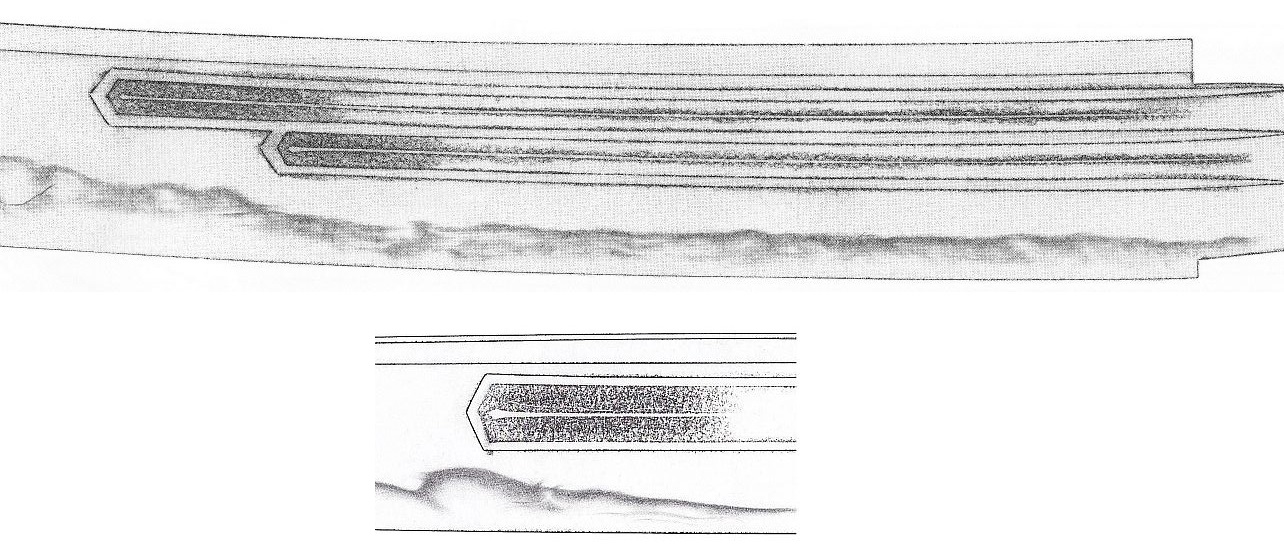
The mid-Nanbokuchô period marked the height of the length and overall size growth of the tachi. Blades from that time measure up to 90 cm and even some longer ôdachi with a nagasa of 120 cm were produced in considerable numbers. There is not much taper, a scarce niku, a thin kasane, a narrow shinogi-ji, a shallow toriizori, and an ô-kissaki with not much fukura. The vast majority of these oversized tachi have been shortened but the large kissaki, the thin kasane, and the wide mihaba identifies them, with some experience, rather easy as mid-Nanbokuchô even if they show the same, about 70~75 cm measuring nagasa of a tachi or katana. Please note that sometimes and due to later polishings and alterations, an ô-kissaki is not that large and elongated as you might think. Or in other words, certain mid-Nanbokuchô tachi are described with having an ô-kissaki but which is in fact only slightly larger than a chû-kissaki. Mid-Nanbokuchô tachi-sugata are described as “magnificent” or “exaggerated,” and in Japanese we find terms like gôsô (剛壮) or yûdai (雄大). And as the climax of this trend in size growth was reached in the eras Enbun (延文, 1356-1361) and Jôji (貞治, 1362-1368), the term Enbun-Jôji-sugata (延文・貞治姿) has become established to refer to oversized mid-Nanbokuchô blades.

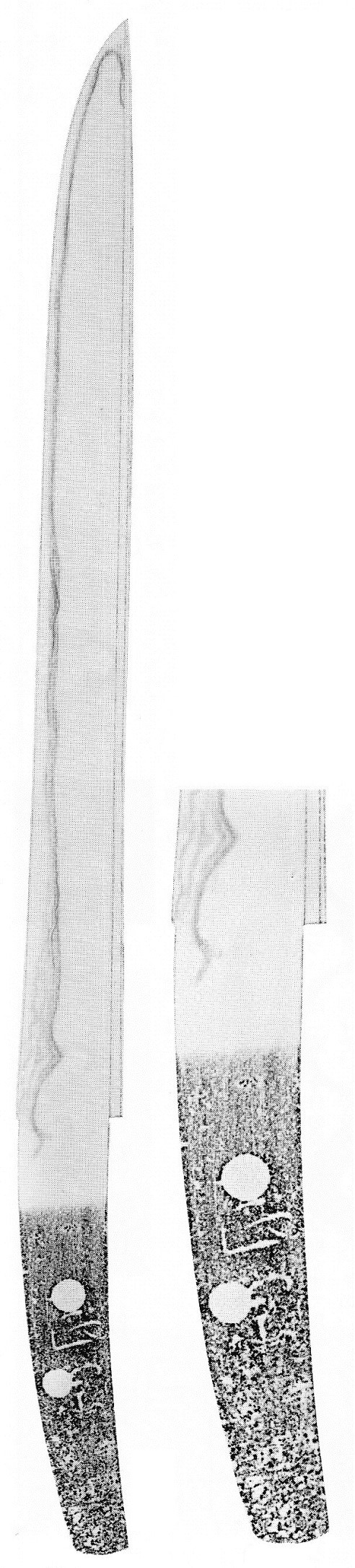
Representative schools and smiths for a mid-Nanbokuchô period sugata are: For Kyôto the Hasebe (長谷部) school (Kunishige [国重], Kuninobu [国信], Kunihira [国平]); the early Nobukuni (信国) smiths; the later Rai smiths (Tomokuni [倫国], Kunizane [国真]); Daruma Shigemitsu (達磨重光); for Yamato the Tegai (手掻) school (Kanetsugu [包次]); the Hoshô (保昌) school (Sadakiyo [貞清], Sadayuki [貞行]); for Sôshû masters like Hiromitsu (広光), Akihiro (秋広), and Hiromasa (広正); for Mino the Sôshû-influenced Naoe Shizu (直江志津) school (2nd generation Kaneuji [兼氏], Kanetsugu [兼次], Kanetomo [兼友], Kanenobu [兼信], 2nd generation Kinjû [金重], Kaneyuki [金行], Tametsugu [為継]); the Sôden-Bizen (相伝備前) school (2nd generation Kanemitsu [兼光], Tomomitsu [倫光], Masamitsu [政光], Motomitsu [基光], Yoshimitsu [義光], Motoshige [元重], Chôgi [長義], Yoshikage [義景]); the Ômiya (大宮) school (Morikage [盛景], Sukemori [助盛], Morokage [師景]); the Un (雲類) group (2nd generation Unji [雲次], Unjû [雲重]); the Chû-Aoe (中青江) school (Tsuguyoshi [次吉], Tsugunao [次直], Moritsugu [守次], later generations Sadatsugu [貞次]); the Ko-Mihara (古三原) school (Masaie [正家], Masahiro [正広], Masamitsu [正光]); the Uda (宇多) school (Kunimitsu [国光], Kunimune [国宗], Kunifusa [国房]); Kashû Sanekage (真景); the Sekishû-Naotsuna (石州直綱) school (Naotsuna [直綱], Sadatsuna [貞綱]); Hôjôji Kunimitsu (法城寺国光); the Niô (二王) school (Kiyotsuna [清綱], Kiyosada [清貞]); for Kyûshû the Sa (左) school (Yasuyoshi [安吉], Yoshisada [吉貞], Kunihiro [国弘], Hiroyuki [弘行],); Tosa Yoshimitsu (土佐吉光).

Also we must not forget that up to the mid-Nanbokuchô period there were some smiths who worked in two blade shapes, that is to say on the one hand in a tachi-sugata that followed the style of their times, and on the other hand in a classical slender tachi-sugata which remind of the late Heian or early Kamakura period. Representative for these “reminiscence of classic tachi-sugata” were Rai Kunitoshi (来国俊), Rai Kunimitsu (来国光), Ryôkai (了戒), for the Osafune school Nagamitsu (長光), Kagemitsu (景光), Sanenaga (真長), and the 1st generation Kanemitsu (兼光), Kanro Toshinaga (甘呂俊長), and certain Enju smiths like Kunimura (国村) or Kunitomo (国友).

NanbokuchoMid

Picture 7: mid-Nanbokuchô period tachi (from left to right):
kokuhô, mei “Bishû Osafune Tomomitsu” (備州長船倫光), dated Jôji five (1366), nagasa 126.0 cm, sori 5.8 cm
jûyô-bunkazai, mei “Bizen no Kuni Osafune-jû Yoshikage” (備前国長船住義景), suriage, nagasa 74.4 cm, sori 0.9 cm
kokuhô, mei “Senju´in Nagayoshi” (千手院長吉), dated Jôji five (1336), nagasa 135.7 cm
jûyô-bunkazai, mei “Kaneuji” (兼氏), suriage, nagasa 66.7 cm

*


1.13 Late Nanbokuchô and early Muromachi period (1375-1428)

The late Nanbokuchô period brought a turning away from the exaggerated mid-Nanbokuchô blade shapes. That means tachi still have a rather long nagasa and a shallow toriizori but the kasane increases a bit, the blades taper again, and the tip returns to a chû-kissaki. And towards the end of the Ôei era (応永, 1394-1428) we are back at classical Kamakura-period tachi but now interpreted with a hint of a sakizori and a somewhat shorter nagasa. Well, it is difficult to recognize this sakizori as it is really just a hint but at an ubu blade from that time, you might just “feel” a somewhat different toriizori, i.e. with its deepest point slightly more towards the tip than usual.

Representative schools and smiths for a late Nanbokuchô and early Muromachi period sugata are: For Kyô-mono the the Sanjô (三条) school (Yoshinori [吉則]), the later Nobukuni (信国) masters; for Bizen the Kozori (小反) and Yoshii (吉井) school and for early Muromachi the Ôei-Bizen (応永備前) school (Morimitsu [盛光], Yasumitsu [康光]); for Mino the Akasaka-Senju´in (赤坂千手院) school; the Fujishima (藤島) school; the Uda (宇多) school.

MuromachiEarly

Picture 8: late Nanbokuchô and early Muromachi period tachi (from left to right):
jûyô-bunkazai, mei “Bishû Osafune Morimitsu” (備州長船盛光), dated Ôei 23 (1416), nagasa 76.1 cm, sori 1.1 cm
mei “Bishû Osafune Tsuguyuki” (備州長船次行), Kozori, suriage, nagasa 78.4 cm, sori 2.3 cm


The specialist for treatment of sword cuts

Whilst translating recently a battlefield-related article, I came across the term kinsô’i (金創医) that referred to “physicians” who were specialized in the treatment of incised wounds in general and of arrow wounds and sword cuts in particular. The article did not go much into detail at this point as it was more of a general nature but that term awoke my interest and as hardly anything is available on the net on this topic, I started to do some research the result of which is this humble article.

Basically, the ancient and medieval Japanese medical system was very similar to he one in the West. That means, there were academic physicians and partly specialized and partly allround practitioners who were considered lower ranking. This lower ranking was either connected to the fact that these practitioners did not undergo that an extensive training as the physicians, or to certain religious and social stigmas associated with unclean things like blood and the like. As for Japan, the records on “physician affairs” go pretty far back, that is to say to the 8th century Taihô and Yôrô Codes. The former was merely an adaption of the governmental system of China’s Tang Dynasty whereas the latter already incorporated Japanese traditions and practical necessities of administration. Pretty much of these codes is known today as it had survived in original and transcribed forms and we find therein also a medical service statute, the ishitsu-ryô (医疾令). Depending on what you base your counting on, i.e. extant original fragments or later transcriptions of the code, the ishitsu-ryô consisted of either 19, 24, or 26 articles. It deals with the regulations regarding the training and appointment of physicians (e.g. regulations of how to become a physician, an acupuncturist, a massage therapist, a spirit-vanquisher by charms [charm healer] and so on), the duties of the court physicians (ten’yaku-ryô, 典薬寮) and the local physicians in the provinces, and the operation of medicinical-herb gardens.

 EyeSurgery

Eye surgery as seen in the late Heian to early Kamakura period picture scroll Yamai no Sôshi (病草紙).

Well, most of the then know-how and the model for the aforementioned codes was imported from Chinese mainland and so it is no wonder that also medical science, i.e. the art of healing and of preventing diseases, came mostly from abroad. There were some indigenous physicians but it is assumed that they were rather healers and shamans and that there was no systematically accumulated and handed-down medical knowledgebase. Records of visits of mainland physicians date back to the 5th century AD but a more continuous and systematic exchange of medical knowledge only started with the missions to Tang China in the 7th, 8th and 9th centuries. The main carriers of this knowledge were Buddhist monks who played a major role in the entire “mainland exchange program.” Court physicians were given court titles, a requirement anyway to be be around in the imperial palace and to see and treat the emperor, and a kind of medical hierarchy started to develop. As far as medical knowledge is concerned, the latest trends, medicines, and treatments were constantly “updated” from Jin, Western Xia, Yuan and Ming Dynasty China. But we can see major changes from the Muromachi period onwards, on the one hand as the then established Ashikaga-bakufu was now introducing a medical service statute itself, i.e. for the ruling warrior class, and on the other hand that the entire approach of applying medicine and treating patients started to change. That means, in former times, physicians basically looked up the patients’ symptoms in their handed-down books and treated them or prescribed them medicine according to what was written in there. But now, physicians started more and more to rely on personal experiences and their own lifelong studies what in turn resulted in an increased body of medical publications, although often kept secret within a school or family.

Returning to our main topic, the kinsô’i specialists for incised wounds, we rightaway have to go back again to the Taihô and Yôrô Codes. In these codes, it was distinguished between internal medicine (tairyô, 体療), surgery (sôshu, 創腫), pediatrics (shôshô, 少小), obstetrics (jo’i, 女医), otorhinolaryngology (jimoku-kushi, 耳目口歯), acupuncture (hari, 鍼・針), massage (anma, 按摩), charm healing (jugon, 咒禁), and herb farming (yaku’en, 薬園). But it has to be pointed out that the then surgeons did not carry out surgeries like we understand that term today. It was more a removing of tumors and swellings (shu, 腫) – thus the name sôshu – and treating external wounds like cuts and also burns. Later on, that means during the Kamakura and Nanbokuchô periods, the terms tairyô and sôshu were replaced by the terms naika (内科) and geka (外科) respectively. With the aforementioned significant changes in medical system over the Muromachi period, more specialists emerged and although some distinctions between tumor, furuncle, or boils removers and those who treat incised wounds had been going round since the Nanbokuchô period, there were now “real specialists” like the haremono-ishi (腫物医師, tumor surgeon), the kizu-ishi (疵医師, general wound surgeon), and the kinsô’i (金創医) and no longer just “surgeons” who performed all surgeries. And it is in my opinion safe to assume that it was the increased warfare during the Sengoku era which demanded specialized cut wound surgeons. Well, incised wounds had always been mentioned separately, for example in the ishitsu-ryô where we read that court physicians are required to provide and have in stock medicine for incised wounds. But now, treating incised wounds became a special field with a body of teachings on its own, very likely born from surgeons who had direct and constant battlefield experience similar to the European barber surgeons who looked after soldiers during or after a battle.

An advancement in the successful treatment of incised wounds came with the exchange with European physicians like the Portuguese Luís de Almeida (1525-1597) towards the very end of the Muromachi period, for example due to the introduction of surgical suture. Well, Japanese records are pretty rare on this matter but just on the basis of thinking about the difficulties of treating larger open wounds and the existence of ancient Chinese records of sutures, I think it is logical to assume that wounds have had been sutured in Japan before the contact with European physicians. On the other hand, it seems as if a kind of “reinvention” of surgical sutures took place in the mid to late Edo period, “reinventure” because Western medicine was soon treated with suspicion or “neglected as a precaution” after the sakoku (鎖国, “locked country”) foreign relations policy enacted in the early Edo period. So it is also possible that even larger open wounds were mostly just treated with compression bandages and the like. For example, we know from Muromachi-eriod records that persons injured by sword cuts were treated with medicine taken internally, e.g. ginseng, Ligusticum wallichii, or peony roots, and that bleeding was stopped by sprinkling powdered resins with names like shôroku (松緑), furuse-ma (古瀬麻), or kirinketsu (麒麟血) onto wounds. And as a painkiller, ointments of rosewood or bulrush were directly applied on the wound. Also we read of urinating in a jingasa and applying the urin to the wound as a disinfectant.

 Bandages

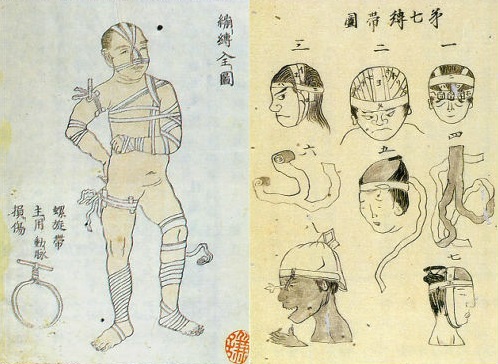
Guidance for putting on bandages from an early 19th century publication.

Last I want to deal with the question who these kinsô’i were. In view of the fact that up to the Muromachi period many of the trained physicians were actually monks and because often priests of the Ji-shû (時衆) group accompanied the warriors onto the battlefield in the role of army chaplains (jinsô, 陣僧), battlefield physicians and thus kinsô’i are often equated with monks. Well, we do know that Ji-shû priests also acted as physicians but experts suggest to be careful in this respect. That is to say, also non-ordained persons who had specialized in treating incised wounds often shaved their heads when operating in or around a battlefield in order to avoid being shot and attacked. In other words, shaving your head identified you as a member of the clergy just like the red crosses or red crescent used by present-day protected persons in armed conflicts as international humanitarian law considers them as non-combatants (whether military or civilian) and thus they may not be attacked and not be taken as prisoners of war. Also because of the fact that kinsô’i were rather of low rank, we can assume that the majority of them did not come from academically trained and “qualified” physicians but were recruited from local and self-trained practitioners.

I hope this was an interesting brief excursion to the history of battlefield-related medical staff in general and to the kinsô’i in particular, a subject that is as indicated not that widely known in sword-related fields.

Masamune Book Update

It should be safe now to re-order or order your book respectively if you were waiting for things being fixed. Please note that you should only re-order if Lulu.com has sent you a notification mail that your order was cancelled (and refunded you). So if you never got any notification from Lulu.com, just wait a little it is likely that your order went through. Again, if there are any troubles (or if you receive a faulty copy), please don’t hesitate and get in touch with me via “markus.sesko@gmail.com.” Thank you all for your patience and I hope that I don’t loose any readers due to this fiasco…

IMPORTANT: Masamune Book Update

Over the last couple of days, Lulu.com and customers of mine have informed me that there was some issue with the PDF file that serves both as basis for the print and for the eBook. In the meanwhile, some of you who already had placed an order on the book were refunded by Lulu.com as the order was cancelled. The problem with the PDF is now solved and I sincerely apologize for the inconvenience as you have to place a new order! This is the first time anything like that happened and I am very sorry for all the trouble!! Please get in touch with me via “markus.sesko@gmail.com” if you have any further questions.


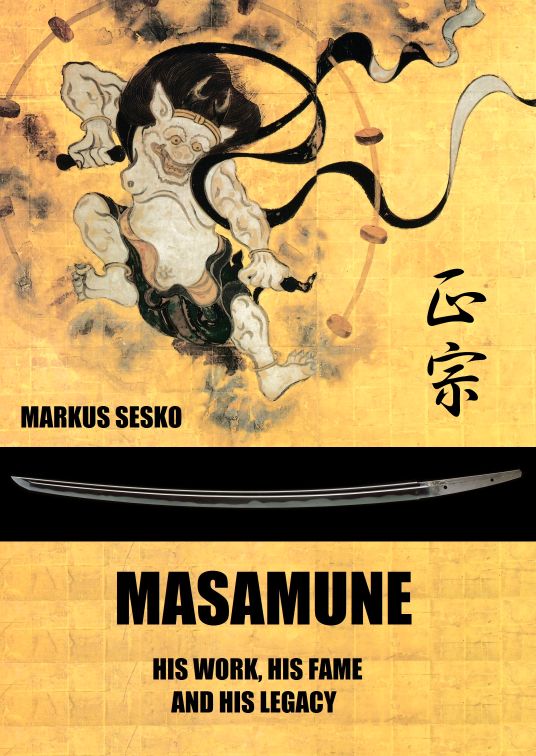
MASAMUNE – His Work, his Fame and his Legacy

It’s done, my announced Masamune book is out now!

I quote from the blurb:

“It is often said that Masamune was the greatest Japanese swordsmith of all times but we have to define what we mean by “greatest.” From a mere technical point of view, it is next to impossible to say if there was one “greatest” swordsmith as the country brought forth so many great master smiths over the centuries. Each of these masters had a more or less personal approach in producing a perfect sword, and within these elite circles of smiths we are not only referring to technical perfection but also to aesthetical considerations. Or, in other words, these great master smiths not only strived to produce an impeccable sword but also to leave a work of art following the then aesthetical currents. This all, i.e. the technical and artistic aspect, is both very true for Masamune and, putting aside the claim to name a “greatest,” we can at least say for sure that Masamune is by far the most famous swordsmith of Japan. A lot has been written on Masamune and his swords, both inside and outside of Japan. The aim of this publication is to contribute to the understanding and appreciation of this great swordsmith in the West, that is to say by not only presenting his most famous works but also by providing, on the basis of an examination of all major written records on Masamune, a newly researched and detailed historic overview of his life and the circumstances in the establishment of a new forging tradition. This publication introduces more than 50 of his meibutsu (noted swords). “

Please note that there are two editions: The standard b/w paperback edition that is (shortly) available everywhere (e.g. Amazon.com), and the hardcover color higher quality paper deluxe edition that is only available via Lulu.com. I would highly recommend the latter edition as the pictures should turn out much better on the higher quality paper. Also I added many portraits of previous historic owners of the meibutsu to give the provenances “a face.” These also should do much better in color.

Paperback Edition 49.90 USD

Deluxe Edition 89.90 USD

eBook Edition 19.90 USD

MasamuneCover


KANTEI 1 – SUGATA #4

1.7.2 Horimono (engravings)


Let us continue with the engravings that are usually found on a Japanese sword. As mentioned at the very beginning, I will skip historic background as much as possible and focus on what you see on blades and what is essential for kantei. As for horimono, an excellent and detailed overview in terms of terminology and religious significance had been written by Gabriel Lebec just last year and is available as PDF here. So if you want additional and background info on this subject, this is where you go. Important for kantei conclusions drawn on the basis of horimono is to know that engravings other than hi basically follow two approaches: The one is the belief that certain religious symbols provide good luck, offer protection from evil or harm, and/or underline what the sword wearer beliefs, and the other one is to personalize and decorate a blade. Well, it can be said hat virtually all horimono have some kind of religious background and that over time just the degree of detail and repertoire increased. In short, deities were in the beginning often justrepresented by their bonji (Sanskrit character) but were later on fully “carved out” in a picturesque manner. And the detail of such engravings can be truly amazing! And stylized religious symbols were later in time no longer interpreted in an abstract and abbreviated but in a full and more “realistic” manner. When it comes to Japanese depictions, we differentiate between three degrees of elaboration or abbreviation: 1. shin (真): “formal,” “full,” or “most elaborate;” 2. gyô (行): “semi-formal” or “intermediate degree of elaboration;” and 3. (草): “informal,” “free,” or “abbreviated.” For the definition of horimono (and other Japanese arts as well), these terms are used as prefixes, e.g. shin no …, gyô no …, and sô no …

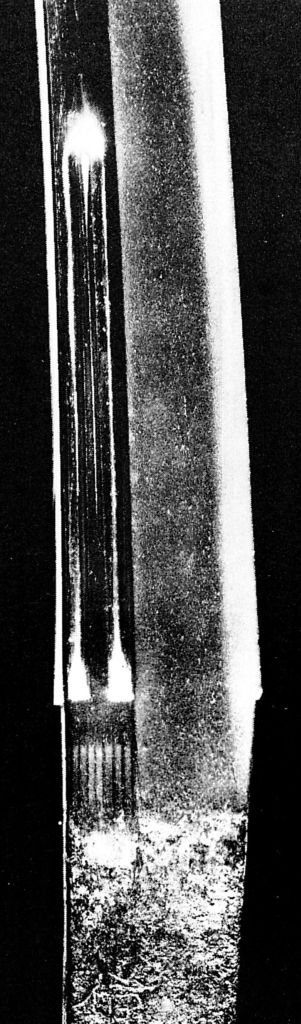
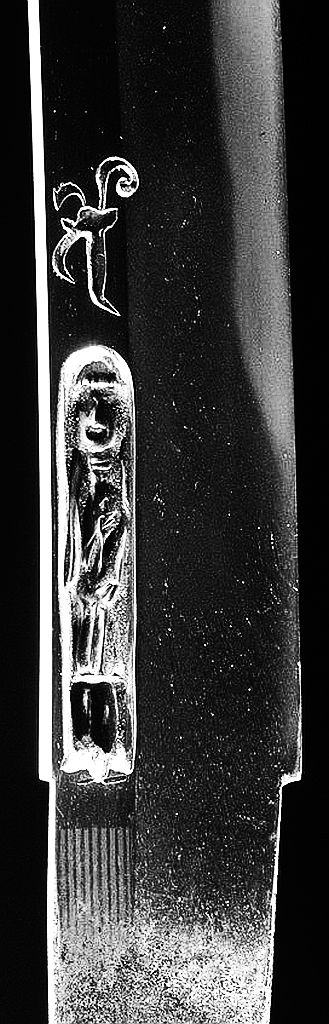
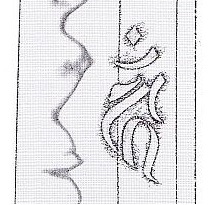
An important aspect of horimono is the fact that hey do not necessarily had to be added at the time the blade was forged. That means, every later owner of a blade was able to decide to have it enlarged by whatever engraving (or groove). This was sometimes done to hide certain flaws, for example open fukure blisters in the shinogi-ji, or to “push” an unsigned blade into a certain direction. For example, a blade whose workmanship suggests Nanbokuchô Sôshû might have better chances to receive an attribution to the great Sadamune if enlarged with futasuji-hi as several blades of this master show this kind of grooves. Also important to know is that as far as swords are concerned, classicism had always been a choice. So a smith or client from whatever period, let’s say late Muromachi or mid-Edo could have made or ordered a blade that models on classical Kamakura masterworks, including their horimono, or if not modelled on a concrete example, made or ordered an elegant blade that got a classic touch by adding an ancient-looking engraving at its base. And with this, we arrive at the question of what was/is considered as classical? As a rule of thumb it can be said that classical horimono are those that had emerged before the end of the Kamakura period. Often quoted examples of what is thought to be the oldest horimono are a suken as relief in a hi on a blade of Bizen Tomonari (友成), the bonji for Fudô-Myôô on top of a suken on a blade of Ko-Hôki Ôhara Sanemori (大原真守), and the relief of a kurikara, a bonji and the a deity as relief (experts argue on what deity is depicted), or a crane that bites into a pine cone on blades by Bungo Yukuhira (行平) (see picture below). That means we are as early as in the late Heian or very beginning of the Kamakura period with these smiths. What is obvious at these earliest horimono is that they focus pretty much at just the base of the blade and that they are quite simple.

Tomonari             Sanemori                  Yukihira          matsukui

From left to right: Tomonari, Sanemori, Yukihira.

Before I introduce one by one the most common engravings, I want to address the question of which blades from which schools or smiths are likeliest to show horimono? And in this case I mean horimono in terms of more elaborate decorations and not just suken. Well, chronologically speaking, more elaborate horimono are very often seen at the Nobukuni (信国) school followed by the Hasebe (長谷部) school and the Bizen Osafune smiths from master Kagemitsu (景光) onwards. That means we basically start not before the mid to late Nanbokuchô period with elaborate engravings. The Bizen smiths in general are known for adding relative often horimono what applies to the Kozori group (小反) that emerged towards the end of the Nanbokuchô period as well as to the Ôei-Bizen, Eikyô-Bizen, and Sue-Bizen groups. The Sôshû smiths too are famous for their horimono and that concerns the master smiths after Masamune, i.e. Hiromitsu (広光) and Akihiro (秋広), as well as the entire Sue-Sôshû group. Another candidate whose blades show almost always any kind of horimono is Heianjo Nagayoshi (平安城長吉), or to be precise the later smith who was active around Eishô (永正, 1504-1521). When it comes to the end of the Muromachi period, we find – apart from the Sue-Bizen and Sue-Sôshû smiths – relative many elaborate horimono on works of the Yamato Kanabô (金房) and Shitahara (下原) school. And at the transitional time to the shintô era, we find many engravings on blades made in the vicinity of the supposed “founder” of the shintô, Umetada Myôju (埋忠明寿), e.g. at Horikawa Kunihiro (堀川国広) and Hizen Tadayoshi (肥前忠吉) and on blades of their immediate successors like Dewa no Daijô Kunimichi (出羽大掾国路) and his Mishina colleague Etchû no Kami Masatoshi (越中守正俊). Not to forget Echizen Yasutsugu (康継) and the Shimosaka (下坂) school where he came from. Somewhat later in shintô times, Kotetsu (虎徹) and Awataguchi Ikkanshi Tadatsuna (粟田口一竿子忠綱) are famous for adding elaborate horimono, stating that proudly on the tang via the phrase hori-dôsaku (彫同作) what means “horimono by the smith” in contrast to horimono engraved by a specialized horimono artist like it was often the case at the earliest Hizen smiths. And as for shinshintô times, first and foremost Hosokawa Masayoshi (細川正義) and Taikei Naotane (大慶直胤) must be named. But I would like to repeat that this “list” concerns schools and smiths that are known for adding elaborate horimono. That means, more simple and classical engravings are found throughout all periods and schools. Anyway, if a certain school or smith is famous for a certain horimono or certain horimono interpretation, I will point that out again in the corresponding chapters. Having that said, let me now introduce in alphabetical order the most common horimono. And not to make this blog post disproportionally long, I will add comparisons of individual horimono interpretations as PDFs.

bonji (梵字) – Sanskrit character(s). Might be used alone or in combination with other engravings, for example on top of a groove or suken or in between two grooves that have been “interrupted” for the purpose of adding a bonji. It is almost impossible to point out a certain school or smith that is very famous for adding bonji but I would say Nobukuni, Heianjô Nagayoshi, Hiromitsu, Akihiro, the Sue-Sôshû school, the Osafune school, the Ôei-Bizen school, the Sue-Bizen school, Umetada Myôju, the Horikawa school, Dewa no Daijô Kunimichi, Etchû no Kami Masatoshi, Hizen Tadayoshi, Echizen Yasutsugu, Higo no Daijô Sadakuni (肥後大掾貞国), Kotetsu, Suishinshi Masahide (水心子正秀), and Taikei Naotane.

Bonji

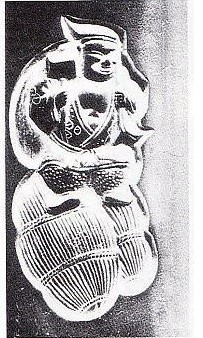
Daikokuten (大黒天) – One of the Seven Lucky Gods associated with wealth and prosperity. Sometimes also just referred to as Daikoku. He is usually interpreted as relief and depicted standing on two bales of rice. Usually seen on blades of Horikawa Kunihiro, Dewa no Daijô Kunimichi, and Kotetsu. A Daikokuten horimono is sometimes also soon at Hiroyoshi (広賀) from Hôki. ComparisonDaikokuten.

Daikokuten

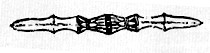
dokko (独鈷) – A single-prong vajra hilt. Such a vajra hilt is a weapon which is used as a ritual object to symbolize both the properties of a diamond (indestructibility) and a thunderbolt (irresistible force). The dokko can be found as horimono itself or with one prong elongated to a ken sword, an interpretation which is referred to as dokko-ken (独鈷剣) or short dokken (独剣) (see bottom picture below). This kind of horimono is for example sometimes found at blades of the Sue-Sôshû school but is much lesser seen than its “famous” counterpart, the sankozuka-ken, i.e. the three-pronged vajra hilt. ComparisonDokko.

 dokko

dokko-ken

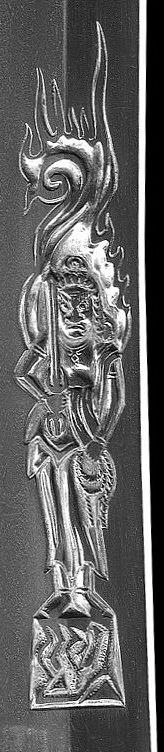
Fudô-Myôô (不動明王) – Guardian deity primarily revered in Vajrayana Buddhism or in Japan respectively in the Shingo, Tendai, Yen, and Nichiren sects. He is usually depicted in a fierce manner, holding a sankozuka-ken or kurikara, a sword with a dragon coiled around it in the one hand, and a kensaku (羂索) rope in the other hand. The flaming nimbus or halo behind the statue is known as the karura (迦楼羅) flame, after a mythical firebreathing birdlike creature, the Garuda (jap. Karura). His seat, the banjakuza (盤石座 , lit. “huge rock base”), is considered an appropriate iconographic symbol to demonstrate the steadfastness of Fudô-Myôô. A Fudô-Myôô engraving is also seen at quite many schools and throughout all times so it is hard to name any name here. ComparisonFudoMyoo.

FudoMyoo

hatahoko (幡鉾・旗鉾) – Lit. “banner spear.” Symbolic weapon used in esoteric Buddhism to decorate an altar place. The spear or lance is sometimes also referred to as Bishamon-ken (毘沙門剣, lit. “Sword of Bishamon”) or just hoko (鉾). A hatahoko engraving is pretty rare. The one shown below is found on a Hizen Tadayoshi blade and was added by the horimono-shi Munenaga (宗長) who had refined his craft under Umetada Myôju.

hatahoko

kensaku (羂索) – Rope of Fudô-Myôô and other guardian deities which symbolizes the keeping at distance of enemies of the Buddhist teachings and the catching of new believers.

 kensaku

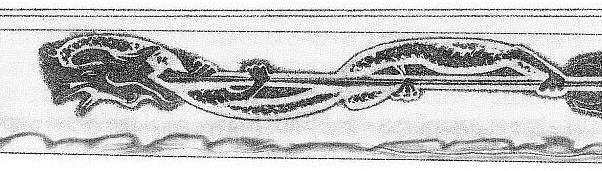
kurikara (倶梨伽羅) – According to legend, the guardian deity Fudô-Myôô (不動明王) once had to fight a deity from another religion, the dragon king Kurikara, written with the same characters as stated above. He changed himself into a flaming sword but Kurikara did the same and the fighting went on without a winner. But then Fudô-Myôô transformed into the dragon Kurikara, wound himself around the opponent’s sword, and ate it from the top. Also referred to as kenmaki-ryû (剣巻龍, lit. “dragon winding around a sword”). There are quite many kurikara interpretations but basically we differentiate between three approaches that follow the shin-gyô-sô mentioned at the beginning, i.t. shin no kurikara (真の倶梨伽羅, “full” or “realistic kurikara”), gyô no kurikara (行の倶梨伽羅, “more or less abbreviated kurikara”), and sô no kurikara (草の倶梨伽羅, “abbreviated,” “stylized,” or “abstrac kurikara”). A shin no kurikara is often seen on blades of Nobukuni, Heianjô Nagayoshi, of the Sue-Bizen school, at Awataguchi Ikkanshi Tadatsuna, Hizen Tadayoshi, Echizen Yasutsugu, Higo no Daijô Sadakuni, Suishinshi Masamune, Hosokawa Masayoshi, Taikei Naotane, and at the shinshintô and gendai Gassan school. A gyô no kurikara can be found on Nobukuni and Heianjô Nagayoshi blades, at Kagemitsu, the Sue-Bizen and Sue-Sôshû schools, Echizen Yasutsugu, Kotetsu, Hizen Tadayoshi, Taikei Naotane, and Tairyûsai Sôkan (泰龍斎宗寛). And a stylized sô no kurikara is typical for the Hasebe school, Nobukuni, Heianjô Nagayoshi, the Kanabô school, the Sue-Sôshû and Sue-Bizen school, the smiths around Osafune Kanemitsu, Awataguchi Ikkanshi Tadatsuna, Echizen Yatsuugu, Hizen Tadayoshi, the shintô Hôjôji school, Ômi no Kami Tsuguhira (近江守継平), Harima no Daijô Shigetaka (播磨大掾重高), Yamashiro no Kami Kunikiyo (山城守国清), and Taikei Naotane. And please note that Heianjô Nagayoshi often combined a gyô no kurikara and a sô no kurikara or two differently stylized sô no kurikara distributed on the two sides of one blade. The same peculiarity is seen at the Kanabô school. But it has to be pointed out that sometimes it is hard to say if a kurikara is shin or already gyô or gyô tending to . A variant or certain characteristic interpretation of a kurikara is the so-called harami-ryû (孕龍, lit. “pregnant dragon”). Here, the body of the dragon is somewhat at distance from the sword and with a curve of the thigh which makes it look like as if the dragon is pregnant. Such a harami-ryū is often found on swords by Nagamitsu and his Osafune main line successors. ComparisonKurikara.

ShinNoKurikara

 shin no kurikara

 GyoNoKurikara

gyô no kurikara

 SoNoKurikara

sô no kurikara

 harami-ryu

harami-ryû

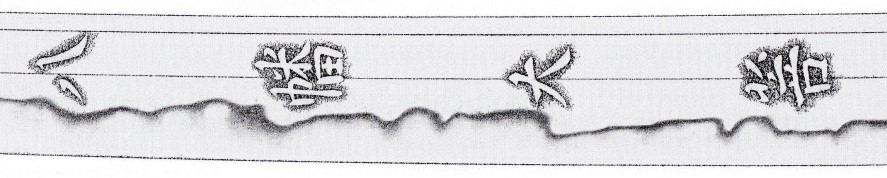
myôgô (名号) – Names of deities engraved onto sword blades, for example of Hachiman-Daibosatsu (八幡大菩薩) oder Marishiten (摩利支天). Known for engraving myôgô are for example Kagemitsu, Kanemitsu, the Sue-Bizen smiths, Heianjô Nagayoshi, Horikawa Kunihiro, Echizen Yasutsugu, and Yamato no Kami Yasusada (大和守安定).

 myogo

rendai (蓮台) – The rendai is the lotus-shaped platform or lotus blossom seat beneath a Buddha image. A rendai was engraved to sword blades by itself or in combination with other horimono, for example a suken or bonji.

 rendai

ryû (龍・竜) – Plain dragon that do not wind around a ken. A very common variant of the “plain” dragon is the horimono subject tamaôi-ryû (玉追い龍), the lit. “gem hunting dragon” (see picture below). According to Japanese mythology, the god of the sea in the shape of a dragon (ryûjin, 龍神) had two magical gems – the “ebb stone” kanju (干珠) and the “tide stone” manju (満珠) – with which he controlled the tide. Later he presented them to his son the demigod Hoori no mikoto (火遠理命). A legend says that later empress Jingû (神功天皇, 201-269) was in the possession of the two gems and as she was not able to control the tide, she crossed the sea, had her enemies drowned and conquered Korea. Historians assume that already back then elements of the Indian Cintāmaṇi (Jap. nyoi-ju, 如意珠) were adopted, a wish-fulfilling jewel equivalent to the philosopher´s stone in Western alchemy. A tamaôi-ryû is for example relative often seen on blades of Kurihara Nobuhide (栗原信秀) and of the shinshintô/gendaitô Gassan school. And dragons in general are typical for Nobukuni, Umetada Myôju, Horikawa Kunihiro, Hizen Tadayoshi, Awataguchi Ikkanshi Tadatsuna, Kotetsu, Taikei Naotane, Tairyûsai Sôken, as well as for the mentioned Kurihara Nobuhide and the shinshintô/gendaitô Gassan school. Another characteristic dragon horimono has to be mentioned, that is that of a jôge-ryû or nobori-kudari-ryû (上下龍) where two dragons are egraved on each side of the blade, one facing upwards ( or nobori), i.e. towards the tip, and the other one facing downwards (ge or kudari), i.e. towards the habaki. A nobori-kudari-ryû might be found on blades of Umetada Myôju, Horikawa Kunihiro, Hizen Tadayoshi, Echizen Yasutsugu, Kotetsu, Awataguchi Ikkanshi Tadatsuna, Nanki Shigekuni, and at the shinshintô/gendaitô Gassan school.

tamaoi-ryu1

tamaoi-ryu

sankozuka (三鈷柄) – Trident vajra hilt. Such a vajra hilt is a weapon which is used as a ritual object to symbolize both the properties of a diamond (indestructibility) and a thunderbolt (irresistible force). The vajra is essentially a type of club with a ribbed spherical head. The ribs may meet in a ball-shaped top, or they may be separate and end in sharp points with which to stab. The sankozuka has now three ribs unlike the dokko which has one rib or prong. A ritual ken sword with such trident vajra hilt is referred to as sankozuka-ken (三鈷柄剣) accordingly. A sankozuka-ken horimono comes in many different interpretations. As a rule of thumb it can be said that at the Nobukuni smiths, the tip of the sakozuka-ken is quite deeply cut and the engraving is often combined with a bonji on top. At the Sue-Sôshû school, the tip of the ken is rather pointed whereas it is more roundish at the Sue-Bizen, Sue-Mihara, and Sue-Seki schools.

 sankozuka

santai-butsu (三体仏) – Also referred to as sanzon (三尊). Buddha triumvirate with Buddha in the middle accompanied by two Boddhisattva. On paintings the triumvirate is usually depicted side by side but on a narrow sword blade the figures are engraved below of each other.

 santaibutsu

shiketsu (四橛) – A shiketsu is a utensil used in esoteric Buddhism. It is a kind of post, mostly of copper, which symbolically encloses the four sides of an elevated platform on which religious and/or ascetic practices are performed. The shiketsu is a rather rarely seen horimono and might be found on the opposite side of a kurikara, for example on Sue-Bizen blades.

 shiketsu

suken (素剣) – Lit. “plain ken.” Simplified horimono of a ritualistic ken sword which just depicts the outlines of the blade. Suken can come alone but are often accompanied by other engravings like a sankozuka hilt, tsume claws (see tsume-ken), a rendai base, or a bonji. Also it can be interpreted as relief in a hitsu. A suken is one of the classical horimono and thus also found on pretty early kotô. As it was very common, it is again hard to name any particular school or smith who was “famous” for adding a suken. Noticeably wide suken with an obtuse-angled tip or two such wide suken arranged in takekurabe manner are for example seen on blades of Nanki Shigekuni (南紀重国) (see bottom two pictures below).

suken

NankiShigekuni

tsume () – Lit. “claw.” The claw-shaped protrusion often seen on suken. But a tsume can also come by itself or in combination with other horimono, e.g. gomabashi.

 tsume

tsume-ken (爪剣) – A suken with a tsume claw at its base.

 tsume-ken


In conclusion I want to say that horimono-kantei is a field of reseach on its own and I have to admit, I haven’t been into engravings that much to elaborate on the subtle differences of the claws and scales of kurikara dragons of the depth of suken for example. But that is on my list of future studies to do and I will present results of research of course here on my blog.

Asking for Masamune tantô feedback

Still working on my Masamune book and I am “struggling” with a Masamune tantô that was published in Token Bijutsu 196 (May 1973). Therein, Honma Junji introduces the tantô in his series titled Kantô Hibi Shô (鑑刀日々抄), p. 31. The blade is signed “Masamune” and Honma says in the very brief description of the piece that the signature is unfortunately a so-called soko-mei (底銘), i.e. the tang lost some substance what weakens the mei more or less, but that it looks apart from that legit.

Now my question: Was this tantô described or discussed later again, and if so, where? Thank you!

 * Edit: “Problem” solved. Thank you.

MasamuneTanto


KANTEI 1 – SUGATA #3

1.7 Hi and horimono

First of all some terminology issues need to be clarified. The term horimono (彫物) is an umbrella term and refers to both grooves (hi, 樋) and engravings but the latter are also referred to as by the very same term horimono (彫物), or as by the term tôshin-bori (刀身彫). I am using the term horimono in the latter sense, that means I am always refer to engravings and never to grooves.

                                         horimono (彫物)

                       ⌈¯¯¯¯¯¯¯¯¯¯¯¯¯¯¯¯¯¯¯¯¯¯¯¯¯¯¯¯⌉

                 hi (樋)                            horimono (彫物) / tôshin-bori (刀身彫)

*

1.7.1 Hi (grooves)

Well, also hi and horimono allow to a certain extent conclusions on the school or smith or the production time of a blade. The most common hi is that of a wide bôhi (棒樋) which was applied by so many schools and smiths and makes it impossible to quote any representative names. By the way, in the case of carved to a tantô or hira-zukuri ko-wakizashi, a wide bôhi is referred to as katana-hi (刀樋). One has to pay attention to how a bôhi was carved into a shinogi-zukuri blade. That means it can be carved directly along the shinogi or slightly set-off. This little leftover of the shinogi-ji is called chiri (チリ). Is the bôhi carved directly along the shinogi and leaves only a chiri towards the mune, we speak of kata-chiri (片チリ), and is the bôhi carved centrally on the shinogi-ji leaving a chiri along the shinogi and along the mune, we speak of ryô-chiri (両チリ). By the way, it is hardly ever seen that a bôhi extends from the shinogi to the very edge of the mune, i.e. leaving no chiri at all, or directly from the edge of the mune leaving just a chiri along the shinogi. A conspiciously wide bôhi is typical for Miike Tenta Mitsuyo (三池典太光世), Osafune Mitsutada (光忠), and Higo no Daijô Sadakuni (肥後大掾貞国), and a noticeably thin bôhi is typical for Sôshû smiths. But we can also see certain tendencies when it comes to the chiri. A kata-chiri is far more often seen on kotô blades with bôhi than on shintô blades. As this feature is so typical for kotô-bôhi, it is again hard to quote any representative names. When it comes to shintô, kata-chiri interpretations are typical for the Horikawa (堀川) school, the Hizen Tadayoshi (忠吉) school, Ogasawara Nagamune (小笠原長旨), Ippei Yasuyo (一平安代), and Yokoyama Sukesada (横山祐定), and are occasionally also seen on blades of Hankei (繁慶) and Kotetsu (虎徹). For shinshintô, we see kata-chiri preferrably at Suishinshi Masahide (水心子正秀), Taikei Naotane (大慶直胤), Oku Motohira (奥元平), Hôki no Kami Masayoshi (伯耆守正幸), and Gassan Sadakazu (月山貞一). For the kotô era, a ryô-chiri is more often seen at non-gokaden than gokaden smiths, for example at the Aoe (青江) school, the Enju (延寿) school (Kunitoki [国時], Kunimura [国村]), the Naminohira (波平) school, at Kashû Yukimitsu (加州行光), or at Kongôbyôe Moritaka (金剛兵衛盛高). Also we learn that a ryô-chiri is more often found on blades from the provinces of Kaga, Echizen, Etchû, Hôki, and Iwami, and on Sue-Niô (末二王) blades. When it comes to shintô, ryô-chiri interpretations are typical for Hankei, Ogasawara Nagamune, Sasaki Ippô (佐々木一峯), Higo no Daijô Sadakuni (肥後大掾貞国), Yamato no Daijô Masanori (大和大掾正則), and Echizen no Daijô Tadakuni (越前大掾忠国). But be careful: There is always the chance that a bôhi with ryô-chiri was later widened and became so a kata-chiri bôhi. Anyway, hi were often added later, a feature called ato-bi (後樋), so grooves are of course only indicators for kantei when they are original to the blade.

chiri

ryô-chiri left, kata-chiri right

Next thing to focus on is how a hi ends. Well, often a hi runs into the nakago – either due to shortening or intended by the smith – but if it ends before the habaki, it does that either in a roundish (maru-dome, 丸留), or in an angular manner (kaku-dome, 角留). Representative schools and smiths for a maru-dome are: Many Bizen smiths from the mid-Kamakura and Muromachi period, Nobukuni (信国), Heianjô Nagayoshi (平安城長吉), the Sue-Tegai (末手掻) school, the Kanabo (金房) school, the Horikawa (堀川) school, Ikkanshi Tadatsuna (一竿子忠綱), Tsutsui Kijû (筒井紀充), Echizen Yasutsugu (康継), Hankei (繁慶), Kotetsu (虎徹), Ogasawara Nagamune (小笠原長旨), the Hôjôji (法城寺) school, Suishinshi Masahide (水心子正秀), and Taikei Naotane (大慶直胤). Please note that a maru-dome might end noticeably higher at Kagemitsu (景光), Kanemitsu (兼光), Horikawa Kunihiro, and Kotetsu. And representative schools and smiths for a kaku-dome ending are: Tomonari (友成), Nagamitsu (長光), Kagemitsu (景光), the Ôei-Bizen (応永備前) school, Yoshii Kiyonori (清則), the Sue-Bizen (末備前) school (Kiyomitsu [清光]) Ôei-Nobukuni (信国), Ryûmon Nobuyoshi (龍門延吉), Shimada Yoshisuke (島田義助), the Ko-Mihara (古三原) school, Arikuni (顕国), the Taira-Takada (高田) school (Sadamori [定盛]), Inshû Kanenaga (因州兼長), Kanro Toshinaga (甘露俊長), Fujishima Tomoshige (藤島友重), Zenjô Kaneyoshi (善定兼吉), Dewa no Daijô Kunimichi (出羽大掾国路), Etchû no Kami Masatoshi (越中守正俊), Ogasawara Nagamune (小笠原長旨), the Hôjôji (法城寺) school, Yokoyama Sukesada (横山祐定), the Chikuzen Nobukuni (筑前信国) school, Hizen Tadahiro (忠広), Taikei Naotane (大慶直胤), Koyama Munetsugu (固山宗次), Kiyondo (清人), and Gassan Sadakazu (月山貞一).

dome

maru-dome left, kaku-dome right

The next to check is how the hi ends towards the kissaki. There are basically two ways: Exceeding the yokote and more or less close to the ko-shinogi, a feature which is called hisaki-agaru (樋先上る), or before the yokote what is called hisaki-sagaru (樋先下る). Please note that a hisaki-agaru can be the result of a reshaped kissaki. That means the hi originally may have ended as hisaki-sagaru but due to a repair in the tip material had to be removed and the tip ends now at or towards the ko-shinogi. But when you look closely you can usually see if a hisaki-agaru ends in a straight and kind of awkward manner right at the ko-shinogi ridge (or even exceeds it a little), or if the hisaki-agaru tip leaves a chiri and runs parallel to the ko-shinogi. Hisaki-agaru is usually more often seen on kotô than on shintô blades and representative schools and smiths are: The Rai (来) school (Kuniyuki [国行], Kunitoshi [国俊], Kunimitsu [国光]), Nobukuni (信国), the Ko-Bizen (古備前) school, the Ichimonji (一文字) school, the Ko-Osafune (古長船) school (Mitsutada [光忠], Nagamitsu [長光], Kagemitsu [景光]), Kanemitsu (兼光), Kunimune (国宗), Hatakeda Moriie (畠田守家), the Ôei-Bizen (応永備前) school, Ryûmon Nobuyoshi (龍門延吉), the Enju school (延寿), Yukimitsu (行光), Horikawa Kunihiro (堀川国広), Etchû no Kami Masatoshi (越中守正俊), Echizen Yasutsugu (越前康継), Higo no Daijô Sadakuni (肥後大掾貞国), Hankei (繁慶), Teruhiro (輝広), Hizen Tadayoshi (忠吉), Suishinshi Masahide (水心子正秀), Taikei Naotane (大慶直胤), Koyama Munetsugu (固山宗次), and Kiyomaro (清麿). A noticeable hisaki-sagaru is typical for blades from the mid-Nanbokuchô period and representative schools and smiths are: The Tegai (手掻) school, the Shikkake (尻懸) school, Gô Yoshihiro (郷義弘), Tsunahiro (綱広), the Chôgi (長義) school, the Kanemitsu (兼光) school, the Motoshige (元重) school, the Aoe school (青江), the Sue-Aoe (末青江) school, the Sue-Sa (末左) school, the Sue-Seki (末関) school, Dewa no Daijô Kunimichi (出羽大掾国路), the Echizen Yasutsugu (康継) school, the Hôjôji (法城寺) school, Hizen Tadayoshi (忠吉), swords from Satsuma, and Sa Yukihide (左行秀).

hisaki

From left to right: hisaki-agaru (Ko-Bizen) hisaki-agaru (Kagemitsu), hisaki-sagaru (Chôgi) hisaku-sagaru (Aoe)

So far the basic features to check when examining a hi and now to the different kind of grooves which are introduced one by one. First the bôhi-related grooves. An interpretation which is called bôhi ni soebi (棒樋に添樋) is to carve a thin hi parallel along a bôhi and the thinner hi can either lie with the bôhi in the shinogi-ji or, directly at the shinogi, or slightly under the shinogi. A bôhi ni soebi is very rarely seen in Kamakura times and was more or less introduced by the Bizen smiths of the Nanbokuchô era. The interpretation had its heyday in the Muromachi period and is rare for the Mishina (三品) school, Ôsaka-shintô blades and blades from Satsuma province. Representative schools and smiths are: The Hasebe (長谷部) school, Nobukuni (信国), Sanjô Yoshinori (三条吉則), the Sue-Tegai (末手掻) school, the Sue-Shikkake (末尻懸) school, the Kanabo (金房) school, the Sue-Seki (末関) school, the Takada (高田) school, the Sue-Mihara (末三原) school, Horikawa Kunihiro (堀川国広), Dewa no Daijô Kunimichi (出羽大掾国路), the Hôjôji (法城寺) school, Miyoshi Nagamichi (三善長道), Aizu Masanaga (政長), Yamato no Daijô Masanori (大和大掾正則), Echizen Kanenori (越前兼則), Yamashiro no Kami Kunikiyo (山城守国清), the Chikuzen Nobukuni (筑前信国) school, the Hizen Tadayoshi (忠吉) school, or Taikei Naotane (大慶直胤).

A variant of the bôhi ni soebi is the bôhi ni tsurebi (棒樋に連樋), that is when the thinner soebi runs at the tip in front of the end of the bôhi up to the mune. The bôhi no tsurebi interpretation became more popular towards the end of the Muromachi period but is also seen on blades of famous Kamakura and Nanbokuchô-era master smiths. Representative schools and smiths are: The Rai (来) school (Kuniyuki [国行], Kunitoshi [国俊]), Nobukuni (信国), Sukezane (助真), the Ko-Osafune (古長船) school (Mitsutada [光忠], Nagamitsu [長光], Kagemitsu [景光], Sanenaga [真長]), Kanemitsu (兼光), Morimitsu (盛光), Yasumitsu (康光), Norimitsu (則光), Tsunahiro (綱広), the Horikawa (堀川) school, Ikkanshi Tadatsuna (一竿子忠綱), the Hôjôji (法城寺) school, the Chikuzen Nobukuni (筑前信国) school, and shinshintô smiths when working in the Bizen tradition like Suishinshi Masahide (水心子正秀), Taikei Naotane (大慶直胤), or Koyama Munetsugu (固山宗次). A bôhi ni tsurebi is sometimes also seen on blades of the Mishina (三品) school, of Nanki Shigekuni (南紀重国), Sendai Kunikane (国包), the Mizuta (水田) school, and on works from Satsuma smiths.

soetsure

Left two: bôhi ni soebi (Ôei-Bizen and Taira-Takada)

Right two: bôhi no tsurebi (Rai Kuntisugu and Naoe-Shizu Kanetomo)

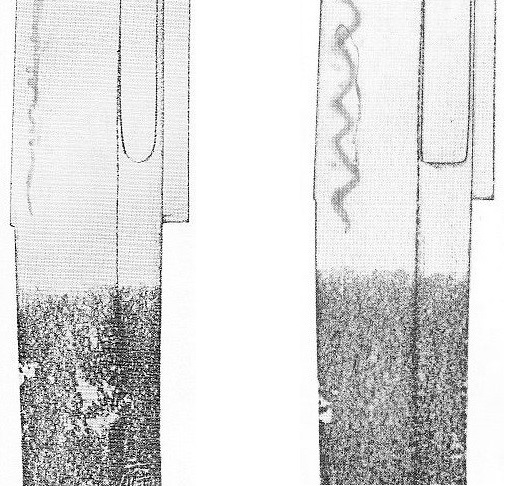
Two parallel grooves of the same thickness are called futasuji-hi (二筋樋) and appear towards the end of the Kamakura period. Thus futasuji-hi on noticeably earlier swords are probably ato-bi. Also please note that futasuji-hi were later occasionally added to blades to “underline” a certain approach. In other words, an early Nanbokuchô-style blade that showed characteristics similar to Sadamune for example could have been “enlarged” with futasuji-hi as some famous blades of this master were known for this feature. Schools and smiths known for carving futasuji-ji are: Rai Kuninaga (来国長), Nobukuni (信国), Sadamune (貞宗), Tsunahiro (綱広), Kaneuji (兼氏), the Naoe Shizu (直江志津) school, Kinjû (金重), Izumi no Kami Kanesada (和泉守兼定), Wakasa no Kami Ujifusa (若狭守氏房), the Sengo (千子) school (Muramasa [村正], Masazane [正真]), Fujishima Tomoshige (藤島友重), Inshû Kanenaga (因州兼長), for Bizen Nagamitsu (長光), Chôgi (長義), Tomomitsu (倫光), Kanemitsu (兼光), Yoshimitsu (義光), and Morikage (盛景), the Chû (中) and the Sue-Aoe (末青江) schools, Dewa no Daijô Kunimichi (出羽大掾国路), Etchû no Kami Masatoshi (越中守正俊), the Yasutsugu (康継) school, the Hôjôji (法城寺) school, Miyoshi Nagamichi (三善長道), Aizu Kanesada (兼定), Kashû Kanewaka (兼若), the Echizen-Seki (越前関) school, the Echizen-Shimosaka (越前下坂) school, the Chikuzen Nobukuni (筑前信国) school, the Fujiwara-Takada (高田) school, the Hizen Tadayoshi (忠吉) school, Mondo no Shô Masakiyo (主水正正清), Taikei Naotane (大慶直胤), Minamoto Kiyomaro (源清麿), Oku Motohira (奥元平), and Oku Mototake (奥元武).

futasuji

Examples of futasuji-hi, from top to bottom: Nagamitsu, Aoe, Fujishima Tomoshige

A variant of the futasuji-hi which is mostly found on hira-zukuri tantô or wakizashi is the take-kurabe (丈比べ, lit. “comparison of height”) where one thin hi ends noticeable before the other.

takekurabe

A take-kurabe on a sunnobi-tantô of Kanefusa (兼房, also named Kenbô).

Another variant of the futasuji-hi is the shôbu-hi (菖蒲樋), that is when the tips of the two small grooves merge. Representative for adding shôbu-hi are the following schools and smiths: Rai Kunimitsu (来国光), Awataguchi Norikuni (則国), for Yamato the Taima (当麻), Hoshô (保昌), and Shikkake (尻懸) school, Sôshû Akihiro (秋広) and Hiromitsu (広光), Takagi Sadamune (高木貞宗), and the Miike (三池) school of Chikugo province. There is a variant of the shôbu-hi that comes in several interpretations and that is called kuichigai-bi (喰違樋). At one interpretation, the upper hi of a shôbu-hi, i.e. the one along the mune, is interrupted at a certain point (see picture below, top). At another interpretation, the bottom hi widens to a bôhi after the upper hi (see picture below, center). And at a third kuichigai-bi interpretation, the thin grooves are “crossing” somewhere on the blade (see picture below, bottom). In addition to those schools and smiths who applied shôbu-hi, a kuichigai-bi is also seen on blades by: Nobukuni (信国), Heianjô Nagayoshi (平安城長吉), Sanjô Yoshinori (三条吉則), the Hoshô (保昌) school, the Sue-Tegai (末手掻) school, the Kanabo (金房) school, the Sue-Mihara (末三原) school, the Uda (宇多) school, the Hiroyoshi (広賀) school, the Sue-Enjû (末延寿) school, Dewa no Daijô Kunimichi (出羽大掾国路), Etchû no Kami Masatoshi (越中守正俊), the Yasutsugu (康継) school, shintô blades from Echizen province, Taikei Naotane (大慶直胤), Kurihara Nobuhide (栗原信秀), and Gassan Sadakazu (月山貞一).

shobuhi

shôbu-hi

kuichigai

Three kuichigai-ba variants.

A koshi-bi (腰樋) is a short bôhi variant carved towards the base of a blade. It is usually carved on just the omote side with anoher hi variant on the ura and mostly seen on hira-zukuri tantô or ko-wakizashi, although also some kotô-era tachi show a koshi-bi. Representative schools and smiths for a koshi-bi are: The Awataguchi (粟田口) school, the Rai (来) school, Nobukuni (信国), Heianjô Nagayoshi (平安城長吉), Sanjô Yoshinori (三条吉則), Shintôgo Kunimitsu (新藤五国光) the Sue-Tegai (末手掻) school, Umetada Myôju (埋忠明寿), the Horikawa (堀川) school, Yasutsugu (康継), Ômi no Kami Tsuguhira (近江守継平), Sagami no Kami Masatsune (相模守政常), Higo no Daijô Sadakuni (肥後大掾貞国), Yamato no Daijô Masanori (大和大掾正則), Kanenori (兼則), Ujishige (氏重), Teruhiro (輝広), the Hizen Tadayoshi (忠吉) school, Suishinshi Masahide (水心子正秀), and Taikei Naotane (大慶直胤).

A popular combination to the koshi-bi are gomabashi (護摩箸), stylized ritual chopsticks which are basically a shorter futasuji-ji variant. Gomabashi are like koshi-bi rare for tachi and katana and mostly seen on hira-zukuri tantô or ko-wakizashi. Representative schools and smiths known for carving gomabashi are: The Awataguchi (粟田口) school (Kuniyoshi [国吉], Yoshimitsu [吉光]), the Rai (来) school (Rai Kunitoshi [来国俊], Kunimitsu [国光]), Nobukuni (信国), the Hasebe (長谷部) school, Heianjô Nagayoshi (平安城長吉), Sanjô Yoshinori (三条吉則), Shintôgo Kunimitsu (新藤五国光), the Masamune (正宗) school (Yukimitsu [行光], Sadamune [貞宗]), Kagemitsu (景光), the Ôei-Bizen (応永備前) school, the Sue-Bizen (末備前) school, Izumi no Kami Kanesada (和泉守兼定), Shimada Yoshisuke (島田義助), the Horikawa (堀川) school, Hizen Tadayoshi (忠吉), shintô swords from Echizen province, Suishinshi Masahide (水心子正秀), and Taikei Naotane (大慶直胤). Please note that Yamashiro smiths often combined the gomabashi with a suken on the other, i.e. the omote side. Apart from that it has to be mentioned that the Awataguchi smiths carved their katana-hi closer to the mune than the Rai smiths when it comes to grooves on Kamakura-period Yamashiro tantô.

hi-comp

Left: koshi-bi gomabashi combination on a Rai Kunitoshi;

right: katana-hi very close to the mune on a blade by Awataguchi Kuniyoshi

Another groove interpretation is the naginata-hi (薙刀樋), named after the fact that it is mostly found carved along the shinogi-ji of naginata before it sets off and thins out to the mune. But a naginata-hi is sometimes also found on blades in kanmuri-otoshi-zukuri and unokobi-zukuri. Representative schools and smiths for a naginata-hi are: Nobukuni (信国), Heianjô Nagayoshi (平安城長吉), Sanjô Yoshinori (三条吉則), the Sue-Tegai (末手掻) school, the Kanabo (金房) school, the Sue-Seki (末関) school, the Uda (宇多) school, Hôjôji Kunimitsu (法城寺国光), Ryôsai (良西), the Hiroyoshi (広賀) school, the Sue-Mihara (末三原) school, the Sue-Sa (末左) school, the Horikawa (堀川) school, Miyoshi Nagamichi (三善長道), Aizu Michitoki (道辰), Suishinshi Masahide (水心子正秀), Taikei Naotane (大慶直胤), Kurihara Nobuhide (栗原信秀), and Gassan Sadakazu (月山貞一).

naginatahi

Rather long naginata-hi on a kanmuri-otoshi-zukuri tantô of Ryôsai.

KANTEI 1 – SUGATA #2

1.4 Mihaba and taper

After you have checked out the more overall features of a blade, i.e. length and curvature, it is time to go into details regarding a blade’s shape. There is no rule what detail to focus on first or in which order you check a blade but to save time, for example at a nyûsatsu-kantei where others are waiting in line and where usually an accustic signal tells you when to put down the blade, I follow a bottom to top approach. Well, you usally don’t judge a mihaba (身幅) by itself but see it in context with the sakihaba (先幅), i.e. the width of the blade at the yokote. And so you automatically arrive at the taper. I will introduce all the typical sugata for each time in one of the next posts so in this section it is only important to point out that for example if a blade is long, strongly tapering, and deeply curved, it is likely a tachi of pre-Nanbokuchô times or a later tachi that follows a classical shape. Is it long, wide, shallowly curved, and does not taper much, chances are high to have a mid-Nanbokuchô, Keichô-shintô, or shinshintô blade. And a strong taper in combination with a very shallow sori and a compact chû-kissaki is very typical for a Kanbun-shintô. As mentioned, these are just examples and you have to study the characteristics in sugata that will be explained in one of the next posts.

Another feature which belongs to this category is funbari (踏張り). The term funbari is only applied to a blade that starts wide at the base and then tapers significantly over the first 4~5 cm (1.5~2 inches). That means just a wide blade which tapers noticeably but uniformly towards the tip does not have funbari. So if funbari is present you can assume that the blade is unshortened and has its original sugata. Sidenote: To recognize that a blade is in its original sugata is quite important as it puts into context features like nagasa, mihaba and tapering. In other words, if you have a blade in its original condition, you don’t have to speculate about the degree of shortening and how its original sugata might have looked like to start drawing conclusions on a possible production time. It is also important as you learn so if you are facing for example a tachi, a katana, or a tachi that has been shortened to a katana, i.e. to be worn as uchigatana. Back to funbari. Funbari is first and foremost typical for Kamakura-period tachi in general and for rather early Kamakura-period tachi in particular. Funbari is connected to the feature of yaki-otoshi, i.e. where the hardened edge starts at a considerable distance from the base. In the case of a yaki-otoshi, swordsmiths widened the blades towards the machi to specifically counteract any possible weakness in this area as it was not hardened.

funbari

Detail of a tachi by Ko-Hôki Yasutsuna with yaki-otoshi and funbari.

*

1.5 Kissaki

After the length, curvature, width, and tapering, you focus on the tip. Is it large, very large, medium-sized, or does it feel only slightly elongated, compact, or even stubby? All these are important indicators which either confirm your assumptions done so far on the basis of the previous characteristics or rule them out as they now no longer match. For example: You have a blade with a long nagasa, a deep koshizori, and a noticeable taper which you had dated so far somewhere before mid-Kamakura but which comes with an ô-kissaki, you can now rather rule out an early kotô and better switch to shinshintô. Of course this track has again to be either confirmed or dismissed by the characteristic features examined in the next steps. Or you have a magnificent blade that does not taper that much and which you had dated to Kamakura so far and which turns out to have an ikubi-kissaki. With this “discovery,” you can stay with the initial dating and focus on the next characteristics and see if you can further narrow down the kantei to a certain school or smith from that time. By the way, be careful with the term ô-kissaki. This means, an ô-kissaki actually might not be that big as you think when reading of this term. Or when you see a blade with just a larger but not “ridiculously” large tip, bear in mind that you might already face an ô-kissaki. What I try to say is: Don´t think automatically of a super-long nagamaki-style kissaki when the term ô-kissaki is dropped as transitions are fluid and an ô-kissaki might just be a hint longer than an elongated chû-kissaki. Again, the different kissaki interpretations are more easy to grasp in the next posts when we deal with the different sugata for each time. Here I am just introducing point by point the order or checklist of doing kantei. The rules of thumb when it comes to kissaki are: 1. The smaller the ko-kissaki, the earlier the blade probably is. 2. A chû-kissaki is the most common tip and found throughout all periods. 3. An ô-kissaki is most likely found on a blade from the Nanbokuchô, Keichô-shintô, and shinshintô era. 4. An ikubi-kissaki is as indicated usually only found on blades from the mid-Kamakura period, that is to say on mid-Kamakura blades that follow the more stout and wide approach (compared to the more slender tachi that were still produced at the same time). 5. And a kamasu-kissaki where the cutting-edge of the tip has virtually no fukura is usually restricted to very early kotô and jokotô or later reproductions of such ancient swords (but it might also be found on a blade where much material had to be removed at a restoration, e.g. due to a deep notch along the cutting-edge of the kissaki).

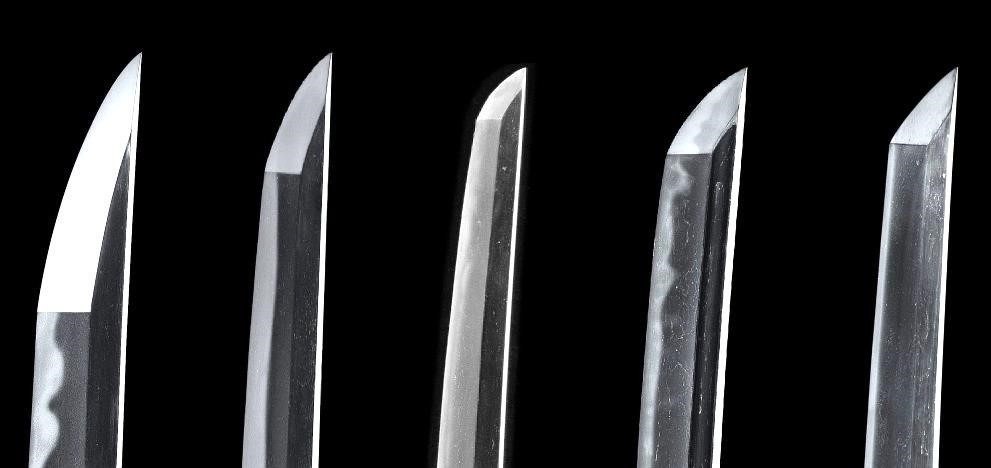
kissaki

From left to right: ô-kissaki, chû-kissaki, ko-kissaki, ikubi-kissaki, kamasu-kissaki.

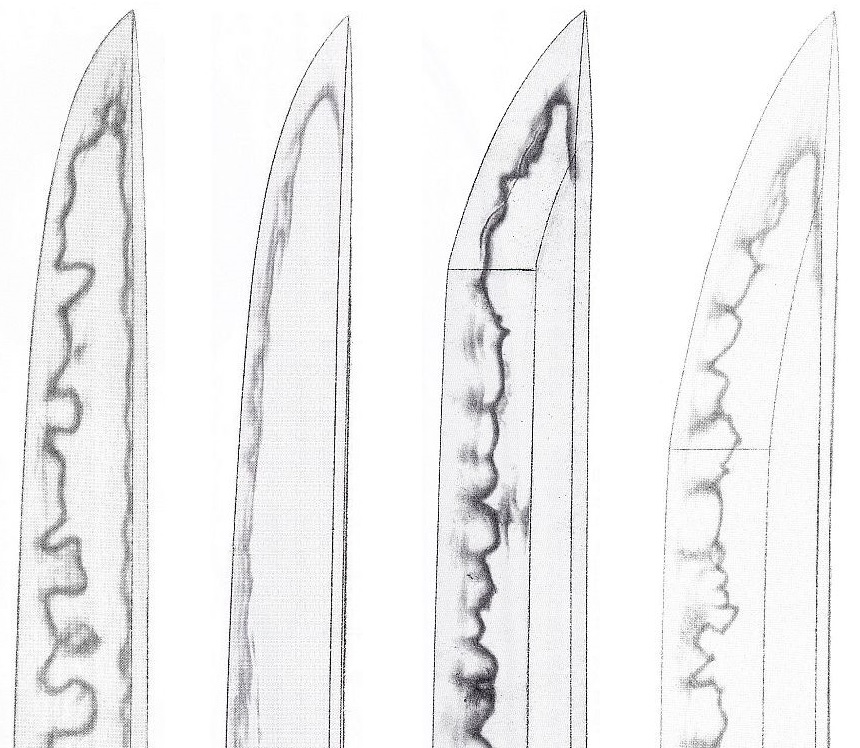
With this we arrive at the fukura, the curvature or bulbousness of the tip’s cutting-edge. The fukura can be rounded or full, or not rounded or scarce, and this applies to longer swords in shinogi-zukuri with yokote as well as to short swords and tantô in hira-zukuri. Well, the bulbousness of the tip’s cutting-edge is kind of a tricky point as transitions are very fluid and subtle and quite many kissaki have been reshaped to a certain extent. So if you read of a full fukura, don’t think automatically of a super roundish kissaki and in case of a scarce fukura not of a very straight kamasu-style kissaki vice versa as the actual differences are as mentioned more subtle. A really noticeably scarce fukura can be seen for example on tantô of Samonji (左文字) or of the Sue-Sôshû school and on later Muromachi-period katana with an elongated chû-kissaki, e.g. of Magoroku Kanemoto (孫六兼元). Also the Kyô-utsushi tantô (i.e. Rai copies) of No-Sada and other Sue-Seki smiths have by trend a rather scarce fukura. A chû-kissaki with a scarce fukura is also very typical for Ôei-Bizen smiths. This means, if you have a classical tachi that looks like Bizen Kamakura at a glance, take a closer look at the kissaki and if you find out that its cutting edge is not that pronounced, keep this in mind and bring it in line it with features along the jigane and hamon as you might face an Ôei-Bizen work. Also known for making tips with a noticeable scarce fukura are the smiths of the Kiyomaro (清麿) school and occasionally also Sa Yukihide (左行秀) worked in that pointy tip style. And don’t forget, at Norishige, who is also known for making tantô with noticeably scarce fukura, the scarce fukura comes in combination with a peculiar uchizori what results in a takenokozori.

fukura

Scarce fukura on tantô and katana respectively and from left to right: Sue-Sôshû, Samonji, Kiyomaro, Kurihara Nobuhide

*

1.6 Shinogi and shinogi-ji

Also how the central ridge is applied must not be forgotten as the height of the shinogi and the width of the shinogi-ji can point towards a certain tradition or production time. We speak of a high shinogi when the cross-section of the blade is noticeably diamong-shaped or the distance between the two ridges is noticeably wide in cross-section compared to the width of the kasane respectively. Representative for a high shinogi are the Yamato and Yamato-related schools like the Uda (宇多) school, the Mihara (三原) school, the Iruka (入鹿) school, the Tadasada (忠貞) school, the Niô (二王) school, the Kongôbyôe (金剛兵衛) school, or the the Naminohira (波平) school. Also the Sue-Bizen (Sukesada [祐定], Kiyomitsu [清光], Harumitsu [春光]) and Sue-Seki (Kanesada [兼定]) schools are known for making blades with a noticeably thin kasane and a high shinogi. Also representative for this feature are smiths like Shintôgo Kunimitsu (新藤五国光), the Eitoku-era (永徳, 1381-1384) Mino Kanemitsu (兼光), Norishige (則重), Kozori Tsuneie (経家), Osafune Tadamitsu (忠光), Nanki Shigekuni (南紀重国), Sendai Kunikane (国包). Please note that a high shinogi comes mostly automatically with blade shapes like shôbu-zukuri and kanmuri-otoshi-zukuri and all kinds of naginata and nagamaki. So also schools like the Hôjôji (法城寺) school (Kunimitsu [国光]), the Katayama-Ichimonji (片山一文字) school (Norifusa [則房]), the Naoe-Shizu (直江志津) school, the Kanemitsu (兼光) and Chôgi (長義) schools, the Echizen-Yasutsugu (康継), Kiyomaro (清麿), and Taikei Naotane (大慶直胤) are on the list when it comes to a high shinogi as they often made naginata or nagamaki-naoshi-style blades.

A low shinogi is typical for Bizen and Sôshû blades, for example for the Ichimonji (一文字) school, the mid-Kamakura period Osafune (長船) school, or the Kozori (小反) school. Also representative for a low shinogi are: For Kyô-mono the Hasebe (長谷部) school, the early Nobukuni (信国) generations, the Daruma (達磨) school, the Heianjô (平安城) school; for Yamato Tegai Kanekiyo (包清); Rai Kuninaga (来国長); for Sôshû Sadamune (貞宗), Akihiro (秋広), Hiromitsu (広光), Yoshihiro (吉広), Masahiro (正広), Hiromasa (広正); for Mino Kanesada (兼定), Kanemoto (兼元), Kanetsugu (兼次), Kinjû (金重), Kaneyuki (金行); the Chiyozuru (千代鶴) school; Unji (雲次), Kanemitsu and Chôgi when not making nagamaki-style blades, Tsuda Sukehiro (津田助広), Ômi no Kami Sukenao (近江守助直), or the Hizen smiths. At Sukehiro and his students for example, the shinogi is usually extremely low so that it sometimes even seems optically as if the blade thins from the mune to the shinogi. The same applies to Sue-Bizen Sukesada. That means you have to be careful and check the height of the shinogi and its relation to the width of the kasane closely as there are Sue-kotô smiths like Sukesada or Kanesada who worked in the one or other style. And also the early Ko-Mihara smiths Masaie (正家) and Masahiro (正広) are known for applying a low shinogi in places even if the school has its roots in the Yamato tradition.

Now to the width of the shinogi-ji where also the rule of the thumb applies: Yamato and Yamato-related schools applied a wide shinogi-ji and Sôshû and Yamashiro smiths a narrow shinogi-ji . Also known for making blades with a wide shinogi-ji are: Mino Kanetsugu (兼次) and Kanesada (兼定), Osafune Mitsutada (光忠), Kozori Tsuneie (経家), the Un (雲類) group except for Unshô (雲生) from whom we know blades with a narrow shinogi-ji, Aoe Masatsune (正恒), and the Chikuzen Miike (三池) school. And representative for a narrow shinogi-ji are: The Awataguchi school (粟田口), Ko-Hôki Yasutsuna (安綱), Sekishû-mono (石州), for Bizen Ômiya Morikage (大宮盛景), Hidemitsu (秀光), Masatsune (正恒), and Sanetada (真忠), and for shintô times for example Kotetsu (虎徹).

shinogiji

From left to right: wide Yamato shinogi-ji (Shikkake Norinage), narrow Sôshû shinogi-ji (Sadamune)

*

1.6 Mune, kasane and niku

I put these three elements together as I usually look at them kind of together, quasi as first group of features that require a rotating of the blade. So after lifting the blade up to check its weight and “feel” and looking at it as a whole to determine the length, curvature, taper, and interpretation of the tip, it is time to look at it from the back and at different angles to see how the back ridge (mune, 棟) is interpreted, how thick it is, i.e. what kasane (重ね) it has, and to what extent the cutting edge bulges, i.e. niku what (肉) it has. First the mune. Here we distinguish roughly between a flat kaku-mune (角棟), a round maru-mune (丸棟), a two-surfaced iori-mune (庵棟), and a three-surface mitsu-mune (三ッ棟), and further how high the ridge is or how steep the lateral areas (oroshi, 卸・おろし) go down to the blade respectively in the case of an iori-mune, and how wide the top level is in case of a mitsu-mune. A kaku-mune is usually only seen on ancient blades but rarely also on some short and thick Sue-Bizen (末備前) tantô (e.g. yoroidôshi). A maru-mune is also typical for ancient swords but was occasionally also applied by the following smiths or schools: The Hasebe (長谷部) school, Nobukuni (信国), the Heianjô (平安城) school, Kaga Shirô Sukemasa (加賀四郎資正), the Môgusa (舞草) school, Fuyuhiro (冬広), the Ko-Bizen (古備前) school (Masatsune [正恒], Tomonari [友成], Kanehira [包平]), Osafune Nagamitsu (長光), Bizen Shirô Kuniyasu (備前四郎国安), Sukezane (助真), the Ko-Aoe (古青江) and Aoe (青江) school, the Mihara (三原) school, the Miike (三池) school, the Taira-Takada (平高田) school, and the Naminohira (波平) school. When it comes to an iori-mune, a high or steep interpretation is typical for Yamato-related schools and for Hankei (繁慶) for example. A gentle or low interpretation is rather typical for Bizen blades in general. A mitsu-mune in turn speaks for the Sôshû tradition and for tantô of the Yamashiro smiths. As for Sôshû-mono, the earlier masters applied more a mitsu-mune with a wide top surface whereas the Sue-Sôshû smiths applied rather a narrow top surface. A mitsu-mune is also typical for Umetada Myôju (埋忠明寿), the Horikawa (堀川) school, Echizen Yasutsugu (康継), i.e. at Keichô-shintô smiths who focused on the great Sôshû masters, but it can be found on all later copies of or hommages to early Sôshû works.

kasane

Measuring the kasane.

With checking the mune, you automatically arrive at the kasane. The term kasane is commonly used to refer to the thickness of a blade but please bear in mind that strictly speaking, it means the thickness at the mune, i.e. where the ridges of the back end and go over into the shinogi-ji (see picture above). So in the case of a high shinogi, the blade might be described as thick although the actual kasane is thin. The kasane can be an important key in appraising a sword. For example, mid-Nanbokuchô blades in Enbun-Jôji-sugata (more on this blade form later) are known for having a very thin kasane for their length and width. Later revival works from the Keichô-shintô and shinshintô times copy the overall sugata very well but come mostly with a somewhat thicker kasane. In other words, if you are facing a magnificent and wide blade with an ô-kissaki and you are not sure if Nanbokuchô or something later, check the kasane before turning towards the blade characteristics. It might give you an idea where the direction goes, i.e. stay with Nanbokuchô or focus on the possibility of a later copy. Also known for a considerably thin kasane is the Hasebe (長谷部) school. Even for mid-Nanbokuchô and the already existing trend to a thin kasane the Hasebe’s kasane is strikingly thin. So if you have lets say a sunnobi-tantô or hira-zukuri ko-wakizashi in Enbun-Jôji-sugata which shows a very thin kasane, it is advisable to check if the workmanship matches with the characteristic features of the Hasebe school. But also check the ratio of moto-kasane (元重ね) and saki-kasane (先重ね), i.e. the “tapering” of the thickness. Is the kasane decreasing uniformly from base to tip, or is there a certain drop of the thickness? In the latter case, chances are high that a blade had seen a more “intense” polishing at the monouchi area, i.e. the area with which a target is hit in the ideal case. This also shifts the balance significantly and a blade which has lost a lot of material towards the tip feels lighter or more “easy to handle” as it originally was what in turn might set you on the wrong track.

And finally the niku. Here a distinction is made between ha-niku (刃肉) and hira-niku (平肉) whereat the former describes the rate of the niku from the cutting edge to the habuchi, and the latter the rate of the niku from the habuchi to the shinogi. But this differentiation is rather sophisticated and mostly just the general term niku is used to describe the bulging of the cutting surfaces in cross-section. The fullness of the niku depends on the what kind of target the blade is designed for to cut, that means the harder the target the fuller the niku has to be. A noticeably full niku is typical for blades from the Kamakura period and a variant of a full niku which only drops towards the very cutting edge is called hamaguri-ba (蛤刃) (see picture below). With the mid-Nanbokuchô period, the niku decreases significantly. Niku can get low due to repeated polishing but a good polisher tries to preserve the original geometry of a blade as good as possible. That means removing the full niku of a Kamakura-era blade when not absolutely necessary would be considered as no go. So one has to be careful and take into consideration the age of a blade. A noticeably low niku is typical as mentioned for the mid-Nanbokuchô period but also for their later “revival counterparts” made in Keichô-shintô and shinshintô times. Incidentally, the distribution of the niku is called niku-oki (肉置) or niku-dori (肉取り).

hamaguriba

Hamaguri-ba.

And last but not least for this group of features it is also advisable to check if a blade has ubu-ha (生ぶ刃), an unsharpened cutting-edge at the very base. Ubu-ha is a sign that a blade is unshortened and hasn´t seen much polishes. So if you recongize ubu-ha on a classic tachi of which all characteristics point towards Kamakura, be careful and try to double-check other features to find out if you are facing one of the extremely a rare and healthy blades from that time or, what is more likely, a later copy. By the way, I have seen a Sa tachi with such a conspicious ubu-ha in Japan some years ago that I ended up at shinshintô utsushimono with my bid. So this blade quasi experienced only the absolute minimum of polishes over the last ~650 years!

Token-Bijutsu Articles

Before we continue with the Kantei series, I have compiled a list of almost all editorial and smaller articles (more than 400) that were published in the NBTHK Token-Bijutsu magazine over the last two decades (issues #427-711). A few issues are missing as I didn’t have all the editions available when I scanned all the articles for my archive. As stated in the PDF, there is a column with the netto pages per article so if you are interested in a translation of a certain article, just multiply this number with the price for a full page as stated in the top menu of this blog.

PDFLogo

TOBI-Logo