Stages in Yasuchika´s life

This time I want to tell from different stages of Yasuchika´s life, namely illustrated by a selection of a few tsuba which show characters as motif. Yasuchika was born in the tenth year of Kanbun (寛文, 1670) as son of Tsuchiya Chûzaemon (土屋忠左衛門) who was a retainer of Dewa´s Shônai fief (庄内). His first name was „Yagohachi“ (弥五八) and with his coming of agem he entered the service of the Matsudaira-Naizen family (松平内膳), who were the elder (karô, 家老) of the Sakai family (酒井). The Sakai were the daimyô of the Shônai fief by the way. But on the side, he entered an apprenticeship as a kinkô artist with the local Shônai-Shôami artist Satô Chinkyū (佐藤珍久). When he realized that metalwork was his thing, he resigned from his bushi status, married the daughter of his master and became an independent kinkô. In the 16th year of Genroku (元禄, 1703) – he was 34 years old at that time – he left his wife and children under the care of his father-in-law and went to Edo to refine his craft under the guidance of Nara Tatsumasa (奈良辰政). This step might be connected to the fact that Chinkyû himself had studied under a Nara master, namely under Toshiharu (利治), who was in turn the master of Tatsumasa. According to transmission, Yasuchika lived at the house of a relative at that time, namely Tsuchiya Hanbei (土屋半兵衛), in Edo´s Kanda district. But the house fell victim of both fires in the 16th year of Genroku (1703) and in the second year of Hôei (宝永, 1705). So Yasuchika went to Shinano province for some years to work for the Suwa shrine (諏訪神社). But, by the latest with Hanbei´s death in Hōei four (1707), he had returned to Edo to continue his profession as a kinkô artist.

Some time later he had to bear a serious blow when he learned in Edo of the death of his wife. He hadn´t been in Shônai for more than ten years by then. But he was able to take his mind off his worries by work when he was employed in the later years of the Shôtoku era (正徳, 1711-1716) by Matsudaira Daigaku no Kami Yorisada (松平大学頭頼貞, 1664-1744). Just about ten years earlier, to be more precise in Genroku 13 (1700), Yorisada had been transferred from the Nukada fief (額田藩) of Hitachi province to Moriyama (守山藩) in Mutsu province which had become officially an independent fief whith his entry. The fief was rather small and had an annual income of 20.000 koku. Well, Moriyama was actually regarded as a so-called “shihan” (支藩), a quasi “branch fief” of another fief ruled by a different line of the same family. In our case, the Matsudaira were as we know related to the Tokugawa. So Moriyama was under the supervision of the influental Mito fief. That means that the daimyô stayed permanently in the Edo mansion and was exempt from commuting between the latter and the fief in the course of the sankin-kôtai system. The Moriyama-Matsudaira mansion was located in the Ôtsuka district (大塚) of Edo and covered a 20,46 ha large area. As the wind was blowing up constantly from the lower southwestern districts of Edo, the mansion was also called Fukiage-tei (吹上邸, about “upward wind mansion”). So Yasuchika worked from this mansion and this employment with Yorisada was very beneficial to Yasuchika´s artistic development and very individual pieces date back to that stage in his career, for example the peculiar daigaku tsuba shape named after Yorisada´s honorary title “Daigaku no Kami. The two tsuba introduced below show such a daigaku-gata. And thus we arrive at the first two pieces through which I want to illustrate this stage in his life.
 yasuchika1a

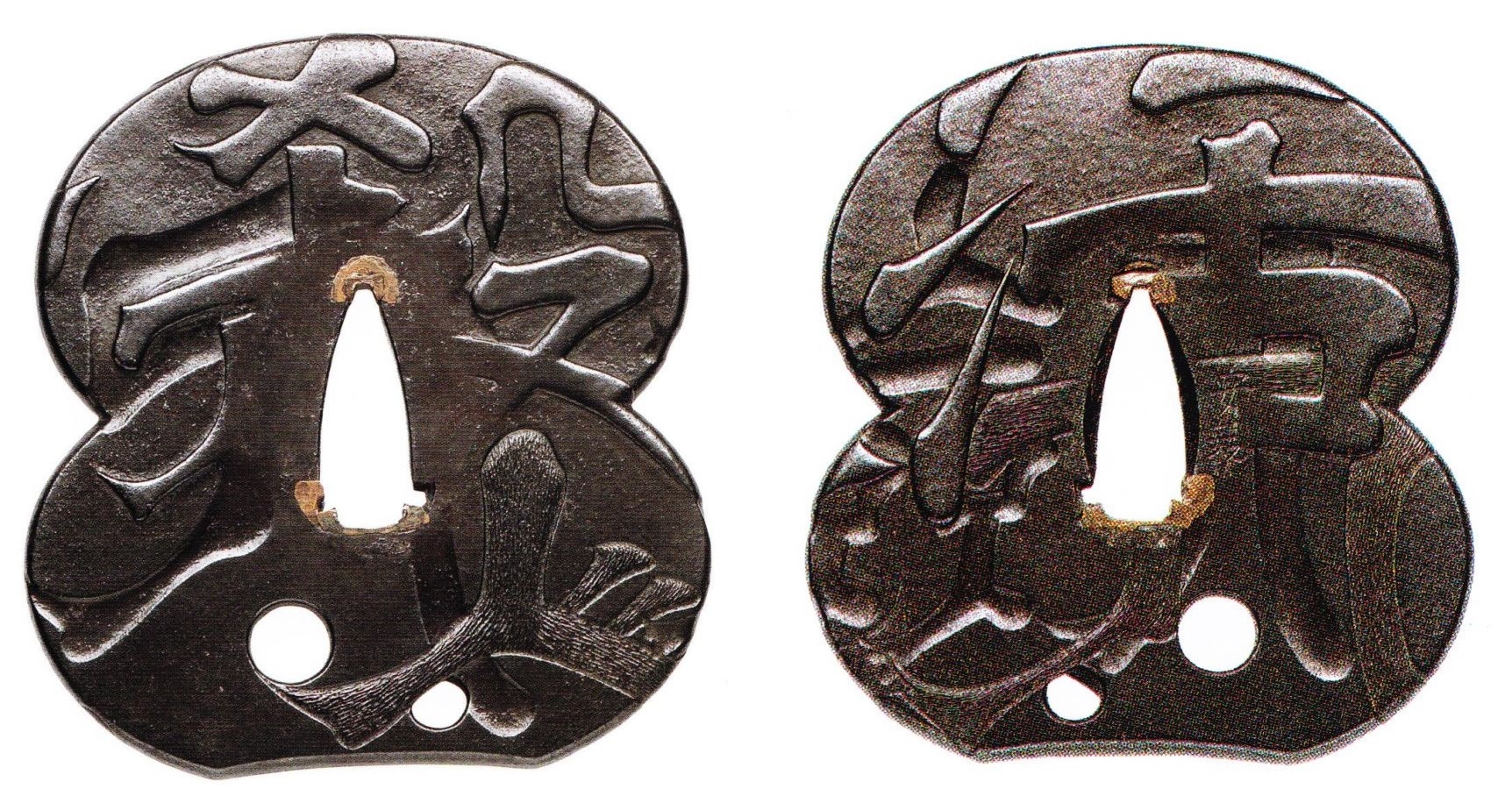
The first tsuba is inspired by fencing philosophies and shows in sukidashi and sukisage-bori the well-known phrases “katsujinken” (活人剣) and „satsujintô“ (殺人刀), also pronounced as „katsuninken“ and „satsunintô“, i.e. the „life-giving sword“ and the „death-dealing sword“ respectively. Mostly the katsujiken-satsujintô phrase is used to describe the process of mastering the art of swordsmanship, i.e. to come to a point where you have the freedom to decide if to kill or not or if to use your sword just to kill others or help them by dealing with their „problems“. But the phrase has a much deeper meaning which goes back to „Mumonkan“ (無門関), the collection of Zen kôan compiled by the monk Mumon Ekai (無門慧開, 1183-1160). Chapter 11 is about the Zen master Jôshû Junshin (趙州従諗, 778-897) who visits two enlightened monks which already had retreated to their hermitages. According to the „Mumonkan“, he tested them by entering their cottages and asking „Anybody there?“ The monk raised his fist but Jôshû replied: „The water is too shallow to anchor here.“, what means about „there is not much enlightenment to find for me in here.“ But at the second monk and after the very same procedure, Jôshû replied after the monk had just raised his fist: „Free to give, free to take, free to kill, free to save,“ and made a deep bow. So Jôshû tested the mental states of enlightenment of the monks, that means if his reaction showed any hints of irritation by his question „Anybody there?“, Jôshû knew that this monk was not that deeply enlightened. But Mumon Ekai suggested on the other hand, that the monks were testing Jôshû. So they know that he was going to ask something like that and tested him by seeing his reaction after they just raised their hands. This situation is described as if two mirrors are reflecting each other. The goal of this kôan teaching is to go quasi once through the entire process of thinking into both Jôshû and the monks, followed by a transcending of all of this. And as it is common for the end of each chapter, Mumon forwards a little poem to this kôan which goes: „The eye like a shooting star, the spirit like a lightning; a death-dealing blade, a life-giving sword.“ In short, if you are truly enlightened, you can look through someones mind super fast and you have the power to either show him immediately that he is not enlightened, or help him with the right single word to get enlightened.
 yasuchika1b

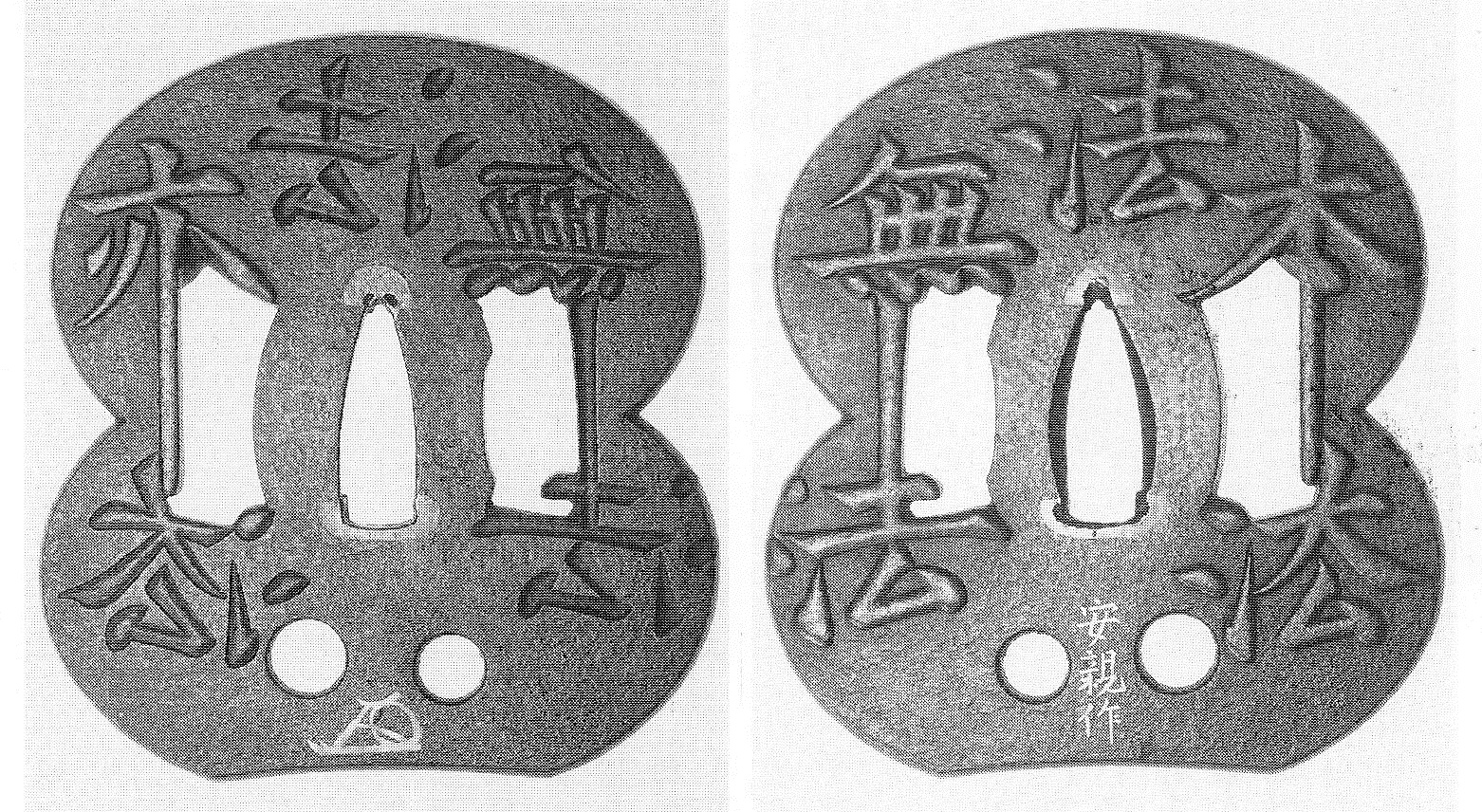
Now to the next tsuba. This one shows again in sukidashi and sukisage-bori the characters (法本法無法・無法法亦法) which read: “hô wa moto hô to shite muhô nari, muhô mo hô to shite mata hô nari.” It basically means: “The laws of Buddha (Dharma) were initially not (profane/worldly) laws in the proper meaning of the word, but they eventually became laws (as they turned out to be “right”).” It is said that Shakyamuni Buddha told this his principle disciple Mahākāśyapa (Japanese „Makashô“ [摩訶迦葉] or „Daikashô“ [大迦葉]). Later many Buddhist reformers like Hônen (法然, 1133-121) and Nichiren (日蓮, 1222-1282) used this teaching of Shakyamuni to justify their reforms.

So the choice of phrases for these two tsuba made during the time he worked for Matsudaira Yorisada give us a deep insight into this employment relationship. It is namely assumed that the well-educated daimyô Yorisada initiated Yasuchika to certain classical subjects. As mentioned, this employment was very beneficial to Yasuchika´s artistic development, namely not only because of the fact that he got many orders and was able to refine his craft, but more of a philosophical nature. He got in touch with Buddhist teachings and history and probably struggled with Zen kôan himself. It is namely hardly conceivable to assume that he didn´t think about the meaning of the motif he was working on over days, weeks or even months. So maybe the tsuba with the katsujiken-satsujintô alludes to him testing Yorisada or to the other way round, or maybe they were likeminded on their way to enlightenment so that they experienced this mentioned „two mirrors reflecting each other“ situation.
 yasuchika1c

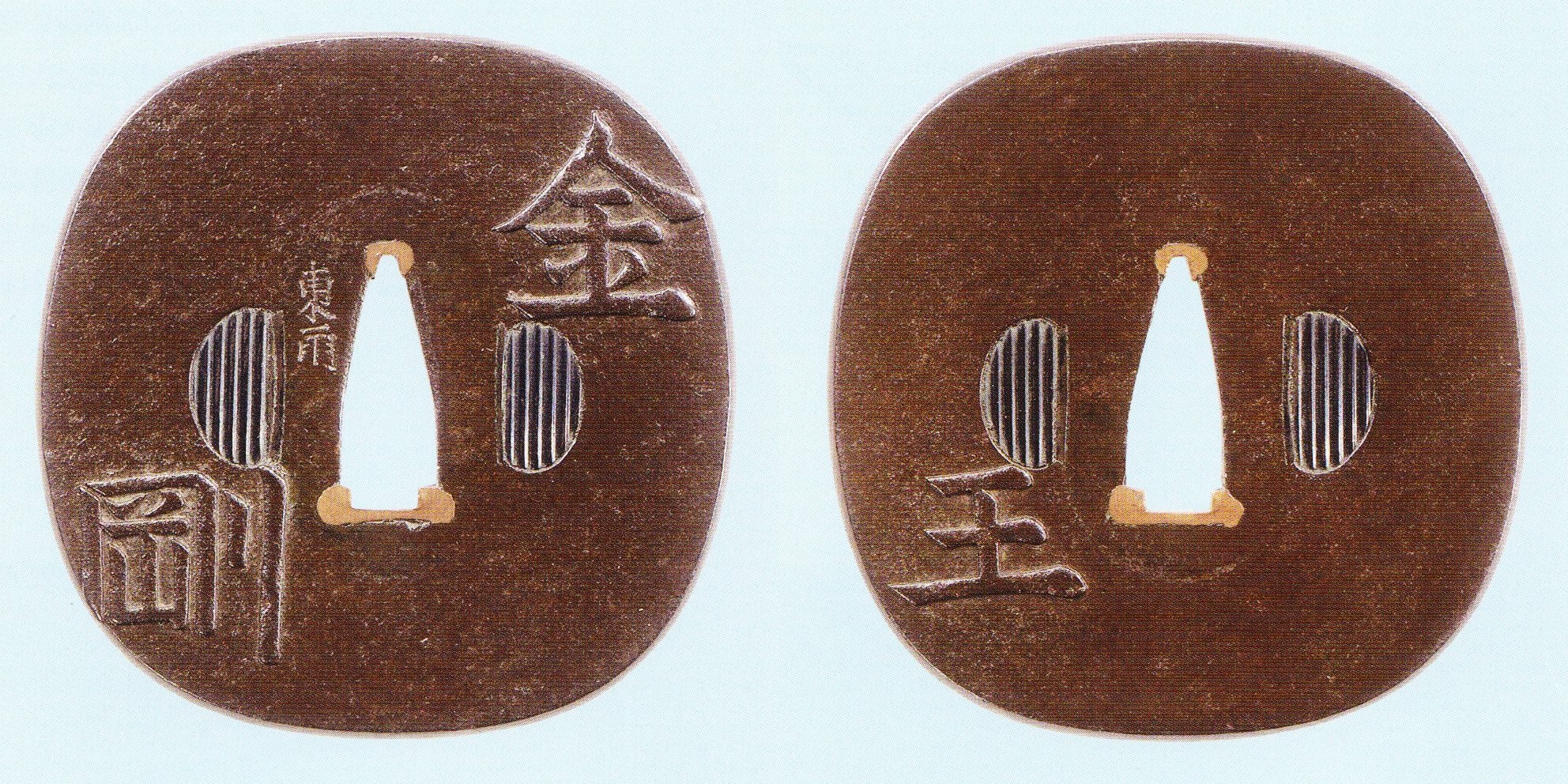
But let us continue with his career. Yasuchika quit namely voluntarily this employment to work even more independently. In the meanwhile, his son Yaichirô (弥一郎) was 22 years old and so he had him come to Edo. Yasuchika married again and moved to Kanda where he trained his students. At this time – pushed by orders of famous daimyô families like the Arima (有馬) and Tsugaru (津軽) – most of his famous jûyô-bunkazai and jûyô-bijutsuhin masterworks were created. That means he had attained artistic maturity by that time. In the 15th year of Kyôhô (享保, , 1730) he entered priesthood at the age of 61 and called himself henceforth „Tô´u“ (東雨, lit. “Eastern Rain”). He handed-over the management of the family and his name „Yasuchika“ as well as his first name „Yagohachi“ to his son Yaichirô. In Genbun three (元文, 1738) his second wife died and from extant letters to his kinkô colleague Watanabe Arichika (渡辺在哉), who worked in his homeland Shônai, we learn that Yasuchika often had to stay in bad due to his bad physical condition. And in these hard times, the last tsuba was made which I want to introduce representative for his latest years. It is as indicated no longer signed “Yasuchika” but “Tô´u” and shows on a very gentle nadekaku-gata, by making use of much free space, the three elegantly interpreted characters “Kongô´ô“ (金剛王). Kongô´ô can either be the abbreviation of „Kongô-yasha-myôô“ (金剛夜叉妙王, sanskrit „Vajrayakṣa“), one of the „Sixteen Great Bodhisattva“ and one of the „Five Great Myôô“, or of the Bodhisattva „Kongô-za´ô“ (金剛蔵王), one of the most important deities of the practitioners of shûgendô (修験道). So it is possible that Yasuchika increasingly turned towards Buddhism when he fell ill, namely as support for his prayers for health and inner peace, as spiritual backing for keeping-off demoniacal hindrances (mashô, 魔障) during meditation. The brush strokes are much more unobtrusive as on the two tsuba in daigaku-gata. Everything, i.e. the color, shape, and the arrangement and interpretation of the motif is much more cut back, a look which is so typical for the tsuba from his later Tô´u phase. Anyway, Yasuchika died six years after his second wife, namely on the 27th day of the ninth month of Enkyô one (延享, 1744), at the age of 75.
yasuchika1d


The contestant Nobukuni Shigekane

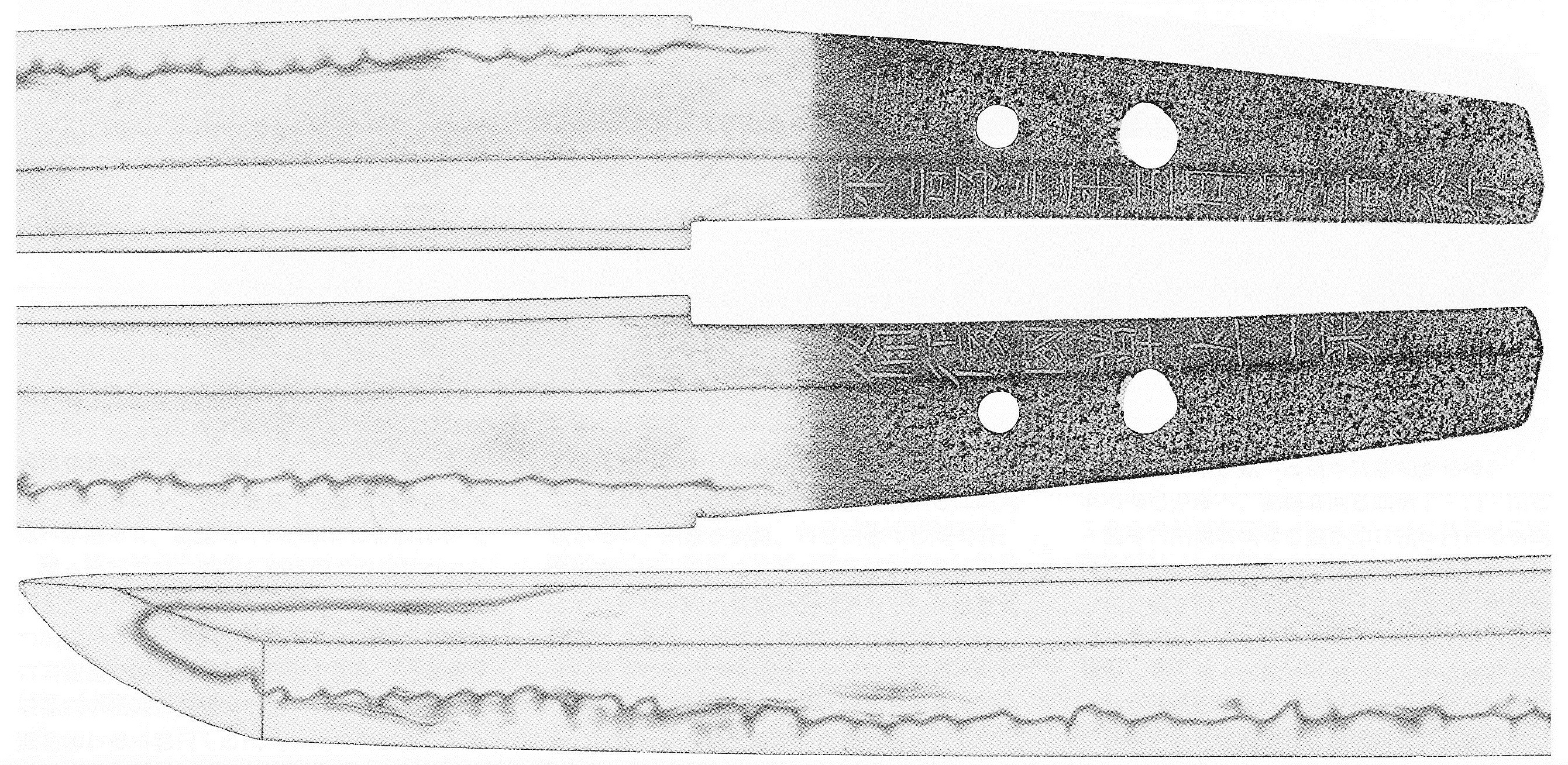
A while ago I wrote in my article on the honorary titles of Mondo no Shô Masakiyo (主水正正清) and Shume no Kami Ippei Yasuyo (主馬首一平安代) about the sword forging contest initiated by the eighth Tokugawa-shôgun Yoshimune (徳川吉宗, 1684-1751). As mentioned therein, there were four winners selected, namely apart from Masakiyo and Yasuyo the 4th generation Nanki Shigekuni (南紀重国) and the Chikuzen smith Nobukuni Shigekane (信国重包). I also wrote that after the contest, the winners were supported by a program of orders and recommendations. But how did this „programm“ look like? To understand this, I want to introduce a concrete and very good example of an order directly from Tokugawa Yoshimune. In picture 1 we see a wakizashi with a nagasa of 58,8 cm (1 shaku 9 sun 4 bu) and a sori of 1,8 cm. It shows an itame mixed with mokume, ji-nie, plentiful of chikei and a midare-utsuri. The hamon is a rather small-dimensioned gunome mixed with chôji with more ups and downs along the monouchi and base than in between where the ha tends to suguha-chô with gunome-ashi. The nioiguchi is rather wide, quite ko-nie-loaden, and shows along the upper half sunagashi. The bôshi is sugu with a bit ko-midare and runs back in a ko-maru-kaeri with hakikake. The tang bears the single leaf of the Tokugawa aoi crest granted to the winners of the contest, and the detailed mei reads: „Chikushû-jû Nobukuni Minamoto Shigekane“ (筑刕住信国源重包) – „Uyauyashiku taimei o hôjite Tôbu ni itari kore o tsukuru“ (恭奉台命至于東武作之) – „Toki Kyôhô kanoto-ushi haru sangatsu“ (旹享保辛丑春三月). Translated: „Made by Nobukuni Minamoto Shigekane from Chikuzen province in the third month, spring, of the year of the ox of the Kyôhô period (1721), in Tôbu (= Edo) by respectfully following the shôgun´s order.“

 Shigekane1

Picture 1: wakizashi of Nobukuni Shigekane

Particularly striking on this blade are the horimono. We see on the ura side a kurikara-ryû as ukibori relief in a hitsu, and on the omote side the deity Fudô-Myôô, also in a hitsu. And at a Fudô-Myôô horimono on a Shigekane blade, you should prick up your ears. There is namely an interesting entry in the local history „Chikuzen no Kuni zoku-fudoki-furoku“ (筑前国続風土記附録) compiled in the Kansei era (寛政, 1789-1801) on behalf of the local Fukuoka fief (福岡藩) for which Nobukuni Shigekane had worked. The entry goes as follows: „Nobukuni Shigekane, first name Sukezaemon (助左衛門), called himself later Sukeroku Masakane (助六正包), Made in the Kyôhô era on orders of the shôgun Yoshimune at his Hama-goten (浜御殿) residence in Edo copies of the Wakasa-Masamune (若狭正宗) and Fudô-Kuniyuki (不動国行). As a reward, he got the – not hereditary – permission to engrave one leaf of the aoi crest under the habaki area. Due to this honor of the sovereign, his salary by the fief was raised to 15 koku and a support for five persons. This raised him about to the level of a lower ranking samurai.“ And indeed, the meibutsu Fudô-Kuniyuki showed the very same horimono at the base so we are able to can confirm this transmission through this wakizashi.

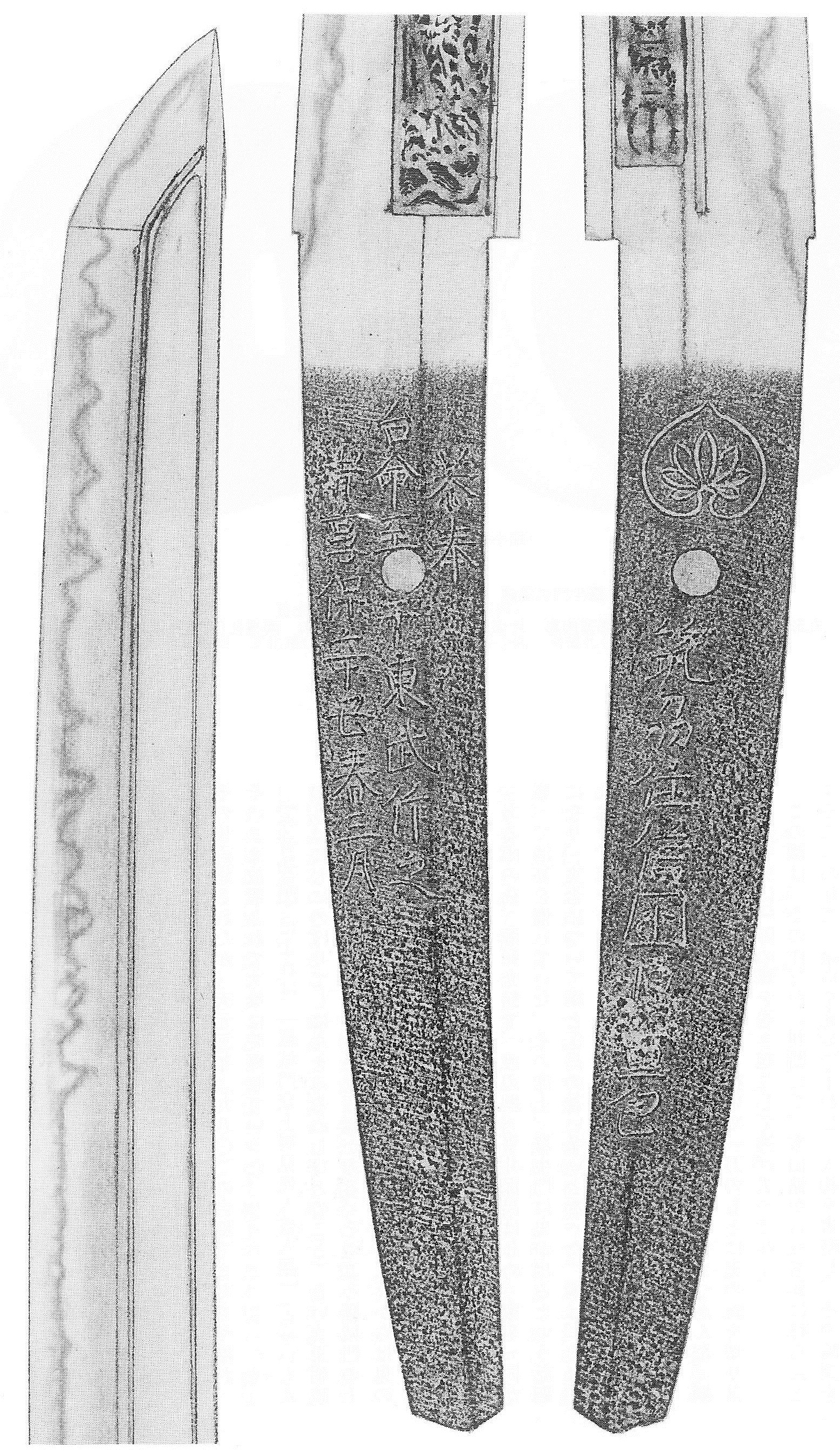
Let me introduce what we know about the Fudô-Kuniyuki (the sword also appears briefly in my Legends and Stories around the Japanese Sword 2). It was once a heirloom of the Ashikaga family but captured by Matsunaga Hisahide (松永久秀, 1510-1577) in the course of the defeat of the then shôgun Ashikaga Yoshiteru (足利義輝, 1536-1565). Hisahide presented it to Oda Nobunaga when on the occasion of his marching-in in Kyôto. After Nobunaga´s death it came into the possession of Akechi Mitsuhide (明智光秀, 1528-1582) who in turn presented it to his retainer Akechi Hidemitsu (明智秀満, 1536-1582). We know that Hideyoshi was eager to take revenge for Nobunaga´s death in order to come into power and when Hidemitsu realized that he was going to die, he volunatrily handed-over the Fudô-Kuniyuki to Hideyoshi so that the famous sword will not be destroyed. After the Battle of Komaki and Nagakute, Hideyoshi presented the sword to Ieyasu and so it came to be a heirloom of the Tokugawa family. However, it was damaged in the Great Meireki Fire in 1653 and had to be retempered by the 3rd generation Echizen Yasutsugu (越前康継). The Yasutsugu by the way were quasi the first-choice of the Tokugawa when it came to retemper precious meibutsu. As a sidenote, there exists the transmission that the horimono of Fudô-Myôô in flames caused the destruction of the sword by fire. Or to be more precise, it was rumored that the blade was tired of the peaceful times and committed quasi suicide by surrendering itself to the flames. However, the Tokugawa sold the sword in the early years of the Shôwa era and it was designated as jûyô-bijutsuhin even if it had a saiha. Unfortunately, the Fudô-Kuniyuki is missing since after World War II. All we have are some depictions, like for example in the „Kôtoku-katana-ezu“ (光徳刀絵図, picture 2), which in turn was at least made before the blade was damaged by fire. But as so often the case, we have different measurements in all these sources. The „Kôtoku-katana-ezu“ lists the Fudô-Kuniyuki with a nagasa of 1 shaku 9 sun 1 bu (57,9 cm) whereas the „Kyôhô-meibutsu-chô“ lists it with 1 shaku 9 sun 9 bu (60,3 cm), and a „Kiya-oshigata“ (木屋押形) copy from Kyôhô six (1721) with 1 shaku 9 sun 4 bu (58,8 cm). That means the copy of Shigekane follows ecactly the latter source.

 Shigekane2

Picture 2: The Fudô-Kuniyuki as depicted in the „Kôtoku-katana-ezu“.

So Shigekane had no chance to see the original hamon of the meibutsu and so he focused merely on copying exactly the bôhi with its tsurebi and of course the horimono (see comparison pictures below). But with some imagination, we can see a similarity of the Shigekane-utsushi and the drawing in the „Kôtoku-katana-ezu“ in terms of the smallish togari protrusions connected by suguha sections in the monouchi area of the omote side. This blade gives us an insight of how sensitive the then sword world was, at least in higher circles. That means Tokugawa Yoshimune and higher ranking daimyô did not just order any old sword from the winners of the contest which was then stored away forever in a locker. Much attention was namely paid to details, everyone was talking about the swords of the „Kyôhô-meibutsu-chô“, and famous swords were taken out of the treasury and handed over to the smiths when they were in Edo so that they were able to study them hands-on. So it was a great honour for Shigekane to work on a copy of the Fudô-Kuniyuki and the details below show how thorough his approach was.

 Shigekane3

Picture 3: Comparison of the horimono. Please also not how the tsurebi of the ura side ends in the same way a bit lower than the hitsu for the kurikara-ryû.

 Shigekane4

Picture 4: Comparison of the hi at the kissaki area and the hamon along the monouchi.

Kantei Supplement 2

Out now as promised, the second supplement to the first two kantei volumes in English. It contains 175 kotô, shintô and shinshintô blades in the classical order, namely kotô-gokaden, kotô other provinces, shintô-centres Kyôto, Ôsaka and Edo, shintô other provinces and shinshintô. The numbering continues with the last blade of the first supplementary volume, i.e. with number 419. So we arrive now at almost 600 blades (594 to be precise) with all volumes so far!

428 pages, A4, paperback, b/w pictures, price: $ 89.00

It can be obtained at Lulu.com via this link.

There is also an eBook available here.

KanteiSupplement2

Table of contents

The secret world of mekugi-ana

   Some years ago Kondô Hôji (近藤邦治), the president of the Gifu branch of the NBTHK, discovered a transcription of a sword publication published in Bunka three (文化, 1806). Well, the sword publication itself is rather diversified and covers the usual spectrum, and the reference to the second year of Gentoku (元徳, 1330) as time of the publication of the original is highly questionable. It is assumed that this is a typo and that either Genroku (元禄, 1688-1704) or Shôtoku (正徳, 1711-1716) was meant. However, this transcription contains an interesting chapter called „Menuki-ana no shidai“ (目貫穴之次第, about „The Conditions of menuki-ana“), yes menuki-ana, but actually mekugi-ana are meant. The book depicts 15 illustrations of different mekugi-ana which are introduced in the following by adding as far as possible similar mekugi-ana on actual blades.

mekugi1-3

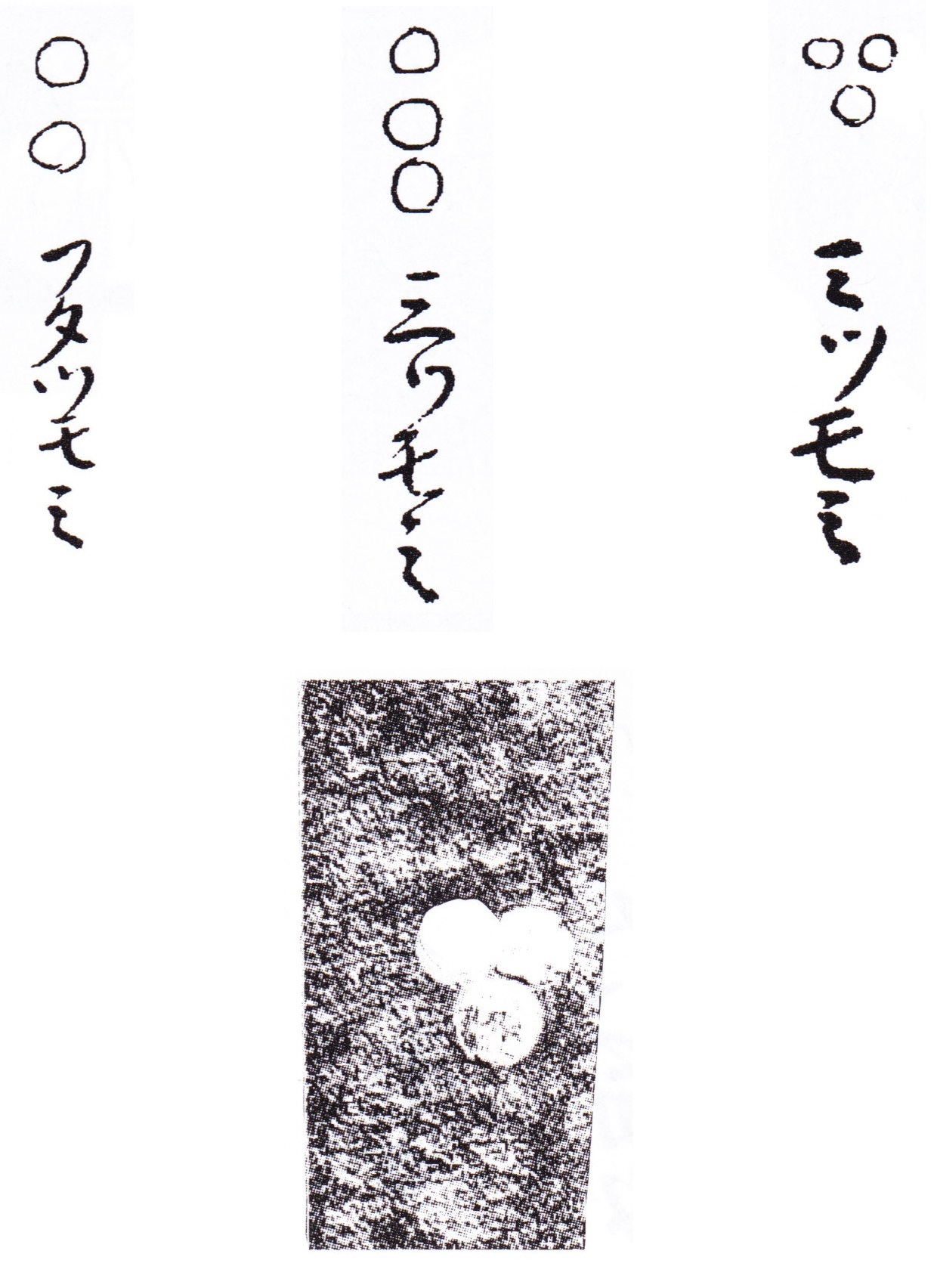
   The first three pictures describe an arrangement of two or three peg holes one below the other or in a triangle. These arrangements are called „futatsu-momi (フタツモミ) and „mitsu-momi“ (ミツモミ) respectively what might best be translated as „twosome rubbing“ and „threesome rubbing“. The text mentions that in this category, just the number is counted and that four aligned menuki are called „yotsu-momi“ (ヨツモミ) and five „itsutsu-momi“ (イツツモミ) and so on. A mitsu-momi in a triangular arrangement is very rare and is mostly restricted to early kotô blades like the one shown below from a tachi of Bungo Yukihira (行平).

 mekugi4

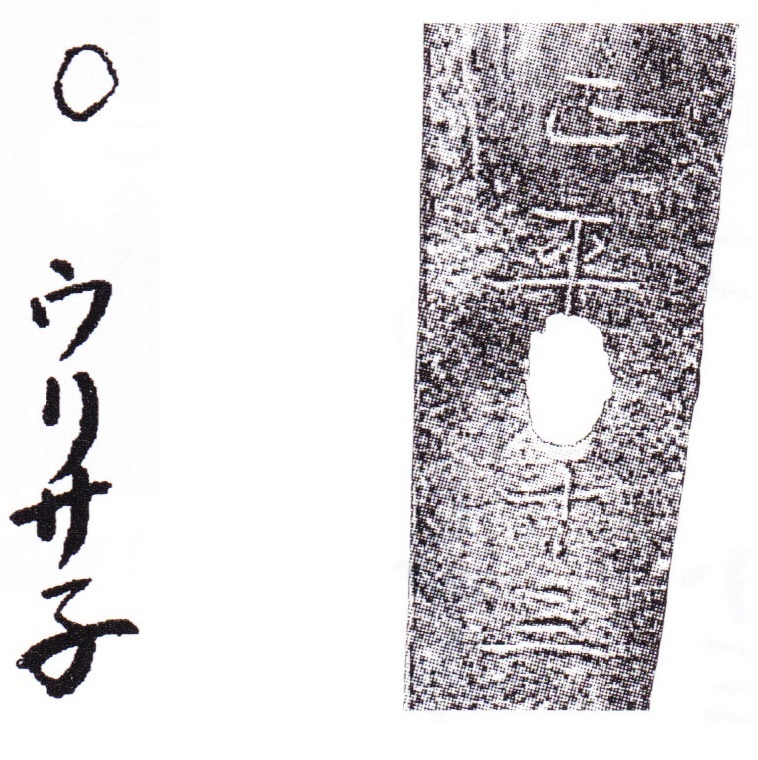
The fourth picture is called „urizane“ (ウリサ子, lit. „melon seed“). So here not the arrangement but the shape of the mekug-ana is described. Such a hole is very common and comes by widening an existing mekugi-ana. The picture to the left shows an actual example on a tantô of Tomoyuki (友行).

 mekugi5

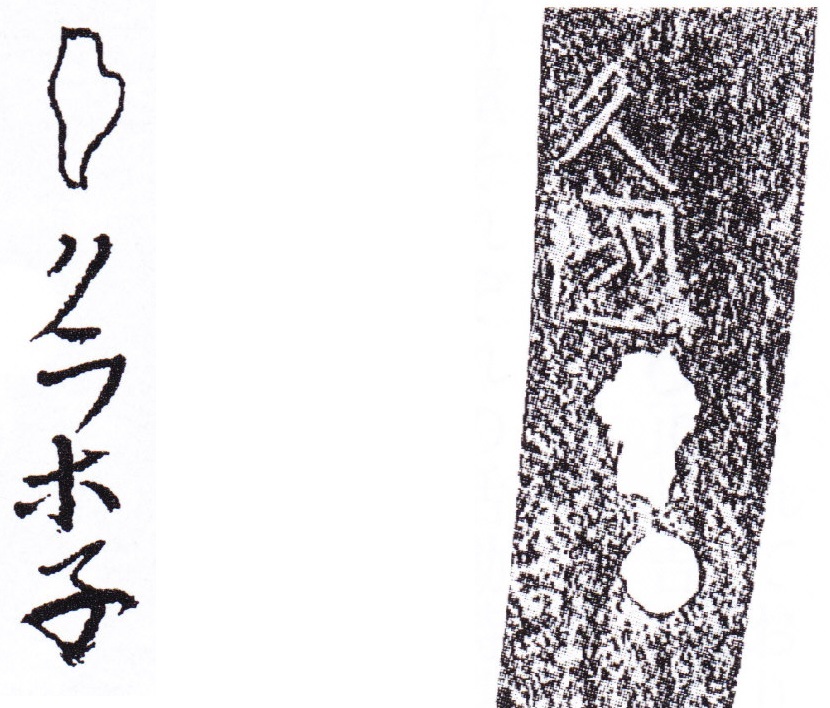
Picture number five is called „nasu-hisago“ (ナスヒサ子, lit. „eggplant“). Such a mekugi-ana is rather rare and is found, if at all, mostly on kotô-tantô as the example on a blade by Morimitsu (盛光) shows. A nasu-hisago hole is in the same way a widened mekugi-ana as the urizane hole.

 mekugi6

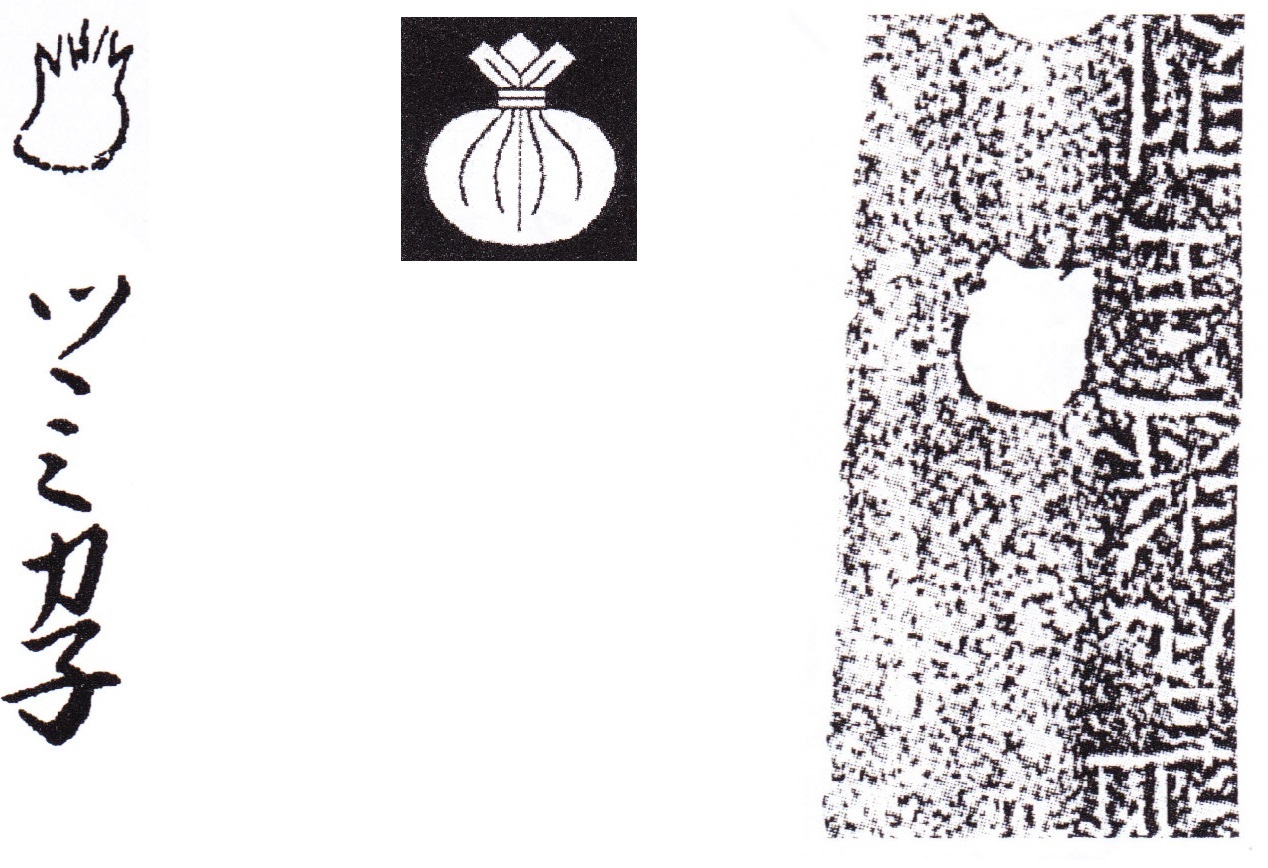
Number six is called „tsutsumigane“ (ツゝミカ子) what refers to the shape of a wrapped-up money present (tsutsumigane, 包み金) or the auspicious symbolism of a bag of gold (kanabukoro, 金袋, see b/w picture in the middle). Principally a tsutsumigame describes a hole which was once widened and where the mekugi got loose again. To tighten the peg, the steel was hammered from one side to narrow the hole again, namely to avoid opening a new mekugi-ana. The picture to the right shows an actual tsutsumigane hole on a tachi of Shikkake Norinaga (尻懸則長).

 mekugi7

The seventh picture bears the name „kurahone“ (クラホ子), i.e. the frame (hone, 骨) of a wooden saddle (kura, 鞍). It is hard to find actual examples of mekugi-ana which match this depiction but probably one like seen on the tachi of Hisakuni (久国) on the right is meant.

 mekugi8

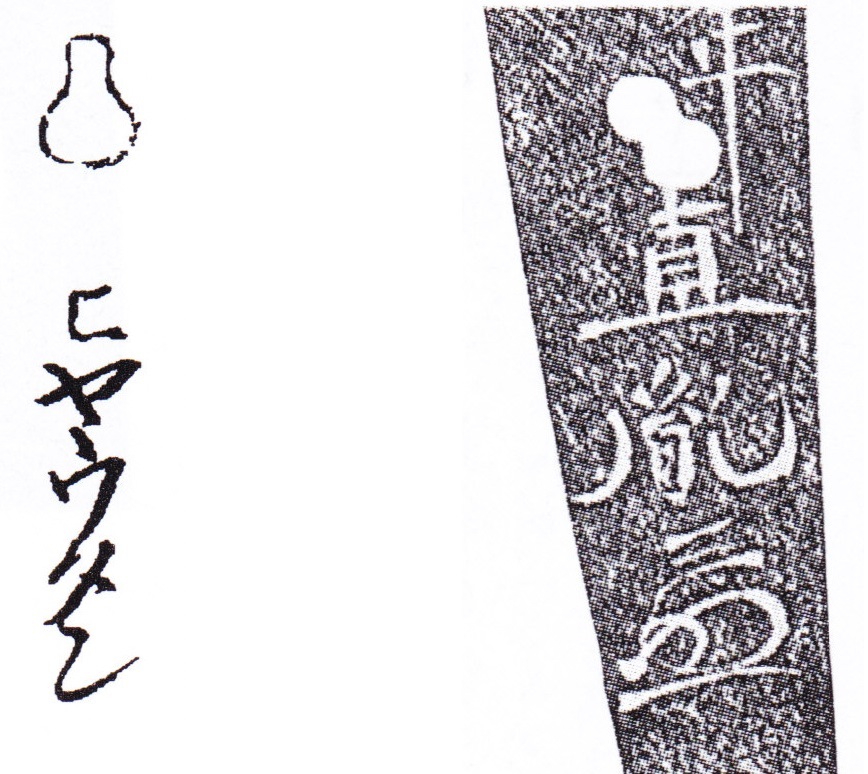
The name of the mekugi-ana in picture eight is again more clear, namely „hyôtan“ (ヒヤウタン, „bottlegourd“). Such a hole is quite often found and the result of two differently sized mekugi-ana opened so close that their merge into each other. The picture on the right shows a hyôtan-mekugi-ana on a wakizashi of Taikei Naotane (大慶直胤).

 mekugi9

Number nine is called „yomitori“ (ヨミトリ). The verb „yomitoru“ (読み取る) means „to read (from an instrument for example)“, „to read into“, or „to read (someones) mind“. But because of the transcription in katakana syllables it is unclear if really this verb is meant. Such a mekugi-ana is very hard to find on actual blades and it might be assumed that it was actually a hidden Christian symbol.?

 mekugi10

Most collectors are probably familiar with the term in the next, the tenth depiction, which is namely „suhama-gata“ (スハマカタ), i.e. it refers to the suhama (洲浜) element as we know it for example from hitsu-ana on tsuba. Such mekugi-ana are most likely found on wide kotô-era sunnobi-tantô as demonstrated by the blade of Unjû (雲重) shown on the right.

 mekugi11

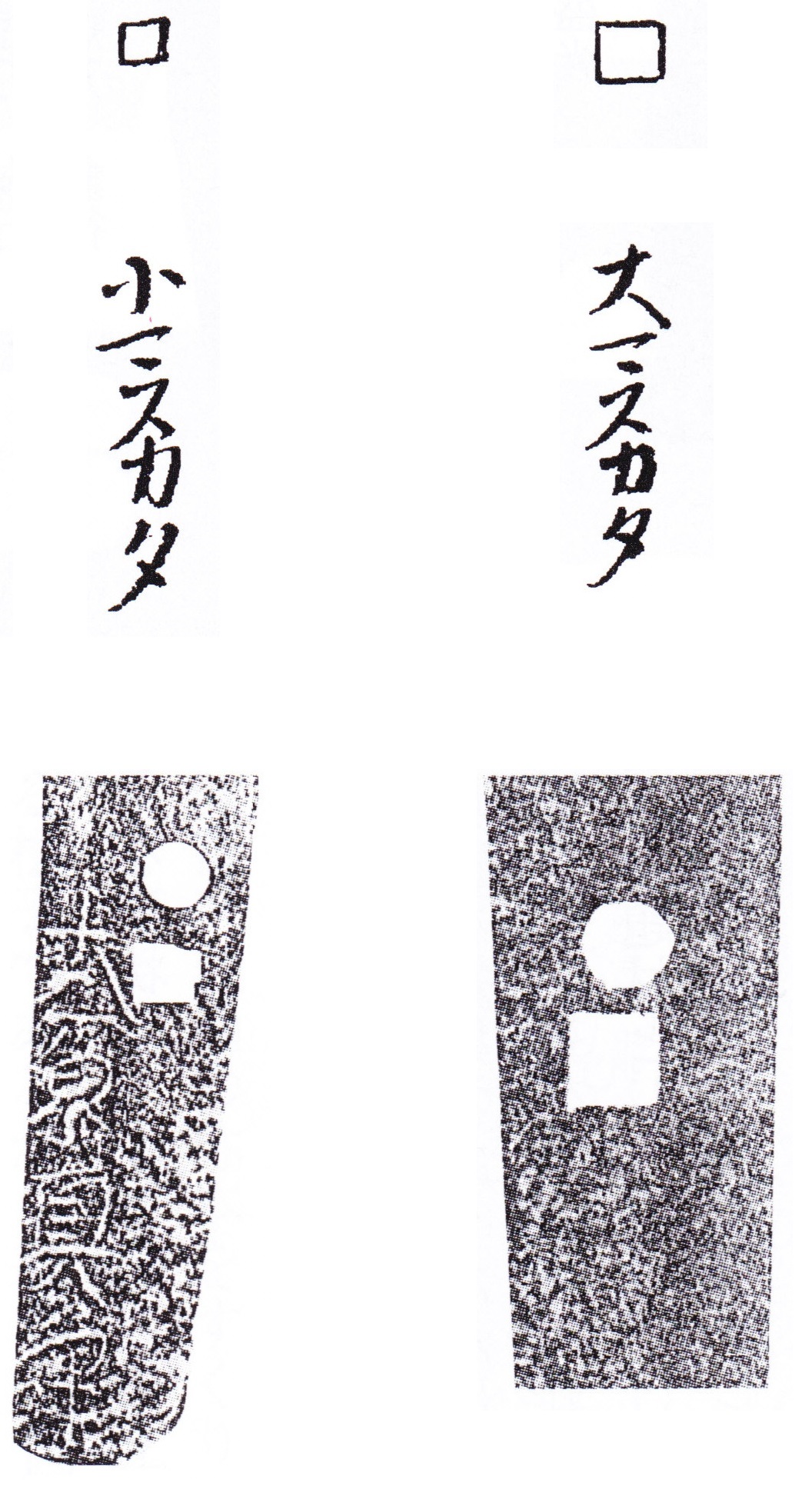
Number eleven and twelve are called „ko-masugata“ (小マスカタ) and „ô-masugata“ (大マスカタ) respectively, i.e. small (ko, 小) and large (ô, 大) square masugata, 枡形). However, it is unclear how it was actually distinguished between „small“ and „large“. Kondô suggests that if the edge of a square mekugi-ana corresponda approximately to the diameter of an average mekugi-ana, it might be called as ko-masugata. If the edge is larger, probably the classification ô-masugata applies. To substantiate this approach, we see at the lower left a tachi of Ôhara Sanemori (大原真守) where the square hole has about the same size as the regular mekugi-ana. At the Taima-tantô (当麻) to the right, the square hole is a hint larger as the regular mekugi-ana. By the way, such a hole is quite archaic and goes back to times when menuki and mekugi formed a unit and where the square hole hindred the ornament from twisting.

 mekugi13

Also the name of picture number 13 is familiar as it is called „inome“ (イノメ). It occurs when a mekugi-ana is opened in an overlapping manner right next to an existing mekugi-ana. As example serves a tantô of Hoshô Sadayoshi (保昌貞吉).

 mekugi14-15

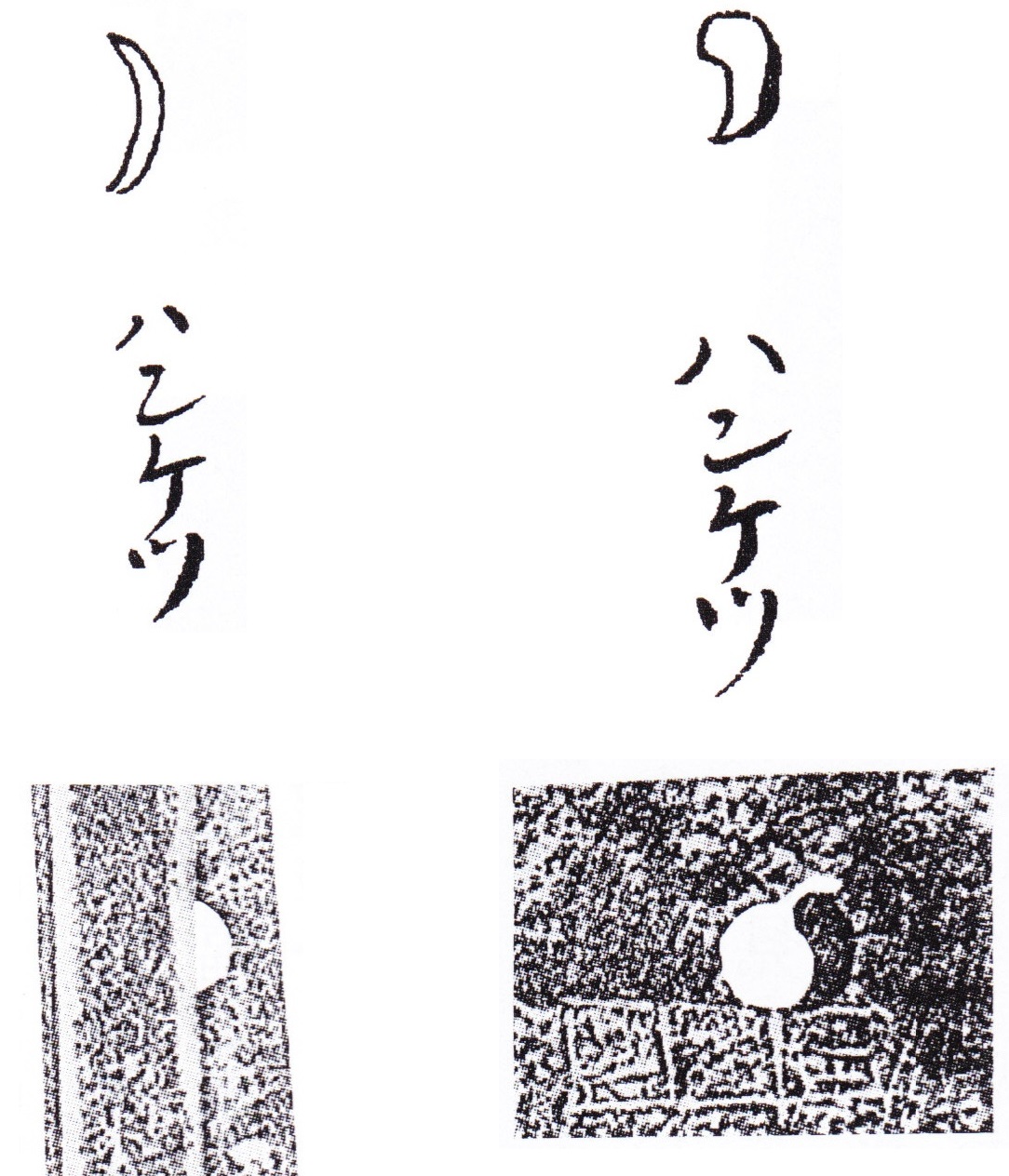
The last two depictions of the chapter „Menuki-ana no shidai“ are both called „hangetsu“ (ハンケツ, „half-moon“) whereas the the last one to the right reminds more of a comma-shaped bead (magatama, 勾玉) oder of a tomoe (巴). And the former one seems to be exaggerated as it is hardly possible to stick a mekugi through such an opening. So maybe the last two examples actually don´t show mekugi-ana but shapes which occur through an orikaeshi-mei or gaku-mei (see picture at the lower left on a katana of Kunimune, 国宗), or a semegane softmetal fitting (see picture at the lower right on a katana of Sukesada, 祐定). In this sense it is possible, that the katakana syllables „hanketsu“ actually stand for (半欠) what means „half missing“.

   All those mekugi-ana go back to the necessity of adding a new peg hole or to enlarge or adjust an existing one. That means except maybe number nine with the cross-shape, we are probably not dealing with holes which were consciously opened in suhama or inome shape and the like. In other words, the publication just gathered existing mekugi-ana and gave them names. In earlier times, smiths or other craftsmen were not exactly gentle when it came to adding new holes as they were drilled through signatures and dates without remorse. Today this seems like „wanton destruction“ of important references but back then a new peg hole just marked a new phase in the life of a blade as the owner was at the best a „custodian“ who took the sword temporarily from his predecessor and had to give it away at the end of his life.

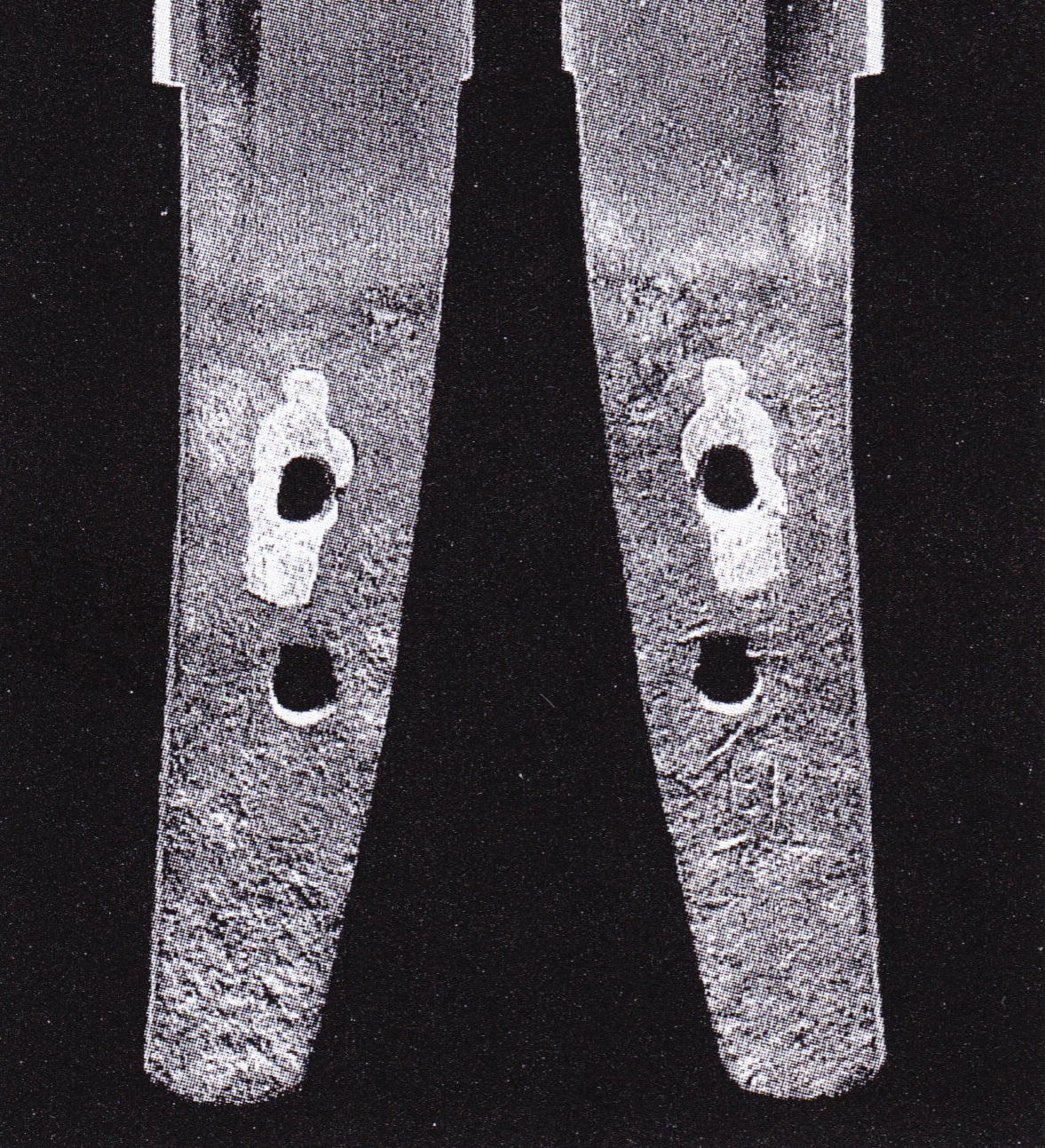
   When with the Edo-period and especially with the emergence of the Ôsaka-shintô schools meticulous and elabotate nakago finishes came into fashion and even emphasis was laid on the calligraphic value of a signature, the peg hole could not just be left out and placed randomly. That means many smiths decided where the first and original ubu-ana (生ぶ孔) was positioned, mostly also in relation to the signature. A lateral trend in the attention to peg holes were the so-called „keshô-ana“ (化粧孔, lit. „ornamental holes“). An example of a keshô-ana is the tsubo-ana (坩孔, lit. „pot-shaped hole“) as it was occasionally applied by Kotetsu (虎徹). Some say the tsubo-ana depicts actually the head of a tiger because the first character „Ko“ in Kotetsu means „tiger“. However, the notches at the side had the purpose to hold an eventual semegane, that means the smith decided exactly where the holes on his tang should be and anticipated the necessity of a later new peg hole by providing one with blank notches for whatever softmetal semegane. A more elaborate form born from the tsutsumigane is the so-called „hanamaru“ (花丸, lit. „flower circle“). There are different interpretations of this kind of mekugi-ana with different numbers of petals. Thus also terms like sakura-ana“ (桜孔, „cherry-blossom home“) and „kiku-ana“ (菊孔, „chrysanthemum hole“) exist. Like the tsubo-ana, also the hanamaru is an elaborate anticipating hole added by the smith. The picture below shows to the left two more consciously opened mekugi-ana on blades of Kotetsu. They look like the numerous peg holes on kotô blades but are all ubu.

 mekugi16

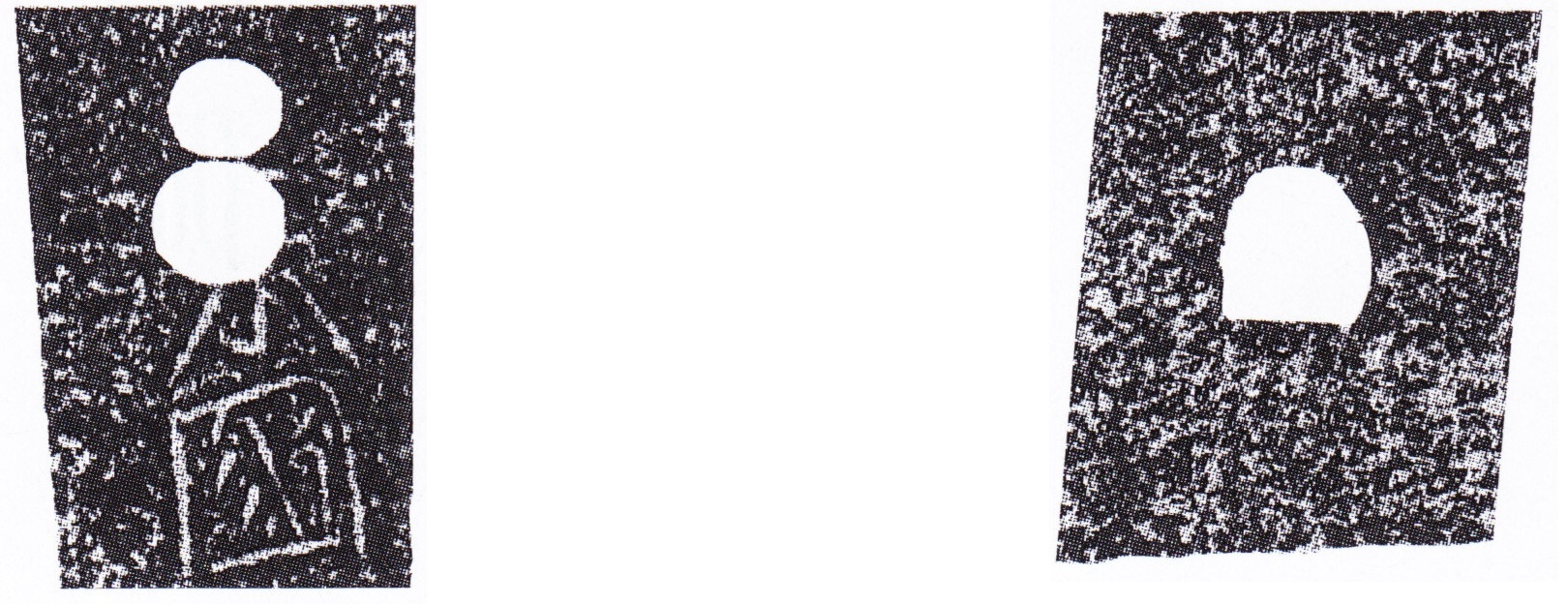
   In addition, some more mekugi-ana forms should be introduces, namely uncommon forms just called „kawari-ana“ (変わり孔) in general. The flowery names go back to Kondô Hôji.

 mekugi17

Left: kaiki-shoku (皆既食), „total solar eclipse“; right: chûya (昼夜), „day and night“

 mekugi18

Large semegane on a tantô of Jinsoku (神息) which remind of Yakushi-Nyôrai (薬師如来), the Healing Buddha.

 mekugi19

Left: ikken (一献), ikken war a custom to serve a guest to a feast side dishes and three cups of sake; right: aburi-mochi (炙り餅), „frying mochi

 mekugi20

Left: yukidaruma (雪達磨), „snowman“; right: suidô (隧道), „tunnel“

 mekugi21

tsuki ni kumo (月に雲), „moon behind clouds“

Kantei Zusatzband 2

Out now, the German version of the second supplement of my kantei series. It contains 175 kotô, shintô and shinshintô blades. The numbering continues with the last blade of the first supplement, i.e. with number 419. I add the table of contents so that you get an overview of the introduced blades. As promised, the English version will follow towards the end of the month.

428 pages, A4, paperback, b/w pictures, price: €75.00

It can be obtained at Lulu.com via this link.

There is also an eBook available here.

KanteiZusatz2

Table of contents

NBTHK-EB meeting in Salzburg

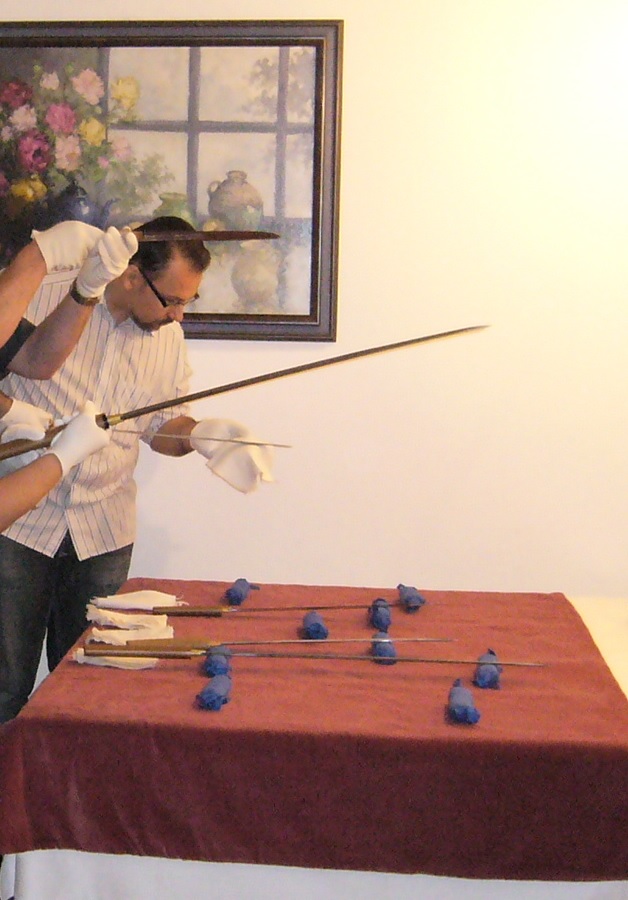
After five years we had our second NBTHK-EB meeting in Salzburg last Saturday. The subject was „Renowned shinshintô masters“ and in the following I would like to forward a brief outline of my introductory lecture on shinshintô for those unable to attend (and for those interested of course). After that I give you also a brief introduction of the fine blades we were able to see.

 Sbg2

For a better understanding of the shinshintô era, we have to start at shintô. We know that with the execption of the Shimabara Rebellion of the years 1637 and 1638, peace had been restored by the Tokugawa all over Japan. Of course swords were still made but by the end of the 17th century, all the fiefs learned that the peace is a lasting one and by the strict regulations of the bakufu which tried to minimize the chance that certain indiduals are raising larger armies, the demand for swords decreased drastically. At about the same time, i.e. we are in the first decades of the 18th century, the unsound financial policy of the fiefs in particular and the bakufu in general became apparent. That means even if a daimyô wanted, there was in general just not enough money to hire master smiths and support upcoming talents on a large scale or systematically.

The eighth Tokugawa-shôgun Yoshimune (徳川吉宗, 1684-1751) was unhappy with declining craft of sword forging and ordered in 1719 his elder to get in touch with every fief with an income of more than 10.000 koku so that their best smiths could participate in a forging contest. As we know, the contest took place in 1721 and winners were Mondo no Shô Masakiyo (主水正正清), Ippei Yasuyo (一平安代), the 4th generation Nanki Shigekuni (南紀重国) and Nobukuni Shigekane (信国重包). Yoshimune´s goal was to breath new life into the then stagnating sword world and indeed, the winners were great master smiths. But with the tense financial situation of the country, the plan was not successful and most of the local smiths and their students and descendants continued to muddle along in a sufficient but not breathtaking niveau.

Another measure of Yoshimune to arouse more interest on swords amongst daimyô was the compilation of the famous „Kyôhô-meibutsu-chô“ (享保名物帳). This was a list with the most famous swords all over Japan and the project forced the local rulers quasi to deal with their old sword collections and sort out the famous pieces so that they could be published in the meibutsu-chô. This list had of course not a direct influence on the craft of sword forging, but an indirect one. Over time namely, treatises on the great masters of the Heian, Kamakura and Nanbokuchô period were written and old sword publications were discussed and reprinted. And with the upcoming new bourgeoisie in the transition from the 17th to the 18th century, for the first time something like „sword as a hobby“ was born. That means most were of course not able to afford a meibutsu of have them luxurious blades made, but at least one was able to indulge in books and discuss with others about swords. This trend was accompanied by another sub-trend, namely the rise of wealthy merchants, who were namely in the position to support contemporary smiths and order fine blades from them. And it wasn´t long before new books like the „Shintô-bengi“ (新刀弁疑) were published which introduced contemporary swordsmiths and presented their merits.

The „Shintô-bengi“ praised first and foremost the Ôsaka-shintô smiths and their tôranba, but this is only natural as Sukehiro (助広), Inoue Shinkai (井上真改) and their kinds were still the best the shintô era had produced so far. Thus the contemporary smiths, the book was published in 1777, tried first and foremost to orientate towards their inpretations. But one master was not satisfied with this trend. It was Suishinshi Masahide (水心子正秀) who tried quasi alone by studying old blades and all publications available to reproduce and revive the old forging techniques. His approach, which was supported and continued by his master students like Taikei Naotane (大慶直胤) and Hosokawa Masayoshi (細川正義), is known as fukkotô (復古刀). The focus was especially placed on the good old Bizen and Sôshû traditions but basically all five gokaden were studied and reproduced. However, when Masahide died in 1825, he had not seen himself the swing to the Nanbokuchô-esque shinshintô.

With the bakumatsu era, Japan was in a difficult situation. More and more foreigners appeared at the coasts, the fiefs were bankcrupt and the bakufu was regarded as totaly incompetent. Everyone felt that something was going to happen soon, most likely in combination with fightings. As it is common for such times, the fiefs and atists tried to restore old values and swordsmiths tried to make stout and durable blades for the upcoming fightings. And back then, the Nanbokuchô blades were considered to the best choice for that. So the daimyô were quasi forced to arm and spend money on the employment and training of good swordsmiths. This in turn resulted in a noticeable quantitative but also qualitative increase of fine blades. By the time the bakufu was overthrown by the imperial troops, Japan was again able to present a considerable number of ambitious mastersmiths. As we know, the modernization lead eventually to the ban on swords in 1876. This was such a radical measure that the shinshintô era which started with Suishinshi Masahide is considered to be over with this ban. Emperor Meiji was fortunately a great sword lover and so he tried to save the craft of sword forging, even the demand for newly made swords tended with the ban over night quasi to zero. All this is well known but without Masahide, his master students and the fukkotô movement, the swordsmiths of Japan probably would have continued to work to the end of the feudal era like they did in the 18th century. In other words, there would not have been a shinshintô and not much to rescue for emperor Meiji when he came to power. Of course swords still would have been made as they played such an important role in Japan, but without the fukkotô movement, probably no one would have been able to reproduce the great kotô works in the way Masahide and his descendants did. And when you take it one step further, the gendai and shinsaku smiths would not be what they were or are respectively without the fukkotô movement.

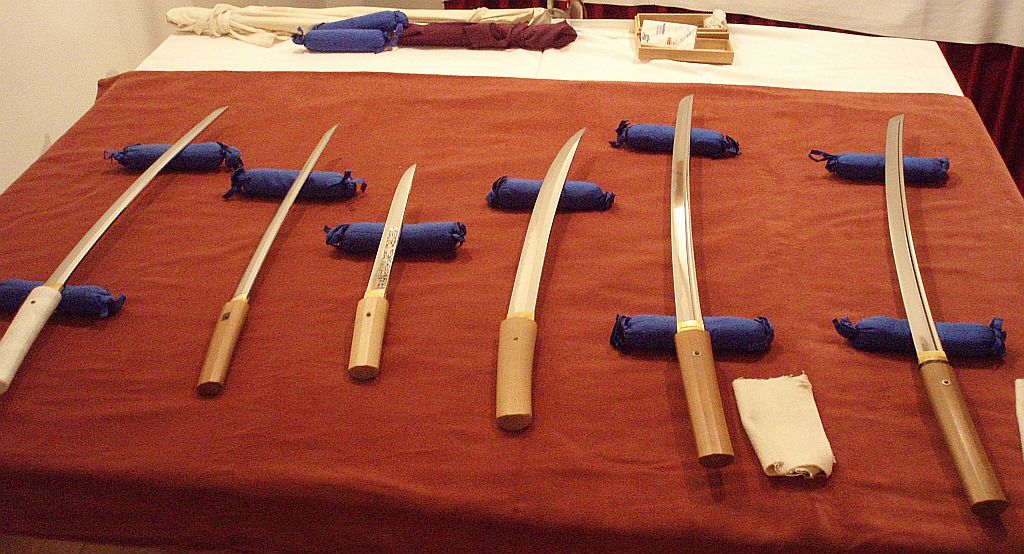
 Sbg1

Now to the blades we appreciated at our meeting. The picture above shows the table and the blades were, from right to left: katana by Tairyûsai Sôkan (泰龍斎宗寛), katana by Shizu Saburô Kaneuji (志津三郎兼氏) presented to see what Kiyomaro was copying, naginata-naoshi-zukuri by Minamoto Kiyomaro (源清麿), tantô by Taikei Naotane (according to Tanobe-sensei a Bizen-utsushi but with Nobukuni elements), wakizashi by Taikei Naotane (Bizen-utsushi), wakizashi by Taikei Naotane (Bizen-utsushi). Quite a bunch of high-quality blades, isn´t it?

Last but not least I want to thank all those participating and a big thank you to those bringing their blades!

The rise and fall of the Bingo smiths

With this article, I want to shed some light on the rise and fall of the Bingo smiths, as both aspects are usuall just briefly dealt with in most of the known sword publications. First of all some basics on the province of Bingo itself. As some might now, Bingo was once part of the larger Kibi province (吉備) which was divided into Bizen, Bitchû and Bingo in the late 7th century. All new provinces took the character „Bi“ from the former Kibi and added „zen“ (前), „chû“ (中) and „go“ (後), i.e. „near“, „middle“ and „far“ respectively, according to their distance from the Kinai heartland. There was a road passing through Kibi (more on that later) called „Kibi no michi“ (吉備道), and as Bingo was later the last of the new provinces on this road, it was also called „Kibi no michi no shiri“ (吉備道後, lit. „the end of the Kibi road“). So if you remove the first and the third character from this name, the characters (備) and (後) remain, and you arrive again at „Bingo“. Before the so-called „goki-shichidô“ (五畿七道) administrative units and highways were established with the Taika Reform in 645 and the subsequent ritsuryô system, there were of course already roads to get from A to B. These ancient roads, or at least the major and official ones, were called „kandô“ (官道, lit. „government road“). One major kandô connected Kyôto with Dazaifu (太宰府) on Kyûshû, the hub of the exchanges between the Yamato court and China and Korea. As Dazaifu was so important for the court, it was strictly controlled and administered, mostly by artistocrats and even members of the imperial family in the higher offices. So there was a lot of coming and going between the Kinai heartland and „the distant capital“ as Dazaifu was often called. The distance is more than 500 km and Bingo province is right half way in between. Therefore some experts assume that the large number of shôen (荘園) in Bingo goes back to the numerous „business travellers“, i.e. aristocrats and clergy, who needed safe places to stay on their way to Dazaifu. Shôen were namely private, tax-free, often autonomous estates or manors granted by the emperor.

And now we come to swordsmiths. The „Kokon-kajimei-hayamidashi“ (古今鍛冶銘早見出) says that Masaie (正家), the ancestor of the Mihara school (三原), was active in Bingo province in the Tenpyô era (天平, 729-749) and further that the later, i.e. late Kamakura-period Masaie of the same name revived the school of his local predecessor. Well, of course there are no works by the Nara-period Masaie extant but at least from the historical context, his existence is possible. We know namely that the workmanship of the late Kamakura-period Masaie, who is today regarded as the actual founder of the Mihara school, shows undeniably strong Yamato features. Thus it is possible, although highly speculative, that the Nara-period Mihara ancestors came once to that area in the retinue of official temple travellers going from Yamato province to Dazaifu and stayed half way in their own shôen manors in Bingo. Maybe the smiths stayed there as Mihara was a logistically favourable location for their craft, that means it was located on a main road and on the Nutagawa (沼田川), along which iron could be transported out of the mountains from the north of Bingo province. As mentioned, this is just speculation but the spreading of the later early Mihara smiths to other places in Bingo at the beginning of the Muromachi period matches with the decline of the shôen system when namely these lands came mostly under the administration of shugo (守護, military governors) and their vassals.

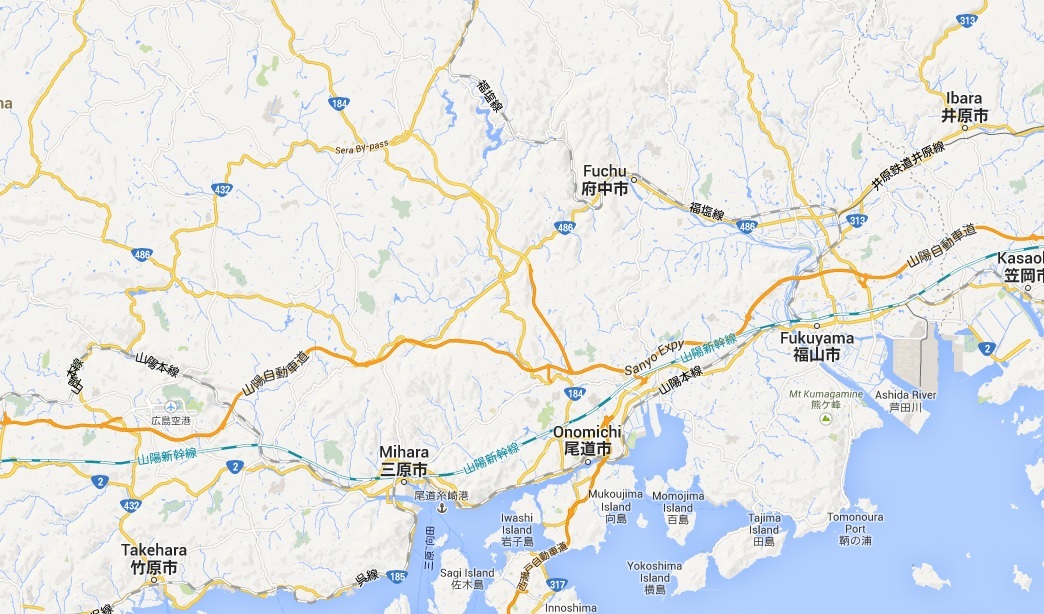
New centres of sword forging in Bingo province were now, apart from Mihara and among others, the Ashida district (葦田), Tomonoura (鞆の浦) and Onomichi (尾道). There they were quite active throughout the entire Muromachi period and schools like Kai-Mihara (貝三原), Kinashi-Mihara (木梨三原) Tomo (鞆), Go´ami (五阿弥) Tatsubō (辰房) or Hokke-Ichijô (法華一乗) emerged. But virtually none of them made it into the shintô era. Only some Bingo smiths are known from early 17th century whose names allude of kotô-era predecessors. A reason for the lack of shintō smiths from that area might be that most of the daimyō along the San´yōdō were on the side of the defeated at Sekigahara and thus classified by the Tokugawa-bakufu as tozama-daimyô (外様大名). That means they were kept on a short leash by, for example, transferring some of them to remote fiefs with a lower income. In Genna five (元和, 1619), Fukuyama (福山藩), the one and only fief of Bingo province, was founded with an annual income of 11.000 koku. It was given to the faithful Tokugawa-follower Mizuno Katsunari (水野勝成, 1564-1651). As all the heirs of the Mizuno died in infancy towards the end of the 17th century, the fief became bakufu-owned (= tenryô) from 1698 to 1700 until it was decided that Matsudaira Tadamasa (松平忠雅, 1683-1746) should be the new daimyô. Well, Tadamasa was again transferred, namely in Hôei seven (宝永, 1710) to the Kuwana fief of Ise province. After him, the Fukuyama fief of Bingo province was ruled by the fudai-daimyô family of the Abe (阿部) until the end of the Edo period. But the most important regions of eastern Bingo like, for example, the port city of Onomichi and the town of Mihara had already been turned over to the neighbouring Hiroshima fief when Fukuyama was founded in 1619. Large regions in the north of the province also remained tenryô or entrusted to the control of other fiefs as enclaves. In short, Bingo province was during shintô times only a shadow of its former self in kotô times, at least from the point of view of swordsmiths.

 Bingo1

Picture 1: Map of the area ( © 2013, Google, ZENRIN). Kusano-Sengen is where the letter “k” of “Fukuyama” is on the map.

I want to demonstrate the decline of late kotô-era Bingo smiths by an example. We know from extant signed blades that Hokke Ichijô and some other smiths worked in a village called “Kusado” (草土). It is assumed by experts that this Kusado referred to what are nowadays the ruins of Kusado-Sengen (草戸千軒). It was often the case that place names were written with different characters and pronounced differently over the time. So Kusado was also noted as (草津), (草井地) and (草出). The Kusado-Sengen ruins are insofar interesting as they are sometimes referred to as “Japanese Pompeii” or “Pompeii of the East”. A long time the whereabouts of this medieval village was only known from records, for example from the local history “Biyô-rokugun-shi” (備陽六郡志) written by the Fukuyama-retainer Miyahara Naoyuki (宮原直倁, 1702-1776). He writes that “there was once a village called Kusado-Sengen which was destroyed by a flood in Kanbun 13 (寛文, 1673).“ Kusado Sengen was discovered in 1931 when a large quantity of pottery, porcelain and gravestones were discovered while attempting to re-route the Ashida River. Many historians believed that it was the site of Kusado-Sengen. Excavation was not carried out, and the site was buried by a sandbank in the re-routed river. But in 1961, the excavation was started by the Fukuyama Municipal Board of Education and several items dating back to the Kamakura and Muromachi Periods were found, and it became obvious that the site was indeed Kusado-Sengen. Among the items there were also remnants of a bellows, polishing stones, slag and sunnobi-tantô found, so there were obviously swordsmiths working there. But why was Kusado-Sengen given up after a flood? Well, we know from records that there was an earlier major flood of the Ashida river, namely in Genna six (元和, 1620), which even caused a halt in the ongoing construction of Fukuyama Castle. The latter was completed two years later and even had an inlet which led to via the Ashida river to the Seto Inland Sea. So with Fukuyama Castle as new capital of the Fukuyama fief of the same name, Kusado-Sengen lost more and more its importance as commercial port and. And with the second devastating flood in 1673, probably no more efforts were made to reconstruct it.

 Bingo2

In picture 2 I want to introduce a blade quasi from the golden age of Kusado-Sengen. It is a wakizashi signed „Bingo no Kuni Kusado Ichijô – Eikyô sannen gogatsu-hi Saneie saku“ (備後国草土一乗・永享三年五月日実家作). It measures 47,3 cm, shows an itame-hada with ji-nie, chikei and a fain utsuri, a hamon in ko-gunome mixed with togariba and ko-midare in nioi-deki with a bit ko-nie and some sunagashi. The bôshi has a kaeri typical for Bingo-mono. According to transmission, Saneie was the son of the 1st generation Ichijô.

Update on Kantei Supplement 2

Just want to inform you that I have collected 175 fine blades for my second Kantei supplement. More than 100 of them are already translated. Introduced will be a rare tachi of Shintôgo Kunimitsu, four Chôgi (including the meibutsu “Yagyû-Chôgi”), three Sôshû Fusamune, three Kanemoto, three Muramasa, a Furuya-uchi of Horikawa Kunihiro dated 1586, five Kotetsu, a rare Hanjô wakizashi (student of Hankei), four Ippei Yasuyo, and many more. That means with the previous Kantei books (see links below), we arrive now at a total of 574 blades! Estimated time of publication: End of September (as usual, there will be a German and an English volume).

Kotô-kantei

Shintô & Shinshintô-kantei

Kantei Supplement 1


A kôgai that has passed through many hands

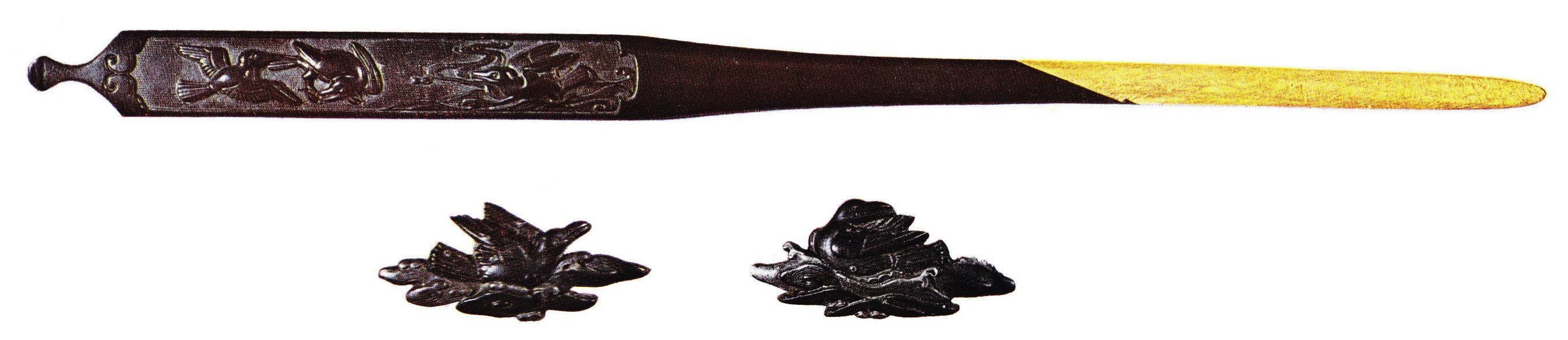
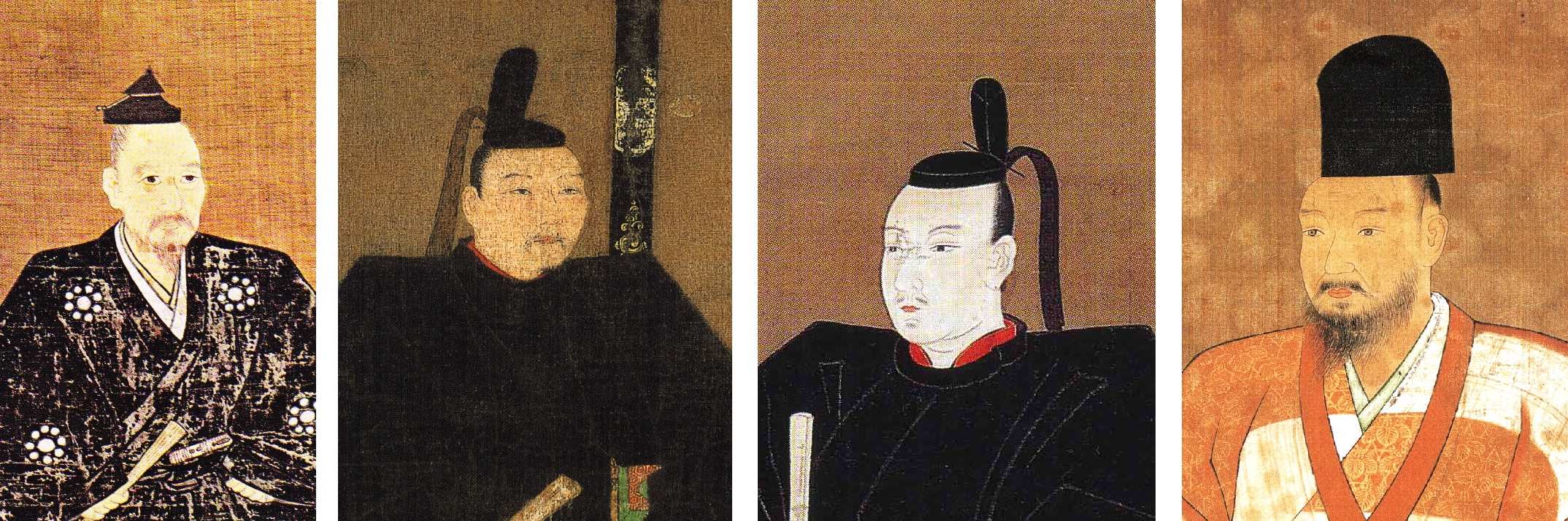
This time I want to introduce a very famous kôgai of Gotô Yujô (後藤祐乗, 1440-1512), namely the so-called “nuregarasu” (濡烏), which was not always called that way. But one thing at a time. First of all, it is today part of a futatokoromono set with menuki of the same motif which is attributed to the 7th Gotô-generation Kenjô (後藤顕乗, 1586-1663). Originally, the kôgai belonged to a kind of „triple set“ of kôgai owned by Ashikaga Yoshimasa (足利義政, 1436-1490, r. 1449-1473) for whom Yûjô worked. Basically we have two slightly differing provenances on this triple set, found namely in the work “Gotô-ke jûnana-dai” (後藤家十七代) and the Maeda chronicles “Kichôhin-mokuroku” (貴重品目録). The information quoted in the former goes back to a document called “Higashiyama-dono gyobutsu-soshi Yûjô-horimono no oboe” (東山殿御物祖師祐乗彫物之覚, about “Memories on Carvings of Yûjô, the Ancestor of [making] Things for Lord Higashiyama [i.e. Ashikaga Yoshimasa]”). Therein we read that Yoshimasa was treasuring three kôgai of Yûjô, one with the kuyô crest (九曜) motif, one with kari (雁, wild geese) motif, and one with crows by the water (mizugarasu, 水烏) motif. He did not part with them and after his death, they became hereditary treasures of the Ashikaga-shôgun family. However, the kuyô-kôgai was later given to Oda Akita Jônosuke Nobutada (織田秋田城之介信忠, 1557-1582) – Nobunaga´s son and heir – but destroyed by fire in Ôgaki Castle (大垣城) in Mino province. The 13th Ashikaga-shôgun Yoshiteru (足利義輝, 1536-1565, r. 1546-1565) placed the kari and the mizugarasu-kôgai in custody at the 4th Gotô-generation Kôjô (後藤光乗, 1529-1620). The Gotô family in turn sold them for 100 ryô to Akechi Mitsuhide (明智光秀, 1467-1568) who presented them to his lord Oda Nobunaga. Nobunaga in turn gave them as a gift to Hideyoshi and Hideyoshi presented the mizugarasu-kôgai to Katô Kiyomasa (加藤清正, 1561-1611) to reward him for his achievements in battle. The kari-kôgai was left at the Toyotomi family but destroyed when Ôsaka fell in 1615. Being in the possession of Kiyomasa, the mizugarasu-kôgai was for whatever reason renamed to nuregarasu-kôgai (lit. “wet crow”) and eventually presented to Maeda Toshitsune (前田利常, 1594-1658).

The Maeda chronicles “Kichôhin-mokuroku” however say that all three kôgai in question were passed down within Yûjô´s successors and not within the Ashikaga family and that Gotô Kôjô sold them all to Akechi Mitsuhide. Mitsuhide in turn presented all three to Nobunaga who in turn presented the kuyô and the mizugarasu-kôgai to Hideyoshi. This document says that it was the kari-kôgai which was destroyed in Ôgaki Castle and the kuyô-kôgai which was destroyed at the fall of Ôsaka. And further we read that Hideyoshi did present the mizugarasu-kôgai to Katô Kiyomasa but that it went from him back to the Gotô family which eventually sold it to Maeda Toshitsune.

 nuregarasu

Picture 1: nuregarasu no zu futatokoromono (濡烏の図二所物), mumei, attributed to Gotô Yûjô, the matching menuki are attributed to Kenjô

It is also speculated that Nobunaga, who had a fondness for tea utensils, paintings and famous masterworks from all over the country, displayed a certain wish to own the famous three Yûjô-kôgai handed down within the Gotô family and that Akechi Mitsuhide, trying to fullfil this, eventually “convinced” Kôjô by offering the incredible sum of 100 ryô. Anyway, it is hard to say which of the transmission is correct as just the nuregarasu-kôgai is extant which is today preserved in the Maeda Ikutokukai (前田育徳会), the foundation established in 1926 for the management and preservation of the cultural heritage of the Maeda clan. As mentioned, it is assumed that the matching menuki are a work of Kenjô and further that the kôgai came into the possessions of the Maeda at Kenjô´s time as he and his cousin Kakujô (後藤覚乗, 1589-1656) worked on a biennial basis alternating between Kyōto, for the bakufu, and Kanazawa (金沢) for the Maeda, receiving a salary from the latter of 150 koku. There are namely many examples known where single famous pieces were completed by later Gotô masters to futatokoro or mitokoromono sets.

That means the nuregarasu-kôgai has passed through the hands of all the key figures of Momoyama and early Edo Japan. What a history-charged piece!

 nuregarasu1

Picture 2 (from left to right): Gotô Yûjô, Ashikaga Yoshimasa, Oda Nobutada, Ashikaga Yoshiteru

 nuregarasu2

Picture 3 (from left to right): Akechi Mitsuhide, Oda Nobunaga, Toyotomi Hideyoshi, Katô Kiyomasa, Maeda Toshitsune

Some thoughts on utsuri

This time I want to sare some thoughts on utsuri. At the end of one of our last sword meetings we had a brief discussion on utsuri in the course of which the most common approaches in explaining this effect were touched. In this article, I want to forward these approaches and expand them by what I was able to find in other sources. To begin with, we all know that utsuri is a synonym for kotô Bizen swords. The common knowledge is also that utsuri „disappeared“ at the end of the kotô period and had to be „rediscovered“ by shintô, shinshintô and even by shinsakutô smiths. Well, to a certain extant, all this is kind of true. Also we know that utsuri is not a superficial thing as it remains even if a blade is polished multiple times. That means it must have a certain depth. Kapp says on p. 91 in his „The Craft of the Japanese Sword“ that „utsuri shows no evidence of containing any martensite“ and this line is what is mostly discussed and opposed when we are talking about utsuri at our sword meetings. Kapp mentions further: „The sides, where utsuri appears, are heated to 750-760°C – at this temperature, the steel is in a transitional phase from pearlite to austenite; it is presumed that utsuri is related to the complex ferrite and pearlite microstructure that obtains in this area, although close scientific analysis has yet to be done.“ Another important note in this section which must not be overlooked is: „Temperature produces other effects as well, depending on the structure of the steel. We have seen how the smith can combine blocks of varying carbon contents before finish forging. Higher carbon layers will produce more martensite steel upon quenching.“ That means not all hardened areas we see on the finished and polished blade are necessarily a result of just how the clay coat is applied. A steel with a carbon content of less than 0,5 % for example does not turn entirely into martensite when hardened. And has the steel a carbon content of less than 0,2 %, it can´t be hardened at all. The kawagane, i.e. the steel on which the utsuri appears, lies between these limitations. Apart from the carbon content, temperature is another factor which defines the resulting metallic structure after the hardening process. Is the temperature to which the blade is heated before quenching too high or too low, too much or not enough martensite is created respectively (depending as mentioned also on the carbon content of the steel). This also explains nie-utsuri, an utsuri consisting of nie particles. So for creating nie-utsuri, the kawagane has to have a high enough carbon content to produce enough martensite, i.e. nie clusters in the ji.

The appearance and lack of nie-utsuri matches also with Bizen-utsuri. That means except some early Ko-Bizen works, Bizen blades usually do not feature nie-utsuri as they are hardened in nioi-deki and feature a kawagane with a lower carbon content. This lower carbon content is usually reflected in desctiptions of polishers that the Bizen steel is „relative soft“. And with this softness, we arrive at the purpose of applying utsuri. Many experts and swordsmiths assume that it was exactly this „softness“ of the Bizen steel that required an additional treatment. Everone knows that if the steel of a blade is too hard, the sword becomes brittle and if the steel it is too soft, the blade is prone to bend. That means adding utsuri, i.e. hard but not too hard areas of steel along the ji, provides a certain torsional rigidity. But it also has to be mentioned that polishers report of Bizen blades with utsuri which were once bent but straightened. So utsuri does not reduce the risk of bending to zero. Nagayama explains utsuri in his „The Connoisseur´s Book of Japanese Swords“ on page 86 as: „The purpose seems to have been to improve the sword´s flexibility to prevent breakage during use. Usually made of steel that is softer than the rest of the blade´s surface.“ So he addresses the same challenge from the other side, i.e. not making a soft steel more rigid but a brittle blade more flexible.

The sword polisher Kurashima Hitoshi (倉島一) forwarded his thoughts on utsuri in the Tôken-Bijutsu No 470 (March 1996). He also brings it in line with steel with lower carbon content whereat he introduces the generic term „namagane“, a not so refined steel with lower carbon content. I.e. he uses namagane as „opposite“ of hagane by not making a distinction between shingane and kawagane. In short, namagane is exactly the aforementioned steel with a carbon content between 0,2 and 0,5%. Well, Kurashima actually does differentiate his namagane, namely by „type A namagane“ and „type B namagane“, terms which correspond virtually to shingane and kawagane respectively. But he goes as far as to say that namagane IS utsuri. That means he assumes that the utsuri we see is the border of the namagane meeting the hagane. In other words, the visible border of the utsuri is created by structures with more martensite than others. According to this approach, a ji with utsuri has basically three degrees of hardness: The „super hard“ ha, the hard antai (暗帯, the dark areas between nioiguchi and border of the utsuri) and the softer rest of the ji which corresponds to the utsuri. So utsuri would be the visible brighter but softer area above the hamon whereas the harder part which adds more torsional rigidity is actually the darker antai directly above the hamon. This again would correspond to Nagayama´s comment „made of steel that is softer than the rest of the blade´s surface.“

 utsuri1

Picture 1: The visible effects and steels with different carbon content, according to Kurashima.

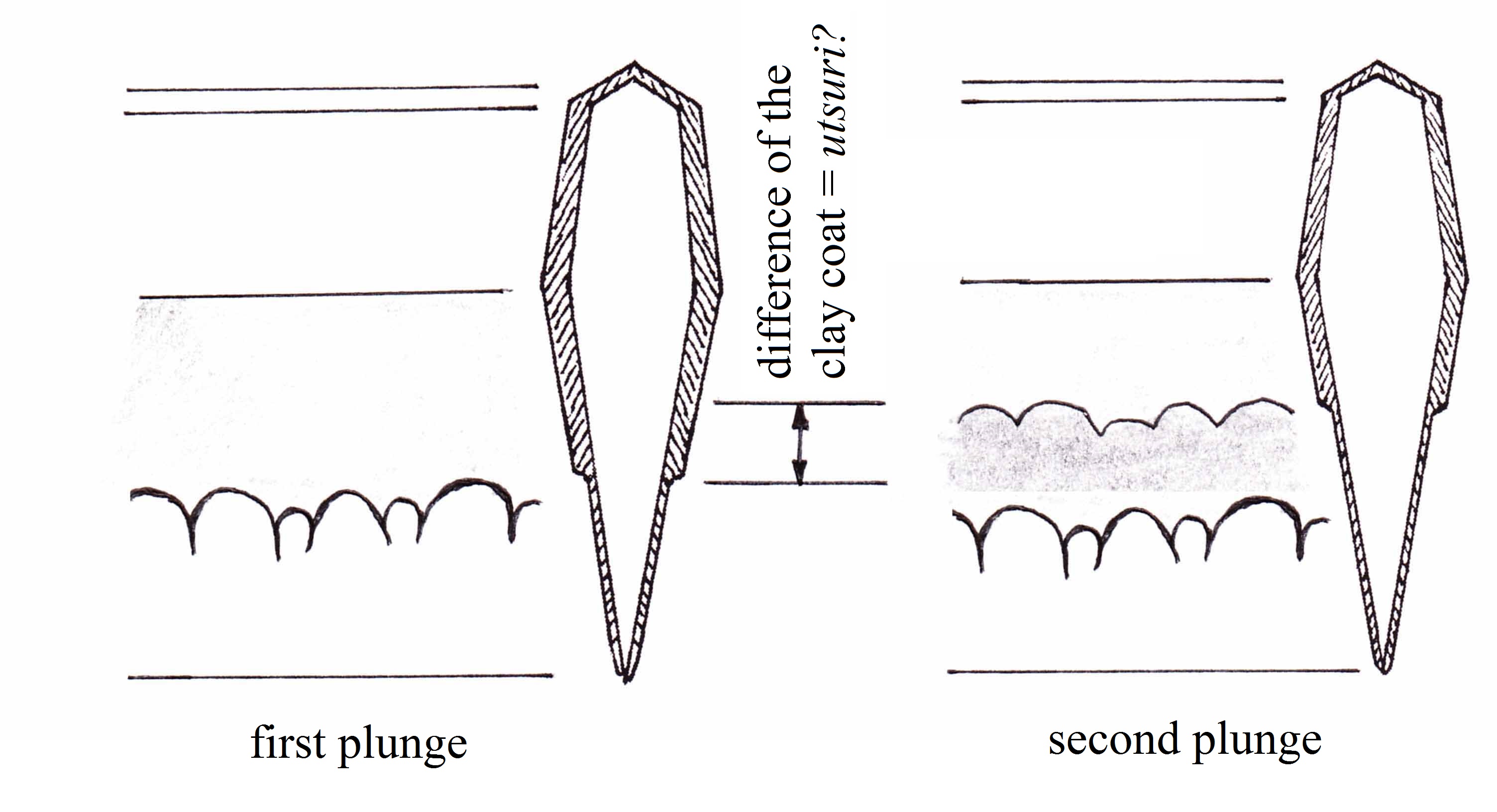
Another interesting approach to explain utsuri can be found in the „Kentô-kikigaki“ (見刀聞書) from Tenpô 14 (天保, 1843). Therein we read: „By plunging the heated blade into water, the clay coat contracts. When the blade is now plunged into the water a second time, the now exposed areas cool down faster than the upper areas which are still covered with clay. This produces utsuri.“ I made a sketch (picture 2) to illustrate what the „Kentô-hikigaki“ probably means. According to this approach, also the temperature difference between heated blade and water would not be that high as at the first plunging. Thus not so much martensite is produced and the utsuri area above the hamon would be a „second“, „softer“ hamon. This in turn would match with Edp-period sword publications in which utsuri is circumscribed as „kage-hamon“ (景刃文, lit. „shadow hamon“ or also „second hamon). But on the other hand, this would mean that the dark antai area above the hamon is actually harder than the whitish utsuri area. Apart from that I think that it would be very difficult to produce utsuri that way. That means to coordinate all the factors like the carbon content and desired distribution in the steel and the exact temperature is already difficult enough, i.e. adding also the factor „total control of the clay coat by plunging a heated blade two times into a trough of water“ would make utsuri in my humble opinion merely a product of chance.

utsuri2

Picture 2: Achieving utsuri, according to the „Kentô-kikigaki

So the most common approach to explain utsuri would be by a case hardening or surface hardening. Here, just the surface is hardened but requires infusing additional carbon into the top layer of the to be hardened steel with a lower carbon content. Thus the deeper steel layers remain soft as it is desired with the kawagane and shingane. For adding the carbon just to the steel surface, traditionally a mixture of ground bone and charcoal or a combination of leather, hooves, salt and urine was used. But the temperature must not be that high and stay under the melting point of the iron, and left at that temperature for a length of time. The longer the temperature is held, the deeper the carbon will diffuse into the surface, whereat a typical depth of case hardening with this method is up to 1.5 mm. That means the adding of such supplements under the clay coat still requires an exact heat treatment. Thus explaining utsuri by case hardening also „solves“ the question why the effect remains to be seen even after repeated polishing. Well, at a considerable loss of material, the utsuri gets of course weak and disappears eventually.

So far so much to say on the subject utsuri from my side and I hope I provided some food for thoughts.