Finishing my translation of Honma’s entire Appraisal Diary (Kantō Hibi Shō, 鑑刀日々抄) that he maintained from 1969 to 1987, which turned out to turn into 10! volumes, I thought it would be interesting for my readers to learn how he actually ended up becoming one of the most important figures in the 20th century Japanese sword world. So, with deepest respect, I am presenting here a short biography of the man, the legend, Honma Sensei.
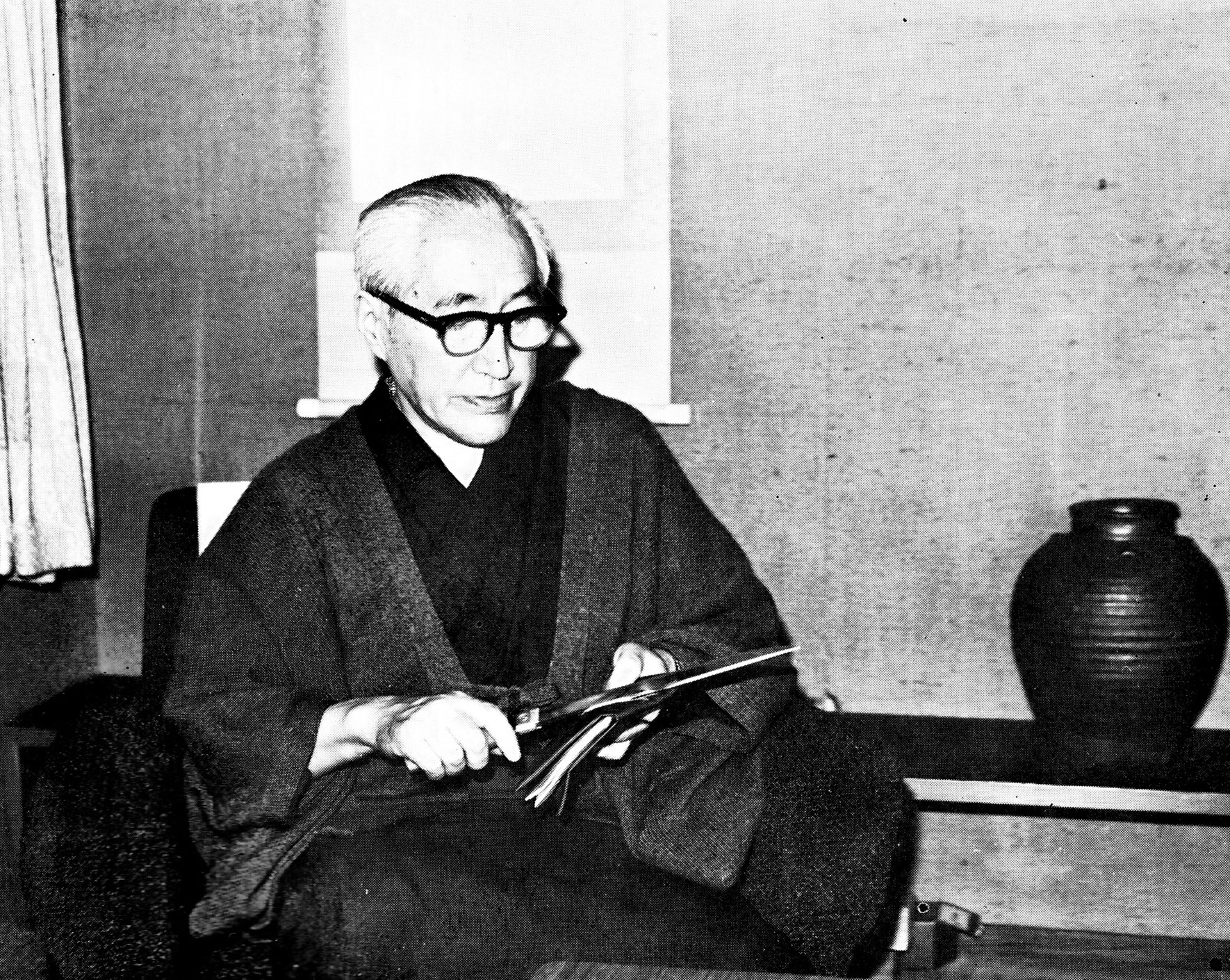
Honma Junji, pen name Kunzan, was born on April 16, Meiji 37 (明治, 1904), in what is now the city of Sakata (酒田), Yamagata Prefecture, into a very wealthy family. The Honma (本間) of Sakata were merchants and one of the largest private landholders in Japan. Their first generation was Honma Motomitsu (本間原光, 1674–1740), a buisness savant, who opened his first store at the age of 16. Well, the Honma family can actually trace back their origins to end of the Heian and beginning of the Kamakura period, but elaborating on that would of course be overkill for this article. Thus, back to Junji.
Junji’s father was Honma Keiji (本間敬治), who, originally from the Hattori (服部) familiy, had married Sunao (すなを), the daughter of Mitsuteru (本間光輝, 1854–1922), the seventh generation Honma main line. And here is where his “sword fate” already began. Although Junji’s grandfather Mitsuteru was not so much into swords, his son Mitsuya (本間光弥, 1876–1929), the eighth generation Honma, was. However, the greatest sword collector within the later Honma family was Mitsuya’s father, Junji’s great-grandfather, Mitsuyoshi (本間光美, 1836–1913), who had amassed about 2,000 swords at the time of his passing. Mitsuyoshi was at the right time at the right place, if you will: The Meiji Restoration hit in 1868, the ban on wearing swords in public was issued in 1876, former Samurai were struggling financially, and Mitsuyoshi had money, lots of it. Honma once wrote about family stories that were shared with him that many former Samurai from near and far were visiting the Honma residence, asking Mitsuyoshi to please buy their swords as they were in need of cash. Incidentally, the most priced blades of Mitsuyoshi were a signed Sukezane (助真) and a signed Mitsutada (光忠). Also Junji’s paternal grandfather Hattori Yasō (服部弥惣) was into swords. Honma mentioned that Yasō was even obsessed with them, and, as a Samurai retainer of the Shōnai fief (庄内藩), he became the foremost local expert on, and appraiser of Kotō blades.
So, this was the situation Junji was born into. However, he didn’t have a chance to learn directly from his paternal grandfather Yasō as he passed away when Junji was a young boy, and he also did not receive any training from his Honma great-grandfather Mitsuyoshi, only remembering sitting next to him as a kid, observing how he studied blades. Maybe he learned a little by osmosis… Well, even as an early teenager, Honma only once in a while had a chance to look at blades that were in his uncle Mitsuya’s collection, but no one really taught him anything in a structured manner, except for etiquette, handling, and maintenance (teire). It all began when he entered Kokugakuin University (國學院大學), Tōkyō, in 1923, where he studied Japanese literature and Japanese art history, and also attended many Japanese history lessons, where he met professors and made the connections that later led to him entering the Ministry of Education.
Now, most important connection in terms of swords was his Japanese literature professor, Mitsuya Shigematsu (三矢重松, 1872–1923), who came from a family of Shōnai fief Samurai retainers, like his paternal grandfather did, and they were even remotely related. Shigematsu’s younger brother namely, Mitsuya Miyamatsu (三矢宮松, 1880–1959), was an official with the Imperial Household Agency and a well-known sword connoisseur. It was Miyamatsu who, in view of Junji being from a collateral branch of the Honma family and never taking over the family business, and in view of his love of Japanese art and history, suggested he should actually go into the sword field.
At that time, the passing on of sword knowledge was not in critical danger per se as there was actually a momentum created by sword clubs being founded and by once again more and more related craftsmen being trained. However, the then sword experts were getting older, and the old Sensei were passing away left and right, and what was needed was someone preferrably with a “neutral” and academic, non-dealer or craftsman background, if you will, with the right passion for the art, who can be trained from a young age on, and who also has what it takes to take on a leadership role. Exactly 100 years later now, exactly the same situation, but I digress… In any case, Miyamatsu was convinced that person was the 20-years-young Honma Junji, and so were also Honma’s father and his Honma main line uncle and grandfather, who supported him as well. So, through recommendation of Miyamatsu, Honma was formally taken under the wing as a sword student by Kōzu Haku (神津伯, 1872–1951).
Kōzu Haku was an engineer with the Hydrographic Department of the Imperial Japanese Navy by trade, but had been the foremost student of Imamura ‘Chōga’ Nagayoshi (今村長賀, 1837–1910), former sword appraiser to the Imperial Museums of Tōkyō and Nara, and later in charge of the swords in possession of the Imperial Household Agency. Nagayoshi was a former Samurai from Tosa, who had participated in the Boshin War, and who was trained sword-wise by the Hon’ami (本阿弥) family. In short, Honma’s educational lineage was Hon’ami → Imamura → Kōzu.
From now on until his graduation from Kokugakuin University in 1928, Honma was not only studying with Kōzu on a weekly basis, often even two or three times a week, he also religiously attended the meetings of the sword clubs Chūō Tōken Kai (中央刀剣会, est. 1900) and Tsukiji Tōken Kai (築地刀剣会). Incidentally, someone once went through the records of both clubs and learned that from 1925 to 1929, Honma’s name not only was on the list of attendees for virtually every single month, it was also always on the list of who scored first and second rank at their monthly Nyūsatsu Kantei.
Through these activities, Honma made new contacts and met new sword teachers and supporters. For example, Sakakibara ‘Tekken’ Hiroyasu (榊原「鉄硯」浩逸, 1855–1937), a Boston-trained engineer and important figure in the early days of the Japanese railway system, who, after retirement, dedicated the rest of his life to calligraphy, painting, poetry, and swords. Another was statesman and prime minister Inukai ‘Bokudō’ Tsuyoshi (犬養「木堂」毅, 1855–1932), who was also a sword collector and like Sakakibara and founding member of the Chūō Tōken Kai. Further important contacts that soon became close friends of Honma were, just to name a few, statesman Count Itō Miyoji (伊東巳代治, 1857–1934), Daimyō son and sword expert Matsudaira Yorihira (松平頼平, 1858–1929), polititian and businessman Yamamoto Teijirō (山本悌二郎, 1870–1973), Marquis Hosokawa Moritatsu (細川護立, 1883–1970) the 16th generation of the Higo Hosokawa main line, and entrepreneur Nakajima Kiyoichi (中島喜代一, 1890–1947). All these people maintained renowned sword collection and regularly brought cherished blades to said sword club meetings for members to study, the best of which of course reserved for invitation only at their homes, and Honma saw them all…
After graduating in 1928, and through recommendation of Mitsuya Miyamatsu, and historian Ogino Nakasaburō (荻野仲三郎, 1870–1947) and art historian Fujikake Shizuya (藤懸静也, 1881–1958), whose classes he had taken, Honma landed a job as a researcher for what was referred to as National Treasures Survey Office of the Religious Affairs Bureau of the Ministry of Education, placed within the then Imperial Museum, Ueno. In short, he was examining objects that were vetted for Kokuhō and Jūyō-Bijutsuhin designations. Not only was he in charge of drafting the initial paperwork for each object, he was also investigating objects in private estates and such that were owned by temples and shrines, in the process of which he learned a great deal and made further important contacts, and that was his job until the end of WWII. That is, Kokuhō and Jūyō-Bijutsuhin designations were still carried out throughout the entire time of the war. Also in 1928, Honma had married his wife, whose aunt was married to Mitsuya Miyamatsu, and in 1932, their son Toshio (本間紀男, 1932–2015) was born, who later became a celebrated sculptor, who, BTW, made Junji’s bust that is installed at The Sword Museum of the NBTHK.
After the war, the Imperial Museum became what is now the Tōkyō National Museum, and Honma was named head of its Research Department. He once wrote that the museum became an institution under the juristiction of the Ministry of Education, and as he continued to work there on matters related to Kokuhō and Jūyō-Bijutsuhin, not much of his work actually changed in all of this. As much as he wanted, now as a department head, Honma could not just focus on swords, so he put Satō ‘Kanzan’ Kan’ichi (佐藤「寒山」貫一, 1907–1978) in charge of that. Kanzan had also graduated from Kokugakuin University, whose captain of the Kendō club he was, and was, like Honma, a researcher for the National Treasures Survey Office. Apart from that, Kanzan was also from Yamagata Prefecture, from the town of Tsuruoka (鶴岡), just 20 km (13 miles) south of Honma’s home town of Sakata.
Well, of course the most pressing issue of the day was the “sword hunt” carried out by the occupation forces, i.e., after Japan accepting the Potsdam Declaration in July of 1945, the country was required to surrender all weapons to the GHQ, and the aforementioned Nakajima Kiyoichi was the first, who gave Honma a head up that this will also include swords. Shocked, Honma immediately strategized with Satō about how to preserve the Nihontō by having their value recognized as works of art and as cultural objects, not as mere weapons. Satō Kanzan once wrote that this was actually their full-time occupation at that time, exhausting every avenue and petitioning with the GHQ in many ways. Just for the timeline, after said acceptance, the Japanese Home Ministry followed through right away and prohibited the civilian possession of swords in September of 1945, and in October of the same year, the GHQ issued an order that all swords must be handed over to the US Army. As a result, all confiscated swords that were not taken out of the country ended up in the US Eighth Army Ordnance Supply Depot in Akabane (赤羽), Kita Ward, Tōkyō, for the time being, on the basis of which they became colloquially known as Akabane-tō (赤羽刀).
One of the persons Honma was approaching was Col. Carol Victor Cadwell Sr. (1898–1972), a member of the Military Police Corps and Provost Marshal General of the Eighth Army. Very lucky for our field, Col. Cadwell was receptive and understood what was at stake, but it was not an easy journey for all involved. First, the GHQ wanted to limit the “permitted” swords to Kokuhō and Jūyō-Bijutsuhin, quasi: “That is what you want, National Treasures and Important Art Objects. Its right there in the name. And you were part of their designation process in the first place, Dr. Honma.” Honma of course replied this list is by far not exhaustive, and there are many swords that are worthy of preservation for various reasons that remain below the criteria for these objects. After all persistent negotiating, and assisted with this by Col. Cadwell, the GHQ made the concession that “any sword which, when examined by an expert, is found to possess artistic value in at least one aspect, can be declared an art object and does no longer come under the category of a to-be-confiscated weapon.”
That was it, the first important victory, as now, the proper vetting process could be started. Well, there is a lot of granular details about deadlines for applying for permission to possess swords of artistic value that were extended several times, and everything needed to be worded properly on the Japanese side for the Ministry of Education, Honma’s employer, to be on board, and there needed to be a Japanese committee with an appointed/elected chair and a panel of judges, etc., but which all shall be a topic for another article. In a nutshell, with Honma as head of that committee, with the Tōkyō National Museum as a headquarter, and with daily trips to Akabane, the first report of the vetting process was submitted to the GHQ in October of 1946, with another one in 1947, and with the final deadline being extended until February of 1948.
In course of all of this, and by drumming up so much support from the aforementioned Chūō Tōken Kai sword club members and many more from all walks of life, from ministers to local businessmen, everyone understood that something should come out of this all that shall not end with the final deadline… And this was the background for the foundation of the NBTHK, The Society for the Preservation of Japanese Art Swords, which came into being at that very time, in February of 1948. By the way, as this article is about Honma’s life, I also want to mention that in parallel, he was also named first director of the Honma Museum of Art (本間美術館) that had been established in his home town of Sakata by his younger brother Yūsuke (本間祐介, 1907–1983) in 1947.
Well, Honma, and Satō, stayed with their positions for the time being and the aforementioned Hosokawa Moritatsu was appointed first president of the NBTHK, which then went on its course by inaugurating their certification system for swords, fittings, and koshirae, in September of 1948, their monthly Tōken Bijutsu (刀剣美術) magazine in October of 1949, and their annual sword making contest, plus the opening of their sword museum and headquarters in May of 1968 in Yoyogi, relocating there from the offices of the Tōkyō National Museum.

In 1950, the new Law for the Protection of Cultural Properties came into force, and the Agency for Cultural Affairs was established as an external bureau of the Ministry of Eduction. This was the occasion we usually refer to as “the new system,” when the designation of Jūyō-Bunkazai was introduced and the former Jūyō-Bijutsuhin and Kokuhō objects were re-assessed. Honma became the first director of the Fine Arts and Crafts Division of said agency, and stepped down in 1960 to serve henceforth as a member of their Council of Specialized Expert Consultants. It was a time when he focused more on his engagement with the NBTHK, writing articles for them, assisted with some of their groundbreaking exhibitions, and also lectured on a regular basis at many sword clubs and societies. Also, Honma fell ill and was hospitalized in 1960, and although he had not yet reached retirement age, he took that opportunity to leave early. He once wrote that his post as a director involved nothing but end to end meetings, leaving no time to study swords in any peaceful capacity.
When Hosokawa Moritatsu passed away in 1970, Honma became the second president of the NBTHK at the age of 66, which he held until 1981, passing on the baton to Fujikawa Kinji (富士川金二, 1903–1999). After that, Honma remained busy contributing articles, working on his Appraisal Diary, writing sayagaki, being an advisor for all kinds of nationwide exhibitions, and acting as an editor for many publications, just to name some activities. Incidentally, Satō had left the Tōkyō National Museum in 1969 to join the NBTHK as their Executive Secretary and later Managing Director, and also as their Deputy Director of the Sword Museum, working there alongside with Honma as the famous duo Ryōzan (両山), “The Two Zan” (because of their pen names Kunzan and Kanzan), until his passing in 1978.
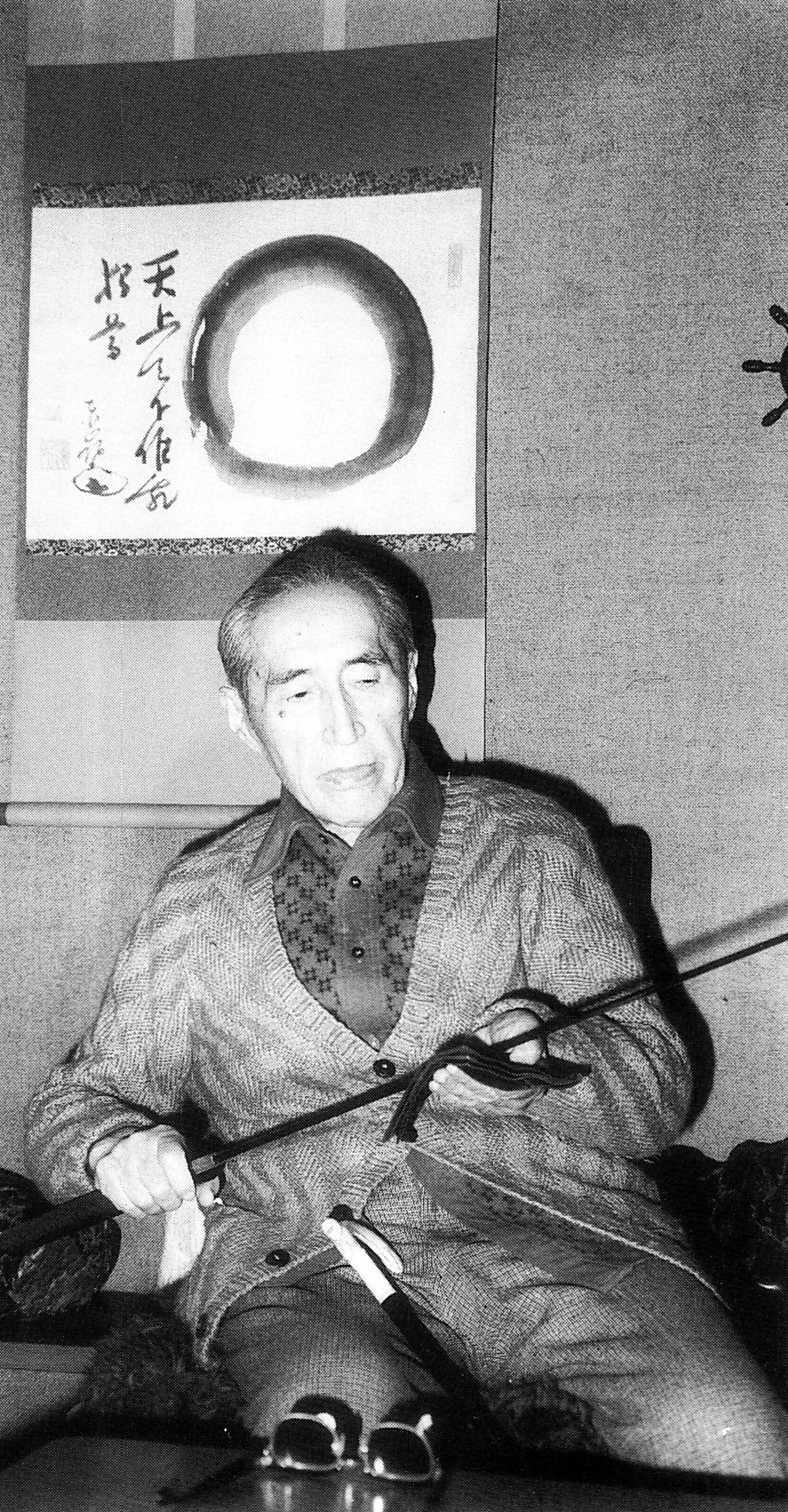
Doing what he loved until the end, Honma Sensei passed away on August 29, 1991, 7:40 pm, age 87, of a heart failure at his home in Kugayama (久我山), Tōkyō.
 Markus Sesko
Brilliant!
A great blog post with a wonderful summary of Honma Kunzan Junji life. Thank you.
Hi MarkusA brief aspect of my collecting Japanese swords:A Collector’s Manifesto: In Pursuit of Steel and StoryI collect Japanese swords not as trophies, but as witnesses of history. My journey begins with the hada — the living skin of the blade, particularly matsukawa-hada, whose fractured, pine-bark textures speak first, before any name or reputation. The hada is the voice of the smith, the climate, and the forge — a subtle language that reveals character, intention, and centuries of craft.I dwell in the koto era (pre-1596), a period when swords were still tools, not ornaments; when each strike and fold was shaped by necessity and experience. Within this era, my attention gravitates north — to the Etchū and Kashū traditions, where darker jigane and layered steel carry a depth and weight unique to their regions. The work of smiths like Etchū Norishige and Kashū Sanekage resonates because it is interpretive rather than uniform, alive rather than polished.I find profound joy in study and comparison. Every school, every smith, every forging technique is a different dialect, a different perspective on the same elemental act. Understanding a sword demands full engagement — handling it, studying its oshigata, reading its history — because only through such immersion does the blade reveal its story.For me, swords are conversations across time. They are living artifacts that carry the voice of their makers, the spirit of their era, and the wisdom of those who forged them. I do not seek perfection, but expression. I do not collect for quantity, but for insight. Every blade I encounter is a teacher, and every collection is a library of steel — rich, complex, and unendingly fascinating.I am a student of steel.I am a reader of hada.I am a seeker of stories that only centuries-old iron can tell.JohnSent from my T-Mobile 5G Device