KANTEI 4 – YAMASHIRO #12 – Awataguchi (粟田口) School 7

We arrive at Yoshimitsu (吉光) who is, depending on tradition, seen as student or as son of Kuniyoshi (国吉), his fourth son precisely, taking into consideration his first name Tôshirô (藤四郎) (i.e. the suffix shirô refers to a fourth son). The meikan either date him around Kôan (弘安, 1278-1288) or Shôô (正応, 1288-1293) but there are no date signatures of Yoshimitsu known. We have learned in the last chapter that from Kuniyoshi, blades dated Kenji four (建治, 1278) and Kôan six (弘安, 1283) and ten (1287) are known so both Kôan and Shôô seem perfectly fine for Yoshimitsu, regardless of if he was Kuniyoshi’s son or his student. The Kotô Meizukushi Taizen by the way quotes Yoshimitsu with Kangi one (寛喜, 1229) as year of birth and Shôô four (正応, 1291) as year of death. Before we continue, let me introduce all the (non-Kuniyoshi son) theories that were forwarded over time regarding Yoshimitsu’s background. Some say he was actually the fourth son of Norikuni (則国) and that’s where the first name Tôshirô comes from. Following this approach, he would have been Kuniyoshi’s younger brother, what does not exclude that he rather studied under his older brother than under his father. If we follow the Kotô Meizukushi Taizen, then Yoshimitsu was nine years old when Norikuni died, what would be an explanation for the aforementioned constellation. Incidentally, Kuniyoshi was 24 when Norikuni died but again, the data of the Kotô Meizukushi Taizen is highly doubtful and I don’t want to base too many theories on just that source. All I want to do here is to point out possible scenarios. Others see Yoshimitsu as son of Kuniyasu, others as son of Shintôgo Kunimitsu, and others again as great-grandson of Hisakuni.

Anyway, I want to introduce an interesting theory that follows the Kuniyoshi student-approach and that is connected to a highlight of Yoshimitsu, and that is his signature style. This theory says that Yoshimitsu came originally from Echizen province where he lived in the vicinity of the Shiisaki-jinja (椎前神社・志比前神社, present-day city of Tsuruga, Fukui Prefecture). Now Tsuruga is not that far away from the old capital, i.e. about 100 km following the Hokurikudô, and the Hokurikudô was a much frequented route as in Heian and early Kamakura times, Tsuruga had been (apart from Hakata on Kyûshû) the main hub for trade with Song China. The theory also says that he studied calligraphy of the Guzei’in-ryû (弘誓院流) in the capital, a style of shodô that has been established by court noble Kujô Noriie (九条教家, 1194-1255). Taking that into consideration, it is likely that Yoshimitsu has belonged to a rather high-ranking local Tsuruga family and that he moved in higher circles when visiting Kyôto. So maybe he came for something else but had a fondness for swords and was thus introduced to the then most renowned lineage of swordsmiths, the Awataguchi, where he started to study with master Kuniyoshi. I mean, we are talking here about the most prestigious masters of that time who only took orders from the wealthiest clientele, so following the Echizen approach, it is unlikely that for example a peasant boy packed his backback, marched down to Kyôto, and knocked at the door of Kuniyoshi to become his apprentice. Stories like that are more like Edo-era romanticism. As mentioned, this is just one of the numerous theories on the background of Yoshimitsu but reason why I deal with it that persistently is his signature style of which experts agree that the elegant style is not a coincidende and that he must had a decent knowledge of the aesthetics of calligraphy. In other words, Yoshimitsu’s signatures are not just of the “elegant because of the archaic, antique feel” category, like the mei of Heian and early Kamakura-era smiths for example, but are well thought out with all elements like curves of strokes and distance of radicals in perfect harmony.

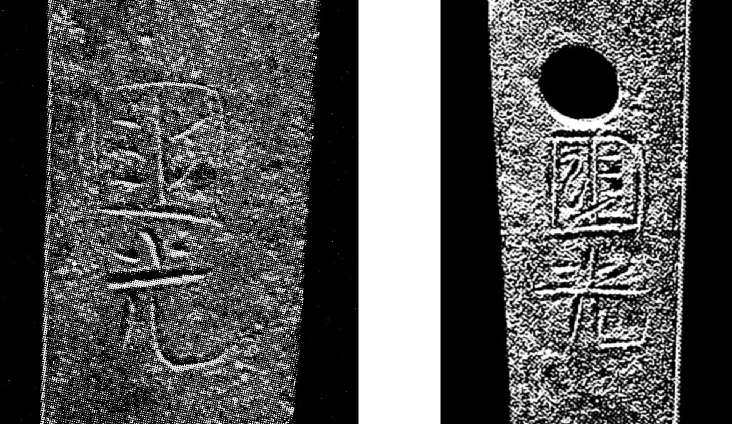
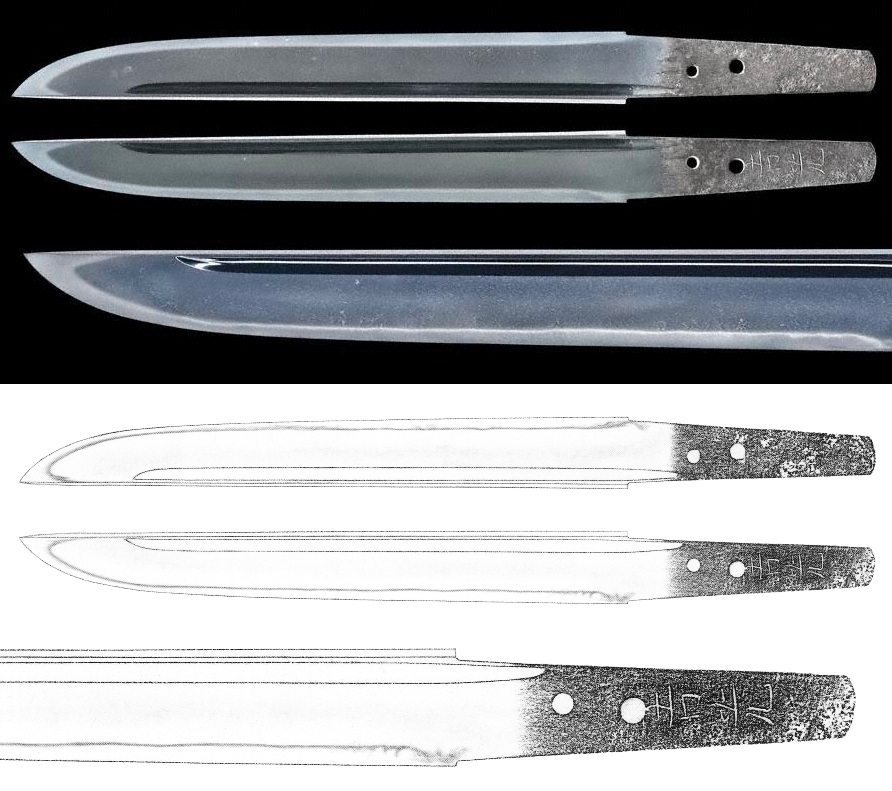
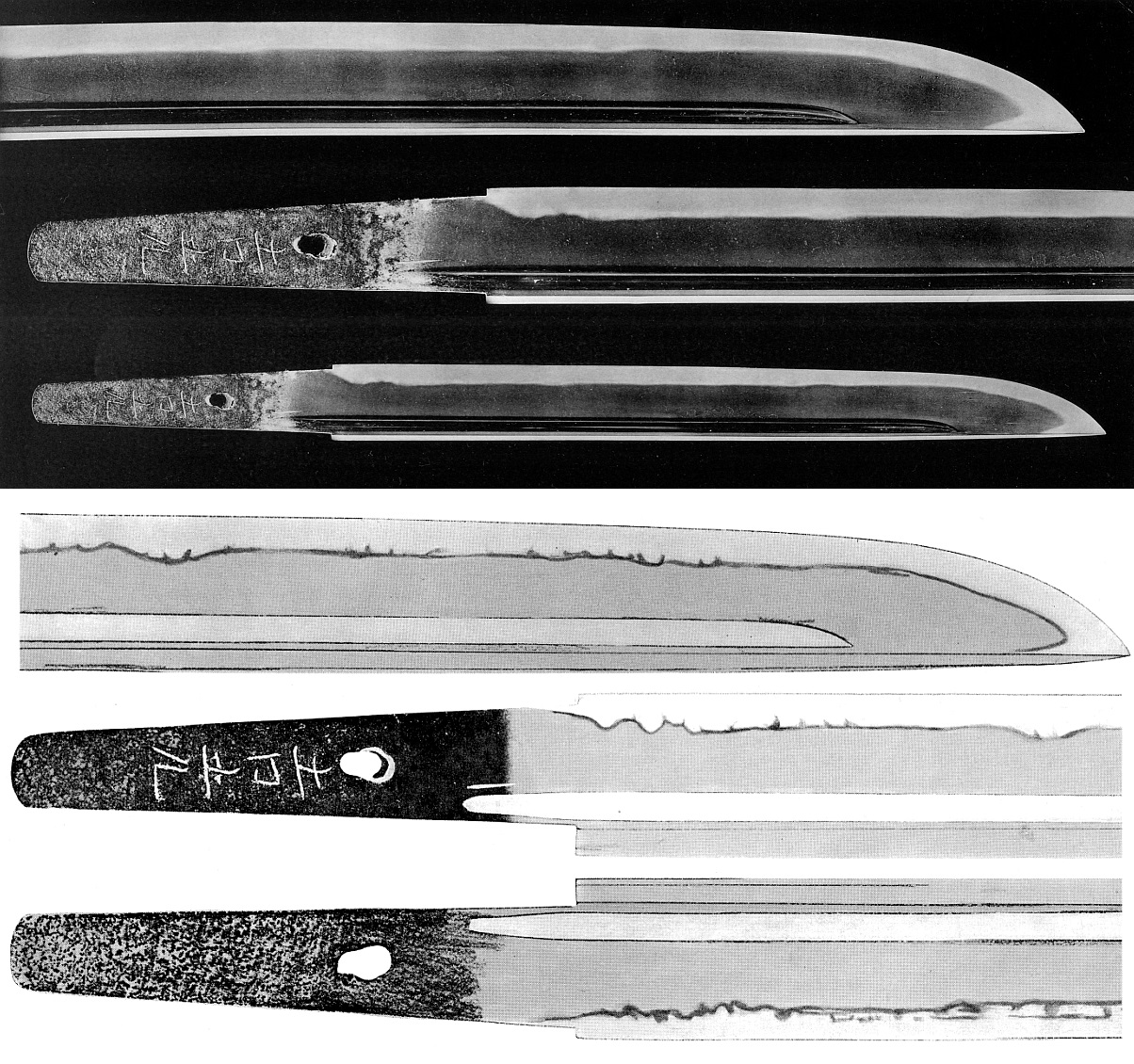
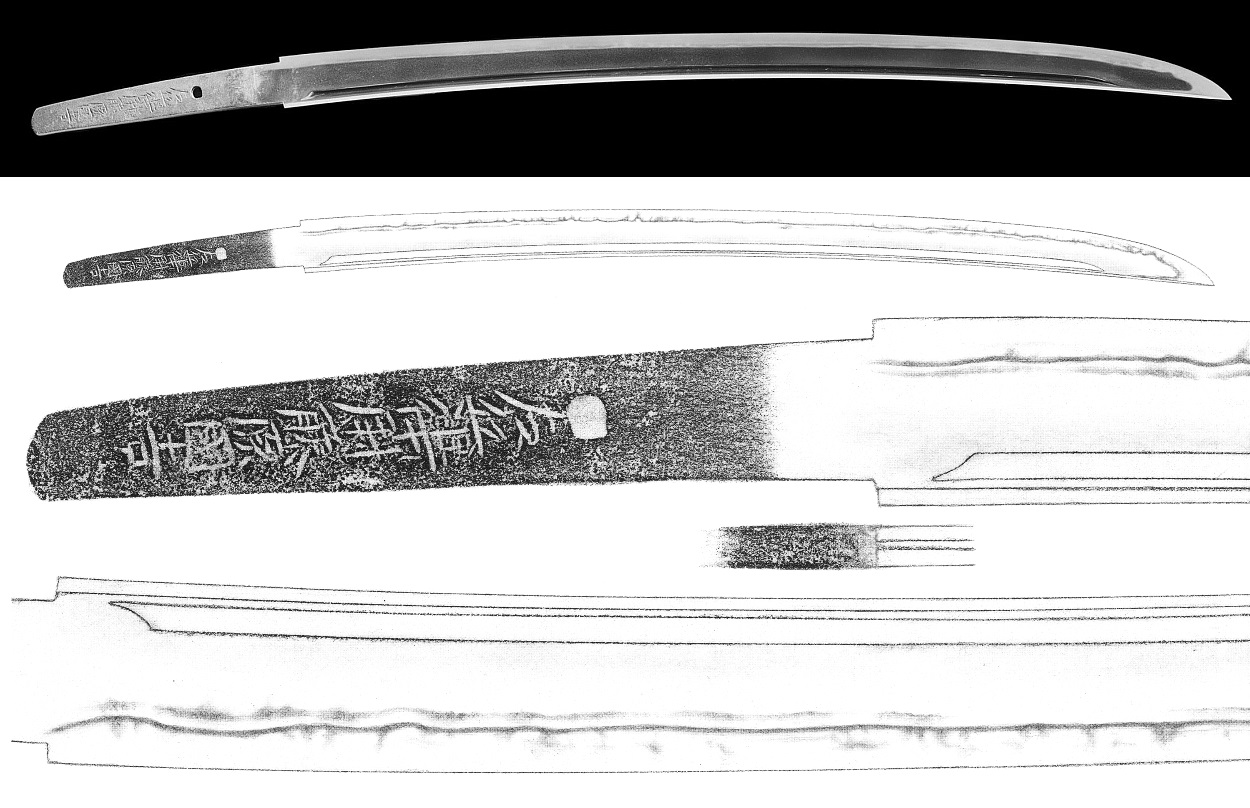
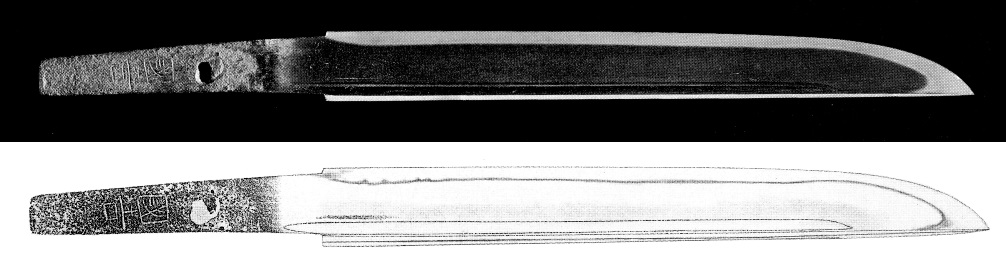
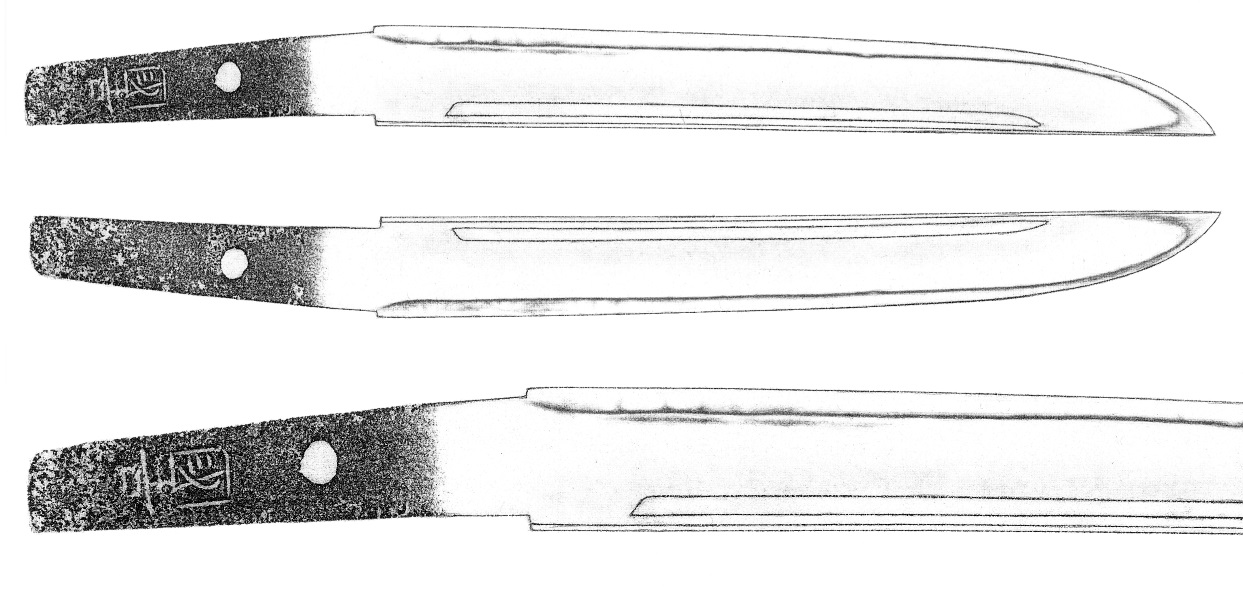
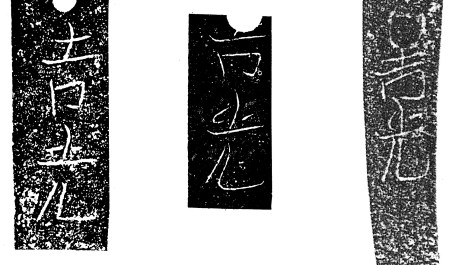
When it comes to Yoshimitsu’s signatures, we basically distinguish between two groups: A more “stiff” and “angular” one that is executed with a somewhat thicker chisel, and a “looser” and more “roundish” one for which a thinner chisel was used. The former features a smaller lower kuchi (口) radical of the character for Yoshi (吉) and is therefore also referred to as koguchi-mei (小口銘), and the latter, with the noticeably larger kuchi radical, as ôguchi-mei (大口銘) respectively. It is assumed that the ôguchi group goes back to his late years. Tanobe sensei introduces a third group which is somewhere in between these two and that mixes certain elements from each group, i.e. that goes back to a transitional time if you want, which he personally thinks of being the most elegant one. Picture 1 below shows one exemplary mei for each group.
Yoshimitsu1

Picture 1, from left to right: koguchi-mei, intermediate, ôguchi-mei

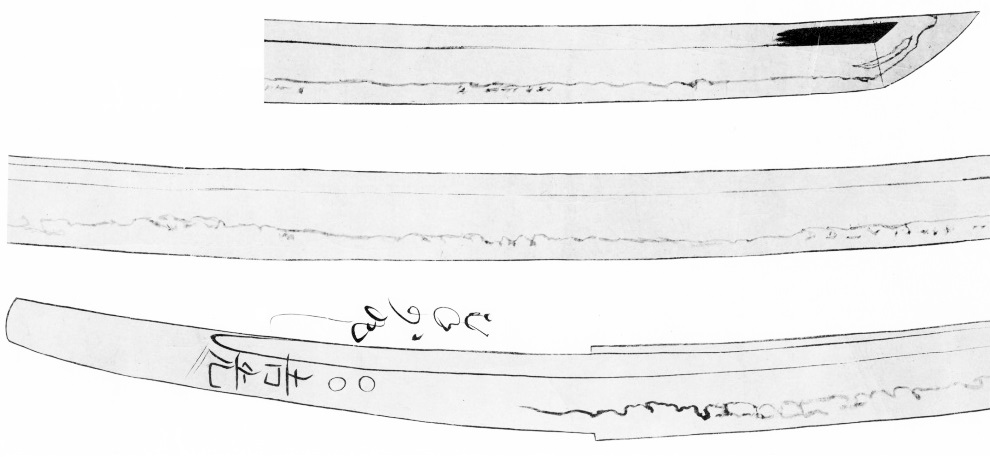
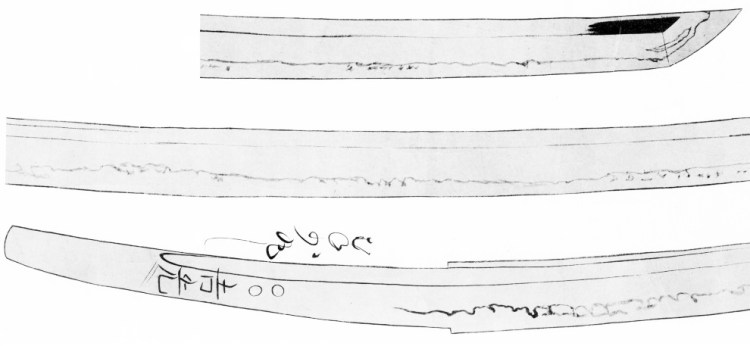
When it comes to Yoshimitsu’s oeuvre, it is kind of similar to Kuniyoshi, that means, the majority are tantô, followed by a few others and hardly any long swords going round at all, with Yoshimitsu’s long sword body of evidence even weaker than that of Kuniyoshi. And due to the latter fact, I want to “quickly” get by that very limited non-tantô database before we come to the blades we can actually talk about in more detail. Throughout the entire feudal era and up to the 1980s, it was thought that only one long blade of Awataguchi Yoshimitsu exists, namely the meibutsu Ichigo-Hitofuri (一期一振), which was once worn by Toyotomi Hideyoshi. However, Hideyoshi had it shortened from 85.7 to 68.8 cm but ensured that the original signature of Yoshimitsu was set into the new tang as so-called gaku-mei (額銘). When Ôsaka fell in 1615, the blade suffered a fire damage and had to be rehardened by Echizen Yasutsugu. In other words, it is saiha and, apart from old oshigata, we can’t say much about the original interpretation of its yakiba. Pictures of the meibutsu and further info can be found on my Japanese Sword Legends site here and here. Speaking of oshigata, there is a special copy of the work Kôtoku Katana Ezu (光徳刀絵図) that dates to Bunroku three (文禄, 1594) and that shows the Ichigo-Hitofuri before it was shortened. Although the reproduction of the hamon is more or less subject to artistic freedom in such old oshigata collections, I nevertheless want to point out that the ha is obviously more flamboyant than it is the case at Yoshimitsu’s tantô. But this is not as odd as it seems as there is for example the meibutsu tantô Midare-Tôshirô (乱藤四郎) which shows, as the name suggests, a midareba. So Yoshimitsus did work in midareba.
Yoshimitsu2

Picture 2: Oshigata of the unshortened Ichigo-Hitofuri.

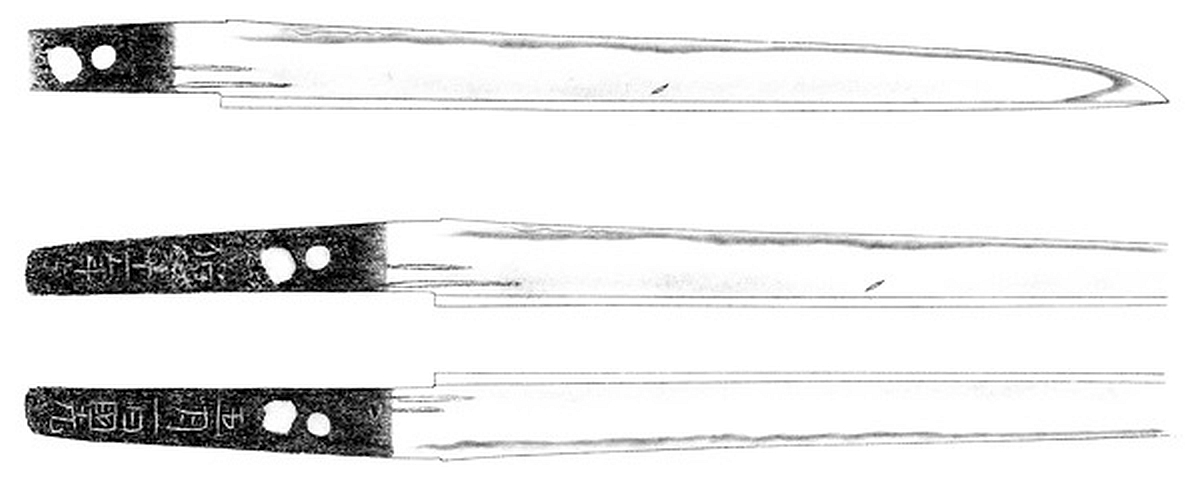
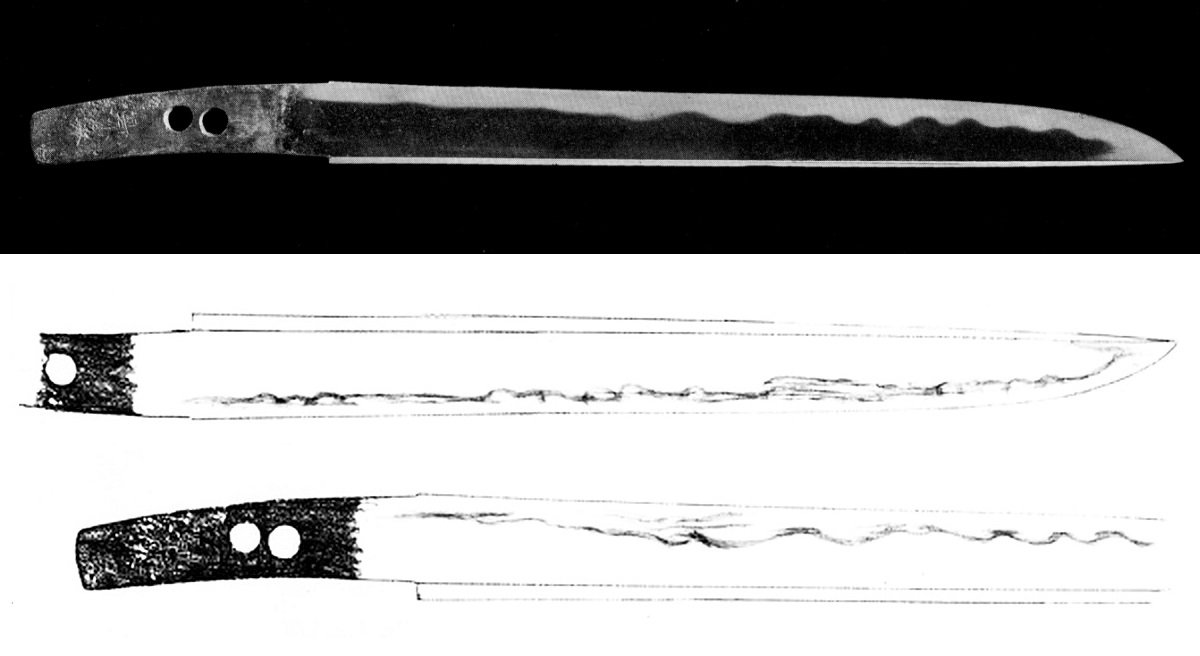
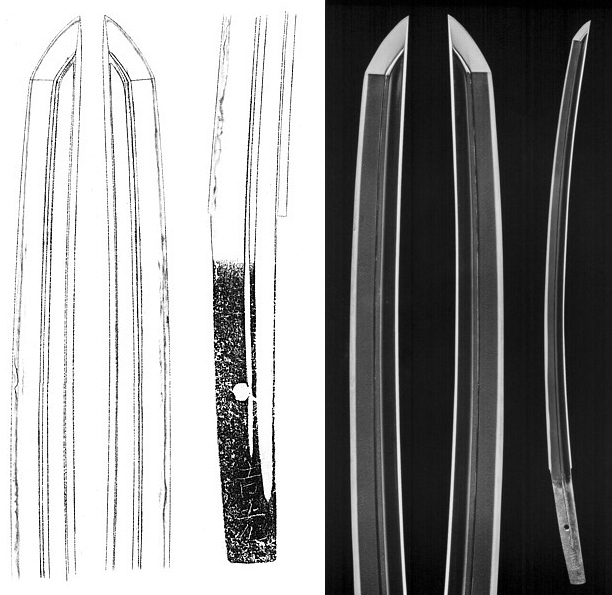
In our times, a zaimei wakizashi of Yoshimitsu was “discovered” which had been an heirloom of the Naruse family (成瀬), the daimyô of the Inuyama fief (犬山藩) of Owari province. The blade has a nagasa of 58.3 cm and as its bôhi with tsurebi go way down into the tang and as the signature is placed even below and towards the nakago-jiri, it looks at a glance as if the blade is suriage. But it is not, it is almost ubu (a tiny bit of the original nakago-jiri has been cut off) and was made that way, and with the mei on the omote side, everythong points towards the assumption that this blade was intended as uchigatana. The blade went jûyô in 1991 and was submitted to tokubetsu-jûyô the very next year, which it passed with flying colors of course. This uchigatana has with 2.0 cm quite a deep sori, a toriizori, and ends in a compact chû-kissaki. The jigane is a dense and finely forged itame with plenty of ji-nie and much chikei and the steel is clear and has a “wet” look. The hamon is a ko-nie-laden suguha with a wide nioiguchi mixed with some ko-gunome, ashi, , a few sunagashi and kinsuji and shows from the mid blade section upwards some nijûba-style yubashiri. The bôshi is sugu with a little notare and displays a very brief ko-maru-kaeri. So the top quality forging with its abundance of sparkling chikei, the “wet” looking steel, and the classical interpretation in suguha with some nijûba and brightly shining ko-nie lives very much up to the reputation of the Awataguchi school.
Yoshimitsu3

Picture 3: tokubetsu-jûyô, uchigatana, mei “Yoshimitsu” (吉光), nagasa 58.3 cm, sori 2.0 cm, shinogi-zukuri, iori-mune

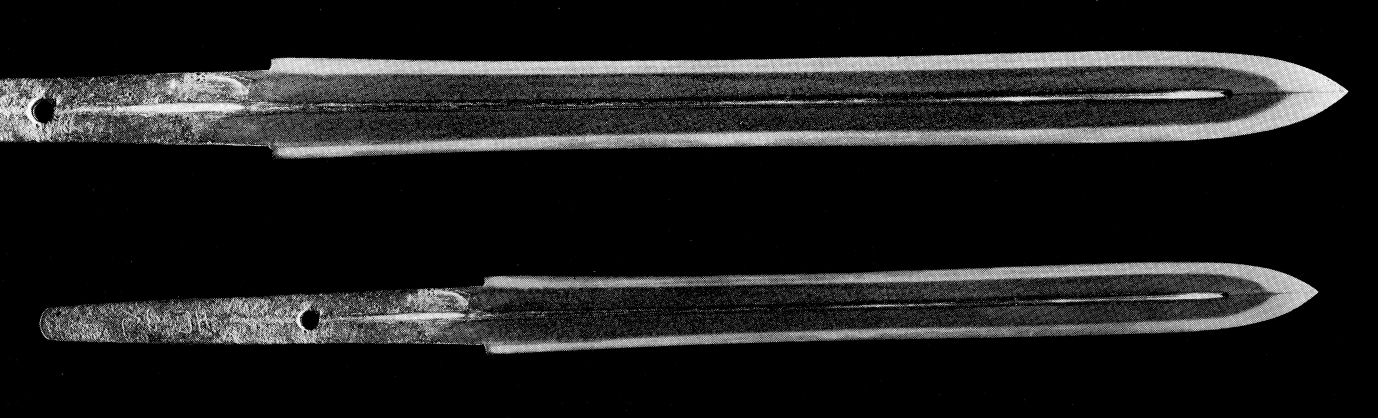
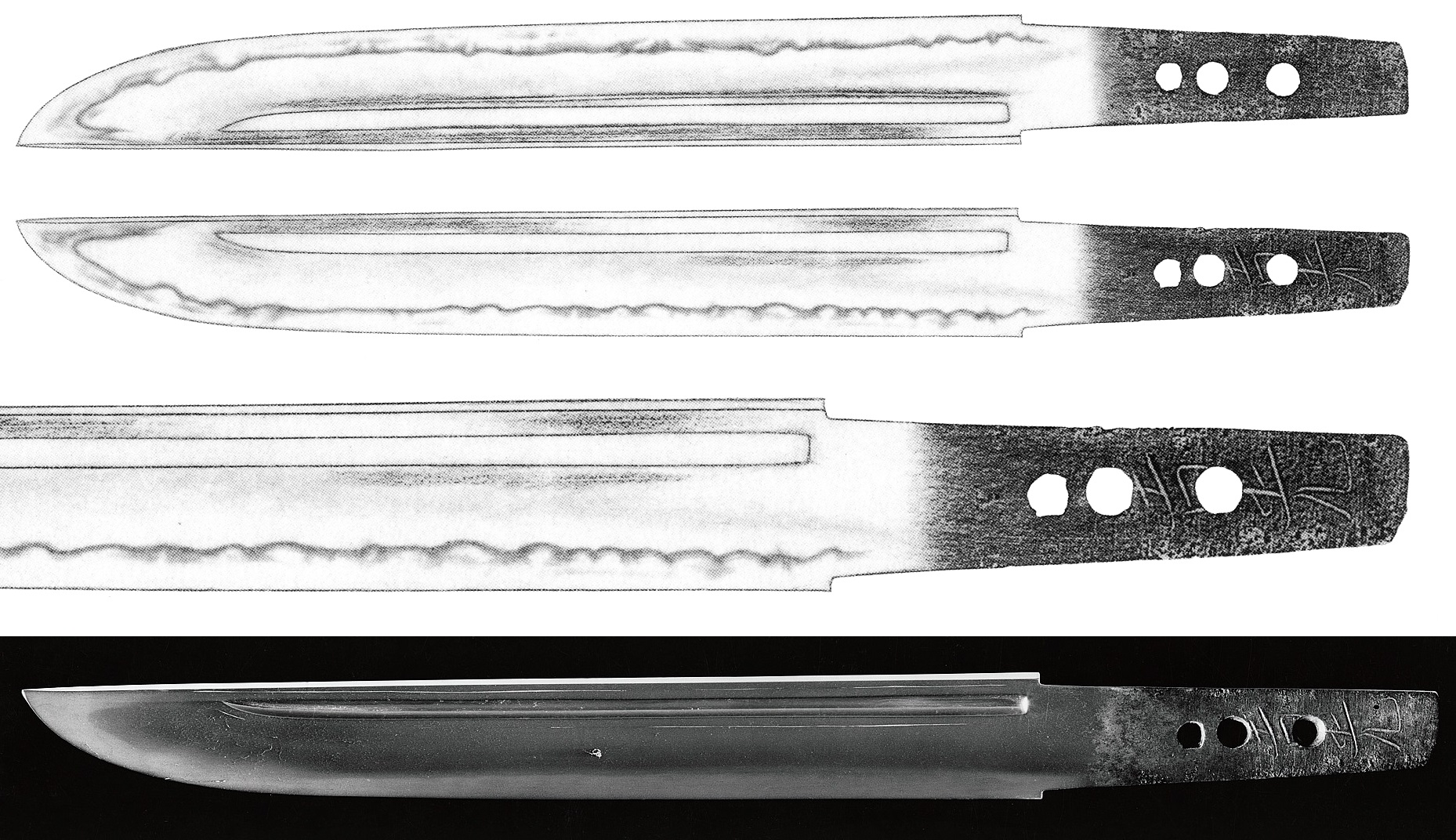
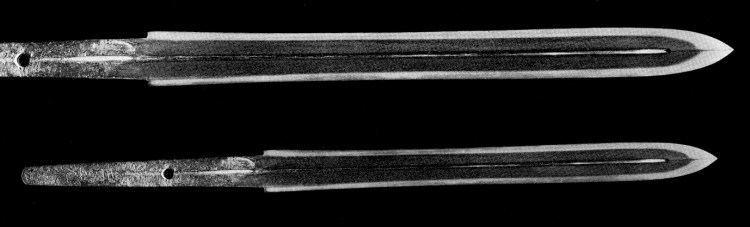
There are also ken of Yoshimitsu extant, for example the one shown in picture 4 which is designated as kokuhô. It is pretty close to those of his master, or father, Kuniyoshi, i.e. interpreted in ryô-shinogi-zukuri with a central shinogi-hi and a high shinogi, although with a hint more fukura. The kitae is a dense ko-itame with some masame, fine ji-nie, and chikei, and the hamon is a suguha-chô in ko-nie-deki mixed with ko-chôji-ashi, a few sunagashi, and some nijûba on the ura side. The nioiguchi is rather tight and the bôshi shows hakikake. This ken is preserved in the Shirayamahime-jinja (白山比咩神社, Ishikawa Prefecture).
Yoshimitsu4

Picture 4: kokuhô, ken, mei “Yoshimitsu” (吉光), nagasa 22.9 cm, motohaba 2.2 cm

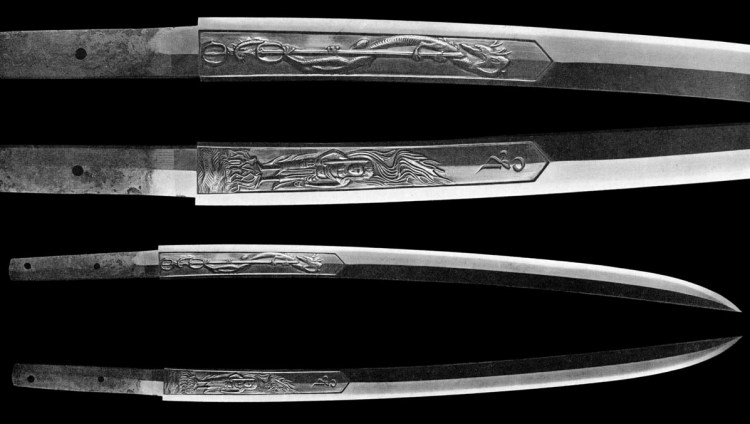
And before we go over to the tantô, let me introduce one more of these “other” blades of Yoshimitsu, the meibutsu Honemabi-Tôshirô (骨喰藤四郎, lit. “bone-gnawing Tôshirô”), which is a mumei naginata-naoshi that is designated as jûyô-bunkazai, despite the fact that it is saiha (retempered by the 3rd gen. Yasutsugu after the Great Meireki Fire). In old oshigata collections we see a slanting ko-midare/chôji mix at the base which turns into a calm suguha-chô with ko-ashi. The blade shows prominent horimono of a kurikara and Fudô-Myôô with atop a bonji in a hitsu recess. On the basis of the tang it is speculated that the blade had been mumei from the beginning, that means, even if the naginata – it was once a smaller-sized ko-naginata – was shortened to wakizashi/uchigatana length, the signature would have been at a higher position anyway and would not have been affected by the shortening. The attribution to Awataguchi Yoshimitsu goes back to the Hon’ami family and the jûyô-bunkazai designation – which says “Den” Awataguchi Yoshimitsu by the way – reflects more the historical value and provenance of the blade, which is as mentioned shortened, unsigned, and saiha.
Yoshimitsu5

Picture 5: jûyô-bunkazai, naginata-naoshi, mumei “Den Awataguchi Yoshimitsu” (伝粟田口吉光), meibutsu Honebami-Tôshirô, nagasa 58.8 cm, sori 1.4 cm, preserved in the Toyokuni-jinja (豊国神社, Kyôto)

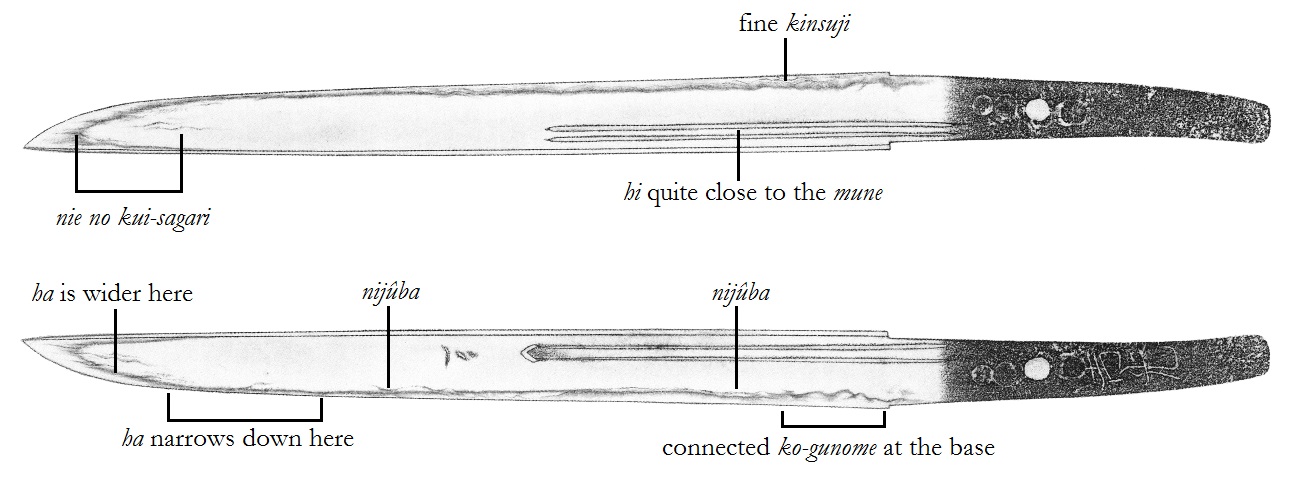
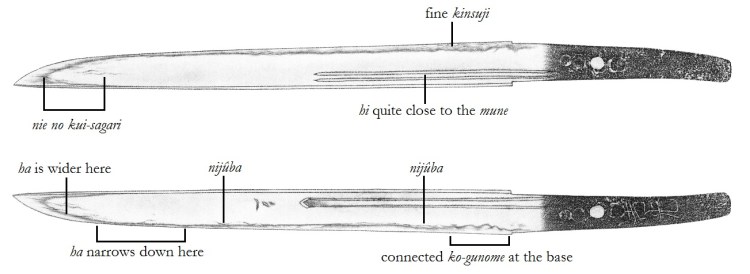
Now to Yoshimitsu’s tantô. Many experts see him as best tantô smiths of all times, standing on top of the winners’ rostrum with Shintôgo Kunimitsu. On top of that, he is counted with Masamune and Gô Yoshihiro to the so-called sansaku (三作), a term that was coined in the Edo period and which means about “Best Three Smiths of All Times.” With 16 listed blade, he also ranks, from a quantitative point of view, number three in the Kyôhô Meibutsu Chô, only “beaten” by Masamune with 39, and Sadamune with 19 blades. Incidentally, 18 blades of him are found in the yakemi section of the Kyôhô Meibutsu Chô. As comparison, the publication lists the same number of yakemi by Masamune and eleven of Gô Yoshihiro. When we get a quick overview of Yoshimitsu’s tantô, we learn that things are not that much different than with Kuniyoshi. That is, he made tantô in a great variety of shapes, e.g. standard ones, smaller and wider hôchô-style blades, long and thin, and long and wide tantô which feature a sunnobi-sugata. Also the way grooves are added is very similar to Kuniyoshi and when we remember that Kuniyoshi worked up to Kôan (弘安, 1278-1288) and Yoshimitsu is traditionally dated around Kôan and the subsequent Shôô era (正応, 1288-1293), we realize that this dating is – despite of the fact that as mentioned no date signatures of Yoshimitsu are extant – quite senstive. In other words, the interpretation of extant works corroberates that Yoshimitsu’s active period has been pretty close to that of Kuniyoshi what allows us to speculate that he indeed might has been his younger brother rather than his son as for a son, we would expect a hint later nengô like for example Einin (永仁, 1293-1299) or Shôan (正安, 1299-1302), which in turn means leaving late Kamakura and entering the final years of this period. Anyway, regardless of the sugata of tantô, we see characteristic features that appear on the majority of blades from that category and which can be described as follows: Small connected gunome elements or at least gunome-ashi at the yakidashi which make that area look like small strung together beans. Sometimes also an approach or even a solid koshiba might be seen. Nijûba or nijûba-like yubashiri appear parallel to the habuchi, but not as obvious and not all over the blade it is the case at Kuniyoshi. The ha often gets somewhat wider, and/or thins a little out before it enters the bôshi. This feature can be pretty obvious and appear as a true bend, or might just as a bend by a slightly thinnig or slightly widening ha at the point where the bôshi starts. In addition, the nie are much more emphasized in the bôshi and appear there often as if they “spill” in a frayed manner into the ji, a feature that is referred to as nie no kui-sagari (沸の喰い下がり). Please note that there is some confusion with the term okina no hige (翁の髭, lit. “beard of an old man”). This term too refers to increasing nie in the bôshi but is reserved for Shintôgo Kunimitsu. Basic difference is that okina no hige are super fine kinsuji within the ha that remind – due to the fact that they follow the underlying hada which tends at Shintôgo somewhat to nagare in that area – of the long beard of an old man. They might reach into the ji too in certain cases but focus as mentioned more on the ha whereas at Awataguchi Yoshimitsu, the nie-hataraki take much more place in the ji than in the ha. So before we continue, let me summarize the characteristic feature of Yoshimitsu in picture 6 below.
Yoshimitsu6

Picture 6: Characteristic features of Awataguchi Yoshimitsu’s workmanship.

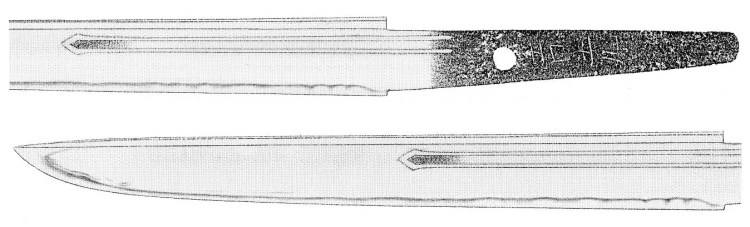
In the following I would like to introduce some representative tantô of Yoshimitsu (going from small to large) and, if you have time, I recommend going back one chapter, comparing them to the works of Kuniyoshi. You will see the similarities. First a blade that is designated as jûyô-bijutsuhin and that is one of the smallest tantô known by Yoshimitsu. It has a nagasa of 21.5 cm, uchizori, and because of its proportions, everything points towards late Kamakura. It shows a fine and uniformly forged ko-itame which shows ji-nie. The hamon is a hoso-suguha with some ko-gunome at the base and narrows a little towards the monouchi before it gets again wider in the bôshi. In addition, we see faint nijûba and nie that get stronger in the bôshi and appear there as nie no kui-sagari. So we have pretty obviously all characteristic features of this smith present on this blade.
Yoshimitsu7

Picture 7: jûyô-bijutsuhin, tantô, mei “Yoshimitsu” (吉光), nagasa 21.5 cm, uchizori, hira-zukuri, mitsu-mune

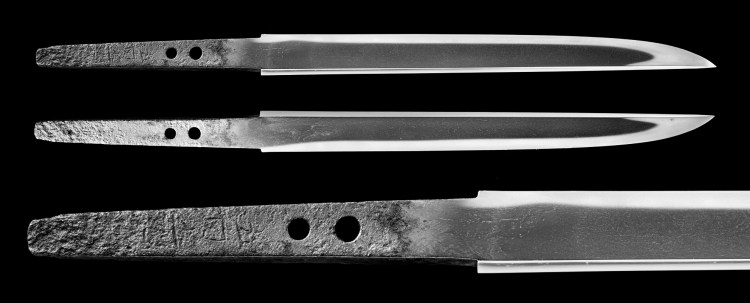
Next a blade that is a little uncommon, namely in the way that it is a yoroidôshi-style tantô, featuring a moto-kasane of 1.05 cm. Accordingly, the tantô got the nickname Atsushi-Tôshirô (厚藤四郎, lit. “The Thick Tôshirô,” sometimes also read Atsu-Tôshirô). The blade is designated as kokuhô and shows a somewhat standing-out itame with plenty of ji-nie and much chikei. The ko-nie-laden hamon starts with some ko-notare and gunome at the base and turns then into a suguha which is mixed with some kinsuji and with plenty of ashi an . The bôshi has a ko-maru-kaeri and shows hakikake.
Yoshimitsu8

Picture 8: kokuhô, tantô, meibutsu Atsushi-Tôshirô, mei “Yoshimitsu” (吉光), nagasa 21.8 cm, hira-zukuri, mitsu-mune, preserved in the Tôkyô National Museum

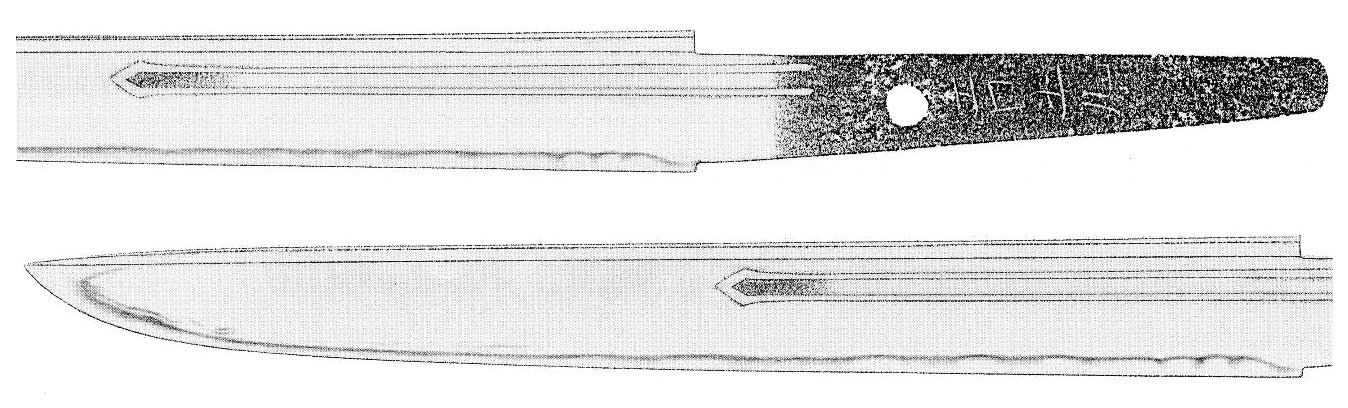
As mentioned, Yoshimitsu also made some wide and stout hôchô-style blades like the one shown in picture 9 which bears the nickname Hôchô-Tôshirô (包丁藤四郎) accordingly. Please note that there is another meibutsu with that name but which was damaged by fire during the Great Meireki Fire of 1657. The one introduced here is designated as jûyô-bijutsuhin, shows a very dense and beautifully forged ko-itame with plenty of ji-nie, and also displays a slanting bô-utsuri at where the hamon starts and a nie-utsuri all over the blade. A faint nie-utsuri is also seen on the tantô shown in picture 7. The hamon of the Hôchô-Tôshirô is a ko-nie-laden chû-suguha-chô with a bright and clear nioiguchi and is mixed with ko-gunome, some ko-notare, ko-ashi, and . The bôshi features a somewhat “tied-up” ko-maru-kaeri. The blade shows a pretty conspicuous amount of midare and please note the hi which is in Awataguchi-typical manner engraved close to the mune (although here with traces of a thin tsurebi that went all around the groove).
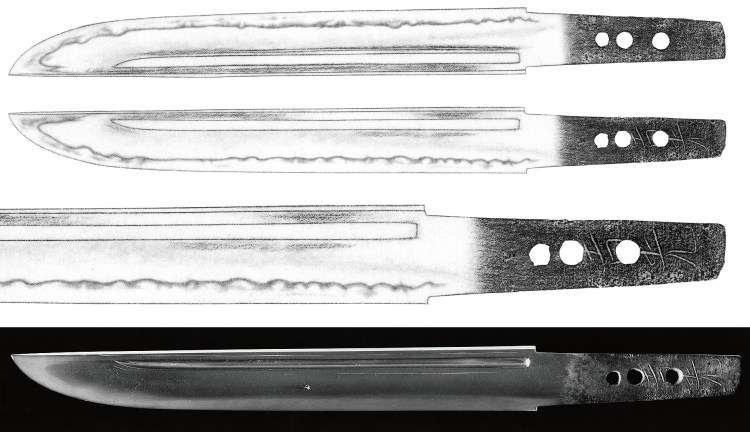
Yoshimitsu9

Picture 9: jûyô-bijutsuhin, tantô, meibutsu Hôchô-Tôshirô, mei “Yoshimitsu” (吉光), nagasa 21.8 cm, uchizori, hira-zukuri, mitsu-mune, preserved in the Tokugawa Museum

Picture 10 shows another wide blade that tends to hôchô. It was a heirloom of the Tachibana family (立花), the daimyô of the Yanagawa fief (柳川藩) of Chikugo proince, and is today designated as kokuhô. The blade is as mentioned wide, has a nagasa of 23.1 cm, and shows a dense and beautifully forged ko-itame with plenty of ji-nie, rather thick chikei, and a straight nie-utsuri. The hamon is a ko-nie-laden chû-suguha that features a bright nioiguchi, a few ko-ashi, and some connected ko-gunome at the base (more prominent on the omote side). The bôshi appears as sugu with a ko-maru-kaeri and brief hakikake and again, we see a hi that is engraved extremely close to the mune.
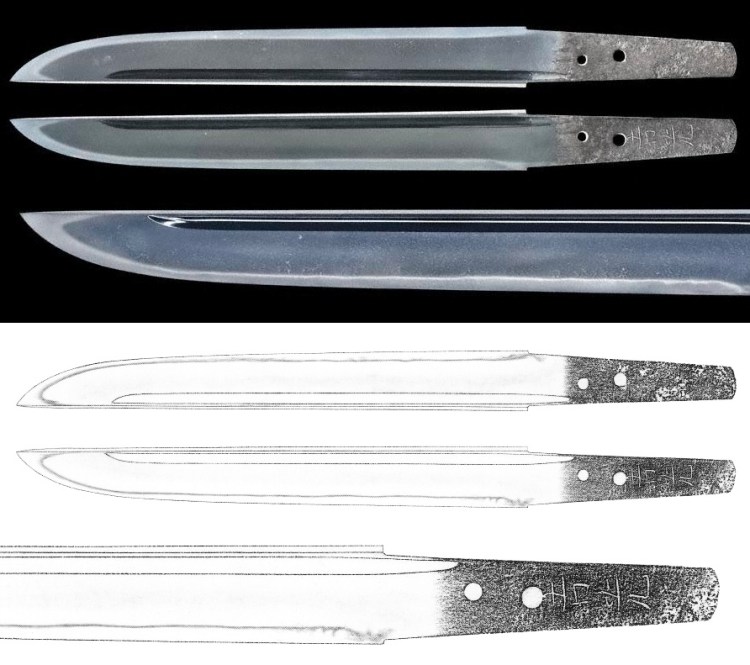
Yoshimitsu10

Picture 10: kokuhô, tantô, mei “Yoshimitsu” (吉光), nagasa 23.1 cm, a little uchizori, hira-zukuri, iori-mune, privately owned (Fukuoka Prefecture)

And last but not least, I want to introduce one of Yoshimitsu’s most famous (some say his best) and largest tantô, the meibutsu Hirano-Tôshirô (平野藤四郎). It has a nagasa of 30.1 cm, a rather wide mihaba of 2.8 cm, and also quite a thick kasane of 0.8 cm. It shows a very dense ko-itame with a hint of masame towards the mune and plenty of fine ji-nie. The hamon is a suguha in ko-nie-deki that starts with some connected ko-gunome and that is mixed with shallow notare, a little gunome-midare, ko-ashi and . Both nioiguchi and ha are bright and clear and the bôshi is a shallow notare-komi with a ko-maru-kaeri.
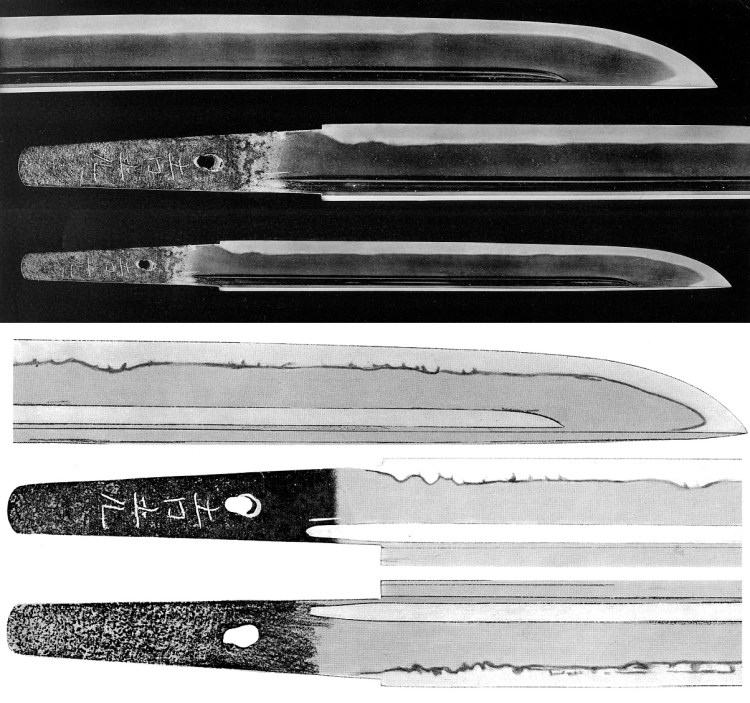
Yoshimitsu11

Picture 11: gyobutsu, tantô, meibutsu Hirano-Tôshirô, mei “Yoshimitsu” (吉光), nagasa 30.1 cm, uchizori, hira-zukuri, mitsu-mune

*

To round this chapter off, let me address some essential kantei points. As we find ourselves in the late Kamakura period, we are dealing with the finest, most elegant, and qualitative best tantô ever made and are facing the greatest tantô smiths of all times, which were Awataguchi Kuniyoshi, Awataguchi Yoshimitsu, Shintôgo Kunimitsu, and Rai Kunitoshi. All of them made tantô with various sugata, so it is difficult to jump to a conclusion right away based on the shape alone. But what we can say is that tantô of Shintôgo Kunimitsu and Rai Kunitoshi show by trend a little thinner kasane as they were active later and approached Nanbokuchô. But if present, hi are a good hint because if they are noticeably close to the mune, it is very likely that you have an Awataguchi work. When it comes to the jiba, the blades of Shintôgo feature more chikei and kinsuji and are overall more nie-laden than those of Yoshimitsu. In other words, his jigane is stronger and with Shintôgo Kunimitsu, we can feel a moving away from Kyô and towards the soon to be established Sôshû tradition. At Rai Kunitoshi in turn, the nie are somewhat more calm, that means, the emphasis on nie goes in ascending order: Rai Kunitoshi → Awataguchi Yoshimitsu → Shintôgo Kunimitsu. I have already mentioned that Yoshimitsu’s tantô are quite similar to those of Kuniyoshi, with the difference that Kuniyoshi’s ko-itame is a hint denser and a hint more uniform and appears a hint more often as “straightforward” nashiji-hada. Apart from that, there is much more nijûba and the nie would not increase in the bôshi. And when you see prominent ko-gunome at the base or some kind of koshiba, it is safe to go for Yoshimitsu, supposing that you have narrowed down a bid to Kuniyoshi and Yoshimitsu. As indicated in the last chapter, there are some tantô of Kuniyoshi which too show an approach of this feature at the base but it was Yoshimitsu who so to speak applied it “fully”.
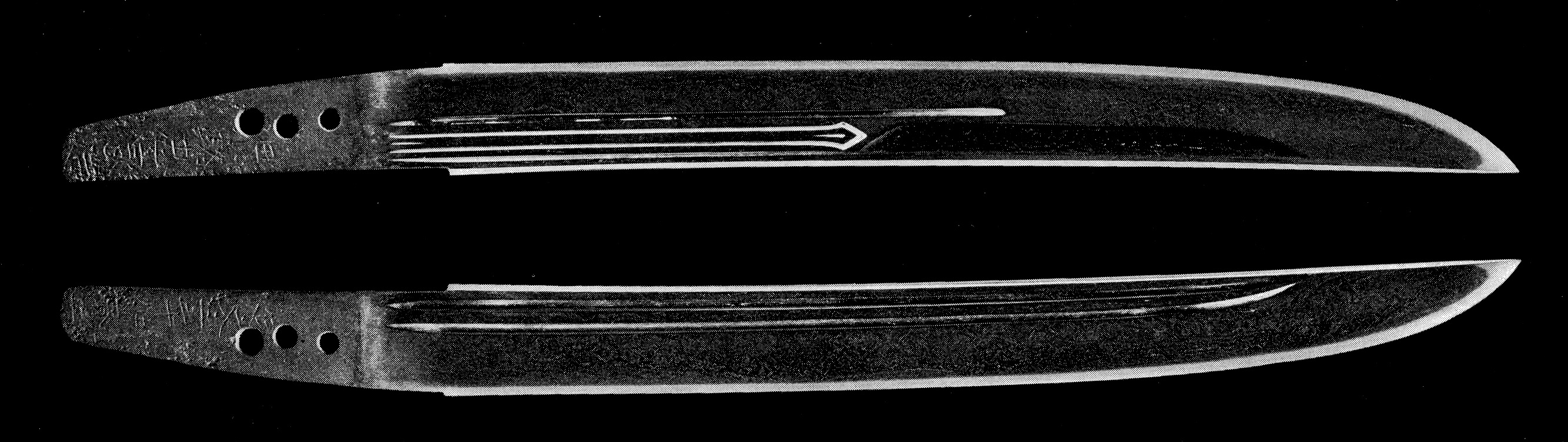
Short Update

I will end the DTI/Thanksgiving eBook Super Sale by this Wednesday. So if you want to grab some copies as long as they are 50% off, you have two days left to do so. Please note that Lulu doesn’t offer any voucher codes for eBooks, i.e. makes no sense to wait for one, and the next one done by my humble self manually will be the Easter Sale next year. Thus either now or in five months 🙂

http://www.lulu.com/spotlight/nihontobooks

KANTEI 4 – YAMASHIRO #11 – Awataguchi (粟田口) School 6

The Awataguchi main line was continued by Norikuni’s eldest son Kuniyoshi (国吉) of whom no first name is handed down, although we know that he bore the honorary title Sahyôe no Jô (左兵衛尉). Just to let you know, the Kotô Meizukushi Taizen says that he was born in Genkyû one (元久, 1204) and that he died in Bun’ei four (文永, 1267) at the age of 64. Traditionally he is dated around Hôji (宝治, 1247-1249) and contradicting the anyway suspicious year of death forwarded by the Kotô Meizukushi Taizen, there are old oshigata collections extant that show blades dated for example Kenji four (建治, 1278) and Kôan six (弘安, 1283) and ten (1287). Following the latter data means that with Kuniyoshi, we have reached the closing years of the mid-Kamakura period. Fortunately, there are relative many works of this Awataguchi smith extant and these works comprise all kind of blades like tachi, uchigatana, ken, tantô, and larger dimensioned sunnobi-style tantô. So we have a pretty good overview of his artistic repertoire, although it must be said that long swords are rarest when it comes to quantities in the extant oeuvre of Kuniyoshi. Let me work through Kuniyoshi’s workmanship step by step, beginning with long swords and coming via the “others” to his tantô.

There are only two zaimei tachi of Kuniyoshi extant whose signatures are bulletproof. Then there is a group of three signed blades where the signature is off a little, although these mei are thought to be most likely authentic and within the range of natural changes of a smith but which are nevertheless labelled as “need further study.” In other words, the NBTHK is very very careful in this respect and does not lean an inch out of the window when it comes to big names like Awataguchi Kuniyoshi. And then there are more than a dozen of jûyô and more than a dozen of tokubetsu-jûyo tachi known which are unsigned but which are attributed to Kuniyoshi. So let’s focus on the signed specimen to define how he interpreted his long swords. One of the two bulletproof zaimei tachi (see picture 1) is tokubetsu-jûyô and it is very special because it is completely ubu. The blade has an elegant tachi-sugata with a deep koshizori with funbari but does no longer taper that much like earlier Kamakura blades and ends in a straightforward chû-kissaki, i.e. nothing like ko or slightly elongated ko-kissaki, as it was typical for preceding periods, but chû. It shows a very dense ko-itame with a little nagare, plenty of ji-nie, fine chikei, and a nie-utsuri and the steel is clear and looks “wet.” The hamon is a ko-nie-laden suguha-chô that comes with a little undulating notare and that is mixed with a few ko-gunome, ko-chôji, and ko-midare, ashi, some kinsuji, and a conspicuous, discontinuous nijûba that appears almost over the entire blade (sparing just the base). The nioiguchi is wide and bright. The bôshi is sugu with prominent nijûba and almost runs out as yakitsume. The tang is as mentioned ubu, has a kurijiri, kiri-yasurime, and two mekugi-ana.

Kuniyoshi1

Picture 1: tokubetsu-jûyô, tachi, mei “Kuniyoshi” (国吉), nagasa 75.5 cm, sori 2.4 cm, shinogi-zukuri, iori-mune

The signed jûyô-bunkazai (see picture 2) was shortened up to the signature but retains its elegant sugata that is again not that much tapering and ends in a chû-kissaki. The interpretation of the jiba is very similar to the tokubetsu-jûyô and we see the same prominent and discontinuous nijûba that focuses on the upper part of the blade and that continues into the bôshi, here even a hint more pronounced. Incidentally, this feature has already been pointed out in pre-Edo period sword publications.

Kuniyoshi2

Picture 2: jûyô-bunkazai, tachi, mei “Kuniyoshi” (国吉), nagasa 72.3 cm, sori 2.4 cm, shinogi-zukuri, iori-mune

The mei of these two blades also mark so to speak the both extremes of Kuniyoshi’s spectrum of signature variations, that means the one on the tokubetsu-jûyô is the finest and largest, and the one on the jûyô-bunkazai the thickest and most compact mei. Picture 3 shows these two signatures compared to those which are as mentioned labelled as “need further study.” [Sidenote: The way these signatures are actually addressed in NBTHK papers is “to mei ga aru” (と銘がある) but this supplement deserves an extra and an explanation goes beyond the scope of the kantei series.] Again, we are talking here just about long swords. Signed tantô and ken are plenty and will be addressed later.

Kuniyoshi3

Picture 3: mei of the tokubetsu-jûyô left, of the jûyô-bunkazai right, and below those which “need further study”

To demonstrate what discrepancies we are facing with the “to mei ga aru” works, or rather to demonstrate the lack of discrepancies, I want to introduce in picture 4 one such blade, the one whose mei is shown in picture 3 on the bottom left. It even passed tokubetsu-jûyô, that means if the mei (and workmanship) was that off, it would not have received jûyô (or even hozon) in the first place. In other words, if the mei was judged as gimei (or way too off), the blade would not have passed any paper and be returned to the owner who might then be left with the decision having the signature removed and submitting it again (most likely then it would actually receive a paper on Awataguchi, or even on Awataguchi Kuniyoshi). So these to mei ga aru signatures can make it up to the tokubetsu-jûyô rank without problem and the supplement in question has to be understood as “precaution” on the part of the NBTHK. Take a look at the blade in picture 4 and judge yourself. It is a slender tachi with a deep koshizori and a chû-kissaki, showing a very dense ko-itame mixed with some mokume and nagare that features plenty of ji-nie, chikei, a hint of jifu, and a faint nie-utsuri. The hamon is a ko-nie-laden chû-suguha-chô mixed with ko-chôji, ko-gunome, plenty of ashi and , fine sunagashi, kinsuji, and the very same prominent discontinuous nijûba that also runs into the bôshi. The nioiguchi is wide and bright and the bôshi is sugu with a ko-maru-kaeri. The condition of this blade is outstanding. It was once owned by the statesman Ôkubo Ichiô (大久保一翁, 1818-1888) and went then into the possession of the Iwasaki family (岩崎).

Kuniyoshi4

Picture 4: tokubetsu-jûyô, tachi, mei “Kuniyoshi” (国吉), nagasa 70.9 cm, sori 2.1 cm, shinogi-zukuri, iori-mune

Now to Kuniyoshi’s “other” blades. There are about seven ken of him known of which I want to introduce the most famous one, the jûyô-bunkazai ken. I have “only” pictures of five of these blades in my database but I dare to say that the majority of them is identically interpreted. They are all slender, in ryô-shinogi-zukuri, show a thin hi along the rather high shinogi (a groove that is referred to as shinogi-hi by the way), and their tips are not that stubby (that means they don’t have a pronounced fukura). The majority has a nagasa between 21.0 and 25 cm (although there is an overlong jûyô-bijutsuhin ken with a nagasa of 84.8 cm), that means Kuniyoshi’s ken are mostly small and graceful and have a nakago that is relative long in relation to the blade length. Their jigane is about identical to that of the tachi, i.e. highest quality nashiji, and the hamon is a suguha-chô in ko-nie-deki with kinsuji and sunagashi and some ken feature a few hotsure and others a little mixed-in notare (the jûô-bunkazai for example). We also see nijûba, also not that prominent as on long swords, and at one ken, the nijûba just appears in the bôshi, meeting at the shinogi ridge (see picture 6). The jûyô-bunkazai ken is signed with a fine chisel whereas one jûyô-bijutsuhin ken bears a thickly chiselled mei, that means we can’t make out any rule when it comes to ken signatures (for example that all of them are signed the same way and would therefore go back to the same phase in his career).

Kuniyoshi5

Picture 5: jûyô-bunkazai, ken, mei “Kuniyoshi” (国吉), nagasa 24.2 cm, motohaba 2.3 cm, ryô-shinogi-zukuri

Kuniyoshi6

Picture 6: jûyô, ken, mumei “Den Awataguchi Kuniyoshi” (伝粟田口国吉), nagasa 23.8 cm, motohaba 1.9 cm, ryô-shinogi-zukuri

Next “special case” is the famous jûyô-bunkazai and meibutsu Nakigitsune (鳴狐, lit. “howling fox”) from the former possessions of the Akimoto family (秋元) which ruled the Tatebayashi fief (館林藩) in Kôzuke province. Here we are facing a long uchigatana (the jûyô-bunkazai designation says “katana”) in hira-zukuri and although this is the only one of its kind, i.e. by a famous smith from that time (Kamakura), it has some Heian-period predecessors. Please note that the blade shows a bôhi which is engraved very close to the mune, a characteristic feature that is typical for the Awataguchi School. However, the diagonal end just above the habaki is unique to Kuniyoshi and also found on some of his tantô. By the way, Tanobe sensei sees the Awataguchi Hisakuni tantô shown in picture 6 here from its overall impression as “miniature version” of the Nakigitsune. The jiba of the Nakigitsune follows that of Kuniyoshi’s tachi and on this blade too we see prominent nijûba. But the suguha is pretty wide and we see some ko-gunome and ko-notare along the fukura. Please check out hi-res pictures of this blade here.

Kuniyoshi7

Picture 7: jûyô-bunkazai, uchigatana, mei “Sahyôe no Jô Fujiwara Kuniyoshi” (左兵衛尉藤原国吉), nagasa 54.0 cm, sori 1.6 cm, hira-zukuri, mitsu-mune

Tantô make the majority of Awataguchi Kuniyoshi’s extant oeuvre. There is one jûyô-bunkazai, a couple of jûyô-bijutsujin, and more than a dozen jûyô/tokubetsu-jûyô tantô, and the majority of these tantô is signed (all but one in niji-mei, the one “exception” is signed “Saemon no Jô Kuniyoshi”). When we take a look at all these tantô we learn that he interpreted them in a great variety of shapes. There are such with a standard, a mid-sized and elegant Kamakura-period sugata, smaller and wider tantô that tend to a hôchô-sugata, long and thin tantô, and long and wide tantô that come in a sunnobi-sugata. His tantô show a little uchizori or no sori at all and can come with an iori or a mitsu-mune. Also we see several kinds of grooves like gomabashi, katana-hi, katana-hi with tsurebi, combination of suken on the one and koshibi on the other side, combination of katana-hi with bonji on the hira-ji towards the base, bonji and suken as relief in a katana-hi, and futasuji-hi on both sides. As mentioned, the hi are engraved in Awataguchi-manner quite close to the mune and some end in Kuniyoshi’s peculiar diagonal manner. And before I introduce some of his tantô I briefly want to address Kuniyoshi’s standing within his school. Some see him as best tantô smith of all times whereas this attribute is mostly associated with his successor Yoshimitsu. Others say he was the best when it comes to a gentle and dignified suguha whilst Honma sensei ranks him second in his school in terms of skill, only surpassed by Hisakuni. Well, works of these Awataguchi masters are all outstanding and the quality is so close that such rankings are more of a subjective nature and not really something to fight about.

Picture 8 shows the jûyô-bunkazai tantô of Kuniyoshi. It is wide and with a nagasa of 22.9 cm rather compact, what gives the piece a hôchô, i.e. “kitchen knife” sugata. It shows a dense ko-itame that is mixed with some ô-hada in places, fine ji-nie, and a hint of jifu-utsuri. The hamon is a ko-nie-laden chû-suguha that is mixed with ko-ashi, , and a little ko-gunome at the very base. The nioiguchi is bright and rather tight and the bôshi is sugu with a ko-maru-kaeri. Please note that this blade does not show nijûba. Both sides feature a katana-hi that is, again, arranged pretty close to the mune, and we can also see traces of a tsurebi. The tang is ubu, has a kirijiri, kiri-yasurime, and is signed in niji-mei. Incidentally, this blade was once a heirloom of the Asano family (浅野), the daimyô of the Hiroshima fief of Aki province.

Kuniyoshi8

Picture 8: jûyô-bunkazai, tantô, mei “Kuniyoshi” (国吉), nagasa 22.9 cm, uchizori, motohaba 2.4 cm, hira-zukuri, iori-munne

In picture 9 we see a tantô of Kuniyoshi that features prominent nijûba, also in the typical manner what means interrupted and a hint more emphasized in the bôshi. This is, or rather was Kuniyoshi’s largest known tantô, was because it is a little machiokuri. It measures now 29.1 cm but was originally 30.9 cm in nagasa. So this tantô comes in sunnobi-sugata and somehow foreshadows the later Nanbokuchô interpretations. The jigane is a very dense ko-itame with plenty of ji-nie and appears altogether as nashiji-hada. We see a little mixed-in jifu and a prominent nie-utsuri. The hamon is a ko-nie-laden chû-suguha-chô mixe with a little notare and, as mentioned, nijûba. The nioiguchi is bright and the bôshi is sugu with a kind of ô-maru-style kaeri. Both sides bear a katana-hi with tsurebi. The tang is machiokuri, has a kurijiri, kiri-yasurime, and shows a thickly chiselled niji-mei.

Kuniyoshi9

Picture 9: tokubetsu-jûyô, tantô, mei “Kuniyoshi” (国吉), nagasa 29.1 cm, only very little uchizori, hira-zukuri, mitsu-mune

And last but not least I want to introduce another tantô of Kuniyoshi, a jûyô-bijutsuhin, that shows the diagonal ending of his hi that I have mentioned several times. This tantô – which was an heirloom of the Aoyama family (青山), the daimyô of the Sasayama fief (篠山藩) of Tanba province by the way – is with a nagasa of just 20.4 cm pretty short and tends with the wide mihaba to a hôchô-sugata. The jigane is a dense ko-itame with plenty of fine ji-nie and nie-utsuri and the hamon is a chû-suguha in ko-nie-deki that is mixed with ko-ashi and and that thins somewhat down towards the fukura. Please note the ko-ashi at the base which make the hamon there tend a little bit to ko-gunome. This feature anticipates a typical characteritic of Kuniyoshi’s successor Yoshimitsu (which will be addressed in detail in the next chapter) and that is why I am introducing this tantô here. Also we see nijûba, although here just at the base, and some hakikake along the relative wide ko-maru-kaeri.

Kuniyoshi10

Picture 10: jûyô-bijutsuhin, tantô, mei “Kuniyoshi” (国吉), nagasa 20.4 cm, uchizori, hira-zukuri, mitsu-mune

And to get a feel for the brilliance, the outstanding and breath-taking quality of the Awataguchi steel, I would highly recommend checking the photo gallery at the very bottom of Darcy’s site here!

DTI eBook Super Sale!

Initially I had planned a Thanksgiving eBook Super Sale but then I thought it might be way better to schedule it earlier as some of you are going to attend the DAI TOKEN ICHI the very weekend before. For those who want  to look up stuff on their phones or tablets spot on at the fair, some of my eBooks might be very handy and thus the earlier sale. And yes, it is again one of my Super Sales with ALL eBooks 50% off! There will be no other eBook sale then later this year so if you were already thinking about getting the one or other digital copy of my books for Christmas, this is the right time! Offer will be on until Thanksgiving though.

So please check out my Lulu site here to grab the sales.

OrderHere

Thank you for your attention and have a great time at and around the DTI (jealous)! 🙂

DTI2015

Shogunal Support Program

Kinmei1

A little over two years ago I wrote this article about Mondo no Shô Masakiyo (主水正正清) and Ippei Yasuyo (一平安代), their role in the famous sword forging contest held by the eighth Tokugawa-shôgun Yoshimune (徳川吉宗, 1684-1751), and the uniqueness of their honorary titles and added a little later a follow-up article on one of the other winners of this contest, Nobukuni Shigekane (信国重包). In the latter article, I was already talking about the support Shigekane received by orders from high-ranking persons but this time I want to examine this “support program” in view of Masakiyo and Yasuyo. Stumbling block was that I actually came across the relative unknown terms by which these “support blades” are referred to as, namely either as kinmei-uchi (鈞命打・欽命打) or as taimei-uchi (台命打). Both kinmei and taimei mean “order from the emperor, the Imperial family, from an aristocrat, or from the shôgun,” and uchi being in this case the prefix for “sword” or “make.” As seen in the follow-up article on Shigekane, the blade introduced there is signed with the supplement taimei, i.e. it was directly ordered by the shôgun, by Yoshimune to be precise.

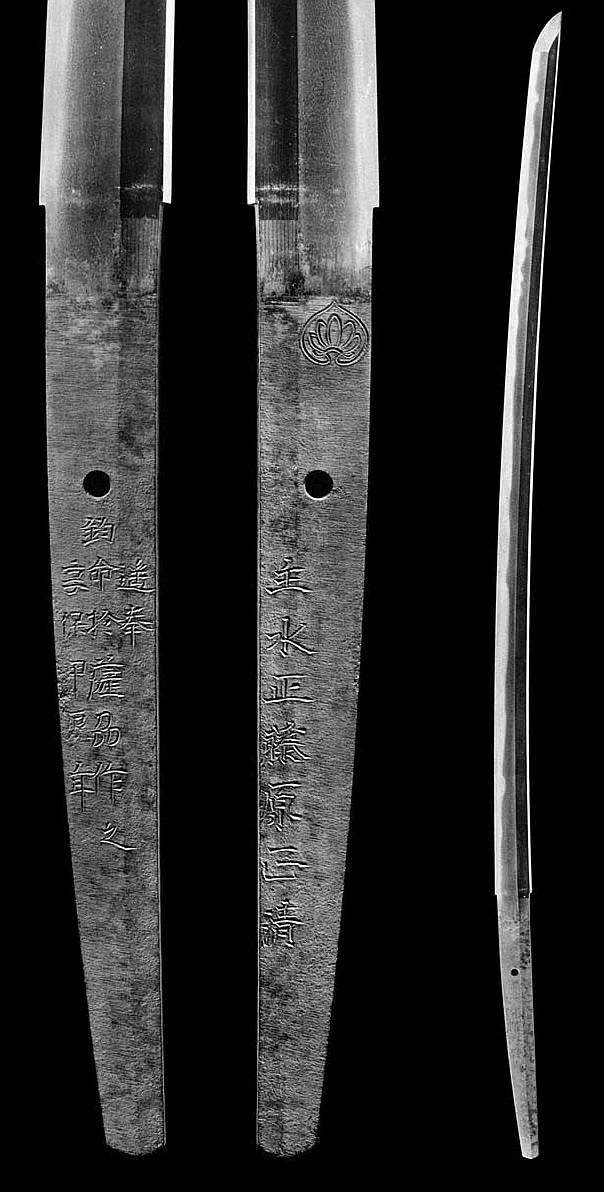
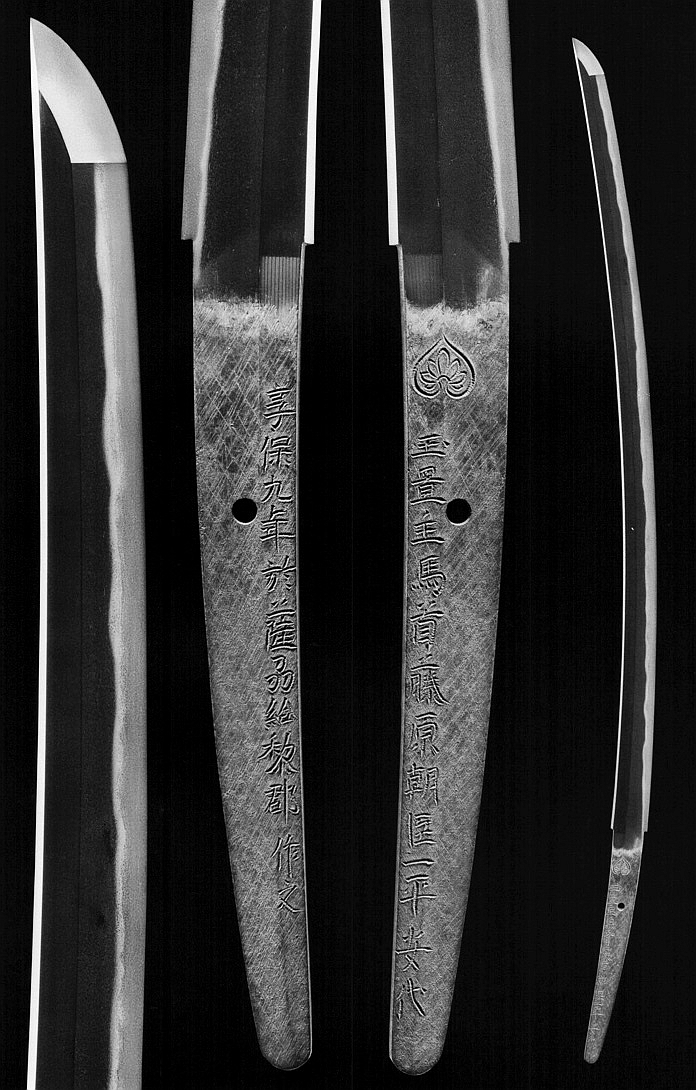
Let me begin with Masakiyo. The blade shown in picture 1 has a nagasa of 76.6 cm, a sori of 1.2 cm, and is signed “[aoi-mon] Mondo no Shô Fujiwara Masahiro” (主水正藤原正清) and “Haruka ni kinmei o hôjite Sasshu ni oite kore o tsukuru, Kyôhô kinoe tatsudoshi” (遥奉鈞命扵薩刕作之・享保甲辰年, “made in the year of the dragon of the Kyôhô era [1724] on orders of the shôgun in distant Sastuma province”). Remember, the contest has taken place three years earlier in 1721. The extant original sayagaki tells us that the blade had been polished and presented to the shôgun on the third day of the tenth month of that year. It remained in Tokugawa possession until WWII. Please note that this katana is signed tachi-mei, that means the smith switched out of respect for the high-ranking customer to the ura side of the tang. That means, the name of the swordsmith should not come first but be found on the back side of a blade’s tang. Well, this was no strict rule but nevertheless a common practice throughout all times. So these blades must not be classified as tachi even if they are signed in tachi-mei and also the NBTHK clearly states “katana” on all papers concerning these kinmei-uchi. Also the wakizashi of Shigekane introduced in my above mentioned article is signed tachi-mei. However, there are also post-contest blades with aoi-mon extant which are signed in katana-mei and I thus think for the time being that only those made for the highest-ranking customers, i.e. the “true” kinmei-uchi or taimei-uchi, were signed tachi-mei.

Masakiyo1

Picture 1: kinmei-uchi by Masakiyo

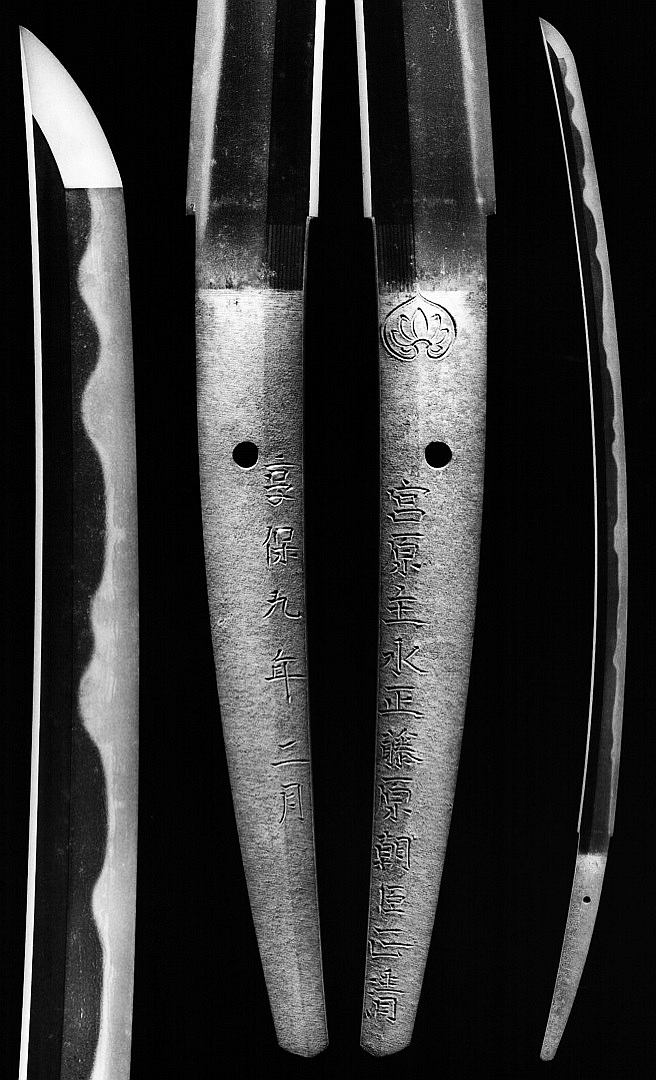
So following these observations, i.e. katana being signed in tachi-mei and bearing an aoi crest (what identifies them as post-contest works), it is safe to assume that also the blade shown in picture 2 is a kinmei-uchi. This one has a nagasa of 77.1 cm, a deep sori of 3.2 cm, and is signed “[aoi-mon] Miyahar Mondo no Shô Fujiwara Ason Masahiro” (宮原主水正藤原朝臣正清) and “Kyôhô kyûnen nigatsu” (享保九年二月, “second month Kyôhô nine [1724]”), that means it was made in the very same year as the previous blade. Very interesting is that this blade was, together with the Ippei Yasuyo introduced next, presented by the then Satsuma lord, Shimazu Tsugutoyo (島津継豊, 1702-1760) to the court noble and kanpaku regent Konoe Iehisa (近衛家久, 1687-1737). Let me go a little into detail and explain how Tsugutoyo and Iehisa were related. Iehisa was married twice, his first wife Kamehime (亀姫) was a daughter of Tsugutoyo’s grandfather Tsunataka (島津綱貴, 1650-1704), and his second wife Mangimi (満君, not sure about this reading) was a daughter of Tsugutoyo’s father Yoshitaka (島津吉貴, 1675-1747). In other words, Mangimi was Tsugutoyo’s aunt and Konoe Iehisa his uncle. Iehisa’s two daughters Takagimi (好君) and Tsûshi (通子) in turn were married to Tokugawa Munechika (徳川宗睦, 1733-1800) and Tokugawa Munetake (徳川宗武, 1716-1771) who were the 9th head of the Owari-Tokugawa and the founder of the Tayasu-Tokugawa lineage respectively. And Shimazu Tsugutoyo’s second wife Takehime (竹姫) was an adoptive daughter of shôgun Tsunayoshi. This was how the feudal alliances worked, i.e. everyone tried, by marrying their sons and daughters and by adopting, to get as closely tied to the house of Tokugawa as possible.

Masakiyo2

Picture 2: kinmei-uchi by Masakiyo

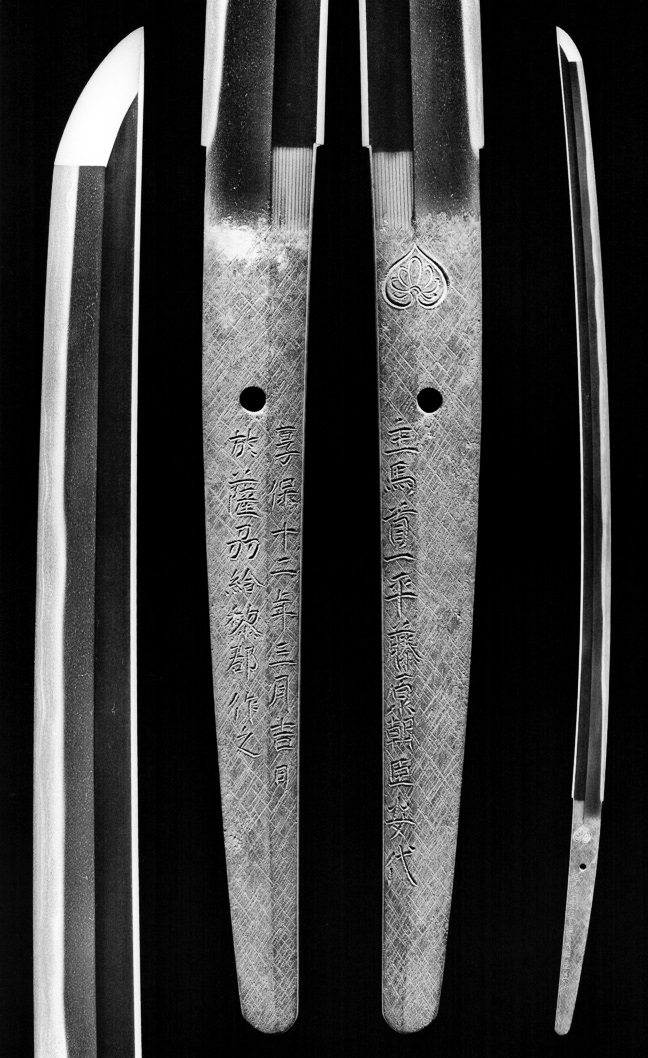
Now to Ippei Yasuyo. The blade shown in picture 3 is the one that was presented together with the Masakiyo from picture 2 to Konoe Iehisa. It has a nagasa of 75.35 cm, a sori of 2.6 cm, and is signed “[aoi-mon] Tamaki Shume no Kami Fujiwara Ason Ippei Yasuyo” (玉置主馬首藤原朝臣一平安代) and “Kyôhô kyûnen Sasshû Kiire-gun ni oite kore o saku” (享保九年於薩刕給黎郡作之, “made in Kyôhô nine [1724] in the Kiire district of Satsuma province”). Incidentally, there are written records extant which tell us that Iehisa really enjoyed Yasuyo’s blades and presented him with hakugin (白銀, ellipsoid silver coins worth 3 bu wrapped in paper and used as a gift) and calligraphies joint written and signed by court nobles. This all speaks volumes for the impact and success (although limited in time) Tokugawa Yoshimune had – unhappy with the general decline in the quality of blades at his time – with his project that peaked in the 1721 sword forging contest. Before that time higher ranking daimyô and persons from the vicinity of the shôgun were usually sticking to kotô blades of renowned masters when it comes to sword gifts and gifts-in-return. This all went back to a century old practice of circulating swordsmith rankings and the well-established origami valuation practice of the Hon’ami, i.e. kotô sword gifts were a pretty common and transparent thing. But now newly made swords, shinsakutô, by smiths far from the capital and without having fancy lineages were considered worthy enough to be chosen as sword gift for the highest ranking persons! And for Shimazu Tsugutoyo, who succeeded as fifth Satsuma daimyô in the very year the contest took place, it was a stroke of luck being the employer of two winners of this contest.

Yasuyo3

Picture 3: kinmei-uchi by Yasuyo

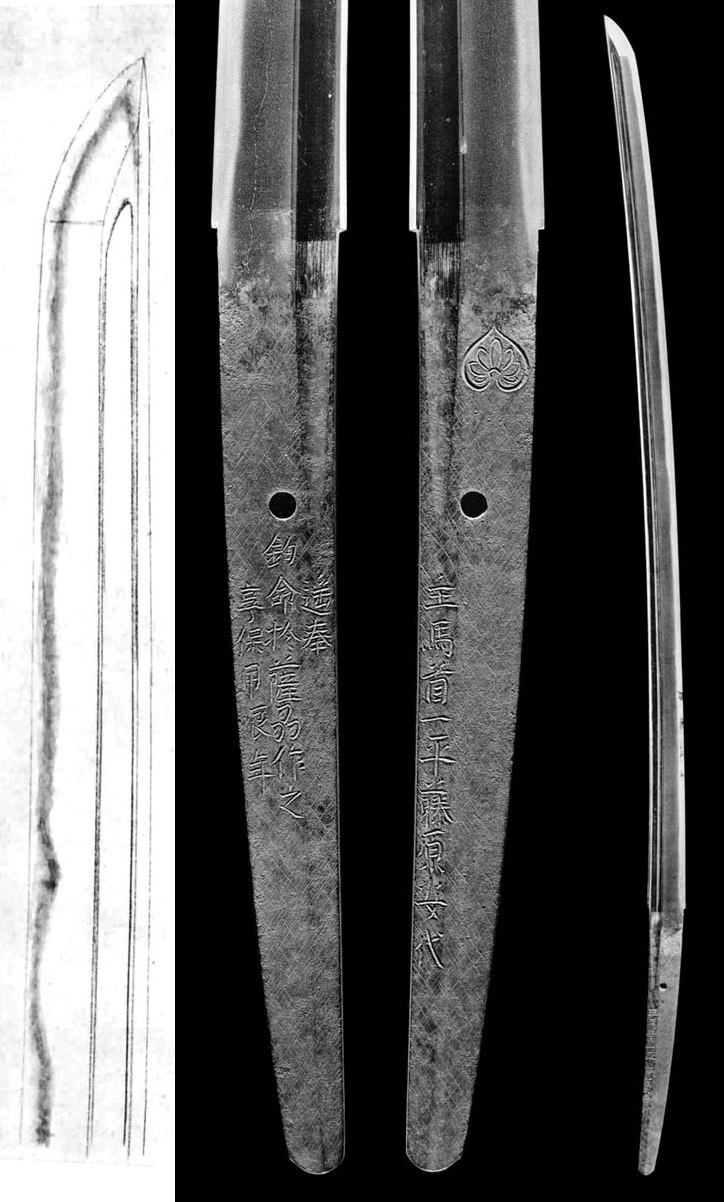
The next blade (picture 4) is quasi the twin of the Masakiyo shown in picture 1. It signed the very same way “Haruka ni kinmei o hôjite Sasshu ni oite kore o tsukuru, Kyôhô kinoe tatsudoshi” (遥奉鈞命扵薩刕作之・享保甲辰年, “made in the year of the dragon of the Kyôhô era [1724] on orders of the shôgun in distant Sastuma province”) and was presented to the shôgun on the very same day, i.e. on the third day of the tenth month of 1724. It has a nagasa of 76.0 cm, a sori of 1.5 cm, and is signed tachi-mei “[aoi-mon] Shume no Kami Ippei Fujiwara Yasuyo” (主馬首一平藤原安代).

Yasuyo4

Picture 4: kinmei-uchi by Yasuyo

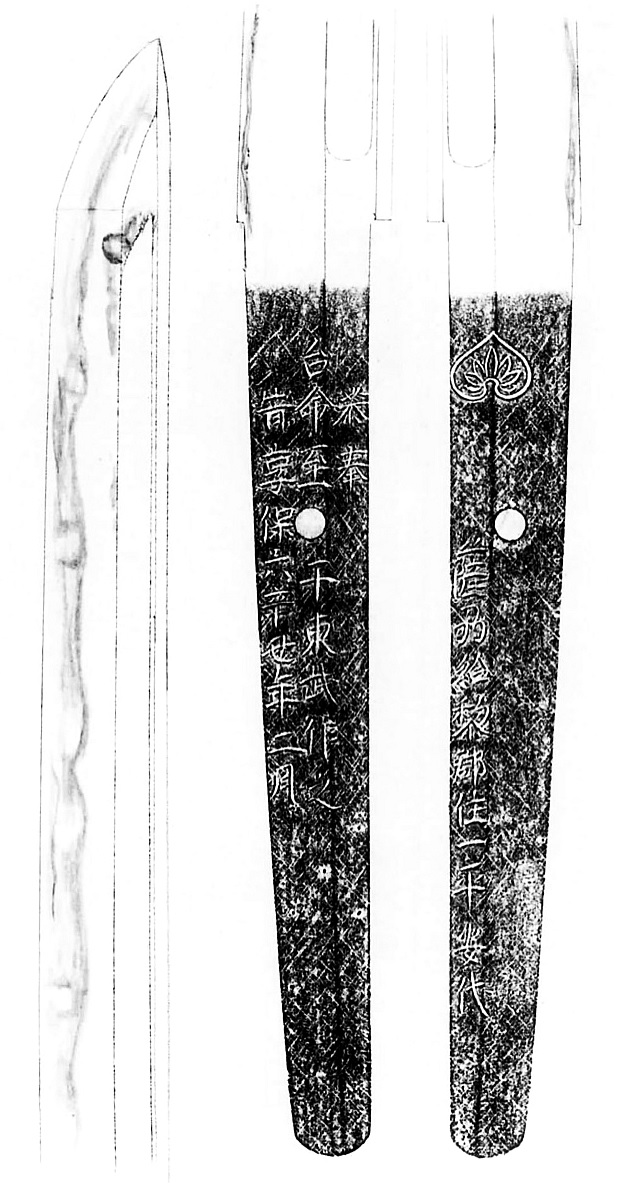
And the blade shown in picture 5 has to be seen as sibling of the Nobukuni Shigekane utsushi as it was also made on-site in Edo, although the month before. It is thus signed the same way “Uyauyashiku taimei o hôjite Tôbu ni itari kore o tsukuru, Toki Kyôhô roku kanoto-ushidoshi nigatsu” (恭奉台命至于東武作之・旹享保六辛丑年二月, “made in the second month of Kyôhô six [1721], year of the ox, in Tôbu [= Edo] by respectfully following the shôgun´s order”).

Yasuyo5

Picture 5: taimei-uchi by Yasuyo

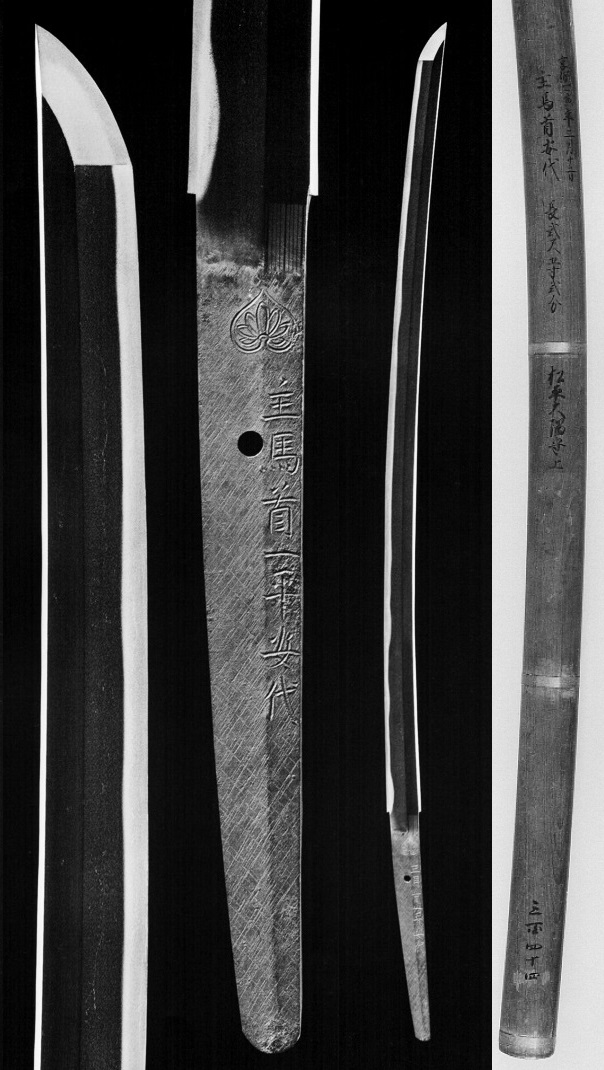
A katana-mei signed blade by Yasuyo with a nagasa of 76.5 cm and a sori of 1.6 cm that is not dated and just signed “[aoi-mon] Shume no Kami Ippei Yasuyo” (主馬首一平安代) is shown in picture 6. Please note that it also comes without any additional mei supplements like “Fujiwara” or “Ason.” The old sayagaki of the blade says that it was once presented by Shimazu Tsugutoyo on the twelfth day of the third month Kyôhô seven (1722) to shôgun Yoshimune. The original wording on the saya is “Matsudaira Ôsumi no Kami tatematsuru” (松平大隅守上, “presented [to the house of Tokugawa] by Matsudaira Ôsumi no Kami”). Ôsumi no Kami was the honorary title of Tsugutoyo and Yoshimune granted him the use of the Tokugawa-related clan name Matsudaira.

Yasuyo6

Picture 6: Shume no Kami Ippei Yasuyo

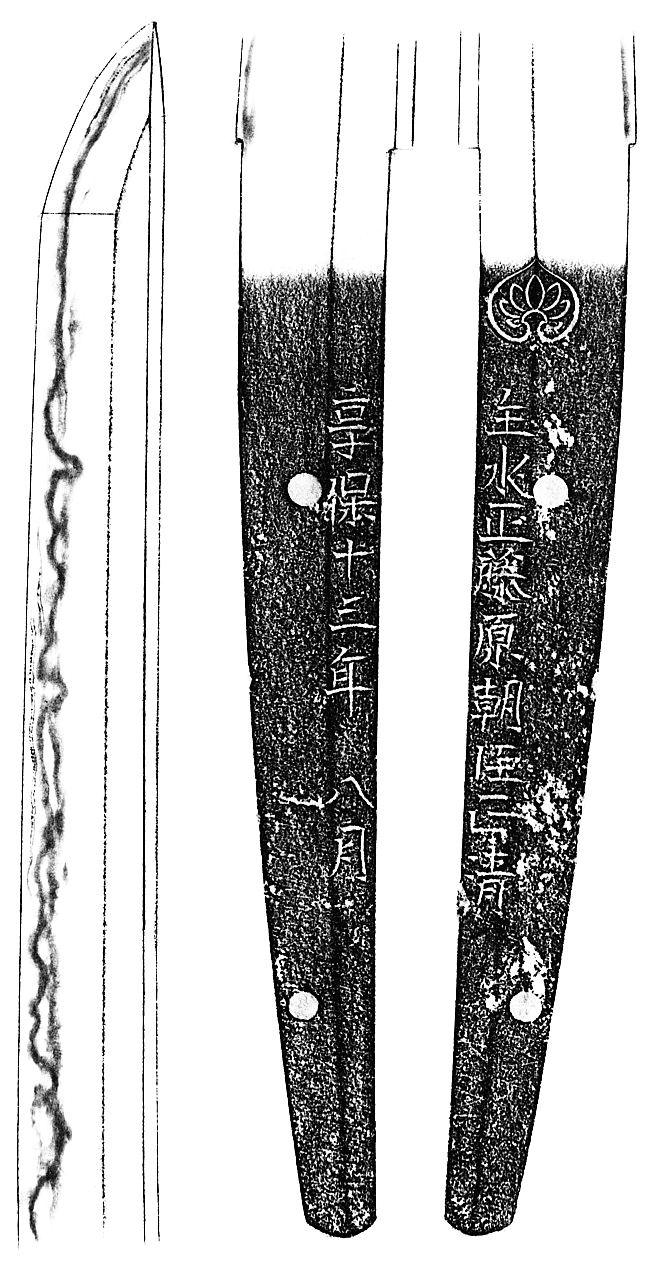
Well, the kinmei-uchi program continued for the rest of the lives of the two smiths. Masakiyo died on the sixth day of the sixth month Kyôhô 15 (1730) at the age of 61 and Yasuyo on the 28th day of the eleventh month Kyôhô 13 (1728) at the relative young age of 49. The blade show in picture 7 is dated with the eight month Kyôhô 13, that means Masakiyo made it two years before he died. Again, it is signed in tachi-mei what suggests that we are facing a kinmei-uchi, although it is unknown to whom it was presented. FYI: Works of Masakiyo are rarer in general than those of Yasuyo and that applies the more to dated works but there is a blade extant that is dated second month Kyôhô 15, i.e. made just four months before his death. And Yasuyo’s kinmei-uchi of picture 8 is dated lucky day of the third month Kyôhô twelve, so it was made the year before his death. There are later dated blades of Yasuyo extant, for example from the second and eighth months of Kyôhô 13, so made just nine and three months before his death, but they are signed katana-mei and thus I think they do not classify as kinmei-uchi. So maybe the two blades shown below are the latest ones going round that were made in the course of the shogunal support program.

Masakiyo7

Picture 7: kinmei-uchi by Msakiyo

Yasuyo8

Picture 8: kinmei-uchi by Yasuyo

Maples…

Momiji1

MomijiNCFall (2)

*

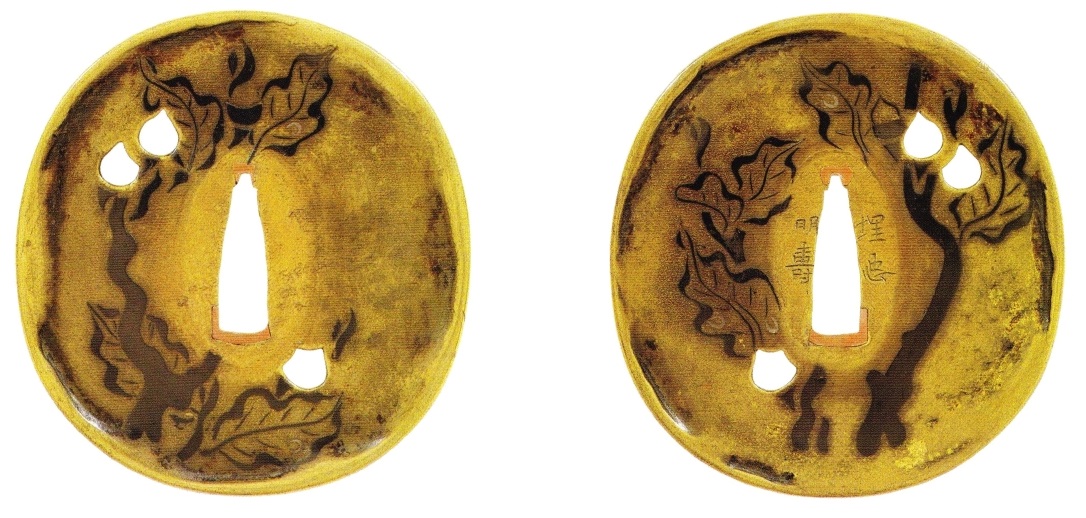
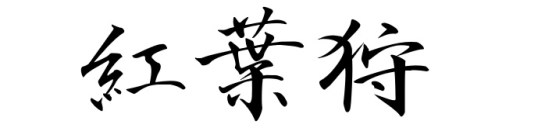
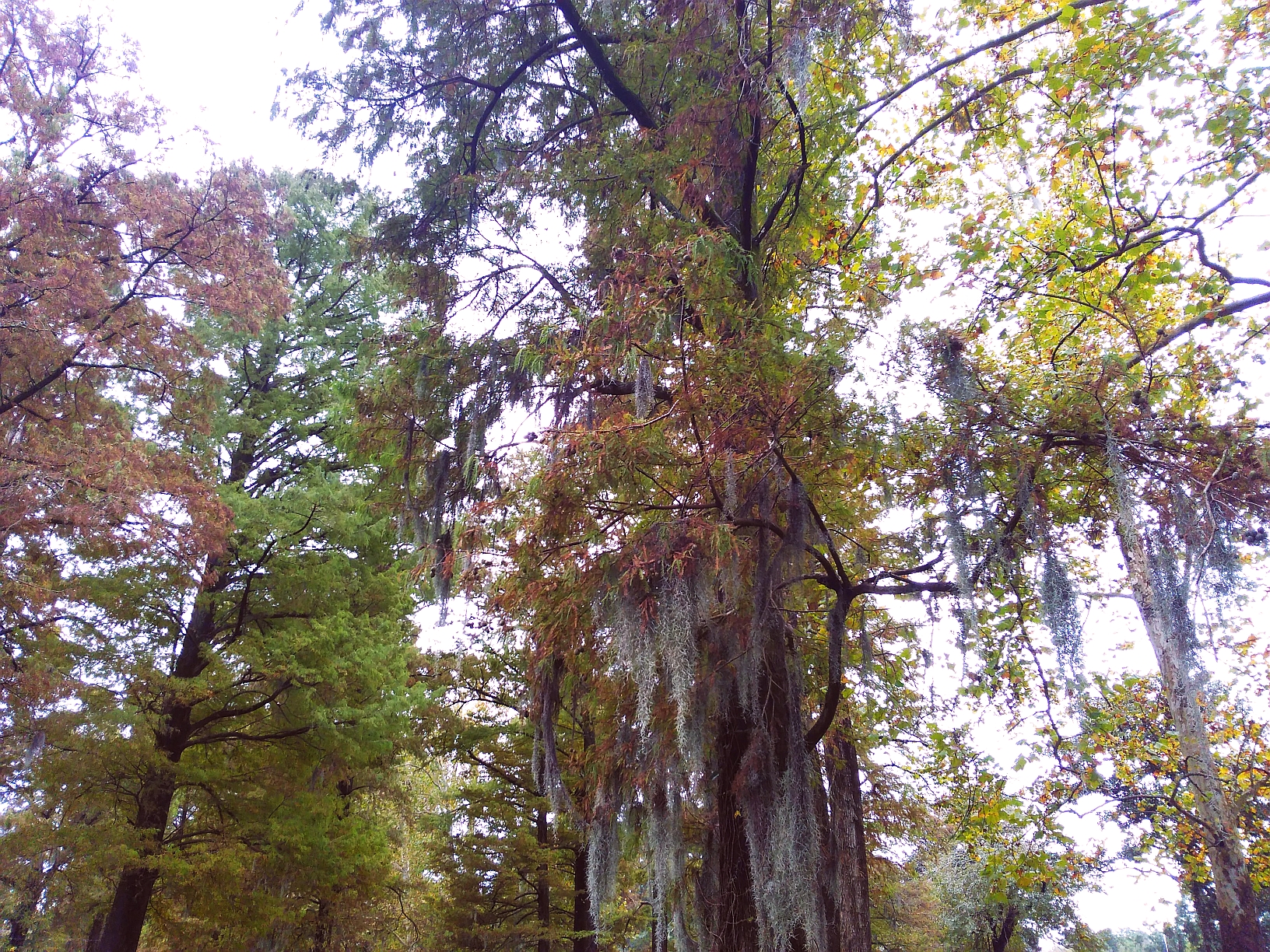
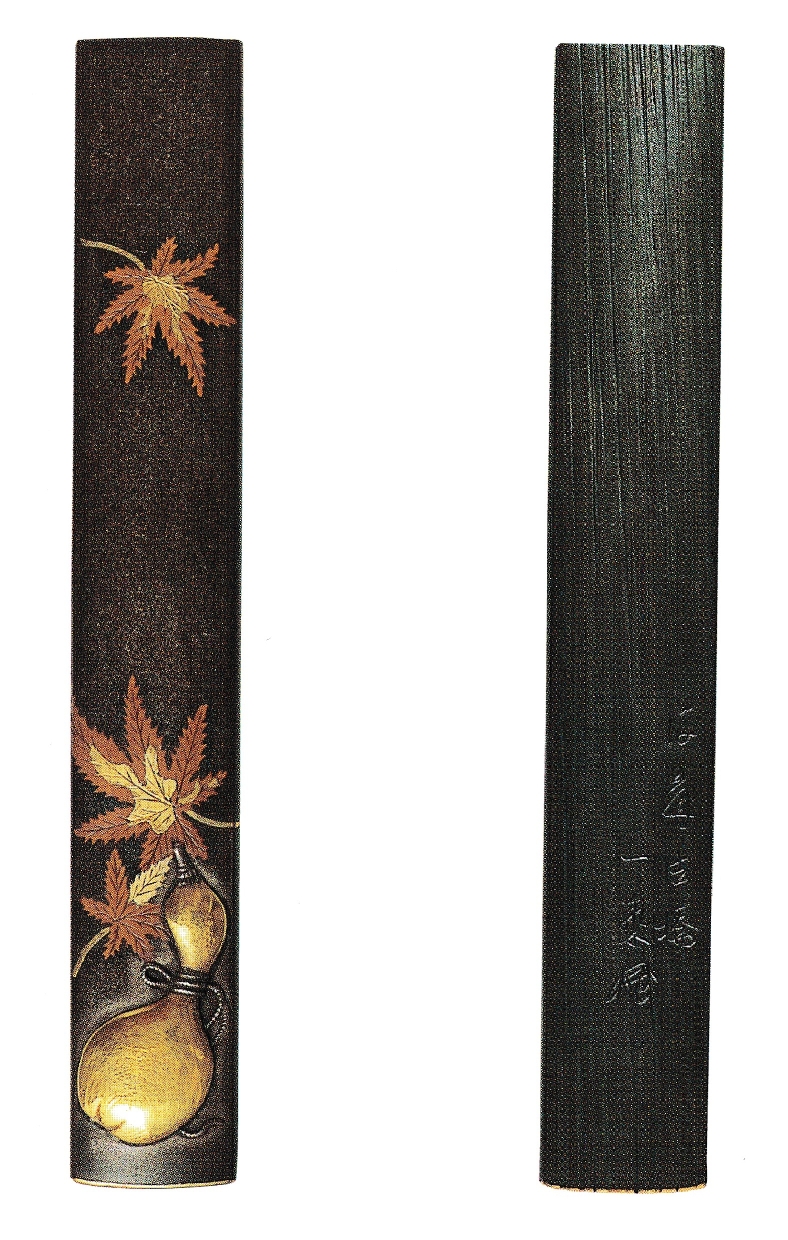
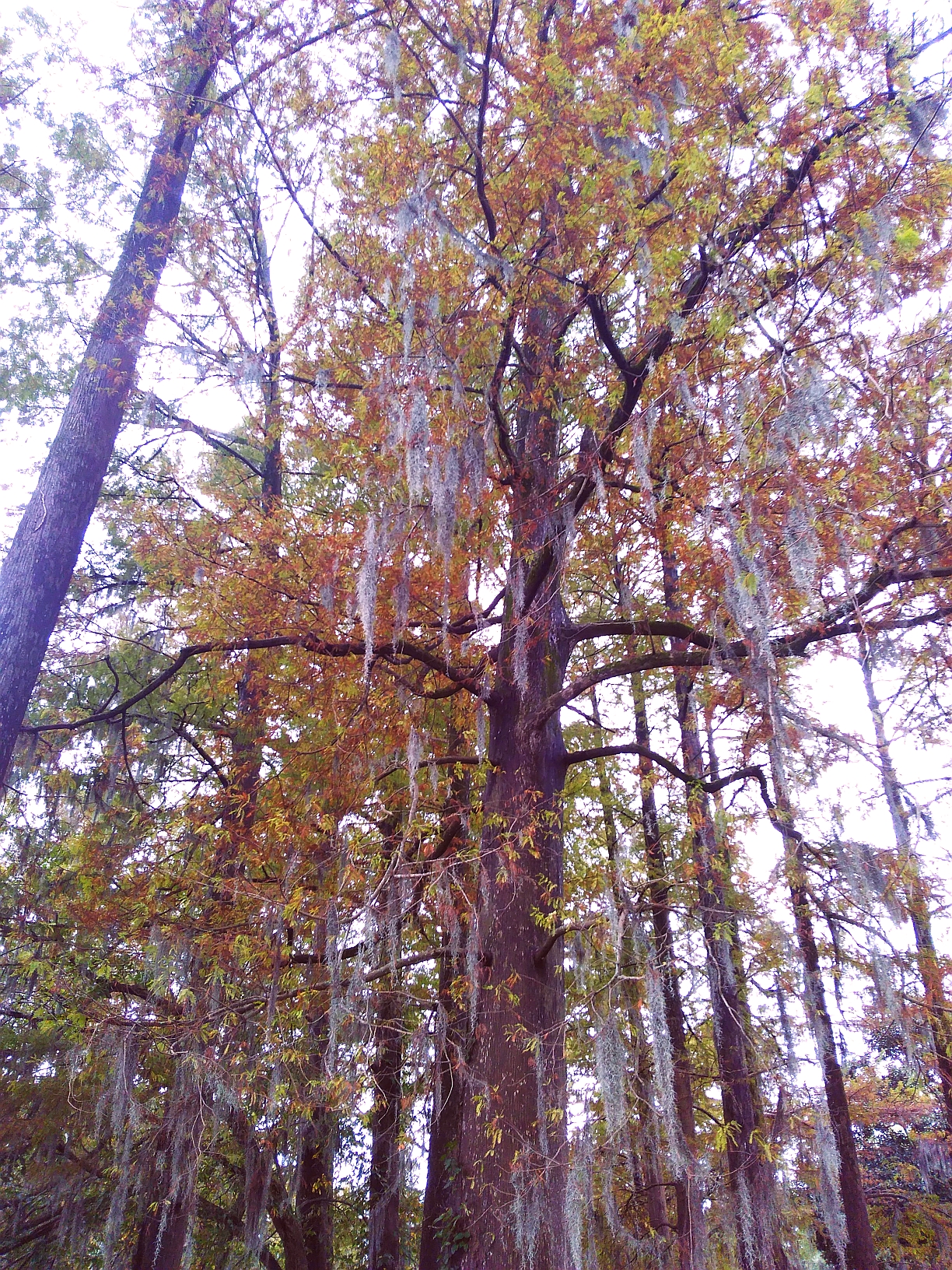
Yes, fall is already fully underway and before some of you experience the first hints of winter, I want to introduce a kozuka that I found quite wonderful a while ago and that I came across (in a book of course) the other day when looking for something different. It was rainy that day but temperatures and humidity were and are still quite high here in coastal North Carolina (see spooky accompanying pics), at least compared to the fall I was used to in Austria, and this, whilst in an autumnal mood anyway, inspired me to write a little bit around this kozuka. First of all, it is a work of the great master Gotô Ichijô (後藤一乗, 1791-1876) and is signed “Gotô Hokkyô Ichijô + kaô” (後藤法橋一乗). It is of shibuichi and not only the motif but also the color scheme is as much fall as it gets. The ground plate shows three maple leaves which are inlaid in suaka and gold hira-zôgan with the gourd carved out in takabori and decorated with gold and silver iroe. Please note that also the butt of the kozuka was accentuated with gold. The arrangement is excellent as just two maple leaves, which, being placed under the gourd, occupy felt the entire lower area of the kozuka, suggesting so a rural, forrest scene where the entire ground is covered with maple leaves. And the one atop, noticeably apart from the base, seems as if it is just falling down from a tree. But as the motif and color scheme of this kozuka works pretty much by itself as a “seasonal trigger object” for fall, there is more to it as the motif is actually also an allusion to a certain subject. When you have maple leaves combined with a gourd, you are certainly hinted at the Legend of Momiji (Momoji Densetsu, 紅葉伝説) which was later worked by Kanze Nobumitsu (観世信光, 1450-1516) into a play with the title Momijigari (紅葉狩) (later it was also converted into a Kabuki play of the same name).

MomijiIchijoPicture 1: kozuka by Gotô Ichijô

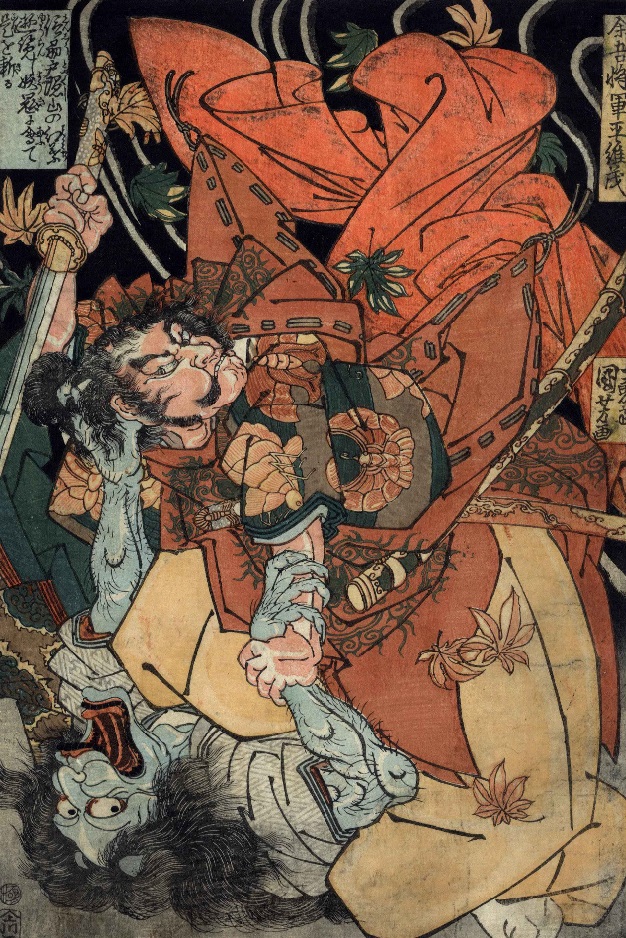
First about the legend. It tells of a couple from Aizu that remains childless for so long and that is finally desperate enough to pray to Tenma (天魔), a quite evil demon. As we know, praying to such a powerful evil force that might be comparable to “our” Satan in this context of old legends, is never a good thing but first everything looks fine as the couple is blessed in the seventh year of Jôhei (承平, 937) with a beautiful daughter which they name Kureha (呉葉). Growing up, Kureha turns out to be not only beautiful but also highly intelligent and capable of witchcraft. When she was against her will promised to the son of a local wealthy farmer, she created a doppelganger of herself who married the boy. But after leaving happily for some time, the false Kureha suddenly vanished into thin air and so also the real Kureha and her parents decided to leave and ended up in Kyôto where he changed her name to Momiji (紅葉). Smart as she was, she quickly absorbed aristocratic culture and eventually ended up becoming Minamoto no Tsunemoto’s (源経基, ?-961) concubine. She got pregnant, much to the dislike of Tsunemoto’s main wife who also got ill at the same time. So a high priest from Mt. Hiei ws consulted who told them that the illness goes back to a curse of Momiji and so Tsunemoto banished here to remote Togakushi (戸隠) in Shinano province. In fall of Tenryaku ten (天暦, 956) however, Momiji ended up in the village of Kinasa (鬼無里), back then named Minase (水無瀬), where she gave birth to a son. She took one of his father’s characters and named him Tsunewakamaru (経若丸). Momiji was held in high esteem by the local community as she not only brought them near the culture of Kyôto but also cured their illnesses, taught their boys reading and writing and arithmetic, and their daughters sewing. However, trying to copy everyday Kyôto life in rural Shinano province – the townsmen even made a small imperial palace-style mansion for her – made her miss the capital even more and so she eventually snapped. With Mt. Togakushi as a base, Momiji started to gather a band of robbers around her which raided neighboring villages every night, stealing money for her plan to return to Kyôto. Things were pretty bad and the story of the “Demoness of Togakushi” eventually reached the capital from where Emperor Reizei (冷泉天皇, 950-1011) sent Taira no Koremochi (平維茂) to deal with this problem. But as Momiji was capable of witchcraft, Koremochi couldn’t defeat here so he visited the Kitamuki-Kannon (北向観音) temple in nearby Bessho-Onsen (別所温泉) and prayed to Kannon. Well, Kannon heard his prayers and gave Koremochi via an appearing old priest a, quote, gôma no tsurugi (降魔の剣), a “Concquering the Devil Sword.” (Incidentally, in some versions of this legend this sword is the famous Kogarasu-maru.) With this sword, Koremochi was able to kill her and lo and behold, it was in fall, fall of the second year of Anna (安和, 969). This was also the reason why the local community renamed their village from Minase to Kinasa which means literally “no demon/devil village.”

MomijiKoremochi

Picture 2: Taira no Koremochi defeating Momiji.

So far the legend, of which of course several different versions are going round, introducing slightly different locations and protagonists, for example that it was not Taira no Koremochi who killed the demoness but Minamoto no Mitsunaka (源満仲, 912-997), using his sword Onikiri (鬼切). Now Kanze Nobumitsu worked this legend into a play, and his adaption is very exciting as it kind of starts quite innocently and reveals more and more what this is all about as the play goes on. Nobumitsu namely begins the drama with a noble woman and her retinues who went into the mountains to enjoy the maple leaves, a tradition that was and is also referred to as momojigari (lit. “maple leaves hunting,” or rather “going to view autumn foliage”). Then by chance, Taira no Koremochi, who is deer hunting with his men, comes across the women. First he tries to not get involved too much but they convince him to join their momijigari picnic in the course of which Koremochi gets drunk (thus the gourd on the kozuka) and falls asleep. Then comes the interlude that explains for the first time what this is all about. Whilst Koremochi sleeps and dreams, the deity Takeuchi (武内) appears (in Koremochi’s dream) and reveals – whilst rushing to the mountain, Mt. Togakushi – that the hero was not just for deer hunt in the area but was actually sent there by the Emperor to subjugate a local demoness, the noble woman. Takeuchi also says that the Great Bodhisattva Hachiman gave him the sacred order to help Koremochi, i.e. Nobumitsu deviates from the legend and replaces the Goddess of Mercy with the God of War, and just before Koremochi wakes up, Takeuchi places the divine sword he had been given by Hachiman for Koremochi in front of the latter. Of course Koremochi grasps the sword and eventually kills the demoness after a fierce eight.

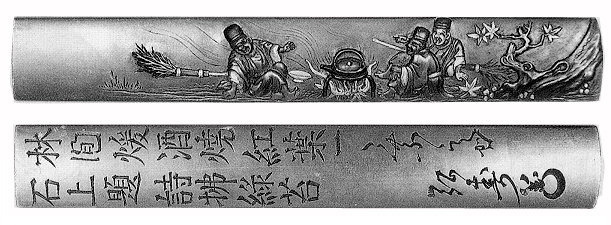
But let me also introduce another, indirectly related kozuka in this context. It is a work by the late Edo-period Mito kinkô artist Uchikoshi Hirotoshi (打越弘寿). It depicts on the front three men sitting under a tree, having fun, and heating up sake by burning maple leaves they have picked up. And on the back side, a Chinese poem is engraved which goes:

林間煖酒焼紅葉 
石上題詩拂緑苔

Línjian nûanjîu shao-hóngxíe 
Shí-shàng tí shi fú lùtái.

In the forest, warming sake by burning maples leaves; 
Sweeping green moss from the stone to sit and compose poems.

MomijiHirotoshi

Picture 3: kozuka signed cursive script “Ichijôsai Hirotoshi + kaô” (一乗斎弘寿)

The poem is by the Chinese poet and Tang Dynasty government official Bái Lètian (白楽天, Jap. Haku Rakuten, 772-846) who, as governor of three provinces, often made poems about his career, and as he was exiled and pardoned, many of them are very sentimental, an approach that of course perfectly matched the mood of aristocratic Kyôto at the time his poems made it over to Japan in the Heian period. And I said “indirectly related” because in one scene of Kanze Nobumitsu’s play Momijigari, when the two groups were enjoying the sake, the noble woman makes a reference to this very poem of Bái Lètian. And staying with sentimentality for a little, maple leaves and the custom of momijigari has this peculiar sentiment that goes along with so many traditional Japanese things that deeply root in Heian culture. The viewing of the very beautiful but quickly falling cherry blossoms in spring reminds one of the ephemeral nature of life for example, and by viewing gorgeous red maples leaves, one is at the same time made aware of the fact that with this coloring of the foliage, the time of abundance is definitely over and winter and all its hardships are approaching. It is this cruel certainty of facing the definite and irrevocable end of something that determines the peculiar feeling, not just that seasons are about to pass. In other words, there is absolutely no whatsoever hope that cherries might blossom for some more months or that summer comes back after leaves had turned that red…

So again, we have here a beautiful sword fitting that perfectly works just by itself as nice fall motif but if you dig deeper into the subject and get more and more versed in Japanese culture, so many things pop up when viewing a kozuka like this, e.g. old legends, adaptions of these old legends, artistocratic Heian culture sentiments, allusions, references, hidden meanings, symbolisms, and so on and so forth. As mentioned in several of my older, related posts, it is highly recommended not to stop at just saying: “Well, this is a nice fall-themed kozuka.”

MomijiNCFall (1)

Poll: Paperback ed. of Swordsmith Index

Brief update: Over the last few months, several readers approached me who were informed by others about my revised 3-volume set Swordsmiths of Japan (see here) but couldn’t find it on Amazon. Well, the set is not available there because Lulu does not offer a distribution of this kind of format and layout (i.e. hardcover and 8.25″ x 10.75″)  on Amazon. Only smaller hardcovers make it over there. Of course I was referring to Lulu where the set is perfectly find and orderable but then I was told “Amazon or it did not happen” 😉 So I add a poll to this post to see if there are more who want a somewhat cheaper paperback version to be orderable from Amazon. Depending on the feedback, I will provide a new, additional edition or not. Thanks for your time!

Book Review – Nihon no Bi: Nihonto

Finally received my copy of Gakken’s latest sword publication Nihon no Bi: Nihonto (The Japanese Sword) the other day (thanks to Jason). To tell you right away, I really really appreciate the approach of this book as it is the first in this category (of books coming from Japan) that comes fully bilingual. That means it is not, as so often, a sword book in Japanese with just an English index and here and there some half-hearted English captions, no, it is as mentioned truly bilingual. Or almost, as the descriptions of the tsuba and kodôgu were not translated. But not a big deal and I am aware of the fact that sometimes concessions have to be made to layout and to extent of a publication and that the focus was clearly on swords. Also Paul Martin did a great job with the translations and I am very glad the he did this as he is an expert himself and knows his stuff, i.e. we are luckily not dealing with “outsider” translations that leave ambiguities. This becomes the more evident in the extensive 40+ pages terminology section at the end of the book. So if you grab a copy, you not only have depictions and explanations of the great swords (with which I will deal in the following), you also get a detailed and comprehensive sword glossary that works as a fine reference by itself.

Book1   Book2

Book3

Book4   Book5

Now to the book itself, which is four-sectioned (or at least that is how I see it, your mileage may vary). First section introduces about 30 renowned blades in color and with certain parts in full size. Depending on the sword, also its mounting is depicted in color. This section is concluded by several fine koshirae with excellent details of their highlights and masterly tsuba and fittings. As most of them are also blown up to 200~300% (135~185% when it comes to tsuba), you can really appreciate subtle details in workmanship. The second section are the pullout pages which present 1:1 color pictures of about a dozen of renowned swords and their mountings. And this section is great as it gives newbies and others who don’t have access to handle and study superior Japanese swords in person a good feel of the excellence and what makes the fascination of these superior and so much more than edged weapons. Thus one tip: Some of the swords might look at a glance delicate and fragile for beginners when you open the book but when you pull out the pages fully and place them vertically on a (preferrably empty) table or on the floor and approach them just as you would pick them up at a sword appreciation (kantei) session, you will realize how magnificent and breathtaing they actually are! The third section provides the explanation of the blades introduced in sections 1 and 2 and comes in an appealing layout as each one page is reserved for one blade and due to the bilingual approach with the Japanese text and Paul’s translation right next to each other, this also provides a great exercise for those who are about to dig deeper into the subject of translating nihontô-related texts. And section four is the aforementioned terminology part.

Book6a

My conclusion: This book should be found in every nihontô library as it also excellently serves as a teaser if someone interested asks you to tell him or her more about this fascinating subject and you can show him or her, via catchy pictures, what this is all about. The only small downer is that you can’t easily order it outside of Japan for example from amazon.com. But it is relative easy to create an account on amazon.co.jp (no, your amazon.com account won’t work for that and you need to register with a different email address) and order it from them. Five of five stars.

KANTEI 4 – YAMASHIRO #10 – Awataguchi (粟田口) School 5

We continue with the Awataguchi main line which was succeeded after Kunitomo by his son Norikuni (則国). The Kotô Meizukushi Taizen says that he was born in Jô´an four (承安, 1174) and that he died in Ryakunin one (暦仁, 1238) at the age of 65. Traditionally he is dated around Jôkyû (承久, 1219-1222) although some put him around Katei (嘉禎, 1235-1238), that means with Norikuni, we are slowly approaching mid-Kamakura. His first name was Tômanosuke (藤馬允) and like his uncle Kunitsuna (国綱) and his cousin Kagekuni (景国), he was part of the Oki-goban-kaji group. It seems that Norikuni has focused more on the production of tantô, or at least he is the early Awataguchi master of whom the most tantô are extant. But we are lacking a sound quantitative evidence base to say for sure what his main focus was and if the increased tantô production started with him or if the tantô production increased at all at a certain point in time or if there are just no such blades of the earlier smiths extant. To my knowledge, there are four signed Norikuni tachi going round, the most representative one being the kokuhô that was once a heirloom of the Ikeda (池田) family, the daimyô of the Tottori fief (鳥取藩) of Inaba province (see picture 1). This blade keeps despite of the suriage some of its originally deep koshizori, features a ko-kissaki, and is overall quite elegant and of a very harmonious tachi-sugata. The kitae is a very dense ko-itame with fine ji-nie and chikei and appears as nashiji-hada and the hamon is a ko-nie-laden hoso-suguha-chô with a little shallow notare sections that is mixed with ko-midare, ashi, and frequent kinsuji. The bôshi is sugu and shows a ko-maru-kaeri with kinsuji. In general we can say that Norikuni’s interpretations are a hint more nie-emphasized than that of his successors Kuniyoshi and Yoshimitsu. The tang is as mentioned suriage but its original katte-sagari yasurime can still be made out. The niji-mei is preserved at the very tip of the tang.

norikuni1

Picture 1: tachi, kokuhô, mei “Norikuni” (則国), nagasa 74.7 cm, sori 2.1 cm, shinogi-zukuri, iori-mune, please click here to see get some close-ups of the blade

Following the kokuhô, there are two tachi of Norikuni that bear the status of jûyô-bunkazai which I want to introduce in the following. One of them (see picture 2) is owned by the Atsuta-jingû but preserved in the Tôkyô National Museum. It is also slender and elegant and almost ubu, that means it retains its deep koshizori and also its funbari. The kitae is a dense ko-itame in nashiji with ji-nie and a faint nie-utsuri. The hamon is a suguha-chô in ko-nie-deki that is mixed with ko-chôji, ko-midare, ko-ashi, and kinsuji and the bôshi is notare-komi with a somewhat pointed ko-maru-kaeri.

Norikuni2

Picture 2: tachi, jûyô-bunkazai, mei “Norikuni” (則国), nagasa 72.1 cm, sori 2.7 cm, shinogi-zukuri, iori-mune

The other jûyô-bunkazai (see picture 3) is preserved in the Konda-Hachimangû (誉田八幡宮, Ôsaka Prefecture). This tachi is with a nagasa of 81.1 cm rather long and has a wide and noticeably tapering mihaba (from 3.2 cm motohaba to 1.7 cm sakihaba), a koshizori, a thick kasane, plenty of niku, and a ko-kissaki. The kitae stands a little more out than at the aforementioned two blades and shows some masame towards the ha but is overall forged as itame with chikei and plenty of ji-nie. The hamon is a suguha in ko-nie-deki with a somewhat subdued nioiguchi that is mixed with ko-midare and many ko-ashi and that starts with a hint of yaki-otoshi. The bôshi is sugu with a wide ko-maru-kaeri and the tang is ubu and shows a shallow kurijiri. In addition, the name of the donator to the shrine is inlayed in gold in a carved out recess on the tang and the whole kinzôgan-mei reads “Ôhashi Nyûdô Shikibu Kyô Hô’in Ryûkei” (大橋入道式部卿法印竜慶, the donator) on the one, and “Kenjô Konda-Hachimangû moshi sejin kore o obau kami no bachi o ukubeki nari” (献上誉田八幡宮世人若奪之可受神罰也, “offered to the Konda-Hachimangû and if stolen, the stealer should receive divine punishment”) on the other side. Incidentally, Ôhashi Ryôkei (1582-1645) was a renowned calligrapher and tea master of the early Edo period. He served Hideyoshi and Ieyasu and the blade had been a family heirloom since the Muromachi period. The jûyô-bunkazai designation mentions that the tachi was handed down under the nickname Karigiri (鐘截, lit “temple bell cutter”) within the Ôhashi family.

Norikuni3

Picture 3: tachi, jûyô-bunkazai, mei “Norikuni” (則国), nagasa 81.1 cm, sori 2.6 cm, shinogi-zukuri, iori-mune

Picture 4 shows a signed tokubetsu-jûyô tachi that is ubu too, slender, and highly elegant. It shows a deep koshizori with funbari and a ko-kissaki and the kitae is an itame mixed with mokume that features plenty of ji-nie, chikei, and a faint nie-utsuri. The hamon is a hoso-suguha-chô in ko-nie-deki that is mixed with ko-midare, ko-chôji, ko-gunome, ashi, hotsure, uchinike, nijûba, and fine kinsuji. The bôshi is sugu and runs out as yakitsume. Please note that this blade too shows a brief yaki-otoshi and a thin and short koshibi just like the one on blade 2 by his father Kunitomo in the first Awataguchi chapter. And in direct comparison (see picture 5) the similarities become even more obvious (e.g. also the kijimono-style finish of the tang). By the way, this tachi of Norikuni had been a heirloom of the Kitabatake family since Kitabatake Akiie (北畠顕家, 1318-1338) had received it as a present from Emperor Godaigo.

Norikuni4

Picture 4: tachi, tokubetsu-jûyô, mei “Norikuni” (則国), nagasa 77.7 cm, sori 2.3 cm, shinogi-zukuri, iori-mune

Norikuni5

Picture 5: Comparison Kunitomo top, Norikuni bottom.

Now to Norikuni’s tantô. A representative piece is the signed tokubetsu-jûyô (see picture 6) that ws once a heirloom of the Kuroda (黒田) family, the daimô of the Fukuoka fief (福岡藩) of Chikuzen province. The blade has normal proportions, i.e. mihaba and nagasa are neither wide nor sunnobi respectively, and an uchizori. The kitae is a dense ko-itame mixed with mokume and nagare and we see plenty of ji-nie and fine chikei. The hamon is a nie-laden suguha-chô to slightly undulating notare that is mixed with a conspicuous amount of ko-gunome, ko-ashi, and some nie-suji. The nioiguchi is rather wide and the bôshi is notare-komi with brief ko-maru-kaeri. Both sides show gomabashi which are close together and arranged more towards the mune, a feature that is typical for all Awataguchi horimono on tantô. And we find another Awataguchi featuere at Norikuni, namely that in many cases the smiths of this school added the exact same kind of horimono on each side whereas for their Rai colleagues engraved for example a suken on the omote and gomabashi on the ura side. But there are also exceptions to this “rule” as seen at a tokubetsu-jûyô mumei tantô attributed to Norikuni that shows a suken on the omote and a shôbu-hi on the ura side.

Norikuni6

Picture 6: tantô, tokubetsu-jûyô, mei “Norikuni” (則国), nagasa 24.2 cm, uchizori, hira-zukuri, mitsu-mune (with wide top surface)

Last but not least it should not go unmentioned that again, we are facing slightly different signature styles but which are thought to go back to the different stages in the career of a single smith. There are somewhat larger and somewhat smaller mei and by trend we can say that he signed his tachi with a thinner chisel than his tantô which show a relative thickly chiselled signature. There was a ken of Norikuni discovered in recent years during repair works at a hall belonging to the Yokawa (横川) temple unit of the Enryaku-ji on Mt. Hiei that was hidden in a Buddhist statue. The ken (see link here) is now designated as cultural property of Takamatsu City, Kagawa Prefecture, as it is preserved in the local history museum and it shows the same thick mei as seen on tantô. Also interesting to note is that his character for “Kuni” is very similar to that of his son Kuniyoshi (see picture below). Both signed the left inner part of the box radical as three more or less horizontal and parallel strokes, met underneath by a pronounced arc that starts to the top right of the separating central stroke.

Norikuni7

Norikuni mei left, Kuniyoshi mei right.

On vacation…

With this post I leave for a short vacation and will be back in office on Oct 19th. Thank you all for your loyalty as blog stats are pretty impressive (for me personal and also from the point of view that this is a nihontô blog in particular) by now keeping an average of about 6,000~8000 views per month. Top ten readers come from (from top to bottom): USA, Germany, UK, France, Japan, Netherlands, Italy, Australia, Poland, and Canada. You want more stats? Most search terms that lead to my site are “markus sesko” followed by “kotegiri masamune”, “honshu masamune”, “kuji kiri”, “higo koshirae”, “masamune hamon”, “hamon masamune, “a real masamune sword hamon”, and “masamune oshigata.” So I guess Masamune is still pretty omnipresent 🙂 After my return we will continue with the Awataguchi School and of course with other interesting articles. So stay tuned and see you all towards the end of October.