KANTEI 4 – YAMASHIRO #22 – Rai (来) School 8

Today, I am talking about Mitsukane (光包) before we deal next with the Nakama-Rai branch. I did not want to “pack” Mitsukane into the previous chapter because he was a pretty outstanding master and because there is, compared to for example Kunihide and Kunitsugu, a relative good body of work of him extant. In short, he deserves a separate chapter for himself. What you will immediately notice when you deal with Mitsukane is first, that there are no long swords known by him and second, that he never signed with the prefix “Rai.” The first distinctive feature has already been pointed out in Muromachi-period sword publications. Some now assume that he actually did some in his early years but that on a very small scale whilst others assume that he did not make any tachi at all. Well, there were allegedly some very few unsigned tachi attributed to him going round in feudal times but nothing really tangible from today’s perspective. And the second distinctive feature goes back to the fact that he was not an indigenous Rai smith. According to tradition, he left the forge of the Osafune master Nagamitsu (長光) to proceed to Kyôto where he studied under Rai Kunitoshi whereupon he left the capital again later to open up his own forge in Ômi province. Now the old publications, for example the Kotô Meizukushi Taizen, give us some cornerstones for this tradition, namely that Mitsukane was born in Kôan one (弘安, 1278), that he studied around Tokuji (徳治, 1306-1308) under Nagamitsu, that he became a student of Rai Kunitoshi at the age of 29, and that he died in Jôwa five (貞和, 1349) at the age of 72. Now the given age of 29 would correspond to Tokuji two (1307) and this in turn would mean that he entered the forge of Kunitoshi immediately after having studied with Nagamitsu. But other sources, e.g. the Kokon Mei Zukushi, say that he arrived in Kyôto around Bunpô (文保, 1317-1319) and this could mean that the given age of 29 is a typo and he that was actually 39 when he studied with master Kunitoshi (what would then correspond to Bunpô one, 1317).

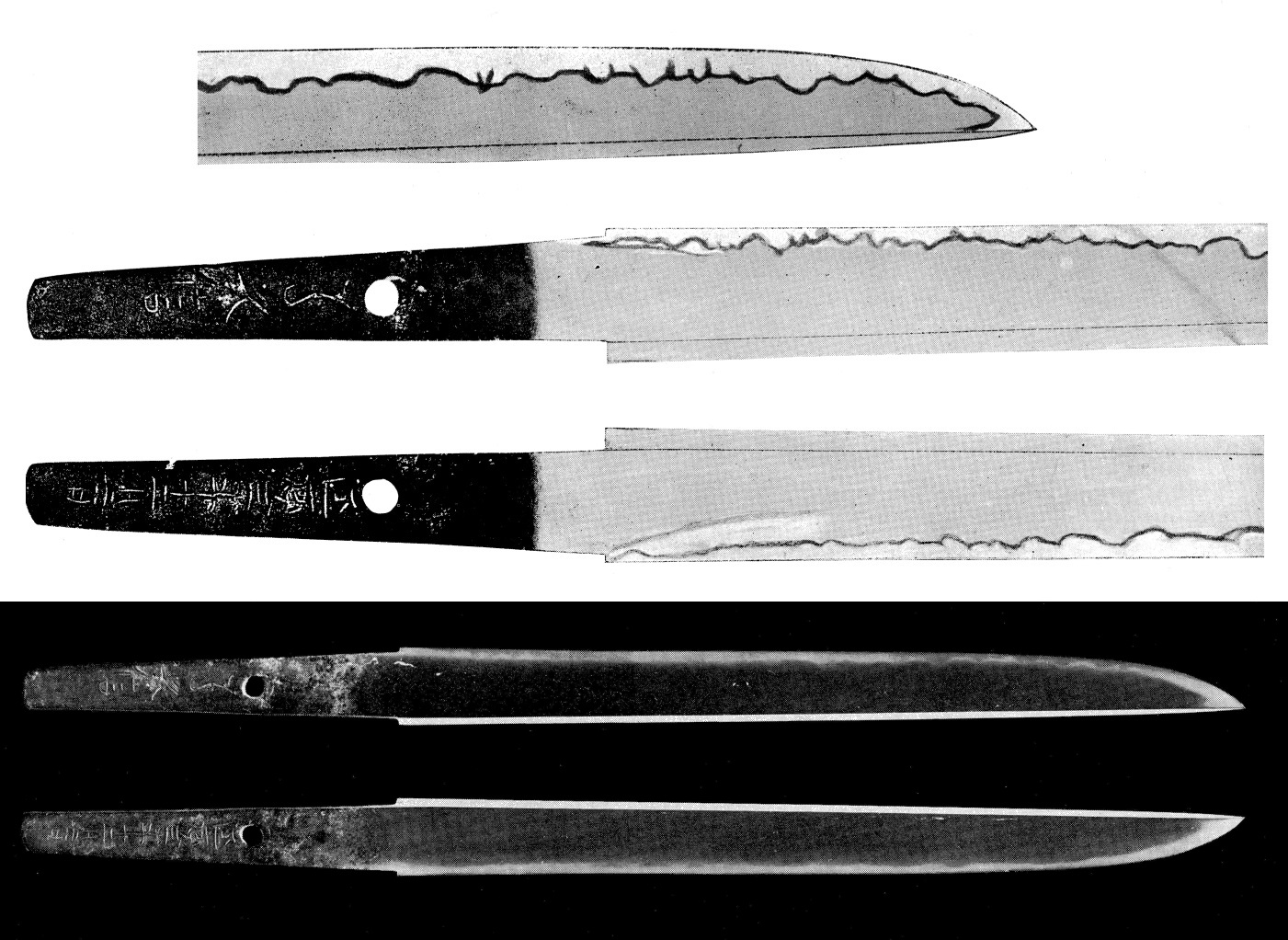
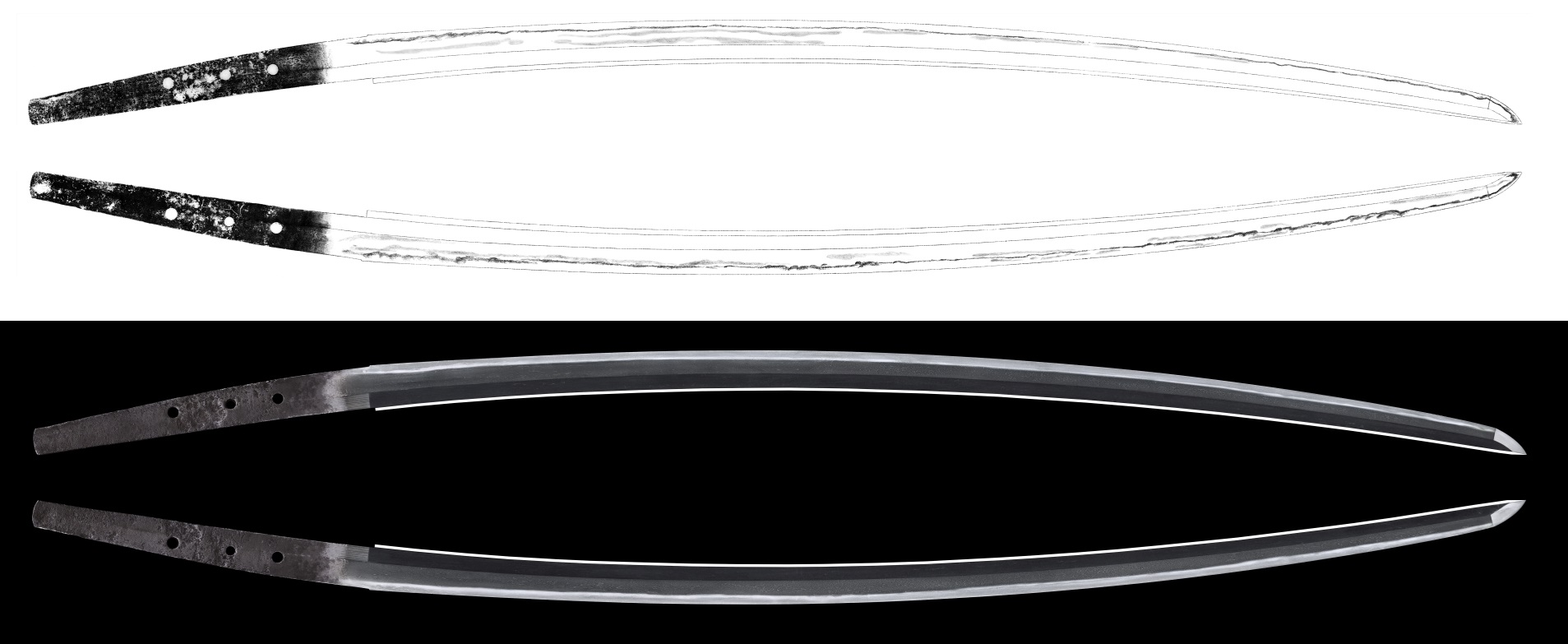
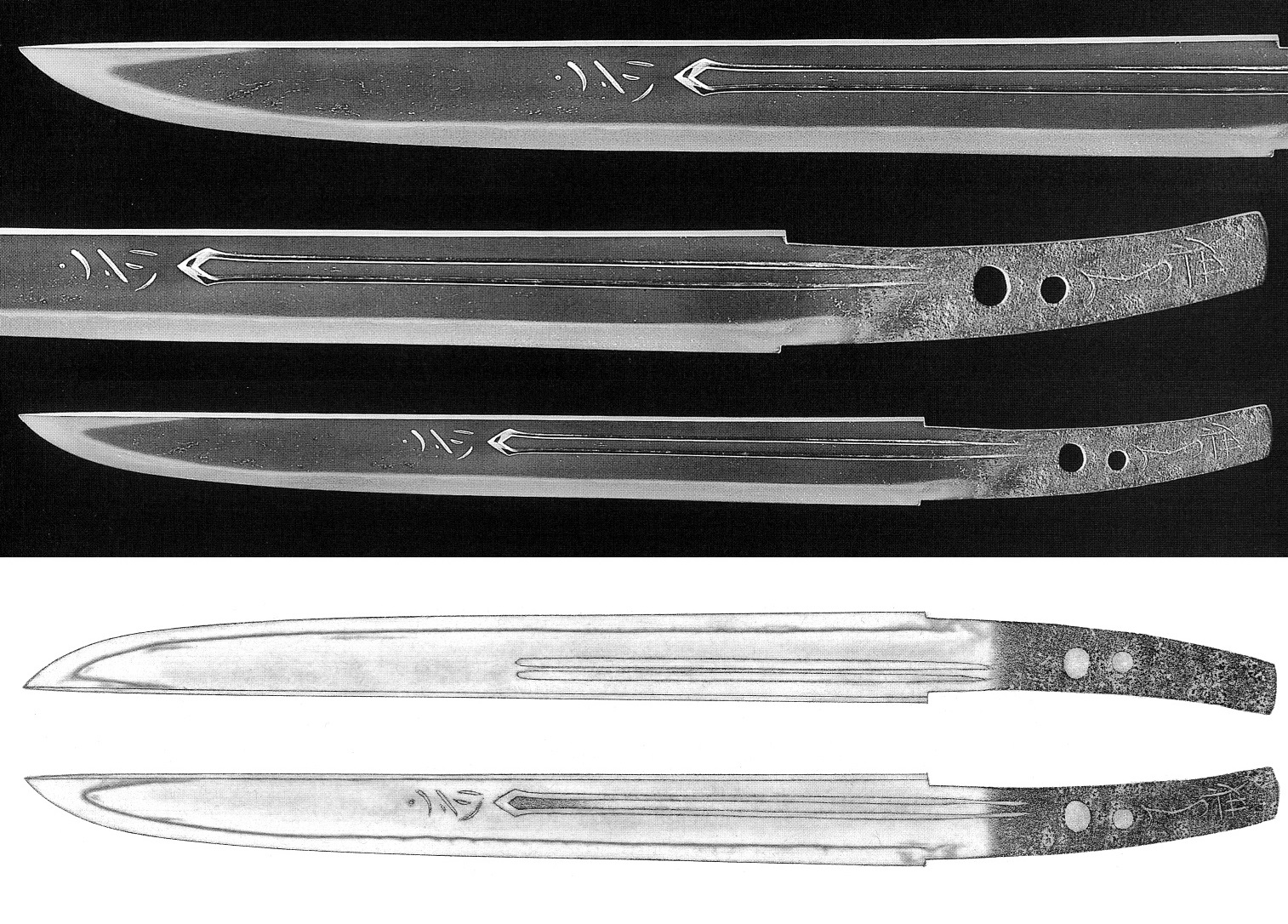
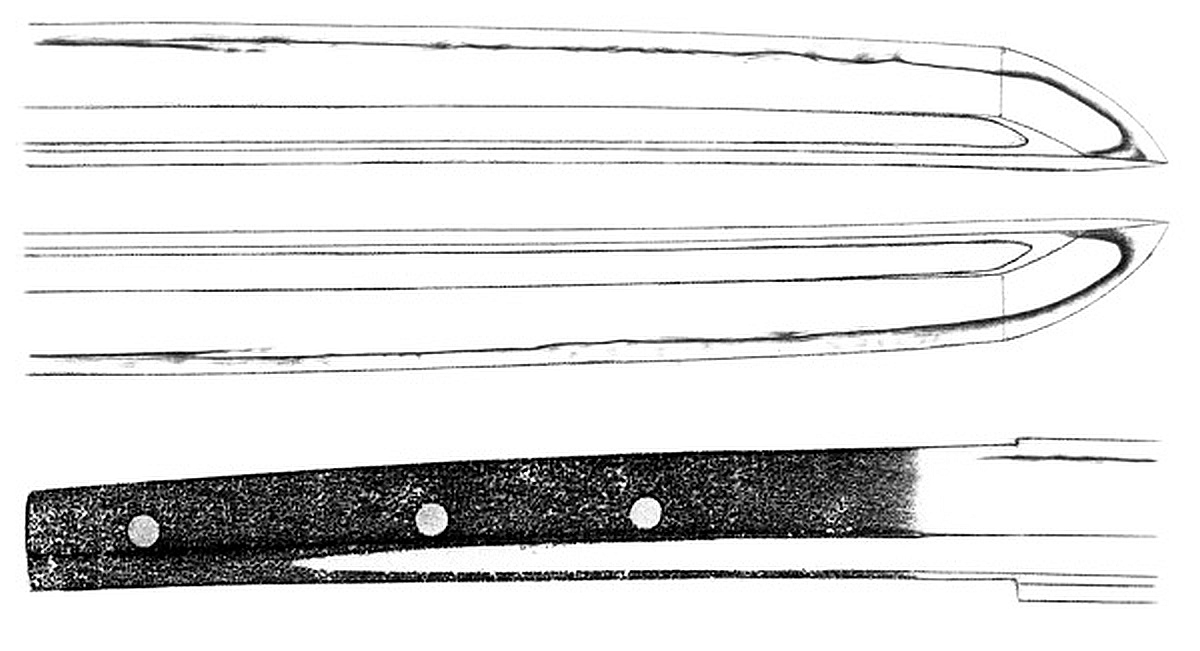
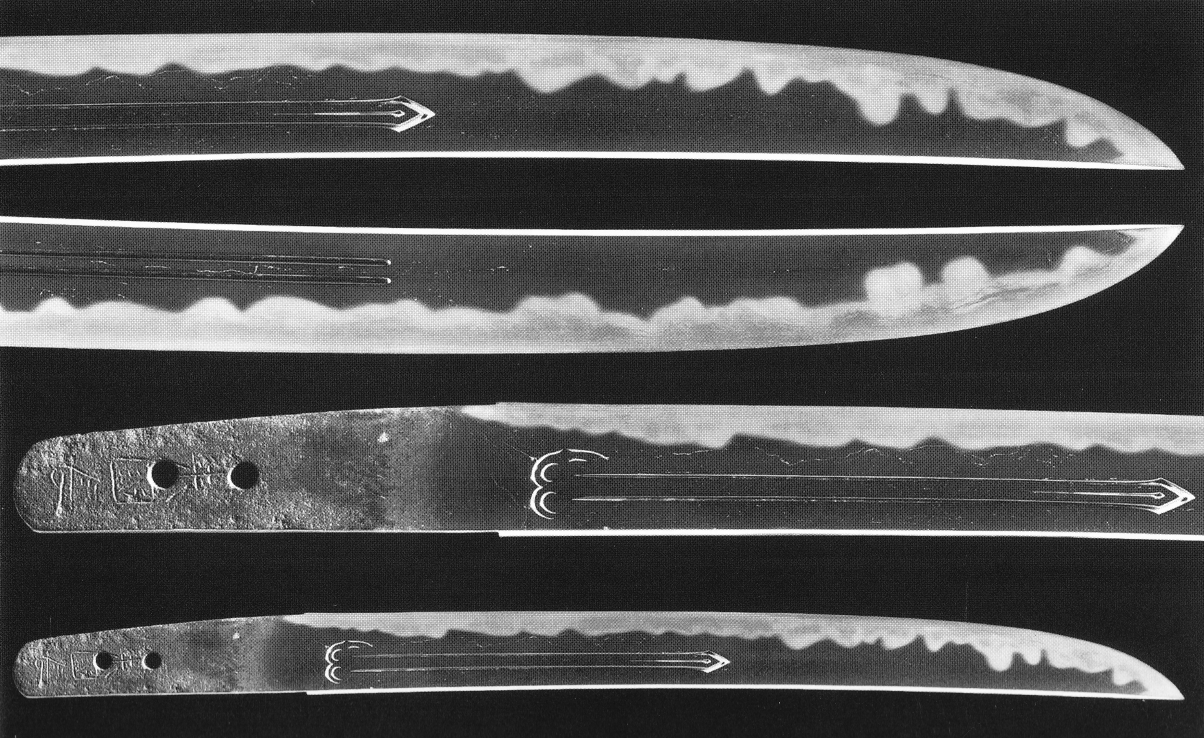
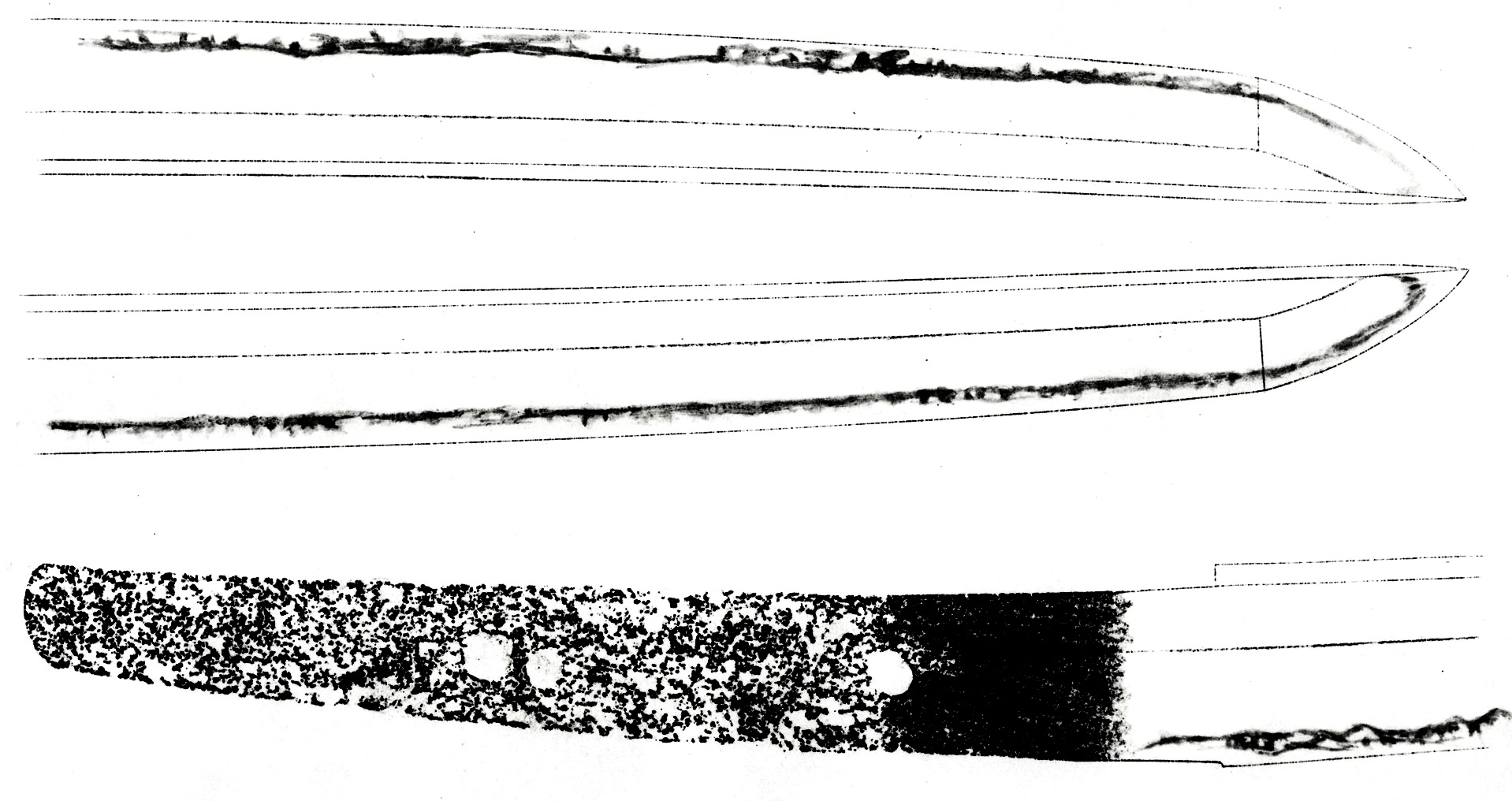
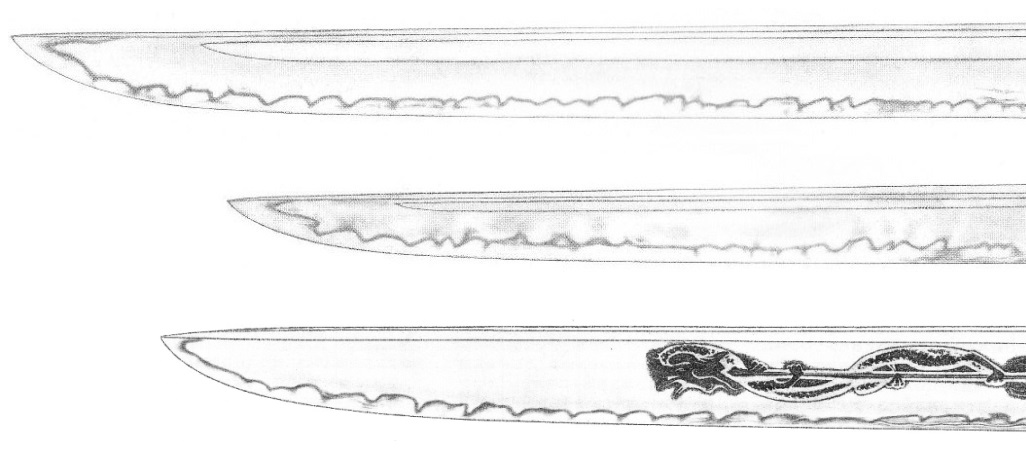
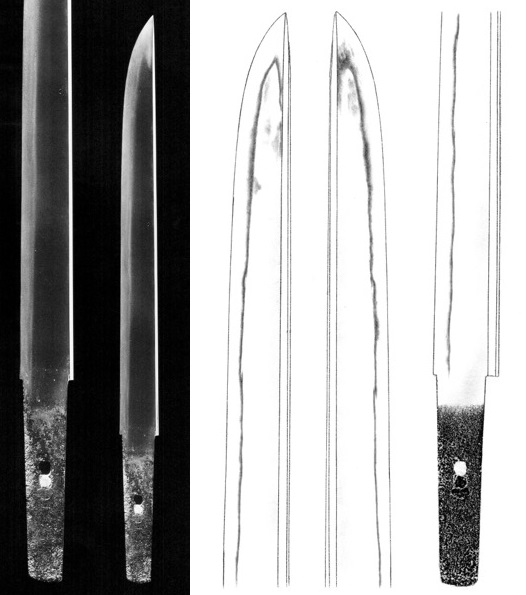
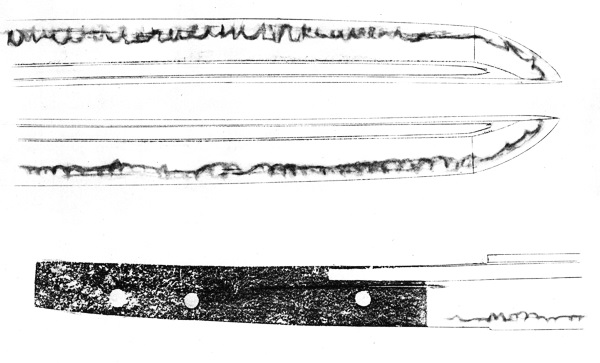
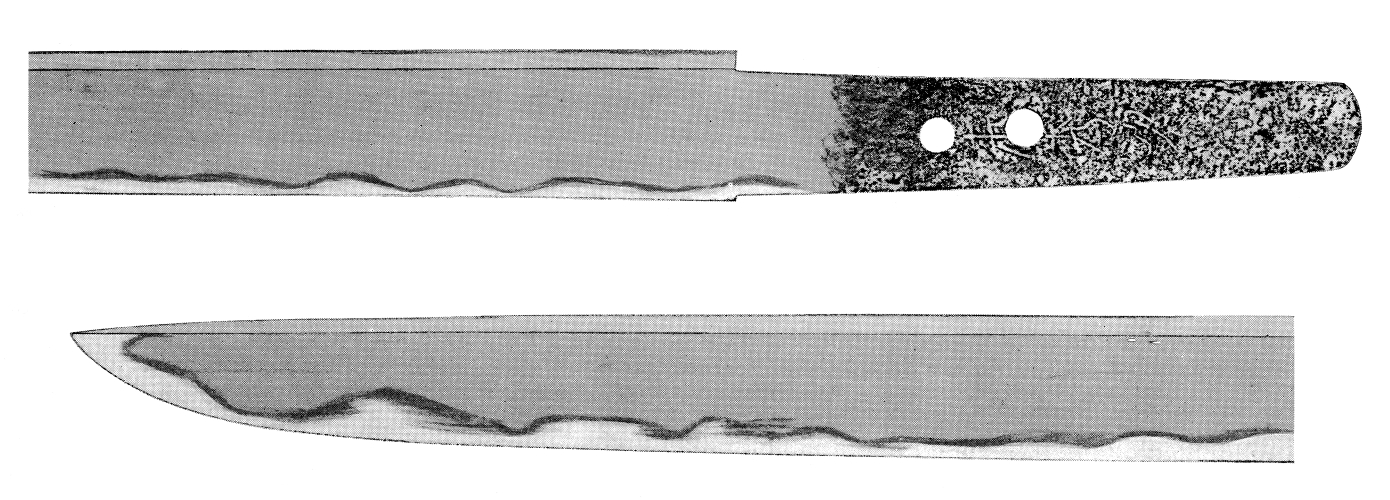
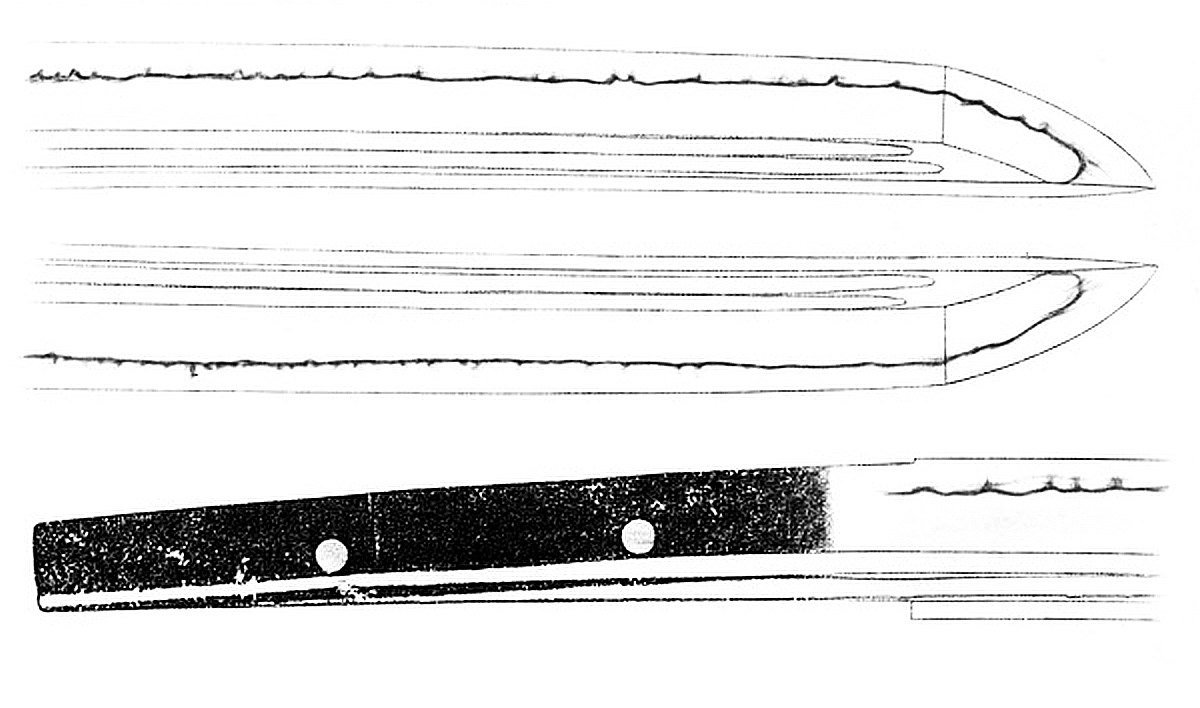
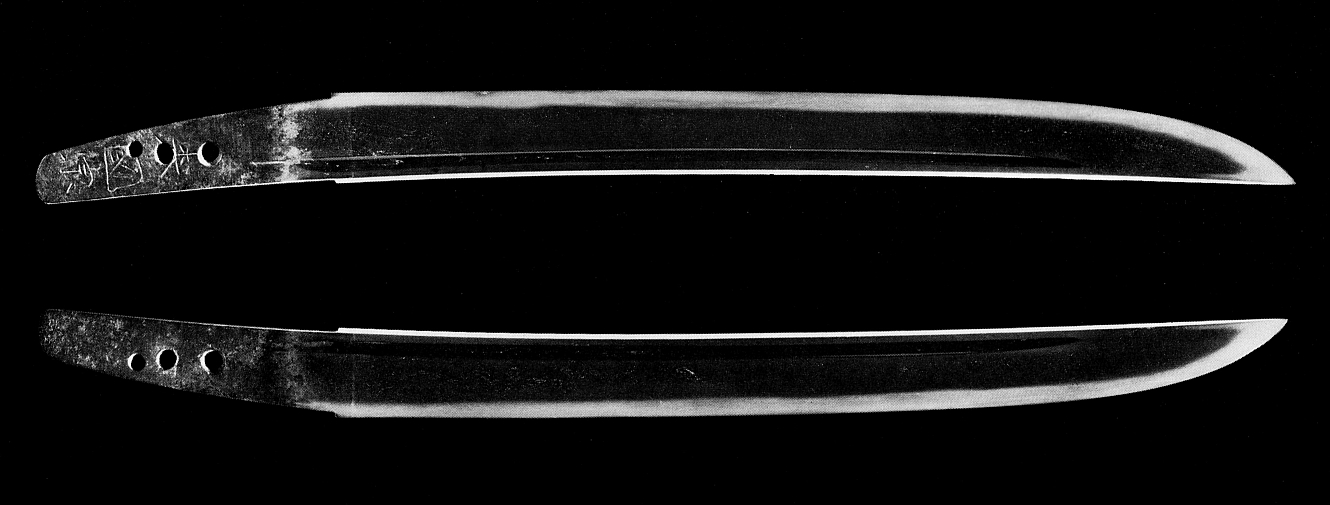
So lets unravel this handed down career of Mitsukane step by step. It is said that he was the fourth son of Nagamitsu, thus being named Heishirô (平四朗, i.e. -shirô as suffix for the fourth son). Some say that he was the son of a mistress of Nagamitsu but maybe both is true, i.e. that he was his fourth son but born out of wedlock. When we now follow this tradition that he was Nagamitsu’s son and take Kôan one (1278) as his year of birth, his entire apprenticeship would have roughly correlated to the Einin era (永仁, 1293-1299). In this light, the tradition that he studied with Nagamitsu around Tokuji (1306-1308) sounds a little odd as he was already approaching his 30th birthday at that time. So if the Tokuji approach is true, then Mitsukane was probably not the son of Nagamitsu but a student who entered the Osafune forge at an advanced age. Or his alleged year of birth is not true and he was born a decade or so later. Anyway, his most famous work, the meibutsu Midare-Mitsukane (乱れ光包), seems to go back to this Osafune milieu. The blade is shown in picture 1 and got its nickname from the interpretation in midareba. It is a wide sunnobi-style hira-zukuri tantô with uchizori and a rather thick kasane that shows a dense ko-itame with chikei and plenty of fine ji-nie that tends somewhat to nagare and that shows shirake along the mune. The hamon is a slanting, katauchi-style gunome in ko-nie-deki with a wide nioiguchi and is mixed with ashi and kinsuji. The bôshi is midare to notare-komi and shows a rather pointed ko-maru-kaeri that runs back in a long fashion. Both sides bear a katana-hi that runs with kaki-nagashi into the tang. The tang is ubu, has a ha-agari kurijiri, katte-sagari yasurime, and shows centrally under the mekugi-ana Mitsukane’s large and finely chiseled, peculiar niji-mei.

RaiMitsukane1

Picture 1: jûyô-bunkazai, tantô, mei “Mitsukane” (光包), nagasa 29.2 cm, uchizori, kasane 0.7 cm, motohaba 2.5 cm, hira-zukuri, iori-mune, owned by the NBTHK

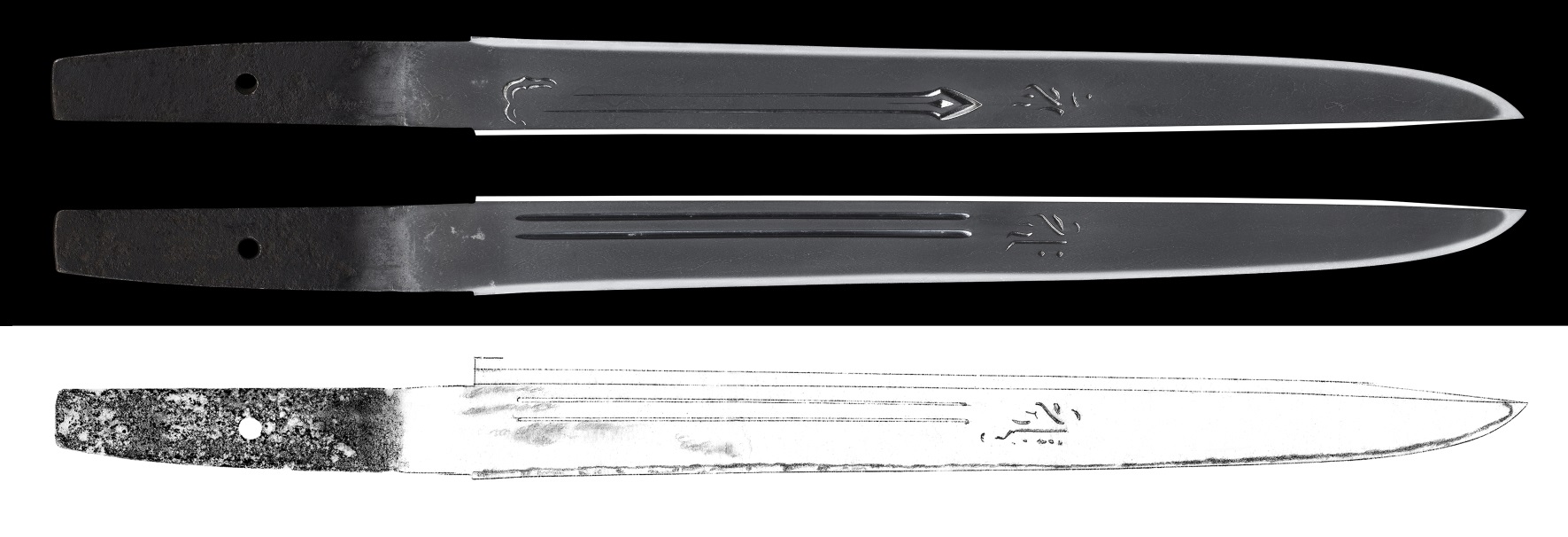
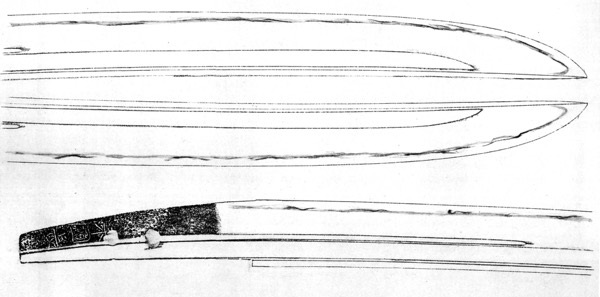
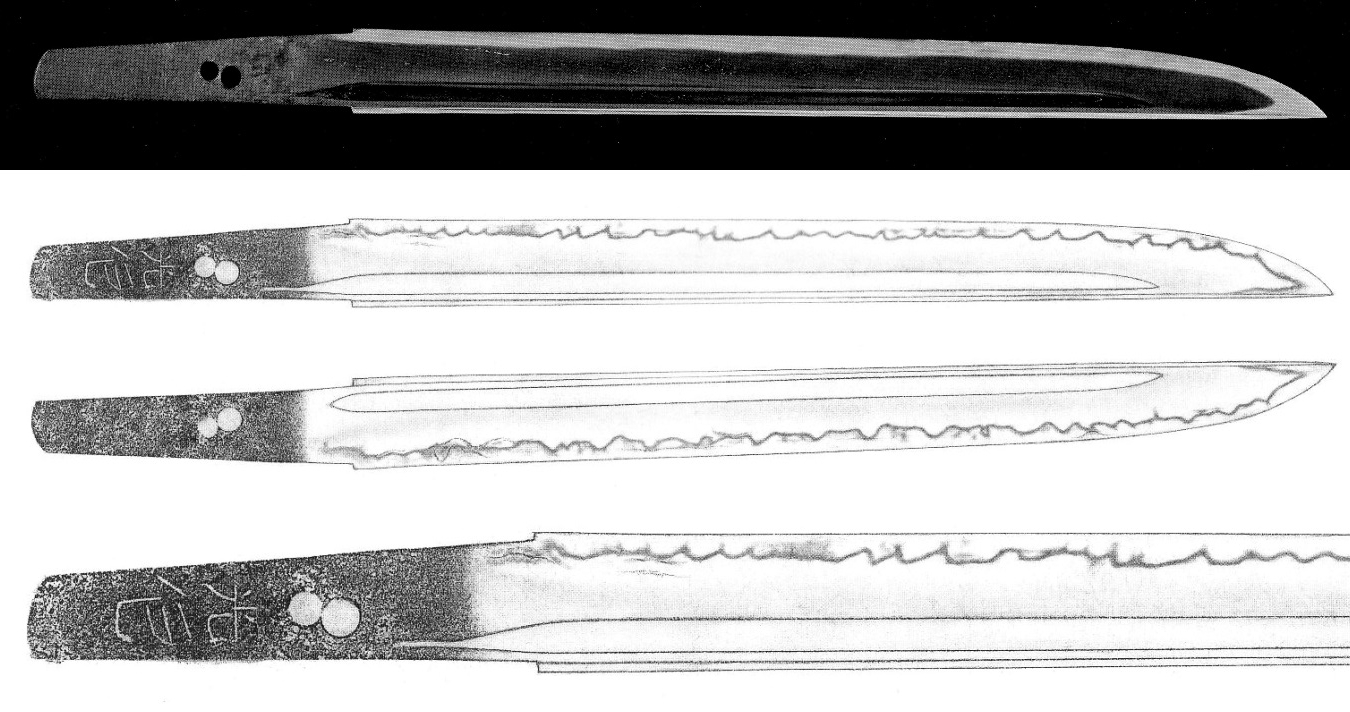
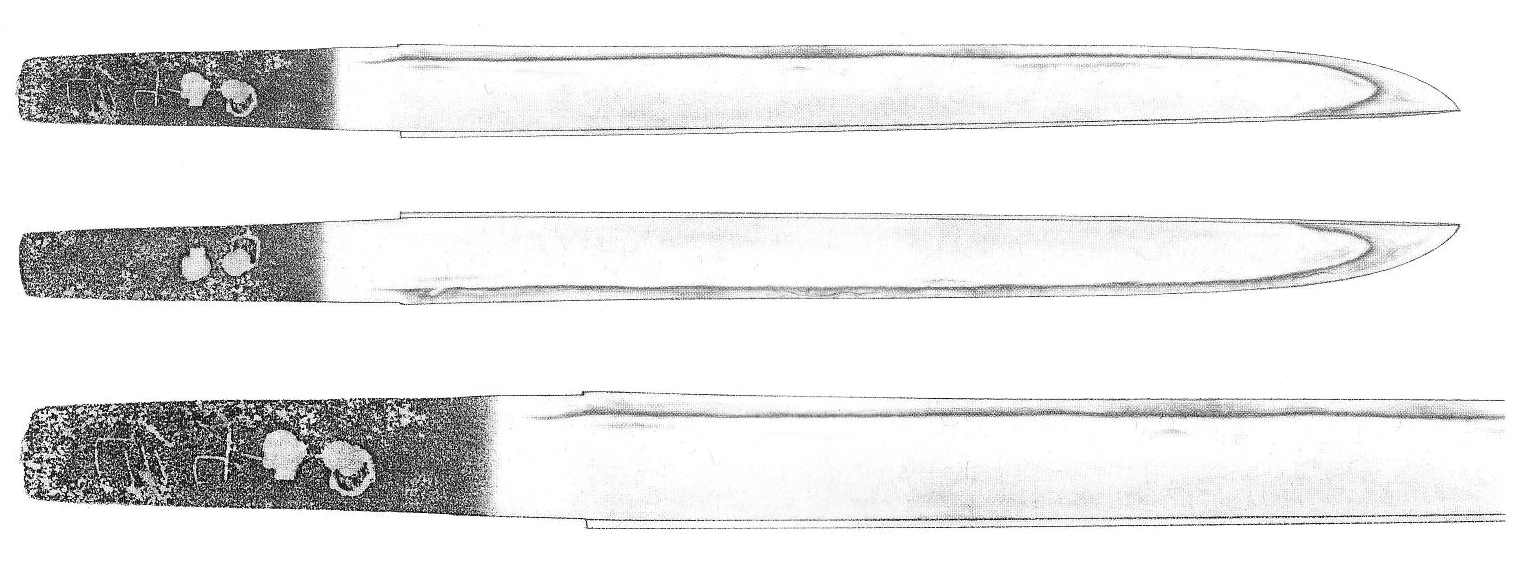
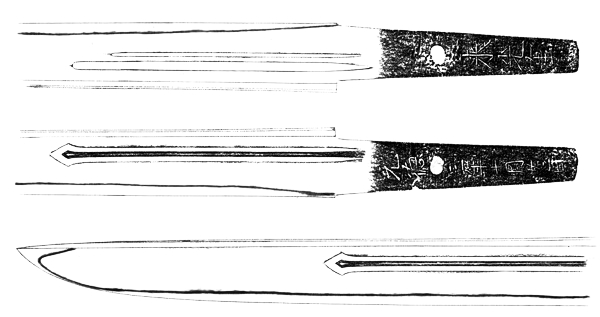
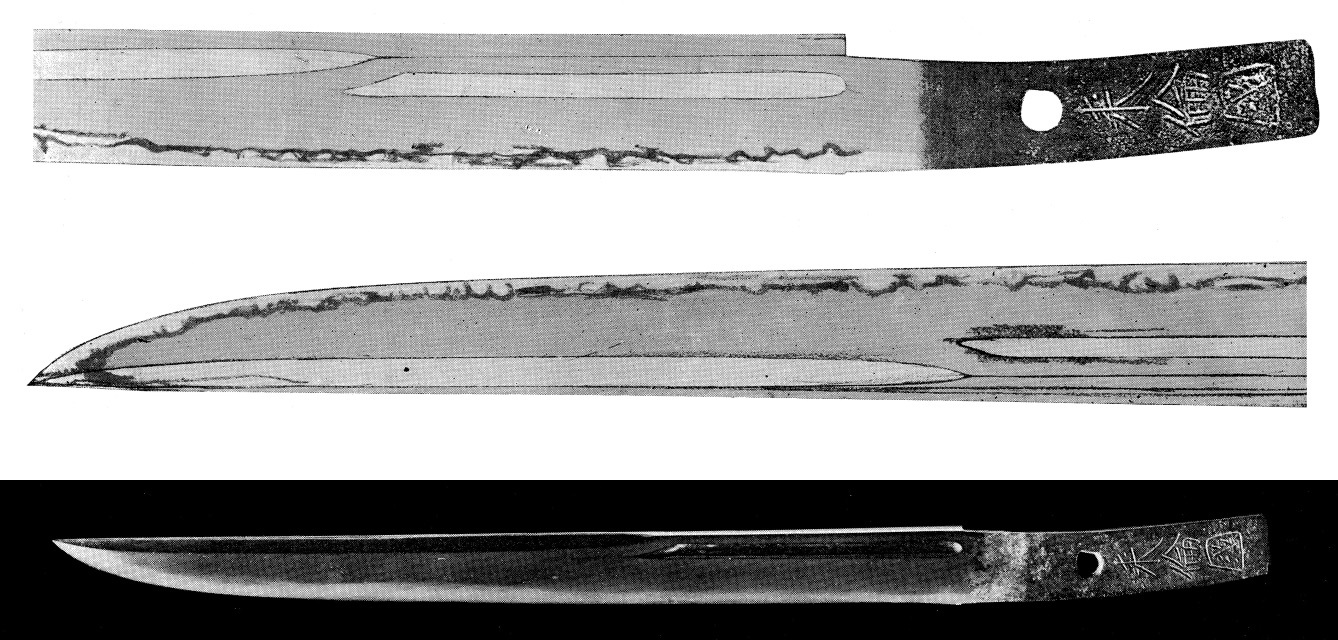
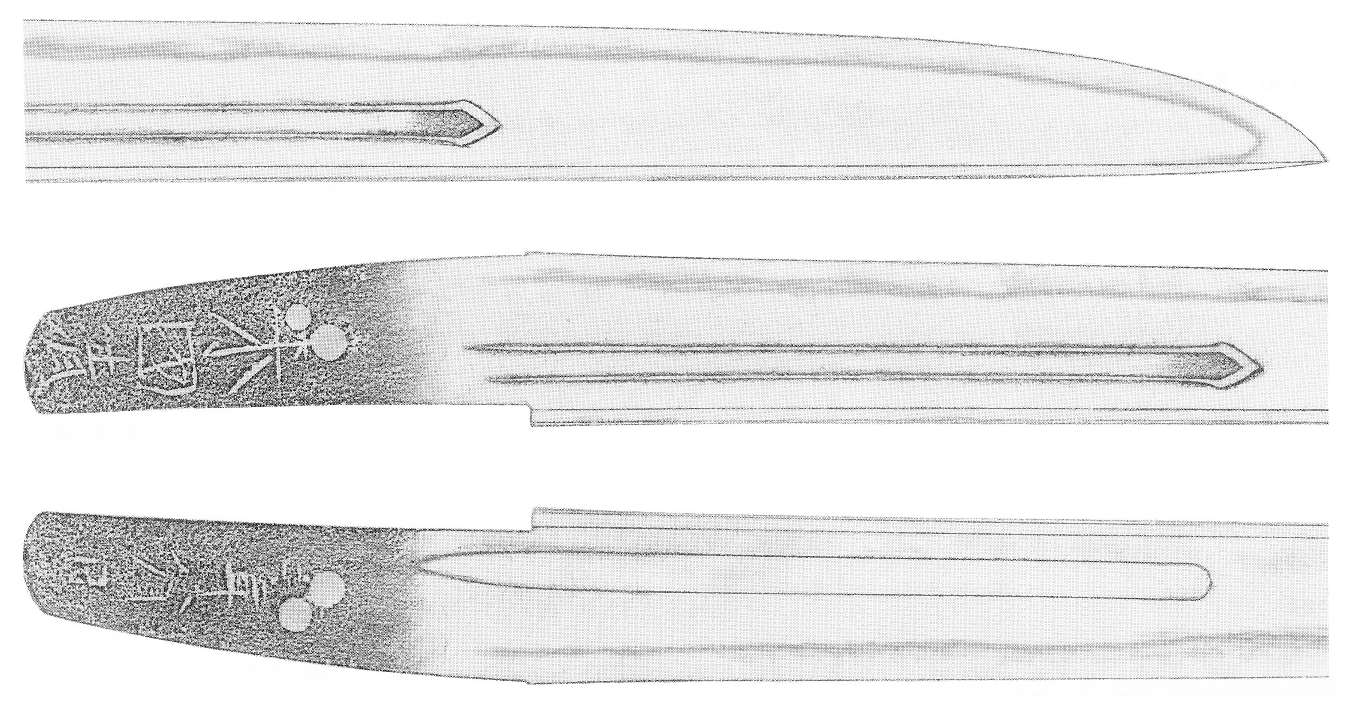
The interpretation of the midareba that tends noticeably to kataochi-gunome is so much similar to that of Nagamitsu and (some earlier blades) of his successor Kagemitsu (景光) (see picture 2) that the tradition of Mitsukane having studied at the Osafune School shall be deemed safe. Also the noticeable thickness of this tantô is a feature that is also seen at several Nagamitsu tantô. Interesting is that Tanobe describes the Midare-Mitsukane as showing also a nie-utsuri, an element that I haven’t read in any other descriptions of the very meibutsu. This would distinguish him from Nagamitsu as the Osafune master usually either applied a or a midare-utsuri and is probably feeding into the (more uncommon) approach that Mitsukane’s career happened the other way round, i.e. coming from the Rai School and studying later in life down in Bizen under Nagamitsu. Another factor that would support this approach is that on the one hand, Bizen-style blades of Mitsukane are regarded as his wakauchi (若打), i.e. his early works, but the meibutsu Midare-Mitsukane is a great masterwork of the calibre we would expect from an advanced master. Well, maybe Mitsukane was just a very talented smith and able to produce early on such great masterworks and what also speaks against the “other way round” approach is that if he was a Rai smith who decided to study with Osafune Nagamitsu later in his career, he would have signed with “Rai,” and probably not given up to do so.

RaiMitsukane2

Picture 2: Comparison of the Midare-Mitsukane (top) with works of Nagamitsu (center) and Kanemitsu (bottom).

Mitsukane eventually arrived in Kyôto and studied with Rai Kunitoshi. As mentioned in one of the previous chapters, we know that Kunitoshi was born in Ninji one (1240) and lived at least until Genkô one (1321). So when the studies of Mitsukane have taken place around Tokuji (1306-1308) or Bunpo (1317-1319), depending on tradition, then he was learning from an about 67 or 77 years old master respectively. Both ages might look advanced at a glance but we have to bear in mind that Mitsukane was alreay a fully trained swordsmith when he entered the Rai forge and we can assume that Kunitoshi was rather acting as a grand master, giving him some coaching and being supported so by his no less skilled sons Kunimitsu and Kunitsugu. In short, Mitsukane didn’t have to learn from scratch how to prepare the charcoal for example and was basically “just” introduced on the spot to the Rai School’s technical approach of sword forging.

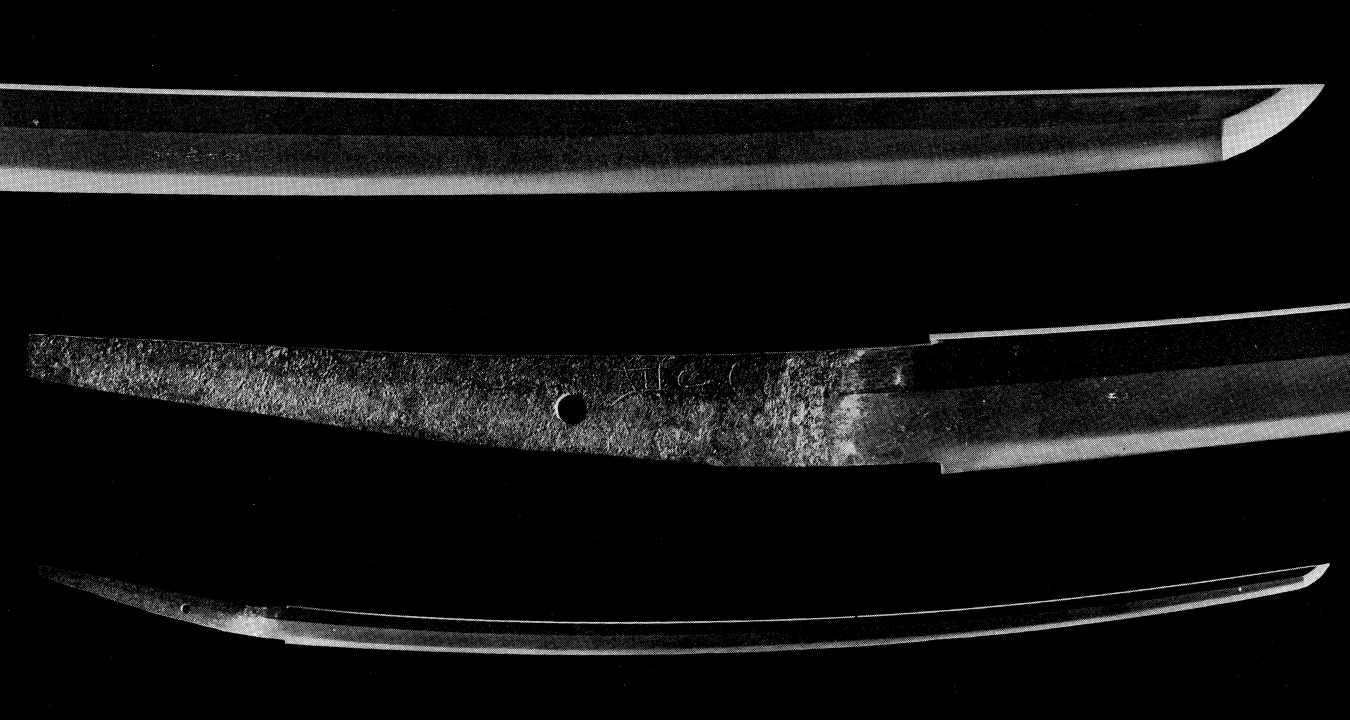
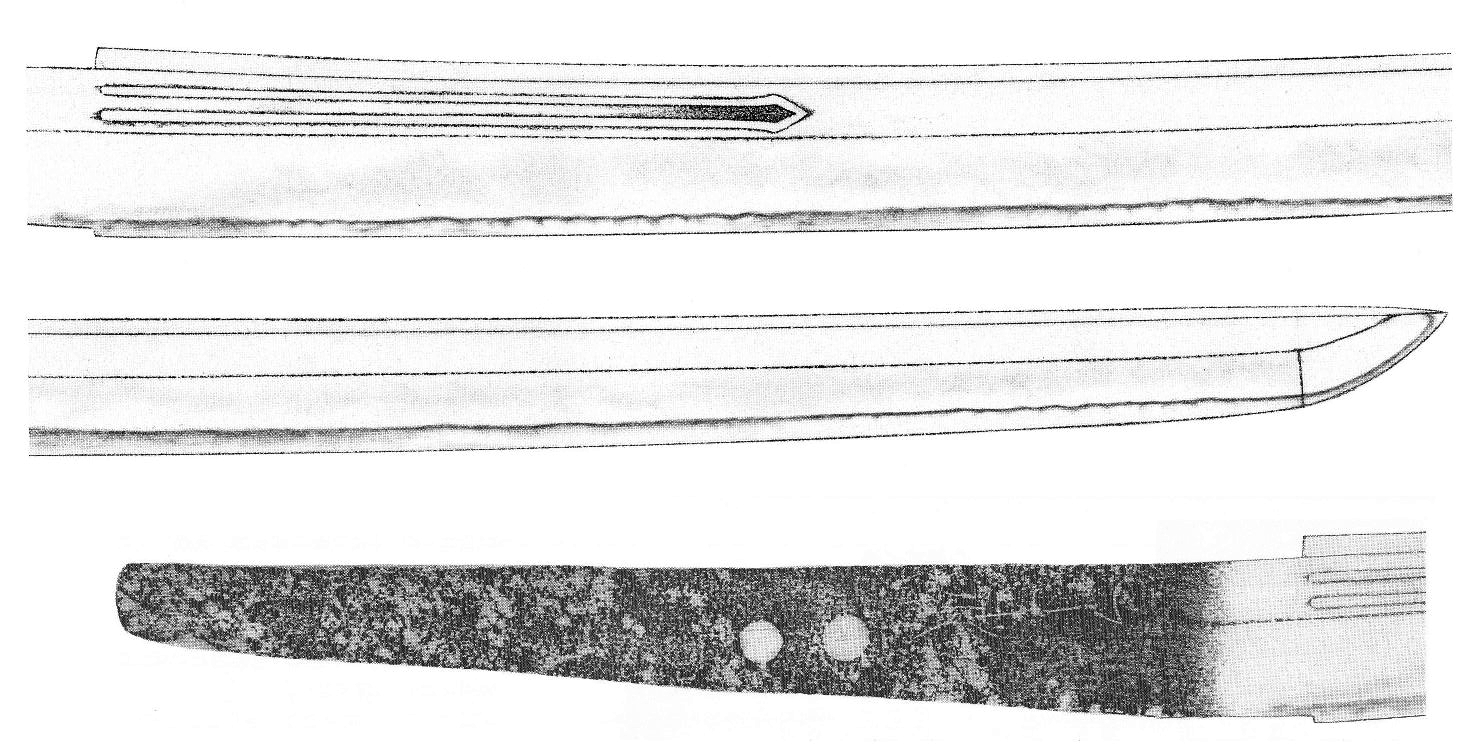
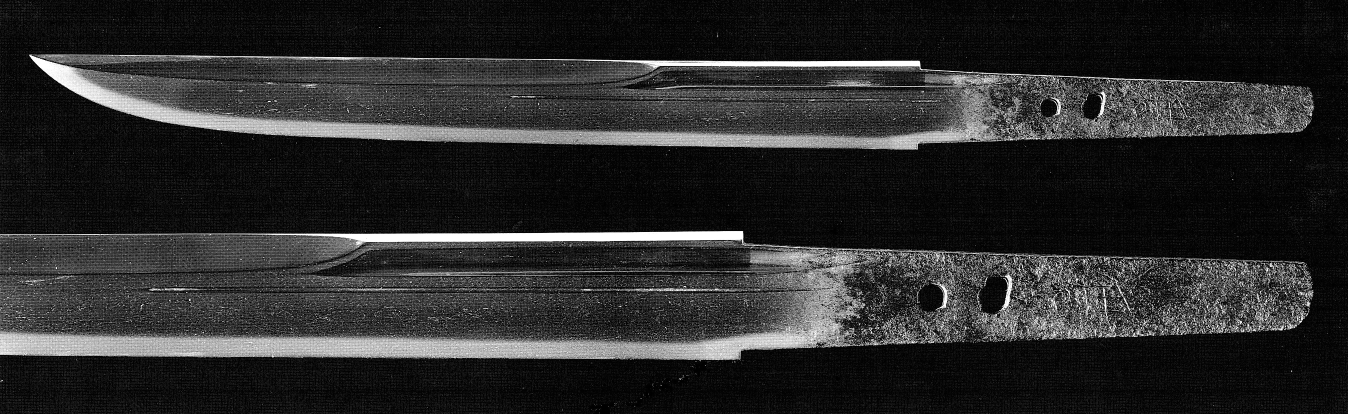
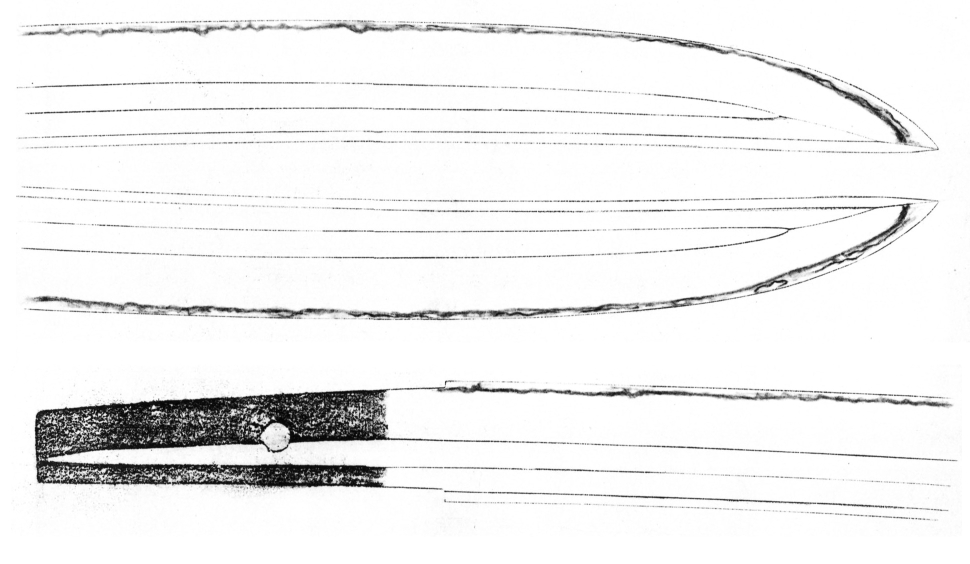
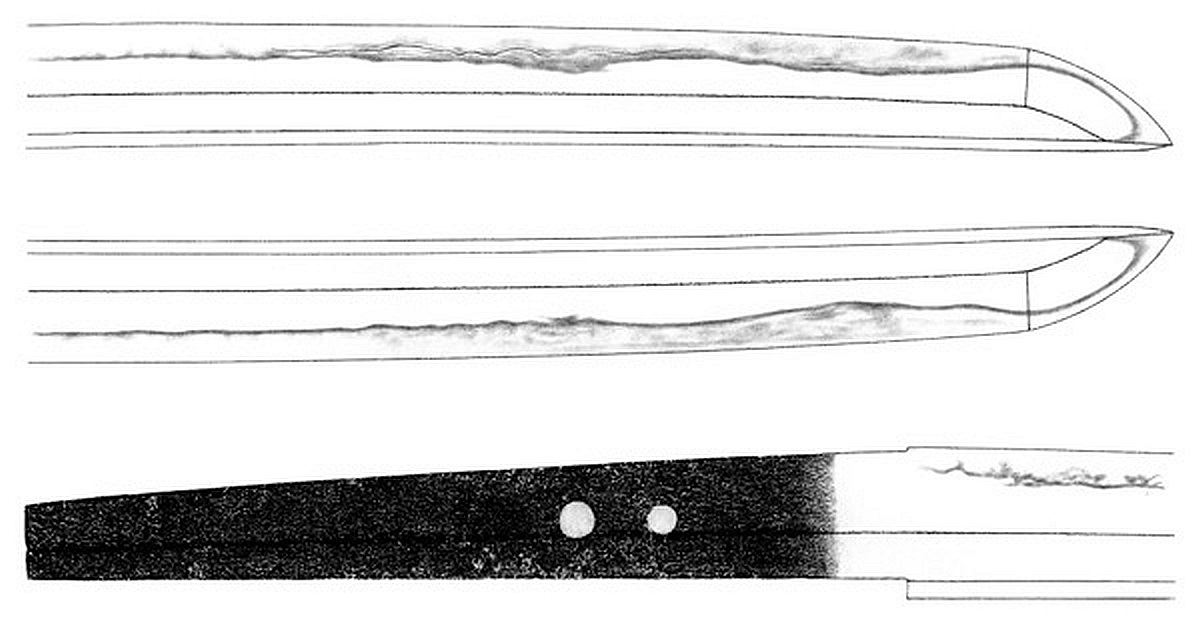
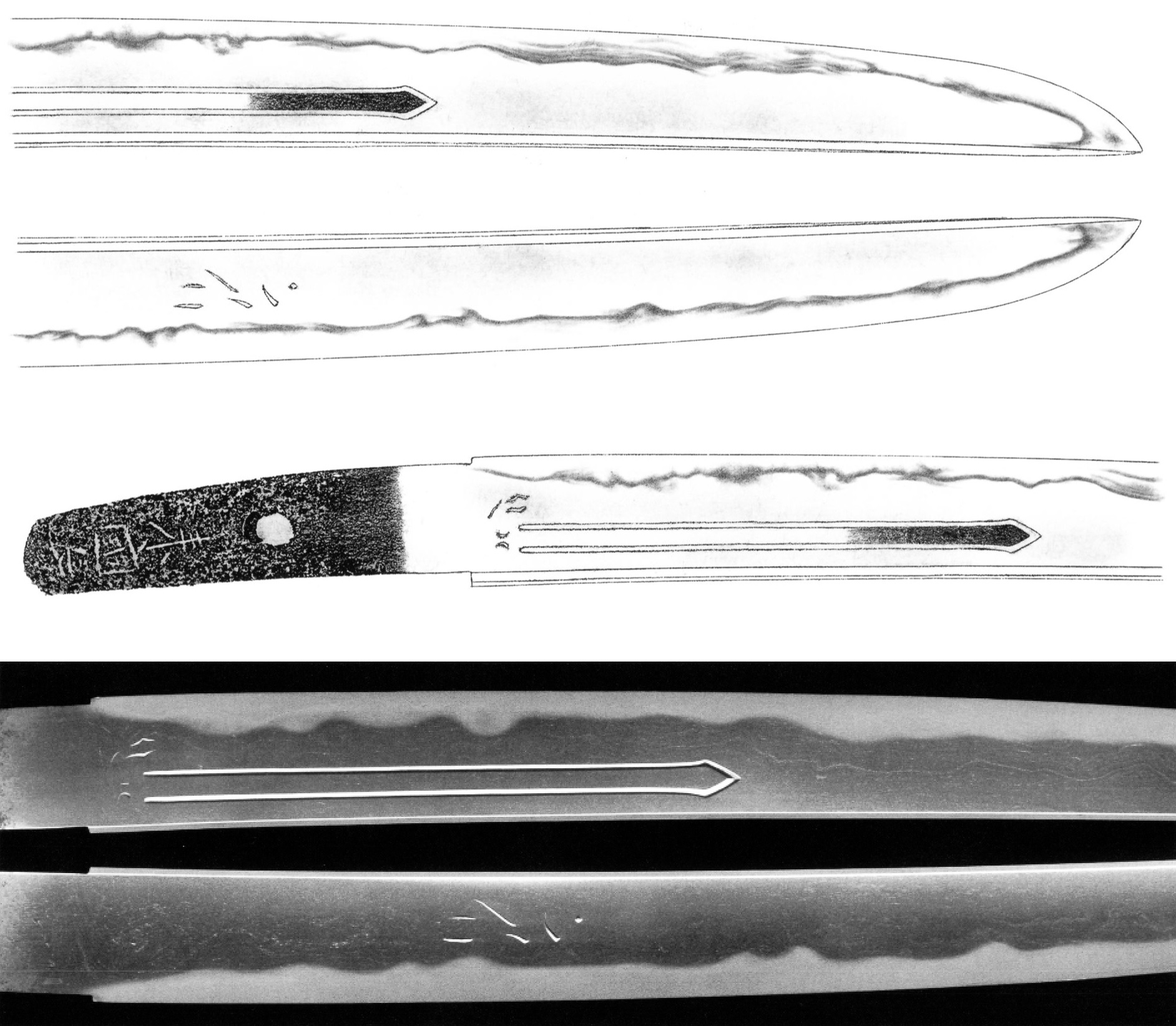
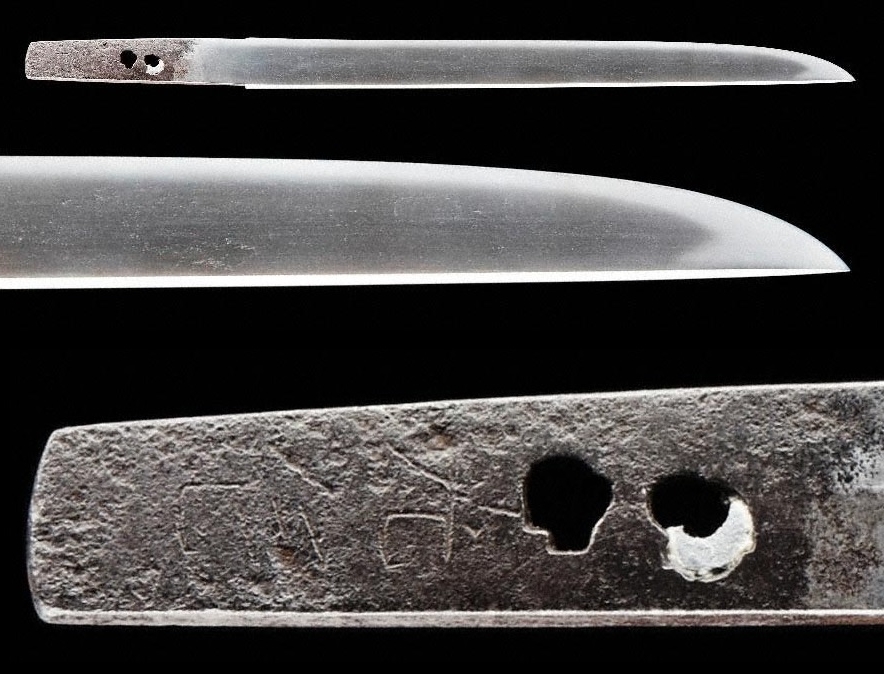
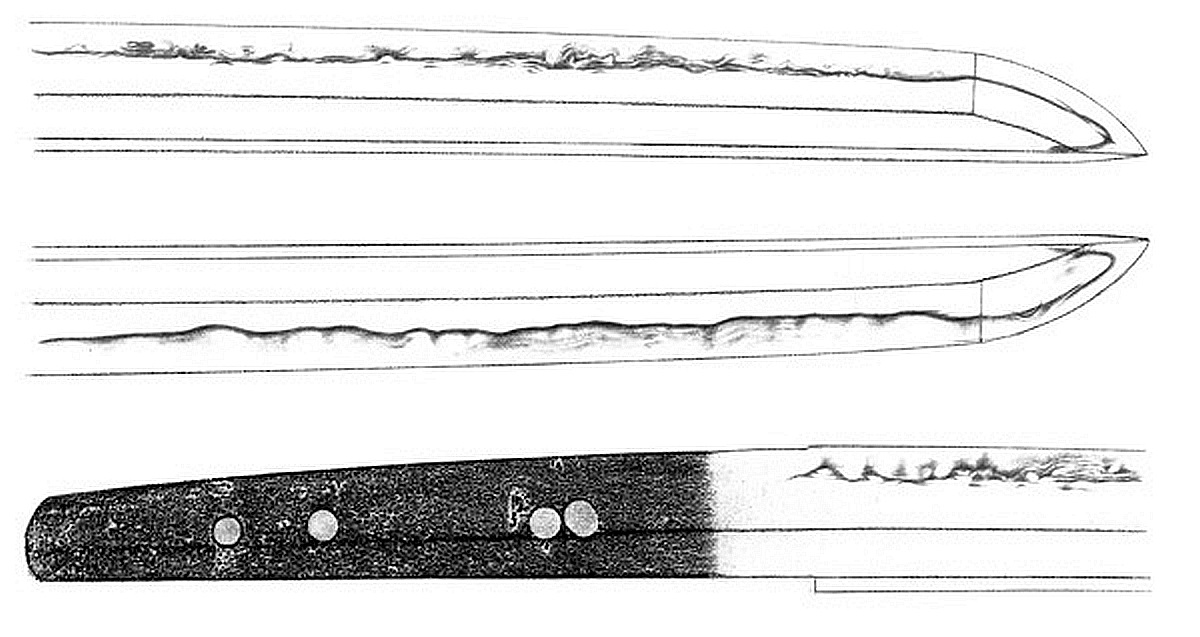
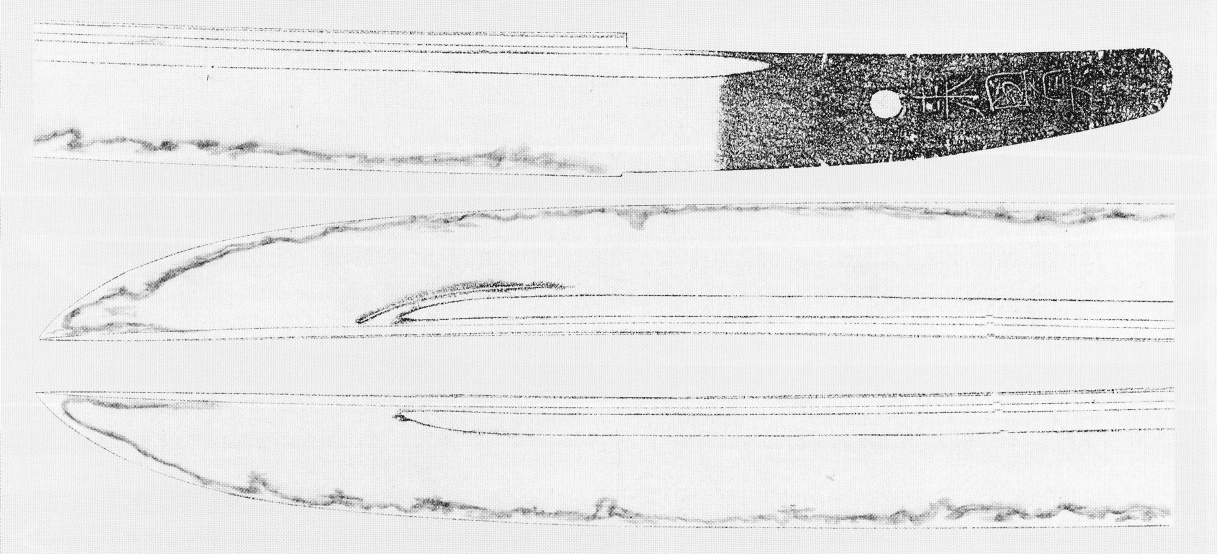
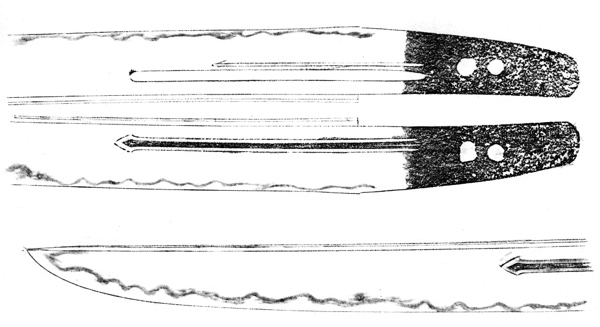
A prime example of his later Rai interpretations is shown in picture 3. It is a jûyô-bunkazai tantô that was once handed down within the Date (伊達) family, the daimyô of the Sendai fief. It is with a nagasa of 26.4 cm about jôsun, i.e. of standard length, shows a hint of an uchizori, and is rather slender. Different from Kunitoshi is that the kasane is somewhat thicker than we would expect from a tantô of the Rai grand master. The kitae is a very dense ko-itame with fine ji-nie, some chikei, and a nie-utsuri, and the lower half of the blade shows some mixed-in larger hada structures, but we don’t see Rai-hada. The hamon is a ko-nie-laden and thin suguha that has a rather tight nioiguchi and that is mixed with some fine kinsuji and a little bit of hotsure along the monouchi of the ura side. The bôshi is quite prominent as it is widely hardened and a little taore, i.e. “falling/leaning” towards the ha on the omote side. So the bôshi too is different from that of Rai Kunitoshi.

RaiMitsukane3a

RaiMitsukane3b

Picture 3: jûyô-bunkazai, tantô, mei “Mitsukane” (光包), nagasa 26.4 cm, a hint of uchizori, hira-zukuri, mitsu-mune, preserved in the Fukuyama Museum of Art, Hiroshima

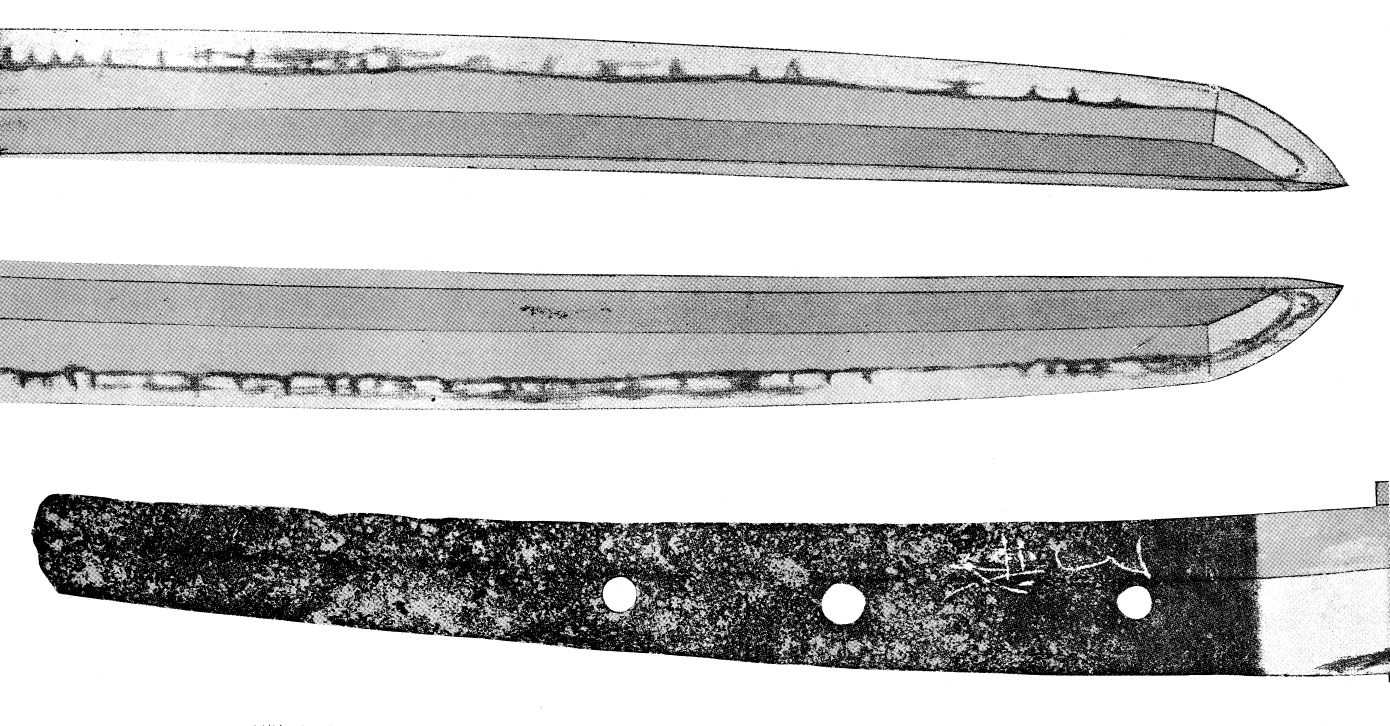
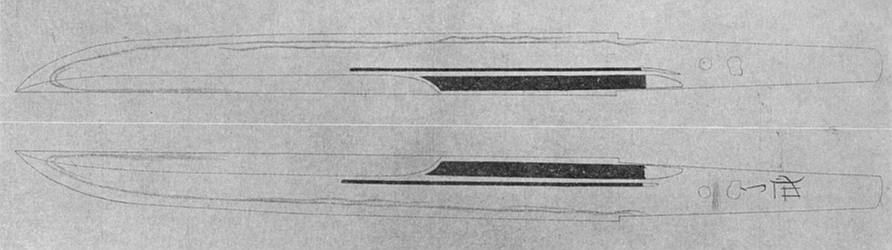
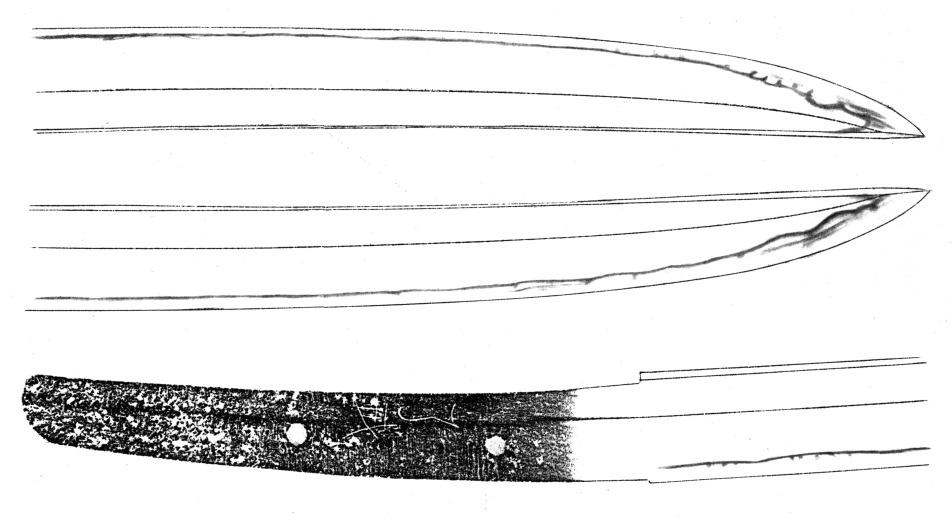
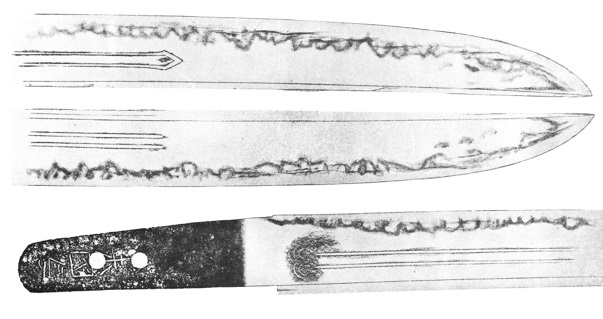
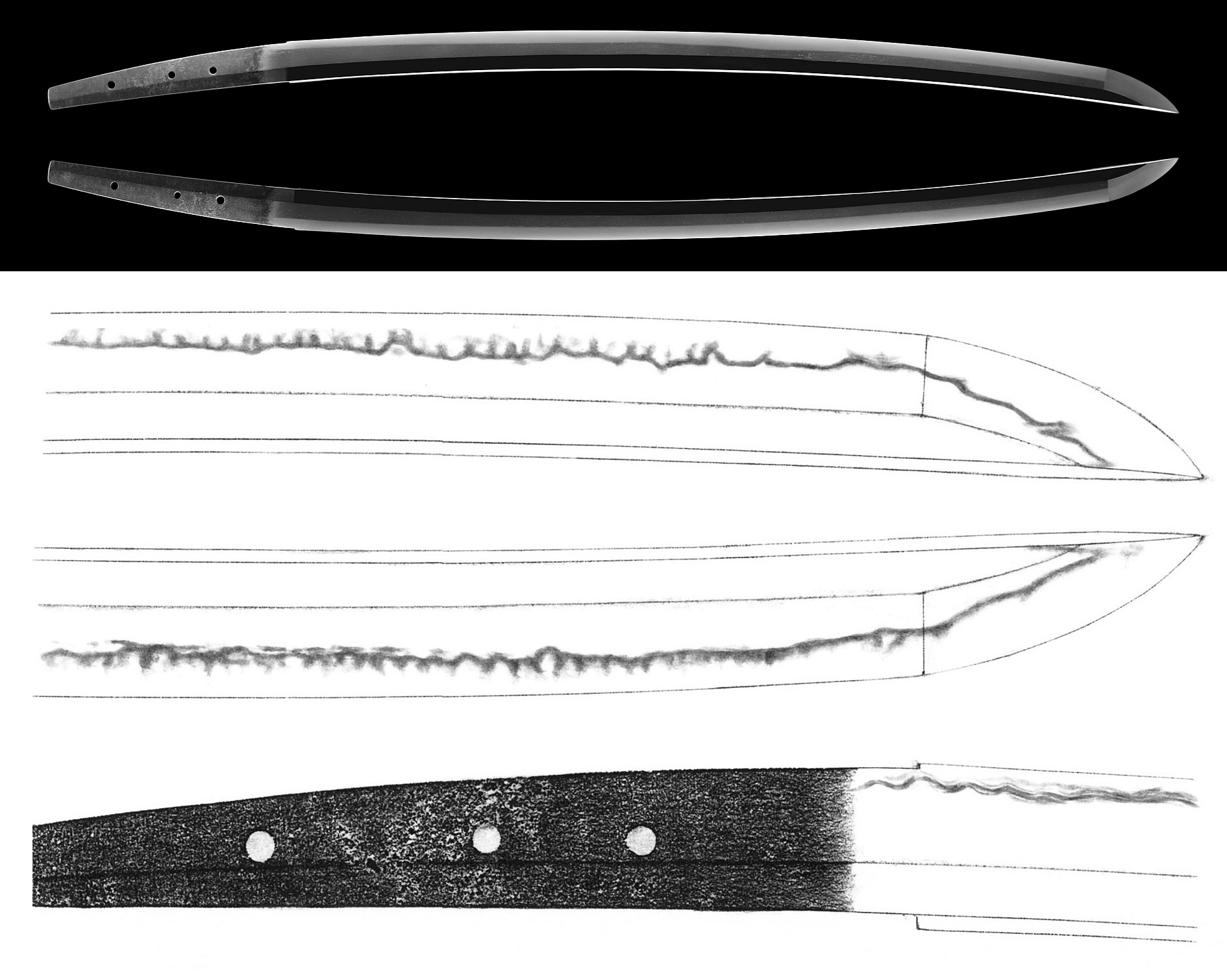
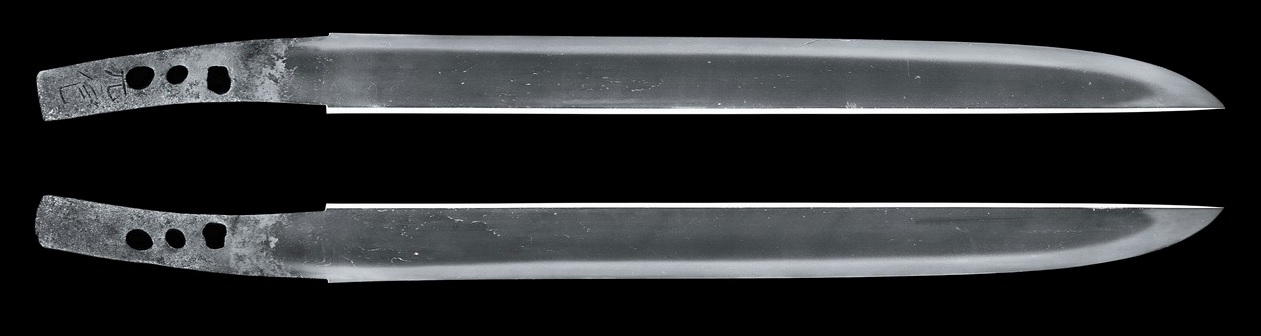
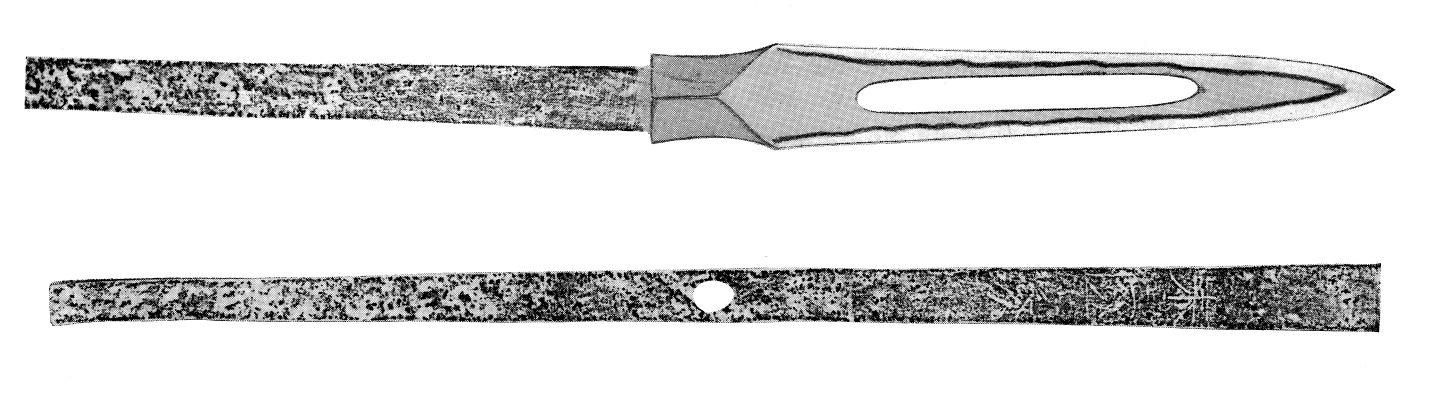
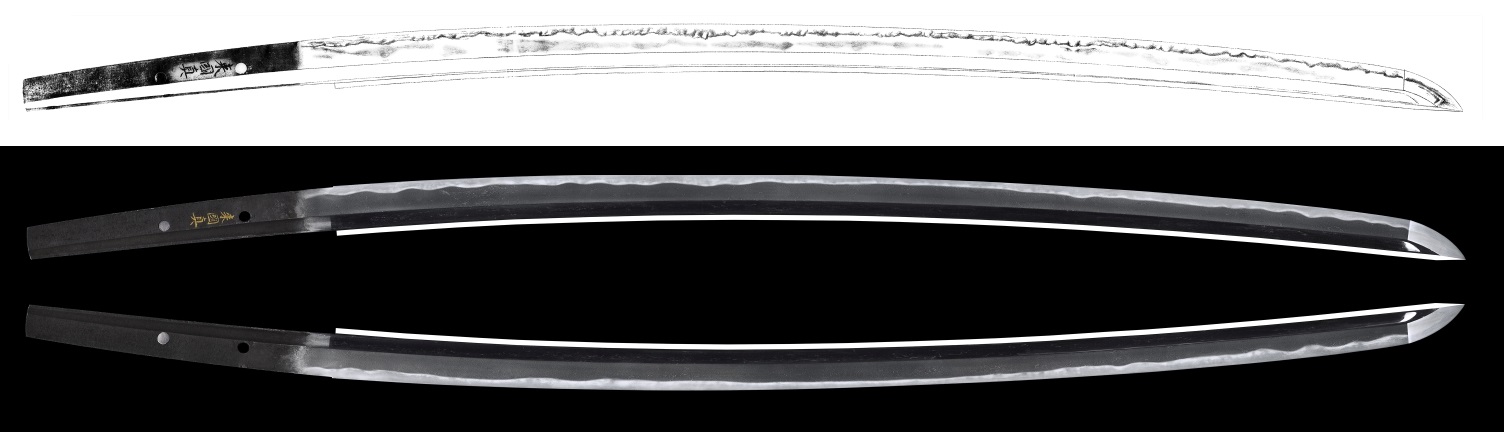
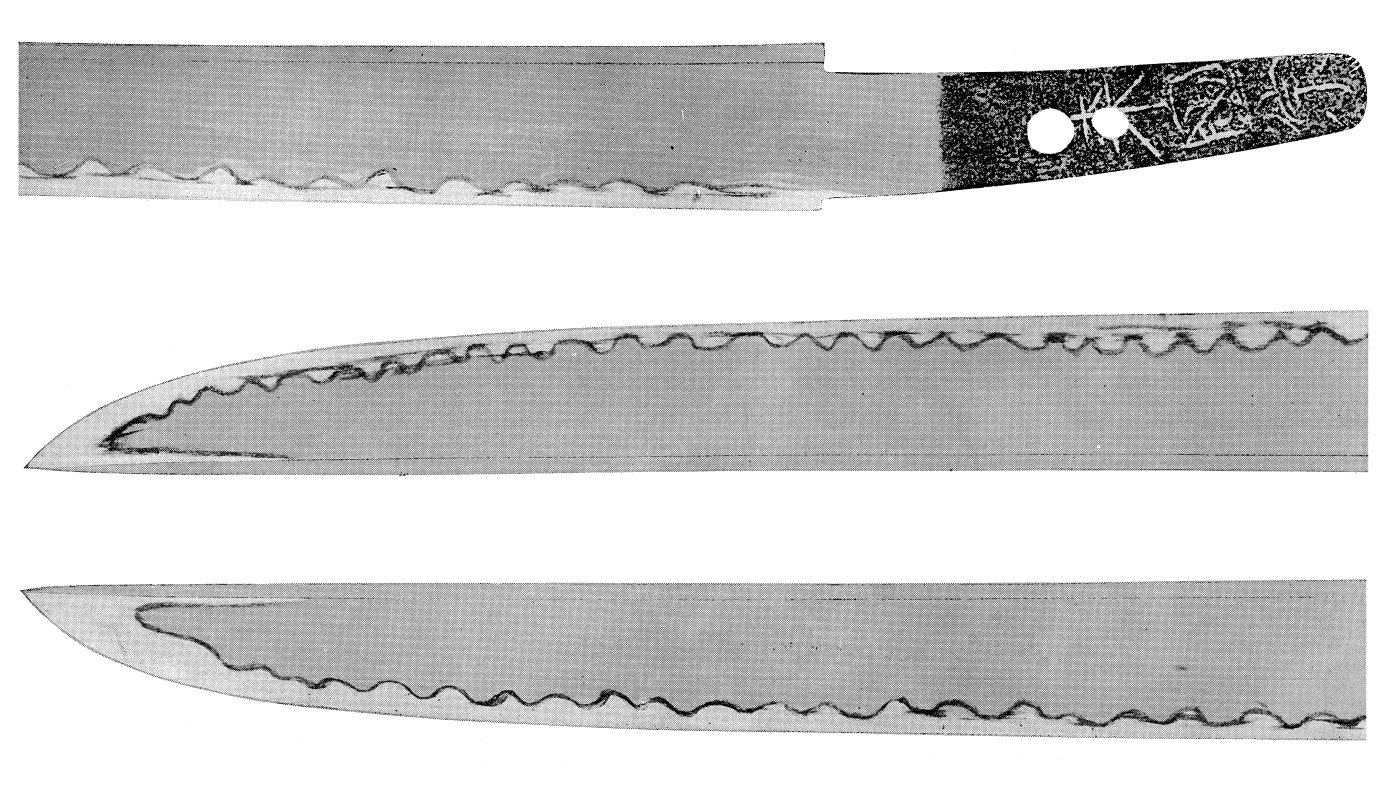
Another jûyô-bunkazai of Mitsukane in Rai style is shown in picture 4. This blade is with a nagasa of 24.5 cm a little shorter and comes with a curved furisode-nakago. It shows a rather dense itame with a nie-utsuri and a suguha in ko-nie-deki, a deki which reminds of Kunitoshi at first sight but the again somewhat thicker kasane and the widely hardened bôshi with the long kaeri show the typical stylistic approach of Mitsukane. The blade was once a heirloom of the Echizen-Matsudaira (越前松平) family.

RaiMitsukane4

Picture 4: jûyô-bunkazai, tantô, mei “Mitsukane” (光包), nagasa 24.5 cm, uchizori, hira-zukuri, mitsu-mune, preserved in the Tôkyô National Museum

Well, after his study visit of Kyôto he travelled a little bit farther north-east and settled in Tozu (戸津) in neighboring Ômi province and took with this the name of Tozu Sasuke (戸津佐助). A popular tradition says that he had then retreated to the Konpon-Chûdô (根本中堂) named main hall of the Enryaku-ji (延暦寺) on Mt. Hiei (比叡山) to forge swords for a while there, what earned him later the nickname Chûdô-Rai (中堂来). Now some see this Tozu referring to the Totsu Shrine (戸津神社) which is located on the southeastern lakeside of Lake Biwa. But it was found out that also a neighborhood of present-day Sakamoto (坂本) was named Tozu and Sakamoto is right where you arrive at when coming down from Mt. Hiei going east, i.e. down to Lake Biwa. However, this tradition of him establishing a forge on Mt. Hiei, what is with transporting all the raw materials up there rather cumbersome and laborious, is today dismissed by some scholars who forward that Chûdô actually refers to the Chûdô-ji (中堂寺) and its surrounding district, a neighborhood which is just located in the heart of Kyôto. But on the other hand, his later name Tozu Sasuke and the fact that his son and some of his students moved to the southern Biwa lakeside village of Awazu (粟津) does suggest a strong connection to Ômi province. Incidentally, this branch of his that moved down to Awazu is referred to as Awazu-Rai (粟津来).

Before I introduce a last work of Mitsukane, let me address some kantei points for him. As mentioned, his tantô show a somewhat thicker kasane than Rai Kunitoshi. Also his jigane is a little stronger and does not show Rai-hada and of course the widely hardened bôshi is different too. In addition, Mitsukane’s kaeri often emphasizes the nie and there are by trend a little more hataraki within the ha as at Kunitoshi. It is often said that Mitsukane’s suguha is generally wider than that of Kunitoshi but if you take a look at his entire body of works, you learn that this view needs to be rethought as more than half of his tantô actually shows a pretty narrow suguha. Some even place Mitsukane’s tantô more in the vicinity of Awataguchi Yoshimitsu but the sugata differs insofar as the blades of Mitsukane feel a little more stretched, i.e. more sunnobi for their width, and are just not as harmonious in overall shape as are Yoshimitsu’s tantô (of that kind). Well, Yoshimitsu is regarded by many experts as greatest tantô smith of all times so his daggers have of course an overwhelming presence and dignity that is not seen to that extent in the tantô of Mitsukane.

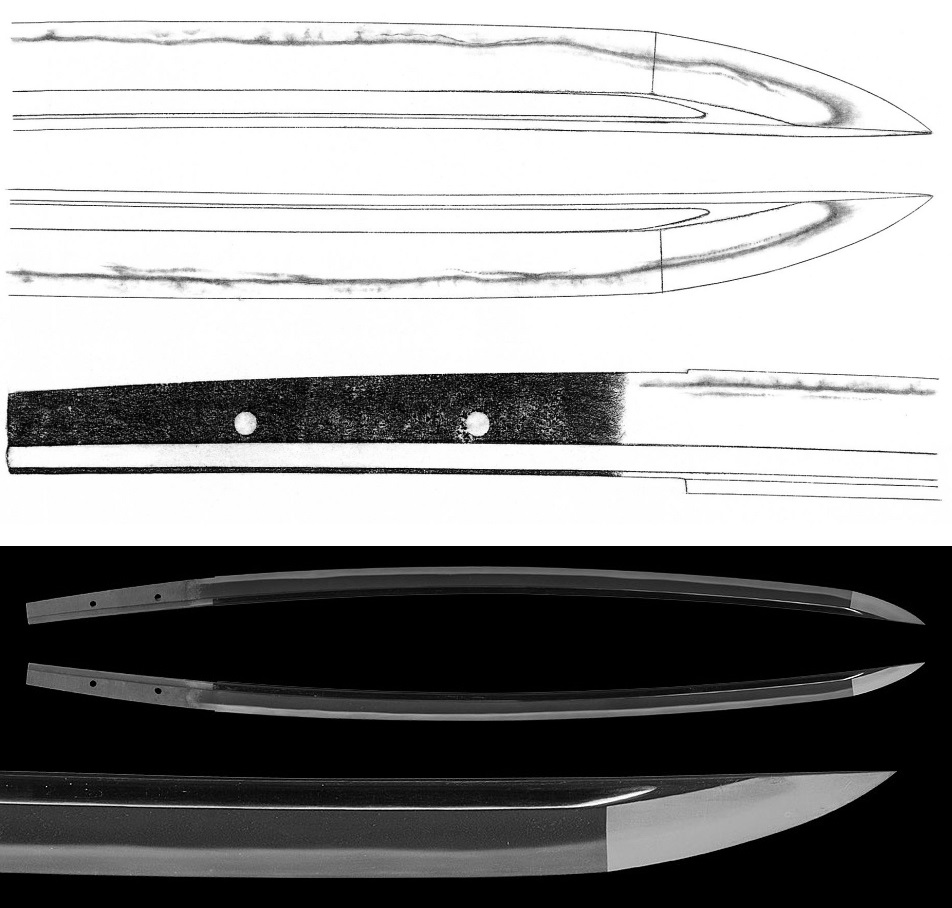
Now last but not least the meibutsu Kuwayama-Mitsukane (桑山光包). Also I want to mention at this point that 5 works of Mitsukane bear designations by the Agency of Cultural Affairs (all tantô and all jûyô-bunkazai). 7 tantô passed jûyô of which 3 made it tokubetsu-jûyô later. The Kuwayama-Mitsukane is one of these 3 tokuju and was once owned by Kuwayama Iga no Kami Motoharu (桑山伊賀守元晴, 1563-1620) who presented it later to shôgun Tokugawa Iemitsu (徳川家光, 1604-1651), who in turn gave it to Maeda Toshitsune (前田利常, 1594-1658) after whom it was handed down within the Kaga Maeda family (which sold it after WWII). By the way, the Kyôhô Meibutsu Chô says that Motoharu once bought this tantô for 1,500 kan from a person from Ôtsu (大津) in Ômi province, a town that is also located at Lake Biwa. The tantô , shown in picture 5, is pretty similar in interpretation to the jûyô-bunkazai tantô introduced in picture 3. It has a nagasa of 27.1 cm, shows a hint of uchizori, a thick kasane, and tends to sunnobi. The kitae is a very dense ko-itame with plenty of ji-nie and a nie-utsuri appears along the mune. The hamon is a ko-nie-laden suguha with a wide, bright and clear nioiguchi that is mixed with kuichigai-ba and along the fukura with yubashiri. The bôshi is again relative widely hardened but is due to the this time rather wide suguha not as prominent. It shows a pointed ko-maru-kaeri which meets the yubashiri to form some kind of muneyaki approach, but just in the tip.

RaiMitsukane5

Picture 5: tokubetsu-jûyô, meibutsu Kuwayama-Mitsukane, mumei, nagasa 27.1 cm, a hint of uchizori, hira-zukuri, mitsu-mune

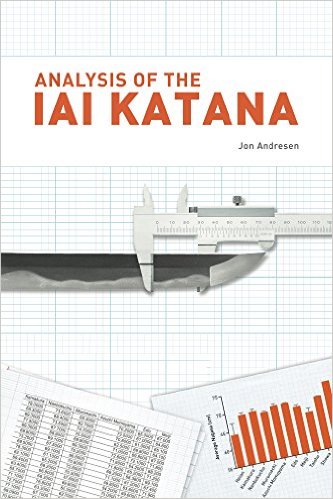
Book review: Analysis of the Iai Katana

Today I want to review a recently published book, written by PhD Jon Andresen from American Art Swords. Title of the book is Analysis of the Iai Katana, published by Jon’s Androzo Publishing, and available via amazon. In his book, Jon approaches the katana, as mentioned in the blurp, analytically and his academic scientific background is very much reflected in this approach. Jon is also an iaidôka, a rokudan renshi to be specific, and thus he tackles the analysis of swords, and that is of iaitô and shinken as well, truly from the modern iaidô practitioner’s point of view.

The book is basically divided into three parts, i.e. bokutô, iaitô, and shinken. In the first part, Jon thoroughly analyses all aspects of the bokutô, with a main focus on the woods used, from traditional to modern Japanese sources to non-Japanese equivalents. And with thorough, I mean thorough, as this (I am speaking of ~ 50 pages) is the most comprehensive study on bokutô I have come across to this day. The second part is comparatively brief and addresses all basic and relevant points you have to know about iaitô whereas the third part on shinken is the main part of the book and comprises ~ 120 pages. In these 120 pages, Jon analyses and puts into relation measurements, weight, and bôhi grooves by using a dataset of 1,695 long swords from all periods. Through this analysis, you can see certain trends and relations of nagasa, kasane, weight, and presence or absence of bôhi, just to name a few factors, whereas the weight makes an important part of this analysis because as Jon says in the preface, to predict the weight of blades based on their nagasa was originally a major goal of this work.

This means, and borrowing from the preface, it was to be for the benefit of iaidô students who generally care about what swords weigh when information of the weight is usually omitted in descriptions on sites that sell swords. The book is rounded off by guidelines and tips on maintenance (and that applies to bokutô, iaitô, and shinken) and therefore I would recommend this publication to the serious iaidô aspirant who wants to get as much information as possible to make up his mind on the purchase of an as perfect as possible iaitô or shinken (in addition to what your sensei is recommending of course). In other words, studying Jon’s book gives you useful tips, and makes you aware of maybe never thought off aspects that you have to bear in mind when shopping for a sword that should fit you well and for a long time on your journey along the Way of Drawing the Sword. As indicated, the book places a firm focus and does not pretend to be anything else, thus do not expect to find in it any discussions on swordsmiths schools, workmanships, swords as collectibles, or iaidô techniques/kata and things like that . I just wanted to underline that because, from my personal experience as an author in this field, people often expect a “Swiss Army knife” approach.

AnalysisOfTheIaiKatana

Fujiwara ligature

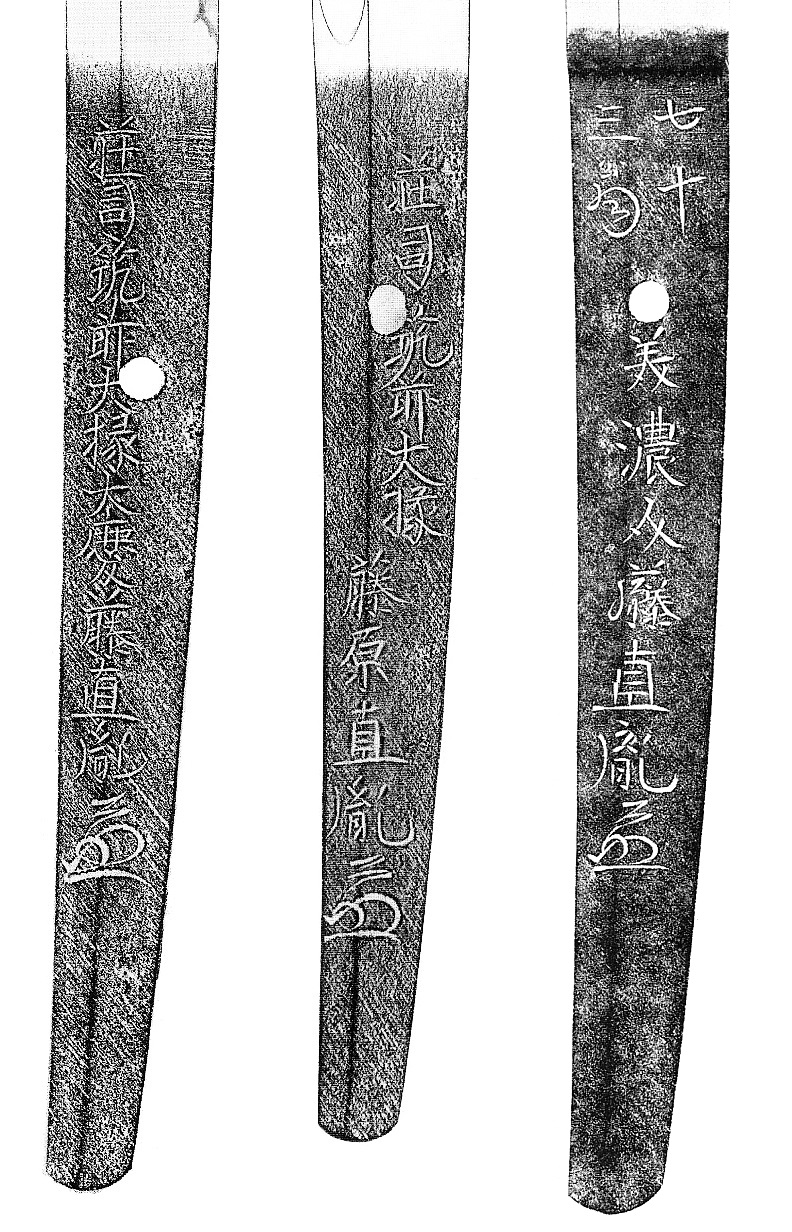
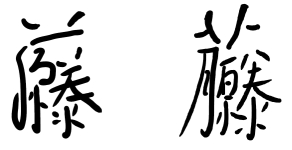
Working on the German translation of parts of the current Tôken Bijutsu magazine I saw that Satô Kazunori (佐藤一典) points out a “habit” in the 24th part of his article series on Sendai swordsmiths that I would briefly like to introduce. The habit in question is a certain ligature, gôji (合字) in Japanese, that combines the characters Fuji (藤) and wara (原) to a single character that represents, obviously, the clan name Fujiwara. Now I don’t want to deal with the specific swordsmith, who is the Nidai Sôryûshi Tamateru (雙龍子玉英, 1820-1889) by the way, but suffice it to say that I first came across this habit years ago via his master Taikei Naotane (大慶直胤, 1778-1857). Naotane started rather early on in his career, i.e. around Bunsei (文政, 1818-1830) to drop the wara and sign the reference to the clan name Fujiwara just with Fuji (see my Shinshinto-Meikan, p. 135f). Later, i.e. around Tenpô (天保, 1830-1844), he signed Fujiwara as everyone else with two characters but changed towards the end of his career, i.e. around Kôka (弘化, 1844-1848) and Kaei (嘉永, 1848-1854) to the gôji ligature variant. So Tamateru obviously adopted this habit from his master.

Goji1

Picture 1, from left to right: Naotane signing just with Fuji (dated Bunsei four, 1821), with Fujiwara (dated Tenpô eleven, 1840), and with the gôji (dated Kaei four, 1851)

When I say “came across via Naotane” above, I mean that I once wrongly read this gôji just as Fuji, i.e. I thought that he later returned to the habit of dropping the wara character again but was pointed out that he did add it by so to speak squeezing it into the the lower Fuji part (滕), that is squeezing it between the radicas (月) and (𣳾). So if you see a mei like the one in picture 1 right, you correctly read it (in this very case) as “Mino no Suke Fujiwara Naotane” and not “Mino no Suke Fuji Naotane.”

Goji2

Picture 2: Naotane’s Fujiwara gôji (left) and how Tamateru signed it (right).

Explicit ligature was and is rather rare in Japan because when you combine two characters, you just get a new character and this is not regarded as ligature in the strict sense. However, there were some, but they mostly used for decorative or “underlining/emphasizing” purposes on temple inscriptions or talimans. Apart from that, and what we see sometimes today, Western units were adopted and made into gôji, for example (糎) for centimeter, Japanese senchi or senchimêtoru, composed from the characters (米) and (厘), and (粍) for millimeter, Japanese miri or mirimêtoru, composed from the characters (米) and (毛). In our field, you can come across such units gôji via certain papers, for example those issued by the Nihon Tôsôgu Kenkyû Kai and the Jûhô Tôken Kenkyû Kai (see picture below).

Goji3

Picture 3: Details from a NTK and a JTK paper.

KANTEI 4 – YAMASHIRO #21 – Rai (来) School 7

We continue with some of the “below of the radar” Rai smiths. I have mentioned another son of Kunitoshi in the previous chapter, the homonymous Kunitoshi (国歳), but hardly anything is known on this smith and I am not aware of any extant blades of him. The Kotô Meizukushi Taizen however says that he was born in Kenji two (建治, 1276) and that he died in Genkô one (元弘, 1331) at the age of 55. Consulting the traditional genealogies, it seems that the lineage of Rai Kunimitsu did not bring forth many independent smiths. Or in other words, it is safe to assume that he trained many students but who remained working as assistants throughout their entire career and did not have an output of blade on their own account. Well, we find a certain Rai Kuniyoshi (来国吉) listed as son of Kunimitsu who was supposedly active around Ôan (応安, 1368-1375) but no blades of him are known either.

*

This brings us the the next Rai lineage, namely that of Kunitsugu. He had a son, Rai Kunihide (来国秀), who was born in the first year of Kôan (弘安, 1278) and who died in Kôei one (康永, 1342) at the age of 65, so the Kotô Meizukushi Taizen. There are a few signed yari extant of Kunihide and one niji-mei tachi that got jûyô. Incidentally, there are 7 works of Rai Kunihide that passed jûyô but none that bears a designation by the Agency for Cultural Affairs. Asigned tachi of Kunihide is shown in picture 1. It has a wide mihaba, a shallow sori, and an elongated chû-kissaki, what speaks for a sugata from the very end of the Kamakura to the early Nanbokuchô period. The kitae is a dense itame with ji-nie and chikei and the hamon is a nie-laden gunome with a wide nioiguchi that is mixed with chôji, many ashi, and some few sunagashi and kinsuji. The bôshi is midare-komi with a very brief ko-maru-kaeri. Both sides show a bôhi with ryô-chiri and a kakudome in the tang and traces of a soebi. The tang is suriage, has a kirijiri, kiri-yasurime, and bears a thinly chiseled niji-mei. Now interesting is that this tachi is not signed with the prefix “Rai” but the blade is nevertheless attributed to Rai Kunihide. In the jûyô description we also read that because of the kitae with chikei and the nie-deki hamon in gunome mixed with chôji and the midare in the bôshi, the workmanship resembles closely that of Rai Kunitsugu, his alleged father.

RaiKunihide1

Picture 1: jûyô, tachi, mei “Kunihide” (国秀), nagasa 71.5 cm, sori 1.6 cm, motohaba 2.95 cm, sakihaba 2.35 cm, shinogi-zukuri, iori-mune

It is interesting that seemingly neither signed nor unsigned tantô or hira-zukuri ko-wakizashi of Rai Kunihide going round. Thus I want to introduce another tachi of him before referring to his yari. The tachi (which is now a katana) shown in picture 2 is relative wide and has a slightly elongated chû-kissaki, what again brings us in the same time of end of Kamakura to early Nanbokuchô. The kitae is an overall somewhat standing-out itame that is mixed with mokume and much nagare on the omote side and also chikei and plenty of ji-nie appear. The hamon is a nie-laden suguha-chô to shallow notare that features a wide and bright nioiguchi and that is mixed with gunome, chôji, ko-chôji, thick and long ashi, , sunagashi, kinsuji, uchinoke, and smallish yubashiri which all focus pretty much on the habuchi (i.e. don’t spill much into the ji). The bôshi is sugu with a ko-maru-kaeri and some hakikake. So again, the workmanship suggests Rai Kunitsugu at a glance but once more, the NBTHK plays the quality card and says the overall quality is just a hint under that of Kunitsugu but the work is clearly from the direct vicinity of Kunitsugu and as the quality is very close, they go for the smiths who ranks very next, and that is his alleged son Kunihide.

RaiKunihide2

Picture 2: jûyô, katana, mumei, attributed to Rai Kunihide (来国秀), nagasa 66.9 cm, sori 1.0 cm, motohaba 2.75 cm, sakihaba 2.1 cm, shinogi-zukuri, iori-mune

Now in picture 3 we see one of his extant signed yari. It is with a nagasa of 11.0 cm a smallish yari and shows a finely forged ko-itame with plenty of ji-nie and a noticeable tendency to masame. This appearance of much masame is also true for his other yari and goes most likely back to the different forging techniques used for yari (which are for example also evident on ken). The hamon is a slightly undulating suguha-chô in ko-nie-deki.

RaiKunihide3

Picture 3: hira-sankaku yari, mei “Rai Kunihide” (来国秀), nagasa 11.0 cm

*

Another smith who came from the lineage of Kunitsugu was Rai Hidetsugu (来秀次). He is listed as son or student of Kunitsugu but also as son of Kunihide whereas some put all them all in a pot and say that Kunihide and Hidetsugu were the same smith who succeeded later as 2nd generation Rai Kunitsugu. This would mean that Kunihide changed his name at some point in his career to Hidetsugu or vice versa. The meikan list Hidetsugu a little later than Kunihide, i.e. around Jôji (貞治, 1362-1368), and the Kotô Meizukushi Taizen says that he was born in Enkyô two (延慶, 1309) and that he died in Jôji six (1367) at the age of 58. Well, as the signature style of Kunihide and Hidetsugu is quite different, I would keep them all separated for the time being and dismiss the approach that we are facing here the same smith who succeeded later as 2nd generation Rai Kunitsugu. Interesting is that unlike Kunihide, there are just tantô and no long swords of Hidetsugu extant. Also no hira-zukuri ko-wakizashi of this smith are extant as far as I know. So let’s take a look at one of his tantô (picture 4). It measures 27.9 cm in nagasa, has an uchizori, and shows an itame-nagare with shirake. The hamon is a nie-laden ko-notare with sunagashi and some kinsuji and yubashiri and the bôshi is notare-komi with a ko-maru-kaeri and a hint of hakikake. In the Nihontô Kôza, Honma states that this tantô fits well into the lineage of Rai Kunitsugu but earlier in his Nihon Kotô Shi he said that “There are two tantô with the signature of ‘Rai Hidetsugu’ existing and their hamon is midareba, but their workmanship is totally different from that of Rai Kunitsugu.” The other tantô, which is briefly presented in the Nihontô Kôza and shown here in picture 5, is of different interpretation, i.e. it is even more nie-laden and hardened in gunome-chô, and shows clearly a different signature style. Well, Honma says that if viewed each by its own, he would say that they are authentic but in comparison, he is not sure if one is gimei (or both) or not or if one goes back to the hand of a second generatio Hidetsugu. So this is something for further study but I am not aware of any other signed Rai Hidetsugu blade popping up in the meanwhile and there is also none that passed jûyô so far. But maybe this discrepancy has to be seen in view of what Honma suggests, namely that at around this time, the Rai School had already lost their traditional workmanship and things becoming washy.

RaiHidetsugu1

Picture 4: tantô, mei “Rai Hidetsugu” (来秀次), nagasa 27.9 cm, uchizori, hira-zukuri, iori-mune

RaiHidetsugu2

Picture 5: The other known tantô of Rai Hidetsugu as a reference.

On the other hand, there were still some late Rai smiths who tried to keep up the tradition of the school. For example, there was a tantô discovered about 30 years ago that is signed “Rai Kunikiyo” (来国清) and dated “Meitoku yonnen hachigatsu hi” (明徳二二年八月日, “a day in the eighth month Meitoku four [1393]”). Now this Rai Kunikiyo is not listed in any meikan and the date of Meitoku four, i.e. at the very end of the Nanbokuchô period, makes this tantô one of the very last Rai works known. It is rather wide, has a thin kasane, shows a hint of sori, and a dense ko-itame that is partially mixed with ô-hada. Also ji-nie and a faint utsuri appear. The hamon is a suguha in ko-nie-deki that features a wide nioiguchi and that is mixed with noticeably wide hotsure areas and some sunagashi. The bôshi is sugu with a ko-maru-kaeri and we see a suken on the omote, and a wide koshibi on the ura side. Not sure if the tang is a little suriage but the mei is thickly chiseled. The two characters for the nengô era are barey legible on the oshigata but the descriptio says that it is clearly Meitoku when examining the tang in hand.

RaiKunikiyo

Picture 6: tantô, mei “Rai Kunikiyo” (来国清), date see text above, nagasa 26.3 cm, hira-zukuri, mitsu-mune

*

To conclude this chapter, I want to introduce the smith Rai Mitsushige (来光重) who is dated around Gentoku (元徳, 1329-1331) and who was a student of Rai Kunitoshi. Well, some speculate that Mitsushige was the early name of Rai Kunimitsu but the signature style differs too much as to follow this approach blindly. However, signed works of him are extremely rare so well, we can’t say for sure if there is some truth in this tradition. I for my self see them as two individual smiths for the time being. Now there is one signed tantô extant (see picture 7) that is also dated, namely “Gentoku sannen jûgatsu nijûninichi” (元徳三年十月廿二日, “22nd day of the tenth month Gentoku three [1331]”). It is rather wide, has a little uchizori, and comes in a sunnobi-sugata. The kitae is a ko-itame with nagare and ji-nie and the hamon is a suguha in ko-nie-deki that shows nijûba along the monouchi. The bôshi narrows very much down along the fukura and runs widely back as ko-maru-kaeri. On the omote side we see a suken and on the ura a take-kurabe-style koshibi with soebi. The tang is ubu, has a kurijiri, shallow katte-sagari yasurime, and bears a rather largely chiseled mei.

RaiMitsushige
Picture 7: jûyô, tantô, mei “Rai Mitsushige” (来光重), date see text above, nagasa 26.9 cm, uchizori, motohaba 2.65 cm, hira-zukuri, mitsu-mune

Easter eBook Super Sale II

Dear Readers,

I just started, like last year, an Easter eBook Super Sale where ALL of my eBooks are reduced by 50%! This offer will be valid for a week so you have enough time to decide what you want. So fill up all your tablets (or PC´s) with all the important Nihonto and Tosogu reference material you need four your studies!

If you have any questions or can´t find the one or other book, don´t hesitate and contact me via my “markus.sesko@gmail.com”.

Thank you and a Happy Easter to everyone!

http://www.lulu.com/spotlight/nihontobooks

Easter-Sale

KANTEI 4 – YAMASHIRO #20 – Rai (来) School 6

Now I want to talk about some of the Rai smiths who worked under master Kunitoshi and then deal in separate chapters with the Nakajima-Rai lineage, Ryôkai, and the Nobukuni School that goes back to the Rai offshoot that was established by Ryôkai. Due to the relative large number of active Rai smiths, all these chapters will be divided into several parts. Again, I want to create a useful reference and don’t want to rush through all the schools just because we are running out of time, and there are anyway no limitations of space here in the net. Or in other words, I want that later on, one can find also some of the more unknown smiths being dealt with and their workmanship described in this series. But let’s continue with the Rai School.

Now when we take a look at the traditional genealogies of the Rai school, we learn that Kunitoshi had supposedly several sons, namely in chronological order: Ryôkai (了戒), Kunimitsu (国光), Kunizane (国真), Tomokuni (倫国), and Kunitoshi (国歳), whilst some also see Kuniyasu (国安) as his son but more on him in the corresponding chapter. Now Ryôkai is said to have been born when Kunitoshi was 17 years old, what would mean in Shôka one (正嘉, 1257). He entered priesthood (more on this in the corresponding chapter) so his second son, Kunimitsu (born in Bun’ei one, 1264) became his heir. His third son Kunizane was born in Bun’ei five (文永, 1268), his fourth son Tomokuni in Bun’ei nine (1272), and his fifth son Kunitoshi in Kenji two (建治, 1275). Again, all these dates go back to the Kotô Meizukushi Taizen, which is questionable in this context, but I nevertheless want to use the dates here for the sake of comparison.

*

Kunimitsu has been dealt with and Ryôkai will get a chapter on his own so let’s continue with Kunizane (国真). So his father (and master) Kunitoshi was 28 years old when he was born and according to the Kotô Meizukushi Taizen, Kunizane died in Bunpô two (文保, 1318). The meikan traditionally date him around Shôwa (正和, 1312-1317) and some say “active before Kenmu (建武, 1334-1336),” what would both match with the aforementioned life data of 1268-1318. Problem with this date is that quite a number of his works, or at least works that are attributed to him as signed blades are very rare, speak clearly for Nanbokuchô, i.e. to a noticeably later production time. Thus it has been forwarded that he lived much longer than said or that there was a second generation Kunizane. A later Rai Kunizane appears in the meikan who is dated around Bunna (文和, 1352-1356) what would match (also because he is listed as grandson of Kunitoshi). But there are also some few more classical blades extant, i.e. such which do come close to Kunitoshi if you want, or in other words, we know some few more Kamakura-Rai and several Nanbokuchô-Rai works of Kunizane and so both could be true, that he was a master who lived long and who changed his style of the years, becoming also more productive in his later years, or that there were just two generations. If you ask me, I tend towards the latter approach. Anyway, signed works are very rare as mentioned and as far as I know, they count less than a handful, or to be precise, we are talking about 1 tachi, 2 hira-zukuri ko-wakizashi, and 1 tantô. And whilst we are talking about figures, there are no blades of Kunizane that are designated as a kokuhô or a jûyô-bunkazai and 18 of him passed jûyô (no tokubetsu-jûyô) to this day. Unfortunately, I don’t have a picture of the tachi, which seems to be, with a (only very slightly shortened) nagasa of 61.1 cm, more a kodachi than a “real” tachi. It is preserved in the Ise Shrine’s Jingû Chôkokan Museum. Satô Kanzan describes it as having a normal mihaba with a thin kasane and a ko-kissaki and showing an itame that is a little tired, stands out, and shows some masame and fine ji-nie. The hamon starts in the lower half as ko-midare mixed with tobiyaki and develops in the upper half to a hitatsura, running into a midare-komi bôshi with a ko-maru-kaeri with hakikake. There is a bôhi on both sides that runs with kaki-nagashi into the tang and the blade bears a finely chiseled tachi-mei. So with the thin kasane and the hitatsura, it looks like we are facing here a later, i.e. a Nanbokuchô work.

Picture 1 shows one of the two extant signed hira-zukuri ko-wakizashi. It has a nagasa of 38.4 cm and does show a sori, namely one of 0.3 cm. And with the thin kasane, we have here really a blade whose sugata says Nanbokuchô, and not early but heyday Nanbokuchô. The kitae is a very dense ko-itame with ji-nie and the hamon is a gunome-midare in ko-nie-deki that is mixed with ko-notare, ashi, , and sunagashi and that tends, like the above mentioned tachi/kodachi, in the upper blade section to hitatsura. The bôshi is midare-komi with hakikake and shows a long and wide kaeri that runs as midare-komi back to form a part of the hitatsura approach. On the omote side we see a suken as relief in a katana-hi and on the ura side a futasuji-ji. The tang is ubu, has a kurijiri, kiri-yasurime, and shows centrally a rather finely chiseled sanji-mei.

RaiKunizane1

Picture 1: wakizashi, mei “Rai Kunizane” (来国真), nagasa 38.4 cm, sori 0.3 cm, hira-zukuri, mitsu-mune, preserved in the Tôkyô National Museum

Picture 2 shows the other extant signed hira-zukuri ko-wakizashi. The nagasa is with 35.7 cm a little shorter what makes the sori of 0.4 cm a hint more prominent. This blade too is thin and wide and truly Nanbokuchô. The kitae is an itame with ji-nie and chikei and the hamon is a shallow notare in ko-nie-deki and a rather wide nioiguchi that is mixed with gunome. The bôshi is notare-komi on the omote, and midare-komi on the ura side and shows a ko-maru-kaeri that runs back in a long fashion. There is a katana-hi engraved on both sides and we can see traces of a tsurebi on the ura. The tang is ubu, has a kurijiri, kiri-yasurime, and bears again a rather finely chiseled sanji-mei. This blade doesn’t show any approaches to hitatsura.

RaiKunizane2

Picture 2: jûyô, wakizashi, mei “Rai Kunizane” (来国真), nagasa 35.7 cm, sori 0.4 cm, hira-zukuri, mitsu-mune

How about his long swords? The signed kodachi/tachi aside, I first want to introduce a blade that was designated as an Important Cultural Property of Ôgaki City (Gifu Prefecture) in 1961 and was just recently submitted to the NBTHK in 2012 to authenticate its attribution inlaid via a kinzôgan-mei. It passed and got tokubetsu-hozon papers and it might be a very good candiate for jûyô. Well, the kinzôgan-mei does not come with a kaô but Tanobe attributes it in his sayagaki for the blade to the 12th Hon’ami main line generation Kôjô (本阿弥光常, 1643-1710). He also writes that the workmanship is very typical and also that the jiba of this very blade might well be used as a reference for future attributions to Rai Kunizane. Now the blade itself shows a ko-itame that is mixed with ko-mokume and that features ji-nie and a clearly visible nie-utsuri. The hamon is a ko-gunome-midare in ko-nie-deki that is mixed with some chôji-midare sections, plenty of ashi, and with sunagashi and kinsuji. The bôshi has a ko-maru-kaeri and shows nijûba and rather prominent hakikake. So in terms of the sugata, i.e. the fact that the kissaki is not that prominently large, and the ji with the nie-utsuri, I would place this work before the Nanbokuchô period, i.e. more towards to when Rai Kunitoshi was still alive or just had died, what essentially means late to end of Kamakura.

RaiKunizane3

Picture 3: katana, kinzôgan-mei “Rai Kunizane” (来国真), nagasa 71.2 cm, sori 1.5 cm, motohaba 2.94 cm, sakihaba 2.18 cm, kasane 0.54 cm, shinogi-zukuri, iori-mune

The next blade that I want to introduce is an ô-suriage mumei jûyô katana that is rather wide, does not taper much, and that shows an ô-kissaki but the thick kasane and the rather deep sori place it not into the heyday, but right before the heyday of the Nanbokuchô period. It shows a ko-itame with ji-nie that is mixed on the omote with some ô-hada and also a nie-utsuri appears. The hamon is a suguha-chô in ko-nie-deki that is mixed with ko-chôji, ko-gunome, ashi, , and some few hotsure. The nioiguchi is clear and rather tight and the bôshi appears on the omote side with a little midare, on the ura side as sugu-chô, and runs back with a brief ko to chû-maru-kaeri and a hint of hakikake. Now when you read the description and take a first look at the oshigata, everything would speak for Rai Kunimitsu, but please note the smallish and densely arranged hataraki along the habuchi that appear on the ura side’s lower monouchi area. So these smallish hataraki are one hint that identifies the hand of Kunizane but the NBTHK usually orientates towards the quality aspect. That is, if the workmanship speaks for Kunimitsu at a glance but the quality is just a hint inferior, they might go for Kunizane. And if you have Nanbokuchô hira-zukuri ko-wakizashi, i.e. with Enbun-Jôji-sugata, that shows a tendency to hitatsura but which still says Rai at the end of the day, it is also a recommendable option to go for Kunizane.

RaiKunizane4

Picturre 4: jûyô, katana, mumei, attributed to Rai Kunizane (来国真), nagasa 74.0 cm, sori 1.9 cm, motohaba 3.05 cm, sakihaba 2.4 cm, shinogi-zukuri, iori-mune

While we are on the topic of quality and the differentiation of Rai smiths, I want to quote Tsuneishi at this point, who writes:

The term “Rai-ichimon” (来一門) is a generic term for all Rai smiths like Kunizane, Kuniyasu, Kunisue, Kunimune, Kuninaga, or Kunihide of whom relative few signed works are extant and whose skill is noticeably inferior to that of the main line masters Kuniyuki, Kunitoshi, Kunimitsu, and Kunitsugu. That is, compared to main line works, their sugata is not so perfectly in harmony, their hamon is usually calm, unobtrusive, suguha-based and lacks nie what makes their blades sometimes look like Aoe at a glance. But compared to Aoe, their suguha is not as tight, there is less hira-niku, the hada stands more out and is overall not that tight, and there appears Rai-hada, what identifies them as Rai works in the end. But on the other hand, these Rai-ichimon works are in terms of overall dignity and quality, i.e. hardening and forging of the steel, still more close to the Rai main line than the works of contemporary Rai offshoots (like Ryôkai, Ko-Uda, Enju, Fujishima, Chiyozuru). Accordingly, higher quality works that are shortened and/or unsigned might therefore well bear attributions to Rai Kunitoshi. Tantô can be interpreted in the classical Rai style, i.e. with takenoko-zori and hardened in nie-deki, but some show a suguha-chô with less nie that is mixed with densely arranged gunome-midare, whilst wide and thin sunnobi-tantô or hira-zukuri ko-wakizashi respectively often show a large midare and a tendency to hitatsura. Works of the latter category show thus the then (i.e. Nanbokuchô) influence of the much thriving Sôshû tradition and might be difficult to identify as Rai as they often resemble contemporary Hasebe or Nobukuni works. However, the nie-hataraki like the appearance of the sunagashi and the forging technique are not Sôshû but remain always Rai. And incidentally, also Rai-hada that is mixed with masame might appear on these Rai-ichimon works.

Also Tsuneishi assumes that the lack of signed works of these Rai-ichimon smiths does not go back to the fact that they were not very productive but rather to that they were most of their life busy working for the Rai manufacture and as assistants or “suppliers” to the successive masters. Thus it is just safe to assume that a certain share of the so numerously available Kunitoshi and Kunimitsu blades are actually damei by these Rai-ichimon smiths.

*

Now to Rai Tomokuni (来倫国). As stated at the beginning, the Kotô Meizukushi Taizen says that he was born in Bun’ei nine (1272) and further that he died in Shôchû two (正中, 1325). Apparently, there are no long swords of him extant, neither signed nor (shortened and) unsigned ones, and as far as signed works are concerned, we are dealing with just two specimen, a tantô in hira-zukuri and a tantô in kanmuri-otoshi-zukuri. Also, no blades of him bear a designation by the Agency of Cultural Affairs and to the present day, only four passed jûyô (all tantô or hira-zukuri ko-wakizashi). With Tomokuni, we are facing the same “problem” as with Kunizane, that is, he is listed as son of Kunitoshi but many of his works speak for heyday Nanbokuchô what gave rise to the theory that there was a second generation. Anyway, the meikan list him around Genkô (元享, 1321-1324) and those who follow the two-generations theory list the second Tomokuni around Bunna (文和, 1352-1356). A characteristic feature of him is that he signed with a thick chisel and for whatever reason, he did not follow the rule of the school by using Kuni as the first character of his smith name but as the second character. Honma writes in his Nihon Kotô Shi that he remembers two tantô of Tomokuni, most likely he is referring to the two signed examples, that came with a narrow mihaba and a ko-midare hamon which showed overall a similar workmanship to that of Rai Kunitoshi. Some see them more in the vicinity of Ryôkai by the way. But the majority of the unsigned blades that are attributed to him are wide Nanbokuchô-style hira-zukuri ko-wakizashi with a strong, sometimes zanguri-like jigane and a ko-notare-based hamon what makes them remind of the Nobukuni School at a glance, so Honma. There is the approach to attribute all these to the second generation what then suggests that the first generation, of whom signed example do exist, was mostly active working for the Rai workshop and did not work much independently, and that the second generation hardly ever signed.

Picture 5 shows one of the signed tantô of Tomokuni, the kanmuri-otoshi-zukuri one. As we know, this blade shape was also applied by other smiths of the Rai School and by Ryôkai. It is of standard length, has a normal mihaba, a hint of uchizori, and shows a dense ko-itame with ji-nie and jifu. The hamon is a ko-nie-laden ko-notare that is mixed with ko-midare, gunome, ashi, sunagashi, and on the omote side along the monouchi also with nijûba and uchinoke. The bôshi is midare-komi with hakikake and a somewhat pointed and late starting kaeri. Both sides show a naginata-hi with marudome. The tang is almost ubu, has a furisode shape, a kirijiri, and ô-sujikai yasurime.

RaiTomokuni1

Picture 5: tantô, mei “Rai Tomokuni” (来倫国), nagasa 24.8 cm, a hint of uchizori, kanmuri-otoshi-zukuri, mitsu-mune, preserved in the Tôkyô National Museum

Next I would like to introduce one of these nanbokuchôesque hira-zukuri ko wakizashi of Tomokuni and as a side note, they all seem more merge with sunnobi-tantô in his case. In other words, it seems that he did not make like extra long hira-zukuri ko-wakizashi that scratch the 40 cm and smaller tantô but actually just one category of blades, namely sunnobi-tantô. The one in picture 6 has a nagasa of 32.6 cm, is wide, thin, and has a sori. The kitae is an itame with plenty of ji-nie and some chikei and the hamon is a ko-nie-laden notare with a wide nioiguchi that is mixed with gunome and kinsuji. The bôshi is notare-komi with a ko-maru-kaeri and hakikake. The omote side bears a suken and the ura sude a koshibi with soebi. The tang is ubu, has a kurijiri, and shallow katte-sagari yasurime. The jûyô description says briefly that the sugata is Nanbokuchô but the jiba Rai, so Tomokuni.

RaiTomokuni2

Picture 6: jûyô, wakizashi, mumei, attributed to Rai Tomokuni (来倫国), nagasa 32.6 cm, sori 0.3 cm, mihaba 3.0 cm, hira-zukuri, mitsu-mune

As you see, it is difficult to grasp individual features within the aforementioned Rai-ichimon group as so few signed references are extant. So if you have an unsigned Rai sunnobi-tantô or hira-zukuri ko-wakizashi that shows a notare-based ha and that reminds of Nobukuni at a glance, where do you go? If it is more on the longer side and shows an approach of hitatsura, you go for Kunizane and if it is rather on the short side and has a strong and/or rougher jigane, better go for Tomokuni, but at the end of the day, there is a big grey zone.

*

This brings us to another one of the Rai-ichimon, the Rai Kunimune (来国宗), who was either the son or student of Tomokuni but who is listed as having also studied under master Kunitoshi. Same story here, the older, i.e. feudal sword publications place him somewhere from the end of the Kamakura to the early Nanbokuchô period but those few works of him that are extant rather speak for mid-Nanbokuchô and so most of the more recent meikan list him around Bunna (文和, 1352-1356). I am not aware of any long swords of Rai Kunimune and as far as signed example are concerned, I think there are only two going round, that is two tantô in hira-zukuri. One of them is shown in picture 7. The blade was once a heirloom of the Yamanouchi family (山内), measures 27.0 cm in nagasa, and has a little sori of 0.15 cm. The kitae is a dense ko-itame with fine ji-nie and some masame towards the ha and the steel is overall rather whitish, i.e. comes with shirake. The hamon differs a little from the usual Rai hamon as it appears as a ko-nie-laden, rather uniformly connected gunome with a subdued nioiguchi that is mixed with angular elements and plenty of sunagashi. The bôshi appears on the omote side as notare-komi and on the ura side as midare-komi, but running back on both sides in a long fashion and with a ko-maru-kaeri with hakikake. The tang is ubu, has a kurijiri, kiri-yasurime, and bears a thickly chiseled sanji-mei. This is by the way the only jûyô blade of Rai Kunimune.

RaiKunimune1Piture 7: jûyô, tantô, mei “Rai Kunimune” (来国宗), nagasa 27.0 cm, sori 0.15 cm, hira-zukuri, iori-mune

The other signed blade that I am aware of is shown in picture 8 and is basically similar in deki. It is a sunnobi-tantô measuring 30.4 cm in nagasa, showing a sori of 0.34 cm, and with the wide mihaba a nanbokuchôesque sugata. The kitae is an itame with chikei that tends again to masame towards the ha and the hamon is a chû-suguha in nie-deki that is mixed with some gunome-midare, a few kuichiga-ba, and some nijûba. The bôshi is a shallow notare-komi with a long running-back ko-maru-kaeri with hakikake. So the masame towards the ha and uniformly connected gunome should be a good kantei point for Rai Kunimune. Here is a link to a Rai Kunimune where you can clearly see the masame. Please note that the blade got papered hozon even if it is saiha, probably due to the extreme rarity of zaimei examples of this smith. It appears to me that the tang had a recent re-patination job done, probably because of the effect the fire damage had on the patina of the tang. A few red flags here though so this blade is presented here as a reference but with reservation.

RaiKunimune2

Picture 8: tantô, mei “Rai Kunimune” (来国宗), nagasa 30.4 cm, sori 0.34 cm, hira-zukuri, iori-mune


That should do it for today and next I will introduce some more rare Rai-ichimon smiths before we deal with Mitsukane and then with the Nakajima-Rai lineage. So stay tuned.


Report Japanese Legacy II

Report0

Report0b

I aplogize for the rather long time of nothing going on here but first there was travelling, and then an important project needed attention. And with this, I want to give you a brief report on the first reason for my blog absence, and that was the international conference on Japanese armor, Japanese Legacy II, taking place in Florence from February 25 to 27. Well, those of you who were there know that it was great but I want to use this report to create interest in our activities and maybe the one or other either joins the armor association NKBKHK, and/or attends the next meeting in 2018.

Report0a

As mentioned, the conference was held over three days and the entire afternoon of the first day, Thursday, was spent at the famous Museo Stibbert. For me, it was the first time there and of course I agree with those who have been there, namely that it is a very very fascinating place! Now this first afternoon was so to speak the “warm-up” for the conference and the opportunity to study certain selected objects hands on, like for example several fine armor masks and teppô from the collection of the museum. Also shown to us was a very special armor (picture 1, the one in the middle) of which Francesco Civita, the curator at the Stibbert, was just recently able to confirm with experts from Japan its former wearer. Just a note at this point: I am not going into great detail as first, I don’t want to anticipate or rather interfere with possible reports and treatises by the persons themselves, and second, to create as mentioned an interest and to motivate people to participate in upcoming events and hear and see everything on the spot.

Report1

Picture 1: The armor in question and the accompanying helmet.

The second day of the conference, Friday, was started right in the morning and after a short introduction to the organizing party, the Life Beyond Tourism, which did a great job in perfectly organizing the whole three-day event, so a big thank you at this point!, Mr. Civita continued from the day before and gave us a lecture on not only this very armor but on armors used in the Shimabara Rebellion in general. He was followed by Jan Petterson who was speaking about Japanese matchlocks, but embedded into a case study of the Uesugi clan, giving us a great insight into the ups and downs of their fief and how this all like the financial crises affected, or rather not affected, the fief-employed gunsmiths. Present via Skype was Piers Dowding (Mr. Bugyotsuji for those who are on the NMB) who was unfortunately not able to make it for reasons of health. Hope you are doing well Piers! Jan was joined by Ian Bottomley who worked out in detail certain stylistic and technical similarities of Japanese teppô in view of the previous distribution of matchlocks throughout the Asian mainland. The second day was packed and start of the afternoon lectures was made by Japanologist Bas Verberk, curator at the Wereldmuseum Rotterdam. He gave us an insight into one aspect of his PhD research, namely on the comparison of armor masks to their Noh counterparts. Again, not going into details here, also because Mr. Verberk’s doctoral thesis is yet not finished, but this much I can say, there is no denying that certain inspirations took place as armorers surely did not suddenly start to produce masks out of an absolute artistic vacuum. Bas Verberk was followed by collector Aymeric Antien, who gave us, assisted by his fellow collector Luc Taelman (both contributing, amongst others, to the publication Helmets of the Saotome School which I had the honor to provide with translations a few years ago) an overview of the evolution of the Japanese helmet, with a main focus on the time from the 16th to the 17th centuries. An important thing I learned with Aymeric’s lecture: With great helmets it is just like with masterly swords, i.e. it is not just the interpretation, it is first of all the quality of the workmanship that has to be recognized to make observations when talking about the greatest of the masters. Mr. Antien finished his lecture the next day, Friday, and was followed by the researcher Francesco Grazzi from the ISC Florence (picture 2) who introduced to us the results of his metallurgical studies done in a non-destructive way through neutron diffration. These were only the first of a planned row of studies and aim is, to identify the forging and hardening methods of Japanese swords via this non-destructive way. And the conference was completed by another lecture from Ian Bottomley (picture 4), that is on the evolution of armor in general, but he also referred to certain aspects addressed by his lecturing predecessors.

Report3

Picture 2: Lecture by Francesco Grazzi

Report2

Picture 3: Jo (left) and Luc (right) telling us what we gonna hear at the conference.

Report4

Picture 4: Ian Bottomley

Not mentioned so far was Jo Anseeuw, our man when it comes to non-Japanese members of the NKBKHK. Jo deserves special thanks as he managed it to open for Western collectors a window to the Japanese armor society, making it possible that we have now a pretty solid and substantial base of members outside of Japan! So in this sense, I apologize if I have overlooked someone who too was responsible for making this great experience of the Japanese Legacy II happen, I thank you to all of you gentlemen (and ladies), and I am really looking forward to our next meeting!

And last but not least, I am also very happy that I was finally able to meet, on Sunday, with Francesco Marinelli and Massimo Rossi from the INTK (and to talk about swords, or about one tantô in particular). Again thank you very much for your small gift (that I enjoyed with my friends later in Salzburg) Oh and yes, I am also glad that I had added a couple of extra days to spend, romantically, in Florence 😉

Report0c

Report0e

Announcement

Dear Readers, I am leaving for Florence to attend the Katchu symposium at the Stibbert so if you read this, I am probably already on my plane. I am looking very much forward to this meeting, to all the interesting stuff and insights, and of course also to make some new friends 🙂 Upon return, I will continue with the Kantei series by dealing with the Rai smiths in the vicinity of Kunitoshi, the Nakajima-Rai lineage, some of the more unknown Rai smiths, and will then arrive at the Ryokai lineage which goes into Nobukuni. Apart from that, I will start again an Easter eBook Sale in a little. In this sense, emails reponse might be slow and larger translations might have to wait until I am back in office, what will be on March 14th.

Oh, and before I leave. Something funny from a project that is about to be finished. It is one of those episodes that gives us a little understanding of how some of these Edo period masters worked:

Takahashi Kinai (高橋記内, ?-1696) was a tsuba artsist from Echizen Fukui. His first name was Gonbei (権兵衛) and it is recorded that he was skilled in carving the hard iron. It is said that he was openhearted and loved the sake and that he often had to stop working because of his episodes of heavy drinking. Once his daimyō wanted to have the roosters the fief bred depicted on a tsuba and placed an order with Gonbei, loaning him one so that he can study the bird in detail. Kinai let the rooster free in his house and watched it for several days whilst drinking. Well, he eventually ran out of sake doing so and short on money, he decided to sell the precious rooster to buy some more. The lord of the fief heard of this and bought the rooster back and decided that it should be better to lock up Kinai in his house so that the production of the ordered tsuba can finally move forward. Well, when Kinai was checked up on some days later, he was lying there completely drunk. They woke him up and he promised that he will deliver but being locked up in his house with every door and window shut, it is just too dark to make a tsuba he complained. So he asked for permission to open the windows half-way and also asked if he can have the rooster back for studying purposes. This was granted and Kinai eventually delivered a wonderful masterwork…

Who was Horiuchi Kanpei?

I have a kind of log book where I write down interesting things I come across along my various translating and research jobs which I want to study in depth at some point in the future. Mostly they sit there for a while as time is tight but sometimes I come across certain things on that list again but from another context and then I usually see this as an incentive to finally dig deeper into that matter. The following thoughts are such a case and it all started when I was trying to find out where exactly Kiyomaro lived when he had escaped to Hagi. Well, to tell you right away, his exact Hagi whereabouts are unknown but thought to have been in the Saikumachi (細工町), the craftsman’s district, located just about 1.2 km to the east of Hagi Castle (the area still bears that name today). Now this was forwarded by local NBTHK Yamaguchi branch member Kunihiro Kôsuke (國廣浩典) in Tôken Bijutsu 654 (July 2011) and in his article, he refers to a student Kiyomaro had whilst staying in Hagi, namely to a certain Toshikimi (俊卿), whose real name was Horiuchi Kanpei (堀内寛平). A quick search in my Swordsmiths of Japan revealed that I have not listed this smith, at least not under Toshikimi, but I list a Horiuchi Kanpei who was active in Nagato around Ansei (安政, 1854-1860) under the name Kiminao (卿直) (whom both Hawley and Stan list with the reading “Norinao”). So who was this man?

Now Kunihiro refers to Tôken Bijutsu 517 (February 2000) for a further reading on Toshikimi as his main focus is Kiyomaro. Digging out the issue in question I learn that Iida Toshihisa (飯田俊久) introduces two blades of Toshikimi and says that his name is not to be found in the meikan and that his origins are unclear. He also says that although quoted as Toshinori, his name was more likely read as either Toshiaki or Toshikimi. So with this in mind, Hawley and Stan’s listing of Kiminao, who was obviously the same smith, as Norinao is understandable. My listing as Kiminao goes back to the Tôshô Zenshû where he is listed in the section of smiths whose names beginn with Ki, thus Kiminao. Well, I am not sure where the Nori reading comes from as none of the dictionaries I consulted offer Nori as a possible name reading for the character (卿). They say either Aki or Kimi with the former being the more modern name reading. Therefore I stay with Kimi and Kiminao and Toshikimi for the time being. But I am convinced there must be a reference to the Nori reading somewhere out there because it surely doesn’t come from nowhere.

Iida sensei introduces two blades of Toshikimi, a tantô and a shôbu-zukuri wakizashi (see picture 1). The former is signed “Horiuchi Toshikimi saku” (堀内俊卿作) and the latter with his full name, “Horiuchi Kanpei Toshikimi saku” (堀内寛平俊卿作). Both are dated Tenpô 14 (天保, 1843), the tantô with the eighth month and the wakizashi with the second month of that year. This wakizashi from the second month of Tenpô 14 is the earliest known dated blade of Toshikimi and apart from that, there exists one more from Tenpô 15 (1844) which is signed with the supplement “Nagato no Kuni ni oite” (於長門国, “made in Nagato province”). This syntax suggests that we are facing here a so-called chûtsui-mei (駐槌銘), a signature marking a temporary workplace or place of residence. Also the Kiminao signature I list in my Swordsmiths of Japan is of that category and starts with “Chôyô ni oite” (於長陽), “Chôyô” being a different name for Nagato province. In other words, if Toshikimi was a permanent resident of Nagato, he would have just signed with something like “Nagato no Kuni Hagi-jû,” i.e. without ni oite (“at”). It is interesting that both Iida and Kunihiro don’t mention the Kiminao/Norinao signature variant of this smith and as the meikan list him under that name around Ansei, it suggests itself that he must have changed to this name later in life.

Horiuchi1

Picture 1: wakizashi, mei “Horiuchi Kanpei Toshikimi saku – Tenpô jûyonnen nigatsu hi” (堀内寛平俊卿作・天保十四年二月日), nagasa 40.9 cm, sori 1.0 cm, shôbu-zukuri, iori-mune

So how about his connection to Kiyomaro? Iida says that there are no historic records or any kind of entries extant that do definitely proof a master-student relationship of the two but both workmanship, tang finish, signature style, and local and chronological coincidence strongly suggest that Toshikimi had learned from Kiyomaro. It remains unclear where this relationship originated. We know that Kiyomaro arrived in winter of Tenpō five (1834) at Edo. He was then 21 years old and signed with the name Hidetoshi (秀寿) at that time. He changed it a few years later to Masayuki (正行) and left Edo under that name to arrive in Nagato somewhere in the first half of Tenpô 13 (1842). He left Nagato in the sixth month of Tenpô 15 (1844) but did return to Edo only via a stopover in Komoro in Shinano province. So far and very briefly the relevant years of Kiyomaro’s CV. And before we come back to Horiuchi Kanpei, I want to elaborate on the similarities in workmanship. The wakizashi from picture 1 shows a kitae in itame that is mixed towards the ha with nagare and that features plenty of ji-nie and much chikei. The hamon is a very nie-laden gunome mixed with chôji, ko-notare, and an abundance of kinsuji and sunagashi. The nioiguchi is wide and the bôshi is midare-komi with a relative wide ko-maru-kaeri. So we have here clearly the Sôshû-inspired workmanship of Kiyomaro he favored at that time (and emphasized later). Also the sharp sugata with the scarce fukura and the finish of the tang in sujikai-yasurime and a somewhat bulbous kurijiri matches with Kiyomaro. And so does the signature. Picture 2 shows the mei of the wakizashi next to that of a Kiyomaro katana which is dated Tenpô 13 (1842). As Iida points out, please note the striking similarity in how the characters for Tenpô (天保) and (十) executed, i.e. with the same curve of the lower right ending of the (人) radical of Ten, the entire (呆) radical of , and how the horizontal stroke of (一) extends to the right.

Horiuchi2Picture 2: Signature comparison. Toshikimi left, Kiyomaro right.

Both Kunihiro and Iida assume that it is likely that Horiuchi accompanied Kiyomaro from Edo to Hagi and as hardly all of Toshikimi’s blades got tôrokushô papers from Yamaguchi Prefecture (i.e. former Nagato province), and as he is listed under Kiminao as a Nagato smith, it is most likely that he stayed there and did not return to Edo. Either he found an employer and/or a wife there and settled down, or he did want to accompany his master but not via a stopover in Komoro so he stayed and was maybe waiting in vain for Kiyomaro inviting him back to the capital. Because when Kiyomaro returned to Edo, he had to clean up the mess he left behind with fleeing from the Bukikô lottery (more details here) to Nagato. Another interesting thing in all of this is that all the master students Kiyomaro had were trained after his return to Edo. So if Toshikimi was a student of Kiyomaro, and everything points towards that, then he was probably his very first one? I mean, he was just about to turn 30 when he left Edo for Hagi in 1842. Maybe Toshikimi would have become more famous if he had showed up again at the new Edo forge of Kiyomaro in the late 1840s but life had chosen different for him.

Anyway, I tried to find out more about the origins of Horiuchi Kanpei by going through vassal registers, for example that of the Chôshû fief, but no success. It is interesting that the area between the aforementioned Saikumachi and Hagi Castle is named Horiuchi (堀内) what might suggest that Horiuchi Kanpei actually came from here at a glance. But I think that this is just a coincidence as this name means literally just “within the moat” and many castle towns had areas within the moat that were just named as that, i.e. Horiuchi. One Horiuchi family was originally from Kii province and after being at Sekigahara on the “wrong side,” they were reassigned to become retainers of Katô Kiyomasa and accompanied him to Kumamoto. Well, Kumamoto was taken from Kiyomasa and given to the Hosokawa shortly afterwards and the descendant of this Horiuchi family ended up as retainers of the Tsu fief (津藩) of Ise province. Another Horiuchi family served as retainers and later as karô elders of the Sôma family (相馬), the daimyô of the Nakamura fief (中村藩) of northern Mutsu province. And then there was the Horiuchi family of Omotesenke tea masters that originated in Kyôto and that served from the latter half of the 18th century the Takatsuki fief (高槻藩) of Settsu province as head of all tea-related affairs.

Well, I can’t really draw any connection between Kanpei and any of those Horiuchi families. The things above are just the result of a very first and brief research and this would be the point where you have to visit local libraries and go through possible local registers of vassals and fief-employed craftsmen. Also looking for registers of deaths of temples in and around Hagi would be an option but this all is like looking for a needle in a haystack. But maybe one day some other blade of Toshikimi or Kiminao pops up that gives us another hint about his life and career. But another thing that makes me wonder in this whole issue is the use of the character Kimi (卿). This is an extremely rare character for a swordsmith name and apart from Toshikimi/Kiminao, I could not really find any other smith using it. But it is not only extremely rare, it also comes with a pretty significant connotation, and that is its meaning of being a suffix that either marks a high official position held by a person of nobility or another very high ranking person. I mean, swordsmith names were to a certain degree arbitrary but the characters were usually also understood by their meaning. Thus there were no-go characters with negative meanings or negative connotations for example. And as Toshikimi stayed with that character when he changed his name later, i.e. he dropped toshi and added nao, the character must have had a certain meaning to him, maybe he had received it from someone special. Well, I don’t know if Kiyomaro (the then Masayuki) had anything to do with that but I doubt it because in this case, we would expect something like Toshimasa (俊正) or Toshiyuki (俊行), i.e. using one character of the master’s name. Also the quality of the work and the overall “self-confidence” with which he chiseled his signature (see picture 3) makes me wonder if Horiuchi Kanpei was actually older than Kiyomaro?

Horiuchi3Picture 3: Reference signature of the aforementioned tantô from Tenpô 14.

Also he must have had some money to be able to accompany Kiyomaro from Edo to Hagi (if we assume that it took place that way). Kiyomaro was very busy at that time due to the Bukikô project and money was surely coming in but his mentor Kubota Sugane kept him tight so that he wasn’t able to waste all the money on drinking. So it seems to me that Kiyomaro was not in the position to support a student and pay for both of them the whole trip down to Hagi. On the other hand, Kiyomaro made in Hagi some blades for important local royalists, so he had an income there. Maybe it was enough for both of them making a decent living in the capital of Nagato province. But when we take into consideration the rare use of the character Kimi with the nobility connotation, the assumption that Toshikimi was older than Kiyomaro, and the assumption that he had some money, it could be possible that Horiuchi Kanpei was from a higher ranking family who just forged swords as a hobby? But then again, his name should be recorded somewhere and easier to be tracked down. Anyway, the whole thing just doesn’t appear to me that Kanpei was a youngster who fled with his barely older master Edo and then deliberately stayed there by eking out a living as local swordsmith. But maybe it was just like that. I guess we will never know…

KANTEI 4 – YAMASHIRO #19 – Rai (来) School 5

After Kunimitsu we arrive right away at Rai Kunitsugu (来国次) who is listed, amongst others, as son-in-law of Rai Kunitoshi or as older cousin of Rai Kunimitsu (well, bearing in mind the then family system and situation of adoptions an so on, it is quite possible that actually both is true). As mentioned in the chapter on Rai Kunitoshi, Kunitsugu made some daimei for the master and we can assume that he also supported his cousin when the latter succeeded as head of the school. Interesting is that Kunitsugu deviated noticeably from the traditional Rai style and we can only speculate if he did so on his own initiative, finding himself in a situation where it didn’t make much sense for him – either in terms of artistic demands he placed on himself or order situation – to make exactly the same blades as his cousin, or if the school, i.e. the newly appointed Kunimitsu, made the conscious decision that Kunitsugu better meets the customer requests concerning the then very much thriving Sôshû tradition whilst Kunimitsu as head covers more the traditional Rai style. Anyway, dated works of Rai Kunitsugu are very rare and we only know a few from between Karyaku (嘉暦, 1326-1329) and Shôkyô (正慶, 1332-1334) but we can safely say that he was active at the same time as Rai Kunimitsu, and that is from the very end of the Kamakura to the early Nanbokuchô period.

The Kotô Meizukushi Taizen says that Kunitsugu was born in Hôji one (宝治, 1247) and died in Shôchû one (正中, 1324) at the age of 78. It further says that he went in Bun’ei eleven (文永, 1274) at the age of 28 to Kamakura where he became a student of Masamune and that he returned in Kengen one (乾元, 1302), aged 56, to Kyôto. Well, there are now basically two theories about that: One says that it is quite possible that he indeed visited Kamakura to learn so to speak at ground zero the technical approach of the just established Sôshû tradition, and the other suggests that it was rather unlikely for a Kyôto smith of his time to travel that far just to undergo a training under a certain master and that the stylistic peculiarities in Kunitsugu’s blades go merely back to an all local adjustment to the now so much in fashion Sôshû tradition. Consequently, there exists the nickname “Kamakura-Rai” for Kunitsugu and this term is ambiguous enough not to dismiss it, i.e. it can be understood as a reference to him visiting Kamakura, or just as a reference to his Sôshû-influenced workmanship. Just the same case as Bizen Sukezane being called “Kamakura-Ichimonji.” Please note that the term “Sôshû tradition” is a rather recent one and that in earlier times, a reference to this style or approach of sword forging was usually made by its birthplace or major production site Kamakura, thus “Kamakura-Rai” and “Kamakura-Ichimonji” and not “Sôshû-Rai” or “Sôshû-Ichimonji” respectively. Before we continue with Rai Kunitsugu’s workmanship, it is also interesting to note that when talking about Kunitsugu, it is always said that he did not make many tachi and that he focused more on tantô and ko-wakizashi. But when we check out his body of work, we learn that the number of extant signed long swords is actually pretty equal to that of extant signed short swords and that there are actually quite a few ô-suriage mumei long swords going round that are attributed to him. For example, five blades of him bear designations by the Agency of Cultural Affairs, 1 kokuhô and 4 jûyô-bunkazai, of which two are short, and three are long swords. And way more than half of the about 50 jûyô of Kunitsugu are long swords too. So I have a hunch that the old saying that tachi of Rai Kunitsugu are so much rarer than tantô needs to be rethought. In any case, what we learn when we take a look at his body of work is that he focused much more on longer and wider tantô (or ko-wakizashi) than Kunimitsu did, even if he was senior to him. That means, this peculiarity can not be explained by him being active later than Rai Kunimitsu and thus approaching more the heyday of the Nanbokuchô period. Maybe this has to be seen in the above mentioned Sôshû context too, i.e. him adjusting much more to the latest fashions than Kunimitsu.

*

Now to his works. First one of his tachi that is designated as a jûyô-bunkazai (see picture 1). It is completely ubu and has an impressive nagasa of 82.0 cm and shows the sugata from the late Kamakura period, i.e. it is wide, has some funbari, tapers, but not that much, has a moderate sori, and ends in a chû-kissaki. The kitae is a rather standing-out itame with plenty of ji-nie and some chikei and ô-hada. The hamon is a nie-laden gunome-chô mixed with ko-midare and a few sunagashi. The nioiguchi is wide and the bôshi is sugu and runs out as yakitsume. The overall interpretation is rather classical for Rai Kunitsugu and blades like this or such which are hardened in suguha-chô are often placed in his early period, i.e. showing the remaining influence of his master Kunitoshi.

RaiKunitsugu1

Picture 1: jûyô-bunkazai, tachi, mei “Rai Kunitsugu” (来国次), nagasa 82.0 cm, sori 2.5 cm, motohaba 3.1 cm, shinogi-zukuri, iori-mune, the blade was once a heirloom of the Kaga Maeda family

Another one of these supposedly early works is seen in picture 2. It is an ubu tokubetsu-jûyô tachi that is more on the elegant side and sticks much more to the traditional Rai style than his later interpretations. The kitae is truly Rai and appears as a dense and finely forged ko-itame that is mixed with some jifu, a few ô-hada areas here and there, and that features plenty of ji-nie, fine chikei, and a nie-utsuri. The hamon is a ko-nie-laden suguha-chô mixed with shallow notare, ko-gunome, ko-chôji, ashi, , fine kinsuji and sunagashi, muneyaki (towards the base), and nijûba along the monouchi. The bôshi is a thin sugu with a very brief ko-maru-kaeri. The ha is as a whole close to Rai Kunitoshi and I this would be a very tricky kantei blade.

RaiKunitsugu2

RaiKunitsugu2a

Picture 2: tokubetsu-jûyô, tachi, mei “Rai Kunitsugu” (来国次), nagasa 74.1 cm, sori 3.2 cm, motohaba 2.9 cm, shinogi-zukuri, iori-mune

Although not as prominent as seen via his short swords, Rai Kunitsugu also had the Sôshû approach “slip” into his tachi. The blade seen in picture 3 is such an example. The tachi is suriage and although it keeps a relative deep sori, it is due to the lack of distinct taper and the compact, almost ikubi-style chû-kissaki of an overall rather stout sugata. The kitae is a somewhat standing-out itame mixed with mokume and shows ji-nie and a little jifu, and the hamon is a nie-laden mix of ko-notare and ko-gunome that features a noticeable amount of ups and downs, a bright nioiguchi, and an abundance of hataraki like ashi, , sunagashi, kinsuji, yubashiri, prominent muneyaki, and some tobiyaki. The bôshi is midare-komi with a ko-maru-kaeri that shows some hakikake and that connects with the muneyaki. The nie are pretty strong in ji and ha and the interpretation truly lives up to his nickname Kamakura-Rai.

RaiKunitsugu3

RaiKunitsugu3a

Picture 3: tokubetsu-jûyô, tachi, mei “Rai Kunitsugu” (来国次), nagasa 69.7 cm, sori 2.5 cm, motohaba 2.85 cm, shinogi-zukuri, iori-mune

As just indicated, the Sôshû influence is more obvious at Rai Kunitsugu’s tantô and I want to introduce first his one and only kokuhô and his most famous work in general (see picture 4). The tantô in question would actually come under the classification of a wakizashi today as it has a nagasa of 32.7 cm. So you can either name it sunnobi-tantô or hira-zukuri ko-wakizashi to transport that it is overlong and not one of those standard-sized (jôsun) tantô of the Kamakura period. It has a wide mihaba and might thus look like an Enbun-Jôji work at a glance but the kasane is too thick and the sori is, although there is sori present, too shallow for a blade from that time. Or in other words, at a blade in Enbun-Jôji-sugata, the sori would be much more noticeable. The kitae is a dense ko-itame with ji-nie and much chikei and here we have just arrived at a feature that distinguishes Kunitsugu from Kunimitsu and Kunitoshi, and that is the presence of chikei. So if you can make out chikei on a Rai blade, you better go for Kunitsugu. Apart from that, weaker Rai-hada areas are very rare for Kunitsugu but as the exception proves the rule, a hint of Rai-hada is actually present on that kokuhô. The hamon of this tantô or rather sunnobi-tantô is a very nie-laden ko-notare-chô mixed with gunome, nijûba, yubashiri, plenty of ashi and , and some kinsuji and sunagashi. The nioiguchi is wide, bright, and clear and the bôshi is a notare-komi with a somewhat pointed ko-maru-kaeri and some nijûba and kuichigai-ba along the monouchi. The interpretation of the bôshi distinguishes him from Rai Kunimitsu. As mentioned in the previous part, Kunimitsu emphasized his bôshi in contrast to the rest of the hamon in case of a midareba. In other words, at those blades he hardened in midareba, Kunimitsu added a so to speak “extra touch” of midare and “wildness” to the bôshi whereas Kunitsugu lets his midareba calm more down in the bôshi. And this “calmness” in the bôshi also distinguishes Rai Kunitsugu from “real” Sôshû works as these often come with wild bôshi that tend to ichimai or ichimai with enclosed islands of unhardened areas in between. In addition, also his jigane distinguishes him from true Sôshû because in direct comparison you learn that his jigane (and his ha) is actually much more Rai than Kamakura. So if you have a Rai blade from the very end of the Kamakura and the early Nanbokuchô period where the hamon is noticeably midare and comes with much nie, it is safe to go for Kunitsugu.

 RaiKunitsugu4

Picture 4: kokuhô, tantô, mei “Rai Kunitsugu” (来国次), nagasa 32.7 cm, sori 0.1 cm, motohaba 3.3 cm, hira-zukuri, mitsu-mune, the blade was once a heirloom of the Kishû-Tokugawa family

Another good example for him staying much more at Rai with the jigane and having, apart from chikei in cases as mentioned above, the Sôshû approach mostly affecting his ha is the tantô seen in picture 5. Darcy put it perfectly in one of the recent threads on NMB by saying that Rai Kunitsugu was Sôshû influenced but he did not make Sôshû swords. That means, some might be called hybrid at a max but in general these blades were not made from scratch by following the technical Sôshû approach of steel combination and treatment. So Rai Kunitsugu was basically sticking to the Yamashiro Rai approach of forging and had Sôshû influence his ha. The tantô seen in picture 5 is again wide and sunnobi, but with a nagasa of 27.4 cm not as long as the kokuhô. It has a thick kasane and only a hint of sori, so clearly no Enbun-Jôji-sugata here. The kitae is a dense and finely forged ko-itame with plenty of ji-nie and a nie-utsuri. The hamon is a relative widely hardened and ko-nie-laden shallow notare-chô mixed with some gunome, ashi, fine sunagashi, and nie-suji. The nioiguchi is wide, bright, and clear and the bôshi is sugu with a ko-maru-kaeri that tends a little bit to ô-maru on the omote side.

RaiKunitsugu5

Picture 5: tokubetsu-jûyô, tantô, mei “Rai Kunitsugu” (来国次), nagasa 27.4 cm, only a hint of sori, motohaba 2.6 cm, hira-zukuri, mitsu-mune, the blade was once a heirloom of the Ôkubo (大久保) family, the daimyô of the Odawara fief

Finally, I would like to mention that Kunitsugu sometimes also “went full Rai,” for example as seen as in picture 6. This blade has an about jôsun nagasa of 25.3 cm and a hint of uchizori and is thus, also with the curved furisode-style nakago, classical Kamakura. The kitae is an itame mixed with mokume and some nagare and shows plenty of ji-nie and although it features some chikei, the jigane is very much Rai-like, also due to the presence of a nie-utsuri. The hamon is a calm and ko-nie-laden suguha that is mixed with some ko-ashi, some fine hotsure, and a little kuichiga-ba on the ura side. The bôshi is sugu too and runs back in a ko-maru-kaeri with some hakikake. If you bear in mind this and similar tantô and also the tachi in suguha-chô that are extant by Rai Kunitsugu, it is not at all like day and night between him and Kunimitsu as some of the older sources suggest.

RaiKunitsugu6RaiKunitsugu6a

Picture 6: tokubetsu-jûyô, tantô, mei “Rai Kunitsugu” (来国次), nagasa 25.3 cm, hint of uchizori, mihaba 2.4 cm, hira-zukuri, mitsu-mune, the blade was once a heirloom of the Uesugi (上杉) family