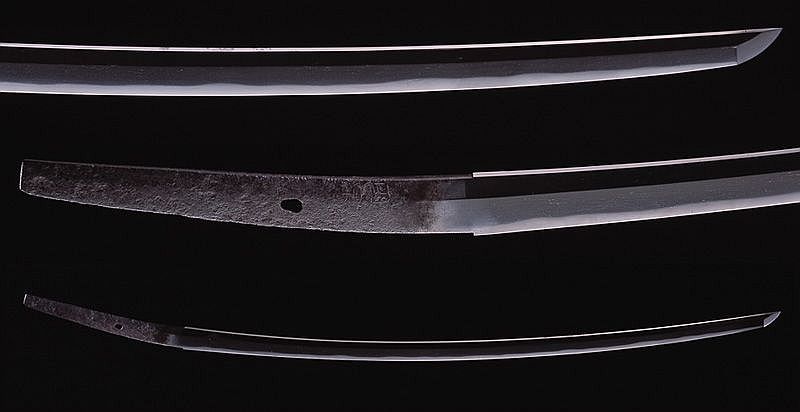
From the Meiji-era sword world

Yesterday we had another very interesting meeting of our Nihonto Club Deutschland which was founded in 2008 and I would like to take this occasion to present a brief article on a sword club from 125 years before.

Around June 2012, Arai Shigehiro (新井重凞), the former president of the Kyôto branch and former board member of the NBTHK, presented the association with a rare document (33,3 x 24,2 cm, 26 pages), namely the articles of the kantei club Hôryûsha (宝隆社) founded in Meiji 16 (1883). This document is insofar also very interesting as it shows us that such clubs were founded just six years after the ban on swords. Article 1 also shows us that by then, sword experts were fully aware of where the journey has to go, namely to swords being regarded as national treasures and art works. The club was located in Kyôto and the document lists three founding members, namely Nose Kakuemon (能勢角右衛門), Kishimoto Gensuke (岸本源助) and Tsujimoto Shigeyuki (辻本繁之). Kishimoto Gensuke and his son Shônosuke (岸本正之助, might also read „Masanosuke“), who is found in the Hôryûsha member´s list, runned the sword shop Kusanaginoya (草薙廼舎) which was famous as being purveyor of the imperial family in terms of swords since the end of the Edo period. By the way, Satô Kanzan published in 1973 the book „Kusanaginoya-oshigata“ (草薙廼舎押形) which bases on the vast oshigata collection of Kishimoto Kannosuke (岸本貫之助), Gensuke´s adopted son. Kannsouke was also a member of the executive board in the early days of the NBTHK. Well, the Hôryûsha was eventually dissolved and basically continued by the sword clubs Kurotani Tokenkai (黒谷刀剣会) and Gosho-Hachiman Tokenkai (御所八幡刀剣会), and with the establishment of the NBTHK, it finally merged into its Kyôto branch. In the following I want to share the articles of association of the Hôryûsha kantei club:

Articles of Association

1. Swords are treasures of our nation. Apart from the fact that they must be treated with utmost care, discussions on the quality of a smith and his work shall be carried out with a quiet voice.

2. The mutual replies to a bid on a smith might be corrected by Hon´ami Nagane (本阿弥長根).

3. Mumei blades without any of the three Hon´ami certifications origami, soejô or sagefuda shall not be presented for kantei. But mumei blades with ubu-nakago can be brought to the meeting to get an external opinion.

4. Each member is encouraged to bring one blade to the meeting. The kantei blades are presented regardless of their quality.

5. Legendary meibutsu or famous swords from certain families are presented separately at a meeting. But owners who are uncertain of their authenticity can present them as kantei swords to get an external opinion.

6. For the moment, there are six meetings per year. Each year two members are responsible for holding a meeting, taking turns every other second month.

7. Alcohol is prohibited until the end of the meeting.

8. Members should not leave until the meeting has ended.

9. The fee for a meeting which is charged at the very day of a meeting for both members and guests is at the moment 50 sen. [Today about 20 USD]

10. In the event of a „no-show“ or if the member does not cancel his attendance one day prior to the meeting by notifying the member in charge of holding the meeting, the association will charge the aforementioned fee. This rule does not apply in case of emergency or accidents.

11. If a regular meeting is delayed or has to be cancelled because of a member without any particular reason, half of the amount of all the fees of the meeting in question must be paid by this mamber..

12. The participation of guests is with the usual reserve. This does not apply to guests known to members and/or guests announcing their arrival one day prior to the meeting.

13. Swords of guests which should be presented to kantei must be discussed in advance with the member holding the meeting and are accepted with reservation.

14. Entering the association comes with a membership fee of 15 Yen  [today about  600 USD]. But the full amount is immediately returned after holding a meeting or if the person has to leave the association due to extraordinary circumstances.

15. If a member is not able to hold a meeting before he leaves the association, half of the amount of a meeting´s fee is charged. The half of a meeting fee is about 5 to 10 Yen [today about 200 to 400 USD]. Anyway, the final amount might be determined by the founding members and other members.

16. Each member has to follow the articles of association. Otherwise the founding members and other members reserve the right to exclude a member from the association.

17.  For the maintainance of the association, the articles may be changed but each change needs to be discussed by the members in a special session.

Ninth month Meiji 16 (1883), year of the sheep, Hôryûsha

Era name changes in signatures

Well, nengô (年号), the Japanese era names, are well known to every sword enthusiast. And most of you probably also know basically what they were about. But interesting for me was and is how fast the information of a newly proclaimed nengô made the rounds and arrived eventually in the forges of swordsmiths far away from the capital Kyôto. Fortunately there are minute records of when exactly each era was changed in Japanese history and but before I come to my actual examination I briefly want to introduce the practice of nengô, or gengô (元号) how they are also called. As so often, the Japanese nengô system has its origins in China where everything started with the Kengen era (建元, Chinese Jiànyuán ) in the year 140 BC when Emperor Wu of Han (漢武帝) ascended the throne. In Japan, the nengô system was adopted in the course of the Taika Reform in 645 but interrupted a decade later and once again re-adopted in 701 which became the first year of Taihô (大宝, 701). So far, so good. A nengô was basically connected to the ascension of a new emperor but was sometimes also changed due to other felicitous events or natural disasters. The emperor and his court officials now decided what motto the new era should have, picked the appropriate characters, and picked on which day it should come into effect. That means in earlier years, the change in nengô took not automatically place when a new emperor ascended the throne. So the first year of the new nengô (gannen, 元年) continues until the next lunar new year, which is understood to be the start of the nengô´s second year. To give an example: The Bunmei era (文明) came into effect on the 28th day of the fourth month Ônin three (応仁, 1469). Thus 1469 was both Ônin three and Bunmei one. And the other way round, the first year of Bunmei lacks accordingly a first, second and third month as these months lied in the previous Ônin era.

Bureaucracy had always been elaborate in Japan and so the news of the death of an emperor and the proclamation of the start of a new nengô – sometimes even up to two years after the ascension of the next emperor – reached the most distant provinces surely within weeks, or in some cases maybe months. And signatures on swords are also a good way to proof the speed of an era change. To do so, we have to focus of course on the first year of a nengô, the gannen. But also we have to be careful about the custom to date swords by default with the second and eighth month regardless in what month they have actually been made. This „second month eighth month thing“ is said to go back to the auspicious change in season, i.e. from winter to spring in the case of the second month and from summer to fall in the eighth month. At the same time it is said that the water and the air are especially apt for the sword forging process in these months. Others assume that as both the characters for the numbers „two“ (二) and „eight“ (八) have quasi two halves and that these halves allude to the sharpness of a sword which cuts things in half. However, it is interesting to note that the custom of using the second and eighth month regardless of when the sword was forged started about with the Kanshô era (寛正, 1460-1466). That means a trend towards these two months can not be confirmed in Kamakura and Nanbokuchô era date signatures. In short, pre-Ôei (応永, 1394-1428) date signatures show about equally all twelve months.

A good example for the speed the change in nengô made the rounds is a tantô of Osafune Norimitsu (則光) which is dated „Ônin gannen sangatsu-hi“ (応仁元年三月日, „a day in the third month Ôei one [1467]“). According to transmission, the Ônin era was proclaimed by emperor Go-Tsuchimikado (後土御門天皇, 1442-1500) and his court because of repeated severe calamities, namely to come into effect on the fifth day of the third month of the second year of the previous Bunshô era (文正). So as the tantô of Norimitsu is dated with the third month, we learn that the information of the era changed had reached Bizen in the very same month. To remember, Osafune is about 170 km from Kyôto. But the same works also for the way north. For example there exists a katana of Uda Kunimune (宇多国宗) which is dated with the 16th day of the eighth month Chôkyô one (長享, 1487). The Chôkyô era was proclaimed by the same emperor Go-Tsuchimikado for the 20th day of the seventh month Bunmei 19 (文明, 1487) because of the ongoing turmoils initiated by the Ônin War and an epidemic. So Kunimune knew about the change in nengô at the latest after 27 days after it started. His production site was about 250 km from Kyôto. Another example for blades of a smiths around the border between two nengô. There are a katana and a tantô extant by Osafune Sukesada (祐定) of which the katana is dated with the second month Bunki four (文亀, 1504) and the tantô with the second month Eishô one (永正, 1504). The Bunki era was changed by emperor Go-Kashiwabara (後柏原天皇, 1464-1526) to the Eishô era on the 30th day of the second month of its fourth year because the sexagenary circle changed. The latter was namely also a reason to change a nengô because the year it happened was considered as inauspicious. Quasi better have a new era name to counteract the inauspicious cosmological signs. It was namely belieced that one could, in fact, change fortune by changing the motto of an era. Anyway, the two blades show that the katana was made right before, and the tantô right after the change of the nengô.

But sometimes the smiths missed a change in nengô. For example there exists a wakizashi by Osafune Katsumitsu (勝光) which is dated with a day in the sixth month Meiô ten (明応, 1501). But the Meiô era had already been changed by the aforementioned emperor Go-Kashiwabara on the 29th day of the its second month to Bunki (文亀). So Katsumitsu was four months behind with his date signature in question. Of course we also know even „worse“ examples like a wakizashi by Osafune Yukimitsu (幸光) dated with the 15th day of the second month Eiroku 16 (永禄, 1573). But Eiroku had changed to Genki (元亀) about three years before, i.e. in Eiroku 13 (1570). Rare on swords but still existing are the so-called „shi-nengô“ (私年号), unofficial era names popping out here and there throughout Japanese history. They were used locally and by certain institutions like temples and shrines and represent a denial of the ear name established by the emperor, thus they concentrate in periods of political and social unrest. In many cases, just a certain shi-nengô year appears in a text and so we don´t know of most of them how long they actually lasted. One such shi-nengô can be found in a 32-plate suji-kabuto helmet bowl of Myôchin Nobuie (明珍信家) depicted in Matsumiya Kanzan´s (松宮観山, 1686-1780) „Meikô-zukan – zokushû“ (名甲図鑑続集). It is described in the latter publication as bearing the date Hôju ninen kinue-uma shôgatsu-hi“ (宝寿二年甲午正月日, „a day in the first month of the second year Hôju, year of the horse“). The Hôju era seems to have been in use in and around Kai province. It lasted two years and Hôju two was equivalent to Tenbun three (天文, 1534). I wasn´t able to find an oshigata with a shi-nengô on a sword blade yet but I would be very pleased if somebody could provide me with one.

The swords of the Tokugawa-shitennô

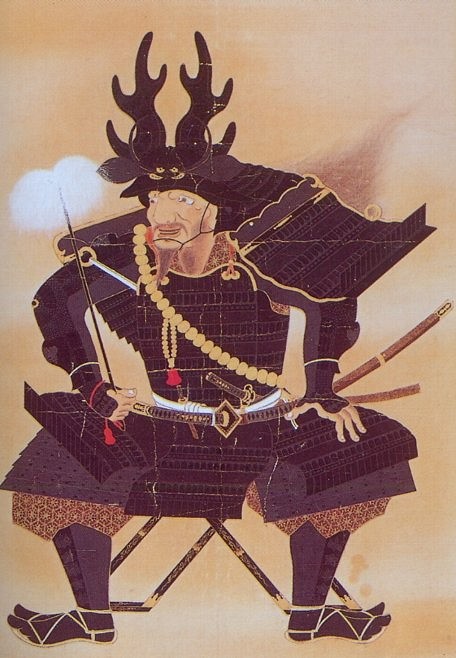
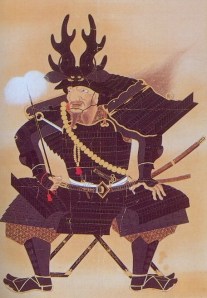
„Tokugawa-shitennô“ (徳川四天王), lit. „Four Heavenly Kings of the Tokugawa“, is a summarizing nickname for four of Ieyasu’s best generals. The term itself alludes to the Four Heavenly Kings (shitennô, 四天王) of Buddhist iconography. In the following, I want to introduce the Tokugawa-shitennô one after another and introduce some of their favourite swords or swords of which we know that they were in their possession.
 sakaiTadatsugu

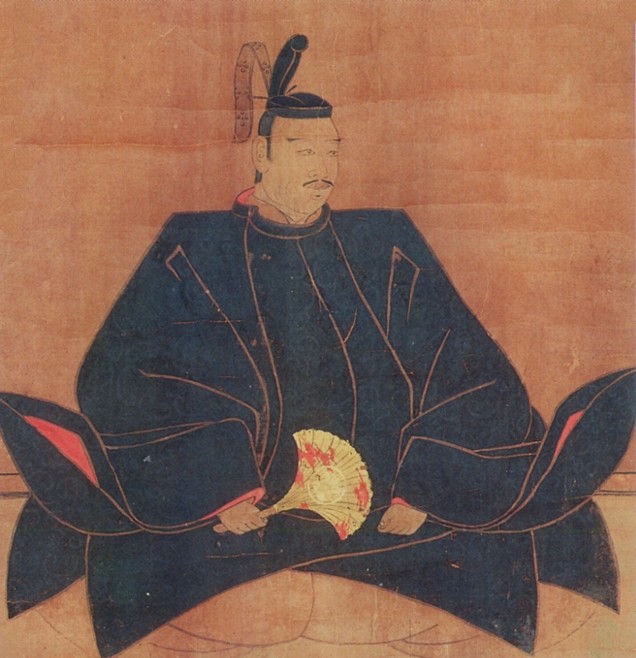
1. Sakai Tadatsugu (酒井忠次, 1527-1596)

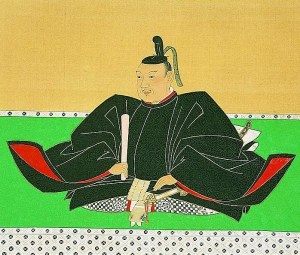
Let´s start with the eldest of the four, Sakai Tadatsugu. Tadatsugu war born in the seventh year of Daiei (大永, 1527) as second son of the Matsudaira-retainer Sakai Tadachika (酒井忠親) in Ida Castle (井田城) in Mikawa province. After coming of age, he served first Tokugawa Ieyasus´s father Matsudaira Hirotada (松平広忠, 1526-1549), the then lord of Okazaki Castle (岡崎城) of Mikawa province. By the way, Tadatsugu was 15 years older than Ieyasu. The latter spent his childhood as so-called „human pledge“ and was raised within the Imagawa family (今川). When he broke with the Imagawa in Eiroku three (永禄, 1560), Tadatsugu changed to the service of Ieyasu and was four years later made lord of Yoshida Castle (吉田城) which was located in Mikawa too. He made himself a naw in the battles of Anegawa (姉川の戦い) in Genki one (元亀, 1570), of Mikatagahara (三方ヶ原の戦い) in Genki three (1572), of Nagashino  (長篠の戦い) in Tenshô three (天正, 1575), and of Komaki and Nagakute (小牧・長久手の戦い) in Tenshô twelve (1584). In Tenshô 16 (1588) he handed over the leadership of the family to his son Ietsugu (酒井家次, 1564-1618) and withdrew to his mansion in the Sakurai district (桜井) in Kyôto where he got a pension of 1.000 koku. He died there on the 28th day of the tenth month Keichô one (慶長, 1596) at the age of 70.

1.1 A tachi of Bizen Sanemitsu (備前真光), kokuhô

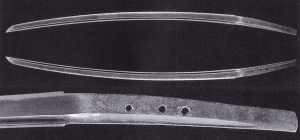
When Oda Nobunaga conquered in Tenshô ten (1582) the provinces of Shinano and Kai and quasi eliminate the Takeda clan (武田), he stopped on his way back at Yoshida to thank Sakai Tadatsugu for his service. He presented him 200 ryô in gold and this highly elegant and magnificent tachi of Bizen Sanemitsu which came in an itomaki-tachi-koshirae. The blade has a nagasa of 76,9 cm, a sori of 2,7 cm, is in shinogi-zukuri, has an iori-mune, a deep koshizori, funbari and an ikubi-kissaki. The kitae is a very densely forged ko-itame with ji-nie, and the hamon is a chôji mixed with gunome with a wide nioiguchi and which is a bit more flamboyant on the ura side. The tang is ubu and bears the niji-mei „Sanemitsu“. It is said the itomaki-tachi-koshirae dates to the time of Nobunaga. It shows a kin-nashiji lacquer saya and the fittings are en suite shakudô with nanako ground and show the takabori-iroe ornamentation of the 3-5-3 kiri crest.
 sanemitsu

1.2 A tachi of Ko-Bizen Nobufusa (古備前信房), kokuhô

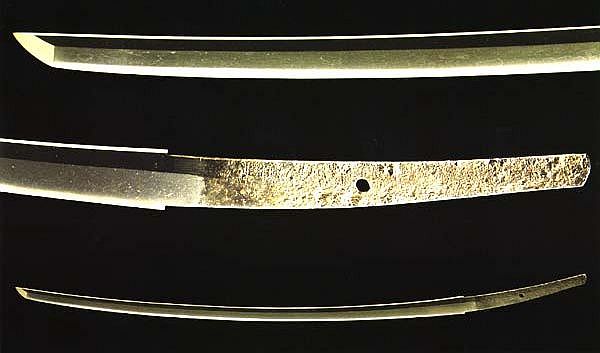
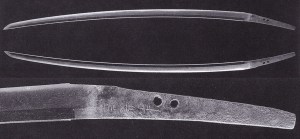
Tadatsugu got this tachi from Ieyasu for his military achievements in the Battle of Komaki and Nagakute. It also comes in an itomaki-tachi-koshirae with a kin-nashiji lacquer saya and en suite fittings with the aoi and kiri crest made by the Shônai-kinkô Yûrakusai Sekibun (遊洛斎赤文), that means the mounting dates to the Edo period. The blade has a nagasa of 76,6 cm, a sori of 2,4 cm and a motohaba of 2,7 cm. It is in shinogi-zukuri, has an iori-mune, a deep koshizori, funbari and a ko-kissaki, and so its sugata dates it clearly to the early Kamakura period. The kitae is a somewhat standing-out ko-itame mixed with ko-mokume. There is ji-nie and a faint midare-utsuri and the hamon is a quite nie-loaden mix of ko-chôji and ko-midare with nijûba and kinsuji whereat the yakihaba gets wider towards the tip. The bôshi is a wide yakitsume with hakikake and appears almost as ichimai. The tang is ubu, has a kijimomo-gata, shallow katte-sagari yasurime, a shallow kurijiri and bears the sanji-mei „Nobufusa saku“ (信房作). It is interesting that there were two more  swords of Nobufusa in the possession of the Sakai family. The one is a rather small tachi with the sanji-mei „Nobufusa saku“ which belonged to the Sakai branch which ruled from the mid Edo period onwards the Himeji fief (姫路藩) of Harima province. And the other one was a tachi signed in the very same way which belonged to the Sakai branch which ruled the Obama fief (小浜藩) of Wakasa province.
 Nobufusa

1.3. A katana of Masazane (正真)

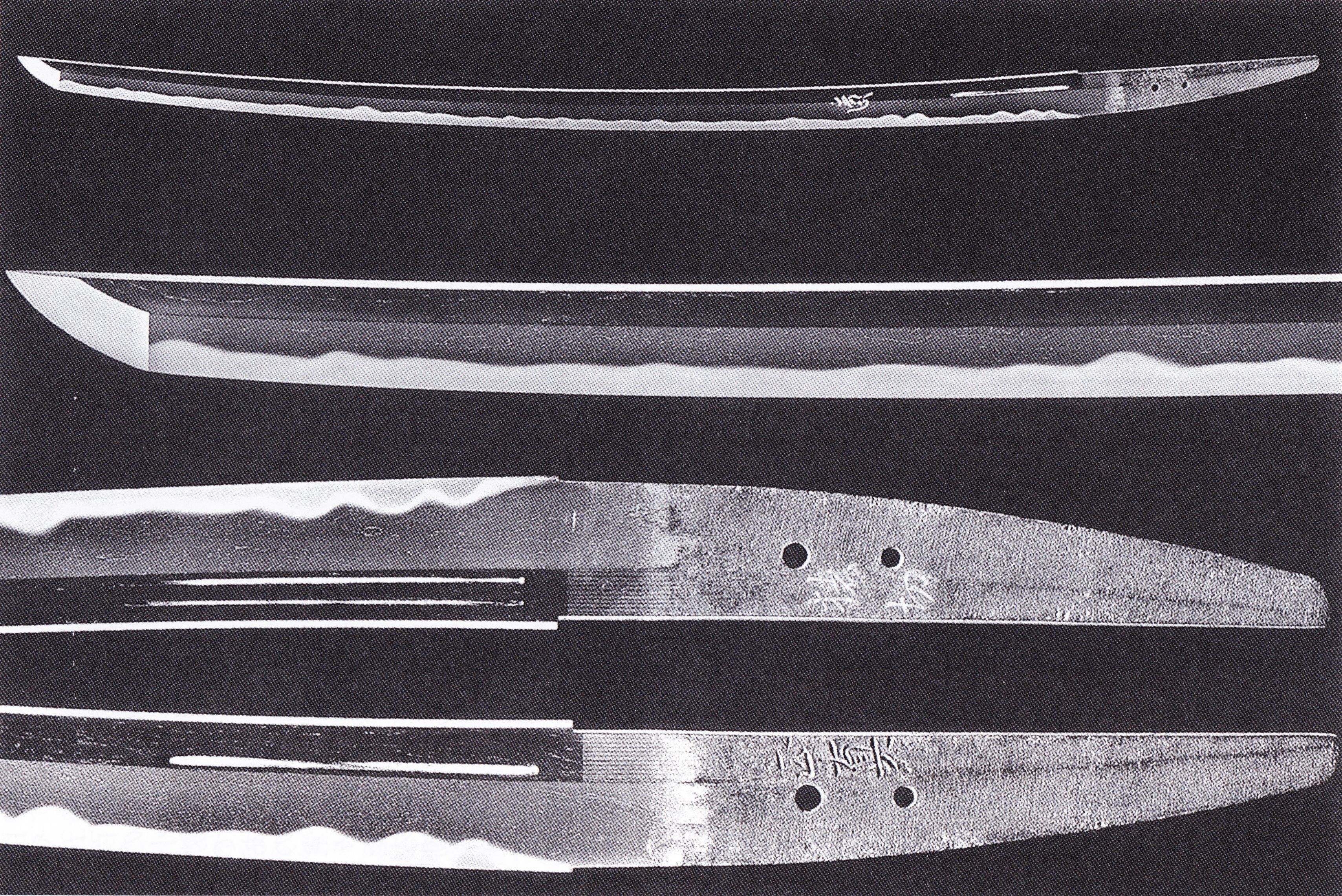
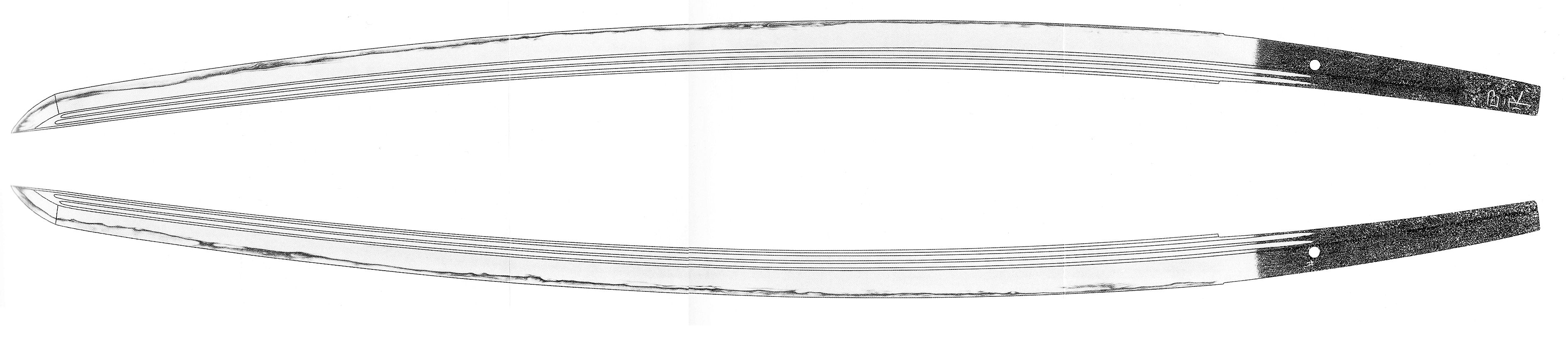
I have introduced this katana, the so-called „Inoshishigiri“ (猪切), some months ago in this article.
 Inokiri

1.4 The yari „Kametôshi“ (瓶通し)

According to transmission, Tadatsugu killed with this yari an opponent whi was hiding behind a large water jug (mizukame, 水瓶・水甕), namely by piercing (tôshi, 通し) the entire jug and the person behind. This earned the blade the nickname „Kametôshi“. It is said that it was a hira-sankaku-yari of Heianjô Yoshifusa (平安城吉房) with a nagasa of 21,2 cm but the whereabouts of the famous piece are unknown. But the yari must had been quite famous as there were several utsushimono made in the Edo period which all mention the provenance in the signature, namely in the way: „Mo Sakai Saemon no Jô Kametôshi-yari“ (模酒井左衛門尉瓶通槍), „made modelled on (mo, 模) the Kametôshi-yari of Sakai Saemon no Jô.“ Some of these copies are still in the possession of the Sakai family.

1.5 A tachi of Tegai Kanenaga (手掻包永し), jûyô-bijutsuhin

This tachi was in the possession of the Shônai-Sakai family since the Edo period. It has a nagasa of 70,9 cm, a sori of 2,1 cm and a motohaba of 2,9 cm. The blade is also featured in my latest publication Kantei Supplement 2. With the extant signature at the very end of the tang, we can calculate an original nagasa of about 83 cm. The kitae is a dense and beautifully forged itame with nagare towards the ha. Especially the haki-omote side shows many areas of a very densely forged hada. In addition, there is plentiful of ji-nie and chikei. The hamon is a rather low and slightly undulating notare-chō to suguha with hotsure, uchinoke, kuichigaiba, nijūba, yubashiri, sunagashi and kinsuji. The nioiguchi is wide, bright, clear and very nie-loaden, and the yakiba gets somewhat wider in the monouchi area. The bôshi shows much hakikake, tends to kaen, and runs out as yakitsume. Incidentally, the futasuji-hi are untypical for Kanenaga but the accompanying documents to the blade show us that they were once added in Kansei eight (寛政, 1796) by the Hon´ami family, namely on orders of the Sakai family.
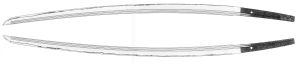
 Kanenaga

HondaTadakatsu

2. Honda Tadakatsu (本多忠勝)

Tadakatsu was born in Tenbun 17 (天文, 1548) as oldest son of Honda Tadataka (本多忠高) in Kuramae (蔵前) in Mikawa province. He served Ieyasu since his youth and participated in his first battle at the age of twelve (or 13 according to the Japanese way of counting years), namely in Eiroku three (永禄, 1560) on the occasion of an initiating fighting to the Battle of Okehazama (桶狭間の戦い). He took his very first head at the age of 15, namely those of the Imagawa-general Ohara Bizen (小原備前). Later he participated in numerous battles, among others those of Anegawa, of Hitokotosaka  (一言坂の戦い) in Genki three (元亀, 1572), of Mikatagahara, of Nagashino, and of Komaki and Nagakute. After Sekigahara, which he fought of course at the side of the Tokugawa, he received the Kuwana fief (桑名藩) of Ise province which had an income of 100.000 koku. He handed over the control of the fief to his son Tadamasa (忠政, 1575-1631) in Keichô 14 (慶長, 1609) and retirned, but died shortly later, namely on the 18th day of the tenth month of the following year at the age of 63.

2.1 The meibutsu Kuwana-Gô (桑名江), jûyô-gunkazai

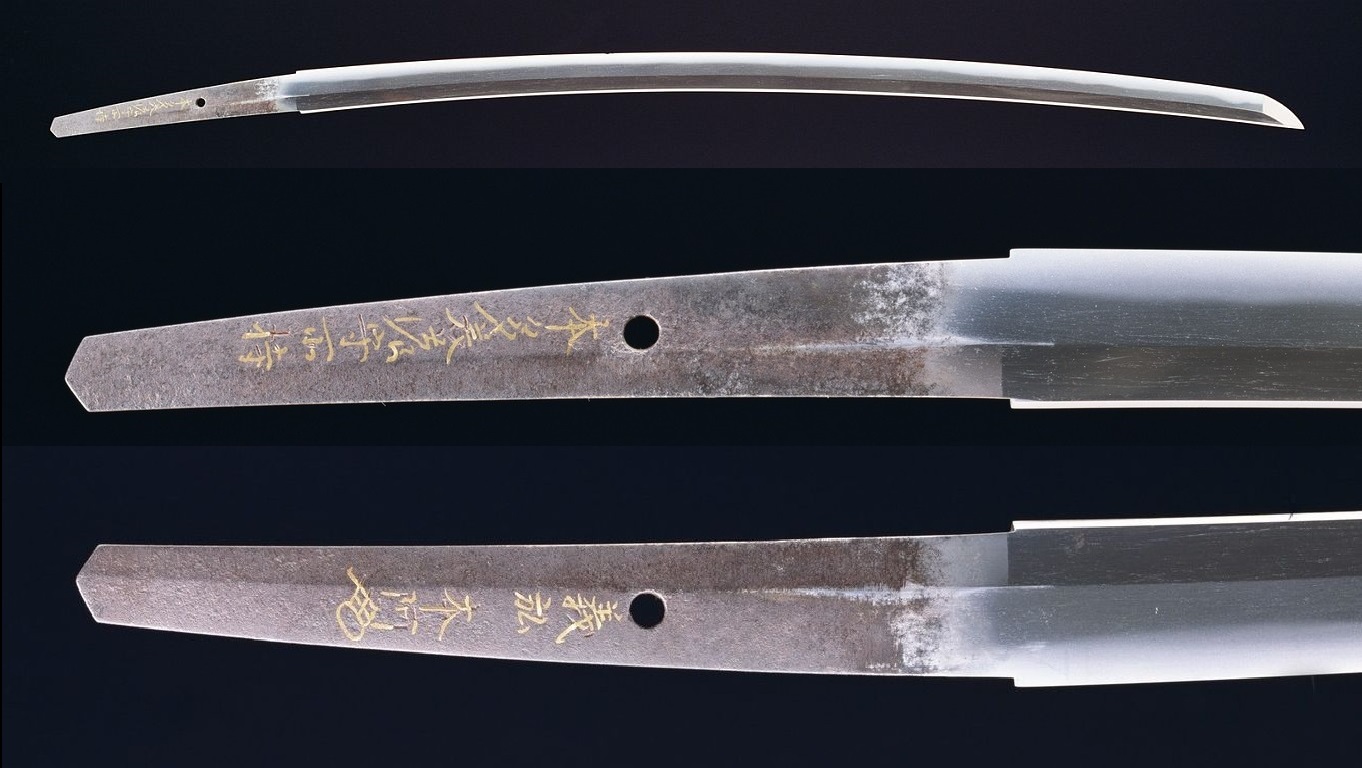
According to transmission, Tadakatsu´s son Honda Mino no Kami Tadamasa participated once in a falcon hunt when he decided to take a break at the house of a local man. This house had a special room marked with gohei streamers where a special sword was worshiped. Tadamasa asked the owner about the sword and he said that each family that had preserved that sword so far was free of vices and sins. He was eventually allowed to inspect the blade hands on and after some negotiations, he bought it from the man for an unknown sum. As the blade was ô-suriage and thus mumei, Tadamasa had it appraised by Hon´ami Kôtoku (本阿弥光徳) who attributed it to the famous master Gô Yoshihiro (郷義弘). And the appraisal was inlayed in gold on the tang via the kinzôgan-mei „Yoshihiro Hon´a + kaô“ (義弘本阿) and on the ura side „Honda Mino no Kami shoji“ (本多美濃守所持, „in the possession of Honda Mino no Kami“). Henceforth the nickname of the sword was „Kuwana-Gô“ as Tadamasa was the lord of Kuwana fief. By the way, (江) is another, shorter way to note Yoshihiro´s name „Gô“ (郷). The blade has a nagasa of 69,4 cm, a sori of 2,0 cm, is in shinogi-zukuri, has an iori-mune, and a normal mihaba and kasane. The kitae is a ko-itame with plentiful of ji-nie and magnificent chikei which tends a little to masame. The hamon is a ko-notare mixed with gunome whose wide, bright and clear nioiguchi is quite ko-nie-loaden and shows some kinsuji. The bôshi tends to ichimai what is typical for Gô Yoshihiro.
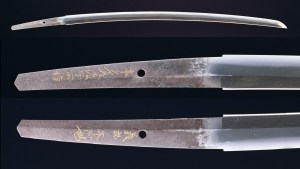
 KuwanaGo

2.2 The yari „Tonbôgiri“ (蜻蛉切)

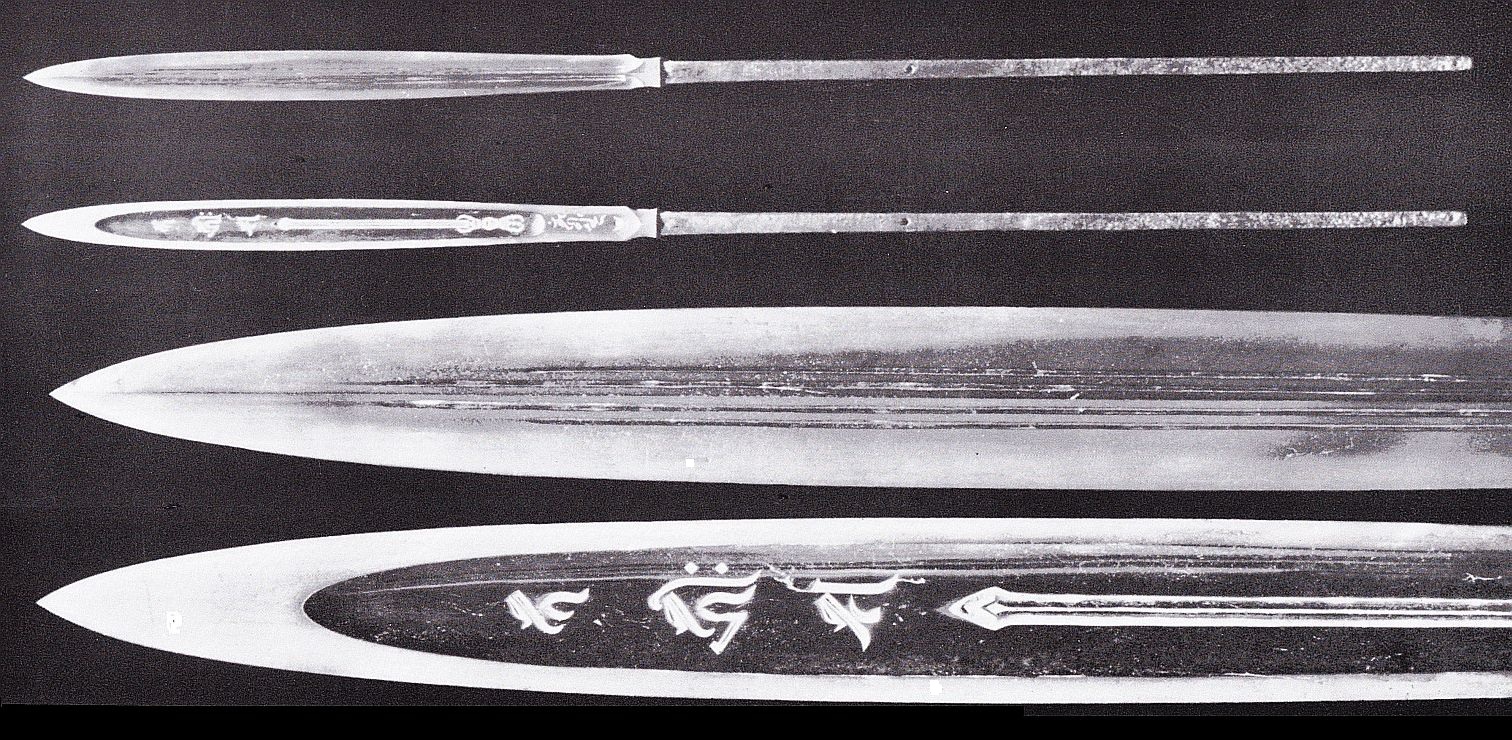
At Komaki and Nagakute, the 35.000 men army of the Tokugawa-Oda alliance faced a twice as strong army of Hideyoshi. When Hideyoshi learned on the ninth day of the fourth month Tenshô twelve (1584) that a part of his army had lost the Battle of Hakusanmori (白山林の戦い), he ordered 20.000 of his men to the close river of Ryûsenji (竜泉寺). Honda Tadakatsu faced him there with only 500 warriors and he was so brave as stopping his horse inmidst the river, only about 500 metres in front of Hideyoshi, to let it calmly drink. His aim was to delay Hideyoshi´s attack on his lord Ieyasu and succeeded with this daring manoeuvre. At that time, Tadakatsu wore his famous helmet with the deer antlers and the spear Tonbôgiri with a 6 m long shaft. Incidentally, he had it later shortened to 90 cm when he gew older. The nickname goes back to the story that once a dragonfly (tonbô, 蜻蛉) tried to land on the blade of the spear but was cut in half. The spear itself is a work of the same Masazane (正真) who made the aforementioned Inoshishigiri. The blade has a nagasa of 43,7 cm and a nakago length of 55,6 cm. The hi shows a relief of a bonji and a sankozuka-ken.
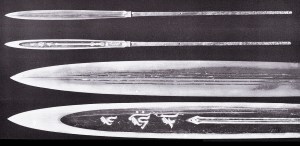
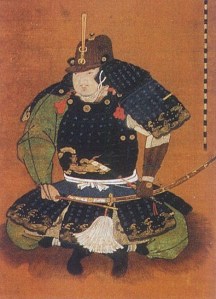
 tonbogiri

SakakibaraYasumasa

 3. Sakakibara Yasumasa (榊原康政)

Yasumasa was born in Tenbun 17 (天文, 1548) as second son of Sakakibara Nagamasa (榊原長政) in the Ueno district (上野郷) of Mikawa province. He came into the service of Ieyasu quite early, namely as one of his pages. Later and for his outstanding achievements in the crushing of the Ikkô-Ikki rebels (一向一揆) of Mikawa province, Ieyasu granted him his character for „yasu“. Before he was just called „Koheita“ (小平太). Yasumasa too participated successfully in the battles of Anegawa, Mikatagahara, Nagashino, and Komaki and Nagakute. He criticized Hideyoshi´s quasi annexation of the Oda clan after Nobunaga´s death in 1584 whereupon Hideyoshi placed a bounty on his head in the height of 100.000 koku. In Tenshô 18 (天正, 1590), Yasumasa leaded Ieyasu´s vanguard at the siege of Odawara Castle (小田原征伐) and when his lord was transferred to the Kantô region in the very same year, Yasumasa was made lord of Tatebayashi Castle (館林城) in Kôzuke province. He restructured the surrounding land and turned it into the Tatebayashi fief of the same name which had later an income of 100.000 koku and remained in the possession of the Sakakibara family even after Sekigahara. Yasumasa also died there, namely on the 14th day of the fifth month Keichô eleven (慶長, 1606) at the age of 59.

3.1 The meibutsu „Ishida-Sadamune“ (石田貞宗), jûyô-bunkazai

There is the legend that Ieyasu showed mercy with Ishida Mitsunari (石田三成, 1559-1600) after winning Sekigahara and that he hid him at Sakakibara Yasumasa where he got old and died a natural death. For this great favour an maintaining strict silence, he presented Yasumasa with a sunnobi-tantô of Sôshû Sadamune. However, the more common transmission says that Mitsunari gave the sword in question as a memento to his friend Tanaka Yoshimasa (田中吉政, 1548-1609) who namely found and arrested him when he hid in Ômi province after his defeat at Sekigahara. But it remains unclear how the sword came in this version from the Tanaka into the possession of the Sakakibara family. Anyway, the blade has a nagasa of 31,2 cm, a sori of 0,5 cm, is in hira-zukuri and has a mitsu-mune. The kitae is a standing-out itame with plentiful of ji-nie and quite prominent chikei. The hamon is a Sadamune-typical ko-notare in ko-nie-deki with a wide nioiguchi and plentiful of kinsuji. The bôshi is in midare-komi with hakikake and a rather long running-back kaeri. The omote side shows a bonji, a rendai, a kuwagatga and a suken, and the ura side a bonji and gomabashi. The tang is ubu, mumei, has a funagata and a kengyô-jiri. The koshirae is a work of the early Edo period.
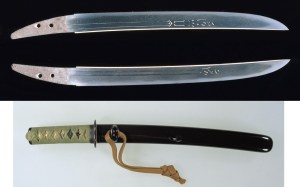
 Sadamune

3.2 A tachi of Rai Kuniyuki (来国行)

A transmission says that the favourite sword of Yasumasa was a 73,3 cm long tachi of Rai Kuniyuki which he got as a present from Ieyasu for his military achievements. One theory assumes now that this was the meibutsu „Fudô-Kuniyuki“ (不動国行) which I have introduced recently in this article. As the Fudô-Kuniyuki was since the Battle of Komaki and Nagakute a heirloom of the Tokugawa family, the only way the mentioned theory could work is that Ieyasu had presented the sword to Yasumasa but the latter, or the Sakakibara family, gave it later as a return gift to the Tokugawa.

3.3 A katana if Motoshige (元重)

Records show us that Ieyasu presented a katana of Bizen Motoshige to Yasumasa on the 25th day of the eleventh month Keichô eight (1603) together with two yari of a not further described Kunitsuna (国綱) and a raise of his salary by 5.000 koku. Unfortunately, the blade suffered a fire damage at an earthquake in Ansei two (安政, 1855) but was successfully rehardened.

3.4 A sasaho-yari

According to extant records, Yasumasa received this yari in Tenshô twelve (1584) on the occassion of the Battle of Komaki and Nagakute. It is a hira-sankaku sasaho-yari with a nagasa of 19,1 cm. It is said that the shaft was originally 1,8 m long. The blade is signed „Morinaga“ (守長) and is still in the possession of the Sakakibara family.
 IiNaomasa

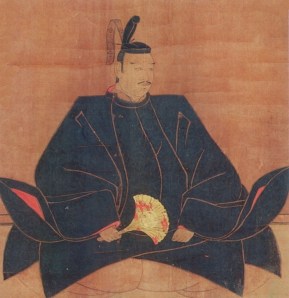
4. Ii Naomasa (井伊直政)

Naomasa was born on the 19th day of the second month Eiroku four (永禄, 1561) as oldest son of the Imadegawa-retainer Ii Naochika (井伊直親) in Iinoya (井伊谷) in Tôtômi province. That means he was the only one of the four Tokugawa-shitennô who came not from Mikawa. When his father was executed because of a false accusation in Eiroku five (1562), the situation of the Ii family was unclear until Naomasa became Ieyasu´s page in Tenshô three (天正, 1575) and the decision was made that the Ii lineage should be continued. Naomasa showed a great political talent when he was acting as messenger at the peace negotiations of the Tokugawa with the (北条) after the Tenshô-Jingo Incident (天正壬午の乱) in Tenshô ten (1582). After Ieyasu annexed the former Takeda lands in Shinano and Kai, he gave Naomasa the command over the elite troops „Ii no Akazonae“ (井伊の赤備え, about „the Red Ii“) or also called „Ii no Akaoni (井伊の赤鬼, „the Red Ii Devils“), which were as the name suggests equipped with red-lacquered armours. Two years later and at the Battle of Komaki and Nagakute, Naomasa was able to make himself a name as leader of this troop and in Tenshô 18 (1590), he leaded his men at the siege of Odawara Castle in an unequalled night attack where they were able to enter the castle grounds. When Ieyasu was transferred to the Kantô region, Naomasa became castellan of Minowa (箕輪城) in Kôzuke province and was thus in the possession of the lands with the highest income (120.000 koku) amongst all Tokugawa retainers. At Sekigahara he was hit by a bullet in his right arm and fell of his horse but insisted to participate until the battle was over. For his service and achivements, he received the Sawayama fief (佐和山藩) of Ômi province worth 180.000 koku which was before ruled by Ishida Mitsunari. But he died shortly later, namely on the first day of the second month Keichô seven (1602).

4.1 A tachi of Bizen Kunimune (備前国宗), jûyô-bunkazai

Naomasa got this tachi from Ieyasu in Tenshô 18 (1590) for his military achievements at the Siege of Odawara. Later his descandants offered the sword to the Ii-jinja (井伊神社) in Ômi province which was erected to honour Naomasa, but the shrine returned it to the Ii family after World War II. It became kokuhô in 1922 but received later „just“ the status jûyô-bunkazai after the re-submittal in the course of the new system. The blade has a nagasa of 70,0 cm, is in shinogi-zukuri, has an iori-mune, is rather slender and has a deep koshizori. The kitae is a very densely forged ko-itame with ji-nie and a midare-utsuri. The hamon is a suguha with ko-ashi and a relative tight nioiguchi, and the bôshi is sugu too with a roundish kaeri. The tang is ubu and bears quite high and towards the nakago-mune a rather small niji-mei. The blade is attributed to the 2nd generation Kunimune, i.e. to the son of Saburô Kunimune (三郎国宗).
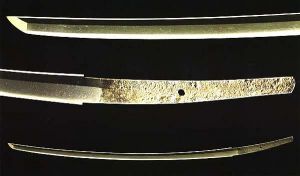
 KunimuneBizen

4.2 A tachi of Hôki Kunimune (伯耆国宗), jûyô-bunkazai

This blade is also ubu and signed „Kunimune“ but is not a work of Bizen-Saburô but of Hôki Kunimune. It has a nagasa of 79,0 cm, a sori of 2,9 cm, a deep koshizori and funbari. The kitae is a standing-out itame with ji-nie and chikei and the hamon is a quite ko-nie-loaden suguha-chô mixed with ko-midare, kinsuji and sunagashi. The nioiguchi is subdued and the bôshi is midare-komi with a ko-maru-kaeri.
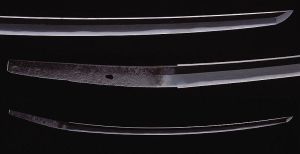
 KunimuneHoki

Stages in Yasuchika´s life

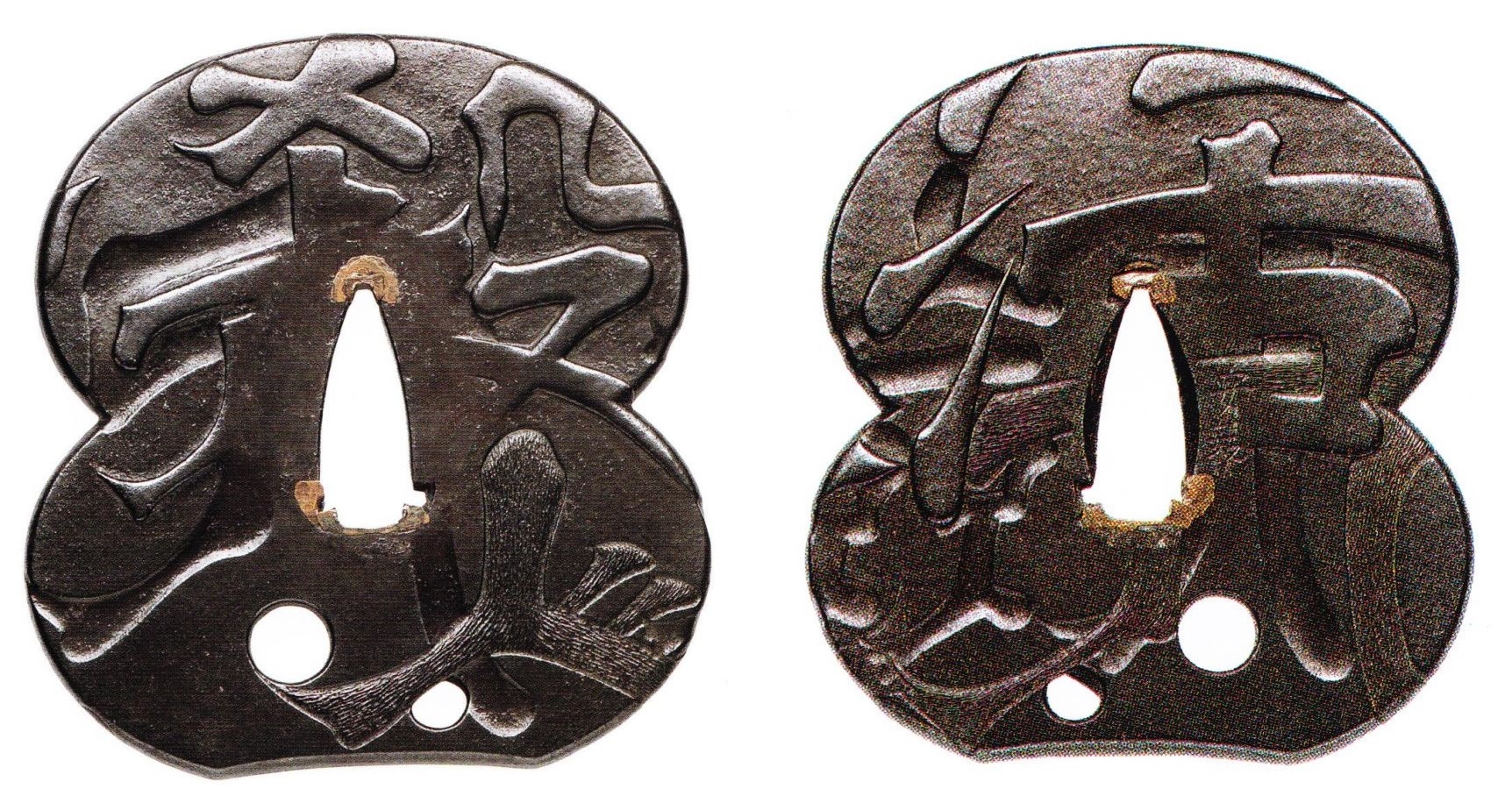
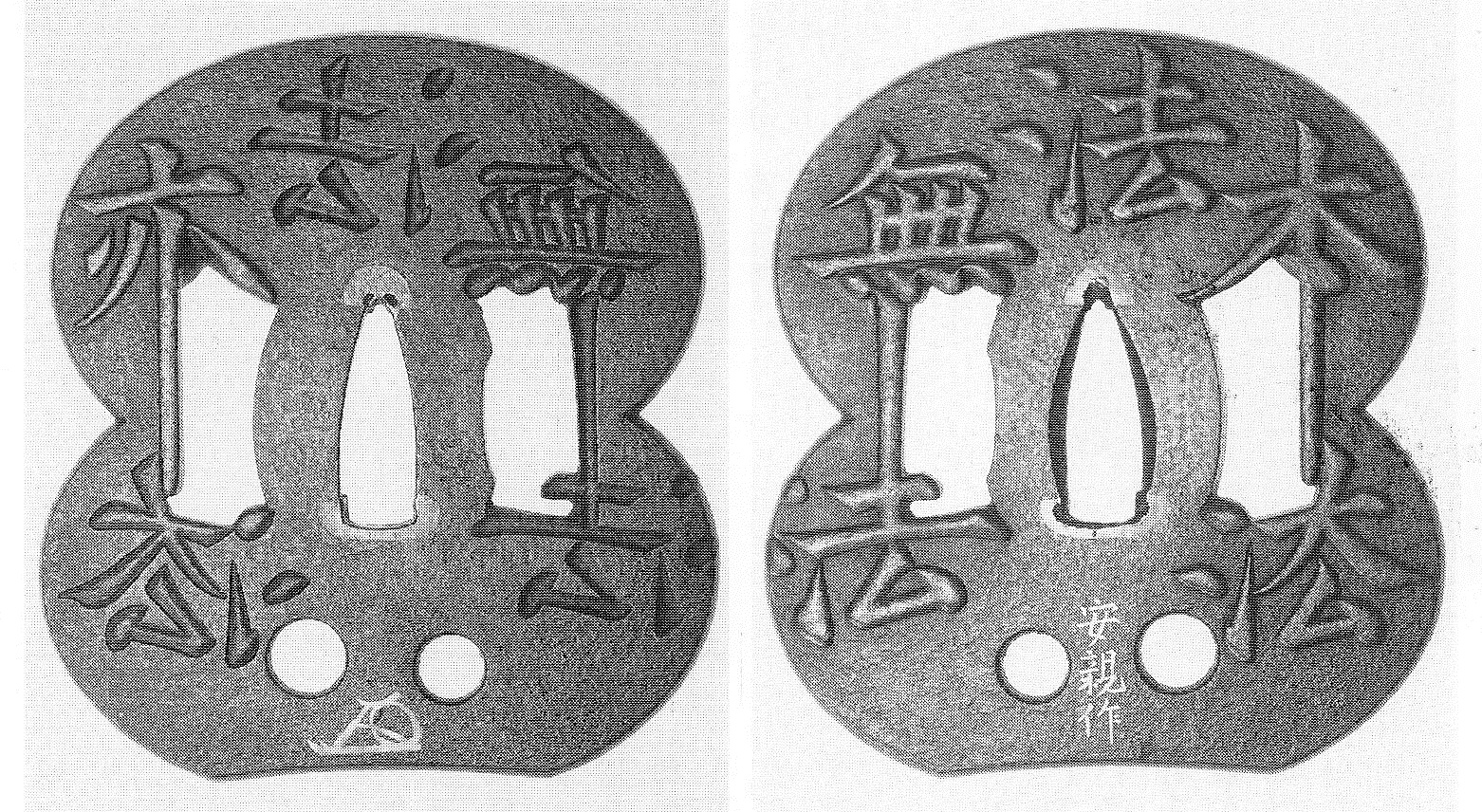
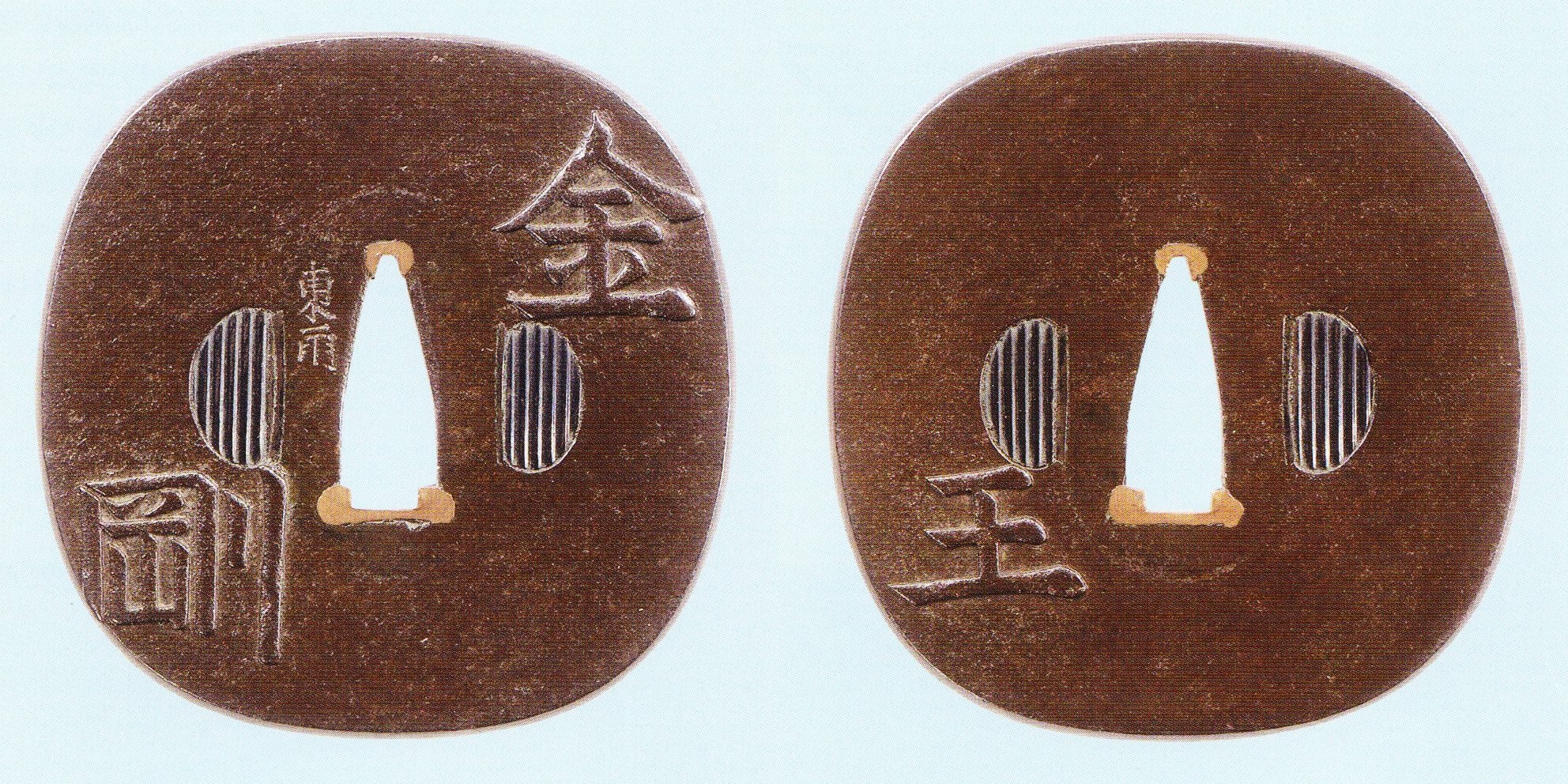
This time I want to tell from different stages of Yasuchika´s life, namely illustrated by a selection of a few tsuba which show characters as motif. Yasuchika was born in the tenth year of Kanbun (寛文, 1670) as son of Tsuchiya Chûzaemon (土屋忠左衛門) who was a retainer of Dewa´s Shônai fief (庄内). His first name was „Yagohachi“ (弥五八) and with his coming of agem he entered the service of the Matsudaira-Naizen family (松平内膳), who were the elder (karô, 家老) of the Sakai family (酒井). The Sakai were the daimyô of the Shônai fief by the way. But on the side, he entered an apprenticeship as a kinkô artist with the local Shônai-Shôami artist Satô Chinkyū (佐藤珍久). When he realized that metalwork was his thing, he resigned from his bushi status, married the daughter of his master and became an independent kinkô. In the 16th year of Genroku (元禄, 1703) – he was 34 years old at that time – he left his wife and children under the care of his father-in-law and went to Edo to refine his craft under the guidance of Nara Tatsumasa (奈良辰政). This step might be connected to the fact that Chinkyû himself had studied under a Nara master, namely under Toshiharu (利治), who was in turn the master of Tatsumasa. According to transmission, Yasuchika lived at the house of a relative at that time, namely Tsuchiya Hanbei (土屋半兵衛), in Edo´s Kanda district. But the house fell victim of both fires in the 16th year of Genroku (1703) and in the second year of Hôei (宝永, 1705). So Yasuchika went to Shinano province for some years to work for the Suwa shrine (諏訪神社). But, by the latest with Hanbei´s death in Hōei four (1707), he had returned to Edo to continue his profession as a kinkô artist.

Some time later he had to bear a serious blow when he learned in Edo of the death of his wife. He hadn´t been in Shônai for more than ten years by then. But he was able to take his mind off his worries by work when he was employed in the later years of the Shôtoku era (正徳, 1711-1716) by Matsudaira Daigaku no Kami Yorisada (松平大学頭頼貞, 1664-1744). Just about ten years earlier, to be more precise in Genroku 13 (1700), Yorisada had been transferred from the Nukada fief (額田藩) of Hitachi province to Moriyama (守山藩) in Mutsu province which had become officially an independent fief whith his entry. The fief was rather small and had an annual income of 20.000 koku. Well, Moriyama was actually regarded as a so-called “shihan” (支藩), a quasi “branch fief” of another fief ruled by a different line of the same family. In our case, the Matsudaira were as we know related to the Tokugawa. So Moriyama was under the supervision of the influental Mito fief. That means that the daimyô stayed permanently in the Edo mansion and was exempt from commuting between the latter and the fief in the course of the sankin-kôtai system. The Moriyama-Matsudaira mansion was located in the Ôtsuka district (大塚) of Edo and covered a 20,46 ha large area. As the wind was blowing up constantly from the lower southwestern districts of Edo, the mansion was also called Fukiage-tei (吹上邸, about “upward wind mansion”). So Yasuchika worked from this mansion and this employment with Yorisada was very beneficial to Yasuchika´s artistic development and very individual pieces date back to that stage in his career, for example the peculiar daigaku tsuba shape named after Yorisada´s honorary title “Daigaku no Kami. The two tsuba introduced below show such a daigaku-gata. And thus we arrive at the first two pieces through which I want to illustrate this stage in his life.

 yasuchika1a

The first tsuba is inspired by fencing philosophies and shows in sukidashi and sukisage-bori the well-known phrases “katsujinken” (活人剣) and „satsujintô“ (殺人刀), also pronounced as „katsuninken“ and „satsunintô“, i.e. the „life-giving sword“ and the „death-dealing sword“ respectively. Mostly the katsujiken-satsujintô phrase is used to describe the process of mastering the art of swordsmanship, i.e. to come to a point where you have the freedom to decide if to kill or not or if to use your sword just to kill others or help them by dealing with their „problems“. But the phrase has a much deeper meaning which goes back to „Mumonkan“ (無門関), the collection of Zen kôan compiled by the monk Mumon Ekai (無門慧開, 1183-1160). Chapter 11 is about the Zen master Jôshû Junshin (趙州従諗, 778-897) who visits two enlightened monks which already had retreated to their hermitages. According to the „Mumonkan“, he tested them by entering their cottages and asking „Anybody there?“ The monk raised his fist but Jôshû replied: „The water is too shallow to anchor here.“, what means about „there is not much enlightenment to find for me in here.“ But at the second monk and after the very same procedure, Jôshû replied after the monk had just raised his fist: „Free to give, free to take, free to kill, free to save,“ and made a deep bow. So Jôshû tested the mental states of enlightenment of the monks, that means if his reaction showed any hints of irritation by his question „Anybody there?“, Jôshû knew that this monk was not that deeply enlightened. But Mumon Ekai suggested on the other hand, that the monks were testing Jôshû. So they know that he was going to ask something like that and tested him by seeing his reaction after they just raised their hands. This situation is described as if two mirrors are reflecting each other. The goal of this kôan teaching is to go quasi once through the entire process of thinking into both Jôshû and the monks, followed by a transcending of all of this. And as it is common for the end of each chapter, Mumon forwards a little poem to this kôan which goes: „The eye like a shooting star, the spirit like a lightning; a death-dealing blade, a life-giving sword.“ In short, if you are truly enlightened, you can look through someones mind super fast and you have the power to either show him immediately that he is not enlightened, or help him with the right single word to get enlightened.

 yasuchika1b

Now to the next tsuba. This one shows again in sukidashi and sukisage-bori the characters (法本法無法・無法法亦法) which read: “hô wa moto hô to shite muhô nari, muhô mo hô to shite mata hô nari.” It basically means: “The laws of Buddha (Dharma) were initially not (profane/worldly) laws in the proper meaning of the word, but they eventually became laws (as they turned out to be “right”).” It is said that Shakyamuni Buddha told this his principle disciple Mahākāśyapa (Japanese „Makashô“ [摩訶迦葉] or „Daikashô“ [大迦葉]). Later many Buddhist reformers like Hônen (法然, 1133-121) and Nichiren (日蓮, 1222-1282) used this teaching of Shakyamuni to justify their reforms.

So the choice of phrases for these two tsuba made during the time he worked for Matsudaira Yorisada give us a deep insight into this employment relationship. It is namely assumed that the well-educated daimyô Yorisada initiated Yasuchika to certain classical subjects. As mentioned, this employment was very beneficial to Yasuchika´s artistic development, namely not only because of the fact that he got many orders and was able to refine his craft, but more of a philosophical nature. He got in touch with Buddhist teachings and history and probably struggled with Zen kôan himself. It is namely hardly conceivable to assume that he didn´t think about the meaning of the motif he was working on over days, weeks or even months. So maybe the tsuba with the katsujiken-satsujintô alludes to him testing Yorisada or to the other way round, or maybe they were likeminded on their way to enlightenment so that they experienced this mentioned „two mirrors reflecting each other“ situation.

 yasuchika1c

But let us continue with his career. Yasuchika quit namely voluntarily this employment to work even more independently. In the meanwhile, his son Yaichirô (弥一郎) was 22 years old and so he had him come to Edo. Yasuchika married again and moved to Kanda where he trained his students. At this time – pushed by orders of famous daimyô families like the Arima (有馬) and Tsugaru (津軽) – most of his famous jûyô-bunkazai and jûyô-bijutsuhin masterworks were created. That means he had attained artistic maturity by that time. In the 15th year of Kyôhô (享保, , 1730) he entered priesthood at the age of 61 and called himself henceforth „Tô´u“ (東雨, lit. “Eastern Rain”). He handed-over the management of the family and his name „Yasuchika“ as well as his first name „Yagohachi“ to his son Yaichirô. In Genbun three (元文, 1738) his second wife died and from extant letters to his kinkô colleague Watanabe Arichika (渡辺在哉), who worked in his homeland Shônai, we learn that Yasuchika often had to stay in bad due to his bad physical condition. And in these hard times, the last tsuba was made which I want to introduce representative for his latest years. It is as indicated no longer signed “Yasuchika” but “Tô´u” and shows on a very gentle nadekaku-gata, by making use of much free space, the three elegantly interpreted characters “Kongô´ô“ (金剛王). Kongô´ô can either be the abbreviation of „Kongô-yasha-myôô“ (金剛夜叉妙王, sanskrit „Vajrayakṣa“), one of the „Sixteen Great Bodhisattva“ and one of the „Five Great Myôô“, or of the Bodhisattva „Kongô-za´ô“ (金剛蔵王), one of the most important deities of the practitioners of shûgendô (修験道). So it is possible that Yasuchika increasingly turned towards Buddhism when he fell ill, namely as support for his prayers for health and inner peace, as spiritual backing for keeping-off demoniacal hindrances (mashô, 魔障) during meditation. The brush strokes are much more unobtrusive as on the two tsuba in daigaku-gata. Everything, i.e. the color, shape, and the arrangement and interpretation of the motif is much more cut back, a look which is so typical for the tsuba from his later Tô´u phase. Anyway, Yasuchika died six years after his second wife, namely on the 27th day of the ninth month of Enkyô one (延享, 1744), at the age of 75.

yasuchika1d


The contestant Nobukuni Shigekane

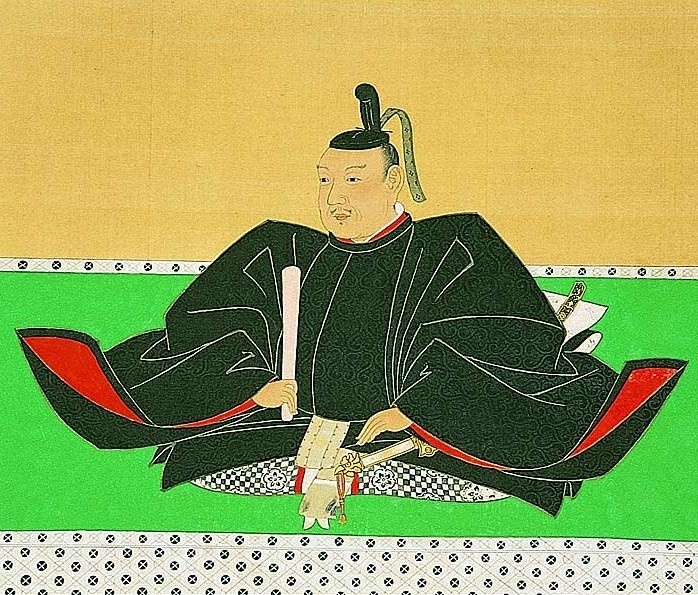
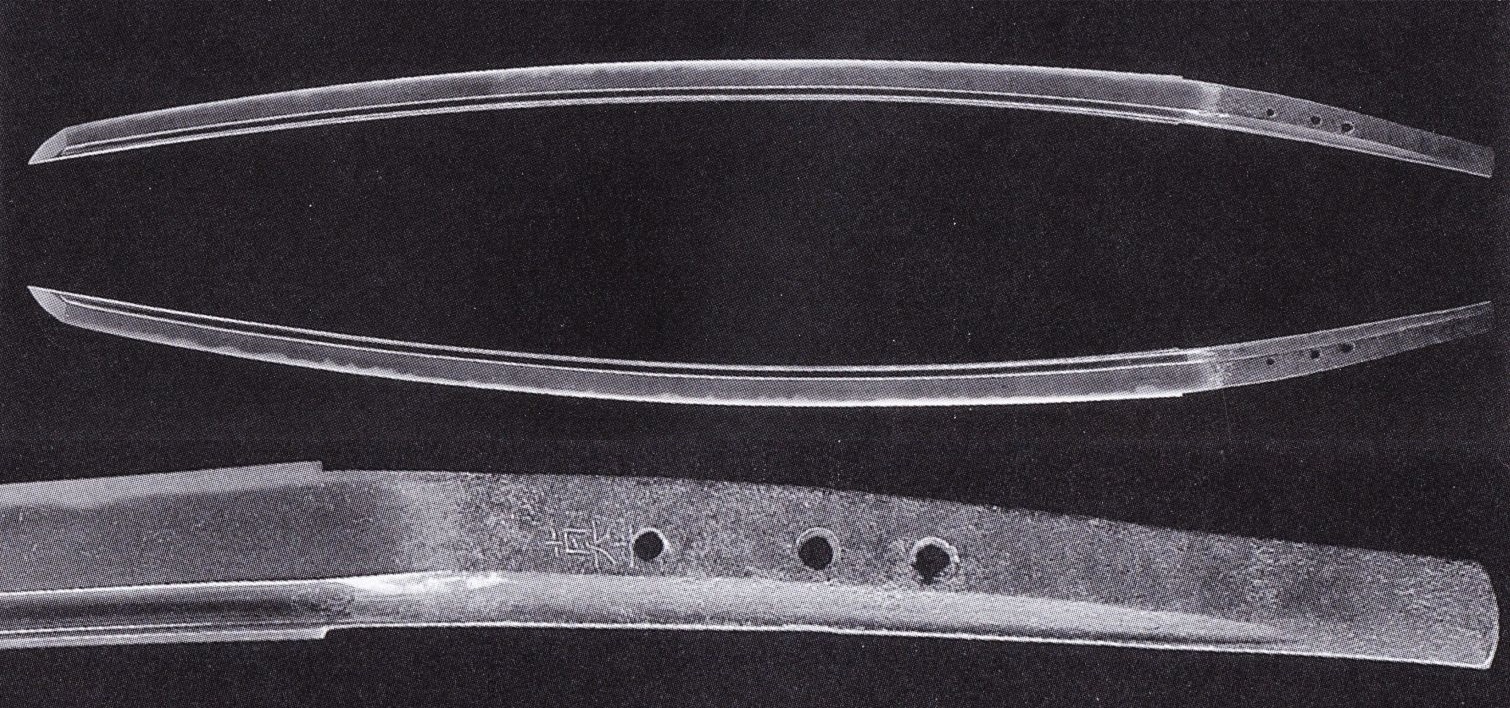
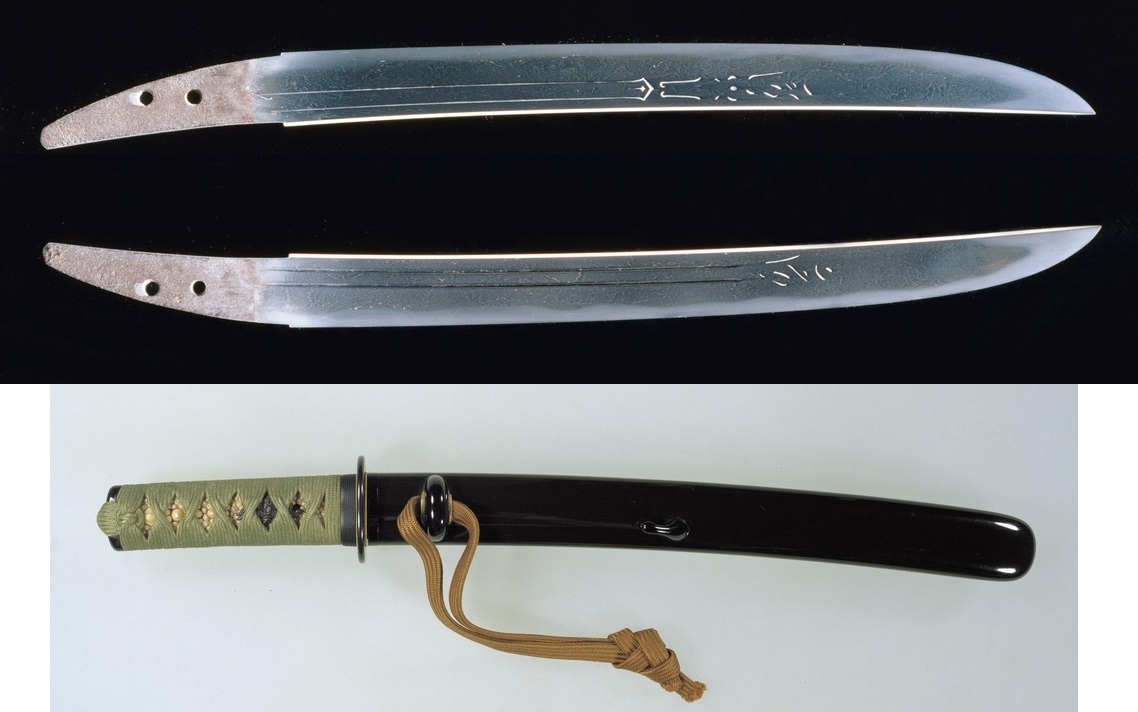
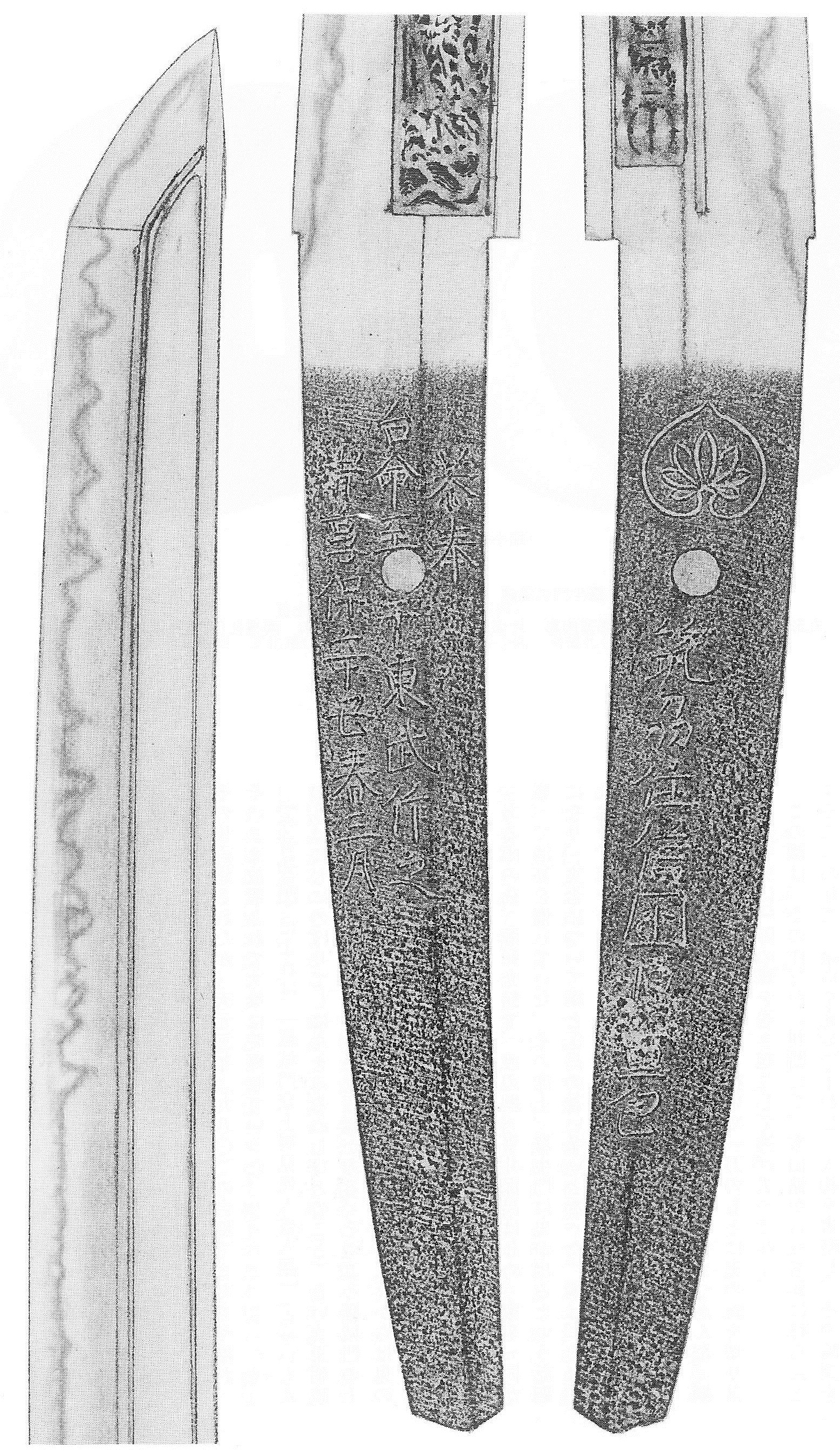
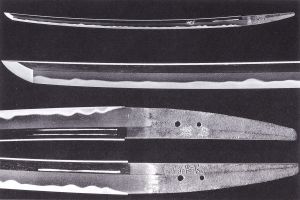
A while ago I wrote in my article on the honorary titles of Mondo no Shô Masakiyo (主水正正清) and Shume no Kami Ippei Yasuyo (主馬首一平安代) about the sword forging contest initiated by the eighth Tokugawa-shôgun Yoshimune (徳川吉宗, 1684-1751). As mentioned therein, there were four winners selected, namely apart from Masakiyo and Yasuyo the 4th generation Nanki Shigekuni (南紀重国) and the Chikuzen smith Nobukuni Shigekane (信国重包). I also wrote that after the contest, the winners were supported by a program of orders and recommendations. But how did this „programm“ look like? To understand this, I want to introduce a concrete and very good example of an order directly from Tokugawa Yoshimune. In picture 1 we see a wakizashi with a nagasa of 58,8 cm (1 shaku 9 sun 4 bu) and a sori of 1,8 cm. It shows an itame mixed with mokume, ji-nie, plentiful of chikei and a midare-utsuri. The hamon is a rather small-dimensioned gunome mixed with chôji with more ups and downs along the monouchi and base than in between where the ha tends to suguha-chô with gunome-ashi. The nioiguchi is rather wide, quite ko-nie-loaden, and shows along the upper half sunagashi. The bôshi is sugu with a bit ko-midare and runs back in a ko-maru-kaeri with hakikake. The tang bears the single leaf of the Tokugawa aoi crest granted to the winners of the contest, and the detailed mei reads: „Chikushû-jû Nobukuni Minamoto Shigekane“ (筑刕住信国源重包) – „Uyauyashiku taimei o hôjite Tôbu ni itari kore o tsukuru“ (恭奉台命至于東武作之) – „Toki Kyôhô kanoto-ushi haru sangatsu“ (旹享保辛丑春三月). Translated: „Made by Nobukuni Minamoto Shigekane from Chikuzen province in the third month, spring, of the year of the ox of the Kyôhô period (1721), in Tôbu (= Edo) by respectfully following the shôgun´s order.“
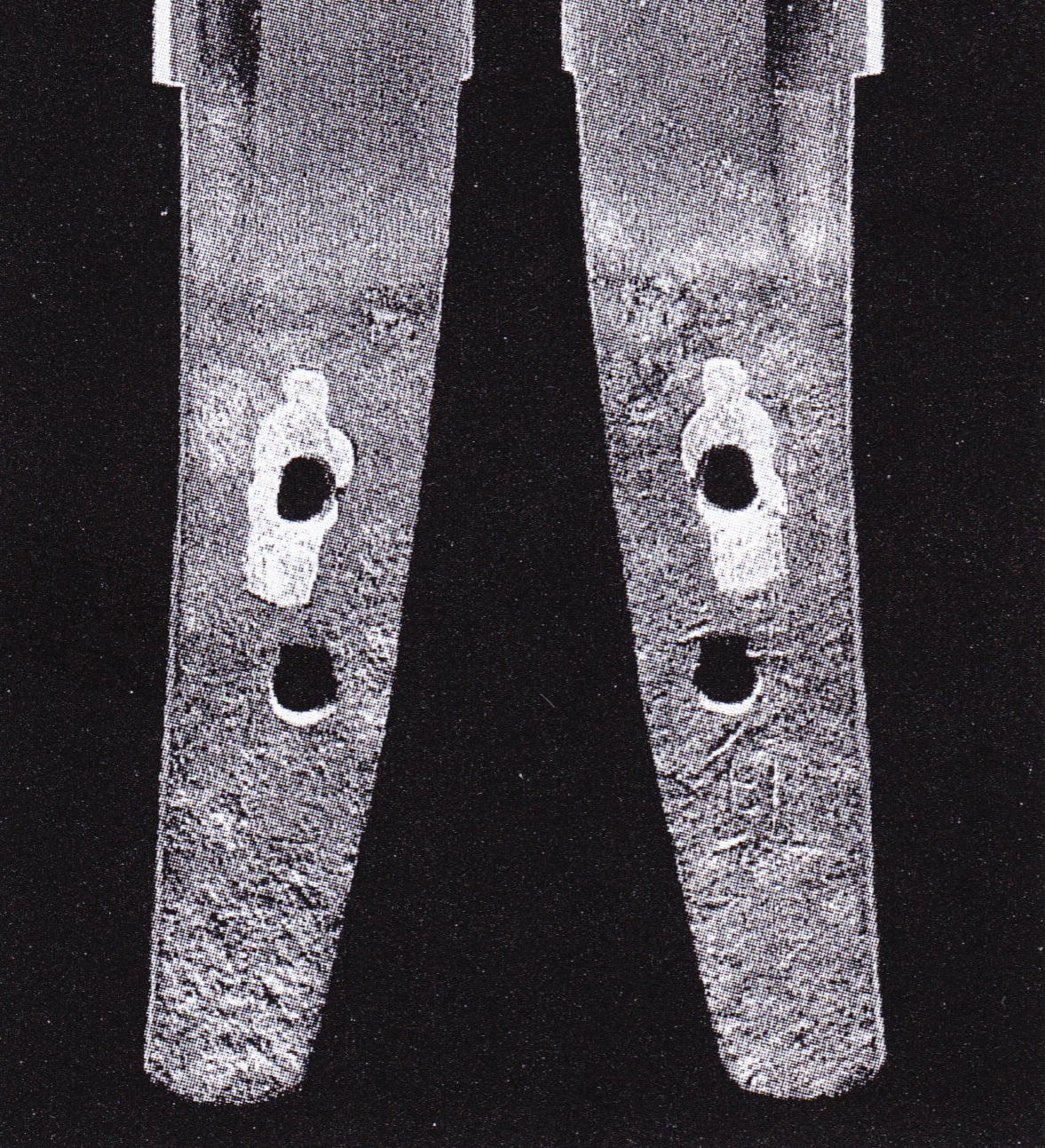
 Shigekane1

Picture 1: wakizashi of Nobukuni Shigekane

Particularly striking on this blade are the horimono. We see on the ura side a kurikara-ryû as ukibori relief in a hitsu, and on the omote side the deity Fudô-Myôô, also in a hitsu. And at a Fudô-Myôô horimono on a Shigekane blade, you should prick up your ears. There is namely an interesting entry in the local history „Chikuzen no Kuni zoku-fudoki-furoku“ (筑前国続風土記附録) compiled in the Kansei era (寛政, 1789-1801) on behalf of the local Fukuoka fief (福岡藩) for which Nobukuni Shigekane had worked. The entry goes as follows: „Nobukuni Shigekane, first name Sukezaemon (助左衛門), called himself later Sukeroku Masakane (助六正包), Made in the Kyôhô era on orders of the shôgun Yoshimune at his Hama-goten (浜御殿) residence in Edo copies of the Wakasa-Masamune (若狭正宗) and Fudô-Kuniyuki (不動国行). As a reward, he got the – not hereditary – permission to engrave one leaf of the aoi crest under the habaki area. Due to this honor of the sovereign, his salary by the fief was raised to 15 koku and a support for five persons. This raised him about to the level of a lower ranking samurai.“ And indeed, the meibutsu Fudô-Kuniyuki showed the very same horimono at the base so we are able to can confirm this transmission through this wakizashi.

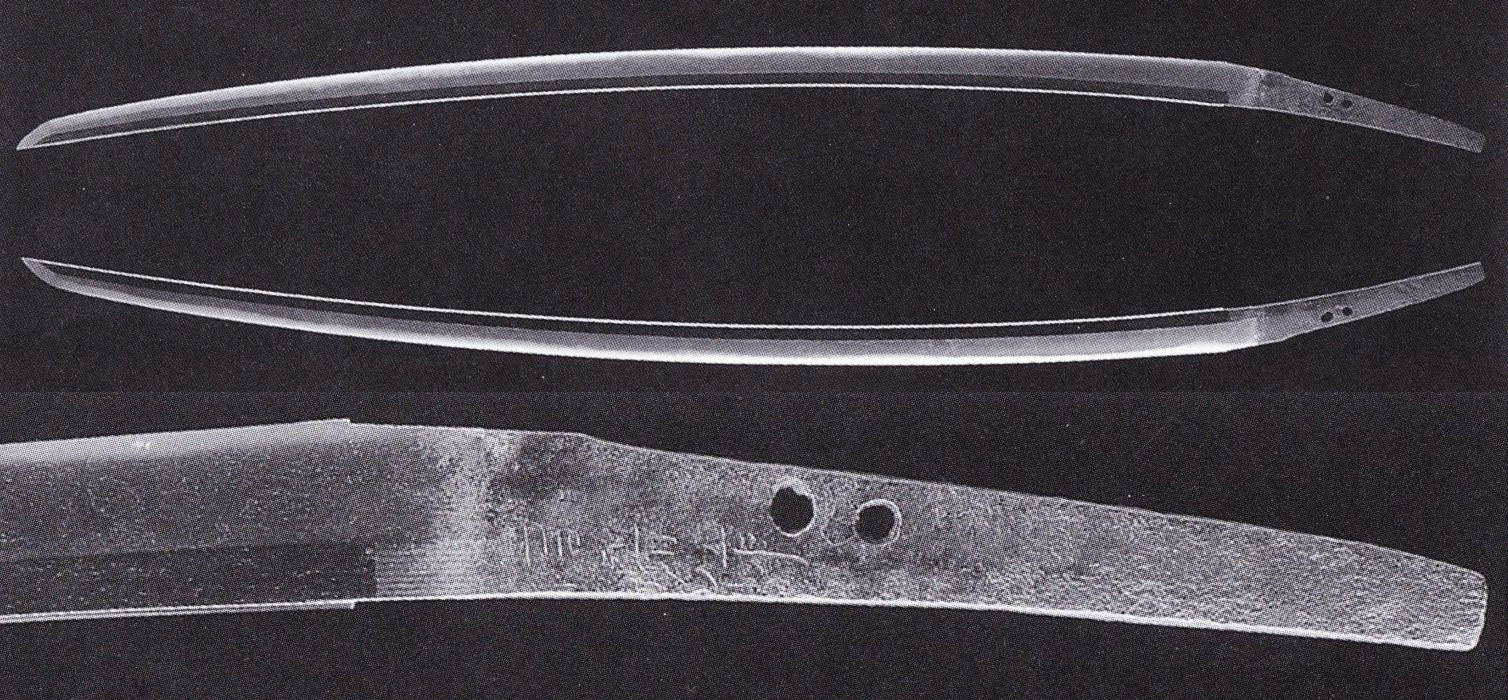
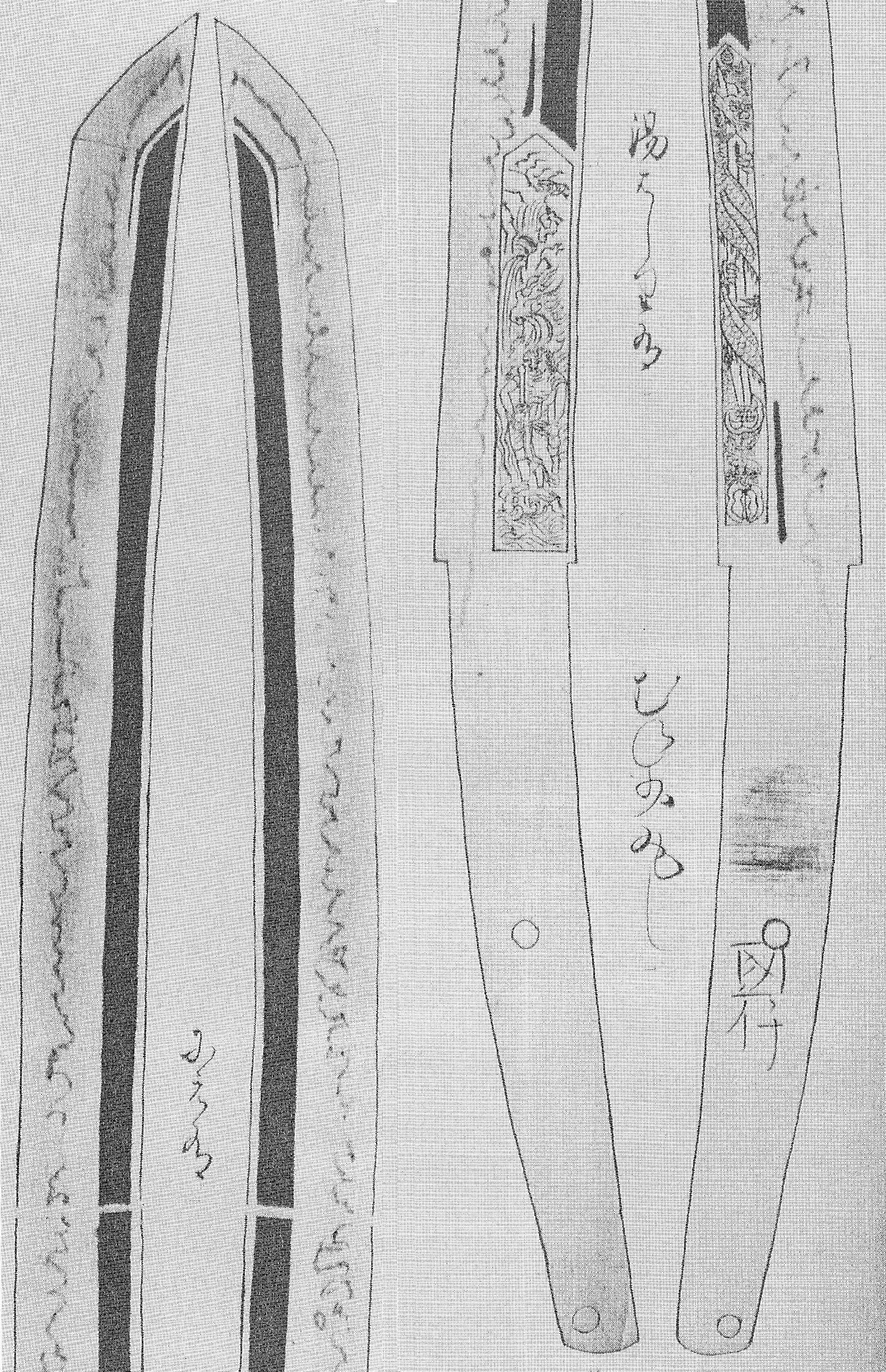
Let me introduce what we know about the Fudô-Kuniyuki (the sword also appears briefly in my Legends and Stories around the Japanese Sword 2). It was once a heirloom of the Ashikaga family but captured by Matsunaga Hisahide (松永久秀, 1510-1577) in the course of the defeat of the then shôgun Ashikaga Yoshiteru (足利義輝, 1536-1565). Hisahide presented it to Oda Nobunaga when on the occasion of his marching-in in Kyôto. After Nobunaga´s death it came into the possession of Akechi Mitsuhide (明智光秀, 1528-1582) who in turn presented it to his retainer Akechi Hidemitsu (明智秀満, 1536-1582). We know that Hideyoshi was eager to take revenge for Nobunaga´s death in order to come into power and when Hidemitsu realized that he was going to die, he volunatrily handed-over the Fudô-Kuniyuki to Hideyoshi so that the famous sword will not be destroyed. After the Battle of Komaki and Nagakute, Hideyoshi presented the sword to Ieyasu and so it came to be a heirloom of the Tokugawa family. However, it was damaged in the Great Meireki Fire in 1653 and had to be retempered by the 3rd generation Echizen Yasutsugu (越前康継). The Yasutsugu by the way were quasi the first-choice of the Tokugawa when it came to retemper precious meibutsu. As a sidenote, there exists the transmission that the horimono of Fudô-Myôô in flames caused the destruction of the sword by fire. Or to be more precise, it was rumored that the blade was tired of the peaceful times and committed quasi suicide by surrendering itself to the flames. However, the Tokugawa sold the sword in the early years of the Shôwa era and it was designated as jûyô-bijutsuhin even if it had a saiha. Unfortunately, the Fudô-Kuniyuki is missing since after World War II. All we have are some depictions, like for example in the „Kôtoku-katana-ezu“ (光徳刀絵図, picture 2), which in turn was at least made before the blade was damaged by fire. But as so often the case, we have different measurements in all these sources. The „Kôtoku-katana-ezu“ lists the Fudô-Kuniyuki with a nagasa of 1 shaku 9 sun 1 bu (57,9 cm) whereas the „Kyôhô-meibutsu-chô“ lists it with 1 shaku 9 sun 9 bu (60,3 cm), and a „Kiya-oshigata“ (木屋押形) copy from Kyôhô six (1721) with 1 shaku 9 sun 4 bu (58,8 cm). That means the copy of Shigekane follows ecactly the latter source.

 Shigekane2

Picture 2: The Fudô-Kuniyuki as depicted in the „Kôtoku-katana-ezu“.

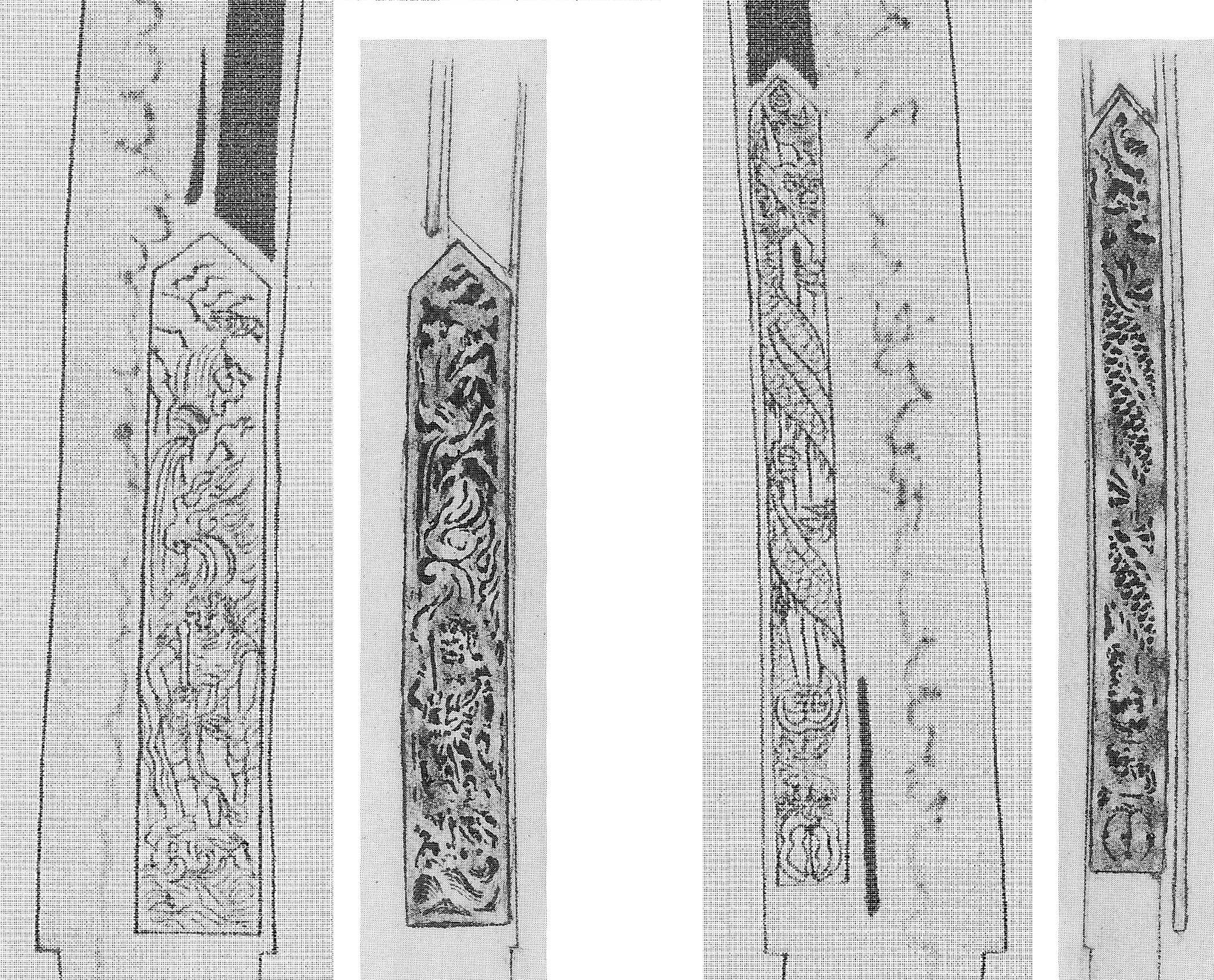
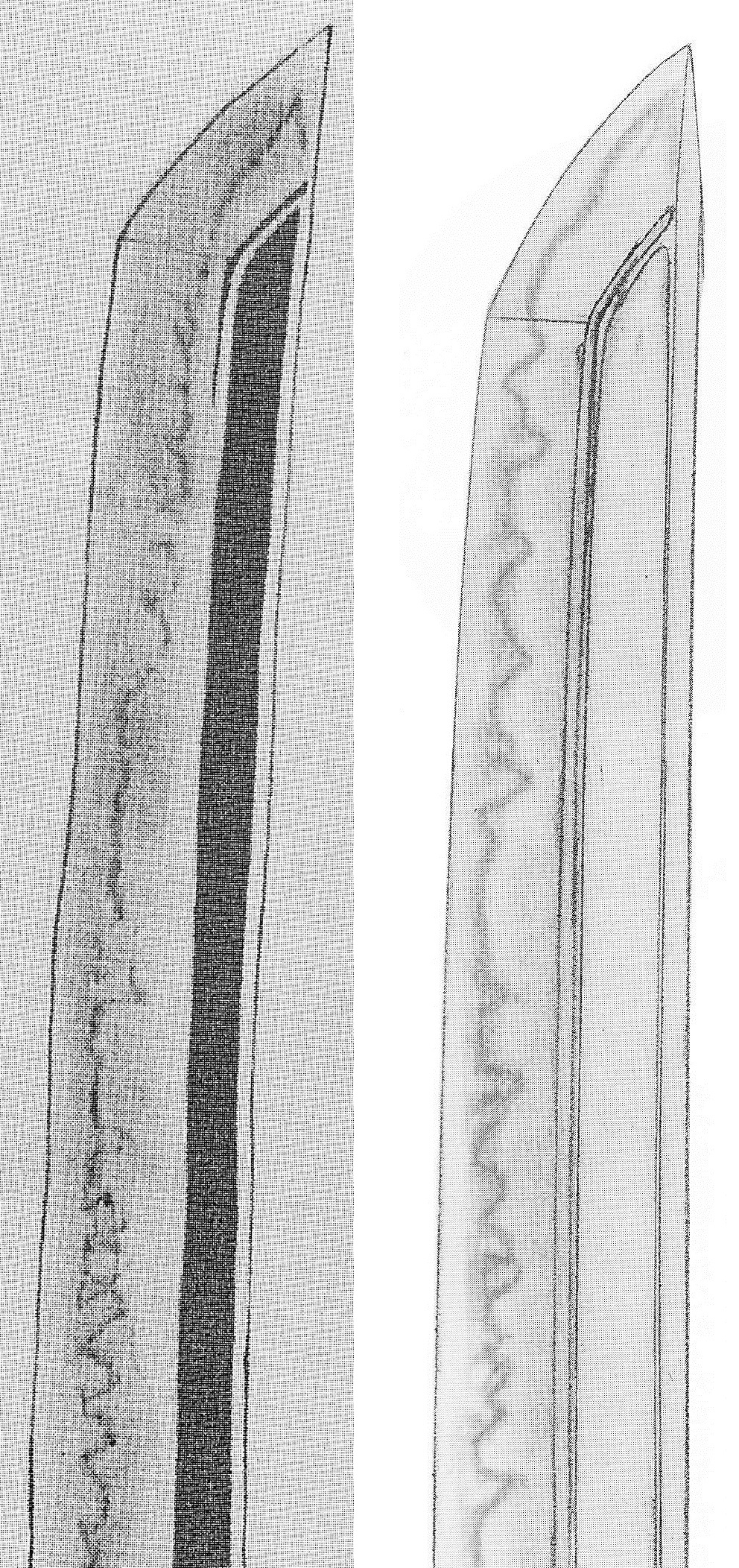
So Shigekane had no chance to see the original hamon of the meibutsu and so he focused merely on copying exactly the bôhi with its tsurebi and of course the horimono (see comparison pictures below). But with some imagination, we can see a similarity of the Shigekane-utsushi and the drawing in the „Kôtoku-katana-ezu“ in terms of the smallish togari protrusions connected by suguha sections in the monouchi area of the omote side. This blade gives us an insight of how sensitive the then sword world was, at least in higher circles. That means Tokugawa Yoshimune and higher ranking daimyô did not just order any old sword from the winners of the contest which was then stored away forever in a locker. Much attention was namely paid to details, everyone was talking about the swords of the „Kyôhô-meibutsu-chô“, and famous swords were taken out of the treasury and handed over to the smiths when they were in Edo so that they were able to study them hands-on. So it was a great honour for Shigekane to work on a copy of the Fudô-Kuniyuki and the details below show how thorough his approach was.

 Shigekane3

Picture 3: Comparison of the horimono. Please also not how the tsurebi of the ura side ends in the same way a bit lower than the hitsu for the kurikara-ryû.

 Shigekane4

Picture 4: Comparison of the hi at the kissaki area and the hamon along the monouchi.

Kantei Supplement 2

Out now as promised, the second supplement to the first two kantei volumes in English. It contains 175 kotô, shintô and shinshintô blades in the classical order, namely kotô-gokaden, kotô other provinces, shintô-centres Kyôto, Ôsaka and Edo, shintô other provinces and shinshintô. The numbering continues with the last blade of the first supplementary volume, i.e. with number 419. So we arrive now at almost 600 blades (594 to be precise) with all volumes so far!

428 pages, A4, paperback, b/w pictures, price: $ 89.00

It can be obtained at Lulu.com via this link.

There is also an eBook available here.

KanteiSupplement2

Table of contents

The secret world of mekugi-ana

   Some years ago Kondô Hôji (近藤邦治), the president of the Gifu branch of the NBTHK, discovered a transcription of a sword publication published in Bunka three (文化, 1806). Well, the sword publication itself is rather diversified and covers the usual spectrum, and the reference to the second year of Gentoku (元徳, 1330) as time of the publication of the original is highly questionable. It is assumed that this is a typo and that either Genroku (元禄, 1688-1704) or Shôtoku (正徳, 1711-1716) was meant. However, this transcription contains an interesting chapter called „Menuki-ana no shidai“ (目貫穴之次第, about „The Conditions of menuki-ana“), yes menuki-ana, but actually mekugi-ana are meant. The book depicts 15 illustrations of different mekugi-ana which are introduced in the following by adding as far as possible similar mekugi-ana on actual blades.

mekugi1-3

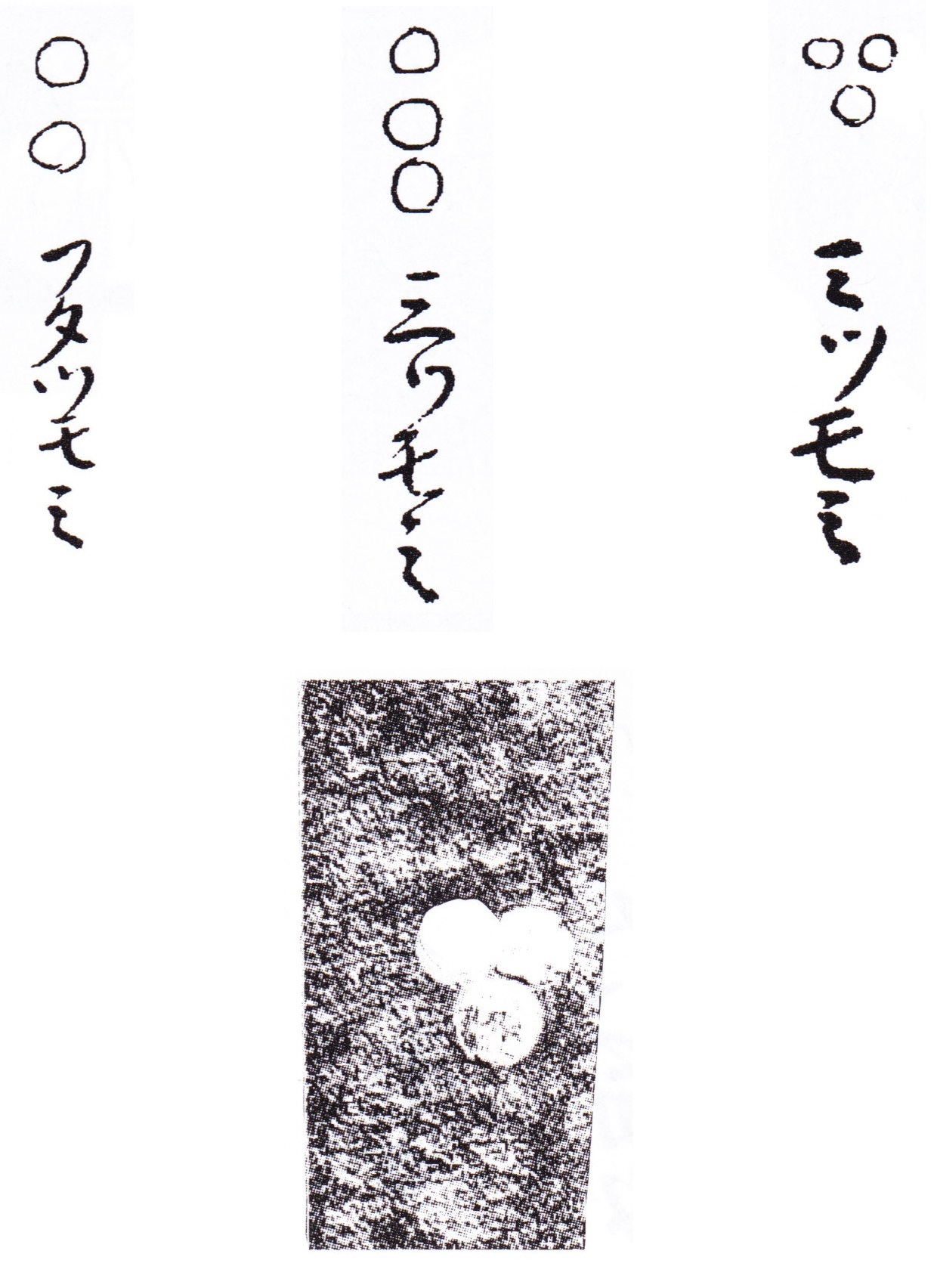
   The first three pictures describe an arrangement of two or three peg holes one below the other or in a triangle. These arrangements are called „futatsu-momi (フタツモミ) and „mitsu-momi“ (ミツモミ) respectively what might best be translated as „twosome rubbing“ and „threesome rubbing“. The text mentions that in this category, just the number is counted and that four aligned menuki are called „yotsu-momi“ (ヨツモミ) and five „itsutsu-momi“ (イツツモミ) and so on. A mitsu-momi in a triangular arrangement is very rare and is mostly restricted to early kotô blades like the one shown below from a tachi of Bungo Yukihira (行平).

 mekugi4

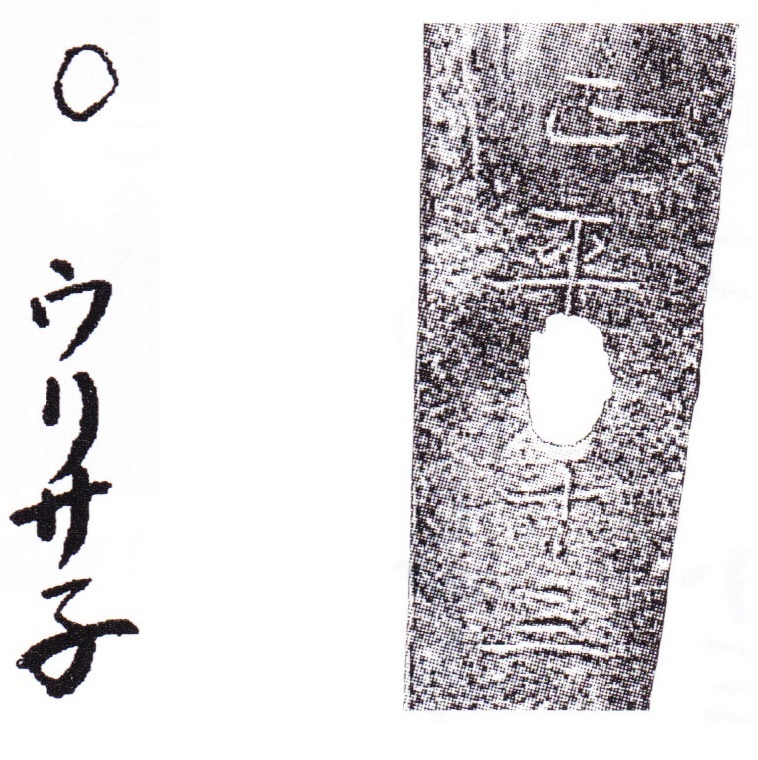
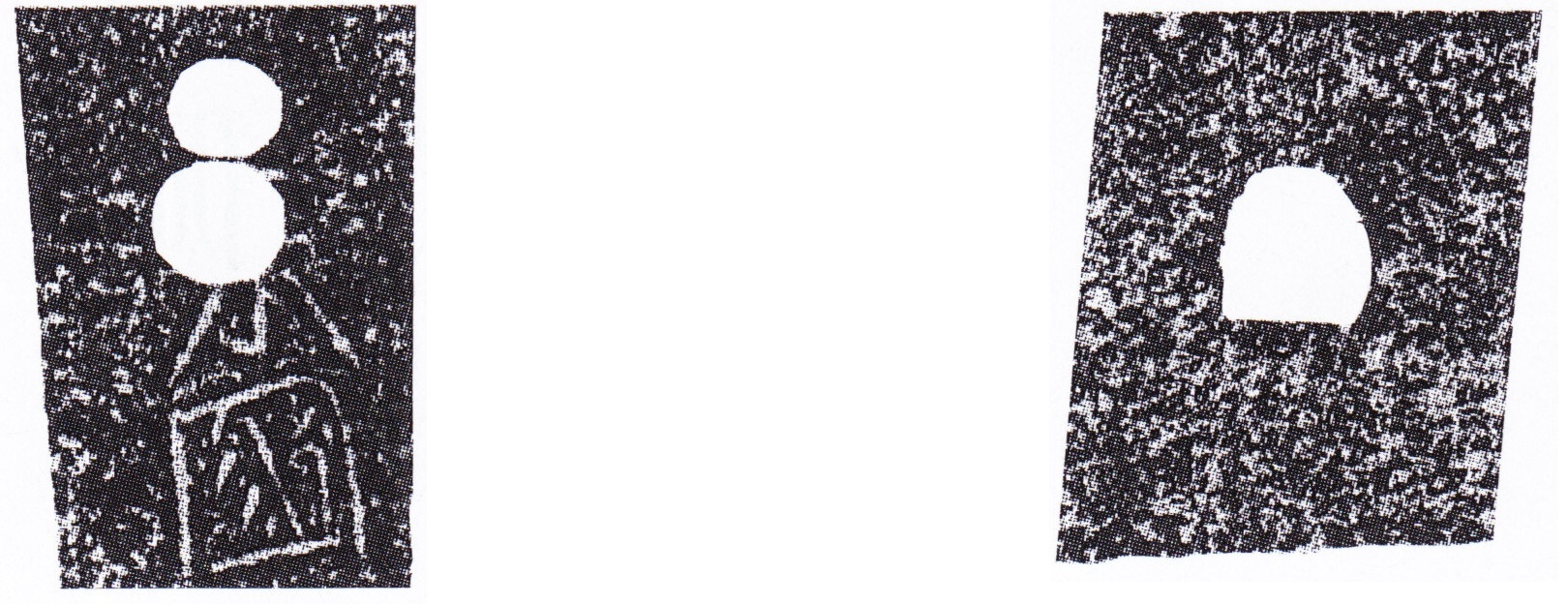
The fourth picture is called „urizane“ (ウリサ子, lit. „melon seed“). So here not the arrangement but the shape of the mekug-ana is described. Such a hole is very common and comes by widening an existing mekugi-ana. The picture to the left shows an actual example on a tantô of Tomoyuki (友行).

 mekugi5

Picture number five is called „nasu-hisago“ (ナスヒサ子, lit. „eggplant“). Such a mekugi-ana is rather rare and is found, if at all, mostly on kotô-tantô as the example on a blade by Morimitsu (盛光) shows. A nasu-hisago hole is in the same way a widened mekugi-ana as the urizane hole.

 mekugi6

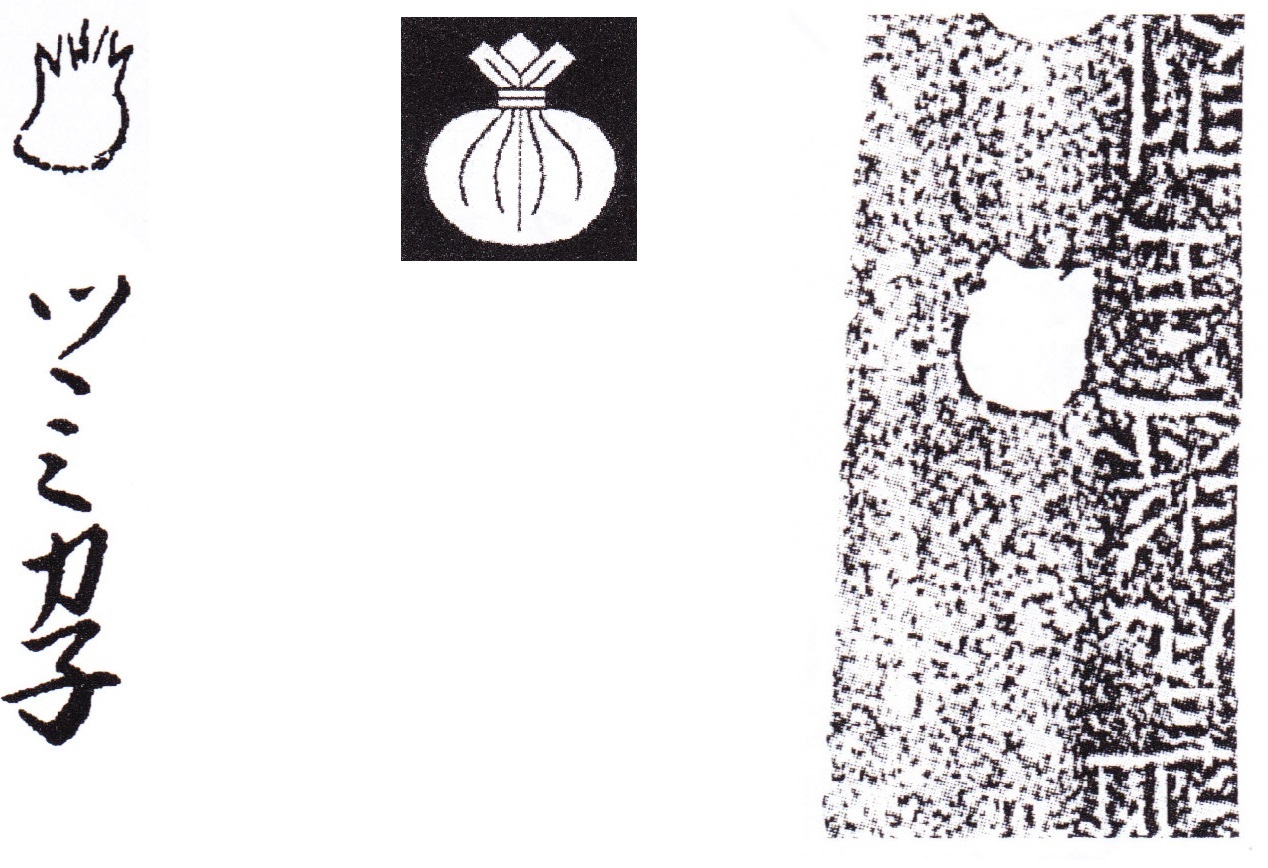
Number six is called „tsutsumigane“ (ツゝミカ子) what refers to the shape of a wrapped-up money present (tsutsumigane, 包み金) or the auspicious symbolism of a bag of gold (kanabukoro, 金袋, see b/w picture in the middle). Principally a tsutsumigame describes a hole which was once widened and where the mekugi got loose again. To tighten the peg, the steel was hammered from one side to narrow the hole again, namely to avoid opening a new mekugi-ana. The picture to the right shows an actual tsutsumigane hole on a tachi of Shikkake Norinaga (尻懸則長).

 mekugi7

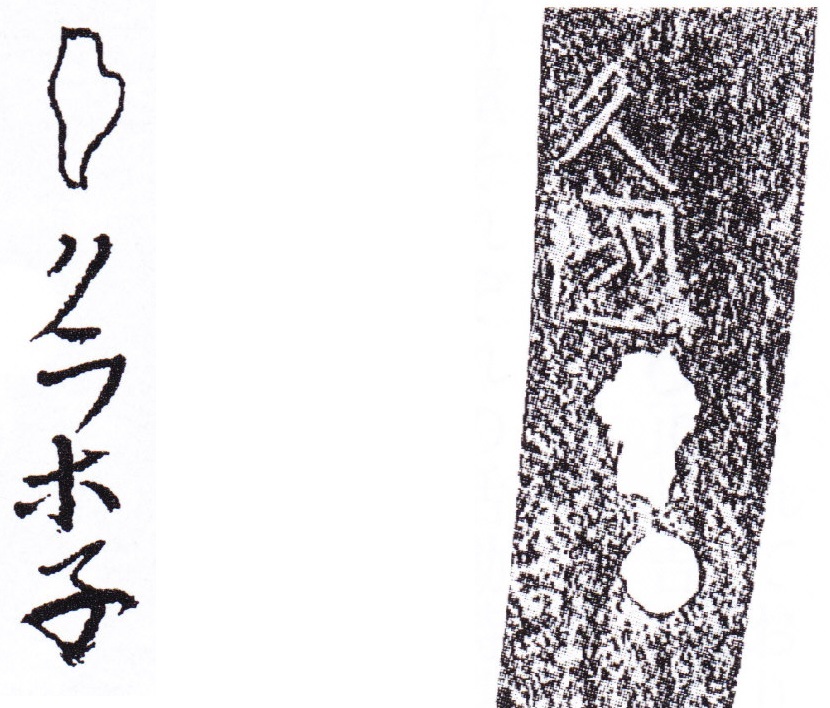
The seventh picture bears the name „kurahone“ (クラホ子), i.e. the frame (hone, 骨) of a wooden saddle (kura, 鞍). It is hard to find actual examples of mekugi-ana which match this depiction but probably one like seen on the tachi of Hisakuni (久国) on the right is meant.

 mekugi8

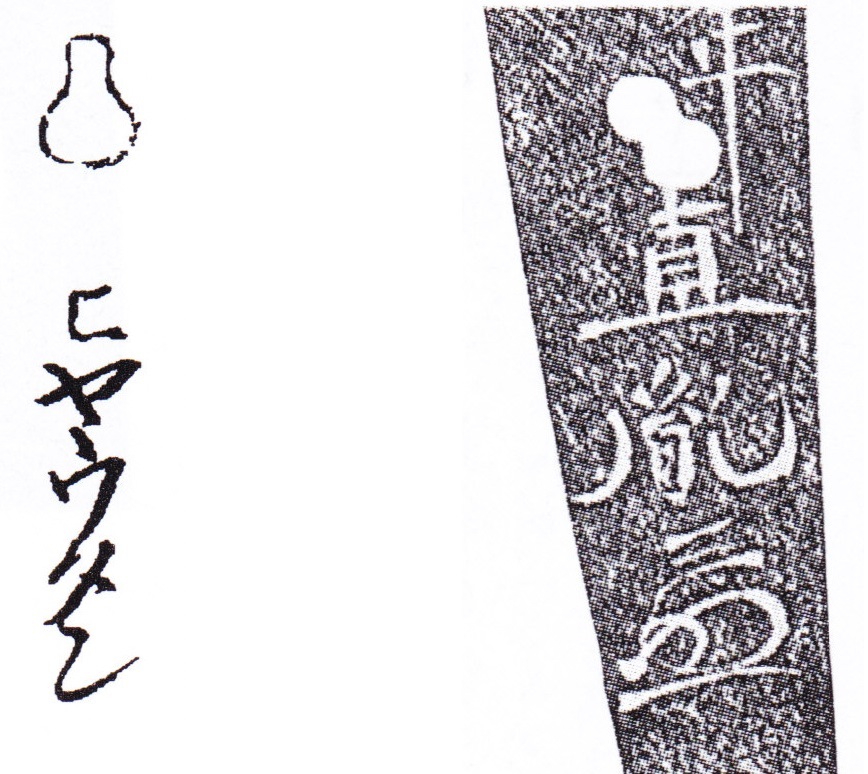
The name of the mekugi-ana in picture eight is again more clear, namely „hyôtan“ (ヒヤウタン, „bottlegourd“). Such a hole is quite often found and the result of two differently sized mekugi-ana opened so close that their merge into each other. The picture on the right shows a hyôtan-mekugi-ana on a wakizashi of Taikei Naotane (大慶直胤).

 mekugi9

Number nine is called „yomitori“ (ヨミトリ). The verb „yomitoru“ (読み取る) means „to read (from an instrument for example)“, „to read into“, or „to read (someones) mind“. But because of the transcription in katakana syllables it is unclear if really this verb is meant. Such a mekugi-ana is very hard to find on actual blades and it might be assumed that it was actually a hidden Christian symbol.?

 mekugi10

Most collectors are probably familiar with the term in the next, the tenth depiction, which is namely „suhama-gata“ (スハマカタ), i.e. it refers to the suhama (洲浜) element as we know it for example from hitsu-ana on tsuba. Such mekugi-ana are most likely found on wide kotô-era sunnobi-tantô as demonstrated by the blade of Unjû (雲重) shown on the right.

 mekugi11

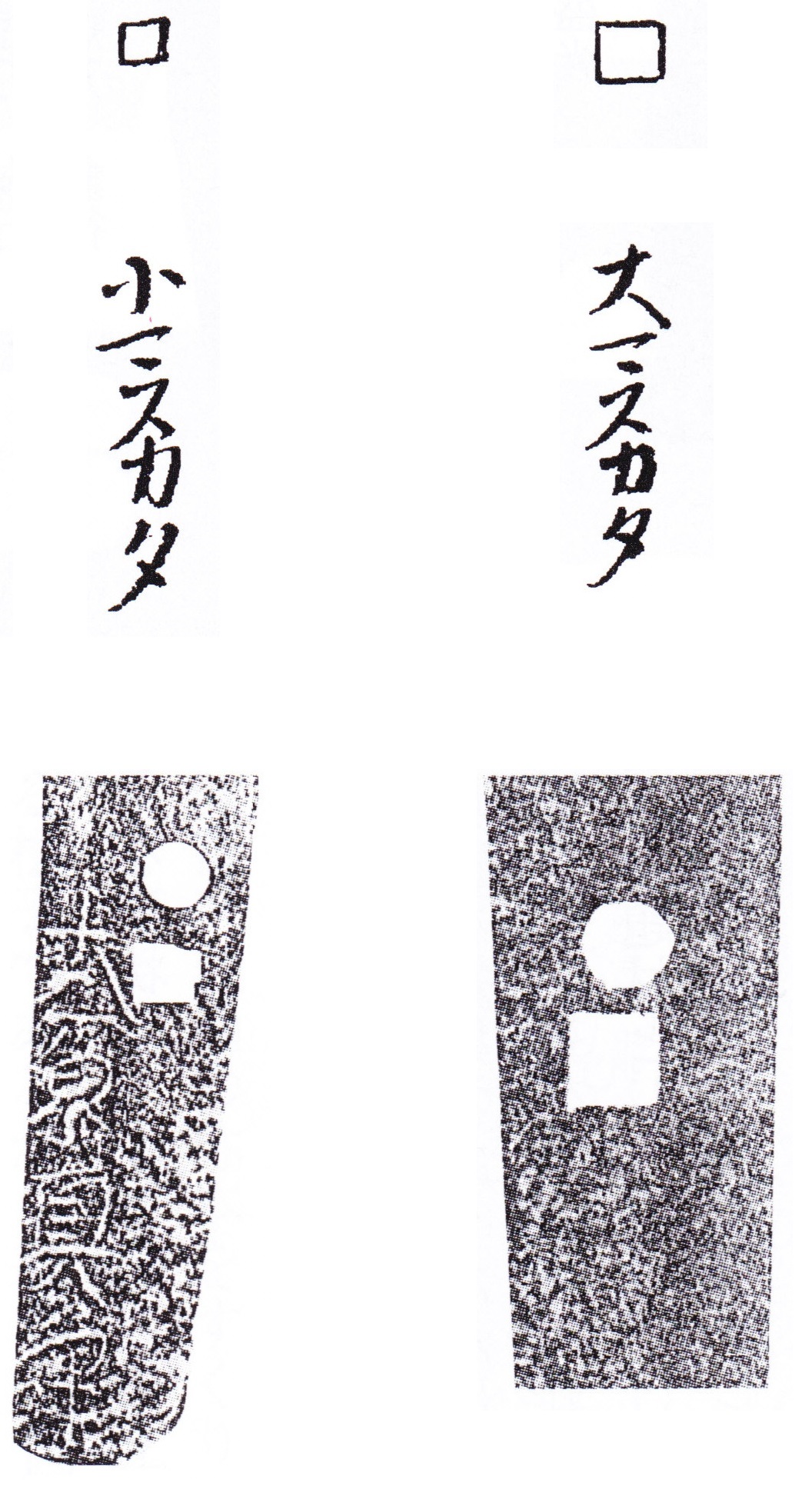
Number eleven and twelve are called „ko-masugata“ (小マスカタ) and „ô-masugata“ (大マスカタ) respectively, i.e. small (ko, 小) and large (ô, 大) square masugata, 枡形). However, it is unclear how it was actually distinguished between „small“ and „large“. Kondô suggests that if the edge of a square mekugi-ana corresponda approximately to the diameter of an average mekugi-ana, it might be called as ko-masugata. If the edge is larger, probably the classification ô-masugata applies. To substantiate this approach, we see at the lower left a tachi of Ôhara Sanemori (大原真守) where the square hole has about the same size as the regular mekugi-ana. At the Taima-tantô (当麻) to the right, the square hole is a hint larger as the regular mekugi-ana. By the way, such a hole is quite archaic and goes back to times when menuki and mekugi formed a unit and where the square hole hindred the ornament from twisting.

 mekugi13

Also the name of picture number 13 is familiar as it is called „inome“ (イノメ). It occurs when a mekugi-ana is opened in an overlapping manner right next to an existing mekugi-ana. As example serves a tantô of Hoshô Sadayoshi (保昌貞吉).

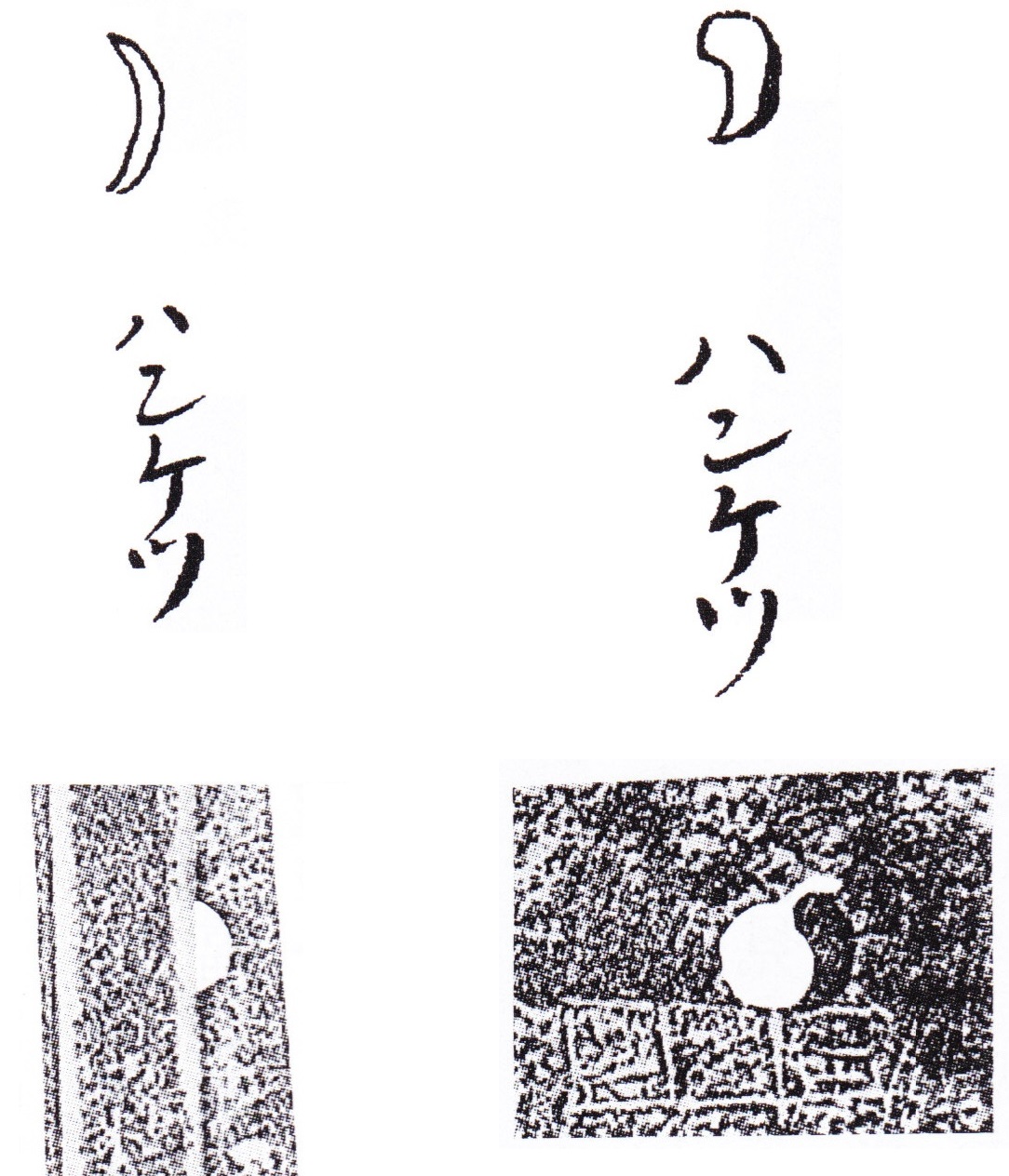
 mekugi14-15

The last two depictions of the chapter „Menuki-ana no shidai“ are both called „hangetsu“ (ハンケツ, „half-moon“) whereas the the last one to the right reminds more of a comma-shaped bead (magatama, 勾玉) oder of a tomoe (巴). And the former one seems to be exaggerated as it is hardly possible to stick a mekugi through such an opening. So maybe the last two examples actually don´t show mekugi-ana but shapes which occur through an orikaeshi-mei or gaku-mei (see picture at the lower left on a katana of Kunimune, 国宗), or a semegane softmetal fitting (see picture at the lower right on a katana of Sukesada, 祐定). In this sense it is possible, that the katakana syllables „hanketsu“ actually stand for (半欠) what means „half missing“.

   All those mekugi-ana go back to the necessity of adding a new peg hole or to enlarge or adjust an existing one. That means except maybe number nine with the cross-shape, we are probably not dealing with holes which were consciously opened in suhama or inome shape and the like. In other words, the publication just gathered existing mekugi-ana and gave them names. In earlier times, smiths or other craftsmen were not exactly gentle when it came to adding new holes as they were drilled through signatures and dates without remorse. Today this seems like „wanton destruction“ of important references but back then a new peg hole just marked a new phase in the life of a blade as the owner was at the best a „custodian“ who took the sword temporarily from his predecessor and had to give it away at the end of his life.

   When with the Edo-period and especially with the emergence of the Ôsaka-shintô schools meticulous and elabotate nakago finishes came into fashion and even emphasis was laid on the calligraphic value of a signature, the peg hole could not just be left out and placed randomly. That means many smiths decided where the first and original ubu-ana (生ぶ孔) was positioned, mostly also in relation to the signature. A lateral trend in the attention to peg holes were the so-called „keshô-ana“ (化粧孔, lit. „ornamental holes“). An example of a keshô-ana is the tsubo-ana (坩孔, lit. „pot-shaped hole“) as it was occasionally applied by Kotetsu (虎徹). Some say the tsubo-ana depicts actually the head of a tiger because the first character „Ko“ in Kotetsu means „tiger“. However, the notches at the side had the purpose to hold an eventual semegane, that means the smith decided exactly where the holes on his tang should be and anticipated the necessity of a later new peg hole by providing one with blank notches for whatever softmetal semegane. A more elaborate form born from the tsutsumigane is the so-called „hanamaru“ (花丸, lit. „flower circle“). There are different interpretations of this kind of mekugi-ana with different numbers of petals. Thus also terms like sakura-ana“ (桜孔, „cherry-blossom home“) and „kiku-ana“ (菊孔, „chrysanthemum hole“) exist. Like the tsubo-ana, also the hanamaru is an elaborate anticipating hole added by the smith. The picture below shows to the left two more consciously opened mekugi-ana on blades of Kotetsu. They look like the numerous peg holes on kotô blades but are all ubu.

 mekugi16

   In addition, some more mekugi-ana forms should be introduces, namely uncommon forms just called „kawari-ana“ (変わり孔) in general. The flowery names go back to Kondô Hôji.

 mekugi17

Left: kaiki-shoku (皆既食), „total solar eclipse“; right: chûya (昼夜), „day and night“

 mekugi18

Large semegane on a tantô of Jinsoku (神息) which remind of Yakushi-Nyôrai (薬師如来), the Healing Buddha.

 mekugi19

Left: ikken (一献), ikken war a custom to serve a guest to a feast side dishes and three cups of sake; right: aburi-mochi (炙り餅), „frying mochi

 mekugi20

Left: yukidaruma (雪達磨), „snowman“; right: suidô (隧道), „tunnel“

 mekugi21

tsuki ni kumo (月に雲), „moon behind clouds“

Kantei Zusatzband 2

Out now, the German version of the second supplement of my kantei series. It contains 175 kotô, shintô and shinshintô blades. The numbering continues with the last blade of the first supplement, i.e. with number 419. I add the table of contents so that you get an overview of the introduced blades. As promised, the English version will follow towards the end of the month.

428 pages, A4, paperback, b/w pictures, price: €75.00

It can be obtained at Lulu.com via this link.

There is also an eBook available here.

KanteiZusatz2

Table of contents

NBTHK-EB meeting in Salzburg

After five years we had our second NBTHK-EB meeting in Salzburg last Saturday. The subject was „Renowned shinshintô masters“ and in the following I would like to forward a brief outline of my introductory lecture on shinshintô for those unable to attend (and for those interested of course). After that I give you also a brief introduction of the fine blades we were able to see.

 Sbg2

For a better understanding of the shinshintô era, we have to start at shintô. We know that with the execption of the Shimabara Rebellion of the years 1637 and 1638, peace had been restored by the Tokugawa all over Japan. Of course swords were still made but by the end of the 17th century, all the fiefs learned that the peace is a lasting one and by the strict regulations of the bakufu which tried to minimize the chance that certain indiduals are raising larger armies, the demand for swords decreased drastically. At about the same time, i.e. we are in the first decades of the 18th century, the unsound financial policy of the fiefs in particular and the bakufu in general became apparent. That means even if a daimyô wanted, there was in general just not enough money to hire master smiths and support upcoming talents on a large scale or systematically.

The eighth Tokugawa-shôgun Yoshimune (徳川吉宗, 1684-1751) was unhappy with declining craft of sword forging and ordered in 1719 his elder to get in touch with every fief with an income of more than 10.000 koku so that their best smiths could participate in a forging contest. As we know, the contest took place in 1721 and winners were Mondo no Shô Masakiyo (主水正正清), Ippei Yasuyo (一平安代), the 4th generation Nanki Shigekuni (南紀重国) and Nobukuni Shigekane (信国重包). Yoshimune´s goal was to breath new life into the then stagnating sword world and indeed, the winners were great master smiths. But with the tense financial situation of the country, the plan was not successful and most of the local smiths and their students and descendants continued to muddle along in a sufficient but not breathtaking niveau.

Another measure of Yoshimune to arouse more interest on swords amongst daimyô was the compilation of the famous „Kyôhô-meibutsu-chô“ (享保名物帳). This was a list with the most famous swords all over Japan and the project forced the local rulers quasi to deal with their old sword collections and sort out the famous pieces so that they could be published in the meibutsu-chô. This list had of course not a direct influence on the craft of sword forging, but an indirect one. Over time namely, treatises on the great masters of the Heian, Kamakura and Nanbokuchô period were written and old sword publications were discussed and reprinted. And with the upcoming new bourgeoisie in the transition from the 17th to the 18th century, for the first time something like „sword as a hobby“ was born. That means most were of course not able to afford a meibutsu of have them luxurious blades made, but at least one was able to indulge in books and discuss with others about swords. This trend was accompanied by another sub-trend, namely the rise of wealthy merchants, who were namely in the position to support contemporary smiths and order fine blades from them. And it wasn´t long before new books like the „Shintô-bengi“ (新刀弁疑) were published which introduced contemporary swordsmiths and presented their merits.

The „Shintô-bengi“ praised first and foremost the Ôsaka-shintô smiths and their tôranba, but this is only natural as Sukehiro (助広), Inoue Shinkai (井上真改) and their kinds were still the best the shintô era had produced so far. Thus the contemporary smiths, the book was published in 1777, tried first and foremost to orientate towards their inpretations. But one master was not satisfied with this trend. It was Suishinshi Masahide (水心子正秀) who tried quasi alone by studying old blades and all publications available to reproduce and revive the old forging techniques. His approach, which was supported and continued by his master students like Taikei Naotane (大慶直胤) and Hosokawa Masayoshi (細川正義), is known as fukkotô (復古刀). The focus was especially placed on the good old Bizen and Sôshû traditions but basically all five gokaden were studied and reproduced. However, when Masahide died in 1825, he had not seen himself the swing to the Nanbokuchô-esque shinshintô.

With the bakumatsu era, Japan was in a difficult situation. More and more foreigners appeared at the coasts, the fiefs were bankcrupt and the bakufu was regarded as totaly incompetent. Everyone felt that something was going to happen soon, most likely in combination with fightings. As it is common for such times, the fiefs and atists tried to restore old values and swordsmiths tried to make stout and durable blades for the upcoming fightings. And back then, the Nanbokuchô blades were considered to the best choice for that. So the daimyô were quasi forced to arm and spend money on the employment and training of good swordsmiths. This in turn resulted in a noticeable quantitative but also qualitative increase of fine blades. By the time the bakufu was overthrown by the imperial troops, Japan was again able to present a considerable number of ambitious mastersmiths. As we know, the modernization lead eventually to the ban on swords in 1876. This was such a radical measure that the shinshintô era which started with Suishinshi Masahide is considered to be over with this ban. Emperor Meiji was fortunately a great sword lover and so he tried to save the craft of sword forging, even the demand for newly made swords tended with the ban over night quasi to zero. All this is well known but without Masahide, his master students and the fukkotô movement, the swordsmiths of Japan probably would have continued to work to the end of the feudal era like they did in the 18th century. In other words, there would not have been a shinshintô and not much to rescue for emperor Meiji when he came to power. Of course swords still would have been made as they played such an important role in Japan, but without the fukkotô movement, probably no one would have been able to reproduce the great kotô works in the way Masahide and his descendants did. And when you take it one step further, the gendai and shinsaku smiths would not be what they were or are respectively without the fukkotô movement.

 Sbg1

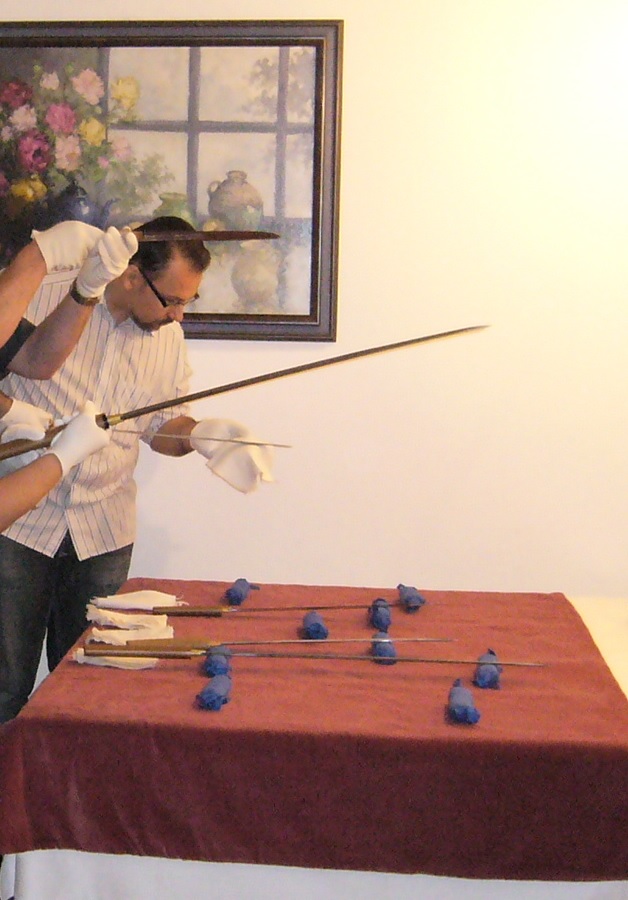
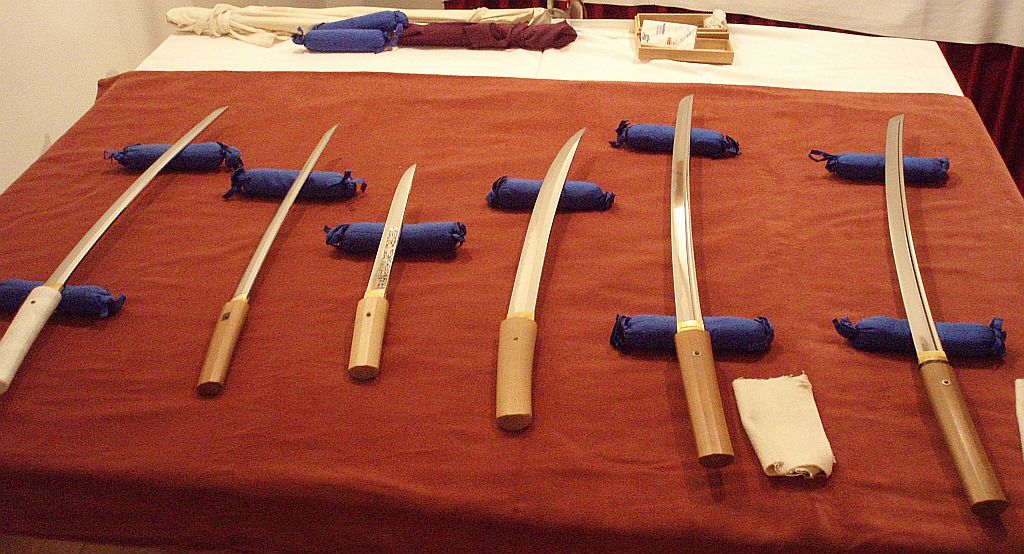
Now to the blades we appreciated at our meeting. The picture above shows the table and the blades were, from right to left: katana by Tairyûsai Sôkan (泰龍斎宗寛), katana by Shizu Saburô Kaneuji (志津三郎兼氏) presented to see what Kiyomaro was copying, naginata-naoshi-zukuri by Minamoto Kiyomaro (源清麿), tantô by Taikei Naotane (according to Tanobe-sensei a Bizen-utsushi but with Nobukuni elements), wakizashi by Taikei Naotane (Bizen-utsushi), wakizashi by Taikei Naotane (Bizen-utsushi). Quite a bunch of high-quality blades, isn´t it?

Last but not least I want to thank all those participating and a big thank you to those bringing their blades!