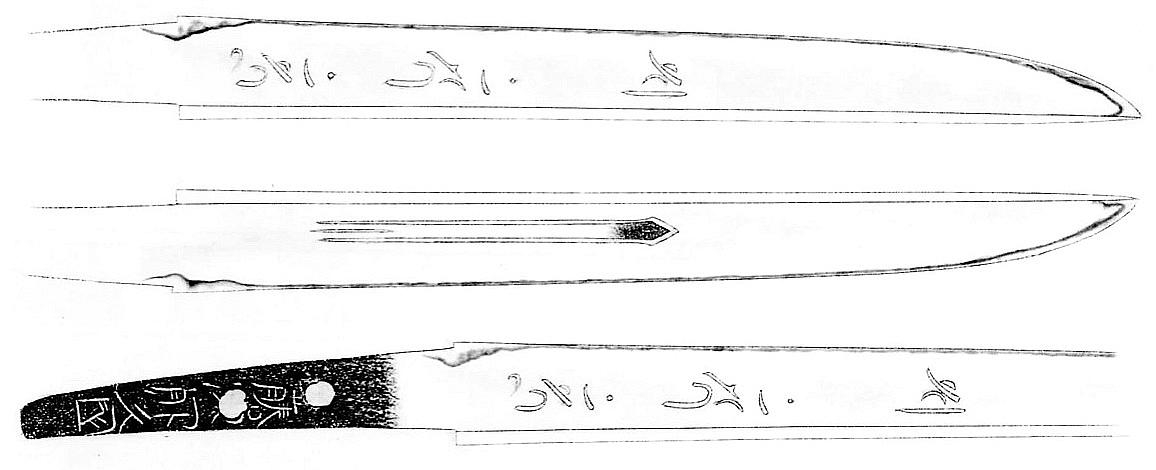
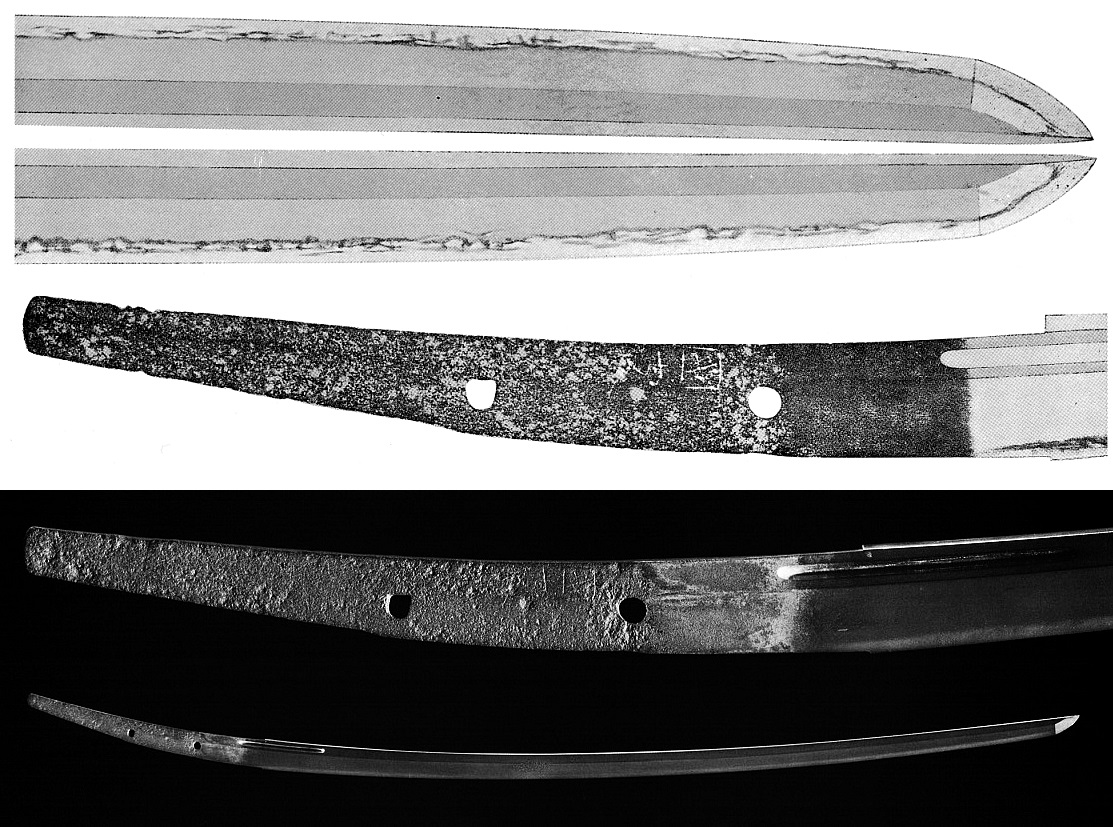
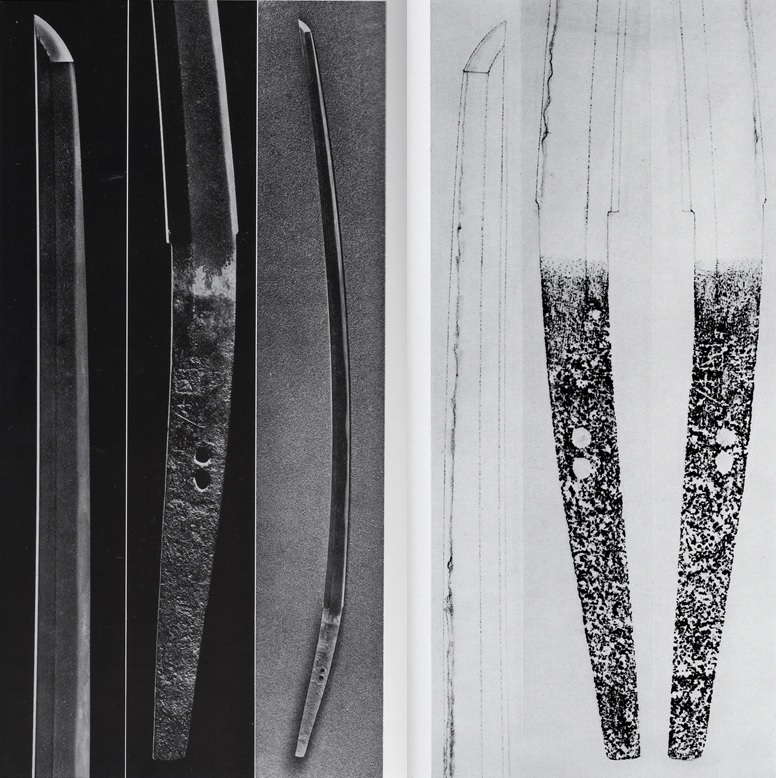
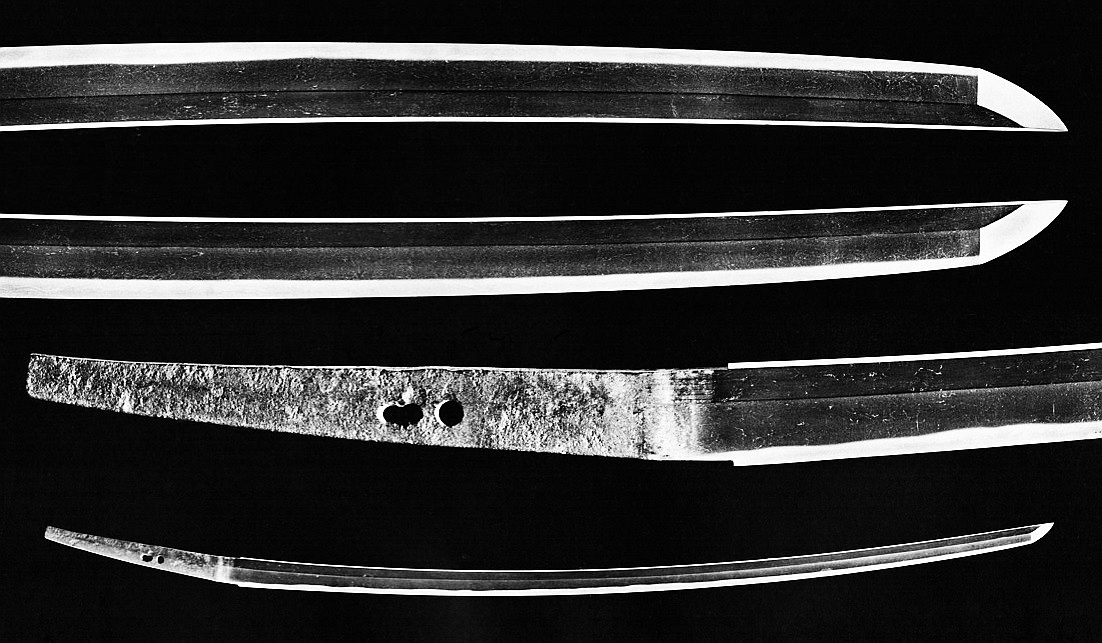
KANTEI 4 – YAMASHIRO #8 – Awataguchi (粟田口) School 3

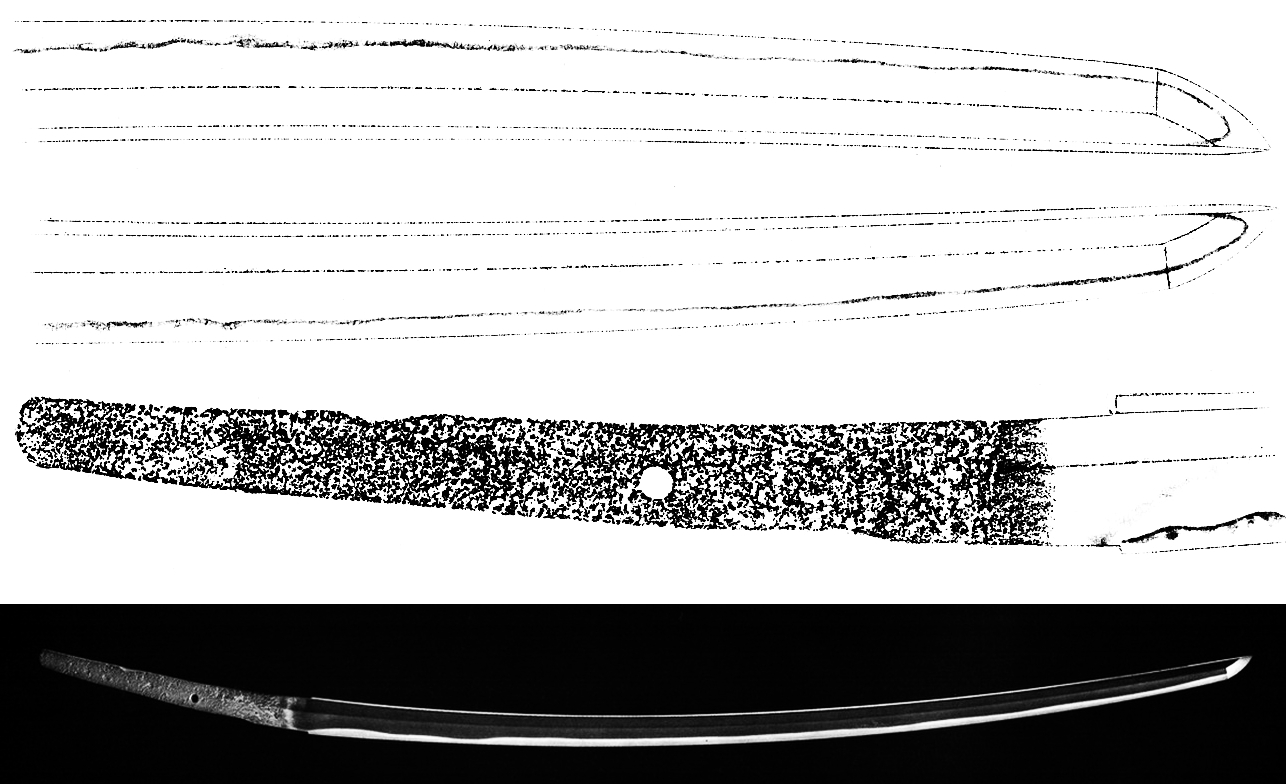
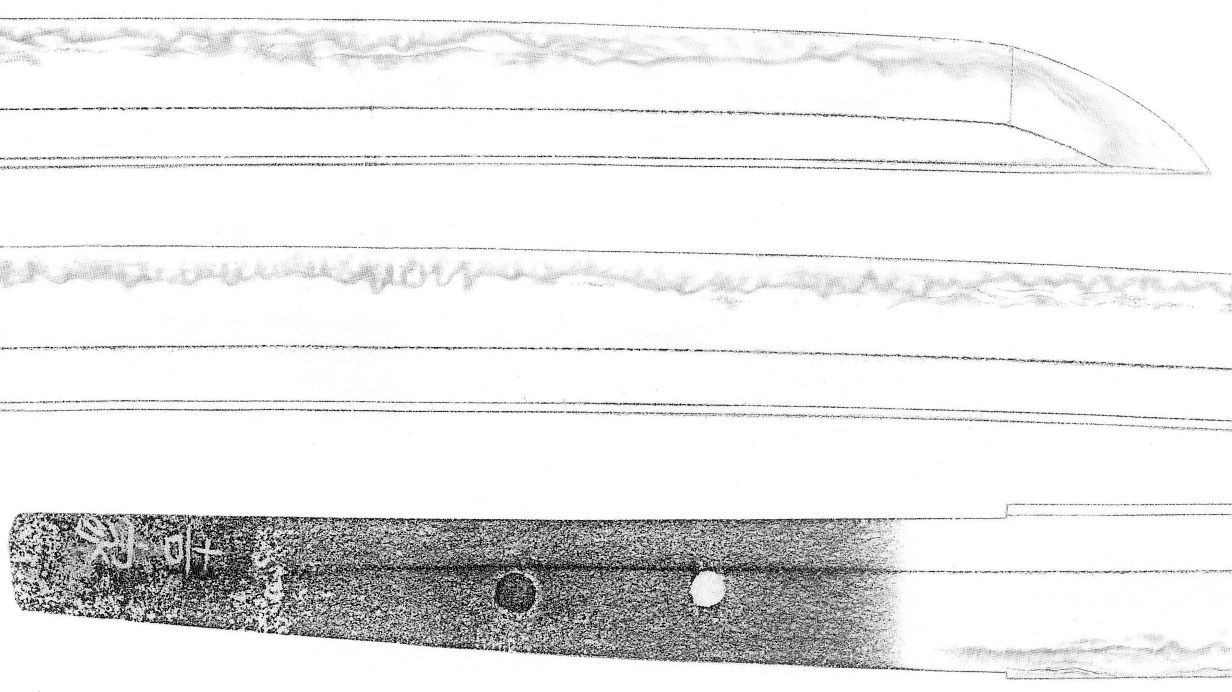
Now to the third of the Six Awataguchi Brothers, Kuniyasu (国安), who bore the first name “Tôsaburô” (藤三郎), the honorary title of Yamashiro no Kami (山城守), and who was goban-kaji smith of the fourth month. He is traditionally dated around Shôji (正治, 1199-1201), that means to the very end of the Heian and the beginning of the Kamakura period. Accordingly, we can see at him a shift towards wider and somewhat more magnificent blades. In short, he made elengant and slender but also relative wide and long tachi with a chû instead of a ko-kissaki, the former being close to works of his older brothers Kunitomo and Hisakuni. He also added relative often bôhi. In addition, we know blades with a fine jigane but much more with a rather standing-out itame that tends to nagare and even ô-hada in places. That is why Kuniyasu is known as forging the most standing-out jada of all Six Awataguchi Brothers. That all and the fact that we are facing slightly different signature stiles and relative many extant works has lead to a two generations theory in which the alleged second generation is dated around Kenchô (建長, 1249-1256). But it is well possible that there was just one Kuniyasu, in other words, he might had been active somewhat longer than some of his brothers and just reacted towards the end of his career to then trends in sword fashion. Incidentally, the Kotô Mei Zukushi says that the youngers of the six, Kunitsuna, died in Kenchô seven (建長, 1255) at the age of 93, what calculates his year of birth as Chôkan one (長寛, 1163). Also Kunitsuna, who moved later to Kamakura, made magnificent and powerful blades. So if we assume that the Six Brothers were born not that far apart, Kenchô seems perfectly fine as career end and there is no need for introducing a second generation Kuniyasu.
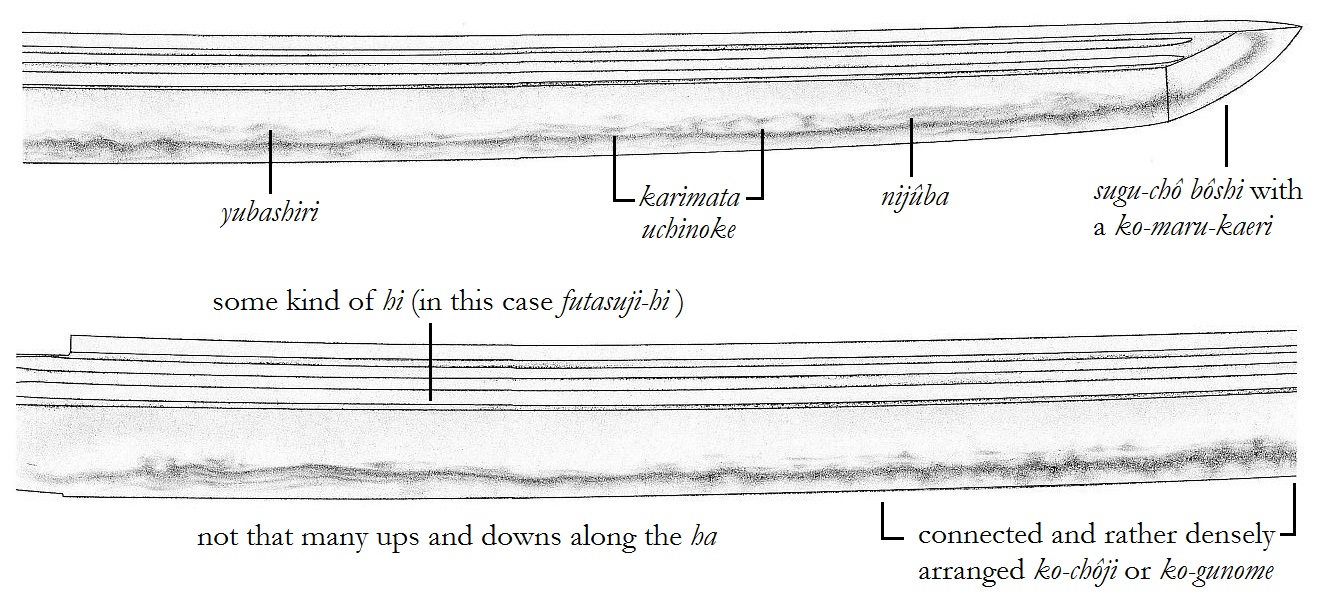
Kuniyasu1

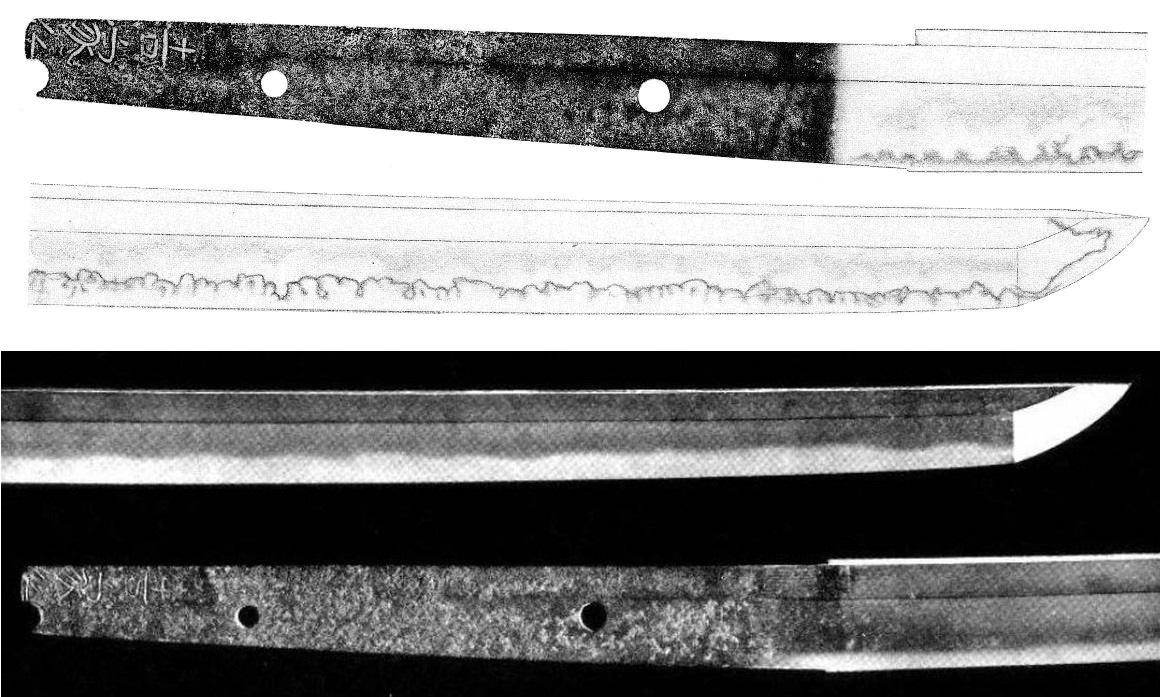
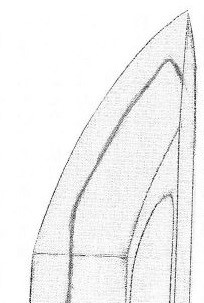
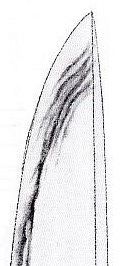
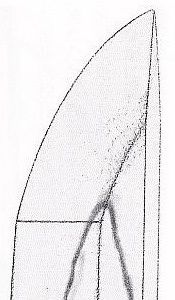
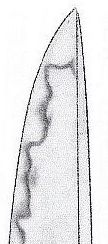
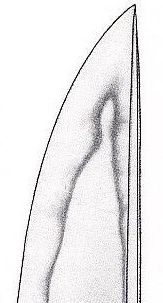
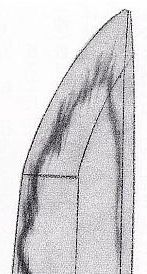
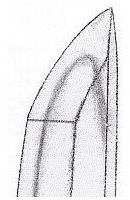
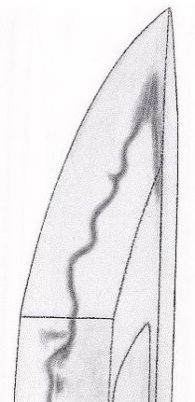
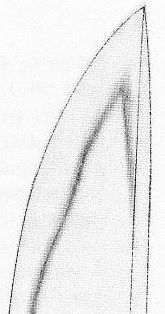
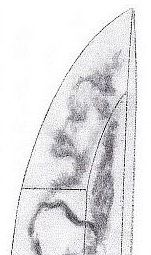
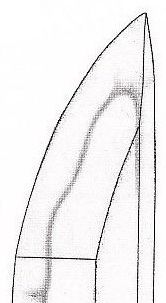
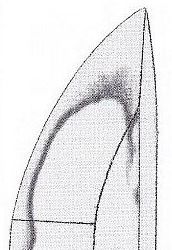
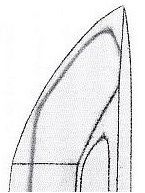
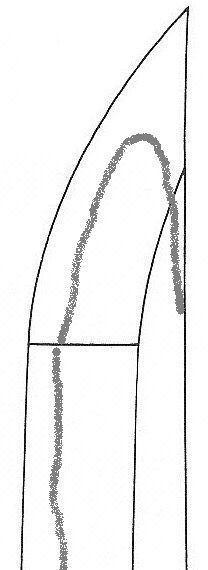
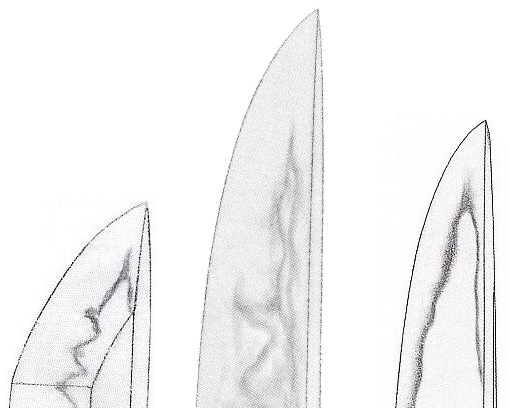
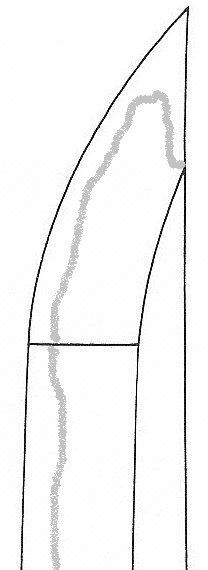
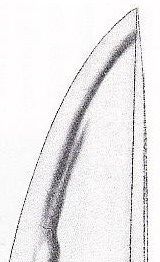
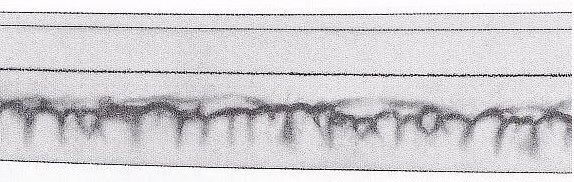
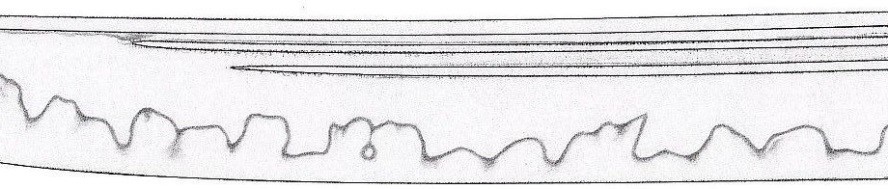
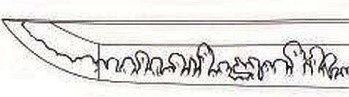
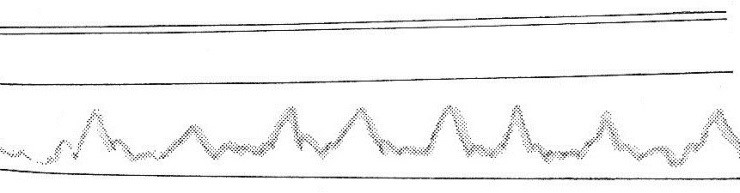
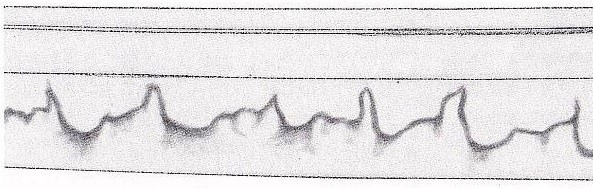
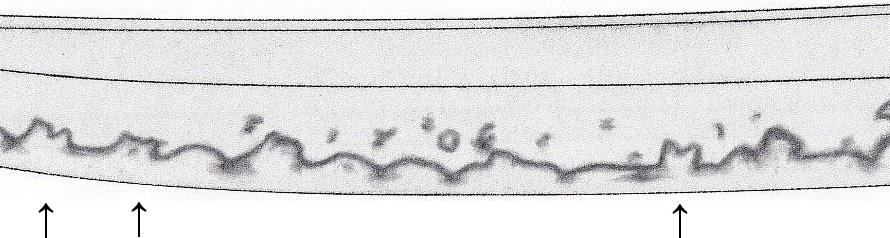
Picture 1: Characteristic features of Awataguchi Kuniyasu’s workmanship.

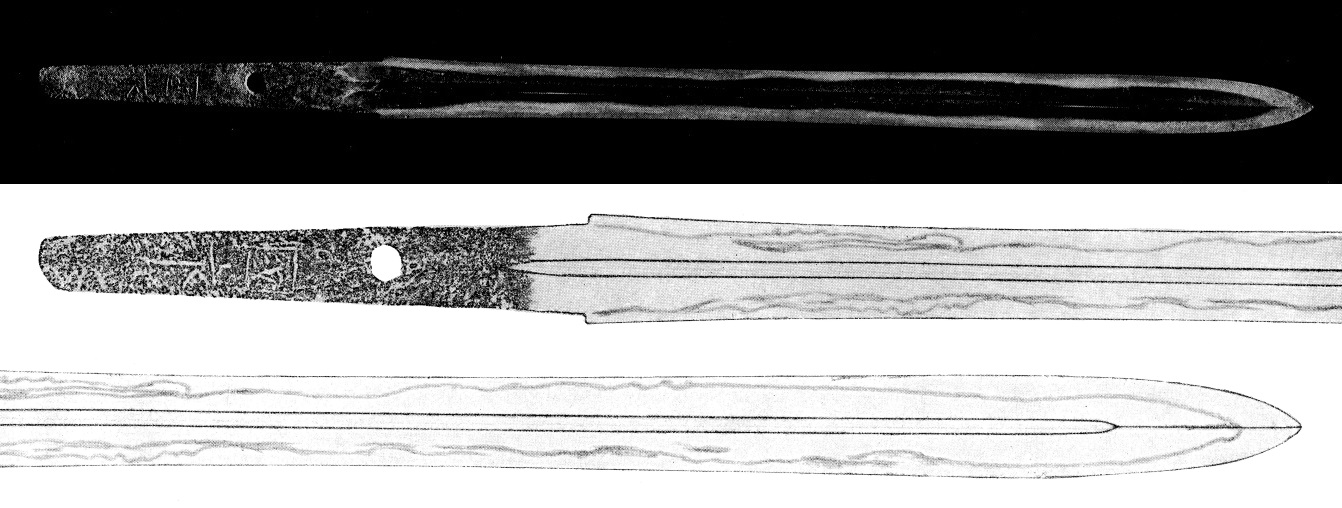
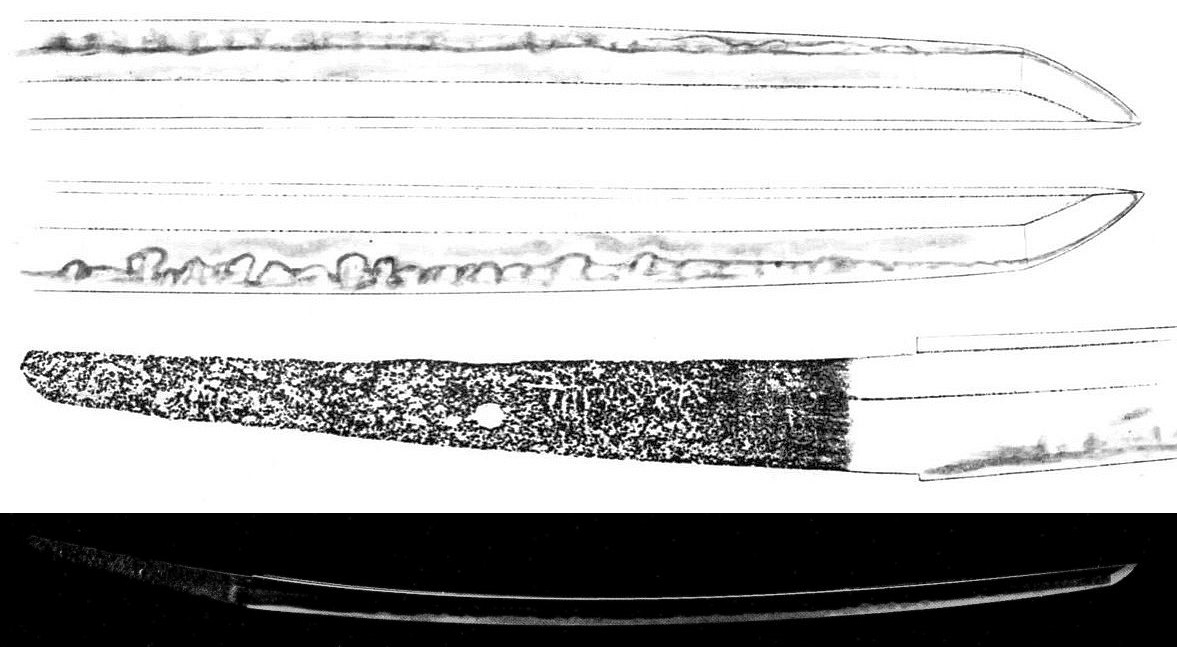
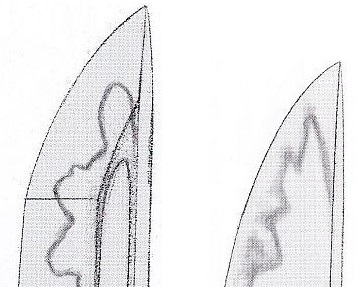
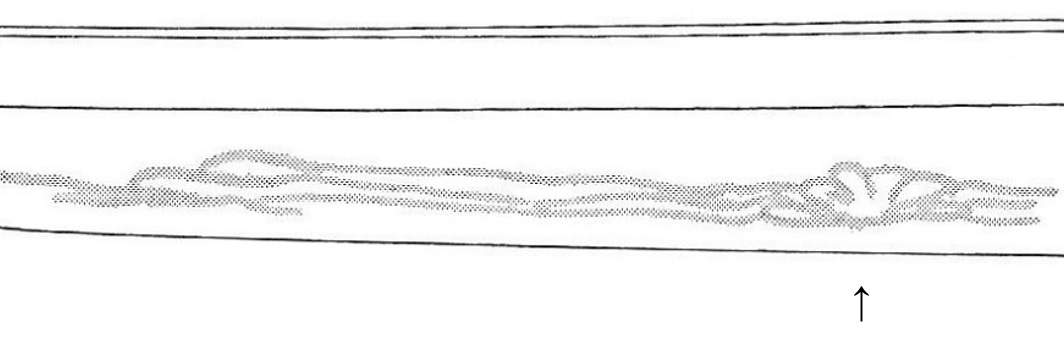
Apart from the above mentioned features, i.e. hada for Awataguchi-mono rather on the rough side and often bôhi, Kuniyasu hardened mostly a sugha-chô that is mixed with ko-midare, ko-chôji, and ko-gunome of which the individual elements are densely arranged and tend to appear in a connect manner, especially the ko-gunome. Besides of that, we see kinsuji and sunagashi (sometimes prominent) and small uchinoke-like elements atop of the yakigashira which are referred to as karimata (雁股, bifurcated arrowheads). These karimata were later adopted by Rai Kuniyuki (来国行) and became one of his characteristic features but they can also be seen on some swords of Ayanokôji Sadatoshi (綾小路定利). In addition, Kuniyasu’s nioiguchi is not as clar as at Hisakuni. That in turn means, you can mix up his works with that of Ayanokôji Sadatoshi as Sadatoshi too is known for applying groups of several ko-gunome and/or ko-chôji elements embedded into a rather subdued nioiguchi and accompanied by yubashiri and nijûba that create that peculiar “layered” appearance of the ha. Major difference between their works is the bôshi as Sadatoshi’s bôshi is noticeably more nie-laden and shows hakikake and nie-kuzure. Kuniyasu’s bôshi is more calm and appears as only slightly undulating sugu with a ko-maru-kaeri. However, some blades of Kuniyasu also show hakikake and a more wide kaeri, so some of his works are pretty close to Sadatoshi. But apart from that we can say that Kuniyasu’s entire ha is a little more calm than that of Ayanokôji Sadatoshi, that means we see a hint more ups and downs at blades of the latter. The more standing-out hada of Kuniyasu might also remind of Ko-Hôki Yasutsuna (安綱) but Yasutsuna’s blade are overall more rustic, i.e. they have a darker steel, a jifu-utsuri with antai (what gives the ha a rather “brindled” appearance), and ha-bie and hotsure that are interwoven into a conspicious ha-hada. As for Kuniyasu’s tangs, they mostly tend to kijimono, show katte-sagari yasurime, and a kurijiri. There are only niji-mei of Kuniyasu known which are signed with a kind of semi-cursive character for “yasu” with large curves for the vertical strokes, although we can see some differences (but which probably go all back to different phases in the career of a single smith). Please note that Ko-Bizen Kuniyasu signed in a similar manner (see picture 2). So watch out but Ko-Bizen Kuniyasu’s blades should be different in terms of hamon (more flamboyant) and sugata (he was active in the mid-Kamakura period).

Kuniyasu2

Picture 2: mei comparison, to the left Awataguchi Kuniyasu, the one to the right Ko-Bizen Kuniyasu

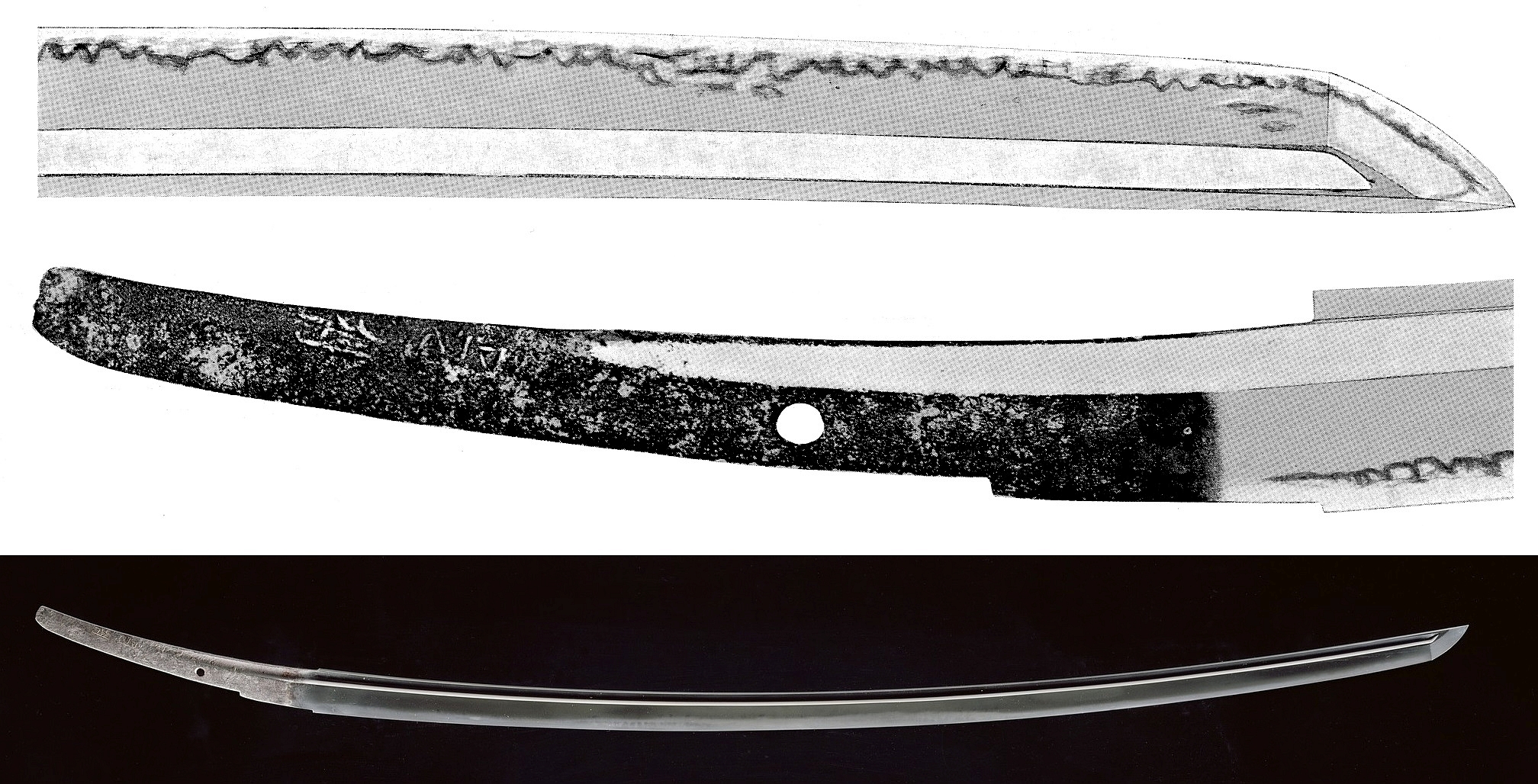
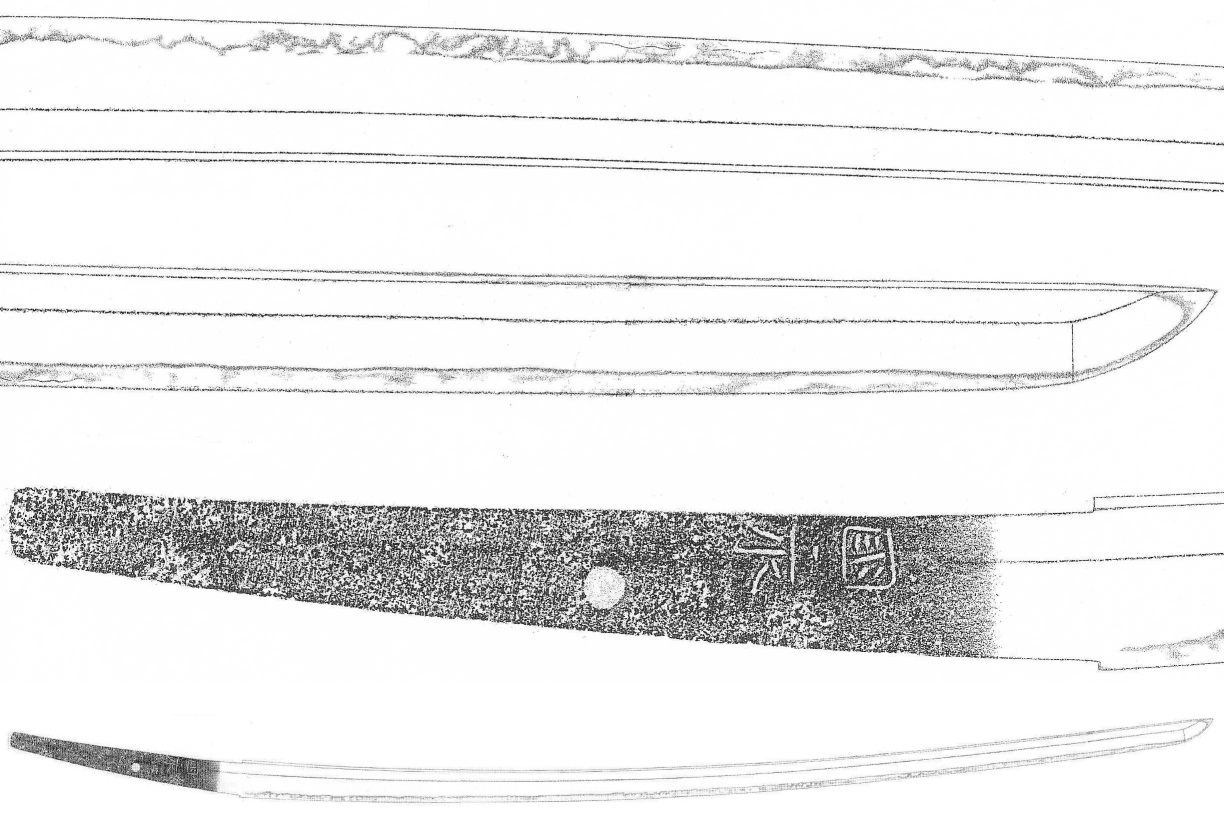
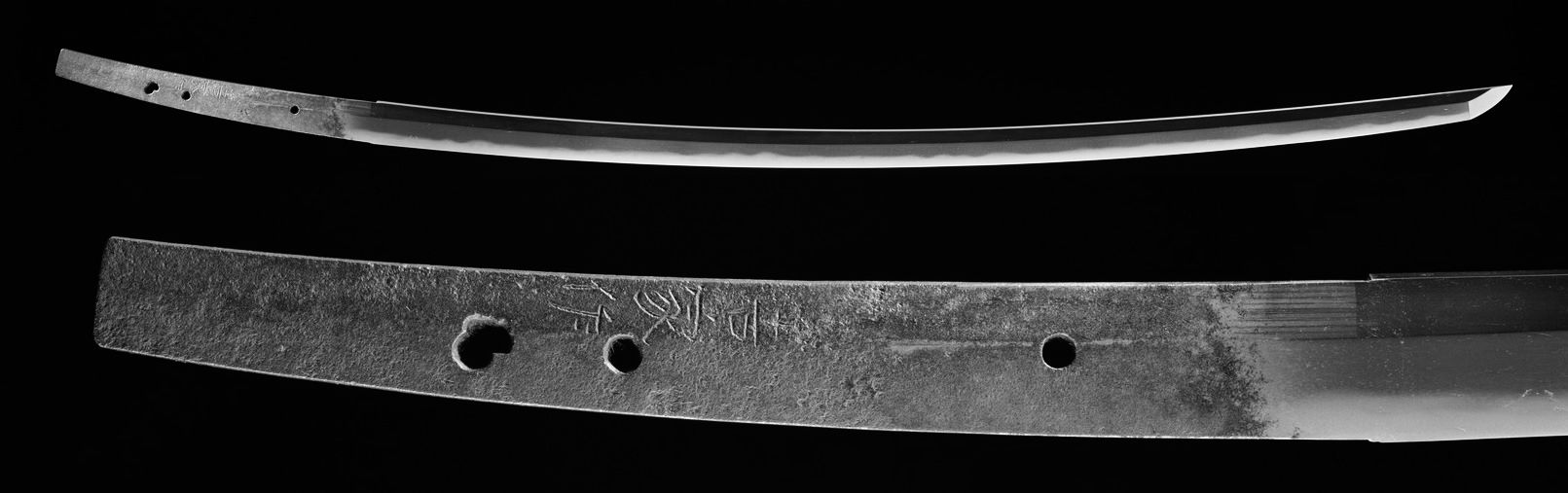
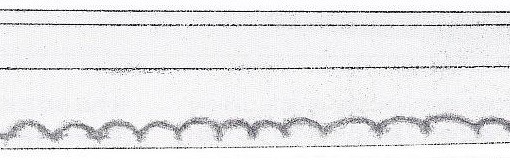
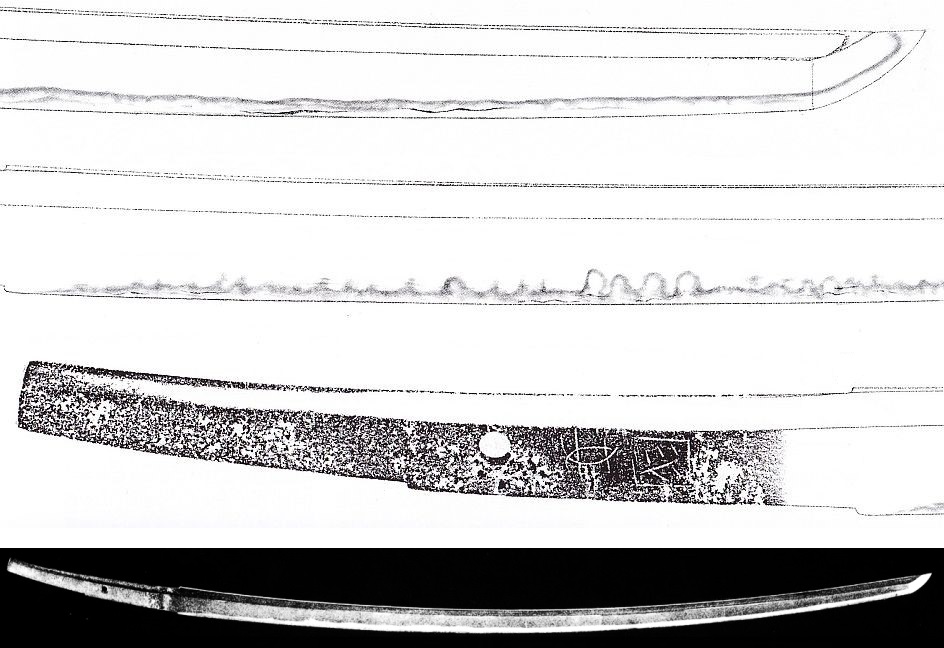
The blade shown in picture 3 was a former heirloom of the Mizuguchi family (溝口), the daimyô of the Shibata fief (新発田藩) of Echigo province, and is today designated as jûyô-bunkazai. It is a little on the wider side but is overall very elegant, shows funbari, and ends in a ko-kissaki. The kitae is a dense itame with plenty of ji-nie and the hamon is a ko-nie-laden ko-midare to suguha-chô along the upper area that is mixed with some prominent ko-chôji and that comes with a rather subdued nioiguchi. We also see some kinsuji and sunagashi and the bôshi is sugu with a ko-maru-kaeri.
Kuniyasu3

Picture 3: tachi, jûyô-bunkazai, mei “Kuniyasu” (国安), nagasa 79.3 cm, sori 2.9 cm, shinogi-zukuri, iori-mune

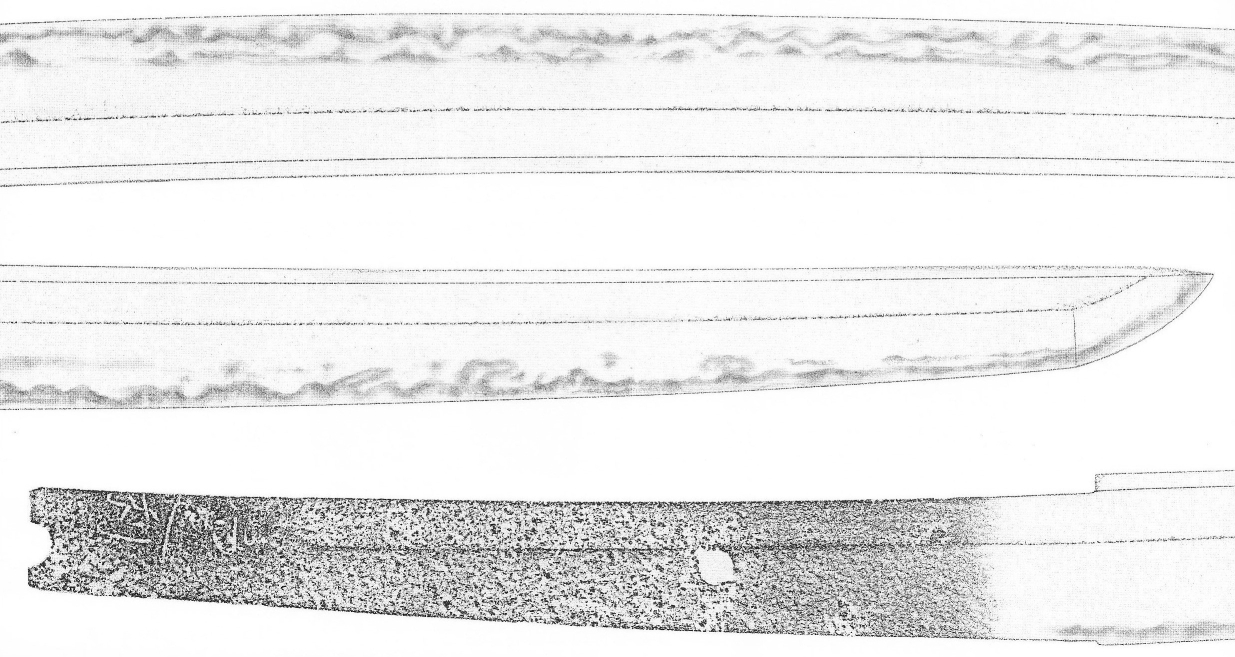
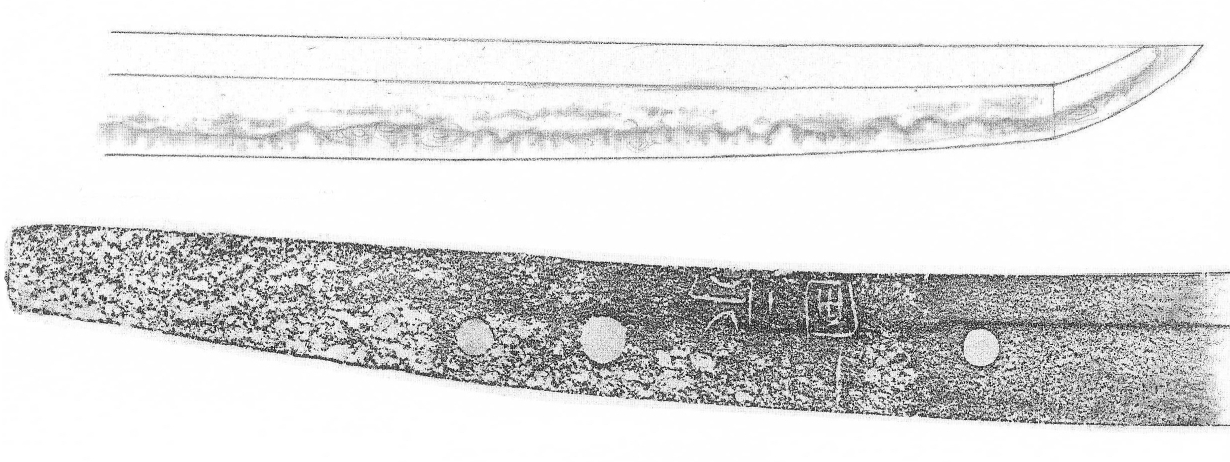
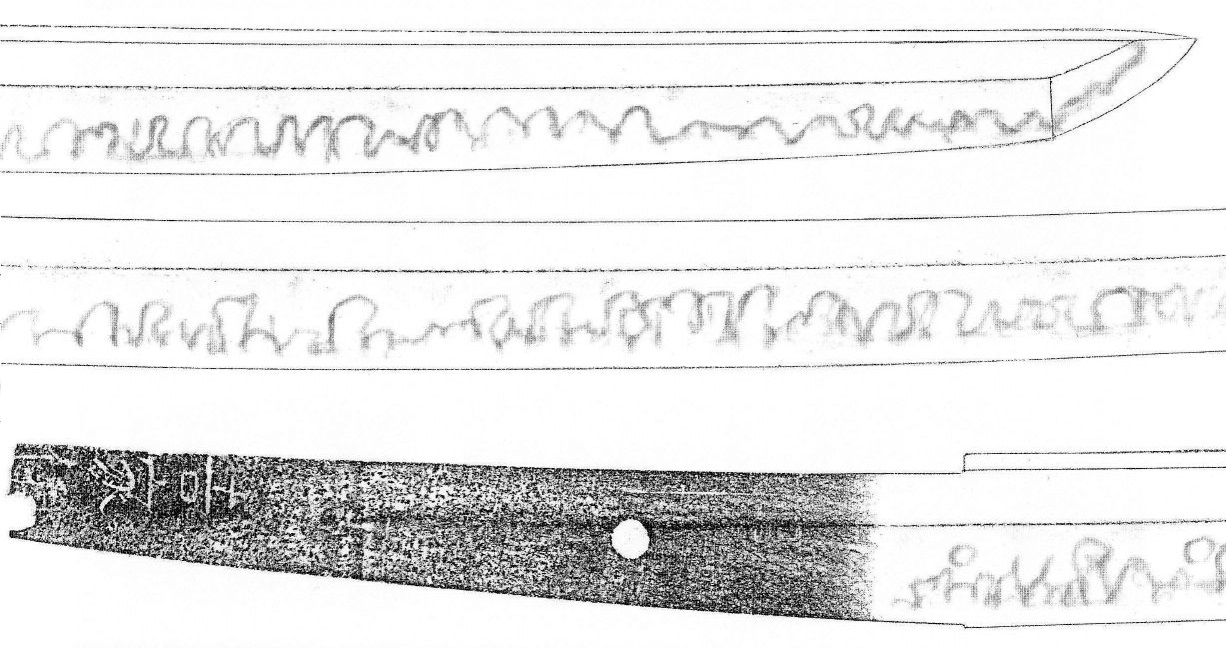
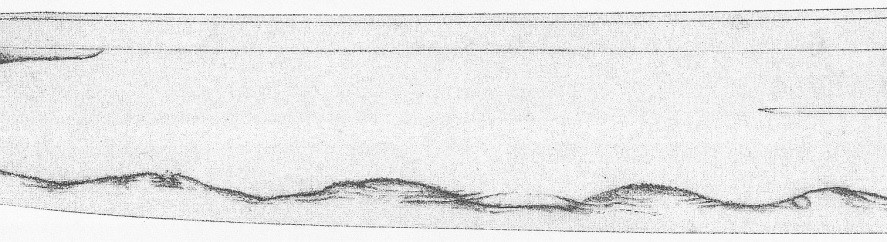
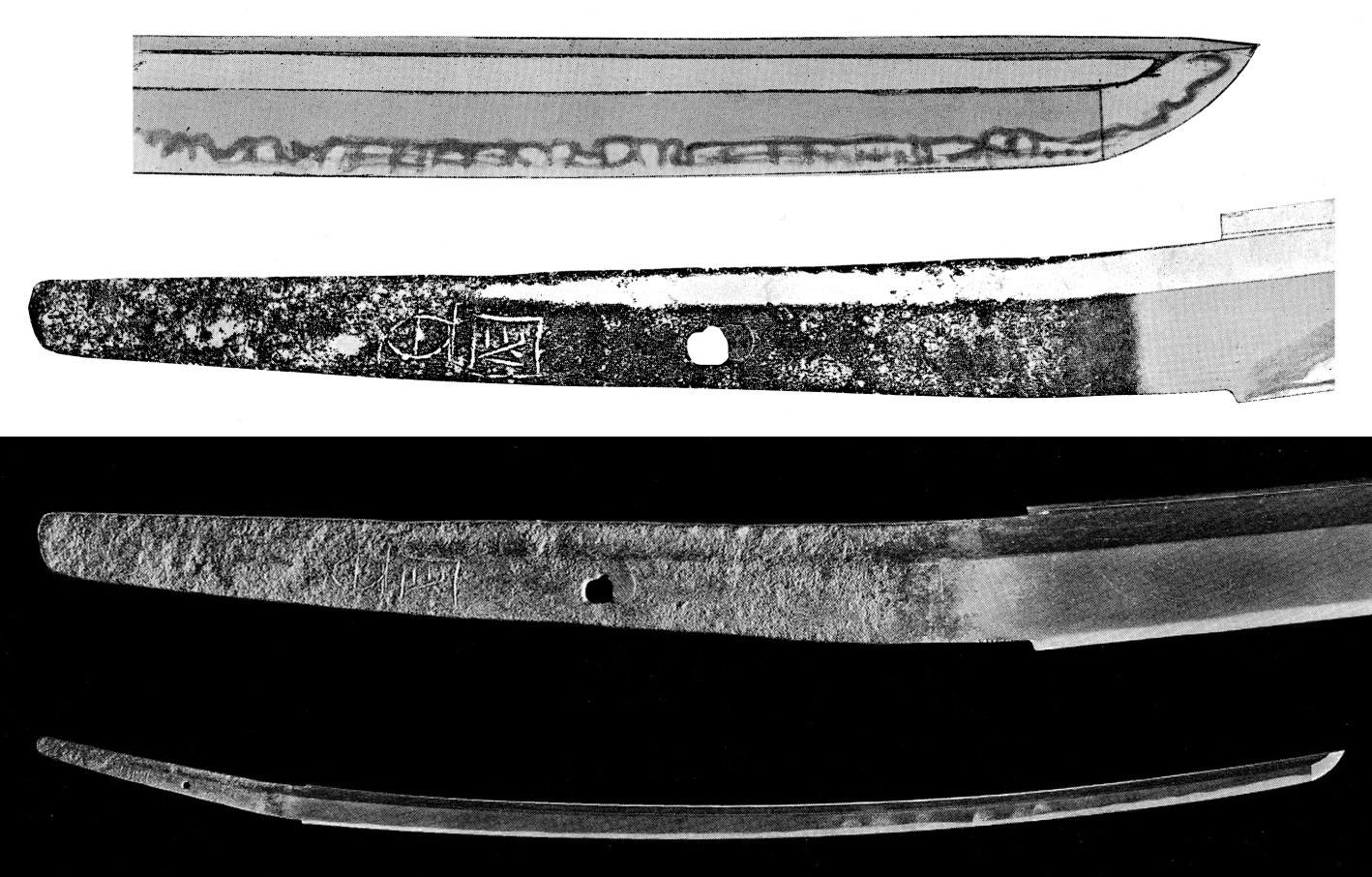
Next I want to introduce a tachi of Kuniyasu that is preserved in the Tôkyô National Museum but that has no whatsoever designation. It is again a little wide, has a deep koshizori with funbari, and a compact chû-kissaki and the kitae ist a rather standing-out ko-itame with ji-nie. The hamon is a ko-nie-laden ko-notare that is mixed with ko-midare, many ko-ashi and , kinsuji, and sunagashi and the bôshi is midare-komi with a ko-maru-kaeri. Please see here to get some impression of the steel of this blade and its overall perfect condition.
Kuniyasu4

Picture 4: tachi, mei “Kuniyasu” (国安), nagasa 79.4 cm, sori 2.7 cm, shinogi-zukuri, iori-mune

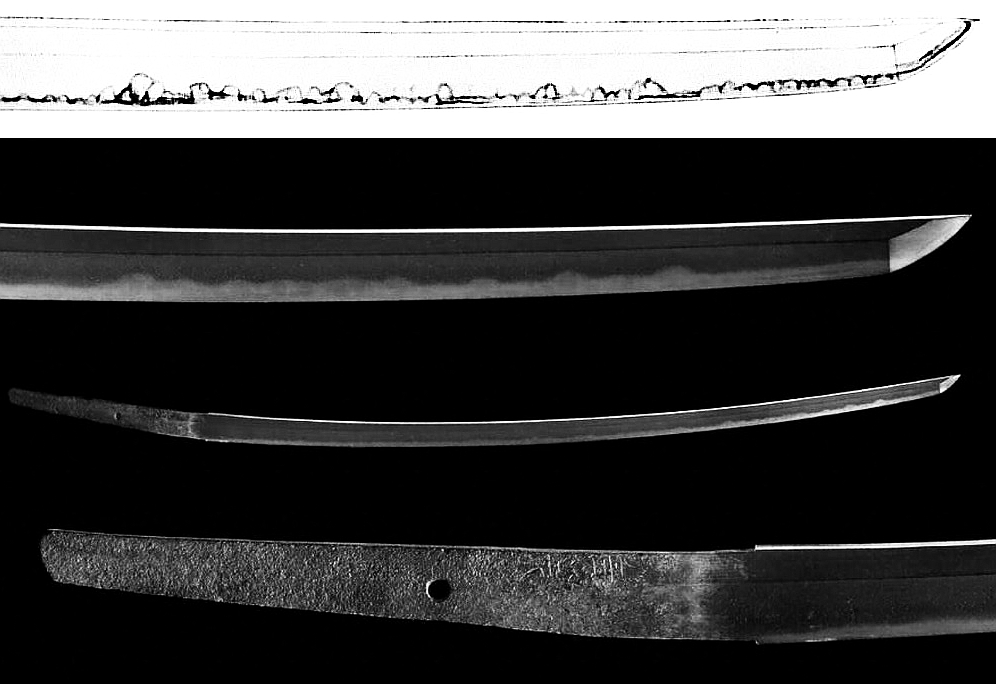
And as last work of Kuniyasu I want to introduce the jûyô-bijutsuhin tachi that was once owned by the Matsudaira branch (松平) which was in control of the Tsuyama fief (津山藩) of Mimasaka province and which is now preserved by the NBTHK. It is shows a standing-out itame mixed with mokume and nagare and also fine ji-nie, chikei, and a faint nie-utsuri appear. The hamon is a ko-nie-laden suguha-chô mixed with plenty of ko-ashi and , kinsuji, sunagashi, and discontinuous yubashiri and nijūba along the yakigashira that create the very “layered” apperance. The ha does not show conspicious ups and downs and its midare elements are densely arranged. The bôshi is sugu with a ko-maru-kaeri and please note that this blade bears futasuji-hi.
Kuniyasu5

Picture 5: tachi, jûyô-bijutsuhin, mei “Kuniyasu” (国安), nagasa 71.4 cm, sori 2.7 cm, shinogi-zukuri, iori-mune

*

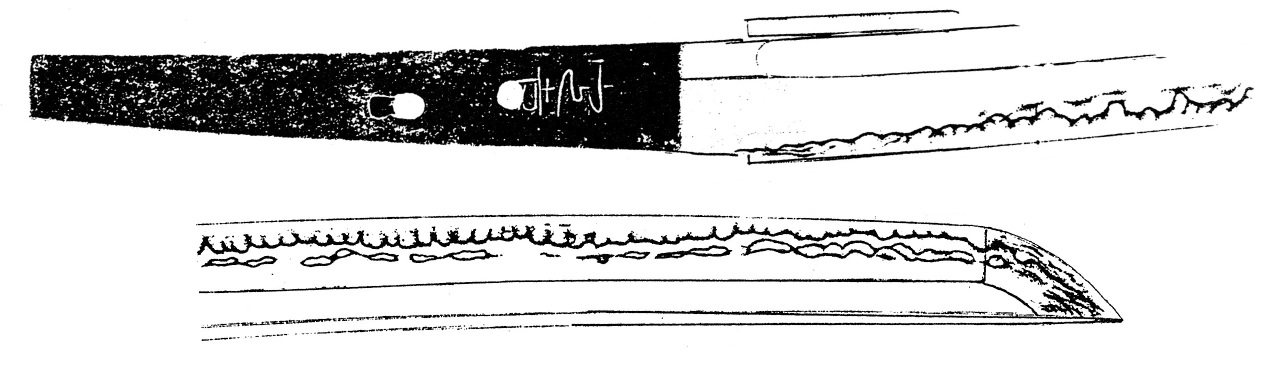
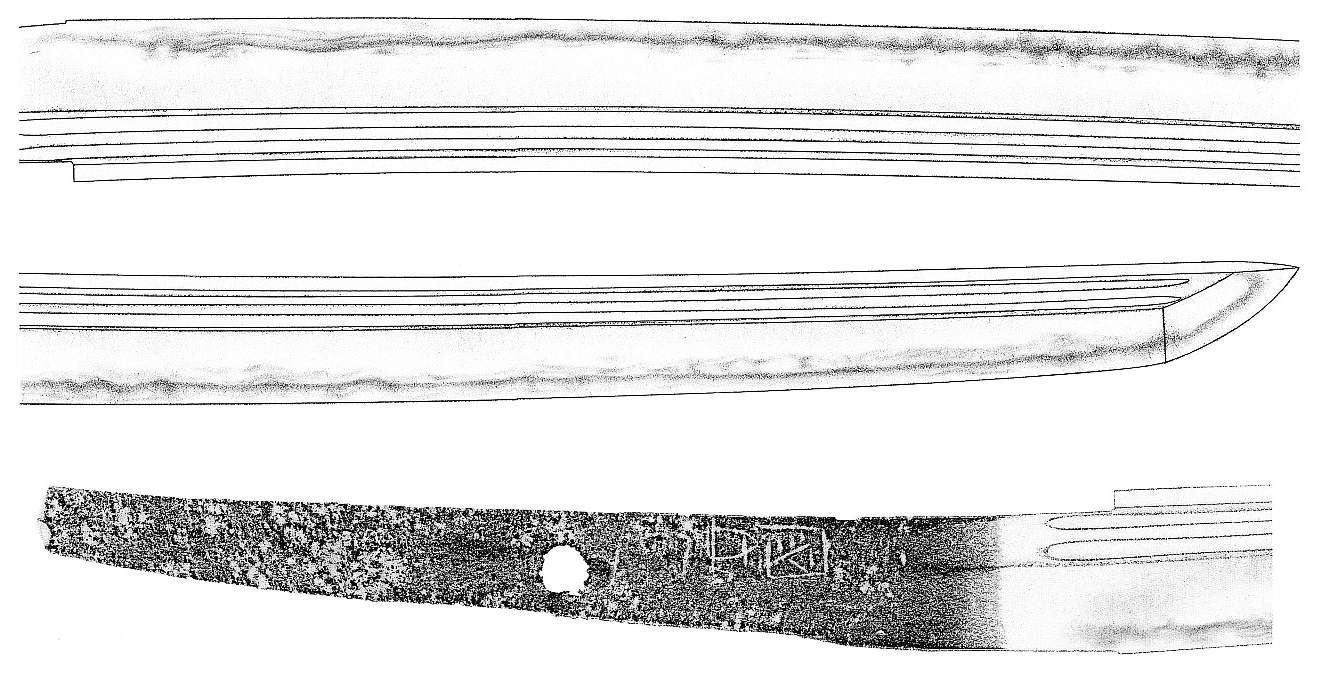
Kuniie’s fourth son was Kunikiyo (国清). He bore the first name Tôshirô (藤四郎) and the Kotô Meizukushi Taizen says that he also signed with “Shirôbei” (四郎兵衛) and that he was around Genryaku (元暦, 1184-1185) 30 years old. As for Kunikiyo, we only have two authentic signed and a few ô-suriage mumei works attributed to him to work with. The jûyô-bunkazai tachi (picture 6) was once owned by the Satake (佐竹) family, the daimyô of Akita, and handed down within them as Awataguchi work since the early Edo period. The other signed work is a jûyô-bijutsuhin but which bears quite a differently chiselled mei. It was once owned by the pre-WWII collector Saitô Moichirô (斎藤茂一郎), who owned several bunkazai, bijutsuhin, and kokuhô, but Honma said that its provenance is unclear. However, he also says that despite of the differences in their mei, both blades are more classical than Rai works and he has no problem with seeing them as Awataguchi-mono. Honma was not sure if the blades go back to the same smith but for him, the differences in mei are too great to see them as just going back to different phases of a single smith’s career. And in this course he was also not sure which one was the fourth of the Six Awataguchi Brothers. Tanobe too remarks the somewhat “hesitatingly” chiselled mei of the jûyô-bijutsuhin but rather tends to think that we are facing signatures of two different active periods of a single smith. Incidentally, there was another Awataguchi Kunikiyo but he was a student of Kunitsuna and active too late (around Kôan [弘安, 1278-1288]) for attributing any of these blades to him.

Anyway, the jûyô-bunkazai is elegant, has a rather shallow sori, funbari, and a ko-kissaki. The kitae is a dense ko-itame with fine and bright ji-nie and shows a faint but beautiful nie-utsuri. The hamon is a ko-chôji in ko-nie-deki that is mixed with ko-midare, ko-gunome, karimata-like elemements, small tobiyaki and yubashiri atop of the yakigashira in places, ashi, , sunagshi and kinsuji. The ha is quite complex and its elements are densely arranged and we can see a strong resemblane to works of Kuniyasu. Kunikiyo’s ha is just a little wider, the sori more shallow, and the shinogi-ji somewhat broader. Please note that Tanobe describes this blade at one place as having a deep koshizori but what is probably a mistake.

Kunikiyo1

Picture 6: tachi, jûyô-bunkazai, mei “Kunikiyo” (国清), nagasa 79.4 cm, sori 2.2 cm, shinogi-zukuri, iori-mune

Picture 7 shows a tachi of Kunikiyo that is tokubetsu-jûyô and attributed via “Den” to Awataguchi Kunikiyo. It has a deep koshizori that bends down towards the tip and shows a rather standing-out itame mixed with some nagare, plenty of ji-nie, and much chikei. The hamon is a nie-laden suguha-chô mixed with some notare, ko-midare, gunome, ashi, some yubashiri along the monouchi, kinsuji, and many fine sunagashi. The nioiguchi is bright and clear and the bôshi is sugu with a short maru-kaeri and nijûba. The tang is ô-suriage, shows a shallow kurijiri, and shallow katte-sagari yasurime. This blade was once a heirloom of the Sakai (酒井) family, the daimyô of the Himeji fief (姫路藩) of Harima province.
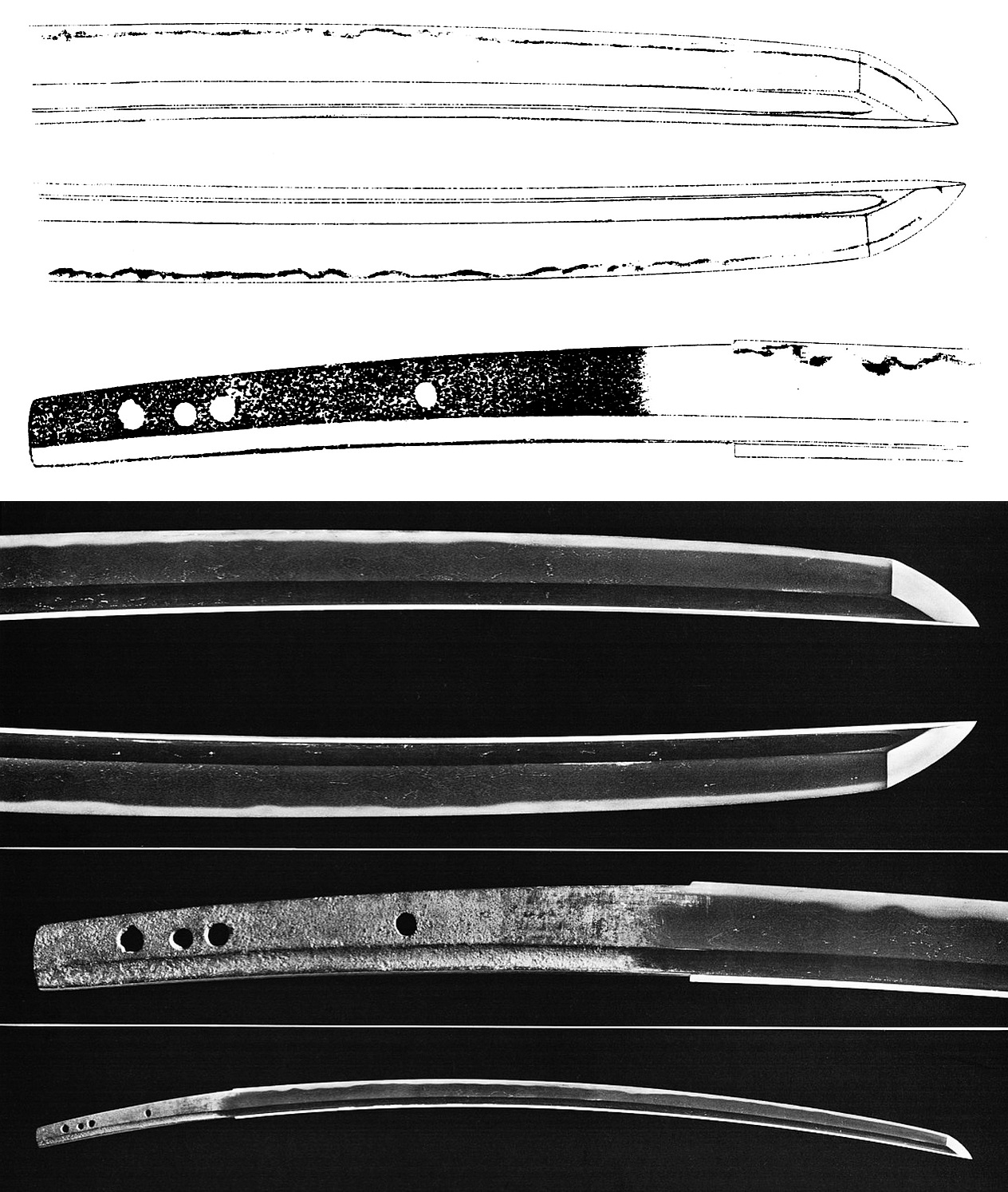
Kunikiyo2

Picture 7: tachi, tokubetsu-jûyô, mumei “Den Awataguchi Kunikiyo” (伝粟田口国清), nagasa 69.8 cm, sori 2.6 cm, shinogi-zukuri, iori-mune


*


Arikuni (有国) was the fifth son of Kuniie and his first name was Tôgorô (藤五郎). Unfortunately, there is only one signed blade known by him, a tachi (picture 8) that had been shortened to an uchigatana (per nagasa definition a wakizashi today) but whose signature was preserved via orikaeshi. It was once owned by a certain Nakasawa (中沢) from Nagoya but who offered it to the Ise Shrine. The blade remains despite of the suriage an elegant shape that still gives you an idea of the noble and refined original tachi-sugata. It shows a compact ko-kissaki with a hint of ikubi and a dense ko-itame that is mixed with some nagare and masame and that appears with its abundance ji-nie as nashiji-hada. The hamon is a hoso-suguha in ko-nie-deki and the bôshi has a ko-maru-kaeri. Please note that there was another Awataguchi Arikuni smith active from whom a blade dated Kagen two (嘉元, 1304) is extant. Some see him as a possible later generation of Kuniie’s son but the Kokon Meizukushi Taizen lists him in its genealogic section as son of Kunitsuna, although beneath of Kunitsuna’s alleged other son, Kunihiro (国弘), what means that he possibly could have been Kunitsuna’s grandson.
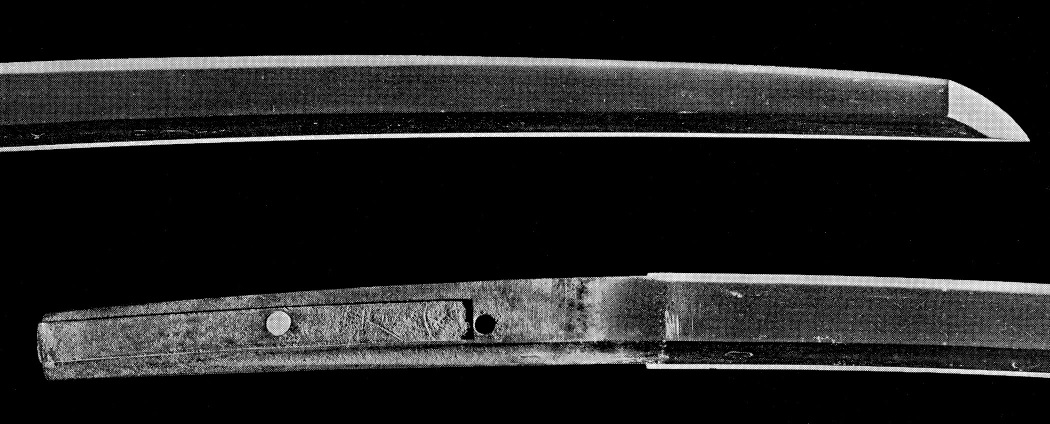
Arikuni1

Picture 8: wakizashi, jûyô-bunkazai, orikaeshi-mei “Arikuni” (有国), nagasa 56.3 cm, sori 0.9 cm, shinogi-zukuri, iori-mune


Next time I will introduce Kunitsuna (国綱), the sixth and youngest son of Kuniie, before we continue with the Awataguchi main line after Kunitomo and sons and students of the Six Brothers.

 

KANTEI 4 – YAMASHIRO #7 – Awataguchi (粟田口) School 2

Awataguchi Hisakuni (久国) was the second son of Kuniie and thus the second oldest of the so-called “Six Awataguchi Brothers.” He is listed with the first name Tôjirô (藤次郎) what makes sense as “Jirô” means “second son.” So the “Fuji” from Fujiwara was combined with the fact that he was the second son and this approach was kept for all other sons of Kuniie who were named Tôsaburô, Tôshirô, Tôgorô, and Tôroku (the youngest went without the suffix ). Just his first son Kunitomo is an exception as he was called Saemon, or if we follow the “Fuji” character integration approach, Tôzaemon, or Tôrinzaemon if we also integrate the alleged family name Hayashi. Anyway. Hisakuni had the honor to become the sword forging instructor of Emperor Gotoba and received for this the honorary title of Ôsumi Gonnokami (大隅権守) and an extra intracalary month was added to the monthly-based goban-kaji to include him in the list. In addition, Gotoba also conferred titles of the ancient courtly Smiths Office (kanuchi no tsukasa, 鍛冶司) upon smiths who worked for the goban-kaji project. For example, Hisakuni was made head of all Yamashiro smiths (Yamashiro Kokuchû Kaji Chôja, 山城国中鍛冶長者) and entrusted with Bizen-Ichimonji Nobufusa (延房) – who was the other sword forging instructor of Gotoba – with another courtly sword office, namely that of the Nihon Kaji Sôchô (日本鍛冶惣庁). Those titles and the fact that Gotoba had chosen him as teacher (it is said that he worked for eight years with the retired emperor) speaks for the great skill of Hisakuni and virtually all experts agree that Hisakuni was the best of all Awataguchi smiths. Incidentally, the Kotô Meizukushi Taizen states that he died in Kenpô four (建保, 1216) at the age of 67, that means he was three years younger than Kunitomo (if we believe in this data).

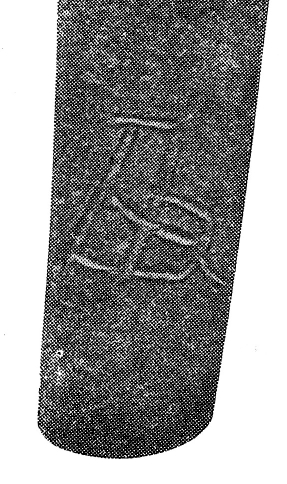
Fortunately, there are relative many works of Hisakuni extant, both tachi and tantô. Like Kunitomo, and due to the local and chronological context, he made highly elegant and slender tachi with a deep koshizori that bends down towards the tip, funbari, and a ko-kissaki that might tend to a little chû. His jigane is of unrivalled quality and also the hamon is perfectly hardened. The fineness and density of his steel is referred to as tataki-tsume (たたきつめ) in old sword publications what means about “as dense as a stamped-down clay floor.” The most famous and best work of him is the kokuhô (picture 1) that was once a heirloom of the Matsudaira (松平) branch which ruled the Saijô fief (西条藩) of Iyo province. It shows a very dense ko-itame whose abundance of ji-nie tends towards nie-utsuri and which appears altogether as nashiji-hada. The hamon is a suguha-chô in ko-nie-deki that is mixed with ko-midare, ko-chôji, ko-gunome, plenty of ko-ashi, some uchinoke, kinsuji and sunagashi in places, and brightly glittering ha-nie. The nioiguchi is very clear and the bôshi is a shallow notare-komi with a short kaeri (almost entirely yakitsume on the ura) with hakikake. The tang is ubu, although its end was altered as the seen on the first and third Kunitomo picture, shows a kurijiri, sujikai-yasurime, and two mekugi-ana. The niji-mei is chiselled right next to the mekugi-ana and it has to be pointed out that this is the thinnest signature known by Hisakuni. Also interesting is that the tang bears at the very end a kaô (picture 2) but which does not go back to the smith. It was added later, probably on behalf of a later owner of the sword.

Hisakuni1

Picture 1: tachi, kokuhô, mei “Hisakuni + kaô” (久国), nagasa 80.4 cm, sori 3.0 cm, shinogi-zukuri, iori-mune

 Hisakuni2

Picture 2: Detail of the kaô

Next I want to introduce the Hisakuni tachi from the Imperial Collection (picture 3). It is suriage and shows a dense ko-itame with plenty of ji-nie and chikei and a suguha that tends to ko-notare and that is mixed with ko-midare, plenty of ashi and , and some kinsuji. The bôshi is sugu with a hint of midare and shows a ko-maru-kaeri with nijûba on the omote side. Please note that the signature is noticeably thicker chiselled than that of the kokuhô, what is the more common signature style of Hisakuni (actually, only the kokuhô was signed with that a thin chisel but Tanobe assumes that all known mei go back to the hand of a single smith).

Hisakuni3

Picture 3: tachi, gyobutsu, mei “Hisakuni” (久国), nagasa 66.7 cm, sori 1.5 cm, shinogi-zukuri, iori-mune

When it comes to long swords of Hisakuni, also the jûyô-bunkazai from the former collection of the Akimoto family (秋元) has to be mentioned (picture 4) as it is regarded as his “second best” work. The tang was shortened like the gyobutsu just as much as to preserve the mei, which was added with the same thick chisel. The kitae is a very densely forged ko-itame with plenty of ji-nie and also an irregular jifu-utsuri with some antai appears. The hamon is a nie-laden suguha that tends to ko-notare and that is mixed with ko-chôji, ko-midare, kinsuji, sunagashi, ha-nie, and seven some ara-nie in places. And with the hakikake in the bôshi and the jifu-utsuri we might say that Hisakuni gave this blade on top of its elegance a hint of power. Please note that like at the gyobutsu, the undulating area of the hamon focuses on the monouchi.
Hisakuni4

Picture 4: tachi, jûyô-bunkazai, mei “Hisakuni” (久国), nagasa 78.5 cm, sori 1.6 cm, shinogi-zukuri, iori-mune

Hisakuni5

Picture 5: tachi, tokubetsu-jûyô, mei “Hisakuni” (久国), nagasa 74.4 cm, sori 2.0 cm, shinogi-zukuri, iori-mune, dense itame with a hint masame and plenty of fine ji-nie, the hamon is a suguha-chô in ko-nie-deki with a little shallow notare and is mixed with ko-gunome, ko-midare, ko-ashi, , and fine sunagashi, the bôshi is a rather wide sugu-chô with a ko-maru-kaeri, the tang is completely ubu, has a kurijiri, katte-sagari yasurime, and comes in a kijimono-gata, again, we have here the common thickly chiselled mei of Hisakuni

*

Now to Hisakuni’s tantô. The majority of them is small dimensioned and has an uchizori that shows a hint of takenoko (i.e. can appear as more pronounced uchizori). By the way, Hisakuni is often quoted when it comes to the earliest extant fine tantô. And then there is the wide, long, slightly curved, and almost Nanbokuchô-esque jûyô-bijutsuhin tantô of Hisakuni that is the odd one out. But the signature and deki of the jiba is a total match with the other works of Hisakuni and experts agree that this is just one of the more rare dagger interpretations that were occasionally ordered at that time. Well, the blade shows a ko-nie-laden suguha-chô that is mixed with connected ko-gunome, yubashiri that create nijûba and kuichigaiba in places, and some kinsuji and sunagashi. The bôshi is sugu with a rather long running-back ko-maru-kaeri. On both sides a bôhi with a shorter soebi at the base is engraved.

Hisakuni6

Picture 6: tantô, jûyô-bijutsuhin, mei “Hisakuni” (久国), nagasa 29.4 cm, hira-zukuri, mitsu-mune

The most representative tantô of Hisakuni (and regarded by some as one of the finest of all Awataguchi tantô) is the jûyô-bunkazai that was owned liked the kokuhô by the Saijô-Matsudaira family (picture 7). It is slender, as mentioned small dimensioned, has a rather pronounced uchizori, and shows a very dense ko-itame with fine ji-nie that tends to form nie-utsuri. The hamon is a ko-nie-laden suguha-chô that is mixed with ko-midare, kinsuji, and sunagashi, and we have the same tendency towards nijûba and kuichigaiba as seen on the sunnobi-style jûyô-bijutsuhin. The bôshi is sugu with a little midare-komi and has a ko-maru-kaeri.

Hisakuni7

Picture 7: tantô, jûyô-bunkazai, mei “Hisakuni” (久国), nagasa 20.1 cm, uchizori, hira-zukuri, iori-mune

Picture 8, an heirloom of the Date (伊達) family, shows one of the more rare blades of Hisakuni that is signed with his first name. It is a slender jûyô-tantô that shows a very fine and densey forged ko-itame with ji-nie which appears as nashiji-hada. The hamon is a hoso-suguha in ko-nie-deki with a prominent yakikomi at the machi and with hotsure. The ha widens along the fukura and runs back with a ko-maru-kaeri. The omote side shows three bonji and the ura side a suken.

Hisakuni8

Picture 8: tantô, jûyô, mei “Tôjirô Hisakuni” (藤次郎久国), nagasa 22.4 cm, uchizori, hira-zukuri, iori-mune

There is also one tachi signed that way (picture 9), a jûyô that bears a kinzôgan-mei with the name of its former owner – Shimazu Narinobu (島津斉宣, 1774-1841), the ninth daimyô of the Satsuma fief – on its tang. It is slender, preserves despite of the suriage a deep sori, and shows an itame with some nagare and ji-nie. The hamon is a nie-laden suguha-chô mixed with chôji, ko-midare, sunagashi, kinsuji, and plenty of ha-nie. The bôshi is a thin sugu with a ko-maru-kaeri.

Hisakuni9

Picture 9: tachi, jûyô, mei “Tôjirô Hisakuni” (藤次郎久国) kinzôgan-mei “Bungo no Kami Narinobu kore o haku” (豊後守斉宣帯之), nagasa 68.4 cm, sori 2.2 cm, shinogi-zukuri, iori-mune


KANTEI 4 – YAMASHIRO #6 – Awataguchi (粟田口) School 1

It is said that the Awataguchi School goes back to a certain Kuniyori (国頼) but who was not a swordsmith, at least it is noted so in the old genealogies which add the supplement “hi-kaji” (非鍛冶, also read “kaji arazu”), lit. “no smith.” So his successor Kuniie (国家) – who is listed as “started to educate himself to become a swordsmith” or “the first [of the school] who carried out the profession of a swordsmith” – is regarded as de facto founder of the school what in turn renders Kuniyori the school’s “ancestor” if you want. Kuniie is also listed as being a “descendant of Yamato´s Kôfukuji (興福寺),” whatever that means, because no source goes into detail about what relationship Kuniie had to this temple. The Kotô Mei Zukushi Taizen states that Kuniyori was an armorer from Yamato and that his son Kuniie lived in Tanba (丹波), in the Soekami district (添上郡) of Yamato province which was an area that became a part of present-day Tenri (天理), Nara Prefecture. The Kôfukuji is about 10 km to the north of Tanba/Tenri. So not sure if these two traditions, i.e. being affiliated with the Kôfukuji and living/working in Tanba go hand in hand. I want to do some research on the jôji-hôshi (承仕法師) in the future, the so-called “monk craftsmen” or “monk workers” of a certain temple. Maybe I am able to come across something which helps us in this matter. The Kotô Mei Zukushi Taizen dates Kuniie around Tenshô (天承, 1131-1132) but the meikan date Kuniyori around Bunji (文治, 1185-1190) and Kuniie around Genryaku (元暦, 1184-1185), that means both towards the very end of the Heian period. As mentioned repeatedly in this blog, these dates have to be taken with a grain of salt, so even if Bunji was later than Genryaku, there is a certain grey area and the dates do not rule out at all that Kuniyori and Kuniie were father and son. Well, if it is true that Kuniie became a swordsmith with his move to Kyôto, we have no records that tell us who his master was. In addition, there are no blades of Kuniie extant which would allow us to draw some conclusions on the basis of workmanship. I would like to refer to the Japanese practice of tôri-ji (通字) or kei-ji (系字) at this point, the practice of a lineage or school of sharing a common character. When we assume that Kuniie was in Kyôto around Genryaku (元暦, 1184-1185), under whom could he have studied? Neither the Ayanokôji nor the Rai School had been established at that time. The Sanjô School seems a bit too early so maybe Gojô comes into question. Their latest known master, Kuninaga (国永), is traditionally dated around Tengi (天喜, 1053-1058) but as mentioned in the relevant chapter of this series, it is very likely that there were several generations Kuninaga active. So with the practice of tôri-ji in mind, we can speculate that Awataguchi Kuniie might had been a student of a later Kuninaga. But it is of course also possible that the very character for “Kuni” had already been shared in his lineage of armorers and Kuniie so to speak brought it with him from Nara and his use of “Kuni” has nothing to do with the lineage of Gojô Kuninaga. Anyway, I said at the beginning of this series that I don’t want to go too much into historic detail and focus on kantei. But I also said I will introduce some historic background if it is necessary for the understanding of a certain subject. And the establishment of the Awataguchi School is such a case because as mentioned in the following, Kuniie’s six sons and their successors turned out to be the greatest masters of their time. It is thus hard to accept that a school like the Awataguchi came out of nowhere. So either Kuniie was a later and skilled smith from the lineage of Gojô Kuninaga, or he was a skilled armorer who reacted to the then local demand for elegant swords for the aristocracy, studied under a local smith, and worked with his six sons very hard to establish a forge that should become the first point of contact when it comes to high-quality blades. Before I come to the first tangible Awataguchi masters, please take a look here to read about the origins of the Rai School, a post of mine from last year that deals with a famous blade of Kuniyori. So if this blade is authentic and a work of this Awataguchi Kuniyori, then either the armorer approach should be dismissed, or already Kuniyori had changed his profession after his move to Kyôto and not just his son Kuniie. Lastly, I don’t want to leave out what is written in the early Kamakura-period work Uji Shûi Monogatari (宇治拾遺物語). This collection of Japanese tales of unknown author bases on a no longer existing work with the title Uji Dainagon Monogatari (宇治大納言物語), written by Minamoto no Takakuni (源隆国, 1004-1077) who was the Dainagon counselor of Uji. The later Uji Shûi Monogatari writes in Volume 1, Chapter 15: “He entered Kyôto from the Awataguchi Entrance […] nearby where the Awataguchi smiths reside/live.” So it seems that smiths were working there at the latest by the end of the 11th century but what makes this entry even more interesting is that this chapters starts with the words: “This is another old story.” This is a strong indicator for the assumption that the Awataguchi School does not go back to an armorer who had moved there at the very end of the Heian period. It is of course theoretically possible that the Awataguchi School had been active there as Gojô offshoot and mere below the radar level since mid-Heian times and that it was revived by an outsider, i.e. by Kuniie, who brought as a skilled armorer from Nara (the then heartland of master armorers) new blood into the school.

GenealogyAwataguchi

*

Kunitomo (国友) is the earliest Awataguchi smith of whom we have extant blades to work with (leaving aside the aforementioned Kuniyori tantô). He is traditionally dated around Kenkyû (建久, 1190-1199) and was the oldest son of Kuniie. The Kotô Mei Zukushi Taizen states that he died in Kenpô one (建保, 1213) at the age of 67. Again, this information has to be taken with a grain of salt because as stated in my Masamune book, the publication gives for each and very smith his year of birth and death, a data that was not known to earlier authors and just pops up in the Kotô Mei Zukushi Taizen that was published for the first time in Kansei four (寛政, 1792). Just wanted to address that at this point because when I am referring to dates forwarded by the Kotô Mei Zukushi Taizen in the future, I am not going to remind of their doubtfulness. So Kunitomo was summoned by the retired Emperor Gotoba (後鳥羽天皇, 1180-1239, r. 1184-1198) for his so-called goban-kaji (御番鍛冶) project and appears on the initial goban-kaji list as smith for the sixth month, and again on the list that features 24 smiths, on that one for the first month. By the way, also his son Norikuni (則国), his younger brother Kuniyasu (国安), and his nephew Kagekuni (景国) appear on goban-kaji lists and his younger brother Hisakuni (久国), Kagekuni’s father, had the honor to act as personal sword forging instructor of Gotoba. It is also said that Kunitomo’s father Kuniie was given the honorary post of supervisor of all goban-kaji. And this is why I think it is rather unlikely that an outsider came to Kyôto where he founded from scratch a school of sword makers whose smiths were considered right from the start as best of the best.

Extant works of Kunitomo are extremely rare and can be counted on one hand. The most famous one is the jûyô-bunkazai tachi that is preserved in the Atsuta-jingû (picture 1). It has a highly elegant and slender tachi-sugata with a deep koshizori that bends down towards the tip, much funbari, and a ko-kissaki. The kitae is a very dense ko-itame with ji-nie and the hamon a ko-nie-laden suguha with ko-ashi. The bôshi is sugu and has a smallish ko-maru-kaeri but appears almost as yakitsume. The tang of this blade is completely ubu. It tapers noticeably, has sujikai-yasurime, a kurijiri, and the finely chiselled mei is placed above the mekugi-ana and towards the back of the tang.

Kunitomo1

Picture 1: tachi, jûyô-bunkazai, mei “Kunitomo” (国友), nagasa 75.7 cm, sori 2.2 cm, shinogi-zukuri, mitsu-mune

There is only one more signed tachi of Kunitomo known, or at least one more that is definitely attributable to Awataguchi Kunitomo. There is namely a tachi signed “Kunitomo tsukuru” (国友造) owned by the Kurokawa Institute of Ancient Cultures (picture 3) that differs in terms of deki and signature style and that Honma hesitates attributing it to the Awataguchi smith and says it might actually be a Ko-Bizen work but from about the same time of production. However, it goes as Awataguchi work its designation as jûyô-bijutsuhin. Anyway, the other definite signed tachi of Kunitomo is a tokubetsu-jûyô (picture 2) and very close to the tachi of the Atsuta-jingû. It shows the same elegant and slender tachi-sugata with funbari and a deep koshizori but has an iori instead of a mitsu-mune. Also it is a little machi-okuri, although its tang has the original kijimomo-style shape whereas at the Atsuta-jingû blade, the end of the tang seems to have been altered so that it does not have this conspicuous curve. The tokubetsu-jûyô has a very dense ko-itame that is mixed with some itame and nagare in places and that appears with the ji-nie and chikei altogether as nashiji-hada. The hamon is a ko-nie-laden suguha-chô that is mixed with ko-midare, ko-ashi, , kinsuji, and sunagashi. The nioiguchi is rather wide and like the Atsuta-jingû blade, the ha tends to urumi in places. The bôshi is sugu and has a smallish ko-maru-kaeri but appears almost as yakitsume. Also we see a hint of hakikake at the very tip. There is a small koshibi on the haki-omote side that runs due to the machi-okuri a little into the tang.

Kunitomo2

Picture 2: tachi, tokubetsu-jûyô, mei “Kunitomo” (国友), nagasa 74.3, sori 2.2 cm, shinogi-zukuri, iori-mune

Kunitomo3

Picture 3: tachi, jûyô-bijutsuhin, mei “Kunitomo tsukuru” (国友造), nagasa 72.4 cm, shinogi-zukuri, iori-mune, slender and elegant tachi-sugata with a deep koshizorifunbari, and a ko-kissaki, the kitae is an itame mixed with mokume and ji-nie and the hamon is a ko-nie-laden suguha-chô mixed with ko-midare and kinsuji. Well, who am I to question Honma but from the overall interpretation and sugata and especially from the finish of the tang and the position of the signature, it would pass very well as Awataguchi Kunitomo for me.

Kunitomo4

Picture 4: tachi, tokubetsu-jûyô, mumei, attributed to Awataguchi Kunitomo, nagasa 76.6 cm, sori 1.6 cm, shinogi-zukuri, iori-mune, elegant and slender tachi-sugata with a deep koshizorifunbari, and a ko-kissaki, the kitame is a dense ko-itame mixed with some itame here and there, nagare, ji-nie, and chikei, the hamon is a ko-nie-laden ko-midare mixed with ko-gunome, ko-chôji, ashi, and plenty of kinsuji, the bôshi is sugu with a ko-maru-kaeri with hakikake and kinsuji

*

Honma also says that there are two tantô that bear the mei “Kunitomo” which are no Awataguchi works but whose signatures don’t give the impression of being gimei of Awataguchi Kunitomo either. In other words, they are most likely works of another Kunitomo who is not found in the meikan and whom Honma attributes on the basis of the workmanship to the Yamato tradition, probably Senju’in school (and somewhat later than Awataguchi Kunitomo). Also he says that there are blades going round that bear the niji-mei “Fujibayashi/Tôrin” (藤林). Kunitomo is listed with the name Fujibayashi Saemon (藤林左衛門), although the exact reading or interpretation of this name is unclear. Some read it as “Fuji Hayashi Saemon,” i.e. Hayashi as the family name, “Saemon” as the first name, and “Fuji” referring to the clan name Fujiwara (藤原). Another theory suggests that the entire name is completely read as one first name, i.e. as “Tôrinzaemon.” And the reading “Fujibayashi/Tôrin Saemon” follows the assumption that Kunitomo´s first name was Saemon and that he signed his family name Hayashi and Fuji for the clan name Fujiwara in a conbined version as “Fujibayashi” which can also be read “Tôrin.” Now Honma says that such a Fujibayashi/Tôrin signed tachi was once submitted for an old kichô-tôken shinsa. The blade indeed did look like an Awataguchi-mono but it did not pass because of the suspicious or rather very uncommon signature. And then there is the kanmuri-otoshi-zukuri, kikuchi-yari-style ken signed “Fujibayashi/Tôrin” that was once owned by Naruse Masanari (成瀬正成, 1567-1625), the first daimyô of the Inuyama fief of Owari province. Here too, no one dares to attribute the work to Awataguchi Kunitomo, even if old sword publications say that Kunitomo also signed with the niji-mei “Fujibayashi/Tôrin” and even depict drawings of tangs with this mei.

KANTEI 4 – YAMASHIRO #5 – Ayanokôji (綾小路) School

Sadatoshi (定利) is regarded as the de facto founder and, in practical terms, also as the almost solitary representative of the Ayanokôji School. It is not exactly clear where he came from, scholastically speaking, but records say since olden times that he lived in the Ayanokôji district of Kyôto what earned his school or group its name. There is the tradition that Sadatoshi was the son-in-law of a certain Nagamasa (永昌), the legendary ancestor of the school. Some say that Nagamasa came originally from Tôtômi province and then there was also a northern Môgusa smith of the same name who was allegedly active in the late Heian period. As seen in the genealogy presented below, Nagamasa was suceeded by his heir Sukesada (介定) and then Sueyuki (末行) followed as next head Ayanokôji main line. Also we see that as far as records are concerned, the school had quite a wide genealogy and it seems that it must had been very much flourishing back then. But for whatever reason, not a single blade has survived of any other Ayanokôji smith than of Sadatoshi and Sadayoshi (定吉) and “funny” is, that Sadayoshi does not even appear in the earlier genealogies of the school. Another problem we are facing with the Ayanokôji School is that all the handed down active periods seem to be too late. Experts agree in the meanwhile that Sadatoshi was probably active earlier than it is stated in the old records, which date him around Bun’ei (文永, 1264-75). In concrete terms, the shape and first and foremost very classical workmanship of his blades rather suggests early than mid Kamakura. This in turn would place Nagamasa somewhere from the end of the Heian to the early Kamakura period, what matches more with the handed-down active period of Môgusa Nagamasa, Heiji (平治, 1159-1160), than with that of Ayanokôji Nagamasa, which is Kenchô (建長, 1249-1256). The pushing back of Sadatoshi’s handed down active period is also supported by another factor, namely his relation to Rai Kuniyuki (来国行), the earliest Rai smiths of whom works are extant. There are theories that Ayanokôji Sadatoshi and Rai Kuniyuki made daisaku works for each other and that Kuniyuki was Sadatoshi’s son, i.e. that they really worked very closely together. The degree of truth of all that might never be found out but what we can say is that their workmanship has indeed many things in common. And due to a relative good evidence base of dated works of Kuniyuki’s son Kunitoshi, we can date Rai Kuniyuki around Shôgen (正元, 1259-1260) and going from there, again Ayanokôji Sadatoshi’s handed down active period of Bun’ei (文永, 1264-75) seems to be too late as his works are for sure more classic and a little older than that of Rai Kuniyuki. Tanobe sensei sums it up with: “When we take into consideration all extant blades of Sadatoshi, we can see more common points in terms of sugata and jiba with classic Ko-Kyô-mono like Sanjô or Gojô than with Rai Kuniyuki. And the majority of Kuniyuki’s works looks at least one generation younger than those of Sadatoshi. But it is possible that the later active period of Sadatoshi overlapped with the early active period of Kuniyuki.” For the sake of completeness, I also want to forward some other approaches concerning the background of Sadatoshi. It is namely also said that he was the son of the Yamato Senju’in smith Tôgorô Sadamune (藤五郎定宗) who was active around Jôô (貞応, 1222-1224). This would kind of match in terms of his actual active period but there is hardly any Yamato influence seen in Sadatoshi’s blades. Also it is speculated that Sadatoshi might not have been an Ayanokôji smith at all. That means, he rather worked in the vicinity of the early Awataguchi and the very beginning of the Rai School and his only connection to the “real” Ayanokôji School was that he was married to Nagamasa’s daughter and eventually moved to their place in Ayanokôji. In other words, the rather “below-the-radar” group of smiths around Nagamasa and Sukesada that worked in Kyôto’s Ayanokôji only made it into the records because of Nagamasa being connected via his daughter to the, obviously very active and Awataguchi/Rai-related grandmaster Sadatoshi and not the other way round.

GenealogyAyanokoji

Well, the true connections of the earliest Yamashiro smiths might be lost forever in the mists of time so let’s go over to what is tangible, and that is Ayanokôji Sadatoshi’s workmanship. Sadatoshi made tachi with a noticeable taper, funbari, a deep koshizori that bends down towards the tip, and that end in a ko-kissaki. So all in all, his tachi are sender and of a very classical elegance. I might sound like a broken record but as long as we find ourselves in pre mid-Kamakura times, we will come over and over again terms like “elegant” and “classical.” Back to Sadatoshi. I have mentioned that we can see similarities in workmanship to Rai Kuniyuki but that does not necessarily apply to the sugata. That means, if you have a blade where you hover between Sadatoshi and Kuniyuki, go back again one step and take another look at the sugata. Kuniyukis tachi, at least those which are interpreted in a more slender manner, don’t taper that much, rather show a torii than a koshizori, and feature a ko-kissaki comes with a hint of chû or ikubi. In short, Sadatoshi’s tachi tend more towards Heian than to mid-Kamakura. As for the jigane, Sadatoshi’s steel is described as toromekite (蕩めきて, lit. “melted, sticky, syrupy”) and nebaki-yô ni mietari (粘きように見たり, lit. “has a sticky/viscous look”) in old sources. That means his jigane looks soft, “sticky” and a little subdued, compared to the bright and clear steel of Awataguchi and Rai works for example. The kitae is an excellently forged itame to ko-itame that can be mixed with some mokume and that shows plenty of ji-nie and occasionally also some fine and unobtrusive chikei. Sometimes the hada also stands out and the ji-nie might tend to nie-utsuri with jifu whereas some works show an approach of shirake. Sadatoshi usually hardened a ko-nie-laden mix of ko-midare, ko-chôji and ko-gunome whose elements are rather densely arranged and might connect to groups of several ko-chôji or ko-gunome in places. Along these connected groups, the ha usually appears as suguha-chô but apart from that, we see ups and downs and also some togari. The nioiguchi as well as the entire ha are altogether rather subdued. In addition, we usually see ko-ashi, , fine kinsuji and sunagashi. And the partially connected, partially disconnected, but often quite prominent yubashiri, the small tobiyaki, and the nijûba elements create that classical, “layered” and subjectively ancient look that ties Sadatoshi more to the Sanjô and Gojô Schools than to a technical mid-Kamakura background with its noticeable more sophisticated and magnificent interpretations. Another important kantei point are the mostly strong hakikake and nie-kuzure in the bôshi. The bôshi itself is suguha-chô to midare-komi and has a ko-maru-kaeri, a frayed tip where it is hard to define how the turnback is formed, or runs out as yakitsume.

Sadatoshi1

Picture 1: Characteristic features of Ayanokôji Sadatoshi’s workmanship.

The ubu tangs of Sadatoshi are finished in kijimomo-gata or at least tend to kijimomo and show sujikai-yasurime. Sadatoshi always signed with a niji-mei which is chiselled in a beautifully ancient-looking manner. The character for “Sada” is in its cursive style quite peculiar and is noticeably larger than the character for “toshi.” The mei itself is always arranged pretty close to the nakago-mune and sits at blades with a bôhi below of where the groove runs out as kaki-nagashi. Well, the range of extant Sadatoshi signatures differs a little but Tanobe says that they all show about the same dymanic ductus and can be traced back to the same craftsman, although to different stages in his active period. Tsuneishi suggests that those mei which are overall somewhat smaller and where the character for “toshi” is noticeably larger or of the same size as the character for “Sada” are works of the 2nd generation Sadatoshi who signed his name in early years with the characters (定俊). And Satô Kanzan mentions a signed (almost sunnobi) hira-zukuri tantô from the possessions of the Gotoh Museum (五島美術館) which shows a pure suguha and which is somewhat inferior in quality than the extant Sadatoshi tachi. But he says that the mei does not look gimei at all and that this blade might thus actually be a work of the 2nd generation Sadatoshi. Incidentally, Tsuneishi quotes pretty specific differences in workmanship between the first and second generations Sadatoshi. He says that the second generation mostly hardened a more calm suguha-hotsure with lesser nie-hataraki and prominent hajimi, and that his itame is mixed with masame, stands more out, is mixed with ô-hada, and shows more shirake. He also says that the second generation made more kodachi than tachi.

Sadatoshi2

Picture 2: kokuhô, tachi, mei “Sadatoshi” (定利), nagasa 78.8 cm, sori 3.0 cm, shinogi-zukuri, iori-mune, this blade is regarded as the best extant work of Sadatoshi [former heirloom of the Abe (阿部) family, the daimyô of the Bingo Fukuyama fief (福山藩), today preserved in the Tôkyô National Museum]

 Sadatoshi3

Picture 3: jûyô, tachi, mei “Sadatoshi” (定利), nagasa 67.7 cm, sori 2.0 cm, shinogi-zukuri, iori-mune, this blade shows one of the most classical deki of Sadatoshi and Tanobe writes that it “establishes intuitively as well as objectively a connection to Sanjô or Gojô” [former heirloom of the Naitô (内藤) family, the daimyô of the Echigo Murakami (村上藩) fief]

Sadatoshi4

Picture 4: tokubetsu-jûyô, tachi, mei “Sadatoshi” (定利), nagasa 71.8 cm, sori 1.1 cm, shinogi-zukuri, iori-mune

*

Now to Sadayoshi (定吉). He is listed as son, student, or contemporary of Sadatoshi, in short, we don’t know fore sure how he was related to the latter. He is traditionally dated around Kôan (弘安, 1278-1288) but this has to be seen with the traditional Bun’ei (文永, 1264-75) dating of Sadatoshi which is, as mentioned, no longer sustainable. His works are as classical as Sadatoshi’s and Satô states that he knows two tachi of Sadayoshi which really look like works of Sadatoshi at a glance in terms of tachi-sugata and interpretation of the jiba. One of them is shown in picture 5. It shows a classically elegant tachi-sugata with funbari and a ko-kissaki. The kitae is a dense ko-itame with fine ji-nie and the hamon a ko-nie-laden mix of ko-chôji-midare with kinsuji and some protruding kawazu no ko-chôji along the monouchi. The nioiguchi is subdued and the bôshi is a shallow notare-komi with a ko-maru-kaeri. The tang comes in a kijimono-gata with sujikai-yasurime like at Sadatoshi and please note that also the signature is executed in a very similar way, i.e. showing a cursive-style character for “Sada” and the second character being smaller than the first one.

Sadayoshi1

Picture 5: tachi, mei “Sadayoshi” (定吉), nagasa 77.3 cm, sori 3.0 cm, shinogi-zukuri, iori-mune [preserved in the Tôkyô National Museum]

Sadayoshi2

Picture 6: jûyô-bunkazai, tachi, mei “Sadayoshi” (定吉), nagasa 70.4 cm, sori 2.7 cm, shinogi-zukuri, iori-mune. This blade was initially attributed to the Chikuzen Sa smith of the same name but recent studies have revealed, that because of its jiba and signature style, it is most likely a work of Ayanokôji Sadayoshi.

*

By the way, one of my most favorite blades is a tokubetsu-jûyô Ayanokôji Sadatoshi. It was shown to me by a gentleman when I spend some time in the Hokuriku region some years ago. It is neither the most spectacular blade nor the healthiest early kotô blade I have seen. Its beauty is of a restrained, understated nature. It does not try to impress and is thus of true classical elegance, although I have to mention that I am a Yamashiro guy (apart from Aoe works which I like very much too). Looking at that blade gave me a flash of 800 years of Japanese history, of old Kyôto, of aristocratic Heian culture on the eve to warrior culture and much more. It made me walk home with a big smile on my face because, well, you can’t keep up the same constant level of enthusiasm and motivation as there are those days where you ask yourself, what the heck am I doing and did I make the right decisions? But if somebody had asked me why I was smiling, I would have replied that with looking at that outstanding sword, I just got reassured that my life is on the right track…

KANTEI 4 – YAMASHIRO #4 – Gojô (五条) School

We have arrived at the one and only direct Sanjô offshoot, the Gojô School. According to tradition and as seen in the Sanjô Genealogy presented here, the offshoot was founded by Sanjô Arikuni’s (有国) son Kanenaga (兼永) who lived and worked in the vicinity of Kyôto’s Gojô axis, what earned the school its name. Traditionally Kanenaga is dated around Chôgen (長元, 1028-1037) but what has to be seen in the context of bringing him in about “grandson-distance” to Munechika who, as we know, is traditionally dated around Ei’en (永延, 987-989). Before we continue I have to address an obvious thing, and that is the course of this series. As you can easily see, talking about the early schools – i.e. everything that comes with a “Ko-” prefix (like here Ko-Kyô-mono) – means dealing with a big lack of extant references. So no one can avoid making his or her way, hand over hand, along the very same few blades and matching them as good as possible with the written references (which on top of that differ from each other). Apart from that, the historic references were often written in a rather flowery style and early oshigata were highly subjective copies of a blade’s characteristics. In addition, there had been this “need” among upper (warrior or aristocratic) classes from the earliest times on for having swords by certain famous master in their collection. This lead to many counterfeit signatures and attributions of unsigned blades to famous names which in turn later entered the annals as alleged original references themselves. And when we combine all this, it should be easy to imagine that we are facing a huge hodgepodge of data and it is not surprising that many unsigned blades that are attributed to a certain smith or school do not really match the interpretations of the very few extant signed specimen.

Kanenaga1

Picture 1: The two “unshakeable” Kanenaga mei; left the jûyô-bunkazai, right the jûyô-bijutsuhin

As for Kanenaga, there are only five signed blades extant, or just two if you rule out the three where only the character for “Kane” is left (at two of them the blade is shortened up to the character of “Kane,” both are jûyô, and at the other one, which is tokubetsu-jûyô, only the “Kane” character is illegible of the niji-mei). The two “unshakeable” ones are designated as jûyô-bunkazai and as jûyô-bijutsuhin respectively whereas they signature differs (see picture 1). The former is signed in an overall somewhat larger manner than the latter and also the lower part part of the character “Kane” (兼) is chiselled in a different manner. The jûyô-bunkazai tachi (picture 2) is slender and has a deep koshizori with funbari and a ko-kissaki. The kitae is a dense ko-itame with plenty of ji-nie, fine chikei, and faint nie-utsuri. The hamon is a ko-chôji in ko-nie-deki with a rather wide nioiguchi that is mixed with ko-midare, ko-gunome, ko-ashi, and kinsuji. The bôshi is sugu with a ko-maru-kaeri, nijûba, and hakikake. The tang is entirely ubu and has a kurijiri and one mekugi-ana. The blade has an elegant and very classical shape but again we have here (see chapter on Sanjô Yoshiie) some characteristics that make one think of Bizen, for example the relative large amount of “real” chôji (i.e. not just chôji ashi along a suguha-chô but “actively” protruding chôji tassels), especially along the monouchi where the hamon shows conspicuous ups and downs. So the overall quite sophisticated interpretation of the jiba speaks on the one hand for a later production time, i.e. rather early Kamakura than mid-Heian, but the classical shape and the nijûba along the bôshi which tie the blade to the Sanjô school on the other hand speak for Heian. Thus we maybe meet in the middle, which would be late to very end of Heian.

Kanenaga2

Picture 2: jûyô-bunkazai, tachi, mei “Kanenaga” (兼永), nagasa 77.1 cm, sori 2.4 cm, shinogi-zukuri, iori-mune [owned by the NBTHK, former collection of Kimura Tokutarô (木村篤太郎, 1886-1982)]

I don’t have any information on the jûyô-bijutsuhin so I want to focus on the tokubetsu-jûyô of which the second character is illegible but which is otherwise ubu. Please note that the NBTHK is, as often in such high spheres, careful and gives an attribution to Gojô as there also other Gojô artists active whose names start with “Kane,” e.g. Kanetsugu (兼次) and Kaneyasu (兼安). Well, these smiths quasi only exist on paper as no signed blades are extant by them, but it is true, you just can’t make a straightforward Kanenaga attribution if you are not entirely sure. So the tokubetsu-jûyô (picture 3) also has an elegant sugata with a strong koshizori, funbari, and a ko-kissaki. The jigane is an itame with ji-nie and a faint nie-utsuri. The hamon shows this time not so many chôji. It is a suguha-chô in ko-nie-deki that is mixed with ko-chôji, ko-midare, and plenty of ashi and . The nioiguchi is rather tight but tends to be dull along the monouchi. The bôshi is sugu with a short ko-maru-kaeri.

Kanenaga3

Picture 3: tokubetsu-jûyô, mei “Kane…” (兼◯), nagasa 77.4 cm, sori 1.9 cm, shinogi-zukuri, iori-mune

*

Now to Kanenaga’s alleged son Kuninaga (国永) with whom we are facing the very same difficulties. He is listed, as mentioned, as son of Kanenaga but some see him as his younger brother. Traditionally he is dated around Tengi (天喜, 1053-1058) but problem here is that several of Kuninaga’s works even look a hint more classical (i.e. old) than works of Kuninaga. But again, evidence base is very limited. As for “unshakeable” signed Kuninaga works, there are only six known, and within these six, we can make out four different signature variants with experts being in disagreement on the dating or attribution to different craftsmen and/or generations. Let’s start with Kuninaga’s famous work, the imperial treasure (gyobutsu) Tsurumaru-Kuninaga (鶴丸国永) (see picture 4), whose mei makes up one of the four categories by itself. Well, at least most experts agree that the Tsurumaru is not only the best work of Kuninaga but the best of all Ko-Kyô-mono in existence (and some even say that it is the best Yamashiro work of all). The blade is ubu and kenzen, i.e. in perfect condition, what adds to the value of the piece, and shows an elegant sugata with funbari and a deep koshizori that bends down towards the tip. The kitae is a very densely forged ko-itame with fine and beautiful ji-nie and the hamon is a suguha-chô with ko-midare and ko-chôji in thick nioi, plenty of ko-nie, and kinsuji. The bôshi tends to sugu and has a ko-maru-kaeri. So the Tsurumaru shows overall a more sophisticated workmanship than the Mikazuki-Munechika and dates therefore somewhat later.

Kuninaga4-Tsurumaru

Picture 4: gyobutsu, tachi, mei “Kuninaga” (国永), meibutsu Tsurumaru-Kuninaga, nagasa 78.8 cm, sori 2.7 cm, shinogi-zukuri, iori-mune

Category two of the known Kuninaga-mei contains two blades, a tachi that is preserved in the Ise Shrine and a jûyô-bunkazai ken (see picture 5) that was once owned by the tôsôgu expert Kokubo Ken’ichi. Unfortunately, I have no picture of the Ise Shrine blade but want to assume for the time being that the workmanship is similar to that of the ken as also the mei is very similar. My assumption bases on the following two factors: One is the statement of Honma sensei who was of the opinion that the Ise Shrine tachi is the oldest extant signed work of Kuninaga. And the other factor is that we can see a lot of the very classical, “naturally layered” approach of the ha at the ken. This feature can also be seen on the works of Sanjô Munechika what supports an earlier production time. The Ise Shrine tachi is slender and shows a koshizori and a ko-kissaki The kitae is itame that is mixed with ô-hada in places and the hamon is a nie-laden hiro-suguha-chô that is mixed with ko-midare and ko-chôji that comes with a more subdued nioiguchi. The ken shows a noticeable amount of masame along the kitae what makes it kind of yamatoesque. This and the fact that it is, well, an old ken, might add to the subjective “old feel” of the blade and Tanobe sensei assumes that ken had always been forged in a more classical way because making them had a strong religious and ceremonial character and did not leave much artistic freedom or room for trying something new. Apart from that, Tanobe also assumes that the subdued nioiguchi and thus more ancient feeling hamon of the Ise Shrine tachi goes back to a loss of hira-niku and that the hamon might once had been similar to that of the Tsurumaru. And Tsuneishi Hideaki (常石英明), the author of the Nihontô no Kenkyû to Kantei and Nihontô no Kantei to Kansho, even assumes that mei of category two go back to a third generation Kuninaga. Tsuneishi also says that the Tsurumaru-mei dates to the later years of a the first generation Kuninaga.

Kuninaga5-Ken

Picture 5: jûyô-bunkazai, ken, mei “Kuninaga” (国永), nagasa 32.1 cm, ryô-shinogi-zukuri [once owned by Kokubo Ken’ichi]

Also rather classical is the tachi whose mei forms category three. The blade was once a heirloom of the Bizen-Ikeda (備前池田) family and is completely ubu (see picture 6). It is slender, has a deep koshizori that bends down towards the tip, funbari, and a ko-kissaki. The kitae is itame and the hamon is a suguha-chô that is mixed with ko-midare and plenty of ha-nie, ashi and and that turns into a nidan-ba in places, i.e. a two-layered ha that consists (in this case) of a ko-midare-chô with much nijûba that makes it look like as if a “second” ha, a suguha, runs atop of it. Tsuneishi attributes this blade to the early period of Kuninaga.

Kuninaga6-BizenIkeda

Picture 6: tachi, mei “Kuninaga” (国永) [heirloom of the Bizen-Ikeda family]

And category four is formed by two blades, a jûyô-bijutsuhin tachi that was once owned by Itô Miyoji (伊東巳代治, 1857-1934) and a jûyô-bijutsuhin tachi that was once a heirloom of the Uwajima-Date (宇和島伊達) family. Tsuneishi says that the mei of this category go back to the second generation Kuninaga and Tanobe suggests that their workmanship can be considered as a kind of precursor of the later Yamashiro smiths, e.g. Ayanokôji Sadatoshi (綾小路定利) and Awataguchi Kuniyasu (粟田口国安). The tachi of Itô Miyoji (see picture 7) has an elegant sugata with some traces of funbari and shows a very densely forged ko-itame with penty of ji-nie and fine chikei. The hamon is a suguha-chô with ko-midare, plentiful of ko-nie, mixed with ko-chôji, and shows many hataraki in the form of yubashiri and repeated ashi especially in the area of the monouchi at the haki-omote side. In addition there are small and faint yubashiri and tobiyaki which run parallel to the ha but not in a continuous manner. The nioiguchi tends to be subdued. The other jûyô-bijutsuhin, i.e. the one from the possessions of the Uwajima-Date family, is suriage and shows the remnants of a relative wide and deeply cut suken on the one, and a koshibi with atop a bonji on the other side. It has a fine ko-itame with some nagare and plenty of ji-nie and yubashiri which tend to form an utsuri over almost the entire blade. The hamon is a nie-laden ko-chôji with many fine kinsuji and the bôshi is like at the Itô Miyoji blade more calm than the rest of the hamon and appears with as midare-komi with a short ko-maru-kaeri. So all in all, these two blades make with their rather flamboyant hamon a more sophisticated impression than the Bizen-Ikeda blade whereupon I don’t follow the approach of Tsuneishi of the latter being a work of a third, and the former two a work of a second generation, although I tend to think (for the time bing) that there was probably more than one generation Kuninaga as the mei and the workmanship show significant differences.

Kuninaga7-ItoMiyoji

Picture 7: jûyô-bijutsuhin, tachi, mei “Kuninaga” (国永), nagasa 75.4 cm, sori 2.4 cm, shinogi-zukuri, iori-mune [once owned by Itô Miyoji]

Kuninaga8-UwajimaDate

Picture 8: jûyô-bijutsuhin, tachi, mei “Kuninaga” (国永), nagasa 69.4 cm, shinogi-zukuri, iori-mune [heirloom of the Uwajima-Date family]

KuninagaOverview

For a better overview of all this “confusing” information, I have arranged above a large pic with the four mei categories in its center with all the so-far introduced blades connected to them so that you see it for yourself. So click on it, zoom in, and enjoy J. Last but not least I want to introduce a blade that is attributed to the Gojô school, i.e. not differentiating between Kanenaga and Kuninaga, but which is in my opinion insofar important as it forms kind of a link to the Sanjô school. It shows a nie-laden ko-midare that is mixed with ko-chôji, ko-ashi, fine kinsuji and sunagashi, and prominent yubashiri, nijûba and sanjûba (especially along the upper half of the blade) that create this “layered” appearance, although here no longer as ancient looking as at Munechika (but still pretty much classical). For a more detailed write-up and excellent pictures of the blade and its hataraki (highly recommended), please go to Darcy’s page here. That should do it for today and with the next part we are slowly entering Kamakura times when I will talk about the Ayanokôji school.

Gojo9

Picture 9: jûyô, tachi, mumei “Den Gojô” (伝五条), nagasa 68.7 cm, sori 1.9 cm, shinogi-zukuri, iori-mune

KANTEI 4 – YAMASHIRO #2 – Sanjô (三条) School 2

This time I want to talk about Yoshiie (吉家), the smith who is usually mentioned right after Munechika when it comes to introducing the Yamashiro tradition. Now Yoshiie is traditionally listed as Munechika’s eldest son but this is where the problems begin. Today we are looking at two kinds of extant Yoshiie works: Such interpreted in a way that speaks for mid-Kamakura Fukuoka-Ichimonji works, and such which speak for early Yamashiro, but not that early which would place them in the direct vicinity of Munechika. This state of facts gave rise to several theories and the today widely accepted theory is that there were most likely two Yoshiie, a Sanjô Yoshiie and a Fukuoka-Ichimonji Yoshiie. Others say that Sanjô Yoshiie moved later in his career to Bizen where he changed to more flamboyant interpretations but if that is true, then he was surely not the son of Munechika as there is a gap in production times of about two centuries (Yoshiie is dated around Kenryaku [建暦, 1211-1213]). Some say that there was no Sanjô Yoshiie and that the classical, Yamashiro-like works of Fukuoka-Ichimonji Yoshiie go back to the early years of this smith. But this approach is rather unlikely because those classical works are not just “Yamashiro-like,” they are fully-grown Sanjô works. That means, I don’t think that a Bizen smith started to work entirely in a classical Yamashiro style that feels at least hundred years older than the work of his contemporaries and then “cought-up” and worked in the Fukuoka-Ichimonji style. Incidentally, there are indeed some more classically interpreted Fukuoka-Ichimonji Yoshiie works extant and these might well go back to the early years of a Fukuoka-Ichimonji Yoshiie.

Also there are some who say that Yoshiie was the name Munechika used in his later years but that does not go in accordance with those (signed) Yoshiie blades that are Sanjô works for chronological reasons. Well, we can’t rule out that Munechika did change his name to Yoshiie in later years but it seems that this approach goes just back to another try to link the extant Yoshiie works somehow to Munechika. An issue that somewhat complicates the matter is the fact that the signatures of presumably Sanjô works are rather close to those which are presumably Fukuoka-Ichimonji works. Incidentally, we know two kinds of signature variants, namely niji-mei “Yoshiie” and sanji-mei “Yoshiie saku,” and a theory says that blades with the suffix saku in the mei go back to the hand of Sanjô Yoshiie and those in niji-mei to Fukuoka-Ichimonji Yoshiie. But as pointed out by Tanobe sensei in his Gokaden series, this is not really a valid rule as similarities between mei of many early smiths can be made out, e.g. Gojô Kuninaga and Kanenaga signed their character for “naga” in a very similar way as Tegai Kanenaga did and these guys were for sure not the same smith(s).

Next and on the basis of concrete examples, I want to elaborate on the workmanship of Sanjô Yoshiie and forward some of the most obvious differences to the blades of Fukuoka-Ichimonji Yoshiie. The blade shown in picture 1 is one of those where there is consensus on the attribution to Yoshiie from the Sanjô school. It has a normal mihaba, a high shinogi, a chû-kissaki, and due to the suriage there is only a hint of funbari left. The kitae is a fine and densely forged ko-itame with fine ji-nie and a faint jifu-utsuri and the hamon is a ko-chôji mixed with some rather small dimensioned and densely arranged ko-midare and ko-gunome elements. Further we see plenty of ashi and , a few sunagashi and kinsuji, and an arrangement of yubashiri, tobiyaki and nijûba that can be regarded as a reminiscence of Munechika’s “layered” appearance of the ha, although here, and as you can see, already in a noticeably more thought out and sophisticated manner. In other words, the blade is surely an early Yamashiro work but does not have the ancient feel that would date it back deep into the Heian period. But everything from end of Heian to very early Kamakura seems legit and so his dating around Kenryaku is pretty much spot on. By the way, some sources date him around Hôgen (保元, 1156-1159) what might be still in the realm of possibilities but the date around Kankô (寛弘, 1004-1012) that is found in some older sources is as mentioned above surely a try to link him to Munechika. The nioiguchi by the way is wide and shows ko-nie and the bôshi appears as a somewhat undulating hakikake-bôshi with a few kinsuji.

 Yoshiie1

Picture 1: tachi, mei: Yoshiie (吉家), nagasa 70.6 cm, sori 2.1 cm, shinogi-zukuri, iori-mune [former heirloom of the Kajiki-Shimazu (治木島津) family]

 Yoshiie2

Picture 2: tachi, mei: Yoshiie saku (吉家作), nagasa 76.9 cm, sori 3.0 cm, shinogi-zukuri, iori-mune [former heirloom of the Matsudaira family]

The Yoshiie blade shown in picture 2 is also attributed to Sanjô Yoshiie. Well, the mei is hardly illegible and it was later altered to “Amakura” (天座) but still traces of the initial characters “Yoshi” and “ie” can be made out. It is of a classical interpretation showing a dense ko-itame with fine ji-nie and a nie-like utsuri in combination with a ko-chôji-midare hamon that is mixed with many ashi and , strong kinsuji and some sunagashi at the base and which runs out as a calm suguha towards the tip. The nioiguchi is bright, wide, and nie-laden and Honma writes that the blade really has a classical “Kyô feel,” in other words, early Yamashiro tradition. The bôshi is sugu and has a very smallish kaeri. This blade is precious because it has an ubu-nakago with one mekugi-ana. The tang has a pronounced ha-agari kurijiri and faint kiri-yasurime can be made out.

 Yoshiie3

Picture 3: jûyô-bunkazai, tachi, mei: Yoshiie saku (吉家作), nagasa 74.5 cm, sori 2.3 cm, motohaba 2.7 cm, sakihaba 1.9 cm, shinogi-zukuri, iori-mune [former heirloom of the Shimazu family]

The blade shown in picture 3 is attributed to Sanjô Yoshiie but if you look at the yakiba as a whole, it is relative wide and magnificent and although the sugata is indeed elegant, it has also a magnificent feel that rather speaks for Kamakura than Heian. The jigane is a dense ko-itame with fine ji-nie and the hamon a densely arranged and nie-laden ko-midare mixed with chôji and ko-ashi/ The bôshi is midare-komi and the tang that is somewhat suriage shows shallow katte-sagari yasurime. So this could well be an earler Fukuoka-Ichimonji work what makes me think that maybe there was even an third, a Ko-Ichimonji Yoshiie whose existence could easily explain these intermediate interpretations and edge cases. And last but not least I want to show you in pictures 4 and 5 two of those Yoshiie blades that are today attributed to the Fukuoka-Ichimonji smith. The first one shows a flamboyant ô-chôji-midare with a prominent midare-utsuri and just by looking at the hamon at a glance you surely would not think of a late Heian Yamashiro work.

Yoshiie4

Picture 4: tachi, mei: Yoshiie saku (吉家作), nagasa 76.1 cm, sori 2.4 cm, shinogi-zukuri, iori-mun [former heirloom of the Chichibunomiya (秩父宮) family]

 Yoshiie5

Picture 5: jûyô-bunkazai, tachi, mei: Yoshiie saku (吉家作), nagasa 70.4 cm, sori 1.1 cm, shinogi-zukuri, iori-mune, dense itame with ji-nie and a clearly visible midare-utsuri, ko-midare in ko-nie-deki mixed with gunome along the upper half and with chôji-midare along the haki-omote side, also some kawazu-no-ko chôji in places, the ha is altogether rather flamboyant but does not have that many ups and downs

  *

So in conclusion I tend to think for the time being that there was a Sanjô Yoshiie and a Fukuoka-Ichimonji Yoshiie and that the former was, if at all, the grandson of Munechika and not his son as his works are just too far away from the highly classical, “ancient” interpretations of Munechika. Well, there is another thing that complicates the matter. If Sanjô Yoshiie was the son or grandson of Munechika, then his works should be somewhat more classical or at least on the same level as those of Gojô Kanenaga (兼永) and Kuninaga (国永). And when you take a look at these Gojô works (I will talk about them in one of the next posts), it seems in their case too that we are facing a few different approaches in workmanship or aesthetics. That means, some of them are highly classical whilst others show prominent gunome and/or chôji and look like early Kamakura works at a glance. And that makes me think that either these smiths, i.e. Gojô Kanenaga and Kuninaga and Sanjô Yoshiie, made at some time a great progress in their craft, or that there was one or two more generations active of each of these smiths. Well, this is just a thought and not substantiated by any deeper studies but the gap of not only age but also of refinement in craftsmanship between these smiths and Munechika who was supposedly their father or teacher puzzles me. Dating the Gojô smiths and Yoshiie to the end of the Heian period would make sense to me as that would allow us to accept that they might have worked right into early Kamakura. But this would mean that we also must date Munechika later what in turn does not go in accordance with his blades as they indeed look significantly older and nothing like transition from Heian to Kamakura. You can now see the problem we have with these early smiths and their handed down active periods and if you want to read a little more about these difficulties, I did a write-up on Ô-Kanehira a while ago here that deals with the same issues. Anyway, I will be back in a little and introduce some more Sanjô smiths before we arrive at their offshoot, the Gojô school.

KANTEI 4 – YAMASHIRO #1 – Sanjô (三条) School 1

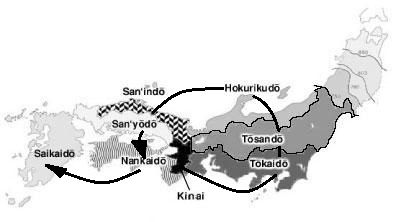
I would like to add a few introductory words before we start with the Sanjô school. First of all and speaking of the gokaden in my last post, the Japanese swordsmiths school are usually introduced via the aforementioned goki-shichidô system. That means even if the gokaden are so dominant when it comes to kotô times, the swordsmiths schools are usually not introduced in the gokaden order Yamashiro → Yamato → Bizen → Sôshû → Mino → Rest of the Sword World but, either starting with Yamashiro or Yamato, worked off province by province for each goki-shichidô entity. So Bizen comes way after Yamashiro and Yamato as the system first goes eastwards from the Kinai region, then north, and then quasi comes back and goes west and down to Kyûshû. You might imagine this system as a clock, with Kinai in its center and a shichidô circuit as its hand, starting with the Tôkaidô and working-off anti-clockwise the Tôsandô, Hokurikudô, San’indô, San’yôdô, Nankaidô, and Saikaidô, i.e. Kyûshû (see picture below). Well, some publications don’t stick strictly to this clock-system and might introduce the Hokurikudô schools before those along the Tôsandô but going anti-clockwise is how the order of school introduction basically works. Also there is no rule with which of the two major Kinai-based traditions, i.e. Yamashiro and Yamato, to start. Some use a chronological approach and say Yamato is the oldest tradition and start so with the Yamato schools but there is actually not that a big time difference between the emergence of the earliest Yamashiro (i.e. Kyôto-based) and Yamato (i.e. Nara-based) schools. The historical and geographical backgrounds for the development of each of the first indigeneous schools of sword making (e.g. Yamashiro, Yamato, Ko-Hôki, Môgusa, Ko-Kyûshû) are sophisticated topics on their own and should be omitted here. Anyway, like you already noticed, I want to start with Yamashiro. Oh, and a last note before we start: I will present the blades here for a better readbility of the posts and due to reasons of space in a horizontal manner. This was quite a difficult decision as I break away from the standard rule to present blades vertically to get an instant feel for the sugata and proportions but the blog posts will just become too lengthy and too confusing with all the scrolling. But everyone is free to download the pics and rotate them. I apologize for the extra work.

ShichidoOrder

*

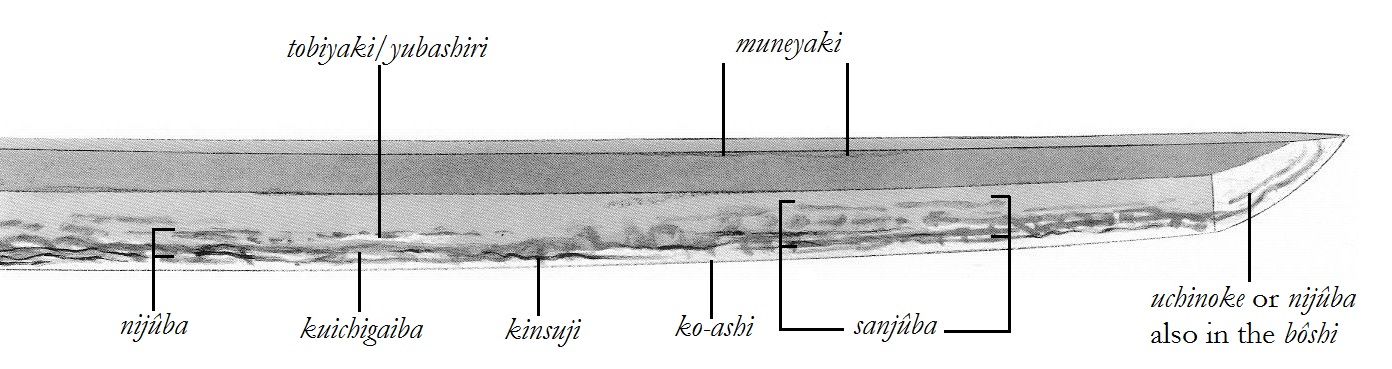
The Sanjô school was founded by Munechika (宗近), nickname Kokaji (小鍛冶), who is traditionally dated around Ei´en (永延, 987-989), what means he worked at about a time when Kyôto had been the new imperial capital for two centuries and roughly 250~300 years after the youngest swords in the Shôsô’in Repository had been made. So Munechika’s works are considered to be one the earliest extant specimen of a fully developed nihontô, what is a single-edged and curved blade in (as far as long swords are concerned) shinogi-zukuri, and standing in front of for example the meibutsu Mikazuki-Munechika (三日月宗近), it really looks its age (see picture 1). I say “standing in front of” on purpose because chances to study a Munechika hands on or come across one in the wild are virtually zero. All known blades are either in temple possession, imperial treasures (gyobutsu, 御物), or preserved in the Tôkyô National Museum. But the ancient, highly dignified, and graceful look of the Mikazuki-Munechika does not only go back to its age as for example Ko-Hôki and Ko-Bizen blades that date back to around the same time are so to speak more “substantial,” although being still pretty elegant at the same time. The highly dignified and graceful look of the Mikazuki-Munechika has to be seen in its contemporary cultural context as experts agree that it was most likely not made as a war sword. Of course it also has lost some substance due to the polishes that were necessary over ten! centuries but it never had been massive in the first place. At the time it was made, the good old Heian culture was at its peak. The famous Pillow Book and Tale of Genji were written when Munechika was active and the court was full of refined aristocrats for whom swords were merely symbols of their rank and obligatory accessories. Apart from one major disturbance, the rebellion led by Taira no Masakado (平将門) in 939/40, the imperial capital was quite peaceful up to the time of Munechika and although the first dark clouds were gathering over the aristocracy, there was yet no sign that the just briefly forming military class was ever becoming so strong that it takes over the entire country. It goes without saying that most of the then swordsmiths were indeed producing weapons but the largest customer base for Munechika and his contemporary Kyôto-based colleagues was the aristocracy. Accordingly and apart from the graceful sugata, a blade not only had to be masterly crafted but also had to be refined and beautiful as everything rural, rustic, and uncouth was usually frowned upon in noble circles. So Munechika’s blades show basically a soft looking and beautiful jigane with a fine ko-mokume in combination with a relative narrow suguha-based hamon that is hardened in ko-nie-deki. There are actually quite many hataraki like nijûba, sanjûba, uchinoke, ko-ashi, , yubashiri, kuichigaiba, muneyaki, inazuma, kinsuji, ji-nie, and chikei and the suguha is livened up by ko-midare and even subtle ko-chôji elements. Also the hada varies in density and shows here and there larger structures but all these hataraki and features are very natural, unaffected, and unsophisticated and put pointly, his blades make the overall impression of being works of one from a group of the earliest outstanding smiths that had just mastered their craft but for whom it was yet not time to experiment with forging and hardening techniques from an artistic point of view. Or in other words, Munechika would not even come up with the idea of hardening a flamboyant ôbusa-chôji even if he was probably technically capable of doing so. Munechika and his colleagues put on the clay coat how they knew it will work for the hardening process, maybe with some accentuations here and there, but the principal job in creating the hamon was left to the metallurgical – back then “magical” – interplay between steel and heat treatment. Incidentally, there is the tradition that Munechika was a court noble himself who started to forge swords as a pastime in his residence along Kyôto’s Sanjô. It turned out that he was very talented and soon took orders from his noble colleagues and even from the emperor, but just as it is the case with Masamune, there are so many legends and plays around Munechika that we do not longer know which tradition has a core of truth and which one is just pure fiction.

 Munechika1

Picture 1: kokuhô, tachi, mei: Sanjô (三条), meibutsu Mikazuki-Munechika, nagasa 80.0 cm, sori 2.7 cm, motohaba 2.9 cm, sakihaba 1.4 cm, shinogi-zukuri, iori-mune [Tôkyô National Museum]

Munechika2

Picture 2: jûyô-bunkazai, tachi, mei: Mune… saku (宗◯作) (Den Munechika), nagasa 78.8 cm, sori 3.2 cm, motohaba 2.8 cm, sakihaba 1.5 cm, shinogi-zukuri, iori-mune [Wakasahiko-jinja, Fukui Prefecture]

Munechika3

Picture 3: gyobutsu, tachi, mei: Munchika (宗近), nagasa 78.4 cm, sori 2.4 cm, motohaba 2.85 cm, sakihaba 1.5 cm, shinogi-zukuri, iori-mune [imperial treasure]

Munechika4

Picture 4: Characteristic features of Sanjô Munechika’s workmanship.

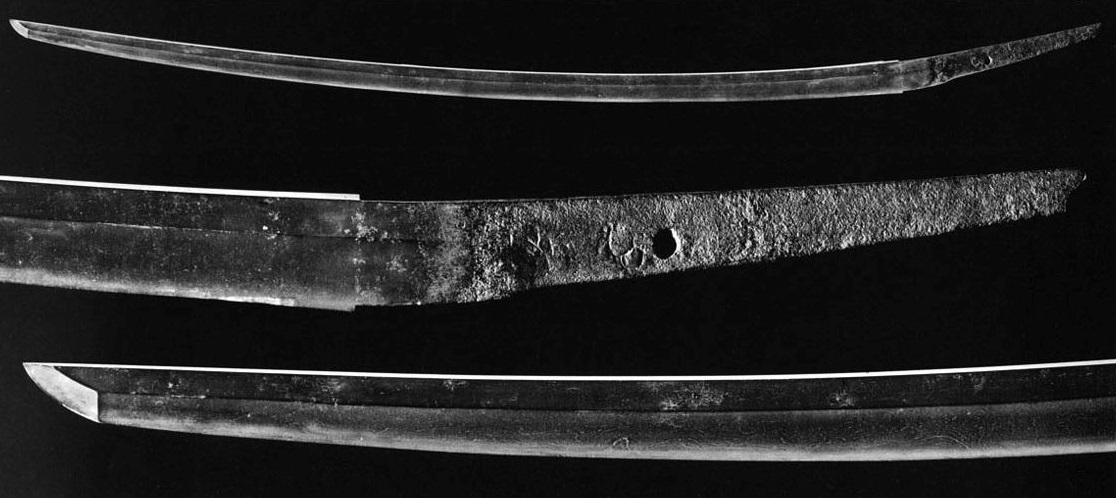
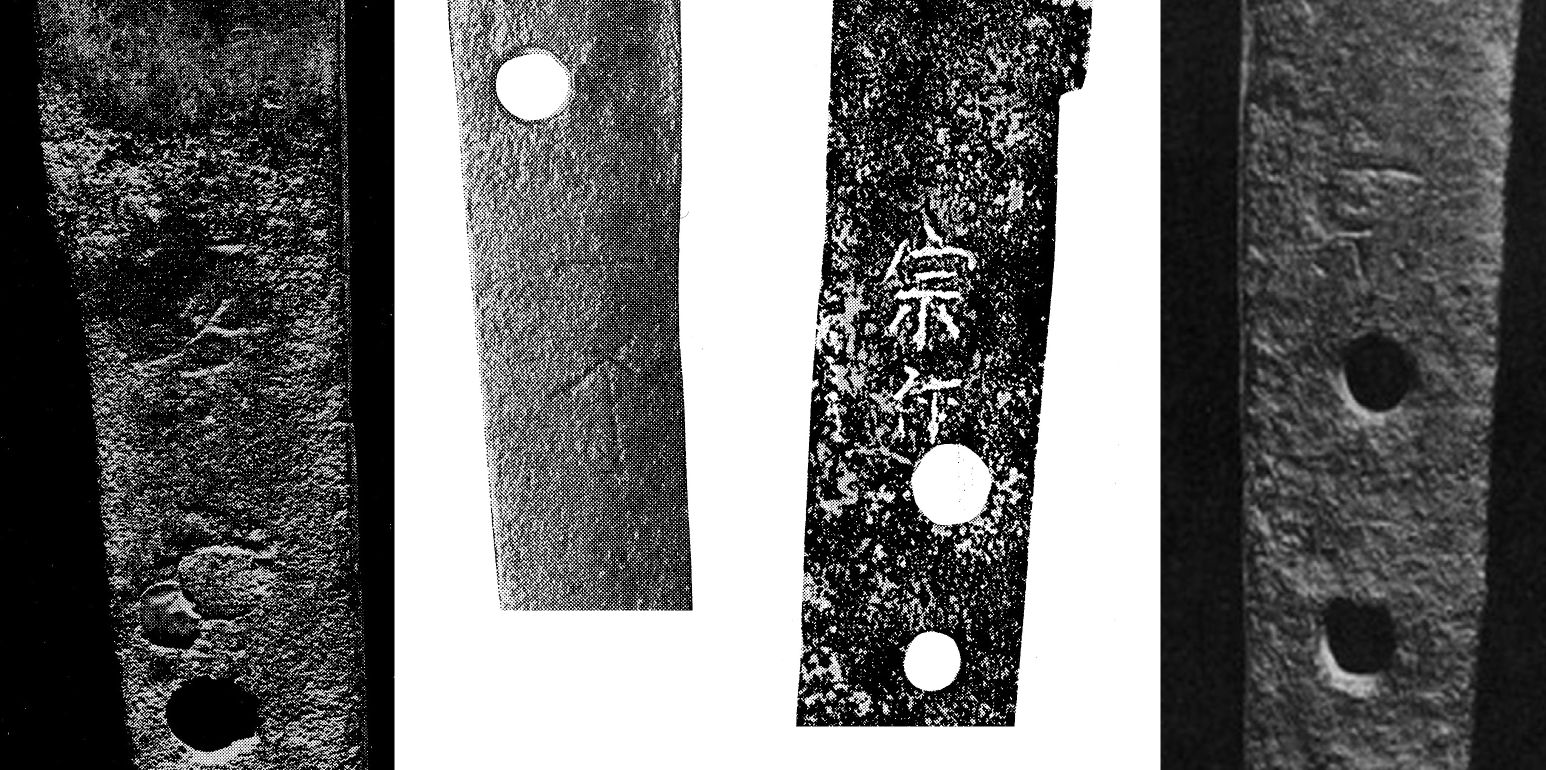
I have already described the characteristic features of Munechika’s workmanship above but want to point them out in detail in picture 4 on the basis of the oshigata introduced in picture 3. As you can see, there is a general trend towards more horizontal hataraki and towards a “multi-layered” hamon. Before we continue with other smiths of the Sanjô school, I want to deal with Munechika’s tang finish and signatures. The tangs of the Mikazuki-Munechika and of the gyobutsu are in kijimono-gata whereas the others are just tapering and slightly curved. Due to the age the yasurime are hardly discernible but some tangs of Munechika do show katte-sagari yasurime. If the tip of the tang is not chamfered as on the Mikazuki and the jûyô-bunkazai seen in picture 5, it is usually a shallow kurijiri. Munechika either signed with a fine and smallish chiselled niji-mei “Munechika” on the haki-omote, or with a somewhat larger dimensioned niji-mei “Sanjô” on the haki-ura side. (The jûyô-bunkazai seen in picture 2 was long thought to bear a niji-mei but traces of the character for “saku” can be seen between the top and the second, the ubu mekugi-ana. The later added upper mekugi-ana goes goes through the now no longer legible character for “chika.”) There is no definite answer so far that explains the question why he either signed with “Munechika” or “Sanjô” and why he switched between the haki-omote and haki-ura side. Also we will probably never able to tell for sure if there were two or even three generations with that name as some assume. Please note that there are actually many blades with the yoji-mei “Sanjô Munechika” going round but they are basically all ruled out as gimei. Well, and then there is the meibutsu Ebina-Kokaji on which I did a write-up a while ago here.

Munechika5

Picture 5: jûyô-bunkazai, tachi, mei: Sanjô (三条), nagasa 78.2 cm, sori 3.3 cm, shinogi-zukuri, iori-mune [Nangû-taisha, Gifu Prefecture]

Munechika6

Picture 6: The signatures of Munechika. From left to right: Mikazuki-Munechika, jûyô-bunkazai of the Nangû-taisha, gyôbutsu, jûyô-bunkazai of the Wakasahiko-jinja

As this series is on kantei, I don’t want to just forward characteristics in workmanship and that’s it but in the case of these very early smiths it isn’t easy at all to give kantei tips as hardly any of their works are accessible anyway and as I so have to rely heavily on what is written in the references. Now Sanjô Munechika, Ko-Bizen Tomonari (古備前友成) and Ko-Hôki Yasutsuna (古備前友成) are often mentioned in the same breath when it comes to the founder generation of the nihontô that is known by name. First of all, Munechika’s and Tomonari’s workmanships are closer together than they are with the workmanship of Yasutsuna. Both Munechika and Tomonari forged a ko-mokume but that of Munechika is by trend somewhat finer whereas it stands more out at Tomonari. Also the ji-nie is more evenly distributed over the blade at Munechika than it is at Tomonari where we can also see some utsuri and jifu in turn. Yasutsuna then again mixed in some larger ô-hada structures and principally rather forged in itame than in ko-mokume. Also his ji-nie is more rough and visible than that of Munechika and Tomonari as his entire jiba is way more nie-laden than it is at the former two smiths. When it comes to the hamon, Tomonari’s ha tends more to nioi, i.e. the order goes Yasutsuna → Munechika → Tomonari in terms of the intensity of the nie. Munechika’s hamon appears with its majority of horizontal hataraki more “layered” whereas we see a hint more fully formed ko-chôji and ko-midare at Tomonari and not this “layer effect” and more sunagashi and hotsure at Yasutsuna which give his ha a somewhat more frayed appearance. Apart from that, Yasutsuna’s hamon usually starts with a prominent yaki-otoshi. But most obvious are the differences in sugata as Munechika’s blade are as mentioned very graceful and slender whereas those of Tomonari and Yasuchika are more magnificent and wide and show a way more pronounced koshizori than it is the case at Munechika.

*

In the next part I will continue with the sons and students of Munechika before we come to the Sanjô descendant, the Gojô school. I hope you like so far where this kantei series is going and the next post should follow in a little.

KANTEI 4 – FOREWORD

After dealing with the sword basics, we are entering the main body of my series series and that is the description of the workmanship of the individual schools and smiths, and that with a focus on kantei. So with “focus” I mean I am not going too much into historic detail and omit for the most part biographical data unless it is necessary for the understanding of certain chapter. Before we start I have to explain a few things. Like I followed the traditional approach in looking at Japanese swords, I will also follow the traditional approach in describing them, and that is kotô-era gokaden, kotô-era other schools (wakimono/majiwarimono), shintô, and shinshintô. What I mentioned at the very beginning of this series applies here too, that is to say that all major publications are structured like that and it doesn’t make much sense if I reinvent the wheel and tackle the schools in a complete different way. Well, this “traditional” approach is actually not as old as you might think. It is assumed that it was introduced by Hon´ami Kôson (本阿弥光遜, 1879-1955) who was a key figure of the Meiji, Taishô, and early Shôwa era in terms of gathering and spreading knowledge of the Japanese sword and it was him who realized that certain things have to be changed to make studies easier, meeting so the requirements of a strongly growing crowd of collectors and enthusiasts which was thirsting to know more about the nihontô. Before he introduced the gokaden (五ヶ伝・五箇伝), lit. “The Five Traditions,” swords in general and kotô swords in particular were classified according to their production site, or more precise according to the province they were made in, e.g. blades made in Bizen were called Bizen-mono (備前物), and such made in Yamato were called Yamato-mono (大和物), sorted by so-called goki-shichidô (五畿七道) system of initially administrative units and later geographical entities. The goki-shichidô consisted of five provinces in the Kinai or capital region, plus seven  (道) or circuits, each of which contained provinces of its own. These seven circuits were the Hokurikudô, Nankaidô, Saikaidô, San’indô, San’yôdô, Tôkaidô, and the Tôsandô.

Well, this goki-shichidô system is unchangedly in use when it comes to the mere sorting of swordsmith schools but this alone and the classification via mono (物, lit. “thing” or rather “work”) and the province a sword was made in was inflexible and does not make clear any stylistic connections. That means, you can’t see at a glance that for example an Enju blade is, via the Yamashiro tradition, actually stylistically connected to the Kyôto-based Rai school when it is just listed as Kyûshû-mono. The introduction of the gokaden follows the observation that throughout kotô times there had been basically five major sword production sites, namely Yamato, Yamashiro, Bizen, Sagami (= Sôshû), and Mino, where own typical styles of sword forging emerged and developed. Swordsmiths from these production sites moved and spread their knowledge and so offsprings of the indigenous traditions spread all over the country. These offsprings developed own characterisic features but were scholastically connected to the original forging tradition. In other words, about 80% of all kotô schools and smiths can be attributed to one of the five major traditions which were the Yamashiro tradition (Yamashiro-den, 山城伝), the Yamato tradition (Yamato-den, 大和伝), the Bizen tradition (Bizen-den, 備前伝), the Sôshû tradition (Sôshû-den, 相州伝), and the Mino tradition (Mino-den, 美濃伝). The remaining forging traditions which emerged and developed separately or as offshoots from the gokaden or which are made up of a mix of two or more of the five major traditions are summarized as wakimono (脇物) or majiwari-mono (交わり物) respectively. The gokaden declined in importance with the progressing Muromachi period as the uncertain Sengoku era forced many swordsmiths to move to other, often very remote areas. At the same time, steel production was modernized and more and more swordsmiths were receiving now steel from the same source which meant a further approximation of the characteristic features of sword blades. This trend became even more obvious with the transition to the shintô era and so Kôson introduced a sixth tradition, the shintô-tokuden (新刀徳伝), about “special shintô sword tradition,” but I will just refer to swords made in that era as shintô as it is hard to nail down characteristic features for the shintô “tradition.” Well, Kôson followed the approach that a shintô blade can come with a fine jigane in combination with a wide and vivid hamon whereas in kotô times a fine jigane usually came along with a more narrow and unobtrusive, often suguha-based hamon, and a larger dimensioned jigane usually with a wider and more vivid hamon. Apart from that he felt that the new and picturesque hamon interpretations of the shintô era like tôran-midare, sudareba, kikusui and the like “justify” the introduction of a “special shintô tradition” of sword forging. However, the term shintô-tokuden is too general in my opinion as also the shintô era gave rise to several major currents (which were Ôsaka, Edo, Hizen, and Satsuma, and Kyôto if you want) and as a consequence, it never became as much established as the very practical approach with the gokaden.

In preparation for the upcoming chapters, I want to give a very basic overview of the fundamental characteristics of each forging tradition. In other words, if you spot them in the described combination on a blade, it is safe to focus on schools that worked in the associated tradition.

Yamashiro tradition: Rather dense and uniform itame or mokume in combination with a suguha or suguha-based hamon in ko-nie or nie-deki. Blades look elegant and dignified. Yamashiro lost (in sword terms) by the end of the Nanbokuchô period much its significance so rather do not expect a Muromachi-period uchigatana or katateuchi to be a Yamashiro work. Flourished from the end of the Heian to the early Nanbokuchô period.

Yamato tradition: High shinogi-ji and relative wide shinogi. Jigane often shows masame and the hamon is suguha or suguha-based in nie-deki which shows by trend more horizontal hataraki (i.e. hataraki that concentrate on and follow the habuchi). Blades look elegant but also strong and with a hint of ancient charme. Yamato too was superseded by the upcoming Sôshû and still thriving Bizen traditions in the Nanbokuchô period. So like mentioned above, rather do not expect a Muromachi-period uchigatana or katateuchi to be a Yamato work. Flourished from the end of the Heian to the end of the Kamakura period.

Bizen tradition: Jigane in itame or mokume with utsuri in combination with a chôji-midare or gunome-midare hamon in nioi-deki. Blades in Bizen tradition look flamboyant compared to blades forged in the Yamashiro or Yamato tradition. Had its heydays in the Kamakura and late Muromachi period.

Sôshû tradition: Larger structured itame in combination with a noticeably nie-laden midareba, notare, or hitatsura. Blades look “wild” and vivid and as the Sôshû tradition was not established before the very end of the Kamakura period, do not expect a blade in one of the (earlier) Kamakura-sugata to be a Sôshû work. Had its heydays in the Nanbokuchô, late Muromachi, and Momoyama period.

Mino tradition: Jigane shows more or less shirake, i.e. is whitish, and comes in combination with a hamon, mostly a midareba, that shows some concpicuously protruding togari elements, with the sanbonsugi so to speak as its purest Mino-hamon form. As the Mino tradition is the youngest of the gokaden and was not fully developed until the mid-Muromachi period, do not expect a blade in Kamakura or Nanbokuchô-sugata to be a Mino work. Mino blades look more “pragmatic” in general. Had its heyday in the late Muromachi period.

Shintô-tokuden: Fine, dense and “healthy” jigane in combination with a more “affected” or picturesque hamon. Bôshi often in suguha even if the rest of the hamon is in midareba. Blades have the “typical” katana shape, that means do not expect a long, elegant and classical tachi to be shintô, at least not in the first place.

So far the introduction to the upcoming main body of the series and I will be back soon with the first chapter which is on Yamashiro province.


KANTEI 3 – HAMON & BOSHI #3

Now we arrive at the bôshi (帽子, sometimes also written with the characters [鋩子]), the continuation of the hamon in the kissaki which runs with a kaeri (返り), the so-called “turn back,” back or up to the mune. The very end of the kaeri, i.e. the point where the hardening reaches the mune, is called tome (留め) what just means “stop.” Please note that some refer with bôshi just to the continuation of the hamon and see the kaeri as a separate element. That means the hamon in the kissaki is the bôshi and the kaeri is the kaeri. But mostly the term bôshi is used to refer to the whole ensemble, i.e. hamon in the kissaki and kaeri and that is how I use this term too. Before we continue with the different bôshi interpretations we have to address the fact that the bôshi is considered as a very sensitive point in kantei. Reason for this is that hardening the kissaki in a proper way – that means in a way which leaves a uniform and controlled hamon and a clearly defined turn back on this rather small and bevelled area – requires some skill. Accordingly, the quality of the bôshi is a very good indicator for the overall quality of the blade because it is rather unlikely that the smith got that right but messed up the rest of the hamon, to put it bluntly. So judging the bôshi is usually the “last fine tuning” in your kantei, or in other words, it either confirms your conclusions drawn from the sugata (production time), jigane (steel), and hamon (school) and allows you to nail your judgement down to a certain smith within a school or at least reassures you to stay with the school you have found out with judging the hamon. Or it is so unique that you have to go one step back and adjust your school judgement by taking another look at the hamon. So far the theory but the topic bôshi comes with a big “but” and that is the polish of the kissaki. That means the same way it is difficult for the smith to harden this part it is difficult for the polisher to polish it, and that has two reason: One reason is the fact that the kissaki has bevelled surfaces, per se not that a big thing because also the ji is bevelled with the niku, but the other reason is the aesthetical concept of the nihontô requires a tip that contrasts with the other surfaces of the blade. Thus the polisher has to tackle the tip in a different way than he tackles the ji and shinogi-ji (you can find a detailed description of the process of kissaki polishing in The Craft of the Japanese Sword). From my own experience I can say that very often the polishing of the tip is kind of neglected, or rather way more emphasis is placed on the contrasting effect than on the visibility of the bôshi. That means in the worst case you just have some scratchy white surface which makes it very hard to see its actual hardening. Well, a good thing at the Japanese sword is that the hamon shows at quite an early stage in polishing so at least you will be able to see something in the kissaki, maybe at least the rough outline of its hardening. But that in turn only works if you have the time and the freedom to look at the blade in a way until you can make something out. At a kantei session you don’t have that time and freedom, i.e. you just can’t walk away with the blade and take it to a different light source where you look at the kissaki for let’s say two minutes.

Back to the bôshi, but a few more things have to be explained before I introduce the different bôshi forms. As seen later there is a special term for a fully or almost fully hardened kissaki but if the kissaki has just a conspicuously wide hardening, we speak of yaki ga fukai (焼きが深い), what means exactly that, i.e. “wide hardening.” Also important for a sophisticated kantei is to judge where the hamon in the kissaki starts to turn back towards the mune. If the kaeri begins rather early after the yokote, we speak of a sagari-kaeri (下がり返り), and if it starts noticeably late, i.e. more towards the very tip of the kissaki, we speak of an agari-kaeri (上がり返り). Please note that this feature can be deliberate, i.e. applied so by the smith, or, in the case of a late starting agari-kaeri, go back to the fact that the kissaki has lost some material. Apart from that, the kaeri can be noticeably pointed, a feature which is referred to as togari-kaeri (尖り返り) or togari-bôshi (尖り帽子). As bôshi interpretations with a pointed kaeri are kind of a small subcategory of their own, I will combine them in the following section under the umbrella term togari-bôshi. You see, it is getting complicated again but also the topic bôshi is actually not as hard to memorize as it seems at a glance. A good tip to start with is to check the interplay of hamon and bôshi. That means, is the bôshi a continuation of the hamon or does the outline of the hardening change with the yokote? If so, chances are high that you are facing a shintô work as in kotô times it was more common to let the hamon run out “naturally” into the kissaki. In shintô times and with the increasing art aspect of the sword, the ji was more seen as a canves where the smith “painted” his hamon, framed by the yokote and the ha-machi. When there was a backwards trend to kotô in the late Edo period, also the hamon continued by trend again into the bôshi. That’s just a rule of thumb, highly simplified, and a thing that has to be put in context with what you have learned so far from the blade. For example, if you think you have a classical kotô Ichimonji as it shows a flamboyant chôji hamon and even utsuri but then you see that the bôshi is suguha or notare-komi, you are probably facing an Ishidô work.

*

3.4 The different bôshi forms

Aoe-bōshi (青江帽子) – Special bōshi interpretation appearing with the Chū-Aoe school which is undulating, shows a tight nioiguchi, and whose smallish ko-maru-kaeri turns relative abruptly and rather pointed and runs back straight back to the mune.

Aoe-boshi

hakikake-bōshi (掃掛け帽子) Bōshi whose main characteristic feature are hakikake. However, a bōshi with an even larger amount of hakikake is usually referred to as kaen (火炎).

hakikake

ichimai-bōshi (一枚帽子) – A fully or almost fully tempered kissaki. In some cases part of the outline of the bōshi is still discernible somewhere in the kissaki area. That means, the kissaki is not completely hardened and a kaeri can be seen somewhere very close to the mitsukado (the point where yokote, shinogi, and ko-shinogi merge). The transitions between an ichimai-bôshi and a bôshi with a pronounced yaki ga fukai are fluid.

ichimai

ichimonji-kaeri (一文字返り)Bōshi where the kaeri sets off in a straight manner towards the mune and does not run back along the back (or runs back only very little).

ichimonji-kaeri

jizō-bōshi (地蔵帽子)Bōshi which appars more or less as midare-komi but with a sharply constricted kaeri area that makes it look like a profile of a statue of the Bodhisattva Jizō. A jizō-bōshi is particularly typical for Mino blades.

jizo

kaen (火焔・火炎) – Lit. “flame, blaze.” Very nie-laden bōshi with an abundance of hakikake which looks like flames. Sometimes also referred to as kaen-gashira (火焔頭・火炎頭, lit. “head in flames”).

kaen

ko-maru (小丸) – Small roundish kaeri.

komaru1

midare-komi (乱れ込み) – Irregular, midare-based bōshi.

midare-komi

Mishina-bōshi (三品帽子) – Basically a variant of the sansaku-bōshi but with a kaeri that looks like a narrow jizō-style kaeri. This bōshi interpretation was often applied by smiths in the vicinity of the Mishina school, thus the name.

Mishina-boshi

nie-kuzure (沸崩れ) – A heavily nie-laden bôshi that appears frayed so that it is hard to define the habuchi or outline, or in extreme nie-kuzure cases no outline can be made out at all. A nie-kuzure is often seen on Sôshû blades and at schools and smiths who worked in or were influenced by the Sôshû tradition, for example the Hasebe (長谷部) and Nobukuni (信国) schools, Shikkake Norinaga (尻懸則長), and the Sôden-Bizen, Horikawa, and Satsuma-shintô smiths, just to name a few. The transition between nie-kuzure, much hakikake, and kaen are fluid. A nie-kuzure bôshi might also tend to a nie-based ichimai-bôshi if the entire kissaki is thickly covered in nie.

nie-kuzure

notare-komi (湾れ込み) – A slightly undulating, notare-based bōshi.

notare-komi

ō-maru (大丸) – Large roundish kaeri.

omaru

sansaku-bōshi (三作帽子) – Lit. “bōshi of the Three Great (Osafune) Masters” which were Nagamitsu (長光), Kagemitsu (景光), and Sanenaga (真長) as they were known for applying this kind of bōshi. It is formed by a suguha that runs shortly straight and unchangedly over the yokote and follows then in a slightly undulating manner the fukura to turn back in a compact ko-maru-kaeri.

sansaku1

taki no otoshi (滝の落し・瀧の落し)Bōshi with a long and rather oblique kaeri which reminds of a waterfall (taki). This kind of bōshi is usually associated with Mihara blades.

takinootoshi

taore-bōshi (倒れ帽子) – Lit. “falling bōshi.” Bōshi interpretation where the kaeri leans towards the ha. A typical feature of Sue-Seki blades (bottom picture left) or of Sa Yasuyoshi (安吉) (bottom picture right). Their bôshi looks like a jizô-bôshi with Jizô’s head leaning towards the ha but with the difference that Jizô’s head is by trend more pointed at the Sa smiths. Please note that a bōshi with a kaeri that approaches the cutting edge due to loss of material is also referred to as taore-bōshi. Thus one has to be careful using this term and specify if in a reference to an altered kissaki or to a characteristic feature of certain smiths.

taore

tarumi-bōshi (弛み帽子) – Lit. “slackening, relaxing bōshi.” Sugu-bōshi that is actually straight or, if undulating, that does not run parallel the fukura. In exaggerated terms, the bōshi is “tired” and has to “relax” and goes thus the short way, which is straight, to the kaeri. For example, a sansaku and a Mishina-bōshi come under the category of a tarumi-bōshi.

tarumi

togari-bôshi (尖り帽子) – As mentioned, a bôshi with a noticeably pointed kaeri. A form of the togari-bôshi is the rōsoku-bōshi (蝋燭帽子) which is basically a midare-komi bōshi with a quite pointed kaeri, mostly with plenty of nioi, which reminds of a candle wick (rōsoku no shin), thus sometimes also referred to as rōsoku no shin (蝋燭の芯) instead of rôsoku-bôshi. This bōshi interpretation is typical for Osafune Kanemitsu (兼光) and the Ōei-Bizen school (bottom picture left). And a noticeably pointed kaeri that tends to rôsoku which comes in combination with plenty of nie and a long and rather wide kaeri is typical for Chôgi (長義), thus also the term Chôgi-bôshi exists to refer to his peculiar togari-bôshi interpretation (bottom picture center). And a togari-bôshi is also a typical feature of the Sa (左) school where in their case, the rôsoku part is a hint wider at the base than at the Kanemitsu and Ôei-Bizen schools (bottom picture right).

togariboshi

tora no ago (虎の顎) – Lit. “tiger chin.” Term to refer to a bōshi interpretation seen on blades by Kotetsu (虎徹) and smiths in his scholastic vicinity where the hamon shows a double yakikomi right before the yokote and runs after the ridge more or less parallel along the fukura to a ko-maru-kaeri. The name goes back to the similarity of the yakikomi element to a tiger’s chin.

toranoago

tora no o (虎の尾)Bōshi with a more or less long kaeri that runs parallel to the mune and ends abruptly and roundish. This kind of bōshi reminds of the tail (o) of a tiger (tora) and is usually associated with Ko-Mihara blades.

toranoo

yakitsume (焼詰め) – Also pronounced as yakizume. A bōshi where the hamon runs out without kaeri. The yakizume itself can be sugu or midare-komi and accompanied by various hataraki.

yakitsume

*

Now we are through with the basics (and the terminology) and after a short break – want to post some other articles for reasons of variety – I will continue with the kantei points of all major (and not so major) schools and smiths. Also I have added a new menu with the title KANTEI SERIES to the top page which brings you to all the individual chapters so that you don’t have to scroll back and forth through my entire blog to find a certain post. Thank you so far for your attention and I am very happy about all the positive feedback I get in regards of this series! So stay tuned, there is a lot to come.

KANTEI 3 – HAMON & BOSHI #2

For the sake of completeness and not to have to revinvent the wheel so to speak, I want to quote the relevant sections from The Connoisseur’s Book of Japanese Swords along this chapter. And allow me for a better readability, if I may, to work these quotes into the sections below without strictly highlighting them as quotes. Thank you for the understanding.

*

3.3 The different hamon forms

chōji (丁子) – Lit. “clove(s).” Elements of a hamon which resemble cloves, with a round upper part (the tassel or fusa, 房) and a narrow constricted lower part. There are many different chōji interpretations. See also ko-chōji, ō-chōji, jūka-chōji, saka-chōji, and kawazu-no-ko chōji. Is the entire hamon composed of chōji elements, we also speak of a chōjiba (丁子刃), or when it consists mainly of a mix of chōji and midare elements chōji-midare (丁子乱れ) accordingly. The chôji, or to be precise the chôjiba, was the most prominent feature of the Bizen tradition (regardless of if by kotô or if by later shintô and shinshintô smiths who worked in this tradition) but chôji elements are seen at many other schools and smiths, for example also at the Yamashiro and Sôshû tradition.

choji

chū-suguha (中直刃) – Medium width suguha.

Fujimi-Saigyō (富士見西行) – A picturesque hamon interpretation that alludes to the Heian poet Saigyō (西行, 1118-1190) looking at Mt. Fuji. Saigyō was famous for admiring nature in his works. A Fujimi-Saigyô feature is not that obvious and often overlooked. So you have to spot first a relative largely protruding, rather isolated element, and if it looks like Mt. Fuji see if, after a certain distance, a smaller double-protrusion occurs. Is that the case, you probably have a Fujimi-Saigyô feature which brings you right away to early shintô and the Mishina school and the Yoshimichi (吉道) smiths in particular. But it can also be seen at Ôsaka-shintô works like at Kawachi no Kami Kunisuke (河内守国助) for example.

FujimiSaigyo

fukuro-chōji (袋丁子) – Bag/pouch (fukuro) shape chōji. Typically seen at Fukuoka-Ichimonji or Katayama-Ichimonji works, at Osafune Mitsutada (光忠), but also at shintô-era Fukuoka-Ishidô smiths like Koretsugu (是次) and Moritsugu (守次).

fukuro-choji

gunome (互の目) – Lit. “reciprocal eyes/elements.” A series of waves that look like similarly-sized semicircles. Depending on its size, this hamon pattern is referred to as ō-gunome (大互の目, large gunome) or ko-gunome (小互の目, small gunome) but there are more variants of this hamon interpretation referred to by their shapes. Mix forms are described as gunome-chōji (互の目丁子), gunome mixed with chōji, and gunome-midare (互の目乱れ), gunome mixed with midare, for example.

gunome

hakoba (箱刃) – A hamon which consists basically just of box shaped elements. Angular elements are often seen at the Sengo (千子) (Muramasa [村正], Masashige [正重]), the Sue-Seki (Kanesada [兼定], Kanefusa [兼房], Ujifusa [氏房]), and the Shimada (島田) school and in shintô times for example at the Kashû smiths Kanewaka (兼若) and Takahira (高平), at Masanori (正則), and at the Mizuta (水田) school. And to a cetain extant some angular approach is also seen at Yamato no Kami Yasusada (大和守安定).

hako-midare

hako-midare (箱乱れ) Hamon interpretation mixed with of consisting of more or less regular box shaped elements.

hiro-suguha (広直刃) – Wide suguha. Usually this term is used in the case the suguha is a third or more in width in relation to the mihaba of the blade.

hitatsura (皆焼) – Lit. “all/everything hardened.” Gunome-midare, notare-midare, or other mix of undulating hamon elements with plentiful tobiyaki scattered throughout the blade, mostly also combined with muneyaki. This hamon interpretation goes back to Sōshū smiths of the Nanbokuchō period but was later applied by smiths all over the country.

hitatsura

hoso-suguha (細直刃) – Narrow suguha.

hoso-suguha

hyōtan-ba (瓢箪刃) – Lit. “gourd ha.” A hamon which reminds of a more or less regular arrangement of gourd halves. This interpretation is especially typical for Kotetsu (虎徹) and the smiths in his vicinity.

hyotan-ba

ito-suguha (糸直刃) – Lit. “thread suguha.” Very thin suguha.

ito-suguha

jūka-chōji (重花丁子) – Lit. “overlapping flowers.” Gorgeous multiple, overlapping chōji.

juka-choji1

juzu-ba (数珠刃) – A hamon of regular and uniform, roundish gunome which reminds of a Buddhist rosary (juzu, 数珠). This interpretation is especially typical for Kotetsu (虎徹) and the smiths in his vicinity.

juzuba

kataochi-gunome (片落ち互の目) – A gunome with uniformly straight yakigashira but where each element slants towards the valley. As this hamon reminds of sawtooth pattern (nokogiri), the interpretation is also referred to as nokogiri-ba (鋸刃). It is said that the kataochi-gunome was introduced by Kagemitsu (景光) but hints of this hamon can already be seen on certain works of his predecessor Nagamitsu (長光).

kataochi-gunome

kawazu-no-ko chōji (蛙子丁子) – Lit. “tadpole chōji.” A mush-room-shaped chōji with a long neck which reminds of tadpoles. This chōji interpretation is especially typical for Osafune Mitsutada (光忠), Hatakeda Moriie (守家), and Kamakura-Ichimonji Sukezane (助真).

kawazunoko

kenbō-midare (兼房乱れ) – A kind of large-dimensioned chōji-midare that goes back to the smith Kanefusa (兼房). Kenbō is the Sino-japanese reading of the characters “Kanefusa.”

kenbo-midare

kikusui-ba (菊水刃) – Picturesque hamon interpretation with chrysanthemum-shaped elements above the habuchi which reminds of the kikusui subject, i.e. chrysanthemums floating down on a stream. A kikusui-ba is a actually variant of the sudareba so you are in the vicinity of the Mishina Yoshimichi (吉道) smiths when facing a kikusui-ba.

kikusui-ba

kobushigata-chōji (拳形丁子) – Lit. “first-shaped chōji.” A chōji-midare interpretation introduced by the second generation Kawachi no Kami Kunisuke (河内守国助) which reminds of clenched fists. But precursorsof this style of hamon can also be seen at Sue-Bizen Katsumitsu (勝光) and Sukesada (祐定) and at the Taira-Takada school.

kobushigata-choji

ko-chōji (小丁子) – Small chōji.

ko-choji

ko-gunome (小互の目) – Small gunome.

ko-gunome

ko-midare (小乱れ) – Small midare.

ko-notare (小湾れ) – Small notare.

ko-notare

koshi-no-hiraita (腰の開いた) – Term for hamon elements that widen towards their base. Usually seen on midare and gunome formations, thus also koshi-no-hiraita midare for example. Koshi-no-hiraita is typically seen at the Sue-Bizen school (Norimitsu [則光], Katsumitsu [勝光], Munemitsu [宗光], Sukesada [祐定], Kiyomitsu [清光], Harumitsu [春光]), the Uda (宇多) school, the Kanabô (金房) school, at Kashû Kiyomitsu (加州清光), Hôki Hiroyoshi (広賀), and the Takada (高田) school. In shintô times at Ishidô Tameyasu (石堂為康), Tatara Nagayuki (多々良長幸), and the Sukesada (祐定) smiths of that era, and in shinshintô times at Taikei Naotane (直胤), Koyama Munetsugu (宗次), Tsunatoshi (綱俊), and at Gassan Sadayoshi (貞吉) and Sadakazu (貞一).

koshinohiraita

midareba (乱れ刃) – Irregular hamon pattern which comes in many varieties.

midare-chōji (乱れ丁子)Midare mixed with chōji.

mimigata (耳形) – Ear-shaped hamon pattern mostly seen on swords by Osafune Chōgi (長義). Also referred to as mimigata no gunome (耳形互の目) or mimigata-ha (耳形の刃).

mimigata

nokogiri-ba (鋸刃)kataochi-gunome (片落ち互の目)

notare (湾れ) – An undulating hamon pattern of gentle waves. We further differentiate between ō-notare (大湾れ, large notare) and ko-notare (小湾れ, small notare), depending on the amplitude of the waves. A hamon that is entirely composed of notare waves is also referred to as notare-ba (湾れ刃). Incidentally, a shallow notare with not that high waves is referred to as asai-notare (浅い湾れ). A notare is seen after the end of the Kamakura period, mainly on blades of Sôshû-province schools and their related schools. For the kotô era for example at: Sôshû Sadamune (相州貞宗), Nobukuni (信国), Rai Tomokuni (来倫国), the Kanemitsu (兼光) school (Kanemitsu II [二代兼光], Tomomitsu [倫光], Masamitsu [政光], Yoshikage [義景]), Ômiya Morikage (大宮盛景), the Kozori (小反) school, the Samonji (左文字) school, etc., and for the shintô era for example at: Yasutsugu (康継), Kotetsu (虎徹), Okimasa (興正), Yamato no Kami Yasusada (大和守安定), Yasutomo (安倫), Masatsune (政常), Teruhiro (輝広), Hizen Tadayoshi (肥前忠吉), Yasuyo (安代), etc.

notare

ōbusa-chōji (大房丁子) – Lit. “large-tassel chōji.” As the name suggests, a chōji with noticeably large tassels which makes the elements sometims almost tend to gunome.

obusa-choji

ō-gunome (大互の目) – Large gunome.

ō-midare (大乱れ) – Large dimensioned midare.

ō-notare (大湾れ) – Large notare. <Kotô> Heianjô Nagayoshi (平安城長吉), the Sue-Bizen school (Norimitsu [則光], Sukesada [祐定], Kiyomitsu [祐定]), Izumi no Kami Kanesada (和泉守兼定), Ujifusa (氏房), Muramasa (村正), Tsunahiro (綱広), Fuyuhiro (冬広), the Shimada (島田) school, the Uda (宇多) school, etc. <Shintô> Myôju (明寿), the Horikawa (堀川) school, Masatoshi (正俊), Shinkai (真改), Echizen no Kami Sukehiro (越前守助広), Ômi no Kami Sukenao (近江守助直), Shigekuni (重国), Yasutsugu (康継), Yasusada (安定), Sadakuni (貞国), Masatsune (政常), Nobutaka (信高), Daidô (大道), Teruhiro (輝広), the Tadayoshi (忠吉) school, etc.

saka-chōji (逆丁子) – Slanting chōji. <Kotô> The Katayama Ichimonji (片山一文字) school, the Chû-Aoe school (Tsugunao [次直], Tsuguyoshi [次吉], Moritsugu [守次]), etc. Niji Kunitoshi (二字国俊) also sometimes mixed this into his hamon. <Shintô> The Fukuoka Ishidô (福岡石堂) school, the Kishû Ishidô (紀州石堂) school, etc. <Shinshintô> Naotane (直胤), Tsunatoshi (綱俊), Munetsugu (宗次), Tomotaka (朝尊), Sadakazu (貞一), etc.

saka-choji

saka-gunome (逆互の目) – Slanting gunome.

saka-midare (逆乱れ) – Slanting midare.

sanbonsugi (三本杉) – Lit. “three cedars.” Hamon interpretation of groups of three pointed togari mostly seen on works of the Kanemoto school (兼元) of Mino. Also referred to s sanken-ba (三間刃, lit. “three-interval ha”).

sanbonsugi

sudareba (簾刃) – Lit. “bamboo blind ha.” A sudareba is based on suguha or a shallow notare. The pattern seen inside the hamon looks like a bamboo blind. This hamon interpretation was introduced by Tanba no Kami Yoshimichi (丹波守吉道) and applied by his successors and other smiths in his vicinity.

sudareba

suguha (直刃) – Generic term for a straight hamon. Well, a suguha was applied by almost any school and smith, even from time to time by those who were usually working in chôji for example. But we can see more or less obvious differences of course. First of all, one has to check if the hardening bases on nioi or on nie, that can help a lot in differentiating a suguha. A nioi-based suguha is more associated with the Bizen and Mino tradition and a nie-based suguha more with the Yamashiro and Yamato tradition. Due to the fact that a suguha can be virtually found at the school and smith as indicated, it is hard to provide here a definite kantei “checklist.” Suguha is the most popular type of hamon, seen in blades from every province and every period. It was especially popular with smiths of the Yamashiro and Yamato traditions. Leading swordsmith: <Kotô> The Awataguchi (粟田口) school produces abundant nie, with a narrow hamon; hoso-suguha is relatively often seen in the tantô. Rai (来) school (Kunitoshi [国俊], Kunimitsu [国光], Kunitsugu [国次], Kunizane [国真]) blades exhibit chû-suguha mixed with ko-midare. In Yamato-province schools, vertical hataraki, such as hakikake, nijûba, and kuichigaiba, appear in the hamon. Bizen-province schools basically tempered in nioi-deki. Sôshû-province schools produced abundant nie at the end of the Kamakura period, while the Sue-Sôshû school was inclined toward nioi-deki. In addition, suguha is often seen in blades of the Mino-province schools, Muramasa (村正), the Shimada (島田) school, the Uda (宇多) school, the Momokawa (桃川) school, the Mihara (三原) school, and the Enjû (延寿) school. Less hataraki tends to be seen in the hamon of blades produced in later periods. <Shintô> Suguha tempered in nie-deki is seen in the work of the most famous swordsmiths (for instance, in tantô by Myôju [明寿] and work by the Horikawa [堀川] school, Kotetsu [虎徹], Yasutsugu [康継], etc.). Sukehiro [助広] produced abundant ko-nie. Shinkai (真改) created larger nie with a pattern that undulates slightly. The Tadayoshi (忠吉) school temperd in a chû-suguha that is uniform in width from top to bottom. Shigekuni (重国) tempered in nijûba in the monouchi area. In blades by Kunikane (国包), hakikake is seen along the habuchi. A suguha in nie-deki is often seen at the following schools and smiths: <Kotô> The Awataguchi (粟田口) school (Kuniyoshi [国吉], Yoshimitsu [吉光]), the Rai (来) school (Kunitoshi [国俊], Kunimitsu [国光], Mitsukane [光包], Kunizane [国真], Kuninaga [国長], Ryôkai [了戒]), the Tegai (手掻) school, the Hoshô (保昌) school, the Senju’in (千手院) school, the Taima (当麻) school, the Shikkake (尻懸) school, the Shintôgo (新藤五) school (Kunimitsu [国光], Kunihiro [国広]), Yukimitsu (行光), the Shimada (島田) school, the Ko-Aoe school (Yoshitsugu [吉次], Tsunetsugu [恒次], Suketsugu [助次]), the Ko-Mihara school,. the Ko-Niô (古二王) school, Kagenaga (景長), the Miike (三池) school, the Enjû (延寿) school (Kunimura [国村], Kunitoki [国時], Kuniyasu [国康], Kunisuke [国資]), the Naminohira (波平) school, etc. <Shintô> Myôju (波平), the Horikawa (堀川) school, Shinkai (真改), Sukehiro II (二代助広), Shigekuni (重国), Yasutsugu (康継), Ogasawara Nagamune (小笠原長旨), Kunikane (国包), Yamashiro no Kami Kunikiyo (山城守国清), the Tadayoshi (忠吉) school, Yasuyo (安代), Naminohira Yasuchika (波平安周), etc. <Shinshintô> Masahide (正秀), Naotane (直胤), Kiyondo (清人), Norikatsu (徳勝), Sadakazu (貞一), Aizu Kanesada (会津兼定), Sa Yukihide (左行秀), etc. A suguha in nioi-deki is often seen at the following schools and smiths: <Kotô> Osafune (長船) school (Nagamitsu II [二代長光], Kagemitsu [景光], Sanenaga [真長], Kagemasa [景政], Chikakage [近景]), the Ôei-Bizen (応永備前) school (Morimitsu [盛光], Yasumitsu [康光]), The Sue-Bizen school (Norimitsu [則光], Tadamitsu [忠光], Sukesada [祐定], Kiyomitsu [清光]), the Ukai (鵜飼) school, the Chû-Aoe school (Tsugunao [次直], Tsuguyoshi [次吉], Moritsugu [盛次]), the Sue-Tegai (末手掻) school, Zenjô Kaneyoshi (善定兼吉), the Sue-Seki school (Kanesada [兼定], Kaneyoshi [兼吉], Kanetsune [兼常]), the Sue-Mihara school, the Sue-Niô school, etc. Suguha with wide nioiguchi: <Kotô> Gô Yoshihiro (郷義弘), etc. Very rare in Kotô blades. <Shintô> Shinkai (真改), Sukehiro II (二代助広), Sukenao (助直), Tadatsuna II (二代忠綱), the Tadayoshi (忠吉) school. <Shinshintô> Yukihide (行秀), etc. Suguha with hazy (and subdued) nioiguchi: <Kotô> Bungo Yukihira (豊後行平), the Gassan school, the Hôju (宝寿) school, Sairen (西蓮), Jitsu’a (実阿), the Naminohira school, etc. Also found on blades of local swordsmiths.

suguha

suguha-hotsure (直刃ほつれ・直刃解れ) Suguha with a noticeable amount of hotsure which make is look like a frayed piece of cloth.

suguha-hotsure

togari (尖り) – Prefix for any kind of pointed hamon element. For example a togari-gunome consists of gunome which are noticeably pointed. Togari is a common feature of Sue-Seki blades. A hamon that is entirely composed of togari elements is referred to as togari-ba.

togari

tōranba (乱刃) – Lit. “ha in the form of large surging waves.” This hamon interpretation is said to go back to Echizen no Kami Sukehiro (越前守助広) and was later favored by certain Ōsaka-shintō smiths. It was then later revived by some shinshintō smiths. It is occasionally accompanied by tama which remind of spray.

toranba

uma-no-ha midare (馬の歯乱れ) – A hamon interpretation that consists of regular large gunome and/or midare elements which remind of horse teeth (uma-ha or uma no ha) and which is usually associated with the Sôshû tradition. In kotô times it is for example seen at the Masamune (正宗) school (Yukimitsu [行光], Masamune [正宗], Hiromitsu [広光], Akihiro [秋広]), Gô Yoshihiro (郷義弘), Norishige (則重), Shizu Kaneuji (志津兼氏), the Hasebe (長谷部) school, etc. In shintô times at Echizen Yasutsugu (越前康継), Hankei (繁慶), Okimasa (興正), Kunihiro (国広), Kunimichi (国路), the Mizuta (水田) school, Mondo no Shô Masakiyo (主水正正清), etc. And in shinshintô times at the Kiyomaro (清麿) school, Oku Motohira (元平), etc.

umanoha

yahazu (矢筈) – Forked or dove-tail shaped midare elements that resemble arrow notches (yahazu). This interpretation is often seen on Mino swords. A special variant of just half dove-tail shaped elements is known as kata-yahazuba (片矢筈刃) or short kata-yahazu (see picture below bottom) and is a characteristic feature of Higashiyama Yoshihira (東山美平). A hamon which is mostly composed of yahazu elements is called yahazu-ba (矢筈刃). <Kotô> The Sue-Seki school (Kanesada [兼定], Kanetsune [兼常]), Muramasa (村正), Heianjô Nagayoshi (平安城長吉), Tsunahiro (綱広), etc. <Shintô> The Echizen Seki school, Kanewaka (兼若), Nobutaka (信高), Teruhiro (輝広), etc.

yahazu

kata-yahazu

As a supplement to this chapter, and if you don’t  already have it, I would recommend my Kantei Reference Book (eBook here) which lists specific examples of about 400 hamon and 230 bôshi interpretations of numerous swordsmiths, so to speak as a “reverse reference book.”