Identifying Japanese Seal Script

This is for all trying to identify seals on paintings or elsewhere.

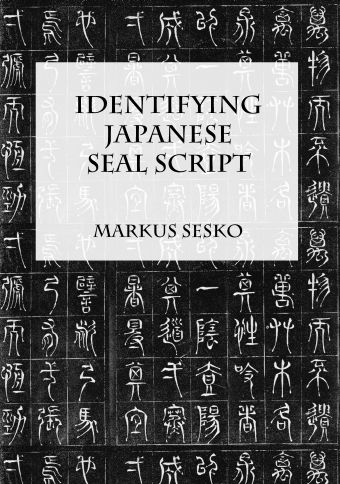
The purpose of this publication is to provide a basic guide and reference for identifying Japanese seal script. The most effective way of identifying a seal script is by its radical, a graphical component under which the character is traditionally listed in a dictionary. The radicals used here are the Japanese version of the 214 Chinese Kangxi radicals.The first thing to do is to identify the radical under which the character is most likely to have been indexed.To begin with, this dictionary offers a RADICAL SECTION. If you think you found a match with the supposed radical for the seal character in question, then go to the page which lists the characters grouped under that radical. This dictionary contains approximately 4,000 characters. As mentioned, the purpose of this publication is to provide a basic guide and reference. It is not meant as a comprehensive seal script dictionary offering different interpretations of each seal character.

6 wide x 9 tall, 362 b/w pages, price $ 39.90 / 32,24 € (for the paperback)

As at the previous publication Identifying Japanese Cursive Script, there is a paperback, a hardcover, and an eBook version available.

Please click at Preview under the cover at any of the links provided above to see some sample pages of the book.

CoverSealSmall

Signatures of Japanese Sword Fittings Artists

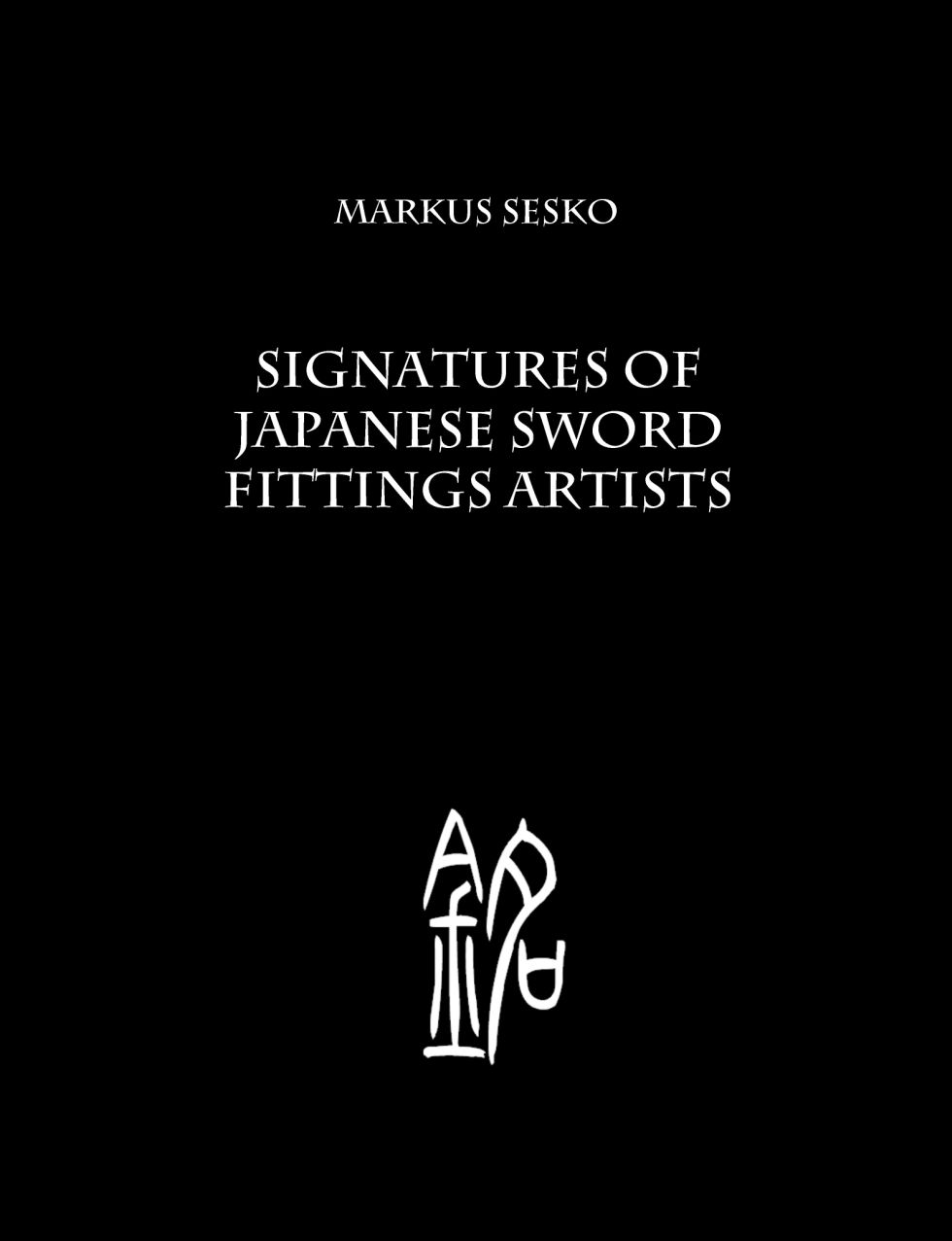
It turned out that the formatting did not take that much time and so I was able to finish my just previously announced latest publication Signatures of Japanese Sword Fittings Artists.

My motivation for compiling this work was purely a service-oriented one. Over the years I have constantly received inquiries for authenticating signatures on sword fittings, or for advice as to whether a work/signature looks promising enough to be submitted to shinsa, a procedure which we all know needs some background work and takes time and money. Dealing with such inquiries is quite a sensitive task. First of all, you don´t have the item in hand. That means you have to decide on the basis of pictures alone if a signature and quality of a work justifies further research, providing that the pictures you receive are of decent enough quality. If so, you have to compare the signature with your reference, and for this I have compiled over the years a humble database of roughly 5,000 pictures of mei. As this was for my use only, and as I am fortunately able to read Japanese, I just labelled the pictures accordingly, i.e. I did not make any list with the names of the artists or translations of the signatures and the like. With this database as a reference I have so far been able to offer some signature comparisons which have been of much help in making some basic judgements. So, if a signature matches in syntax and the characteristic style is very close to an authentic signature from my database, then sending the piece to Japan for shinsa becomes a possibility. Or, if the inquiry was not about obtaining papers, the inquirer can be reassured that chances are now higher that his item is authentic.

The greatest problem in compiling this publication was due to the quality of the pictures. Although over the years I have always scanned the pictures with the highest possible resolution and with a decent scanner, the main problem remaining was the often bad initial quality. In many cases signatures had been photographed and catalogued only once and then it was decades ago. After some test prints I had to immediately dismiss about a fifth of the pictures in my archive. Apart from that there are some pictures whose quality is really no better than those dismissed but for which I decided that they should remain in the publication. This concerns first and foremost signatures of artists of which hardly any signed works are known. On the other hand I also kept pictures where one is at least able to see the basic style, position, and arrangement; information which might also help sometimes in “judging” a signature.

As for the structure of the book, the information provided for each artist is kept as simple as possible. That means, for reasons of space, all the necessary data is given which allows one to recognize an artist on which detailed information can then be found elsewhere in a next step. I also attached importance to quoting the signature shown, as if I had simply illustrated the pictures this publication would have been a “half-hearted” approach and would not have been that useful in the end. However, and again for reasons of space, only the basic and essential information of lengthy signatures is quoted. Specifically this means that dated signatures are just quoted as “dated 1858” for example, and sometimes the names of places and the like are omitted. In addition, and for the sake of searchability and recognisability, I also attached importance in quoting each name and with both the simplified and the un-simplified characters. Apart from that this publication should be self-explanatory. A list of all the characters from the names used by the featured artists is provided at the end. In this sense I hope that this work will serve the collector, dealer, and sword fittings enthusiast as a source of reference.

The 680-pages hardcover book (format US Letter) is available here:

http://www.lulu.com/shop/markus-sesko/signatures-of-japanese-sword-fittings-artists/hardcover/product-21586801.html

And the eBook version, ideal for an on-site signature comparison when purchasing signed sword fittings when having it on the tablet, is available here:

http://www.lulu.com/shop/markus-sesko/e-signatures-of-japanese-sword-fittings-artists/ebook/product-21586815.html

Thank you for your attention and once again Happy Easter to everyone!
SignaturesCoverSmall

Identifying Japanese Cursive Script

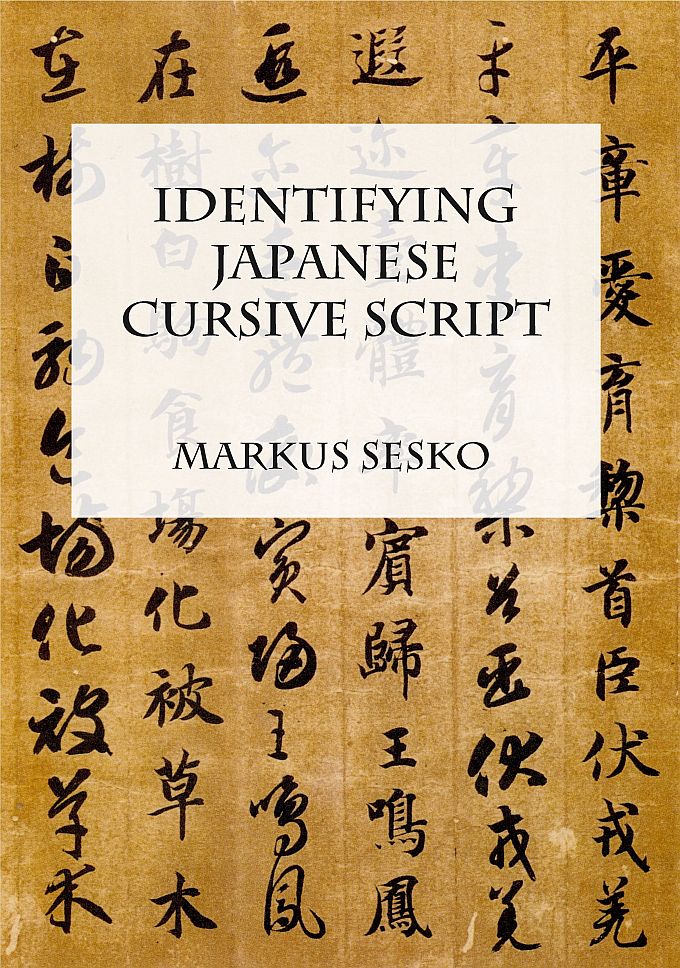
This latest publication is for all “decipherers” out there which need a guide and reference when struggling with Japanese cursive script (sôsho). When you are facing a character written in cursive script, identification by the number of strokes cannot be applied any longer as the abbreviated writing style omits certain strokes. So the only effective way of identification is by its radical. What makes identifying cursive script so difficult is that the radicals of course are also written in an abbreviated manner and that several radicals look quite the same in their abbreviated form. For that, this dictionary offers a RADICAL SECTION which provides several examples of how each radical appears in its cursive writing. A match with the supposed radical of the cursive character takes you to the page which lists characters grouped under that radical. This dictionary contains approximately 5.300 characters, but is not meant as a cursive script dictionary with different handwritings of each cursive character, as the aim is to provide a basic guide and reference for identifying them.

6 wide x 9 tall, 472 b/w pages, price $ 44.90

There is a paperback, a hardcover, and an eBook version available.

CursiveScriptCover

CursivePreview

Nihon-shinshinto-shi

Out now, my “Nihon-shinshinto-shi”, the history of the shinshinto era of Japanese swords, which completes Dr. Honma Junji´s standard work „Nihon-koto-shi“ and my follow-up the „Nihon-shinto-shi“, starting from Suishinshi Masahide´s initiation of a new trend around An´ei (1772-1781) to the ban on swords issued by the Meiji government in 1876. As with the „Nihon-koto-shi“ and the „Nihon-shinto-shi“, the reader should be able to grasp a coherent picture of the backgrounds and scholastic activities around the Japanese sword at the end of the feudal era. The shinshinto era requires a slightly different approach than the shinto era, just like between shinto and koto. We have namely a combination of the trend towards old traditions initiated by the aforementioned Masahide on the one hand, and on the other hand the local trends which were established after certain students had returned to their home lands where they founded their own schools. Finally, the time scale must not be overlooked: The „Nihon-koto-shi“ had to deal with roughly 800 years, from the Nara to the end of the Muromachi period, and the „Nihon-shinto-shi“ comprised „just“ about 200 years, whereas the shinshinto era lasted only about a century. In this sense I hope that the „Nihon-shinshinto-shi“ serves, like the „Nihon-koto-shi“ and my own publication the „Nihon-shinoto-shi“, as a standard or at least as a reference work for this era of the Japanese sword.

Paperback, 7.44 wide x 9.68 tall, 296 pages, b/w pictures – $ 65.00

It can be purchased here or shortly also on amazon.

And the eBook version for $ 30.00 is available here.

And as a special introductory offer for those who haven´t got any of the books yet, I will sell the entire set of three volumes, i.e. „Nihon-koto-shi“, „Nihon-shinoto-shi“ and „Nihon-shinshinto-shi“ on request for $ 150 instead of $ 200. If you are interested, do not hesitate to contact me (email address can be found on the section Imprint on top of this blog).

cover-engl-small

Shinshintoshi-Contents

Nihon-koto-shi: New English Version

I just finished a minor project I was asked for several times over the last months and years. As most of you know, the NBTHK provides an English translation of Dr. Honma´s Nihon-koto-shi on their website, but just the plain translation without any pics here.

Non-members of the NBTHK and younger members which don´t have all the back issues of the Token-Bijutsu asked me frequently where to get the pictures or if I am willing to sort them out. Now I fulfilled this request and compiled a paperback version (and an eBook version) of the Nihon-koto-shi with all the pics, but not only that, I added also a lot of pics mentioned in the text but not shown in the Token-Bijutsu reprint. The result is a 320 pages 408 b/w pictures book (7.44 wide x 9.68 tall) available as a personal reference. Once again, this version will not be available in public so if you are interested in a copy, please contact me for further details via “markus.sesko@gmail.com”. The price is $60.00 + $10.00 flat shipping rate and determined by the printing costs and the compilation work involved.

The eBook version can be downloaded here:

NihonKotoShi

KotoShiContents

PS: I have taken the liberty to adjust the format to my previously published Nihon-shinto-shi, so that it will be a decent set with the upcoming Nihon-shinshinto-shi 😉

Nihon-shinto-shi

Out now, the English version of my recently published Nihon-shinto-shi.

I quote from the blurb:

“This book should bring the reader more near to the no less interesting era of the „New Sword“, the shinto. With the transition to the peaceful Edo period, the Japanese sword experienced considerable changes which are briefly touched in some other sword publications. This book now tries to present the historical and scholastic changes of the shinto in a comprehensive manner. The reader should get an idea about the activities of the Edo-period swordsmiths in all the provinces and how – if at all – they were connected in terms of school or workmanship. The classification based on the traditional gokaden is no longer applicable in shinto times and so a more geographical processing suggests itself. In the beginning we have the large sword centres of Kyoto, Osaka and Edo. Subsequently, all other provinces follow, arranged according to their „significance“ in the sword world and in context with each other to avoid as much as possible big geographical and theoretical jumps.”

Paperback, 440 pages, b/w pictures, 7.44 wide x 9.68 tall, $75.00

It can be obtained here.

And the eBook version here.

Cover-engl-kl1

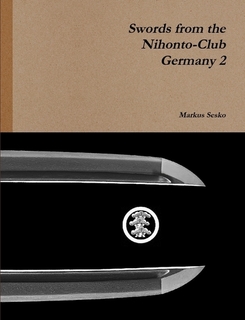
Swords from the Nihonto-Club Germany 2

After about two years we are proud to present the second catalogue of the Nihonto-Club Germany. Again, and with the support of our members, we have collected and catalogued altogether 31 blades whereas this time tsuba and kodogu also appear in the catalogue. This publication not only introduces „well-known“ and „classical“ items but also fine blades by rare masters like Jitsu´a, Ko-Hoki Sadatsuna, or the 3rd generation Hizen-Tadayoshi for example. The order follows the usual way, i.e. Koto, Sue-Koto, Keicho-Shinto, Shinto, Shinshinto, and Gendaito.

Again, I would like to take this opportunity to express my sincere thanks to all those who contributed to the compilation of this catalogue, and also to those who have taking an active part in our club meetings by providing blades, articles, tips, and advice.

The English version is available here.

And the German one here.

ClubCatalogue2

The tabe of contents can be seen here.

Contents

Kantei Reference Book out now

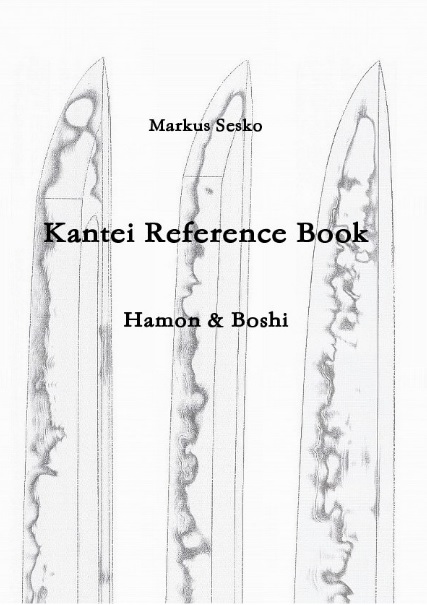
I would like to introduce the announced Kantei Reference Book – Hamon & Boshi and quote from the blurb:

“Towards the end of 2012, I published the two-volume project Koto-kantei and Shinto & Shinshinto-kantei, depicting 358 blades from all schools and styles. Recently, I was able to continue with the first Kantei Supplement 1 introducing another 61 blades. In between I received feedback which suggested that a kind of „reverse version“ would be practical. This means a guidebook where specific examples of hamon and boshi are depicted instead of more or less detailed schematic representations. The result is this small publication which shows about 400 hamon and 230 boshi interpretations. I hope this humble guide will be helpful for identifying specific works, or at least guide you on the right track enabling you to look for further information and confirmation. It also might come in useful for oshigata-based kantei riddles where only the hamon and the boshi are provided.”

It is available at Lulu.com via this link.

And the eBook version can be found here.

CoverFinished


Kantei Supplement 1

The first supplement volume to my set Kotô-kantei and Shintô & Shinshintô-kantei is out now. It contains 61 blades (koto, shintô and shinshintô). A second supplement volume will not be published before the very end of the year.

It can be obtained at Lulu.com via this link.

There is also an eBook available here.

And the German version can be found here.

cover-blog1

Paperback, 152 pages, b/w, 8.26 wide x 11.69 tall, 42.00 $ or 39.90 €

Table of contents


Shinto & Shinshinto-kantei

Kantei-shinto

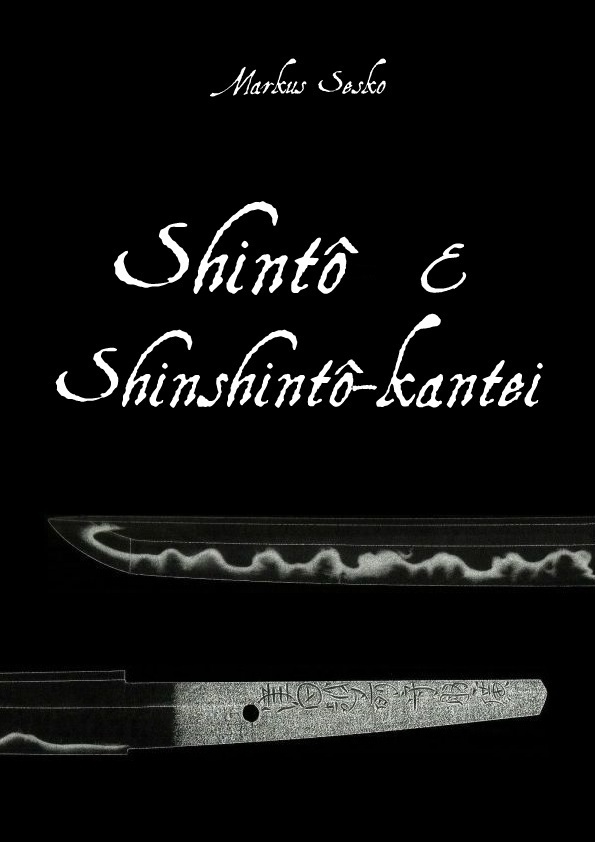
An unavoidable difficulty with books that deal with Japanese swords in general is that the workmanship of a smith has to be reduced to its most important characteristics which can be seen on the majority of his works. It is here that this work comes into play, with the motive to provide more concretely described reference examples. Unique is that – depending on the blade – former participant’s kantei bids are also addressed. This means that one’s own approach and attempt at attributing a blade may also be comprehended. With the 169 introduced shinto and shinshinto blades from altogether 13 provinces, this volume constitutes an extensive reference work. The order starts for shinto with Kyoto, Edo and Settsu, and for shinshinto with Edo.

Lulu.com

ISBN 9781300555711, Paperback, 8.26 wide x 11.69 tall, 416 pages

98.00 $ / 75,21 €