Kuji-kiri – A very special koshirae

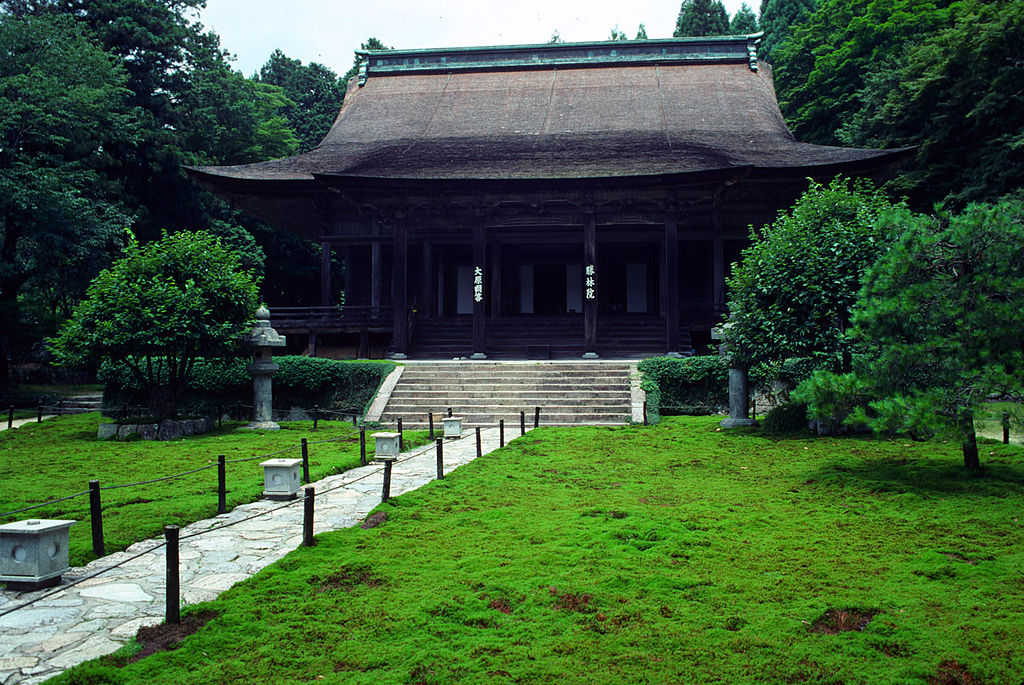
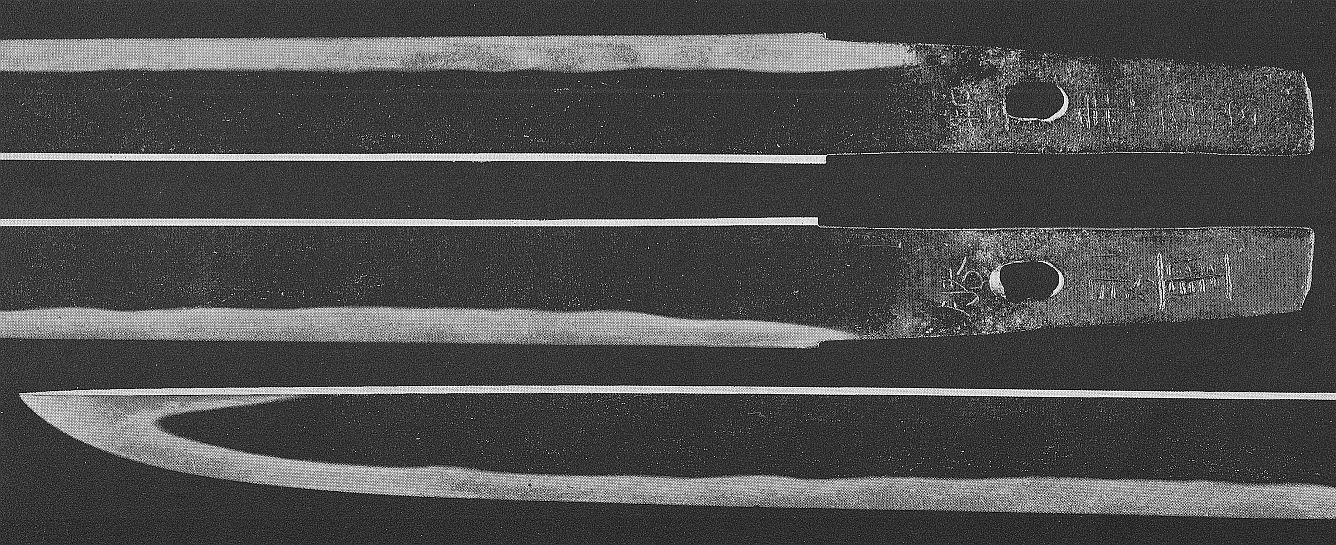
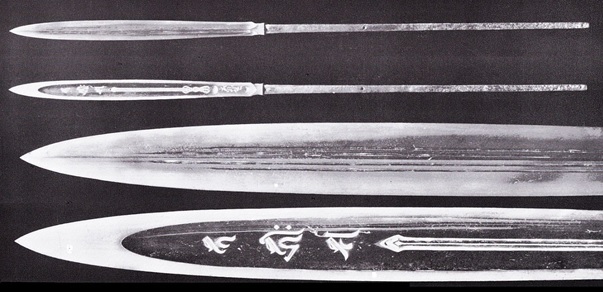
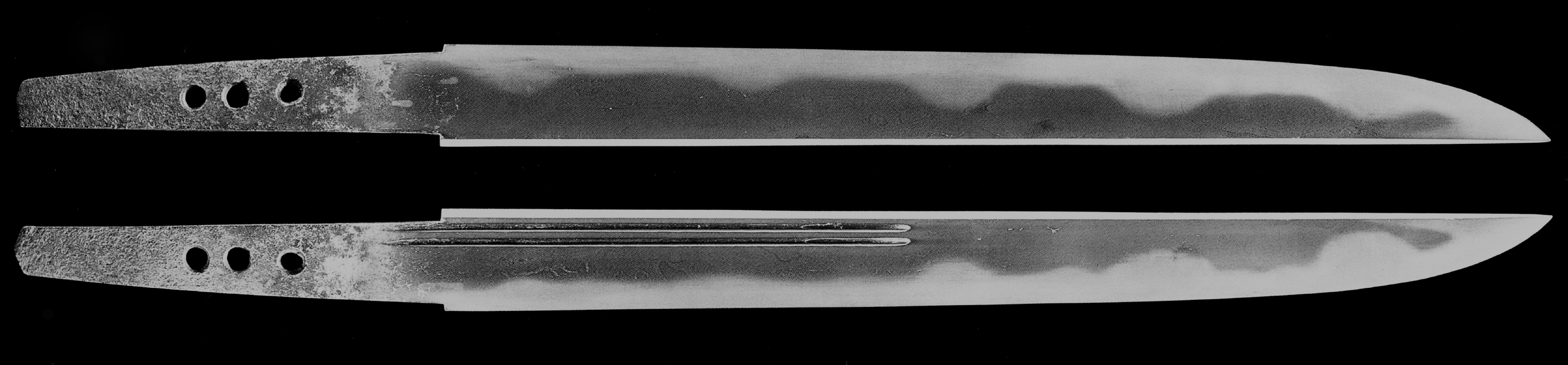
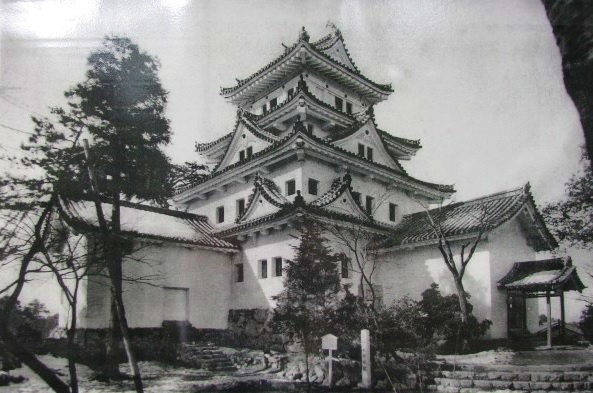
About six years ago, my friend from the japanische-schwert-galerie (see blogroll) and I were classifying a koshirae to a blade by the 5th generation Hizen Tadayoshi (肥前忠吉, 1696-1775). Please note that all pictures of the blade and koshirae shown in this article are copyright of the japanische-schwert-galerie so please do not resuse them. Right at this point I would like to thank the owner for allowing me to present the pictures on my blog as this koshirae was kind of special and remained in my memory over all the years. At a glance, the mounting looks like a tachi-koshirae from the mid or second half of the Edo period (see picture 1), but on a closer look it turns out that firstly, all the fittings are en suite of mokumegane and decorated with different golden characters, and secondly, the ashikanamono hangers have hinges and can be removed so that the sword can be worn as handachi thrusted through the belt. Of course the first thing to do is to decipher the characters and find out what is their context. The fuchi shows at the lower end a grid pattern which gives about the direction to where the context is to be found. Such a grid pattern is namely known as kuji-kiri (九字切り), a symbol deepy interwoven with the esoteric Buddhism (mikkyô, 密教). So when we sort and read the characters which are found on the fuchi, the kabutogane and the metal fitting of the saya (see picture 2), we get „rinpyô-tôsha-kai-jinretsu-zaizen“ (臨兵闘者皆陣烈在前), a saying or rather prayer from a Taoist lyrical text from the 4th century AD with about the following meaning „May the presiders over warriors be my vanguard!“ Later this line got more and more a religious connotation and was eventually used as mantra. That means the original characters were still used when writing down or as mnemonic when reciting the mantra but should not be taken literally any more.

 OLYMPUS DIGITAL CAMERA

Picture 1: Blade in shirasaya and its koshirae

Kuji2

Picture 2: The inscriptions on the fittings.

Many associate the kuji right away with ninjutsu but this is not what it is all about. The kuji-kiri grid was known long before certain ninjutsu teachings emerged, namely for warding off  dangers. The grid was painted or written over the potential danger, for example seafarer and fishermen wrote the grid over the character for „sea“ (umi, 海) or „water“ (mizu, 水), but mostly it was written over the character for „demon“ (oni, 鬼) to act as a general protection. Quite early certain mudra (hand seals/gestures) were asssociated with the nine characters or syllables respectively. A mudra is a very old spiritual gesture and used among others for meditation or to support the mantra. There are hundreds of them and they did not have the magical powers modern ninjutsu interpretations read into them. But of course we can ascertain connections. When esoteric Buddhism was introduced to Japan at the beginning of the Heian period, it found fertile ground in certain and similar shintô rituals and folk-traditions connected with sacred mountains and the like. This gave soon rise to the shugendô (修験道), a mysitcal-spiritual interpretation of mikkyô and shintô approaches of understanding the world and with a focus on ascetism, preferably practiced in the mountains. Only centuries later when the turmoils of the Sengoku era gave rise to a continuous need for espionage and assassinations, families organized themselves and established an early form of curriculum and body of thought which in turn was inspired by esoteric Buddhism. However, we can agree that the commissioner and/or owner of the koshirae was somehow involved either in shugendô or maybe also in ninjutsu as at the peaceful time the mounting was made, the few remaining families which preserved the ninjutsu focused more on spiritual aspects and thus formulated a more sophisticated philosophical and spiritual background of their teachings.

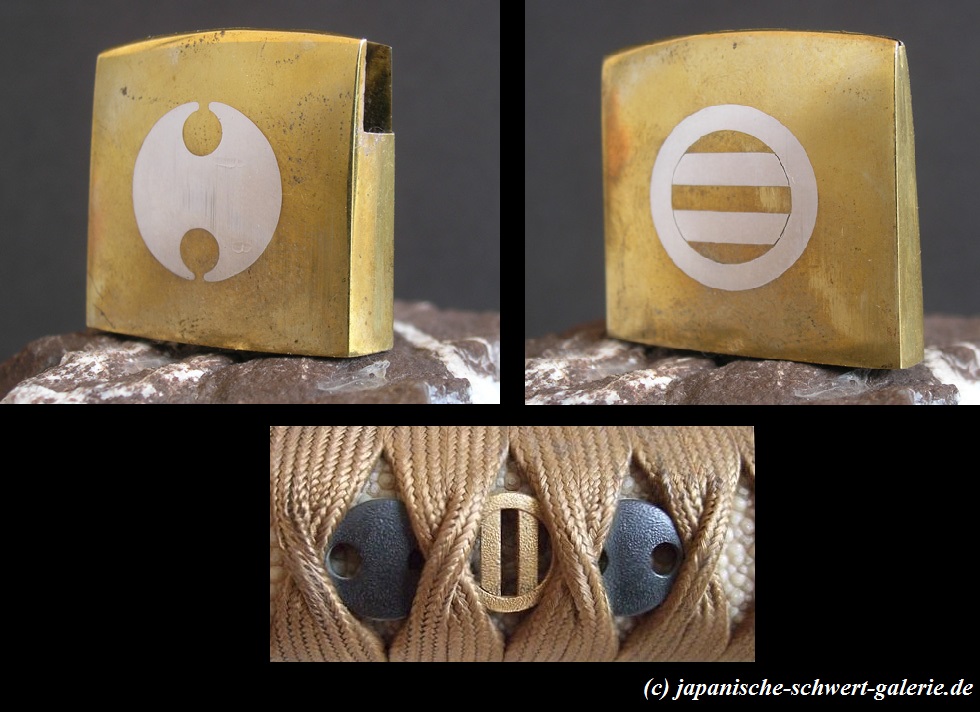
But there is more to it than that at this koshirae. As seen in picture 3 we find on the menuki and on the habaki two family crests. One is the so-called „fundô“ (分銅, weight), the other one the so-called „futatsu-hikiryô“ (二つ引両, two crossbars). The former was used among others by the Horio family (堀尾). The Hideyoshi-retainer Horio Yoshiharu (堀尾吉晴, 1542-1611) switched sides after his lord´s death and became a follower of Tokugawa Ieyasu. Well, because of an injury he was unable to participate at Sekigahara but as his son Tadauji (堀尾忠氏, 1578-1604) did, Ieyasu granted them lands in Izumi province worth 240.000 koku and the new Toda fief (富田藩) was founded. But Tadauji died young and so Yoshiharu´s underage grandson Tadaharu (堀尾忠晴, 1599-1633) became the successor of the Horie family. Shortly before Yoshiharu´s death, i.e. in 1611, Matsue Castle (松江城) was completed whereupon the administration of the fief moved there and it was renamed to „Matsue fief“ (松江藩). Now also Tadaharu died young and without heir and as the Horie family asked the bakufu for the permission to adopted his older cousin Sôjûrô (宗十郎) as successor, this was not granted and the government decided that the Horie main line should end at this piont. The Matsue fief was given to the Kyôgoku family (京極) for the time being but four years later in 1638 finally to the Matsudaira family (松平). With this the bakufu sent the remaining Horie family members on the one hand into service of the Matsudaira, that means they remained Matsue-retainers, and on the other hand into the service of the Hosokawa family (細川), the daimyô of the Kumamoto fief (熊本藩) of Higo province. And now we come back to the koshirae. The futatsu-hikiryô crest was namely used by the Hosokawa, but also within the line of Matsudaira Naomasa (松平直政, 1601-1666), the daimyô who received the Matsue fief from the Kyôgoku family. It was a customary practice since oldest times that the two cross bars-crest was given to the second son of a family. Ieyasu did the same and thus it came to be used by Naomasa as Naomasa´s father Yûki Hideyasu (結城秀康, 1574-1607) was the second son of Ieyasu. The tsuba shows the tsuta crest (蔦紋, ivy) which was used by several Matsudaira branches too as it is very similar to the aoi crest of the Tokugawa but officially not the same. In conclusion we can say that the owner of the koshirae wanted to display that he was a retainer of the Matsudaira or Hosokawa (there are not enough facts to rule one of them out) but in the context of having Horio origins. So all in all we have a very well thought out mounting you don´t see every day.
 Kuji3

Picture 3: menuki and habaki with the two family crests

Announcement

I got a lot of positive feedback about my recently published kantei volumes and at the same time many suggested to have a reference work compiled where all the various hamon and bôshi are sorted by shape/interpretation. The general response was namely to have specific examples to compare and not only schematic representations of hamon and bôshi.

As your wish is my command, I am going to compile such a reference work and below you will find a preview of how this project might look like.

KanteiPreview

Thank you and Happy Easter to all of you!

Sorting out legends around Ôhara Sanemori

During my research for one of my more or less recent publications, the Legends and Stories around the Japanese Sword 2, I came across a number of legends and transmissions regarding the swordsmith Sanemori (真守) which are interesting enough not to be dismissed right away. In chapter 2 on the famous Kogarasu-maru (小烏丸) I introduced the sword Nuke-maru (抜丸) which was once in the possession of Taira no Tadamori (平忠盛, 1096-1153). Some later chroniclers cunfused the Nuke-maru with the Kogarasu-maru as it was once called „Kogarashi“ (木枯), but most experts assume that the Kogarasu-maru and the Kogarashi were two different swords, which were both handed down within the Taira family. Another „proof“ that there were two swords are their different provenances after the time of Tadamori as the latter bequeathed the Kogarasu-maru and the Kogarashi to his oldest son and heir Taira no Kiyomori (平清盛, 1118-1181). More details can be found in my book and I want to continue with another transmission which says namely that the Nuke-maru was a work of Ôhara Sanemori (大原真守), the supposed son of the famous Yasutsuna (安綱). According to that transmission which is also found in the „Kokon-mei-zukushi“ (古今銘尽) from Manji four (万治, 1661), Sanemori made the Nuke-maru as “protective sword” (mamori-gatana, 守刀) for emperor Saga (嵯峨天皇, 786-842). Well, this can be ruled out as also Yasutsuna´s active period has been dated around the mid Heian period and the late 10th century. And as more recent sword publications date Sanemori even around Hô´en (保延, 1135-1141) it is, at least from the point of view of time, possible that he made the Nuke-maru for Taira no Kiyomori.

 sanemori2

Picture 1: kokuhô, tachi, mei: Sanemori tsukuru (真守造) – mune-mei: Ôhara (大原), nagasa 76,7 cm, sori 1,9 cm.

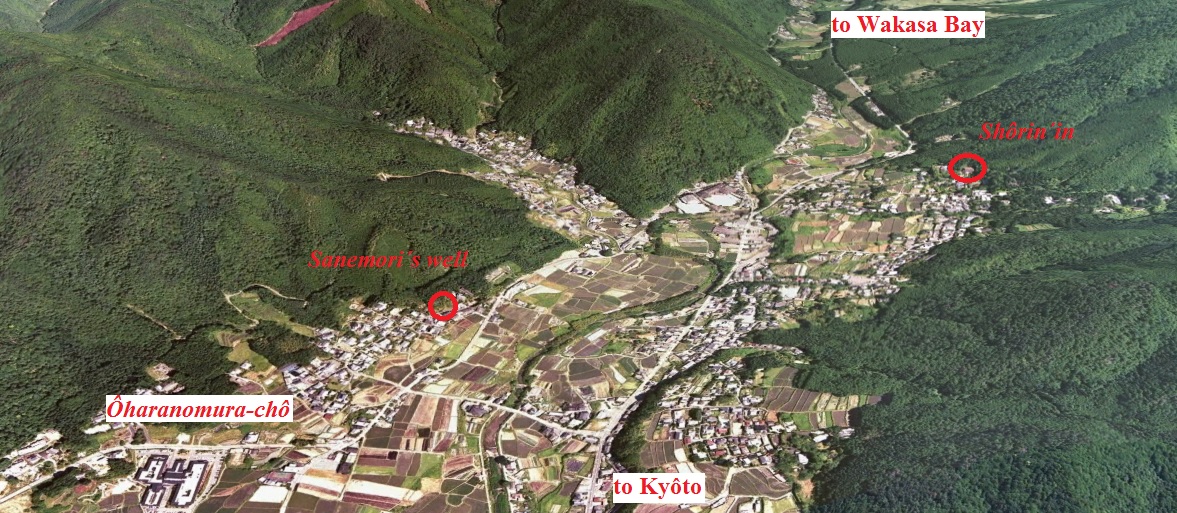
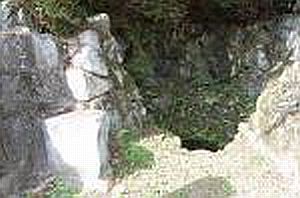
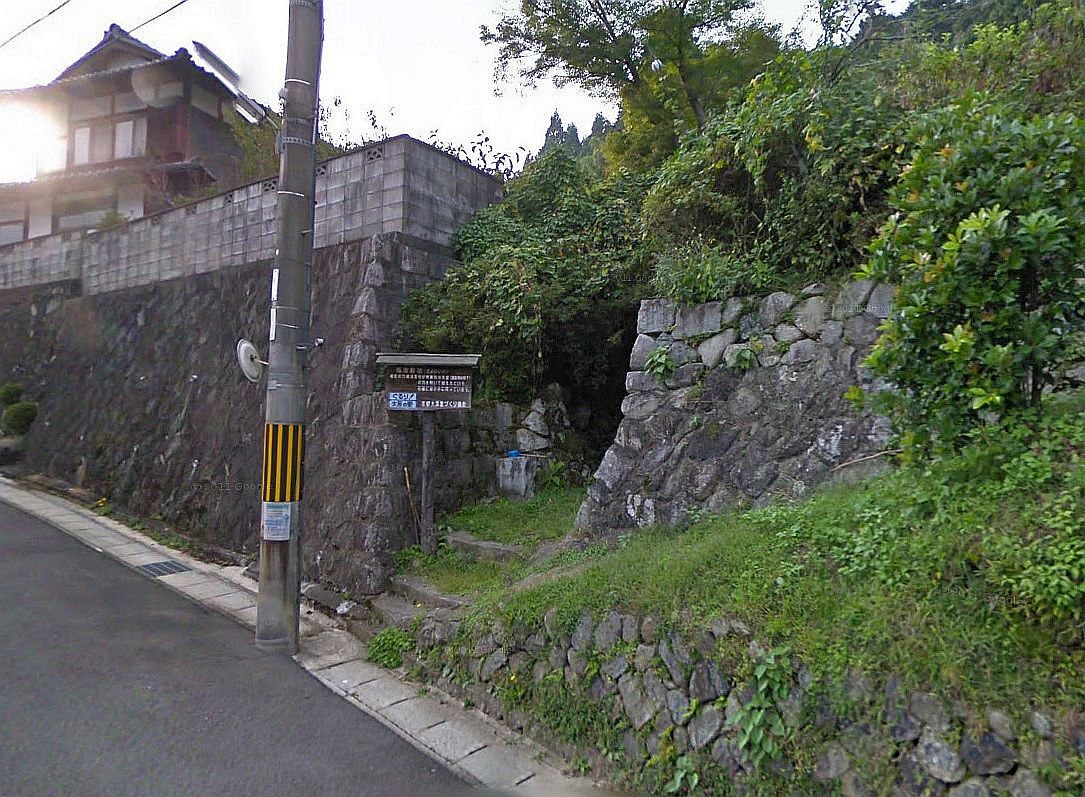
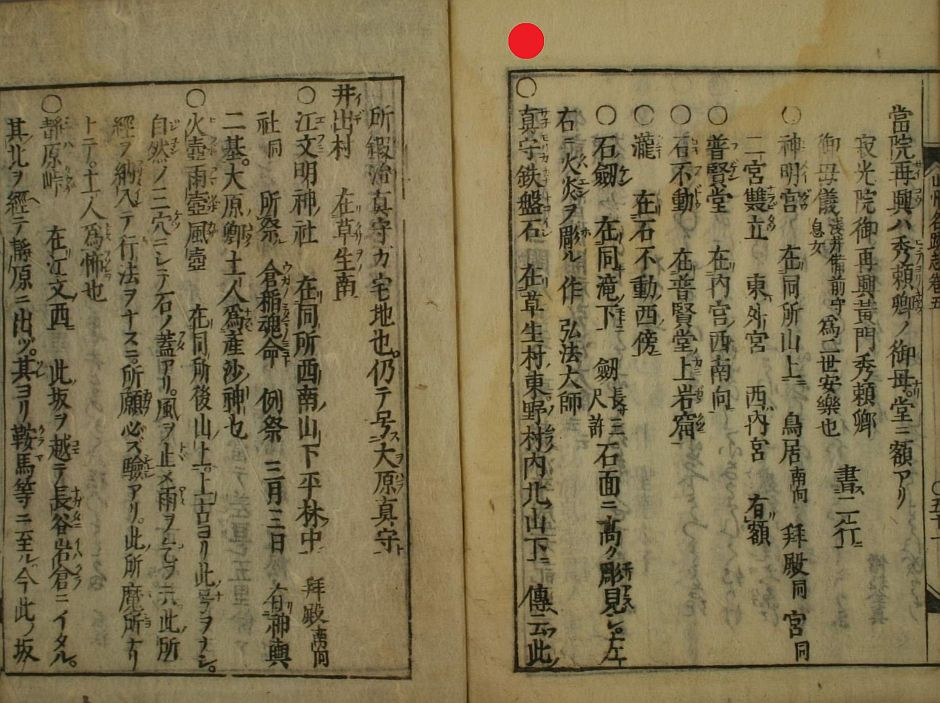
There are blades extant by Sanemori which are signed with „Hôki Ôhara Sanemori“ (伯耆大原真守). Because of these signatures and as it is obvious, most experts assume that he lived in the village of Ôhara in Hôki province which was located about 10 km to the southeast of present-day Yonago City of Tottori Prefecture. However, Sanemori did not explicitly mention „jû“ (住), i.e. „resident of“. This doesn´t have to mean anything but leaves nevertheless room for speculation. By the way, the blade shown in picture 1 bears the supplement „Ôhara“ on the back of the tang what is quite uncommon. One such a speculation takes us to the village of Ôhara of the same name, not in Hôki but in former Yamashiro province. This Ôhara was located on the main road which connected Kyôto with Wakasa Bay and just about 6 km to the south was the Enryakuji (延暦寺) on Mt. Hiei. And now things are becoming interesting. There in Ôhara, or to be more precise in the present-day Ôharanomura-chô (大原野村町, see picture 2) exists a legendary stone and well. The flat natural stone is namely called „Sanemori-kanatokoishi“ (真守鉄盤石, lit. „Sanemori´s anvil“, see picture 3), and the well „Sanemori no i“ (真守の井, lit. „Sanemori´s well“, see picture 4). Already the old local history „Sanshû-meiseki-shi“ (山州名跡志, „Famous Ruins from Yamashiro Province“) from the first year of Shôtoku (正徳, 1711) mentions this stone and well and says that once the house of the swordsmith Sanemori was erected at this area, that he used the stone as anvil, and that is why he was called „Ôhara Sanemori“ (see picture 5). On the other hand, the much later „Kyôto-minzoku-shi“ (京都民俗志) written by Inoue Yoritoshi (井上頼寿, 1900-1979) says that the well or the well water respectively is called „Kokaji no mizu“ (小鍛冶の水, lit. „Kokaji´s water“), as another legend says that the water was used by the famous Kyôto smith Sanjô Kokaji Munechika (三条小鍛冶宗近). Inoue also writes that the local people still arrange shimenawa around the well at New Year. Besides of that he quotes the stone as „Taira no Kiyomori kanatokoishi“ (平清盛鉄盤石, lit. „Taira no Kiyomori´s anvil“) what would close the circle to the transmission that Kiyomori owned the sword Nuke-maru by Ôhara Sanemori given to him by his father Tadamori.

 mapOhara

Picture 2: Map of the relevant places

sanemorinoiPicture 3: Sanemori´s anvil

sanemoriwell1

Picture 4: Sanemori´s well

sanshu2

Picture 5: Relevant passage of the „Sanshû-meiseki-shi

But there is more speculation. Some blades of Sanemori are signed with „Shô/Kachi/Katsu“ (勝, lit. „victory“) (see picture 6). Well, it is unclear of this supplement has a literal meaning, was a nickname or a family name. Used as family name this character would read „Katsu“ or „Kaji“ and might be a pun and stand for the homonymous „kaji“ (鍛冶) which means „smith“ as we know. But some see this character in the context of Ôhara in Yamashiro province and assume that it is an abbreviation, namely an abbreviation for the local Tendai temple Shôrin´in (勝林院, see picture 7) located only about 1,5 km to the northeast of the well. Father and son Tadamori and Kiyomori had some disputes with the Tendai-monastery Enryaku-ji what shows us that they were at least in that area. So if we let our thoughts run free it is possible that Tadamori had the local smith Sanemori make him a sword when he was around and Sanemori was somehow affiliated with the Shôrin´in, but most experts assume that the legend with the well and the old smithy of Sanemori emerged much later and just because of the same name „Ôhara“ and further they assume that the smith neither worked nor lived there.

 Sanemori3

Picture 6: kodachi, mei: Hôki Ôhara Sanemori (伯耆大原真守) – Shô/Kachi (勝), nagasa 61,9 cm, sori 1,8 cm

Shorin-in

Picture 7: Shôrin´in

But there is another interesting sidenote. We know that the Etchû-smith Norishige (則重) tried to reproduce the old Ko-Hôki style and several extant blades definitely show his approach. And there exists a tokubetsu-jûyô tantô of Norishige which also bears the character „Shô/Kachi“ (see picture 8). Like on the Sanemori blade seen in picture 6, the character in question is chiselled above the mekugi-ana, that means not directly connected to the name of the smith. So maybe this character was a way for Norishige to show that he knows Sanemori´s blades very well. Anyway, the reproduction of the Ko-Hôki style by Norishige and this single character known to be used by Sanemori is in my opinion too much to be just a coincidence.

norishige1Picture 8: tantô, mei: Shô/Kachi Norishige (勝・則重) – Shôwa sannen jûichigatsu-hi (正和三年十一月日, „a day in the eleventh month Shôwa three [1314]“), nagasa 22,4 cm

Kantei Supplement 1

The first supplement volume to my set Kotô-kantei and Shintô & Shinshintô-kantei is out now. It contains 61 blades (koto, shintô and shinshintô). A second supplement volume will not be published before the very end of the year.

It can be obtained at Lulu.com via this link.

There is also an eBook available here.

And the German version can be found here.

cover-blog1

Paperback, 152 pages, b/w, 8.26 wide x 11.69 tall, 42.00 $ or 39.90 €

Table of contents


Maeda Toshiie taking heads

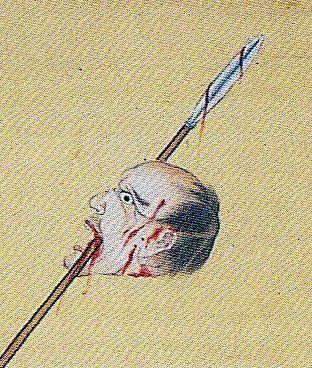
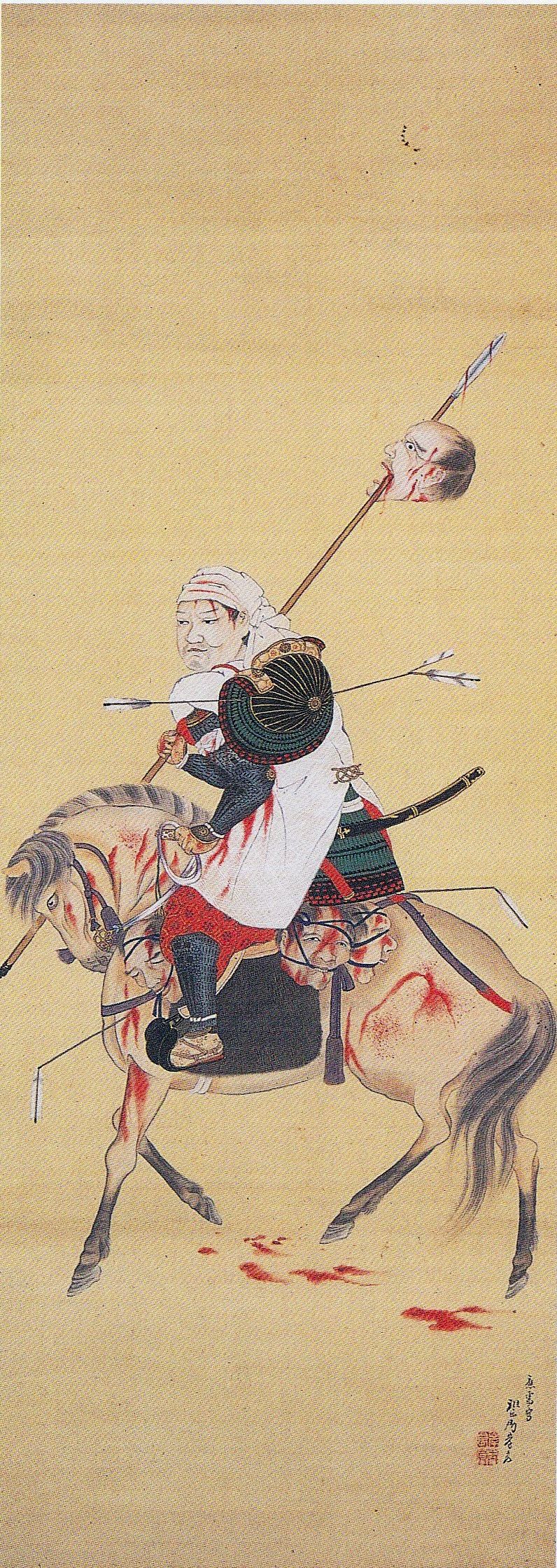
It is widely known that samurai were keen to take the heads of their enemies as a way to prove where they were victorious. Reports on taking heads go way back to the mid Heian period but a kind of ritualized aspect of this act did not emerge until about the Genpei War which marked the end of thei Heian and the beginning of the Kamakura period. That means the more taken heads a warrior was able to present at the end of a battle, the more likely it was he was rewarded by his lord. Now I would like to introduce a more modern but still very graphic rendering of this bloody tradition. The picture shown below depicts the young Maeda Toshiie (前田利家, 1538-1599) returning victorious from the Battle of Okehazama. When Imagawa Yoshimoto (今川義元, 1519-1560) was on his way entering Kyôto in Eiroku three (永禄, 1560), he had to cross the territories of Oda Nobunaga in Owari province who of course wanted to stop him. It is said that Toshiie was not allowed by Nobunaga to participate in this battle but he nevertheless did, taking one enemy head right in the morning and two during the main battle. But Nobunaga was angry and did not allow him to come back into his service. But one year later Toshiie again decided for himself to participate in the Battle of Moribe (森部の戦い) where he took the head of Adachi Rokubei (足立六兵衛), a retainer of the Hibino family (日比野) and a tough hero nicknamed „Kubitori-Adachi“ (頸取足立, „the head-severing Adachi“). But Toshiie was also able to take another head in this battle and for these deeds he was finally rewarded by Nobunaga by an increase of his salary by 300 kan.

Well, apart from the head taking reports of Toshiie, he also got the nickname „yari no Mataza“ (槍の又左, „Mataza the Spear“) as „Matazaemon“ (又左衛門) was one of his first names. This nickname goes back according to transmission to the Battle of Ukino (浮野の戦い) which took place in the first year of Eiroku (1558) when Toshiie was 21 one years old. He was namely wielding a yari with a 6 m 30 cm long shaft in this battle and decided to make the spear his main weapon.

maedahead2 MaedaHead1

Picture 1: Maeda Toshiie Okehazama gaisen no zu (前田利家桶狭間凱旋図) by Ganryô, ink and colours on silk. The depiction is actually an exaggeration of Toshiie´s merits as it shows four taken heads whereas the Nobunaga chronicle „Shinchô-kôki“ (信長公記) speaks „only“ of three taken heads as mentioned above.

The picture came from the possessions of a later Maeda retainer and was clearly ordered for boosting the morale and fighting spirit. The artist chosen for fulfilling this task was Ganryô (岸良, 1798-1852). Ganryô was born as „Hamatani Gorô Masayoshi“ (濱谷五郎昌良) in Kyôto. His nicknames were „Shirô“ (子良) and „Saeki Ganryô“ (佐伯岸良) and he also bore the pseudonyms „Ga´un“ (画雲) and „Jôkaku“ (乗鶴). He entered an apprenticeship under master Ganku (岸駒, 1756-1749), the famous founder of the Kishi school (岸) of painting, and married his eldest daughter Tei (貞). Later he worked for the Imperial Arisugawa-no-miya family (有栖川宮) but was somehow outshined by Ganku´s son and heir Gantai (岸岱, 1782-1865). Well, Ganryô did not focus on the traditional „Kishi tiger motif“ but followed more the style of the Nanpin school (南蘋派). The latter goes back to Chinese artist Shěn Nánpín (沈南蘋, 1682-?) who worked basically in academic Ming styles. Shěn Nánpín stayed from 1731 to 1733 for two years in Japan and his paitings became very popular as the Japanese taste developed more and more towards realism in the 18th century and also because the novelty of his style and its decorative appeal. Thus also Ganryô´s paintings are more realistic and his trong points were depictions of figures and the so-called „bird-and-flower genre“ (kachô-ga, 花鳥画).

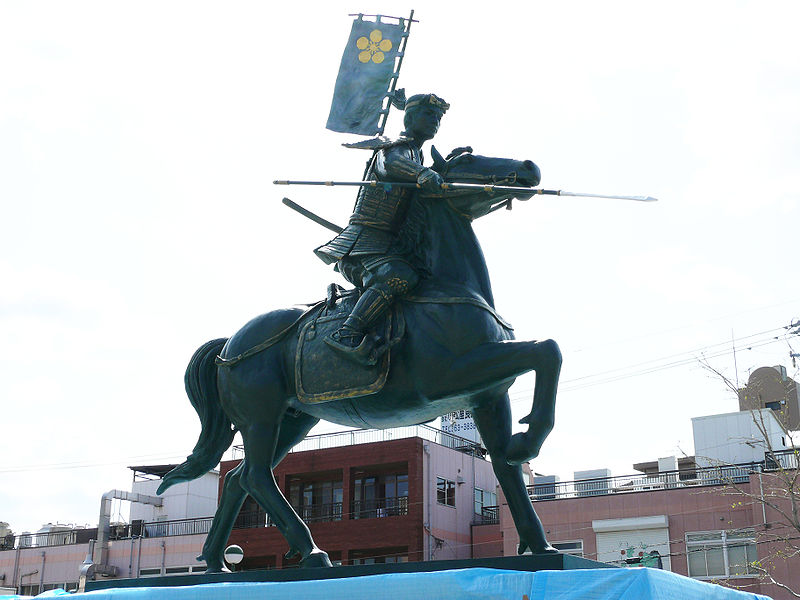
Incidentally, as Maeda Toshiie was born in the village of Arako (荒子) somewhat to the southwest of Nagoya (it is now a part Nagoya), the city commissioned the sculptor Tabata Isao (田畑功, 1955- ) in 2007 with a bronze statue of the young Toshiie riding into his first battle with his spear. You can see the statue when you take the Aonami Line from Nagoya Station and leave at Arako. It was erected right in the centre of the traffic circle in front of the station (see picture 2).

 statue1

Picture 2: Statue of the young Toshiie

The Inoshishigiri and the travels of Masazane

Sakai Tadatsugu (酒井忠次, 1527-1596), one of the so-called „Four Guardians of the Tokugawa“ (Tokugawa-shitennô, 徳川四天王), was born in Mikawa province and appointed by his lord Tokugawa Ieyasu to castellan of Yoshida (吉田城) in Eiroku eight (永禄, 1565) which was located in the eastern part of Mikawa. The castle town of Yoshida was insofar important as it had via the Toyokawa River access to the sea (Mikawa Bay) and as it was located at the Tôkaidô, the main road which connected Kyôto with the Kantô area. Now whilst ruling Yoshida Castle, Tadatsugu killed – according to transmission – with one of his swords a boar whereupon the katana got the nickname „Inoshishigiri“ (猪切, lit „boar cutter“). The nickname was inlayed via kinzôgan on the tang. The blade came eventually in the possession of Tadatsugu´s fourth son Matsudaira Jinzaburô Hisatsune (松平甚三郎久恒, 1584-1652). When Tadatsugu´s grandson Tadakatsu (酒井忠勝, 1594-1647) became daimyô of the Shônai fief (庄内藩) of Dewa province in Genna eight (元和, 1622), he made his uncle Hisatsune castellan of Kamegasaki (亀ヶ崎城) and later in Kan´ei six (寛永, 1629) his karô elder. The sword remained in Hisatsune´s family, according to transmission until the last karô Matsudaira Jinzaburô Hisaatsu (松平甚三郎久厚, ?-1921).

 masazane

Picture 1: Inoshishigiri by Masazane

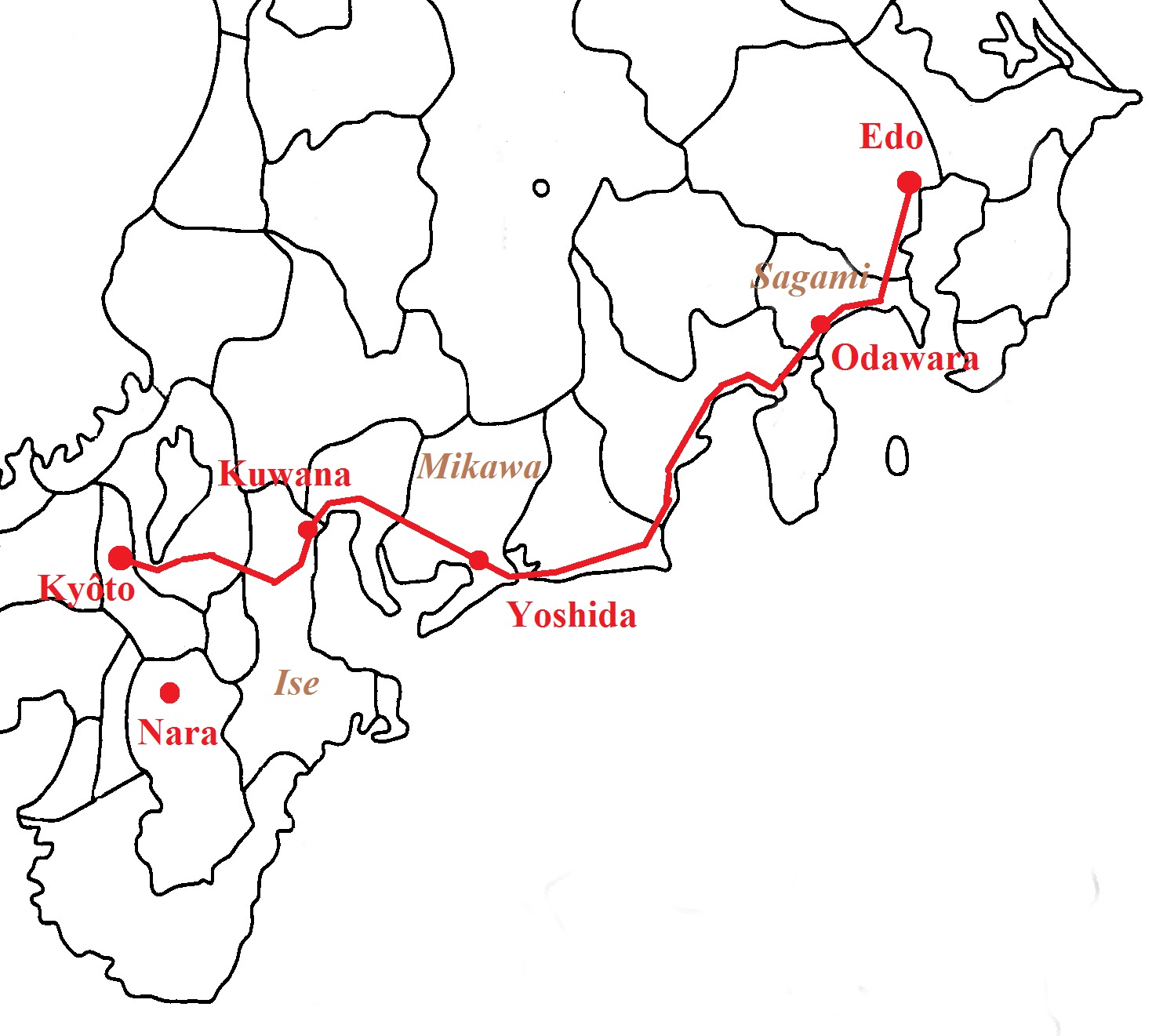
The blade itself is a work of Masazane (正真) on whom I would like to make some observations. It is said that Masazane was a late Tegai smith who lived in the old Fujiwara district (藤原) of Nara in Yamato province. From there he visited Kyôto where he became a student of the Eishô-era (永正, 1504-1521) Heianjô Nagayoshi (平安城長吉) with whom he travelled a lot. Their first destination was Kuwana (桑名) in Ise province where they worked together with Muramasa (村正). Well, it is unknown who actually learned from whom but we can definitely see similarities in the workmanship of Masazane, Nagayoshi and Muramasa. After their stay in Ise they went further eastwards, namely to Mikawa province, and as the Tegai school was also called „Monju school“ (文珠), the lineage of Masazane was later also called „Mikawa-Monju“ (三河文珠). But that was not enough as both travelled along the Tôkaidô up to Odawara (小田原) in Sagami province. This can be confirmed by signatures of Nagayoshi and Masazane which mention „Sôshû-jû“ as place of production.

 mapleer1

Picture 2: The travels of Masazane and Nagayoshi. In red the Tôkaidô.

There is some confusion about the Kanabô smith Masazane of the same name. He was active somewhat later, i.e. around Tenbun (天文, 1532-1555), and was according to transmission the son of the Eishô-era late Tegai Masazane. He did not accompany his supposed father on his journeys but moved later from Fujiwara to the Kanabôtsuji (金房辻) district of Nara which earned the Kanabô school its name and which was later adopted as family name. He signed for example with „Kanabô Hayato no Suke Masazane“ (金房隼人佐正真) and his signatures are clearly different from the earlier Masazane. Also from the point of view of workmanship the theory that the Eishô-era Masazane and Kanabô Masazane were the same person can be dismissed. Around Tenshô (天正, 1573-1592) there was a 2nd generation Kanabô Masazane, presumably the son of the 1st generation. Well, the 1st generation Kanabô Masazane had according to transmission a younger brother who also bore the name „Hayato no Suke“ but wrote his name „Masazane“ with the characters (正実), or in the old and unsimplified form (正實). The latter Masazane was active around Eiroku (永禄, 1558-1570) and his successor of the same name around Keichô (慶長, 1596-1615).

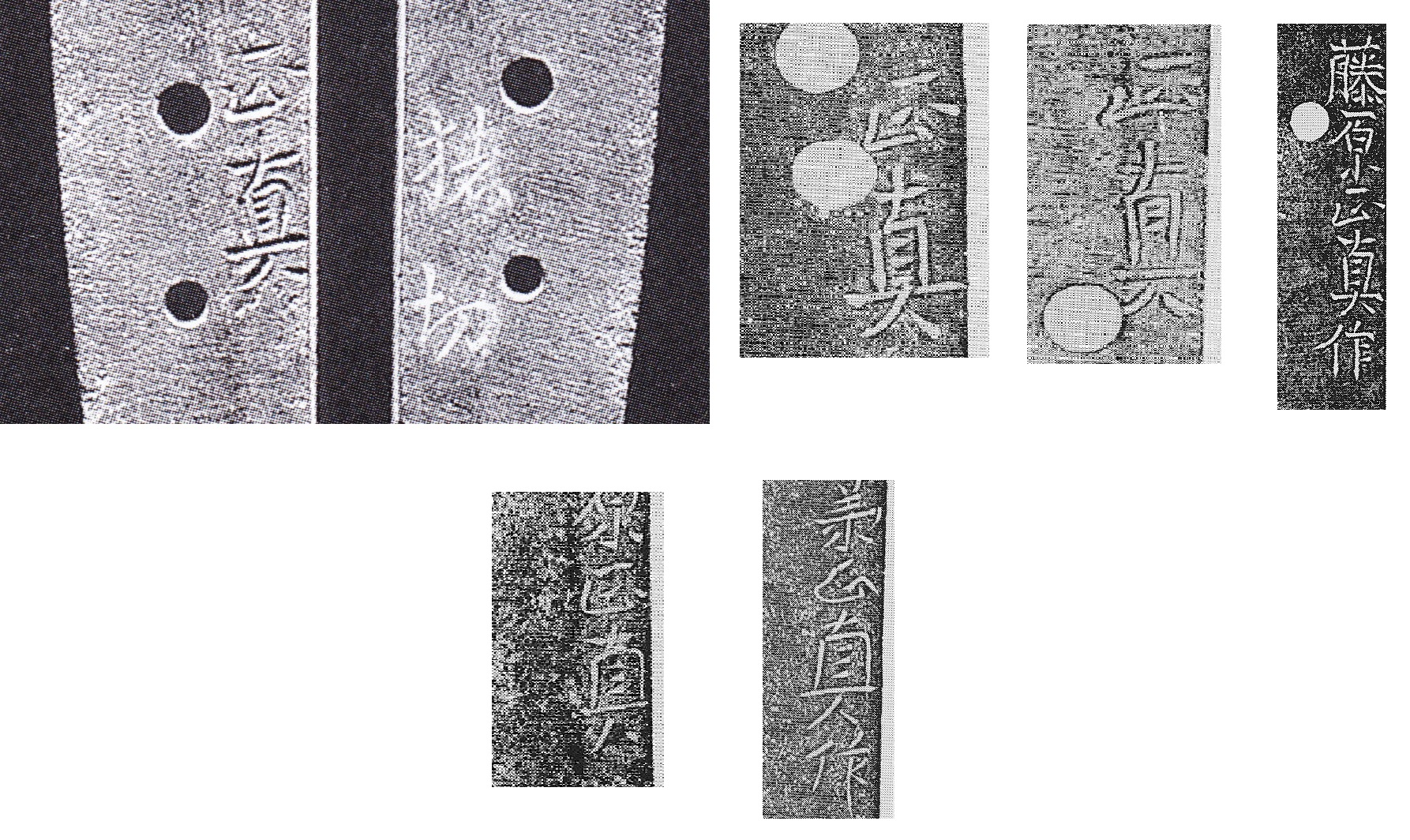
 meicompMasazane

Picture 3: Signature comparison. Top row four signatures of the Eishô-era Masazane with the mei of the Inoshishigiri to the left. Bottom row two signatures of Kanabô Masazane.

So when Masazane was active around Eishô (永正, 1504-1521) and Sakai Tadatsugu was born in Daiei seven (大永, 1527), it can be ruled out that the latter ordered the blade from Masazane whilst he stayed in Mikawa. Thus the blade must had been in the possession of the Sakai before the time of Tadatsugu. At the time Tadatsugu was born, his father Tadachika (忠親) ruled Ida Castle (井田城) in Mikawa province which was located about 30 km to the northwest of Yoshida and along the Tôkaidô. From Kuwana to Ida is about 80 km. As it is unlikely that Masazane and Nagayoshi traveled with a bunch of blades we can assume that they might had just some presentation pieces to demonstrate local rulers their skill. So maybe Tadachika was impressed by Masazane and ordered the later Inoshishigiri from him. If this was the case, then the blade was forged at Ida Castle. Incidentally, Tadachika´s father, grandfather and great-grandfather were Yasutada (康忠), Tadakatsu (忠勝) and Ujitada (氏忠, ?-1470) respectively. As the exact dates of Yasutada and Tadakatsu are unknown, it is also possible that the contact to Masazane came about through Tadachika´s father Yasutada or even grandfather Tadakatsu. All of them were castellans of Ida in succession.

But I don´t want to leave out the most famous work of Masazane, the yari Tonbôgiri (蜻蛉切). Honda Tadakatsu (本多忠勝, 1548-1610), another Tokugawa-shitennô, wore this yari at the Battle of Hitokotozaka (一言坂の戦い) in Genki three (元亀, 1572) and forced with it his way through the line between the enemy and the allies by wielding it overhead. It has to be mentioned that the shaft of the spear was 6 m long! (The blade itself has a nagasa of 43,8 cm.) According to transmission, once a dragonfly (Jap. tonbô) tried to land on the yari but was cut in two halves and that is why it got the nickname „Tonbôgiri“ (lit. „dragonfly cutter“).

 tonbogiri

Picture 4: Tonbôgiri

Another different oshigata

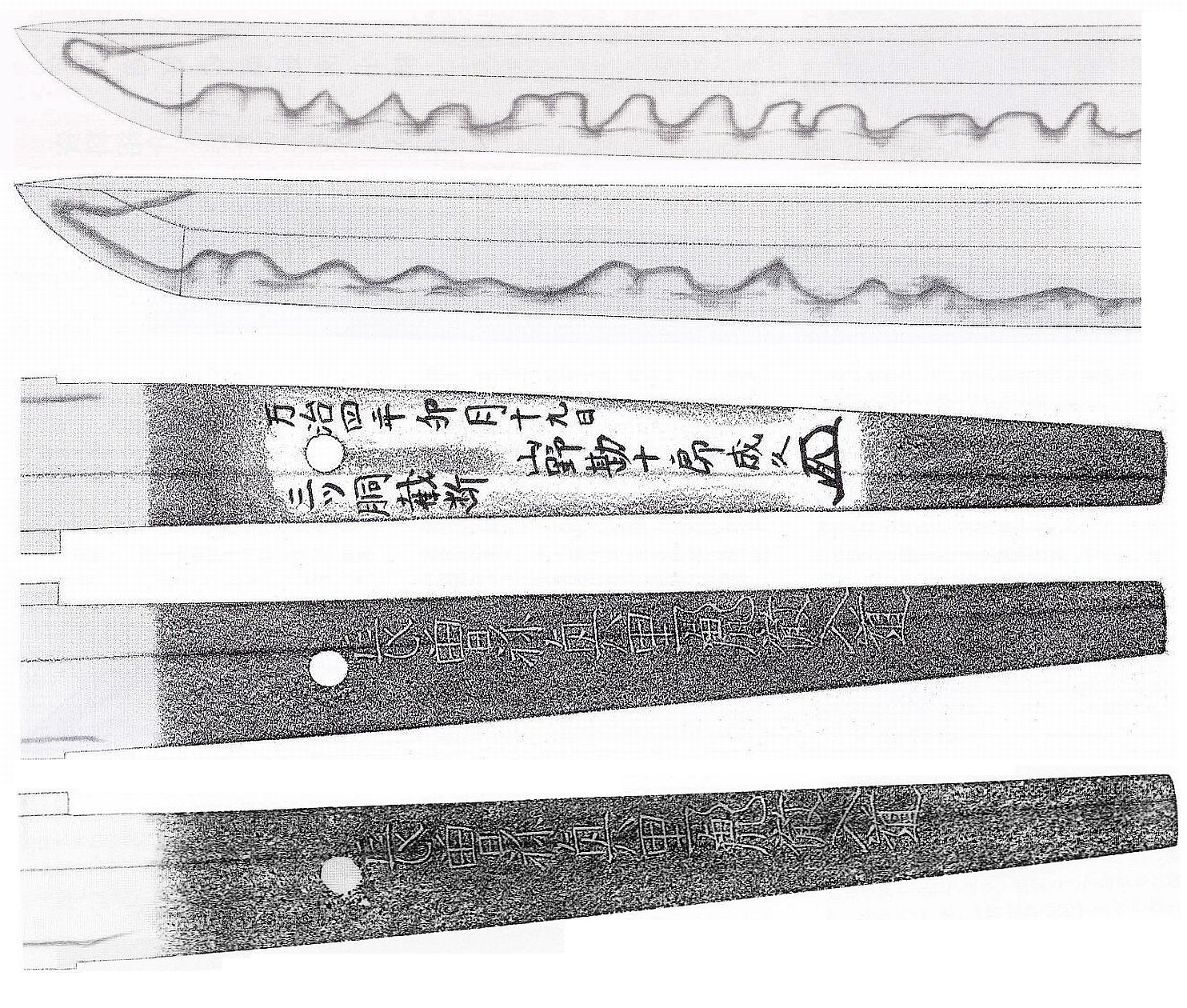
Had a root canal treatment earlier today so I will be brief as I don´t want my painkillers to gain the upper hand over my writing. In my article on the Musashi-Masamune I presented four different oshigata to the very same blade. As I had to look for something in older Token Bijutsu magazines, I found another oshigata to a blade of Kotetsu I introduced in my recent publication Shinto & Shinshintô-kantei (number 236.665). I was surprised how different the reproduction of the monouchi section is. Well, we can agree that the bôshi and the connected gunome-protrusion right before the yokote match but then it seems that the hamon take way a different course. It seems at a glance that the hamon on the upper oshigata is slightly compressed but after a closer look we learn that also the course after the second connected gunome-protrusion differs. At the upper oshigata, four bumps follow after the protrusion before the hamon lowers a little. At the lower oshigata, there is one large bump and two smaller before the lower section starts. Just on the basis of these oshigata alone I would say we are facing two different blades but I double-checked the descriptions. Both blades have exactly the same measurements and exactly the same tameshi-mei. Please not that at the lowermost oshigata of the tang, the maker saw a kind of yakikomi at the habaki area whereas the hamon continues as suguha and even goes down on the upper oshigata. For your information, the oshigata I used in my Shintô & Shinshintô-kantei was published in issue 665 (June 2012) of the Token Bijutsu. The other one is from issue 581 (June 2005). So I guess the differences can´t be explained by a new polish.

Kotetsu-comp

Picture 1: Comparison of two Kotetsu-oshigata. The uppermost monouchi-oshigata belongs to the lowermost nakago-oshigata.

Suehirogari – A small but fine tsuba by Natsuo

A long time ago, that is to say in 2006, I had to translate the description of a tsuba by the great master Kanô Natsuo (加納夏雄, 1828-1898). It crossed my mind recently when I had to find out something about the construction of Japanese fans. As I was fond of the story behind the motif, I would like to introduce it here. The motif is called „suehirogari“ (末広がり) what means literally „something that opens “, but it is also the title of a short and humorous waki-kyôgen play of an unknown author. The first stage adaption was called „Wakamidori Suehirogari“ (稚美鳥末広) and had its première in Ansei one (安政, 1854) at the kabuki theatre Nakamuraza (中村座) in Edo. The composer was Kineya Rokuzaemon (杵屋六左衛門), the lyricist Sakurada Jisuke (桜田治助) and the choreographer Tôma Kanjûrô (藤間勘十郎).

The play is about an errand who was wrong but manages it to bring it to a happy ending. A certain lord called „Kahômono“ (果報者) is in the middle of preparations for a banquet and needs some presents for his guests. The present for his elder should be a folding fan, a suehiro, whose name goes back to the aforementioned literal meaning „something that opens“. Thus a folding fan is a symbol for the growing and prosperity of a family. So he calls for his errand Tarôkaja (太郎冠者) and tells him to go downtown and buy „a suehiro with a paper of decent quality and a playful painting“. Well, Tarôkaja sets out for the shopping streets but is actually not aware what a suehiro is. Downtown he asks through but comes to the wrong person, a slicker called „Suppa“ (すっぱ) who tells him that the old umbrella he sells is a suehiro. Well, the thing with the „opening“ makes sense for Tarôkaja and the „friendly hawker“ teaches him a song to sing with such an umbrella. And at the persuasion scene of Suppa, a pun on what Kahômono said is made. Kahômono told him „with a playful painting“, in Japanese „zare´e“ (戯れ絵), but when Tarôjaka asks Suppa if the suehiro has a zare´e, the slicker replies „yes, it has“, but refers to a „playful handle“, also pronounced as „zare´e“ (戯れ柄).

Back in the residence of his lord, Tarôkaja proudly hands over the umbrella as he was sure that he got the right thing but Kahômono gets very angry and tells him off. And now Tarôkaja´s talent comes into play. He starts namely to sing the song Suppa taught him before which goes: „Kasa o sasunaru Kasugayama, kore mo kami no chikai tote, hito ga kasa o sasunara, waga mo kasa o sasô yo, geni mo saari, yayo gari mo sô yo no!“ (傘をさすなる春日山、これもかみのちかいとて、人が傘をさすなら、我も傘をさそうよ、げにもさあり、やよがりもそうよの!) „The divine Mt. Kasuga opens like an umbrella, the people open their umbrella all the time, but when I open an umbrella, I get scolded!“ And here we have another pun. Tarôjaka is now aware of the difference between a suehiro folding fan and an umbrella, a kasa (傘), and ostentatiously emphasizes the latter word in this song. By the way, it was said that the Kasuga mountain range in Nara has the shape of an umbrella, that´s why it occurs in that song. Kahômono cheers up and joines his errand singing and dancing. So the moral of this short and humorous play is that it is the thought that counts. Often namely such waki-kyôgen have a lord or master who has to organize stuff and everything ends in a mess. Sometimes the arrogance of the lord is the reason for the mess and sometimes also the incompetence of his servants but there is always a happy end.

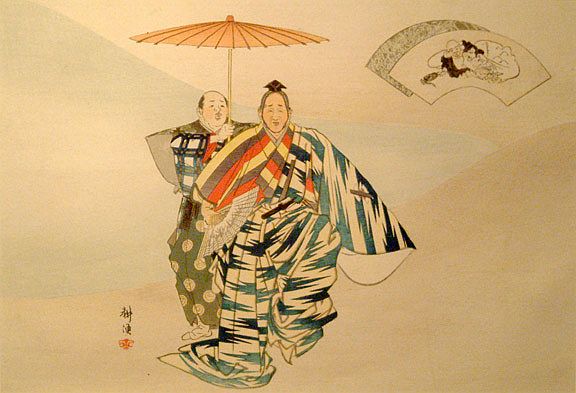
 suehirogari2

Picture 1: „Suehirogari“ ukiyo´e print by Tsukioka Kôgyo (月岡耕漁, 1869-1927) from his series „Nôgaku-zue“ (能楽図絵, „Pictures of Nô Plays“), 1898. We see Tarôkaja with the umbrella, his lord Kahômono already dancing and at the top right symbolically two suehiro folding fans.

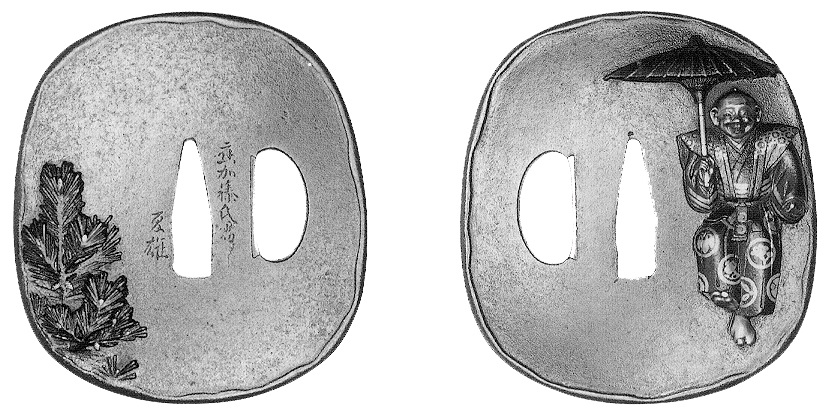
The tsuba is of iron, in aori-gata, has an uchikaeshi-mimi and a takabori-zôgan-iroe ornamentation. It was ordered by the Katô family (加藤) and finished and delivered in the first month of Man´en one (万延, 1860). So it is noted by Natsuo´s third son Akio (秋雄, ?-1950) in the hakogaki. It is assumed that the piece was commissioned one year before, i.e. in Ansei six (安政, 1859), the year in which Natsuo married, as many orders by the Katô were placed to support the artist. Often Natsuo had free choice of the motif and interpretation of the tsuba he made for his patron. The entire right side of the omote is occpuied by the joyfully dancing Tarôkaja wearing a loud stage outfit. The ura side is calm and shows a young pine, a New Year´s decoration as the banquet in question was a New Year´s banquet. Fascinating for me is the interplay of so many facets just on such a small but fine tsuba. We learn about the life circumstances of the artist by the mention of the name of the client, we have the hakogaki by the master´s son which confirms the date the piece was completed, than we have a peephole through which we can see the late 19th century world of waki-kyôgen, and we learn something about the then humour and the plenty use of puns. That means tsuba can be so much more than simple hand guards.

 suehirogari

Picture 2: tsuba by Kantô Natsuo with the mei „Katô-shi no motome ni kotae – Natsuo“ (応加藤氏需・夏雄, „made by Natsuo according to an order of the Katô family“)

On the nickname of the Ogaki-Masamune

A few weeks ago I posted an article on the Musashi-Masamune and I now would like to share some thoughts on the Ôgaki-Masamune. First of all about the blade itself. It has a rather wide mihaba, a thin kasane, a shallow sori and the tip might be classified as a just slightly elongated chû-kissaki. Of particular note is the very low suguha-chô with one major protrusion on the same area of each side and otherwise only small ups and downs. This is not the most representative style of Masamune and rather calm for him but we can see the typical sunagashi and yubashiri and the plentiful of nie which spill into the ji, especially towards the base of the blade. And in the bôshi, we can see a similar approach of the smith as at the Musashi-Masamune, i.e. it is rather wide and shows some isolated unhardened areas. So far so god. The blade was shortened to a nagasa of 63,9 cm and has today tokubetsu-jûyô papers.

 Ogaki-raw-korr-kl

Picture 1: Ôgaki-Masamune, mumei, nagasa 63,9 cm, sori 0,8 cm

In the „Kyôhô-meibutsu-chô“, it is listed with the nickname „Ôgaki-Masamune“ (大垣正宗), and the entry says that the sword was at the time of the compilation of the meibutsu-chô in the possesion of Uesugi Yoshinori (上杉吉憲, 1684-1722), the then fourth Uesugi-daimyô of the Yonezawa fief of Dewa province. It is also mentioned that apart from the present owner, the provenance of the piece is unknown. Well, so far it was assumed that the nickname goes back to Ôgaki in Mino province where the castle of the same name of the Toda family (戸田) was located. Toda Ujitetsu (戸田氏鉄, 1576-1655) presented the sword to shôgun Tokugawa Hidetada (徳川秀忠, 1579-1623) who in turn presented it to Uesugi Kagekatsu´s (上杉景勝, 1556-1623) son Sadakatsu (定勝, 1604-1625) on the occasion of the genpuku ceremony of the latter. These were the research results of Tsujimoto Tadao (辻本直男) published in his 1970-work „Zusetsu tôken-meibutsu-chô“ (図説刀剣名物帳). But in 1973 Satô Toyozô (佐藤豊三) from the Tokugawa Museum Nagoya found the Ôgaki-Masamune listed in the „Sunpu o-wakemono tôken-motochô“ (駿府御分物刀剣元帳), the protocol of the estate of Ieyasu´s swords. That means the sword must already had been in the possession of the Tokugawa in 1616, i.e. the year Ieyasu died. Apart from that, Toda Ujitetsu did not enter Ôgaki Castle before Kan´ei twelve (寛永, 1635). In 1635 in turn, Hidetada was already dead and so the assumption that the blade got its nickname on the occasion of the presentation to Hidetada can be dismissed. In short, the Ôgaki-Masamune must had got its name before the death of Ieyasu.

But when? As explained in my first volume Legends and Stories around the Japanese Sword, Ishida Mitsunari (石田三成, 1560-1600) lost two Masamune in the course of the turmoils before and during the battle of Sekigahara. One of them was the meibutsu „Hyûga-Masamune“ (日向正宗) (see picture 2). Interestingly, this blade is sometimes also referred to as „Ôgaki-Masamune“. I think that the naming of the Ôgaki-Masamune katana introduced here is directly connected to the Hyûga-Masamune but let me explain why I think so. The tantô Hyûga-Masamune was once a present of Mitsunari to  Fukuhara Naotaka (福原直高・長堯, ?-1600), the husband of his younger sister. Naotaka was a vassal of Hideyoshi and ruled a fief in Bungo province and fought of course on the side of the Western Army at Sekigahara. Together Kakemi Iezumi (垣見家純, ?-1600) and Kumagai Naomori (熊谷直盛, ?-1600) – both long-standing vassals of Hideyoshi too – he was detached to support the strategically important and aforementioned Ôgaki Castle which was then held by Itô Morimasa (伊藤盛正, ?-1623). Ôgaki was attacked by an alliance of several daimyô and Naotaka and Morimasa had to give up and surrendered the castle. Naotaka asked if he is permitted to enter priesthood but because he was via his wife a relative of Mitsunari this was not granted and he had to commit seppuku. One of the attacking generals of the Eastern Army was Mizuno Katsunari (水野勝成, 1564-1651), who made sure that he got hold of Naotaka´s Masamune-tantô at this occasion. I think it is quite possible that after the fightings, both blades – i.e. the katana and the tantô – were named for the time being after the surrendered castle. When the katana was presented to Ieyasu, it kept its nickname but the tantô was later renamed when Mizuno Katsunari, since 1601 holder of the title „Hyûga no Kami“, presented it to the Kii-Tokugawa family.

 hyuga-masamune

Picture 2: kokuhô Hyûga-Masamune, mumei, nagasa 24,8 cm

 ogaki-sw

Picture 3: Ôgaki Castle before the main tower burned down after an air raid in 1945.

And here a link to a blade of Horikawa Kunihiro which is thought to be inspired by the Ôgaki-Masamune. We can see the narrow suguha-based hamon but the protrusions occur on other areas and the hi are different (although the hi on the Masamune might be atobori) and so it is not a 1:1 utsushimono but a faithful hommage.

A brief outline of the changes in workmanship of the later Bizen tradition

I want to continue my last entry with some thoughts on the workmanship of the later Bizen tradition. But first some supplements to the genealogy. „Our“ survivor, i.e. Tôshirô Sukesada, was the successor of Shichirô´emon Sukesada (七郎右衛門祐定) who also beared the first name „Tôshirô“ in early years. This Shichirô´emon Sukesada in turn was the fourth son of the 2nd generation Genbei Sukesada (源兵衛祐定) but was later adopted by his own older brother, the Tenshô-era (天正, 1573-1592) Shichirō´emon Sukesada (七郎右衛門祐定) who worked for Kobayakawa Hideaki. It was this adoption by which Tôshirô´s father changed his name from „Tôshirô“ to „Shichirô´emon“. Incidentally, Genbei Sukesada was after the 1st generation Yosôzaemon (与三左衛門祐定) and the 1st generation Hikobei Sukesada (彦兵衛祐定) the most talented Sukesada smiths of the late Muromachi period.

The first Bizen Sukesada mentioned in the genealogy belonged to the Kozori group whereas the term „Kozori“ itself was and is not exactly defined. It is, grossly simplified, applied more or less to late Nanbokuchô-era Osafune smiths whose affiliation is unknown. The Kozori smiths adopted about the style of the dominating Osafune main line, which was then represented by master Kanemitsu (兼光), but gave it a trend towards the so-called „koshi-no-hiraita gunome-midare“, i.e. a gunome-midare whose bases (koshi, 腰) are noticeably wider (hiraita, 開いた) as the tips (yakigashira, 焼頭). This trend can be seen for example at Kozori Moromitsu (師光, picture 1).

ha1

Picture 1: tachi of Kozori Moromitsu dated Eiwa two (永和, 1376)

When the turmoils of the Nanbokuchô era were over, the bushi with their new base in Kyôto again started to focus on the more elegant sword interpretations of the Kamakura period. That means slender and elegant blades came into fashion and this trend was grasped by the young Ôei-Bizen school (応永備前), named after the Ôei era (応永, 1394-1428) it emerged. The Ôei-Bizen smiths oriented themselves towards the glorious Ichimonji style or the style of the Osafune school at its height. But the trend to wider koshi started by the Kozori smiths just before was adopted and refined. We also see a trend towards , that means nioi formations within the ha detached from the habuchi. This feature can be seen on a blade of Ôei-Bizen Morimitsu (盛光, picture 2) for example.

 ha2

Picture 2: tachi of Ôei-Bizen Morimitsu dated Ôei twelve (1405)

With the Eikyô era (永享, 1429-1441), the individual gunome-midare elements get gradually smaller and more narrow and the valleys go more down towards the ha. As the change in style is quite noticeable, the term „Eikyô-Bizen“ was introduced. Eikyô-Bizen marks about an intermediate step from Ôei-Bizen to Sue-Bizen. Picture 3 shows a blade of Iesuke (家助) dated Eikyô nine (1437). The continuous trend to is apparent.

 ha3

Picture 3: tachi of Osafune Iesuke dated Eikyô nine (1437)

The Osafune smiths of the early 16th century kept all these stylistic elements but started to combine the koshi-no-hiraita gunome-midare to characteristic groups of two or three. Representative for that trend were apart from Sukesada also Katsumitsu (勝光), Munemitsu (宗光) and Harumitsu (治光, picture 4).

 ha4

Picture 4: gassaku-katana of Katsumitsu and Munemitsu dated Bunmei 19 (1487)

Towards the end of the Muromachi period, the trend of a more complex gunome was still forwarded what resulted in the case of the Sukesada line in the so-called „kani no tsume“ (蟹の爪), the famous „crab claws“, where individual koshi-no-hiraita gunome-midare elements open towards the top and end in chôji-yakigashira which remind as the name suggests of crab claws (see picture 6).

 ha5

Picture 5: katana of Gorôzaemon Kiyomitsu (五郎左衛門清光) dated Tenbun 24 (1555)

 ha6

Picture 6: Schematic representation of a Sue-Bizen-hamon with kani-no-tsume. We can easily see how the isolated of the Ôei-Bizen smiths become again dividing elements on nioi basis (i.e. ashi) and give so a further complexity to the koshi-no-hiraita gunome-midare.

With the mass-production of the Sengoku era and the accompanying changes in steel and blade production the jigane of the Sue-Bizen smiths looses its original „oily“ appearance what was so typical for earlier Bizen blades. Utsuri is rare too and appears mostly in a faint manner. The hamon shows more and more nie and numerous Sue-Bizen smiths also started to temper in hitatsura. The styistic changes of the shintô era go back to those Bizen smiths who had moved long before the flood of the Yoshii River to Ishidô in Ômi province. With the urbanization of the Edo period, the Ishidô school split up to quite successful branches like the Ôsaka-Ishidô, Edo-Ishidô and Fukuoka-Ishidô lines. They oriented towards the famous Ichimonji style with which the Bizen tradition became famous. But some few outstanding Ishidô masters like Tatara Nagayuki (多々良長幸) did also continue the koshi-no-hiraita gunome-midare of the Sue-Bizen and Sukesada smiths. The Ishidô masters also understood to reproduce utsuri but the most noticable changes in the shintô-Bizen style are – apart from the steel – a yakidashi, a sugu-bôshi in the case of a midareba and a rather „stiff“ looking hamon with lesser hataraki within the ha. As mentioned, this was a rather brief outline of the changes in later Bizen style from the Muromachi to the early Edo period and more details on the Ishidô school can be found in my book „Nihon-shintô-shi“ which will be finished soon.