Book review: Analysis of the Iai Katana

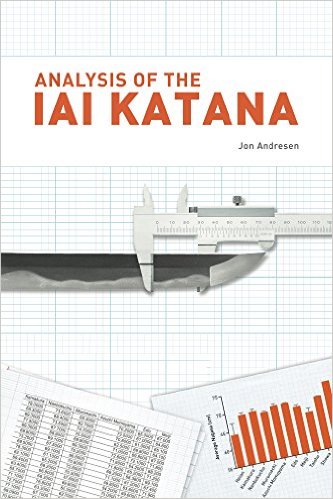
Today I want to review a recently published book, written by PhD Jon Andresen from American Art Swords. Title of the book is Analysis of the Iai Katana, published by Jon’s Androzo Publishing, and available via amazon. In his book, Jon approaches the katana, as mentioned in the blurp, analytically and his academic scientific background is very much reflected in this approach. Jon is also an iaidôka, a rokudan renshi to be specific, and thus he tackles the analysis of swords, and that is of iaitô and shinken as well, truly from the modern iaidô practitioner’s point of view.

The book is basically divided into three parts, i.e. bokutô, iaitô, and shinken. In the first part, Jon thoroughly analyses all aspects of the bokutô, with a main focus on the woods used, from traditional to modern Japanese sources to non-Japanese equivalents. And with thorough, I mean thorough, as this (I am speaking of ~ 50 pages) is the most comprehensive study on bokutô I have come across to this day. The second part is comparatively brief and addresses all basic and relevant points you have to know about iaitô whereas the third part on shinken is the main part of the book and comprises ~ 120 pages. In these 120 pages, Jon analyses and puts into relation measurements, weight, and bôhi grooves by using a dataset of 1,695 long swords from all periods. Through this analysis, you can see certain trends and relations of nagasa, kasane, weight, and presence or absence of bôhi, just to name a few factors, whereas the weight makes an important part of this analysis because as Jon says in the preface, to predict the weight of blades based on their nagasa was originally a major goal of this work.

This means, and borrowing from the preface, it was to be for the benefit of iaidô students who generally care about what swords weigh when information of the weight is usually omitted in descriptions on sites that sell swords. The book is rounded off by guidelines and tips on maintenance (and that applies to bokutô, iaitô, and shinken) and therefore I would recommend this publication to the serious iaidô aspirant who wants to get as much information as possible to make up his mind on the purchase of an as perfect as possible iaitô or shinken (in addition to what your sensei is recommending of course). In other words, studying Jon’s book gives you useful tips, and makes you aware of maybe never thought off aspects that you have to bear in mind when shopping for a sword that should fit you well and for a long time on your journey along the Way of Drawing the Sword. As indicated, the book places a firm focus and does not pretend to be anything else, thus do not expect to find in it any discussions on swordsmiths schools, workmanships, swords as collectibles, or iaidô techniques/kata and things like that . I just wanted to underline that because, from my personal experience as an author in this field, people often expect a “Swiss Army knife” approach.

AnalysisOfTheIaiKatana

Fujiwara ligature

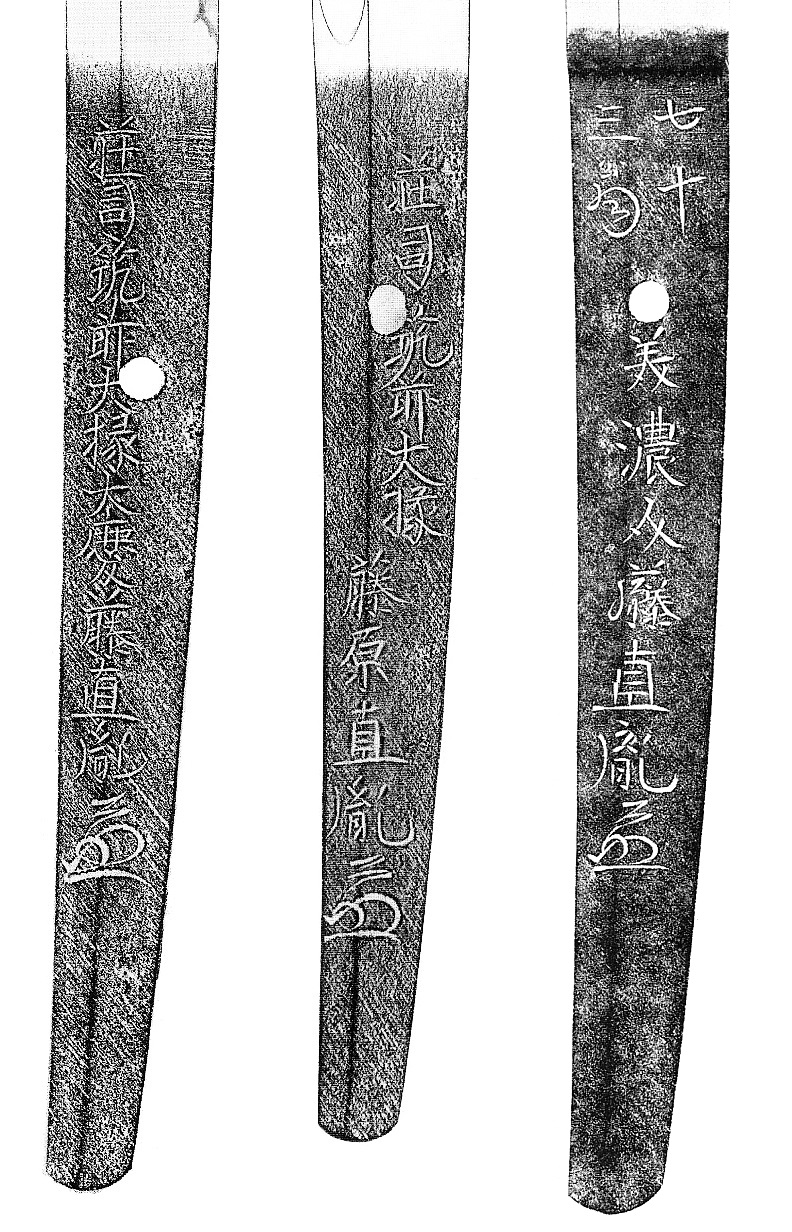
Working on the German translation of parts of the current Tôken Bijutsu magazine I saw that Satô Kazunori (佐藤一典) points out a “habit” in the 24th part of his article series on Sendai swordsmiths that I would briefly like to introduce. The habit in question is a certain ligature, gôji (合字) in Japanese, that combines the characters Fuji (藤) and wara (原) to a single character that represents, obviously, the clan name Fujiwara. Now I don’t want to deal with the specific swordsmith, who is the Nidai Sôryûshi Tamateru (雙龍子玉英, 1820-1889) by the way, but suffice it to say that I first came across this habit years ago via his master Taikei Naotane (大慶直胤, 1778-1857). Naotane started rather early on in his career, i.e. around Bunsei (文政, 1818-1830) to drop the wara and sign the reference to the clan name Fujiwara just with Fuji (see my Shinshinto-Meikan, p. 135f). Later, i.e. around Tenpô (天保, 1830-1844), he signed Fujiwara as everyone else with two characters but changed towards the end of his career, i.e. around Kôka (弘化, 1844-1848) and Kaei (嘉永, 1848-1854) to the gôji ligature variant. So Tamateru obviously adopted this habit from his master.

Goji1

Picture 1, from left to right: Naotane signing just with Fuji (dated Bunsei four, 1821), with Fujiwara (dated Tenpô eleven, 1840), and with the gôji (dated Kaei four, 1851)

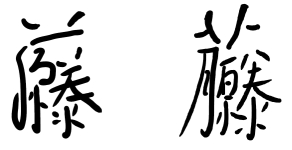
When I say “came across via Naotane” above, I mean that I once wrongly read this gôji just as Fuji, i.e. I thought that he later returned to the habit of dropping the wara character again but was pointed out that he did add it by so to speak squeezing it into the the lower Fuji part (滕), that is squeezing it between the radicas (月) and (𣳾). So if you see a mei like the one in picture 1 right, you correctly read it (in this very case) as “Mino no Suke Fujiwara Naotane” and not “Mino no Suke Fuji Naotane.”

Goji2

Picture 2: Naotane’s Fujiwara gôji (left) and how Tamateru signed it (right).

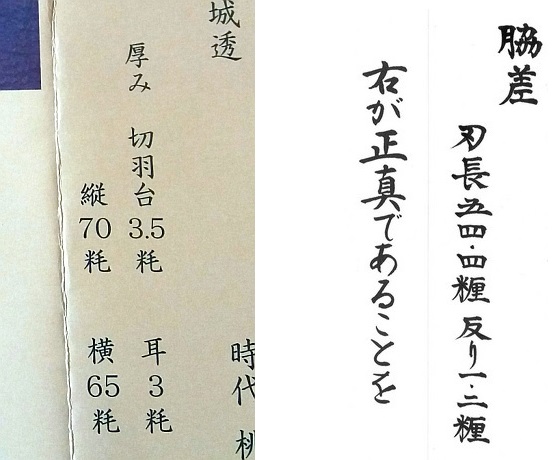
Explicit ligature was and is rather rare in Japan because when you combine two characters, you just get a new character and this is not regarded as ligature in the strict sense. However, there were some, but they mostly used for decorative or “underlining/emphasizing” purposes on temple inscriptions or talimans. Apart from that, and what we see sometimes today, Western units were adopted and made into gôji, for example (糎) for centimeter, Japanese senchi or senchimêtoru, composed from the characters (米) and (厘), and (粍) for millimeter, Japanese miri or mirimêtoru, composed from the characters (米) and (毛). In our field, you can come across such units gôji via certain papers, for example those issued by the Nihon Tôsôgu Kenkyû Kai and the Jûhô Tôken Kenkyû Kai (see picture below).

Goji3

Picture 3: Details from a NTK and a JTK paper.

Easter eBook Super Sale II

Dear Readers,

I just started, like last year, an Easter eBook Super Sale where ALL of my eBooks are reduced by 50%! This offer will be valid for a week so you have enough time to decide what you want. So fill up all your tablets (or PC´s) with all the important Nihonto and Tosogu reference material you need four your studies!

If you have any questions or can´t find the one or other book, don´t hesitate and contact me via my “markus.sesko@gmail.com”.

Thank you and a Happy Easter to everyone!

http://www.lulu.com/spotlight/nihontobooks

Easter-Sale

Report Japanese Legacy II

Report0

Report0b

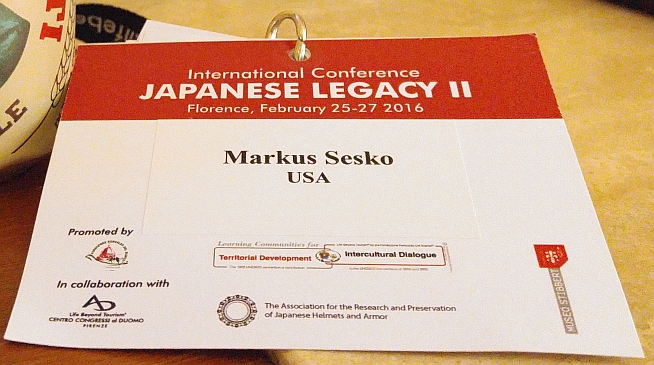
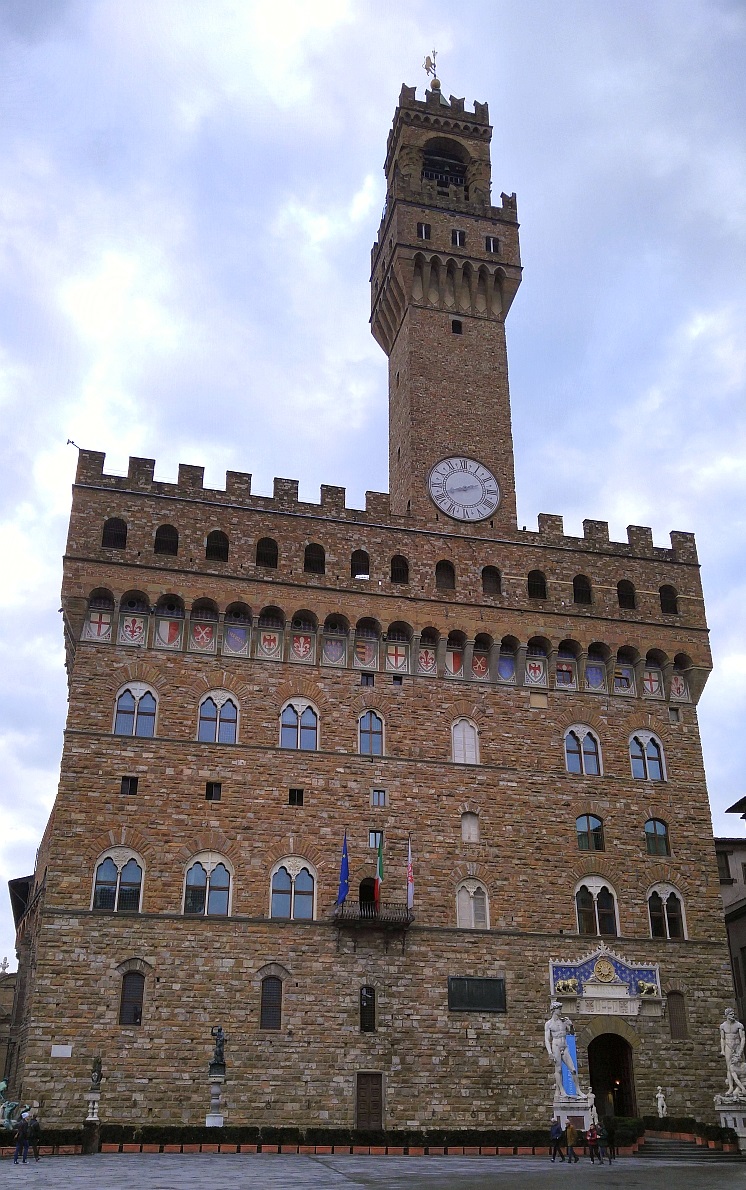
I aplogize for the rather long time of nothing going on here but first there was travelling, and then an important project needed attention. And with this, I want to give you a brief report on the first reason for my blog absence, and that was the international conference on Japanese armor, Japanese Legacy II, taking place in Florence from February 25 to 27. Well, those of you who were there know that it was great but I want to use this report to create interest in our activities and maybe the one or other either joins the armor association NKBKHK, and/or attends the next meeting in 2018.

Report0a

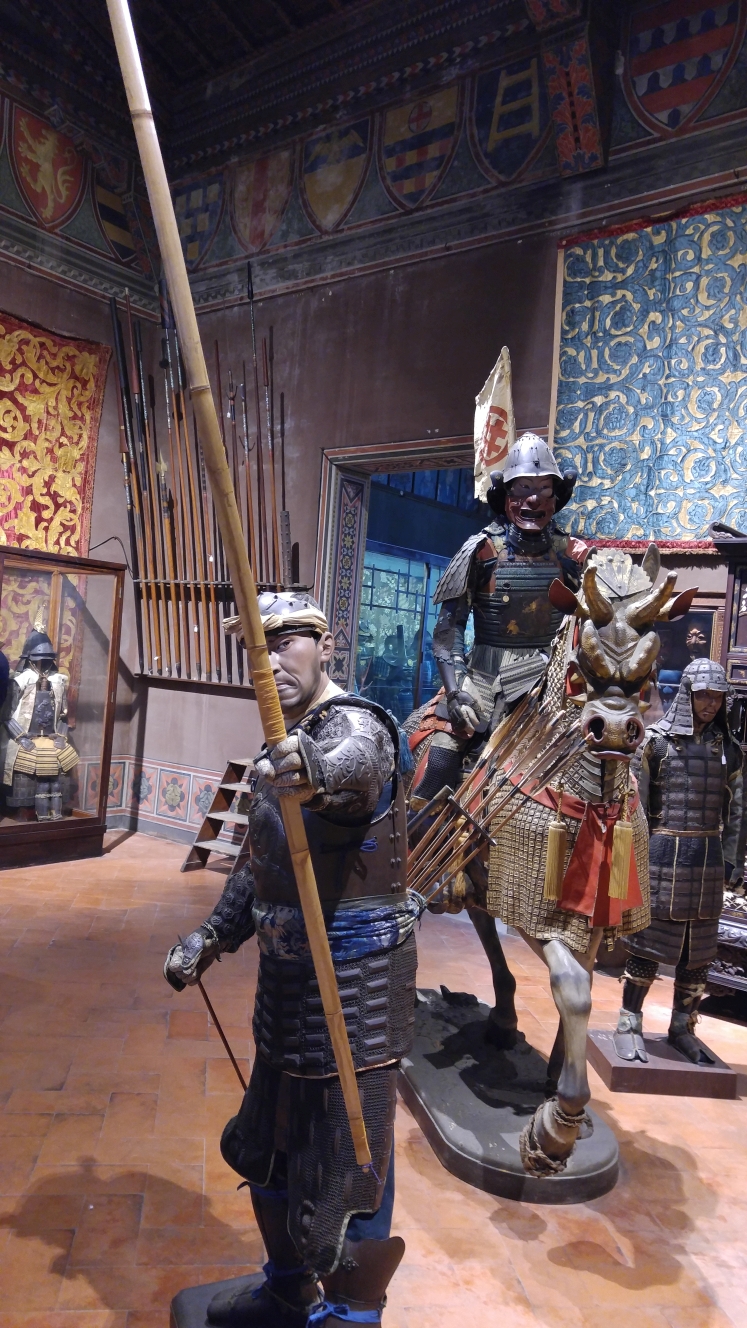
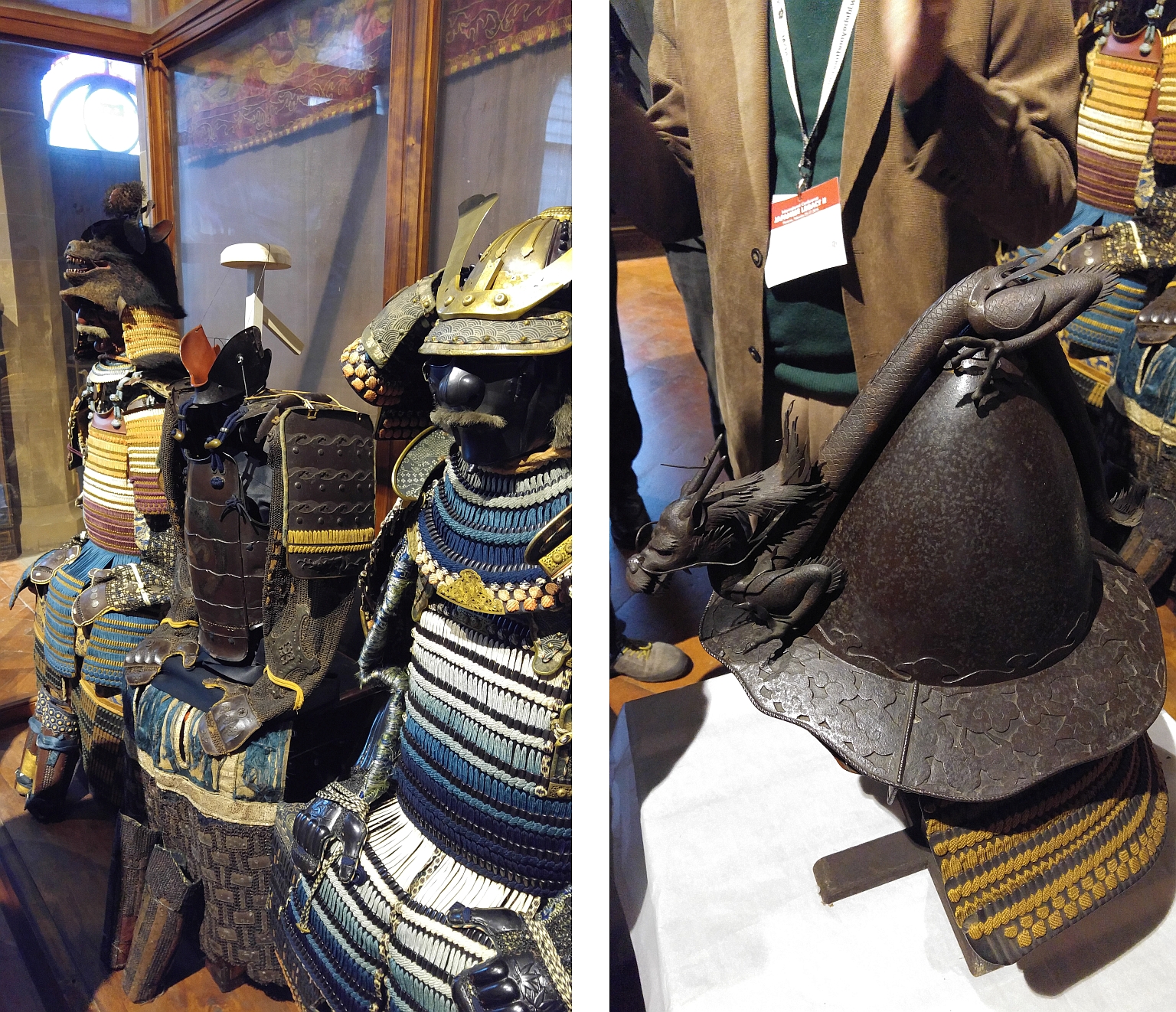
As mentioned, the conference was held over three days and the entire afternoon of the first day, Thursday, was spent at the famous Museo Stibbert. For me, it was the first time there and of course I agree with those who have been there, namely that it is a very very fascinating place! Now this first afternoon was so to speak the “warm-up” for the conference and the opportunity to study certain selected objects hands on, like for example several fine armor masks and teppô from the collection of the museum. Also shown to us was a very special armor (picture 1, the one in the middle) of which Francesco Civita, the curator at the Stibbert, was just recently able to confirm with experts from Japan its former wearer. Just a note at this point: I am not going into great detail as first, I don’t want to anticipate or rather interfere with possible reports and treatises by the persons themselves, and second, to create as mentioned an interest and to motivate people to participate in upcoming events and hear and see everything on the spot.

Report1

Picture 1: The armor in question and the accompanying helmet.

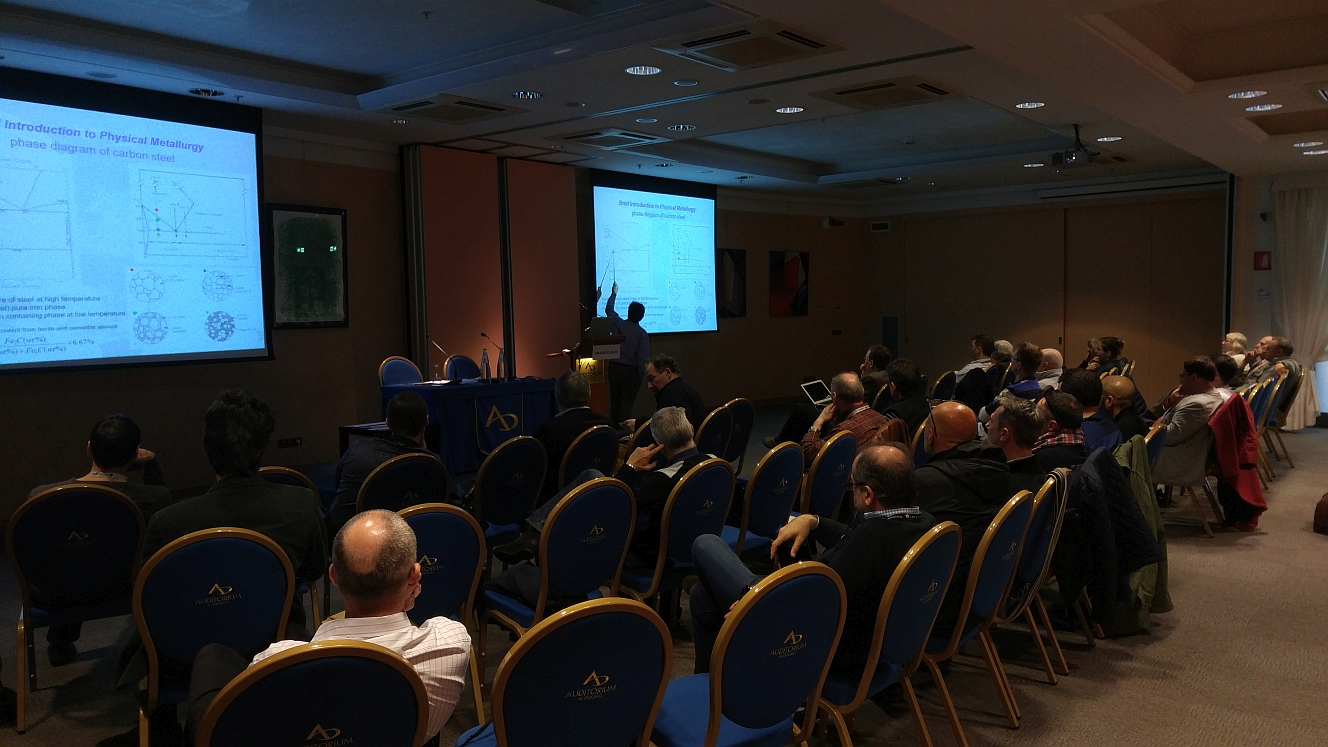
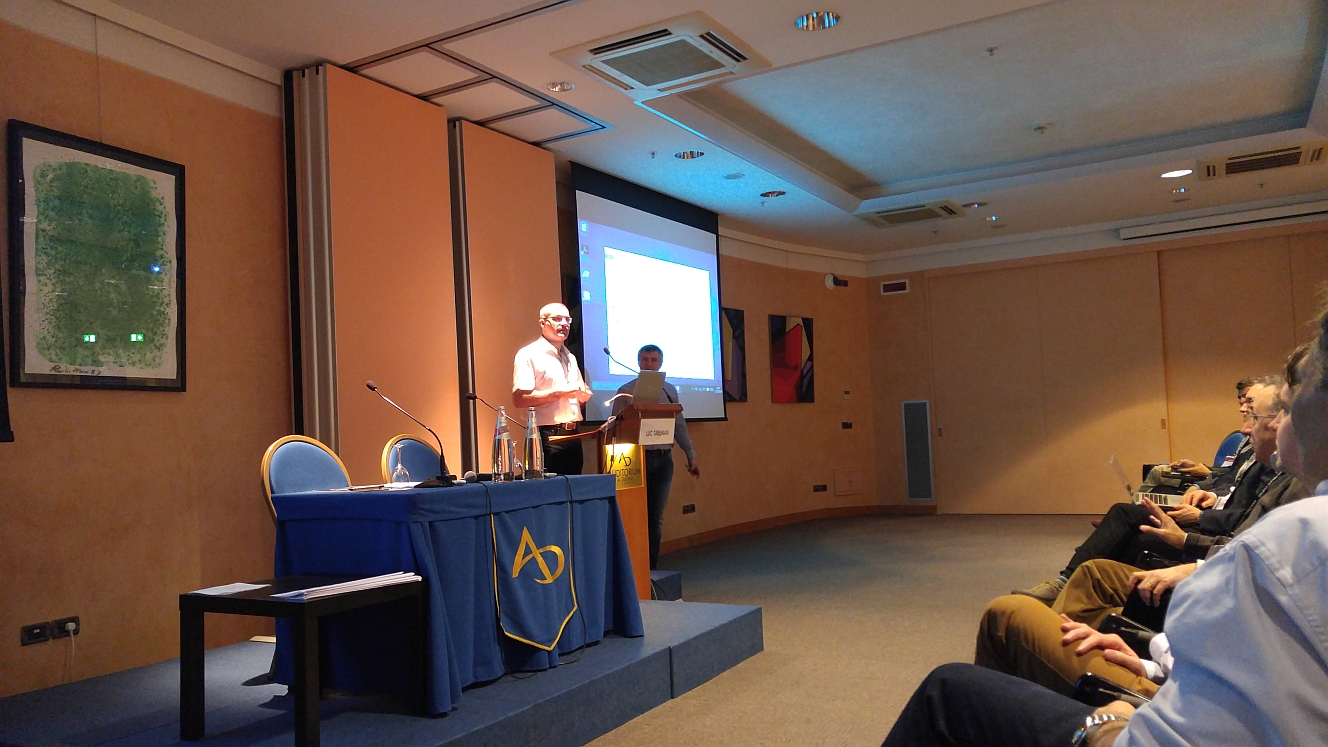
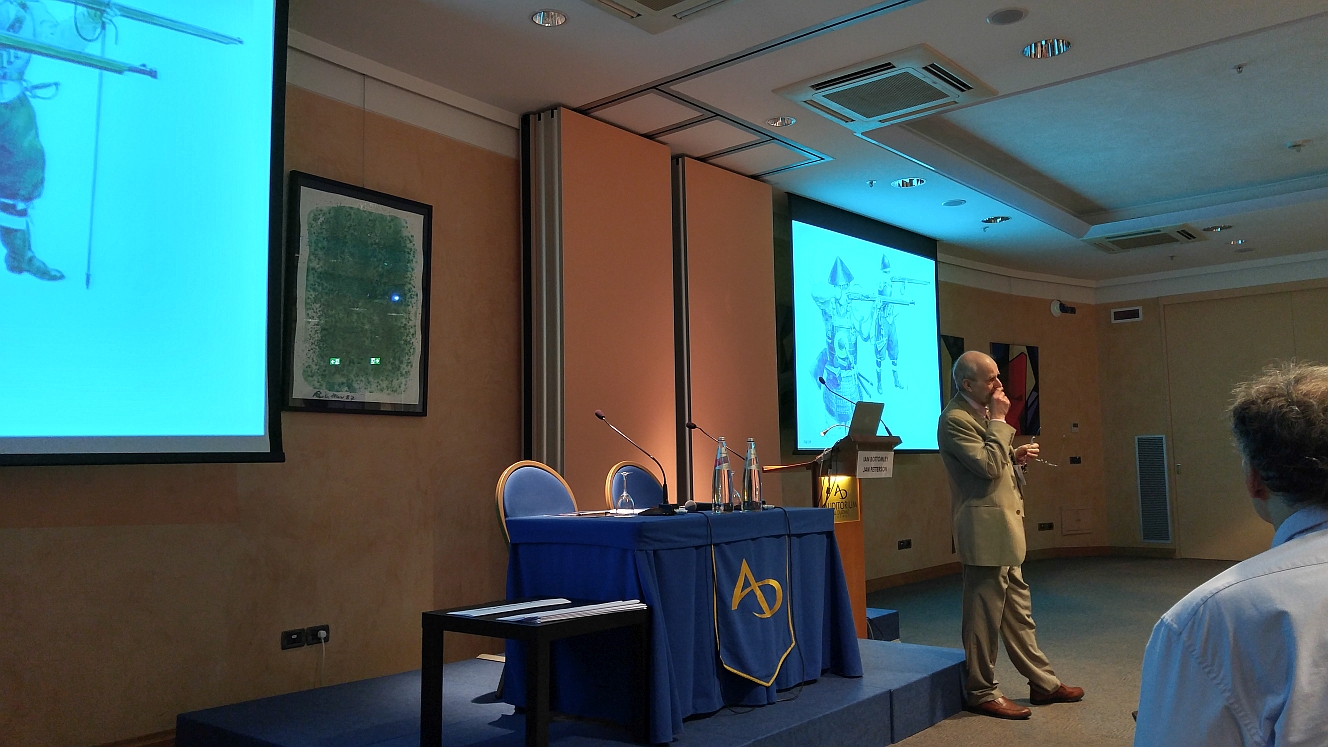
The second day of the conference, Friday, was started right in the morning and after a short introduction to the organizing party, the Life Beyond Tourism, which did a great job in perfectly organizing the whole three-day event, so a big thank you at this point!, Mr. Civita continued from the day before and gave us a lecture on not only this very armor but on armors used in the Shimabara Rebellion in general. He was followed by Jan Petterson who was speaking about Japanese matchlocks, but embedded into a case study of the Uesugi clan, giving us a great insight into the ups and downs of their fief and how this all like the financial crises affected, or rather not affected, the fief-employed gunsmiths. Present via Skype was Piers Dowding (Mr. Bugyotsuji for those who are on the NMB) who was unfortunately not able to make it for reasons of health. Hope you are doing well Piers! Jan was joined by Ian Bottomley who worked out in detail certain stylistic and technical similarities of Japanese teppô in view of the previous distribution of matchlocks throughout the Asian mainland. The second day was packed and start of the afternoon lectures was made by Japanologist Bas Verberk, curator at the Wereldmuseum Rotterdam. He gave us an insight into one aspect of his PhD research, namely on the comparison of armor masks to their Noh counterparts. Again, not going into details here, also because Mr. Verberk’s doctoral thesis is yet not finished, but this much I can say, there is no denying that certain inspirations took place as armorers surely did not suddenly start to produce masks out of an absolute artistic vacuum. Bas Verberk was followed by collector Aymeric Antien, who gave us, assisted by his fellow collector Luc Taelman (both contributing, amongst others, to the publication Helmets of the Saotome School which I had the honor to provide with translations a few years ago) an overview of the evolution of the Japanese helmet, with a main focus on the time from the 16th to the 17th centuries. An important thing I learned with Aymeric’s lecture: With great helmets it is just like with masterly swords, i.e. it is not just the interpretation, it is first of all the quality of the workmanship that has to be recognized to make observations when talking about the greatest of the masters. Mr. Antien finished his lecture the next day, Friday, and was followed by the researcher Francesco Grazzi from the ISC Florence (picture 2) who introduced to us the results of his metallurgical studies done in a non-destructive way through neutron diffration. These were only the first of a planned row of studies and aim is, to identify the forging and hardening methods of Japanese swords via this non-destructive way. And the conference was completed by another lecture from Ian Bottomley (picture 4), that is on the evolution of armor in general, but he also referred to certain aspects addressed by his lecturing predecessors.

Report3

Picture 2: Lecture by Francesco Grazzi

Report2

Picture 3: Jo (left) and Luc (right) telling us what we gonna hear at the conference.

Report4

Picture 4: Ian Bottomley

Not mentioned so far was Jo Anseeuw, our man when it comes to non-Japanese members of the NKBKHK. Jo deserves special thanks as he managed it to open for Western collectors a window to the Japanese armor society, making it possible that we have now a pretty solid and substantial base of members outside of Japan! So in this sense, I apologize if I have overlooked someone who too was responsible for making this great experience of the Japanese Legacy II happen, I thank you to all of you gentlemen (and ladies), and I am really looking forward to our next meeting!

And last but not least, I am also very happy that I was finally able to meet, on Sunday, with Francesco Marinelli and Massimo Rossi from the INTK (and to talk about swords, or about one tantô in particular). Again thank you very much for your small gift (that I enjoyed with my friends later in Salzburg) Oh and yes, I am also glad that I had added a couple of extra days to spend, romantically, in Florence 😉

Report0c

Report0e

Announcement

Dear Readers, I am leaving for Florence to attend the Katchu symposium at the Stibbert so if you read this, I am probably already on my plane. I am looking very much forward to this meeting, to all the interesting stuff and insights, and of course also to make some new friends 🙂 Upon return, I will continue with the Kantei series by dealing with the Rai smiths in the vicinity of Kunitoshi, the Nakajima-Rai lineage, some of the more unknown Rai smiths, and will then arrive at the Ryokai lineage which goes into Nobukuni. Apart from that, I will start again an Easter eBook Sale in a little. In this sense, emails reponse might be slow and larger translations might have to wait until I am back in office, what will be on March 14th.

Oh, and before I leave. Something funny from a project that is about to be finished. It is one of those episodes that gives us a little understanding of how some of these Edo period masters worked:

Takahashi Kinai (高橋記内, ?-1696) was a tsuba artsist from Echizen Fukui. His first name was Gonbei (権兵衛) and it is recorded that he was skilled in carving the hard iron. It is said that he was openhearted and loved the sake and that he often had to stop working because of his episodes of heavy drinking. Once his daimyō wanted to have the roosters the fief bred depicted on a tsuba and placed an order with Gonbei, loaning him one so that he can study the bird in detail. Kinai let the rooster free in his house and watched it for several days whilst drinking. Well, he eventually ran out of sake doing so and short on money, he decided to sell the precious rooster to buy some more. The lord of the fief heard of this and bought the rooster back and decided that it should be better to lock up Kinai in his house so that the production of the ordered tsuba can finally move forward. Well, when Kinai was checked up on some days later, he was lying there completely drunk. They woke him up and he promised that he will deliver but being locked up in his house with every door and window shut, it is just too dark to make a tsuba he complained. So he asked for permission to open the windows half-way and also asked if he can have the rooster back for studying purposes. This was granted and Kinai eventually delivered a wonderful masterwork…

Who was Horiuchi Kanpei?

I have a kind of log book where I write down interesting things I come across along my various translating and research jobs which I want to study in depth at some point in the future. Mostly they sit there for a while as time is tight but sometimes I come across certain things on that list again but from another context and then I usually see this as an incentive to finally dig deeper into that matter. The following thoughts are such a case and it all started when I was trying to find out where exactly Kiyomaro lived when he had escaped to Hagi. Well, to tell you right away, his exact Hagi whereabouts are unknown but thought to have been in the Saikumachi (細工町), the craftsman’s district, located just about 1.2 km to the east of Hagi Castle (the area still bears that name today). Now this was forwarded by local NBTHK Yamaguchi branch member Kunihiro Kôsuke (國廣浩典) in Tôken Bijutsu 654 (July 2011) and in his article, he refers to a student Kiyomaro had whilst staying in Hagi, namely to a certain Toshikimi (俊卿), whose real name was Horiuchi Kanpei (堀内寛平). A quick search in my Swordsmiths of Japan revealed that I have not listed this smith, at least not under Toshikimi, but I list a Horiuchi Kanpei who was active in Nagato around Ansei (安政, 1854-1860) under the name Kiminao (卿直) (whom both Hawley and Stan list with the reading “Norinao”). So who was this man?

Now Kunihiro refers to Tôken Bijutsu 517 (February 2000) for a further reading on Toshikimi as his main focus is Kiyomaro. Digging out the issue in question I learn that Iida Toshihisa (飯田俊久) introduces two blades of Toshikimi and says that his name is not to be found in the meikan and that his origins are unclear. He also says that although quoted as Toshinori, his name was more likely read as either Toshiaki or Toshikimi. So with this in mind, Hawley and Stan’s listing of Kiminao, who was obviously the same smith, as Norinao is understandable. My listing as Kiminao goes back to the Tôshô Zenshû where he is listed in the section of smiths whose names beginn with Ki, thus Kiminao. Well, I am not sure where the Nori reading comes from as none of the dictionaries I consulted offer Nori as a possible name reading for the character (卿). They say either Aki or Kimi with the former being the more modern name reading. Therefore I stay with Kimi and Kiminao and Toshikimi for the time being. But I am convinced there must be a reference to the Nori reading somewhere out there because it surely doesn’t come from nowhere.

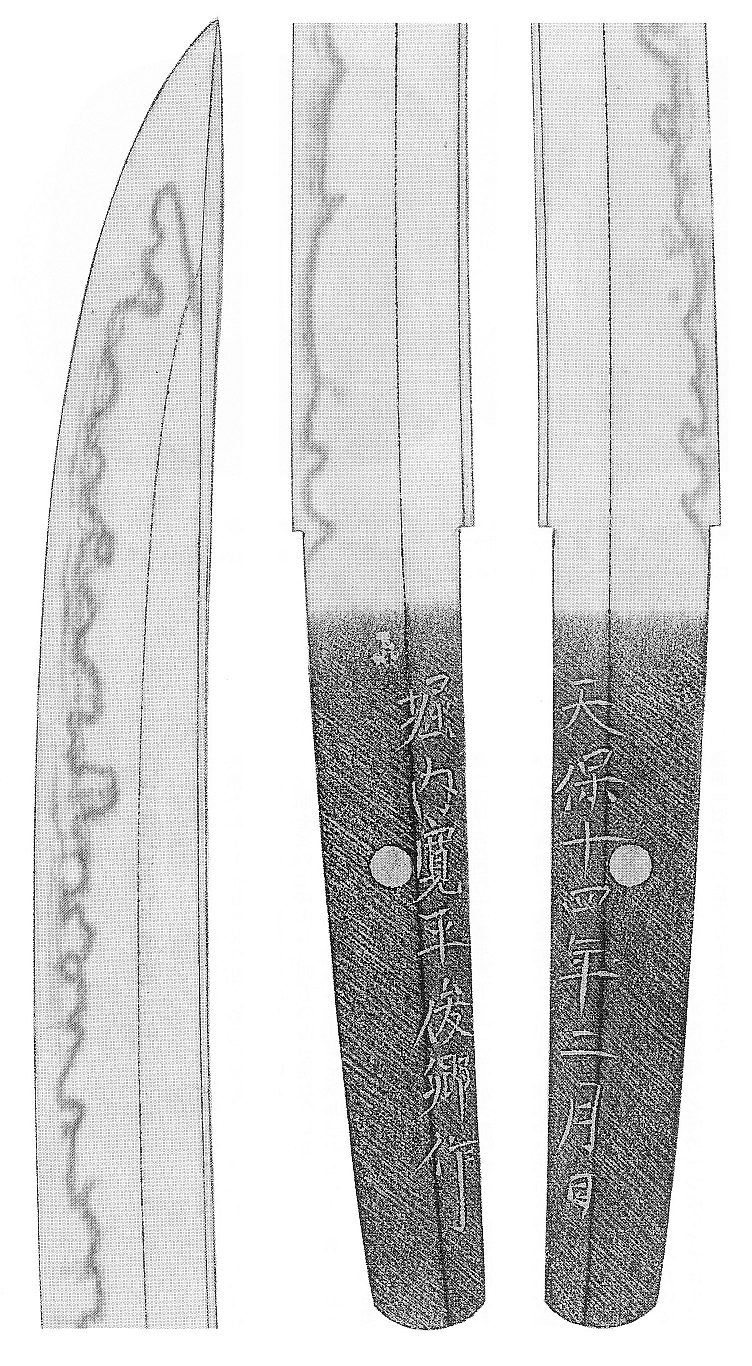
Iida sensei introduces two blades of Toshikimi, a tantô and a shôbu-zukuri wakizashi (see picture 1). The former is signed “Horiuchi Toshikimi saku” (堀内俊卿作) and the latter with his full name, “Horiuchi Kanpei Toshikimi saku” (堀内寛平俊卿作). Both are dated Tenpô 14 (天保, 1843), the tantô with the eighth month and the wakizashi with the second month of that year. This wakizashi from the second month of Tenpô 14 is the earliest known dated blade of Toshikimi and apart from that, there exists one more from Tenpô 15 (1844) which is signed with the supplement “Nagato no Kuni ni oite” (於長門国, “made in Nagato province”). This syntax suggests that we are facing here a so-called chûtsui-mei (駐槌銘), a signature marking a temporary workplace or place of residence. Also the Kiminao signature I list in my Swordsmiths of Japan is of that category and starts with “Chôyô ni oite” (於長陽), “Chôyô” being a different name for Nagato province. In other words, if Toshikimi was a permanent resident of Nagato, he would have just signed with something like “Nagato no Kuni Hagi-jû,” i.e. without ni oite (“at”). It is interesting that both Iida and Kunihiro don’t mention the Kiminao/Norinao signature variant of this smith and as the meikan list him under that name around Ansei, it suggests itself that he must have changed to this name later in life.

Horiuchi1

Picture 1: wakizashi, mei “Horiuchi Kanpei Toshikimi saku – Tenpô jûyonnen nigatsu hi” (堀内寛平俊卿作・天保十四年二月日), nagasa 40.9 cm, sori 1.0 cm, shôbu-zukuri, iori-mune

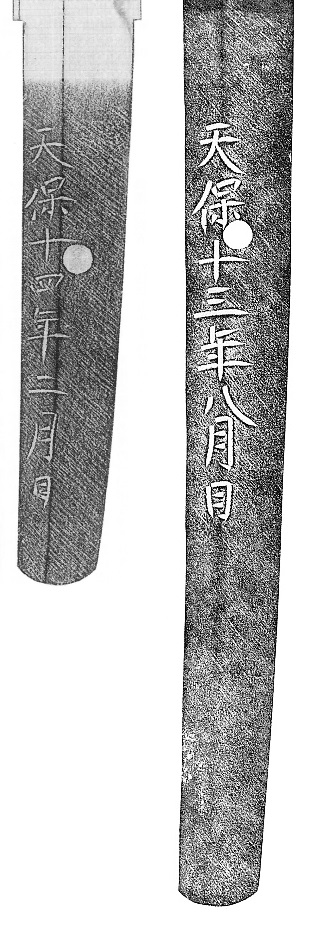
So how about his connection to Kiyomaro? Iida says that there are no historic records or any kind of entries extant that do definitely proof a master-student relationship of the two but both workmanship, tang finish, signature style, and local and chronological coincidence strongly suggest that Toshikimi had learned from Kiyomaro. It remains unclear where this relationship originated. We know that Kiyomaro arrived in winter of Tenpō five (1834) at Edo. He was then 21 years old and signed with the name Hidetoshi (秀寿) at that time. He changed it a few years later to Masayuki (正行) and left Edo under that name to arrive in Nagato somewhere in the first half of Tenpô 13 (1842). He left Nagato in the sixth month of Tenpô 15 (1844) but did return to Edo only via a stopover in Komoro in Shinano province. So far and very briefly the relevant years of Kiyomaro’s CV. And before we come back to Horiuchi Kanpei, I want to elaborate on the similarities in workmanship. The wakizashi from picture 1 shows a kitae in itame that is mixed towards the ha with nagare and that features plenty of ji-nie and much chikei. The hamon is a very nie-laden gunome mixed with chôji, ko-notare, and an abundance of kinsuji and sunagashi. The nioiguchi is wide and the bôshi is midare-komi with a relative wide ko-maru-kaeri. So we have here clearly the Sôshû-inspired workmanship of Kiyomaro he favored at that time (and emphasized later). Also the sharp sugata with the scarce fukura and the finish of the tang in sujikai-yasurime and a somewhat bulbous kurijiri matches with Kiyomaro. And so does the signature. Picture 2 shows the mei of the wakizashi next to that of a Kiyomaro katana which is dated Tenpô 13 (1842). As Iida points out, please note the striking similarity in how the characters for Tenpô (天保) and (十) executed, i.e. with the same curve of the lower right ending of the (人) radical of Ten, the entire (呆) radical of , and how the horizontal stroke of (一) extends to the right.

Horiuchi2Picture 2: Signature comparison. Toshikimi left, Kiyomaro right.

Both Kunihiro and Iida assume that it is likely that Horiuchi accompanied Kiyomaro from Edo to Hagi and as hardly all of Toshikimi’s blades got tôrokushô papers from Yamaguchi Prefecture (i.e. former Nagato province), and as he is listed under Kiminao as a Nagato smith, it is most likely that he stayed there and did not return to Edo. Either he found an employer and/or a wife there and settled down, or he did want to accompany his master but not via a stopover in Komoro so he stayed and was maybe waiting in vain for Kiyomaro inviting him back to the capital. Because when Kiyomaro returned to Edo, he had to clean up the mess he left behind with fleeing from the Bukikô lottery (more details here) to Nagato. Another interesting thing in all of this is that all the master students Kiyomaro had were trained after his return to Edo. So if Toshikimi was a student of Kiyomaro, and everything points towards that, then he was probably his very first one? I mean, he was just about to turn 30 when he left Edo for Hagi in 1842. Maybe Toshikimi would have become more famous if he had showed up again at the new Edo forge of Kiyomaro in the late 1840s but life had chosen different for him.

Anyway, I tried to find out more about the origins of Horiuchi Kanpei by going through vassal registers, for example that of the Chôshû fief, but no success. It is interesting that the area between the aforementioned Saikumachi and Hagi Castle is named Horiuchi (堀内) what might suggest that Horiuchi Kanpei actually came from here at a glance. But I think that this is just a coincidence as this name means literally just “within the moat” and many castle towns had areas within the moat that were just named as that, i.e. Horiuchi. One Horiuchi family was originally from Kii province and after being at Sekigahara on the “wrong side,” they were reassigned to become retainers of Katô Kiyomasa and accompanied him to Kumamoto. Well, Kumamoto was taken from Kiyomasa and given to the Hosokawa shortly afterwards and the descendant of this Horiuchi family ended up as retainers of the Tsu fief (津藩) of Ise province. Another Horiuchi family served as retainers and later as karô elders of the Sôma family (相馬), the daimyô of the Nakamura fief (中村藩) of northern Mutsu province. And then there was the Horiuchi family of Omotesenke tea masters that originated in Kyôto and that served from the latter half of the 18th century the Takatsuki fief (高槻藩) of Settsu province as head of all tea-related affairs.

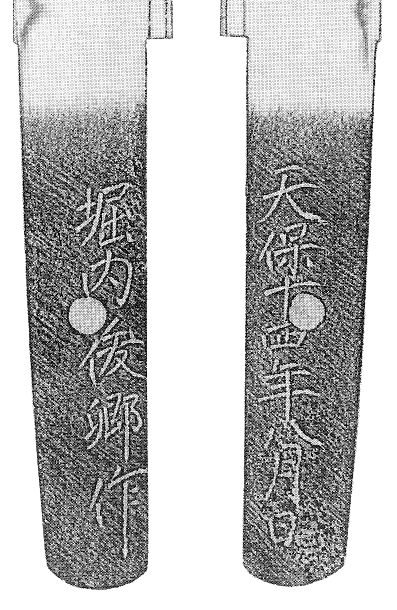
Well, I can’t really draw any connection between Kanpei and any of those Horiuchi families. The things above are just the result of a very first and brief research and this would be the point where you have to visit local libraries and go through possible local registers of vassals and fief-employed craftsmen. Also looking for registers of deaths of temples in and around Hagi would be an option but this all is like looking for a needle in a haystack. But maybe one day some other blade of Toshikimi or Kiminao pops up that gives us another hint about his life and career. But another thing that makes me wonder in this whole issue is the use of the character Kimi (卿). This is an extremely rare character for a swordsmith name and apart from Toshikimi/Kiminao, I could not really find any other smith using it. But it is not only extremely rare, it also comes with a pretty significant connotation, and that is its meaning of being a suffix that either marks a high official position held by a person of nobility or another very high ranking person. I mean, swordsmith names were to a certain degree arbitrary but the characters were usually also understood by their meaning. Thus there were no-go characters with negative meanings or negative connotations for example. And as Toshikimi stayed with that character when he changed his name later, i.e. he dropped toshi and added nao, the character must have had a certain meaning to him, maybe he had received it from someone special. Well, I don’t know if Kiyomaro (the then Masayuki) had anything to do with that but I doubt it because in this case, we would expect something like Toshimasa (俊正) or Toshiyuki (俊行), i.e. using one character of the master’s name. Also the quality of the work and the overall “self-confidence” with which he chiseled his signature (see picture 3) makes me wonder if Horiuchi Kanpei was actually older than Kiyomaro?

Horiuchi3Picture 3: Reference signature of the aforementioned tantô from Tenpô 14.

Also he must have had some money to be able to accompany Kiyomaro from Edo to Hagi (if we assume that it took place that way). Kiyomaro was very busy at that time due to the Bukikô project and money was surely coming in but his mentor Kubota Sugane kept him tight so that he wasn’t able to waste all the money on drinking. So it seems to me that Kiyomaro was not in the position to support a student and pay for both of them the whole trip down to Hagi. On the other hand, Kiyomaro made in Hagi some blades for important local royalists, so he had an income there. Maybe it was enough for both of them making a decent living in the capital of Nagato province. But when we take into consideration the rare use of the character Kimi with the nobility connotation, the assumption that Toshikimi was older than Kiyomaro, and the assumption that he had some money, it could be possible that Horiuchi Kanpei was from a higher ranking family who just forged swords as a hobby? But then again, his name should be recorded somewhere and easier to be tracked down. Anyway, the whole thing just doesn’t appear to me that Kanpei was a youngster who fled with his barely older master Edo and then deliberately stayed there by eking out a living as local swordsmith. But maybe it was just like that. I guess we will never know…

The case of the 5th generation Hayashi

Hayashi

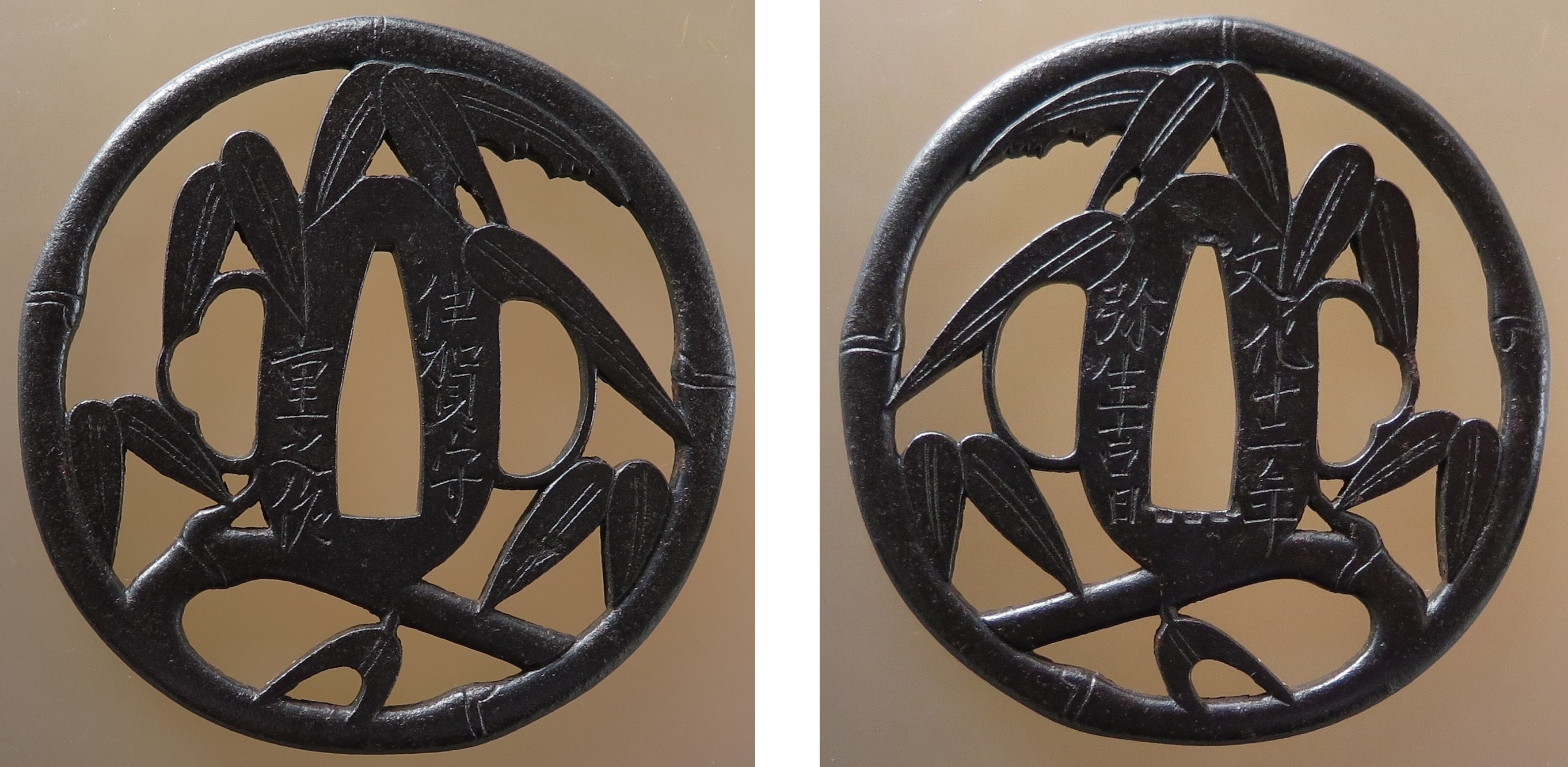
The other day I was looking for a certain Higo-tsuba in my references and so to speak “rediscovered” a work of the 5th Hayashi generation Matahei that is owned by a friend of mine (see picture 1) and that raises some questions. Not the work itself (its papered and published by the way) but the artist, the fifth generation Hayashi, who changed his craftsman name at least four times and who bore the honorary title Iga no Kami (伊賀守). So each of these points in question is not necessarily special by itself but coming together in the very case of this artist is what raises these questions. To tell you right away, I don’t have definite answers but I think that in this case the truth is somewhere to be found in the historical context. So let me first explain what caught my attention and then elaborate on the artist’s historical context.

*

Shigeyuki

Picture 1: iron sukashi-tsuba with bamboo design, mei “Iga no Kami Shigeyuki saku – Bunka jûninen yayoi kichijitsu” (伊賀守重之作・文化十二年弥生吉日, “on a lucky day of the third month Bunka twelve [1815]”)

*

We are talking about Hayashi Matahei (林又平), the 5th generation of the renowned lineage if tsuba artists, who used as a craftsman the names Katsuie (勝家), Shigehisa (重久), Shigeyuki (重之), and probably also Minamoto Yasuyuki (源保之). Katsuie was his early mei and we learn this from a tsuba which is signed: “Hayashi godaime Katsuie jûnana ni te kore o saku – Tenmei rokunen nigatsu gejun kore o shiageru” (林五代目勝家十七ニ而作之・天明六年二月下旬仕上之, “made by Katsuie, the fifth generation of the Hayashi family, at the age of 17, finished in the last third of the second month Tenmei six [1786]”). Then there exists a tsuba dated with the third day of the tenth month Kansei one (寛政, 1789) which is signed “Shigehisa,” so Shigehisa was the name he used next, followed by “Shigeyuki” (重之) which we find on tsuba with date signatures from the Bunka era (文化, 1804-1818). As for the name “Minamoto (no) Yasuyuki” (源保之), there is to my knowledge no work extant that is actually signed that way and all sources are unanimously hesitant, saying that “it is said that he also used the name Minamoto (no) Yasuyuki.” By the way, Itô suggests that Matahei signed with two more names, Shigeharu (重春) and Shigefusa (重房), the latter probably as a daimei for his father.

As indicated, numerous name changes were quite common for Japanese tsuba and kinkô artists and and was mostly linked to an important even in the artist’s life, for example finishing an apprenticeship, entering another master-student relationship, succeeding as head of a family and so on. So what was going on in Matahei’s life? He was born in Meiwa seven (明和, 1770) to the then 26 years old fourth Hayashi generation Heizô (平蔵), craftsman name Shigetsugu (重次). Heizô died in Tenmei four (1784) at the young age of 41 (according to the Japanese way of counting years). Matahei was only 14 years old at that time and his grandfather Tôhachi (藤八, 1723-1791), the third Hayashi generation, was still alive and only 60. Tôhachi was a great and much sought after artist and is equaled in certain aspects with the famous Hayashi founder Matashichi (又七, 1613-1699). As Tôhachi was still alive when his son Heizô died and as Heizô is counted as fourth head of the school, we can confirm that the former had retired for some reason, i.e. the succession of Heizô was not initiated by Tôhachi’s death. Maybe he became ill at that time and maybe his son turned out to be sickly because we know that their employer, the Hosokawa family, ordered in An’ei seven (安永, 1778) Tôhachi to accept the then 24 years old Kamiyoshi Juhei (神吉寿平, 1754-1820) as a student and that he should be initiated into all family secrets of the Hayashi. Incidentally, Heizô was ten years older than Juhei but Itô quotes Juhei’s year of birth from the Higo Kinkô Roku as being Meiwa three (明和, 1766) which would mean that he entered his Hayashi apprenticeship at the age of twelve. Either way, Heizô died only six years after Juhei had started to train with his father what supports the suspicion that he was ill. Please note that I am using the Western way of counting years here and from now on, i.e. all these ages might differ by one when referring to Japanese sources. In short, the Hosokawa saw their cherished Hayashi family of tsuba makers in danger of discontinuation and intervened by arranging that Juhei from the Kamiyoshi family of tsuba makers should be groomed for being the successor, not of the lineage but of its art.

Now back to Matahei. So after the early death of his father, he found himself training under his grandfather and with the decision being made that his fellow student Kamiyoshi Juhei will take over the family’s main or higher end production line. As mentioned above, he was either 16 or four years younger than his direct competitor. We know from historic records that Kamiyoshi Juhei received in Tenmei six (1786) a stipend for the support of three persons what suggests that he had already finished his apprenticeship with Hayashi Tôhachi at that time. Matahei had inherited the salary of the Hayashi family, which was 15 koku plus a stipend for the support of five persons. 1786 is also the year Matahei made the above mentioned tsuba that is signed with Katsuie and at the latest three years later, he changed his name to Shigehisa. So my assumption for the time being is that, a.) Matahei signed for a couple of years with Katsuie, b.) that it was in Tenmei six (1786) when grandfather Tôhachi finally retired, making Kamiyoshi Juhei and independent artist (receiving the stipend) and c.), making Matahei, finally at age, the head of the family whereupon he shortly later changed his name to Shigehisa, eventually adopting the character for Shige that was used on a hereditary basis for the craftsman names of the Hayashi masters.

But then something happened. He received the honorary title of Iga no Kami, changed his name again, from Shigehisa to Shigeyuki (in my opinion most likely in connection with that honor), and switched on top of that to another counting of generations what is another piece in that puzzle. As seen above, he signed his early works straightforward as him being the fifth generation after the grandmaster Matashichi. But then all of a sudden he started to sign with “tenth generation” (there are several tsuba signed that way extant, for example the one of my friend shown above dated 1815 and another one dated 1807). Itô is not sure about that counting and assumes that he started from the ancestor of the family, the late Muromachi and Momoyama era gunsmith Hayashi Kazue (林数枝), but that he must have included some other Hayashi masters because even when we start counting with Kazue, Matahei would be the eighth head. So not sure how he arrived at him being the tenth generation. And what about his honorary title? Provincial governors’ titles like no Kami, no Suke, and no Daijô were in general rare for tsuba and kinkô artist. This means, when we deduct honorary title-bearing swordsmiths who also made tsuba, the renowned Myôchin lineage of armorers, and the Yoshioka Inaba no Suke School, only a little more than a handful of artists remain who had this honor, most famous example the Kyôto kinkô master Ichinomiya Nagatsune (一宮長常, 1721-1787) who bore the titles of Echizen no Daijô and Echizen no Kami. In other words, granting the title of (Iga) no Kami to a tsuba maker was not only rare, it was very very rare.

As mentioned, Matahei’s tsuba signed that way date concentrate on the Bunka era, i.e. on the time from his mid 30s to his mid 40s. From his late 20s to his early to mid 30s he had used the name Shigehisa, so a lot was going on back then. He died in the eleventh month of Bunsei six (1823) at the age of 54 by the way, only eight years after he made the shown bamboo sukashi-tsuba dated 1815.

My preliminary theory is that by the Bunka era, the Hosokawa realized that Matahei turned out to be an apt successor of the Hayashi School of tsuba makers and maybe, whilst leaving the higher end of the Hayashi-tsuba production line with the Kamiyoshi family, they somehow tried to push him or bring him again into the focus by having arranged that he receives a high honorary title such as Iga no Kami. Or maybe this honorary title was kind of a compensation for acklowledging that he was a worthy successor of the Hayashi lineage but leaving everything as it was, i.e. the Hayashi tradition at the disposal of the Kamiyoshi family? This is in my opinion supported by the fact that the Kamiyoshi family started to flourish greatly after Juhei whilst Matahei’s Hayashi successors were rather “also ran” (by the way, Matahei’s successor Matahachi [又八] died in 1840 and his successor Tôshichi [藤七] in 1874 and I haven’t seen any works of them; so if someone has pictures of their works, they would be greatly welcomed).

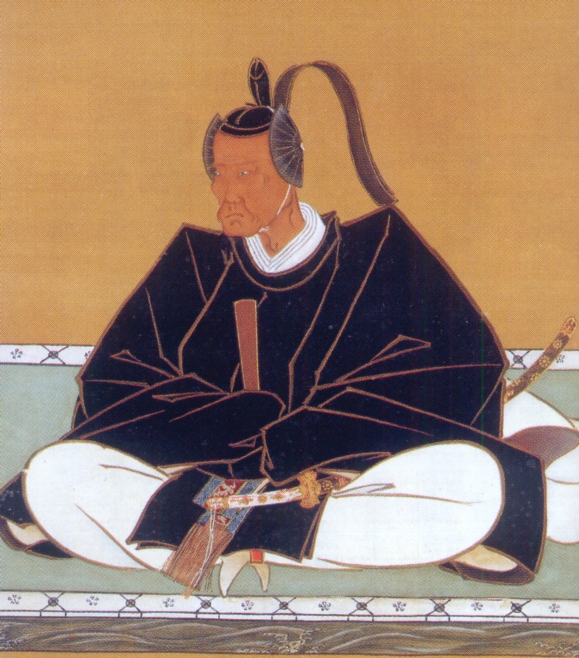
As indicated at the very beginning, I want to present some more of the historical context, so to speak as a starting point and reference for those who take it from here and find out more about the life of Hayashi Matahei. It was sixth Kumamoto daimô and seventh Higo Hosokawa head Shigetaka (細川重賢, 1721-1785) who had it arranged that Juhei should inherit the secrets of the Hayashi family. Incidentally, the Kamiyoshi had been serving the Hosokawa since the early Edo period but we don’t know what profession the early generations had. Itô suggests that as they are listed amongst gunsmiths and swordsmiths, they must had been involved in the arms and armor production and Fukushi states that they were armorers or made the metal ornaments of armors. It was not until Juhei that tsuba making came into play. He namely learned the craft of tsuba making from Zenshichi (善七) who was from the Tôyama lineage of tsuba artists, Juhei’s cousin (his father had married Juhei’s aunt), and a student of the second generation Nishigaki Kanshirô. Hosokawa Shigetaka was a great man who passed one of the few successful Edo period financial reforms at local fief level. He also established a fief school, the Jishûkan (時習館), and a medical school, the Saishunkan (再春館). Well, his financial reform was critizised because being so radical but of course they were radical, they had to be, and they eventually worked by the early 1760s when the financial status of the Kumamoto fief had greatly improved in comparison to what he had inherited from his predecessor Munetaka (細川宗孝, 1716-1747).

HosokawaShigekataHosokawa Shigekata

The man who must had arranged Hayashi Matahei’s honorary title Iga no Kami was Shigekata’s adopted grandson Narishige (細川斉茲, 1755-1835). Narishige was adopted by Shigekata’s son Harutoshi (細川治年, 1758-1787) who ruled the Kumamoto fief for merely two years. Well, Harutoshi did not have an easy job. Natural disasters struck Higo province just the year after his father had died and the resulting exploding rice prices caused an uprising. He was just in his 20s and died young, aged 30, making his adopted brother-in-law Narishige age 33 lord of Kumamoto. Well, Narishige’s 1792 silver price changes and financial reform were a failure and even caused a riot in 1802 and the burning down of the Edo Hosokawa mansion left another big hole in the fief’s pocket. Not directly related to the case of Matahei, I still want to talk a little bit about the subsequent financial situation of the Kumamoto fief as it might serve as a reference for the one or other.

So when Narishige retired in 1810, the fief was taken over by his third son Naritatsu (細川斉樹, 1797-1826), well, taken over merely on the paper as he was only 13/14 years old at that time. Now Naritatsu was able to save 100,000 koku but he too died young, aged 30. He was succeeded by his adopted son Narimori (細川斉護, 1804-1860) who was acually his nephew. It is recorded that at his time, the Kumamoto fief had amassed a debt of 800,000 koku and was on the edge of bankruptcy. The situation even worsened when the bakufu insisted on obilgatory duties of providing defense for Amakusa and Sagami Bay againt the US and British ships. This almost split Kumamoto into two factions and as his successor Yoshikuni (細川韶邦, 1835-1876) was critizised as being half-hearted and passive, Kumamoto would have probably faced its end, as many other fiefs at that time, if it was not for Emperor Meiji to end the feudal system. Incidentally, Yoshikuni was briefly succeeded, as governor of Kumamoto, by his adopted heir Morihisa (細川護久, 1839-1893), who was by the way the son of Narimori. And Marquis Hoskokawa Moritatsu (細川護立, 1883-1970), the first president of the NBTHK, was the fourth son of Morihisa. Last but not least, the famous Eisei Bunko Museum, the museum that preserves so many of the famous and important art objects passed down in the Hosokawa family, was founded by Moritatsu and turned into a public museum by his son, titular Marquis Morisada (細川護貞, 1912-2005), Executive Secretary to the Prime Minister. His son Morihiro (細川護煕, 1938- ) was Prime Minister of Japan and is present-day board chairman of the Eisei Bunko Museum.

Cast Sword Fittings

There is a short report in the December 2015 issue of the Tôken Bijutsu that I read with great interest and that I wanted to work into a smaller article on my site. The report in question is about an early Edo period sword fitting workshop that was discovered during construction work for a new apartment building in the Yanagimachi (柳町) neighborhood which is located a little to the southwest of downtown Nara. Well, as so often, a lot of things are going on and I had to put that article idea aside but the other day, Ford Hallam put a link to a short YouTube video on Facebook that briefly shows some of the discovered items that were on display at a small local special exhibition on the find.  The video by Sankei News is neither long nor very detailed but you can see the items much better than in the black and white Tôken Bijutsu article and with this, I thought I better introduce that issue on my site too as next to nothing is known about such cast workshops.

First of all, the finds. Discovered were about 800 items and fragments related to tsuba casting and about 600 of such for menuki, the majority being kikka-sukashi models for tsuba and dragons for menuki. Also found were more than 200 spherical melting pots, some with handles, some with three legs, and fragments of copper and zinc were confirmed on some of them, the “ingredients” you need for making brass (shinchû, 真鍮). The Tôken Bijutsu report says that so far, it was thought that brass was not produced in Japan until the latter half of the 17th century (up to that time it was imported) and that this find, which is dated to the first half of the 17th century, obviously predates that assumed starting point of local brass production. According to the report, the Yanagimachi area where the workshop was found was not settled in the Keichô era (1596-1615) but we have records that at the latest by Kan’ei eight (1631), 21 so-called yakuya (役家) resided there. Yakuya were families who held land tenure on the basis of socage. It seems that not much is found in period records and the first historic document that goes more into detail is the Nara Zarashi (奈良曝) topography/local history of the town published in Jôkyô four (1687). Therein we read that at that time, 14 swordsmiths, 14 saya lacquer artists, and 17 sword polishers were living and working in Nara. And for Yanagimachi we find listed a swordsmith named Kichibei (吉兵衛), a saya lacquer artist named Kansuke (勘介), and a polisher named Kiya Gohei (木屋五兵衛), the latter most likely coming from the renowned Kiya family of sword polishers whose main line had been working (like the Hon’ami and the Takeya) for the bakufu. The source does not mention any sword fittings makers but the find of the cast workshop combined with the listed names and professions strongly suggests that a thriving sword manufacture community had existed in Nara during the early Edo period. The fact that only the first and not the smith name of the swordsmith (i.e. the alias with which he signed) is quoted might not mean anything but it could suggest, again with the cast workshop in mind, that he was one of the many below-of-the-radar smiths and this in turn brings me to another point that made we wonder whilst thinking about the discovery. Incidentally, when I checked the meikan to see which smiths worked at that time in Nara, I could not find any smith with the first name Kichibei/Yoshibei but again, this does not necessarily mean much as the first names of the lesser known smiths were often not recorded and fell into oblivion. And almost all Nara-based smith of that time, i.e. Kanbun and Enpô, were from the Monju School, i.e. the Sue-Tegai lineage that made it into the Edo period.

What made me wonder were the circumstances of the emergence of such small local sword manufactures who obviously did not produce “daimyô level” swords, or not even mid-level bushi swords. Well, smaller or larger sword manufactures under the jurisdiction of local feudal lords had always existed as not every fief or region was receiving from the large sword centers like Osafune or Seki of course and as the equipment of the own men had to be ensured no matter what. And also safe to assume is that the fittings of the tens of thousands of mass produced swords that were exported to Ming China (more details here) were equipped with the cheapest kind of fittings. I am not talking about special presentation and special order swords as they were surely of at least decent make. As mentioned in the linked article, contemporary records say that most of the export swords were made in Nara and Bizen but we are talking here about the early 1500s at the latest and with the ongoing Sengoku era and all what took place during the reigns of Nobunaga and Hideyoshi, it is not unusual that many of the Nara-based manufactures had simply disappeared from the face of earth by a century later. So why were some of these relative cheaply producing workshops reemerging during the early Edo period and were still working when the general demand for swords was declining?

I think that this issue is linked to the then changes within the bushi class. So even if the demand for newly made swords surely declined from the end of the 17th century onwards, we are facing with the early 17th centuries’ continuous expansion and formulation of the Tokugawa-bakufu a certain change in the wearing of swords. It was the time when for the first time a “uniform” for all samurai was introduced and all things office-related – i.e. garments, hairstyle, swords – were dictated by the bakufu. Now each member of the bushi class from a certain rank upwards was required to wear the daishô pair of swords when on duty and rules were even stricter when operating in Edo (see also here). I don’t want to go too much into detail here about what sword form developed from what sword but as everybody knows, by the beginning of the Edo period, a samurai was wearing the typical daishô pair consisting of a katana and a wakizashi mounted in more or less matching koshirae. But before that time, i.e. pre-Momoyama and Sengoku, the uchigatana or katateuchi, the forerunner of the katana, worn by the lower ranking warriors and ashigaru was nothing more than a weapon and so to speak furnished in the minimum requirement to be used.

Saiendo

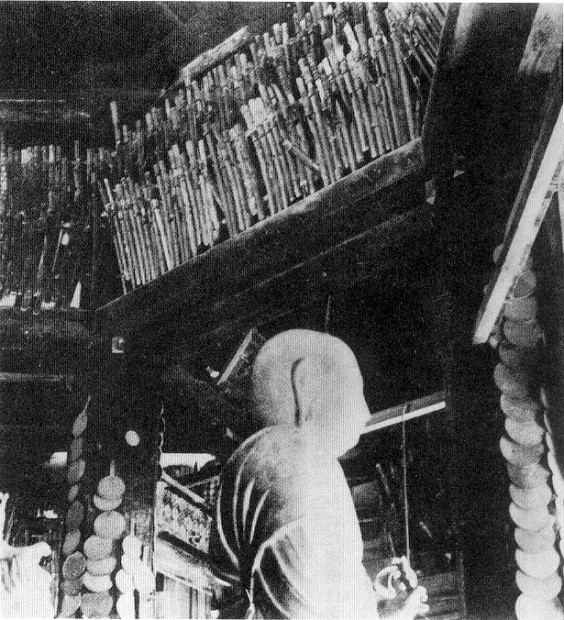
I want to cite the special case of the Sai’en-dô (西円堂) at this point to demonstrate what I mean. This side temple of the Hôryû-ji in Nara is a rare stroke of luck for the studies on Muromachi-period swords and mountings as it stored until recent times hundreds of weapons (see picture above) offered to it, or rather to the healing Buddha Yakushi-Nyorai (薬師如来) to which the temple is dedicated. At some of the swords the tsuba or other fittings were removed again later to reuse them on other swords but still many “intact” specimen have survived. The picture below shows what I meant with “minimum requirement,” that is, many of these basic uchigatana had no decorative elements whatsoever. They had a fuchi and kashira that held the hilt together, a kurigata for tying it with a cord to the obi, a kaerizuno so that the sword doesn’t slip out of the obi, and a rudimentary hilt wrapping. Some were equipped with a kozuka (most of the kozuka are missing so only the slots in the saya remain) and many did not even have a tsuba, i.e. were mounted in aikuchi style, and as many did not feature any menuki. As mentioned, these specimen show the very basic mounting that is necessary to make a sword use and wearable.

Uchigatana1

Such utilitarian swords basically disappeared with the disarming of the civilian population started by Nobunaga and finished by Hideyoshi, the so-called katanagari (刀狩り, “sword hunt”), and the subsequent regulations issued by the Tokugawa-bakufu. Whilst Nobunaga and Hideyoshi first of all sought to ensure with the katanagari that no one could take the country by force, Ieyasu’s rules were more about making sure that only the bushi class had nationwide the monopoly on violence, with the sword pair as easy-to-grasp symbol of being legally allowed to use physical force. From now on, it was unthinkable for even a lower ranking samurai to wear some kind of cobbled together uchigatana, no, you were required to wear a decent daishô when doing duty. Of course there were also semi-bushi class persons who ranked even lower and not every simple rural duty required a full daishô and as mentioned in an earlier article, there was no “sword police” going round that checked if every coutryside samurai had a sword with a proper tsukamaki for example and no plaintiff, no judge. So it was pretty much like if you are a soldier today doing duty on some desert base with just you and your guys all year long. Nobody complains if you show up in the morning with your shirt open. But the fun stops as soon as the base has a certain size or when you have to show up at another base. You don’t want to embarrass yourself or worse, your superior. Back to the early Edo period. Now every sword and short sword that was worn when on duty had to be equipped with a proper tsuba, tsukamaki, fuchigashira, and menuki. (Again, I am not talking about special cases, koshigatana with unwrapped hilts, swords in private collections etc. I am referring to the majority of swords.) Now comes some numbers game. It is estimated that the samurai class made up about 10% of the Japanese population. In the early Edo period, Japan had a population of about 12,000,000 to 18,000,000 and about steady 30,000,000 from Genroku (1688-1704) to the end of the Edo period. So if we start with 12,000,000, about 2,500,000 swords (daishô, thus times two the 10%) have been worn at any given day in the early, and about 6,000,000 swords throughout the later Edo period. Well, tsuba and sword fittings were of course reused and handed down in the peaceful Edo period but still, there must had been a production line for the cheaper swords and therefore it is in my opinion only logical to accept that there were many more of such cast workshops like the one discovered in Nara. I also think that the majority of these relative cheap fittings just did not survive or was melted down for casting metal fittings. Thus we are hardly talking about them today.

These are my initial thoughts on the matter for the time being and maybe some more sites are discovered in the future as it is hard to develop a proper theory on just that one find. Last but not least, some more pictures can be found in the Sankei article here. And thank you Ford for pointing out that video.

KANTEI 4 – YAMASHIRO #15 – Rai (来) School 1

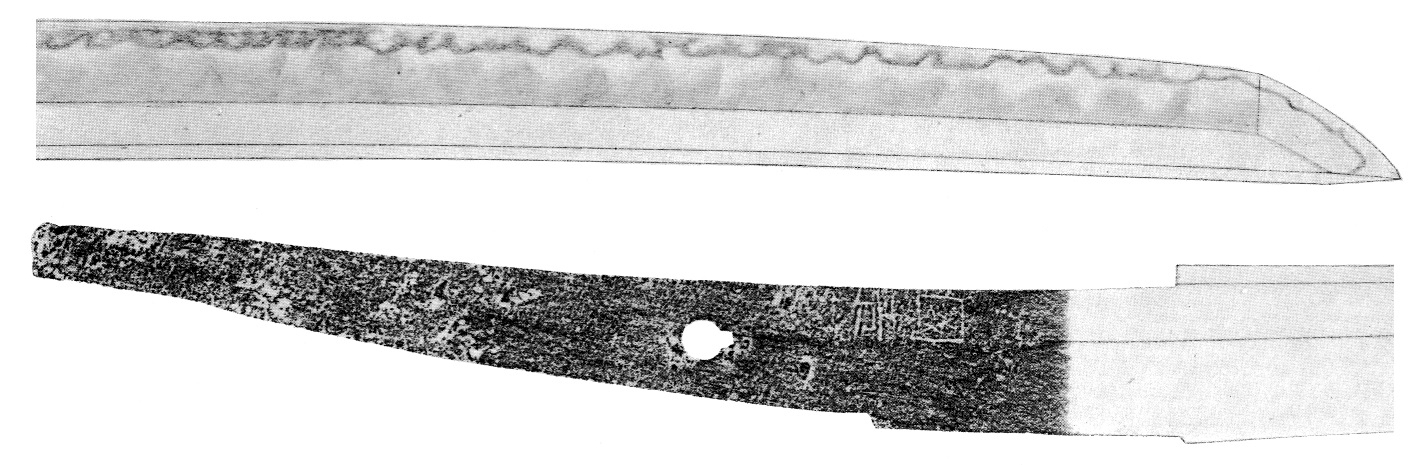
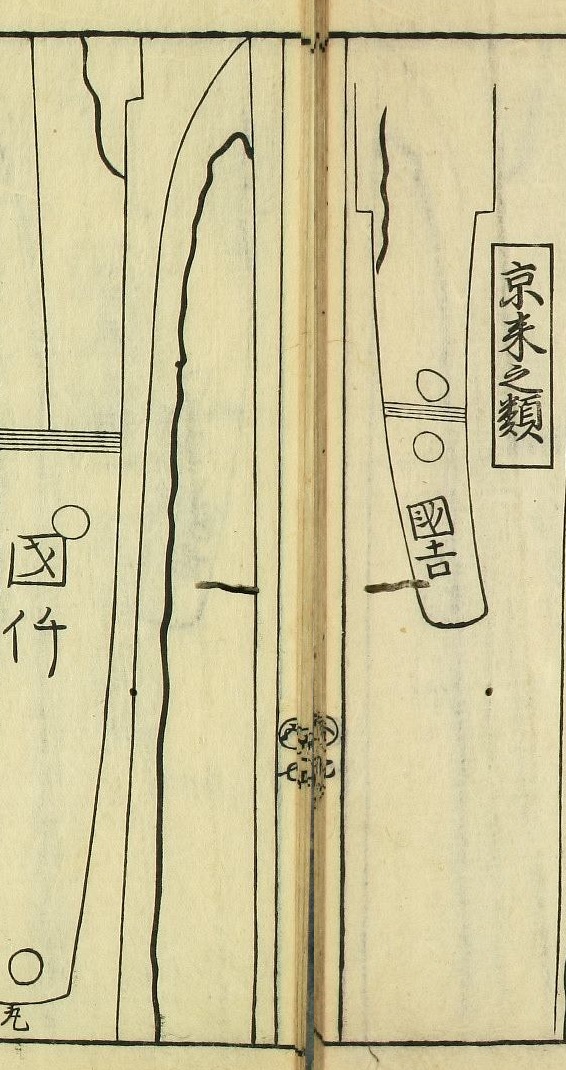
Now we are entering another of the great old Yamashiro traditions, that is Rai. I have summarized most of the traditions concerning the alleged school’s founder Kuniyoshi (国吉) a while ago here, for example that he was from Korea and became naturalized in Japan and that the school’s name Rai goes actually back to that context. Just one more note here, Honma points out that all the early Kyôto schools are either referred to as by and/or signed with the name of their production site, i.e. Sanjô, Gojô, Awataguchi, Ayanokôji. Only the Rai smiths used their family name what, according to Honma, somehow distinguishes them from the other local schools and what might suggest that they did not emerge from any of them. So we end up again at the immigration approach. Incidentally, the first smith who actually signed with the character for “Rai” was Kunitoshi but who was active towards the end of the Kamakura period. When we just stick to the facts then all we can say is that the Rai school emerged in the mid-Kamakura period and is stylistically most likely linked to the Awataguchi school, which had been the dominating Kyôto school of sword making at that time. Apart from that, experts see today Kuniyuki (国行) as founder of the school but that just on the basis of the fact that the earliest Rai works available go back to his hand. He was the son of the aforementioned Kuniyoshi who remains on paper the ancestor of the school. None of his blades have survived but there is a single puzzling blade going round – once owned by the sword polisher Hirai Chiba (平井千葉) that might be his work (see picture 1). Honma says, apart from that the deki is excellent, that the overall workmanship in suguha in ko-nie-deki mixed with ko-midare is clearly Kyô and about contemporary to Awataguchi Kuniyoshi but the mei is completely different from that of the Awataguchi master and that the mei can’t be brought in line with any of the other known Kuniyoshi smiths of that time, e.g. from Yamato. So Rai seems most likely but as even the old oshigata collections leave out Kuniyoshi, we just don’t have enough data to say for sure that the mei is that of Rai Kuniyoshi or not. Well, one of the very few oshigata of Rai Kuniyoshi can be found in the Kokon Mei Zukushi (see picture 2). It is a tantô with a furisode-style nakago and a slightly undulating suguha but the mei is not a definite match with the mei of the tachi in question, although it has to be mentioned that the signatures of early oshigata collections were captured with a certain artistic freedom (i.e. they were copied with the brush and not rubbed like we do it today).

Rai1

Picture 1: tachi, mei “Kuniyoshi” (国吉), nagasa 71.8 cm

Rai2

Picture 2: Rai Kuniyoshi as seen in the Kokon Mei Zukushi

Satô in turn introduces this tachi as being a work of the Rai ancestor and describes its workmanship as showing a sugata with an iori-mune, a koshizori, and a compact ko-kissaki with a slightly standing-out kitae in itame mixed with nagare, a hamon in suguha-chô that has a rather subdued nioiguchi and that is mixed with ko-midare and a few chôji and kinsuji, and a bôshi with a relative widely running-back ko-maru-kaeri. He also says that there is another tachi with an ubu-nakago of Rai Kuniyoshi extant but which is yakinaoshi. The oshigata shown in picture 1 also strongly suggests the existence of a prominent utsuri (maybe one of those antique looking utsuri with antai that is also seen on some blades of Awataguchi Kuniyasu and Ayanokôji Sadatoshi) and the tapering, strongly curved tang and the slender interpretation with the ko-kissaki speak for a blade that dates early Kamakura or to the transition from early to mid-Kamakura at the latest. Before we go over to Kuniyuki, I want to quote Tanobe on this matter as he says that the blade shown in picture 1 looks in terms of sugata and jiba surely older than Kuniyuki but even upon closer examination, he can not attribute the mei with reasonable certainty to Rai Kuniyoshi. But that is just how it goes, i.e. even if many indicators point towards Rai Kuniyoshi, we are talking about a single blade here with no other references to compare with whatsoever.

GenealogyRai

*

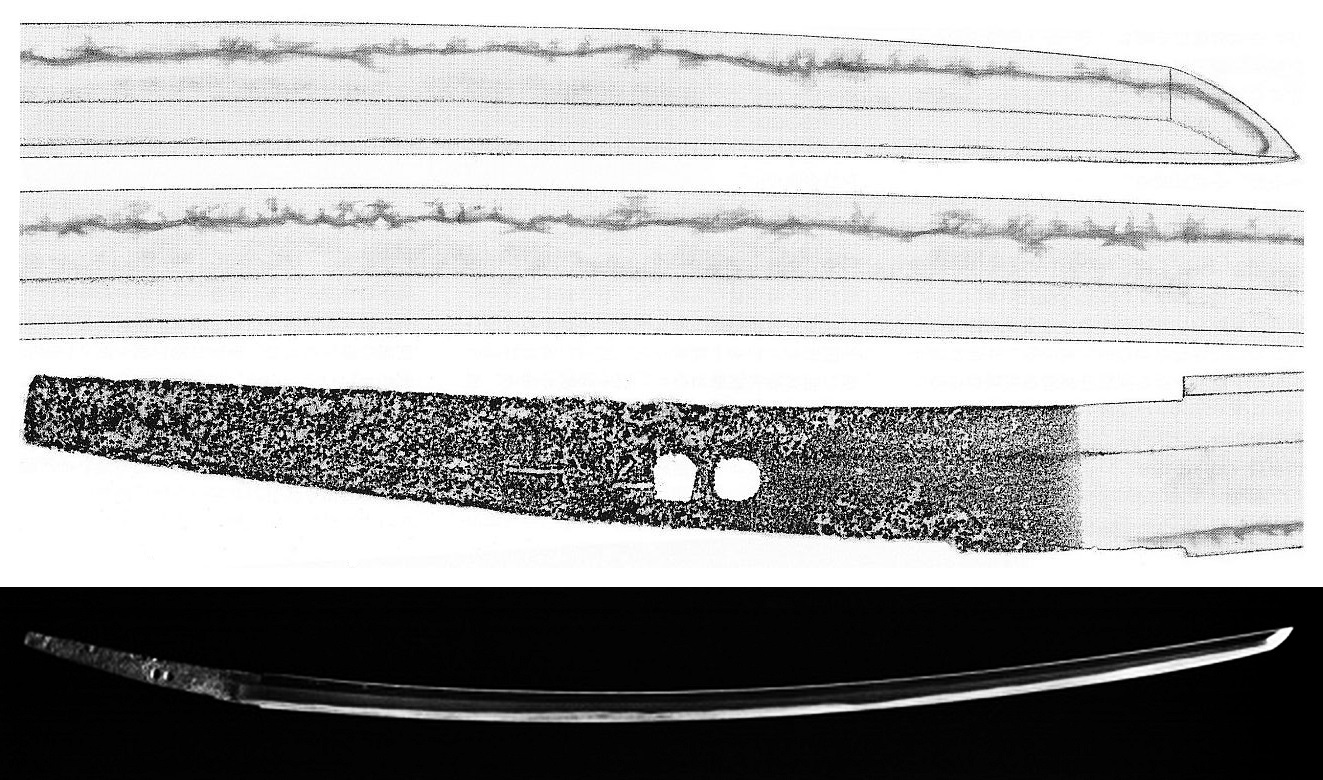
Thus we arrive at Kuniyuki (国行). He is traditionally dated somewhere between Jôgen (承元, 1207-1211) and Shôgen (正元, 1259-1260), but the former seems a bit early. That is because we know a blade by his alleged son Kunitoshi that is dated Shôwa four (正和, 1315) and that is signed with the additional information “made at the age of 75.” So Kunitoshi was born in 1240 and it is rather unlikely that Kuniyuki had the prime of his life 30 years earlier, i.e. in Jôgen. So something around Shôgen seems more fitting. By the way, the Kotô Meizukushi Taizen says that Kuniyuki died in Einin five (永仁, 1297) at the age of 79. So if we believe in this statement for a little, then he was 22 years old when Kuniyoshi was born. Anyway, the Shôgen era brings us right to an important aspect when talking about Kuniyuki, and that is that even if he was the actual founder of a school, we are, as mentioned, already in the mid-Kamakura period. So we are facing a different body of evidence than we did with the founding smiths of the Awataguchi school. These smiths were namely active from the end of the Heian to the very beginning of the Kamakura period, i.e. at least two generations earlier. In other words, the somewhat later active period makes a big difference when it comes to the pure number of extant works. But not only that, Kuniyuki entered the then sword world in a quite impressive manner because we are talking about more than two dozen blades that are jûyô-bunkazai or jûyô-bijutsuhin (one of them is kokuhô), more than 80 that are jûyô, and 17 that are tokubetsu-jûyô! So regardless of his scholastic background, he became without a doubt one of the greatest masters working in Kyôto at that time. Apart from that, his active time around the mid-Kamakura period also marks a noticeable shift from classical and elegant to powerful, and that applies both to sugata (e.g. ikubi-kissaki) and jiba. Accordingly, we have early works of Kuniyuki which are more unobtrusive and later works which are more magnificent and I want to introduce them in a chronological order. Incidentally, there are far more magnificent than classical blades of Kuniyuki extant.

The first two blades I introduce kind of connect to the aforementioned blade that is signed “Kuniyoshi” and to some of the Yamashiro/Kyôto masters who have been active a little earlier than Kuniyuki, e.g. Awataguchi Kuniyasu and Kunikiyo and Ayanokôji Sadatoshi. Blade number one shown in picture 3 is long, ubu, and of a slender and very elegant tachi-sugata but the (deep) toriizori (i.e. not koshi that bends down towards the tip) and the not that much tapering mihaba tell us that it is a mid and not an early Kamakura work. The kitae is a ko-itame mixed with mokume and nagare that shows plenty of fine ji-nie, much chikei, some jifu, and a nie-utsuri. The hamon is a ko-nie-laden chû-suguha-chô that is mixed with ko-midare, ko-chôji, some angular elements, ashi, , uchinoke, fine hotsure, sunagashi, and kinsuji. The nioiguchi is rather wide and the bôshi is a shallow notare-komi with a ko-maru-kaeri with some fine hakikake. Please pay attention to the small crescent-shaped uchinoke that appear here and there right atop of the habuchi. These so-called karimata are often seen on works of the three above mentioned smiths, i.e. Kuniyasu, Kunikiyo, and Sadatoshi, and are one the one hand an important characteristic feature of Rai Kuniyuki, and on the other hand a strong stylistic indicator that connects him as indicated to the earlier masters.

Rai3

Picture 3: tokubetsu-jûyô, tachi, mei “Kuniyuki” (国行), nagasa 82.7 cm, sori 3.0 cm, motohaba 2.8 cm, shinogi-zukuri, iori-mune

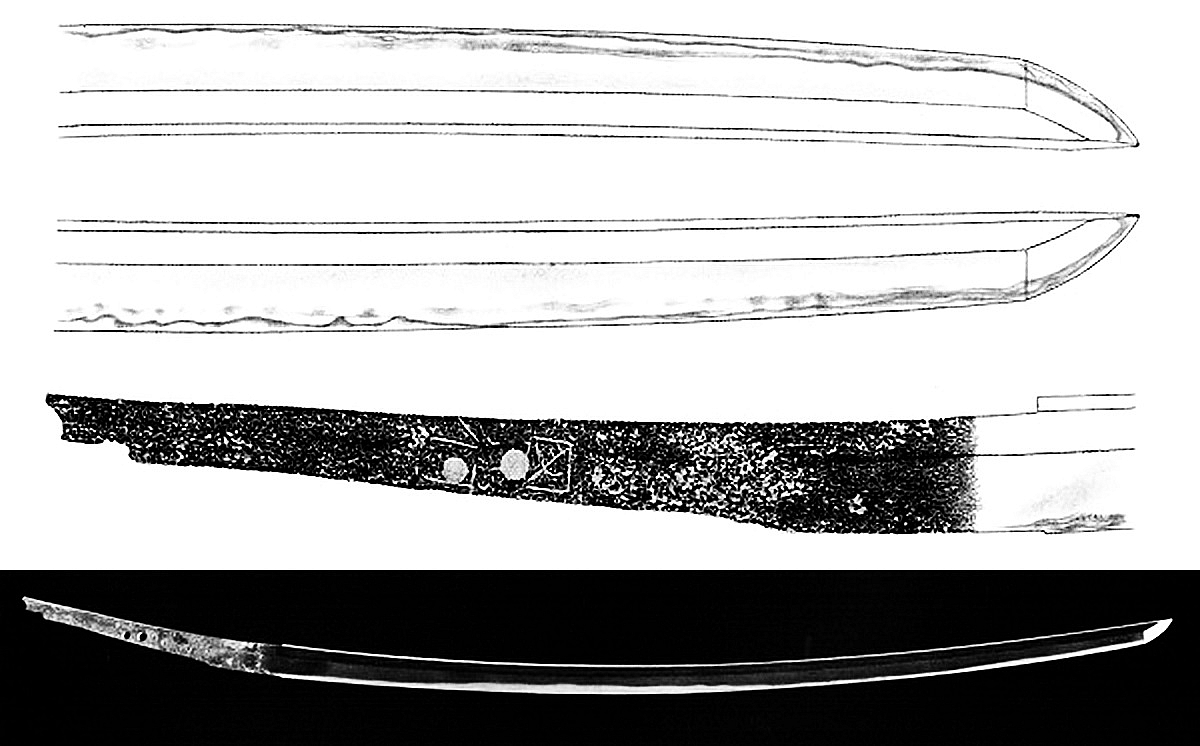
The blade shown in picture 4 too shows a very elegant and slender ubu tachi-sugata with a prominent kijimono-style nakago. The kitae of the “wet-looking” steel is a ko-itame mixed with some ô-hada and nagare that features plenty of fine ji-nie, fine chikei, and a nie-utsuri. The hamon is a mix if ko-chôji ko-gunome and ko-midare that shows some ko-gunome and ko-notare along the upper half and that comes with plenty of ashi and , small and punctual yubashiri along the yakigashira, nijûba in the monouchi area, fine kinsuji and sunagashi, and plenty of ha-nie all over the blade. The nioiguchi is bright and clear and the ha gets somewhat thinner towards the base and along the upper half. The bôshi is sugu with much hakikake and the kaeri is so small that it almost appears as yakitsume. Again, please take a look at what is going on parallel and above to the habuchi and compare that with the blades introduced here and here.

Rai4

Picture 4: tokubetsu-jûyô, tachi, mei “Kuniyuki” (国行), nagasa 76.6 cm, sori 2.7 cm, motohaba 2.75 cm, shinogi-zukuri, iori-mune


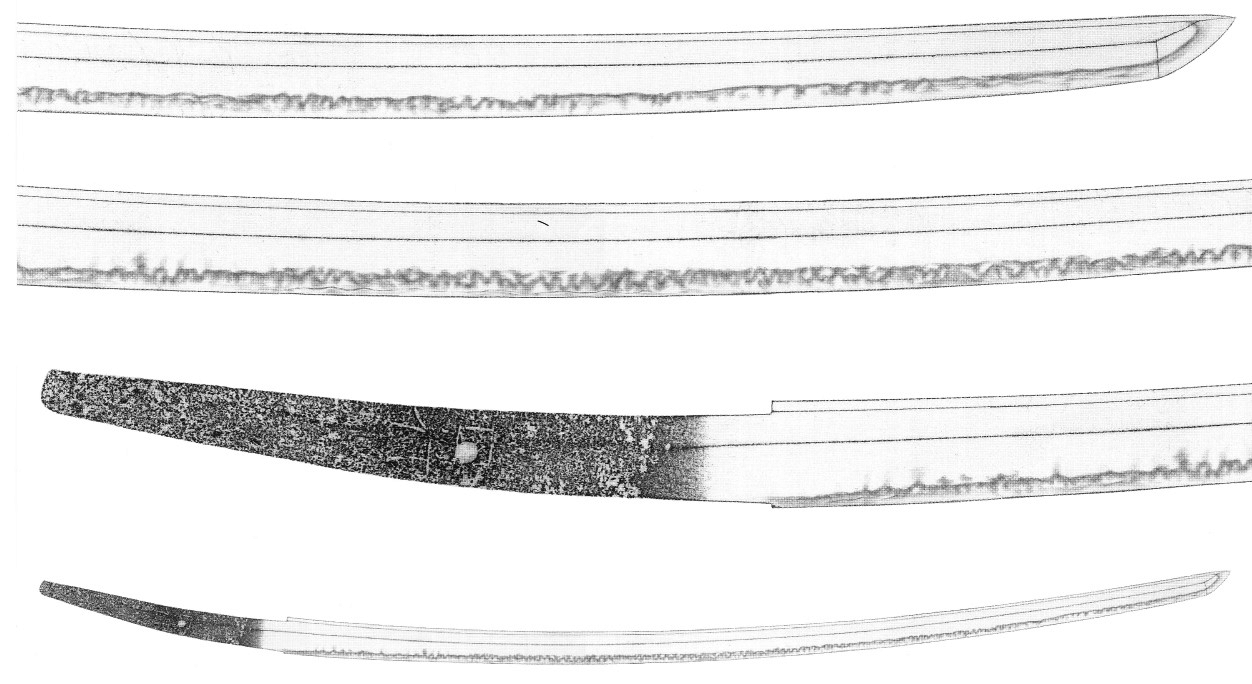
Next a blade (see picture 5) that shows one of his other characteristic interpretations, and that is a suguha-chô with a large amount of smallish and densely arranged chôji which are accompanied by an abundance of ashi, , and karimata. Please note that none of the chôji protrudes prominently and that the ha is as mentioned perfectly suguha-based, i.e. overall straight with not much ups and downs (what distinguishes him from Ayanokôji Sadatoshi as he applied more ups and downs along the ha and apart from that, his bôshi usually shows prominent hakikake). This interpretation, also due to the fact that some jifu appears, might remind of Ko-Bizen at a glance but the sugata would be different as Ko-Bizen blades usually come with a koshizori that bends down towards the tip and also karimata are not associated with Ko-Bizen. And the bôshi is a hint to wide for Ko-Bizen. This blade of Rai Kuniyuki by the way was once a heirloom of the Ogasawara family (小笠原), the daimyô of Buzen´s Kokura fief (小倉藩).

Rai5

Picture 5: jûyô-bunkazai, tachi, mei “Kuniyuki” (国行), nagasa 74.5 cm, sori 3.0 cm, motohaba 2.5 cm, shinogi-zukuri, iori-mune

Another of the very typical interpretations of Kuniyuki is seen in picture 6. This is his only work that is designated as a kokuhô and the blade is regarded as one of his greatest masterworks. The bôhi runs as kaki-nagashi into the tang and there is a mekugi-ana at the tip of the tang but this ana is a so-called shinobi-ana and the nakago is indeed completely ubu (also proven by the sankozuka-ken that is carved as relief in the hi which is exactly where it was intended to be, i.e. not half-way in the tang). The blade has a wide mihaba, does not taper much, has a relative thick kasane, a toriizori, and a stately chû-kissaki. The kitae is somewhat standing-out but dense ko-itame with plenty of ji-nie, some ô-hada along the haki-omote side, and a midare-utsuri. The hamon is a wide and ko-nie-laden suguha-chô that tends a little to notare along the monouchi and towards the yokote and that is mixed with ko-chôji, ko-midare, many ashi and , karimata, and at this blade, we see something that should become a characteristic feature of his school, and that is muneyaki. The bôshi tends to notare-komi and has an ô-midare-kaeri with hakikake and the nie are a hint more emphasized in the bôshi than in the rest of the ha. The blade was once a heirloom of the Matsudair family (松平), the daimyô of Harima´s Akashi fief (明石藩), and is thus also nicknamed Akashi-Kuniyuki (明石国行). Today it is owned by the NBTHK.

Rai6

Picture 6: kokuhô, tachi, mei “Kuniyuki” (国行), nagasa 76.6 cm cm, sori 3.0 cm, motohaba 2.95 cm, shinogi-zukuri, iori-mune

Picture 7 shows one more stylistic approach of Kuniyuki and that is an almost pure suguha or a suguha-chô which is mixed with fewer elements and/or shows some shallow notare over its length. The blade is designated as a jûyô-bijutsuhin and has its mei preserved via orikaeshi. The tachi is rather wide, does not taper much, shows a toriizori, and ends in a stately chû-kissaki. The ha is mixed with some ashi and plenty of all over the blade and most of the mixed-in ko-midare focus on the very base, that means, right after the koshi the ha appears almost as pure suguha. Interesting here is that we see prominent nijûba before the yokote and throughout the sugu-bôshi, which runs back with a neat ko-maru-kaeri (or almost a chû-maru-kaeri on the haki-omote side). The nijûba are insofar very interesting as they connect him on the one hand to Awataguchi Kuniyoshi (see here), and on the other hand as this element was taken by his son-in-law’s son Kunimura (国村) to Higo where it was continued by the local Rai offshoot, the Enju school. But Enju works would show some masame along the hada and a shirake-utsuri.

Rai7

Picture 7: jûyô-bijutsuhin, tachi, orikaeshi-mei “Kuniyuki” (国行), nagasa 69.7 cm, shinogi-zukuri, iori-mune

Now to another noteworthy aspect in Rai Kuniyuki’s oeuvre, and that is that there are apart from a couple specimen hardly any tantô extant by him. This is insofar interesting as his contemporary Awataguchi Kuniyoshi was a great tantô master and produced quite some and so did their successors Yoshimitsu and Rai Kunitoshi respectively. There are also no tantô of Ayanokôji Sadatoshi known and neither are much of pre-Awataguchi Kuniyoshi smiths (with the exception of Hisakuni). So with this and the aforementioned stylistic proximity to Sadatoshi in mind, it is conceivable that Kuniyuki has been active just a hint earlier than Awataguchi Kuniyoshi (who is dated around Kenchô [1249-1256]). But this is very speculative as it is quite possible that he made a decent number of tantô but which just did not survive. Anyway, I want to introduce one of these extremely rare Kuniyuki tantô, a blade that makes one think of Nanbokuchô or beginning Muromachi at a glance. It has a sunnobi-nagasa of 30.7 cm, a sori of 0.2 cm, and is in hira-zukuri with a mitsu-mune and a wide mihaba of 2.8 cm. The kitae is a dense itame that is mixed with some ô-hada in places and that shows jifu and plenty of ji-nie. The steel is clear and the hamon is a ko-nie-laden ko-notare with a wide nioiguchi that is mixed with gunome, ashi, , shimaba, kinsuji, fine sunagashi, and yubashiri. The bôshi is midare-komi with a ko-maru-kaeru with a few hakikake and kinsuji. Both sides bear a katana-hi with tsurebi and the tang is ubu. So this entire interpretation (sugata and jiba with much midare) seems to anticipate the style of Rai Kunimitsu and Kunitsugu, i.e. even skipping his son Kunitoshi. The blade was once a heirloom of the Shimazu family (島津), the daimyô of the Kagoshima fief, and was given to them by shôgun Tsunayoshi on the occasion of the marriage his adopted daughter Takehime (竹姫, 1705-1772) to Shimazu Tsugutoyo (島津継豊, 1702-1760) in Kyôhô 14 (1729).

Rai8

Picture 8: tokubetsu-jûyô, tantô (modern classification is wakizashi), mei “Kuniyuki” (国行), measurements see text

Apart from that, there are a few stout kodachi and, what seems to be, uchigatana of Kuniyuki extant. Picture 9 shows such an uchigatana (it is according to the modern classification a katana) and signed so, i.e. in katana-mei, and was thus worn edge up. The blade is wide and stout, ends in an ikubi-style chû-kissaki, and features unlike his tachi a koshizori. The kitae is overall rather standing out and covered with ji-nie and appears on the omote side as itame, and on the ura side along the lower half as itame-masame and on the upper half as ko-itame mixed with mokume. There is a vivid midare-utsuri and the hamon is a notare-chô in ko-nie-deki with a wide nioiguchi and is mixed with chôji, gunome, and many ashi and . The bôshi is midare-komi with a somewhat “tied up” looking kaeri. On both sides we see a wide bôhi with soebi and the tang is a little suriage. So with the relative flamboyant interpretation with midare-utsuri we might think of Bizen for a moment but there are just too many nie for a Bizen work of that time, i.e. of the mid-Kamakura period.

Rai9
Picture 9: jûyô, uchigatana, mei “Kuniyuki” (国行), nagasa 61.25 cm, sori 1.6 cm, motohaba 3.05 cm, shinogi-zukuri, iori-mune

Last but not least I want to recommend taking a look at the pictures at Darcy’s site here to get an impression of the steel and the almost “supernatural” forging quality we are talking about here. And I want to close by quoting Darcy that “this kind of sword is what shows us that the Kamakura period was truly the golden age of sword making.”

The Momoyama Era Art World

With a focus on Sôtatsu, Kôetsu, and Myôju

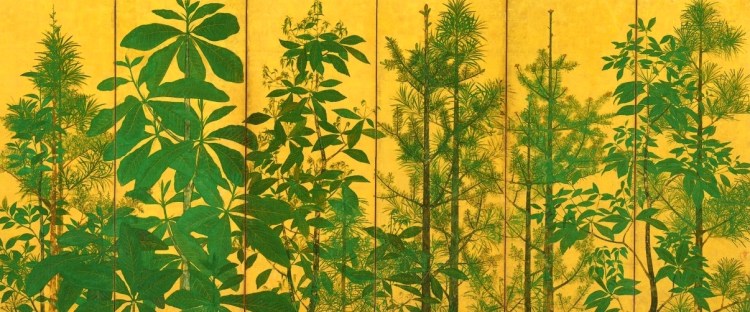
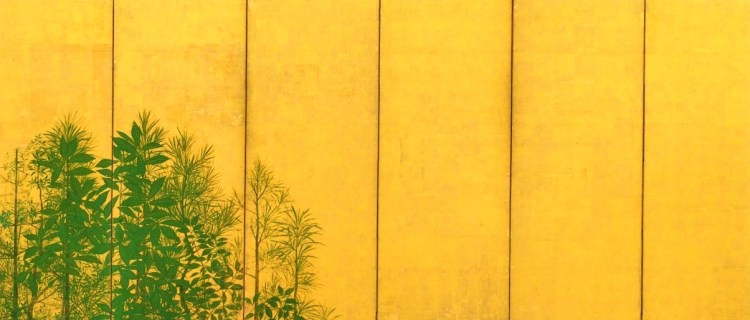
When I was in DC over the Thanksgiving weekend, it goes without saying that I visited the ongoing Sôtatsu: Making Waves exhibition at the Freer and Sackler Galleries. Outstanding works of art from a time in Japanese history which I like very much, especially as my favorite tsuba maker and one of my most favorite Japanese artists were active then, Umetada Myôju (埋忠明寿) and Hon’ami Kôetsu (本阿弥光悦). Back home, I was once again going through some of my earlier drafts to remember how they all, i.e. Sôtatsu, Kôetsu, and Myôju were connected and whilst I was bringing together and restructured half-finished articles, I thought I better post the result on my site rather than leaving it, again, hidden somewhere on my HD. In this sense, I would like to proceed by introducing each of the artists for himself and working out their relation at the end of each corresponding section. But first of all, I would like to introduce an artwork from the exhibition which impressed me the most, and which is not even by Sôtatsu himself (it is from his studio).
Sotatsu1

Sotatsu2

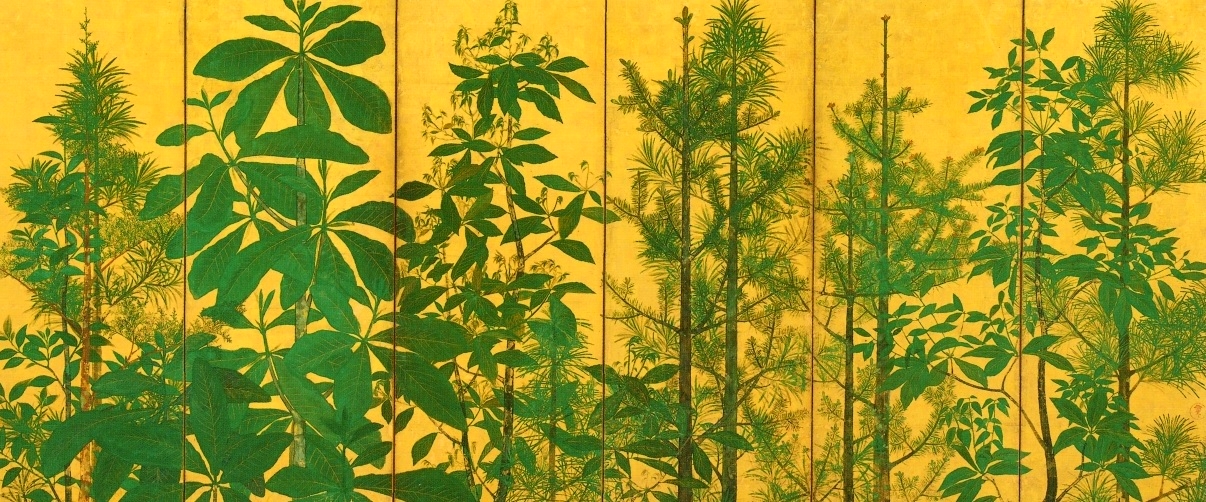
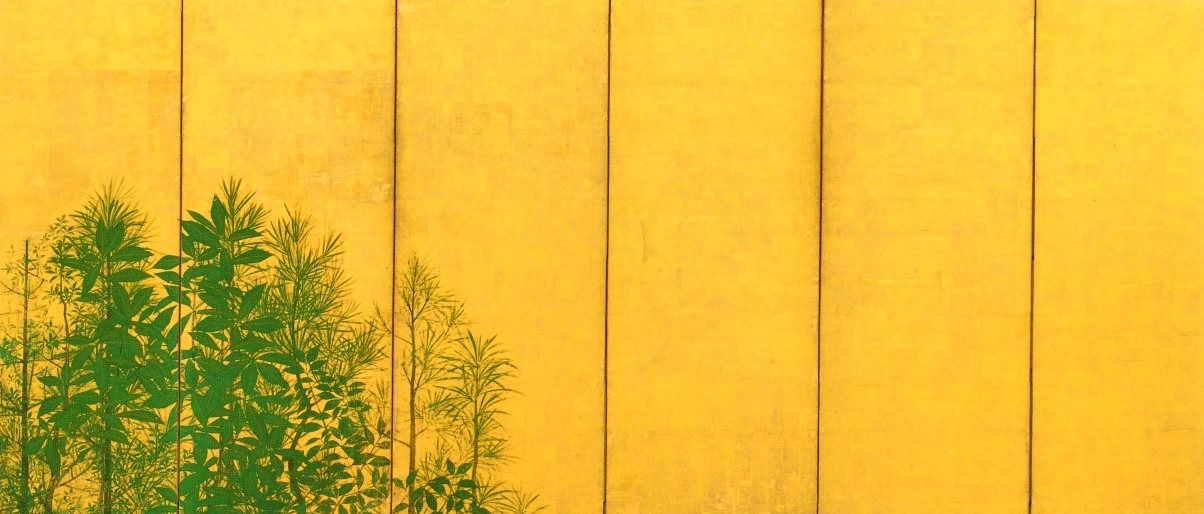
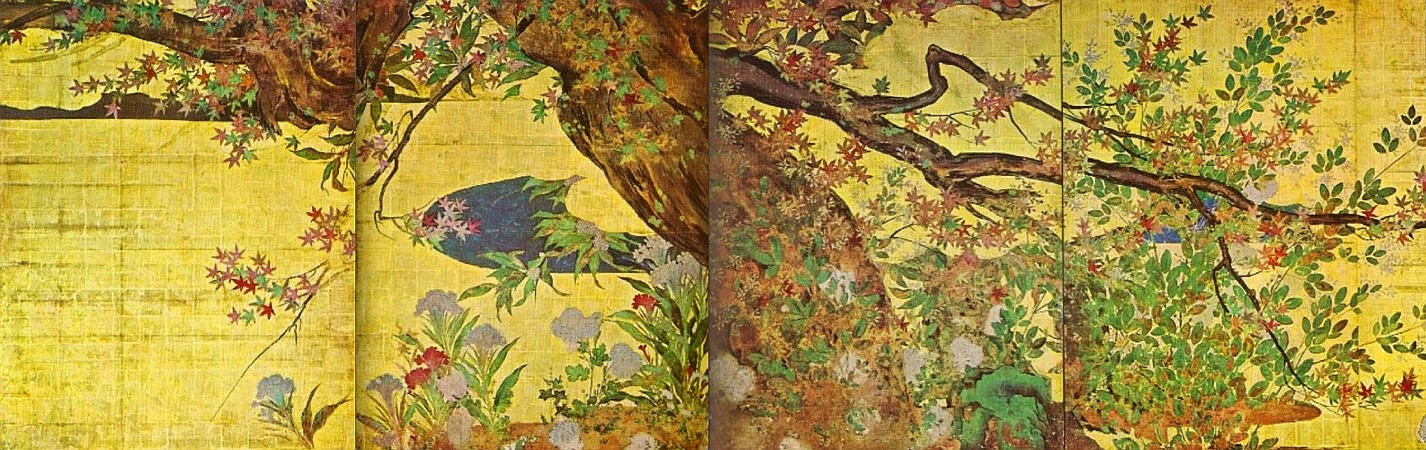
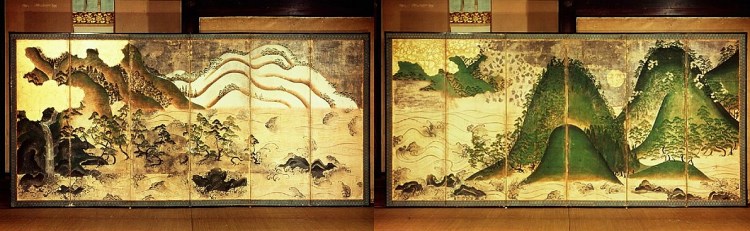
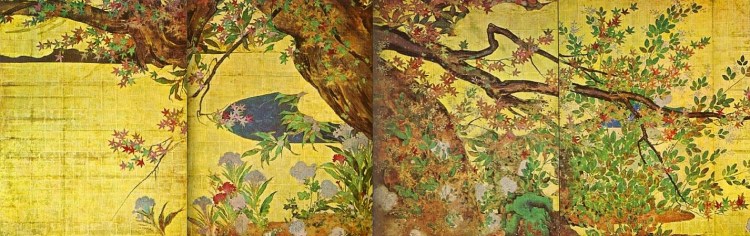
It has the brief title Trees and is a pair of six-panel folding screens that depicts a variety of evergreen trees lined up across a gold-foil ground, to quote from the catalog. One of the screens is filled with trees whilst of the other more than half is left empty, leaving just the golden ground as decorative element. The trees are interpreted in a very realistic manner and even if the emphasis is on presenting the widest variety of evergreens, they go so perfectly together as if you are standing in front of a forest that naturally grew that way. You just have to see it in person, that means from the distance it was meant to be appreciated, namely in a dimly lit room with the gold acting as intensifier for each and every light source and being so to speak a true successor of the grandeur of the Momoyama era (the screens are dated to the Kan’ei era [1624-1644] by the way). That means, the decorative effect is kept but the realistic interpretation already goes in a different direction, away from the bold interpretations of the Momoyama era. For a better understanding of the art, and of paintings of the Momoyama era in particular, you must not only focus on what was going on at that time but you also have to look back. In the Kamakura period, painting had been very much influenced (and commissioned) by the clergy, or had been narrative, but the China-orientation of the Ashikaga-bakufu during the Muromachi period created a boom in secular paintings depicting just landscapes, the four seasons, trees or flowers for example, all of that primarily drawn from trigger words of Chinese legends. In the course of this development, painters eventually started to go “fully secular” towards the end of the Muromachi period. For example, screens with not just legendary Chinese but with concrete Japanese sites appeared that were made for not more and not less than admiring domestic beauties of nature. Of course, the effect of many of these paintings was intensified with the help of Japanese sentiments, i.e. a solitary pine on a rock was not just a beautiful pine but alluded to loneliness. You get the picture. This impressionistic approach runs like a continuous thread through all of Japan’s high art anyway, first by formulated scenes from the classics, later merely by allusions.

Then the chaos of the Sengoku era was ended by Nobunaga and his successor Hideyoshi and a phase of prosperity and extraordinary amount of construction took place. That means, when Nobunaga finally ended all the mess that was going on due to the power vacuum left by a weakening to virtually non-existing Ashikaga-bakufu (and local hegemons getting stronger and stronger, trying to come into power) and Hideyoshi continuing his policies, people, especially in Kyôto, felt that this might be peace after all. I mean, Hideyoshi’s campaigns to unify the country were still going on until 1590 but that concerned first and foremost the more remote regions like Kyûshû and Kantô. At the same time, the mentioned local hegemons constructed enormous castles and residences to underline their status, capability and wealth, and this is especially true for Hideyoshi and his projects in and around Kyôto. In addition, Nobunaga and Hideyoshi have sponsored renovations and reconstructions of countless palace and religious facilities to get as an exchange court titles and lands. And all this lead to a unprecedented number of patrons who were more diverse than ever before. Now not only the bakufu employed artists like that of the Kanô and Tosa Schools were thriving but independent artists were able to get a foot in the door and that more or less just on the basis of their talent (and the ability to sell oneself of course).
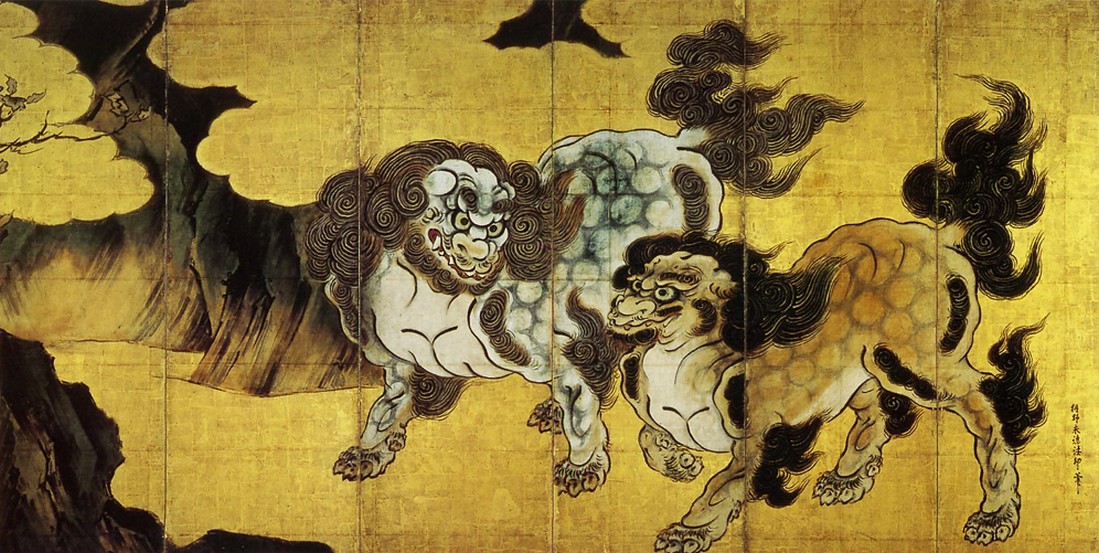
Eitoku

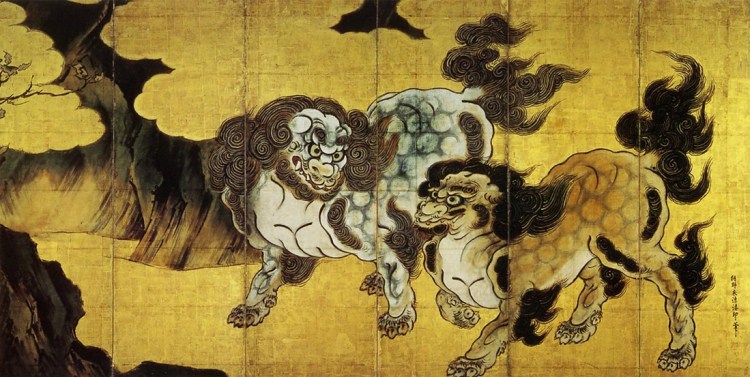
Chinese Lions, Kanô Eitoku, Imperial Household Collection, Late 1580s
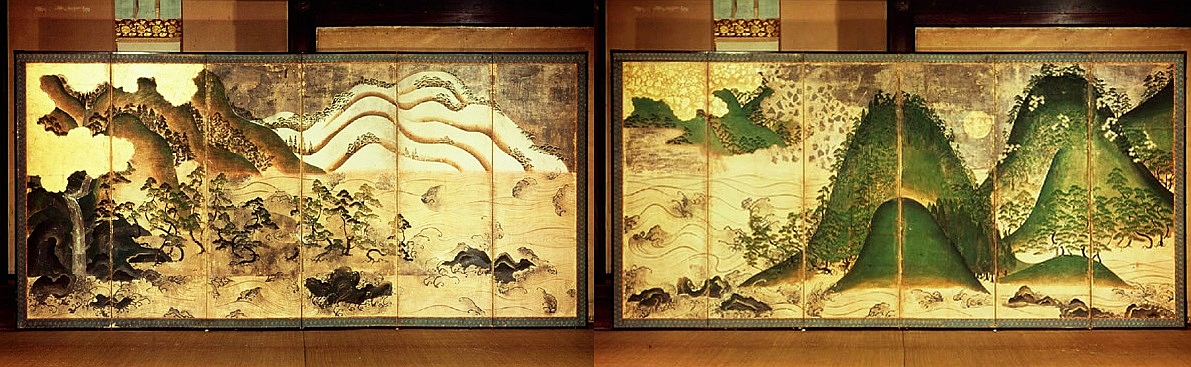
Kongoji2

Landscape with the Sun and Moon, jûyô-bunkazai, unknown artist, mid-16th century, Kongôji (Ôsaka Prefecture)

It has to be mentioned that the course was basically dictated. That is, all the golden screens and paintings with their prima facie easy-to-grasp ornamentation were born to a certain extent out of the need to create artworks that are visually perceptible and appreciable from a certain distance for the ever growing rooms and halls. One of the greatest trendsetters was, of course, an established, prestigious painter from one of the main lines, Kanô Eitoku (狩野永徳, 1543-1590), who had the honor of working directly for Nobunaga and Hideyoshi. But even Eitoku, see picture above, referred to extant interpretations like for example to the early Muromachi period Landscape with the Sun and Moon screens from the Ôsaka Kongô-ji that already introduces some gold (see bottom picture above, and don’t compare the two screens directly, just their aesthetical concept). So as indicated, the ornamental path was kind of laid out, i.e. the Momoyama artists did not start to paint in that ornate way out of the blue, but it was the unique background of peaceful and thriving Momoyama-era Kyôto that created such a highly fascinating momentum in Japanese art history. And this does not only apply to paintings but also two sword fittings. One of the first (and probably the most famous) of the new and independent, that means non-bakufu employed painters, was Hasegawa Tôhaku (長谷川等伯, 1539-1610). Tôhaku was a professional painter from Noto province who moved to Kyôto to study under the Kanô School and when his contemporary Eitoku died in 1590, he found himself as official painter for Hideyoshi. His most representative “Momoyama Kanô-style” work is shown below. Well, many many books have been written on each of these artists and aspects and I tried to break down the background of the Momoyama era (visual) art world as much as possible for the introduction to this humble article.
Tohaku

Maple, kokuhô, Hasegawa Tôhaku, 1592/93, Chishaku’in (Kyôto)

*

Tawaraya Sôtatsu

And with this we arrive at Tawaraya Sôtatsu. Surprisingly little is known on the person Sôtatsu for an artist of his influence (three of his works are designated as kokuhô for example). First of all, we don’t know when he was born and when he died but as his son and successor Sôsetsu (宗雪) was granted with the honorary Buddhist title of Hokkyô in Kan’ei 19 (1642), a title that had been granted before to his father, it is assumed that Sôtatsu had either died shortly before or retired and died shortly later as Sôsetsu moved for good to Kanazawa the following year. The first time Sôtatsu appears in written history is when he was repairing famous late Heian sutra scrolls for Fukushima Masanori (福島正則, 1561-1624) in Keichô seven (1602). Masanori was at that time the daimyô of the Hiroshima fief of Aki province and the scrolls, that were preserved in the local Itsukushima-jinja, so to speak under his jurisdiction. So Masanori paid for the repair work but did not go to Kyôto himself to pick a fan painter (more on that soon) to work on “his” treasured scrolls. It was the Kanô school painter Kaihô Yûshô (海北友松, 1533-1615) and favorite of Hideyoshi and Emperor Go-Yôzei (後陽成天皇, 1571-1617) who had travelled to the Itsukushima-jinja in 1598 to study the famous scrolls. So it was him who “convinced” Masanori to have them repaired and it is safe to assume that it was him too who suggested a capable artist to go with for this project. Anyway, we know that Sôtatsu ran the Tawaraya (俵屋) at that time, a painting shop that – unlike the large, bakufu and court serving Kanô studio – focused on ready-made objects. The Tawaraya, Sôtatsu’s family name was Nonomura (野々村) by the way, was first and foremost a fan shop but also sold smaller art objects like hanging scrolls and poetry sheets. Back then, quite an importance was attached to fans. They were a fashion accessory that not only demonstrated style but to a certain extent also social status and the very mood at that day. They were also perfect gifts as their decorations often bear subtle messages, transported through visual quotations from classical literature, narratives of war, and romance, to use again words from the catalog to the Sôtatsu exhibition. With the Tawaraya’s customer base in mind, i.e. the local machishû (町衆), the Kyôto upper class to put it simply, it is understandable that artistic objectives were set very high. I mean, these customers were well-versed in art and the classics and to not hold up to ridicule among their circles, they were only going for the best of the best. We don’t know much about the ventures of Sôtatsu in the first two decade of the 17th century but we do know from records that at the latest by Genna two (1616), Emperor Go-Mizunoo (後水尾天皇, 1596-1680) was aware of the work produced by the Tawaraya. Also we know that Sôtatsu had became a very close friend of courtier, poet, and painter Karasumaru Mitsuhiro (烏丸光広, 1579-1638) by then and it is assumed that it was Mitsuhiro who provided all the good connections. It is unclear when Sôtatsu had fully arrived in court circles but usually the Genna era (1614-1625) is quoted in this respect. In 1630, he received the aforementioned honorary title of Hokkyô, a great and unusual honor for an “outsider” artist like him and by then, he had virtually became a court painter, carrying out commissions for the highest of the highest clientele.

*
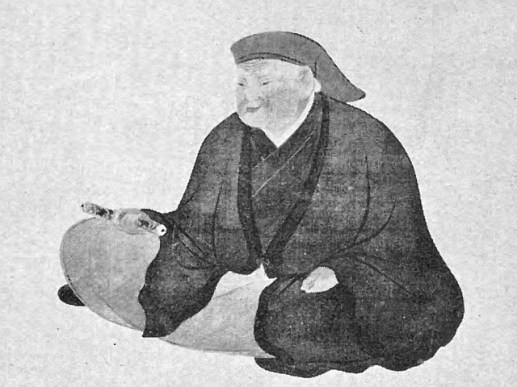
Koetsu

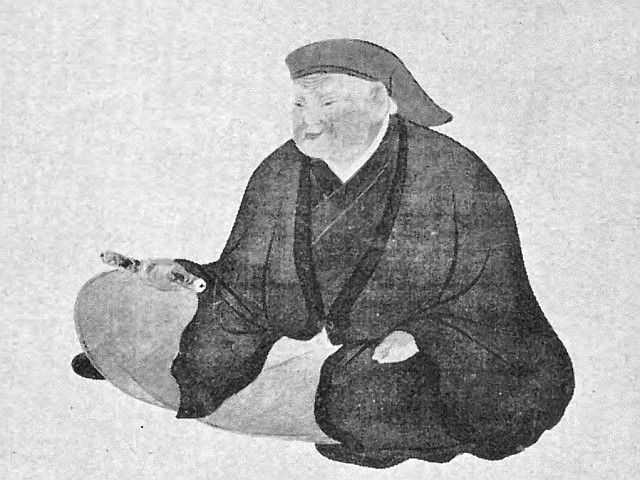
Hon’ami Kôetsu

Kôetsu (see picture above) was born in Eiroku one (1558) into the prestigious Hon’ami family of sword appraisers and sword polishers to the bakufu. The Hon’ami lineage into which Kôetsu was born, the Kôji (光二) lineage, was primarily working for the wealthy Kaga Maeda family, receiving impressive 200 koku per year. Kôetsu however, the second generation of the relative young Kôji lineage, did not focus that much on swords but turned out to be an allround artist and besides calligraphy, he was a passionate potter, a lacquer artist, publicist, and follower of the tea ceremony, mastering each of these arts entirely. By the way, it is assumed that he had passed on all his professional sword obligations to his adopted son-in-law Kôsa (光瑳, 1574-1637) who succeeded as third generation Kôji-Hon’ami. When it comes to painting, there is the theory that Kôetsu has been a student of the aforementioned Kaihô Yûshô and that it was the latter who introduced him to Sôtatsu. Like it is the case with Sôtatsu, Kôetsu’s exact connections remain to a certain part unknown but what we do know is that he was independent by nature, and a versatile genius with an unfailing sense of taste. So whilst Kôetsu was strengthening his cultural and business relations in Kyôto in the decade after Sekigahara, Ieyas was about wiping out the remaining important members and abiders of the Toyotomi clan. And when he finally did so by capturing Ôsaka Castle in 1615, he offered Kôetsu an official position in the bakufu for 300 koku per year, 100 koku more than the Maeda were paying him. But Kôetsu declined with thanks as he avoided going to Edo by all means as the new and hardly developed capital was then totally uninteresting for an artist like him. As “compensation,” Ieyasu granted him a plot of land, Tagamanine (鷹峯), located on the northern outskirts of Kyôto and on the northeastern slopes of Mt. Daimonji (about 5 miles from present-day Kyôto Station). Well, there are now two approaches to explain this gift: One says that it was really a gift of Ieyasu, the lands of yielded later decent 176 koku per year and had tax exempt status. But the other one says it was more like an exile to keep Kôetsu out of Kyôto politics because Ieyasu did not fully trust him. One of Kôetsu’s close friends namely, tea master and warrior Furuta Oribe (古田織部, 1544-1615), had just been forced to commit seppuku because of his alleged loyalty to the Toyotomi so everyone with whatsoever ties to this family was treated by Ieyasu with suspicion. Anyway, Kôetsu turned Takagamine into an artist community with a relative strong religious touch, housing more than 200 residents and also agricultural fields. Incidentally, the records differ on the size of Takagamine and either list 30 or 25 ha for the entire plot. Invited to live there and provided with a house were for example Kôetsu’s paper and brush makers, makie artists, members of his own family and of the Hon’ami main line, and the wealthy draper Ogata Sôhaku (尾形宗伯, 1570-1637) who had excellent relations to the Imperial family and who also was Kôetsu’s nephew. Sôhaku’s father Dôhaku (道伯) was married to Kôetsu’s older sister and his grandson Kôrin (光琳, 1658-1716) went down in history as name giver of the Rinpa School (琳派) of painting. Sôtatsu’s collaboration basically took place before the establishment of Takagamine but some of the last joint artworks date 1615 or shortly after. Recent studies strongly suggest that both artists must have worked simulatenously in a session or at least very closely together on these artworks, the famous scrolls with the gold and silver paintings (by Sôtatsu) and poems (by Kôetsu). (I have used one of them, the Crane Scroll, which is pre-1615 by the way, as cover for my book on the Hon’ami family.) Incidentally, we find on the map of the allocations of the houses in Takagamine the name of the weaver Hasuike Tsuneari (蓮池常有) of whom some assume that he was somehow related to Sôtatsu. Reason for this assumption is that Sôsetsu’s successor of the Tawaraya, Sôsetsu (相説), was from the Kitagawa family (喜多川) and the Kitagawa were a branch of the Hasuike.
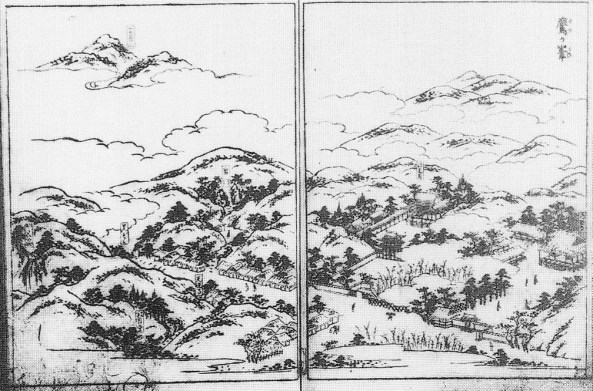
Takagamine

Takagamine as seen in the Miyako Meisho Ezu (都名所絵図, 1780)

*

Umetada Myôju

Myôju was born in the same year as Kôetsu, Eiroku one (1558), and his family too was working on a hereditary basis for the bakufu. The Umetada were not only swordsmiths but also made certain sword fittings and were also responsible for arranging koshirae. That means, the Umetada received the blade from the smith, or in the case of an old blade from the customer, and the tsuba and the other sword fittings from the tsuba and sword fittings maker respectively, for instance from other prestigious bakufu-employed lineage like the Gotô (as far as sword fittings like mitokoromono are concerned). In a next step, the Umetada first equipped the blade with a new habaki as the habaki has to be tailor-made to the blade and as a proper saya can not be made before the blade has a tailor-made habaki. The tsuba was adjusted to the blade either by punches around, or by inserting soft-metal pieces on top and bottom of the nakago-ana. The wood and lacquer work and the hilt wrapping and so on was commissioned to family members or sub-contracting craftsmen and the Umetada family had, depending on the specification of the customer, more or less artistic freedom in arranging the koshirae. And then there were two important task which connected the Umetada to the Hon’ami family. One was the shortening of blades, and the other one was to inlay (in gold or silver) the attribution of a sword the Hon’ami had forwarded them on its tang. We know from records that the Umetada family also dealt with swords, or bought up “hidden treasures” to submit them to the Hon’ami for authentication and attribution – the kinzôgan-mei carried out in the own workshop of course – to sell them later for five times the purchase price for example. So the two families were pretty closely linked. But back to Myôju. We don’t know for sure when and how he came in touch with Kôetsu but we can try to guess what was going on. Myôju started his career as a swordsmith and the earliest extant dated swords are from Keichô two (1597), from a time when he signed with “Muneyoshi” (宗吉). He was already 40 years old at that time. Also we learn from a signed sword by one of his master students, Hizen Tadayoshi (肥前忠吉), that when Tadayoshi came to Kyôto to learn from the Umetada in Keichô one (1596), still Myôju’s father Myôkin (明欽) was the head of the family. The name change to “Myôju” took place two years later, in Keichô three (1598), and it is assumed that this was the time when he took over the forge. But then something odd happens, that is, a gap of almost ten years from which no swords are known. The next known dated blade after the Keichô three one is from Keichô twelve (1607). I mean, there was Sekigahara going on just two years after his succession as Umetada head and there was thus surely a need for newly made swords. Well, it is possible that he was forced to produce in masses for a certain time and to deliver the majority of these blades unsigned as it was customary for fulfillments of bakufu orders. But after everything had calmed down, we are still facing a gap of at least five or six years and this phase of “unproductiveness” seems rather odd for a master swordsmith like him. Now we know that he handed over the management of the Umetada forge and workshop to his younger brother Jusai (寿斎) some time during the Keichô era (1596-1615) and everything points towards that he did so to have more time to cultivate his contacts with the then Kyôto art world. At this point it has to be mentioned that there are outstanding tsuba extant by Myôju that really take up the unique style of the Momoyama era (see picture below) and thus we may assume that he gave up the forge right after Sekigahara to focus for several years on developing a very special kind of tsuba. It has to be mentioned that Myôju was also a great engraver (horimono-shi) and that he trained several craftsmen in this art who turned out to become masters themselves. In other words, Myôju was well versed in working with steel and soft metal, in performing gold inlays, and he knew how to guide a chisel.
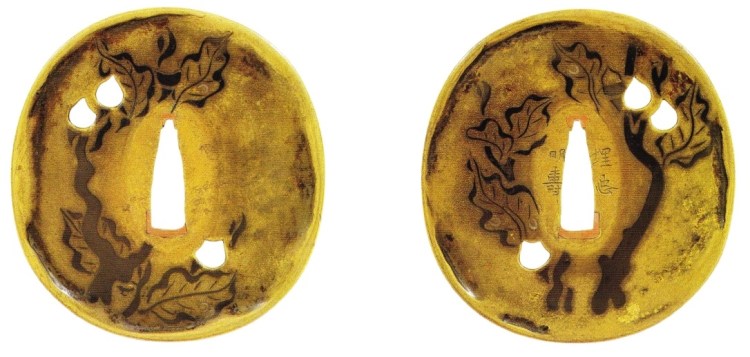
Myoju

tsuba with oak motif, jûyô-bunkazai, mei “Umetada Myôju,” Momoyama era, brass with a slightly raised shakudô hira-zôgan ornamentation and ko-sukashi, owned by the Hôeidô Corporation

Now how does Myôju go in line with Takagamine? Well, Kôetsu and Myôju knew each other pretty well, that is from their related jobs and from the fact that they both lived in Kyôto and moved in the local machishû circles. And by the way, the Hon’ami residence was just across the Horikawa-dôri from the Nishijin district where the Umetada workshop was located, i.e. just a stone’s throw away. It is unclear if Myôju made all of his Momoyama-style tsuba in the “ten year break” from sword forging or if he made them at the side until the end of his career. The year after the break, i.e. 1608, must have been a busy one as far as sword forging is concerned as about one third of all known dated blade goes back to that year. Also we know that his training of horimono-shi concentrated on the later years of the Genna era (1615-1624). Apart from that, he never gave up sword forging because there exists a blade, a ken, that was made just two months before his death, which was in Kan’ei eight (1631) by the way (Kôetsu died six years later in Kan’ei 14, 1637).

A very interesting entry is found on an extant map of Takagamine that mentions all the house owners of the community. Therein we find a certain “Umetada Dô’an” (埋忠道安) who lived in the town house directly opposite from the residence of Kôetsu (see detail below). Now the name Dô’an does not appear in any of the Umetada genealogies but experts assume that it is either an otherwise unknown pseudonym of Myôju or that a very close family member of Myôju lived in that house. The former approach, i.e. Dô’an being a pseudonym of Myôju, is explained by the religious orientation of Takagamine. We know that Kôetsu was a faithful Nichiren (Hokke) follower and that he also acted as a spiritual leader of the artist community. At that time, “Dô” (道) was a popular character to form one’s Hokke name from and it is possible that Dô’an was the lay name of Myôju that he used in Takagamine after Kôetsu had “convinced” him to follow the religious orientation of the community when residing in Takagamine.
Mumetada

Detail of the Takagamine map: (1) Residence of Kôetsu, (2) townhouse of Dô’an, please note that the name is quoted as “Mumetada Dô’an” (むめたゝ道安).

*

What an exciting time the Momoyama era was for the Japanese art world! I want to deal with Takagamine in more detail at some time in the future and apart from that, I want to dedicate Umetada Myôju one day a book within my series that focuses on certain artists, i.e. in the style of my publications on Kanô Natsuo and Masamune.