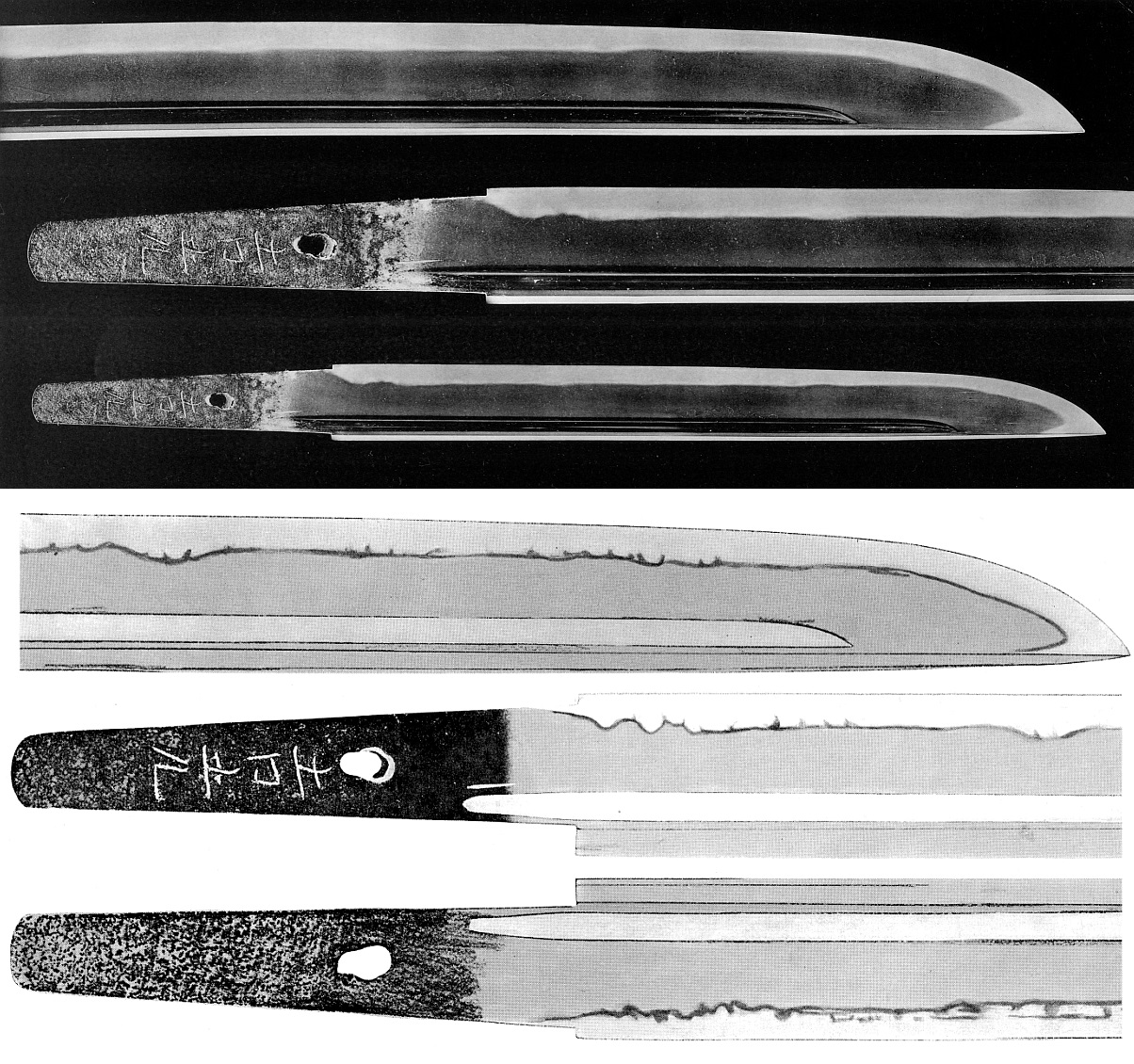
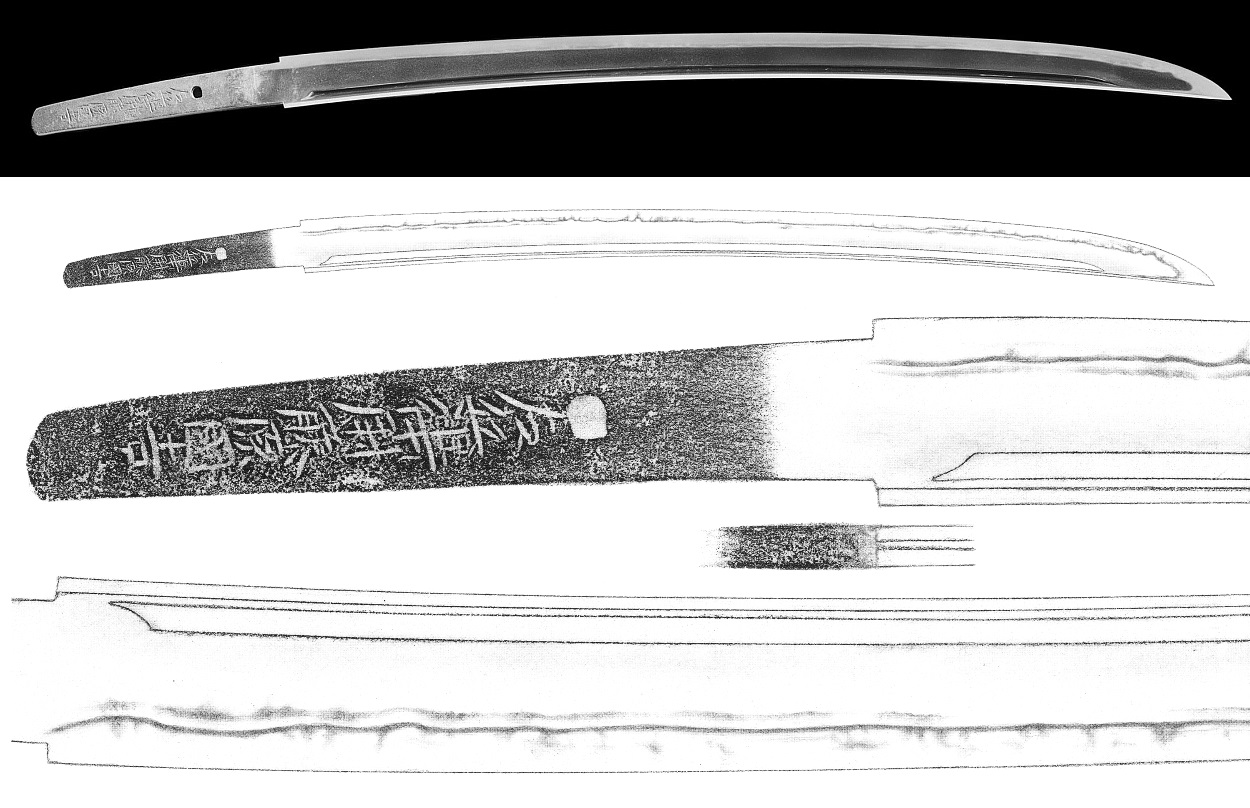
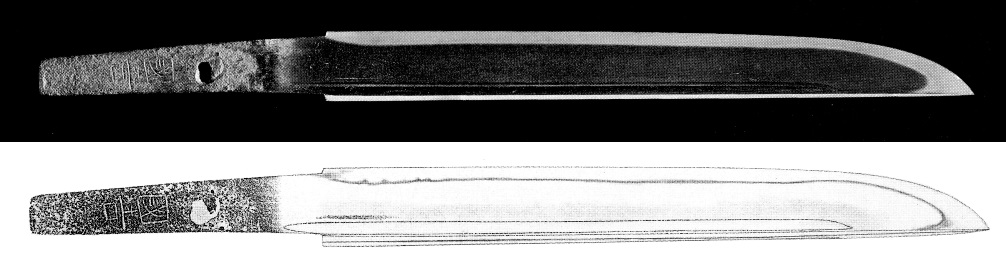
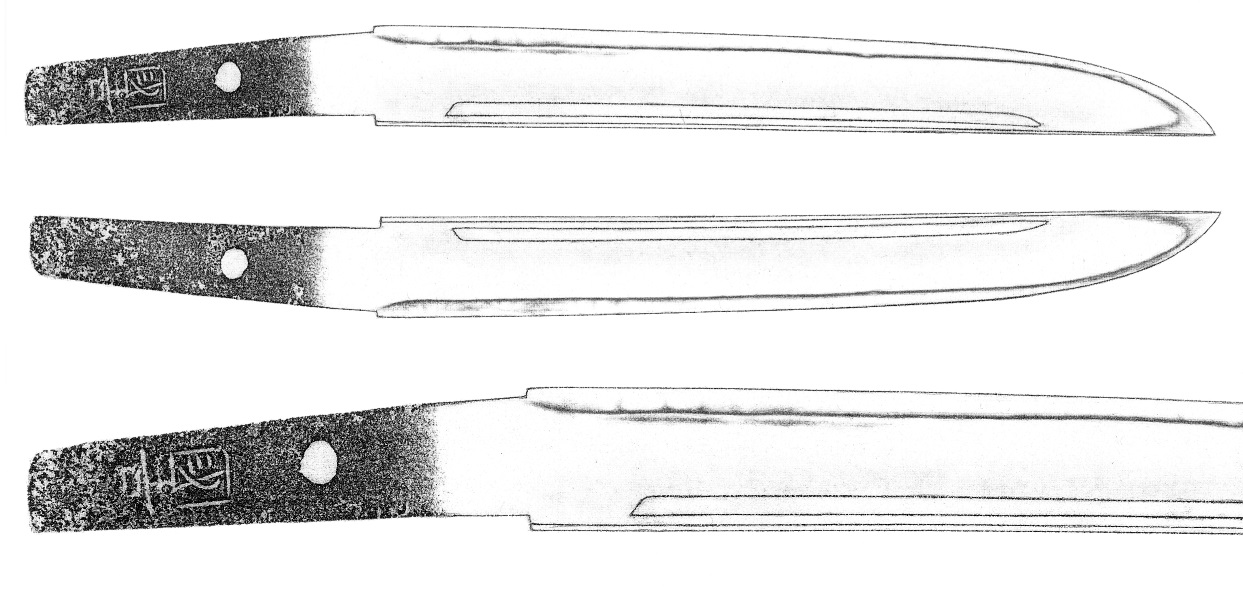
KANTEI 4 – YAMASHIRO #18 – Rai (来) School 4

Rai Kunitoshi was succeeded by his son Kunimitsu (国光) who took over an already very much flourishing Rai School. Well, as so often when talking about such relative early smiths, there are several traditions extant, like that he was actually the younger brother, grandson, or mere a student of Kunitoshi but the widely accepted one is that he was straightforward his son. As for his active period, we know date signatures from Karyaku one (嘉暦, 1326) to Kan’ô two (観応, 1351) and the Kôsei Kotô Meikan introduces a dated blade from Shôwa two (正和, 1313). However, we can assume that he was mostly engaged assisting his father at that time, as daimei works from the first two decades of the 14th century show. Rai genealogies, historic documents, and certain blades (and signatures, more on this later) furthermore suggest that there was a second generation Kunimitsu, but we can’t say for sure when the shift of generations took place. The Kotô Meizukushi Taizen says that the first generation Kunimitsu was born in Bun’ei one (文永, 1264) and died Shôkyô four (正慶, 1335) at the age of 72 but odd here is that the Shôkyô era only counted brief two years. Maybe the author mixed up the then partially overlapping and double counting of nengô eras of the Nanbokuchô era. Anyway, the source also says that the second generation was active around Kôei (康永, 1342-1345) and this approach is also followed by several experts, e.g. Satô Kanzan. Tanobe sensei in turn thinks that the differences in workmanship and signature style of the later works dated with Jôwa (貞和, 1345-1350) and Kan´ô (観応, 1350-1352) might just go back to the advanced age of the master, i.e. that there was maybe just one generation Kunimitsu. But when we take into consideration that his greatest masterworks are dated somewhere around Karyaku (嘉暦, 1326-1329) and Gentoku (元徳, 1329-1331) and assume on the basis of that he had achieved full artistic maturity at that time, it really seems as if the blades made 20~25 years later go back to the hand of a successor. So, to recap: I think that Kunimitsu took over the Rai School pretty soon after the third year of Gen’ô (元応, 1321) as this is the last known dated blade of his father who was then already 82 years old. In case he was the biological son of Kunitoshi, he was already a fully trained master smith at the height of his career at the time he became the newly appointed head of the forge (remember, Kunitoshi was born in 1240). Thus he was able to continue without interruption to satisfy the exquisite customer base of Kunitoshi, therefore the masterwork output right after his succession. In other words, there was no “experimental” post-succession phase which gradually leads to artistic maturity, no, Kunimitsu took the reins being already an undisputed Rai grandmaster. He also ranks about equal to his father Kunitoshi when it comes to designations by the Agency of Cultural Affairs and the NBTHK, 26 in terms of the former (3 kokuhô and 23 jûyô-bunkazai), and slightly over 200 (about 180 jûyô and more than 20 tokubetsu-jûyô) in terms of the latter category.

Now to Kunimitsu’s workmanship, beginning again with long swords. Kunimitsu did make some classical and slender tachi with a ko or rather a smallish chû-kissaki but the majority shows a more or less elongated chû-kissaki and a mihaba that does not taper that much and as stated in some of the previous posts of this kantei series, I am a sugata guy and this is for me a key element in distinguishing him from Kunitoshi. In short, his tachi are just overall more magnificent and wide and give us some idea of what is coming, and that is the heyday Nanbokuchô trend to overall larger blades. No wonder, was most of his career taking place in the Nanbokuchô period anyway (i.e. Rai Kunimitsu was active from the very end of the Kamakura to the beginning of the mid-Nanbokuchô period). However, it is interesting to see that his signed blades are by trend from the more classical and elegant camp but this again is insofar actually not that odd as the wider and more magnificent blades were all of a longer nagasa too and got therefore shortened (and lost their mei).

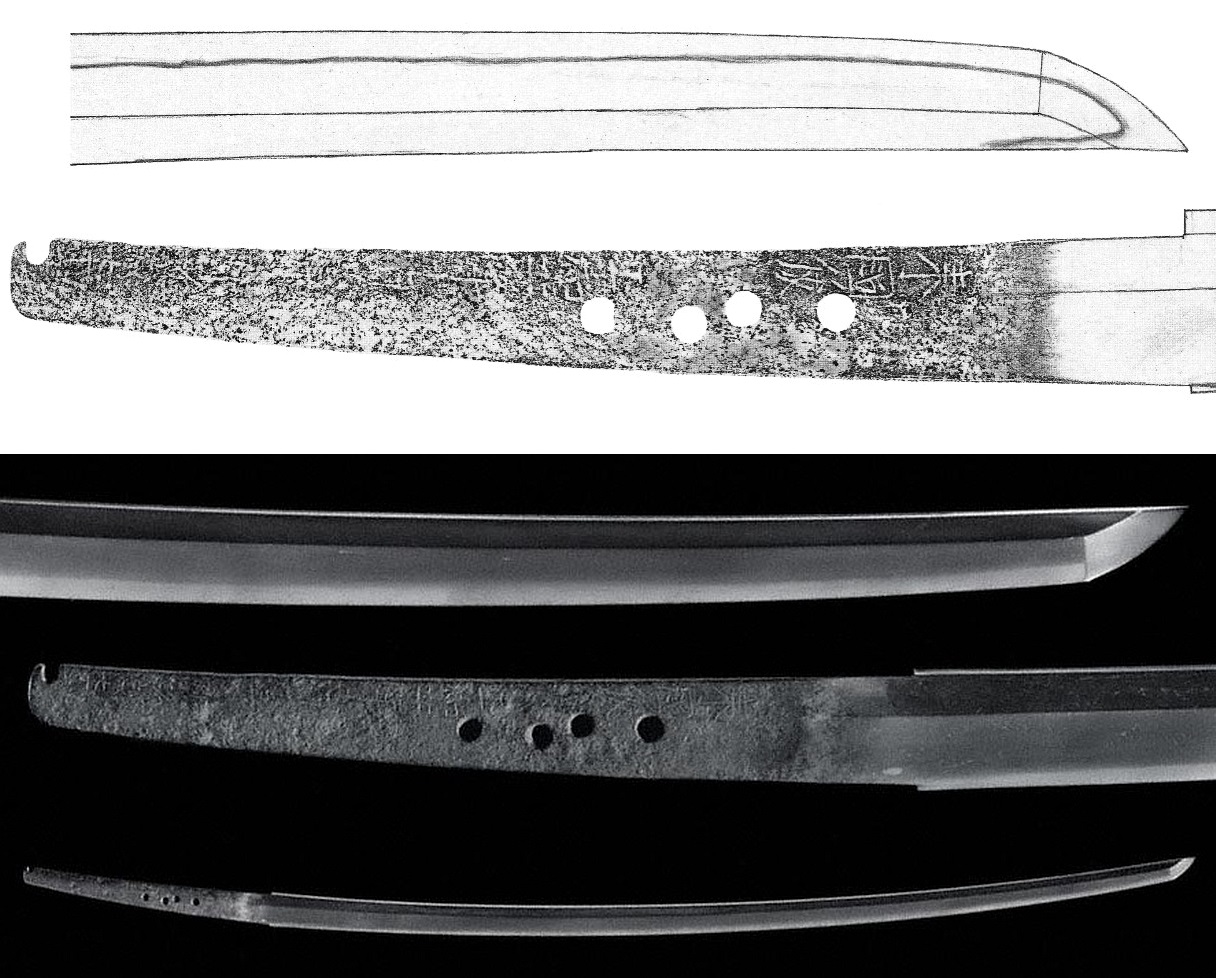
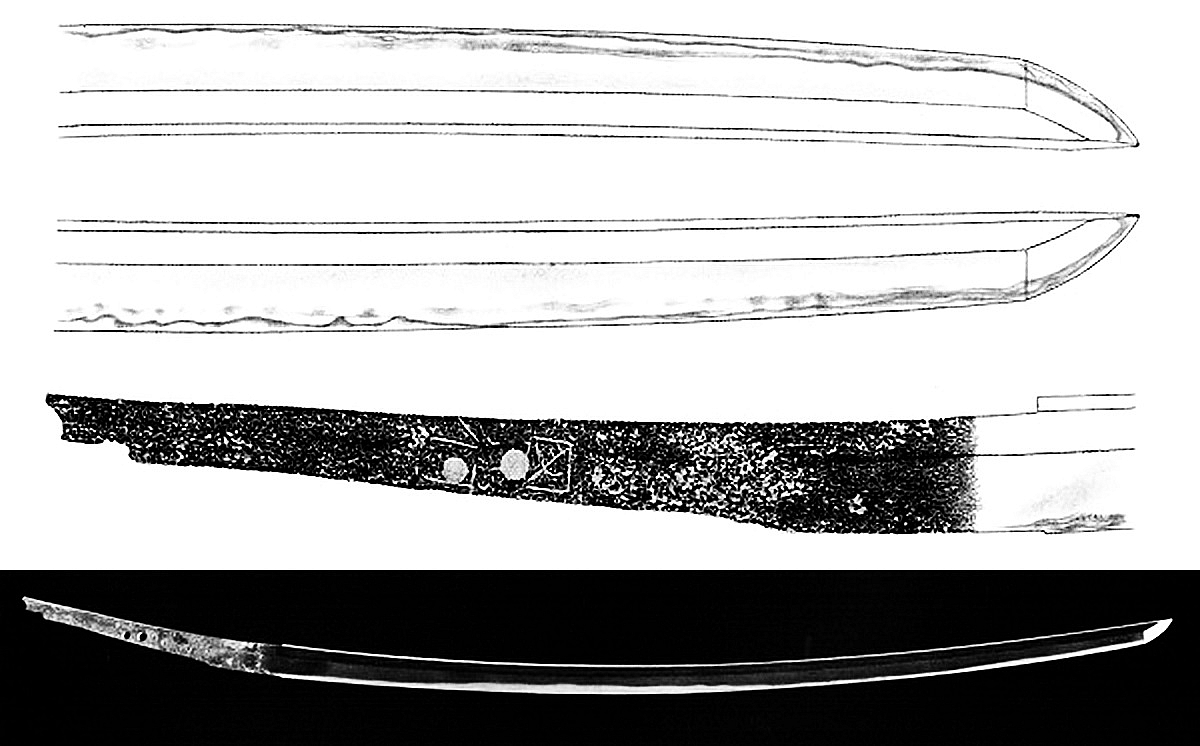
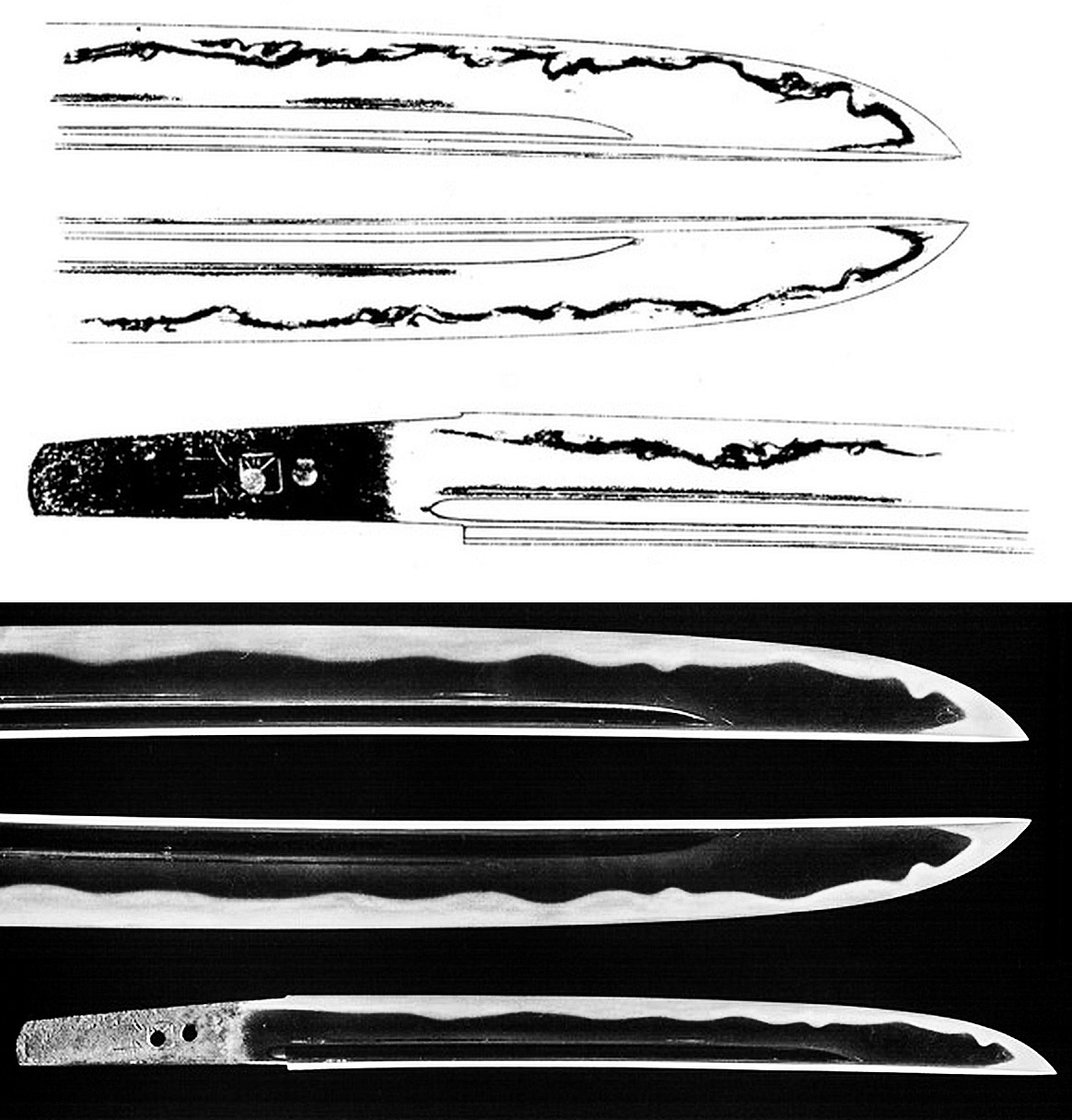
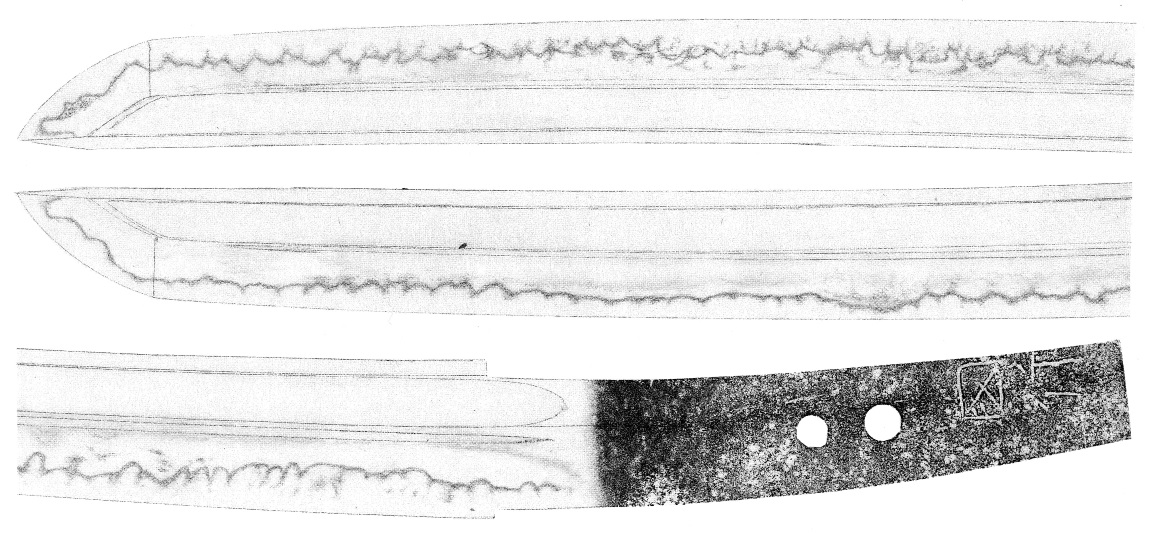
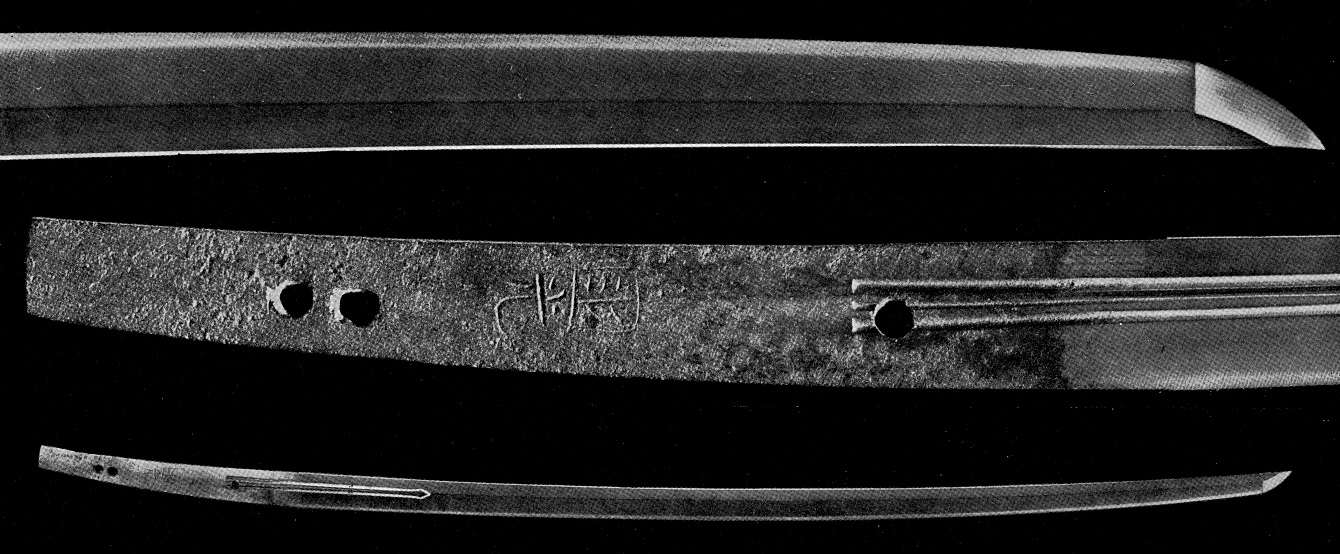
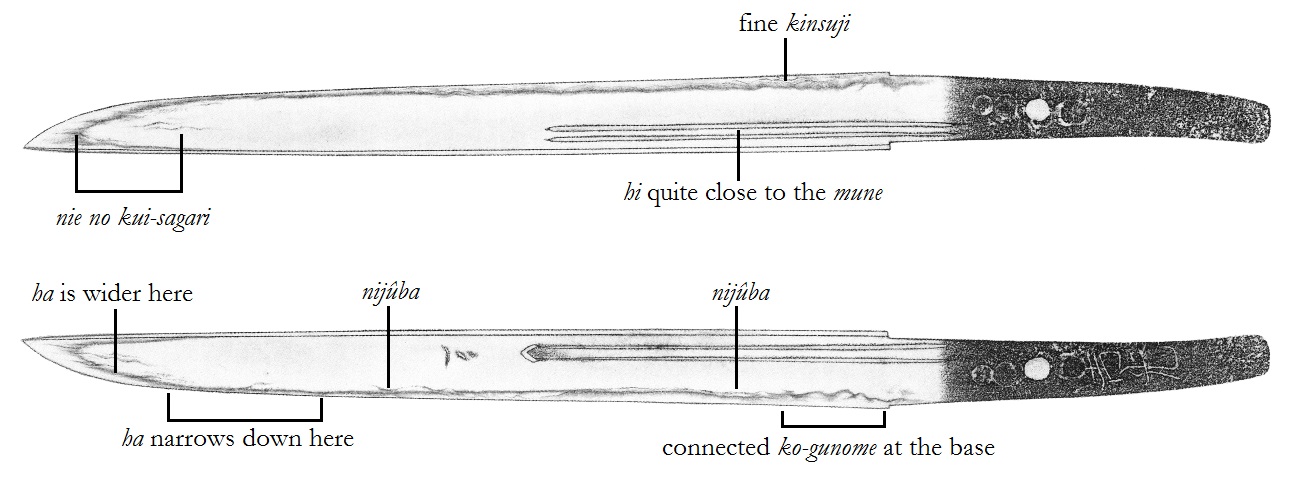
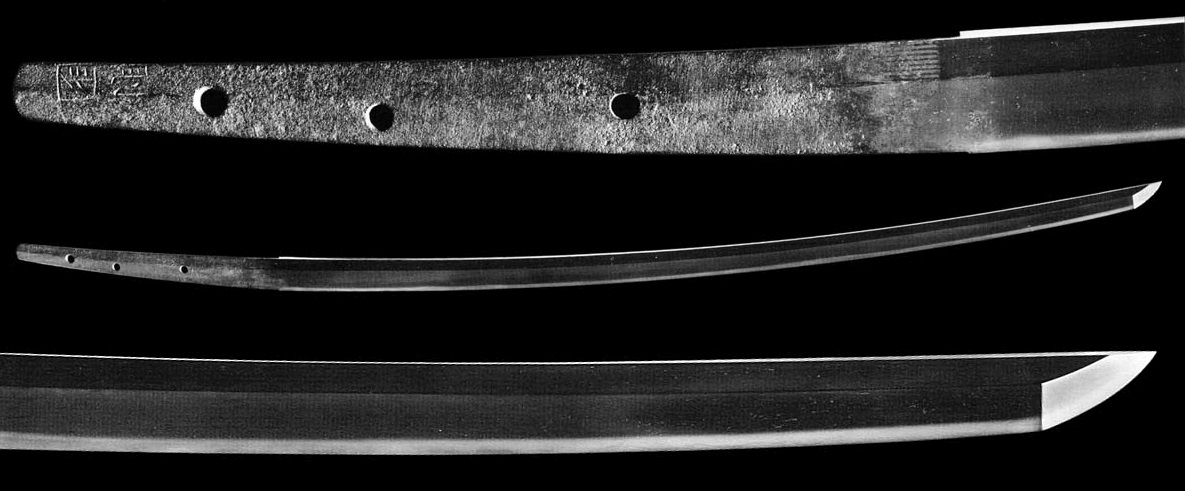
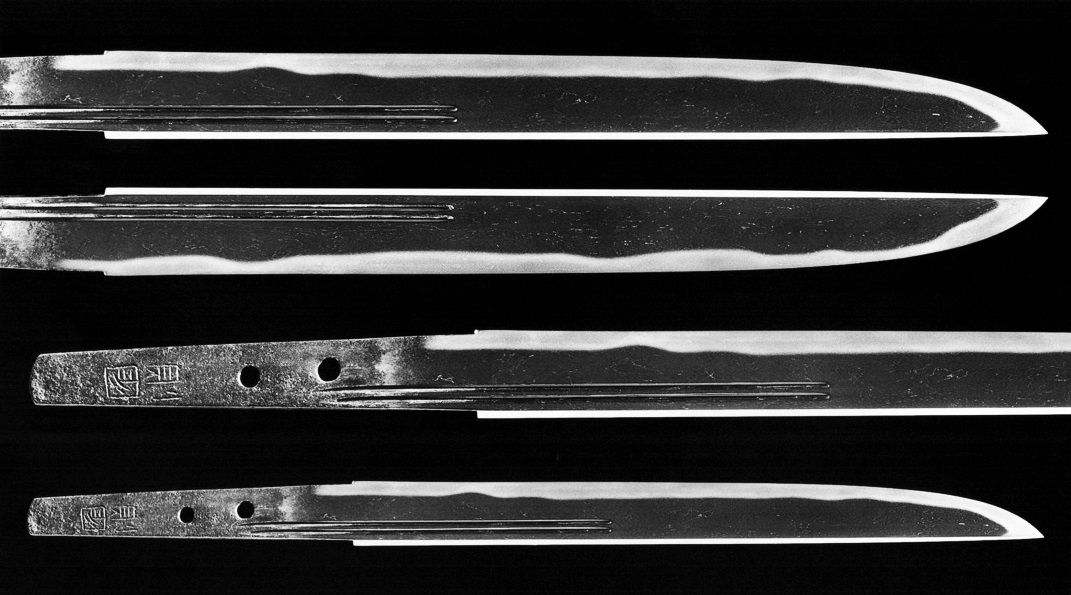
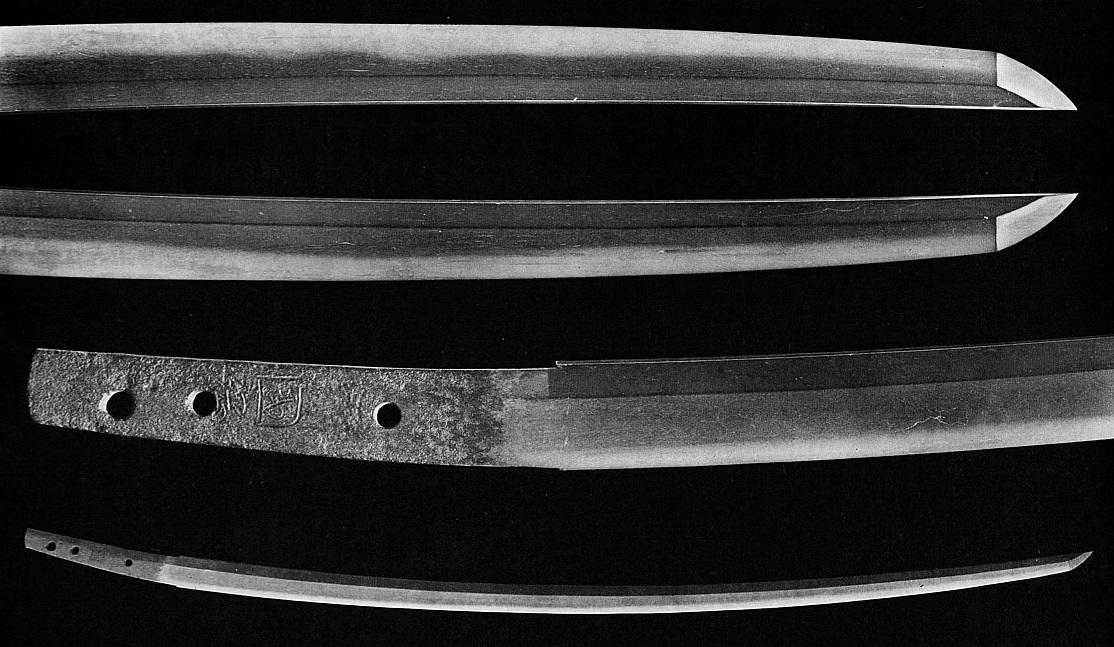
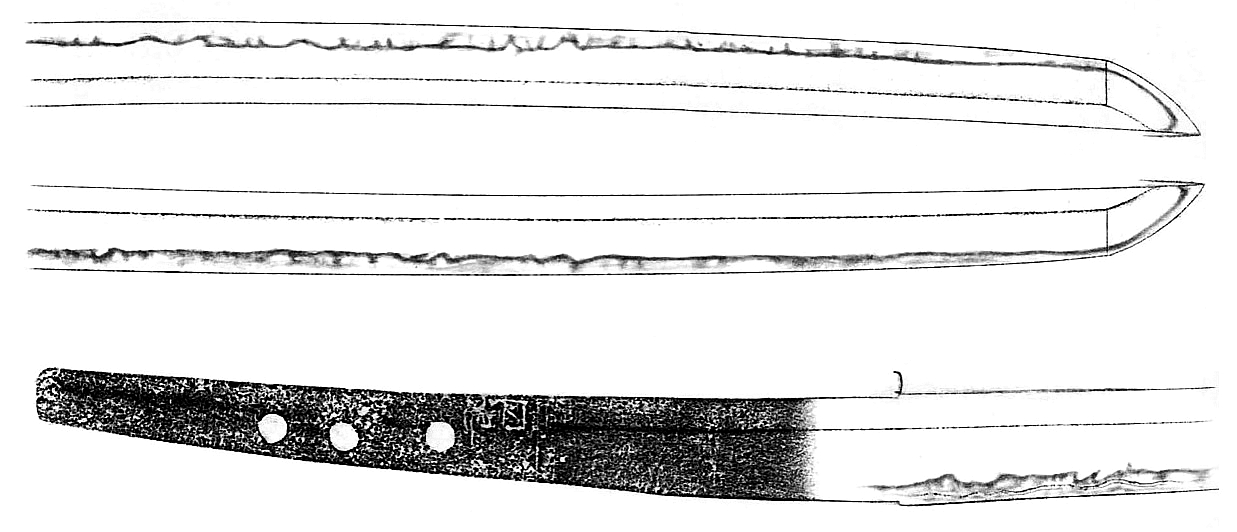
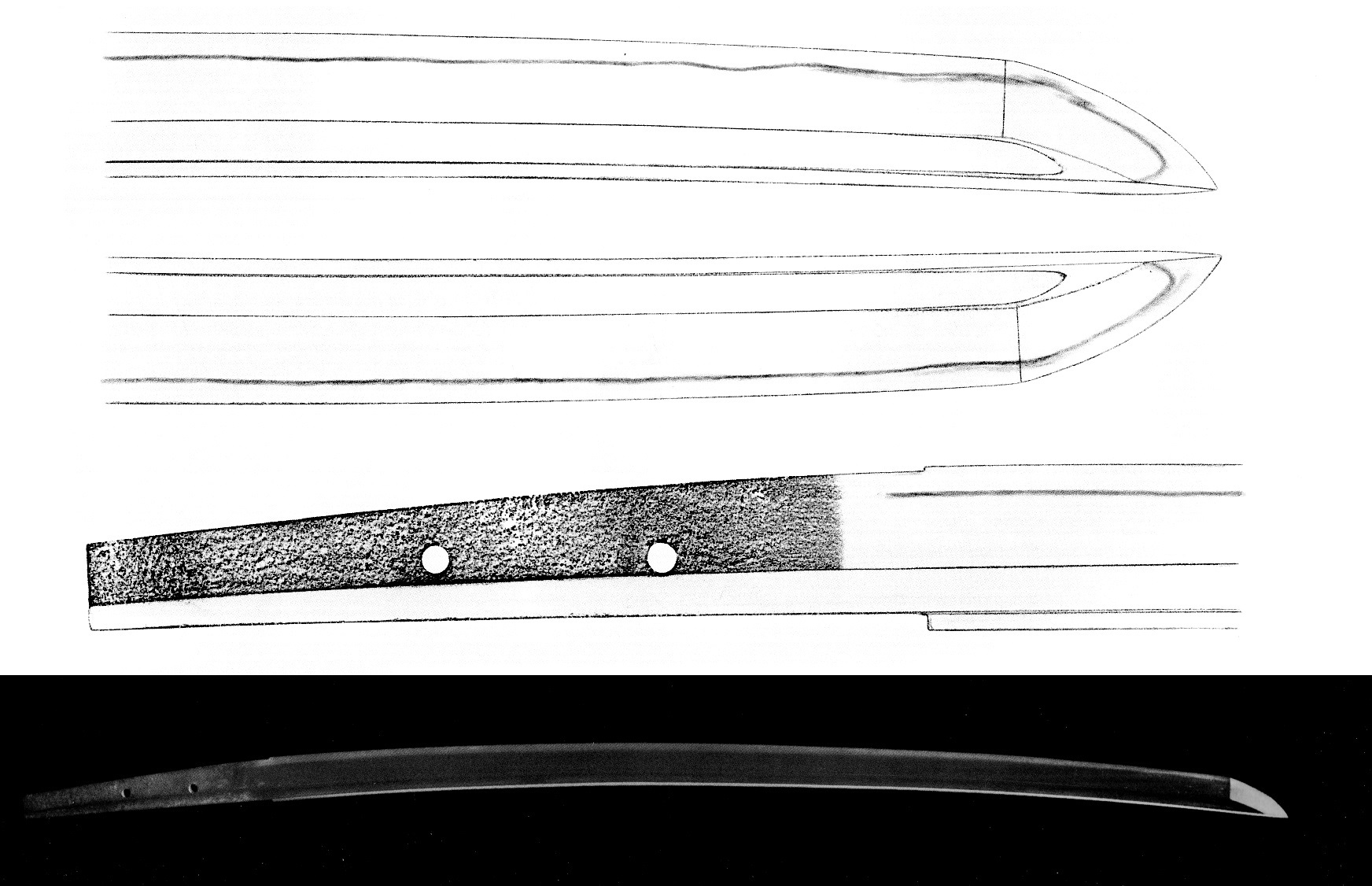
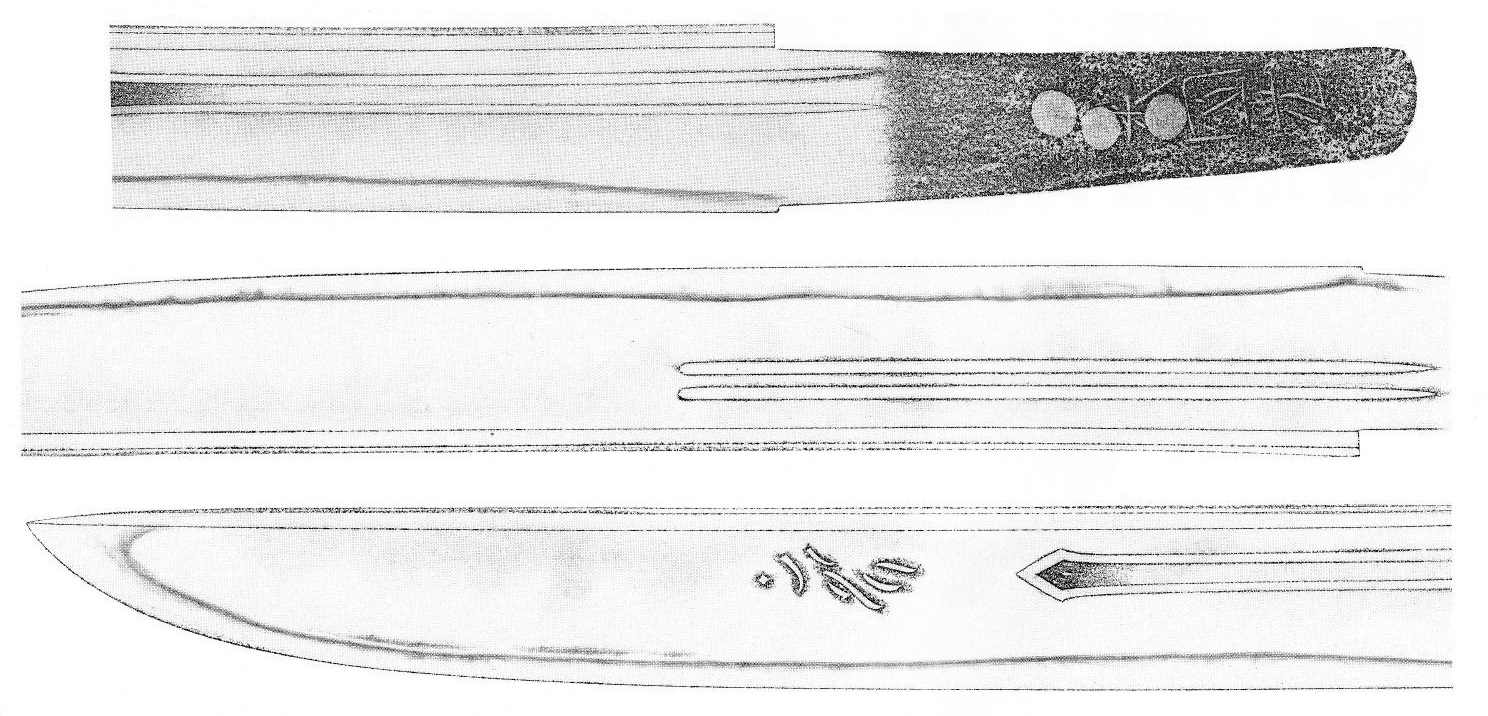
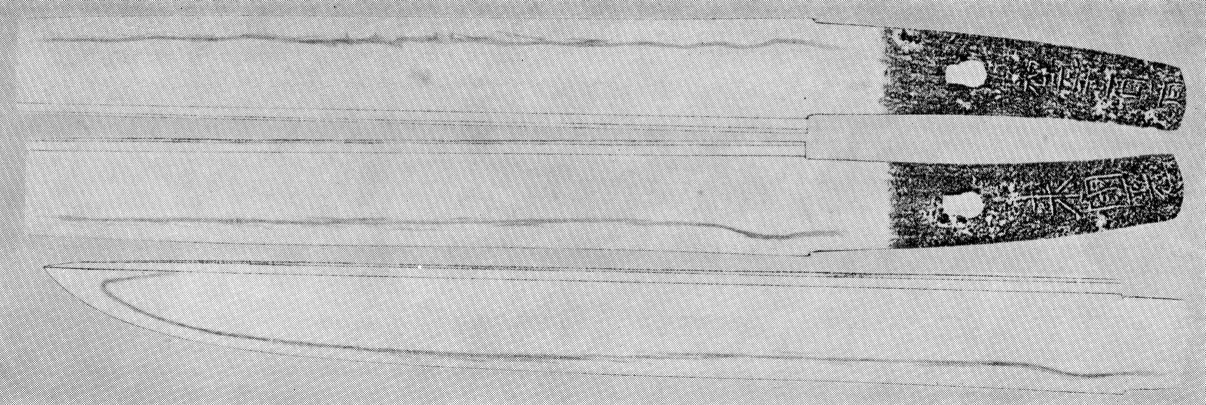
Let me start with some of the signed works, with the most representative ones the two tachi that are designated as kokuhô (the third kokuhô is a tantô and will be introduced later). One is completely ubu and is dated in kakikudashi manner, a feature that is also seen at his father Kunitoshi, with “Karyaku ninen nigatsu hi” (嘉暦二年二月日, “a day in the second month Karyaku two [1327]”). The blade (see picture 1) has a normal mihaba, a deep toriizori with funbari, and a straightforward chû-kissaki, i.e. it maintains with the deep curvature and the noticeable taper still a certain elegance. The kitae is a very fine ko-itame with plenty of ji-nie and the hamon is a ko-nie-laden hiro-suguha-chô that is mixed all over with ko-chôji, ko-gunome, plenty of ashi and connected , and some kinsuji. The nioiguchi is rather tight and the bôshi is a widely hardened sugu with a hint of notare and a ko-maru-kaeri. A bôhi is engraved on both sides that ends in kakudome at the machi. This is by the way the only known dated long sword of Rai Kunimitsu.

RaiKunimitsu1

RaiKunimitsu1a

Picture 1: kokuhô, tachi, mei “Rai Kunimitsu – Karyaku ninen nigatsu hi” (来国光  嘉暦二年二月日), nagasa 78.8 cm, sori 3.6 cm, motohaba 3.6 cm, sakihaba 1.9 cm, shinogi-zukuri, iori-mune, preserved in the Tôkyô National Museum

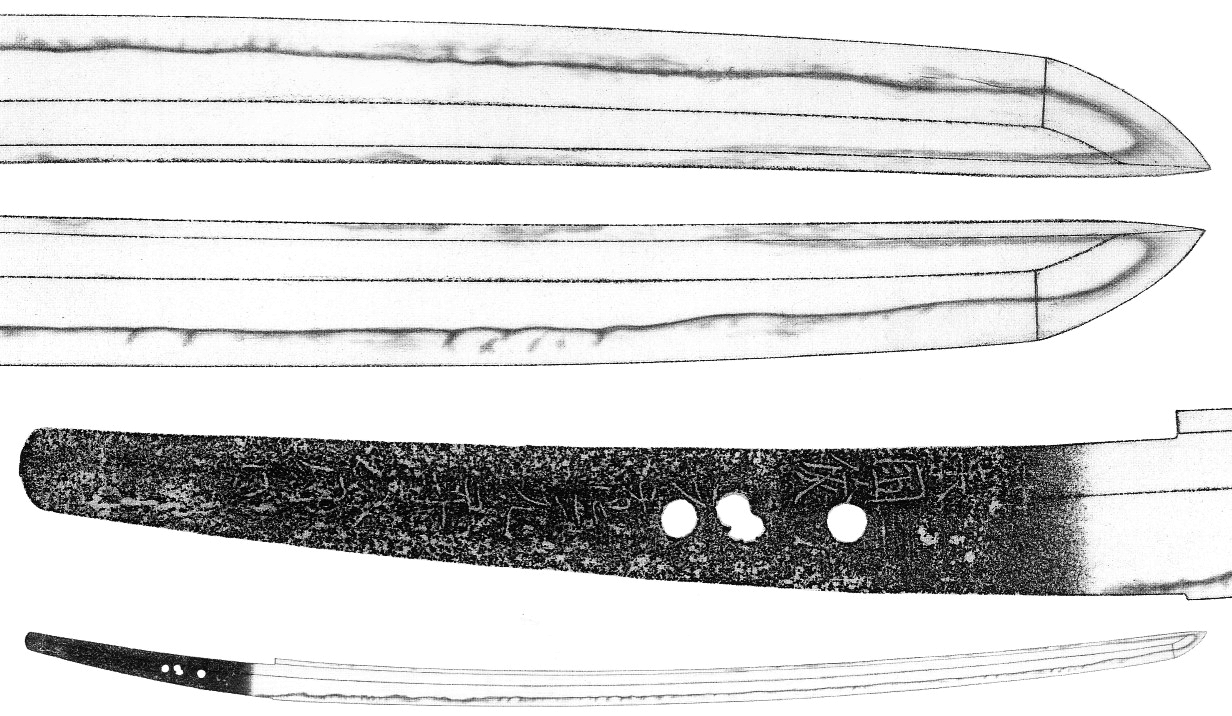
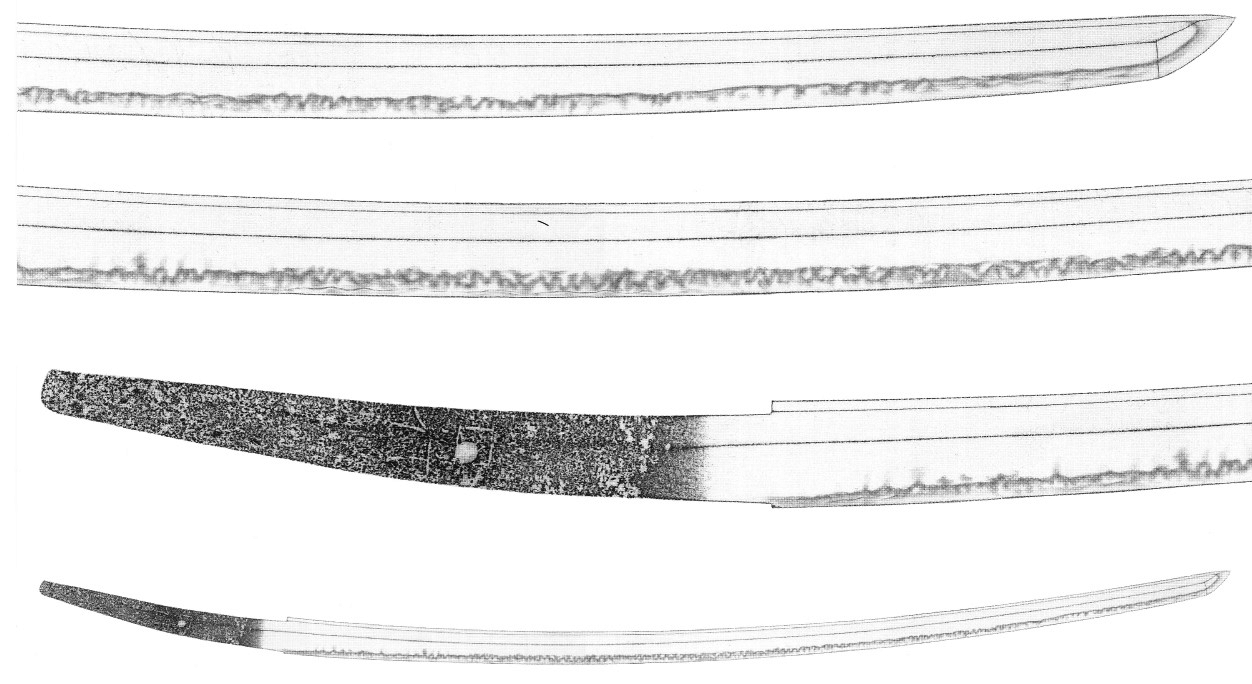
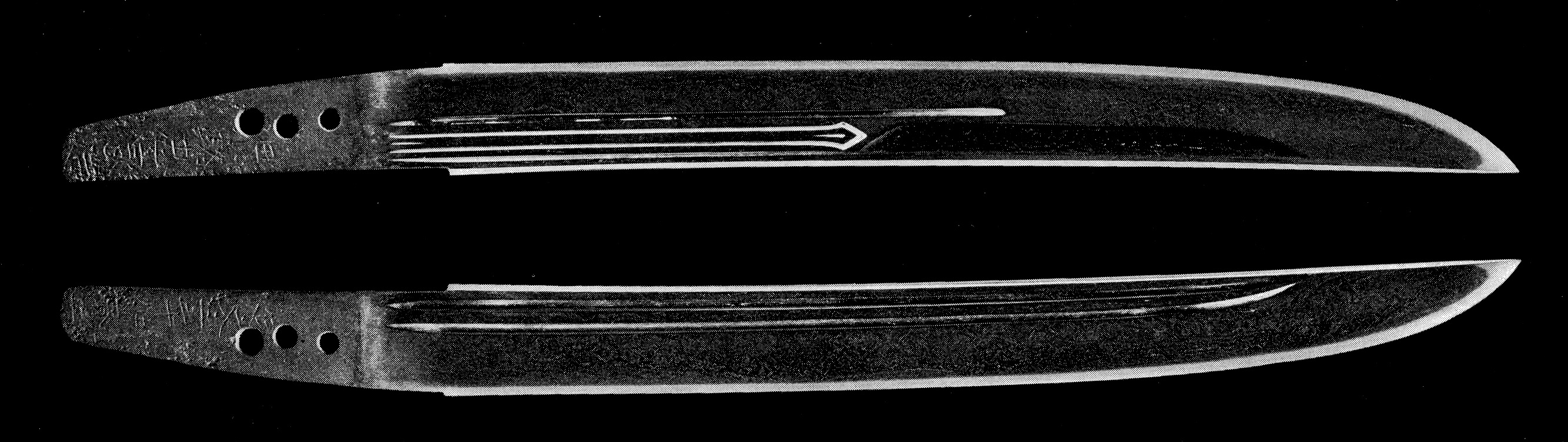
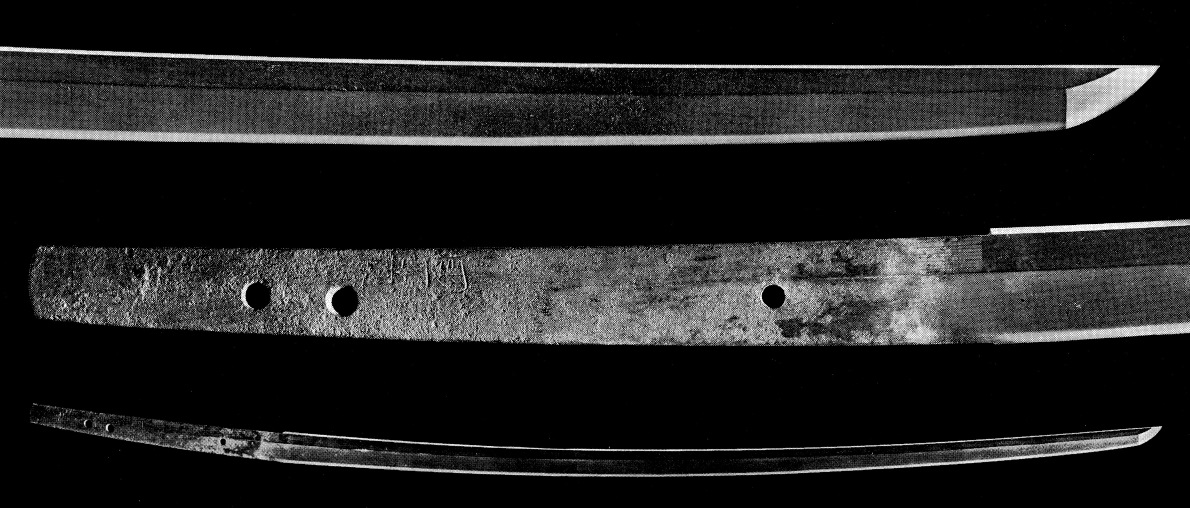
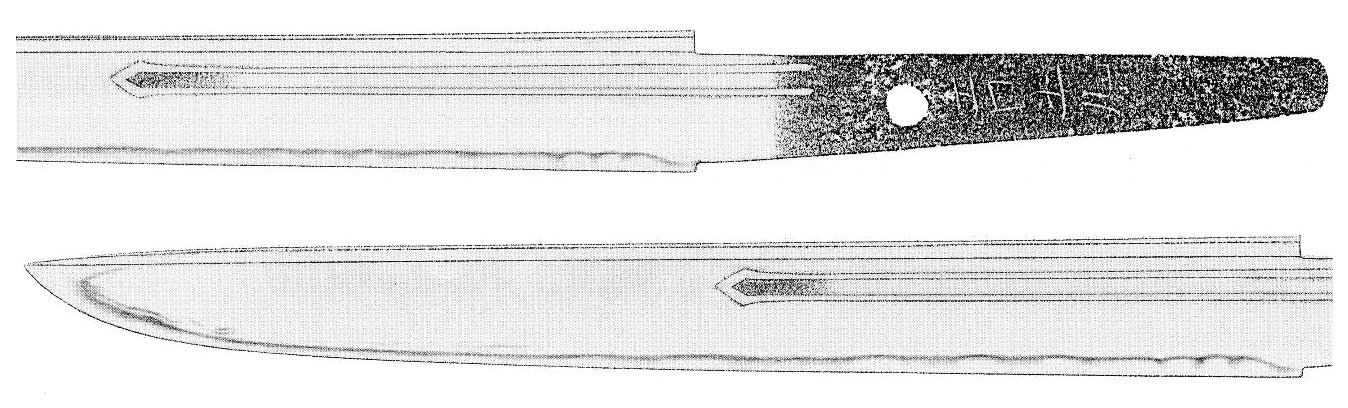
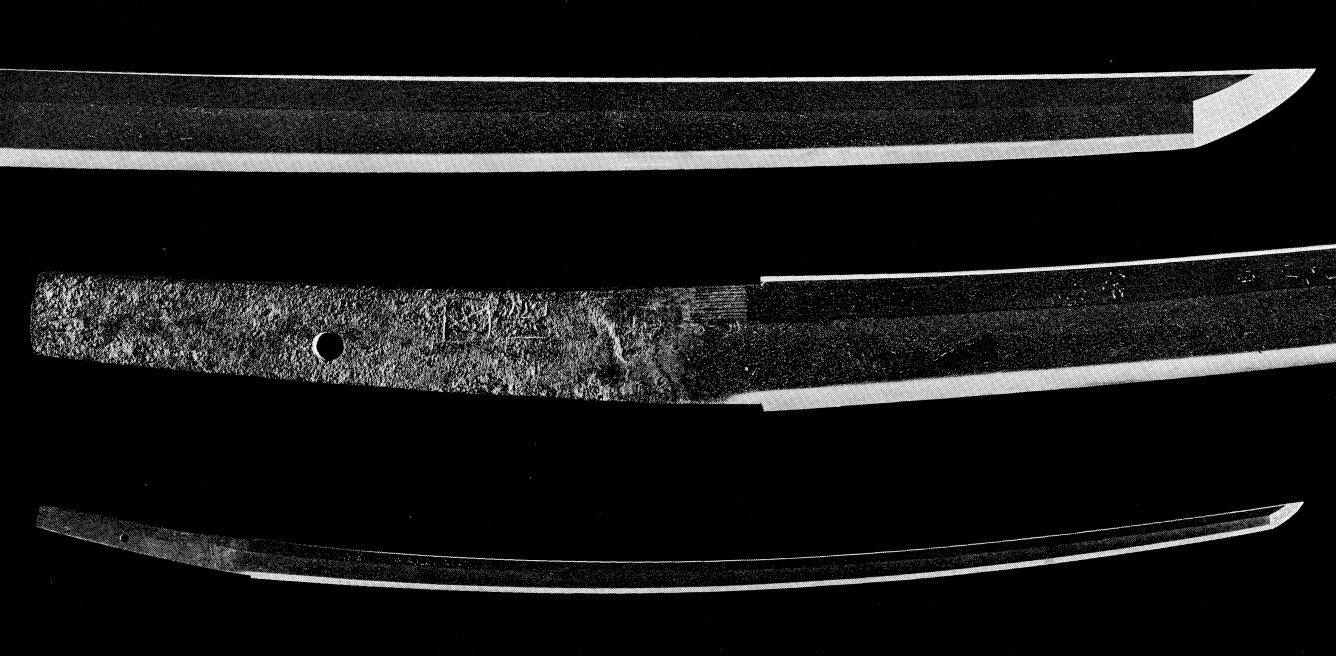
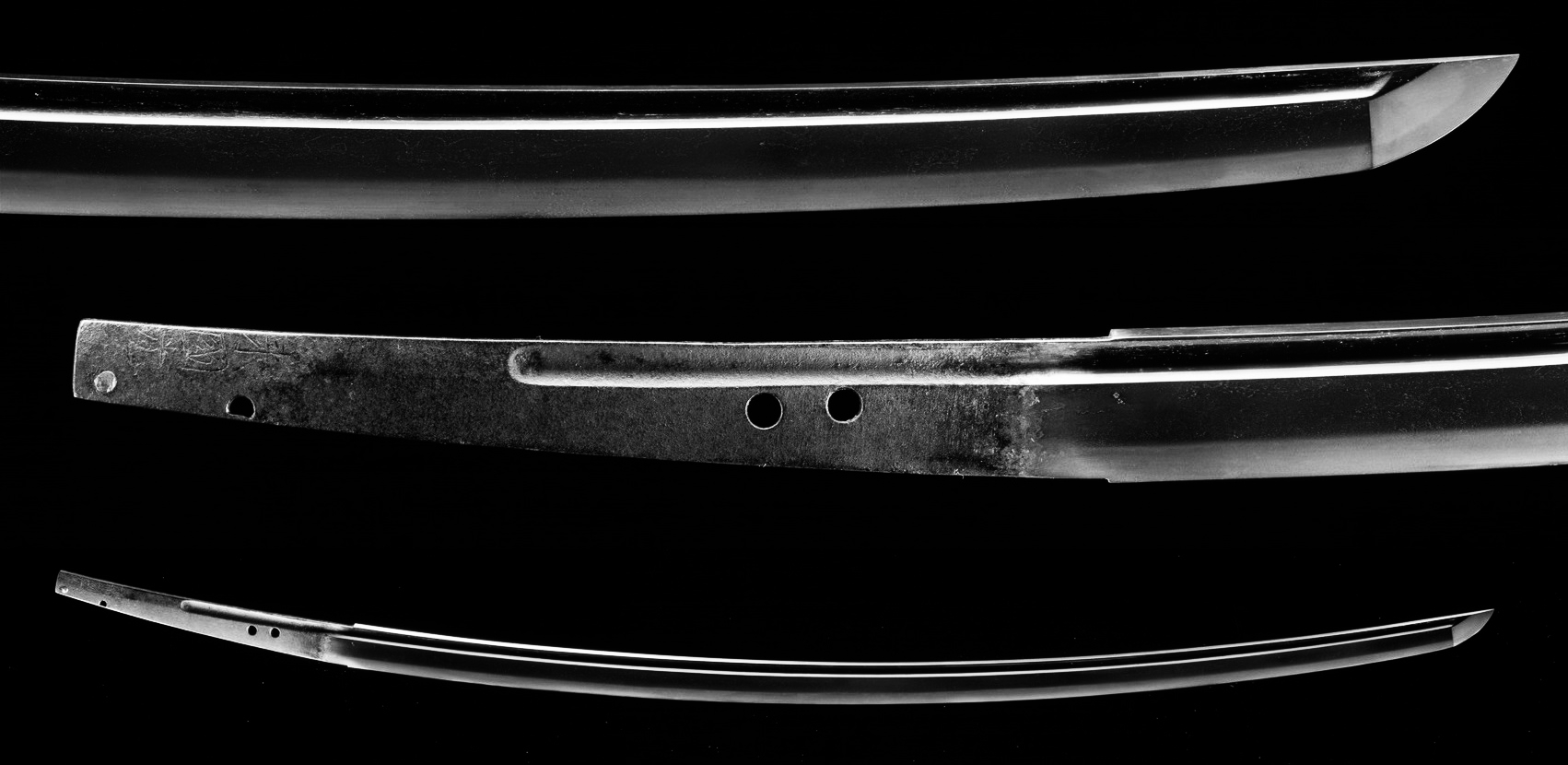
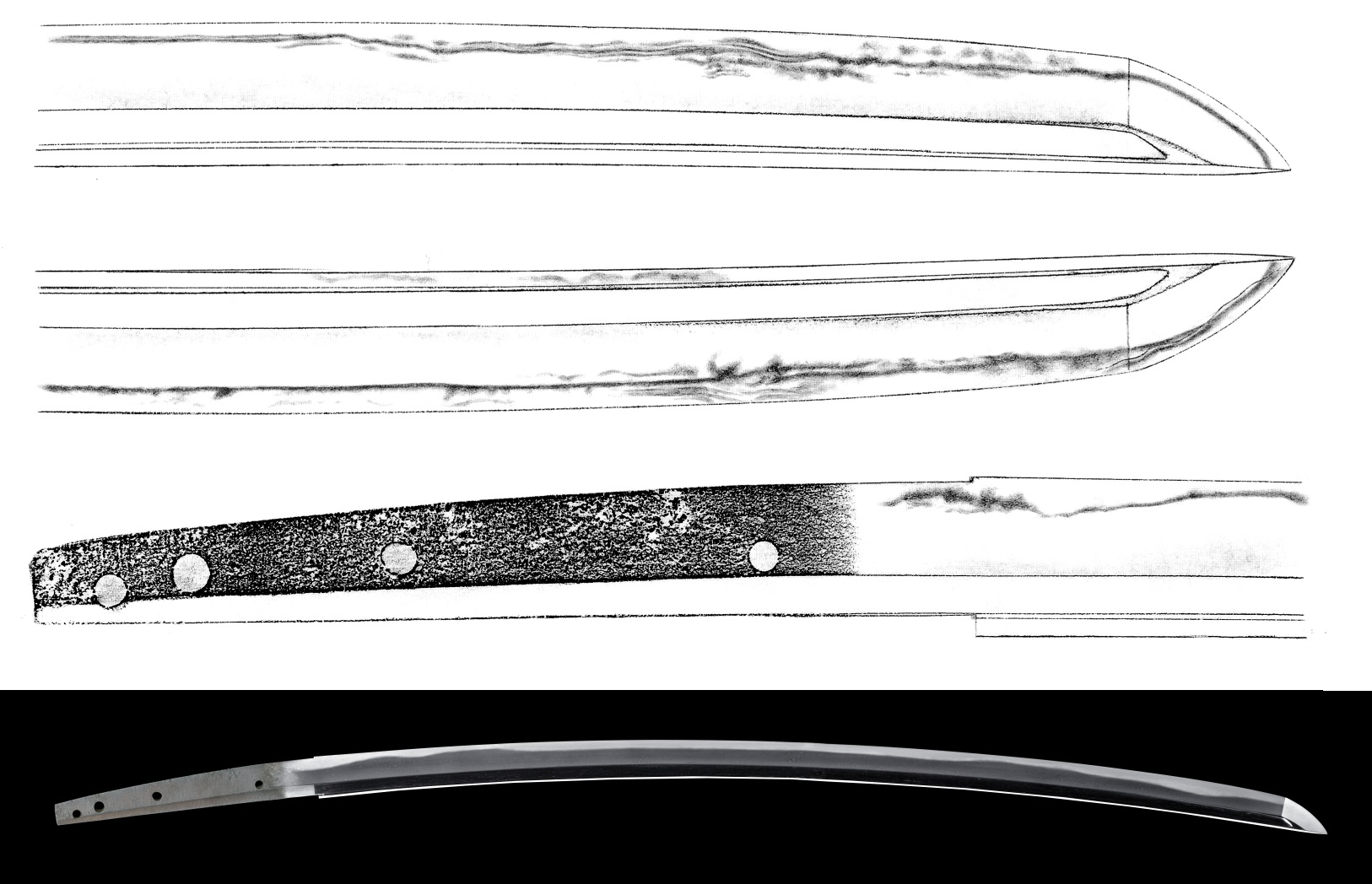
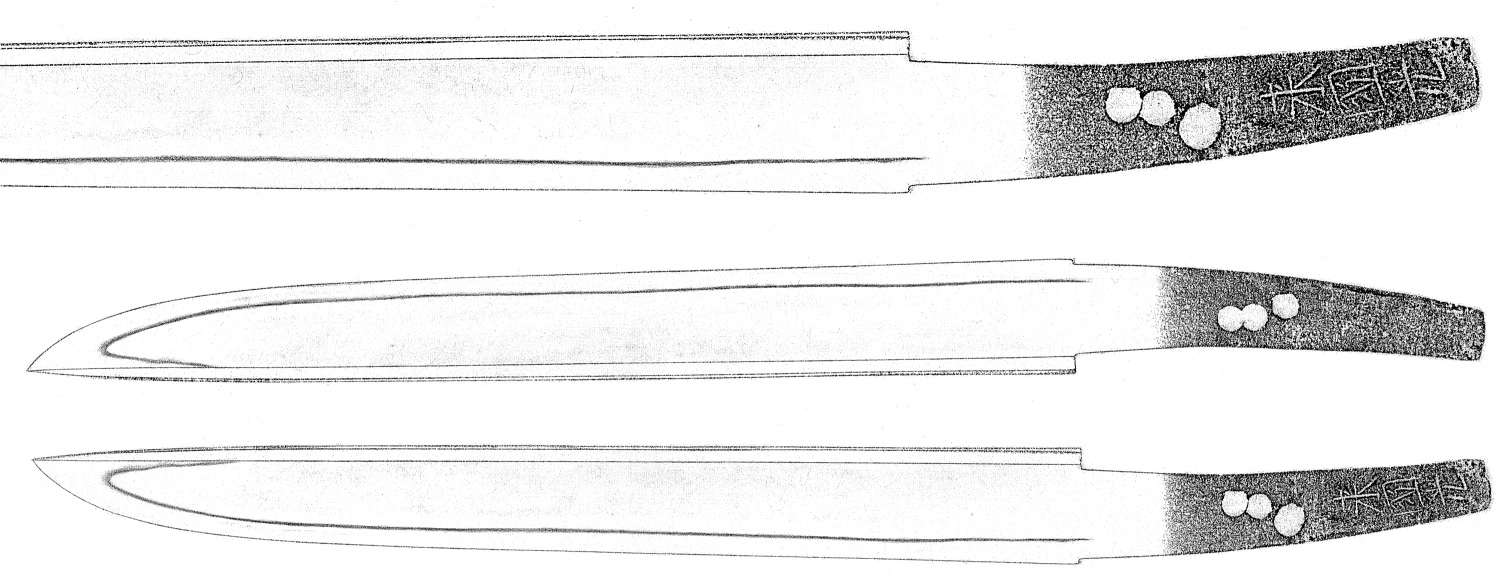
The other signed kokuhô is seen in picture 2 and this one is suriage. This was once a very long blade as its shortened nagasa is still 80.6 cm! It shows a deep toriizori and a chû-kissaki and as it does not taper that much like the previous blade, it looks overall more magnificent and stout, i.e. with the chû-kissaki almost a little bit like ikubi at a glance. The kitae is a very dense ko-itame mixed with some masame and plenty of ji-nie. This blade and the previous one do not show any areas of weak or so-called Rai-hada. The hamon is a ko-nie-laden suguha-chô mixed with ko-midare, ko-chôji, ko-gunome, plenty of ashi (mix of ko, chôji, and gunome-ashi), and . Please note that the hamon of this blade is sometimes described as hiro-suguha but it is in my opinion not that wide to pass as hiro. The bôshi is sugu with a ko-maru-kaeri and this time, the bôhi ends due to the shortening in marudome in the tang. Again, please remember that this blade had once a nagasa of over 90 cm! Some more info on it can be found on my “sister site” here.
RaiKunimitsu2

Picture 2: kokuhô, tachi, mei “Rai Kunimitsu” (来国光), nagasa 80.6 cm, sori 3.3 cm, motohaba 3.0 cm, sakihaba 2.2 cm, shinogi-zukuri, iori-mune, preserved in the Kyûshû National Museum

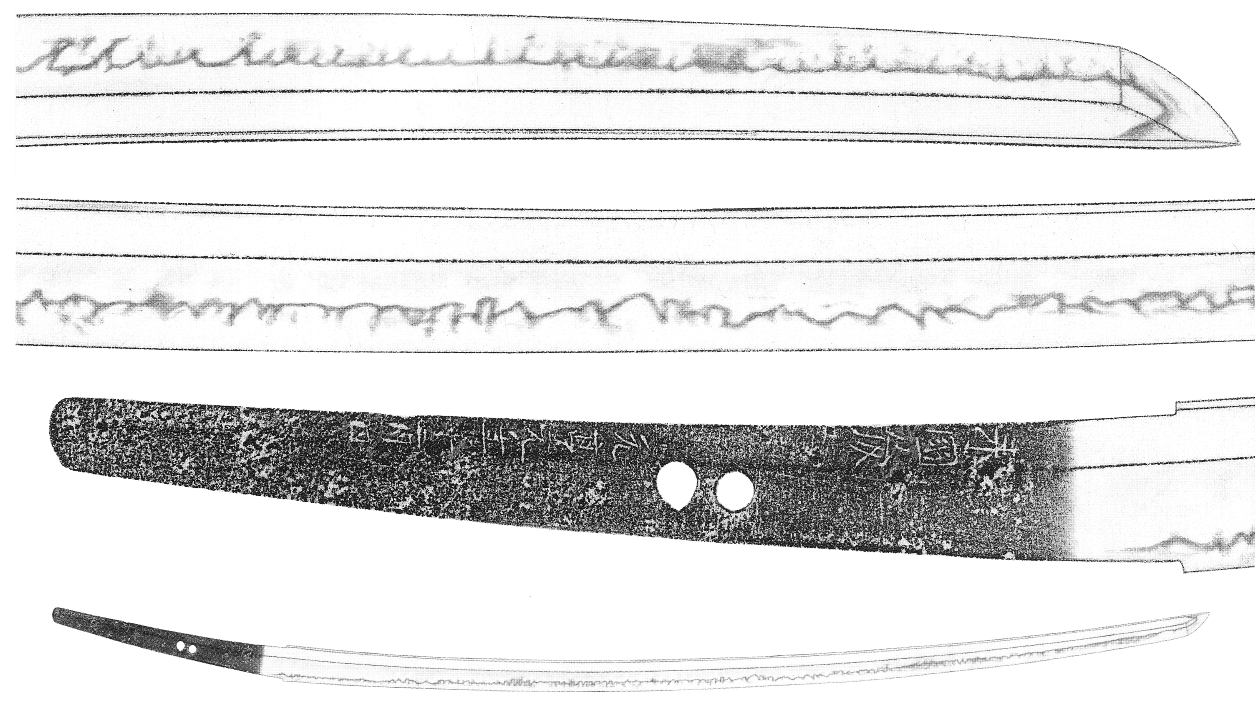
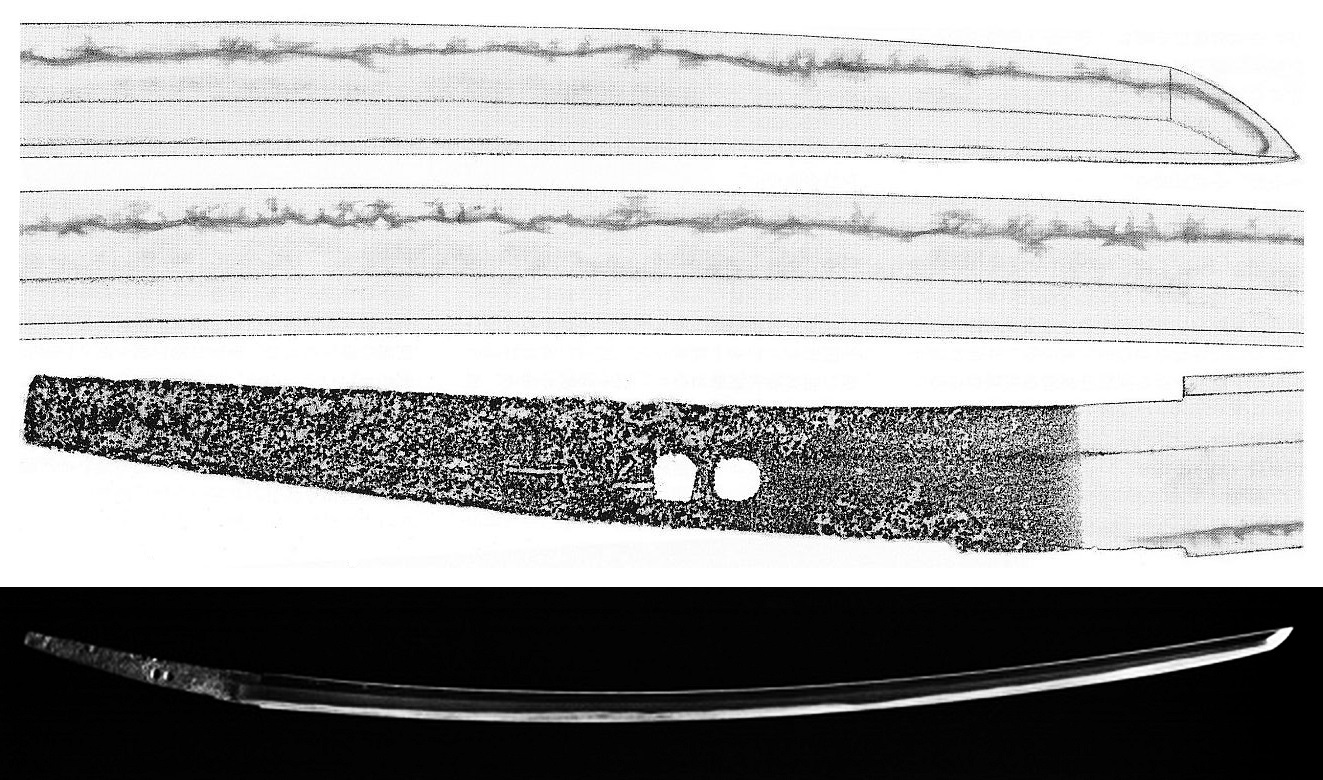
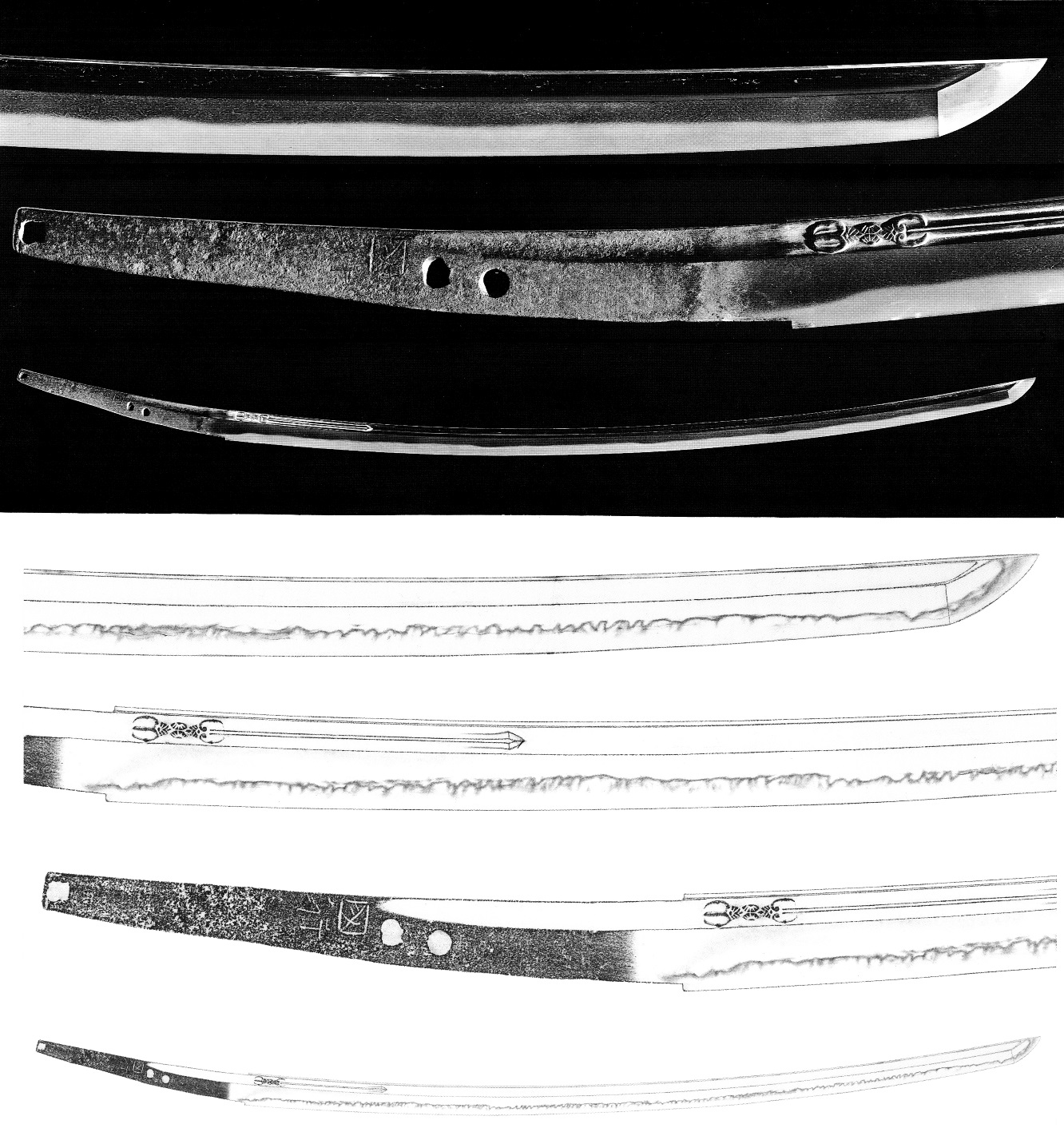
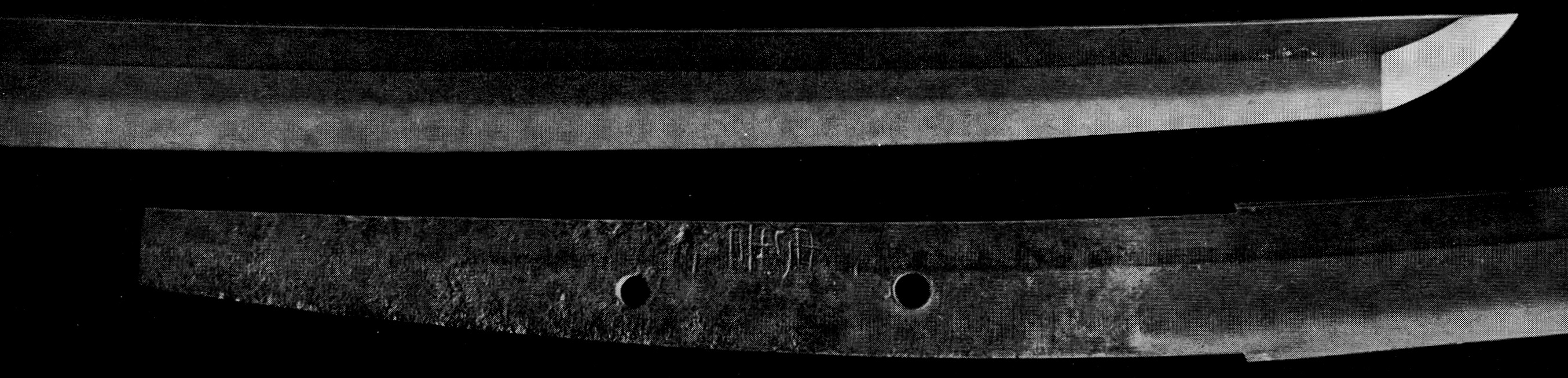
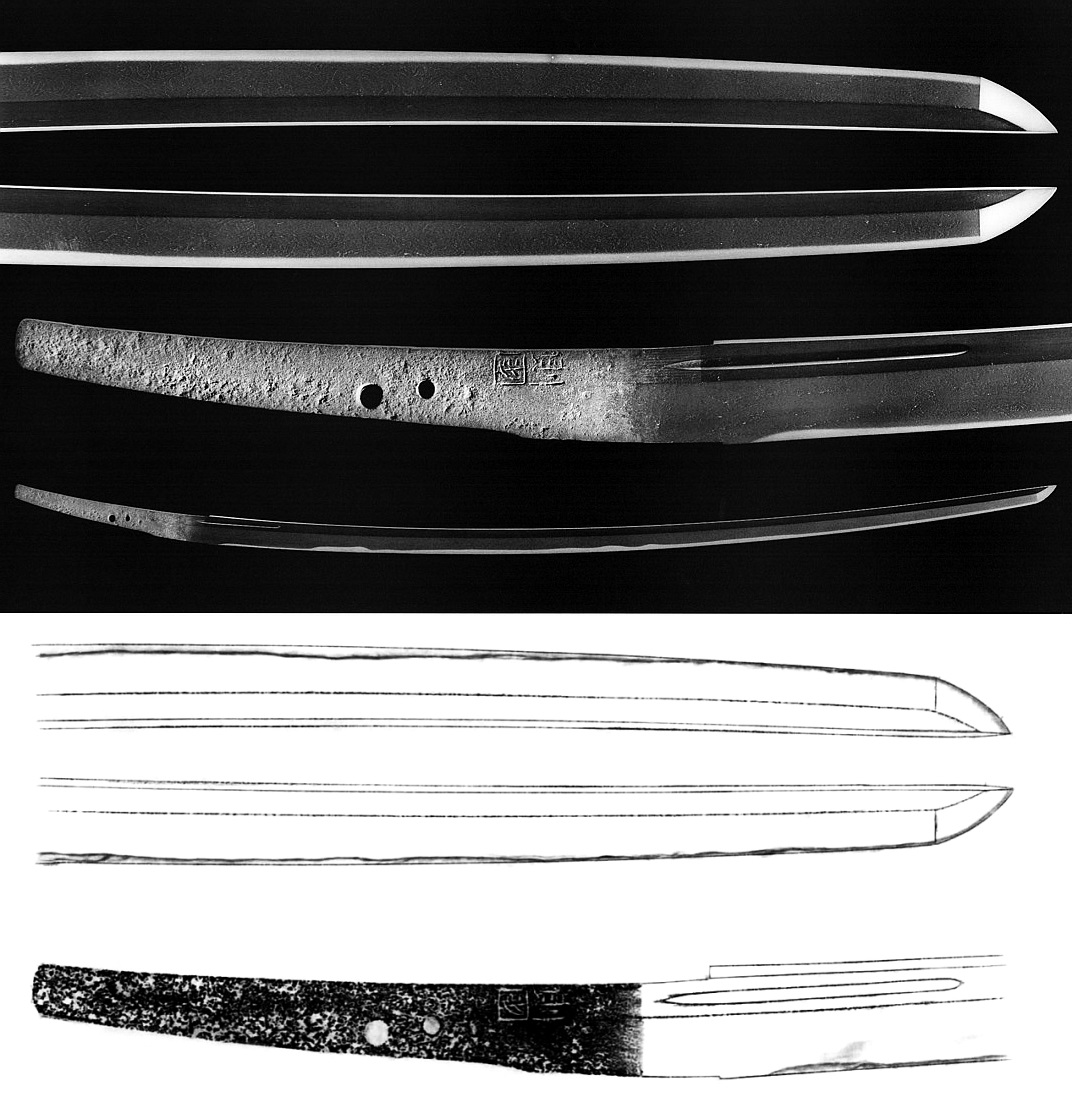
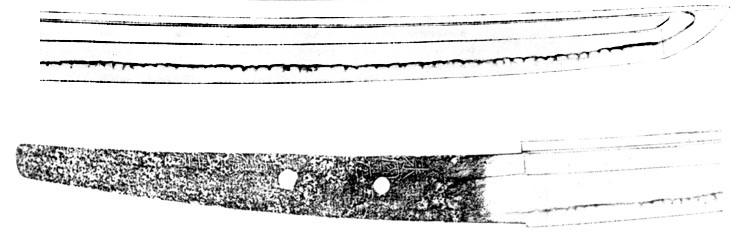
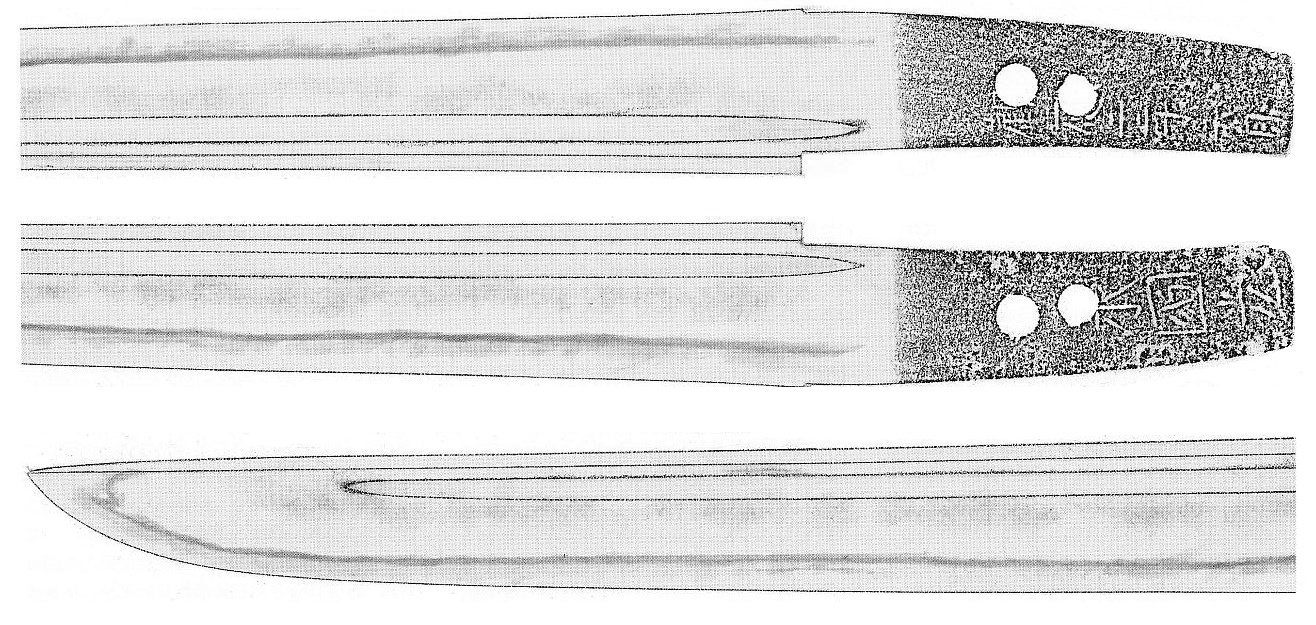
As you can see in the oshigata to blade 1, the hamon is truly interpreted as suguha-chô, i.e. running straight but mixed with an abundance of ko-chôji and ko-gunome or rather with chôji-ashi and gunome-ashi for most of the time. But Rai Kunimitsu also worked in pure suguha, or to be more precise, in a somewhat undulating suguha, i.e. not in a perfectly straight suguha as for example seen on a Hizen blade. The blade shown in picture 3 is a good example for this field of his repertoire and I picked it not only because I had the opportunity to study it hands on but because it it shows two important characteristic features of Rai Kunimitsu, and that is isolated sections of njûba and brief kuichiga-ba. And not to forget, it also shows a feature that distinguishes him from Rai Kunitoshi, namely that his ha comes with a somewhat tighter and more “defined/precise” habuchi. The blade has a magnificent and wide sugata that so to speak anticipates the later grandeur from the heyday of the Nanbokuchô era and the kitae is this time a somewhat standing-out itame that is mixed with mokume and that is not as tightly forged as at the two kokuhô. It also shows plenty of ji-nie and a nie-utsuri. The hamon is as mentioned a suguha in ko-nie-deki that tends overall a little to notare and is mixed with ko-ashi and some nijûba towards the yokote. The bôshi is sugu with a ko-maru-kaeri and kuichigai-ba and both sides bear the so to speak “obligatory” Rai Kunimitsu bôhi that runs due to the ô-suriage as kaki-tôshi through the tang. Incidentally, the blade was once a heirloom of the Owari-Tokugawa family and Hon’ami Kôchû issued (in Genroku three, 1690) an origami for it, giving it a value of 500 kan.
RaiKunimitsu3

Picture 3: tokubetsu-jûyô, katana, mumei “Rai Kunimitsu” (来国光), nagasa 73.6 cm, sori 1.6 cm, motohaba 3.1 cm, shinogi-zukuri, iori-mune

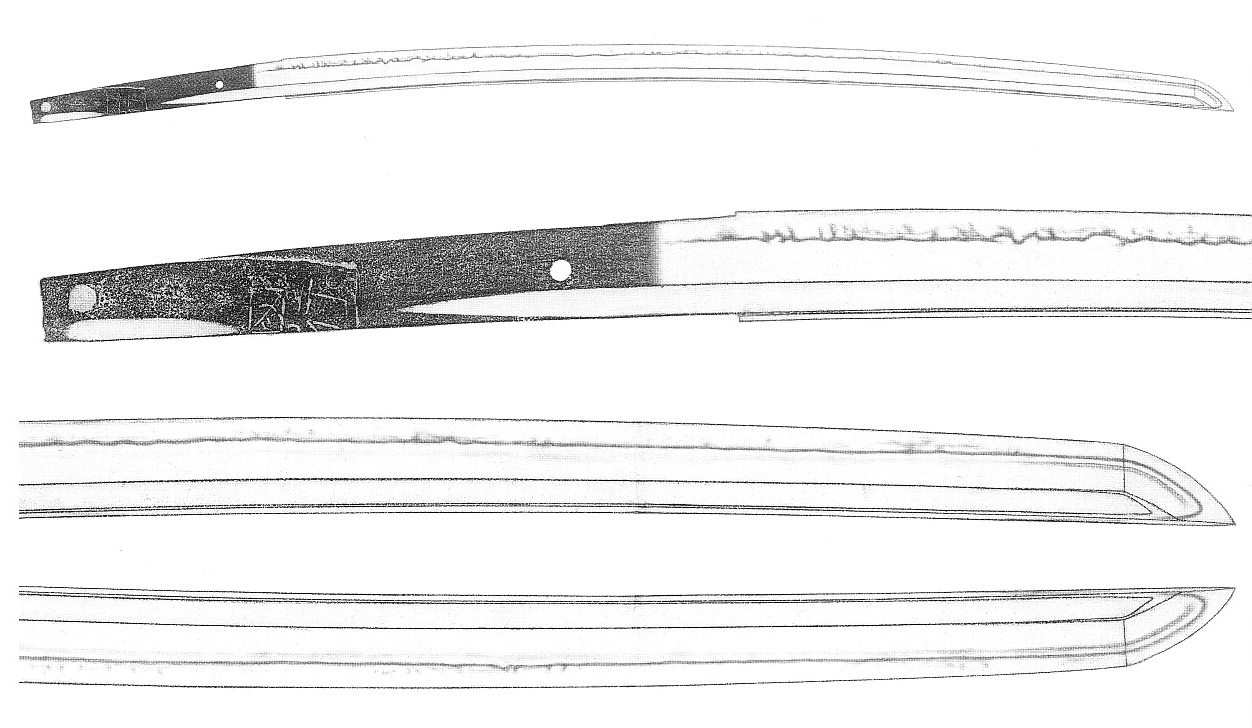
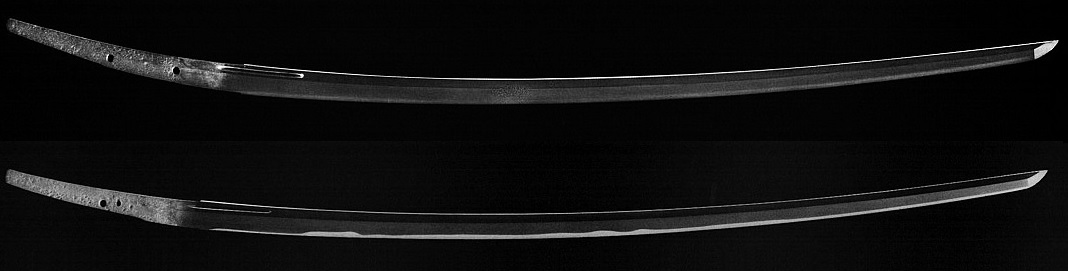
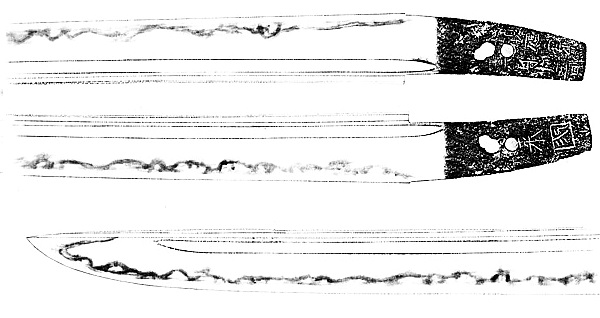
Let’s talk about another typical interpretation from the oeuvre of Rai Kunimitsu, demonstrated via the katana shown in picture 4. This time the hamon is still a ko-nie-laden suguha-chô but which mixed with shallow but conspicuous notare waves. Apart from that, it is mixed with ko-gunome, ko-chôji, plenty of ashi and , muneyaki, and with some fine kinsuji and sunagashi. And with the appearance of hotsure, uchinoke, nijûba, and yubashiri and with the sugu-bôshi that shows hakikake and that runs out as yakitsume, we can even grasp a hint of Yamato. But the steel is different from Yamato and appears as very dense, fine, and beautifully forged ko-itame with ji-nie that truly speaks for Kyô.
RaiKunimitsu4

Picture 4: jûyô, katana, mumei “Rai Kunimitsu” (来国光), nagasa 71.8 cm, sori 2.6 cm, motohaba 2.85 cm, shinogi-zukuri, iori-mune

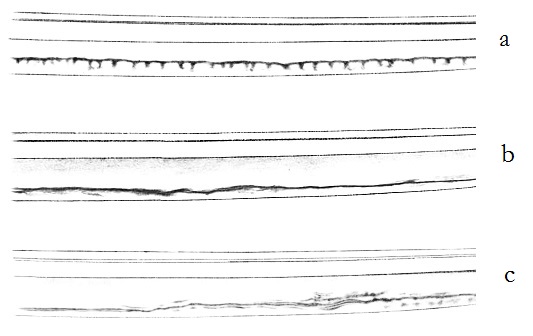
Before we continue with Rai Kunimitsu’s tantô, let me first repeat his three basic long sword styles and second, address the sensitive point of Rai-hada. One of his basic styles is the suguha-chô that is mixed with ko-chôji and ko-gunome or rather with chôji-ashi or gunome-ashi (picture 5 a). The other basic style is an almost pure suguha with just some ashi or slanting Kyô-saka-ashi and a little nijûba and/or kuichigaiba (picture 5 b). And the third one is an undulating suguha that shows horizontal, layered, “yamatoesque” hataraki (that remind if you want a little bit of Rai Kuniyuki) (picture 5 c).
RaiKunimitsu5

Picture 5.

As for Rai-hada, this is a feature which I would typically place with Rai Kunimitsu right away, or in other words, it is seen at Kunitoshi sometimes but hardly at all at Kunitsugu what means if you can make out Rai-hada on a blade that you can nail down as Rai main line work (i.e. obviously no Rai offshoot like Ryôkai or Enju) somewhere from the very end of the Kamakura to the early Nanbokuchô, I would recommend going for Kunimitsu right away. Now those weaker areas of Rai-hada usually appear for long swords somewhere from the monouchi to the yokoto, and for tantô often right where the grooves end, i.e. again more in the upper area. And apart from that we can say that this feature is generally more often seen on tantô than on tachi (at least as far as Rai Kunitoshi is concerned).

*

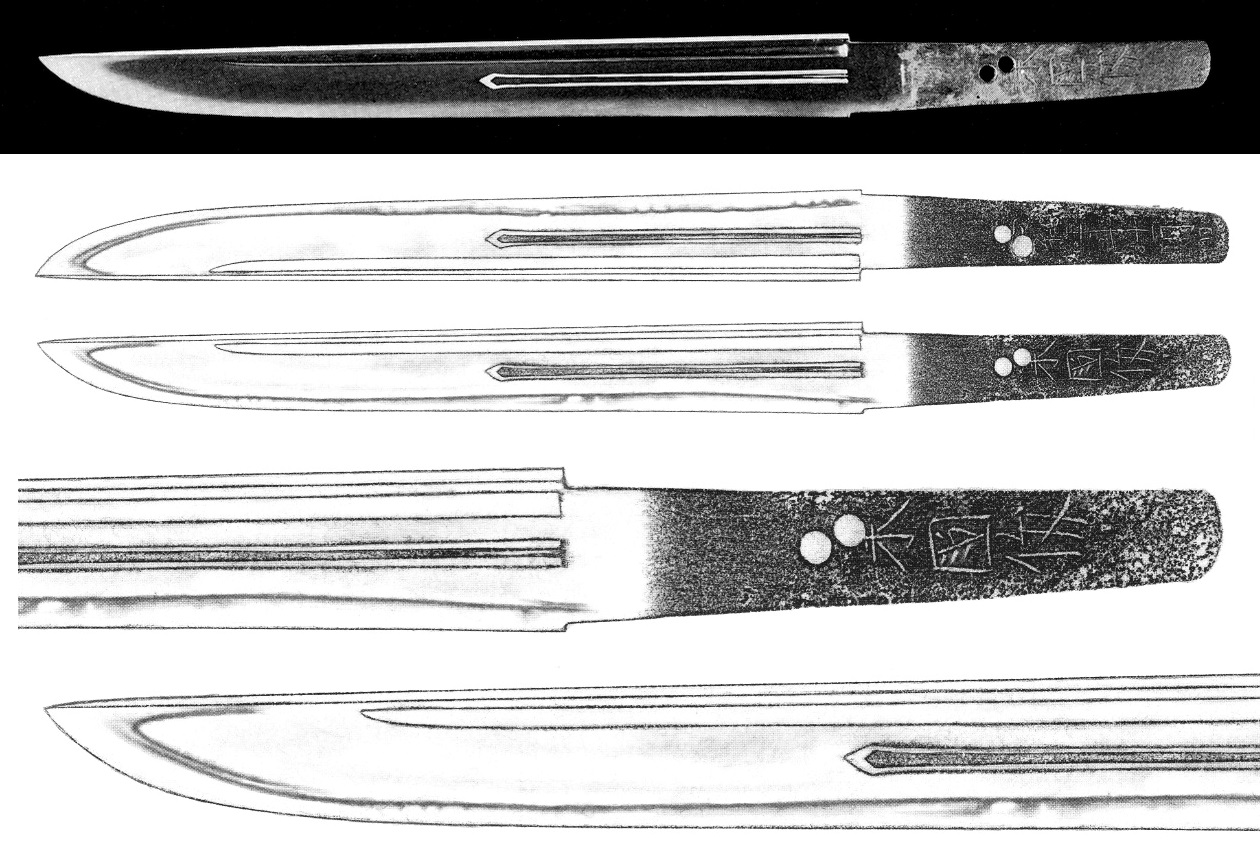
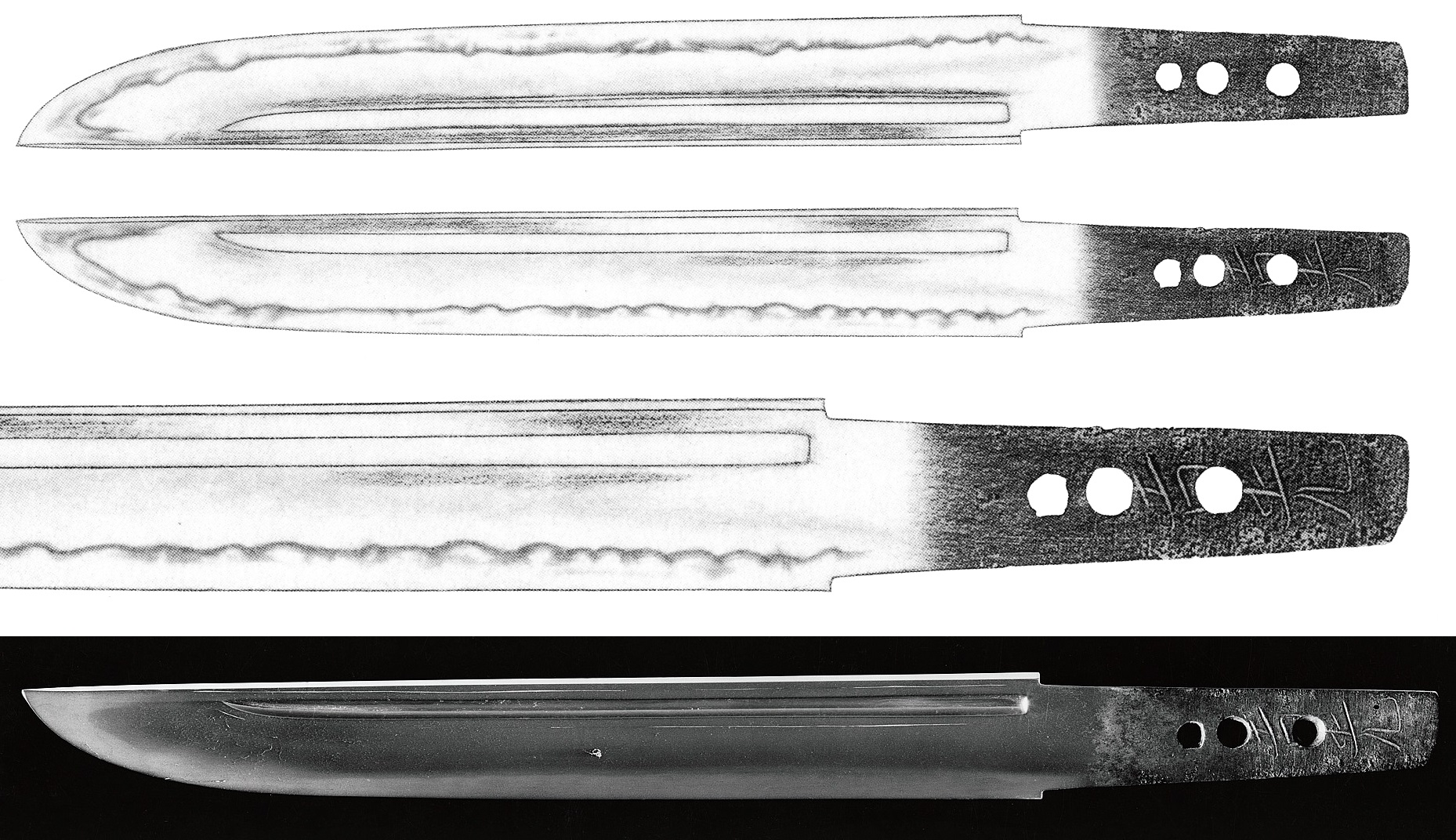
This brings us to Rai Kunimitsu’s tantô where we see again a wide variety of interpretations, for example classical ones in standard size, wider ones, wider and longer ones in sunnobi-style, and even a couple in kanmuri-otoshi-zukuri, with the majority showing either a katana-hi or some other kind of horimono like gomabashi or suken (or both, i.e. gomabashi on one, and a suken on the other side). This means, we can not name one specific tantô style for Rai Kunimitsu. First I want to introduce the third kokuhô of Kunimitsu (see picture 6), and that is the meibutsu Uraku Rai Kunimitsu (有楽来国光), named after the fact that it had once been owned by Sen no Rikyû’s master tea student Oda Urakusai Nagamasu (織田有楽斎長益, 1547-1622). More info here. The blade is with a nagasa of 27.7 cm rather on the long side and is wide and thick but maintains an uchizori, i.e. the thickness of the kasane and the presence of uchizori as well as the nagasa being just not long enough tells us that we have still not arrived yet in the heyday of the Nanbokuchô period. Incidentally, the blade is dated around Karyaku (1326-1329). The kitae is a fine ko-itame with chikei and plenty of ji-nie and we also seem some Rai-hada here and there. The hamon is a wide and nie-laden notare mixed with gunome and ashi and comes with a wide and very bright and clear nioiguchi. The bôshi is a prominent midare-komi with a rather pointed and long running-back kaeri. The entire bôshi is quite nie-laden and tends with its kuzure to kaen. The blade is vigorous and powerful and as the mihaba is wider than usual and the hamon shows much midare, the blade can be mixed up with a work of Rai Kunitsugu at a glance but the wild bôshi shows the hand of Kunimitsu. That is, Kunitsugu did often harden a vivid midareba but it usually runs into a relative calm bôshi in notare with a ko-maru-kaeri whereas at Kunimitsu the bôshi is mostly emphasized.

RaiKunimitsu6

Picture 6: kokuhô, tantô, mei “Rai Kunimitsu” (来国光), nagasa 27.7 cm, uchizori, motohaba 2.7 cm, hira-zukuri, mitsu-mune, the blade is owned by the NBTHK

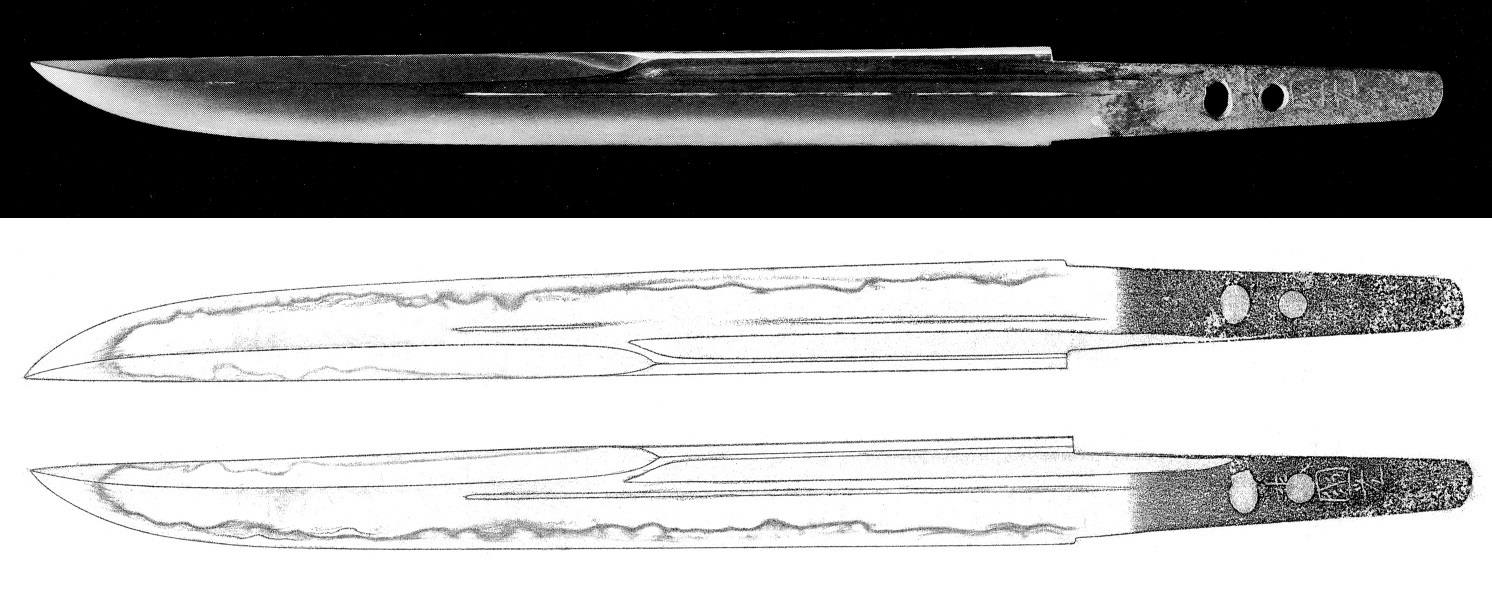
Picture 7 shows one of the two Kunimitsu tantô that are interpreted in kanmuri-otoshi-zukuri. It is designated as a jûyô-bunkazai and is also a meibutsu, namely the Ikeda Rai Kunimitsu (池田来国光) as it was once owned by Ikeda Sanzaemon Terumasa (池田三左衛門輝政, 1564-1613). The blade is rather wide, muzori, and shows again a thick kasane. The kitae is a dense and very uniformly forged ko-itame with ji-nie that does not show any weak areas of Rai-hada and apart from that, we see the Rai-typical nie-utsuri which focuses on the fukura/monouchi area. The hamon is a nie-laden shallow notare that is mixed with ko-gunome, ashi, , and kinsuji and the bôshi is slightly undulating, widely hardened, shows hakikake, and runs back in a long manner.
RaiKunimitsu7

Picture 7: jûyô-bunkazai, tantô, mei “Rai Kunimitsu” (来国光), nagasa 26.3 cm, muzori, motohaba 2.5 cm, kanmuri-otoshi-zukuri, mitsu-mune

Now these two tantô have shown pretty much midare so let me introduce next an interpretation in suguha. The blade shown in picture 8 comes in a sunnobi-sugata, i.e. it is long and wide, but still does not show any sori and features a relative thick kasane. The kitae is a densely forged ko-itame with plenty of ji-nie, much fine chikei, and a nie-utsuri. The hamon is a slightly undulating, ko-nie-laden suguha that is mixed with ko-ashi, fine kinsuji and sunagashi, and along the monouchi with some nijûba. The nioiguchi is bright and clear and the bôshi appears as slightly widening sugu with a ko-maru-kaeri. Now the nijûba elements might make one think of Awataguchi Kuniyoshi or Yoshimitsu but at the former, the nijûba would be much more prominent and appear in longer connected sections, and from the latter, we would expect that the ha gets thinner along the fukura. In addition, we would expect some connected ko-gunome and more nie-hataraki in the bôshi on a Yoshimitsu tantô but apart from that, the horimono are anyway too far from the mune for an Awataguchi work.
RaiKunimitsu8

Picture 8: jûyô, tantô, mei “Rai Kunimitsu” (来国光), nagasa 29.15 cm, muzori, motohaba 2.8 cm, hira-zukuri, mitsu-mune, this blade was once presented by shôgun Tokugawa Tsunayoshi (徳川綱吉, 1646-1709) to Iechiyo (家千代, 1707), the second son of his adopted son Ienobu (徳川家宣, 1662-1712) who had died at the age of only two months .

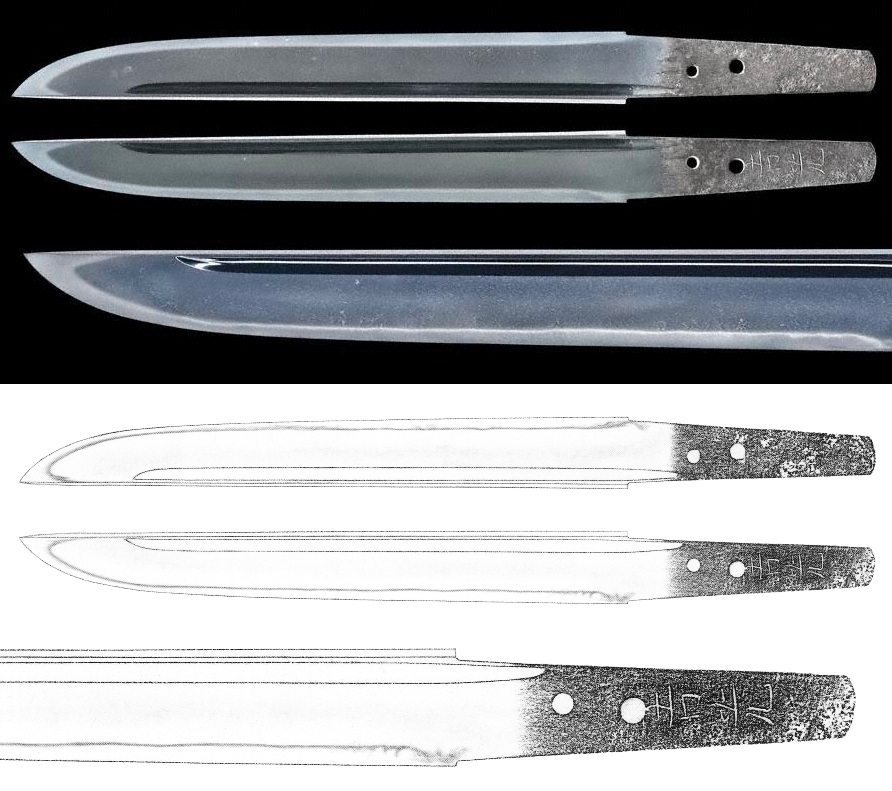
As mentioned, Kunimitsu also made some classical tantô, for example the jûyô-bunkazai seen in picture 9. This blade has a so-called standard nagasa (jôsun) of 24.5 cm, uchizori, and is with the curved furisode-style nakago pretty conservative. It shows a fine ko-itame with plenty of ji-nie and a nie-utsuri and the hamon is a very bright and clear chû-suguha in ko-nie-deki that features a rather tight nioiguchi and a ko-maru bôshi with a long kaeri. The work is elegant and noble and reminds of his father Rai Kunitoshi.
RaiKunimitsu9

Picture 9: jûyô-bunkazai, tantô, mei “Rai Kunimitsu” (来国光), nagasa 24.5 cm, uchizori, hira-zukuri, mitsu-mune, the blade was once owned by the Akimoto (秋元) family, the daimyô of the Tatebayashi fief

*

What about that 2nd generation Rai Kunimitsu? As indicated at the very beginning of this chapter, it is possible that the shift of generations took place somewhere around Kôei (康永, 1342-1345). When it comes to distinguishing features, many sources take the quality route, i.e. they say that late Rai Kunimitsu blades which are somewhat inferior in overall quality and which show a more smallish and thinly chiseled signature might be works of the second generation. That quality aspect is defined by a hamon that lacks both hataraki and that tight nioiguchi that is typical for Rai Kunimitsu and a kitae where the ko-itame stands more out and is mixed with some nagare and masame and which shows a hint of shirake rather than a nie-utsuri. Also possible supplements in the mei like “Yamashiro no Kuni-jû” (山城国住) or “Sahyôe no Jô” (左兵衛尉) are said to be associated with the second generation.

I want to introduce two blades which bear the latest known date signature of Rai Kunimitsu. Both are tantô and the first one is signed “Rai Kunimitsu – Kan’ô ninen rokugatsu” (来国光・観応二年六月, “sixth month of the second year of Kan’ô [1351]”) (see picture 10). It has a nagasa of 25.9 cm, is rather wide, has only a hint of sori, and features a thick kasane. Please note that this tantô has an iori-mune, what is uncommon as Rai Kunimitsu usually made tantô with a mitsu-mune. The kitae is a densely forged ko-itame that is mixed with some itame here and there and that shows ji-nie, fine chikei, and a faint nie-utsuri. The hamon is a bright and clear chû-suguha in ko-nie-deki that is mixed with some ashi, , and fine sunagashi. The bôshi is sugu with a little notare and turns back (on the omote) with a somewhat “awkward” ko-maru-kaeri (the ura shows a normal ko-maru-kaeri) but which is seen sometimes at tantô of Rai Kunimitsu. When introduced by the NBTHK in their kantei series, there was no mention of a second generation having a hand in this one and although not labelling it explicitly “Nidai” in the jûyô paper, we find the remark it “might be a work o the second generation when we follow the traditional classification via date signatures.”
RaiKunimitsu10

Picture 10: jûyô, tantô, mei see above, nagasa 25.9 cm, a little sorimotohaba 2.6 cm, hira-zukuri, iori-mune

The second one (see picture 11) is signed “Rai Kunimitsu – Kan’ô ninen rokugatsu jûsannichi” (来国光・観応二年六月十三日, “13th day of the sixth month Kan’ô two [1351]”). The sugata and tang finish are about identical to the previous work and this one is labelled by the NBTHK as “Nidai” in their jûyô paper. The blade is a little longer but features a rather thin kasane (and again a mitsu-mune), and the hamon is not suguha but notare-chô mixed with gunome, ashi, , and sunagashi. It is a little suriage so that only the upper part of the character for “mitsu” is left and interesting here is that the date signature is chiselled in two rows.
RaiKunimitsu11

Picture 11: jûyô, tantô, mei see above, nagasa 28.2 cm, sori 0.2 cm, motohaba 2.7 cm, hira-zukuri, mitsu-mune

Then there is this tantô shown in picture 12 which is dated “Jôwa sannen rokugatsu ichinichi” (貞和三年六月一日, “first day of the sixth month Jôwa three [1347]”) and which is introduced by Satô Kanzan as “early work of the second generation.” It is with a nagasa of 24.8 cm somewhat smaller and has an overall rather classical sugata. The kitae is an itame-nagare with many weak areas and shirake and the hamon is a suguha in ko-nie-deki that is mixed with some shallow notare and sunagashi. The nioiguchi is bright and clear and the bôshi is sugu with a standard ko-maru-kaeri.
RaiKunimitsu12

Picture 12: tantô, mei “Rai Kunimitsu” (来国光), date see text above, nagasa 24.8 cm, a hint of uchizori, hira-zukuri, mitsu-mune

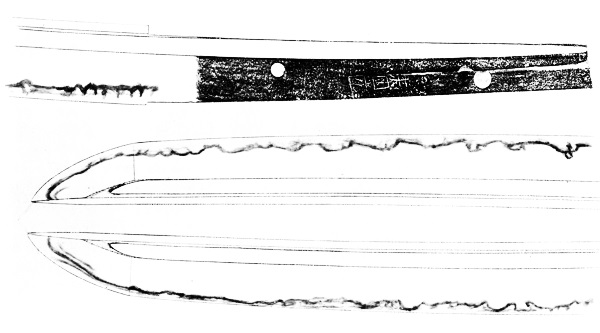
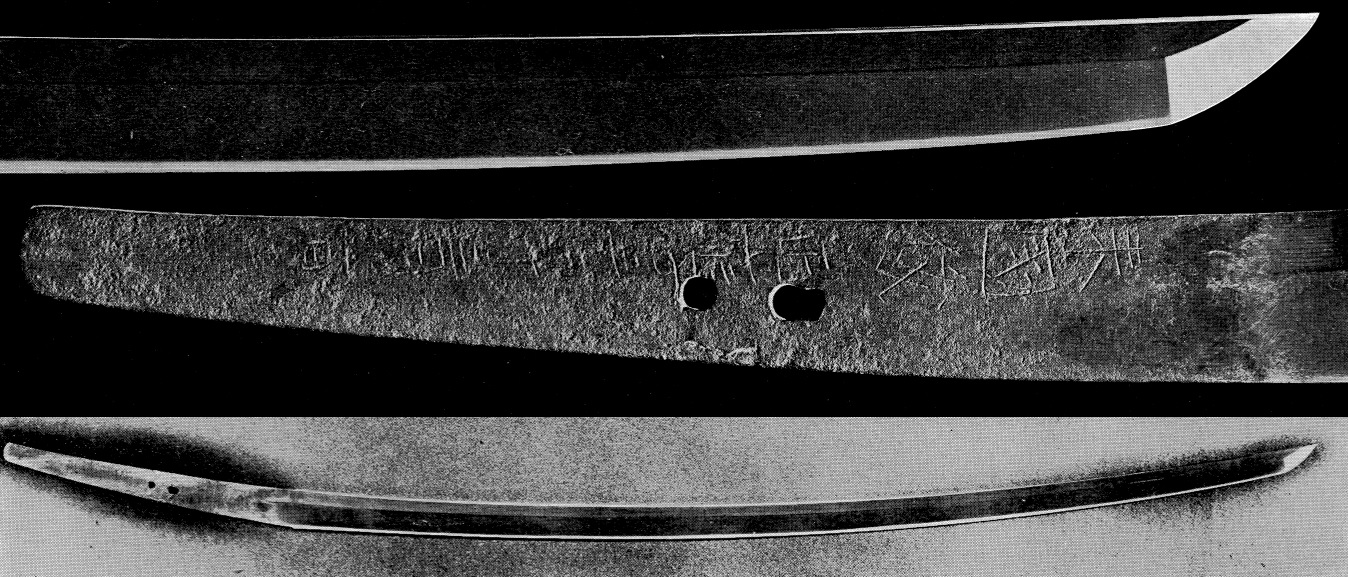
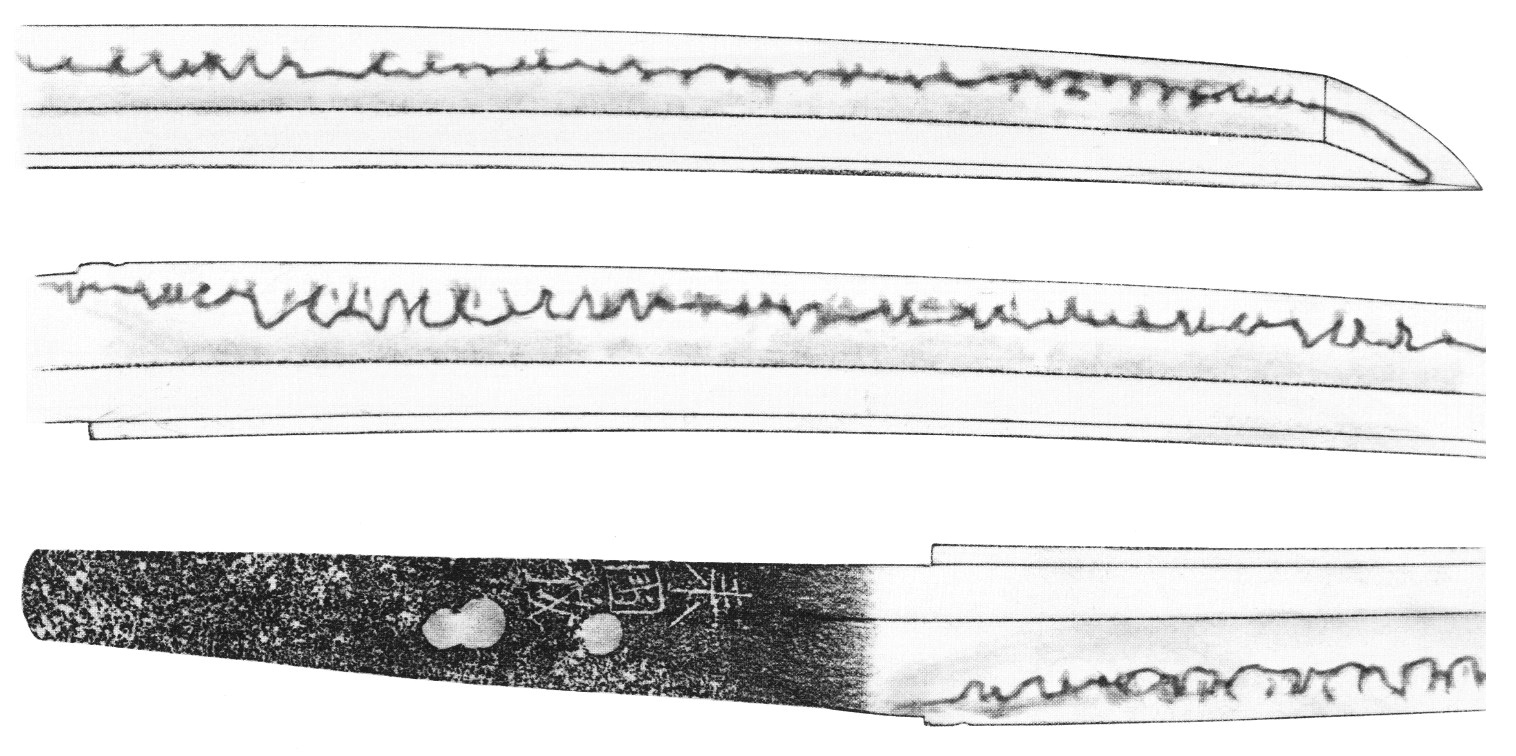
And last but not least one of the very few long swords that I was able to find which might well be a work of the second generation. It is a tachi bearing an orikaeshi-mei that was once an ôdachi measuring somewhere around 90 cm. It was shortened to 71.4 cm, has a rather wide mihaba, despite the suriage a relative deep sori, and an elongated chû-kissaki. The kitae is a standing-out itame mixed with some nagare and ji-nie appears. The hamon is a shallow ko-notare in ko-nie-deki that is mixed with ko-midare, gunome, ko-chôji, plenty of ko-ashi, sunagashi and kinsuji. The bôshi is a shallow notare-komi with a very brief ko-maru-kaeri and features nijûba. So probably the distinct midareba in combination with the somewhat inferior kitae and the smallish mei are the most important features for attributing this blade to the second generation.
RaiKunimitsu13

Picture 13: jûyô, katana, orikaeshi-mei “Rai Kunimitsu” (来国光), nagasa 71.4 cm, sori 2.25 cm, motohaba 3.1 cm, shinogi-zukuri, iori-mune
KANTEI 4 – YAMASHIRO #17 – Rai (来) School 3

We continue with Kunitoshi by entering his Rai phase.

*

Rai Kunitoshi Phase

As mentioned in the first part, Kunitoshi decided at a certain point in time to sign with the prefix “Rai.” I wrote that this might have been connected to his father’s death, i.e. in 1297 according to the Kotô Mei Zukushi Taizen, but I was going through known date signatures again and learned that there are actually two earlier ones known that are already signed with “Rai,” that is a tantô dated Shôô two (正応, 1289) and a tachi dated Shôô three (1290). So maybe this was the time Kuniyuki retired and handed over the forge to him or Kuniyuki actually did not die in 1297, as stated in the anyway partially doubtful Kotô Mei Zukushi Taizen, but in 1289. Anyway, I have edited the first part in this respect to make it work by itself and without the second part. So let’s start with the overlapping phase when Kunitoshi started to leave behind his magnificent tachi and started to follow the then trend to again somewhat more elegant blades with a more unobtrusive hamon. I am saying “started to” on purpose because we have to be careful. The aforementioned tachi dated Shôô three (1290) (see picture 7) is already pretty unobtrusive in terms of its hamon and also shows a noticeably more elegant sugata. It is very similar to the late Niji blade shown in picture of of the last part and was made only twelve years after the magnificent and flamboyant dated work from 1278 (picture 2 in the last part). In short, he made such unobtrusive blades early on in his Rai phase and apart from that, he went back once in a while to a more flamboyant jiba in his latest years, although combining that deki with an elegant and slender sugata (more on this later). So it is not black and white and just styles A and B with a little transitional period. It is complicated, I know.

RaiKunit7

Picture 7: jûyô-bijutsuhin, tachi, mei “Rai Kunitoshi” (来国俊) – “Shôô sannen sangatsu hi” (正応三年三月日, “a day in the third month Shôô three [1290]”), nagasa 79.4 cm

The kodachi shown in picture 8 is dated to his early Rai phase and is as you can see pretty flamboyant. It has a somewhat narrow mihaba, a koshizori, shows funbari, and ends in a ko-kissaki. The kitae is a dense ko-itame with plenty of ji-nie and nie-utsuri and the hamon is, as mentioned, a flamboyant mix of chôji, ko-chôji, and ko-gunome in ko-nie-deki that is mixed with ashi, , fine kinsuji, and sunagashi. The nioiguchi is rather tight and despite of showing some prominent chôji elements with large yakigashira at the base, the ha itself doesn’t feature that many ups and downs. The bôshi is sugu with a ko-maru-kaeri and shows some hakikake.

RaiKunit8

Picture 8: jûyô, kodachi, mei “Rai Kunitoshi” (来国俊), nagasa 59.8 cm, sori 1.6 cm, motohaba 2.7 cm, shinogi-zukuri, iori-mune

The mei of the kodachi shows characteristic features that dates it to the early Rai phase and which I will introduce at the end of this chapter. It is interesting that there seems to be a lack of dated works from his 60s and that they increase again in number from Shôwa two (正和, 1313) onwards, i.e. when he was 73 years old (or 74 if you follow the Japanese way of counting years). So let me finally introduce the famous blade that he signed with the supplement “at the age of 75” (see picture 9). It is designated as a jûyô-bunkazai and signed in kakukudashi manner “Rai Kunitoshi Shôwa yonnen jûgatsu nijûsannichi ?? sai nanajûgo” (来国俊正和二二年 十月廿三日◯◯歳七十五, “Rai Kunitoshi, 23rd day of the tenth month Shôwa four [1315], ??, at the age of 75”). It has a normal to slender and tapering mihaba, a deep toriizori with funbari, and ends in a chû-kissaki. The kitae is a dense ko-itame with ji-nie, a nie-utsuri, and some Rai-hada. The hamon is a straightforward chû-suguha in ko-nie-deki with a rather tight and very bright nioiguchi that only features a few hataraki like ashi and . The bôshi is sugu and shows a long running back ko-maru-kaeri.

RaiKunit9

Picture 9: jûyô-bunkazai, tachi, mei see text above, nagasa 78.2 cm, sori 2.1 cm, preserved in the Tokugawa Museum

Now I want to introduce a blade (see picture 10) that so to speak displays a style which is most representative for Rai Kunitoshi, or that comes to mind first when thinking of this smith. It is a jûyô-bunkazai tachi dated “Gen’ô gannen hachigatsu hi” (元応元年八月日, “a day in the eighth month Gen’ô one [1319]”), once again in kakikudashi manner. It has an elegant sugata with a toriizori, a little funbari, and a chû-kissaki. The kitae is a dense ko-itame that stands a little out in places and the hamon is a ko-nie-laden suguha-chô that becomes a little wider along the monouchi and that undulates a little towards the base. The ha is mixed with ko-chôji, ko-gunome, sunagashi, muneyaki, and ashi which slant here and there. The nioiguchi is rather subdued and the bôshi is sugu with a long running back ko-maru-kaeri. As indicated, the interpretation in suguha-chô with ashi slanting towards the tang, muneyaki, and a kaeri that runs back in a long fashion is typical for Kunitoshi and the Rai School in general. As he was already 79 years old at the time this blade was made, it is assumed that we are facing here a daimei, most likely of Kunimitsu.

RaiKunit10

Picture 10: jûyô-bunkazai, tachi, mei “Rai Kunitoshi” (来国俊), date see text above, nagasa 74.1 cm, sori 2.3 cm, shinogi-zukuri, iori-mune

The latest known date signature of Kunitoshi is from Genkô one (元享, 1321) and is found on the tachi shown in picture 11. He was already 81 years old at that time, therefore it is verly likely that this blade too was made by one of his students, probably Kunimitsu again. It is the work that I meant earlier with him returning once in a while to a more flamboyant jiba, but combined with a very elegant tachi-sugata. The blade is slender, tapers noticeably, has a toriizori, and a smallish ko-kissaki. The kitae is a very fine ko-itame with ji-nie, fine chikei, some jifu and antai, and a midare-utsuri. The hamon is a ko-nie-laden suguha-chô that is mixed with chôji, ko-chôji, ko-gunome, muneyaki, densely arranged ashi and , and fine kinsuji and sunagashi. The midare elements and the ashi slant in places (i.e. appear as Kyô-saka-ashi), the nioiguchi is bright, and the bôshi is sugu with a wide ko-maru-kaeri. This is once more a blade that is difficult to kantei. The sugata is highly elegant and might remind of late Heian and early Kamakura at a glance and with the midare-utsuri and the outstanding quality, one might think of Ko-Bizen masters like Masatsune (正恒) or Tomonari (友成). But their sugata would be different as they made blades with a pronounced koshizori that bends down towards the tip. The jigane says Rai and the ha Kuniyuki but the sugata is the important again why it can’t be him. He too did make such classical sugata with a smaller kissaki but usually in combination with a classical jiba. His more flamboyant jiba is usually found on more magnificent tachi that anticipate the strong mid-Kamakura sugata of Kunitoshi’s Niji phase. Apart from that, we would expect to see some karimata here and there on a Kuniyuki blade. Key here to nail it down to Rai Kunitoshi is the utsuri that appears as midare but with darker antai areas, a peculiarity that is sometimes seen at Kunitoshi in his later phase and at Ryôkai. But at Ryôkai, we would see some masame and shirake and his ha is a hint more subdued.

RaiKunit11

Picture 11: jûyô-bijutsuhin, tachi, mei “Rai Kunitoshi” (来国俊), date see text above, nagasa 74.25 cm, sori 2.45 cm, shinogi-zukuri, iori-mune, the blade was once a heirloom of the Uesugi family

*

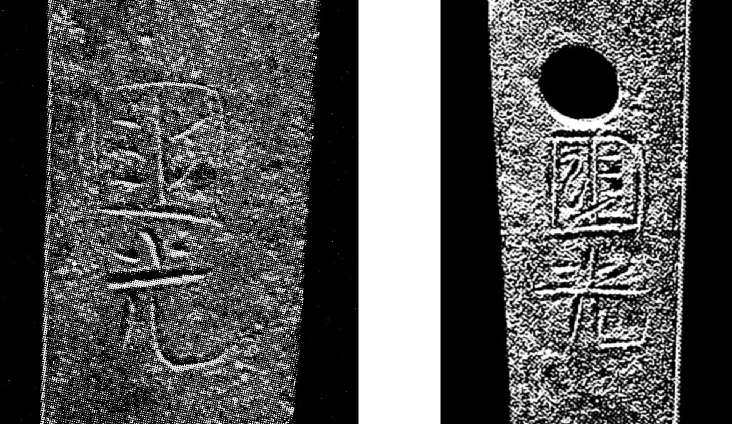
Now to Rai Kunitoshi’s tantô. Like his senior Awataguchi colleagues Kuniyoshi and Yoshimitsu, he did not focus on one single tantô style and made blades with the very wide range of roughly 18 to 30 cm, although the majority lying somewhere between 21 and 24 cm. And he was also open for different blade geometries as he made apart from the standard hira-zukuri also shôbu and kanmuri-otoshi-zukuri tantô. So let me introduce a few representative works, beginning with the kokuhô that is owned by the Atsuta-jingû and that is thus also referred to as “Atsuta Rai Kunitoshi” (熱田来国俊). The blade is dated “Shôwa gonen jûichigatsu hi” (正和五年十一月日, “a day in the eleventh month Shôwa five [1316]”) and is with a motohaba of 2.5 cm pretty wide for its nagasa of 25.1 cm. It shows an uchizori and a kitae in dense ko-itame with fine ji-nie. Interesting here, the nie-utsuri is joined by a thick bô-utsuri that appears parallel to the ha. The hamon is a ko-nie-laden suguha that is mixed with ko-ashi, ko-gunome, and a kuichigai-ba along the fukura that turns into a kind of nijûba. The nioiguchi is wide, bright, and clear and the bôshi features a ko-maru-kaeri which is noticeably longer on the omote than on the ura side and which Tanobe sensei describes as “Fuji shape.” He explains that this shape, which resembles a stylized Mt. Fuji, is a characteristic feature of Rai Kunitoshi and also seen on some tachi and that its “mountain peak” appearance is the result of a wide and long turnback that makes the kaeri look a little symmetrical. Both sides of this tantô show a katana-hi with a suken below which end at the same height in kakudome.

RaiKunit12

Picture 12: kokuhô, tantô, mei “Rai Kunitoshi” (来国俊), date see text above, nagasa 25.1 cm, uchizori, hira-zukuri, mitsu-mune

Next the longest tantô known of Kunitoshi which I once had the chance to study hands on at a northern branch meeting of the NBTHK in Japan. The blade is dated “Einin gonen nigatsu hi” (永仁五年二月日, “a day in the second month Eining five [1297]”) and has a nagasa of 29.7 cm. It has the same motohaba of 2.5 cm as the Atsuta-jingû blade and looks thus with its overlength more narrow. It shows a little uchizori towards the kissaki and a thick kasane, two elements that tell us right away that it is, despite of its length, most likely not a Nanbokuchô work. The kitae is a very dense ko-itame with plenty of ji-nie and a nie-utsuri. The hamon is a suguha in ko-nie-deki that starts with a little indentation and that is mixed with a little ko-gunome and uchinoke along the center of the blade that makes the area tend to nijûba. The nioiguchi is bright and clear, the ha gets a little wider along the fukura, shows nijûba there too, and turns back in “Fuji shape,” i.e. with a ko-maru-kaeri whose turn back is wide and makes the kaeri look like the peak of a mountain. Like at the Atsuta-jingû blade, we have a katana-hi on both sides but this time with a thin koshibi on the omote, and a suken on the ura side. Due to the low position of the mei and the grooves running as kaki-nagashi into the tang, the nakago looks like suriage at a glance but it is ubu. I remember very well voting for Awataguchi Kuniyoshi at the kantei because of the nijûba but was of course not unhappy to see a ubu dated and signed tokubetsu-jûyô Rai Kunitoshi when the hilts were taken off. 😉

RaiKunit13

Picture 13: tokubetsu-jûyô, tantô, mei “Rai Kunitoshi” (来国俊), date see text above, nagasa 29.7 cm, uchizori, hira-zukuri, mitsu-mune

The last tantô I want to introduce is a kokuhô and this blade is truly classical, also with its curved furisode-style nakago. It has a normal mihaba and nagasa, uchizori, and a relative thick kasane, so everything speaks for Kamakura. The kitae is a fine ko-itame with a little masame and displays ji-nie. The hamon is a chû-suguha in ko-nie-deki that is mixed with ko-ashi and some kinsuji along the monouchi. The nioiguchi is rather tight and the bôshi is sugu with a wide ko-maru-kaeri which results again in the aforementioned “Fuji shape,” this time the symmetrical slopes are pretty clear, especially on the omote side of the blade. The omote side bears gomabashi and the ura side a koshibi as horimono. When you go back to the Awataguchi chapters you will see that the grooves are a little farther away from the mune than for example at Kuniyoshi or Yoshimitsu. This, sometimes rather felt than measureable, distance from the mune is a characteristic feature that distinguishes Rai from Awataguchi tantô.

RaiKunit14

Picture 14: kokuhô, tantô, mei “Rai Kunitoshi” (来国俊), nagasa 24.5 cm, uchizori, motohaba 2.14 cm, hira-zukuri, mitsu-mune, owned by the Kurokawa Institute of Acient Cultures

*

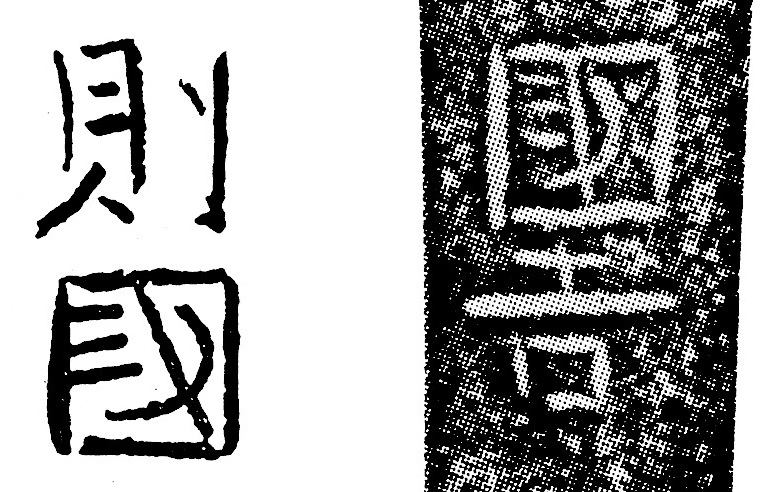
At the end of the chapter on Kunitoshi, I want to address the changes in his signatures but with a focus on the basic changes. During his Niji phase, he signed the three inner left short strokes of the character for “Kuni” pushed up to the upper left corner. He kept that when he started to sign with the prefix Rai but gradually stretched them out and distributed them evenly over the height of the character. Apart from that, the outer box of the character fof “Kuni” got more angular and a little smaller over time and the ending strokes/sweeps of the character for “toshi” were given up in his advanced Rai phase. Another important feature of Kunitoshi’s mei is that he executed the upper part of the character for “Rai” as just three parallel horizontal strokes. The angle of the inner left short three strokes of the character for “Kuni” changes during the Shôwa era, that means they are now no longer slanting from bottom left to top right but from top right to bottom left. But at post-Shôwa mei, i.e. from Bunpô, Gen’ô, and Genkô, the previous variant is seen again.

RaiKunitMei1

Picture 15, from left to right: Niji Kunitoshi dated Kôan one (1278), Torikai Kunitoshi, early Rai Kunitoshi, Rai Kunitoshi dated Bunpô two (1318), dated Shôwa five (1316), dated Gen’ô one (1319)

Comparative studies of Rai signatures allow us certain conclusions about daimei. First of all, it seems as if the daimei artists producing for Kunitoshi in his latest years took over the master’s way of signing the name of the school, Rai, and combined that with their own variant for “Kuni.” For example, Rai Kunitsugu signed the inner left short three strokes just like seen on the Kunitoshi works from the Shôwa era, i.e. slanting from top left to bottom right. Therefore it is assumed that all Kunitoshi blades signed that way go back to the hand of Kunitugu (see picture 16 left). Rai Kunimitsu in turn signed the three strokes in a quite steep manner, similar to what we see on Gen’ô and Genkô dated blades. Thus it is said that all these blades go back to the hand of Kunimitsu (see picture 16 right).

RaiKunitMei2

Picture 16: Left Rai Kunitsugu, right Rai Kunimitsu, with each their supposed Kunitoshi daimei to the right

KANTEI 4 – YAMASHIRO #16 – Rai (来) School 2

The successor of Kuniyuki was Kunitoshi (国俊) and when it comes to Kunitoshi, the first thing to address is the centuries old question if there were one or two generations. Now seeing this question from a chronological point of view, we learn that the earliest sword books, that are those which were compiled up the the mid-Muromachi period, list a single Kunitoshi and that this changed from the very end of the Muromachi through the Momoyama up to the beginning Edo period when two Kunitoshi smiths were introduced. And this approach of dealing with two smiths dominated until the 1970s when experts started to go more and more back to the view that there was actually just one Kunitoshi. But let me explain why it went that way. First of all, Kunitoshi enjoyed a very long life and was active for more than fifty years. We know date signatures from Kôan one (弘安, 1279) to Gen’ô three (元応, 1321) and there is one very famous blade extant which is dated Shôwa four (正和, 1315) and added with the supplement “made at the age of 75.” Thus we can calculate his year of birth as Ninji one (仁治, 1240) and although we don’t know when he died, we know that he made the Gen’ô three blade when he was 82 years old, or rather that he was still head of the school at that time because certain works from those late years were actually made by his sons or students (I will address this point later). So let’s assume that he died some time in the early 1320s for the time being. Second, it is only natural that his style changed over time, one the one hand just because of the fact that he was active for more than half a century, but on the other hand also because a certain stylistic change took place all over the country during his time.

Now the oldest sword publication, the often quoted Kanchi’in Bon Mei Zukushi from 1423 that bases on data collected up to the year 1316, lists only one Kunitoshi. Interestingly, it inserts on one occasion (there are two Rai genealogies in the book) a certain Kuninaga (国永) between Rai Kuniyuki and Kunitoshi but anyway, the manuscript for the book was written on the spot, i.e. in Kyôto, and at a time when Kunitoshi was still alive and head of the Rai school. Experts are not sure where to put this Kuninaga but some say he might have well been a Rai smith but who died young and acted thus only for a very brief period of time as head of the school and therefore he was later removed again from the genealogy. The other very old source, the Ki’ami Hon Mei Zukushi from 1381, also lists just one Kunitoshi and so does the Nô’ami Hon Mei Zukushi from 1483. But then come the Genki Gannen Tôken Mekiki Sho from 1570, the Keichô era (1596-1615) Keifun Ki, and first of all the influental Kokon Mei Zukushi, which was published in 1661 but goes back to data gathered up to 1611, which introduce “all of a sudden” two Kunitoshi. However, this is not surprising. It was the time when sword studies experienced a boom and a lot was written back then (and from the early Edo period onwards also actually published in larger print runs). But think about the limited data situation of those days. You have blades signed Kunitoshi with earlier dates which are all of one style and then you have blades signed Rai Kunitoshi with noticeably later date signatures which are all of a significantly different style. Of course you assume they were two smiths and that a shift of generations must had taken place at some point in time. And this approach was subsequently refined by introducing the nickname Niji Kunitoshi (二字国俊) for the former, as he signed in niji-mei, and Rai Kunitoshi (来国俊) for the latter, as he signed with the prefix Rai, and by the end of the 18th century, you get a construct like the Kotô Mei Zukushi Taizen which says the following: Niji Kunitoshi was the son of Kuniyuki and was born in Niji one (1240) and died in Kôei three (康永, 1344) at the very great age of 105 (according to the Japanese way of counting years). And Rai Kunitoshi was the son of Niji Kunitoshi. He was born Shôan one (正安, 1299), lived in Yamato province, signed from Kenmu one (建武, 1334) onwards with the prefix Rai, and died in Ryakuô two (暦応, 1339) at the young age of 41. With this as a basis, the complicated theory emerged that Niji Kunitoshi actually started his career by signing with “Rai Kunitoshi” and that it was his son who initially signed just with Kunitoshi. But then the son left for Yamato where he established his own branch of the school and where he too signed with “Rai Kunitoshi.” He died young and his father outlived him for some years, signing with “Rai Kunitoshi” throughout his entire career.

Anyway, this is and was seen as a nice anecdote and never made it much into mainstream discussions on the Rai Kunitoshi subject but I wanted to introduce it here for the sake of completeness and to underline how far things can go when an initially honest approach is fed here and there with tiny pieces of hearsay over time. But the Niji Kunitoshi and Rai Kunitoshi theory prevailed for a long time and even Honma sensei saw them first as two smiths, e.g. at the time when he wrote his Nihon Kotô Shi (the first edition was published in 1958 and is based on a thesis he wrote in 1952). He changed his view later and assumed that there was indeed only one Kunitoshi and also Tanobe sensei is of that opinion. This change in scholarship goes back to the fact that by that time, data and references were much easier accessible. That means, experts were and are no longer to restricted to some old manuscripts which were kept secret and only handed down within the own family and to a very limited stock of available Kunitoshi blades. Now you can bring all sources together and you are not only able to check hundreds of Kunitoshi blades for themselves but compare them with hundreds of blades of contemporary smiths and get a much clearer picture of what was going on back then. To sum that all up, Kuniyuki had a successor, Kunitoshi, who decided at a certain point in his career to sign his blades with the prefix Rai, the name of his family and school. Maybe he did so after his father had retired or died and the earliest dated work known that bears the prefix Rai is from the second year of Shôô (正応, 1289). He was already in his late 40s at that time what explains that he had enough time to sign in niji-mei like his father did. Thus the large quantity of extant niji-mei signed blades.

Let’s move on to the workmanship of Kunitoshi and although I go with the one smith theory, I will stay with the nicknames Niji Kunitoshi and Rai Kunitoshi, but that in a pure stylistic context, i.e. I will use terms like “Niji Kunitoshi phase” or “Rai Kunitoshi phase.” When we look at Kunitoshi’s entire body of work, we learn that he started continuing the style of his father Kuniyuki, turned that style into even more magnificent interpretations with a flamboyant hamon and an impressive tachi-sugata with ikubi-kissaki, and that he later changed towards more unobtrusive tachi with a suguha-based hamon and an elegant, slender sugata with chû or ko-kissaki. As indicated earlier, this specific stylistic change from magnificent and flamboyant to calm and slender can be seen at other contemporary smith and best example is Osafune Nagamitsu (長光) who can be seen as Kunitoshi’s “Bizen twin brother.” Both were the greatest masters of their region, both were working at exactly the same (dated works from Kunitoshi range from 1279 to 1321 and from Nagamitsu from 1274 to 1320), both were highly productive, and both were starting from where a previously dominating lineage had ceased to exist, i.e. Ichimonji in case of Nagamitsu and Awataguchi in case of Kunitoshi, with their fathers (Mitsutada [光忠] and Kuniyuki respectively) doing the first step. And as far as their skill and productivity is concerned, both are well represented among the Agency for Cultural Affairs designations: 17 for Kunitoshi (4 kokuhô and 13 jûyô-bunkazai), and 34 for Nagamitsu (6 kokuhô and 28 jûyô-bunkazai). And more than 200 blades of Kunitoshi are jûyô and about 30 passed tokubetsu-jûyô (not separating Niji Kunitoshi from Rai Kunitoshi). In comparison, about 150 blades of Nagamitsu are jûyô and a little over 20 are tokubetsu-jûyô.

*

Niji Kunitoshi Phase

Going more or less chronologically from here, I first want to introduce some works where he so to speak picked up where his father Kuniyuki left. The tachi seen in picture 1 is designated as a jûyô-bunkazai and shows the magnificent and kind of stout sugata that was prevailing at that time, featuring a wide mihaba, no noticeable taper, a deep toriizori, and a compact ikubi-kissaki. The kitae is a ko-itame that tends to stand out a little and that shows plenty of ji-nie and a faint nie-utsuri. The hamon is a ô-chôji-chô in ko-nie-deki mixed with kawazu no ko-chôji, gunome, and many ashi and . The ha tends to slant along the upper half and the nioiguchi is rather subdued. The bôshi is a widely hardened midare-komi with a ko-maru-kaeri. Both sides feature a bôhi that runs with kaki-nagashi into the tang with on the haki-omote side a suken and a soebi over the rest of the length, engraved below of the shinogi. The ura side shows a koshibi with a kind of gem element and after that the same soebi. The tang is ubu, tapers only a little to a ha-agari kurijiri, shows kiri-yasurime, and a shinobi no ana at the tip. The ha is flamboyant and not that nie-laden and as the nie-utsuri tends to midare-utsuri in places, one might think of a Fukuoka-Ichimonji work at a glance. But although lesser in quantity and size, there is too much ko-nie and ha-nie for a Fukuoka-Ichimonji work and having a faint nie-utsuri with a little midare would be also be odd as we would expect to see a striking midare-utsuri all over on a Fukuoka-Ichimonji blade.

RaiKunit1

Picture 1: jûyô-bunkazai, tachi, mei “Kunitoshi” (国俊), nagasa 75.6 cm, sori 2.4 cm, motohaba 3.2 cm, shinogi-zukuri, iori-mune, preserved in the Tôkyô National Museum

Next is the only dated blade known from Kunitoshi’s Nidai phase (see picture 2). This tachi is signed “Kunitoshi” and dated “Kôan gannen jûnigatsu hi” (弘安元年十二月日, “a day in the twelfth month Kôan one [1278]”). It has a wide mihaba, an ikubi-kissaki, and is a little shortened but keeps its magnificent sugata. The kitae is a ko-itame with ji-nie, nie-utsuri, and some jifu in places and the hamon is a ko-nie-laden chôji-gunome mixed with plenty of ashi and and some tobiyaki which even tend a little to nijûba in places. The elements of the ha tend to slant all over the blade and the boshi is midare-komi with yakitsume, i.e. it does not really have a kaeri.

RaiKunit2

Picture 2: tachi, mei “Kunitoshi” (国俊), date see text above, shinogi-zukuri, iori-mune, nagasa 77.9 cm, sori 2.3 cm, the blade is preserved in the Tôkyô National Museum and does not bear any designation of the Agency for Cultural Affairs

Picture 3 shows the meibutsu Torikai-Kunitoshi (鳥養国俊) which was once owned by late Muromachi period calligrapher Torikai Sôkei (鳥飼宗慶, please note that his family name is written with a different kanji for kai than the meibutsu) and ended up via a stopover at Hosokawa Yûsai (細川幽斎, 1534-1610) and his son Tadaoki (細川忠興, 1563-1646) as a heirloom of the Owari-Tokugawa branch. The blade is a kodachi and is today designated as a jûyô-bijutsuhin. It is truly stout and wide, measuring 60.3 cm in nagasa, but kind of elegant at the same time as it has a relative deep toriizori of 2.4 cm. We see funbari and an ikubi-kissaki and the kitae is a dense ko-itame with ji-nie and a nie-utsuri. The hamon is a wide and chôji-based midareba mixed with some gunome and which does not show much ups and downs. There are plenty of hataraki like ashi and and the entire yakiba is quite nie-loaden. The nioiguchi is bright, clear, and tight and the hamon gets wider along the monouchi and turns there into a hiro-suguha-chô. The bôshi is midare-komi with a ko-maru-kaeri and almost tends to ichimai and along the upper half of the blade we see connected muneyaki. The deki and the condition are outstanding and the Torikai is considered to be one of the best work from Kunitoshi’s Niji phase. There are only very few kodachi of him from this time extant but as mentioned in the last part, already his father Kuniyuki made some and so he too continued to take orders in this direction. The overall interpretation with the flamboyant hamon reminds of his “Bizen twin” Nagamitsu but there is too much ji-nie and a nie-utsuri present what speaks against Nagamitsu. And the bôshi is also different as Nagamitsu mostly hardened a so-called sansaku-bôshi.

RaiKunit3

Picture 3: jûyô-bijutsuhin, meibutsu Torikai-Kunitoshi, kodachi, mei “Kunitoshi” (国俊), nagasa 60.3 cm, sori 2.4 cm, motohaba 3.03 cm, shinogi-zukuri, iori-mune, preserved in the Tokugawa Museum

Now to a blade from Kunitoshi’s somewhat later  Niji phase that kind of anticipates the style of his upcoming Rai phase. The blade is still wide and magnificent but the kissaki is no longer straightforward ikubi and becomes chû and we see a hint more taper. The kitae is a dense ko-itame mixed with mokume and shows plenty of ji-nie and a nie-utsuri. The hamon is a calm suguha-chô, or hiro-suguha-chô if you want, in ko-nie-deki that is mixed with ko-ashi, slanting Kyô-saka-ashi (on the omote side), , some yubashiri-based nijûba, and much muneyaki. The nioiguchi is rather tight, bright and clear, and the bôshi continues as wide suguha with a ko-maru-kaeri and a hint of hakikake. This tachi can be difficult to kantei at a glance but if you have internalized this and the upcoming chapter, you should be able to see that it can only be a late work of Kunitoshi’s Niji phase because the sugata is still to magnificent for the Rai phase and the jiba is “too advanced” for Kuniyuki. Well, Rai Kunimitsu would be a good guess too as early works of Kunimitsu are often very close to Rai Kunitoshi but there are just not enough nie-hataraki for Kunimitsu and we would also expect an approach of gunome in his ha. Anyway, this is the style that so to speak served as a blueprint for the Rai School itself from here on and for its offshoots Ryôkai and Enju. Incidentally, the blade was once a heirloom of the Owari-Tokugawa family and comes with an origami of Hon’ami Kôchû from Hôei five (1708) evaulating it with 100 gold pieces.


RaiKunit4a

RaiKunit4b

Picture 4: tokubetsu-jûyô, tachi, mei “Kuni…” (国…), nagasa 77.0 cm, sori 2.6 cm, motohaba 3.0 cm, shinogi-zukuri, iori-mune


But it must not be overlooked that Kunitoshi also went even more classical in his late Niji phase, for example as seen as in picture 5. This tachi is of an elegant sugata with a normal mihaba, a deep toriizori, and a chû-kissaki. The kitae is a dense ko-itame with plenty of ji-nie, fine chikei, and a nie-utsuri. The hamon is a ko-nie-laden hoso-suguha with a little ko-gunome at the machi and faint nijûba accompanying the ha here and there along the ura side. The nioiguchi is rather tight and the bôshi is sugu with a ko-maru-kaeri. This blade too is difficult to kantei and could perfectly pass as Rai Kunitoshi. That means, this and the previous blade are precious references for us to realize that the late Niji and early or subsequent Rai phase are indeed very much overlapping.


RaiKunit5

Picture 5: jûyô, tachi, mei “Kunitoshi” (国俊), nagasa 75.2 cm, sori 2.6 cm, motohaba 2.8 cm, shinogi-zukuri, iori-mune


How about tantô from Kunitoshi’s Niji phase? There is actually only one tantô known, and that is the meibutsu Aizen-Kunitoshi (愛染国俊) which is signed in niji-mei (see picture 6). To my knowledge, all mumei tantô that are attributed to Kunitoshi are explicitly attributed to Rai Kunitoshi, i.e. to his Rai phase. And from his Rai phase on, tantô increase significantly in number. His father Kuniyuki made hardly any tantô and we can only guess why that was the case. My theory, as stated in the previous chapter, is that Kuniyuki was just active a little to early for the great “Kyôto tantô boom” that started with his colleague Awataguchi Kuniyoshi and that was then continued by Kuniyoshi’s successor Yoshimitsu. So I think that Kunitoshi jumped only later onto that fine tantô bandwagon, i.e. when he was already in his Rai phase. Back to the Aizen-Kunitoshi. The blade got its nickname from the kebori carving of the deity Aizen Myôô on its tang and right above the niji-mei. It was once owned by Hideyoshi and came via a stopover at the Tokugawa family into the possession of the Maeda which owned it until the Shôwa era. The blade has a wide mihaba and follows in terms of sugata very much the sunnobi-style tantô of Kuniyuki introduced in the previous chapter (picture 8), although it is a little shorter. It show a dense ko-itame with fine ji-nie and a nie-utsuri and a “wet” looking steel and the entire kitae is described as nashiji in the old text to the jûyô-bunkazai classification. The hamon is a notare-gunome-chô in ko-nie-deki that is mixed ko-midare, togariba, plenty of ko-ashi, and some tobiyaki and yubashiri. The bôshi is notare-komi to midare-komi with a rather pointed but irregular kaeri. On the omote side we see a suken and on the ura side a hatana-hi with a shorter soebi.


RaiKunit6

Picture 6: jûyô-bunkazai, tantô, meibutsu Aizen-Kunitoshi, mei “Kunitoshi” (国俊), nagasa 28.75 cm, sori 0.24 cm, motohaba 2.7 cm, hira-zukuri, iori-mune, owned by Brast Sheave Co., Ltd., Ôsaka

*

Now that should do it for today because I want to dedicate Kunitoshi’s Rai Kunitoshi phase a chapter of its own so that we don’t have one mega post and too much info at once. So stay tuned.


KANTEI 4 – YAMASHIRO #15 – Rai (来) School 1

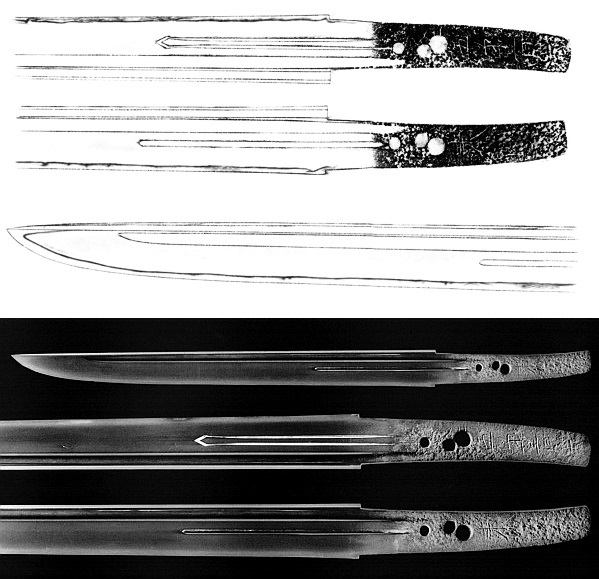
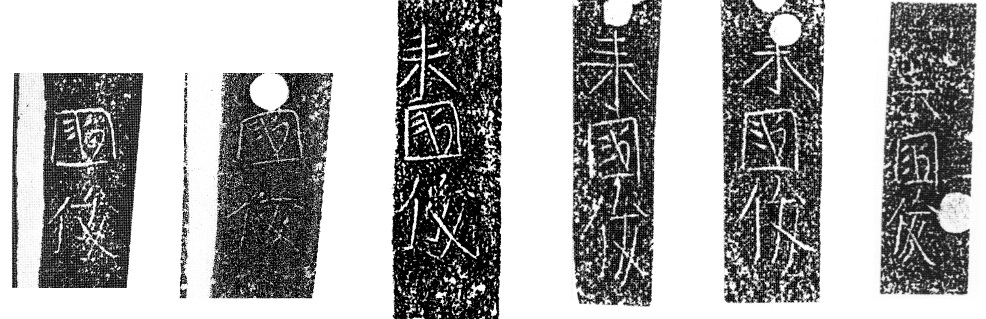
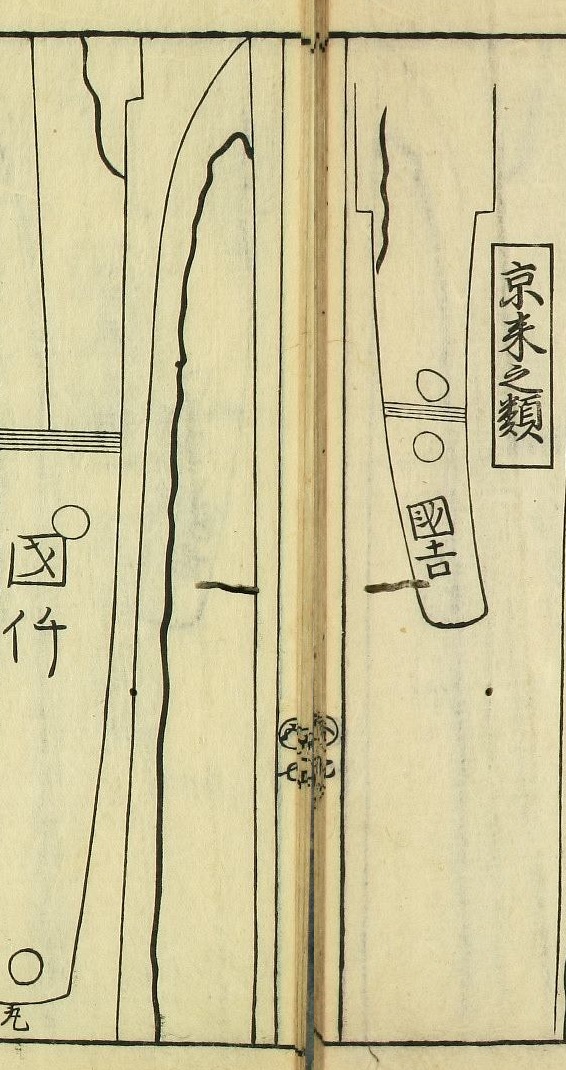
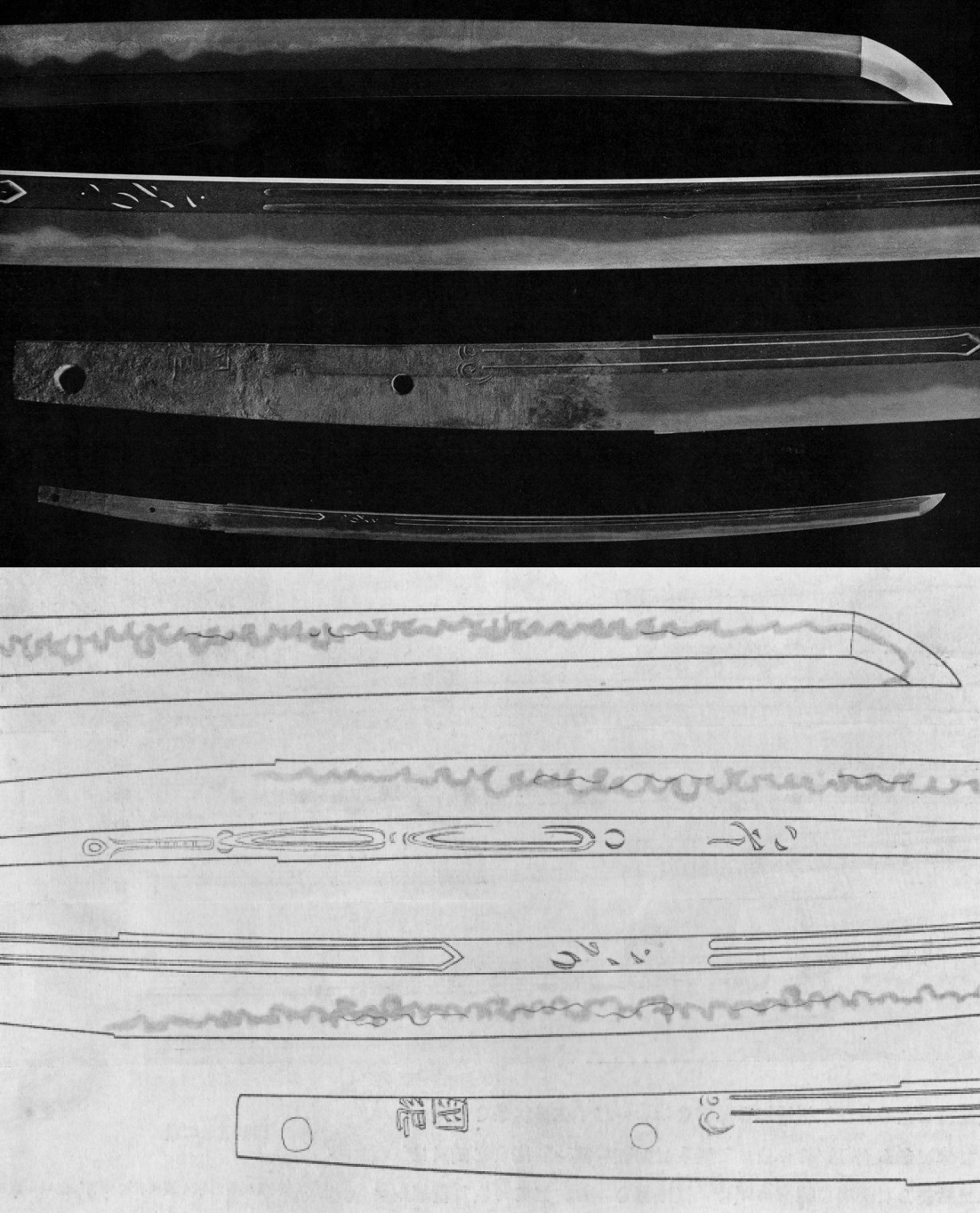
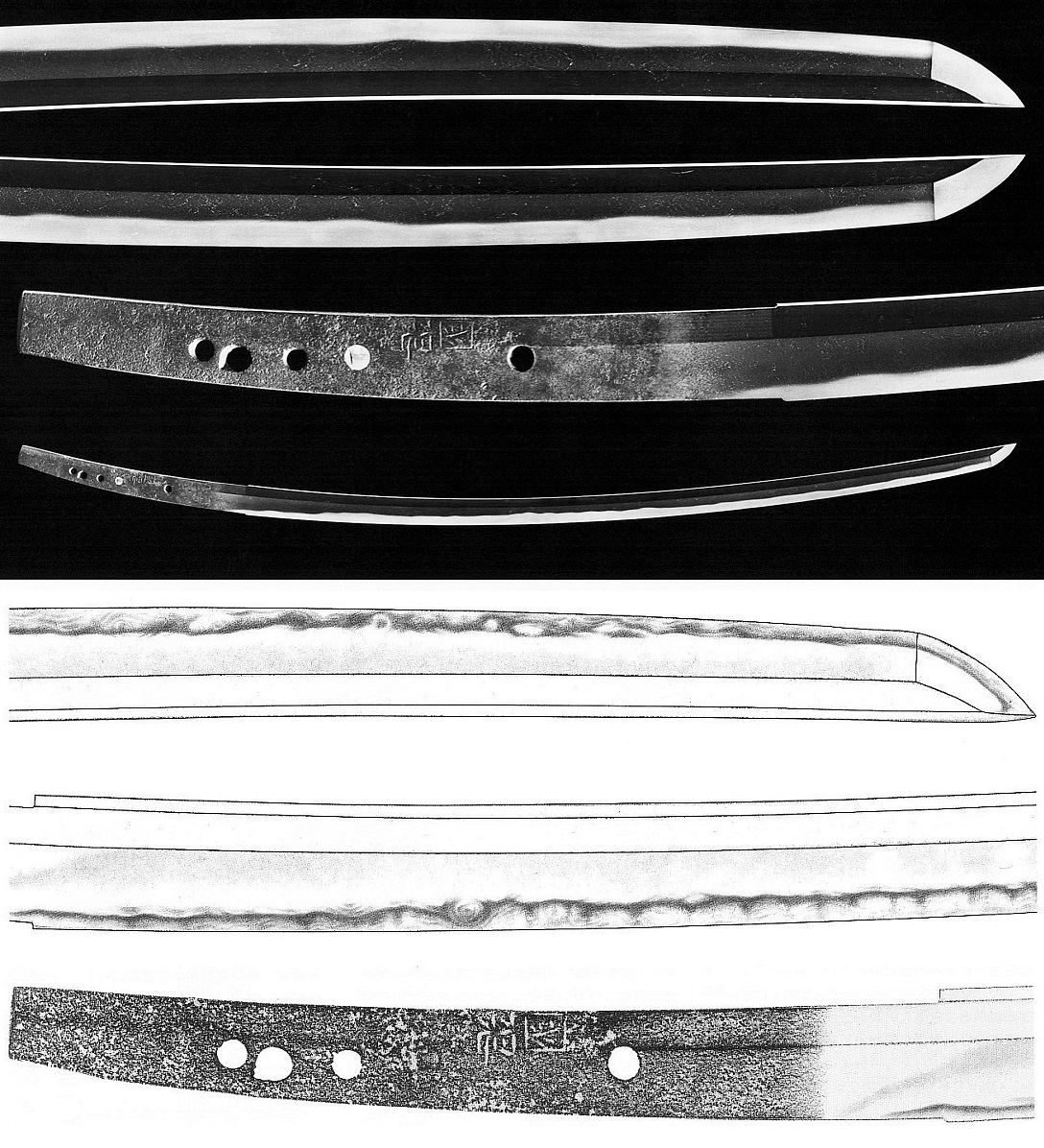
Now we are entering another of the great old Yamashiro traditions, that is Rai. I have summarized most of the traditions concerning the alleged school’s founder Kuniyoshi (国吉) a while ago here, for example that he was from Korea and became naturalized in Japan and that the school’s name Rai goes actually back to that context. Just one more note here, Honma points out that all the early Kyôto schools are either referred to as by and/or signed with the name of their production site, i.e. Sanjô, Gojô, Awataguchi, Ayanokôji. Only the Rai smiths used their family name what, according to Honma, somehow distinguishes them from the other local schools and what might suggest that they did not emerge from any of them. So we end up again at the immigration approach. Incidentally, the first smith who actually signed with the character for “Rai” was Kunitoshi but who was active towards the end of the Kamakura period. When we just stick to the facts then all we can say is that the Rai school emerged in the mid-Kamakura period and is stylistically most likely linked to the Awataguchi school, which had been the dominating Kyôto school of sword making at that time. Apart from that, experts see today Kuniyuki (国行) as founder of the school but that just on the basis of the fact that the earliest Rai works available go back to his hand. He was the son of the aforementioned Kuniyoshi who remains on paper the ancestor of the school. None of his blades have survived but there is a single puzzling blade going round – once owned by the sword polisher Hirai Chiba (平井千葉) that might be his work (see picture 1). Honma says, apart from that the deki is excellent, that the overall workmanship in suguha in ko-nie-deki mixed with ko-midare is clearly Kyô and about contemporary to Awataguchi Kuniyoshi but the mei is completely different from that of the Awataguchi master and that the mei can’t be brought in line with any of the other known Kuniyoshi smiths of that time, e.g. from Yamato. So Rai seems most likely but as even the old oshigata collections leave out Kuniyoshi, we just don’t have enough data to say for sure that the mei is that of Rai Kuniyoshi or not. Well, one of the very few oshigata of Rai Kuniyoshi can be found in the Kokon Mei Zukushi (see picture 2). It is a tantô with a furisode-style nakago and a slightly undulating suguha but the mei is not a definite match with the mei of the tachi in question, although it has to be mentioned that the signatures of early oshigata collections were captured with a certain artistic freedom (i.e. they were copied with the brush and not rubbed like we do it today).

Rai1

Picture 1: tachi, mei “Kuniyoshi” (国吉), nagasa 71.8 cm

Rai2

Picture 2: Rai Kuniyoshi as seen in the Kokon Mei Zukushi

Satô in turn introduces this tachi as being a work of the Rai ancestor and describes its workmanship as showing a sugata with an iori-mune, a koshizori, and a compact ko-kissaki with a slightly standing-out kitae in itame mixed with nagare, a hamon in suguha-chô that has a rather subdued nioiguchi and that is mixed with ko-midare and a few chôji and kinsuji, and a bôshi with a relative widely running-back ko-maru-kaeri. He also says that there is another tachi with an ubu-nakago of Rai Kuniyoshi extant but which is yakinaoshi. The oshigata shown in picture 1 also strongly suggests the existence of a prominent utsuri (maybe one of those antique looking utsuri with antai that is also seen on some blades of Awataguchi Kuniyasu and Ayanokôji Sadatoshi) and the tapering, strongly curved tang and the slender interpretation with the ko-kissaki speak for a blade that dates early Kamakura or to the transition from early to mid-Kamakura at the latest. Before we go over to Kuniyuki, I want to quote Tanobe on this matter as he says that the blade shown in picture 1 looks in terms of sugata and jiba surely older than Kuniyuki but even upon closer examination, he can not attribute the mei with reasonable certainty to Rai Kuniyoshi. But that is just how it goes, i.e. even if many indicators point towards Rai Kuniyoshi, we are talking about a single blade here with no other references to compare with whatsoever.

GenealogyRai

*

Thus we arrive at Kuniyuki (国行). He is traditionally dated somewhere between Jôgen (承元, 1207-1211) and Shôgen (正元, 1259-1260), but the former seems a bit early. That is because we know a blade by his alleged son Kunitoshi that is dated Shôwa four (正和, 1315) and that is signed with the additional information “made at the age of 75.” So Kunitoshi was born in 1240 and it is rather unlikely that Kuniyuki had the prime of his life 30 years earlier, i.e. in Jôgen. So something around Shôgen seems more fitting. By the way, the Kotô Meizukushi Taizen says that Kuniyuki died in Einin five (永仁, 1297) at the age of 79. So if we believe in this statement for a little, then he was 22 years old when Kuniyoshi was born. Anyway, the Shôgen era brings us right to an important aspect when talking about Kuniyuki, and that is that even if he was the actual founder of a school, we are, as mentioned, already in the mid-Kamakura period. So we are facing a different body of evidence than we did with the founding smiths of the Awataguchi school. These smiths were namely active from the end of the Heian to the very beginning of the Kamakura period, i.e. at least two generations earlier. In other words, the somewhat later active period makes a big difference when it comes to the pure number of extant works. But not only that, Kuniyuki entered the then sword world in a quite impressive manner because we are talking about more than two dozen blades that are jûyô-bunkazai or jûyô-bijutsuhin (one of them is kokuhô), more than 80 that are jûyô, and 17 that are tokubetsu-jûyô! So regardless of his scholastic background, he became without a doubt one of the greatest masters working in Kyôto at that time. Apart from that, his active time around the mid-Kamakura period also marks a noticeable shift from classical and elegant to powerful, and that applies both to sugata (e.g. ikubi-kissaki) and jiba. Accordingly, we have early works of Kuniyuki which are more unobtrusive and later works which are more magnificent and I want to introduce them in a chronological order. Incidentally, there are far more magnificent than classical blades of Kuniyuki extant.

The first two blades I introduce kind of connect to the aforementioned blade that is signed “Kuniyoshi” and to some of the Yamashiro/Kyôto masters who have been active a little earlier than Kuniyuki, e.g. Awataguchi Kuniyasu and Kunikiyo and Ayanokôji Sadatoshi. Blade number one shown in picture 3 is long, ubu, and of a slender and very elegant tachi-sugata but the (deep) toriizori (i.e. not koshi that bends down towards the tip) and the not that much tapering mihaba tell us that it is a mid and not an early Kamakura work. The kitae is a ko-itame mixed with mokume and nagare that shows plenty of fine ji-nie, much chikei, some jifu, and a nie-utsuri. The hamon is a ko-nie-laden chû-suguha-chô that is mixed with ko-midare, ko-chôji, some angular elements, ashi, , uchinoke, fine hotsure, sunagashi, and kinsuji. The nioiguchi is rather wide and the bôshi is a shallow notare-komi with a ko-maru-kaeri with some fine hakikake. Please pay attention to the small crescent-shaped uchinoke that appear here and there right atop of the habuchi. These so-called karimata are often seen on works of the three above mentioned smiths, i.e. Kuniyasu, Kunikiyo, and Sadatoshi, and are one the one hand an important characteristic feature of Rai Kuniyuki, and on the other hand a strong stylistic indicator that connects him as indicated to the earlier masters.

Rai3

Picture 3: tokubetsu-jûyô, tachi, mei “Kuniyuki” (国行), nagasa 82.7 cm, sori 3.0 cm, motohaba 2.8 cm, shinogi-zukuri, iori-mune

The blade shown in picture 4 too shows a very elegant and slender ubu tachi-sugata with a prominent kijimono-style nakago. The kitae of the “wet-looking” steel is a ko-itame mixed with some ô-hada and nagare that features plenty of fine ji-nie, fine chikei, and a nie-utsuri. The hamon is a mix if ko-chôji ko-gunome and ko-midare that shows some ko-gunome and ko-notare along the upper half and that comes with plenty of ashi and , small and punctual yubashiri along the yakigashira, nijûba in the monouchi area, fine kinsuji and sunagashi, and plenty of ha-nie all over the blade. The nioiguchi is bright and clear and the ha gets somewhat thinner towards the base and along the upper half. The bôshi is sugu with much hakikake and the kaeri is so small that it almost appears as yakitsume. Again, please take a look at what is going on parallel and above to the habuchi and compare that with the blades introduced here and here.

Rai4

Picture 4: tokubetsu-jûyô, tachi, mei “Kuniyuki” (国行), nagasa 76.6 cm, sori 2.7 cm, motohaba 2.75 cm, shinogi-zukuri, iori-mune


Next a blade (see picture 5) that shows one of his other characteristic interpretations, and that is a suguha-chô with a large amount of smallish and densely arranged chôji which are accompanied by an abundance of ashi, , and karimata. Please note that none of the chôji protrudes prominently and that the ha is as mentioned perfectly suguha-based, i.e. overall straight with not much ups and downs (what distinguishes him from Ayanokôji Sadatoshi as he applied more ups and downs along the ha and apart from that, his bôshi usually shows prominent hakikake). This interpretation, also due to the fact that some jifu appears, might remind of Ko-Bizen at a glance but the sugata would be different as Ko-Bizen blades usually come with a koshizori that bends down towards the tip and also karimata are not associated with Ko-Bizen. And the bôshi is a hint to wide for Ko-Bizen. This blade of Rai Kuniyuki by the way was once a heirloom of the Ogasawara family (小笠原), the daimyô of Buzen´s Kokura fief (小倉藩).

Rai5

Picture 5: jûyô-bunkazai, tachi, mei “Kuniyuki” (国行), nagasa 74.5 cm, sori 3.0 cm, motohaba 2.5 cm, shinogi-zukuri, iori-mune

Another of the very typical interpretations of Kuniyuki is seen in picture 6. This is his only work that is designated as a kokuhô and the blade is regarded as one of his greatest masterworks. The bôhi runs as kaki-nagashi into the tang and there is a mekugi-ana at the tip of the tang but this ana is a so-called shinobi-ana and the nakago is indeed completely ubu (also proven by the sankozuka-ken that is carved as relief in the hi which is exactly where it was intended to be, i.e. not half-way in the tang). The blade has a wide mihaba, does not taper much, has a relative thick kasane, a toriizori, and a stately chû-kissaki. The kitae is somewhat standing-out but dense ko-itame with plenty of ji-nie, some ô-hada along the haki-omote side, and a midare-utsuri. The hamon is a wide and ko-nie-laden suguha-chô that tends a little to notare along the monouchi and towards the yokote and that is mixed with ko-chôji, ko-midare, many ashi and , karimata, and at this blade, we see something that should become a characteristic feature of his school, and that is muneyaki. The bôshi tends to notare-komi and has an ô-midare-kaeri with hakikake and the nie are a hint more emphasized in the bôshi than in the rest of the ha. The blade was once a heirloom of the Matsudair family (松平), the daimyô of Harima´s Akashi fief (明石藩), and is thus also nicknamed Akashi-Kuniyuki (明石国行). Today it is owned by the NBTHK.

Rai6

Picture 6: kokuhô, tachi, mei “Kuniyuki” (国行), nagasa 76.6 cm cm, sori 3.0 cm, motohaba 2.95 cm, shinogi-zukuri, iori-mune

Picture 7 shows one more stylistic approach of Kuniyuki and that is an almost pure suguha or a suguha-chô which is mixed with fewer elements and/or shows some shallow notare over its length. The blade is designated as a jûyô-bijutsuhin and has its mei preserved via orikaeshi. The tachi is rather wide, does not taper much, shows a toriizori, and ends in a stately chû-kissaki. The ha is mixed with some ashi and plenty of all over the blade and most of the mixed-in ko-midare focus on the very base, that means, right after the koshi the ha appears almost as pure suguha. Interesting here is that we see prominent nijûba before the yokote and throughout the sugu-bôshi, which runs back with a neat ko-maru-kaeri (or almost a chû-maru-kaeri on the haki-omote side). The nijûba are insofar very interesting as they connect him on the one hand to Awataguchi Kuniyoshi (see here), and on the other hand as this element was taken by his son-in-law’s son Kunimura (国村) to Higo where it was continued by the local Rai offshoot, the Enju school. But Enju works would show some masame along the hada and a shirake-utsuri.

Rai7

Picture 7: jûyô-bijutsuhin, tachi, orikaeshi-mei “Kuniyuki” (国行), nagasa 69.7 cm, shinogi-zukuri, iori-mune

Now to another noteworthy aspect in Rai Kuniyuki’s oeuvre, and that is that there are apart from a couple specimen hardly any tantô extant by him. This is insofar interesting as his contemporary Awataguchi Kuniyoshi was a great tantô master and produced quite some and so did their successors Yoshimitsu and Rai Kunitoshi respectively. There are also no tantô of Ayanokôji Sadatoshi known and neither are much of pre-Awataguchi Kuniyoshi smiths (with the exception of Hisakuni). So with this and the aforementioned stylistic proximity to Sadatoshi in mind, it is conceivable that Kuniyuki has been active just a hint earlier than Awataguchi Kuniyoshi (who is dated around Kenchô [1249-1256]). But this is very speculative as it is quite possible that he made a decent number of tantô but which just did not survive. Anyway, I want to introduce one of these extremely rare Kuniyuki tantô, a blade that makes one think of Nanbokuchô or beginning Muromachi at a glance. It has a sunnobi-nagasa of 30.7 cm, a sori of 0.2 cm, and is in hira-zukuri with a mitsu-mune and a wide mihaba of 2.8 cm. The kitae is a dense itame that is mixed with some ô-hada in places and that shows jifu and plenty of ji-nie. The steel is clear and the hamon is a ko-nie-laden ko-notare with a wide nioiguchi that is mixed with gunome, ashi, , shimaba, kinsuji, fine sunagashi, and yubashiri. The bôshi is midare-komi with a ko-maru-kaeru with a few hakikake and kinsuji. Both sides bear a katana-hi with tsurebi and the tang is ubu. So this entire interpretation (sugata and jiba with much midare) seems to anticipate the style of Rai Kunimitsu and Kunitsugu, i.e. even skipping his son Kunitoshi. The blade was once a heirloom of the Shimazu family (島津), the daimyô of the Kagoshima fief, and was given to them by shôgun Tsunayoshi on the occasion of the marriage his adopted daughter Takehime (竹姫, 1705-1772) to Shimazu Tsugutoyo (島津継豊, 1702-1760) in Kyôhô 14 (1729).

Rai8

Picture 8: tokubetsu-jûyô, tantô (modern classification is wakizashi), mei “Kuniyuki” (国行), measurements see text

Apart from that, there are a few stout kodachi and, what seems to be, uchigatana of Kuniyuki extant. Picture 9 shows such an uchigatana (it is according to the modern classification a katana) and signed so, i.e. in katana-mei, and was thus worn edge up. The blade is wide and stout, ends in an ikubi-style chû-kissaki, and features unlike his tachi a koshizori. The kitae is overall rather standing out and covered with ji-nie and appears on the omote side as itame, and on the ura side along the lower half as itame-masame and on the upper half as ko-itame mixed with mokume. There is a vivid midare-utsuri and the hamon is a notare-chô in ko-nie-deki with a wide nioiguchi and is mixed with chôji, gunome, and many ashi and . The bôshi is midare-komi with a somewhat “tied up” looking kaeri. On both sides we see a wide bôhi with soebi and the tang is a little suriage. So with the relative flamboyant interpretation with midare-utsuri we might think of Bizen for a moment but there are just too many nie for a Bizen work of that time, i.e. of the mid-Kamakura period.

Rai9
Picture 9: jûyô, uchigatana, mei “Kuniyuki” (国行), nagasa 61.25 cm, sori 1.6 cm, motohaba 3.05 cm, shinogi-zukuri, iori-mune

Last but not least I want to recommend taking a look at the pictures at Darcy’s site here to get an impression of the steel and the almost “supernatural” forging quality we are talking about here. And I want to close by quoting Darcy that “this kind of sword is what shows us that the Kamakura period was truly the golden age of sword making.”

KANTEI 4 – YAMASHIRO #14 – Aburanokôji (油小路) School

Strictly speaking, Aburanokôji does not refer to a school in the proper meaning of the word but to a loose group of swordsmiths which was active somewhere along Kyôto’s Aburanokôji street. This street runs in a north-south direction and parallel (and pretty close) to the Horikawa-dôri that passes Nijô Castle to the east. Satô Kanzan mentions that the group was working near the Ayanokôji School and when we take a look at the map of Kyôto we learn that the Aburanokôji crosses the west-east running Ayanokôji street somewhere halfway between Nijô Castle and the Nishi Honganji. The meikan associate the Aburanokôji smiths with the Awataguchi School but the workmanship and other genealogical considerations suggest that they were rather linked to the Ayanokôji School, thus my brief detour into geographical details.

Well, when we look into the meikan, only a handful of Aburanokôji smiths can be found, so this group was pretty minor. And when we take a look at these few smiths we learn that half of them are dated into the late Kamakura period, to be precise around Shôô (正応, 1288-1293), and the other half into the early to mid Nanbokuchô period, i.e. around Kenmu (建武, 1334-1338) and Enbun (延文, 1356-1361). And not really a connection is drawn between these “sub groups.” Anyway, one clue on the affiliation of this group is offered by the Kokon Mei Zukushi which introduces the smith Tadaie (忠家) in the Ayanokôji genealogy, namely as son of Ayanokôji Sadaie (定家) and as being active around Enbun. The meikan list Sadaie as son of the famous Ayanokôji Sadatoshi and mostly date him around Kagen (嘉元, 1303-1306). The Kokon Mei Zukushi says that he was active around Shôô (正応, 1288-1293) and Einin (永仁, 1293-1299), so not that far away from Kagen. Enbun seems a bit too far from Kagen (or even Einin) for Tadaie being the son of Sadaie but when we look again at the actual genealogy of the Kokon Mei Zukushi, we learn that a “daughter” is slid-in between Sadaie and Tadaie. This most likely means that Sadaie did not have a son but adopted his grandson as heir. And with this in mind the about 50~60 years of difference between Sadaie and Tadaie don’t sound that bad anymore.

Now there is a tantô extant which is signed “Aburanokôji Tadaie tsukuru” (油小路忠家造) and dated “Enbun sannen chûshun no hi” (延文三年仲春日, “a day in the second month Enbun three [1358]”) (see picture 1). This tantô is the only blade known by Tadaie and is not only a very precious reference piece for this smith but also for the entire group as it actually bears the name Aburanokôji in the mei and as it is dated. Experts assume that the Tadaie who is listed at the end of the Kokon Mei Zukushi’s Ayanokôji genealogy refers to the maker of this tantô, Aburanokôji Tadaie, and this assumption is not solely based on the identical name and the identical nengô (i.e. both genealogy and tantô say Enbun) but also on similarities in workmanship. That is, although this tantô comes in a pretty obvious Enbun-Jôji-sugata, i.e. in a sugata we won’t associate with the classical Ayanokôji School at a glance, both jigane and hamon are basically following the Ayanokôji forging tradition. The kitae is a stanting-out itame with nagare and masame towards the ha and ji-nie as well as some shirake appear. The hamon is a hoso-suguha in ko-nie-deki and the bôshi features a short ko-maru-kaeri. The omote side shows a katana-hi with below a suken as relief and accompanied by a soebi, and the ura side a shôbu-hi. Incidentally, this blade was once a heirloom of the Tsuchiya family (土屋), the daimyô of the Tsuchiura fief (土浦藩) of Hitachi province. Later on it was owned by the Shizuoka Prefecture industrialist Yabe Toshio (矢部利雄, 1905-1996) who had a pretty impressive collection (e.g. he also owned the famous yari Tonbogiri).

Abura1

Picture 1: tantô, mei “Aburanokôji Tadaie tsukuru – Enbun sannen chûshun no hi,” nagasa 28.4 cm, sori 0.3 cm, hira-zukuri, iori-mune

Apart from that tantô, we know, or rather knew, a jûyô-bunkazai tachi signed “Tadayoshi” (忠吉) that is attributed to Aburanokôji Tadayoshi (see picture 2) Incidentally, there was obviously a third character below “Tadayoshi” but which is lost due to corrosion. So the blade was originally most likely either signed “Tadayoshi saku” or “Tadayoshi tsukuru.” The tachi was owned by the Suwa-taisha (諏訪大社, Nagano Prefecture) but was unfortunately stolen and its whereabouts are unknown. It has a koshizori that bends down towards the tip, a ko-kissaki, and shows a standing-out itame with some nagare, ji-nie, and a midare-utsuri. The hamon is a suguha-based chôji in nie-deki that is mixed with kawazu no ko-chôji and kinsuji. The elements of the ha are rather smallish and densely arranged and the nioiguchi is subdued. The bôshi features a ko-maru-kaeri but almost tends to a kuzure-like ichimai. The tang is suriage and has kiri-yasurime. So like the tantô introduced above, the workmanship of this tachi does not link to Awataguchi at all, as the meikan suggest for the affiliation of these two smiths. By the way, it is said that Tadayoshi, who is dated around Kenmu, was the father of Tadaie. If this is true and we want to bring that in line with the genealogy of the Kokon Mei Zukushi, Tadayoshi must have been married to Ayanokôji Sadaie’s daughter.

Abura2

Picture 2: jûyô-bunkazai, tachi, mei “Tadayoshi” (忠吉), nagasa 74.3 cm, sori 2.4 cm, shinogi-zukuri, iori-mune

Well, what about the other Aburanokôji smiths who appear in the meikan? There was an Aritada (有忠) who is dated to the Jôji era (貞治, 1362-1368) who was most likely linked to Tadayoshi and Tadaie. Apart from that, we find a Tadatsugu (忠次) and a Sadakage (定景) who are both dated around Shôô (正応, 1288-1293). The use of the characters “Tada” and “Sada” do suggest a connection to Ayanokôji (e.g. Sadatoshi, Sadayoshi, Sadaie) on the one, and to the later Aburanokôji group (e.g. Tadaie, Tadayoshi, Aritada) on the other hand. But due to the lack of extant works and records, I have to end this brief chapter here and with the next part we arrive at a very successful Yamashiro school, namely at Rai.

KANTEI 4 – YAMASHIRO #13 – Awataguchi (粟田口) School 8

With this post I will close the chapter on Awataguchi and after introducing some works of the more or less “also ran” smiths of the school who have not been introduced so far, I want to add some concluding thoughts on why the school did not make it into Nanbokuchô times.

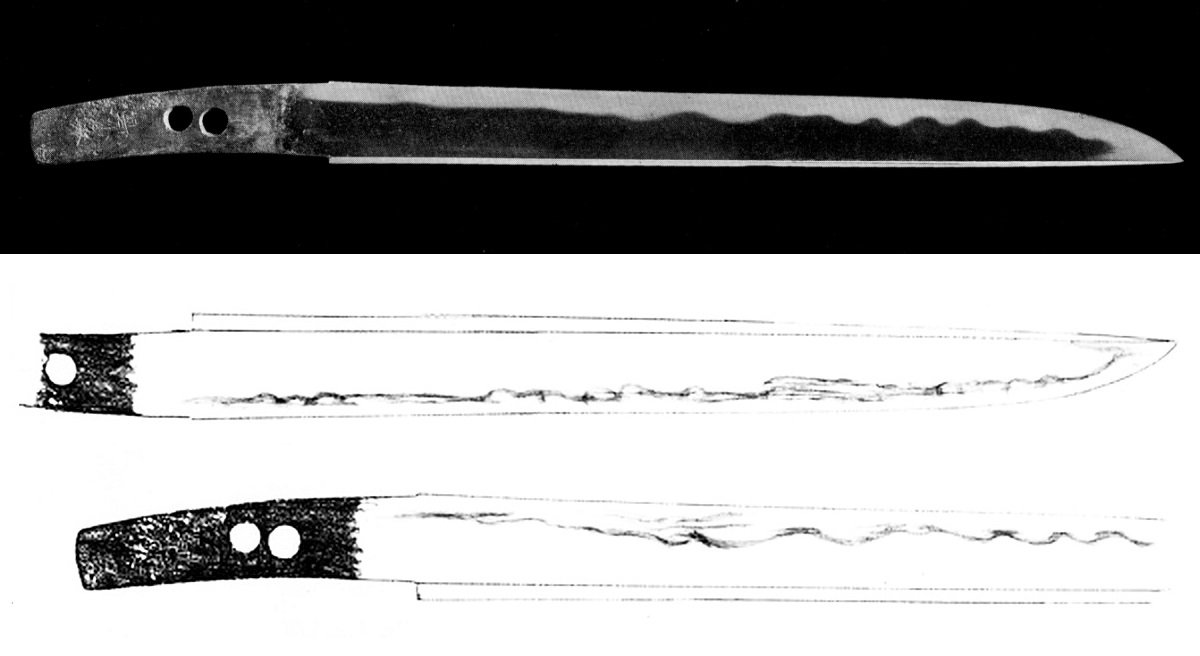
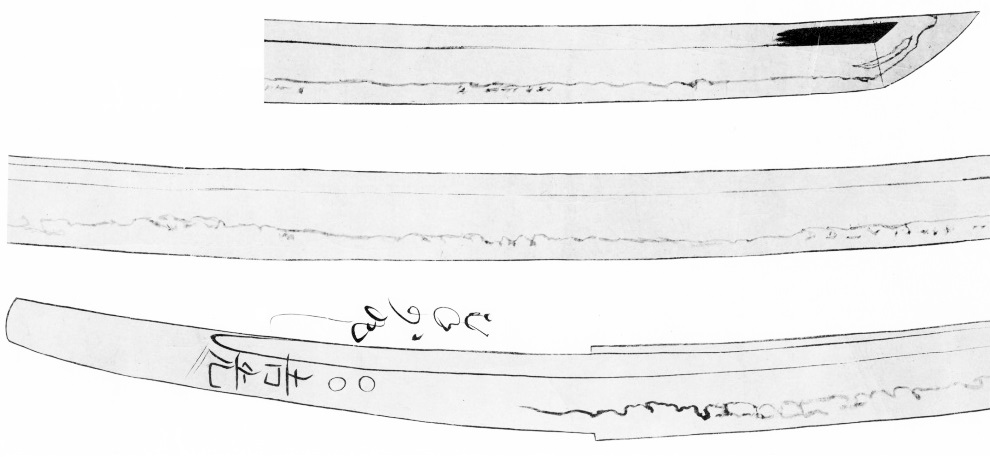
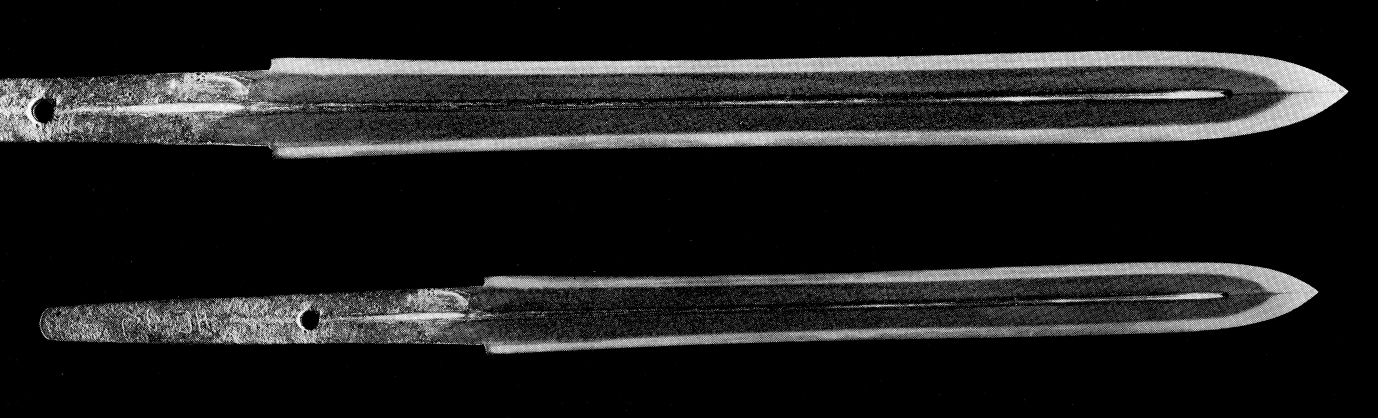
Let me begin with Tôbei Kunimitsu (藤兵衛国光), the younger brother of Awataguchi Kuniyoshi (国吉) who bore the honorary title Sahyôe no Jô (左兵衛尉). There is some confusion about his active period as the meikan date him traditionally around Kenchô (建長, 1249-1256) but there is a ken extant signed “Sahyôe no Jô Fujiwara Kunimitsu” (左兵衛尉藤原国光) which is dated Shôwa ten (正和, 1321). Please note that the mekugi-ana of this ken goes right trough the year and that the very area of the tang shows considerable corrosion and so some interpret the date as Shôwa one (1312) (see picture 1). Apart from that, there are allegedly also works going round which are dated with the Einin era (永仁, 1293-1299) and then there is the jûyô tantô that was discovered in recent years which is dated Kôan eleven (弘安, 1288) (see picture 4). So either Kunimitsu enjoyed a really long life, or there was a second generation, whereby also the theory was forwarded that Kunimitsu was not the son of Norikuni but of Kuniyoshi. Interestingly, the Kotô Meizukushi Taizen – which lists him next to Kuniyoshi but with no reference of being his brother or a student of Norikuni – says that he was born in Jôgen one (承元, 1207) and died in Kangen two (寛元, 1244) at the young age of 36. Kunimitsu is listed in this source with the first name Tarô (太郎) and with the rank of a shinshi (進士), a person that passed certain tests of the Imperial school of civil servants during the ritsuryô era. However, most meikan date this Shinshi Tarô Kunimitsu to the Kenmu era (建武, 1334-1338). So we don’t know for sure how many Kunimitsu have been active within the Awataguchi school and what their exact relations were within the lineage. Maybe Tôbei Kunimitsu was Norikuni’s second son but had his own son, maybe the Tarô Kunimitsu, trained by his older brother Kuniyoshi. Or Tôbei Kunimitsu was indeed Kuniyoshi’s son and was followed by a second generation of the same name, maybe the Tarô Kunimitsu. But we will probably never know…

AwataRest1

Picture 1: ken, mei “Sahyôe no Jô Fujiwara Kunimitsu” “Shôwa jû/gannen jûnigatsu hi (+ 2 bonji),” nagasa 20.3 cm, ko-itame with masame and ji-nie, suguha-chô with some ko-notare and plenty of nijûba

As for Awataguchi Kunimitsu’s extant works, there are two tachi which are famous, a jûyô-bunkazai that is preserved in the Yôrô-ji (養老寺, Gifu Prefecture), and a jûyô-bunkazai that is owned by the Kurokawa Institute of Ancient Cultures. Both blades are slender, elegant, show a relative shallow sori, traces of funbari (both blades are surage), a rather wide shinogi-ji, and a ko-kissaki that tends towards chû and a hint towards ikubi, a feature that was popular in mid-Kamakura times. Also the interpretation of the jiba is very similar. We see a densely forged ko-itame with fine ji-nie and a nie-utsuri, a ko-nie-laden hoso-suguha with a rather wide nioiguchi, and a ko-maru-bôshi with a relative wide kaeri. The former, i.e. the Yôrô-ji tachi shows a few ashi and seems to be a little more nie-emphasized as there are some chikei and kinsuji. The interpretation places the two blades perfectly into the principal stylistic approach of the Awataguchi school.

AwataRest2

Picture 2: jûyô-bunkazai, tachi, mei “Kunimitsu” (国光), nagasa 73.2 cm, sori 1.3 cm, shinogi-zukuri, iori-mune, horimono of a suken towards the base of the omote side, preserved in the Yôrô-ji

AwataRest3

Picture 3: jûyô-bunkazai, tachi, mei “Kunimitsu” (国光), nagasa 80.3 cm, sori 1.9 cm, shinogi-zukuri, iori-mune, owned by the Kurokawa Institute of Ancient Cultures

Picture 4 below shows the aforementioned tantô of Kunimitsu. It is quite graceful and has lost some substance – leaving only traces of the once engraved suken on the omote and the gomabashi on the ura side – but with the jiba very well preserved. The kitae is a ko-itame with masame-nagare that features plenty of ji-nie and fine chikei and the steel is extra bright and clear. The hamon is a ko-nie-laden suguha with a little notare that is mixed with a little ko-gunome on the ura side. The nioiguchi is wide and the suge-bôshi shows a wide ko-maru-kaeri. Based on this work, it seems as if Awataguchi Kunimitsu’s tantô are a little more nie-emphasized than his tachi. Please check out Darcy’s site here for some excellent pictures of the blade and the steel.

AwataRest4

Picture 4: jûyô, tantô, mei “Kôan jûichinen – gogatsu ichinichi Kunimitsu” (弘安十一年・五月一日国光, “a day of the fifth month Kôan eleven [1288]”), nagasa 21.7 cm, uchizori, hira-zukuri, iori-mune

Now there were some theories forwarded in the past that Awataguchi Kunimitsu and Shintôgo Kunimitsu were the same smith but these are dismissed today as their signature style differs significantly (note the left inner part of the character for “Kuni” and the upper part of the character for “mitsu”) (see picture 5). Well, the theory of course suggests itself as Shintôgo has his roots in the Awataguchi school but apart from the signature, the blades of Awataguchi Kunimitsu just don’t show enough chikei and kinsuji to pass for Shintôgo (the steel is different too) and they belong within the Awataguchi school to the least nie emphasized blades at all. So if you add up all kantei points for Awataguchi Kunimitsu, you arrive at: Slender tachi-sugata with a rather shallow sori and a somewhat wider shinogi-ji in combination with a nashiji or nashiji-like hada, a noticeably narrow suguha-based hamon, and a bôshi with a relative wide kaeri (see tantô in picture 4). Again, the jiba does not feature much nie what gives the blades a more unobtrusive overall appearance.

AwataRest5Picture 5: Awataguchi Kunimitsu left, Shintôgo Kunimitsu right

*

There are a few blades extant by Kunisada (国定), a student of Awataguchi Kuniyoshi’s student Kuninobu (国延), but as he moved later to Ayabe (綾部) in Tanba, I want to introduce him when we arrive at this province. The same applies to Kagenaga (景長), the son of Awataguchi Yoshimasa (吉正) who in turn had studied under Tôshirô Yoshimitsu, who founded the Inaba-Kokaji (因幡小鍛冶) lineage. So we will talk about him in the course of when we learn about what was going on in Inaba province. However, last but not least I want to introduce Awataguchi Kagehisa (景久) as there is a single tantô of him known (see picture 6). In other words, there are virtually zero blades of all the other Awataguchi smiths extant who are quoted in the genealogy but who were not the famous masters of the school. So Kagehisa is said to have been the student of Tôshirô Yoshimitsu and he is traditionally dated around Kôan (1278-1288) or Shôan (正安, 1299-1302). The tantô in question is in hira-zukuri, small and elegant, and has a hardly tapering tang that tends to furisode. The kitae is a very fine ko-itame with a little nagare, plenty of ji-nie, and a little chikei. The hamon is a ko-nie-laden ko-midare mixed with ko-notare at the base, gunome-ashi, fine sunagashi, some kinsuji, and nijûba in the upper half. The bôshi is midare-komi with a ko-maru-kaeri with hakikake. The blade features a very bright nioiguchi and Satô Kanzan speaks of it “as might be excepted, of high quality.” In short, it fits into the legacy of the Awataguchi school and the tradition that Kagehisa had learned from an outstanding mastersmith. Also backing the tradition is the noticeable tendency towards midare in the ha and towards furisode in the nakago. The latter shows kiri-yasurime and a small and quite finely chiselled niji-mei.

AwataRest6

Picture 6: jûyô, tantô, mei “Kagehisa” (景久), nagasa 22.6 cm, uchizori, hira-zukuri, iori-mune


*

It is difficult to say how or if at all the Awataguchi main line was carried on after Yoshimitsu. Incidentally, if we count Kuniie (国家) as first generation Awataguchi, Yoshimitsu would have been the fifth generation main line. The school itself had existed for about a century at the time of Yoshimitsu. Well, before I come up with some attempts at explanation, I want to introduce what the historic sources say about what was going on after Yoshimitsu. In the earliest extant sword publication, the Kanchi’in Bon Mei Zukushi, there isn’t any mention at all in this respect and Yoshimitsu is even listed in line with Kuniyoshi and Kunimitsu. Therein the main line goes Kuniie → Kunitomo → Norikuni → Kuniyoshi, period. Yoshimitsu is seen as contemporary or, if you want, as younger brother of Kuniyoshi. In the Kokon Mei Zukushi, Yoshimitsu is succeeded by Nobumitsu (延光) who again has four smiths under him, Masamitsu (正光), Yoshimasa (吉正), Yoriie (頼家), and Kunisumi/Kunizumi (国純), although it is not mentioned who his official successor was or if one of them succeeded him as head of the Awataguchi school at all. Tsuneishi introduces in his Awataguchi genealogy two students of Yoshimitsu, namely Yoshikuni (吉国) and the aforementioned Kagehisa (景久). And the Kotô Meizukushi Taizen lists Masamitsu, Yoshimasa, Nobumitsu, and Kunichika (国近) below of Yoshimitsu.

Let us focus on the tradition of handing over one character to the next generation for a little. When we look at the Awataguchi genealogy we learn that in many cases, the first character of the master’s name was used as second character of the successor’s name, e.g. KUNItomo → NoriKUNI → KUNIyoshi → YoshiMITSU or AriKUNI → KUNIhisa. So in the case of Yoshimitsu, we would expect some name like MITSUxxx. Interestingly, the Kotô Meizukushi Taizen says that Masamitsu also signed with Mitsumasa. A Yoshimitsu student with the name Mitsumasa is not found in the meikan but when we look at the Masamitsu we come across Daruma Masamitsu who is said to have been the son of Daruma Shigemitsu (重光). Well, both Masamitsu and Shigemitsu are dated around Eitoku (永徳, 1381-1384) but lo and behold, there exists the tradition for Shigemitsu that he was the son of Awataguchi Yoshimitsu. But we must be careful. Genealogies were pimped or doctored later on exactly that way, that is, having a smith working in Yamashiro province who shares the same character as a famous master smith tempts the compiler to create this very connection in the first place. So basing a theory just on limited genealogic data can mean falling right into the trap of the compiler. In other words, when you start from a certain smith and go downwards you might just follow what was actually created by a compiler by going backwards.

How about the branches of the other masters of the school? Not many students are recorded for any of them, except for Yoshimitsu’s predecessor Kuniyoshi and for Kunitsuna, the youngest of the earlier Six Awataguchi Brothers. As mentioned, one branch that had emerged under master Kuniyoshi relocated to Tanba province and flourished there throughout the Nanbokuchô period (also by being joined from a branch of the lineage of Yoshimitsu’s student Masamitsu which had moved to Tanba too). And the school of Kunitsuna brought forth Shintôgo Kunimitsu who was one of the founders of the Sôshû tradition as Kunitsuna himself had moved to Kamakura on bequest of the bakufu.

The downfall or rather discontinuance of the Awataguchi School is most likely linked to the fact that the Kyôto-based and highly prestigious lineage was mainly producing for a clientele that came from local aristocracy and highest circles. So by the time of Yoshimitsu, i.e. late Kamakura, the school was facing a Kyôto of an aristocratic class that had reached a point at which its political obsolescence, that came along with the establishment of the Kamakura-bakufu in 1185, had been pretty much noticeable. Of course, Kyôto was still undisputed center when it comes to refined culture, connection to the Chinese mainland, and sanctioning of courtly titles, and traffic between the imperial capital and Kamakura was heavy. Another severe impact on the ability of the Kyôto aristocracy to put anything into practice came with the two invasion attempts of the Mongols which tooks place in 1274 and 1281. We all know that “favourable” weather conditions played an important role in the defeat of the invading fleet but as the bakufu was responsible for national defence, it took large parts of the “victory” on it’s own account. In other words, the Shogunate in Kamakura was so to speak capable of not only defending but also of being in charge of the country. Accordingly, the local Kyôto smiths were about losing a great amount of business and much more promising was what was going on in Kamakura and the newly established Sôshû tradition of sword making. But on the other hand, another Kyôto-based school, Rai, was just about to flourish (and became as successful as it gets). So there was surely a demand left. Anyway, what we can see is that from late Kamakura onwards, a significant shift from noble to martial took place and maybe the Rai School was just more capable of responding to this request. Well, there are still many things in the dark when it comes to the early Kyôto schools. Maybe there were other, i.e. local and/or genealogic factors involved than mere the factors supply and demand and rise of the warrior class. For example, we are still not able to fully connect the dots and draw the connections between Sanjô, Gojô, Ayanokôji, Awataguchi, and Rai. I mean, overlapping workmanships give us a pretty good good hunch about that they must have been somehow connected. But we don’t know for sure which schools’ founder was trained by whom and so on. And with this, I want to close the chapter Awataguchi and move – with a short stopover at Aburanokôji (油小路) – over to the Rai School.

KANTEI 4 – YAMASHIRO #12 – Awataguchi (粟田口) School 7

We arrive at Yoshimitsu (吉光) who is, depending on tradition, seen as student or as son of Kuniyoshi (国吉), his fourth son precisely, taking into consideration his first name Tôshirô (藤四郎) (i.e. the suffix shirô refers to a fourth son). The meikan either date him around Kôan (弘安, 1278-1288) or Shôô (正応, 1288-1293) but there are no date signatures of Yoshimitsu known. We have learned in the last chapter that from Kuniyoshi, blades dated Kenji four (建治, 1278) and Kôan six (弘安, 1283) and ten (1287) are known so both Kôan and Shôô seem perfectly fine for Yoshimitsu, regardless of if he was Kuniyoshi’s son or his student. The Kotô Meizukushi Taizen by the way quotes Yoshimitsu with Kangi one (寛喜, 1229) as year of birth and Shôô four (正応, 1291) as year of death. Before we continue, let me introduce all the (non-Kuniyoshi son) theories that were forwarded over time regarding Yoshimitsu’s background. Some say he was actually the fourth son of Norikuni (則国) and that’s where the first name Tôshirô comes from. Following this approach, he would have been Kuniyoshi’s younger brother, what does not exclude that he rather studied under his older brother than under his father. If we follow the Kotô Meizukushi Taizen, then Yoshimitsu was nine years old when Norikuni died, what would be an explanation for the aforementioned constellation. Incidentally, Kuniyoshi was 24 when Norikuni died but again, the data of the Kotô Meizukushi Taizen is highly doubtful and I don’t want to base too many theories on just that source. All I want to do here is to point out possible scenarios. Others see Yoshimitsu as son of Kuniyasu, others as son of Shintôgo Kunimitsu, and others again as great-grandson of Hisakuni.

Anyway, I want to introduce an interesting theory that follows the Kuniyoshi student-approach and that is connected to a highlight of Yoshimitsu, and that is his signature style. This theory says that Yoshimitsu came originally from Echizen province where he lived in the vicinity of the Shiisaki-jinja (椎前神社・志比前神社, present-day city of Tsuruga, Fukui Prefecture). Now Tsuruga is not that far away from the old capital, i.e. about 100 km following the Hokurikudô, and the Hokurikudô was a much frequented route as in Heian and early Kamakura times, Tsuruga had been (apart from Hakata on Kyûshû) the main hub for trade with Song China. The theory also says that he studied calligraphy of the Guzei’in-ryû (弘誓院流) in the capital, a style of shodô that has been established by court noble Kujô Noriie (九条教家, 1194-1255). Taking that into consideration, it is likely that Yoshimitsu has belonged to a rather high-ranking local Tsuruga family and that he moved in higher circles when visiting Kyôto. So maybe he came for something else but had a fondness for swords and was thus introduced to the then most renowned lineage of swordsmiths, the Awataguchi, where he started to study with master Kuniyoshi. I mean, we are talking here about the most prestigious masters of that time who only took orders from the wealthiest clientele, so following the Echizen approach, it is unlikely that for example a peasant boy packed his backback, marched down to Kyôto, and knocked at the door of Kuniyoshi to become his apprentice. Stories like that are more like Edo-era romanticism. As mentioned, this is just one of the numerous theories on the background of Yoshimitsu but reason why I deal with it that persistently is his signature style of which experts agree that the elegant style is not a coincidende and that he must had a decent knowledge of the aesthetics of calligraphy. In other words, Yoshimitsu’s signatures are not just of the “elegant because of the archaic, antique feel” category, like the mei of Heian and early Kamakura-era smiths for example, but are well thought out with all elements like curves of strokes and distance of radicals in perfect harmony.

When it comes to Yoshimitsu’s signatures, we basically distinguish between two groups: A more “stiff” and “angular” one that is executed with a somewhat thicker chisel, and a “looser” and more “roundish” one for which a thinner chisel was used. The former features a smaller lower kuchi (口) radical of the character for Yoshi (吉) and is therefore also referred to as koguchi-mei (小口銘), and the latter, with the noticeably larger kuchi radical, as ôguchi-mei (大口銘) respectively. It is assumed that the ôguchi group goes back to his late years. Tanobe sensei introduces a third group which is somewhere in between these two and that mixes certain elements from each group, i.e. that goes back to a transitional time if you want, which he personally thinks of being the most elegant one. Picture 1 below shows one exemplary mei for each group.

Yoshimitsu1

Picture 1, from left to right: koguchi-mei, intermediate, ôguchi-mei

When it comes to Yoshimitsu’s oeuvre, it is kind of similar to Kuniyoshi, that means, the majority are tantô, followed by a few others and hardly any long swords going round at all, with Yoshimitsu’s long sword body of evidence even weaker than that of Kuniyoshi. And due to the latter fact, I want to “quickly” get by that very limited non-tantô database before we come to the blades we can actually talk about in more detail. Throughout the entire feudal era and up to the 1980s, it was thought that only one long blade of Awataguchi Yoshimitsu exists, namely the meibutsu Ichigo-Hitofuri (一期一振), which was once worn by Toyotomi Hideyoshi. However, Hideyoshi had it shortened from 85.7 to 68.8 cm but ensured that the original signature of Yoshimitsu was set into the new tang as so-called gaku-mei (額銘). When Ôsaka fell in 1615, the blade suffered a fire damage and had to be rehardened by Echizen Yasutsugu. In other words, it is saiha and, apart from old oshigata, we can’t say much about the original interpretation of its yakiba. Pictures of the meibutsu and further info can be found on my Japanese Sword Legends site here and here. Speaking of oshigata, there is a special copy of the work Kôtoku Katana Ezu (光徳刀絵図) that dates to Bunroku three (文禄, 1594) and that shows the Ichigo-Hitofuri before it was shortened. Although the reproduction of the hamon is more or less subject to artistic freedom in such old oshigata collections, I nevertheless want to point out that the ha is obviously more flamboyant than it is the case at Yoshimitsu’s tantô. But this is not as odd as it seems as there is for example the meibutsu tantô Midare-Tôshirô (乱藤四郎) which shows, as the name suggests, a midareba. So Yoshimitsus did work in midareba.

Yoshimitsu2

Picture 2: Oshigata of the unshortened Ichigo-Hitofuri.

In our times, a zaimei wakizashi of Yoshimitsu was “discovered” which had been an heirloom of the Naruse family (成瀬), the daimyô of the Inuyama fief (犬山藩) of Owari province. The blade has a nagasa of 58.3 cm and as its bôhi with tsurebi go way down into the tang and as the signature is placed even below and towards the nakago-jiri, it looks at a glance as if the blade is suriage. But it is not, it is almost ubu (a tiny bit of the original nakago-jiri has been cut off) and was made that way, and with the mei on the omote side, everythong points towards the assumption that this blade was intended as uchigatana. The blade went jûyô in 1991 and was submitted to tokubetsu-jûyô the very next year, which it passed with flying colors of course. This uchigatana has with 2.0 cm quite a deep sori, a toriizori, and ends in a compact chû-kissaki. The jigane is a dense and finely forged itame with plenty of ji-nie and much chikei and the steel is clear and has a “wet” look. The hamon is a ko-nie-laden suguha with a wide nioiguchi mixed with some ko-gunome, ashi, , a few sunagashi and kinsuji and shows from the mid blade section upwards some nijûba-style yubashiri. The bôshi is sugu with a little notare and displays a very brief ko-maru-kaeri. So the top quality forging with its abundance of sparkling chikei, the “wet” looking steel, and the classical interpretation in suguha with some nijûba and brightly shining ko-nie lives very much up to the reputation of the Awataguchi school.

Yoshimitsu3

Picture 3: tokubetsu-jûyô, uchigatana, mei “Yoshimitsu” (吉光), nagasa 58.3 cm, sori 2.0 cm, shinogi-zukuri, iori-mune

There are also ken of Yoshimitsu extant, for example the one shown in picture 4 which is designated as kokuhô. It is pretty close to those of his master, or father, Kuniyoshi, i.e. interpreted in ryô-shinogi-zukuri with a central shinogi-hi and a high shinogi, although with a hint more fukura. The kitae is a dense ko-itame with some masame, fine ji-nie, and chikei, and the hamon is a suguha-chô in ko-nie-deki mixed with ko-chôji-ashi, a few sunagashi, and some nijûba on the ura side. The nioiguchi is rather tight and the bôshi shows hakikake. This ken is preserved in the Shirayamahime-jinja (白山比咩神社, Ishikawa Prefecture).

Yoshimitsu4

Picture 4: kokuhô, ken, mei “Yoshimitsu” (吉光), nagasa 22.9 cm, motohaba 2.2 cm

And before we go over to the tantô, let me introduce one more of these “other” blades of Yoshimitsu, the meibutsu Honemabi-Tôshirô (骨喰藤四郎, lit. “bone-gnawing Tôshirô”), which is a mumei naginata-naoshi that is designated as jûyô-bunkazai, despite the fact that it is saiha (retempered by the 3rd gen. Yasutsugu after the Great Meireki Fire). In old oshigata collections we see a slanting ko-midare/chôji mix at the base which turns into a calm suguha-chô with ko-ashi. The blade shows prominent horimono of a kurikara and Fudô-Myôô with atop a bonji in a hitsu recess. On the basis of the tang it is speculated that the blade had been mumei from the beginning, that means, even if the naginata – it was once a smaller-sized ko-naginata – was shortened to wakizashi/uchigatana length, the signature would have been at a higher position anyway and would not have been affected by the shortening. The attribution to Awataguchi Yoshimitsu goes back to the Hon’ami family and the jûyô-bunkazai designation – which says “Den” Awataguchi Yoshimitsu by the way – reflects more the historical value and provenance of the blade, which is as mentioned shortened, unsigned, and saiha.

Yoshimitsu5

Picture 5: jûyô-bunkazai, naginata-naoshi, mumei “Den Awataguchi Yoshimitsu” (伝粟田口吉光), meibutsu Honebami-Tôshirô, nagasa 58.8 cm, sori 1.4 cm, preserved in the Toyokuni-jinja (豊国神社, Kyôto)

Now to Yoshimitsu’s tantô. Many experts see him as best tantô smiths of all times, standing on top of the winners’ rostrum with Shintôgo Kunimitsu. On top of that, he is counted with Masamune and Gô Yoshihiro to the so-called sansaku (三作), a term that was coined in the Edo period and which means about “Best Three Smiths of All Times.” With 16 listed blade, he also ranks, from a quantitative point of view, number three in the Kyôhô Meibutsu Chô, only “beaten” by Masamune with 39, and Sadamune with 19 blades. Incidentally, 18 blades of him are found in the yakemi section of the Kyôhô Meibutsu Chô. As comparison, the publication lists the same number of yakemi by Masamune and eleven of Gô Yoshihiro. When we get a quick overview of Yoshimitsu’s tantô, we learn that things are not that much different than with Kuniyoshi. That is, he made tantô in a great variety of shapes, e.g. standard ones, smaller and wider hôchô-style blades, long and thin, and long and wide tantô which feature a sunnobi-sugata. Also the way grooves are added is very similar to Kuniyoshi and when we remember that Kuniyoshi worked up to Kôan (弘安, 1278-1288) and Yoshimitsu is traditionally dated around Kôan and the subsequent Shôô era (正応, 1288-1293), we realize that this dating is – despite of the fact that as mentioned no date signatures of Yoshimitsu are extant – quite senstive. In other words, the interpretation of extant works corroberates that Yoshimitsu’s active period has been pretty close to that of Kuniyoshi what allows us to speculate that he indeed might has been his younger brother rather than his son as for a son, we would expect a hint later nengô like for example Einin (永仁, 1293-1299) or Shôan (正安, 1299-1302), which in turn means leaving late Kamakura and entering the final years of this period. Anyway, regardless of the sugata of tantô, we see characteristic features that appear on the majority of blades from that category and which can be described as follows: Small connected gunome elements or at least gunome-ashi at the yakidashi which make that area look like small strung together beans. Sometimes also an approach or even a solid koshiba might be seen. Nijûba or nijûba-like yubashiri appear parallel to the habuchi, but not as obvious and not all over the blade it is the case at Kuniyoshi. The ha often gets somewhat wider, and/or thins a little out before it enters the bôshi. This feature can be pretty obvious and appear as a true bend, or might just as a bend by a slightly thinnig or slightly widening ha at the point where the bôshi starts. In addition, the nie are much more emphasized in the bôshi and appear there often as if they “spill” in a frayed manner into the ji, a feature that is referred to as nie no kui-sagari (沸の喰い下がり). Please note that there is some confusion with the term okina no hige (翁の髭, lit. “beard of an old man”). This term too refers to increasing nie in the bôshi but is reserved for Shintôgo Kunimitsu. Basic difference is that okina no hige are super fine kinsuji within the ha that remind – due to the fact that they follow the underlying hada which tends at Shintôgo somewhat to nagare in that area – of the long beard of an old man. They might reach into the ji too in certain cases but focus as mentioned more on the ha whereas at Awataguchi Yoshimitsu, the nie-hataraki take much more place in the ji than in the ha. So before we continue, let me summarize the characteristic feature of Yoshimitsu in picture 6 below.

Yoshimitsu6

Picture 6: Characteristic features of Awataguchi Yoshimitsu’s workmanship.

In the following I would like to introduce some representative tantô of Yoshimitsu (going from small to large) and, if you have time, I recommend going back one chapter, comparing them to the works of Kuniyoshi. You will see the similarities. First a blade that is designated as jûyô-bijutsuhin and that is one of the smallest tantô known by Yoshimitsu. It has a nagasa of 21.5 cm, uchizori, and because of its proportions, everything points towards late Kamakura. It shows a fine and uniformly forged ko-itame which shows ji-nie. The hamon is a hoso-suguha with some ko-gunome at the base and narrows a little towards the monouchi before it gets again wider in the bôshi. In addition, we see faint nijûba and nie that get stronger in the bôshi and appear there as nie no kui-sagari. So we have pretty obviously all characteristic features of this smith present on this blade.

Yoshimitsu7

Picture 7: jûyô-bijutsuhin, tantô, mei “Yoshimitsu” (吉光), nagasa 21.5 cm, uchizori, hira-zukuri, mitsu-mune

Next a blade that is a little uncommon, namely in the way that it is a yoroidôshi-style tantô, featuring a moto-kasane of 1.05 cm. Accordingly, the tantô got the nickname Atsushi-Tôshirô (厚藤四郎, lit. “The Thick Tôshirô,” sometimes also read Atsu-Tôshirô). The blade is designated as kokuhô and shows a somewhat standing-out itame with plenty of ji-nie and much chikei. The ko-nie-laden hamon starts with some ko-notare and gunome at the base and turns then into a suguha which is mixed with some kinsuji and with plenty of ashi an . The bôshi has a ko-maru-kaeri and shows hakikake.

Yoshimitsu8

Picture 8: kokuhô, tantô, meibutsu Atsushi-Tôshirô, mei “Yoshimitsu” (吉光), nagasa 21.8 cm, hira-zukuri, mitsu-mune, preserved in the Tôkyô National Museum

As mentioned, Yoshimitsu also made some wide and stout hôchô-style blades like the one shown in picture 9 which bears the nickname Hôchô-Tôshirô (包丁藤四郎) accordingly. Please note that there is another meibutsu with that name but which was damaged by fire during the Great Meireki Fire of 1657. The one introduced here is designated as jûyô-bijutsuhin, shows a very dense and beautifully forged ko-itame with plenty of ji-nie, and also displays a slanting bô-utsuri at where the hamon starts and a nie-utsuri all over the blade. A faint nie-utsuri is also seen on the tantô shown in picture 7. The hamon of the Hôchô-Tôshirô is a ko-nie-laden chû-suguha-chô with a bright and clear nioiguchi and is mixed with ko-gunome, some ko-notare, ko-ashi, and . The bôshi features a somewhat “tied-up” ko-maru-kaeri. The blade shows a pretty conspicuous amount of midare and please note the hi which is in Awataguchi-typical manner engraved close to the mune (although here with traces of a thin tsurebi that went all around the groove).

Yoshimitsu9

Picture 9: jûyô-bijutsuhin, tantô, meibutsu Hôchô-Tôshirô, mei “Yoshimitsu” (吉光), nagasa 21.8 cm, uchizori, hira-zukuri, mitsu-mune, preserved in the Tokugawa Museum

Picture 10 shows another wide blade that tends to hôchô. It was a heirloom of the Tachibana family (立花), the daimyô of the Yanagawa fief (柳川藩) of Chikugo proince, and is today designated as kokuhô. The blade is as mentioned wide, has a nagasa of 23.1 cm, and shows a dense and beautifully forged ko-itame with plenty of ji-nie, rather thick chikei, and a straight nie-utsuri. The hamon is a ko-nie-laden chû-suguha that features a bright nioiguchi, a few ko-ashi, and some connected ko-gunome at the base (more prominent on the omote side). The bôshi appears as sugu with a ko-maru-kaeri and brief hakikake and again, we see a hi that is engraved extremely close to the mune.

Yoshimitsu10

Picture 10: kokuhô, tantô, mei “Yoshimitsu” (吉光), nagasa 23.1 cm, a little uchizori, hira-zukuri, iori-mune, privately owned (Fukuoka Prefecture)

And last but not least, I want to introduce one of Yoshimitsu’s most famous (some say his best) and largest tantô, the meibutsu Hirano-Tôshirô (平野藤四郎). It has a nagasa of 30.1 cm, a rather wide mihaba of 2.8 cm, and also quite a thick kasane of 0.8 cm. It shows a very dense ko-itame with a hint of masame towards the mune and plenty of fine ji-nie. The hamon is a suguha in ko-nie-deki that starts with some connected ko-gunome and that is mixed with shallow notare, a little gunome-midare, ko-ashi and . Both nioiguchi and ha are bright and clear and the bôshi is a shallow notare-komi with a ko-maru-kaeri.

Yoshimitsu11

Picture 11: gyobutsu, tantô, meibutsu Hirano-Tôshirô, mei “Yoshimitsu” (吉光), nagasa 30.1 cm, uchizori, hira-zukuri, mitsu-mune

*

To round this chapter off, let me address some essential kantei points. As we find ourselves in the late Kamakura period, we are dealing with the finest, most elegant, and qualitative best tantô ever made and are facing the greatest tantô smiths of all times, which were Awataguchi Kuniyoshi, Awataguchi Yoshimitsu, Shintôgo Kunimitsu, and Rai Kunitoshi. All of them made tantô with various sugata, so it is difficult to jump to a conclusion right away based on the shape alone. But what we can say is that tantô of Shintôgo Kunimitsu and Rai Kunitoshi show by trend a little thinner kasane as they were active later and approached Nanbokuchô. But if present, hi are a good hint because if they are noticeably close to the mune, it is very likely that you have an Awataguchi work. When it comes to the jiba, the blades of Shintôgo feature more chikei and kinsuji and are overall more nie-laden than those of Yoshimitsu. In other words, his jigane is stronger and with Shintôgo Kunimitsu, we can feel a moving away from Kyô and towards the soon to be established Sôshû tradition. At Rai Kunitoshi in turn, the nie are somewhat more calm, that means, the emphasis on nie goes in ascending order: Rai Kunitoshi → Awataguchi Yoshimitsu → Shintôgo Kunimitsu. I have already mentioned that Yoshimitsu’s tantô are quite similar to those of Kuniyoshi, with the difference that Kuniyoshi’s ko-itame is a hint denser and a hint more uniform and appears a hint more often as “straightforward” nashiji-hada. Apart from that, there is much more nijûba and the nie would not increase in the bôshi. And when you see prominent ko-gunome at the base or some kind of koshiba, it is safe to go for Yoshimitsu, supposing that you have narrowed down a bid to Kuniyoshi and Yoshimitsu. As indicated in the last chapter, there are some tantô of Kuniyoshi which too show an approach of this feature at the base but it was Yoshimitsu who so to speak applied it “fully”.

KANTEI 4 – YAMASHIRO #11 – Awataguchi (粟田口) School 6

The Awataguchi main line was continued by Norikuni’s eldest son Kuniyoshi (国吉) of whom no first name is handed down, although we know that he bore the honorary title Sahyôe no Jô (左兵衛尉). Just to let you know, the Kotô Meizukushi Taizen says that he was born in Genkyû one (元久, 1204) and that he died in Bun’ei four (文永, 1267) at the age of 64. Traditionally he is dated around Hôji (宝治, 1247-1249) and contradicting the anyway suspicious year of death forwarded by the Kotô Meizukushi Taizen, there are old oshigata collections extant that show blades dated for example Kenji four (建治, 1278) and Kôan six (弘安, 1283) and ten (1287). Following the latter data means that with Kuniyoshi, we have reached the closing years of the mid-Kamakura period. Fortunately, there are relative many works of this Awataguchi smith extant and these works comprise all kind of blades like tachi, uchigatana, ken, tantô, and larger dimensioned sunnobi-style tantô. So we have a pretty good overview of his artistic repertoire, although it must be said that long swords are rarest when it comes to quantities in the extant oeuvre of Kuniyoshi. Let me work through Kuniyoshi’s workmanship step by step, beginning with long swords and coming via the “others” to his tantô.

There are only two zaimei tachi of Kuniyoshi extant whose signatures are bulletproof. Then there is a group of three signed blades where the signature is off a little, although these mei are thought to be most likely authentic and within the range of natural changes of a smith but which are nevertheless labelled as “need further study.” In other words, the NBTHK is very very careful in this respect and does not lean an inch out of the window when it comes to big names like Awataguchi Kuniyoshi. And then there are more than a dozen of jûyô and more than a dozen of tokubetsu-jûyo tachi known which are unsigned but which are attributed to Kuniyoshi. So let’s focus on the signed specimen to define how he interpreted his long swords. One of the two bulletproof zaimei tachi (see picture 1) is tokubetsu-jûyô and it is very special because it is completely ubu. The blade has an elegant tachi-sugata with a deep koshizori with funbari but does no longer taper that much like earlier Kamakura blades and ends in a straightforward chû-kissaki, i.e. nothing like ko or slightly elongated ko-kissaki, as it was typical for preceding periods, but chû. It shows a very dense ko-itame with a little nagare, plenty of ji-nie, fine chikei, and a nie-utsuri and the steel is clear and looks “wet.” The hamon is a ko-nie-laden suguha-chô that comes with a little undulating notare and that is mixed with a few ko-gunome, ko-chôji, and ko-midare, ashi, some kinsuji, and a conspicuous, discontinuous nijûba that appears almost over the entire blade (sparing just the base). The nioiguchi is wide and bright. The bôshi is sugu with prominent nijûba and almost runs out as yakitsume. The tang is as mentioned ubu, has a kurijiri, kiri-yasurime, and two mekugi-ana.

Kuniyoshi1

Picture 1: tokubetsu-jûyô, tachi, mei “Kuniyoshi” (国吉), nagasa 75.5 cm, sori 2.4 cm, shinogi-zukuri, iori-mune

The signed jûyô-bunkazai (see picture 2) was shortened up to the signature but retains its elegant sugata that is again not that much tapering and ends in a chû-kissaki. The interpretation of the jiba is very similar to the tokubetsu-jûyô and we see the same prominent and discontinuous nijûba that focuses on the upper part of the blade and that continues into the bôshi, here even a hint more pronounced. Incidentally, this feature has already been pointed out in pre-Edo period sword publications.

Kuniyoshi2

Picture 2: jûyô-bunkazai, tachi, mei “Kuniyoshi” (国吉), nagasa 72.3 cm, sori 2.4 cm, shinogi-zukuri, iori-mune

The mei of these two blades also mark so to speak the both extremes of Kuniyoshi’s spectrum of signature variations, that means the one on the tokubetsu-jûyô is the finest and largest, and the one on the jûyô-bunkazai the thickest and most compact mei. Picture 3 shows these two signatures compared to those which are as mentioned labelled as “need further study.” [Sidenote: The way these signatures are actually addressed in NBTHK papers is “to mei ga aru” (と銘がある) but this supplement deserves an extra and an explanation goes beyond the scope of the kantei series.] Again, we are talking here just about long swords. Signed tantô and ken are plenty and will be addressed later.

Kuniyoshi3

Picture 3: mei of the tokubetsu-jûyô left, of the jûyô-bunkazai right, and below those which “need further study”

To demonstrate what discrepancies we are facing with the “to mei ga aru” works, or rather to demonstrate the lack of discrepancies, I want to introduce in picture 4 one such blade, the one whose mei is shown in picture 3 on the bottom left. It even passed tokubetsu-jûyô, that means if the mei (and workmanship) was that off, it would not have received jûyô (or even hozon) in the first place. In other words, if the mei was judged as gimei (or way too off), the blade would not have passed any paper and be returned to the owner who might then be left with the decision having the signature removed and submitting it again (most likely then it would actually receive a paper on Awataguchi, or even on Awataguchi Kuniyoshi). So these to mei ga aru signatures can make it up to the tokubetsu-jûyô rank without problem and the supplement in question has to be understood as “precaution” on the part of the NBTHK. Take a look at the blade in picture 4 and judge yourself. It is a slender tachi with a deep koshizori and a chû-kissaki, showing a very dense ko-itame mixed with some mokume and nagare that features plenty of ji-nie, chikei, a hint of jifu, and a faint nie-utsuri. The hamon is a ko-nie-laden chû-suguha-chô mixed with ko-chôji, ko-gunome, plenty of ashi and , fine sunagashi, kinsuji, and the very same prominent discontinuous nijûba that also runs into the bôshi. The nioiguchi is wide and bright and the bôshi is sugu with a ko-maru-kaeri. The condition of this blade is outstanding. It was once owned by the statesman Ôkubo Ichiô (大久保一翁, 1818-1888) and went then into the possession of the Iwasaki family (岩崎).

Kuniyoshi4

Picture 4: tokubetsu-jûyô, tachi, mei “Kuniyoshi” (国吉), nagasa 70.9 cm, sori 2.1 cm, shinogi-zukuri, iori-mune
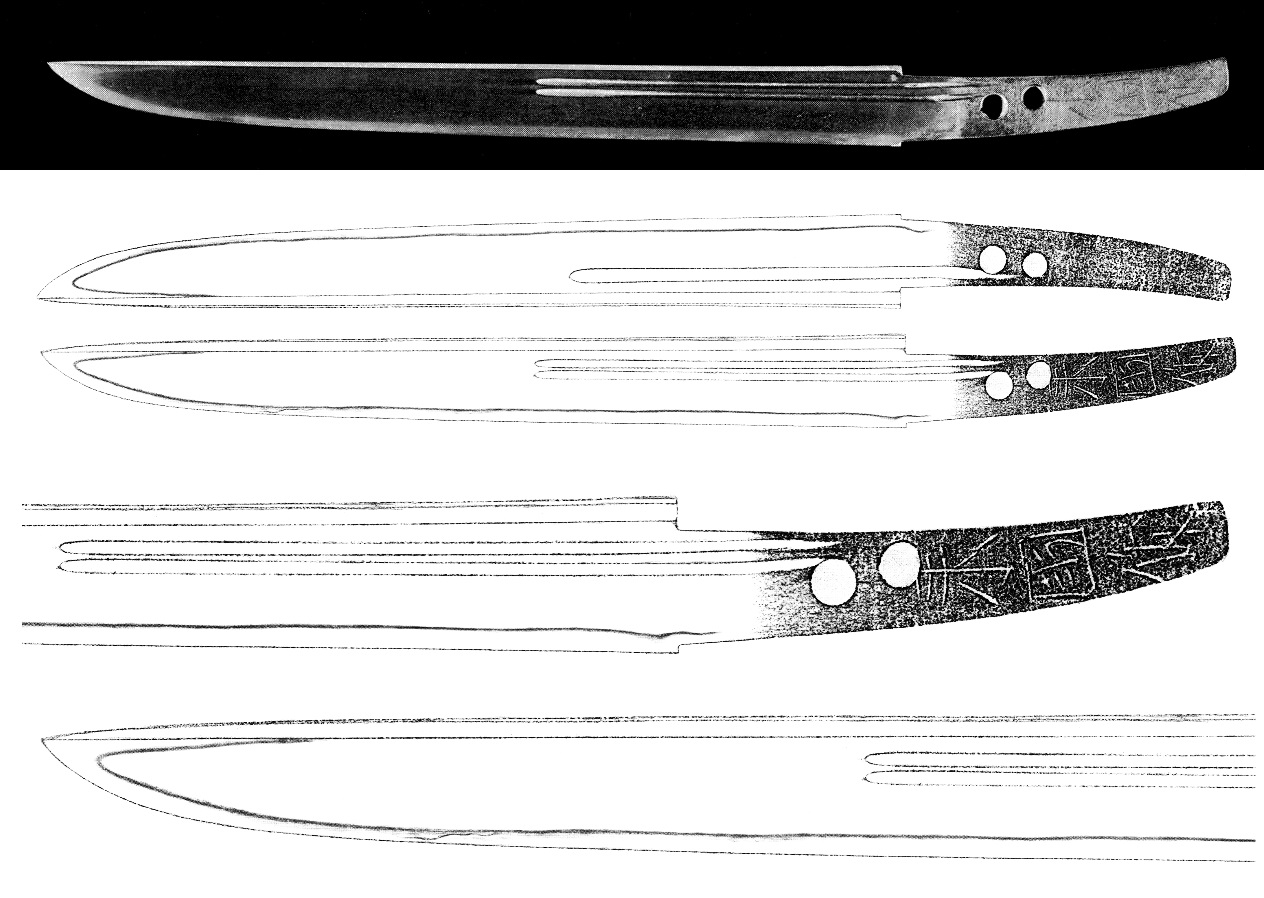
Now to Kuniyoshi’s “other” blades. There are about seven ken of him known of which I want to introduce the most famous one, the jûyô-bunkazai ken. I have “only” pictures of five of these blades in my database but I dare to say that the majority of them is identically interpreted. They are all slender, in ryô-shinogi-zukuri, show a thin hi along the rather high shinogi (a groove that is referred to as shinogi-hi by the way), and their tips are not that stubby (that means they don’t have a pronounced fukura). The majority has a nagasa between 21.0 and 25 cm (although there is an overlong jûyô-bijutsuhin ken with a nagasa of 84.8 cm), that means Kuniyoshi’s ken are mostly small and graceful and have a nakago that is relative long in relation to the blade length. Their jigane is about identical to that of the tachi, i.e. highest quality nashiji, and the hamon is a suguha-chô in ko-nie-deki with kinsuji and sunagashi and some ken feature a few hotsure and others a little mixed-in notare (the jûô-bunkazai for example). We also see nijûba, also not that prominent as on long swords, and at one ken, the nijûba just appears in the bôshi, meeting at the shinogi ridge (see picture 6). The jûyô-bunkazai ken is signed with a fine chisel whereas one jûyô-bijutsuhin ken bears a thickly chiselled mei, that means we can’t make out any rule when it comes to ken signatures (for example that all of them are signed the same way and would therefore go back to the same phase in his career).

Kuniyoshi5

Picture 5: jûyô-bunkazai, ken, mei “Kuniyoshi” (国吉), nagasa 24.2 cm, motohaba 2.3 cm, ryô-shinogi-zukuri

Kuniyoshi6

Picture 6: jûyô, ken, mumei “Den Awataguchi Kuniyoshi” (伝粟田口国吉), nagasa 23.8 cm, motohaba 1.9 cm, ryô-shinogi-zukuri

Next “special case” is the famous jûyô-bunkazai and meibutsu Nakigitsune (鳴狐, lit. “howling fox”) from the former possessions of the Akimoto family (秋元) which ruled the Tatebayashi fief (館林藩) in Kôzuke province. Here we are facing a long uchigatana (the jûyô-bunkazai designation says “katana”) in hira-zukuri and although this is the only one of its kind, i.e. by a famous smith from that time (Kamakura), it has some Heian-period predecessors. Please note that the blade shows a bôhi which is engraved very close to the mune, a characteristic feature that is typical for the Awataguchi School. However, the diagonal end just above the habaki is unique to Kuniyoshi and also found on some of his tantô. By the way, Tanobe sensei sees the Awataguchi Hisakuni tantô shown in picture 6 here from its overall impression as “miniature version” of the Nakigitsune. The jiba of the Nakigitsune follows that of Kuniyoshi’s tachi and on this blade too we see prominent nijûba. But the suguha is pretty wide and we see some ko-gunome and ko-notare along the fukura. Please check out hi-res pictures of this blade here.

Kuniyoshi7

Picture 7: jûyô-bunkazai, uchigatana, mei “Sahyôe no Jô Fujiwara Kuniyoshi” (左兵衛尉藤原国吉), nagasa 54.0 cm, sori 1.6 cm, hira-zukuri, mitsu-mune

Tantô make the majority of Awataguchi Kuniyoshi’s extant oeuvre. There is one jûyô-bunkazai, a couple of jûyô-bijutsujin, and more than a dozen jûyô/tokubetsu-jûyô tantô, and the majority of these tantô is signed (all but one in niji-mei, the one “exception” is signed “Saemon no Jô Kuniyoshi”). When we take a look at all these tantô we learn that he interpreted them in a great variety of shapes. There are such with a standard, a mid-sized and elegant Kamakura-period sugata, smaller and wider tantô that tend to a hôchô-sugata, long and thin tantô, and long and wide tantô that come in a sunnobi-sugata. His tantô show a little uchizori or no sori at all and can come with an iori or a mitsu-mune. Also we see several kinds of grooves like gomabashi, katana-hi, katana-hi with tsurebi, combination of suken on the one and koshibi on the other side, combination of katana-hi with bonji on the hira-ji towards the base, bonji and suken as relief in a katana-hi, and futasuji-hi on both sides. As mentioned, the hi are engraved in Awataguchi-manner quite close to the mune and some end in Kuniyoshi’s peculiar diagonal manner. And before I introduce some of his tantô I briefly want to address Kuniyoshi’s standing within his school. Some see him as best tantô smith of all times whereas this attribute is mostly associated with his successor Yoshimitsu. Others say he was the best when it comes to a gentle and dignified suguha whilst Honma sensei ranks him second in his school in terms of skill, only surpassed by Hisakuni. Well, works of these Awataguchi masters are all outstanding and the quality is so close that such rankings are more of a subjective nature and not really something to fight about.

Picture 8 shows the jûyô-bunkazai tantô of Kuniyoshi. It is wide and with a nagasa of 22.9 cm rather compact, what gives the piece a hôchô, i.e. “kitchen knife” sugata. It shows a dense ko-itame that is mixed with some ô-hada in places, fine ji-nie, and a hint of jifu-utsuri. The hamon is a ko-nie-laden chû-suguha that is mixed with ko-ashi, , and a little ko-gunome at the very base. The nioiguchi is bright and rather tight and the bôshi is sugu with a ko-maru-kaeri. Please note that this blade does not show nijûba. Both sides feature a katana-hi that is, again, arranged pretty close to the mune, and we can also see traces of a tsurebi. The tang is ubu, has a kirijiri, kiri-yasurime, and is signed in niji-mei. Incidentally, this blade was once a heirloom of the Asano family (浅野), the daimyô of the Hiroshima fief of Aki province.

Kuniyoshi8

Picture 8: jûyô-bunkazai, tantô, mei “Kuniyoshi” (国吉), nagasa 22.9 cm, uchizori, motohaba 2.4 cm, hira-zukuri, iori-munne

In picture 9 we see a tantô of Kuniyoshi that features prominent nijûba, also in the typical manner what means interrupted and a hint more emphasized in the bôshi. This is, or rather was Kuniyoshi’s largest known tantô, was because it is a little machiokuri. It measures now 29.1 cm but was originally 30.9 cm in nagasa. So this tantô comes in sunnobi-sugata and somehow foreshadows the later Nanbokuchô interpretations. The jigane is a very dense ko-itame with plenty of ji-nie and appears altogether as nashiji-hada. We see a little mixed-in jifu and a prominent nie-utsuri. The hamon is a ko-nie-laden chû-suguha-chô mixe with a little notare and, as mentioned, nijûba. The nioiguchi is bright and the bôshi is sugu with a kind of ô-maru-style kaeri. Both sides bear a katana-hi with tsurebi. The tang is machiokuri, has a kurijiri, kiri-yasurime, and shows a thickly chiselled niji-mei.

Kuniyoshi9

Picture 9: tokubetsu-jûyô, tantô, mei “Kuniyoshi” (国吉), nagasa 29.1 cm, only very little uchizori, hira-zukuri, mitsu-mune

And last but not least I want to introduce another tantô of Kuniyoshi, a jûyô-bijutsuhin, that shows the diagonal ending of his hi that I have mentioned several times. This tantô – which was an heirloom of the Aoyama family (青山), the daimyô of the Sasayama fief (篠山藩) of Tanba province by the way – is with a nagasa of just 20.4 cm pretty short and tends with the wide mihaba to a hôchô-sugata. The jigane is a dense ko-itame with plenty of fine ji-nie and nie-utsuri and the hamon is a chû-suguha in ko-nie-deki that is mixed with ko-ashi and and that thins somewhat down towards the fukura. Please note the ko-ashi at the base which make the hamon there tend a little bit to ko-gunome. This feature anticipates a typical characteritic of Kuniyoshi’s successor Yoshimitsu (which will be addressed in detail in the next chapter) and that is why I am introducing this tantô here. Also we see nijûba, although here just at the base, and some hakikake along the relative wide ko-maru-kaeri.

Kuniyoshi10

Picture 10: jûyô-bijutsuhin, tantô, mei “Kuniyoshi” (国吉), nagasa 20.4 cm, uchizori, hira-zukuri, mitsu-mune

And to get a feel for the brilliance, the outstanding and breath-taking quality of the Awataguchi steel, I would highly recommend checking the photo gallery at the very bottom of Darcy’s site here!

KANTEI 4 – YAMASHIRO #10 – Awataguchi (粟田口) School 5

We continue with the Awataguchi main line which was succeeded after Kunitomo by his son Norikuni (則国). The Kotô Meizukushi Taizen says that he was born in Jô´an four (承安, 1174) and that he died in Ryakunin one (暦仁, 1238) at the age of 65. Traditionally he is dated around Jôkyû (承久, 1219-1222) although some put him around Katei (嘉禎, 1235-1238), that means with Norikuni, we are slowly approaching mid-Kamakura. His first name was Tômanosuke (藤馬允) and like his uncle Kunitsuna (国綱) and his cousin Kagekuni (景国), he was part of the Oki-goban-kaji group. It seems that Norikuni has focused more on the production of tantô, or at least he is the early Awataguchi master of whom the most tantô are extant. But we are lacking a sound quantitative evidence base to say for sure what his main focus was and if the increased tantô production started with him or if the tantô production increased at all at a certain point in time or if there are just no such blades of the earlier smiths extant. To my knowledge, there are four signed Norikuni tachi going round, the most representative one being the kokuhô that was once a heirloom of the Ikeda (池田) family, the daimyô of the Tottori fief (鳥取藩) of Inaba province (see picture 1). This blade keeps despite of the suriage some of its originally deep koshizori, features a ko-kissaki, and is overall quite elegant and of a very harmonious tachi-sugata. The kitae is a very dense ko-itame with fine ji-nie and chikei and appears as nashiji-hada and the hamon is a ko-nie-laden hoso-suguha-chô with a little shallow notare sections that is mixed with ko-midare, ashi, and frequent kinsuji. The bôshi is sugu and shows a ko-maru-kaeri with kinsuji. In general we can say that Norikuni’s interpretations are a hint more nie-emphasized than that of his successors Kuniyoshi and Yoshimitsu. The tang is as mentioned suriage but its original katte-sagari yasurime can still be made out. The niji-mei is preserved at the very tip of the tang.

norikuni1

Picture 1: tachi, kokuhô, mei “Norikuni” (則国), nagasa 74.7 cm, sori 2.1 cm, shinogi-zukuri, iori-mune, please click here to see get some close-ups of the blade

Following the kokuhô, there are two tachi of Norikuni that bear the status of jûyô-bunkazai which I want to introduce in the following. One of them (see picture 2) is owned by the Atsuta-jingû but preserved in the Tôkyô National Museum. It is also slender and elegant and almost ubu, that means it retains its deep koshizori and also its funbari. The kitae is a dense ko-itame in nashiji with ji-nie and a faint nie-utsuri. The hamon is a suguha-chô in ko-nie-deki that is mixed with ko-chôji, ko-midare, ko-ashi, and kinsuji and the bôshi is notare-komi with a somewhat pointed ko-maru-kaeri.

Norikuni2

Picture 2: tachi, jûyô-bunkazai, mei “Norikuni” (則国), nagasa 72.1 cm, sori 2.7 cm, shinogi-zukuri, iori-mune
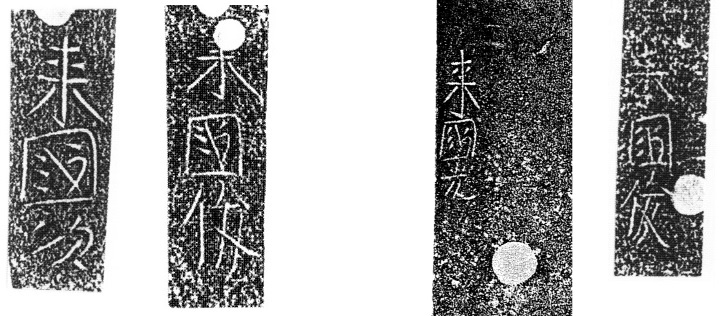
The other jûyô-bunkazai (see picture 3) is preserved in the Konda-Hachimangû (誉田八幡宮, Ôsaka Prefecture). This tachi is with a nagasa of 81.1 cm rather long and has a wide and noticeably tapering mihaba (from 3.2 cm motohaba to 1.7 cm sakihaba), a koshizori, a thick kasane, plenty of niku, and a ko-kissaki. The kitae stands a little more out than at the aforementioned two blades and shows some masame towards the ha but is overall forged as itame with chikei and plenty of ji-nie. The hamon is a suguha in ko-nie-deki with a somewhat subdued nioiguchi that is mixed with ko-midare and many ko-ashi and that starts with a hint of yaki-otoshi. The bôshi is sugu with a wide ko-maru-kaeri and the tang is ubu and shows a shallow kurijiri. In addition, the name of the donator to the shrine is inlayed in gold in a carved out recess on the tang and the whole kinzôgan-mei reads “Ôhashi Nyûdô Shikibu Kyô Hô’in Ryûkei” (大橋入道式部卿法印竜慶, the donator) on the one, and “Kenjô Konda-Hachimangû moshi sejin kore o obau kami no bachi o ukubeki nari” (献上誉田八幡宮世人若奪之可受神罰也, “offered to the Konda-Hachimangû and if stolen, the stealer should receive divine punishment”) on the other side. Incidentally, Ôhashi Ryôkei (1582-1645) was a renowned calligrapher and tea master of the early Edo period. He served Hideyoshi and Ieyasu and the blade had been a family heirloom since the Muromachi period. The jûyô-bunkazai designation mentions that the tachi was handed down under the nickname Karigiri (鐘截, lit “temple bell cutter”) within the Ôhashi family.

Norikuni3

Picture 3: tachi, jûyô-bunkazai, mei “Norikuni” (則国), nagasa 81.1 cm, sori 2.6 cm, shinogi-zukuri, iori-mune
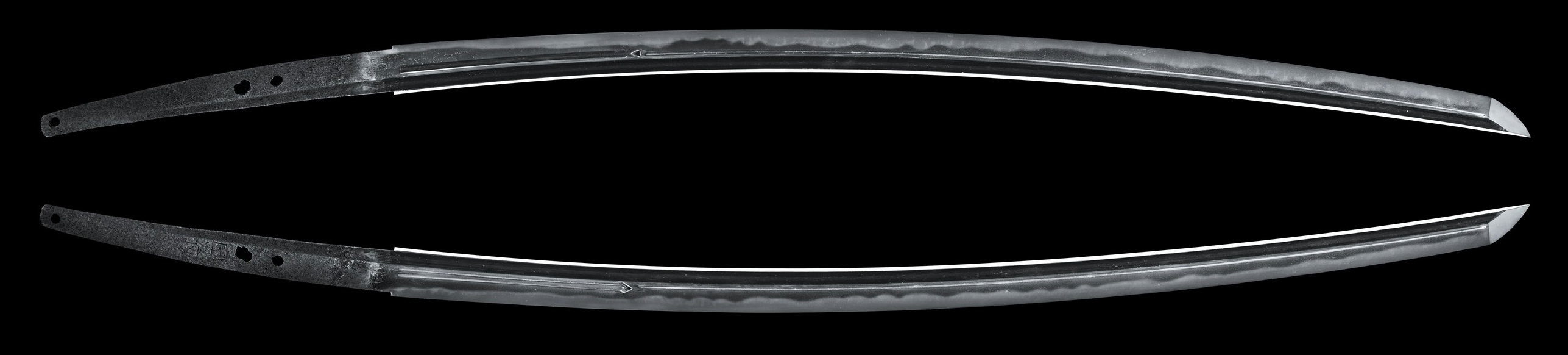
Picture 4 shows a signed tokubetsu-jûyô tachi that is ubu too, slender, and highly elegant. It shows a deep koshizori with funbari and a ko-kissaki and the kitae is an itame mixed with mokume that features plenty of ji-nie, chikei, and a faint nie-utsuri. The hamon is a hoso-suguha-chô in ko-nie-deki that is mixed with ko-midare, ko-chôji, ko-gunome, ashi, hotsure, uchinike, nijûba, and fine kinsuji. The bôshi is sugu and runs out as yakitsume. Please note that this blade too shows a brief yaki-otoshi and a thin and short koshibi just like the one on blade 2 by his father Kunitomo in the first Awataguchi chapter. And in direct comparison (see picture 5) the similarities become even more obvious (e.g. also the kijimono-style finish of the tang). By the way, this tachi of Norikuni had been a heirloom of the Kitabatake family since Kitabatake Akiie (北畠顕家, 1318-1338) had received it as a present from Emperor Godaigo.

Norikuni4

Picture 4: tachi, tokubetsu-jûyô, mei “Norikuni” (則国), nagasa 77.7 cm, sori 2.3 cm, shinogi-zukuri, iori-mune
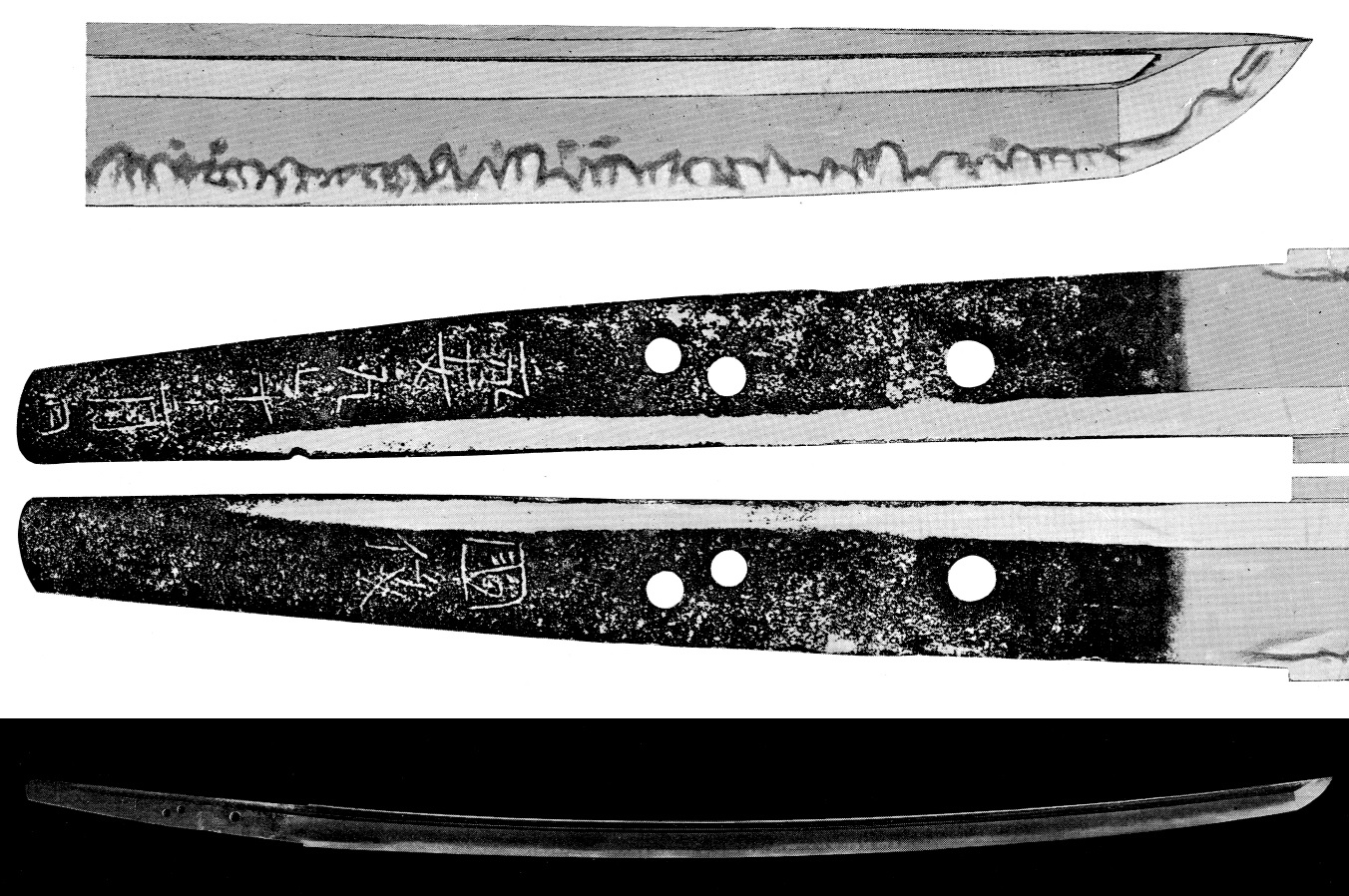
Norikuni5

Picture 5: Comparison Kunitomo top, Norikuni bottom.

Now to Norikuni’s tantô. A representative piece is the signed tokubetsu-jûyô (see picture 6) that ws once a heirloom of the Kuroda (黒田) family, the daimô of the Fukuoka fief (福岡藩) of Chikuzen province. The blade has normal proportions, i.e. mihaba and nagasa are neither wide nor sunnobi respectively, and an uchizori. The kitae is a dense ko-itame mixed with mokume and nagare and we see plenty of ji-nie and fine chikei. The hamon is a nie-laden suguha-chô to slightly undulating notare that is mixed with a conspicuous amount of ko-gunome, ko-ashi, and some nie-suji. The nioiguchi is rather wide and the bôshi is notare-komi with brief ko-maru-kaeri. Both sides show gomabashi which are close together and arranged more towards the mune, a feature that is typical for all Awataguchi horimono on tantô. And we find another Awataguchi featuere at Norikuni, namely that in many cases the smiths of this school added the exact same kind of horimono on each side whereas for their Rai colleagues engraved for example a suken on the omote and gomabashi on the ura side. But there are also exceptions to this “rule” as seen at a tokubetsu-jûyô mumei tantô attributed to Norikuni that shows a suken on the omote and a shôbu-hi on the ura side.

Norikuni6

Picture 6: tantô, tokubetsu-jûyô, mei “Norikuni” (則国), nagasa 24.2 cm, uchizori, hira-zukuri, mitsu-mune (with wide top surface)

Last but not least it should not go unmentioned that again, we are facing slightly different signature styles but which are thought to go back to the different stages in the career of a single smith. There are somewhat larger and somewhat smaller mei and by trend we can say that he signed his tachi with a thinner chisel than his tantô which show a relative thickly chiselled signature. There was a ken of Norikuni discovered in recent years during repair works at a hall belonging to the Yokawa (横川) temple unit of the Enryaku-ji on Mt. Hiei that was hidden in a Buddhist statue. The ken (see link here) is now designated as cultural property of Takamatsu City, Kagawa Prefecture, as it is preserved in the local history museum and it shows the same thick mei as seen on tantô. Also interesting to note is that his character for “Kuni” is very similar to that of his son Kuniyoshi (see picture below). Both signed the left inner part of the box radical as three more or less horizontal and parallel strokes, met underneath by a pronounced arc that starts to the top right of the separating central stroke.

Norikuni7

Norikuni mei left, Kuniyoshi mei right.

KANTEI 4 – YAMASHIRO #9 – Awataguchi (粟田口) School 4

Kunitsuna (国綱), the youngest of the Six Awataguchi Brothers, was a very interesting figure. The Kotô Meizukushi Taizen states that he was born in Chôkan one (長寛, 1163) and that he moved at the request of the bakufu to Yamanouchi (山内) to the outskirts Kamakura when he was 42 years old, what would mean in Genkyû two (元久, 1205). The latter quote is found for the first time in the Muromachi-era sword publication Nôami Hon Mei Zukushi (能阿弥本銘尽, publ. 1483) by the way. At that time, Hôjô Tokimasa (北条時政, 1138-1215) was regent of the Kamakura-bakufu but most other sources quote Hôjô Tokiyori (北条時頼, 1227-1263) as the one who invited Kunitsuna – during the Kenchô (建長, 1249-1256) era – to Kamakura. The Kotô Meizukushi Taizen again says that Kunitsuna died in Kenchô seven (1256) at the age of 93. This would mean that he was working only about six or seven years for Tokiyori, what might be just enough when we bear in mind that he acted there as co-founder of a group of outstanding swordsmiths who developed a new forging tradition. In addition, Tokimasa was the very first Hôjô regent and held this post for less than two years. So it seems rather unlikely that it was him who invited all the swordsmiths as he was surely more busy with getting established the shikken regency of his family. And apart from that, we know that Tokiyori was one of the most renowned sword connoisseurs of his time. Incidentally, the Kenchô era equals his time as shikken. So either Kunitsuna did all what he did in Kamakura at a very high age and over the very last years of his life, or he was not born in 1163 as stated by the Kotô Meizukushi Taizen. But we also can’t rule it out completely as Tokiyori did not randomly recruit smiths but selected the greatest masters of his time, for example also Saburô Kunimune (三郎国宗) and Ichimonji Sukezane (一文字助真) from Bizen Province, and it is assumed that he as sword expert and political key figure of Kamakura not only wanted to have superior cutters but blades that would impress his circles on the basis of their aesthetical appearance. Thus it is possible that he asked the old master Kunitsuna and last survivor of the Six Awataguchi Brothers if he would come to Kamakura to lead a group of local smiths. There is, or rather was, a jûyô-bijutsuhin ôdachi (nagasa 114.5 cm) from the former possessions of the Uesugi (上杉) family that is regarded as kind of proof of Kunitsuna being in Kamakura around Kenchô but the whereabouts of the blade are unfortunately unknown (it is said that it had been confiscated by the occupying forces after WWII). The mei of the blade reads “Kamakura-jû Tôroku Sakon Kunitsuna” (鎌倉住藤六左近国綱) and the date “Kenchô gonen hachigatsu hi” (建長五年八月日, “a day in the eighth month Kenchô five [1253]”). The records of the Uesugi claim that this ôdachi was made by Kunitsuna at the same time he made the Onimaru for Hôjô Tokiyori and that it was handed down within the family at the latest since the old times they held the post of Kantô Kanrei, i.e. the Kantô region deputy of the shôgun, what was at the beginning of the Nanbokuchô period. But the records even claim at another point that the blade was initially owned by the ancestor of the family, Shigefusa (上杉重房, mid-Kamakura), when he moved from Kyôto to Yamanouchi during the Kenchô era. Well, the blade is lost as mentioned so not much can be said about the authenticity of its mei. Also that it once got the status of jûyô-bijutsuhin doesn’t mean much because at pre-WWII times, coming from a big daimyô collection often weighed more than actual quality and authenticity. There are a few tantô with the mei “Yamanouchi-jû Kunitsuna” (山内住国綱) going round but most experts agree that they were made noticeably later, i.e. end of Kamakura to Nanbokuchô, and, if authentic, might be works of a local descendant of Awataguchi Kunitsuna.

Kunitsuna1

Picture 1: ôdachi, jûyô-bijutsuhin, (hardly legible) mei as stated above.

But let us see things from the point of view of Tokiyori. As a man of his rank, he had no other choince other than picking the crème de la crème of what was available his time, and this was Yamashiro, Bizen and Bitchû. We don’t know why he didn’t pick one of the great Ko-Aoe masters who had acted as goban-kaji too but as far as Yamashiro is concerned, only the Awataguchi school was active at that time as the de facto Rai founder Kuniyuki (国行) was just at establishing his school (he was active around Shôgen [正元, 1259-1260]). Of course there were also other skilled smiths active at that time, e.g. from the Hôju, Môgusa, or Ko-Naminohira schools, but none of them was so to speak “worthy enough” in terms of then ranks of craftsmen to aid the Kamakura regent with creating a new forging tradition. The same applies to the time-honored Yamato tradition. Many smiths were working in Yamato province since earliest times but their greatest masters were active significantly later than Tokiyori had started his initiative, for example the Tegai school founder Kanenaga (包永), the Shikkake school founder Norinaga (則長), and the Taima school founder Kuniyuki (国行) around Shôô (正応, 1288-1293), and the Hoshô school founder Kunimitsu (国光) around Kôan (弘安, 1278-88). While on the subject of Kunitsuna’s career, his name is also found on the questionable list of the six goban-kaji who allegedly worked for Gotoba in Jôkyû two (承久, 1220) in his exile on the island of Oki. Kunitsuna was granted with the honorary title Sakon Shôgen (左近将監) and bore the first name Tôroku (藤六) (also as background info for the Uesugi blade introduced in picture 1).

Due to his long life and his move to Kamakura, we are facing two different styles and differences in signature when talking about Kunitsuna. That means a slender and more elegant Yamashiro and Awataguchi style from his earlier years, and a more powerful style that emerged with his move to Kamakura. Well, this is the commonly forward theory but signed works of Kunitsuna are very rare (only eight are in existence to my knowledge) and so we can’t nail down for sure his exact artistic stages and the chronological backgrounds for his change of workmanship and signature but fact is, that the majority of extant works shows a more powerful style. That means, if he had worked most of his life in Kyôto and moved only towards the very end of his life to Kamakura, then actually more true Awataguchi-style blades should be extant. But on the other hand, it is also possible that he was more productive after having arrived in Kamakura, or that these blades were held in higher esteem and thus more often handed down than his earlier Yamashiro blades. Or the traditions are incorrect and he arrived in Kamakura at the prime of his career. Anyway, the first blade that I want to introduce is one that is thought he made whilst still in Kyôto (picture 2). It is a relative short jûyô-bunkazai tachi with an elegant and slender sugata with a koshizori and a pronounced funbari. The kitae is a dense ko-itame with plenty of ji-nie and a nie-utsuri and the hamon a ko-midare in ko-nie-deki that is mixed with kinsuji and whose nie increase noticeably from the monouchi upwards. The bôshi shows nie-kuzure and has a ko-maru-kaeri. The tang is ubu, relative long and in kijimonmo-gata. It has to be pointed out that the niji-mei is somewhat smaller than the other known mei. The blade was once worn by shôgun Tokugawa Yoshimune (徳川吉宗, 1684-1751) and Ienari (徳川家斉, 1773-1841) and was submitted for jûyô-bunkazai by Tokugawa Iesato (徳川家達, 1863-1940) in 1931. Since postwar times, it is preserved by the Tokugawa Reimeikai Foundation.

Kunitsuna2

Picture 2: tachi, jûyô-bunkazai, mei “Kunitsuna” (国綱), nagasa 65.0 cm, sori 2.0 cm, shinogi-zukuri, iori-mune
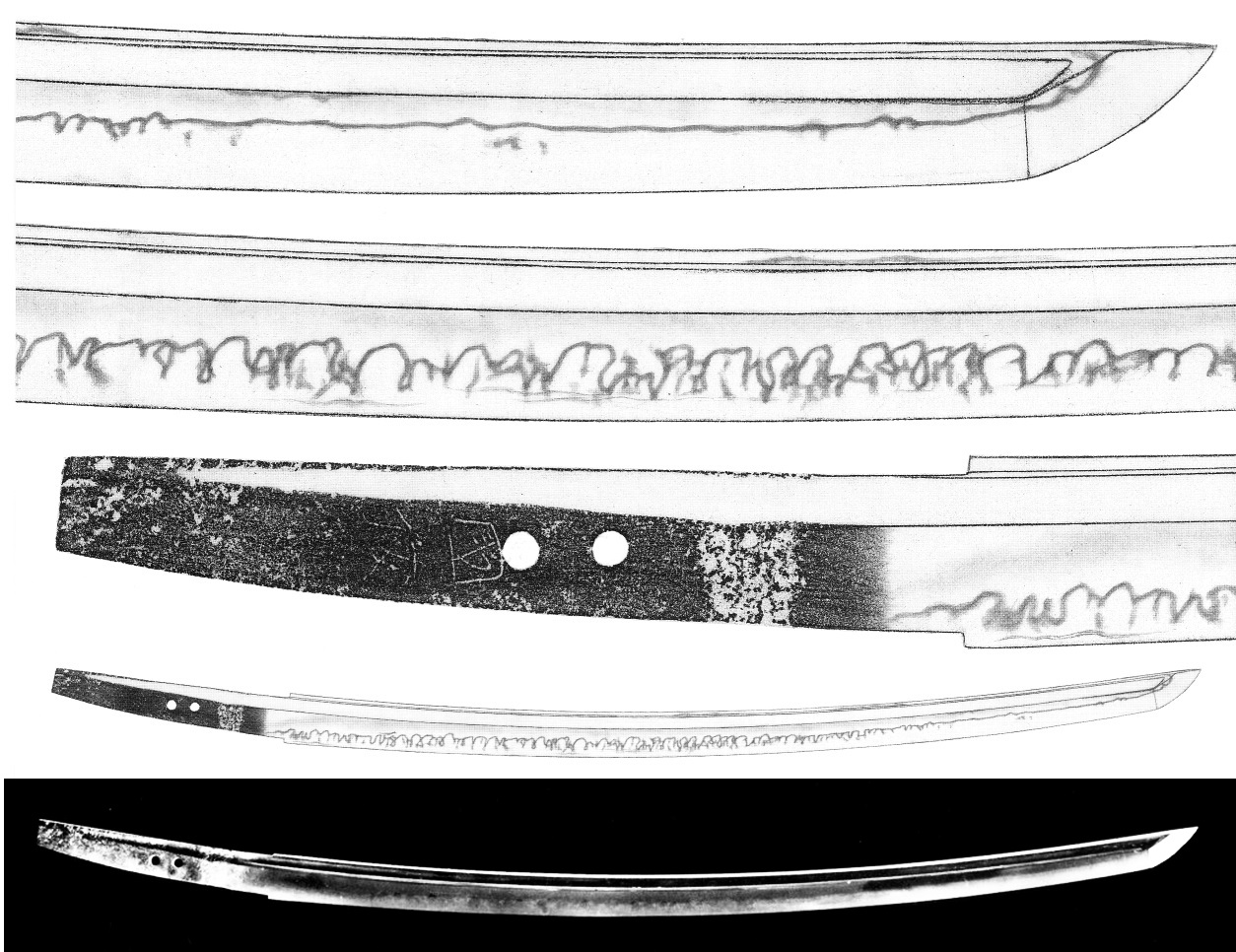
His most famous work is of course the aforementioned Onimaru (鬼丸) which can be seen in picture 3. Unlike the small Awataguchi-style tachi from picture 2, it is wide and magnificent. It has a deep toriizori with pronounced funbari, plenty of hira-niku, does not taper that much, and has a chû-kissaki that tends a hint to kamasu. The kitae is a ko-itame mixed with ko-mokume, plenty of jinie, and some jifu and the hamon is a wide notare-based midareba in ko-nie-deki that is mixed with chôji, ko-ashi, and . A prominent feature of this blade is the diagonal yubashiri-based koshiba that appears somewhat above the ha-machi, an approach in hardening, that is seen in slightly different ways also on his other Kamakura-style blades. Please note that the term “Kamakura-style” is not really a fixed nihontô term. I just use it here to distinguish between his early elegant and his late powerful blades. The bôshi of the Onimaru is a widely hardened midare-komi with a ko-maru-kaeri and much nie. The tang is ubu, curves strongly, ends in a kurijiri, and shows shallow katte-sagari yasurime. After being a heirloom of the Hôjô, the sword was owned by the Ashikaga family and went later through all the “prominent stations,” i.e. Nobunaga, Hideyoshi, Ieyasu, and was later presented by the Tokugawa to Emperor Meiji.

Kunitsuna3

Picture 3: tachi, gyobutsu, mei “Kunitsuna” (国綱), nagasa 79.2 cm, sori 3.0 cm, shinogi-zukuri, iori-mune
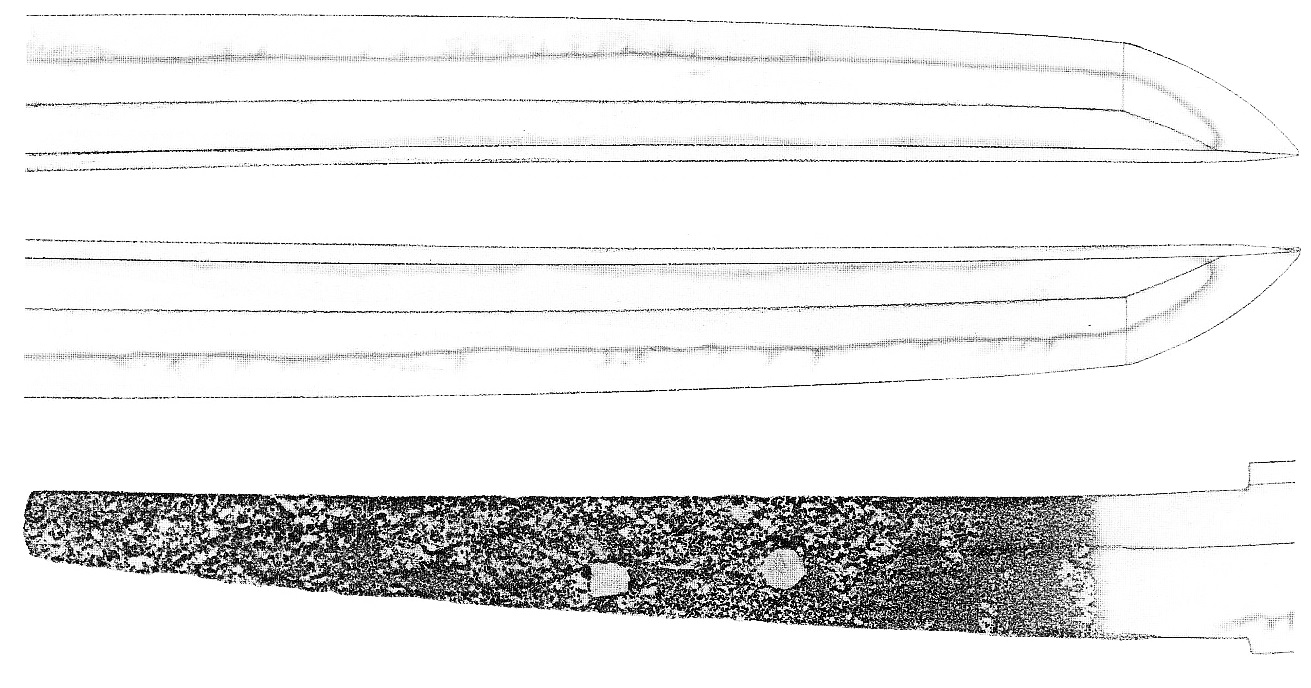
Kunitsuna4

Picture 4: The Muromachi-era kawa-zutsumi tachi-koshirae of the Onimaru-Kunitsuna

A blade that is close to the Onimaru in terms of workmanship and mei (although the tang has suffered somewhat in that area) is the tokubetsu-jûyô shown in picture 5. The blade is a little tired and lost some substance towards the tip but is otherwise outstanding. The kitae is a somewhat standing-out itame with nagare and ô-hada along the omote side and shows ji-nie and a faint nie-utsuri. The hamon is a ko-nie-laden suguha-based ko-chôji mixed with some gunome, ko-midare, ashi, , and sunagashi and kinsuji along the lower half. The bôshi is sugu and has a ko-maru-kaeri. The nie-utsuri forms a kind of mizukage-like appearance at the base, that means we see a certain approach in hardening that Kunitsuna’s later blades seem to have in common. The sword was once a heirloom of the Nishitakatsuji (西高辻) family that served on a hereditary basis as shintô priests the Dazaifu Tenmangû on Kyûshû.

Kunitsuna5

Picture 5: tachi, tokubetsu-jûyô, mei “Kunitsuna” (国綱), nagasa 85.8 cm, sori 3.5 cm, shinogi-zukuri, iori-mune

Next the jûyô-bunkazai that is preserved in the Hie-jinja (日枝神社) (picture 6). The blade is suriage and shows a dense ko-itame with plenty of fine ji-nie and a chôji-midare with ashi and that gets more nie-laden and displays conspicuous kinsuji and sunagashi along the lower half. The bôshi appears as somewhat undulating sugu-chô or notare-komi with a rather wide ko-maru-kaeri and some hakikake on the omote side. Interesting here are the horimono in the form of a futasuji-hi with bonji and suken on the haki-omote, and a bonji and a shiketsu on the ura side, the end of both lower engravings running due to the suriage into the tang. There was some discussion about if this might be a work of a different smith with the same name, mostly because the uncommon horimono and the relative sophisticated hamon, but in the meanwhile, it is accepted that it is a work of Awataguchi Kunitsuna.

Kunitsuna6

Picture 6: tachi, jûyô-bunkazai, mei “Kunitsuna” (国綱), nagasa 69.4 cm, sori 1.7 cm, shinogi-zukuri, iori-mune
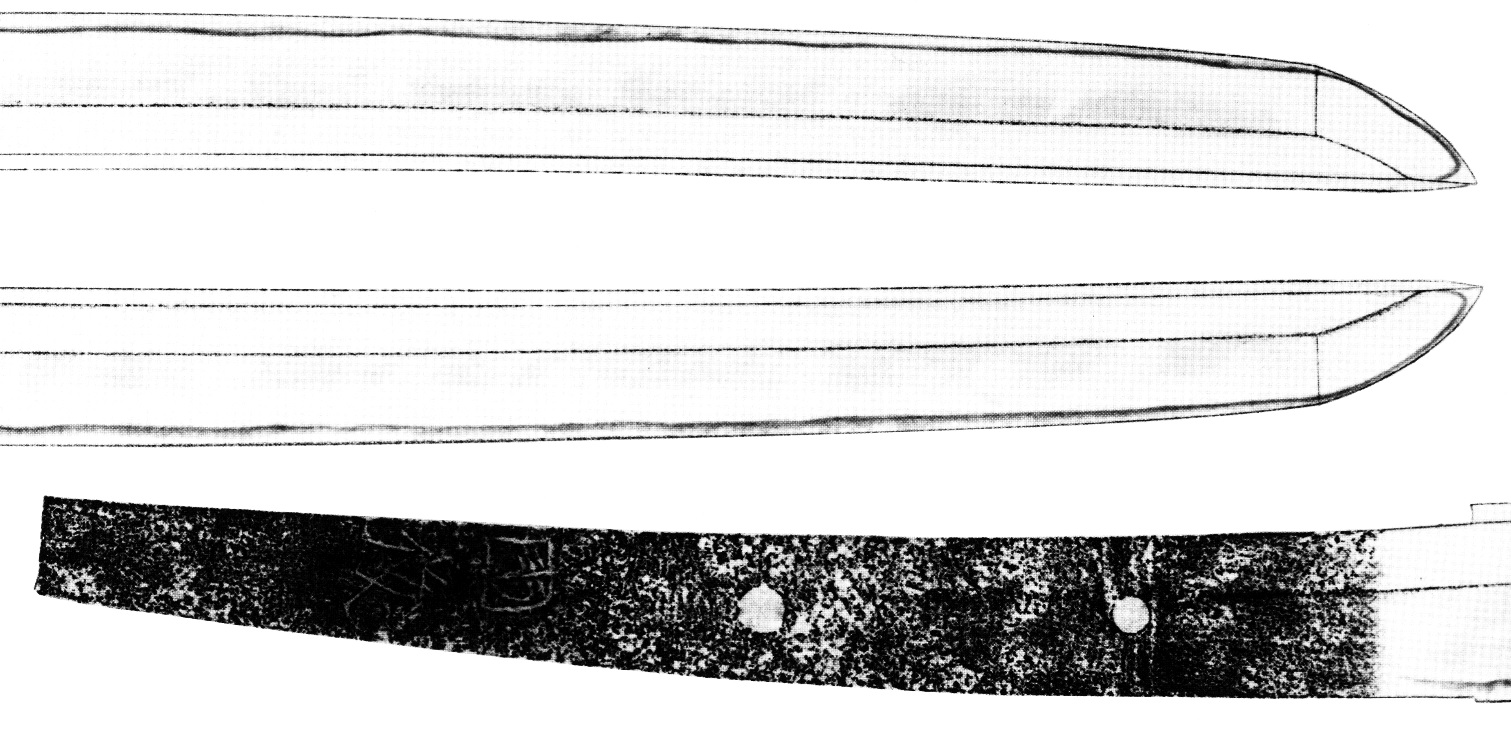
The next tachi is a tokubetsu-jûyô and is more slender, deeply curved, and ends in a ko-kissaki. The jigane is a rather stading-out itame that is mixed with nagare, mokume and ô-hada and plenty of ji-nie, some chikei, and we see again the mizukage-like feature at the base that turns here into a jifu-utsuri which runs then all over the blade. The hamon is a widely hardened and nie-laden suguha-chô mixed with some notare, ko-chôji, ko-midare, thick ashi, , sungashi, kinsuji, and some hotsure, uchinoke, and yubashiri in places. The bôshi is sugu with a short ko-maru-kaeri and a hint of hakikake. The prominent jigane distinguishes Kunitsuna from his older Awataguchi brothers and the jifu-utsuri and strong nie (with visible ha-nie) make this blade look like Ko-Bizen or Ko-Hôki at a glance. But Ko-Bizen works from that time show a brighter nioiguchi and although they do show nie, they do not occur in that amount like here. And for a Ko-Hôki work, the steel is too bright, i.e. Yasutsuna and his contemporaries forged a more blackish jigane and their hamon has a more subdued nioiguchi. Apart from that, their works show more ha-hada, an overall even more standing-out hada, and have altogether a more rustic appearance.

Kunitsuna7

Picture 7: tachi, tokubetsu-jûyô, mei “Kunitsuna” (国綱), nagasa 67.3 cm, sori 2.5 cm, shinogi-zukuri, iori-mune
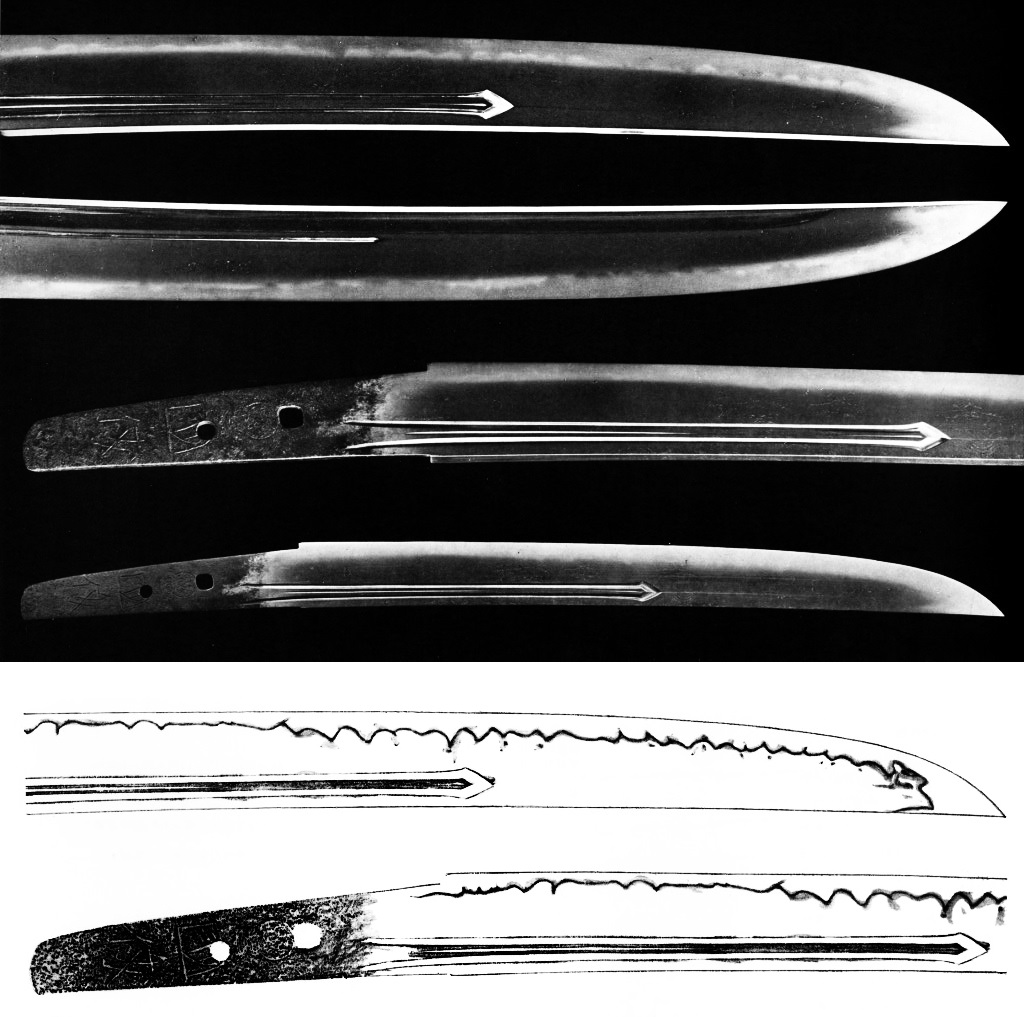
And finally I want to address the fact that there are several blades going round, some quite old and of highest quality, that are signed with the niji-mei “Kunitsuna” but not attributable to Awataguchi Kunitsuna, at least not according to modern standards. The blade shown in picture 8 was a heirloom of the Ii family and offered by Ii Naonori (井伊直憲, 1848-1904) to the Iinoya Shrine (井伊谷宮) where it is preserved today. The records of the shrine say Awataguchi but this is dismissed and the jûyô-bunkazai designation also says “Kunitsuna, Kamakura period, province unknown.” The blade is a little suriage but maintains its elegant and tapering sugata with the koshizori that bends down towards the tip and the pronounced fubari that dates it at the latest to the early Kamakura period. So if it should turn out that it is a work of Awataguchi Kunitsuna, then surely from his early artistic period. The kitae is a dense but standing-out itame with some masame and fine ji-nie. The hamon is a midare that gets gradually wider towards the tip and that is mixed with chôji, even some kawazu-no-ko chôji, ashi, , kinsuji and sunagashi. There are nie which also appear in the bôshi. The bôshi is notare-komi with a ko-maru-kaeri. The signature is large and noticeably different from the other Kunitsuna mei. Incidentally. The jûyô-bunkazai designation says about the attribution that there were, among others, also a Bizen, Yamato, and an Iga Kunitsuna but it is difficult to say whose work it acutally is.

Kunitsuna8

Picture 8: tachi, jûyô-bunkazai, mei “Kunitsuna” (国綱), nagasa 79.8 cm, sori 2.9 cm, shinogi-zukuri, iori-mune
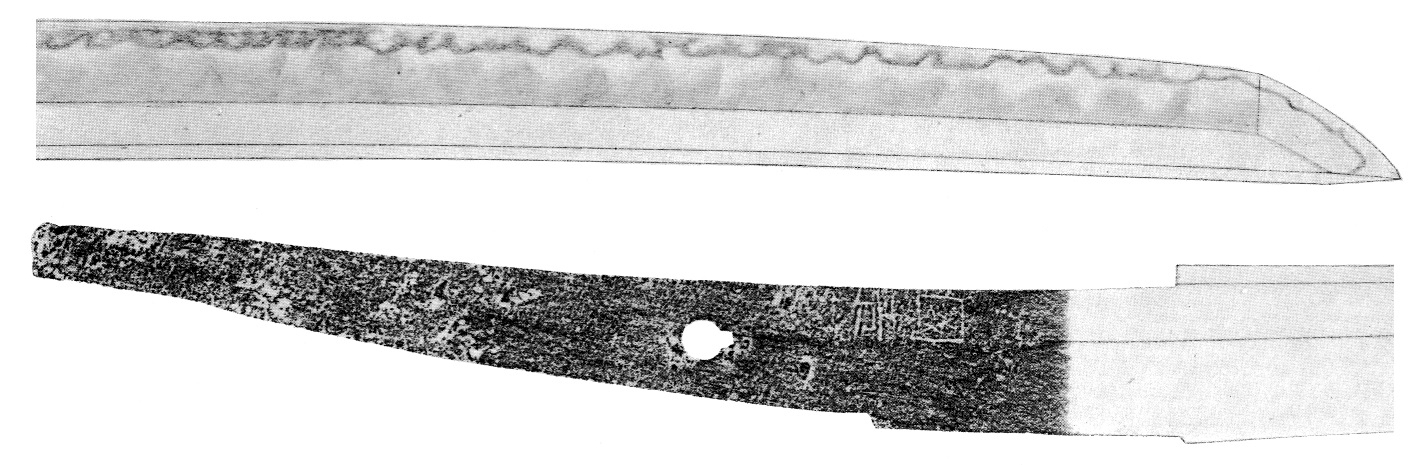
And then there is a jûyô-tachi whose signature is smaller and somewhat different (especially the character for “Kuni”) but of about the same typeface as the Onimaru and the tokubetsu-jûyô from picture 5, but which still got a conservative attribution via “Den,” i.e. “Kunitsuna (Den Awataguchi).” The blade is slender, has a deep koshizori that bends down towards the tip, a ko-kissaki, and interestingly a maru-mune. The kitae is a dense ko-itame with ji-nie and a jifu-utsuri and the hamon is a suguha-chô mixed with ko-midare, ko-chôji, many ashi and , and fine sunagashi and yubashiri. The nioiguchi is wide and the ha is full of nie. The bôshi is sugu with a short ko-maru-kaeri. The shinsa placed this blade on the basis of its jiba and sugata into the Awataguchi vicinity, i.e. to the earlier phase of Kunitsuna. The blade was once a heirloom of the Date (伊達) family who had received in from the court noble Konoe Motohiro (近衛基熈, 1648-1722).

Kunitsuna9

Picture 9: tachi, jûyô-tôken, mei “Kunitsuna” (国綱), nagasa 68.6 cm, sori 2.1 cm, shinogi-zukuri, maru-mune

*

Now we are through with the Six Awataguchi brothers and next post will continue with the Awataguchi main line, i.e. Norikuni (則国), Kuniyoshi (国吉), and Yoshimitsu (吉光) before we close the school with the remaining noteworthy Awataguchi masters.