Whilst working on the last few chapters of Volume 4 of the Tōsōgu Classroom, I came across a signature that made me scratch my head a little, but which I eventually figured out. So, I thought it is interesting enough to share here.
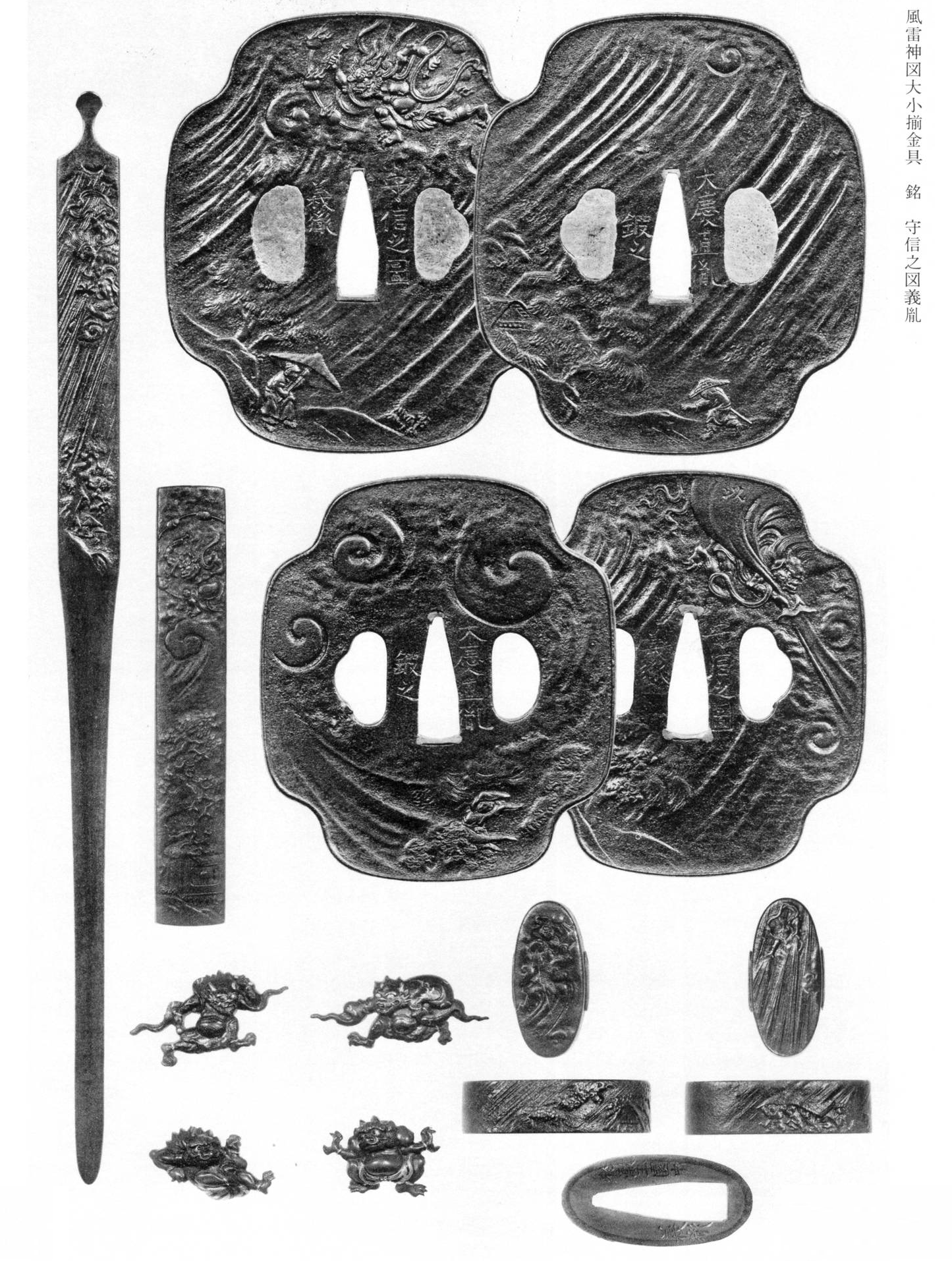
Stumbling block was Fukushi Shigeo Sensei making a reference to an en suite set of daishō fittings by Honjō Yoshitane (本荘義胤). Most of you likely know that Yoshitane was an engraver extraordinaire from the school of Taikei Naotane (大慶直胤, 1779–1857), who, apart from adding horimono to sword blades, also made tsuba and other sword fittings. In said reference, Fukushi quotes the signature of the fuchi as: “Sōō zuchū Yoshitane” (漱王図中義胤). This mei suggests that Yoshitane modelled the work after a painting/design (Japanese: zu, 図) of a certain Sōō (漱王). However, zuchū (図中), lit. “in the figure/illustration” as in “as shown in the figure/illustration” is odd and does not make much sense in this context. Also, who was Sōō? As “painting/design” is mentioned, the first thought it of course that Sōō was a painter, or, to be more precise, the art name (gō) of a painter. A quick search, however, did not yield anything related, only an ancient Korean king named Hae Mo-su (解慕漱王). Very unlikey that its him that Yoshitane references in his signature…
Next step, as Fukushi mentions that the set is Jūyō, is to check the explanation in the respective Jūyō volume, Shinsa No. 22 from 1974 (see picture below). By the way, this set is only one of two works of Honjō Yoshitane that passed Jūyō (the other being a daishō-tsuba, Shinsa No. 62, 2016).
First thing that becomes obvious, Fukushi mis-quoted the signature of the fuchi, or it was a mistake in layout when that issue of the Tōken Bijutsu magazine was put together. Anyway, in the Jūyō volume, the NBTHK quotes the signature as: “Sōō enchū Yoshitane” (漱王園中義胤), “Yoshitane, in the Sōō Garden.” The mei makes a little more sense now, if you will, but raises the next question: Where is or was the Sōō Garden, which I had never heard of before?
As a new search didn’t yield much either, I double-checked the actual fuchi and its signature in the Jūyō volume, and lo and behold, the NBTHK mis-quoted the signature too! The blown up detail from the scan of that page shown below is not the best, but if you look closely, you can see that the mei actually begings with the character oite (於), and that there is a small dot towards the very right of the character ō (王), which makes it the character gyoku (玉) (hence the “stupid” title of this post). Also see how the right radical (欠) of the character for Sō (漱) is also difficult to discern as it touches the seam of the lid of the fuchi.
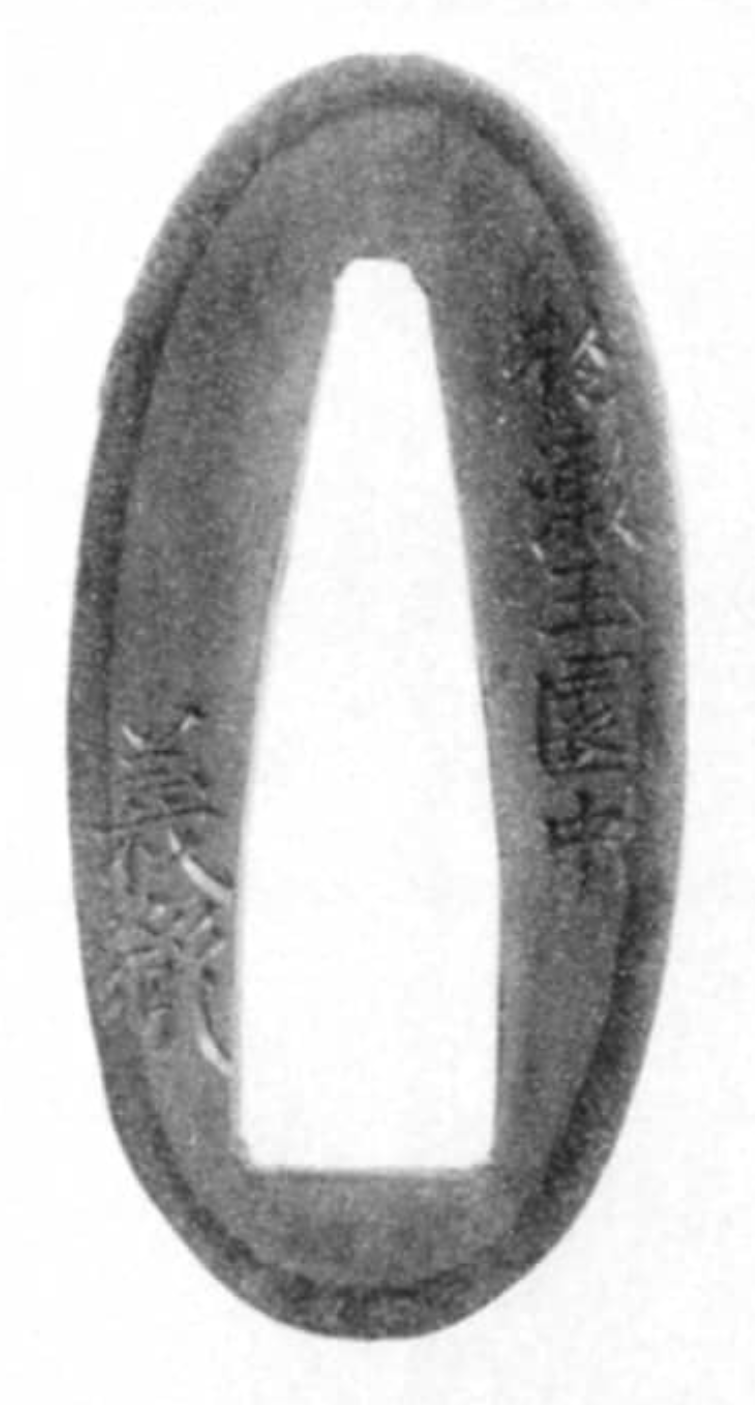
With all this, I am pretty confident that the signature is: “Sōgyoku enchū ni oite, Yoshitane” (於漱玉園中義胤), “Yoshitane, in the Sōgyoku Garden.” And this also makes complete sense now as there actually was a Sōgyoku Garden, whose remains are located on the premises of the Sannōgū Hiyoshi-jinja (山王宮日吉神社) in Miyazu (宮津), Kyōto Prefecture. To provide some background, it is said that the garden was designed in Shōhō four (正保, 1647) by Kyōgoku Takahiro (京極高広, 1599–1677), the then Daimyō of the fief of Miyazu, and was later enlarged at the end of the 1670s by Nagai Naonaga (永井尚長, 1654–1680), who had become the Daimyō of Miyazu in 1674.
But this is not the end of the story, meaning, there is more to unravel here. Realizing that said garden is located in Miyazu immedately rang a bell in the context of the set being a work of Honjō Yoshitane. Some of you might now that Yoshitane’s master Taikei Naotane did some extensive traveling throughout his career, and he also produced blades in all the locations he visited. That is, reading of Miyazu, I immediately remembered some blades by Naotane that bear what is referred to as a “hot stamp” (koku’in, 刻印) in the shape of the character Miya (宮) (see some examples below). Naotane used several of these hot stamps to mark where he had produced blades apart from mentioning it in the signature.
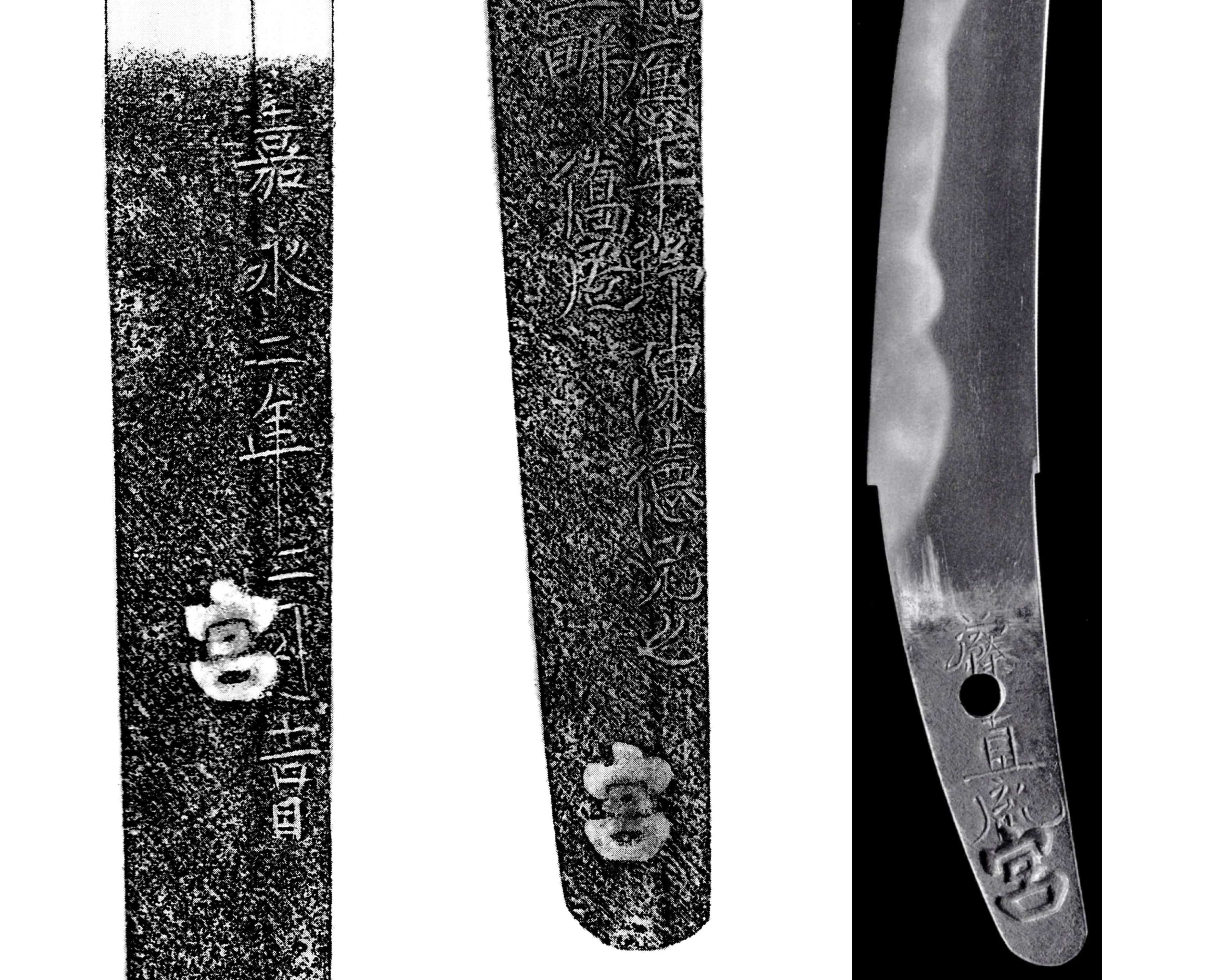
From dated blades of Naotane and from written information provided by his student Hosoda Naomitsu (細田直光), better known as Kajihei (鍛冶平), we know that Naotane had been to Miyazu in Kaei two (嘉永, 1849). What is also interesting is that the daishō-tsuba of Yoshitane’s set are signed: “Taikei Naotane kore o kitaeru Morinobu no zu, Yoshitane” (大慶直胤鍛之守信図 義胤), “Yoshitane, after [Kanō] Morinobu, [plates] forged by Taikei Naotane.” So, we can assume that Yoshitane had accompanied Naotane on his trip to Miyazu in 1849, where he made the set of fittings, or at last parts of it, i.e., the fuchigashira, using plates for the tsuba that had been forged by his master.
In conclusion, I would like to say that sometimes difficult to interpret signatures, or such that are wrongly quoted, can lead to some nice revelations after some research. Also, now you know one of the many reason for why working on projects like the Tōsōgu Classroom takes so long (the other ones mostly being me 😇).
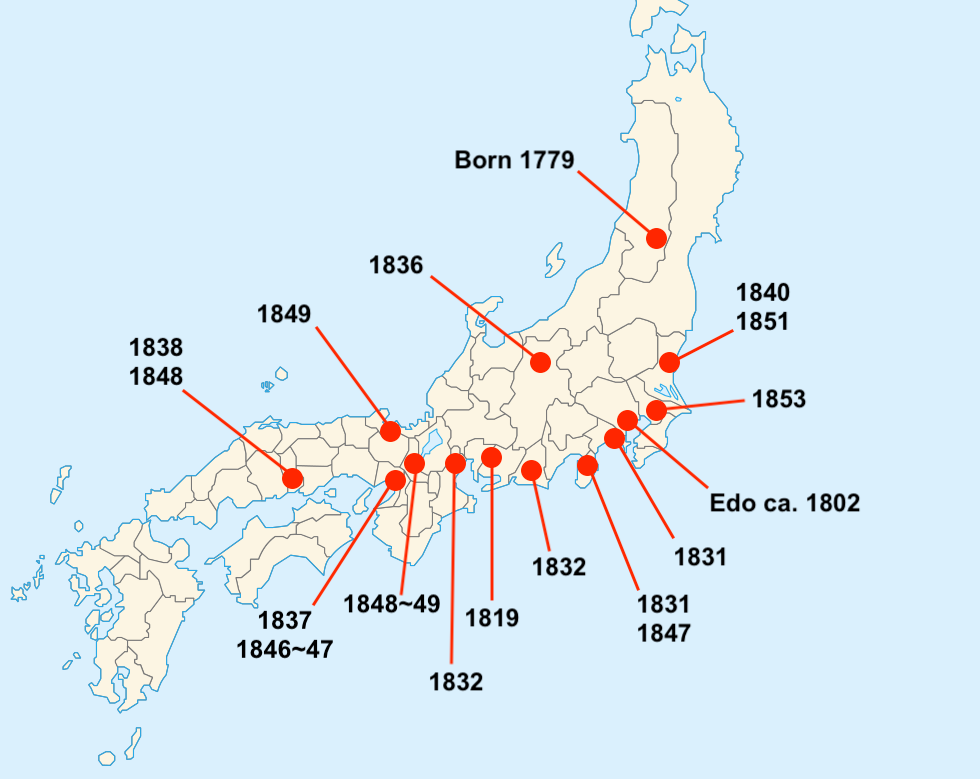
PS: Below is a sneak peek of an overview of Taikei Naotane’s travel destinations that will be elaborated on in an article on him I am still working on. Miyazu is the one marked 1849 on the north coast of Honshū.
 Markus Sesko